Three (1969) **

More interesting for the personalities involved – Sam Waterston, Charlotte Rampling, an ex-fighter pilot, an Australian pop star and a model – than the film itself, which presents a European arthouse take on youngsters freewheeling around Europe looking for their share of the free love purportedly available everywhere.

There’s not really any story, mostly it’s scenery, and whatever tension there is rarely rises to the point of drama. However, it is refreshing to see a picture not steeped in angst that reflects the normality of life rather than superficially-imposed heightened confrontation. On a tour of Italy, American college buddies Taylor (Sam Waterston), the shy, gawky one, and Bert (Robie Porter), the better-looking confident one, take up with British girl Marty (Charlotte Rampling). The guys make a pact not to compete for the girl’s attentions, but that idea doesn’t last long. The title suggests she might end up with one – or both. In trying to sell the film, the marketeers felt obliged to make that idea more implicit.
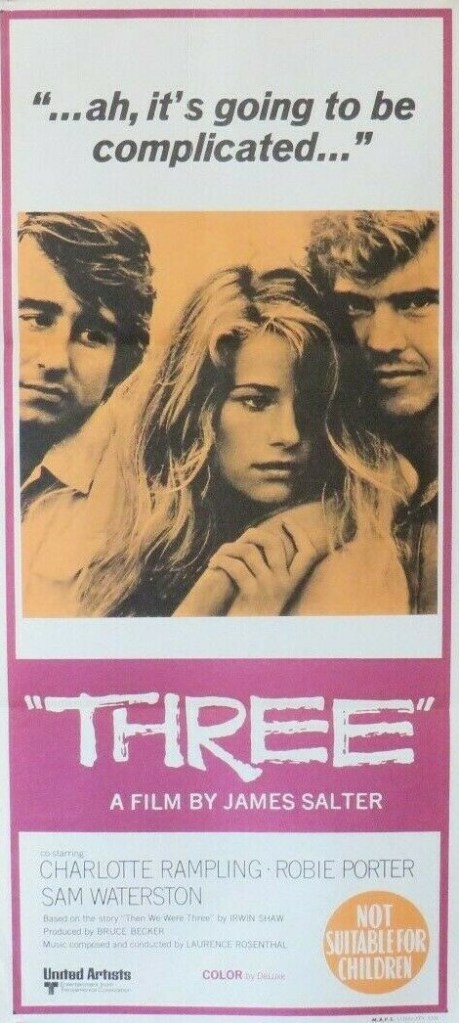
The guys make plays for other girls they meet but seem to find little genuine action and in that sense it is more true to life than other films of the period which suggested sex was there for the asking. But none of the characters are particularly interesting and while that is also more realistic it diminishes enjoyment. The highlight is a naked Taylor attempting to save a girl from drowning in the sea, but in keeping with the film’s tone he is beaten to it by a boat.

There’s not much sign here of the intense dramatic style Oscar nominee Sam Waterston would later bring to the movies. This was his third film after small parts in The Plastic Dome of Norma Jean (1966) and Dick Van Dyke vehicle Fitzwilly (1967) and he wouldn’t hit his stride until The Great Gatsby (1974).

Perhaps the oddest movie fate befell Charlotte Rampling, also a later Oscar nominee. How else to explain that she followed up this picture with Luchino Visconti’s The Damned (1969) and preceded it with Roger Corman’s Target: Harry (1969). With a career that at this point appeared to follow no particular pattern, after making an impact in Georgy Girl (1966) as a libidinous flatmate, she took a small role in The Long Duel (1967) before reaching leading lady status opposite Franco Nero in Italian thriller Sequestro di Persona (1968). Her languid screen persona was turned on its head with The Night Porter (1974). And then she was swept up in Alistair MacLean thriller Caravan to Vaccares (1974).

Who was Robie Porter you might very well ask and why did he only make two pictures, the other being The Carey Treatment (1972)? He was an Australian pop star, specializing in instrumentals on a steel guitar, with a series of hits including two at number one. He chanced his arm in Britain, without repeating that success, then moved to the U.S. and landed parts in television series Daniel Boone and Mannix. After Three, he returned to the music business, as part-owner of record label Sparmac and producing for the band Daddy Cool.

Other names in Three, in bit parts only, none making any discernible impact in the picture, included model Edina Ronay, daughter of celebrated food critic Egon Ronay, who had appeared in A Study in Terror (1965) and Prehistoric Women (1967). Equally as celebrated, if for other reasons, was Gillian Hill, best known as one of the girls cavorting naked with photographer David Hemmings in Blow Up (1966).

Writer-director James Salter was a genuine Hollywood curiosity. He hit a peak of cinematic activity in 1969, with two screenplays filmed – Downhill Racer (1969) and The Appointment (1969). This is pretty much a companion piece to Downhill Racer (1969) which has a bunch of professional skiers on a similar scenic tour and often sitting around with not much to do although that film builds in confrontation and more standard love affair.

Generally considered a “writer’s writer” – i.e. adored by his peers more than the public – his first novel The Hunters (1958), based on his Air Force experiences, was turned into a movie starring Robert Mitchum. He dabbled in documentary film-making, whose impact can be seen in his feature films, but was better known for a short erotic novel A Sport and a Pastime set in Europe. None of his 1969 trio were hits, he ended up in Hollywood limbo, and he didn’t reappear on the movie credits list until Richard Pearce’s sci-fi Threshold (1981) starring Donald Sutherland.   
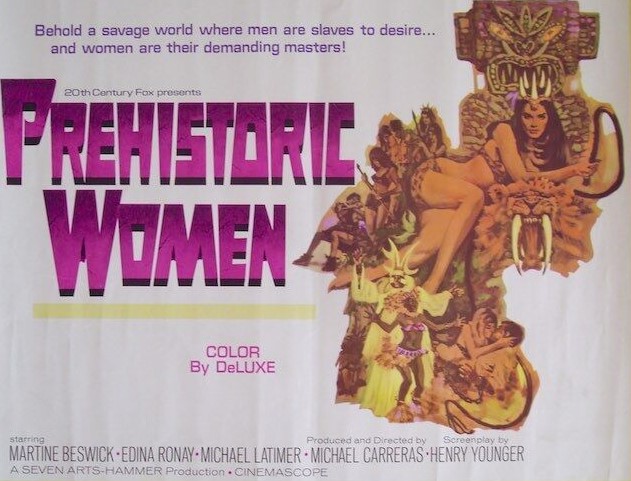
Prehistoric Women / Slave Girls (1967) ***

Can a dash of feminism rescue campy trash? Or even a genetics overload? Or is it enough to wonder what career hole Carol White (Never Let Go, 1960) found herself in to end up here? Or should we just sit back and watch the Pan’s People-style choreography and admire the astute re-use of all those bikinis left over from Hammer’s previous venture into this territory, the much more successful One Million Years B.C. (1966). Whatever, there’s no escaping the wooden acting and the one-note direction.

Dennis Wheatley (The Fabulous Valley, The Lost Continent, They Found Atlantis) and C.S. Lewis for that matter had the knack of transporting characters back in time or into other worlds. There’s usually some routine artefact, door or whatnot, that allows access to an amazing kingdom, or, in this case, queendom.

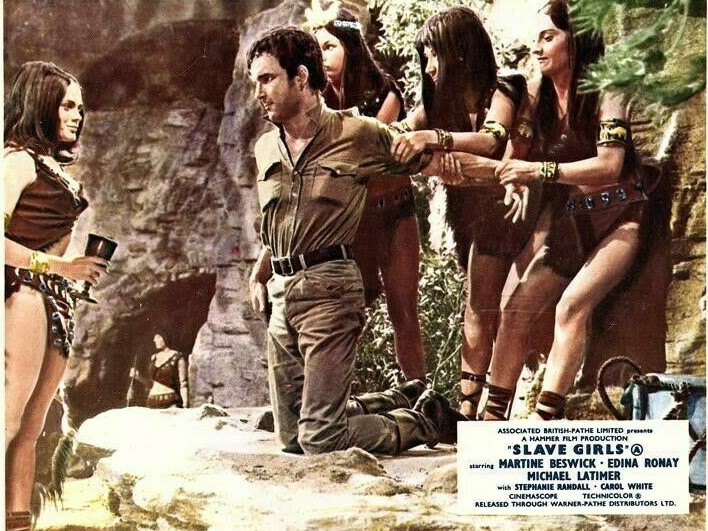
Here, big game hunter David (Michael Latimer), about to be sacrificed to some pagan African god, instead finds himself thrown back in time, chasing bewitching blonde Saria (Edina Romay), who, unfortunately is on the run, so when she is apprehended, so is he. Queen Kari (Martine Beswick) takes him as her lover. But he’s less keen, repulsed by her harsh rule. When one of her subjects rebels, the queen doesn’t delegate the task of bringing her into line but takes her on mano-a-mano. David, put to work with the other male prisoners, soon plots his escape.  

Setting aside the expected mumbo-jumbo – the tribe worships a mythical white rhino (phallic symbol anyone?) for example – if you want to extract anything more from this, there are fresh fields to plunder. For example, brunettes, such as Kari, are in control, but only after rebelling against the blondes who had subjugated the black-haired women in similar fashion as Kari. As well as having a female ruler, the movie makes a relatively pertinent point that gender scarcely comes into it when a dictator imposes such harsh conditions on their subject, Kari, for example, making the blondes eat off the dirt.

I’m not convinced the irony is deliberate. David, scion no doubt of Victorian nobility who made their pile from scarcely paying their downtrodden peasants a living wage, and who goes around shooting leopards, is hardly in a position to ask the queen to cool it. When she even considers giving him some equality – a big role reversal right there – he wants her to treat everyone in a nicer fashion.

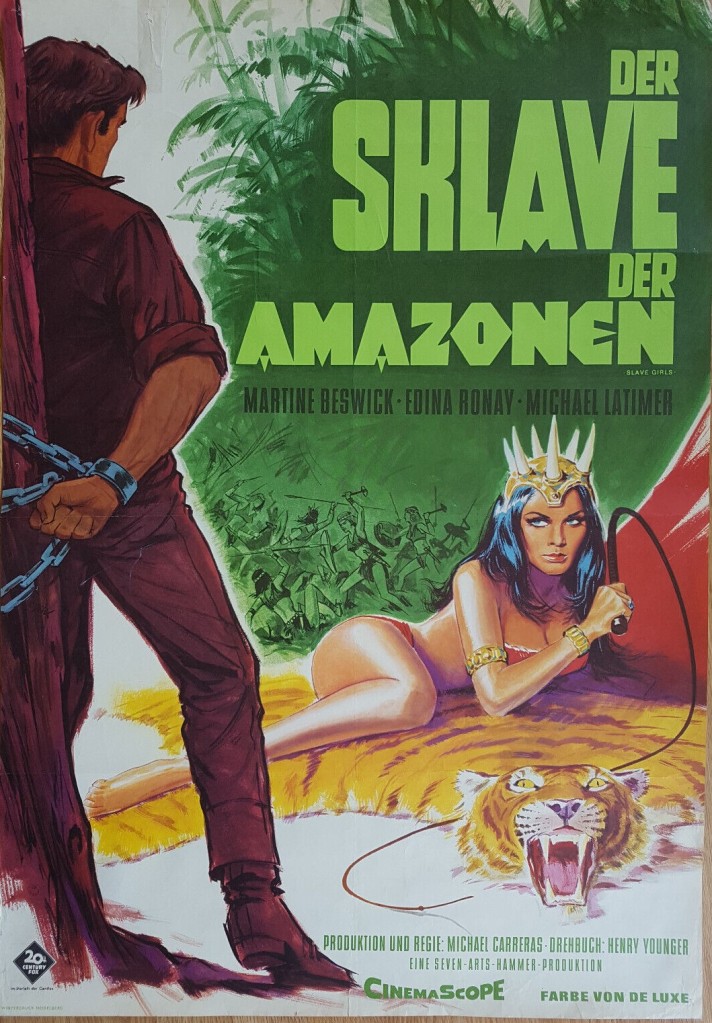
The movie had an unsual history. Made quickly after “One Million Years B.C.” it was released in the U.S. as “Prehistoric Women” in 1967 but flopped so it was heavily cut, re-titled “Slave Girls” and sent out in 1968 in the UK as the support to “The Devil Rides Out.” The new title is a bit of misnomer because her kingdom is as full of slave men. The girls refers to the blondes. It was released in the U.S. in February 1967 by Twentieth Century Fox and managed a tie-in in one city with Cara Nome perfume. Actually, U.S. grosses were not as bad as have been reported – a “good” $25,000 in first run in Detroit, second only to “Grand Prix” there for the week, and decent enough openings in Boston, Minneapolis and San Francisco.

And she has the insecurity of Napoleon, needs to be loved, and not in mercenary fashion, and willing to attempt some form of rudimentary seduction if that’s what it takes to tempt the suddenly high-principled David into her bed. There’s an element of upending the Gentlemen Prefer Blondes trope, as though brunettes have always hankered after putting those ditzy blondes in their place.

Hammer lost sight of the fact that One Million Years B.C. owed as much to Ray Harryhausen as the statuesque temptations of Raquel Welch in a fur bikini and in its haste to cash in on that film’s big box office rushed into production a movie minus the battling dinosaurs. Although, of course, they could merely be making historical amends, since everyone knows dinosaurs and man (never mind women in fur bikinis) did not co-exist. And possibly ignored the fact that the puny Michael Latimer was no substitute for the brawnier John Richardson of the previous picture.   

If you’re not so interested in gender politics, you can always enjoy the dancing, which appears to take up a disproportionate amount of time (well, all those bikinis, need to be used). I was disappointed to discover the choreography was not the work of Flick Colby of the legendary BBC TV Top of the Pops dance troupe, but by one Denys Palmer, an actor it appears, whose main claim to fame was appearing in a classic Dr Who episode.

This was triple-hyphenate job, so blame Michael Carreras (The Lost Continent, 1968) for the screenplay and the direction and for taking on the production duties, or praise him for seeding a campy knock-off with issues that register more strongly today.

This was intended to be a big step-up for Michael Latimer but he was so charisma-free that he didn’t score another movie credit until low-budget British B-picture Man of Violence (1970). Martin Beswick (The Penthouse, 1967) never got another shot at a top-billed role. Carol White did better, next up was Poor Cow (1967) and from there it weas a small step to Daddy’s Gone A-Hunting (1969), but she doesn’t stand out here the way she did in Never Let Go (1960). If anyone stole the show it was Edina Ronay, and much good it did her, her next outing was in the lamentable Three (1969).

A curiosity, half-rubbish, half-interesting.

Three (1969) **

More interesting for the stars involved – in particular Sam Waterston and Charlotte Rampling as well as an ex-fighter pilot, an Australian pop star and a model – than the film itself, which presents a European arthouse take on youngsters freewheeling around Europe looking for their share of the free love purportedly available everywhere.

There’s not really any story, mostly it’s scenery, and whatever tension there is rarely rises to the point of drama. However, it is refreshing to see a picture not steeped in angst that reflects the normality of life rather than superficially-imposed heightened confrontation. On a tour of Italy, American college buddies Taylor (Sam Waterston), the shy gawky one, and Bert (Robie Porter), the better-looking confident one, take up with British girl Marty (Charlotte Rampling). The guys make a pact not to compete for the girl’s attentions, but that idea doesn’t last long. The title suggests she might end up with one – or both. In trying to sell the film, the marketeers felt obliged to make that idea more implicit.

The guys make plays for other girls they meet but seem to find little genuine action and in that sense it is more true to life than other films of the period which suggested sex was there for the asking. But none of the characters are particularly interesting and while that is also more realistic it diminishes enjoyment. The highlight is a naked Taylor attempting to save a girl from drowning in the sea, but in keeping with the film’s tone he is beaten to it by a boat.

There’s not much sign here of the intense dramatic style Oscar nominee Sam Waterston would later bring to the movies. This was his third film after small parts in The Plastic Dome of Norma Jean (1966) and Dick Van Dyke vehicle Fitzwilly (1967) and he wouldn’t hit his stride until The Great Gatsby (1974).

Perhaps the oddest movie fate befell Charlotte Rampling, also a later Oscar nominee. How else to explain that she followed up this picture with Luchino Visconti’s The Damned (1969) and preceded it with Roger Corman’s Target: Harry (1969). With a career that at this point appeared to follow no particular pattern, after making an impact in Georgy Girl (1966) as a libidinous flatmate, she took a small role in The Long Duel (1967) before reaching leading lady status opposite Franco Nero in Italian thriller Sequestro di Persona (1968). Her languid screen persona was turned on its head with The Night Porter (1974).

Who was Robie Porter you might very well ask? And why did he only make two pictures, the other being The Carey Treatment (1972)? He was an Australian pop star, specializing in instrumentals on a steel guitar, with a series of hits including two at number one. He chanced his arm in Britain, without repeating that success, then moved to the U.S. and landed parts in television series Daniel Boone and Mannix. After Three, he returned to the music business, as part-owner of record label Sparmac and producing for the band Daddy Cool.

Other names in Three, in bit parts only, none making any discernible impact in the picture, included model Edina Ronay (daughter of celebrated food critic Egon Ronay) who had appeared in A Study in Terror (1965) and Prehistoric Women (1967). Equally as celebrated, if for other reasons, was Gillian Hills, best known as one of the girls cavorting naked with photographer David Hemmings in Blow Up (1966) and as the titular Beat Girl (1960)

Writer-director James Salter was a genuine Hollywood curiosity. He hit a peak of cinematic activity in 1969, with two other screenplays filmed – Downhill Racer (1969) and The Appointment (1969). This is pretty much a companion piece to Downhill Racer (1969) which has a bunch of professional skiers on a similar scenic tour and often sitting around with not much to do although that film builds in confrontation and a more standard love affair.

Generally considered a “writer’s writer” – i.e. adored by his peers more than the public – his first novel The Hunters (1958), based on his Air Force experiences, was turned into a movie starring Robert Mitchum. He dabbled in documentary film-making, whose impact can be seen in his feature films, but was better known for a short erotic novel A Sport and a Pastime set in Europe. None of his 1969 trio were hits, he ended up in Hollywood limbo, and he didn’t reappear on the movie credits list until Richard Pearce’s sci-fi Threshold (1981) starring Donald Sutherland.   
It’s not a stinker, but it’s not much of anything else either.

Discover WordPress

A daily selection of the best content published on WordPress, collected for you by humans who love to read.

The Atavist Magazine

by Brian Hannan

WordPress.com News

The latest news on WordPress.com and the WordPress community.