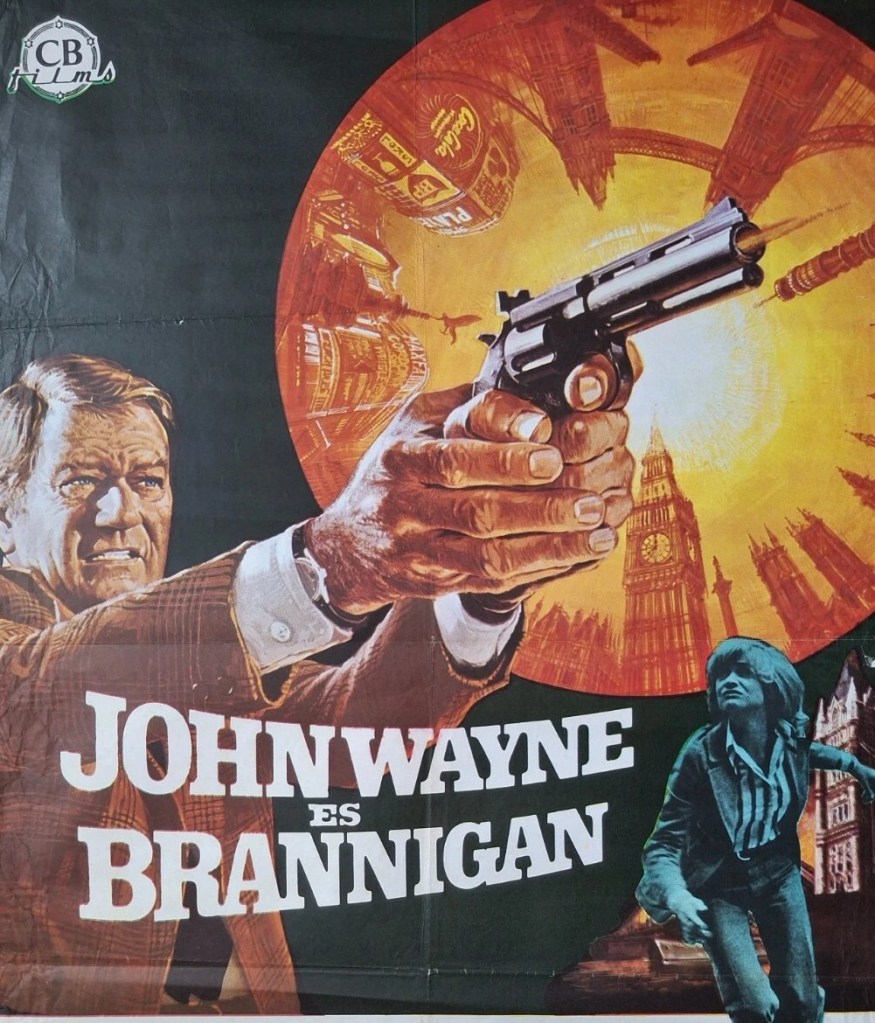
Brannigan (1975) ***

File under guilty pleasure. And bear in mind in the early 1970s there was no such thing as the police procedural, certainly not as we know it today, when cops have the benefits of DNA, increased forensics and computer technology. Hollywood in this era didn’t waste time with endless knocking on doors or collecting massive amounts of minutiae in the hope of uncovering a clue.

Generally speaking, cops of this period had two things in common. They were mavericks and they constantly fought authority usually represented by some dumb superior. Normally the narrative consisted of the character taking on the  persona of a bull in a china shop and thundering towards a main objective, the more set pieces to demonstrate said bullish tendencies the better, and if in the course of apprehending a criminal he can deliver a catchphrase such as “make my day” or, as here, “knock, knock,” so much the better.

John Wayne had made eight westerns in a row and having turned down Dirty Harry (1971) ventured into the cop genre with McQ (1974) and came straight back for seconds here.

Brannigan (John Wayne) has been shipped over to London to bring back under the extradition treaty Mob gangster Larkin (John Vernon) which would be pretty straightforward except the Brits don’t keep such prisoners in custody – Larkin swans around in a white Rolls Royce – and in any case he’s in custody of another kind, having been kidnapped by some British hoods.

In terms of authority Brannigan battles the sappy Brits who won’t allow him to carry a gun and do things the Chicago way. Luckily, for the picture, top cop Commander Swann (Richard Attenborough) is not the standard stiff-upper-lip buffoon but as likely to pitch in when the fisticuffs begin. There are a couple of excellent car chases and one stunt of French Connection (1971) quality when two cars go sailing over the gap in a raised Tower Bridge. This is a London mixing glory and grit, posh residences and ancient buildings share screen time with rundown docklands. And the movie has the sense not to go all May-December on us and while a certain affection builds up between the U.S. cop and his driver Jennifer (Judy Gesson), it doesn’t teeter into unlikely romance.

The plot’s clever. While in a sauna having a massage Larkin is knocked out cold and bundled into a sweatbox by two apparent delivery guys and then smooth attorney Fields (Mel Ferrer) acts as the go-between, delivering Mob ransom money to the kidnappers, the price increasing with every failed rescue attempt, until the kidnappers are sitting on a cool million. Naturally, there’s some double-crossing and the cops have one tiny magic bullet to use to their advantage.

So mainly the fun is watching Brannigan charge around in a British china shop, mostly bypassing British rules. There’s a subplot involving a hitman hunting Brannigan and even when in a normal cop movie you might think, fair’s fair, the policeman should be able to defend himself with a weapon, that doesn’t equate with the British rules, so you have our hero able to point out that if he wasn’t armed to the teeth Jennifer would be dead, while Swann does his best to insist that it would be better for the young lass to end up on a mortuary slab than British cops go rampaging around with guns.

There’s some gentle fun in poking at British tradition – the obligatory wearing a tie in certain upmarket establishments – and in Swann having to translate to a waitperson Brannigan’s breakfast order.

Except when standing up for rules, Swann is great value, a good match for the American, both in tempering his ruthlessness, and matching him punch-for-punch in a brawl.

Apart from the action sequences, John Wayne is permitted to grow old gracefully, his dialog rarely filled with barbed retorts or salty words and there’s quite nice acting on the Duke’s part when he’s called upon to demonstrate his special skill, which is “reacting”.

Richard Attenborough (Only When I Larf, 1968) has a ball, and not before time, able to let some of the usual repressed intensity burst out. Judy Geeson (The Executioner, 1970) must have been delighted to find a part that didn’t involve her taking off her clothes and she’s afforded some of the best lines. John Vernon (Topaz, 1969) is his usual hardass but Mel Ferrer (The Fall of the Roman Empire, 1964) has a good stab at a bad guy.

Not in the same league as director Douglas Hickox’s Sitting Target (1972). Written by Christopher Trumbo (The Don Is Dead, 1973), William McGivern (The Wrecking Crew, 1968), Michael Butler (The Gauntlet, 1977) and William Norton (The Scalphunters, 1968).  

Erroneously tabbed as a box office disappointment, this was made on a budget of $2.6 million but cleared $7 million in rentals (the studio share of the box office) plus another $1.5 million from television.

Obviously, if you’re in the Clint Eastwood camp this falls short, but otherwise it’s enjoyable stuff.

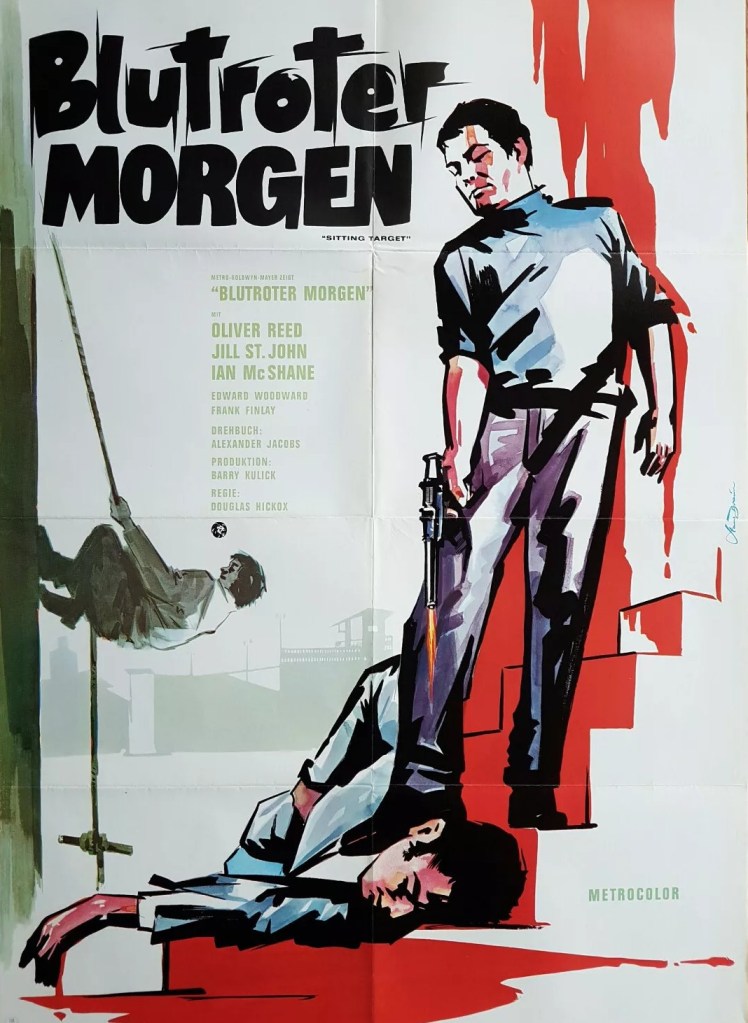
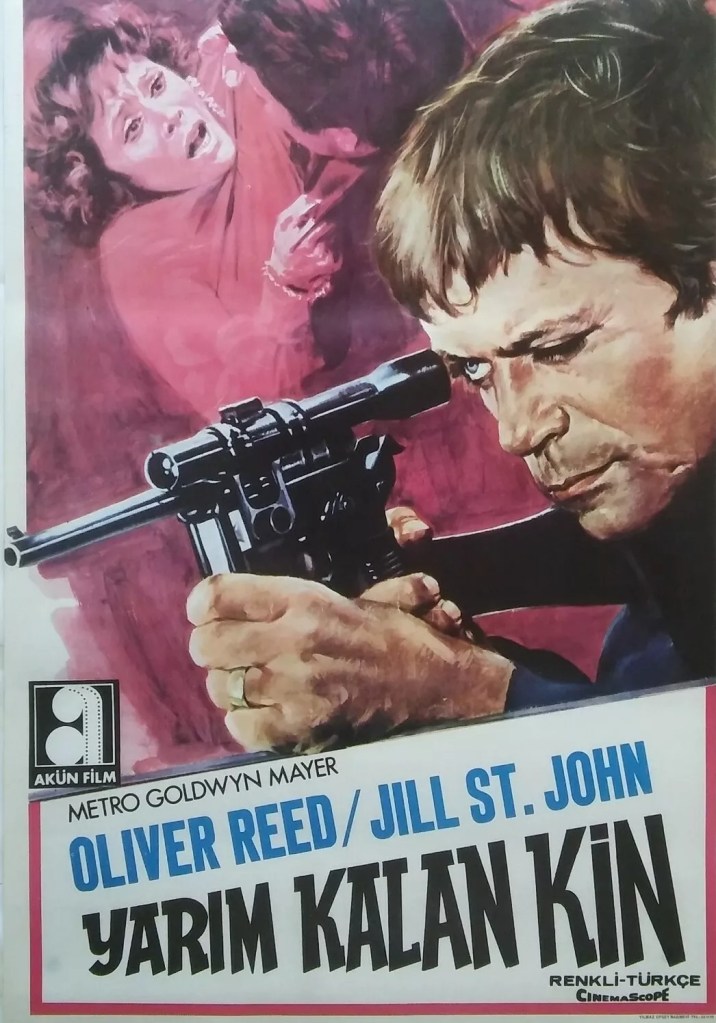
Sitting Target (1972) ****

Forms a neat trilogy with British Noir New Wave gangster pictures Get Carter (1971) and Villain (1971) both with topline stars attached in the form of Michael Caine and Richard Burton. Laden with atmosphere and intrigue, this carries hefty emotional power as a very tough guy struggles to show his gentler side. The moral of the story is that brains always trump brawn. And it’s one of these movies where the truth only unravels when you hit the twist at the end and every character is shown in quite a different light.

Like Get Carter, this is a revenge picture. Discovering girlfriend Pat (Jill St John) is pregnant by another guy, imprisoned bankrobber Harry (Oliver Reed), serving a 15-year stretch for murder, is turned into a “lethal weapon” by the very thought and determines to break out and kill her. And at the same time collect the loot from his last bank robbery.

His escape, masterminded by the gentlemanly MacNeil (Freddie Jones) and accompanied by long-time buddy Birdy (Ian MacShane), is a tense, exciting sequence. First stop outside is to strongarm another gangster into supplying a Mauser that can be turned, a la Day of the Jackal, into a long-range rifle.

And while the movie brings into play the standard trope of villains seeking their share of the loot, it also hangs on another standard wheeze of the 1960s B-picture of the woman as bait. Anticipating that Harry will make a beeline for his loved one, but unaware of his nefarious intent, Inspector Milton (Edward Woodward) has her under police guard. But the likes of Harry always finds a way to sneak in, which triggers police pursuit, in the course of which Harry commits the unpardonable crime of shooting a cop – the villain world only too aware of the severe repercussions.

There’s a stop-off at the apartment of the moll (Jill Townsend) of Mr Big, Marty (Frank Finlay). That doesn’t go as planned, but still they manage to uncover a hidden sack of cash leaving Harry to knock off, sharpshooter style, the unfaithful girlfriend.

And then the pair make a getaway….Not quite. Birdy turns out to be greedy and wants all the robbery cash for himself and attempts to shoot Harry. That would be enough of a twist to be getting on with but there are a few stingers to come. Pat’s not dead – Harry (too far away to identify  her face) just shot a policewoman on protection duty standing in her window. Pat’s not  pregnant either, just stuffed a cushion down her jumper to complete the pretense. And she and Birdy are an item. And it’s clear that Birdy simply purloined Harry’s rage to get him to do the dirty work involved in the escape and dealing with the other gangsters.

Except in the case of being willing to knock off his longtime business partner, Birdy, you see has always been averse to violence, cowardly not to put too fine a point on it, though quite capable of pouring a bowl of urine down a captured guard’s throat, or rape.

Villains are as conflicted as anyone else, otherwise how to explain that Harry climbs into the burning car containing his dead girlfriend, gives Pat a gentle kiss and waits for the car to explode and take him to a fiery grave. We’ve seen the softer side of Harry in flashes. He turns down the chance to bed a sex worker in the getaway lorry, doesn’t take advantage of the moll, and buries his face in the moll’s fur coat. The furthest he gets to expressing his feelings is to explain to Birdy that he was very happy with Pat. He’s almost – perish the thought – got a feminist side. And presumably it takes a lot for a tough gangster like him to open up to a woman, which explains why he takes her betrayal so badly.

The fact that he still kills her is somehow beside the point. As I said, gangsters are complex, witness the gay Richard Burton in Villain.

This is Ian MacShane (The Wild and the Willing, 1962) still in matinee idol mode, minus the gravitas and husky tones of John Wick (2014). Once the twists kick in, you look back and realize he’s stolen the film, a weaselly charmer, able to bend Harry (not that hard, mind you) to his will, which was to help him escape, lead him to the money and send him off to live happily ever after with Pat. Where Harry clearly believes in true love, Birdy has no moral scruples. Even with a beauty like Pat waiting for him, he’s happy to indulge in sex with the sex worker and help himself to the helpless moll. (MacShane was equally dubious in Villain).

Oliver Reed’s Thug we’ve seen countless times before, Oliver Reed’s Softie less so. Jill St John (Tony Rome, 1967) manages a British accent and proves herself capable of a better  role than usual. Actors often say they build up a character from their walk. Watch Edward Woodward (The Wicker Man, 1973) for a classic example of it.

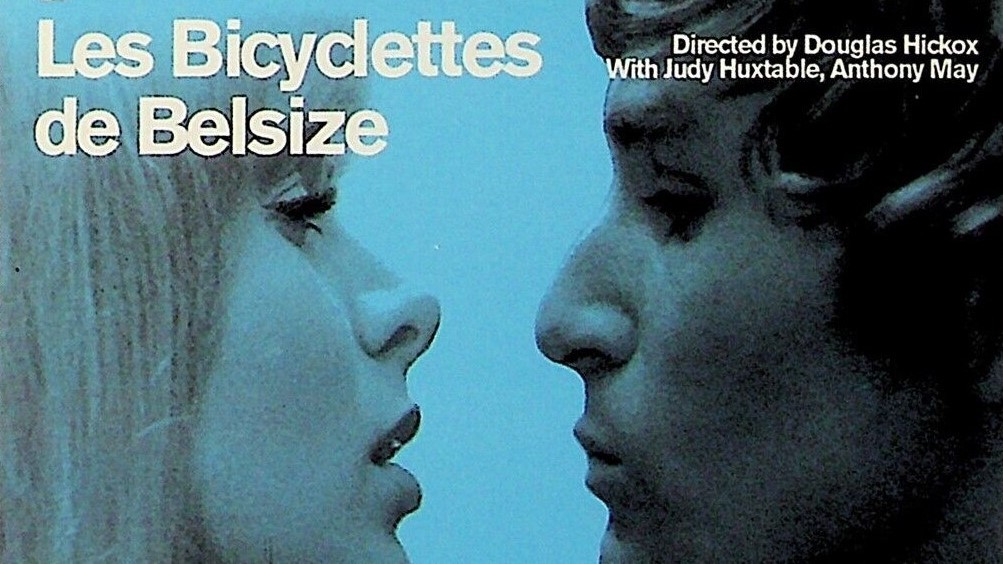
Douglas Hickox had essayed delicate romance via his debut Les Bicyclettes des Belsize (1968) and it’s to his credit that he touches on Harry’s sensitivity in such subtle fashion. Otherwise, some terrific standout sequences – Harry’s fist battering through the glass into the prisoner’s visiting room, the escape, the duel with motorcycle cops through a fog of washing strung out on lines, the final car chase.

Written by Alexander Jacobs (Point Blank, 1967) from the bestseller by Lawrence Henderson. Superb score by Stanley Myers.

Not quite in the league of Get Carter or Villain but not far short.

Les Bicyclettes de Belsize (1968) ***

So, John Wayne, what first attracted you to working with British director Douglas Hickox for tough cop thriller Brannigan (1975)? Was it his work on tough thriller Sitting Target (1973)? Or could it be you were entranced by his directorial debut on this whimsical low-budget  London-based musical?

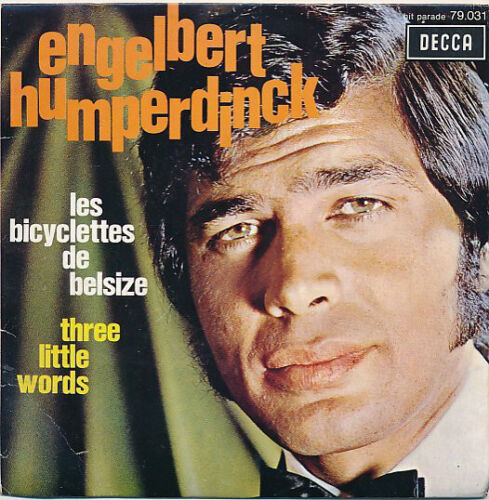
Credit for making a splash in turning the operetta into something that might appeal to the cntemporary youth didn’t go to The Who with Tommy or Andrew Lloyd Webber and Tim Rice for Joseph and His Amazing Technicolor Dreamcoat, but with middle-of-the-road song-writing team Les Reed and Barry Mason, best known for supplying a constant stream of hits for Tom Jones and Engelbert Humperdinck. They need a string of songs here as the opera format excludes dialog, so the music carries both story and emotion.

The theme tune gave British pop star Engelbert Humperdinck a Top Ten hit.

Belsize, in case you are unaware, abuts Hampstead, the most upmarket suburb of London, devoid of the garish tourist scene, immune to the wrecking balls that demolished the same year’s The London Nobody Knows. Hampstead Heath is a huge swatch of parkland, untouched by moviemakers more concerned with Swinging London, red buses and Big Ben. This has more in common with the London of Mary Poppins, rooftops prominent, the camera often lofty.

The French title, suggesting arthouse fare, could not be more misleading except that to some extent it emulates Jacques Demy’s Les Parapluies de Cherbourg (1964). However, the French picture had a more serious theme. This just concentrates on the simplicity of falling love.

At first it’s puppy love as, after a collision, a female child (Leslie Goddard), on a tricycle, follows a young man Steve (Anthony May) on his bicycle. He crashes through a billboard featuring a model Julie (Judy Huxtable) – or a model advertising something called “Julie” (it’s not clear) – and falls in love with her. And, coincidence being the essence of movie romance, bumps into her outside a shop.

She is somewhat disenchanted with the whole model business, constantly turned this way and that for the definable pose, and looking for true love. Initially, though separated by a window, their eyes have met, and they are drawn to kiss each other through the glass. Much to the little girl’s displeasure, Steve pursues Julie but the disappointed youngster soon makes a match of her own with someone her own size.

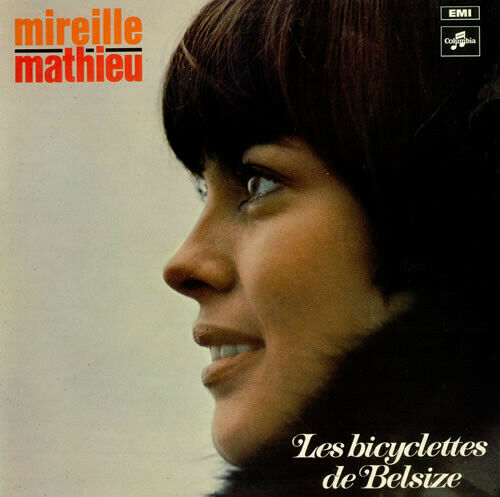
French singer Mirieille Mathieu had the chart hit in France.

Apart from the songs, this is surprisingly well done. The fantasy elements, which failed to click on movies like Wonderwall (1968) and Can Hieronymus Merkin… (1969), work a treat here, never galloping off into the unlikely, but remaining core to the movie’s light-hearted mood.

But it is directed as an audition piece, Douglas Hickox attempting more with the camera than with the script. There’s use of the fish-eye lens, the rarely-seen wipe, this time in vertical rather than horizontal fashion, long tracking shots, and characters silhouetted on the skyline.

We open audaciously with a spinning chimney pot before panning across rooftops to a shaving mirror on top of a chimney pot and watch Steve, mounted on his bike, reach the ground in a series of acrobatic moves. There’s unexpected comedy. The little girl is fond of blowing a raspberry. Doing so at a bus stop causes the waiting passengers to blame each other, the scene degenerating into unexpected slapstick. There’s a Cinerama moment as Steve loses control of his bike and the screen races past.

But once Julie is introduced in person it shifts to something deeper. The eyes meeting across an empty space and the lips approaching each other through the glass is very well done. But that’s undercut by the model being treated as a puppet.

There are some audacious cuts. A car swings by and a door opens and the next thing Julie is in the back seat twisting round to look out the back window while male fingers yank her face back to the ever-present camera. She’s constantly prodded into position. Her look changes with every wig.

The fashion is more mainstream than Wonderwall, hippie dress and headband, short red dress and matching red tights, a striped fur coat, a mini skirt and knee-high boots. By the time the camera focuses on the model, she is the one afflicted with angst, Steve more happy-go-lucky and it’s a tribute to the direction that Julie’s face is more reflective, expressive.

Given the lack of dialog, Judy Huxtable (The Touchables, 1968) is to be applauded for creating an immediately recognisable character. Anthony May (No Blade of Grass, 1970) managed less emotion in his part.

I didn’t mention that this was hardly a full-length feature, coming in at around the 30-minute mark, and hardly set Hickox up for the action genre, any more than his next picture Entertaining Mr Sloane (1970). The team of Francis Megahy and Bernie Cooper (Freelance, 1970) plus Michael Newling devised the screenplay.

Innovative and interesting with hummable tunes. You can catch it on YouTube.

Discover WordPress

A daily selection of the best content published on WordPress, collected for you by humans who love to read.

The Atavist Magazine

by Brian Hannan

WordPress.com News

The latest news on WordPress.com and the WordPress community.