Behind the Scenes: “The Sundowners” (1960)

Whereas Deborah Kerr had always been first choice from the moment in 1957 Fred Zinnemann – he had directed her in From Here to Eternity (1953) –  announced plans to film the Jon Cleary bestseller about itinerants in the Australian Outback, Robert Mitchum was third choice. Despite having been successfully paired with Kerr for John Huston’s box office hit Heaven Knows Mr. Allison (1957), he was passed over in favor of, initially, William Holden with whom she had starred in the equally successful The Proud and the Profane (1956). When Holden dropped out, he was immediately replaced by Gary Cooper who had scored a big success with William Wyler’s Oscar-nominated Friendly Persuasion (1956)

And rather than Peter Ustinov (Topkapi, 1964) and Glynis Johns (The Cabinet of Caligari, 1962) in the major supporting roles, Zinnemann had hoped to secure the services of Claudette Colbert and Errol Flynn, both of whom had once been substantial box office attractions, though Colbert had been offscreen since Texas Lady (1955) and Flynn’s marquee appeal was spotty to say the least, though he had just signed up John Huston’s Roots of Heaven (1958). That decision was taken out of Zinnemann’s hands by Flynn’s premature death in 1959.
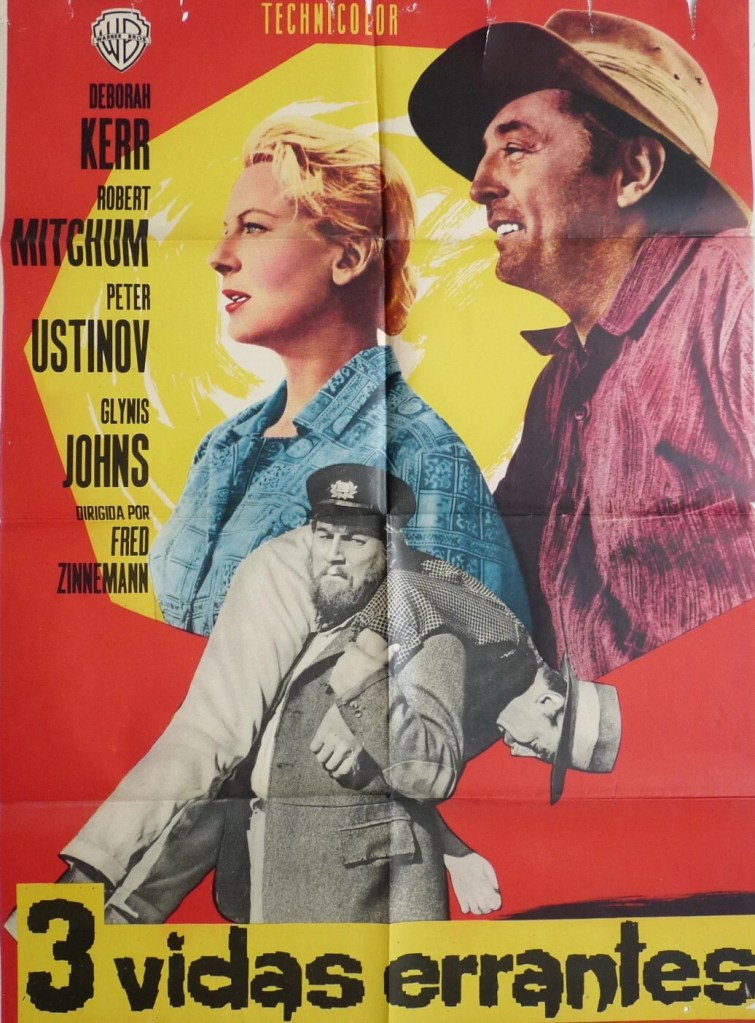
At this point Peter Ustinov was an all-purpose supporting actor and had not appeared in a major Hollywood production in six years but was just about to make a name for himself in Spartacus (1960) while Glynis Johns, at one time a major British star, had lost much of her marquee allure. Kerr and Johns had worked previously on Perfect Strangers (1945) and remained friends.

Nor was Zinnemann first to pounce on the tale. After the novel – based on the lives of the author’s parents – was published in 1952, rights were acquired by producer Joseph Kaufman who commissioned a screenplay from Kay Keavney. But when he failed to secure funding, Zinnemann scooped the rights after being persuaded by Tasmanian-born Dorothy Hammerstein, wife of the lyricist, that Australia would be a great location.

Screenplay duties then fell to Aaron Spelling (Guns of the Timberland, 1960), best known later as an uber-producer in television. After his draft was deemed “unsatisfactory,” he was replaced by Isobel Lennart (Please Don’t Eat the Daisies, 1960), though Zinnemann later claimed that her dialog was “not Australian enough” and author Jon Cleary (uncredited) was called in to solve “these problems.” .

Studio boss Jack Warner wanted Arizona to stand in for Australia but gave in to Zinnemann’s insistence on reality in part because the director had shot the successful The Nun’s Story (1959) in Africa, even though it added $500,000 to the budget. In fact, Warner gave in relatively easily. He understood that “were we to shoot in Arizona,” Zinnemann explained, “it would emerge as a half-assed Western with bars instead of pubs, cowboys instead of sheep-drovers – they move differently, walk and react differently.” It was the first major Hollywood film to be shot there.
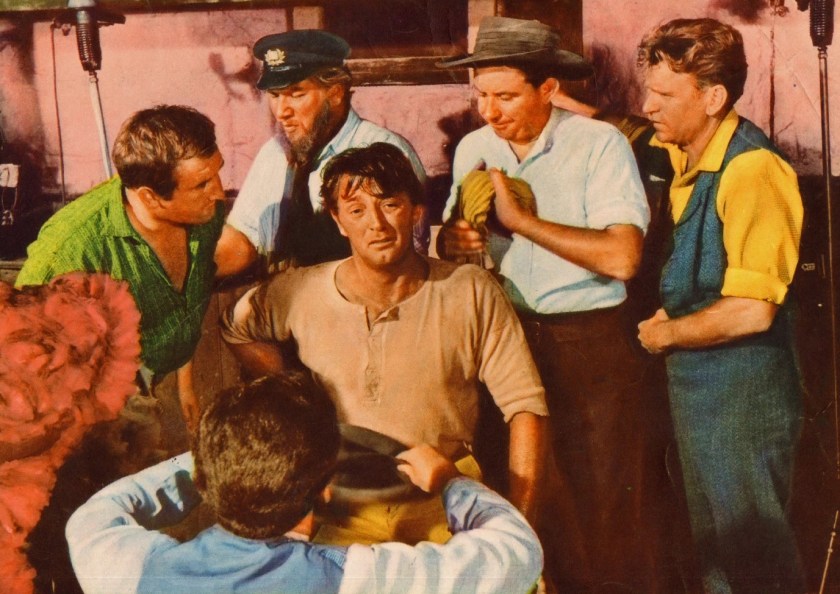
In the second half of 1959 the director spent 12 weeks in advance of the stars arriving filming scenery and most of the scenes involving the sheep – 2,000 of them transported 800 miles to the location. Rather than hiring them, Warner Brothers bought them wholesale and afterwards sold them for a profit.  Despite their reputation for docility, sheep proved difficult to wrangle. A whole day was lost when the leader of the sheep just decided he would move no further and the entire flock did the same.

The crew was initially based in Cooma, a small town in New South Wales. Second unit camera operator Nicolas Roeg would return to Australia a decade later to director Walkabout (1971). The movie was hit by unseasonal bad weather – heavy rain and hailstones – which added several weeks to the schedule.

“There’s a good deal of Ida in me,” said Kerr, “I can settle anywhere and call it home.” Her second husband, screenwriter Peter Viertel (The Old Man and the Sea, 1958), made life more palatable by venturing out into the backs streets and finding German and Italian makers of foodstuffs and thereafter the stars took turns to cook for each other. “Bob Mitchum had a way with steaks,” noted Kerr, “but we all decided Peter was the best and most imaginative cook.”

It’s worth killing off the canard that Kerr only gained top-billing in this picture thanks to the generosity of Robert Mitchum. In fact, Kerr was by far the bigger star. She had been top-billed in Heaven Knows Mr. Allison ahead of Mitchum, The King and I (1956) ahead of Yul Brynner, Count Your Blessings (1959) ahead of Rosanna Brazzi, The Journey (1959) ahead of Brynner again, Bonjour Tristesse (1958) ahead of David Niven, Tea and Sympathy (1956) and The End of the Affair (1955) ahead of Van Johnson. She only ceded top billing to the likes of William Holden and Cary Grant (An Affair to Remember, 1957). Although many commentators these days assume that Elizabeth Taylor was the top British star of the decade, Kerr was easily her equal and outranked her – five versus two – in terms of Oscar nominations.

In fact, in terms of marquee appeal, Robert Mitchum could not compete with Kerr. Heaven Knows Mr. Allison was his biggest hit since River of No Return (1954) with Marilyn Monroe. The work with which he is most commonly associated, Night of the Hunter (1955), was a flop, and he was in the main reduced to a diet of westerns and war films.

He was more associated with the wrong sort of headlines than box office. His previous film The Night Fighters / A Terrible Beauty (1960) attracted more attention from journalists for his fight in a bar than from audiences. But Zinnemann was a fan and had tried to hire him for From Here to Eternity.

Mitchum’s notoriety went ahead of him and at the airport he was deluged by reporters, most determined to know, for such a renowned hard drinker, what he thought of Aussie beer. He crossed swords with journalists a few days later, complaining that he was misunderstood and nothing like his screen personality. “I’m no tough guy,” he argued, “all the public knows is some silver, chromium-plated jerk. How could they know what I’m really like?” When he pointed out that his marijuana bust had been expunged from the record, one frustrated newspaperman recorded, “He isn’t a jailbird, he isn’t a drunk, he isn’t a brawler.”

Mitchum had no trouble with cast and director. Zinnemann was astounded by the actor’s mastery of the accent, pronouncing it  “perfect” and adding “he had the uncanny knack of making any accent sound as though he had been born with it.” Mitchum and Kerr renewed their non-sexual love affair. “It was an honor to feed her lines,” said Mitchum. Zinnemann summed him up, “He has a problem with people who take themselves too seriously.”

But Mitchum was hounded by fans and autograph hunters. An audience gathered to watch him eat in local restaurants, his mood not helped by the solitary confinement imposed when rain prevented filming. One journalist, having inveigled his way into Mitchum’s rented home, was astonished to discover the actor could cook. Jon Cleary sprung to his defense. “Robert Mitchum is anything but a droopy-eyed slob once you get to know him. He is extremely well read and writes beautiful poetry.

When it came to horses, Ustinov was the bigger problem. “He was scared of them and they of him,” said Zinnemann, “and the moment he got in the saddle he would forget all his lines.”

Shooting a bush fire was relatively straightforward since they were a “frequent and devastating occurrence”, so the second unit simply flew near to the area in question, hired a taxi and started shooting. But these fires, fueled by the eucalyptus trees they were burning, moved at terrific speed, jumping along the tops of trees “and scattering their burning fragments fast and wide like projectiles.” But if the fire suddenly switched direction – and it moved at 30 miles per hour – there was a danger, as once occurred, that the crew could be cut off.

When the unit headed for Port Augusta in the south, it was a 45-minute commute to the sheep station at Iron Knob where many scenes were shot. Mitchum had had enough of being an object of curiosity and chartered a luxury cruiser, although he was still fending off young ladies who took to swimming out to the boat.

There was little scenic in the journey to the location. “The dust flew along the whole road,” said co-star Dina Merrill, and Mitchum was taken aback by the size of the sheep and found daunting the task of shearing a 400lb Merino sheep in one go. One mistake and you could cut into a vein and the animal would bleed to death. Mitchum relied on Dutch courage. Interiors were filmed in the more hospitable atmosphere of a London studio. There was an unwelcome sting in the tail for Mitchum – he was sent a tax demand from the Australian authorities which he refused to pay.

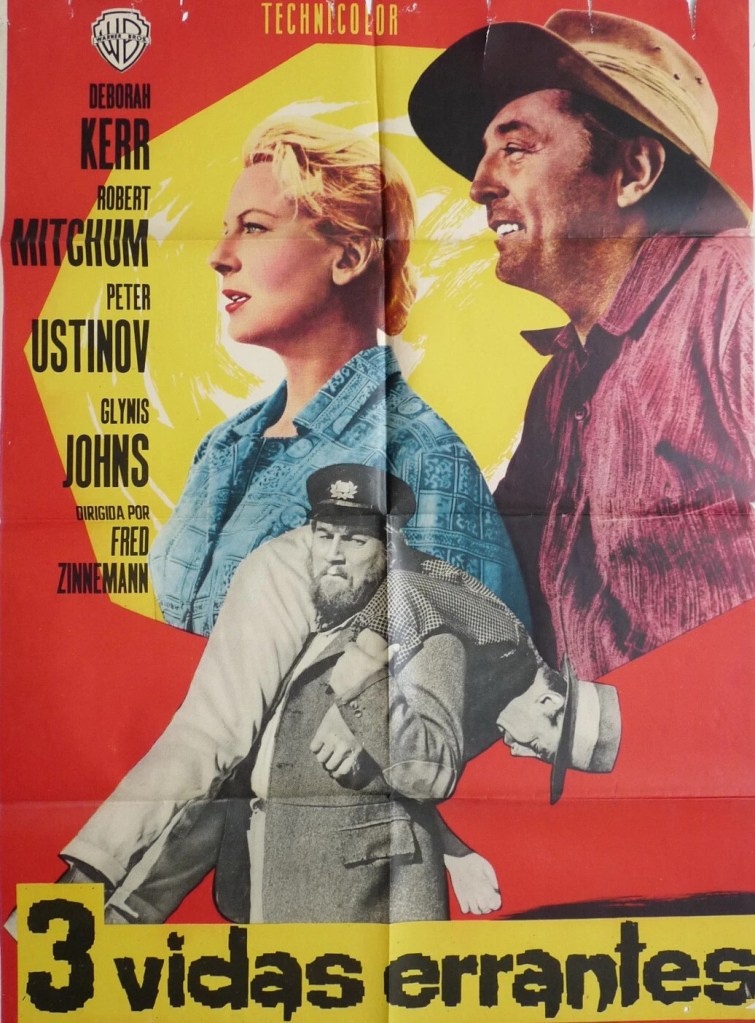
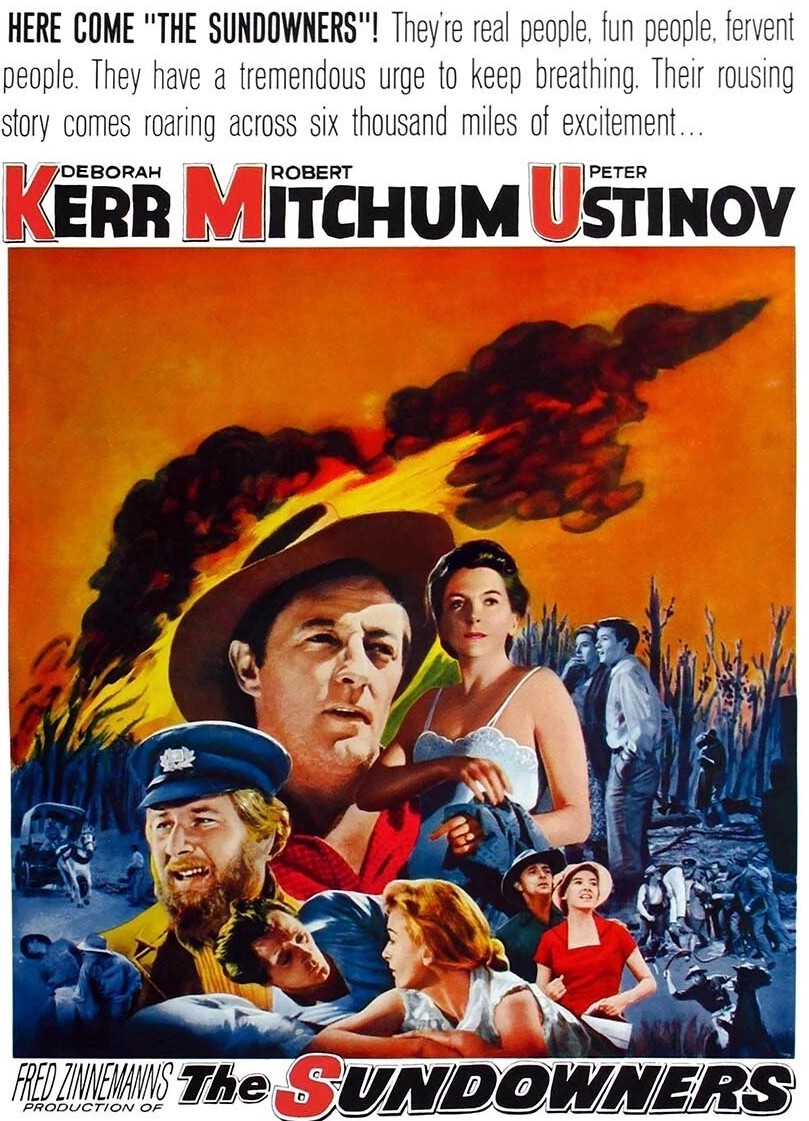
Although Jack Warner had given his assent to the overseas shoot, he was incapable of directing the advertising department to produce a poster that didn’t focus on the notion that this was the frisky Deborah Kerr of From Here to Eternity, “a highly-sexed lady who could harldy wait for the sun to go down so she could lay her hands on Bob.” Audiences were naturally disappointed when the projected love affair failed to materialize.  

While the critics were generally in favor of the movie and audiences in the U.S. big cities responded well, its attraction faded as it set out across the U.S. However, it did better abroad  and not surprisingly was a massive hit in Australia. Mitchum and Kerr re-teamed for Stanley Donen comedy The Grass Is Greener (1960) – with Kerr again billed before Mitchum.

SOURCES:  Eric Braun, Deborah Kerr (WH Allen, 1977) pp173-177; Lee Server, Robert Mitchum, Baby I Don’t Care (Faber & Faber, 2001) pp422-429; Fred Zinnemann, An Autobiography (Bloomsbury, 1992) pp173-183.
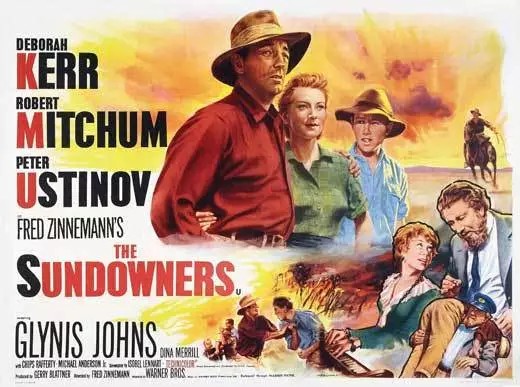
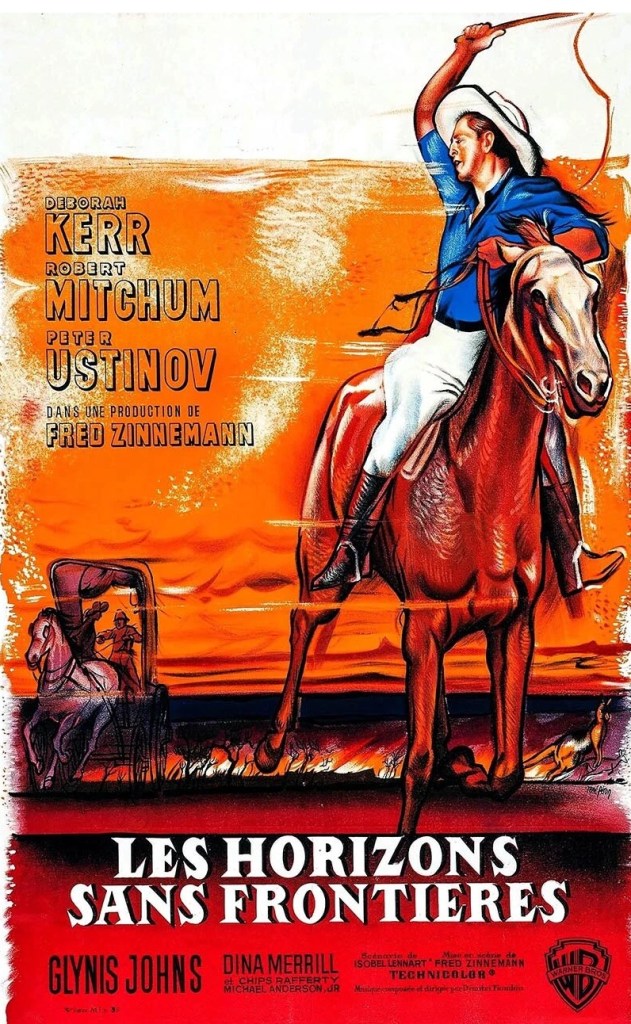
The Sundowners (1960) ****

I kept waiting for Deborah Kerr to turn up and it was a good 20 minutes before I realized that the actress had so immersed herself in the dowdy Ida Carmody that she was turning in what would be recognized as an Oscar-nominated performance. I was less convinced by Robert Mitchum’s Oirish accent but after a time, he, too, buried his normal screen persona under a feckless wanderer. And I was expecting some meaningful point-making stuff from director Fred Zinnemann given he had nursed home such purposeful features as High Noon (1952), From Here to Eternity (1953), A Hatful of Rain (1957) and The Nun’s Story (1959) and would soon be heading back in that virtue-signalling direction with Behold a Pale Horse (1964) and A Man for All Seasons (1966). However, like Day of the Jackal (1973), though for other reasons, this is very much an outlier in the Zinnemann portfolio.

It’s groundbreaking work from the stars. In the first place, Deborah Kerr does the unthinkable for a star of her magnitude – five Oscar nominations so far and a string of hits including From Here to Eternity, The Proud and the Profane (1955) opposite William Holden, The King and I (1956) top-billed ahead of Yul Brynner, An Affair to Remember (1957) opposite Cary Grant and Heaven Knows, Mr Allison (1958) leading Robert Mitchum a merry dance. Here, she is shorn of make-up. Her freckles are everywhere and her cheekbones look as if they are there from hunger not for reasons of fashion. These days, that down-to-the-wire approach would suggest an actress desperately trying to revive her career – Demi Moore in The Substance (2024) or Pamela Anderson in  The Last Showgirl (2024) – rather than a star at the top of her game.

Robert Mitchum, too, dumps his screen persona, and provides his most relaxed and naturalistic performance.

The story is pretty straightforward. Ida wants to settle down, husband Paddy (Robert Mitchum), a born drifter, does not. Paddy enjoys drinking and gambling and wandering through the Australian Outback and ekes out enough as a drover to keep them solvent. The plot, therefore, is episodic. But what could have been a series of loosely-linked sequences is held together by a concentration of the reality of an existence revolving around sheep – droving, shearing, rearing – and trundling along in a horse-drawn caravan, putting up a tent at night, cooking over an open fire, other aspects bordering on the primitive. You can be sure that every minor triumph will be torpedoed.

You could be forgiven for thinking that Wyler had set out to make a western what with the preponderance of sweeping location. Make it sheep instead of cattle and you have Red River (1948) in a minor key with the usual shenanigans once the drover makes his destination.

Livening up proceedings are equally responsibility-resistant itinerant Rupert Venneker (Peter Ustinov), whose more basic skills including pugilism belie his posh accent, and innkeeper Mrs Firth (Glynis Johns) who makes a good stab at trying to hold onto him.

The bulk of the emotion plays through the eyes of Ida, desperately trying to save up enough money to buy a house. A bushfire that temporarily separates the couple unexpectedly acts to strengthen their relationship. While Ida is helping deliver a baby, Frank is getting roaring drunk. The tension between the pair is also a metaphor for growing civilization out of a wilderness, the men who tamed the land becoming redundant, a new educated class taking over. Ida wants to be settled to provide her ambitious son Sean (Michael Anderson Jr) with an education as much as she doesn’t want to be a traveller in her old age.

Offers much about a civilization in the making still relying on the old-timers to put in the hard yards while the guys doing all the work don’t have the sense to seek greater or more stable reward. What’s life if it doesn’t go wrong once in a while? Freedom is its own reward. As Paddy points out, he has no restrictions, the entirety of Australia is his bailiwick.

Wyler makes much of what he’s got, the tensions between the couple undercutting the strength of their affection for each other, and just when it looks as if Ida has got her way Paddy manages to cut loose and destroy her dreams.

There’s drama a-plenty, not just the terrifying bushfire, but a pretty engrossing horse race or two. Paddy’s idea of heaven is to hold court in a saloon singing old Irish songs. Sometimes Ida has little but heartbreak to nurse her along.

And while the various episodes make it a tidy drama, really it’s what one critic described as “a no-story movie – an observation of life” and in that regard more concerned with fallibility and vulnerability. Had it been made by a European director, it would remain one of the most talked-about movies of the decade.

Wyler keeps up a tidy pace. Deborah Kerr (The Arrangement, 1969) steals the show and her peers agreed, putting her up for an Oscar, but it was a close-run thing because Glynis Johns (The Cabinet of Caligari, 1962) was also nominated. Peter Ustinov (Topkapi, 1964) was equally impressive, as was Robert Mitchum (El Dorado, 1967). Wyler was also nominated as was screenwriter Isobel Lennart (Fitzwilly / Fitzwilly Strikes Back, 1967) adapting the Jon Cleary bestseller.

I caught this on Amazon Prime.

Thoroughly involving.

The Innocents (1961) ***

One description of this film’s prequel The Nightcomers (1972) was that, even with the overt sex and violence, it was an arthouse picture masquerading as a horror movie. And obviously absent the sex and violence that’s how I feel about this one. I’m of the old-fashioned school when it comes to horror – once in a while I expect to jump. The biggest problem here is that fear is telegraphed in the face of governess Miss Giddens (Deborah Kerr). Instead of the audience being allowed to register terror, all the tension is sapped away by one look of her terrified face.

Atmospheric? Yes! Scary? No.

Certainly, the set-up is likely to spark the darkest imaginations. Orphans Miles (Martin Stephens) and Flora (Pamela Franklin) are abandoned by their uncle (Michael Redgrave) who wants to spent his time enjoying himself in faraway London without having to bother about the care of the minors. The governesses he installs are given carte blanche to deal with any situation that arises – as long as they don’t concern him with it. And he’s so disinterested in the children’s welfare that he hires a completely inexperienced governess in Miss Giddens despite the fact that the previous occupant of the post, Miss Jessel, had died in mysterious circumstances and a little digging would have revealed that she lived a hellish life under the thumb of valet Quint.

The kids appear somewhat telepathetic or telekinetic – Flora knows Miles is coming home before Miss Giddens does, Miles knows when the governess is standing outside his door. They’re maybe a too bit self-indulgent – Flora enjoys watching a spider munch on a butterfly and isn’t above finding out if her pet tortoise can swim, while Miles has Miss Giddens in a neck stranglehold.

But it’s unlikely the children are summoning ghosts – Quint appears to Miss Giddens at the top of a tower and again peering in through a window, Miss Jessel turns up, too, and I lost count of the number of disembodied voices. The ghosts it turns out have taken possession of the children in order to continue their relationship.

And while this is all very clever it does not chill you to the bone. The children are not as cute as they need to be to make this work. You get the impression, given half the chance, they would happily turn into little savages and experiment with all manner of cruelty. And that would occur whether there was the likes of Quint around to lead them astray because the adults in their lives are so selfish and set the wrong kinds of standards. But with the focus perennially on the trembling Miss Giddens, there’s little chance of getting inside the heads of the children.

Since jump scares are not in director Jack Clayton’s cinematic vocabulary, the best scenes are not visual, but verbal, housekeeper Mrs Grose (Meg Jenkins) filling the governess in on the unequal relationship between Quint and Miss Jessel, Flora imagining rooms getting bigger in the darkness (effectively more dark), Miles seeing a hand at the bottom of the lake.

There’s certainly an elegiac tone and the camera clearly sets out to destabilise the audience but that’s just so obvious it seems more an arthouse ploy than a horror schematic.

This was start of Deborah Kerr (Prudence and the Pill,1968) playing psychologically distorted characters. Over the previous decade she had revelled in a screen persona that saw her playing the female lead (sometimes the top-billed star) opposite the biggest male marquee names of the era – Burt Lancaster (twice), Cary Grant (twice), Yul Brynner (twice), Gregory Peck, William Holden, Robert Mitchum (three times), David Niven (twice), Gary Cooper. Now she turned fragile and that screen persona, introduced here, would see her through the next decade.

So she’s both very good and very bad here. Her character facially registers her inner thoughts but those too often get in the way of the audience. I found the kids more limited in their roles, not through acting inexperience, but through narrative restriction.

Jack Clayton (Dark of the Sun, 1968) directs from a screenplay by Truman Capote (In Cold Blood, 1967) and William Archibald (I Confess, 1953) from the celebrated Henry James story.

A bit too artificial for my taste. Probably heresy to admit it but I preferred the prequel.

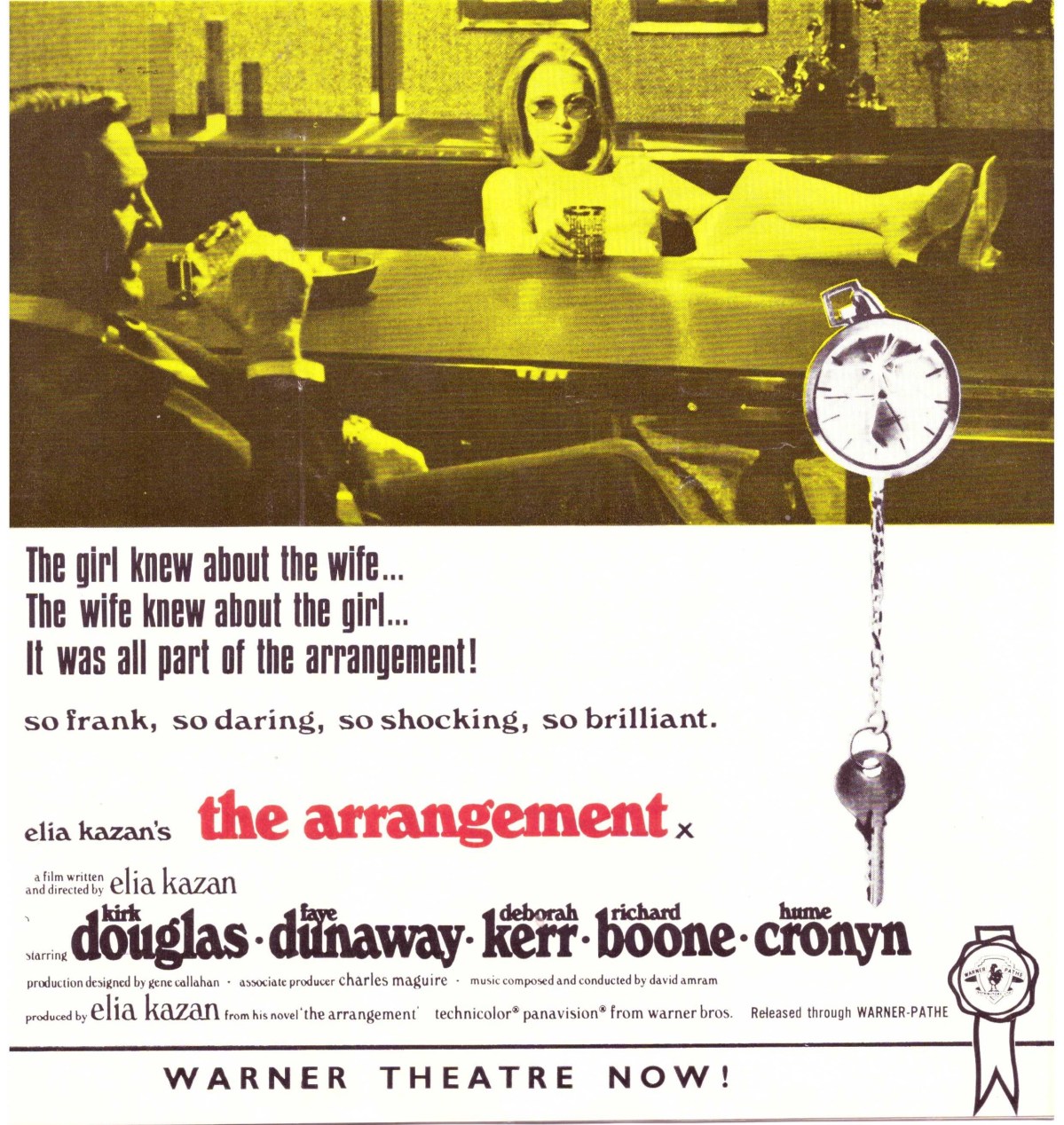
The Arrangement (1969) ***

It might have been better if director Elia Kazan had handed over the screenwriting chores for this adaptation of his bestseller about the midlife crisis of advertising man Eddie Anderson (Kirk Douglas). As director he over-angsts the pudding. Anderson’s attempts to juggle wife Florence (Deborah Kerr) and mistress Gwen (Faye Dunaway) coupled with growing disgust at selling a new brand of cigarettes, Zephyr (“The Clean One”), in a way that pointedly avoids their cancer potential, leads to a suicide attempt. 

During convalescence he determines to quit the advertising world and go back to his first love, writing, but in fact he ends up sabotaging his career. Florence represents impossible seduction and conscience. Slinky, in dark glasses, hot-tempered rather than submissive or demure, she accuses him of self-deception in his job. The picture flits back and forth between his various choices – different job, return to wife, settle down with mistress, or what seems his ideal world, cossetted by both Gwen and Florence.

Gwen is an excellent study of the modern woman (of that fast-changing period, I hasten to add), who needs a man for sex but not necessarily love, and can use the opposite sex as ruthlessly as any man. What she actually requires in her real life is quite different to what she seeks in the fantasy love she enjoyed with Anderson, sex on the beach, the buzz of controlling a high-powered man. Florence could be seen as an old-fashioned portrait of the adoring wife except for capturing so well the bewilderment of betrayal.

Kazan conjures up some wonderful images: the tension before the suicide attempt as Anderson plays chicken between two trucks, Gwen emerging wet from the pool to eat dangling grapes or with her legs up on Anderson’s desk, Anderson’s mother lighting votive candles in her house before using the same match for her cigarette, Kerr’s futile attempts to win back her fallen husband, Anderson flying solo.

In parts well-observed and directorially savvy, quick cuts between the present and the past, however it sinks beneath its own self-indulgence. My guess is that author Kazan could not bear to kill off a single one of the characters he had created for his acclaimed novel and the upshot is a vastly over-populated picture, few of whom cast any real light on Anderson’s predicament. So we are not only introduced to mother, dying father, brother, sister-in-law and  analyst but priest and a bucket of clients and guys from the office. And there are some plot oddities – Anderson gets time off apparently to write journalistic pieces – and what is clearly intended as hard-hitting satire of the advertising world does not come off.

Dunaway (Bonnie and Clyde, 1967) is the standout as Gwen, living life according to her own rules, and with an unexpected vision of domesticity but Deborah Kerr (Prudence and the Pill, 1968) does pain like nobody else and is extremely convincing. Strangely enough, I didn’t go much for Douglas (Seven Days in May, 1964). He could have been leading a cavalry charge for all the range of emotions he exhibited. Douglas is no Montgomery Clift (Wild River, 1960), James Dean (East of Eden, 1955) or Marlon Brando (On the Waterfront, 1954) who was Kazan’s first choice. Kazan had not made a picture in six years and it had been eight years since his last hit Splendor in the Grass (1961). Not quite out-of-touch in concept and delivery, nonetheless it was shunned by the Oscar fraternity.

An odd one distinguished by Deborah Kerr and Faye Dunaway.

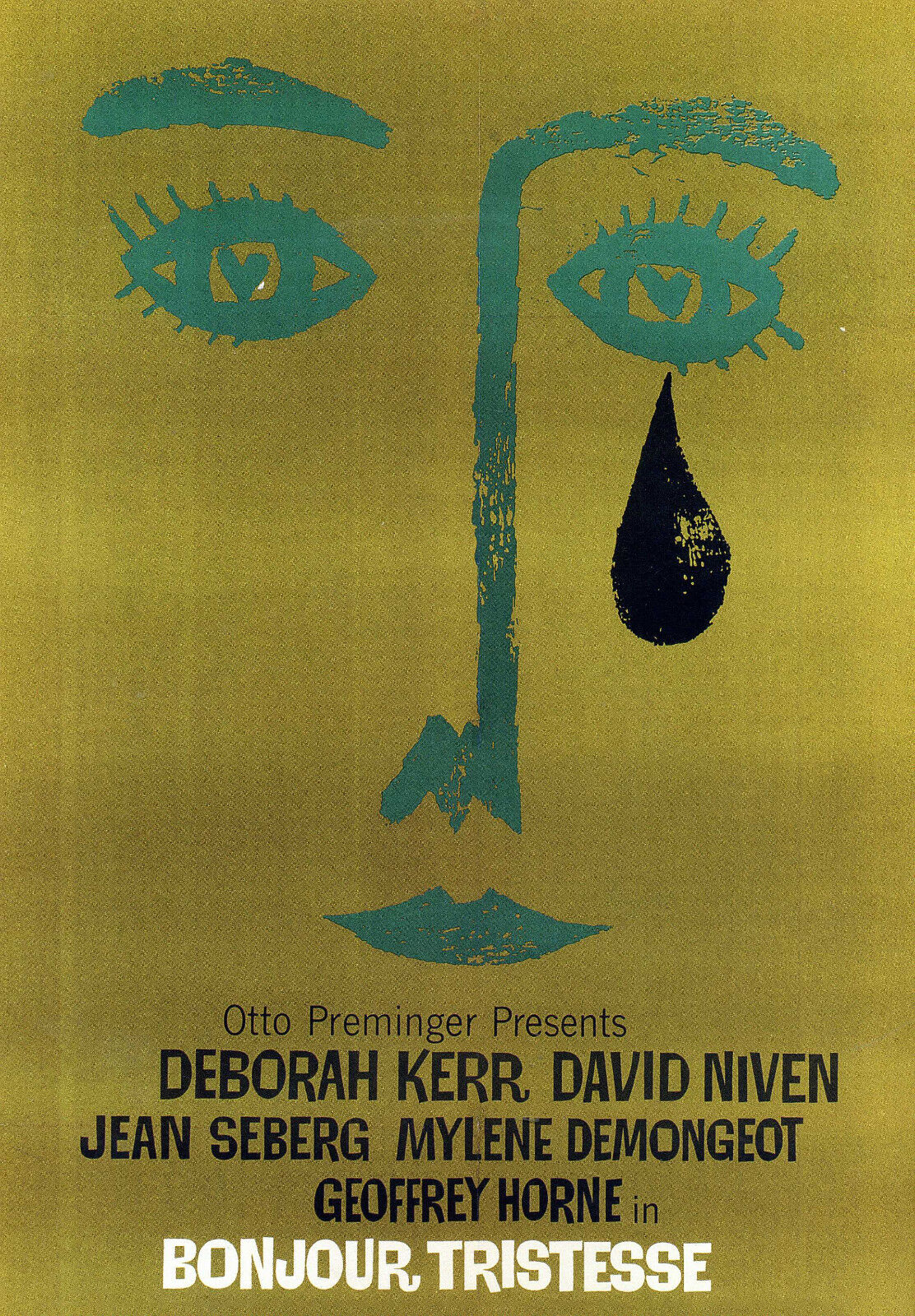
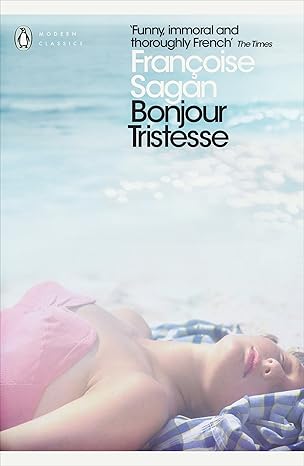
Behind the Scenes: “Bonjour Tristesse” (1958) – Part Two

Audrey Hepburn and Cary Grant (later a famous duo in Charade, 1963) were the first names associated with Bonjour Tristesse. The former was mooted soon after the movie rights were sold to French producer Ray Ventura. She remained in the frame after Otto Preminger took over in 1955, when the project was intended for MGM rather than Columbia, at which point Grant was being targeted.

But, unfortunately, this was not being proposed as a dream team. Vittorio De Sica was being lined up to play the father in the Hepburn version that was to be directed by Jean Negulesco.

(You can see why uncovering this information prompted me to have a second shot at a “Behind the Scenes” for this picture. When I did the original article, I didn’t have access to my usual online sources. But after a query from a reader over the success/failure of the movie, and with internet access restored, I began to check out its box office and, in so doing, found a treasure trove of new data.)   

Even after Preminger dumped Hepburn – and Maggie MacNamara, star of The Moon Is Blue (1953) for that matter – as being too old, at this point Preminger was not looking in the direction of Jean Seberg either. Instead, he was going down a more traditional route to find an actress to play disturbed teenager Cecile. He embarked on a publicity-driven new star hunt. After in 1956 holding a “talent search for femme lead” in France, the director selected 17-year-old Gisele Franchomme for the role.

But she never made the grade either and was quickly jettisoned for Francoise Arnoul (French Cancan, 1955), aged 25 at the time, with another Frenchwoman, Michele Morgan (Lost Command, 1966), as the older woman who snares Cecile’s father, still to be played by Grant.

It’s hard to visualize now just what a hot number the source material was. The novel by Francoise Sagan had been a massive U.S. bestseller. By September 1955 it was in its ninth hardback printing, shifting 110,000 copies, and in 1956 became Dell’s top-selling paperback of the year. The movie rights had originally sold for just $3,000 to Ventura before Preminger ponied up $100,000 (or $150,000 depending on who you believe and in either case still the highest price ever paid for a French novel) and set the movie up at MGM.

So that studio was determined to strike while the novel was hot, taking advantage of the sensational sales figures achieved by Dell. Preminger had different plans. He had a double whammy in mind, planning to pre-empt the movie with a play written by S.N. Berhman (on loan-out from MGM who took first stab at the screenplay) initially scheduled to hit Broadway more than a year before the film appeared.

Preminger had worked the play-into-movie magic before, directing The Moon Is Blue on Broadway in 1951 two years prior to his controversial movie version. In the end Preminger concluded there was “insufficient time” to put a play into production before he was due to begin shooting.

Although it had originally gone along with the idea of the play to the extent of funding the stage production, MGM grew increasingly anxious about the delay in moving onto the picture-making part of the deal. Originally, it was planned as Preminger’s follow-up to The Man with the Golden Arm (1955) which would have seen it released either in later 1956 or early 1957.

The notion of turning the book into a play first probably caused the parting of the ways between MGM and Preminger, the studio unable to pin him down to a start date that would take advantage of phenomenal public interest. He was a hard guy to pin down, already commissioning Alec Coppel to write the screenplay of The Wheel, his proposed biopic of Gandhi, and he also had an ongoing deal with United Artists. So when MGM pulled out, the director turned to Columbia, planning Bonjour Tristesse as the first film in a multi-picture non-exclusive deal.

You could see why MGM were so anxious to get going. The studio was leading the way in a new trend, “the newest film cycle is controversy,” trumpeted Variety in a front-page splash in 1956, tagging Bonjour Tristesse “an unpleasant tale.”

But there was a better reason to act fast rather than just to be seen as with-it. Not only was the paperback market booming, its fastest-growing sector was the movie tie-in. While the 4,500 titles appearing annually accounted for sales of around 200 million copies, publishers also printed movie tie-ins for another 200 titles. 

Movie tie-ins had turned into a publishing phenomenon. Sales of Dell movie tie-in  paperbacks rocketed year on year, so much so that the rise in 1959 was 23 per cent over the previous year. Ironically, Preminger’s Anatomy of a Murder (1959) has been the publisher’s top title for that year. Peyton Place had taken the top spot in both 1957 and 1958 – 4.2 million copies in print – with Bonjour Tristesse its top seller in 1956.

Typically, a movie tie-in was, in effect, a follow-up to the initial paperback. Often the tie-in print run was much higher than the initial printing. The tie-in edition for Bridge on the River Kwai, for example, topped 750,000 copies, for Sayonara it was 900,000. Don’t Go Near the Water sold one million in a month. The average movie tie-in print run for Bantam was 200,000-350,000 copies; for Dell 250,000-300,000; for Signet 300,000; Popular Library 250,000-300,000; and Pocket 225,000-375,000.

Paperbacks accessed a new market. Apart from traditional bookshops, they were available in drugstores, newsstands, supermarkets, impulse buys when the reader was purchasing something else. But they provided for studios a powerful marketing tool. Dell advertised that its paperback “bestsellers were movie pre-sellers” and for good reason. Front covers adorned with stills from a forthcoming movie offered studios fresh promotional opportunity. When a big picture was due you could hardly walk down a street without your attention being called to a tie-in.

Paperback sales were also viewed as a providing a strong indication of box office potential. Based on its sales, it was predicted that Bonjour Tristesse would do as well as Old Yeller and Don’t Go Near the Water, which turned into, respectively, the 10th and 14th biggest films of the year. Columbia sales chief Rube Jackter was so confident of success for Bonjour Tristesse that he departed from convention, taking a groundbreaking approach, personally undertaking a nationwide tour to sell the project to his local sales teams. Perhaps he didn’t want to be beaten to the punch by A Certain Smile (1958), Sagan’s sophomore novel, rights selling for $150,000 and eight per cent of the gross.

Newcomer Jean Seberg was in the vanguard of a new talent hunt. Undaunted by his experience with Seberg in Saint Joan and the critical pummelling she had personally taken, Preminger defended his protégé. “I think she has talent. If I’m wrong, I’ll pay for it. I don’t say I’m infallible, but neither are the critics.”

Preminger backed new talent, taking a chance on Maggie MacNamara in The Moon Is Blue, Lee Remick in Anatomy of a Murder and, later, Tom Tryon in The Cardinal (1963) and Carol Lynley in Bunny Lake Is Missing (1965). In the late 1950s, Twentieth Century Fox was particularly active in developing younger – and cheaper – stars. But other studios such as Universal and Paramount (who had picked up Audrey Hepburn in a talent hunt in the earlier part of the decade) were also keen.

Lynley and Remick were among those being tipped for the top in 1959 in addition to Rod Taylor (Dark of the Sun, 1968), Jill St John (Tony Rome, 1967), Stuart Whitman (Rio Conchos, 1964), Troy Donohue (Rome Adventure, 1962), Bradford Dillman (The Bridge at Remagen, 1969), Sandra Dee (A Man Could Get Killed, 1966), John Gavin (Psycho, 1960) and Cliff Robertson (Masquerade, 1965).

Preminger’s cinematographer George Perinal (who had taken over Saint Joan, 1957, at short notice) hankered after using Technirama for the picture until the director pointed out “the difficulties of using such a large camera in the tiny interiors of the locations.” These included an art gallery in Montparnasse round the corner from Notre Dame where Preminger negotiated a one-day rental (and the purchase of a Picasso) from the Japanese owner. Following Saint Joan, Perinal was so taken with the experience of working with Preminger that he had turned down several other offers in order to keep himself free for a possible shot at Bonjour Tristesse.  

“A large part of my job,” noted Perinal, “ is keeping out of the way once I had lit the set as Preminger wanted,” leaving the physical shooting to the cameraman. He had “great admiration for Preminger’s methods” since “unlike most directors he doesn’t protect himself by having one or two extra cameras covering the scene from different angle. He knows the angle he is after,  and he gets it.” If the rushes proved the scene didn’t go as planned, he simply shot it all over again.

The scene in Maxim’s was filmed for a day and a night, extras being rehearsed in the morning. Most of the takes concentrated on chanteuse Juliette Greco. Francoise Sagan was tapped to write the lyrics for the movie’s theme song, but that didn;t work out instead it’s credited to Jacques Datin.

It’s worth remembering the ease with which top stars travelled. Deborah Kerr had booked passage on the Queen Mary sailing from New York to Cherbourg in the north of France for herself and two children, Melanie and Francesca, and after docking took a leisurely drive down to St Tropez.

As well as paperbacks offering marketing opportunities, the theme song to Bonjour Tristesse was also a promotional tool, Gogi Grant released it as a single, Les Baxter as an instrumental and Janet Blair sang it on British television top show Sunday Night at the London Palladium while the soundtrack album was a premier release for RCA Victor, which backed it up with an advertising campaign.

Released in February 1958 in the U.S., Bonjour Tristesse was one of 35 pictures distributed by Columbia over a six-month period. Thanks to the book sales and the cast, expectations were high. David Niven was riding a commercial (blockbuster Around the World in 80 Days, 1956, still in cinemas) and critical wave (Separate Tables, 1958, would earn him an Oscar). Deborah Kerr remained one of the industry’s most sought-after stars, her commercial and critical standing (three Oscar nominations 1956-1958 in a row) far higher than Niven’s. She had hit box office heights in The King and I (1956) and played opposite such top male stars as William Holden (The Proud and the Profane, 1956), Cary Grant (An Affair to Remember, 1957) and Robert Mitchum (Heaven Knows Mister Allison, 1957).

Robert Coyne of exhibitor alliance Compo rated it potentially one of the year’s “big pictures” along with The Young Lions and Peyton Place. But while enjoying some reasonable results in prestigious first run theaters in hi-hat locations, Bonjour Tristesse quickly fizzled out.

Although a dud in the United States – in terms of rentals it didn’t even clear $1 million – it enjoyed greater success elsewhere, ranking fifth in Japan, 20th in the annual Italian box office race, and in the Top 50 in France, “bang-up business” in journalistic parlance. But it was banned in Ireland. However, suggestions it was a box office smash elsewhere had to be taken with a pinch of salt. It only earned $195,000 in rentals in Japan. So, it is doubtful if it ever reached profitability on initial release.

There was some respite in the critical pummeling of Seberg. Hollywood Reporter, in a favorable review, tabbed her a “delicious little eyeful” noting her style was better suited to this than Saint Joan. And despite her experience of working with the director, the actress, one year later, was reported as “hoping Otto Preminger will come through with a commitment to her” not realising he was on the stage of ducking out of her contract, explaining that there wasn’t  a suitable role for her in his next three planned pictures. So that contract, too, went the way of Columbia who tested her for a supporting role in  The Beach Boys, a starring vehicle for Kim Novak to be helmed by Charles Vidor.

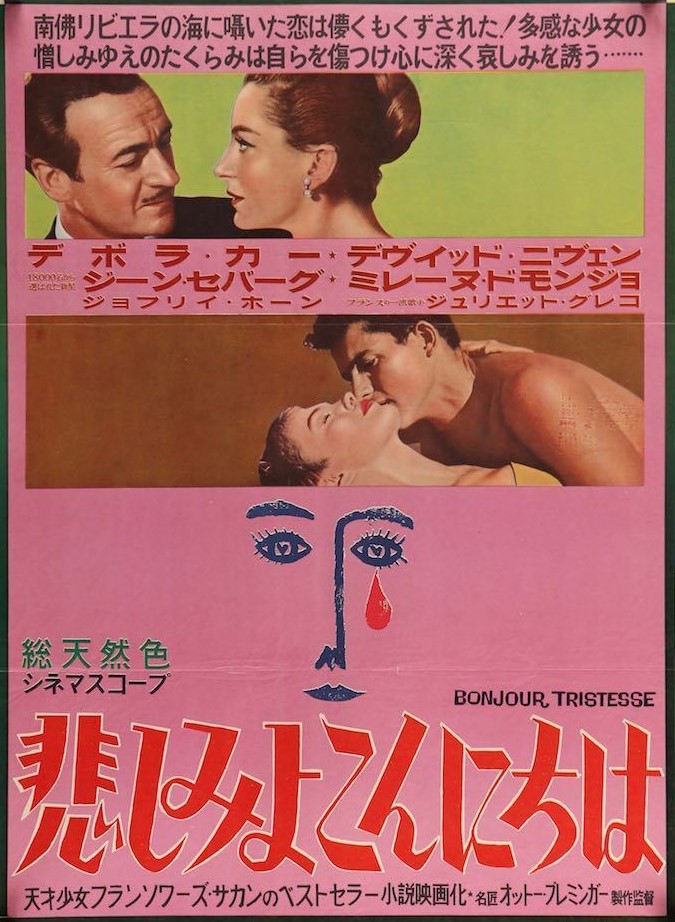
There was some reassessment of the title post-release. When Columbia sold a batch of 60 movies to television in 1964, Bonjour Tristesse was hailed in the trade advertising campaign as the main attraction, photos of the three stars adorning a full-page advert in Variety. It was reissued in Tokyo in 1981. It was featured in a 15-picture Columbia retrospective at the Museum of Modern Art in New York in 1985.

SOURCES: “Europe,” Hollywood Reporter, August 18, 1954, p7; “Otto Preminger Acquires Bonjour Tristesse  Novel,” Hollywood Reporter, April 27, 1955, p2; “Tristesse Legit Version Being Financed by MGM,” Hollywood Reporter, May 31, 1955, p1; “Preminger Gets Behrman To Script Play and Film,” Hollywood Reporter, August 5, 1955, p3; Mike Connolly, “Rambling Reporter,” Hollywood Reporter, August 24, 1955, p2; “M-G Bankrolls Tristesse Legiter,” Variety, September 7, 1955, p3; “Literati,” Variety, September 7, 1955, p69; “Preminger Sets Coppel To Script Wheel,” Hollywood Reporter, January 12, 1956, p3; Stuart Schulberg, “Europe’s Unpampered Stars,” Variety, February 15, 1956, p7; “Chatter,” Variety, February 15, 1956, p74; “Paris,” Hollywood Reporter, May 22, 1956, p20; Mike Connolly, “Rambling Reporter,” Hollywood Reporter, June 8, 1956, p2;  “Chatter,” Variety, June 13, 1956, p78; “Looky – We’re Controversial,” Variety, June 26, 1956, p5; “Bonjour Tristesse,” Variety, July 25, 1956, p4; “Chatter,” Variety, August 22, 1956, p62; ”Niven and Kerr  Will Star in Tristesse,” Hollywood Reporter, February 21, 1957, p2; “Broadway Ballyhoo,” Hollywood Reporter, April 19, 1957, p10; “Insufficient Time for Tristesse Stage Version,” Variety, March 28, 1956, p2; “Cameraman on the Sidelines,” American Cinematographer, August 1957, p510; “The Note-Book,” Hollywood Reporter, August 5, 1957, p7; “Broadway Ballyhoo,” Hollywood Reporter, August 13, 1957, p4; “Broadway Ballyhoo,” Hollywood Reporter, August 20, 1957, p4; “Preminger,” Variety, October 16, 1957, p75; “Jackter Hits Sticks for Bonjour Release,” Variety, December 18, 1957, p3; “Foreign TV Follow-Up,” Variety, December 18, 1957, p38; Advert, “Dell Book Best-Sellers Are Movie Pre-Sellers,” Hollywood Reporter, January 8, 1958, p5; Review, Hollywood Reporter, January 15, 1958, p3; Advert, Variety, January 22, 1958, p56; RCA Victor advert, Variety, January 29, 1958, p56; Advert, Billboard, January 27, 1958, p49; “Columbia Feeds 35 by August,” Variety, February 5, 1958, p18; “A Film ‘Still’ Big Sell on Paperback,” Variety, March 5, 1958, p7; “Irish Want New Film Censoring,” Variety, June 11, 1958, p11; “Broadway Ballyhoo,” Hollywood Reporter, July 1, 1958, p4; “Sindlinger: And Rebuffed,” Variety, July 2, 1958, p5; “Paris First Runs,” Variety, July 16, 1958, p12; “New York Sound Track,” Variety, July 30, 1958, p21; “Columbia To Test Seberg for Beach Boys Role,“ Hollywood Reporter, August 15, 1958, p1; “Yank Films Still Dominate Italy,” Variety, December 3, 1958, p12; “Top Grossers* of 1958,” Variety, Jan 7, 1959, p48; “Kwai Tops in Japan,” Variety, March 18, 1959, p24; “Nine U.S. Pix,” Variety,  May 13, 1959, p12;  “Hollywood Takes To Tyros,” Variety, September 2, 1959, p3; “Paperback-Film Zowie Tandem,” Variety, February 3, 1960, p5; Advert, Variety, September 9, 1964, p39; “Bull Takes Charge,” Variety, May 25, 1981, p32; “MoMa Columbia Retro Set,” Variety, January 30, 1985, p4.

* NOTE: Just to confuse things, Variety headlined its annual rentals report as “Top Grossers of 1958” but in the small print clarified that these figures related to “domestic market rentals accruing to distributors (i.e. studios) a distinguished from total theater gross.”

https://amzn.to/3M8AR40

Behind the Scenes: “Bonjour Tristesse” (1958)

Otto Preminger was initially beaten to the punch, rights to Francoise Sagan’s 1954 bestseller already sold to Ray Ventura, forcing the director to ante up $150,000 a year later to retrieve them. The director started working on the script with S.N. Behrman (Quo Vadis, 1951) but, dissatisfied with the result, turned to Arthur Laurents (Rope, 1948), who was permitted to complete his screenplay without any interference.

Shooting began in July 1957 in Paris and locations included Maxim’s and jazz club La Hachette where Preminger filmed Juliette Greco singing the title song. The main locale, a villa in Le Lavandou in the South of France, was rented from French publisher Pierre Lazareff.

By casting Deborah Kerr (The Night of the Iguana, 1964) and David Niven, who had starred in The Moon Is Blue (1953) as principals, it was officially turned into a British production, providing access to Eady Levy monies, although it was shot with a French crew who proved largely hostile to the director’s personality and went on strike on the second day. Due to a scheduling misunderstanding, Niven and Preminger got off on the wrong foot.

But the chief victim of the director’s ire was Jean Seberg, star of his previous effort – and substantial flop – Saint Joan (1957). While not entirely happy with the neophyte’s performance in her debut, he decided to give her the benefit of the doubt. “I refused to believe that I was so wrong and the critics so right, that this girl was so completely devoid of talent,” he complained, offering her a second chance. “He showed a faith in me nobody expected him to show,” commented a grateful (at the time) Seberg.

But Preminger soon regretted his decision. “I don’t like the way you talk, walk or dress,” he told her. Unable to get a better performance from her after four or five takes he would just give up. At one point, she was drenched with buckets of water for a scene where she was emerging from the sea. However, that scene only took seven takes, something of a triumph for Seberg. And it’s worth noting that seven takes was nothing for Preminger if he really wanted to make an actor suffer.

If you think the movie takes a very melodramatic turn, the screenplay toned down much of the book’s melodrama and especially its more serious overtones. Preminger stuck to the script. He invented camera movement and blocking during the day’s rehearsals rather than arriving at the studio with fixed ideas. To allow the camera to move more freely, the floor of the set was treated with gelatin. He relied on only a few takes, expecting the actors to deliver what he wanted, so in some respects it was no surprise he reacted badly when Seberg failed to follow his instructions, although as a last resort he knew he could always cut to another actor.

Niven and Kerr both braced the director about his treatment of Seberg, telling him “to lay off this girl, because she’s had it, and if you continue, we don’t want to keep working. ”

The movie was completed at Shepperton Studios in England. The last shot of the film took an entire day to shoot, Cecile removing her makeup with cold cream in front of the mirror and tears form. Preminger wanted “the face to remain a child’s face.” Two days of flashback shoots had to be re-done as they had by mistake been processed in color rather than black-and-white

Preminger should have been a happy man. He was falling in love with costume coordinator  Hope Bryce, a model who had worked with Givenchy, and in due course she became his third wife. Ditto, Seberg, who had fallen for lawyer and nobleman Count Francois Moreuil – a relationship that also ended in marriage – and as a result of the romance grew more relaxed on the set and “didn’t let Preminger’s demands bother her.”

Opinions differ regarding Seberg. Arthur Laurents deemed her “a shrewd cookie, I don’t care what they say about her.” Deborah Kerr averred: “I think any other woman would have collapsed in tears or walked out, but she took calmly all the berating and achieved a very interesting and true Sagan-type heroine.” Co-star Mylene Demongeot said, “For a while she had everything in her hands to have a successful career.” From Seberg’s perspective she viewed Preminger as a father figure, with the attendant hate that often comes with that.

Demongeot, however, fought fire with fire, calmly warning the director he would get a heart attack if he kept on yelling at her. Standing up to him and occasionally dissolving into fits of laughter at his instructions kept him at bay. She saw a different side of the director,  although tagging him as “ a nasty man,” she also recalled him as “a very funny, intelligent man…and he could even be charming…outside of work.” Seberg and Demongeot had become friends after the American had stayed with the French actress and her husband in order to learn the lines of French required for her role.

After filming ended, Preminger’s current wife Mary Gardner sued for divorce and Twentieth Century Fox threatened to take him to court for repayment of $60,000 for a film bever made. Preminger sold Seberg’s contract to Columbia. “He used me like a Kleenex and threw me away,” said Seberg. But, interestingly, it was only after that relationship ended that she took acting lessons.

In truth Seberg’s Hollywood career never recovered although she enjoyed a brief mainstream revival a decade later through Paint Your Wagon (1969) and Airport (1970). Hollywood has its revenge on Preminger. After the failure of Skidoo (1968), Paramount chief Charles Bluhdorn exacted “a very slow death” on the director.

NOTE: There’s an update to this called Part Two which is published on Oct 19, 2023. When I did this original article I didn’t have my normal online access which permits me to check through trade magazines. Because I received a query about box office I decided, once the online issue had been cleared up, to check that issue and in the process I uncovered so much fascinating information I took a second stab at it.

SOURCES:   Chris Fujiwara, The World and Its Double, The Life and Works of Otto Preminger (Faber and Faber, 2008) pp210-217;  Eric Braun, Deborah Kerr ( W.H. Allen , 1977) pp164-165; Garry McGee, Jean Seberg, Breathless, Her True Story, (2017) pp42-48.

Bonjour Tristesse (1958)*** – Seen at the Cinema at the Bradford Widescreen Weekend

You might be forgiven for wondering why Otto Preminger, a past master at film noir, did not simply adapt the source novel by Francoise Sagan by tilting the material in that direction. After all, Preminger had helped create the genre with Laura (1944) and followed up with noir trilogy Whirlpool (1950), Where the Sidewalk Ends (1951) and Angel Face (1952).

The purported saving grace of the Sagan novel is the main character’s guilt at the disaster she triggers, although, from another perspective that could be viewed as author cunning, employing acceptance of culpability to render her more sympathetic. In other words, she gets away with it, and that’s a completely different twist.  

Whereas, in another world, she would be doing jail time or at least undergoing psychiatric care, her action appears to make her even more independent, discarding men at whim, turning into the character whom Jean-Luc Godard would use as the inspiration for Breathless (1960).

The tale is told in flashback, allowing a peppering of grief into what otherwise would be a straightforward story of spoiled little rich girl Cecile (Jean Seberg) plotting to rid herself of interloper Anne (Deborah Kerr) who has disrupted the perfect life she shares with doting father Raymond (David Niven).

In some respects it applies a coming-of-age template to all the main characters, adults as well as young required to adjust to the consequences of love and alter their behavior. It’s not just the teenage Cecile who’s spoiled – nothing to do but laze in the sun, swim in the sea and attend parties and night clubs – but Raymond, a charming philanderer/perfect cad, new girlfriend on tap, the beauty of current one, Elsa (Mylene Demongeot), undercut by her propensity to blister under the sun and despite her overall shallowness a mathematical whiz in the casino, a skill which would probably allow her to dispense with her apparent dependence on an older rich lover.

Into this cosy set-up arrives, by an accident of timing, old flame Anne, a successful couturier, whose mental fragility is disguised by an outwardly strong character. Her presence is accepted until Elsa is sent packing and Raymond proposes marriage. Anne makes the fatal mistake of overdoing the maternal, seeking to rein in Cecile, instructing her to chuck her boyfriend Philippe (Geoffrey Horne) and spend her time studying. It says a lot about Anne’s character that she couldn’t have more seriously miscalculated not just Cecile’s character but that of Philippe, who, intending to become a lawyer, seems a sensible choice for a boyfriend.

So, Cecile hatches a plan to bring Elsa back into Raymond’s orbit knowing that fidelity is scarcely his strong suit. Oddly enough, this kind of plotting, especially given the South of France atmosphere, would play better as a standard rom-com ploy, daughter trying to push father in the direction of preferred lover.

Instead, it exposes the cracks in Anne’s psyche and drives her to suicide. But since no one is aware, and Elsa too dumb ostensibly to recognize the part she plays, of the machinations, Cecile gets off scot-free, and in reality using the guilt to make her appear more sympathetic. This probably worked better in the Sagan novel which, with a first-person narrative, allows the author to form the other characters in a manner that makes Cecile’s actions more understandable or at least acceptable, nudging the reader towards sympathy rather than repulsion.

Whatever way the story is pitched, it doesn’t really work. All the characters, save Elsa, are exposed as inherently fragile, unable to accept change and/or reality. The suicide seems a mundane narrative ploy. Raymond is never presented as the love of Anne’s life and her death  seems an incredible over-reaction, intended to give the story a more dramatic climax.

However, the characters are all well-drawn and the vivacity of the French lifestyle brings the picture to life, but hardly suited to Preminger who, by this stage, had a tendency to look for a bigger issue to chew over.

Jean Seberg (Moment to Moment, 1966) never managed a successful Hollywood career but this film was a big hit with emerging French filmmakers, and she was a far bigger box office attraction in France. The iconic short haircut and Givenchy attire seemed to present her as a latter-day Audrey Hepburn, but it was her screen independence that appealed more. Deborah Kerr (Prudence and the Pill, 1968), portraying a complex character, would be the pick of the actors except David Niven (Prudence and the Pill) exerts effortless charm and in terms of screen splash you could scarcely fault the effervescent Mylene Demongeot (The Singer not the Song, 1961).

Preminger, as ever, toys with convention. It’s the present day that’s shot in black-and-white rather than the past. Just as he rid John Wayne of his trick of breaking sentences in two in In Harm’s Way (1965), here Deborah Kerr is revealed without make-up, her freckled face providing her with an innocence. He had some fun with the house servants, apt to glug champagne, literally, behind their employer’s back. Arthur Laurents (Rope, 1948) wrote the screenplay.

Not quite sure how it ended up at the Bradford Widescreen Weekend since although it is in Cinemascope it was not one of that process’s more outstanding champions. Nor why it was introduced as Deborah Kerr’s movie when as far as the public was concerned the star was Jean Seberg. Nor even why Kerr was deemed a “Queen of Scope” since you could apply that term to virtually every female star who appeared in the 1950s in Cinemascope (20th Century Fox), VistaVision (Paramount) or Panavision (MGM).

If this were made now, there would be a scene at the end where Cecile tips the wink to the audience and enjoys rather than feels guilty about her clever ploy.

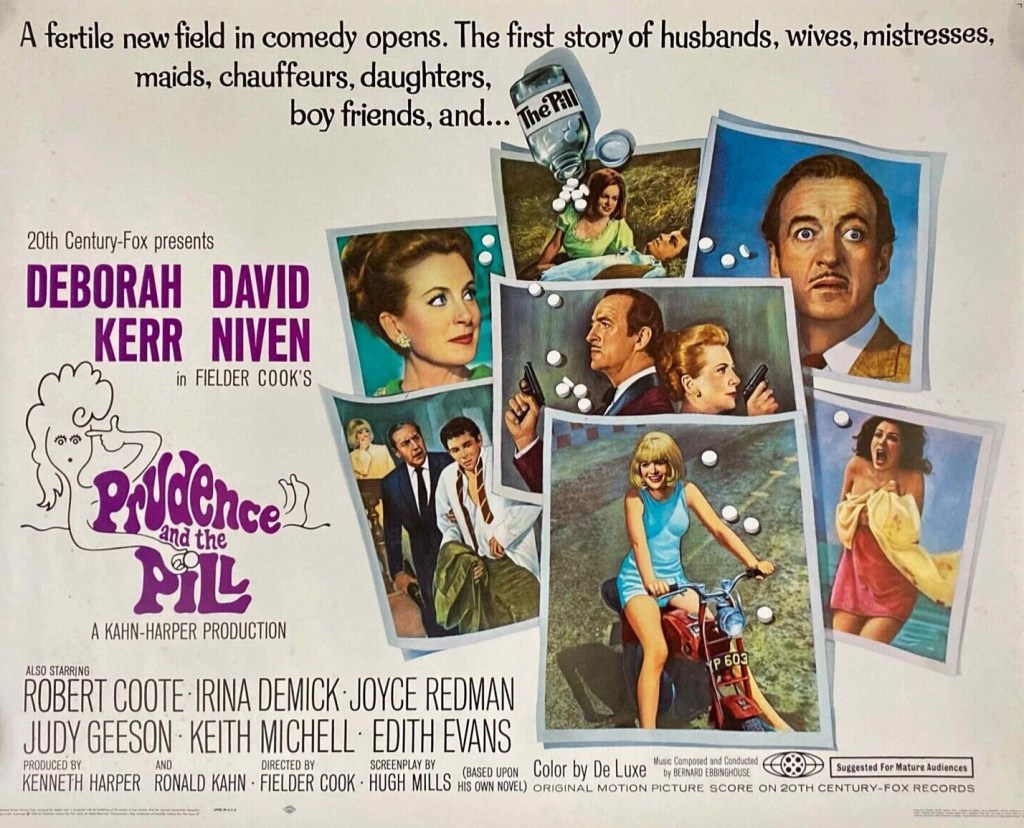
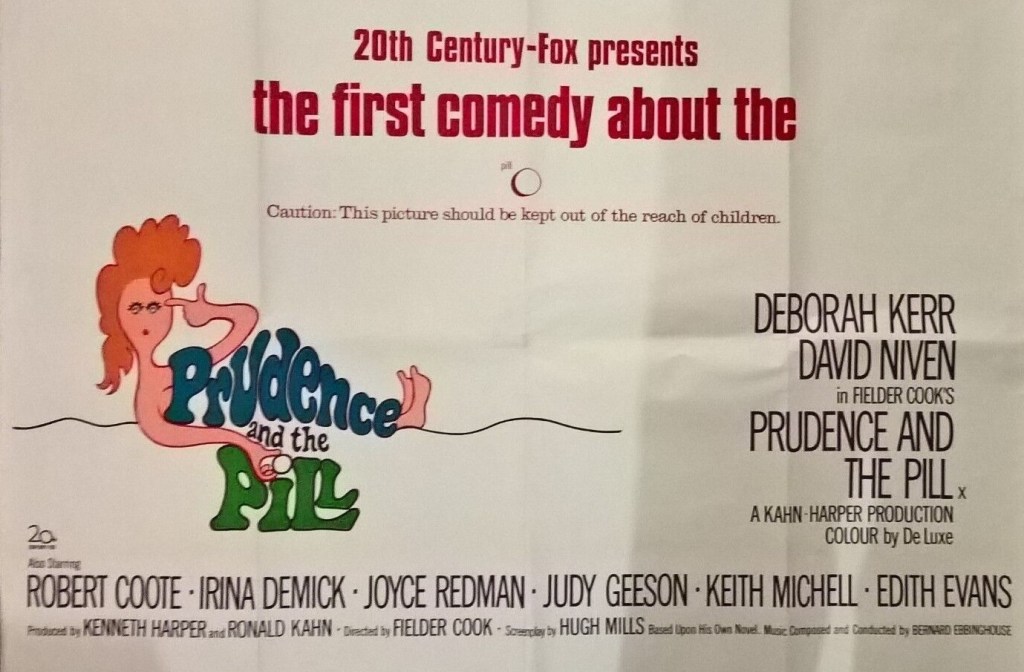
Prudence and the Pill (1968) ****

Cleverly calibrated chuckle-worthy comedy of manners. Far more enjoyable than the basic material might suggest, especially as you will easily guess where it all ends. Anchored by redemptive performances, after disappointing turns in The Eye of the Devil / 13 (1966), by Deborah Kerr and David Niven, playing a middle-aged upper-class childless couple whose marriage survives on civility alone, and a sparkling showing by Judy Geeson (Here We Go Round the Mulberry Bush, 1967).

It’s surprising what a fresh look at cliché can achieve. On the face of it, American director Fielder Cook (How to Save a Marriage and Ruin Your Life, 1968) is the last person to be tackling the upper classes, especially as there’s scarcely a hint of satire. It’s wonderfully pitched, no sexist jokes, no farce, no tourist or Swinging London, and avoids the temptation of aiming for the lowest common denominator (Carry On Up the Pill for example). But authority is constantly confounded, pomposity pricked, and, astonishingly for a  movie about relationships in Britain – the home of the kitchen sink drama – in the late Sixties, everyone ends up happier ever after.

The titular drug in question, in case that term is no longer in common usage, is the contraceptive pill, here sold under the generic name of Thelon. The biggest shocks here might well be that mothers and fathers in middle-age still have sex. Although that is balanced by a contemporary vibe of having children late in life.

So the fun begins when Henry (Robert Cooote) and Grace (Joyce Redman) discover bubbly daughter Geraldine (Judy Geeson) in bed with Tony (David Dundas). Cue howls of anger from staid parents, who divide up the ticking-off, the mother tasked with warning daughter about the dangers of pregnancy – and with it the specter of single motherhood, a high society no-no – the father to whip the young rascal.

The mother is only mollified – though still affronted at such blatant expression of sexuality – when she discovers her daughter is on the Pill. But shocked to discover Geraldine has been pilfering her own supply. Father is taken aback to discover the lover is not only heir to a fortune but has already proposed.

Unlike most movies of the era, where sexuality remained a dirty word, and most illicit romances were conducted in secrecy and ended up in disaster, the vivacious Geraldine could be the poster girl for sex. She is delighted to have lost her virginity, and to expand her sex education, and stands up against her mother’s old-fashioned views.

However, the replacement of mother’s Pill with aspirin presents a dilemma. Robert and Grace are also enthusiastic lovers and the absence of contraception for so long points towards the possibility of a very embarrassing pregnancy.

Meanwhile, Henry’s brother, bored company chairman Gerald (David Niven), who lives in a mansion with servants and swans around in a chauffeur-driven Rolls-Royce, discovers, to his horror, that his wife Prudence (Deborah Kerr) has been taking the Pill, denying him his much-cherished desire to have children. So he swaps it for a vitamin pill. Unknown to him, his young maid Rose (Vickery Turner), warming to the amorous attentions of the chauffeur Ted (Hugh Armstrong), has taken a leaf out of Geraldine’s book and snaffled her mistress’s Pill.

You can see where this is headed. But there’s a complication. Assuming (as a man would) that their lack of children was due to his wife’s infertility, Gerald could have had children by his younger mistress Elizabeth (Irina Demick). But he refuses to seek a divorce (the scandal, don’t you know) and Elizabeth views him as a poor candidate for marriage (would he not just have another mistress) and fatherhood.

Prudence, it soon transpires, also has a lover, Dr Huart (Keith Michell). Equally resistant to divorce, for societal reasons and to prevent her husband marrying his mistress, Prudence soon warms to the thought of having a child, but abhors the prospect of having Gerald as its father.

In the best Hitchcock fashion, the audience is privy to information denied the characters who fluster around in their incompetence.

It should never work. The story is so obvious and, from a narrative perspective – given unplanned pregnancy does not lead to dark deeds, humiliation and abandonment – weak. That it is pretty much a triumph owes as much to the direction (witty use of musical cues, for example) as a script that feasts on reversals. The acting is first-class all round. David Niven and Deborah Kerr, in their final pairing, atone for the under- and over-acting, respectively, of Eye of the Devil. Judy Geeson is a standout as a marvellously gleeful liberated young woman. Edith Evans (The Chalk Garden, 1964) pops up for a delightful cameo.

Pure joy.     

Behind the Scenes – “Eye of the Devil / 13” (1966)

It would have been a different movie entirely with Kim Novak (The Legend of Lylah Clare, 1968) in the lead and directed by Sidney J. Furie (The Ipcress File, 1965). He was one of three directors – the others being Arthur Hiller (The Americanization of Emily, 1964) and Michael Anderson (Operation Crossbow, 1965) – to pass on the picture (then known as 13) before it ended up in the lap of J. Lee Thompson (Return from the Ashes, 1965). Terry Southern (Dr Strangelove, 1964) also hnded the screenwriting torch over to Robin Estridge (the author under a pseudonym of source novel Day of the Arrow) and Dennis Murphy.

Possibly because of the potential involvement of Hiller, and that Martin Ransohoff, producer of The Americanization of Emily, was funding this film through his Filmways shingle, Julie Andrews was mooted for the lead. Instead, the part went to Kim Novak, who had just finished another British production The Amorous Adventures of Moll Flanders (1964). She had signed a three-picture deal with Ransohoff who was firming up productions with a number of Hollywood studios  

According to co-star David Niven (The Extraordinary Seaman, 1969), Novak was insecure about acting the part. “I don’t think I’m betraying any confidences,” said Niven, betraying her confidence to a reporter, “if I said that Kim often told me ‘I think I’m not right for this part. I think I’m a sex-pot.’ ” Given she was playing a mother-of-two, it’s doubtful that she was intended to be overtly sexy, although that would certainly provide a different reading for the role.

Some of Novak’s concerns could be ascribed to any Hollywood-trained actress. “While highly professional,” observed Niven, “Kim worried about her looks, her scenes, her individual lines, everything.” Novak’s professionalism included arriving at the studio at 4.30am and often doing her own make-up accompanied by an “entourage of dialog coach, press agent and personal secretary, with whom she rehearsed her lines before going on set.” (I’m sure she practiced her lines with her dialog coach rather than secretary.)  

As if British actresses prepared for a movie with ease and turned up on the set without a care in the world. However, that was Niven’s conclusion. As if little preparation was involved, “Deborah Kerr,” said Niven, “just walked before the camera and did them (her lines); stand-in Esmee Smythe would occasionally hear her lines – very occasionally because she always knew them – and once in a while would help out if the dresser was not on the spot.”

Four-fifths of the picture was completed when Novak pulled out. The standard reason given was because of a back injury. Initial filming had taken place in fall 1965 in France at the main location of Chateau de Hautefort in Dordogne before Novak fell from her horse. Production was suspended for two weeks. But the actress proved unfit to rejoin the unit.

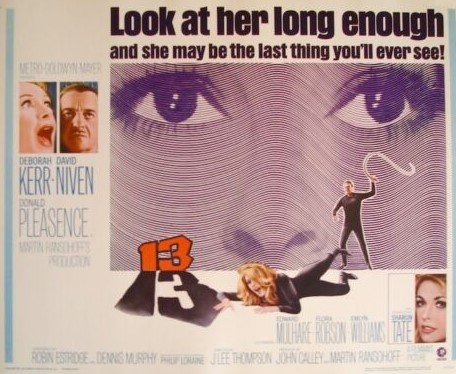
Title changed to “13.” It’s worth noting that the main images of the poster refer to Sharon Tate. It’s her eyes that are hypnotic
and she’s the one being whipped.

Supporting star David Hemmings (The Charge of the Light Brigade, 1968) offered a different reason for her departure. This was the actor’s first big-budget international full-scale picture. His career was in reverse, from starring in Be My Guest (1964) he had tumbled to fourth billing in Two Left Feet (1965). As if forever destined to be the ingenue, here he was billed eighth.

Hemmings knew the director from No Trees in the Street (1959) and had worked with Donald Pleasance in Wind of Change (1961). He recalled “the comparatively unknown but totally ravishing Sharon Tate who was the same age and had done about as much as I did.”

Given his lack of knowledge of American television it was understandable he believed he was in the same bracket as Tate. In fact, she was such a hot prospect, coming off a role in the wildly successful series The Beverly Hillbillies she was given an “introducing” credit and had far the superior part.

“ I loved the setting and my part which demanded skills in riding and toxophily (archery),” said Hmmings. He found all the time wasted in playing darts in pubs assisted him in his archery training. “But I found it quite odd that a young lad of 24, dressed in black leather and riding a white horse, albeit with my toxophilic advantages, should have been thrown together with such a distinguished cast.”

The fact that he presented such a visual treat in his blonde curls and black leathers appeared not to occur to him. “The older actors were astonishingly kind to me. Niven’s charm was profound and genuine.”   

One of the older stars who reached out to him proved to be Kim Novak. Although only eight years older she had been a star for more than a decade, leading lady to William Holden in Picnic (1955), Frank Sinatra in the Man with the Golden Arm (1955) and Pal Joey (1957), James Stewart in Vertigo (1958) and Bell, Book and Candle (1958) and Kirk Douglas in Strangers When We Meet (1960) while in most of her films in the 1960s she had received top billing ahead of the male star.

When Hemmings took to riding his white horse through the French countryside Novak became his companion. “We would stop somewhere to sit and chat. Easily and at great length almost about everything…and to begin with no hint of physicality…after a while I began to detect that strangely attractive wicked look in her eye that an experienced woman gives to an inexperienced man.”

One day, though staying in different hotels, she asked to meet him in a large park in the centre of Brive. “It wasn’t a suggestion, it was a command,” he recollected, “and being the young man it was a command I knew would lead inevitably to possibilities.” The assignment in the park led to a short affair conducted in her hotel room.

Shorty afterwards, at a press conference, “I can’t recall what Marty (Ransohoff) said to upset Kim or if it justified her reaction but I have an indelible vision of her stubbing out a cigarette in his one good eye which led to an ugly scene…and Kim being sacked.”

But it would be hard to convince the completion guarantee bonding companies and the insurance company that a back injury had been faked to cover the embarrassment of the producer. Original budget of £1 million was supplemented by another £600,000 from the insurers to complete the movie. Deborah Kerr had been holidaying at Klosters in Switzerland when she received the call and began work as a replacement at the Borehamwood studio in Britain over Xmas 1965.

Since Novak had not been in every scene, the opening scenes and the beguiling of the children by Sharon Tate, for example, it wasn’t a case of starting completely from scratch. And the director and cinematographer would have the advantage of already having made  decisions regarding camera placement, while the other actors would be well-rehearsed. However, weather for the previous filming had been cold so there would have been a worry about matching exteriors since conditions in France in January-February 1966 were “like summer.”

It was Niven who had suggested Deborah Kerr as the replacement. This was the third of the five pictures they made together, preceded by Bonjour Tristesse (1958) and Separate Tables (1968),  followed by Casino Royale (1967) and Prudence and the Pill (1968). Niven welcomed her presence. “Playing opposite Deborah is as delightful an experience as an actor can have,” he said. “I’ve always felt I won my Academy Award (Best Actor Oscar for Separate Tables) because she made me look so good. That sort of thing makes for a warm and relaxed screen relationship.” Niven was clearly ignoring the fact that, although happily married, the relationship of the couple on Eye of the Devil was tense and strained.  

But the France reshoot took place at a different location, Brives Les Gaillards in Perigord, an overnight train journey from Britain. Perhaps in a bid to save money, Esmee Smythe was eliminated from the personnel intended to be shipped abroad. After a few words from Kerr –  who otherwise would effectively be acting as her own stand-in for scenes involved horse-riding, driving and standing on the parapets – Ransohoff changed his mind. Despite the pressures to complete and ensure that Kerr’s work – a “daunting job of re-shooting” – would fit in with what had come before, shooting was deemed “pleasant.” Kerr again stood up to the producer when informed further work in Borehamwood would begin immediately on the morning of the overnight train journey home.

The original stars were paid twice, for Hemmings “the most lucrative job I’d ever done.” Nonetheless, there was clealry doubt about its box office potential and, unsually for a film with denoted stars, it sat on the shelf for over a year.

Despite MGM’s best marketing efforts the movie fizzled out in the United States where it opened in fall 1967. Prospects proved poor. It waited another  seven months before a British premiere at the Ritz in London’s West End in March 1968, that showing possibly the result of the unexpected success for MGM with David Hemmings’ breakout movie Blow-Up (1966).

But the West End opening counted for nothing when it came to general release it the UK. On the ABC circuit it was only the supporting feature to The Heroin Gang (1968) starring David McCallum and Stella Stevens. It might have done better had it been delayed further and taken advantage of the successful comedy pairing of Kerr and Niven in Prudence and the Pill.

Like many a horror movie, the production was considered jinx. Filming on Prudence and the Pill was delayed when Kerr, who “had never had a day’s illness in her life,” was diagnosed with labyrinthitis, a condition which destroyed her sense of balance. While she recovered, others involved in Eye of the Devil were not so fortunate. Not only was Sharon Tate slaughtered by the Manson gang but a member of the location crew was crushed by a car and the chateau burned down a few years later.

SOURCES: Eric Braun, Deborah Kerr (WH Allan, 1977) p198-202; David Hemmings, Blow-Up and Other Exaggerations (Robson Books, 2004) p123-126.

Eye of the Devil / 13 (1966) ***

Shades of The Innocents (1961), The Wicker Man (1973) and The Omen (1976), but lacking the suspense of any, leading roles woefully miscast, supporting roles, conversely, brimming with inspired casting including the debut of Sharon Tate (Valley of the Dolls, 1967) and a mesmerising role for David Hemmings (Blow-Up, 1967)  Any attempts at subtlety were dumped when the original more intriguing title of 13, which turns out to have more than one meaning, was dumped (except in some foreign markets) in favor of the giveaway designation of Eye of the Devil. Despite embracing a web of sinister legend, it lurches too quickly into full-on demonic horror.

French count Phillippe (David Niven) is called away unexpectedly from the Parisian high life to deal with a crisis in his vineyard. When his son Jacques (Robert Duncan) starts sleepwalking in his absence, his wife Catherine (Deborah Kerr) decamps with daughter Antoinette (Suky Appleby) to the family pile, a huge millennium-old castle. The count’s sister Estell (Flora Robson) fears her arrival. Villagers fear Phillippe, doffing caps when he passes.

Meanwhile, Catherine encounters or witnesses strange goings-on. Archer Christian (David Hemmings) shoots dead a dove which is later offered to unknown gods by his sister Odile (Sharon Tate) in a chamber filled with men in black robes. Later, Odile changes a toad into a dove and hypnotises Catherine into almost falling off a parapet. A quietly spoken priest (Donald Pleasance) offers no succor. The number thirteen could refer to the day of an annual local festival or a ceremony involving thirteen men, twelve of whom dance around the other. In a forest Catherine is trapped by men in black robes, then drugged and imprisoned.

Meanwhile, her husband remains grimly fatalistic, gripped by torpor, except when roused to whip Odile. Generation after generation, going back over a thousand years, the head of the household has come to a sticky end and without explanation it appears Phillipe expects a similar outcome. .

It doesn’t take you long to realise devilry is afoot. It’s a pagan castle, it transpires, a “fortress of heresy.” After three years of poor grape harvest, the earth demands a sacrifice. Where the victim in The Wicker Man is an innocent outsider lured to a remote island, the count accepts his destiny even as his wife struggles to prevent his death. Dramatically, the later film has the edge, the victim struggling against fate rather than a mere observer. That Catherine is powerless somehow doesn’t bring the dramatic fireworks you might expect.

What the posters conceal is that the film was made in black-and-white – the last MGM picture not to be in color – and this is a photo of Sharon Tate as she appeared in magisterial and beguiling form.

There’s a curiosity about the casting of Deborah Kerr (The Gypsy Moths, 1969). This most repressed of actors, as if a veil has been lifted, empowered to scream and batter against doors and race around, seems to drain the movie of energy. She just seems laughably bonkers rather than intense and empathetic. For someone whose performance is generally minimal, who exists in the margins, it seems almost perverse to force her to go so over-the-top.

Perhaps such unusual verbal and physical activity was deemed essential to counter the inactivity, the virtual sleepwalking, of the rest of the cast. While looking pained, David Niven (The Extraordinary Seaman (1969) can’t quite capture the intensity, the personal devastation, the role requires. David Hemmings as the silent archer and especially Sharon Tate as the trance-inducing magician, steal the show, investing their characters with little emotion, and yet, visually, as if mere costumed performers, present the most vivid incarnations.

From an audience perspective, it’s hard to root for Catherine since it’s obvious she is in no mortal danger. Like The Wicker Man, the audience is there in an observatory capacity, but unlike the Scottish policeman the victim attracts little sympathy. There’s not real

It’s a surprising backward step for director J. Lee Thompson after the superb Return of the Ashes (1965) which was chock-full of suspense and interesting characters. After an atmospheric opening, it turns uneven as he falls into the trap of following the wrong character. Screenwriters Dennis Murphy (The Sergeant, 1968) and  Robin Estridge (Escape from Zahrain, 1962) adapted the latter’s acclaimed novel Day of the Arrow, written under the pseudonym Philip Loraine. So perhaps he can be blamed for shifting the investigative focus from Catherine’s ex-lover to Catherine herself.

I was surprised to see Deborah Kerr take on such a role and that is a story in itself which I’ll address tomorrow.

Discover WordPress

A daily selection of the best content published on WordPress, collected for you by humans who love to read.

The Atavist Magazine

by Brian Hannan

WordPress.com News

The latest news on WordPress.com and the WordPress community.