I’m still trying to work out why I enjoyed the Rat Pack’s last hurrah so much. Sure, it’s the knockout debut of “My Kind of Town,” the last tune Frank Sinatra performed on the big screen and one that would have epitomised Ol’ Blue Eyes had it not been supplanted a few years later by “My Way.” And Bing Crosby, also in top crooning form, would have stolen the show except for Peter Falk’s gangster and Barbara Rush weaving a seductive web around all the males. But, actually, it’s mostly because this one time, far more than in the three preceding pictures, there’s a match between story and stars, as if at last the whole idea has come together. The gimmick of transplanting the Robin Hood legend to 1920s Prohibition Chicago works a treat, a gentle spoof rather than an awkward one.
The notion that you would bring together three of the greatest singers – Sinatra, Dean Martin and Sammy Davis Jr. – of their generation and deny audiences the chance to hear their voices was anathema to audiences. As if nobody could make up their mind which way a Rat Pack vehicle was headed, Martin and Davis were accorded tunes in Oceans 11 (1960) but the next two pictures, westerns of one kind or another, appeared tuneless. Robin and the 7 Hoods is a proper musical, all the stars sing, some even get to dance, and the story carries a lot more heft than your usual musical, some decent running gags, and an affectionate nod to the old Warner Brothers gangster pictures.
Guy Gisborne (Peter Falk), having taken control of the city by rubbing out his rival, comes up against Robbo (Frank Sinatra) refusing to bow the knee. Naturally, both decide the only solution is to bust up each other’s joints. Even more naturally, this ends in stalemate. Cue the entrance of Marian (Barbara Rush), the dead mob boss’s daughter who wants her father avenged. As a by-product of her involvement, Robbo ends up donating $50,000 to the poor, a good deed turned into public relations bounty by orphanage chief Allen A. Dale (Bing Crosby), reviving the legend of the outlaw who stole from the rich and gave to the poor.
Complications arise when Robbo refuses to fall for Marian’s wiles and is framed for the murder of a corrupt Sheriff Glick (Robert Foulk). Marian proves far smarter than her male counterparts and when bribery, seduction and corruption fail she turns to politics.
While Sinatra’s rendition of “My Kind of Town” is the standout, tunesmiths Sammy Cahn and Jimmy van Heusen showcase some terrific numbers, in particular the gospel-style “Mr Booze” performed by Bing Crosby, “Style” involving Sinatra, Martin and Crosby, a Martin solo “Any Man Who Loves His Mother,” Sammy Davis with “Bang! Bang!” and even Peter Falk makes a decent stab at “All for One and One for All.” Once Sinatra, Martin or Crosby wrapped their larynxes round a particular song, they claimed ownership for life, you can’t imagine anyone else doing it better. And so it proved here.
In acting terms Sinatra, Martin and Davis are on cruise control, although Sinatra, the butt of the conspiracy, tends to have to work a little harder. The supporting cast relish the opportunities presented. Peter Falk (Penelope, 1966) makes the most of a made-to-order role as the back-stabbing mob chief, his fast-talking style little match for more superior brains, and you can see a screen persona develop in front of your eyes. Bing Crosby (Stagecoach, 1966) starts out as a joke with his outlandish language but soon comes to represent a different perspective on legitimate illegitimate moneymaking schemes. Barbara Rush (Come Blow Your Horn, 1963) is quite superb as the conniving sophisticate, all long dresses and innovative ideas.
Although Gordon Douglas (Stagecoach, 1966) would hardly be your go-to director for a musical, he acquits himself very well, incorporating a great deal of the style he evinced in Claudelle Inglish (1961). There are two marvellous running scenes. The first is that whenever the municipality sees fit to lay the foundation stone of some great new building you can be sure the block contains a corpse. But the second is just wonderful. Any time Marian has a man in her lounge, she goes round switching off the lamps until the room is in darkness. Each time, the scene is played in exactly the same way and of course the minute she starts switching off the lights, moving as sinuously as a spider from lamp to lamp, you know where this scene is going. I should also mention the “Mr Booze” sequence in which an illegal nightclub is transformed into a gospel meeting.
Edward G. Robinson (The Biggest Bundle of Them All, 1968) has a cameo and also look out for Oscar-nominated Victor Buono (What Ever Happened to Baby Jane, 1962). Songs aside, David R. Schwartz (The Bobo, 1967) penned this one.
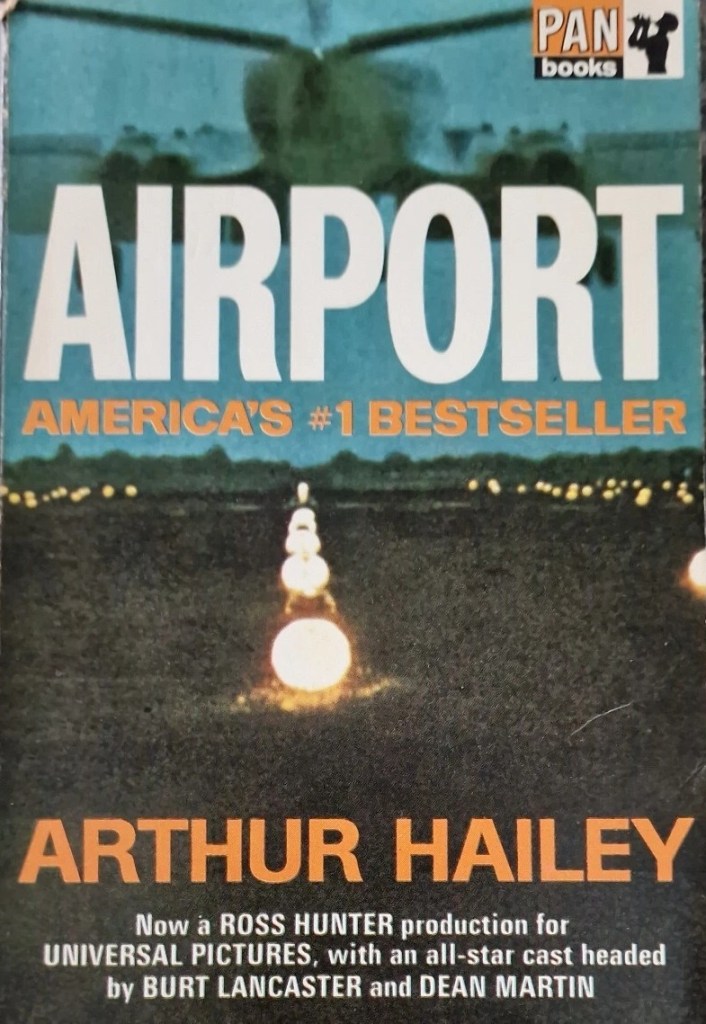
You might think director George Seaton wearing his screenwriter’s hat had his work cut out adapting Arthur Hailey’s 500-page tome for a lean two-hour picture. But Hailey’s book was anything but lean and the fat was easily trimmed away. The author had little idea of dramatic tension and there’s a clear example here that what plays in a novel won’t at all work on screen.
Had Seaton slavishly followed the Hailey template the tension-filled climax of the bomb exploding on the plane and the pilot having to land the stricken plane on an icebound runway would have been interrupted by numb-boring back-and-forth between airport executives and people complaining about planes flying overhead disrupting their lives and the author holding forth on the future of air travel.
A huge chunk of the book is politics one way or another and with the exception of a brief tussle between airport boss Burt Lancaster and his bosses that focuses, unlike the book, on Lancaster’s attempts to keep the runway open, Seaton chucks out all that stuff about townspeople, literally, on the march. Audiences won’t be much interested either in much of what Hailey, in investigative fashion, turns up about cargo loading and the problems facing shoe-shiners and skims over the question of why airports permit insurance agents to so freely operate in an airport, making a healthy living (from which the airport takes a cut) from selling fear to travelers.
It’s interesting, as always, to see what, apart from the obvious as I’ve outlined, a screenwriter doesn’t believe essential. So in the movie Dean Martin’s beef with Burt Lancaster is over the airport’s supposed inefficiency in keeping the runways clear in the face of a snowstorm. But in the book that’s the least of Martin’s concerns, since he’s taken umbrage at this dialing up of the fear factor by selling insurance policies to people about to board a plane.
When you see all those guys and all that heavy-duty equipment trying to clear a path for the airplane grounded in the snow, you think what the heck’s the problem, it’s only a big mound of snow. In the book, the real problem is explained. The plane isn’t stuck in the snow – it’s stuck in the mud underneath the snow, so actually the ground staff have to dig it out of a pretty big hole.
Hailey also takes a detour with the George Kennedy troubleshooter. Instead of getting a police escort to the airport he takes time out to sort out a traffic tangle, demonstrating, for the reader, his unique set of skills, which, sensibly, Seaton reckons will be amply shown when he is doing his job on the runway.
Fourth time unlucky – the series runs out of runway.
There’s a subplot that Seaton eliminates. As well as having a troublesome brother-in-law in Dean Martin, Burt Lancaster has a troublesome brother, so burned out by his job as an air traffic controller that he’s on the verge of committing suicide. But again, Seaton reckons there’s enough going on without over-egging the pudding.
Seaton really comes into his own on the emotional front, having a better notion than Hailey of how to heighten emotion. So there’s no mention that the apparently childless Dean Martin had a previous child from a previous affair – the baby was adopted (a policy airlines encouraged to get stewardesses back to the front line as soon as possible) so the question remains – does he want to be a father? Seaton also brings forward his idea about an abortion. In the book, Burt Lancaster and Jean Seberg have not consummated their affair, but Seaton makes it implicit in the film that they have. Also Hailey reveals from the start that Lancaster’s wife is already playing away from home but Seaton holds that knowledge back so there’s an emotional twist in the film.
What Seaton adds is just as demonstrative of the screenwriter’s skill. Not in the book: the nun, the priest, the bolshie passenger and the know-it-all teenager. These are Seaton inventions. Seaton also builds up Lancaster’s wife as coming from a wealthy family rather than being a failed actress. And he brings to the fore the women who are the casualties of male weakness, Dean Martin’s wife discovering his girlfriend is pregnant, the bomber’s wife realizing what he has done, Lancaster’s wife confronting him.
Although Hailey spends acres of print going on about the problems low-flying planes cause he doesn’t actually show their impact. Seaton cuts right to the chase, opening with a scene of plates and stuff crashing to the floor in a house as a plane flies overhead. And in scenes of the snowplows sending snow wafting through the air the director in Seaton turns what Hailey described as a “conga line” into a ballet
One other element – in the book the Burt Lancaster character has a limp. Movie heroes don’t limp.
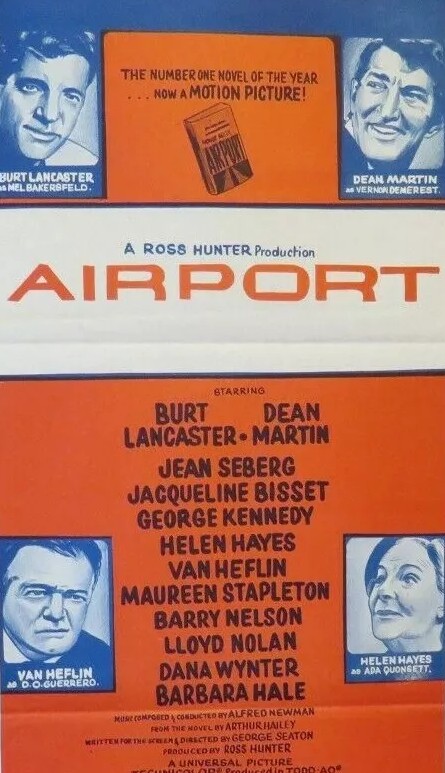
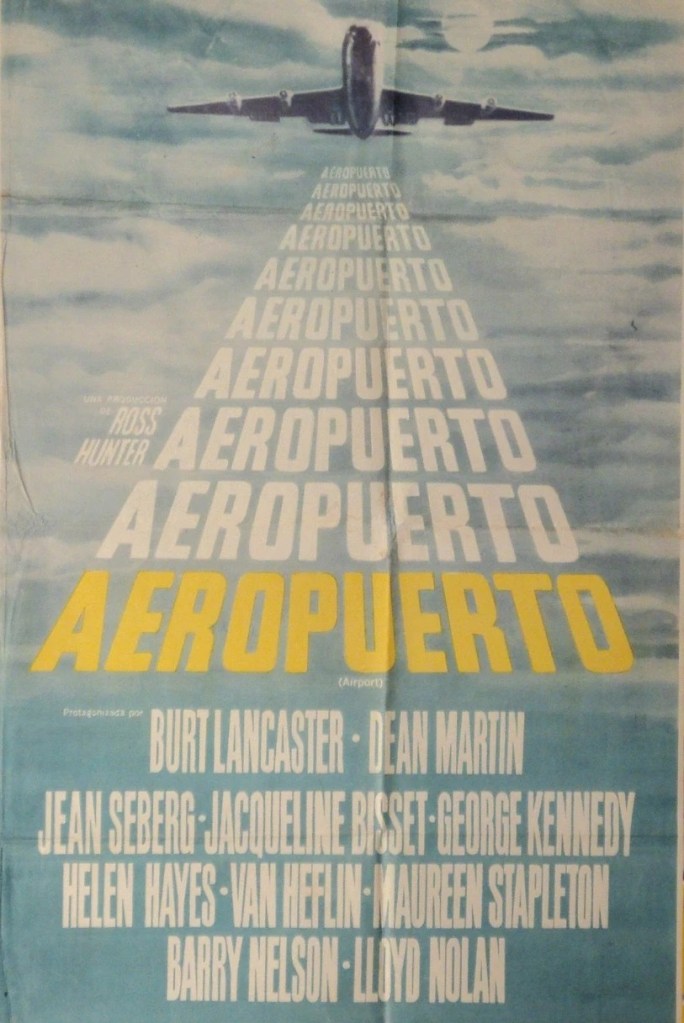
Ross Hunter had been a big wheel in the production business for the best part of two decades, shepherding home hits like Midnight Lace (1960), remakes of universal weepies like Back St (1961) and Madame X (1966), play adaptations such as The Chalk Garden (1964), the Tammy movie series and Julie Andrews musical Thoroughly Modern Millie (1967). He was as close to a sure thing as you could get. Even so, Airport, with a $10 million budget, was the biggest gamble of his career.
He paid $350,000 upfront plus another $100,000 in add-ons for the rights to the runaway Arthur Hailey bestseller. Initially, Hunter was targeting the roadshow audience, filming in 70mm, the first time Universal had employed Todd-AO.
Dean Martin, who had made Texas Across the River (1966) and Rough Night in Jericho (1968) for Universal, was first to sign up for his usual fee plus a percentage. Martin was at a career peak, carried along effortlessly at the box office by the Matt Helm quartet and targeted for westerns.
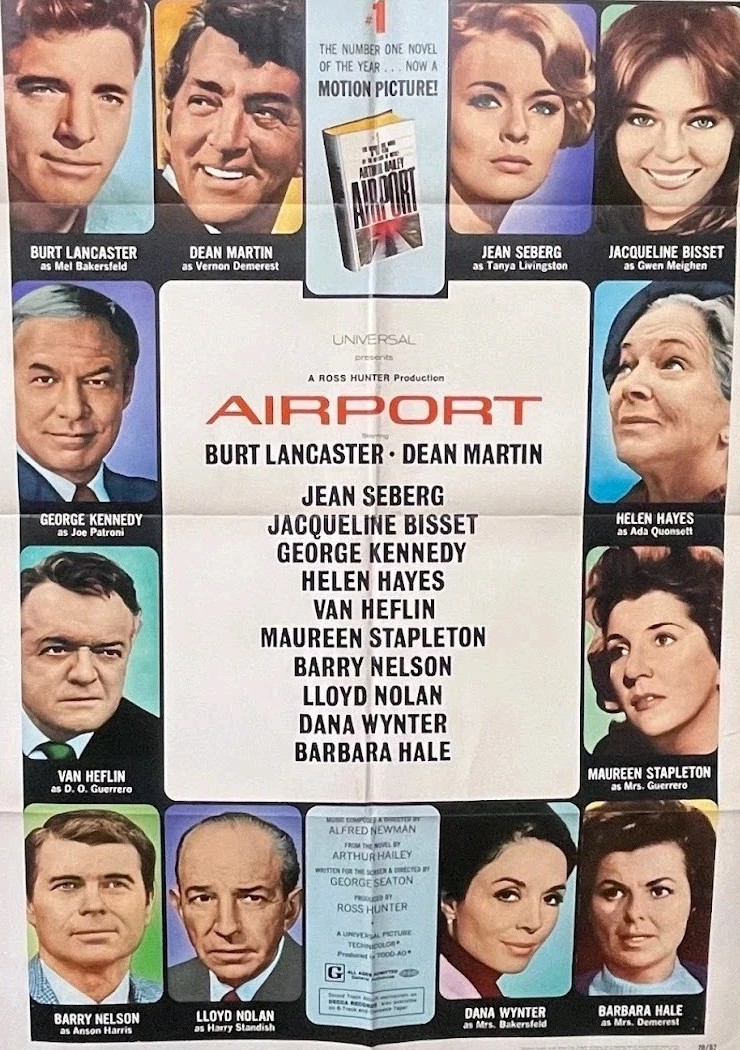
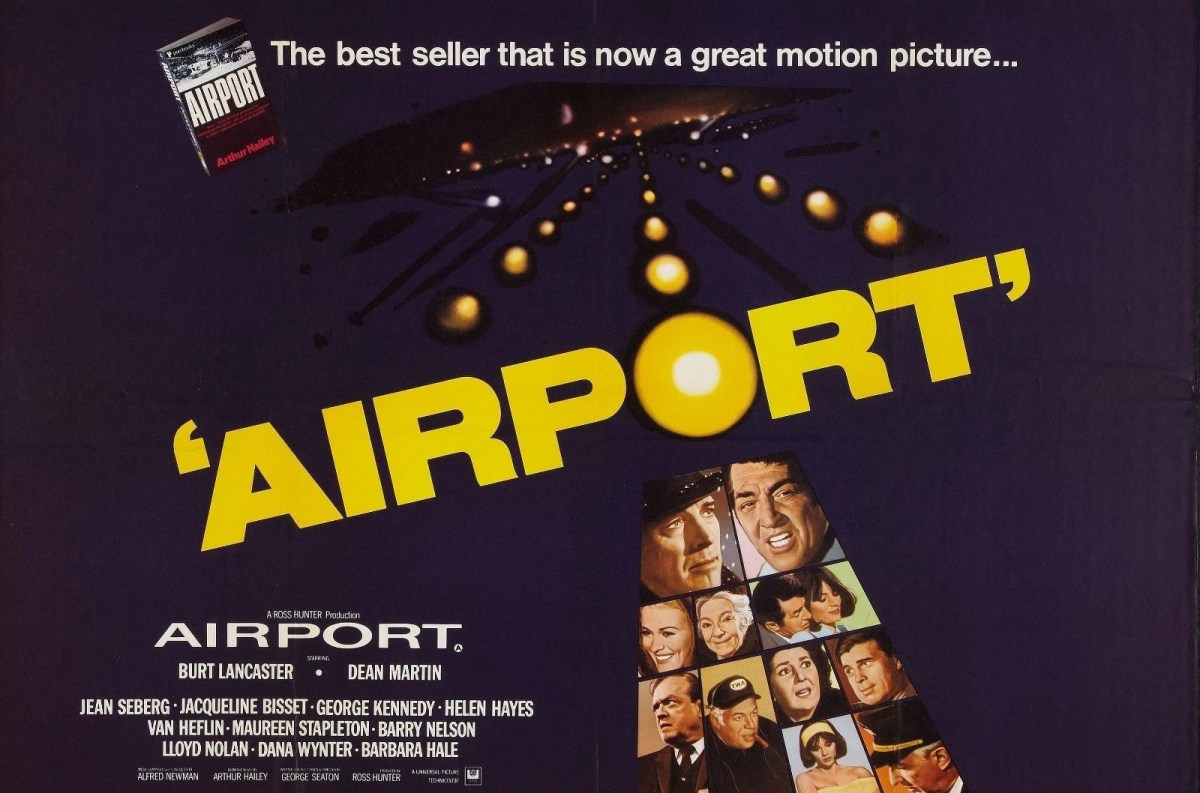
Hunter was pitching a movie with four major stars in Oscar-winner Burt Lancaster (Elmer Gantry, 1960), Dean Martin, Jean Seberg (Paint Your Wagon, 1969) and Oscar-winner George Kennedy (Guns of The Magnificent Seven, a1969) and another half-dozen names of varying marquee appeal that included British actress Jacqueline Bisset (Bullitt, 1968), and mature stars in Van Heflin (Once a Thief, 1965), Lloyd Nolan (The Double Man, 1967), Barry Nelson (The Borgia Stick, 1967), TV Perry Mason’s Barbara Hale and Oscar-winner Helen Hayes (Anastasia, 1956).
The picture came at a fortuitous time for Burt Lancaster. A trio of more challenging movies – The Swimmer (1968), Castle Keep (1969) and The Gypsy Moths (1969) – had flopped, so his marquee value was in question, especially at his going rate of £750,000 (plus a percentage). Doubts had set in with The Gypsy Moths, with MGM dithering over the opening date, switching it originally from summer to Xmas and then back again but happy to censor the picture to meet the approval of the Radio City Music Hall where it premiered.
And while he was still clearly in demand in 1968-1969, he had lost out the starring role in Patton (1970) with James Stewart in the Karl Malden role, which would have coupled commercial success with critical approbation. The shooting of Valdez Is Coming (1971) was postponed for a year. Originally it had been set for a January 1969 start date with Sydney Pollack directing. Face in the Dust, a Dino De Laurentiis production, never saw the light of day.
And although Lancaster later described Airport as “the biggest piece of junk ever made” (luckily he didn’t live to see Anora or Mercy), the disaster blockbuster put his career back on track. It was quite a change of pace for him, too. He wasn’t in every scene and at times he had to take whatever Dean Martin’s character threw at him. But what he brought to the picture was his natural electricity, the tension of never knowing what he was going to do. But Airport barely merits a page in Kate Buford’s biography.
Double Oscar-winner George Seaton was set the dual task of condensing Arthur Hailey’s 500-page novel into a lean two-hour movie which he would direct. In a directing career spanning a quarter of a century, Seaton was well-used to handling big stars of the caliber of William Holden (three pictures including The Counterfeit Traitor, 1962), Bing Crosby and Grace Kelly (The Country Girl, 1953) Kirk Douglas (The Hook, 1962), Montgomery Clift (The Big Lift, 1950) and Clark Gable and Doris Day (Teacher’s Pet, 1958),
Jean Seberg, under investigation by the FBI, had revived an ailing career with Paint Your Wagon (1969). Producer Ross Hunter initially preferred Angie Dickinson (Jessica, 1962) or Stella Stevens (Rage, 1966) for the role of Lancaster’s screen lover, but had to go along with Universal with whom Seberg had a two-picture “pay-or-play” deal (she got paid whether she made a picture or not). However, she was considered a marquee name in the international market, especially France where she had remained a cult figure after Breathless (1960).
Disconcerted by being considered unwanted, her natural nervousness increased until Hunter made a point of convincing her that he was “genuinely happy” at her involvement.
She wasn’t the only person to be considered second best. For the part of the elderly stowaway, six-time Oscar nominee Thelma Ritter (Boeing, Boeing, 1965) and Jean Arthur, who hadn’t appeared in a movie since Shane (1953), had been wooed before Hunter settled on Helen Hayes.
For Seberg, it was the biggest pay cheque of her career – $150,000 plus use of a studio car and $1,000 a week expenses for the 16-week schedule, but she lost out on a percentage. She was billed third. High-flying her career might be, but personally she was struggling, her marriage to Romain Gary in trouble and under pressure to help raise funding for the Black Panther movement. She was receiving calls in the middle of the night. “Many nights she’d be so frightened, she’d come and sleep on the couch at my home,” recalled Hunter, “there’s no doubt it was an extremely difficult period for her.”
Helen Hayes reminded Seberg of her grandmother, to whom the stowaway’s exploits would have appealed. As a teenager, Seberg had idolized Hayes. Dean Martin pushed for Petula Clark (Goodbye, Mr Chips, 1969) for the Jacqueline Bisset role and Stella Stevens (Rage, 1966), as well as being considered for the Seberg part, was also in the frame.
Virtually all the bit parts were played by Universal’s contract players. For Airport, the studio rounded up thirty-two of them. Patty Paulsen, who played stewardess Joan, was a genuine stewardess for American Airlines before she won the role on the strength of winning a beauty contest. It was veteran Van Heflin’s final picture, and also for composer Alfred Newman. George Kennedy would reprise his role through three other pictures in the series – though he turned down Airplane! (1980).
Location filming at Minneapolis-St Paul International Airport began in January minus director George Seaton who had come down with pneumonia. Henry Hathaway stepped in, at no cost, to cover. The producer had headed to Minnesota for the snow, but there was none around, and the production team had to import tons of fake stuff made out of whitened sawdust. Filming took place at night in plunging temperatures. Despite wearing face masks, cast and crew suffered and the freezing conditions slowed down the shoot.
Hunter hired a $7.5 million Boeing 707 for $18,000 a day. For studio work in Los Angeles Hunter brought in a damaged Boeing. Ironically, Dean Martin had a fear of flying and travelled to the location by railway. Ditto Maureen Stapleton.
Seberg’s outfits, including calfskin sable-lined coats designed by Edith Head, cost $2,000 apiece, though Seberg was less keen on the airport uniform. With Seberg’s hometown less than a five-hour drive away she was able to head home during breaks in filming.
John Findlater, who played a ticket checker in the film, remembered Seberg as “frail and lonely…very shy…she had a very hard time of it.” It took four days to film the scene where Helen Hayes explains the art of the stowaway and feels the brunt of the wrath of Burt Lancaster and Seberg. Delays always niggled Lancaster, for whom they smacked of unprofessionalism. To raise her spirits, Seaton improvised little comedy skits.
Seberg befriended Maureen Stapleton, playing the bomber’s wife. Seberg was “impressed” that Stapleton could cry on cue and the minute the scene was over be laughing.
In the end Hunter gave up the idea of a prestigious roadshow run, settling instead for a premiere opening at the Radio City Music Hall and first run houses across the country. There had been no shortage of pre-publicity. Any time an airplane hijack hit the headlines or a snowstorm shut down airports or an airplane skidded off the runway, editors were happy to insert a mention of the picture.
And there was an abundance of airports and travel companies willing to sign up for cooperative promotions, helped along by the fact that Edith Head had designed the “Airport Look” launched not just with male and female fashions but a range of travel accessories. A beauty queen competition “International Air Girl” managed to hook a 45-minute television slot in Britain.
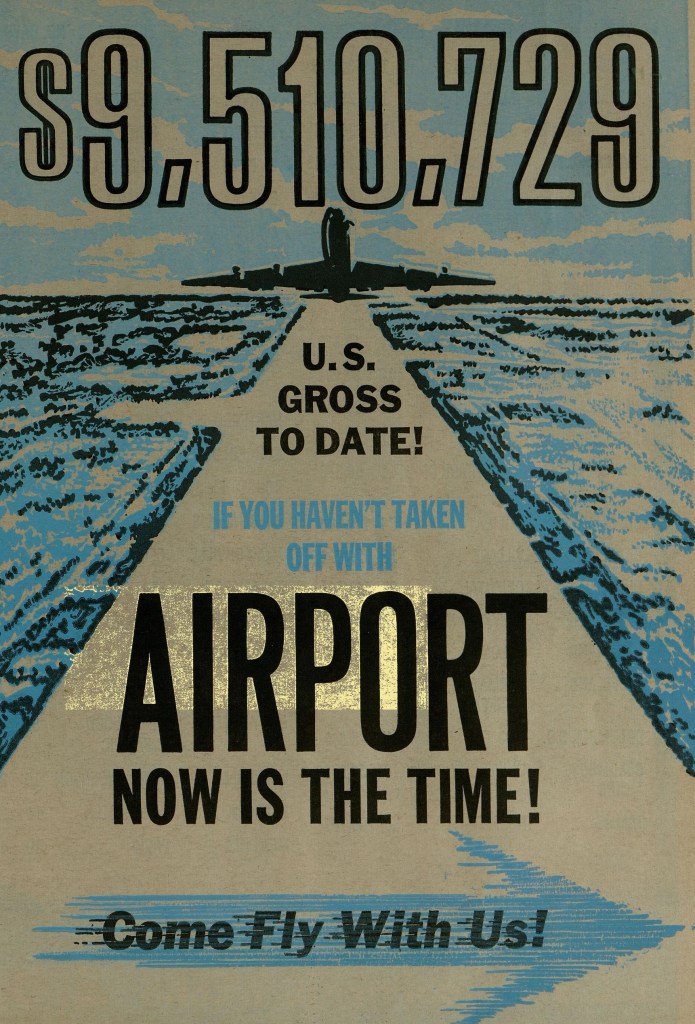
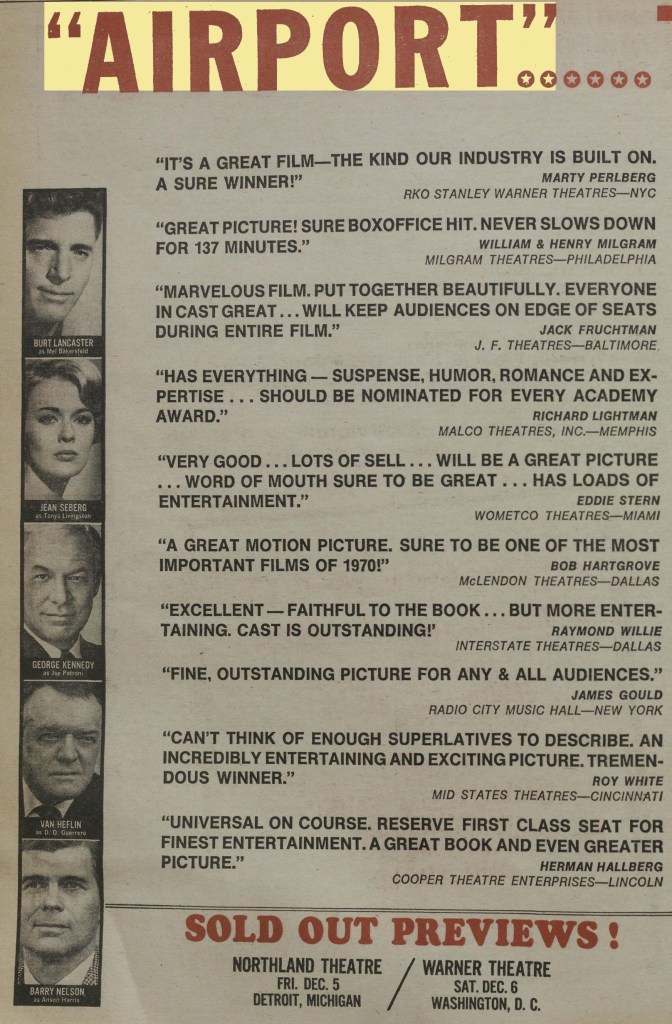
Opening at the Radio City Music Hall in New York, a couple of weeks in advance of the national roll-out, Airport plundered a record $235,000, topping that in its second week, and scooping up $1 million before the end of the month. It was gangbusters everywhere, opening in prestigious first run locations, with nary a showcase/multiple run in sight. “Wham” was the description beloved of the Variety box office headline writers, the word preceding its $80,000 opening week tally in Chicago, $28,000 in San Francisco, and $25,000 in Louisville. “Smash” was also brought into play for its $40,000 in Baltimore and $33,000 in Philadelphia. The subject matter allowed the sub-editors who wrote the headlines some license, so it was a “sonic” $40,000 in Boston and a “stratospheric” $45,000 in Detroit. And it had legs. Week-by-week fall-offs were slight. It was still taking in $25,000 in the 24th week in Detroit, for example.
By year’s end it was easily the top film of the year with $37 million in rentals, way ahead of Mash on $22 million and Patton $1 million further back. And it kept going, adding another $8 million the following year as it was dragged back into the major cities for multiple showings (seven in New York) in multiple engagements.
Business was not so robust abroad. Though Airport managed a six-week run at the Odeon Leicester Square, where it received a Royal Premiere on April 22, 1970, its opening week’s figures were down on both the final week of its predecessor at the London West End cinema, Anne of the Thousand Days, and its successor Cromwell and the film didn’t make the Annual British Top Ten. But in Australia it led the field, though its returns were one-third down on the previous year’s Paint You Wagon and Butch Cassidy and the Sundance Kid.
For its television premiere on ABC in 1973, the network demanded a record $140,000 per minute for advertising. Outside of Gone with the Wind, it earned the highest rating of any movie from 1961 to 1977.
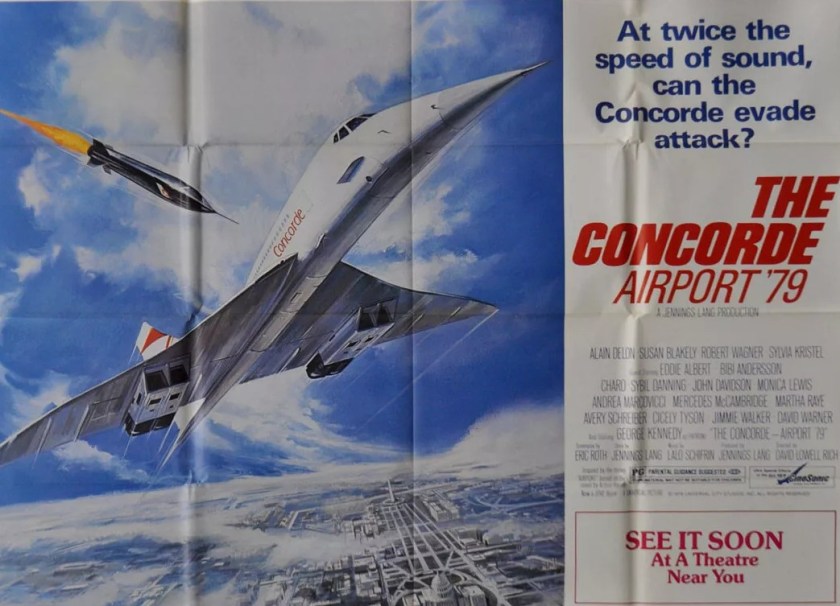
But it also set up an industry. Sequels were the name of the game. And though Airport ’75 (1974) headlining Charlton Heston and Airport ’77 (1977) starring Jack Lemmon were cut-price operations, they were huge successes at the box office, the former hauling in $25.8 million in rentals, the latter $16.2 million. A fourth venture, The Concorde…Airport ’79 (1979) with Alain Delon, flopped and put an end to the series.
SOURCES: Garry McGee, Jean Seberg, Breathless, 2018, p167-171; Kate Buford, Burt Lancaster, An American Life (Aurum Press, 2008) p264-265; “Cast Patton & Bradley,” Variety, September 20, 1967, p13; “Airport Film Deal,” Variety, May 29, 1968, p60; “Steiner at Goldwyn Plant,” Variety, July 24, 1968, p7; “Dean Martin First to Sign for U’s Airport,” Box Office, August 5, 1968, pK4; “Hollywood Happenings,” Box Office, January 6, 1969, pW2; “Airport Will Be U’s First Feature in Todd-AO,” Box Office, January 13, 1969, p12; “Seaton’s Temp Sub at U: H. Hathaway,” Variety, January 22, 1969, p7; “Airport Sequence Follows Real Event,” Box Office, January 27, 1969, pNC3; “17 Inches Snow Brings North East Business To Complete Standstill,” Box Office, February 17, 1969, pE1;“Ross Hunter’s Roadshow,” Box Office, April 28, 1969, pK2; “De Laurentiis Slates 3 Aussie Locationers,” Variety, September 24, 1969, p18; “Put Back Moths Scenes Cut Solely for Radio City,” Variety, October 22, 1969, p5; “Airport Smacks $1-Mil,” Variety, April 1, 1970, p4; “Airport Contest on TV,” Kine Weekly, April 18, 1970, p18; “Big Rental Films of 1970,” Variety, January 6, 1971, p11; “Encore Hits,” Variety, June 16, 1970, p5; “ABC Flying 140G Per Minute for Airport,” Variety, June 27, 1973, p14; “Hit Movies on TV Since ’61,” Variety, Sep 21, 1977, p70; “All-Time Film Rental Champs,” Variety, May 12, 1982, p5. U.S. weekly box office figures – Variety, March-April 1970; U.K. weekly box office figures, Kine Weekly, April-July 1970.
Thundering entertainment from an era when they made movies to appeal to audiences and not to placate the overweening ego of over-entitled directors. I first saw this in 1970 when it was selected as one of three films (the others being Cromwell and The Virgin and the Gypsy) to open the new Odeon triplex in Glasgow, and, thanks to my own in-built movie snobbery, haven’t seen it since. So this was a revelation.
Let’s start with the running time. Made now this would be an overblown 150 minutes (at least) stuffed full of extraneous scenes. But let’s start with the opening. The screen is dark. Yes, absolutely dark. What? Is this some kind of arthouse venture? And it remains dark for about 20 seconds though by now sound has been added, a general hubbub of commotion. Are you sure this isn’t arthouse? Had this been directed by Scorsese or Coppola (who, in fact, used a similar device to open The Godfather, 1972) critics would have picked it up.
John Frankenheimer for Grand Prix (1966) and Norman Jewison for The Thomas Crown Affair (1968) were praised for their use of the split screen, another aspect ignored here by critics. Yet split screen is not only impressively utilized, but, on occasion, it has a humorous quality, as the screen not only splits in two but accommodates other shapes in between or round about. Did anyone mention the use of the wipe? A cinematic technique scarcely employed in the mainstream since Seven Samurai (1954).
Several narrative plates regarding relationships spin in the air while the movie sharpens focus to concentrate on resolving three major incidents involving airplanes. The first is shifting a jet stuck in the snow during a huge snowstorm and blocking off one entire runway. The airport is already under pressure, what with the storm curtailing other flights and forcing others to dive for cover. Then we have a bomber, planning to wreck the plane mid-ocean to claim on the insurance, but when his plan goes awry and he blows out the toilet of the plane, the crew have to bring it down, safety jeopardized by the jet stuck on the ground.
You always know how disaster pictures are going to end, maybe the only guesswork concerns who will actually survive, and it’s an incredible credit to this movie that I felt the tension constantly rippling through me as we hit the various climactic episodes.
On the ground airport manager Mel (Burt Lancaster) is trying to shift the stuck aircraft while dealing with irate wife Cindy (Dana Wynter) and keeping on track his illicit relationship with PR manager Tanya (Jean Seberg). This is on top of a) wrangling with an airport executive who refuses to expand the airport to meet overwhelming demand and whose only reaction to impending crisis is to close the airport down, b) dealing with local citizens furious that plans are rattling their houses, and c) taking flak from brother-in-law and ace pilot Vernon (Dean Martin).
Up in the air Vernon has his work cut out coming to terms with the pregnancy of girlfriend Gwen (Jacqueline Bisset) – always having used his marriage as an excuse not to get emotionally involved with his string of girlfriends – and with a 70-year-old stowaway Ada (Helen Hayes) and bomber D.O. Guerrero (Van Heflin) and then bringing in the stricken plane.
We’re tossed a few red herrings on the passenger manifest. Spot a nun and a priest in a disaster picture and you’re generally in for cliché overload. Here, instead, they are used for humor, the nun taking a swig of whisky under pressure and the priest whacking a belligerent passenger. And the charming Ada is on land given very sympathetic treatment given the thousands of dollars she’s conned out of airlines over the years, but that’s only to set her up for some harsh treatment on board.
There’s an unexpected twist with the bomber. For a few minutes it looks like the crew are going to win the day but then calamity strikes. Meanwhile, on the ground troubleshooter Joe (George Kennedy), huge cigar constantly in place in the mouth, has taken charge of shifting the stuck plane and in the end has to take drastic action.
And in little telling snippets director George Seaton plays fair with the wives who lose out, Mrs Guerrero (Maureen Stapleton) and Mrs Demerest (Barbara Hale) while allowing Mrs Bakersfield to deliver a come-uppance to her errant husband – she’s been playing away too.
The decision to pack this full of more genuine stars than you ever got in a roadshow – mostly the cast list was padded out with newcomers or stars past their best (Lawrence of Arabia, 1962) – reversed this with genuine stars in supporting roles and newcomers in the leading roles) Both Oscar-winning Burt Lancaster (The Professionals, 1966) and Dean Martin after the Matt Helm series and a bunch of westerns were genuine top-notch marquee names. Jean Seberg had just hit a career box office high with Paint your Wagon (1969). After Bullitt (1968) Jacqueline Bisset’s star was on the rise. Oscar-winner George Kennedy (Cool Hand Luke, 1967) was top-billed in Guns of The Magnificent Seven (1969).
And there was a heck of a strong supporting cast: Van Heflin (Once a Thief, 1965), Dana Wynter (Sink the Bismarck!, 1960), Barbara Hale (Perry Mason series, 1957-1966). Oscar-winner Helen Hayes (she won in 1932) and Maureen Stapleton (Bye, Bye, Birdie, 1963) proved the pick, the former here winning a second Oscar, the latter nominated. Apart from Van Heflin, Seaton had gone for character actors rather than stars – Wynter hadn’t made a movie in a decade, for Stapleton it was seven years, for Hayes 14 years and Hale one film in over a decade.
You’d be laughed out of town these days if (outside of sci-fi) you tried to saddle a star with chunks of exposition or technical detail, but here the force of the screen personalities of Lancaster, Martin and Kennedy makes you hang on their every word.
They didn’t have prizes in those days for ensemble acting, but if they had this would surely be in contention, as director George Seaton, in his capacity as screenwriter, ensures that no one is left out and even if it’s only with a look we learn everything we need to know about a character’s emotional life.
Given this was – to use Christopher Nolan’s favorite phrase – “shot in camera” this is a terrific technical achievement in terms of the airplane action especially the stuck plane trying to hirple it way out of trouble.
Director George Seaton (36 Hours, 1964) took ill during production and exterior sequences were filmed by Henry Hathaway (True Grit, 1969). A mention, too, for the driving score by Alfred Newman, in his last screen assignment. It was nominated for 10 Oscars including Best Picture.
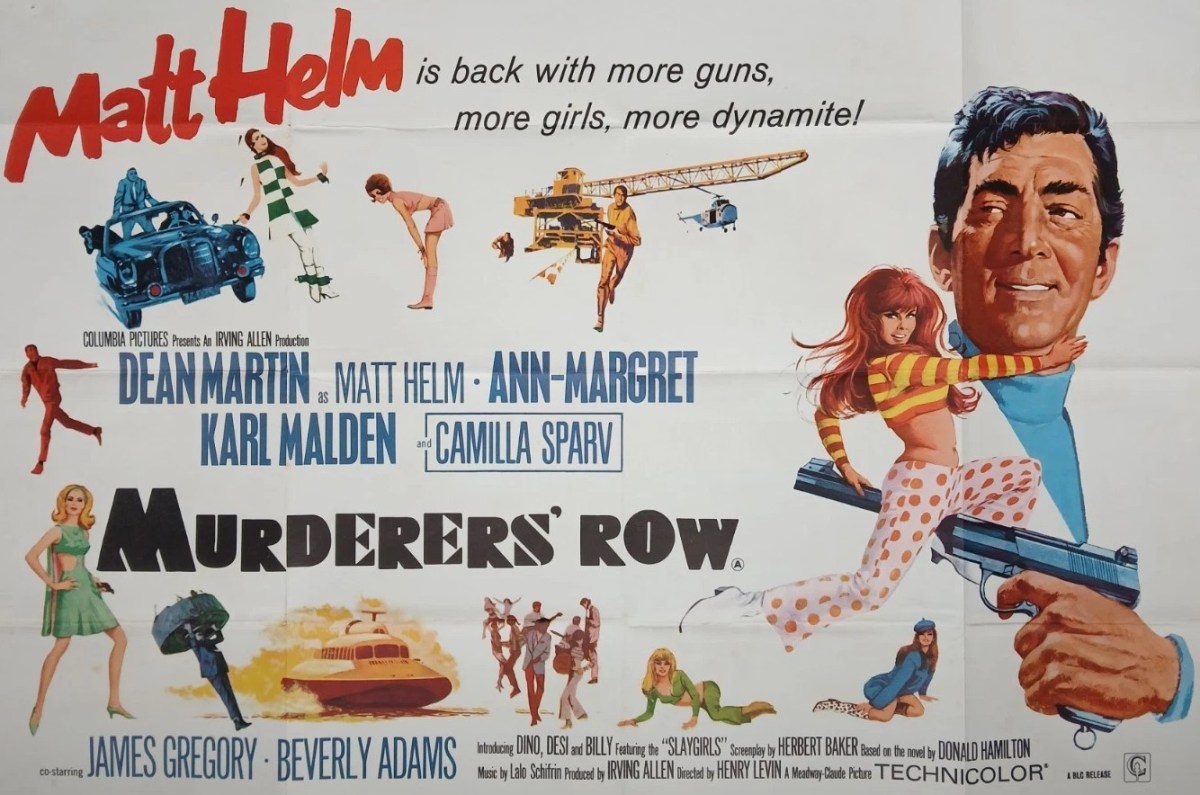
Chucklesome brew. It’s easy to get wrong idea about the Matt Helm series, what with the onslaught of girls in bikinis, a hero majoring in seduction and madmen wanting to take over the world. You could be hoodwinked into thinking this had something to do with espionage rather than a platform for the non-stop delivery of deadpan one-liners and wry visual gags. The star prevents anyone taking anything seriously with a rat-tat-tat quip a minute. The plot’s hooey and the female stars scarcely register. But who cares. The audience has buckled up for a fun ride.
Apart from the dialog the narrative is distinctly lazy. Assuming it’s what audiences want, the action takes time out to note parades of passing girls in bikinis and occasionally stops dead should there be the opportunity to watch youngsters dancing wildly. With humor to the fore, you could probably have gone for a dozen other storylines as good – or bad – as this one and nobody would have noticed.
Matt Helm (Dean Martin) is forced to interrupt photographing a bevy of beautiful girls in order to save the world from madman Julian Wall (Karl Malden) who plans to use the power of the sun to destroy Washington D.C. “Operation Scorch” relies on the brain of scientist Dr Solaris (Richard Eastham), who has been kidnapped to persuade him to hand over his formula.
This takes Helm, masquerading as a Chicago mobster, to Monte Carlo where he almost immediately faces a charge of murder. Tracking down Wall and his squeeze Coco (Camilla Sprav) proves easy. In rather desultory fashion Helm hooks up with local beauty Suzie (Ann-Margret) and until we discover that her father is Solaris her presence is mostly redundant as, for once, neither love nor lust is in the air.
Like any self-respecting madman Wall hangs out on an island where he is putting the final details to his plan and torturing Solaris. With Suzie in his wake, Helm easily infiltrates the rather desultory hideout, is captured, Solaris surrenders the secret formula once his daughter is threatened, and Suzie comes into her own by disabling the infernal machine by the simple device of a hairpin. This leads to a rather desultory happy ending.
I’m not entirely sure why Ann-Margret chose this vehicle, since she is called upon to do very little except shake her trademark booty. If she had gone up in critical estimation after her turns in Once a Thief (1965) and Stagecoach (1966) she plummeted back to earth here. You could say the same for Camilla Sparv – all the hard work in gaining reasonable notices for The Trouble with Angels (1966) and especially heist thriller Dead Heat on a Merry-Go-Round (1966) undone. She has even less to do than Ann-Margret. Eye candy is too good a word for them and they are unfairly underused.
Karl Malden (Nevada Smith, 1966), who usually attempts to humanize his characters, avoids that idea and goes straight for cartoon villain.
So it’s left to Dean Martin to keep the enterprise afloat which he does with tremendous chutzpah. As well as the verbal drollery there are some excellent visual gags, including the use of a giant magnet to render defenseless menacing thug Ironhead (Tom Reese), so called because has a large metal plate on his skull. Virtually every line produces a rejoinder from Dean Martin, and that lightness of delivery matches the souffle nature of the picture, a sequel to The Silencers (1966), both big box office hits.
Director Henry Levin (Genghis Khan, 1965) gives himself no airs or graces, sensible enough to stick the camera on Dean Martin and let him do the rest. Written by Herbert Baker (Hammerhead, 1968) from the bestseller by Donald Hamilton.
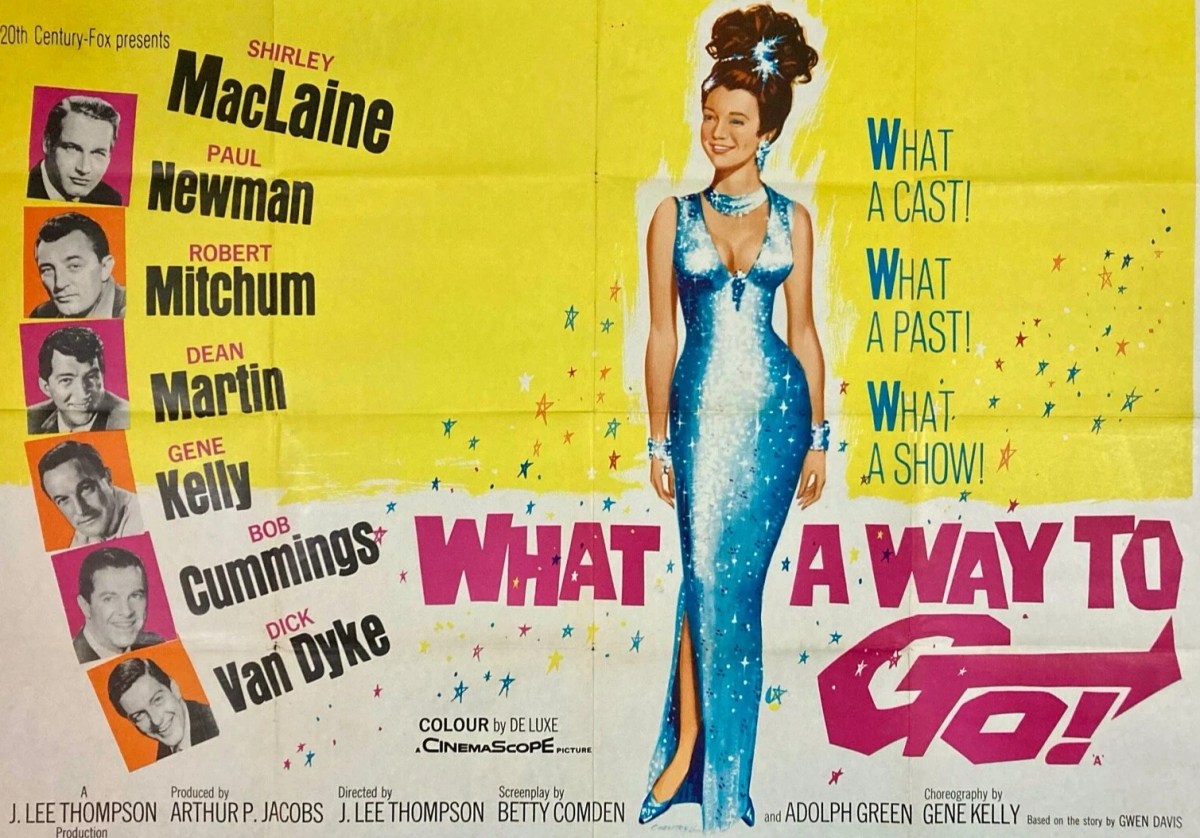
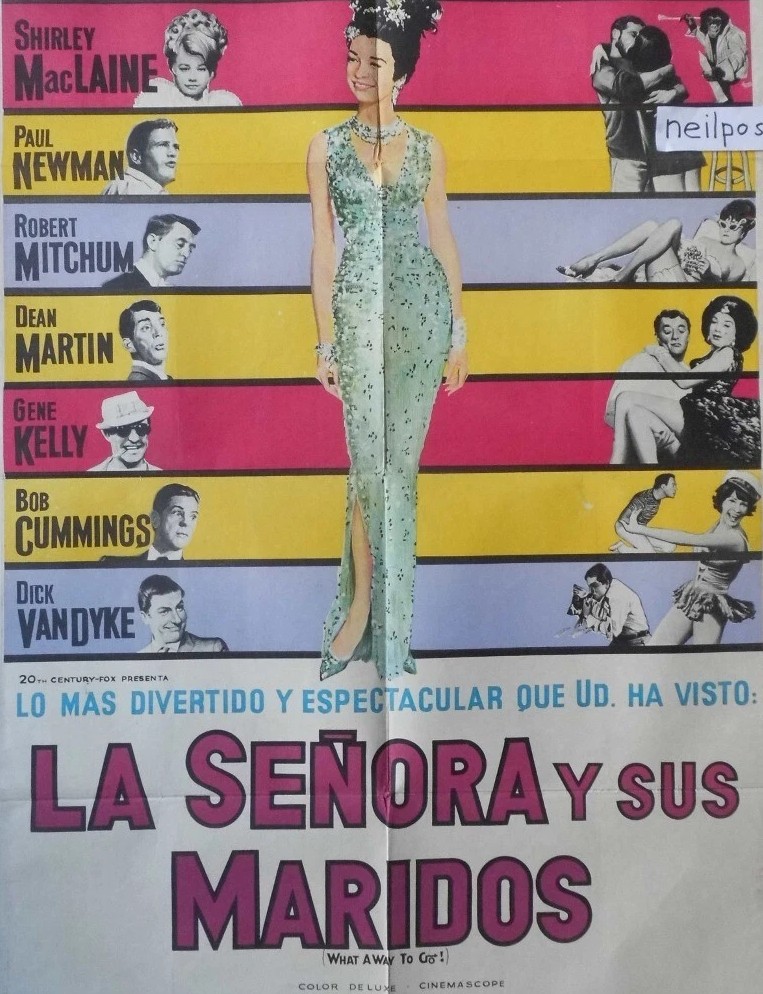
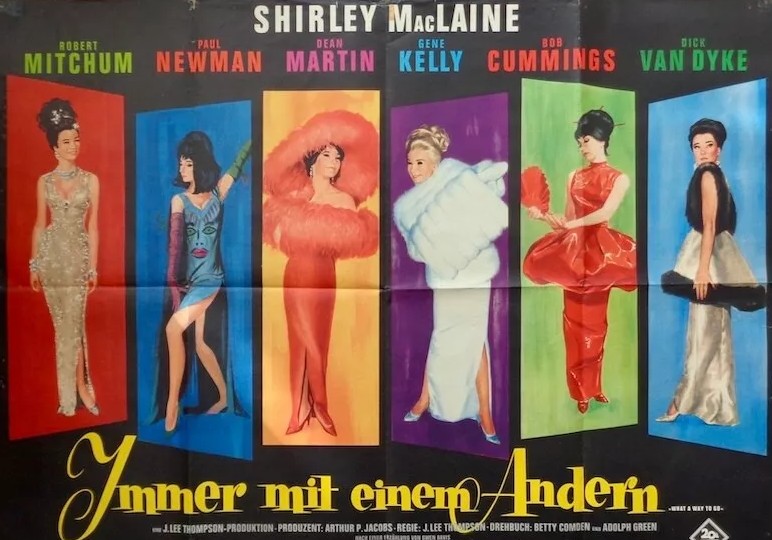
Daftest picture I’ve ever seen. Not the funniest, not by a long chalk, but highly enjoyable if you go with the flow and let wash over you the deluge of costume changes, the satire-a-go-go, a smattering of slo-mo and fast-mo, the worst fake beards and moustaches, and sanctimonious Hollywood rubbish that money isn’t everything and we should all be hankering after the Henry Thoreau approach to life. So wacky and far-out that if it had been made today J. Lee Thompson (The Guns of Navarone, 1961) would be in with a shout of being hailed as a “visionary” director.
The all-star cast snookers you in. Everyone acts – or should that be over-acts – against type, even Shirley MacLaine (Gambit, 1966), casting aside her ditzy screen persona in favor of sense and sensibility. The generally hapless Dick Van Dyke (Divorce American Style, 1967) demonstrates what happens when his manic energy is put to purpose. Add more or less top hat and tails to the commanding stride and imposing figure of Robert Mitchum (The Way West, 1965) and he could grace boardrooms with a venom the participants in Succession would envy. Dean Martin (Rough Night in Jericho, 1967) explores his villainous side. and you do wonder what would have happened to these stars’ careers had studios taken note of these side hustles, only Dean Martin would have the opportunity to tackle a similar character, though less cartoonish, again.
And it’s loaded with visual gems. J. Lee Thompson’s version of The Incredible Shrinking Man/Honey, I Shrunk the Boss is a treat. Watch out for the rows of secretaries slumped over their typewriters, Dick Van Dyke swamped by money, a drunken farmer trying to milk a bull, and contemporary sci-fi fans would dig the machines going crazy. That’s not to forget the monkey not just painting masterpieces but expecting applause on completion. There are spoofs galore – the contemporary (1960s) art scene, the musical, the wealth that opens doors and cannot ever be shut down no matter how hard you try.
Essentially a portmanteau as perennial widow Louisa (Shirley MacLaine) explains to a psychiatrist Dr Stephanson (Bob Cummings) how her four husbands met their demise. Louisa, daughter of a grasping greedy mother and ineffectual father, yearns for the simple life, far removed from the trappings and temptations of money. Ruthless businessman Leonard (Dean Martin) wants to marry her for the simple reason that she’s the only lass in town who doesn’t want to marry him.
Instead she marries financially-challenged Edgar (Dick Van Dyke) who discovers, much to his surprise and her annoyance, that he has a good business brain, enough to drive Leonard into the ground and ignore his new wife, until he drops dead due to the pressures of wealth. Next up is Parisian artist Larry (Paul Newman) whose biggest attraction is his poverty and simple lifestyle. Unfortunately, he could be Dick Van Dyke in disguise having invented a wacky machine that will do all the painting for him. Unfortunately, that makes him rich and leaves Louisa home alone once again until the machines take revenge on their creator.
Billionaire Rod (Robert Mitchum) is so taken with Louisa that he determines to get rid of his fortune only to discover that even when left unattended money just grows. Eventually, he sells up and becomes a happy, if inebriated farmer, but, unfortunately, can’t tell a cow from a bull and ends up dead.
Last up is another impoverished character clown Pinky (Gene Kelly) whose nightclub act is a stinker until he discovers his dancing feet. Once he passes, it’s full circle as Louisa again encounters Leonard, now impoverished and repentant, and marries him and they settle down. There’s a fine twist at the end when wealth once again beckons.
Shirley Maclaine doesn’t have to do a great deal except hold it together and wear a hundred costumes. Robert Mitchum is the pick but Paul Newman (The Hustler, 1961) is to be applauded for sending up so riotously his screen persona. And it could easily have degenerated into a lazy spoof, the actors giving nothing at all. Instead, once it gets going it’s just huge fun.
J. Lee Thompson displays an inventiveness not seen before. This works because it is so indulgent. Written by the team of Betty Comden and Adolph Green (Bells Are Ringing, 1960) from the bestseller by Gwen Davis.
Critics slammed it but audiences lapped it out. I was in both camps. Started out hating it, ended up adoring it.
Complication. The keenest weapon in the screenwriter’s armory. And the most overused and, conversely, not employed to its greatest potential. Generally, it’s the only device for a romance – boy meets girl, (enter complication as…) boy loses girl, boy gets girl. But, just occasionally, it appears with some skill, layer after layer of deft complication until a whole story is tied up in acceptable and believable knots.
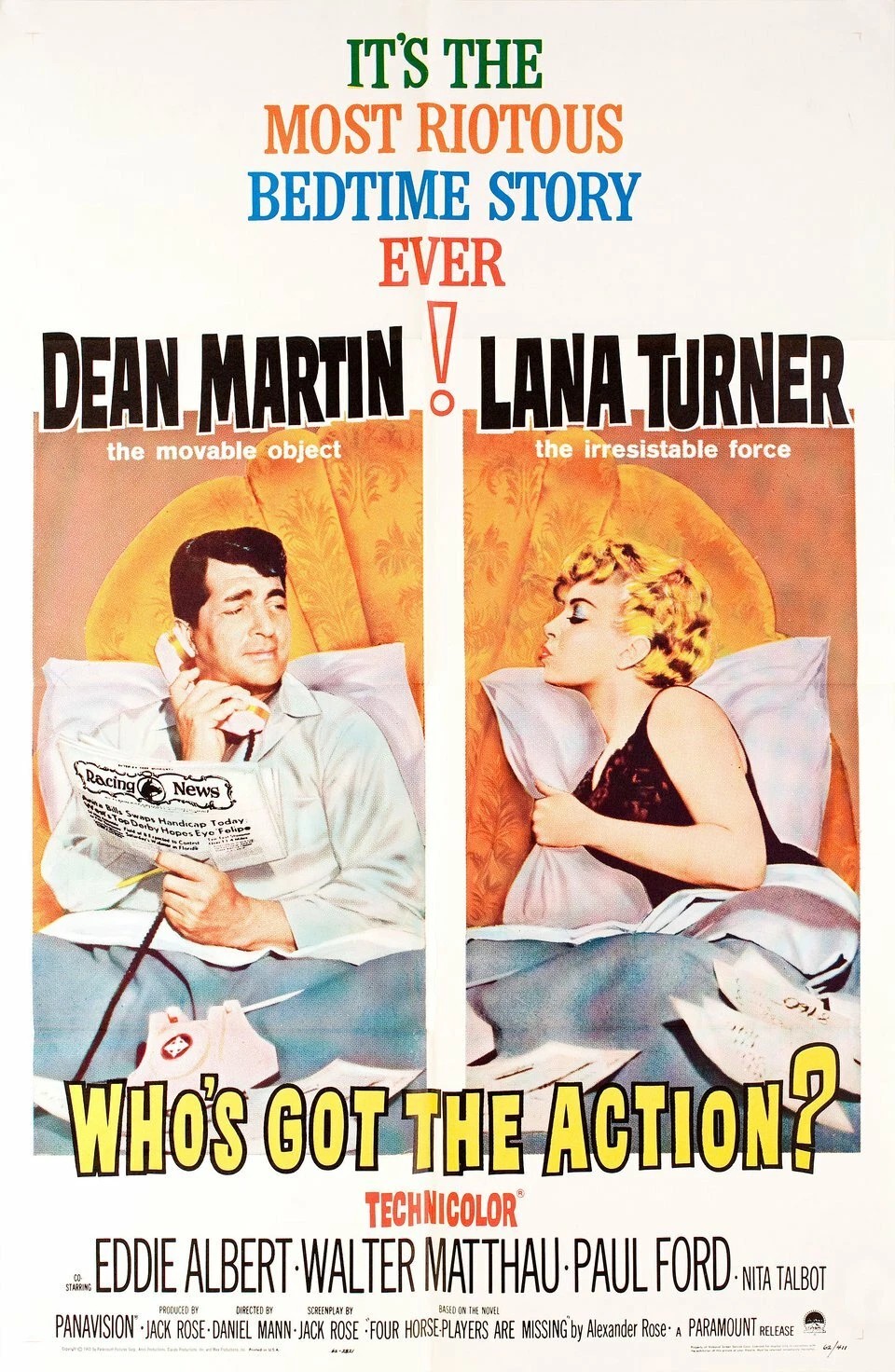
Before we get into all that it’s worth pointing out how language changes. These days mention of “action” will carry connotations of a sexual nature, so, just to be clear, here we’re talking about gambling, betting on horses, the mythical sure thing. And if you want to take a more cosmic perspective, we can apply the scientific rule that every action has a re-action, in other words consequence.
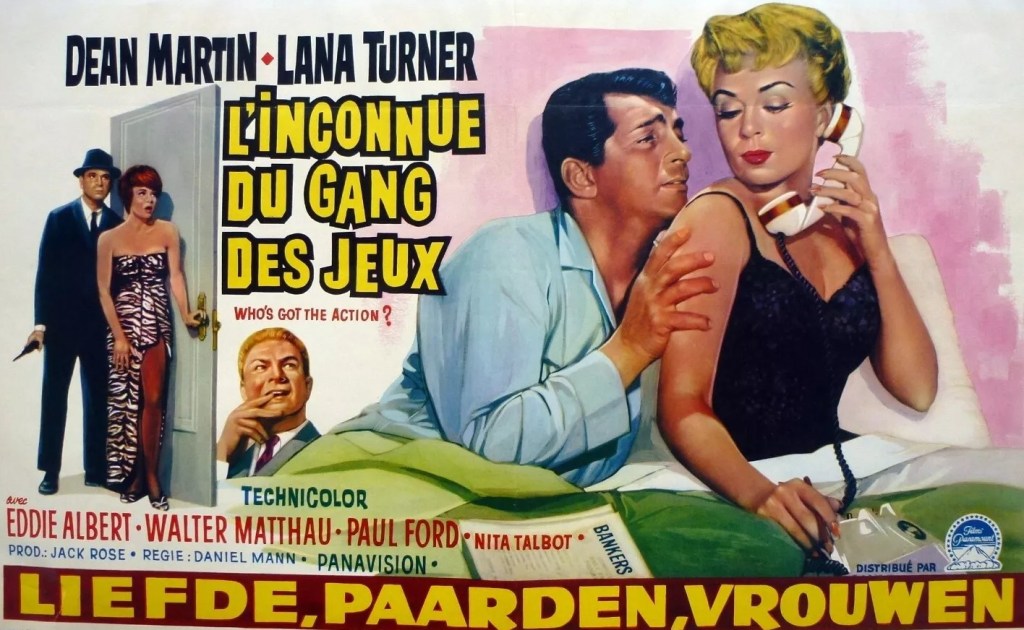
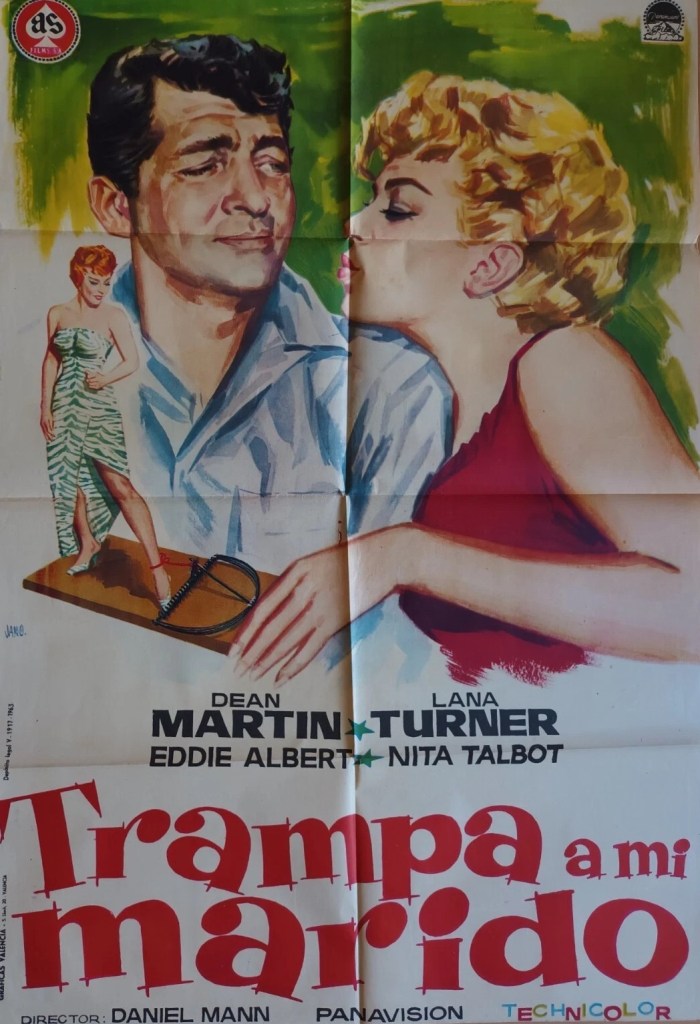
Attorney Steve Flood (Dean Martin) has a gambling addiction. He’s $8,000 in the hole to illegal bookie Clutch (Lewis Charles). Steve’s wife Melanie (Lana Turner) comes up with a clever idea to wean him off his addiction, by creating a fictional bookie, so that her husband’s losses will come to nothing. So she calls in Steve’s partner Clint Morgan (Eddie Albert) triggering Complication No 1. Clint’s always had the hots for Melanie and hopes to take advantage of Steve’s problems, helping her out by agreeing to act as the mythical bookie.
And that would be fine except for Complications No 2 and No 3. Instead of losing, as has been the trend, Steve wins big on his first bet, so now Melanie has to find a large chunk of dough. In dumping Clutch, Steve has come to the attention of mobster Tony Gagouts (Walter Matthau) who’s wondering about the mysterious new bookie queering his pitch and denying him a good customer (such is the definition of a loser).
Steve’s gambling success creates Complication No 4, attracting the interest of a pair of judges who are happy to stake the gambler, whose winning streak shows no sign of stopping.
Complication No 5 – Melanie turns to nightclub singer Saturday Knight (Nita Talbot), her next door neighbor and girlfriend of Tony, for help in raising cash and she obliges by buying some of the couple’s furnishing while Melanie also pawns jewelry.
Complication No 6 is created by Tony, who, trying to trace the rival bookie, installs a wiretap that leads him to the Flood apartment. And that should be the end of the tale, and little chance of a happy ending, except for Complication No 7. Tony has incriminated himself via the wiretaps and with an attorney ready to exploit the situation, it all works out fine, original debt to the gangster wiped out and the mobster blackmailed into marrying Saturday.
Now, with so many complications and sub-plots, this isn’t a Dean Martin picture the way the Matt Helm series is, especially not with a co-star like Lana Turner (By Love Possessed, 1961) who, not weighed down by the kind of heavy romantic tangle that seemed her remit at this point of her career, has the chance to steal a good deal of the limelight.
But the strong supporting case also do their best to chisel scenes away from the big stars. Eddie Albert’s (Captain Newman M.D., 1963) idea of a seductive lunch is a cracker and Nita Talbot (Hogan’s Heroes series, 1965), fashion ideas like Audrey Hepburn on speed, can’t help but play up to the camera. Walter Matthau is trying out a characterization for Charade (1963).
The beauty of this is that the narrative follows a neat logic. You can’t just muscle in on the illegal gambling business.
Director Daniel Mann ( A Dream of Kings, 1969) whips up an entertaining Runyonesque comedy from a screenplay by Jack Rose (It Started in Naples, 1960) based on a novel by namesake Alexander Rose who you might have spotted wearing his acting hat in The Hustler (1961).
They seemed to be a lot better at these effortless concoctions back in the day.
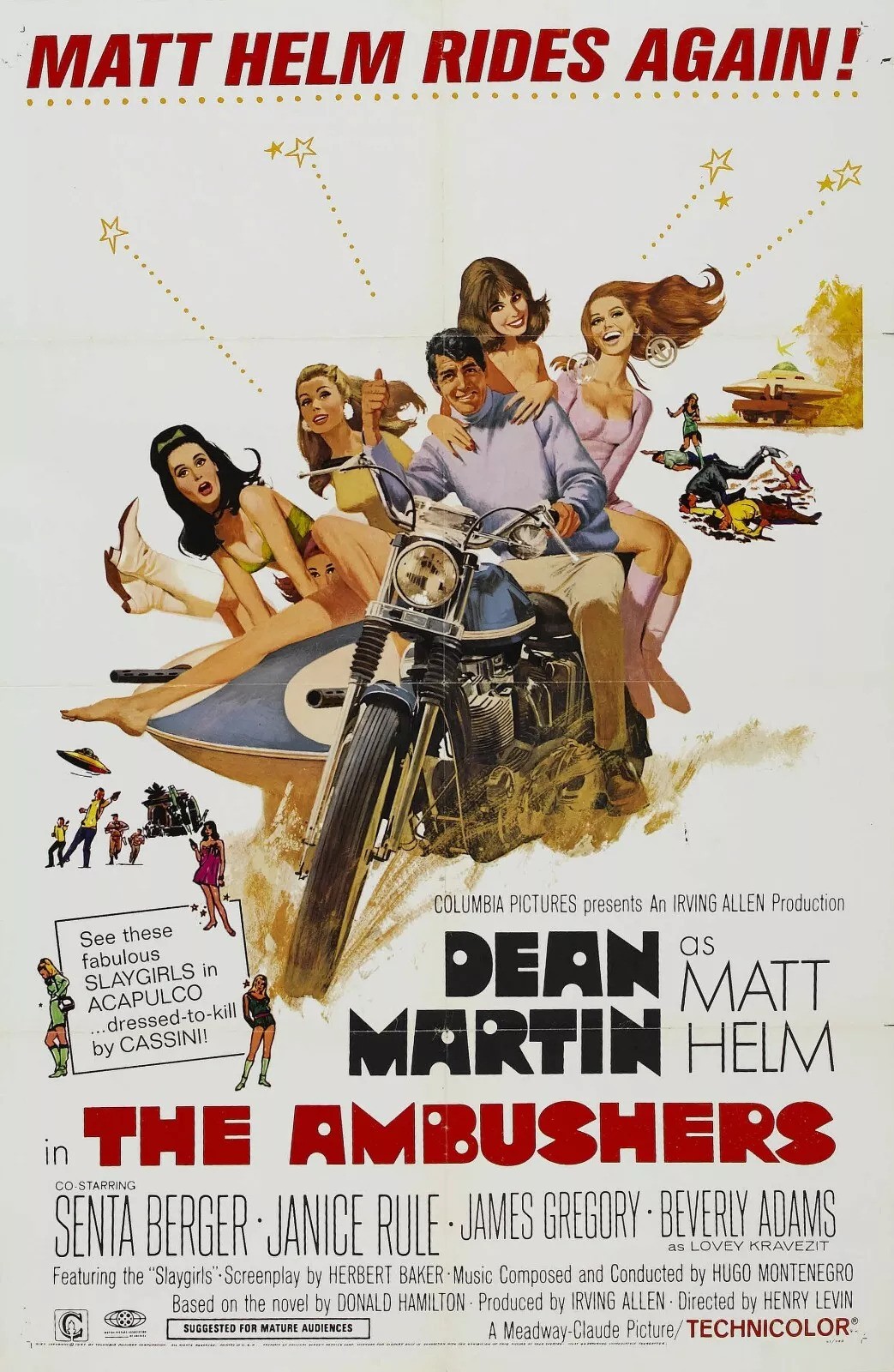
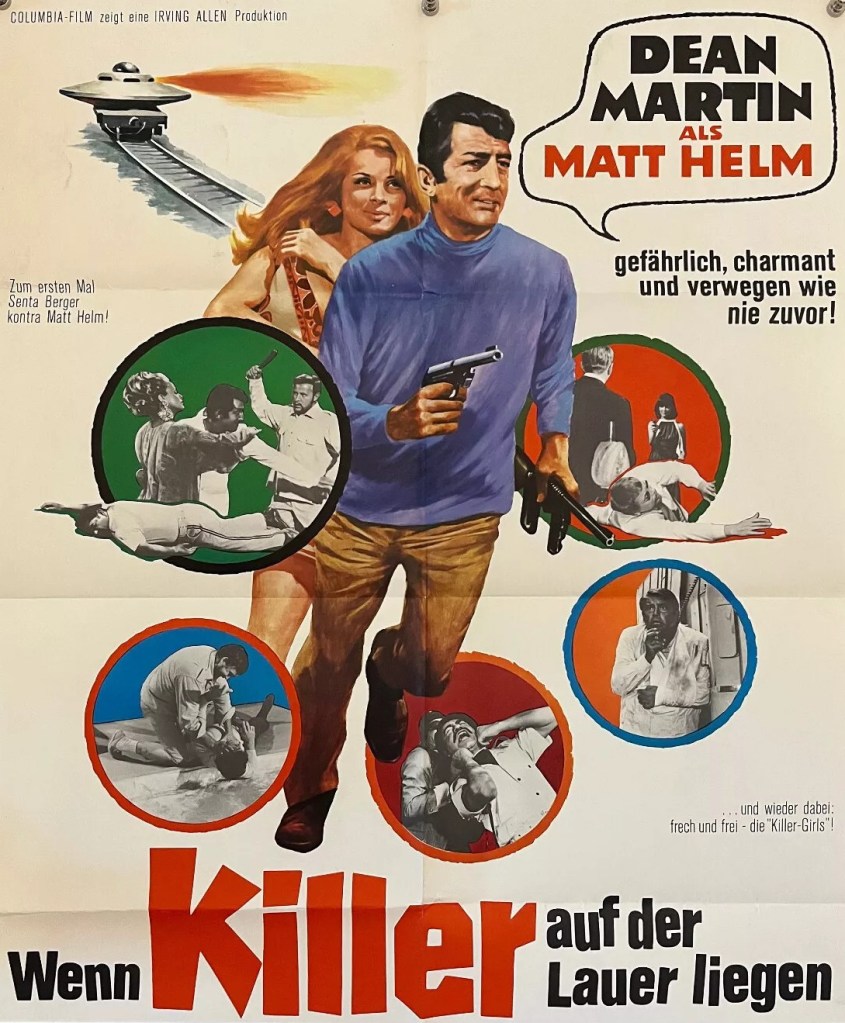
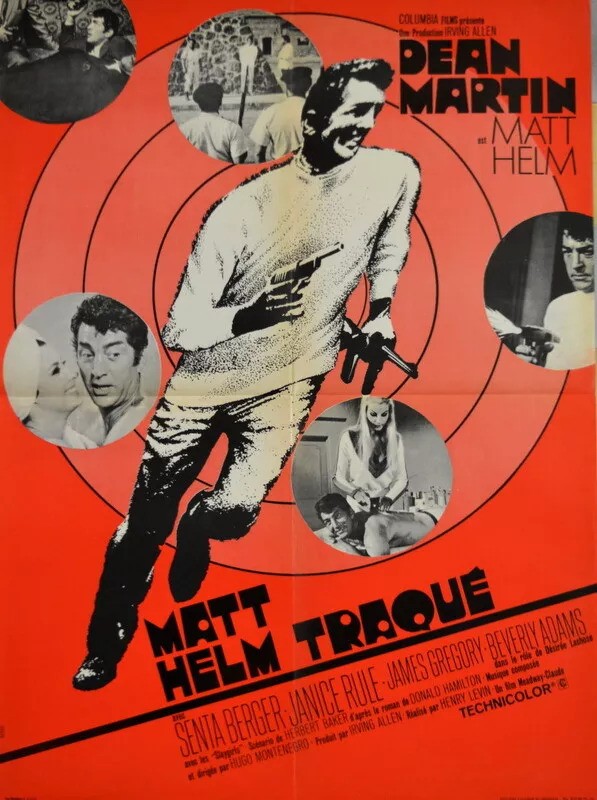
Don’t get too hung up on the supposed rampant sexism in this third iteration the Matt Helm series. These women – bikini-clad or not – are weaponized to the hilt rather than our hero Matt Helm (Dean Martin) who has to make do with a gun disguised as a camera. In fact, he makes pretty good use of the gadget created for the females – the one that melts metal, designed to get rid of the clasp on men’s belts, forcing their trousers to fall down, which, as any student of farce knows, is the easiest way to disable the male.
There’s also a weapon triggered from a bra and a sedative concealed inside lipstick so that males seduced into intimacy will soon be snookered. And it’s also a woman, secret agent Sheila (Janice Rule), who’s impervious to the electromagnetic waves which kill off the opposite gender. Of course, to be fair, it’s not Matt Helm we see sinuously dancing around a playboy mansion in Acapulco the way the women do, although for Francesca (Senta Berger) that appears a clever method of entering the enemy’s lair. Who’s going to question another sexy dancing queen? And the bad guy has one of those devices that make the zips on female attire unzip. (James Bond purloined that one.) But it’s Matt who has the ideal rescue weapon, the levitation gun.
If you’re looking for a more male-oriented theme, how about beer? At various points Matt Helm is literally swimming in the stuff. I wouldn’t have been at all surprised had the plot concerned beer manufacturer Ortega (Albert Salmi) planning world domination through poisoning the global supply of beer or arming his beer gals with bullet-spraying bras. Even though this is largely a spoof, more so than the first in the series, it’s not that much of a spoof and Ortega has more serious intent. Using lasers, he’s hijacked the U.S. Government’s secret flying saucer and plans to sell it to the highest bidder.
Sheila, the pilot, also hijacked, has gone off piste after her experience, and is thrown together with Matt Helm as husband-and-wife, a role they previously played on another mission, to hunt down the villain and recover the missing spaceship. Francesca is also after same, and happy to seduce, trick or sedate Matt in order to achieve that end. Despite believing (from the previous encounter) that she is still Matt’s wife, Stella, despite an instant blow-up tent being laid on, takes a while to understand her duties include getting hot’n’heavy even if she’s less comfortable in the bikini department. Eventually, Matt and Sheila team up with Francesca. Turns out she works for supervillain Big O but is first to find the flying saucer.
More than the earlier entries in the series, this one relies on a series of unlikely events. The switcheroos when the lights in the train go out. But the firing squad sequence is hilarious. The in-jokes about Dean Martin’s recording rivals continue, but the bevy of bikini girls disappear from view pretty much after the opening section.
Janice Rule (Alvarez Kelly, 1966) is generally seen as a class above the previous female leads in the series but that would only be if you ignored Ann-Margret’s performance in Once a Thief (1965), the Stella Stevens of Rage (1966), the Senta Berger of The Quiller Memorandum (1966) and especially the stunning playing of Daliah Lavi in The Demon (1964). Dean Martin was on the cusp of much finer work in Rough Night in Jericho (1967) and Firecreek (1968) so this might just have been a warm-up.
Directed by Henry Levin (Genghis Khan) from a screenplay by Herbert Baker based on the Donald Hamilton novel.
Doesn’t take it itself seriously, which is just as well.
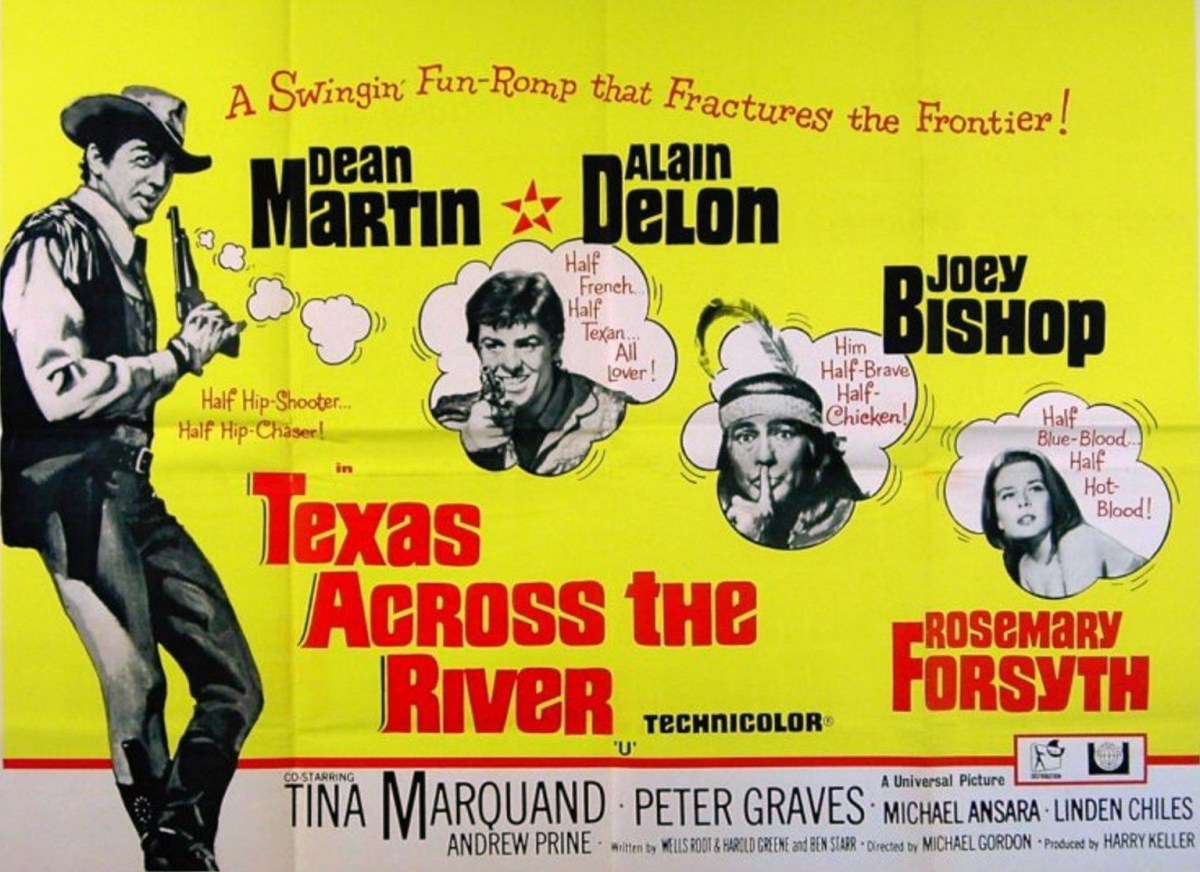
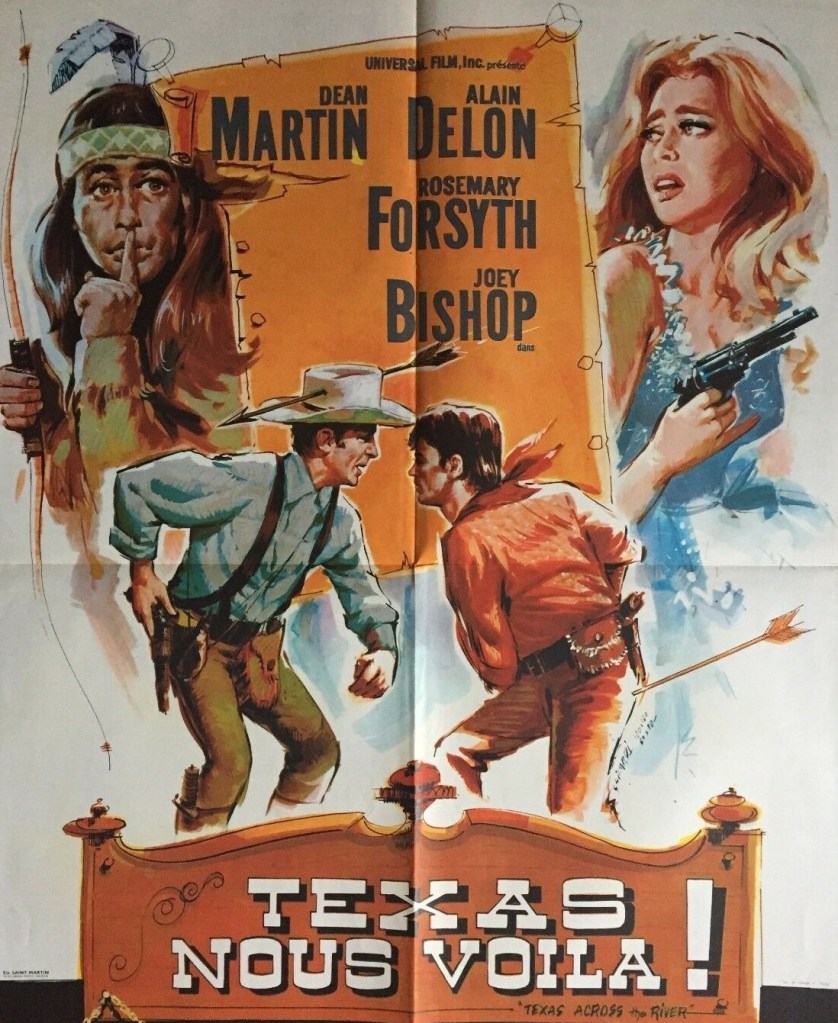
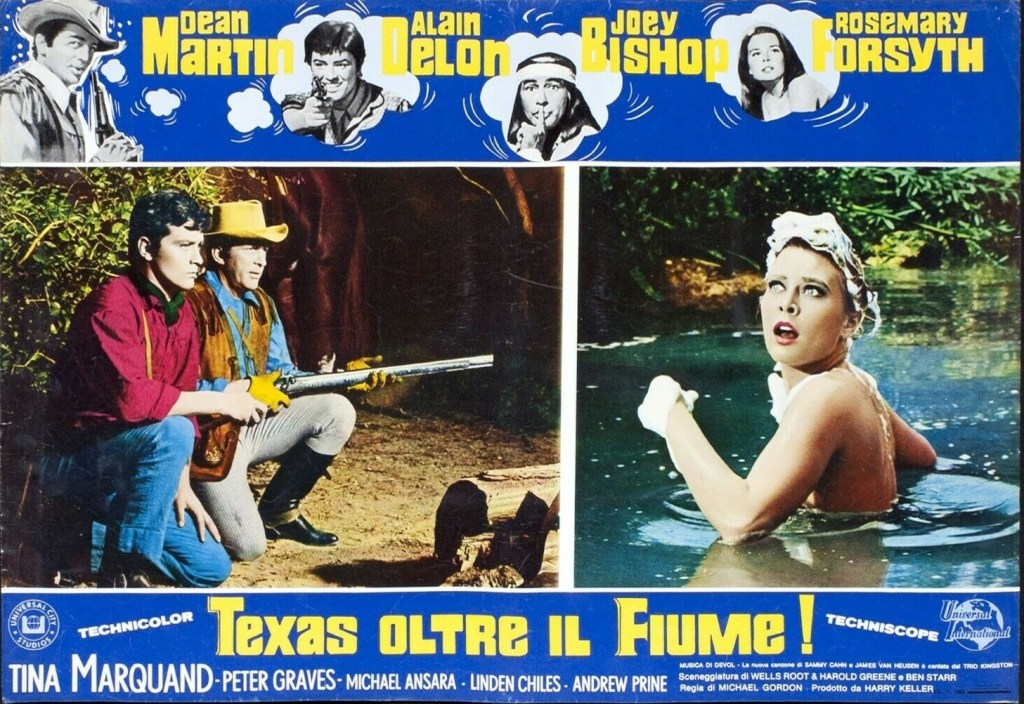
Excellent comedy western mixing dry wit and occasional slapstick to joyous effect. The wedding between Spanish duke Don Aldrea (Alain Delon) and Louisiana belle Phoebe (Rosemary Forsyth) is interrupted by her previous suitor Yancy (Stuart Cottle) who is killed in the resulting melee. Escaping to Texas, Don Aldrea’s marksmanship leads settler Sam (Dean Martin) to recruit him to help fight raiding Comanches. Romantic entanglement ensues when the Don rescues Native American Lonetta (Tina Marquand) and Sam has more than a passing interest in Phoebe.
It is so tightly structured that nothing occurs that doesn’t have a pay-off further down the line. Bursting with terrific lines – including a stinger of a final quip – and set pieces, it pokes fun at every western cliché from the gunfight, the cavalry in hot pursuit, and fearsome Native Americans to the snake bite and the naked bathing scene. Incompetence is the order of the day – cavalry captain Stimpson (Peter Graves) issues incomprehensible orders, chief’s son Yellow Knife (Michael Linden) cannot obey any.
The Don, with his obsession with honor and his tendency to kiss men on the cheeks, is a comedy gift. Despite his terrific head of hair, he is stuck with the moniker “Baldy” and every time he is about to save the day he manages to ruin it. Sam is the kind of guy who thinks he is showing class by removing his spurs in bed while retaining his boots. His sidekick Kronk (Joey Bishop), a mickey-take on Tonto, mostly is just that, a guy who stands at the side doing nothing but delivering dry observations.
Lonetta is full of Native American lore and has enough sass to keep the Don in his place. “What is life with honor,” he cries to which she delivers the perfect riposte, “What is honor without life?” Phoebe is a hot ticket with not much in the way of loyalty.
Two sequences stand out – the slapping scene (whaat?) and a piece of exquisite comedy timing when Sam, Phoebe and the Don try an iron out a complicated situation.
Good as Dean Martin (Rough Night in Jericho, 1967) is the picture belongs to Alain Delon (Once a Thief, 1965) and I would argue it is possibly his best performance. Never has an actor so played against type or exploded his screen persona. Delon was known for moody, sullen roles, cameras fixated on his eyes. But here he is a delight, totally immersed in a role, not of an idiot, but a man of high ideals suddenly caught up in a country that is less impressed with ideals. If he had played the part with a knowing wink it would never have worked.
Martin exudes such screen charm you are almost convinced he’s not acting at all, but when you compare this to Rough Night in Jericho it’s easy to see why he was so under-rated. Joey Bishop (Ocean’s 11) is a prize turn, with some of the best quips. Rosemary Forsyth (Shenandoah, 1965) is surprisingly good, having made her bones in more dramatic roles, and Tina Marquand (Modesty Blaise, 1966) more than holds her own. Michael Ansara (Sol Madrid, 1968) played Cochise in the Broken Arrow (1956-1958) television series. Under all the Medicine Man get-up you might spot Richard Farnsworth. Peter Graves of Mission Impossible fame is the hapless cavalry leader.
Director Michael Gordon (Move Over, Darling, 1964) hits the mother lode, the story zipping along, every time it seems to be taking a side-step actually nudging the narrative forward. He draws splendid performances from the entire cast, knowing when to play it straight, when to lob in a piece of slapstick, and when to cut away for a humorous reaction, and especially keeping in check the self-indulgence which marred many Rat Pack pictures – two of the gang are here, Martin and Bishop. There’s even a sly nod to Sergio Leone spaghetti westerns when the electric guitar strikes up any time Native Americans appear. Frank De Vol (Cat Ballou, 1965) did the score. Written by Wells Root (Secrets of Deep Harbor, 1961), Ben Starr (Our Man Flint, 1966) and Harold Greene (Hide and Seek, 1964).
Producer Irving Allen remains best known as the fella who turned down James Bond. While partnered with Cubby Broccoli in Warwick Films, he decided the Ian Fleming books were not big screen material. Their production shingle, based in Britain, had turned out movies like The Red Beret (1953) with Alan Ladd and Fire Down Below (1957) pairing Robert Mitchum and Rita Hayworth. Divorced from Broccoli, Allen headed down the big-budget historical adventure route but neither The Long Ships (1964) spearheaded by Richard Widmark and Sidney Poitier nor Omar Sharif as Genghis Khan (1965) hit the box office target.
Luckily, Allen had already made an investment in espionage, owning the rights to the hard-edged Matt Helm novels, knocked out at the rate of one or two a year since 1960 by Donald Hamilton whose most notable brush with Hollywood was selling the rights to his novel The Big Country (1958) filmed by William Wyler with a top-class cast. The Matt Helm series was praised by the top thriller critic of the era, Anthony Boucher, who noted that Hamilton brought “sordid truth” to the espionage genre and “the authentic hard realism of Dashiell Hammett.”
Having optioned the books, Allen persuaded Columbia to buy the rights to eight, with the notion of setting up a direct rival to James Bond, that idea given an extra fillip when the Sean Connery series which had appeared on an annual basis skipped 1966. Initially, Allen planned to make films that followed the novel’s serious approach to espionage, intending to cast a marquee name like Paul Newman (The Prize, 1963) – who ironically proved major competition for the first offering through Hitchcock’s Torn Curtain (1966) – or conversely a relative unknown such as Mike Connors (Harlow, 1965).
To hook Dean Martin, Allen had to make him a partner, resulting in the actor making more dough out of a spy film than Sean Connery did from Bond. Martin was something of a Hollywood enigma. Audiences who flocked to the Rat Pack outings tended to disdain his stand-alone efforts such as Toys in the Attic (1963) and Kiss Me, Stupid (1964) and if he was a current household name that owed much more to his recording and television career.
But Allen shifted the emphasis away from straight adaptation to tongue-in-cheek, setting up the series initially as gentle parody rather than out-and-out spoof though as the movies progressed they fell more into the latter category.
Playing to Martin’s strengths of urbane charm and effortless style, as well as his reputation as a lothario, and accommodating his age (he was 48) by ensuring his character was brought out of retirement, and with comedy writer Herbert Baker brought in at Dean Martin’s behest to beef up Oscar Saul’s script, and by surrounding him with more heavyweight damsels than the Bonds, the series was good to go. Baker had written early Dean Martin-Jerry Lewis vehicles like Jumping Jacks (1952) and Scared Stiff (1953). The script drew upon two Hamilton novels, Death of a Citizen (the first in the series) and The Silencers (the fourth). The idea of Helm being married was dropped to allow him the same sexual license as James Bond.
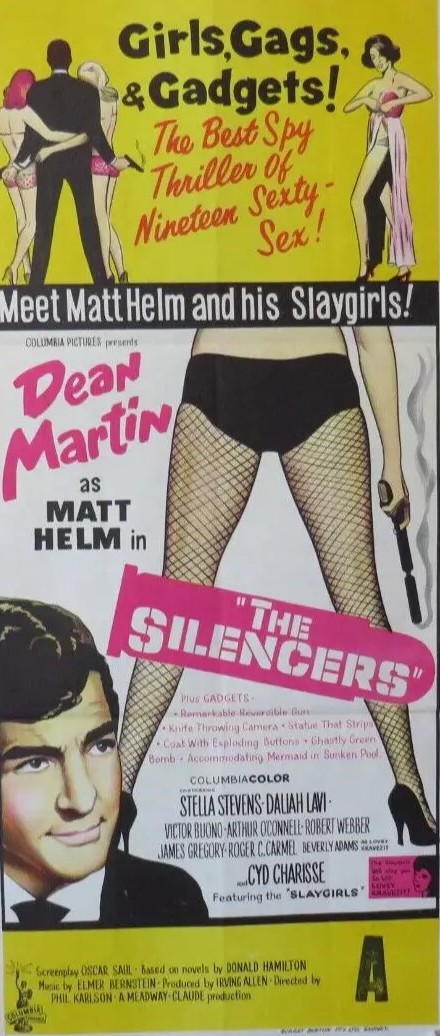
Stella Stevens and Daliah Lavi were unusual choices for the leading ladies of a spy picture, their proven marquee appeal considerably in excess of that of Ursula Andress (Dr No, 1962), Honor Blackman (Goldfinger, 1964) and Claudine Auger (Thunderball, 1965), that trio of movies opening Hollywood doors for the actresses rather than as with Stevens and Lavi already being welcome attractions. Lavi had starred in The Demon (1963) and Lord Jim (1965) while Stella Stevens had been female lead in The Nutty Professor (1963) and Advance to the Rear (1964). The Slaygirls, however, a direct imitation of the Bond Girls, also owed something to Playboy’s Playmates.
Other cast members had some distinction, Victor Buono Oscar-nominated for Whatever Happened to Baby Jane (1962) and James Gregory acclaimed for his role in The Manchurian Candidate (1962). Both had worked previously with Martin, Gregory on The Sons of Katie Elder (1965) and Buono on 4 for Texas (1963) and Robin and the 7 Hoods (1964).
Martin also called upon President Lyndon B. Johnson’s personal shirtmaker Sy Devore, previously personal clothier to Martin and Lewis, to come up with his stylish attire.
Budgeted at just under $4 million, The Silencers began shooting on 12 July 1965, the 12-week schedule (ending 16 September) taking in locations like Carsbad Caverns, White Sands, El Paso and Juarez with the car chases filmed in Santa Fe and Phoenix, Arizona. Columbia’s backlot was deemed too small for interiors, and two of Desilu’s largest soundstages were joined together to make Big O’s underground HQ.
Director Phil Karlson (The Secret Ways, 1961) and the producer didn’t see eye-to-eye. Despite ostensibly aiming for a comedy, Allen wanted Karlson to adopt the style of the more serious The Ipcress File (1965) and shoot “through chandeliers, under tables.” It turned out that movie’s director Sidney J. Furie had relied on Karlson for most of his cinematic flourishes.
Like Sinatra, Martin preferred one take. “Dean was always great to work with,” recalled James Gregory, “because he never took himself seriously…Dean was always relaxed – if it doesn’t work do it over, but for heaven’s sake you oughta not need more than that one or two times to get it right.”
Despite the easy-going atmosphere, there were casualties. Buono was out of action for four days after slipping while climbing a wall, foot in an unseen cast for the rest of his time on the picture. Supporting actor Arthur O’Connell’s face was sliced open during an explosion. He completed the scene with the bandage covering the wound hidden under a turtleneck sweater. Stunt man Tom Hennessey lost three front teeth. There was a bill of several thousand dollars to cover an unexpected explosion on set, combustible dust igniting after one of the grenades went off on the Big O set.
Astonishingly the movie came in $500,000 under budget and $1 million was recouped from television sales. Columbia was so taken with the end result that prior to its release two sequels were announced.
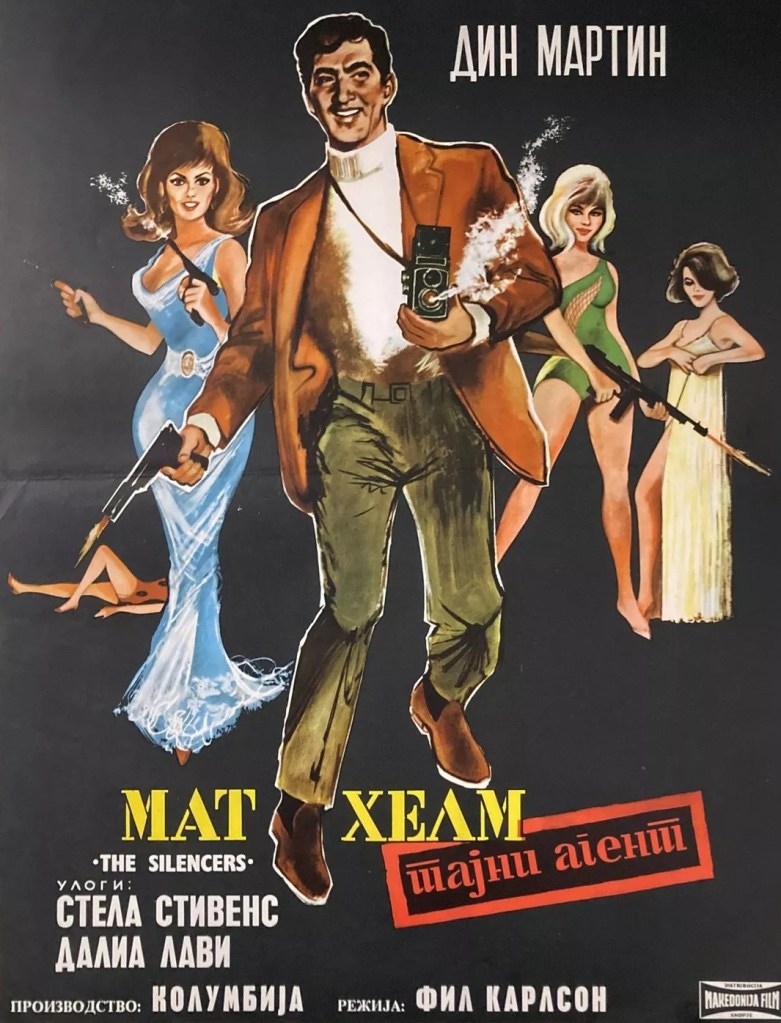
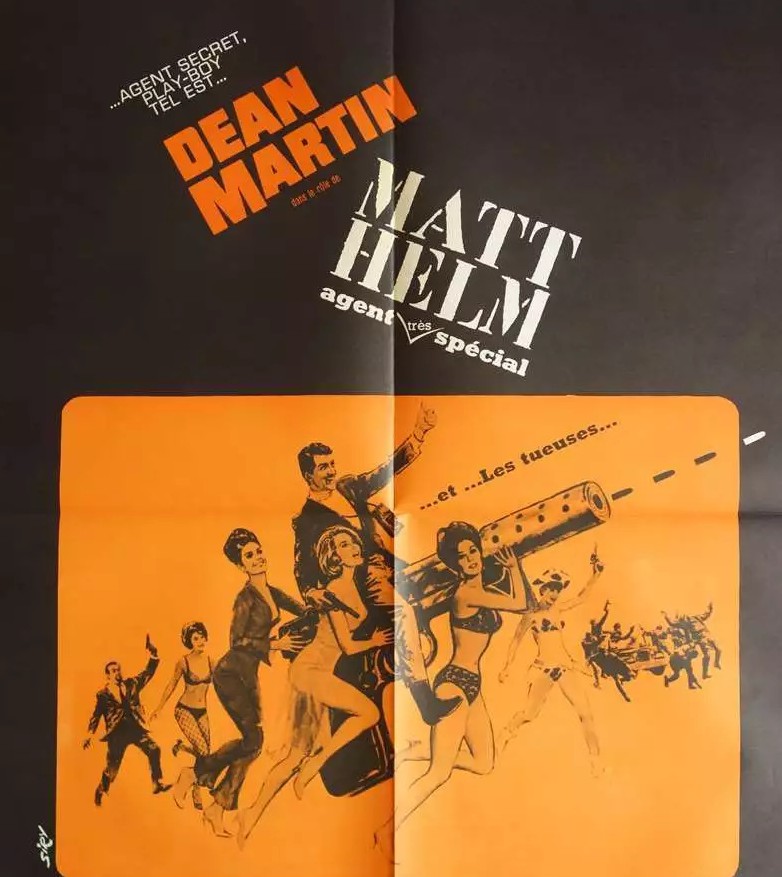
The Slaygirls featured prominently in promotional activities in the U.S. with six sent overseas to hustle up interest. As well as a movie tie-in paperback and album, merchandising included toy guns from Crescent Toys and Louis Marx. Martin wasn’t available for the Chicago world premiere (he was shooting Texas Across the River, 1966) on 16 February 1966. The movie was gangbusters from the start, clocking up $7.35 million in U.S. rentals (the studio’s cut of the box office), enough for 85th spot (by my exclusive count) on the list of the top earning films of the decade.
SOURCES: Brian Hannan, The Magnificent ‘60s, The 100 Most Popular Films of a Revolutionary Decade (McFarland, 2022); Bruce Scivally, Booze, Bullets and Broads, Behind the Scenes with Dean Martin’s Matt Helm Films of the 1960s (Henry Gray, 2013); William Schoell, Martini Man: The Life of Dean Martin (Cooper Square Press, 2003); Cinema Retro Movie Classics Issue No 9: Matt Helm’s Back in Town.


 The Magnificent 60s