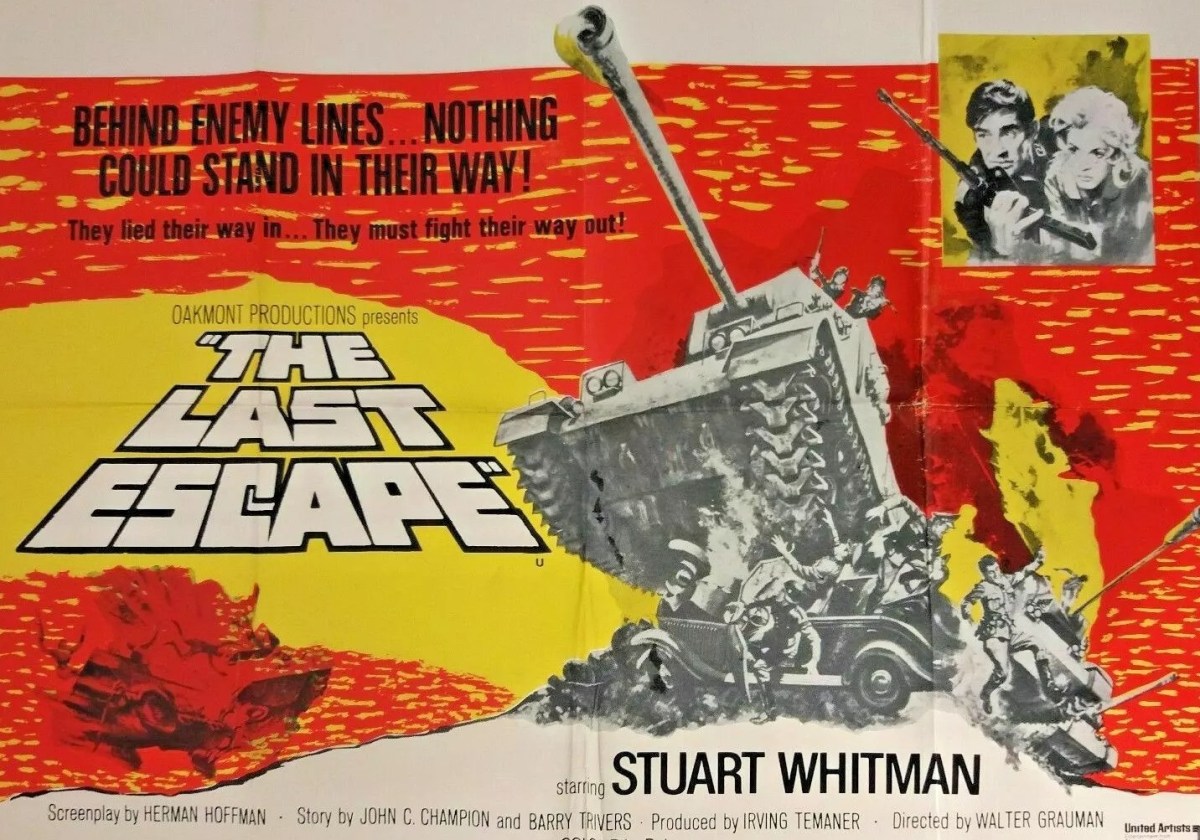
Behind the Scenes: United Artists Goes to War on a Low Budget – “Submarine X-1” (1968) and Five Others

With the contraction of Hollywood production in the 1960s, cinemas worldwide were always crying for pictures – any pictures – that could take up a weekly slot or pad out a double bill. (The single-bill programming that is standard these days was not welcome in most cinemas, except a prestigious few, and audiences expected to see two movies for the price of their ticket). Indie unit Mirisch had scored such a big hit with aerial war number 633 Squadron (1964) – it recouped its entire cost from British distribution so was in profit for the rest of its global run – that Walter Mirisch persuaded distribution partner United Artists to attempt to capitalize on the idea and thus set in progress a series of war pictures to be made in Britain.

There would be cost savings through the Eady Plan. Each film would have a “recognizable American personality in the lead” and have American directors. Budgets would be held under $1 million. Half a dozen movies were planned, the first appearing in 1967, the last in 1970.
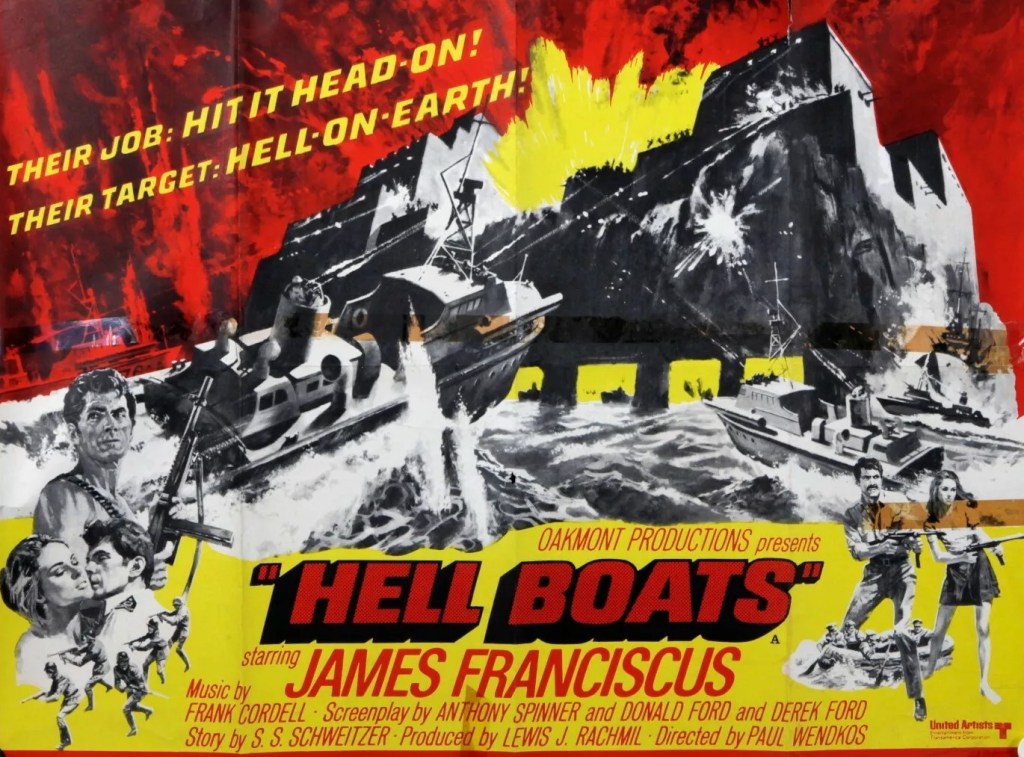
Quite whether James Caan (Red Line 7000, 1965) passed muster as a well-known enough star to qualify as a “personality” at the time he headlined Submarine X-1 (1968) is debatable, as was the presence of James Franciscus (The Valley of Gwangi, 1969) in Hell Boats (1970) and Christopher George (Massacre Harbor, 1968)  in The Thousand Plane Raid (1969) though Stuart Whitman (Rio Conchos, 1964)  exerted a higher marquee appeal for The Last Escape (1970). Veteran Lloyd Bridges (Around the World under the Sea, 1966) who headlined Attack on the Iron Coast (1968) was probably the best known, but these days that was mostly through television. And David McCallum owed whatever fame he had to television as part of The Man from U.N.C.L.E. double act and the idea that would still be enough to attract an audience for Mosquito Squadron (1969) seemed dubious.

Beyond setting up the project, Walter Mirisch had little to do with the actual production, putting that in the hands of Oakmont Production, which beefed up the action with judicious use of footage from other pictures. Invariably, reasons had to be given to explain why actors with American accents were members of the British fighting forces – most commonly they were represented as Canadian volunteers or might have British nationality by dint of having a British mother.

Storylines followed a similar template. At its heart was a dangerous mission. Leaders were invariably hated for some previous misdemeanor or because they were ruthless and drove the men too hard. If there was romance – not a given – it would border on the illicit. And someone required redemption.

And while none of the stars chose – or were chosen to – repeat the experience, Oakmont established something of a repertory company behind the scenes, writers, directors and producers involved in more than one movie.
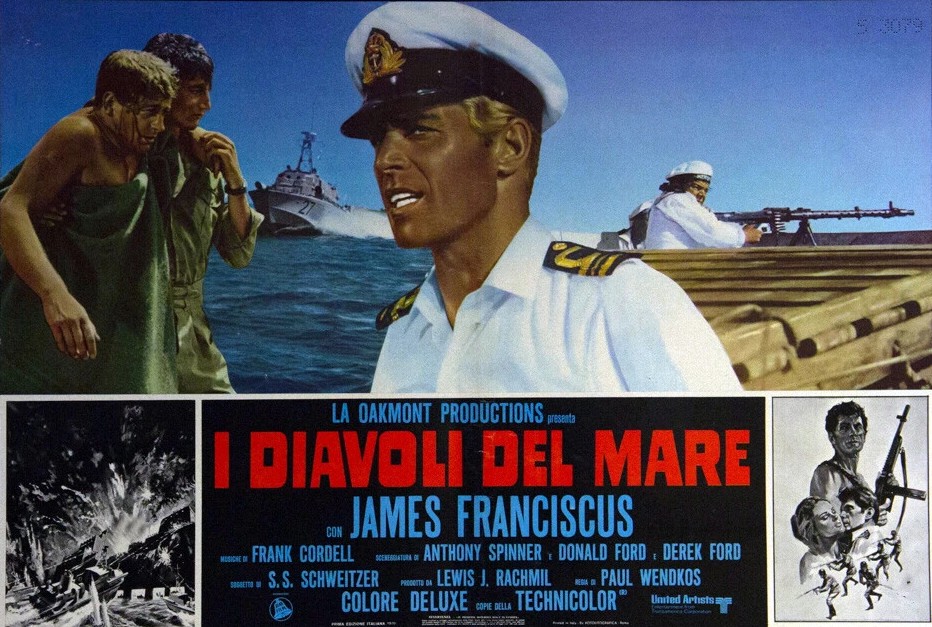
Italian poster (photobusta) for “Hell Boats”. I found Japanese and Australian posters
for most of the films in the series.

Boris Sagal (Made in Paris, 1966) directed both The Thousand Plane Raid and Mosquito Squadron and then made his name with The Omega Man (1971). Paul Wendkos (Angel Baby, 1961) helmed Attack on the Iron Coast and Hell Boats. Walter Grauman who had kicked off the whole shebang with 633 Squadron returned for The Last Escape. William Graham (Waterhole #3, 1967) as the only outlier with just Submarine X-1 to his name.

Veteran producer Lewis Rachmil (A Rage to Live, 1965) oversaw three in the series – Hell Boats, Mosquito Squadron and The Thousand Plane Raid. Another veteran John C. Champion, younger brother of celebrated Broadway choreographer Gower Champion, was involved in a variety of categories. Champion is almost an asterisk these days, best known these days for producing the film Zero Hour! (1957) that inspired disaster parody Airplane! (1980). He was only 25 when he produced his first picture, low-budget western Panhandle (1948). He was behind another four low-budget westerns pictures before Zero Hour!, which had a decent cast in Dana Andrews and Linda Darnell. But that was his last movie for nine years as he switched to television and Laramie (1959-1963), barely reviving his movie career with The Texican (1966) starring Audie Murphy.

He produced Attack on the Iron Coast and Submarine X-1 and was credited with the story for both plus The Last Escape. Irving Temaner produced The Last Escape and received an executive producer credit on Attack on the Iron Coast and Submarine X-1.  Donald Sanford (Battle of Midway, 1976) was the most prolific of the writers, gaining screenplay credits for Submarine X-1, The Thousand Plane Raid and Mosquito Squadron. Herman Hoffman (Guns of the Magnificent Seven) wrote Attack on the Iron Coast and The Last Escape.

Cinema managers were not, it transpired, queuing up for the product. Most commonly, when reviewed in the British trade press, their release date was stated as “not fixed” which generally meant that United Artists was hoping the review would do the trick and alert cinema owners.

In the United States, they rarely featured in the weekly box office reports, though Portland in Oregon appeared partial to the product, Attack on the Iron Coast appearing there as support to Hang ‘Em High (1968), Mosquito Squadron supported The Christine Jorgensen Story (1970), Hell Boats supported Lee Van Cleef western Barquero (1970) while The Last Escape supported Mick Jagger as Ned Kelly (1970). To everyone’s astonishment a double bill of Hell Boats / The Last Escape reported a “big” $10,000 in San Francisco, but that proved an anomaly.

In Britain, the movies fulfilled their purpose as programmers, not good enough to qualify as a proper double bill, but accepted as supporting feature for a circuit release on the Odeon chain. Since UA supplied Odeon with its main features, it proved relatively easy to persuade the circuit to take the war films to fill out a program. This kind of second feature would be sold for a fixed price not sharing in the box office gross. However, they were given the kind of all-action poster they hardly deserved.

So in 1968 Attack on the Iron Coast went out with The Beatles Yellow Submarine. In 1969, Submarine X-1 supported slick heist picture The Thomas Crown Affair, which with Steve McQueen and Faye Dunaway in top form scarcely needed any help securing an audience. Hell Boats was supporting feature in 1970 to Master of the Islands (as The Hawaiians starring Charlton Heston was known). As well as accompanying it on the circuit Mosquito Squadron in 1970 made a very brief foray into London’s West End with thriller I Start Counting and then reappeared a few months later as an alternative choice of support for Billy Wilder flop The Private Life of Sherlock Holmes. If you went to see Burt Lancaster western Lawman in 1971 you might have caught The Last Escape – equally it could have been If It’s Tuesday, It Must Be Belgium (cinema managers could choose either).

United Artists, under the financial cost in the early 1970s, pulled the plug on “programmers” such as these. Walter Mirisch in his biography, disingenuously suggested that the six movies had done relatively well. But that wasn’t supported by the studio’s own figures.

Collectively, they made a loss of $1.7 million. Only Attack on the Iron Coast made it into the black and then by only $59,000. Hell Boats lost $700,000. None of the movies earned more than $200,000 in rentals in the United States.

Although Mirisch managed to keep budgets down to around the million-dollar mark, they would have had to be much smaller to see a profit. Ironically, it was the cheapest, Attack on the Iron Coast costing $901,000,  that made the most. Submarine X-1 lost $150,000 on a $1 million budget, Mosquito Squadron lost $253,000 on a $1.1 million budget while The Thousand Plane Raid lost $50,000 more on the same budget. The longer the series went on, the worse the losses – The Last Escape lost $449,000 on a $995,000 budget while for Hell Boats the budget was $1.36 million.

SOURCES: United Artists Archives, University of Wisconsin; Walter Mirisch, I Thought We Were Making Movies, Not History (University of Wisconsin Press, 2008) p204; Reviews, Kine Weekly – Feb 9 1968, Aug 31 1969, January 1970, April 18 1970; “Flops Loss-Cutting,” Variety, August 26, 1970, p6; “Picture Grosses,” Variety – March 13 1968, May 8 1968, April 24 1968, October 2 1968, June 10 1970, July 1 1970, July 8, 1970, August 12 1970, August 26 1970.
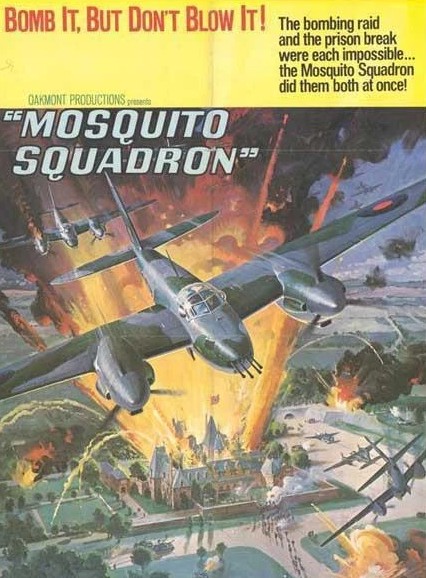
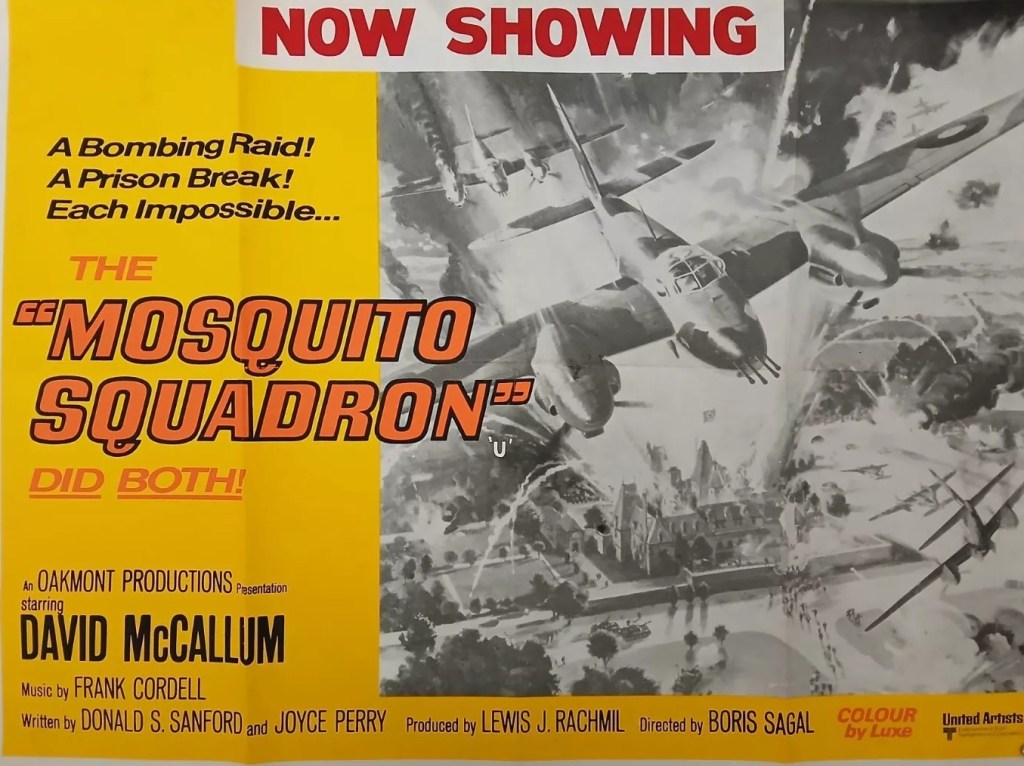
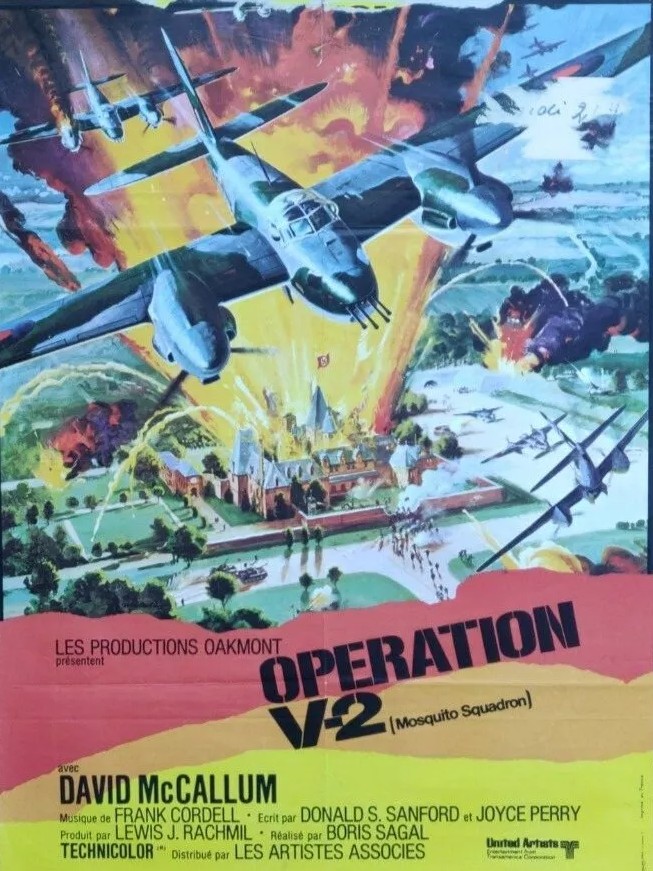
Mosquito Squadron (1969) ****

Surprisingly somber, unusually reflective and exceptionally well-constructed. Except for taking the easy way out at the end, could easily have found itself in the classic finale stakes in the same league as Casablanca (1942) or The Third Man (1949) where true love is thwarted. More than enough aerial action for aficionados and an excellent battle sequence.

In addition we have that very contemporary trope of the human shield and the argument by British officers of obeying orders that would take on a different significance from the enemy perspective at the end of World War Two. Throw in an unexpected slug of guilt, a number of understated scenes, and a very clever wheeze from the Germans and you have a movie that rises well above the standard programmer.

Quint Munroe (David McCallum) is an orphan, taken in at a young age by the family of Squadron Leader “Scottie” Scott (David Buck) whom he regards as a brother. Also a pilot, Quint watches Scottie’s plane explode in a bombing raid over France. Next in line for promotion, Quint, with the usual survivor’s guilt, takes over.

In the first of the sequences that are notably out of place in a standard gung-ho World War Two picture, Quint is sent to tell the bad news to Scottie’s wife Beth (Suzanne Neve). He doesn’t have to say a word. She recognizes the look on his face. Quint had barely escaped from his own burning cockpit, a fact that’s gone unreported to Beth, but when she comes to her husband’s quarters at the air base, she gasps at the burn marks on the back of his jacket. There are four or five instances, again understated, in this scene when Beth is brutally reminded of her husband’s death. And Quint’s colleague Douglas (David Dundas) rejoices in the fact that he’s lost an arm because that’s saved his life, it’s his “ticket” to remain earthbound, and he can safely get married in the knowledge his wife won’t be receiving a knock on the door anytime soon.

This is a mission picture in case you haven’t noticed from my concentration on the other more interesting aspects of the movie. The RAF needs to bomb an experimental station developing the next range of German rockets that’s buried underneath a chateau in France. Flattening the area in the normal fashion won’t do it, the bombers need to be able to hit a very small target indeed, the entrance of the secret hideaway. So they turn to a version of Barnes Wallis bouncing bomb (see The Dam Busters, 1955) and have to practise like billy-oh against a very tight deadline to hit such a target.

Meanwhile…meanwhie…meanwhile. There are three dramatic meanwhiles. Quint begins an understated romance with Beth, he filled with remorse at stealing his dead pal’s wife, she less concerned because there was a hint of earlier romance between them. The Germans protect the chateau behind a human shield of captured RAF pilots. In carrying out the attack, the pilots are condemning colleagues to death, a worry knocked on its head by the gung-ho likes of Air Commodore Hufford (Charles Gray), but other more sensitive high-ranking officers resort to the “obeying orders” routine. Final twist: among the prisoners is Scottie.

Nobody outside the base is permitted to know about the prisoners in case taking such an action damages public morale, so now Quint is in a bind. There’s a final twist to the twists – Scottie has lost his memory so badly that even if he could return to Britain it’s doubtful if he would know who Beth was, though, of course, they would still be married, so that would scupper Quint’s chances unless the story went onto a fourth act in the vein of Random Harvest (1942).

The French Resistance are called in to launch a daring raid to free the prisoners and assuage guilt all-round. Quint is shot down and joins the brutal battle action in which, as predicted by Hufford, the escapees are mown down by superior German firepower. He finds Scottie, who doesn’t recognize him at all. Scottie is also of the gung-ho brigade and dies stopping a German tank.

Meanwhile, Douglas has got into trouble for telling too many people about the prisoners. He’s very good friends with Beth.

You can see the cinematic opportunity. Quint returns knowing he is free to marry Beth only to find Beth turns away from him because he went on an expedition that could kill her husband. But the producers bottle it and go for the happy ending instead.

David McCallum (Sol Madrid/The Heroin Gang, 1968) remains in low gear throughout, and though Suzanne Neve (Naked Evil, 1966) more than makes up for him, you would wonder at the wife of a dead pilot taking up with another flier who could end up the same way.

Director Boris Sagal (Made in Paris, 1966) is to be commended for spending so much time on the themes of guilt and loss and keeping reality to the forefront. Some of the sequences have been stolen from other movies or are stock footage. Written by Donald S. Sanford (The Thousand Plane Raid, 1969) and actress Joyce Perry in her big screen debut.

Raises far more issues than the normal war movie, certainly blown away at the box office by the bigger-budgeted all-star-cast Battle of Britain the same year, but more than holds its own, and if it had been an American low-budgeter with some better-known lesser stars would have probably been re-evaluated long before now.

Impressive.

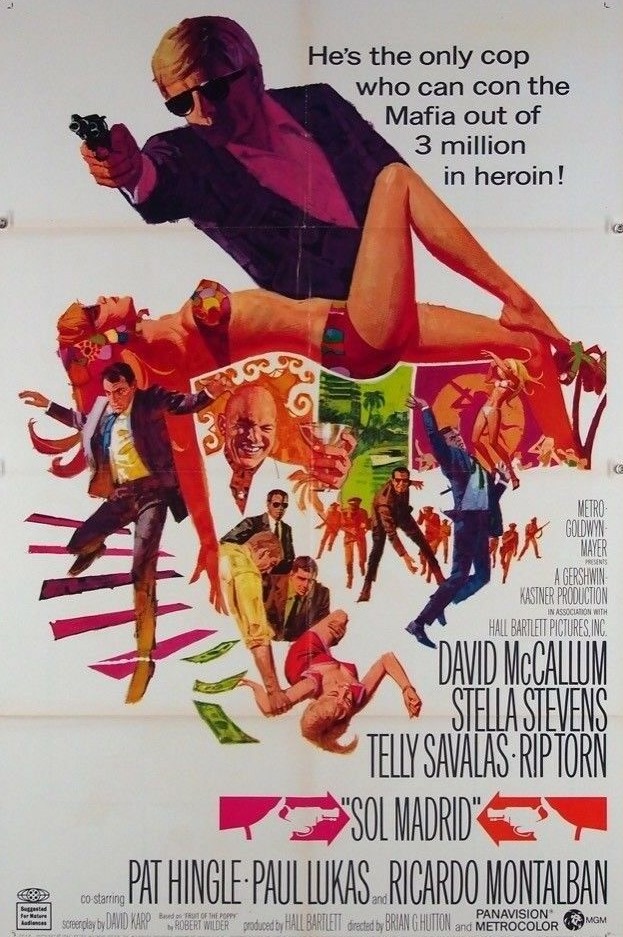
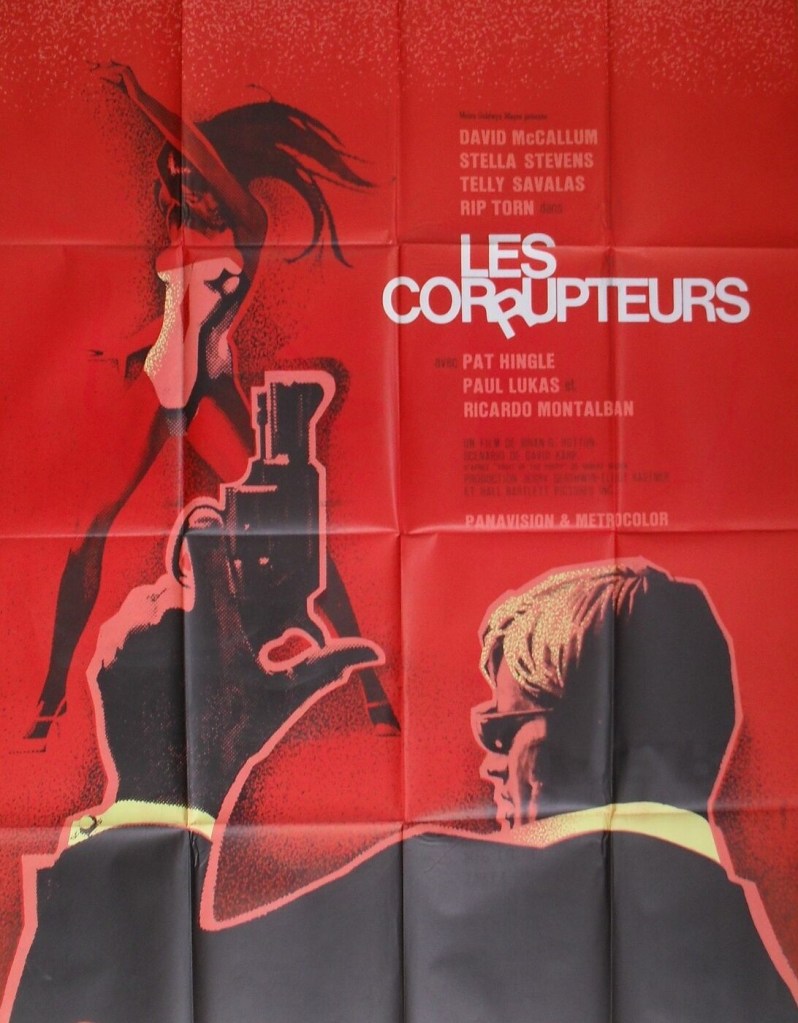
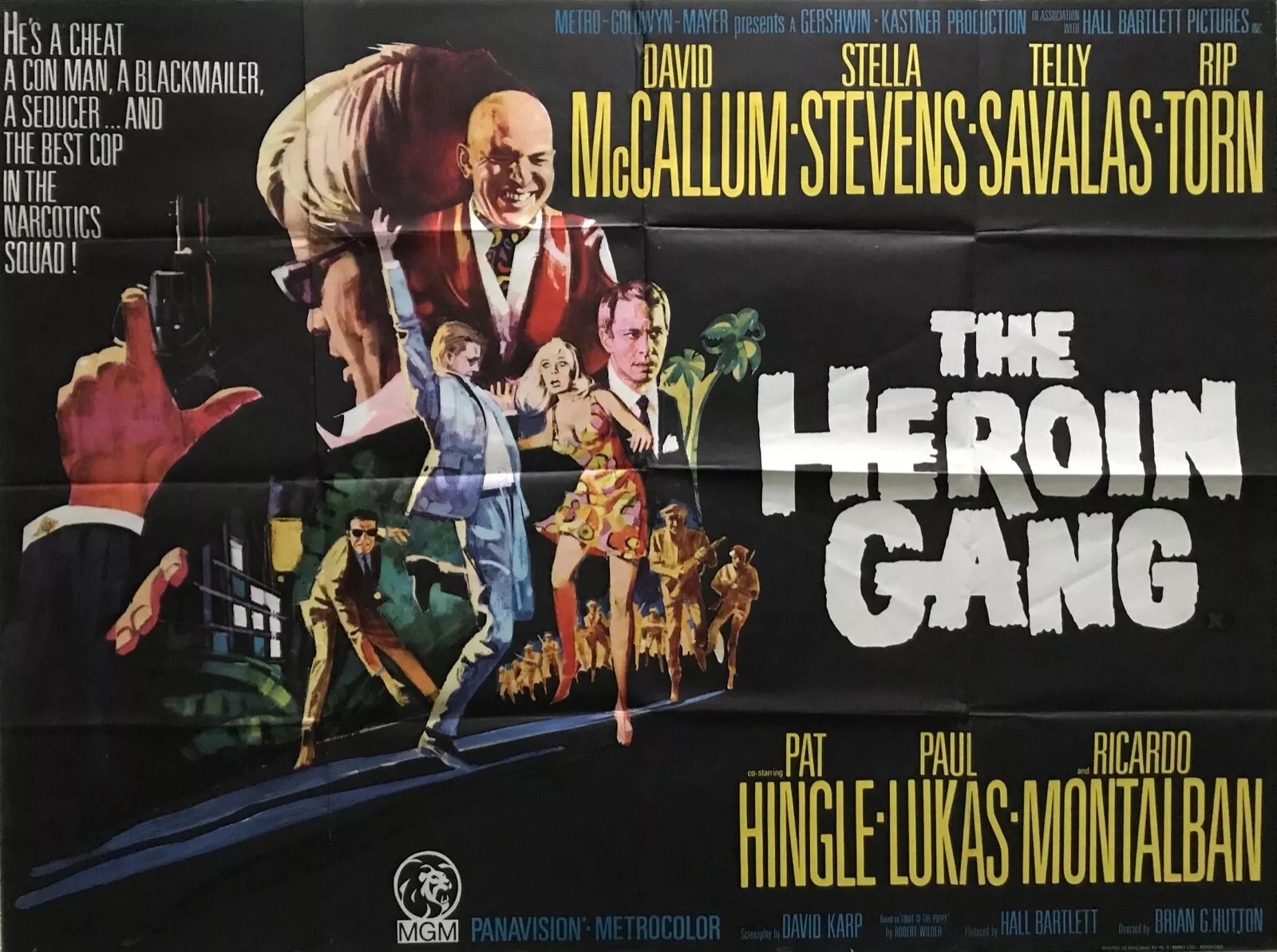
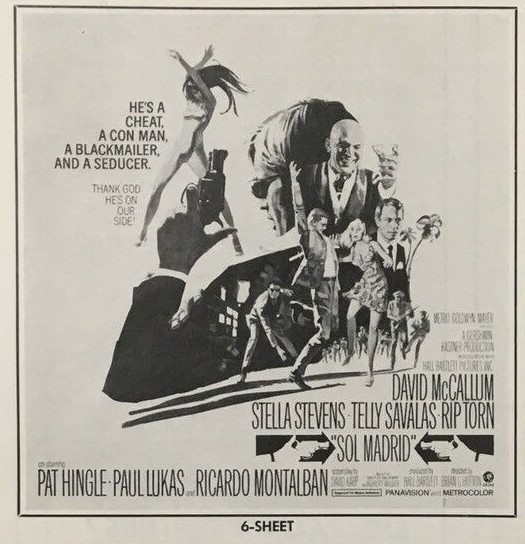
Sol Madrid / The Heroin Gang (1968) ***

Was it David MacCallum’s floppy-haired blondness that prevented him making the jump to movie action hero because, with the ruthlessness of a Dirty Harry, he certainly makes a good stab at it in this slightly convoluted drugs thriller? Never mind being saddled with an odd moniker, the name devised surely only in the hope it would linger in the memory, Sol Madrid (David MacCallum) is an undercover cop on the trail of the equally blonde, though somewhat more statuesque, Stacey Woodward (Stella Stevens) and Harry Mitchell (Pat Hingle) who have scarpered with a half a million Mafia dollars. Mitchell is the Mafia “human computer” who knows everything about the Cosa Nostra’s dealings, Woodward the girlfriend of Mafia don Villanova (Rip Torn).

Sol tracks down Woodward easy enough and embarks on the audacious plan of using her share of the loot, a cool quarter of a million, to fund a heroin deal in Mexico with the intention of bringing down both Mexican kingpin Emil Dietrich (Telly Savalas) and, using the on-the-run pair as bait, Villanova. A couple of neat sequences light this up. When Sol and Woodward are set upon by two knife-wielding hoods in a car park, he employs a car aerial as a weapon while she taking refuge in a car watches in terror as an assailant batters down the window. Sol has hit on a neat method of transferring the heroin from Tijuana to San Diego and that is filled with genuine tension as is the hand-over where Sol with an unexpected whipcrack slap puts his opposite number in his place.

Meanwhile, Villanova has sent a hitman to Mexico and when that fails turns up himself, kidnapping Woodward and planning a degrading revenge. Most of the movie is Sol duelling with Dietrich, suspicion of the other’s motives getting in the way of the trust required to seal a deal, with Mitchell, who has taken refuge in Dietrich’s fortified lair, soon being deemed surplus to requirements. Various complications heighten the tension in their flimsy relationship.

Sol Madrid is Dirty Harry in embryo, determined to bring down the gangsters by whatever means even if that involves going outside the law he is supposed to uphold, incipient romance with Woodward merely a means to an end.

David MacCallum (The Great Escape, 1963) certainly holds his own in the tough guy stakes, whether trading punches or coolly gunning down or ruthlessly drowning enemies he is meant to just capture, and trading  steely-eyed looks with his nemesis.

It’s a decent enough effort from director Brian G. Hutton (Where Eagles Dare, 1968), but is let down by the film’s structure, the expected confrontation with Villanova taking far too long, too much time spent on his revenge with Woodward, for whom audience sympathy is slight. Just at the time when Hollywood was exploring the fun side of drug taking – Easy Rider just a year away – this was a more realistic portrayal of the evil of narcotics.

It is also quite prescient, foreshadowing both The Godfather Part II (1974) in the way Villanova has modernised the organisation, achieving respectability through money laundering, and the all-out police battles with the Narcos. And there is a bullet-through-the-glasses moment that will be very familiar to fans of The Godfather (1972), and you will also notice a similarity between the feared Luca Brasi and the Mafia hitman Scarpi (Michael Conrad) here.

The action sequences are excellent and fresh. Think Madeleine cowering in terror as the car window is battered in No Time to Die (2021) and you get an idea of the power Hutton brings to the scene of a terrified Woodward hiding in the car. Incidentally, you might think MacCallum was more of a secret agent than a cop with the cold-blooded ruthlessness with which he dispatches his enemies.

Stella Stevens (Rage, 1966) is the weak link, too shrill and not willing to sully her make-up or hair when her role requires degradation. Her role is better written (“I never met a man who didn’t want to use me”) than Stevens can deliver and she gets a clincher of final one. Telly Savalas (The Dirty Dozen, 1967) surprises by delivering a playful villain, though the trademark laugh is in occasional evidence whereas Rip Torn is all villain. Ricardo Montalban (Madame X, 1966) is Sol’s Mexican sidekick and Paul Lukas, a star of the Hollywood “golden age”, puts in a fleeting appearance. Written by David Karp (Che!, 1969) and Robert Wilder (The Big Country, 1958).

Proved a winner for Brian G. Hutton – next gig Where Eagles Dare. Less so for David MacCallum – next outing The Mosquito Squadron (1969).

Has its moments.

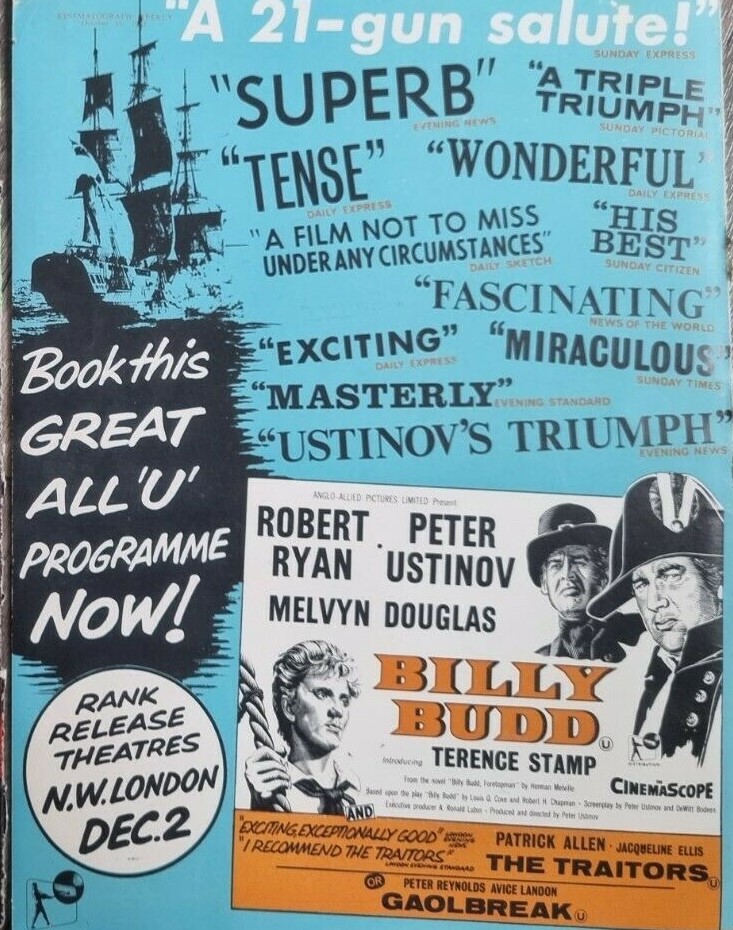
Billy Budd (1962) ***

Unfairly muscled out by lavish roadshow Mutiny on the Bounty (1962) but covering similar territory minus sailors going off-piste on a South Pacific island. Peter Ustinov outranked fellow triple hyphenates Billy Wilder (writer, producer, director) and John Wayne (actor, producer, director) in that he could add acting to his other skills (writer, producer, director) and in some respects he was actually better remembered as a noted raconteur on late night television shows. I was surprised to discover he was actually well versed in the directing malarkey by the time he came to helm Billy Budd, four previous excursions dating from the late 1940s and most recently Romanoff and Juliet (1961). He was better known at this point as an Oscar-winner for Spartacus (1960). He would win another for Topkapi (1964) and go on to direct another three pictures.

Billy Budd is a claustrophic affair that you’ll need a bit of a history lesson to understand. The British Navy had two methods of recruiting sailors. The first was the more honest, awaiting a supply of volunteers. The second, the most dodgy legal proces ever invented, involved grabbing any likely candidate and forcing – “pressing”- them into service. Normally, this caper took place on land and gangs of recruitment officers did the business, hence the term “press gang.”

However, I was unaware that in times of war – this is set during the Napoleonic War – the British Navy could board any passing merchant vessel and commandeer any of its crew. In this case,  Captain (actually Post Captain if you’re being technical about it) Vere (Peter Ustinov) hijacks only one sailor, Billy Budd (Terence Stamp).

Quite why it’s only this singleton is never explained. There are a couple of other irregularities that run against making this a tight ship in terms of narrative construction. The first is, that in the first of two critical incidents, our otherwise charming and chatty Budd is suddenly struck dumb with a stammer, the first time such an affliction has put in an appearance. The second is that, in consequence, Budd strikes an officer, the bullying Master-at-Arms Claggart (Robert Ryan) who hits his head while falling and dies.

Now even I know, and I’m hardly a naval scholar, that striking an officer is punishable by death. The fact that Claggart has a Capt Bligh disposition, inclined to find any opportunity to bring out the lash, makes no difference to the outcome. So while it seems that court martial provides dramatic scope, here the outcome is never in doubt. This isn’t Queeg on The Caine Mutiny, which is a more complicated affair, where the captain’s sanity is questioned.

So where the narrative should have built up in intensity, it largely flounders and depends (successfully as it happens) on audience appreciation of Budd as an innocent abroad.

That said, like Mutiny on the Bounty, it reveals the remarkable lack of recourse to any higher authority on ship should the highest authority either carry out or endorse cruelty. The minute he’s on the ship Budd is exposed to the sadistic will of Claggart who has condemned a sailor to a pitiless flogging for reasons that cannot be explained. Budd soon learns that Claggart has accomplices who will sabotage a crew member’s gear so that he will be put on a report, accumulation of sufficient black marks resulting in automatic flogging without interference from the captain.

While Vere is hardly in the Capt Bligh category and most of the time comes across as relatively amiable, our introduction to him is firing a shot across the bows of a merchant ship that doesn’t want to stop in case its crew is press ganged. He is quite ready to invoke the rules to get what he wants and is enough of a disciplinarian that the crew kowtow to him. He might feel a touch of remorse that Budd is the sacrificial lamb  to the Royal Navy’s rule of law, but he’s hardly going to go against procedure.

So mostly what we’ve got is the acting. Terence Stamp (The Collector, 1965), in his debut, was Oscar-nominated and you can see why and in some senses this is the career-defining role before acting affectations and mannerisms took over. Robert Ryan (The Wild Bunch, 1969) is very effective as the sinister Claggart. And there are a host of other British names to look out for – David McCallum (Sol Madrid/The Heroin Gang 1968), Ray McAnally (Fear Is the Key, 1972), Paul Rogers (Three into Two Won’t Go, 1969) and Niall McGinnis (The Viking Queen, 1967)  among the foremost.

Ably directed by Ustinov who wrote the screenplay with Dewitt Bodeen (Cat People, 1942) based on the original Herman Melville novel and a stage adaptation by Louis O. Coxe and Robert H. Chapman.

Worth seeing for Stamp’s performance.

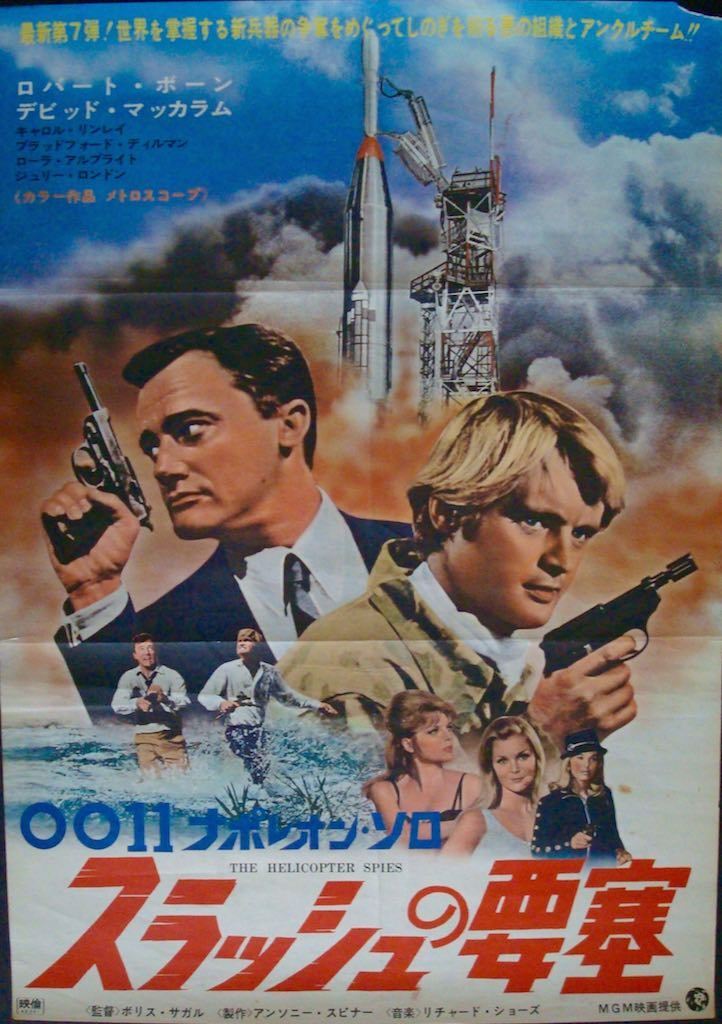
Helicopter Spies (1968) ***

Takes a little while to come to the boil what with disreputable women, a crew of platinum-white-haired thugs, a religious cult, some very dry dialog, a high priestess with her own chorus line of psychedelic dancers, four identical brothers, and a female lead parading a prize shaggy dog story. Our intrepid heroes appear more capable this time round, the previously inept Napoleon Solo (Robert Vaughn) not beaten up quite so often, though he does end up being drowned in sand (water too precious to spare, apparently).

This time round, too, the good guys are taken for a ride by mad scientist Luther Sebastian (Bradford Dillman) who hoodwinks the U.N.C.L.E. organisation into stealing a “thermal prism” from the fortress of another mad scientist Dr Kharmusi (John Dehner). To put his own grand plan into operation Sebastian just has to hijack a rocket. And you should be aware going into this that there’s not the amount of helicoptering you might expect given the title.

This time round, too, there’s hardly a good gal in sight. Azalea (Lola Albright),  aforementioned high priestess of cult The Third Way, has betrayed the good doctor in favor of Sebastian. Sebastian’s wife Laurie (Julie London) pretends to a) be out of contact with him for years and b) maintain a virtuous existence. And that’s before we come to the plainly bonkers, but still traitorous, Annie (Carol Lynley) who will make up any story in a bid to free an imprisoned unseen husband.

Sebastian has some neat touches as a leader, rewarding his team of thugs with booze and women as a prelude to killing them all off. He’s got an ejection seat in his car for getting rid of troublesome passengers. He prefers efficiency, to the point of iciness, to sexiness in his paramour and female underlings. And he has a very dry manner, which elicits a good few laughs.

But some of his thugs just ain’t that bright, the one instructed to follow Solo has just allowed him access to Laurie’s house. Laurie ain’t that bright, either, falling for an old trick by Solo who, as usual, is less bright that Ilya Kuryakin (David McCallum).  

Some of the set pieces are excellent. Sebastian’s followers meet in an abandoned movie theater where Azalea gives the lowdown on the grand plan assisted by her bevy of dancers. Infiltrating the organisation by the simple device of dying his hair, Solo ‘s disguise is uncovered after being sprayed with champagne.

There are a surprising number of human touches. Head henchman Carl (Roy Jenson) vowing to take “Mom” away from her dingy life running her eponymous diner finds she enjoys too much her dingy life. Carl, appreciative of the disguised Solo’s efforts, apologises for making him ride in the baggage train. Annie can stretch innocence to breaking point, to an extent where nobody cares about her problems.

But where The Karate Killers had a straightforward storyline – find the five daughters of a dead scientist – this gets a tad lost in the first section introducing the thermal prism, the cult, doubling down on mad scientists, and giving Annie all the importance of a red herring.

I thought for a moment that this was the end of the line in my appreciation of the U.N.C.L.E. franchise, the one where it all fell flat on its face and we could see the joins, but after the shaky start it picked up and became quite enjoyable in the series’ inimitable barmy fashion. I suppose I should applaud the initial narrative boldness, audience pretty much fooled from the off, the fortress assault not much more than an extended MacGuffin, with neither Sebastian nor Azalea what they seemed.

I could quibble about the guest stars but in fact this is a superb deadpan performance from Bradford Dillman (Sanctuary, 1961) and quite a departure for the Carol Lynley of Bunny Lake Is Missing (1965). And you could say the same for Lola Albright, previously seen essaying a different kind of character in The Way West (1967).

Boris Sagal (The Omega Man, 1971) directed from a screenplay by Dean Hargrove (One Spy Too Many, 1966).

I’ve only got a couple to go to wrap up the entire series and for your sake I will persevere. If you’ve not already done so, it’s back to the box set.

The Karate Killers (1967) ****

What a hoot! A sheer blast! The most brilliant yet of the madman dominating the world schemes, autogyros to out-Bond Bond, a fabulous cast and of course the most incompetent spies this side of Get Smart.

You can’t get better than a scientist inventing a way of turning water into gold. Takes chutzpah to even think of that as a plot. No having to batter your way into Fort Knox as poor Bond did in Goldfinger (1964), you just turn on the tap. But, wait, the formula is lost and our intrepid heroes have to – heaven forbid! – track down five gorgeous women to find it. Was there ever a more onerous proposal?

I never saw any of these films when they came out. At the time I guess they would have been viewed as small screen rivals to James Bond. But although 007 in every picture would eventually be trapped in the madman’s lair, he spent most of the film beating the sh*t out of the bad guys. In sharp contrast, The Men from U.N.C.L.E. seem always to be on the wrong side of a beating, number one hero Napoleon Solo (Robert Vaughn) more hapless than number two Ilya Kuryakin (David McCallum).

With hindsight, it looks like this was never meant to be taken seriously and without going into over-spoof plays exceptionally well as a light-hearted romp. Solo seems to be constantly outwitted with Kuryakin invariably coming to the rescue, the former too often duped by beauty, the latter a bit more discerning. There’s a lovely moment here in their reactions to the instruction by boss Mr Waverley (Leo G. Carroll) to hunt down a dead scientist’s quintet of daughters/step-daughters; Solo gives a knowing smirk, Kuryakin shows disdain.

Must be the best cast yet assembled: legendary Joan Crawford, suddenly hot again after Whatever Happened to Baby Jane (1962) and Strait-Jacket (1965), Curd Jurgens (Psyche ’59, 1964), Herbert Lom (Villa Rides, 1968), Telly Savalas (The Dirty Dozen, 1967), Kim Darby (True Grit, 1969), Terry-Thomas (How To Murder Your Wife, 1965)  and Jill Ireland (Mrs Charles Bronson) as you’ve never seen her before.    

The U.N.C.L.E. duo are in a race against T.H.R.U.S.H. operative Randolph (Herbert Lom) to track down the missing formula. Randolph has a head start. He has been having an affair with the scientist’s wife Amanda (Joan Crawford) who is shocked to discover his charming exterior conceals a ruthless interior.

Solo and Kuryakin track down the scientist’s daughter Sandy (Kim Darby), a good bit brighter than your average eye-candy spy girl, who points the way to the step-daughters and to the possibility that each has one part of the missing formula. Was there ever an easier justification for introducing such a random set of characters?

First up is stark naked Countess (Diane McBain) locked away by jealous impoverished husband (Telly Savalas) in a castle in Rome. Then we’re onto Imogen (Jill Ireland), a flamboyant lass shaking her booty at any opportunity, arrested by a constable (Terry-Thomas) for indecent exposure, and involved in a punch-up in a London night-club where Solo is nearly drowned (yup!) and Randolph instructs the band to keep playing since the ruckus is nothing to do with them.

Then we’re off to Switzerland and Yvonne (Danielle De Metz) and a machine-gun ski chase down a mountainside (beat that, Mr Bond). And so on until all the clues, contained in photographs of the dead father, have been found and, wait for it, the puzzle remains incomplete. Eventually it’s unravelled and the final showdown is on.

But what a way to go. Never mind the ski chase, the picture opens with the duo being attacked by a fleet of autogyros (one-man mini helicopters, the “Little Nellie” of the later You Only Live Twice, 1967 ), and as usual someone, this time Kuryakin, is trapped on a low-tech machine, this time on a ice-block travelator where blocks of ice are smashed to bits by nasty spikes.

Randolph is the most droll villain alive. “Don’t be so melodramatic, my dear,” he informs Amanda when she uncovers his villainy and is about to be murdered. The whole jigsaw is exceptionally appealing, the global whizzing about, Japan also included not to mention one of the poles where T.H.R.U.S.H. has established its HQ.  

The action is a good bit more thrilling, the aerial and ski sequences very well done on a budget a fraction of the Bonds, and there’s more than enough going on to keep interest levels high, not just where to go next, and who to encounter, but the gathering of the clues,  and working out of the final mystery, which offers a nice emotional touch.

Kim Darby is more of a typical ingenue here, sparkier than you might expect but not offering the originality of character expressed in True Grit, while Jill Ireland is a good bit more sassy than she ever appeared thereafter. Barry Shear (Wild in the Streets, 1968) directed.

This is the best so far that I have seen on the series. My interest had begun to flag but, thus fortified, I will continue with my endeavors to watch them all. on your behalf, of course.

The Long and the Short and the Tall / Jungle Fighters (1961) ****

The Brits were onto something in wartime Malaysian jungles in 1942 – sonic warfare. Imagine the franchise possibilities for comic-book or spy villains (The Brides of Fu Manchu, 1966, or Some Girls Do, 1969, anyone?). Fortunately, this ignores such temptations and takes a long hard raw look at the reality of conflict, courage and cowardice, the desire and reality of killing.  

Beginning as a fairly stock examination of men in combat, the usual clash of personalities, bullying loudmouths, and it being British elements of class distinction. But it quickly moves on to something much deeper, initially tough guys worrying about what their wives are getting up in their absence back home, but on capturing a Japanese soldier what exactly to do with him once his usefulness is over. Treat him according to the Geneva Convention as a prisoner-of-war and escort him back to base or just get rid of him and save yourself the trouble.

Five main characters make up this squad. Sgt Mitchem (Richard Todd) is the ruthless leader under pressure. He was busted down to corporal for losing a previous patrol, has got his stripe back and wants to prove his worth. But he appears to be from a different generation to his troops, his stiff upper lip only too evident while the others just give lip.

Corporal Johnstone (Richard Harris) likes to remind him of his previous misdemeanor and question his judgement. Racist Private Bamforth (Laurence Harvey) riles everyone, especially picking on Lance Corporal Macleish (Ronald Fraser) who is as likely to reply with his fists. Radio operator Private Whitaker (David McCallum) is over-keen on the spoils of war, kitbag stuffed with enemy mementoes.

After apprehending Jap soldier Tojo (Kenji Takaki) Johnstone is inclined to bayonet him right away (a bullet would attract attention). Others, more squeamish than principled, balk at the deed. At first Bamforth makes fun of the captive, belittling him, but then views him as a human being caught up in a war not of his making, giving him cigarettes, trying to make him more comfortable. When Macleish starts slapping the prisoner around, Bamforth defends him, though it’s obvious Mitchem and Johnstone have no intention of taking him back.

Then the tide turns. They are surrounded by Japs and it’s battle for real with an enemy who can defend itself. Action determines character. Some are revealed as complete cowards, others will abandon colleagues to save their skin, others are instinctively courageous, others yet again with a bit more cunning.

But the firefight when it comes is nothing like any other battle you have seen where Allied forces invariably triumph. There’s none of the clever ruses more typical of the genre.

This is by far the rawest depiction of British soldiers on the battle. The characters and conversation hit home. Tough guys are nothing but vulnerable. Although it appears that way, none of the characters actually change, it’s more that their real personalities emerge.

This is Laurence Harvey’s (The Running Man, 1963) best performance. In other pictures, his clipped delivery hid an edge of malevolence, and especially to retain audience sympathy he restrained an inner nastiness, even when ruthless as in Room at the Top (1958), this aspect more important if the male lead in a romance or essaying a decent character. Here, the real Harvey is let loose in the sense that his delivery is more normal, as if he delights in taking pleasure in using language to gut his victims. Sure, it’s an ideal central role, the guy who starts off one way and ends another, but he really brings it to life.

Richard Harris (This Sporting Life, 1963) was a rising star at this point. And it shows. He’s always trying to steal scenes, an unnecessary gesture, a roll of the eyes, forceful delivery. He turns out to be nastier than everyone else. Richard Todd (Subterfuge, 1968) also plays against type, no longer the heroic figure of The Dam Busters (1955) but fighting not just the enemy and his fellow soldiers but his internal demons.

Ronald Fraser (Fathom, 1967), often condemned to humorous supporting parts, also has a meatier role as does David McCallum (The Spy in the Green Hat, 1967).

Apart from a heavy dose of rain and some stock shots of animals, it betrays its stage roots, based on a play by Willis Hall, but that hardly matters when the dialog is so sharp, the characters so well-drawn and the drama so intense.

Leslie Norman (Dunkirk, 1958) does an excellent job of focusing on character and making the action believable. Wolf Mankowitz (The Day the Earth Caught Fire, 1961) was credited with the screenplay.

High-quality stuff.

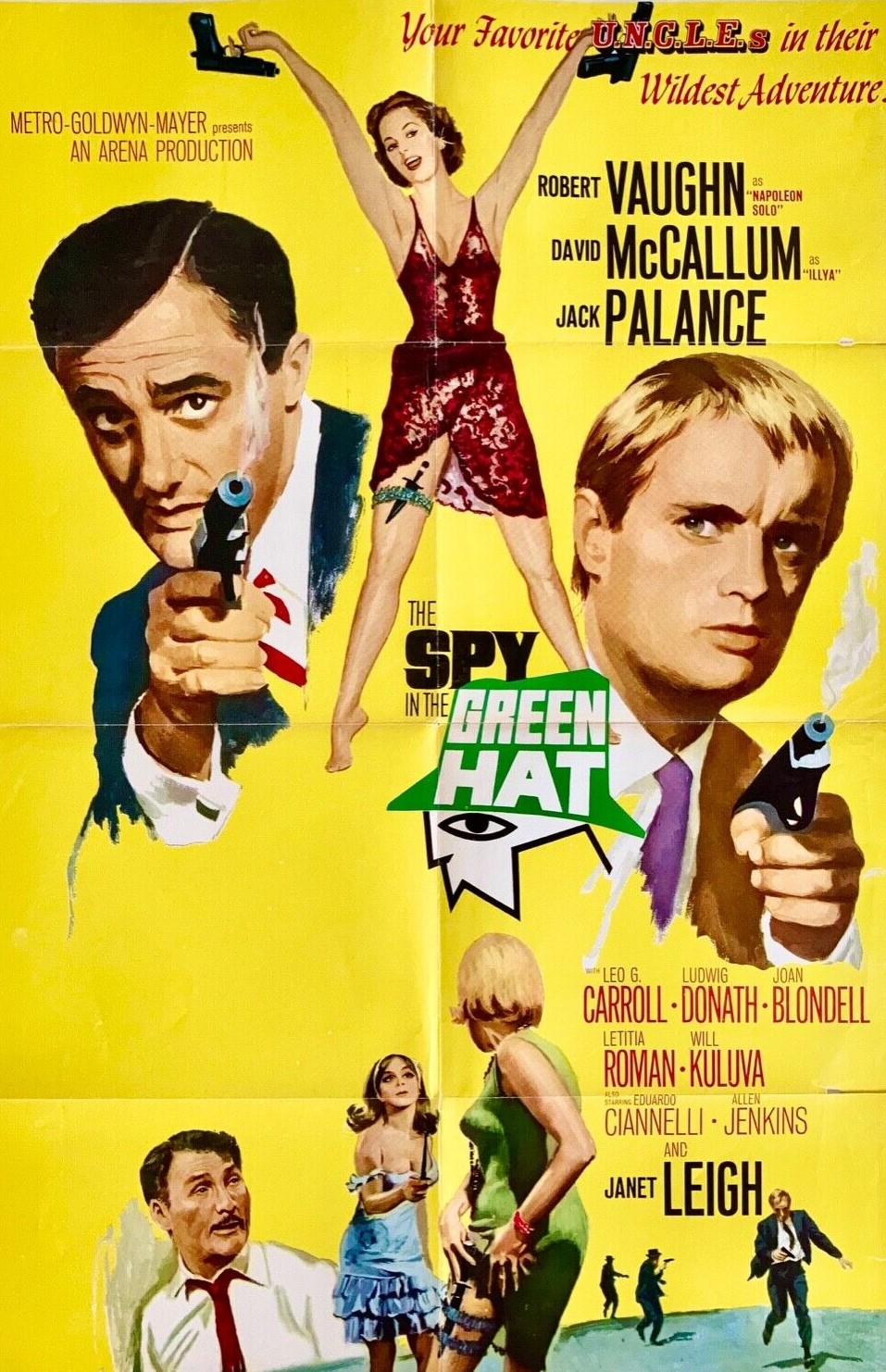
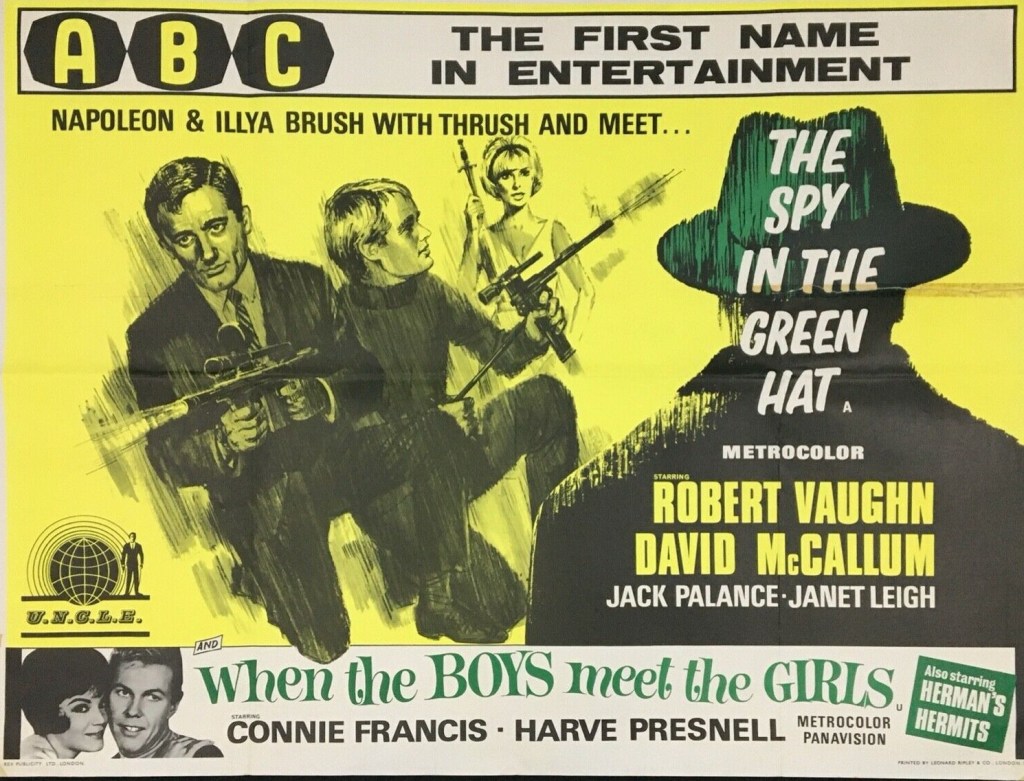
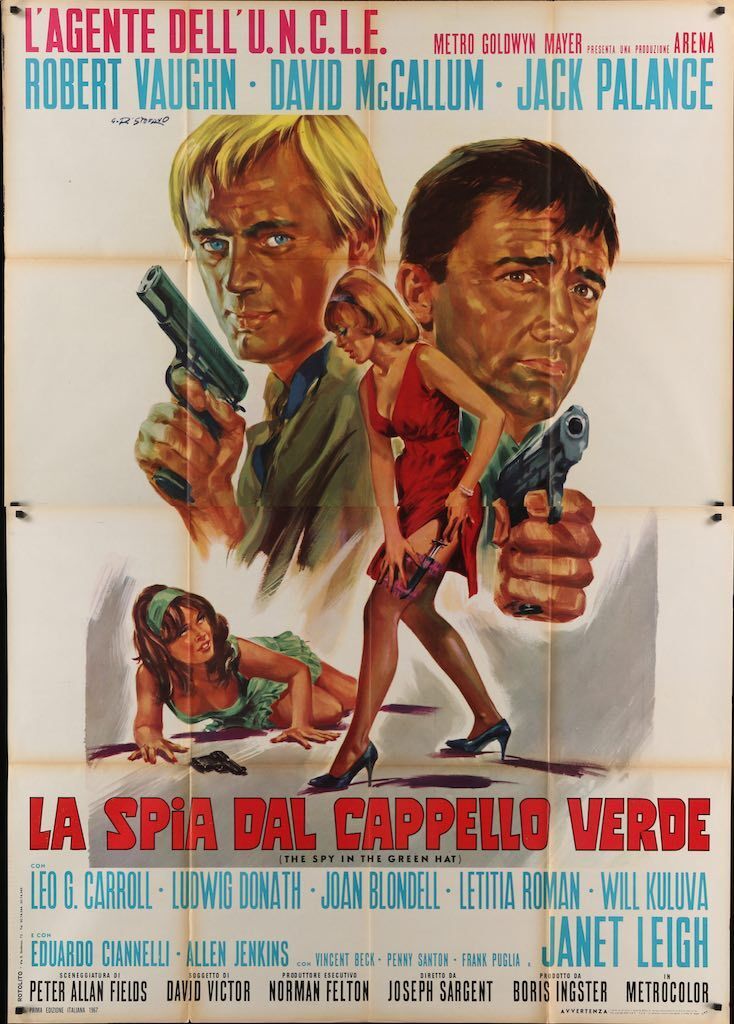
The Spy in The Green Hat (1966) ***

Unable to compete with the influx of big budget espionage pictures, The Man from U.N.C.L.E. throws in the action towel and comes out fighting as a comedy, and a more preposterous storyline you would be hard to find. As if spoofing a genre it helped create, our intrepid heroes find themselves in captivity one way or another, outwitted by a posse of retired Mafia hoods or sadistic females.

Napoleon Solo (Robert Vaughn) and Ilya Kuryakin (David McCallum) can’t even manage a chase, crashing the car in pursuit of former Nazi scientist Dr Von Kronen (Ludwig Donath). The trail leads to Sicily where Solo, again incapacitated, meets the sultry Pia (Leticia Roman) and as a result of a romantic misunderstanding is forced into a shotgun wedding in Chicago by her Mafia uncles, the famed Stilletto Brothers.

Meanwhile, Kuryakin makes the acquaintance of the deliciously sadistic Miss Diketon (Janet Leigh), assistant and masseuse to highly nervous Thrush boss Louis Strago (Jack Palance). The action finally shifts to the Gulf Stream, where Pia is imprisoned and the usual missiles are set to be launched in the presence of head Thrush honcho Mr Thaler (Will Kuluva) in the usual global takeover scenario.

Abandoning any attempt at serious drama, this is just a hoot, a score of sight and visual gags, references to Little Caesar and the St Valentine’s Day Massacre abound. Any time one of our heroes needs speedy access to a villain hideout along comes a guard to be bumped off and uniform purloined. Solo caught hiding under Pia’s bed is let off when discovered by a Thrush operative because he’s not the Uncle agent they are looking for. Not only is Solo constantly whacked over the head, but Kuryakin ends up as the plaything of Miss Diketon.  

Solo and Kuryakin look as if they stepped onto someone else’s parade, trying to keep the narrative on an even keel, while the Mafia gang and Thrush personnel effectively play it for laughs. Pia has Wanted posters of her uncles on her wall on the assumption they are just wonderful guys. Von Kronen gets the hots for Miss Diketon because he admires her skill at torture, although a spurned Miss Diketon turns traitor leading Kuryakin to mutter to Solo when all three meet, “I brought Lucrezia Borgia, you brought the Mafia.”

What makes it work so well are the fabulous performances of the supporting cast. Jack Palance (The Professionals, 1966), completely playing against type, still a villain sure, is a masochistic sweaty bag of nerves. Janet Leigh (Psycho, 1960) camps it up as the deadlier-than-the-male luscious female, dress slit at the thigh to reveal a hidden knife, whose pulse races at the mere thought of the cruelty she can inflict and the slower the better.  Will Kuluva (To Trap a Spy, 1964) is a bonus, the boss who just wants to party and has no idea of the technicalities of firing a missile.

Nobody even bothers to dress it up any more. The missiles look like something you would buy your kid for Xmas, the backdrops are as fake as anything on a backlot. But somehow it all works, as long as you weren’t expecting the original take on The Man from Uncle. And even so, director Joseph Sargent (One Spy Too Many, 1966) adds a few dabs of genuine cinematic icing, characters viewed from the ground-up, a fist fight that’s either in slo-mo or speeded-up freeze frame, the wife (Joan Blondell) of one of the Stiletto Brothers receiving a grapefruit in the mush.

After watching the original movie which came up better than expected in terms of action and spy malarkey, the last thing I anticipated that this would be headed in an entirely different direction. When that quickly became obvious, I feared the worst. Instead, I enjoyed a fun 90 minutes.

Of course, this wasn’t released theatrically in the U.S. just abroad with some added sex and violence, an expanded version, and in color, of a double black-and-white episode of the television series.   

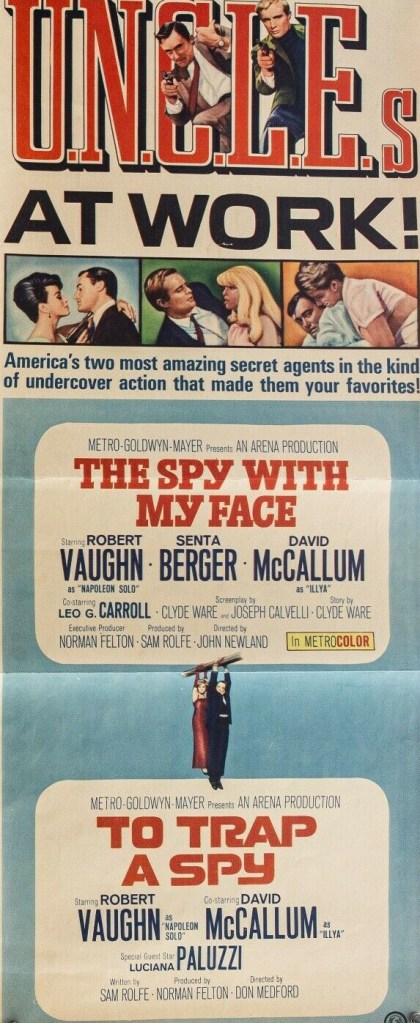
Behind the Scenes: The Spies Who Came in from Television: “The Spy with My Face” (1965)/”To Trap a Spy” (1965)

MGM wasn’t the first studio to hit upon the idea of re-editing episodes of a television series into a movie for cinema release. Small-screen The Lone Ranger had spawned The Legend of the Lone Ranger (1952) and Disney had stitched together episodes from its Davy Crockett franchise to create Davy Crockett, King of the Wild Frontier (1955) and Davy Crockett and the River Pirates (1955). The Challenge for Rin Tin Tin (1957) derived from The Adventures of Rin Tin Tin, Frontier Rangers (1959) born out of Northwest Passage, the Texas John Slaughter series the basis for five movies shown between 1960 and 1962, Crimebusters (1962) originated from Cain’s Hundred and Lassie’s Great Adventure (1963) from five episodes of the eponymous series.

But all these movies had one major disadvantage. Like their source material, they appeared in black-and-white. The Disney pair mined some box office gold, but primarily as matinee material. The rest were fillers, scheduled for the bottom half of a double bill and aimed at suburban and small-town cinemas and drive-ins desperate for anything to fill out a program. And all were nothing cruder than editing two or more episodes together to make a feature film.

MGM took a different approach. Instead of merging two different episodes, albeit starring the same stars, the studio decided to take one episode and expand it, filling out the story with subplots and extra characters and spicing up proceedings with levels of sex and violence that would not be tolerated on mainstream television. As important, it would be shot in color to make it stand out from the television series being shown in black-and-white.

First picture in the trial scheme was To Trap a Spy (changed form the initial To Catch a Spy), an expanded version of the television pilot known as The Vulcan Affair, and as well as series leads Robert Vaughn (The Magnificent Seven, 1960) and David McCallum (The Great Escape, 1963) toplined future Bond femme fatale Luciana Paluzzi (Thunderball, 1965). A second movie was culled from The Double Affair which had been screened on November 17, 1964, with an European star with a considerable pedigree in Senta Berger (Major Dundee, 1965).

Since MGM had no idea whether the spy series, launched in the U.S. on NBC on 22 September 1964,  would catch on abroad, where in any case stations paid comparatively little to screen top American shows, its initial idea was to release films only for the foreign market.  

In fact, the studio didn’t wait to see if the BBC could make a hit out of the debuting The Man from U.N.C.L.E. series and shunted out To Trap a Spy before the series even screened in Britain. And lacking momentum from television, it went out as the support on the ABC circuit in Britain to The Americanization of Emily (1965) starring Julie Andrews and James Garner.

At that time, the ABC chain was not beholden to the double bill idea. In fact, more than half the annual weekly releases went out as solo affairs. A double bill was more likely to suggest that there were doubts over the pulling power of the main film. There was no way of judging the box office appeal of any film put out in the lower half of a double bill.

The odd thing was that if MGM had held off pressing the button on the circuit release, To Trap a Spy would have demonstrated box office success. At the same time as the double bill was simultaneously released at nationwide first run theaters, To Trap a Spy opened in London’s West End in May 1965 at the 529-seat Ritz and delivered the best business MGM had enjoyed there for two years. It returned to the 556-seat Studio One, also in the West end, in October that year as the top attraction in a double bill that included Glenn Ford-Henry Ford western The Rounders (1965) and in its fifth week took in an excellent $5,600 and a few weeks later shifted back to the Ritz.

Between released the first and second Uncle pictures, MGM had launched a major marketing campaign on the back of the launch of the series on BBC. One marketing gimmick, inviting the audience to write in for The Man from U.N.C.L.E. certificates, brought in over half a million applications. MGM splashed out $85,000 marketing The Spy with My Face (1965). Again, the movie went out in an ABC circuit release – in July 1965 – as part of a double bill, with Son of a Gunfighter (1965), but this time the Uncle film topped the bill. Launched in the West End at the much larger 1,330-seat Empire it took $22,000 in its opening week.  Nationally, “it was far and away above average for a top-grossing picture in the UK.”

To Trap A Spy and The Spy with My Face each grossed $2 million in the UK market. By January  1996, a third Uncle film had launched in the British market, One Spy Too Many,  based on the two-episode Alexander the Great Affair which had screened in America in September 1965. This time MGM held off from ABC circuit release until mid-February until One Spy Too Many had cleaned up in January in the West End, $25,000 at the Empire, helped along by a Xmas merchandizing bonanza that saw the country flooded with memorabilia, paperbacks, three singles and an album. It broke studio records in 91 of the 125 situations it first played.   

The success of the first pair pointed up the potential U.S. box office from these featurized episodes and MGM put together the double bill The Spy with My Face/To Trap a Spy on the  assumption that the films at the very least would pick up business outside first run venues where bigger-budgeted pictures dominated and provide respite for showcase (wide release) theaters, drive-ins and small cinemas suffering from product shortage. The bigger a hit a movie became, whether roadshow or not, the longer it took to move down the food chain.

MGM was also inspired by the merchandizing boom generated by the television. A toy gun was well on its way to notching up sales of two million, and there were in addition, games, puzzles, trading cards, costumes and masks and chewing gum.  

The MGM was entering a very crowded espionage market. Not only had Thunderball taken the top off the box office with an explosive debut in Xmas 1965, but any new entrant into the field in 1966 would come up against such spy behemoths as Columbia’s Our Man Flint (1966) and The Silencers (1966) from Twentieth Century Fox as well as more offbeat spy numbers like Paramount’s The Spy Who Came in from the Cold (1965) and other pictures aiming for a slice of the cake like Where the Spies Are (1966) with David Niven and That Man in Istanbul (1965).

Variety magazine was sniffy about the double bill’s prospects – “for the least discriminating audiences” was its take on To Trap a Spy although Box Office deemed it “far better story-wise” than The Spy with My Face.

Advert in “Variety” (May 27, 1964, p41) announcing the new series.

The Spy with My Face/To Trap a Spy gained surprising traction in first run, even though MGM was demanding a 50 per cent share of the box office. In some cities it ran smack bang into the openings of one or other of the biggies while Thunderball played for months on end. Even so, the results were surprisingly good. Leading the single cinema first run bows was $24,000 – equivalent to $214,000 now – in Chicago (and a second week of $18,000). Boston audiences delivered $16,000 (plus $11,000 second week), Detroit $18,000 (and $12,000). It ran for three weeks in Washington D.C., Philadelphia and Providence and two weeks in St Louis, Buffalo, St Louis, San Francisco and Cleveland.

There were one-week bookings at other major cities like Seattle, Pittsburgh, Minneapolis and Cincinnati. Except in Portland (“drab” first week and “dull” the second) and Seattle (“okay”) the box office verdict varied from “potent,” “virile” and “sock”  to “nice,” “fine,” and “pleasant.” Box Office magazine reckoned that in Hartford the duo produced revenues over three times the average and in Memphis twice the average.

Following first run, it would go into wider breaks in these various cities. Some cities ignored first run and opted for a straight “showcase” (wide release) bow, New York leading the way with $104,000 – $928,000 equivalent today – from 25 cinemas, Kansas City bringing in $35,000 from 10 in week one and $25,000 from 10 in week two, and Baltimore good for $40,000 from 18. In new England cinemas and drive-ins united for a multiple run release hat “rang up some of the briskest business of the winter months despite the adverse weather conditions.” The only downside was the Pacific chain of drive-ins refusing to show the double bill on the grounds that previous experience of showing movies adapted from television series had “brought patron beefs” and that its own tests had not worked.

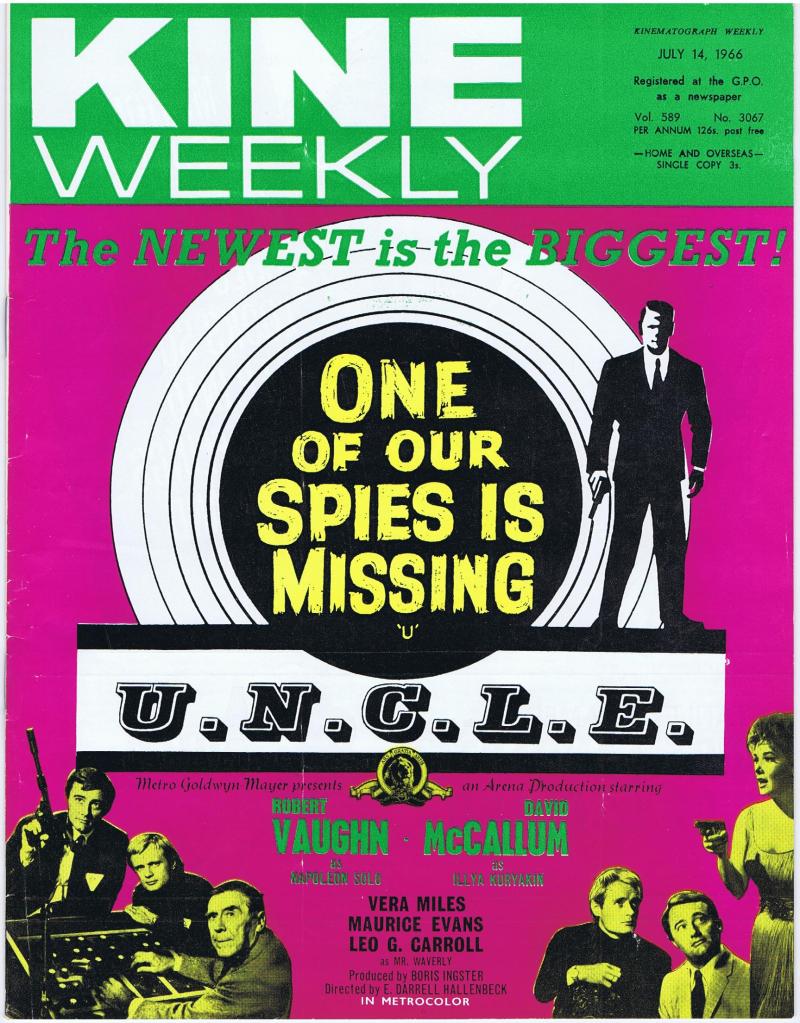
Even when The Man from U.N.C.L.E. series ended after three-and-a-half seasons, MGM continued bringing out movies, eventually totalling eight in all. The others were: One of Our Spies Is Missing (1966), The Spy in the Green Hat (1966), The Karate Killers (1967), The Helicopter Spies (1968) and How to Steal the World (1968).

Towards the end of the decade the Easy Rider (1969) phenomenon prompted a brief vogue for box office analysts to point to low-budget pictures generating the biggest profit. Nobody tended to include the first three Uncle films in this equation regardless of the fact that, costing an original $200,000 per episode plus extra for reshoots and editing, they were, on a profit-to-cost basis, extraordinarily successful, easily bringing home revenues in the region to 10-15 times their budgets.

SOURCES: Allen Eyles, ABC: The First Name in Entertainment (CTA, 1993), p123; “Another Uncle Sequel As O’Seas Theatrical,” Variety, September 23, 1964, p79; “Uncle Gets 3rd Whirl As O’seas Feature,” Variety, January 27, 1965, p26; “International Soundtrack,” Variety, May 26, 1965, p26;  “Toys from Uncle,” Variety, June 30, 1965, p42; “Uncle Stunt in London Is Metro Hit,” Variety, December 8, 1965, p23; “Metro Sees Uncle TV Stanzas As B.O. Kin to James Bond in Theaters,” Variety, February 2, 1966, p1; Review, Variety, February 16, 1966, p18;  Review, Box Office, February 21, 1966, pB11; “Box Office Barometer,” Box Office, March 14, 1966, p22; “One Spy Looms MGM Leader in Britain,” Variety, March 20, 1966, p29; “Drive-Ins in New England Preparing To Solve Springtime Problems,” Box Office, March 21, 1966, pNE4; “Pacific Prefers Not To Follow Video,” Variety, April 20, 1966, p24; “Box Office Barometer,” Box Office, June 20, 1966, p14; “How Uncle in Great Britain Clicked Via Tie-Ups with Tele,” Variety, June 22, 1966, p17; “Uncle TV Conversions Boffo at B.O. Theatrically O’Seas,” Variety, March 20, 1968, p4; Box Office figures taken from the weekly edition of Variety in the “Picture Grosses” section on the following dates: in 1965 on November 10 and December 8, in 1966 from February 2 until June 1; and August 18, 1966.  

The Spy with My Face (1965) ****

Far more enjoyable than I had expected and definitely benefitting from being seen on a small screen – I suspect the effects would show up the worse for wear on the big screen. Certainly, a decent enough plot and Napoleon Solo (Robert Vaughn) as the main Man from U.N.C.L.E. dominating proceedings.  Despite being an expanded version of an episode, The Double Affair from the television series, it doesn’t betray its origins. Female master spies were thin on the ground until Thunderball (1965) and Deadlier than the Male (1967) and here Serena (Senta Berger) masterminding a T.H.R.U.S.H operation to steal a nuclear weapon, steals a march on both. The action is counterpointed by some nice humor.  

While Solo and crew are busy attacking an Australian base of arch-nemesis T.H.R.U.S.H.,  Serena is putting the final plans together to infiltrate U.N.C.L.E. by using a doppelganger of Solo, cosmetic surgery creating an exact double. Solo’s sidekick Ilya Kuryakin (David MacCallum), portrayed as a cold fish – “I’ve got my computer to keep me warm” – is attacked leaving HQ by gas-spraying robots.  

Women here are a good bit more realistic than in Bond. Let down by Solo, his girlfriend Sandy (Sharon Farrell), an airline hostess, proceeds to get drunk. When they go out to dinner, a bandaged man (the double) is at the next booth and when Solo is called to the telephone Serena is there on his return, prompting the jealous Sandy to dump her dinner all over him. In best secret agent style, of course, Solo reckons he can have his cake an eat it, hoping to dupe Serena at the same time as seducing her. However, he is suspicious of her motives – “whenever I go to strange places with strange women I get hid over the head by strange men.”

In Serena’s apartment, suspicion continues, Solo takes his gun into the shower. However, when he answers the door, it’s to his double, and Solo is gassed. Sly sexual elements are brought into play – the double isn’t quite correct, failing the kiss test. While Solo is transported to the Alps where T.H.R.U.S.H plans to hijack a secret nuclear device, the double enters U.N.C.L.E. HQ where he will receive a new password relating to the weapon.

Meanwhile, it transpires the double’s disguise is both convincing – the still jealous Sandy pours a pot of coffee over him and later kicks him. And not foolproof enough – he wears the wrong aftershave. The real Solo is intrepid enough, finding a clever method of delaying a countdown, and a good bit more alert when captured than when not.

The set pieces are well-done, considerable tension built up at various points, the assault on the T.H.R.U.S.H. premises, while lower-grade than James Bond, considerably more realistic with Solo in Special Forces-type camouflage and hiding in the trunk. The climactic fist fight between the rival Solos is convincing and there is an excellent motorcycle chase. Fortunately, the movie steers clear of gadgets and gizmos, presumably for budgetary reasons, and the only let down is a vault which looks as if it is constructed of bits and pieces of leftovers.

I was particularly fond of a quip by Kitteridge (Donald Harron), U.N.C.L.E’s Australian associate. In response to a query from the big boss, Alexander Waverly (Leo G. Carroll), about whether his beard was real, Kitteridge answers “No, sir, it’s fake, I’ve got the real one in my pocket.”

The movie is surprisingly adept at treading a fine line between serious action and playfulness. The notion that the entire conspiracy can be undone by female jealousy or the wrong scent adds an interesting layer to the proceedings. And even the computer-loving Kuryakin finds time for romantic distraction. Serena is something of a secret weapon herself, far from an obvious espionage villainess, and keeps both Solo and the audience in the dark about her real intentions.

Director John Newland, more at home in television, steps up to the plate with a brisk tale that still has time for surprising subtlety. Robert Vaughn (The Venetian Affair, 1966) strides through the concoction effortlessly. The ever-alluring Senta Berger (Bang! Bang! You’re Dead, 1966) creates an intriguing character. Demands of the plot mean that David MacCallum (Sol Madrid, 1968) is somewhat underused. Sharon Farrell (A Lovely Way to Die, 1968) sparkles in a supporting role. Look out for Bardot lookalike Jennifer Billingsley (The Young Lovers, 1964), Harold Gould (The Sting, 1973) and Michele Carey (El Dorado, 1967). Joseph Calvelli (Death of a Gunfighter, 1969) and Clyde Ware (No Drums, No Bugles, 1972) devised the screenplay.

Discover WordPress

A daily selection of the best content published on WordPress, collected for you by humans who love to read.

The Atavist Magazine

by Brian Hannan

WordPress.com News

The latest news on WordPress.com and the WordPress community.