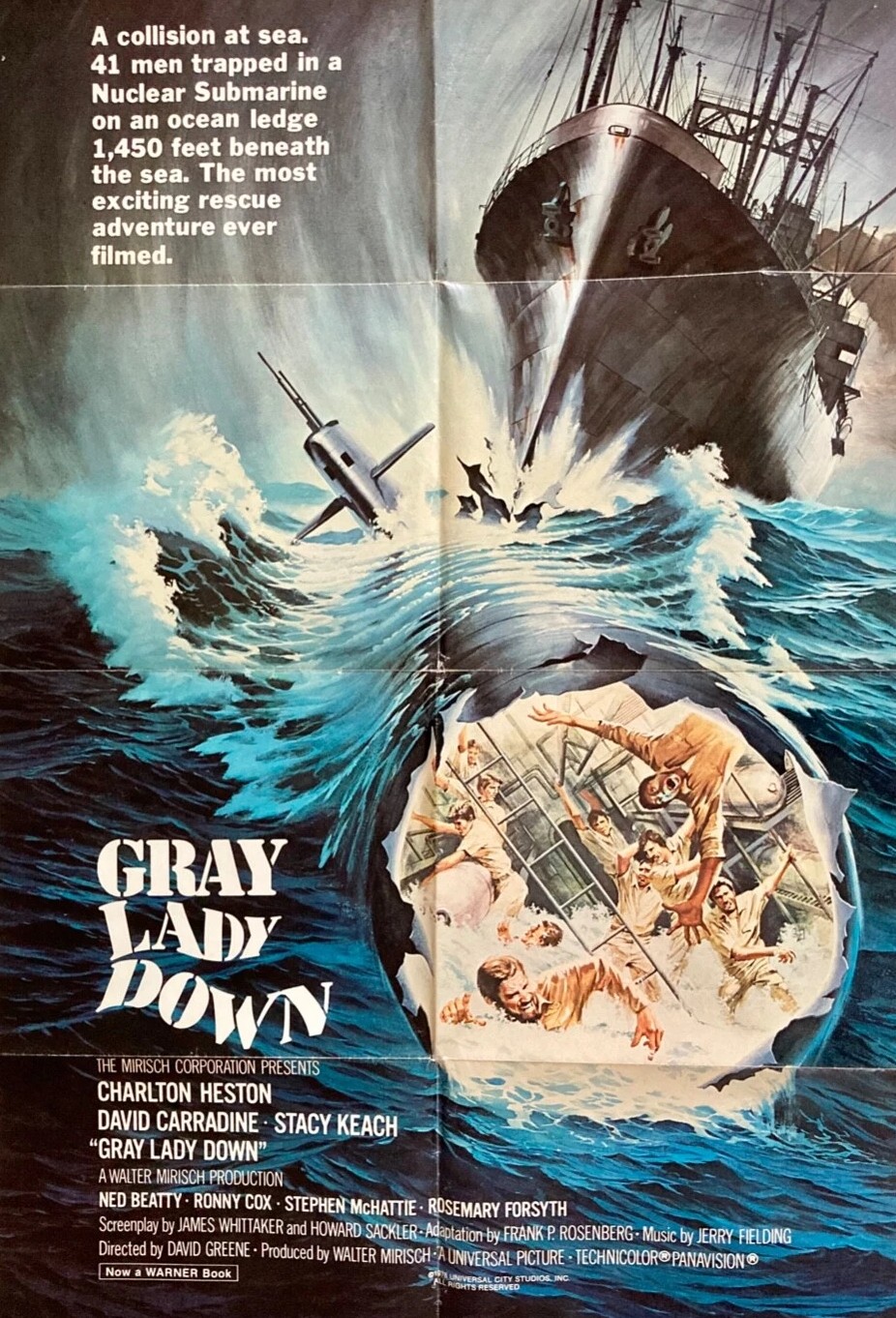
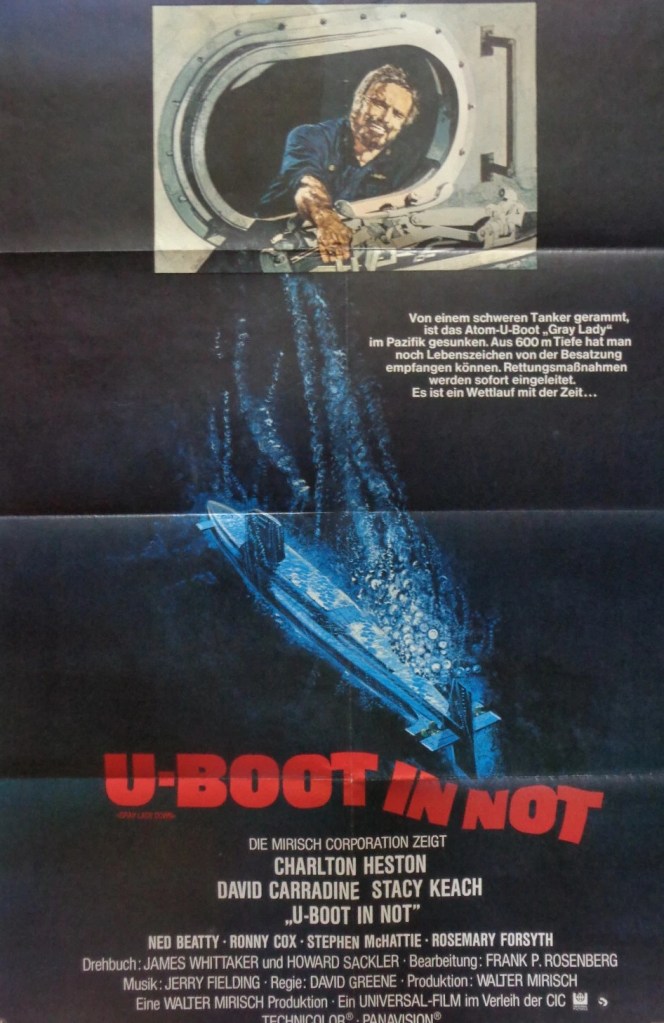
Gray Lady Down (1978) ****

The best of the late 70s disaster pictures and possibly the best of the whole short-lived genre, mixing technology, hair-rising tension and restrained emotion on top of a belter of a concept, sailors trapped in a submarine on the seabed with oxygen running out. But what lifts this above the norm is that it doesn’t follow the normal disaster picture template. Men do not rise easily to this challenge. Courage drains away as fast as time. Tempers flare and more than one of these hardy men collapse under the pressure.

The best scene in the picture is a man dealing wordlessly with loss and being a male of a certain era unable to shed a tear. So it’s all on the face. Capt Blanchard (Charlton Heston) has to shut himself away to grieve. And there’s a somber tone throughout. Corpses, covered only in a blanket, are laid out alongside the injured in an improvised sick bay. More than one person cracks. Even in a major crisis, bureaucracy gets in the way.
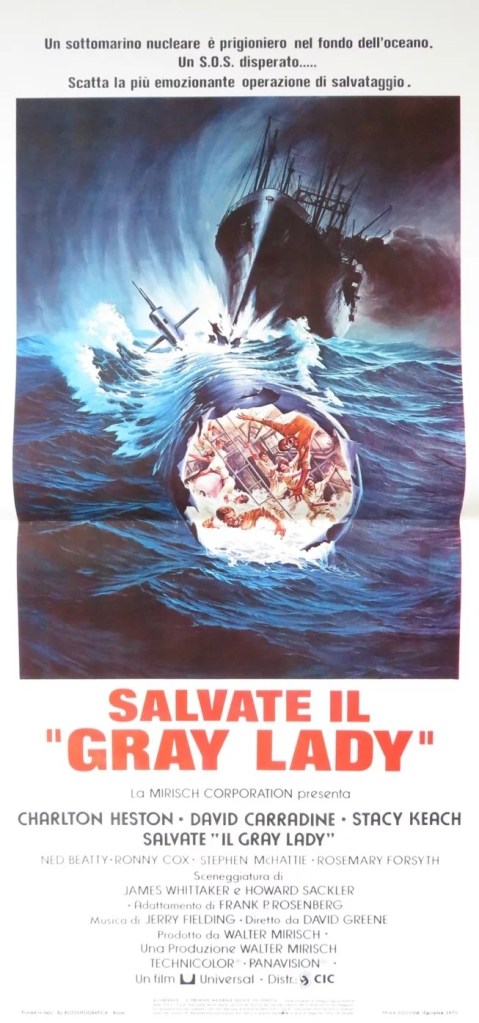
Blachard isn’t exactly the strong-jawed hero. As the situation grows more serious, his equanimity fails and he gets very snappy with the crew. And he’s also dealing with a heavy dose of guilt. Luckily, his major failing isn’t exposed to the crew, but his second-in-command points the finger.

Although the sub has been sent to the bottom courtesy of a collision in thick fog with a merchant ship boasting faulty radar, the accident should never have occurred. The sub shouldn’t have been on the surface. The only reason for that was Blanchard’s pride. This is his final voyage and he wanted to sail into harbor with is vessel atop the waves.

Now the sub is laid up in a deep trench and subject to “gravity slides”, the technical term for rock falls, which not only shift its position every now and then, pushing it deeper into the trench, but seal up the top of the escape hatch.

So the U.S. Navy’s new-fangled DSRV (Deep Submergence Rescue Vehicle) can’t do its job  and an even more new-fangled experimental submersible, operated by Captain Gates (David Carradine) and his sidekick Mickey (Ned Beatty) is called in. But its operation is sabotaged when officious Capt Bennett (Stacy Keach), tasked with the rescue mission, insists on one of his own men going down instead of the more experienced Mickey.

The underwater scenes are thrilling, and there’s plenty of technical know-how on view and a bunch of impression jargon spouted, as the sub slips further away and the submersible moves into more perilous depths. In the days before CGI, this is superb stuff. And since the sub is now upside down you certainly see more than normal of your typical submarine.
Unlike earlier disaster numbers like Airport (1970), The Poseidon Adventure (1972) and Towering Inferno (1974), no time is wasted setting up the various characters, usually embroiled in emotional entanglement, and for sure there’s no nuns or pregnant women to get in the way of a tight narrative. Comic relief, if that’s what you’re looking for, is provided by the chirpy Mickey.

But when you get right down to it, this holds all the narrative aces. You know rescue is going to get complicated. The unexpected always gets in the way.

But the men under pressure a thousand feet blow the surface are really under pressure and it’s not long before the cracks begin to show and widen.

Unfortunately, this came at the tail end of the disaster cycle when public interest was waning, and perhaps precisely because there was a lack of male-female interaction and no nuns it proved less appealing.

Charlton Heston (Will Penny, 1968) is very impressive, especially when he strains to hold it together and the scene I mentioned is one of his most best pieces of acting. Ned Beatty (Deliverance, 1971) also has a top-notch stiff-upper-lip scene.

Topping the supporting cast are David Carradine (Heaven with a Gun, 1969) and Stacey Keach (Fat City, 1972). You can spot Christopher Reeve (Superman, 1978) in an early role. Rosemary Forsyth (The War Lord, 1965) has a small part, but onshore.

Ably directed by David Greene (Sebastian, 1968) from a screenplay by James Whittaker (Megaforce, 1982)  and Howard Sackler (The Great White Hope, 1970) based on the book by David Lavallee

If you’re in the mood for a thrilling ride, hang on to your hat.
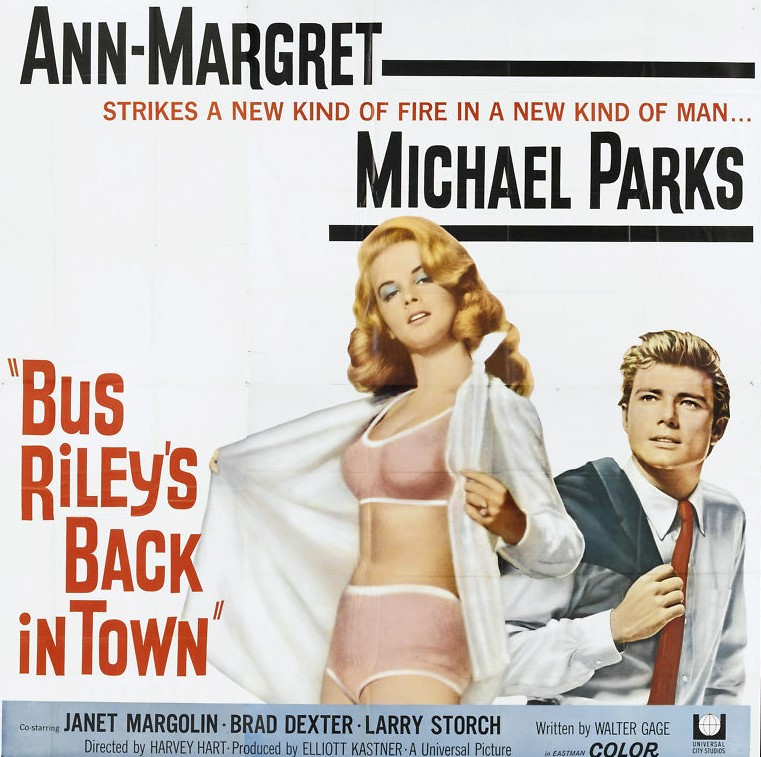
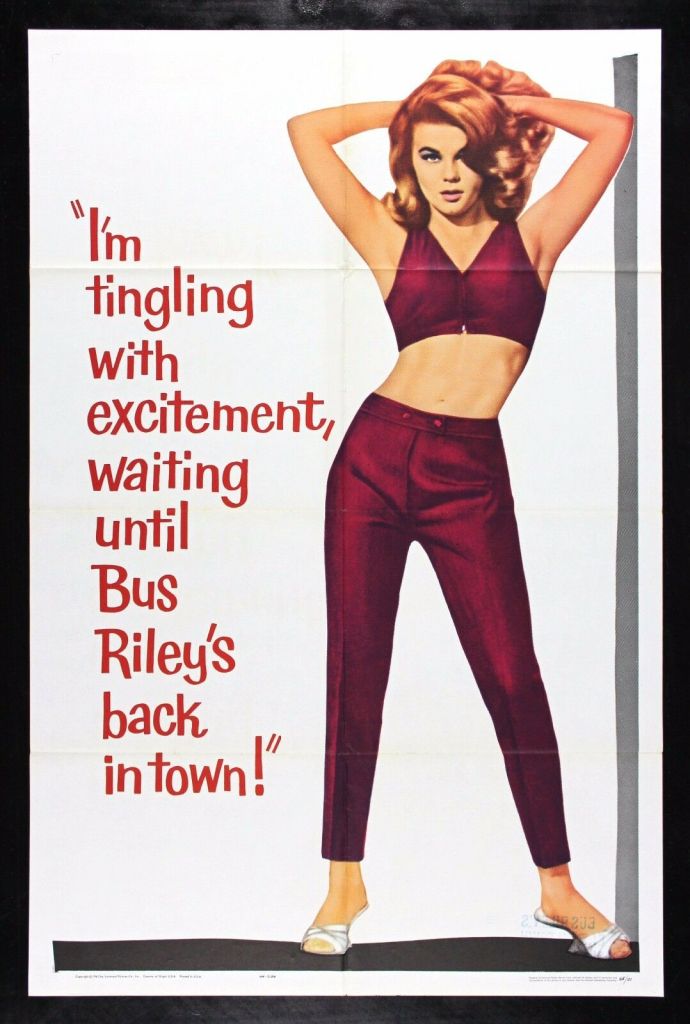
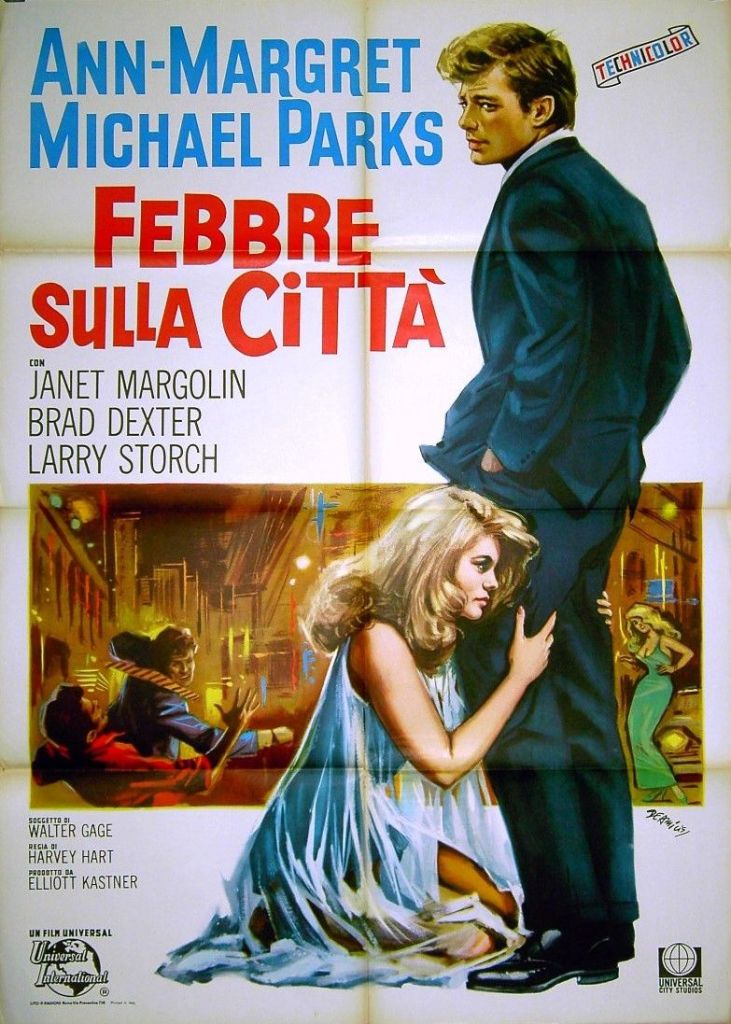
Bus Riley’s Back in Town (1965) ***

Given that Ann-Margret receives top billing I had automatically assumed she was the Bus Riley in question. Although decidedly the female lead, her role is secondary to that of a sailor returning to his small town. The backstory is that Bus – no explanation ever provided for this nickname, Buster perhaps? – Riley (Michael Parks) had been too young to marry the gorgeous Laurel (Ann-Margret) before he joined the U.S. Navy and in his absence she married an older wealthy man.  

Bus dithers over his future, re-engages with his mother and two sisters and finds he has not lost his attraction to Laurel. Although a handy mechanic, he has his eye on a white collar  career. An initial foray into becoming a mortician founders after sexual advances by his employer (Crahan Denton). Instead he is employed as a vacuum salesman by slick Slocum (Brad Dexter).  While his sister’s friend Judy (Janet Margolin) does catch his eye, she is hardly as forward or inviting as the sexy Laurel who crashes her car into his to attract his attention. But easy sex available with Laurel and the easy money from exploiting lonely housewives trigger a crisis of conscience.

Perhaps the most prominent aspect is the absence of good male role models. Bus is fatherless, his mother (Jocelyn Brando) taking in boarders to meet her financial burden – including the neurotic Carlotta (Brett Somers) – and while younger sister Gussie (Kim Darby) adores Bus the other sister Paula (Mimsy Farmer) is jealous of his freedom. Judy’s father is also missing and her mother (Nan Martin) a desperate alcoholic. The biggest male players are the ruthless Slocum and Laurel’s husband who clearly views her as a plaything he has bought. The biggest female player, Laurel, is equally ruthless, boredom sending her in search of male company, slithering and simpering to get what she wants.     

Scandal is often a flickering curtain away in small towns so it’s no surprise that Bus can enjoy a reckless affair with Laurel or that a meek mortician can get away with making his desires so quickly apparent, or that behind closed doors houses reek of alcohol or repression. A couple of years later and Hollywood would have encouraged youngsters like Bus and Laurel to scorn respectability in favor of free love. But this has a 1950s sensibility when finding a fulfilling job and the right partner was preferred to the illicit.

In that context – and it makes an interesting comparison to the more recent Licorice Pizza that despite being set in the 1970s finds youngsters still struggling with the difference between sex and love – it’s an excellent depiction of small-town life.

While Michael Parks (The Happening, 1967) anchors the picture, it’s the women who create the sparks. Not least, of course, is Ann-Margret (Once a Thief, 1965), at her most provocative but also revealing an inner helpless core. And you can trace her screen development from her earlier fluffier roles into the more mature parts she played in The Cincinnati Kid (1965) and more especially Once a Thief (1965).

In her movie debut Kim Darby (True Grit, 1969) is terrific as the bouncy Gussie and Janet Margolin (David and Lisa, 1962) invests her predominantly demure role with some bite. Jocelyn Brando (The Ugly American, 1963) reveals vulnerability while essaying the strong mother. Mimsy Farmer (Four Flies on Grey Velvet, 1971) also makes her debut and it’s only the second picture for David Carradine (Boxcar Bertha, 1972). Brad Dexter (The Magnificent Seven, 1960) is very convincing as the arrogant salesman.

It’s also the first film for Canadian director Harvey Hart (The Sweet Ride, 1968) and he has some nice visual flourishes, making particular use of aerial shots. The scenes of Bus trudging through town at night are particularly well done as are those of Laurel strutting her stuff.

It was also the only credit for screenwriter Walter Gage. That was because Gage didn’t exist. Like the Allen Smithee later adopted as the all-purpose pseudonym for pictures a director had disowned, this was the name adopted when playwright William Inge (Oscar-winner for Splendor in the Grass, 1961) refused to have anything to do with the finished film.

The movie was in limbo for over a year. It was never intended as a major picture, the budget limited to $550,000. Shot in Spring 1964, release was delayed for about a year until  Universal re-edited it and added new scenes. In part this was because Ann-Margret had  achieved surprising movie stardom between her recruitment and the film’s completion. Along with Raquel Welch, she became one of the most glamorous stars of the decade and in building up her own career Welch clearly followed the Ann-Margret template of taking on a bucket of roles and signing deals with competing studios.

After making just three movies, Ann-Margret was contracted for three movies with MGM at an average $200,000 per plus an average 12% of the profit, substantial sums for a neophyte. On top of that she had four far less remunerative pictures for Twentieth Century Fox, three for Columbia, Marriage on the Rocks with Frank Sinatra and a couple of others.

Universal also had another property to protect. Michael Parks was one of small contingent of novice actors in whom the studio had invested considerable sums, using them in television roles before placing them in major movies. Others in this small group – at a time when most studios had abandoned the idea of developing new talent – included Katharine Ross and Tom Simcox who both appeared in Shenadoah (1965), James Farentino (The War Lord, 1965), Don Galloway (The Rare Breed, 1965), Doug McClure (The Lively Set, 1964) and Robert Fuller and Jocelyn Lane in Incident at Phantom Hill (1965).

However, the introduction of Parks had not gone to plan. He was set to make his debut in The Wild Seed (1965) – originally titled Daffy and going through several other titles besides – but that was also delayed until after Bus Riley, riding on Ann-Margret’s coat-tails, offered greater potential.

SOURCES: “Escalating Actress,” Variety, May 22, 1963, page 4; “Inge Thinks Writer Contentment May Lie in Creative Scope of Cheaper Pix,” Variety, May 6, 1964, p2; “Ann-Margret Into the Cash Splash,” Variety, July 22, 1964, p5; “Universal Puts 9 Novices Into Pix,” Variety, March 3, 1965, p25; “Fear Ann-Margret Going Wrongo in Her Screen Image,” Variety, March 24, 1965, p5.

There’s a VHS copy available on Amazon, but otherwise it’s Ebay or this decent enough print on YouTube.

Discover WordPress

A daily selection of the best content published on WordPress, collected for you by humans who love to read.

The Atavist Magazine

by Brian Hannan

WordPress.com News

The latest news on WordPress.com and the WordPress community.