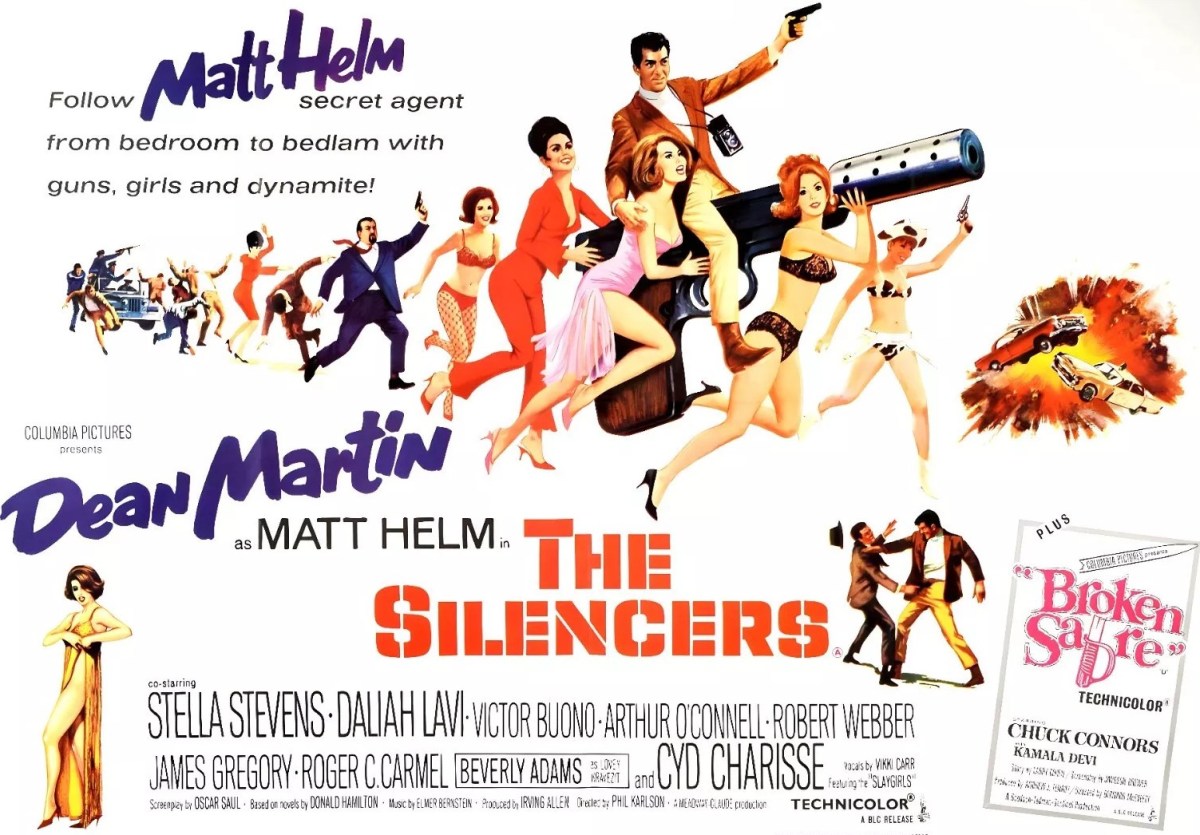
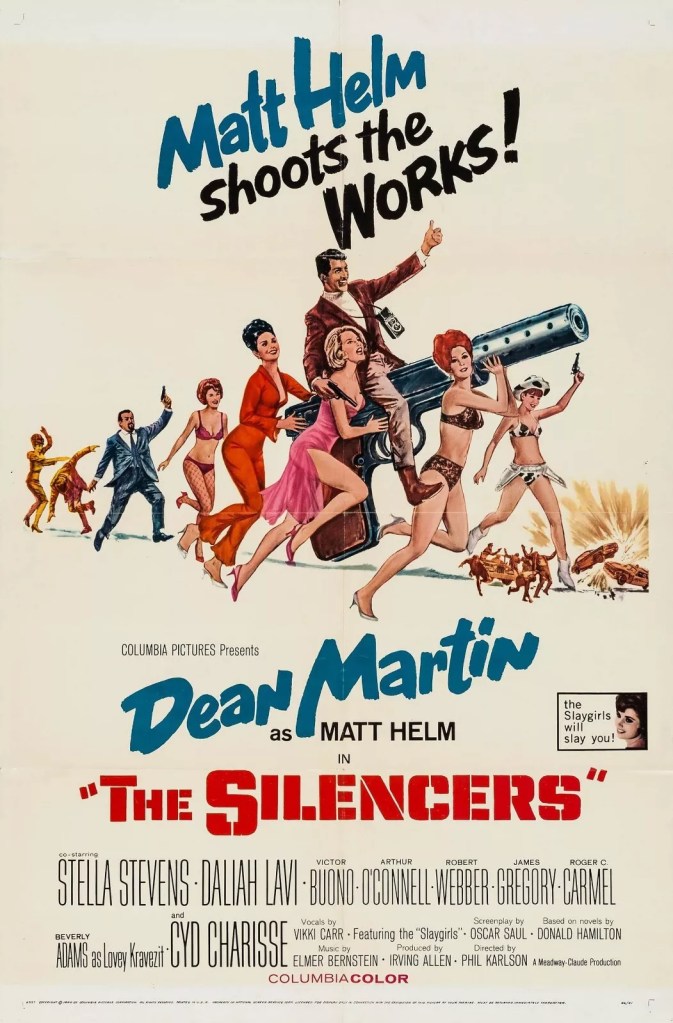
An absolute delight. Have to confess though I had been pretty sniffy about even deigning to watch what I always had been led to believe was an ill-judged spoof of the Bond phenomenon especially with a middle-aged Dean Martin with scarcely a muscle to crease his stylish attire.
Full of witty repartee, and even a whole jukebox of snippets from the Dean Martin repertoire (plus an aural joke at the expense of Frank Sinatra) and a daft take on the Bond gadget paraphernalia. The spoofometer doesn’t go anywhere near 10 and the whole enterprise not only works but damn near sizzles. No wonder it led to another three.
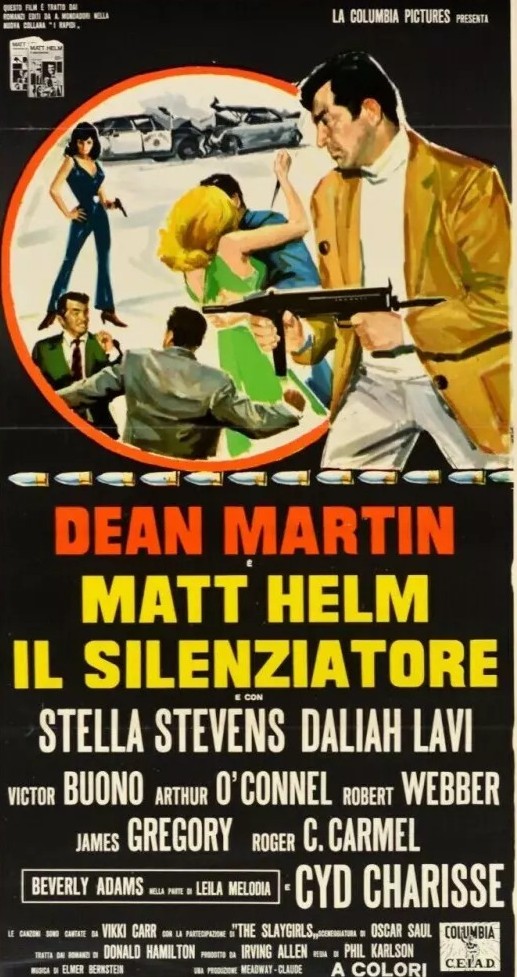
Called out of retirement – hence cleverly swatting away any jibes about his age – Matt Helm (Dean Martin) resists becoming re-involved in the espionage malarkey until his life is saved by former colleague Tina (Daliah Lavi) as he falls for the seductive technique of an enemy agent. Back in harness with ICE (Intelligence and Counter Espionage), Helm is called upon a thwart a dastardly scheme by the Big O organization headed by Tung-Tze (Victor Buono) to stage a nuclear explosion.
Some malarkey about a secret computer brings into Helm’s sphere the klutzy Gail (Stella Stevens) whom he initially treats with suspicion. Gail and Tina end up as rivals for Helm’s afections.
But you could have invented any number of stories and they would still have worked because it’s the rest of narrative that makes the whole thing zing. We could start with the massive effort that goes into ensuring that the private parts of naked men (and women) are concealed by a wide variety of objects, a kind of bait-and-switch that paid homage to the James Bond legend while casually taking it apart. Since Helm now operates legitimately as a fashion photographer it makes sense that his most deadly gadget is a camera that fires miniature knives.
And knowing how much delight villains take in despatching secret service agents in the most gleeful fashion, wouldn’t it make sense to kill said agent with his own gun? Who could resist such a notion? Until it, literally, backfires and the bad guy is shot by a gun that shoots a reversible bullet – two bullets if you’re so dumb you can’t believe that’s what’s happening and you shoot yourself twice.
And what about the laser? Another famed Bond device. Why not have that go haywire?
But there’s also a playful Heath Robinson aspect to those gadgets whose purpose is pure labor-saving. Helm can automate his circular bed so he doesn’t have to get out of it to answer the phone and to save him walking a few steps into the bath the bed is programmed to jerk upwards and tip him in.
“Treasure hunt,” remarks Helm, slyly, as he spies a string of discarded female clothing. But making love to a strange woman feels rude so Helm is impelled to complain they haven’t been introduced. “You’re Matt Helm,” says the stranger. “Good enough,” replies Helm.
And that’s before we come to the joy of Gail, who has been taking lessons from Mrs Malaprop, and, despite lurching into Helm at every opportunity, giving him the mistaken impression that she’s keen to get to know him better, Gail actually is wary. So wary that in a thunderstorm she tries to escape their cosy nest of a car (equipped with separate sleeping arrangements, don’t you know) only to end up slipping and sliding through the mud.
While Daliah Lavi (The Demon, 1963) isn’t exactly called upon to act her socks off, she at least is afforded a believable character, but she can’t hold candle to Stella Stevens (Rage, 1966) when the blonde one decides to go full-tilt boogie into comedy slapstick. Sure, Stevens relies overly on other occasions on a pop-eyed look, but the thunderstorm sequence reveals a deft, and willing, knack for physical comedy.
Dean Martin (Rough Night in Jericho, 1967) struck a solid seam with his interpretation of Helm, slick enough to get away with Bond-style lothario, laid-back enough for no one to take it seriously.
Nancy Kovack (Tarzan and the Valley of Gold, 1967), Cyd Charisse (Maroc 7, 1967) and Beverley Adams (Hammerhead, 1968) up the glamor quotient.
Director Phil Karlson (The Secret Ways, 1961) and screenwriter Oscar Saul (Major Dundee, 1965), adapting the Donald Hamilton bestseller, provide the basic template but Dean Martin makes it work.
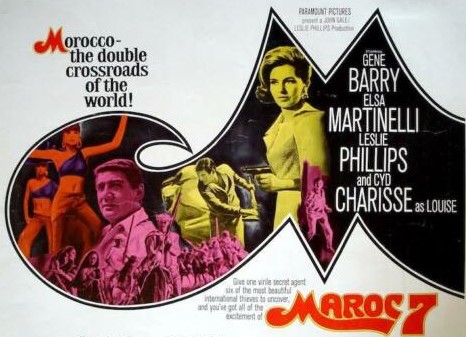
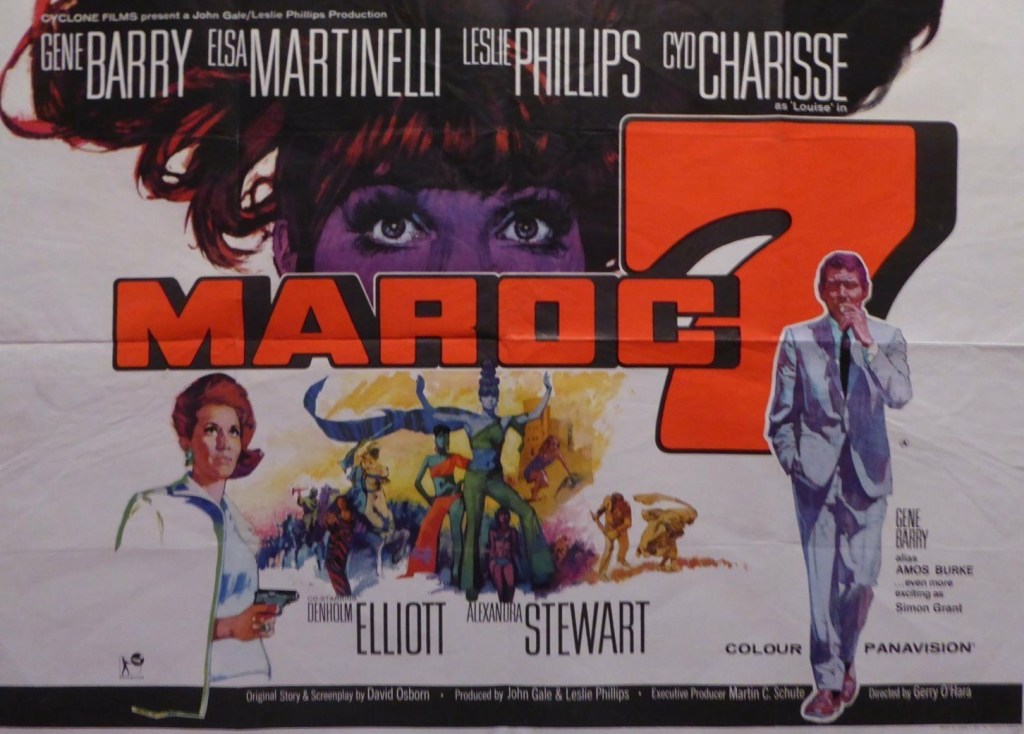
With a string of Swinging Sixties fashion models providing the requisite bevy of beauties, a gang of thieves, a Moroccan heist, superb locations, great cast and a touch of archaeology with secret chambers and a long-lost relic thrown, this splendid espionage frolic proves a welcome return to big screen top billing for Gene Barry after nearly a decade in television in Bat Masterson (1958-1961) and Burke’s Law (1963-1966).
Something of a cat burglar himself, Simon Grant (Barry) infiltrates a gang which uses fashion as a cover and whose ingenious specialty is to steal famous heirlooms and replace them with fake ones in the assumption that on their departure from a foreign country the customs officers will not be able to tell the difference. Louise Henderson (Cyd Charisse) and Raymond Lowe (Leslie Phillips) head up the gang while Claudia (Else Martinelli) may or may not be in on the act.
Her dalliance with Simon suggests an inclination towards the right side of the law justice but the fact that she has been involved with the pair for so long sets up the intriguing notion that she is stringing the American agent along. Initially, she rejects Simon’s advances until told by Louise to comply and pump him for information leading to one of the movie’s best lines (and innuendo that a British audience in particular would adore). Says Simon: “We haven’t done much about pumping but maybe that will come later.” Doubts also surround the intentions of Michelle Craig (Alexandra Stewart). On their trail is Inspector Barrada (Denholm Elliott).
There is mystery aplenty and a fair quotient of punch-ups, romance, shoot-outs and murder while the unearthing of the hidden treasure is more less heist than Indiana Jones. The fashion is the icing on the cake. The Moroccan fashion shoots are more than merely decorative, an excuse to bare the charms of the gorgeous models. Instead, the shoots would not disgrace Vogue or any of the other glossy magazine temples to haute couture, with that Sixties focus on fabulous clothes, genuine location and outlandish hairstyles.
On top of that, several of the stars are either playing against type or out of their comfort zones. Legendary Hollywood dancer Cyd Charisse famed for such classic musicals as The Bandwagon (1953) and Silk Stockings (1957) sets such fluff aside to essay a criminal mastermind, whose cunning often gets the better of Simon. Leslie Phillips (Crooks Anonymous, 1962), better known as a charming Englishman with an eye for the ladies, is as ruthless a photographer as he is a criminal. Director Gerry O’Hara (The Pleasure Girls, 1965) – from a script by David D. Osborn (Some Girls Do, 1969) has managed to get both Phillips and Denholm Elliott to drop their standard methods of delivery, usually embracing a drawl, making their characterizations a good bit fresher than normal. Phillips was clearly intending to make some kind of career change since he was the producer.
Gene Barry makes a perfect entrance as an adventurer-spy, as confident in his seduction techniques without women falling at his feet like James Bond, with a nice line in self-deprecation and more than able to look after himself. Before being side-tracked by television, Barry had shown movie star potential in Thunder Road (1958) and Hong Kong Potential, and now he delivers on that earlier promise. Elsa Martinelli (Hatari!, 1962) is the femme fatale who may or may not wish to play that role, keeping the audience completely on edge as to which side of the law she is likely to come down. Added bonuses are Alexandra Stewart (Only When I Larf, 1968), Angela Douglas (Carry On Screaming!, 1966), Tracy Reed (Hammerhead, 1968), dancer Lionel Blair (A Hard Day’s Night, 1964) and Maggie London.
Until a technological invention first used in Once a Thief (1965) it was impossible to shoot “day for night” without it appearing very obvious. So when director Vincente Minnelli aimed for as much verisimilitude as possible for the Rome-set drama it meant half the shoot took place at night. “Minnelli could sleep easily during the day,” recalled star Kirk Douglas (The Arrangement, 1969), “sometimes till six o’clock in the evening, but I couldn’t so there were three unpleasant weeks of night shooting and not much sleep.”
But the movie suffered, Douglas later complained, by studio interference at the editing stage. When the movie fell foul of the Production Code, change of MGM management vetoed the more salacious aspects of the movie – the worst aspects of “La Dolce Vita” including a sequence in a nightclub where guests watched an unseen sexual act. Fifteen minutes were cut including a scene that showed Cyd Charisse’s character in a more sympathetic light. In an ironic reflection of the film’s narrative, Minnelli played no part in the editing, not due to production deadlines as in the movie, but out of choice.
The actual producer John Houseman – producer of Douglas starrers The Bad and the Beautiful (1952) and Lust for Life (1956) though later best known as an actor in Rollerball (1975) etc – backed out of any tussle with MGM head honcho Joseph Vogel. Douglas implored Vogel and editor Margaret Booth, to no avail. Consequently, in Douglas’s opinion, the film was “emasculated.” He argued MGM had turned an “adult” picture into a “family” film. Quite how this could be squared with marketing that promised a “shocking intimate view of Rome’s international film set” (see below) was not mentioned.
Following the commercial and artistic success of Spartacus (1960), Douglas was at the peak of his career, though his last three pictures had been flops. After nabbing an Oscar for Gigi (1959), Minnelli also enjoyed a career high, and although best known for musicals like Meet Me in St Louis (1944) and An American in Paris (1951) was equally adept at drama like The Bad and the Beautiful, Lust for Life (1956) and Some Came Running (1958). But he, too, was running empty, his last three serious films – Home from the Hill (1960), All the Fine Young Cannibals (1961) and big-budget roadshow The Four Horsemen of the Apocalypse (1962) coming up short at the box office.
Douglas earned $500,000 and a percentage of the profits (though none were forthcoming – it made a loss of $3 million) and top-billing. Although co-star Edward G. Robinson (Seven Thieves, 1960) appeared above the title, Douglas refused to accord female lead Cyd Charisse (Maroc 7, 1967), on one-tenth of his salary, that concession.
Douglas recalled that he build up his acting skills through wrestling. A college wrestling champ, he barnstormed across the country in a carnival, playing the cocky person reputedly from the audience who challenged the giant resident wrestler. “My job was to make the audience think he was going to murder me,” Douglas told the Pressbook/Campaign Manual. “And the way to do this was by expressions on my face. To yell out in pain would seem cowardly. But I learned a hundred and one ways of showing it through use of my eyes and the muscles in my face.”
The actor escaped serious injury when lightning, preceding one of the worst thunderstorms in a decade, struck a 200-year-old clock on the top of the church in Santa Maria Square. Four huge iron numerals were torn off and crashed to the ground, one grazing Douglas’s head.
In fact, the movie’s authenticity owed much to being filmed on the streets of Rome rather than reconstructed on the studio lot. In particular, scenes utilizing the Via Veneto, two long blocks of sidewalk cafes where the movie industry socialized, created a realistic atmosphere, especially when a hundred or so of the extra employed were actually people who would naturally populate the location. So, for example, when the script called for an opera star among the extras, casting director Guidarino Guidi used Bostonian Ann English, an opera singer studying in Rome. Among those sitting in the background at café tables were a promising young painter, a poet and a librettist.
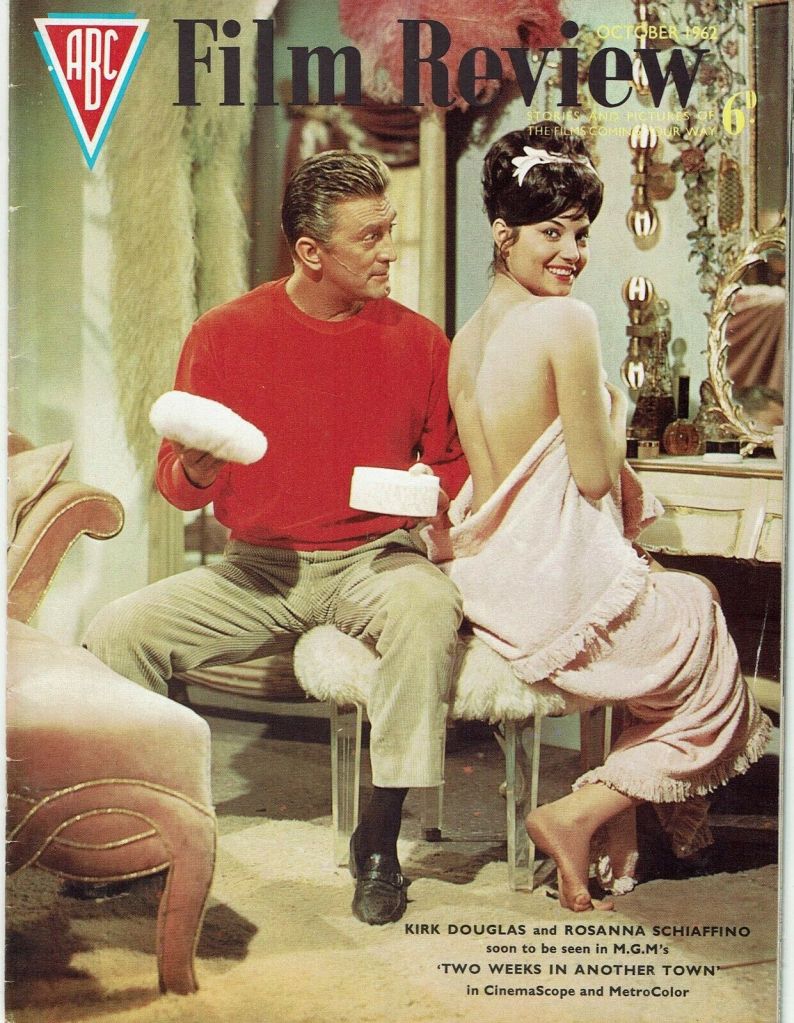
George Hamilton (Act One, 1963), who had worked in Home from the Hill and just finished Light in the Piazza (1962) also shot in Rome, reckoned he couldn’t have been more miscast given his role called for a “funky James-Dean type.” He got the role through the influence of Betty Spiegel, wife of producer Sam, and her friend Denise Gigante, the director’s current girlfriend (later wife). Hamilton drove around in a red Ferrari costing $18,000 (ten times that at today’s prices) and, as he put it, “Italians knew how to worship” Hollywood stars.
Hamilton reckoned part of the problem of the film was that Minnelli was so “besotted with Denise that he had lost his vision.” Jumping to the defence of Cyd Charisse against a tirade from journalist Oriana Fallaci at the Venice Film Festival won Hamilton, unexpectedly, the cover of Paris-Match.
Daliah Lavi owed her career break to Douglas. As a nine-year-old in Hiffa, Israel, she struck up a friendship with the actor when he was filming The Juggler there in 1952. The actor and other stars attended her birthday party, Douglas presenting her with a ballet dress. Later a dancer and then an actress, this was her Hollywood debut. Erich von Stroheim Jr, making his movie acting debut, had his head shaved to make him appear more like his famed director father. Originally employed as an assistant director on the picture, Minnelli decided he would make a good Ravinski, the “fast-talking press agent.”
Chauvinism reared its ugly head, especially when women had to apologise for being on the receiving end. “What goes on in the minds of beautiful women when they get slapped for the cameras?” mused the editor of the Pressbook/Campaign Manual. Rossano Schiaffino’s response regarding being whacked on the behind by Douglas: “He hits hard so charmingly I didn’t mind standing up for a day of two.”
The actress proved tougher than many of her colleagues. She turned down the offer of a double for a scene in which she jumped into a lake. That might not have been such an undertaking had the sequence been shot in the hot Italian sunshine at the height of summer. But the MGM studio tank on Lot 3 was a different – and much colder – proposition. “She shrugged off her stunt with the remark that heated pools are unknown where she comes from.”
Irwin Shaw, author of the best-selling source novel, wasn’t too upset at the way the movie turned out. “An author who wants complete control of his work on the screen is in something of a cleft stick,” he observed. “He can either go into production himself, which is often neither possible nor desirable, or he can refuse to sell his work to the movies. Minor deviations in screen conception don’t send me reeling back a stricken man. I think I’m sufficiently realistic to know that even in the most enlightened films there must be some compromise if they are to be a success. What does matter very strongly to me is that the theme of the novel…should come over on the screen.”
Music trivia: Kirk Douglas was the first big Hollywood star to perform “The Twist” on screen and the song “Don’t Blame Me” was reprised from The Bad and the Beautiful, sung here sung by Leslie Uggams and in the older film by Peggy King.
French designer Pierre Balmain created the dresses, allowing a marketing campaign to be built around those stores which supplied his clothes. TWA, which flew directly to Rome, was suggested to cinema owners as an ideal tie-in. Not only did New American Library issue a new movie tie-in paperback/soft cover but cinemas were encouraged to build a campaign around a director, many of whose films would be well-known to audiences. The marketeers also had material to tie in with stores retailing music, women’s sportswear, menswear, men’s sweaters, beauty and hair styling.
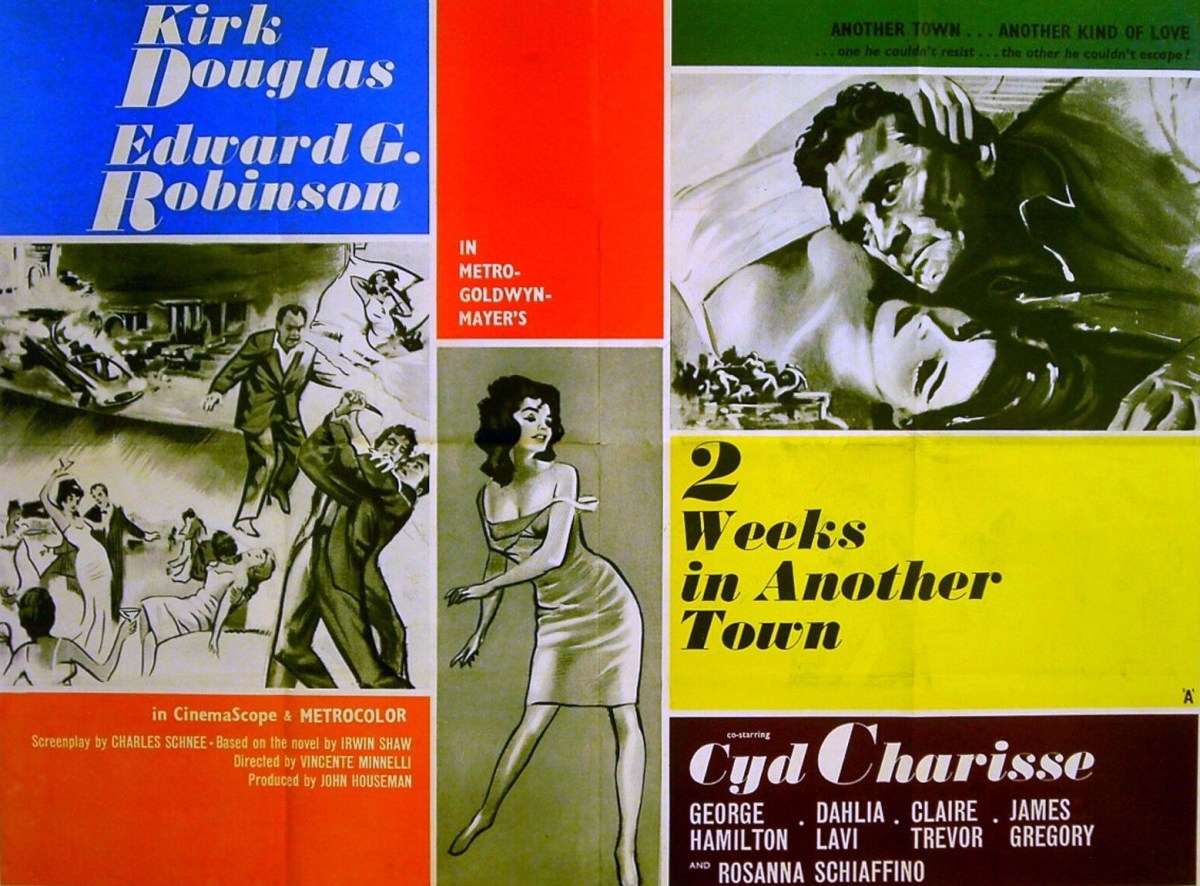
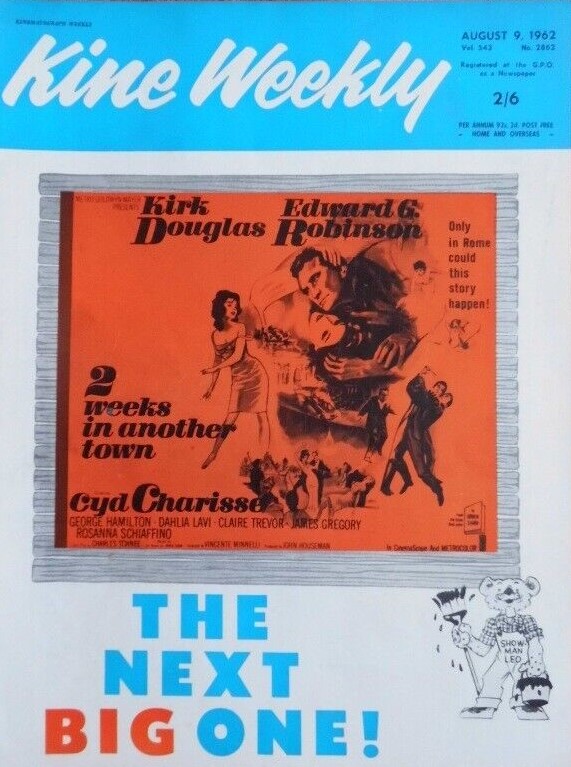
The 16-page A3 Pressbook/Campaign Manual offered a selection of advertisements and taglines. The key advert tagline ran “Another town…another kind of love…one he couldn’t resist…the other he couldn’t escape.” But there were alternatives: “Only in Rome could this story be filmed/Every town has women like Carlotta and Veronica and the kind of man they both want!/From Irwin Shaw’s great best seller.”
Or you could opt for: “Irwin Shaw’s shocking intimate view of Rome’s international film set. The world only sees the glamor. This is the drama behind it!.” Or: “Only in Rome could this story happen. Only in Rome could this story be filmed!”
SOURCES: Kirk Douglas, The Ragman’s Son (Simon and Schuster paperback, 2010) p342-344; George Hamilton, Don’t Mind If I Do (JR Book hardback 2009)pp 155-159; Pressbook/ Campaign Manual, Two Weeks in Another Town (MGM).
Unholy triumvirate of director Vincente Minelli, star Kirk Douglas and screenwriter Charles Schnee had been here before, eviscerating Hollywood in The Bad and the Beautiful (1952). Now, while the locale has shifted to Rome, Hollywood-on-the-Tiber, the behind-the-scenes battles are, if anything, even more fraught since careers are on the slide.
Burnt-out washed-up star Jack (Kirk Douglas) is duped by washed-up director Maurice (Edward G. Robinson) into thinking he is going to revive his career with a supporting role in a low-budget movie made at Cinecitta. In reality, Maurice wants Jack to oversee the dubbing, time restraints preventing the director doing this. Jack and Maurice have history, good and bad, making some fine pictures together, but inveterate womanizer Maurice bedding Jack’s wife Carlotta (Cyd Charisse).
Carlotta, divorced from Jack, now living in Rome and married to a shipping magnate, wants Jack back, if only to keep her bed warm while her husband is away. Young beauty Veronica (Daliah Lavi) dumps temperamental boyfriend and fading star Davie (George Hamilton), in favour of Jack. Maurice is having an affair with his latest find, the tempestuous Barzelli (Rosanno Schiaffino), so brazen she strokes his legs while he toasts his wife Clara (Claire Trevor) at a dinner to celebrate their tenth anniversary. Clara is prone to attempting suicide.
So far, so melodramatic. But instead of explosive melodrama, it’s more about insecurity and the honing of the cutting line. We know enough about vicious Hollywood in-fighting so none of this will come as a surprise, but it’s still astonishing the depth of self-deception on display that occasionally flowers into genuine insight. Maurice may be ducking and diving in the last chance saloon but he still knows how to disarm a young man with a knife. Not sure Jack giving Barzelli a kick in the pants would be deemed an acceptable method of calming down a screeching star. And you won’t get much kudos for a line like “all women are monster.”
But there are nuggets of Hollywood lore. Barzelli being forced to keep her arms in a certain position for a shot, for example, that actors doing the dubbing require direction, the shifting around of scenes, the producer already guaranteed profit through pre-sales before the movie is released, the endless rewrites, and of course that career rejuvenation brings actors a sudden jolt of power. And there’s a car ride that matches Hitchcock for sheer terror, regardless of the fact it is shot with back projection.
Fame as we all know is an illusion, but so is success. The famous are notoriously lonely. What’s hardest to get your head round is failing to notice when your career is on the slide. Being so wrapped up in your notion of invincible self, to which, while you are successful, all pander. There’s some lovely stuff about the collusion of audience and moviemaker, both hiding from reality.
But it’s a true adult drama, far superior in many ways to Once Upon a Time in Hollywood (2019) or Babylon (2022), avoiding the excesses of both, while homing in on character fragility, weakness exacerbated under pressure. In the end all make concession, some beating a tune of self-awareness. Even Maurice accepts he needs his wife to provide him with grounding and self-belief. The aloof arrogant Davie has to beg Jack not to steal his girl. Jack learns to ignore adulation.
If you like long speeches and elegant camerawork and confident direction this is for you. There’s plenty attendant glamor, but mostly it’s characters coming apart and putting themselves back together again, with or without a side order of bitchiness.
The acting is uniformly top-notch. Kirk Douglas might be auditioning for The Arrangement (1969), in which he essays a similar ambitious talent coming unstuck, but here he underplays, to the picture’s benefit, the early scenes when he’s still working out why he has fallen out of favor, and who he now is, just outstanding. But Edward G. Robinson’s (Seven Thieves, 1960) callous insecure monster runs him close. And the petulant performance by George Hamilton (Angel Baby, 1961) had critics purring and the industry predicting great things.
But it wouldn’t be anything without the believable women, all convinced their version of themselves will win favor. Cyd Charisse (Maroc 7, 1967), the female equivalent of the predatory Maurice, Claire Trevor (The Cape Town Affair, 1967) with suicide the preferred option to divorce, and especially Daliah Lavi (Some Girls Do, 1967) who gives Hollywood splendid notice of what she can do away from the sex symbol persona she was later lumbered with. Rossano Schiaffino has a ball as the sex symbol who views powerful men as playthings.
This was Vincente Minnelli’s fourth film with Kirk Douglas and just like Anthony Mann with James Stewart and John Ford with John Wayne or, more recently, Antoine Fuqua with Denzel Washington, draws a greater maturity from the actor. Charles Schnee wrote the screenplay based on the Irwin Shaw bestseller.
Sure-footed, bitchy as hell, hard-hitting, honest and unmissable.
With a string of Swinging Sixties fashion models providing the requisite bevy of beauties, a gang of thieves, a Moroccan heist, superb locations, great cast and a touch of archaeology with secret chambers and a long-lost relic thrown in, this splendid espionage frolic proves a welcome return to big screen top billing for Gene Barry after nearly a decade in television in Bat Masterson (1958-1961) and Burke’s Law (1963-1966).
Something of a cat burglar himself, Simon Grant (Barry) infiltrates a gang which uses fashion as a cover and whose ingenious speciality is to steal famous heirlooms and replace them with fake ones in the assumption that on their departure from a foreign country the customs officers will not be able to tell the difference. Louise Henderson (Cyd Charisse) and Raymond Lowe (Leslie Phillips) head up the gang while Claudia (Else Martinelli) may or may not be in on the act.
Her dalliance with Simon suggests an inclination towards the right side of the law but the fact that she has been involved with the pair for so long sets up the intriguing notion that she is stringing the American agent along. Initially, she rejects Simon’s advances until told by Louise to comply and pump him for information leading to one of the movie’s best lines (and innuendo that a British audience in particular would adore). Says Simon: “We haven’t done much about pumping but maybe that will come later.” Doubts also surround the intentions of Michelle Craig (Alexandra Stewart). On their trail is Inspector Barrada (Denholm Elliott).
There is mystery aplenty and a fair quotient of punch-ups, romance, shoot-outs and murder while the unearthing of the hidden treasure is less heist amd more straightforward Indiana Jones. The fashion is the icing on the cake. The Moroccan fashion shoots are more than merely decorative, or an excuse to bare the charms of the gorgeous models. Instead, the shoots would not disgrace Vogue or any of the other glossy magazine temples to haute couture, with that Sixties focus on fabulous clothes, genuine location and outlandish hairstyles.
On top of that, several of the stars are either playing against type or out of their comfort zones. Legendary Hollywood dancer Cyd Charisse famed for such classic musicals as The Bandwagon (1953) and Silk Stockings (1957) sets such fluff aside to essay a criminal mastermind, whose cunning often gets the better of Simon. Leslie Phillips (Crooks Anonymous, 1962), better known as a charming Englishman with an eye for the ladies, is as ruthless a photographer as he is a criminal. Director Gerry O’Hara (The Pleasure Girls, 1965) has managed to get both Phillips and Denholm Elliott to drop their standard methods of delivery, usually embracing a drawl, making their characterisations a good bit more fresh than normal. Phillips was clearly intending to make some kind of career change since he was the producer.
Gene Barry makes a perfect entrance as an adventurer-spy, as confident in his seduction techniques without women falling at his feet like James Bond, with a nice line in self-deprecation and more than able to look after himself. Before being side-tracked by television, Barry had shown movie star potential in War of the Worlds (1953) and Thunder Road (1958) and now he delivers on that earlier promise. Elsa Martinelli (Hatari!, 1962) is the femme fatale who may or may not wish to play that role, keeping the audience completely on edge as to which side of the law she is likely to come down on. Added bonuses are Alexandra Stewart (Only When I Larf, 1968), Angela Douglas (Carry On Screaming!, 1966), Tracy Reed (Hammerhead, 1968), dancer Lionel Blair (A Hard Day’s Night, 1964) and Maggie London.



 The Magnificent 60s