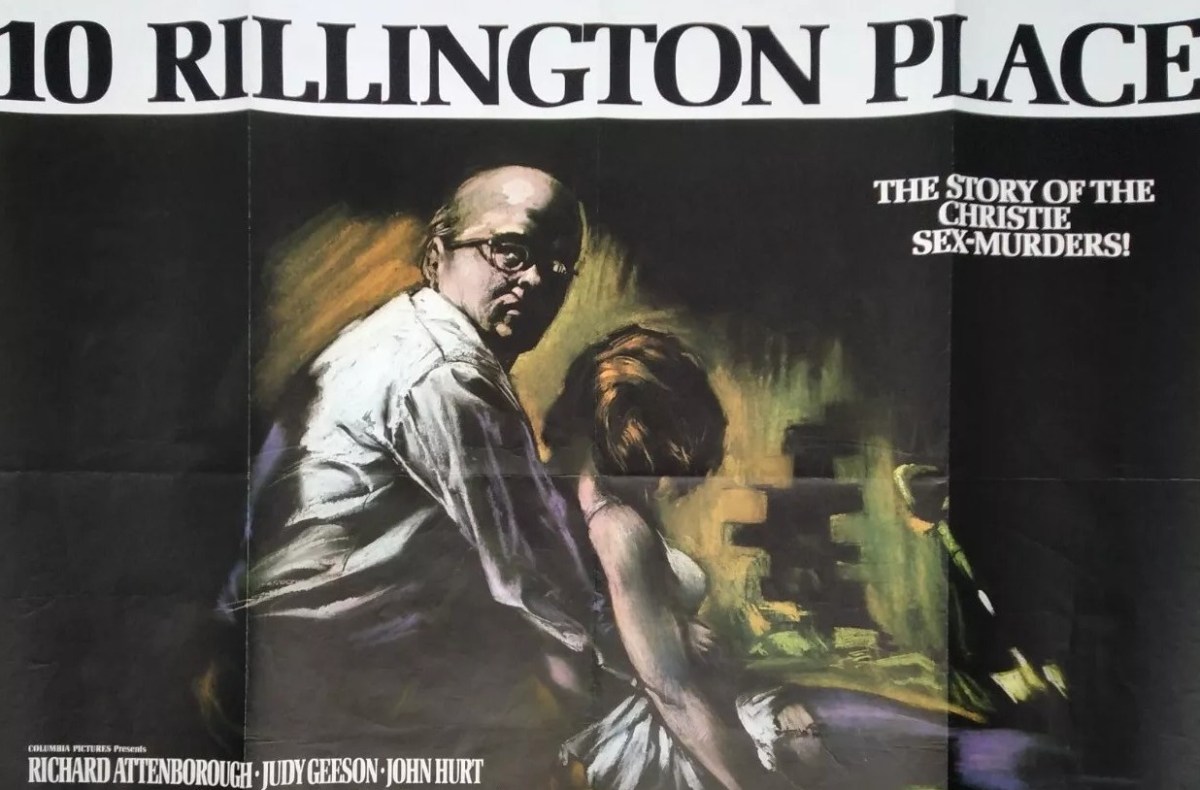
We tend to view Anthony Hopkins as the bold game-changer when he switched from respectable upmarket leading man to Hannibal the Erudite Cannibal in The Silence of the Lambs, paving the way for a plethora of other stars to throw off the shackles of their screen personas. But, in fact, it was another Englishman, Richard Attenborough, equally well-known for exuding principle (and raffish charm when playing a con man in Only When I Larf, 1968), who broke that particular mold.
At the time, the impetus for the picture was the miscarriage of justice which saw innocent Timothy Evans hanged for the crimes of serial killer John Christie, a name that belongs in the British murderer premier league along with the likes of Dr Crippen and Jack the Ripper. The Ludovic Kennedy book on which the film was based was by now a decade old, but it had taken that long for the British censor to clear the subject for filming and to find a star who was not already a well-known screen villain and prevent the film tipping over into sensationalism.
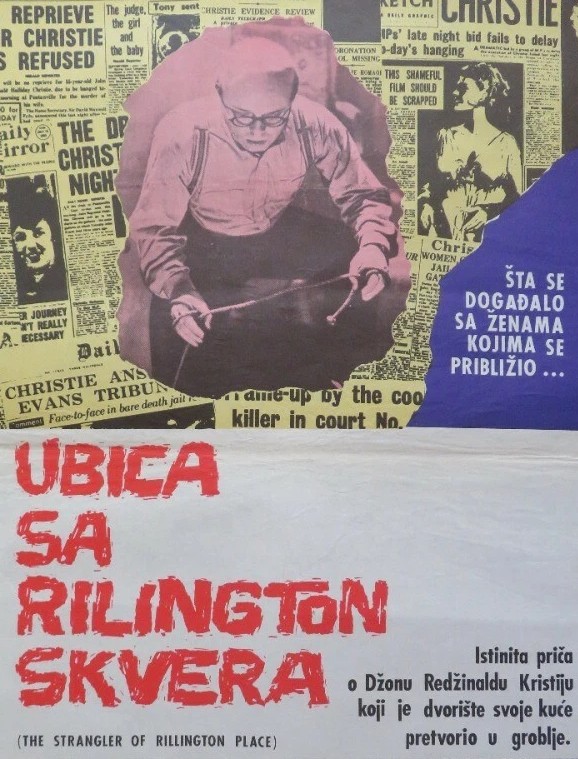
So although Timothy Evans (John Hurt) is the unwitting dupe, the focus is more on the cunning of the killer Christie (Richard Attenborough) who manipulates the class system. Nobody would contemplate the notion of a well-spoken upright middle-class war hero being capable of the lurid killings. And the idea of repeat victims in a Britain still rejoicing in its notions of “fair play” was equally abhorrent.
So while we don’t quite get to the nub of why Christie was so obsessed with murder, he remains a fascinating character rather than a demonic villain. And this is grubby, not tourist, post-War London where poverty is endemic and workshy ill-educated rogues are apt to be taken advantage of and easily caught.
That Christie evaded suspicion, never mind capture, for so long – his crime spree began during the London Blitz of the Second World War – was a credit to his presentation of himself as much as police disinterest or ineptitude and public disbelief at the scale of the killings. That Christie remained free for so long was because Evans was such an idiot, caught out in countless lies and eventually confessing to the crimes. You can see the connection between Christie and Hannibal Lecter (in his control of fellow prisoners) in the hold they have over the less well-educated and easily-led.
Christie, literally, got away with murder simply because, to police eyes, Evans was a more obvious villain. The narrative obscures the worst part of his tendencies, implied necrophilia and sex with unconscious women. In another life he might well have been presented as the down-on- his-luck old codger who only required a break to right himself.
The wonder of Attenborough’s performance is that he doesn’t exude menace. Even as he’s trapping victims he comes over as trustworthy. His creepiness only grows on the audience once they are invited to see the part of him that his victims do not.
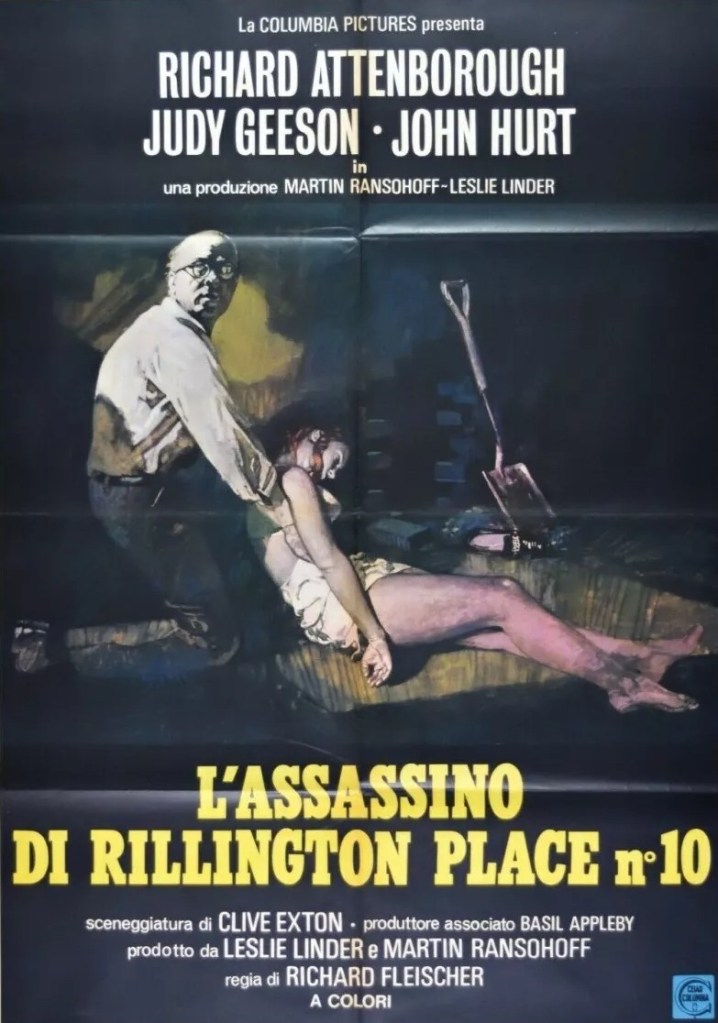
It’s a testament to Attenborough’s conviction in the part that you never notice how much he loathes the character. He only took on the role as part of a campaign to prevent the return of capital punishment. Critics clearly disapproved and their plaudits were reserved for John Hurt (Sinful Davey, 1969) in the more showy role. These days, thanks to Hannibal Lecter, audiences are more inclined to be more considerate towards actors playing irredeemable characters.
Director Richard Fleischer had been here twice before with Compulsion (1959) and The Boston Strangler (1968) and to his credit that he approached it in a low-key fashion eschewing the verbal gymnastics of Orson Welles of the former and the false nose of Tony Curtis and split screen of the latter. John Hurt is excellent and Judy Geeson (Three into Two Won’t Go, 1969) has a small part.
Most films about serial killers at this point in sub-genre’s history tended to follow an investigation or a courtroom drama – Psycho (1960) while initially focusing on victim and thence the killer quickly turned into an investigation. But this is primarily concerned with the actions of the murderer, who unravels as the movie proceeds, and is brought to justice when the general finger of suspicion, rather than the result of a detailed investigation, points to him.
Richard Attenborough created the template for the outwardly-respectable killer. Interestingly, Attenborough had previously played the more typical killer, the immediately loathsome gang-leader Pinkie in Brighton Rock (1948). Written by Clive Exton (Isadora, 1968).
Well worth it to soak up the creepiness that gently begins to subsume the character.

