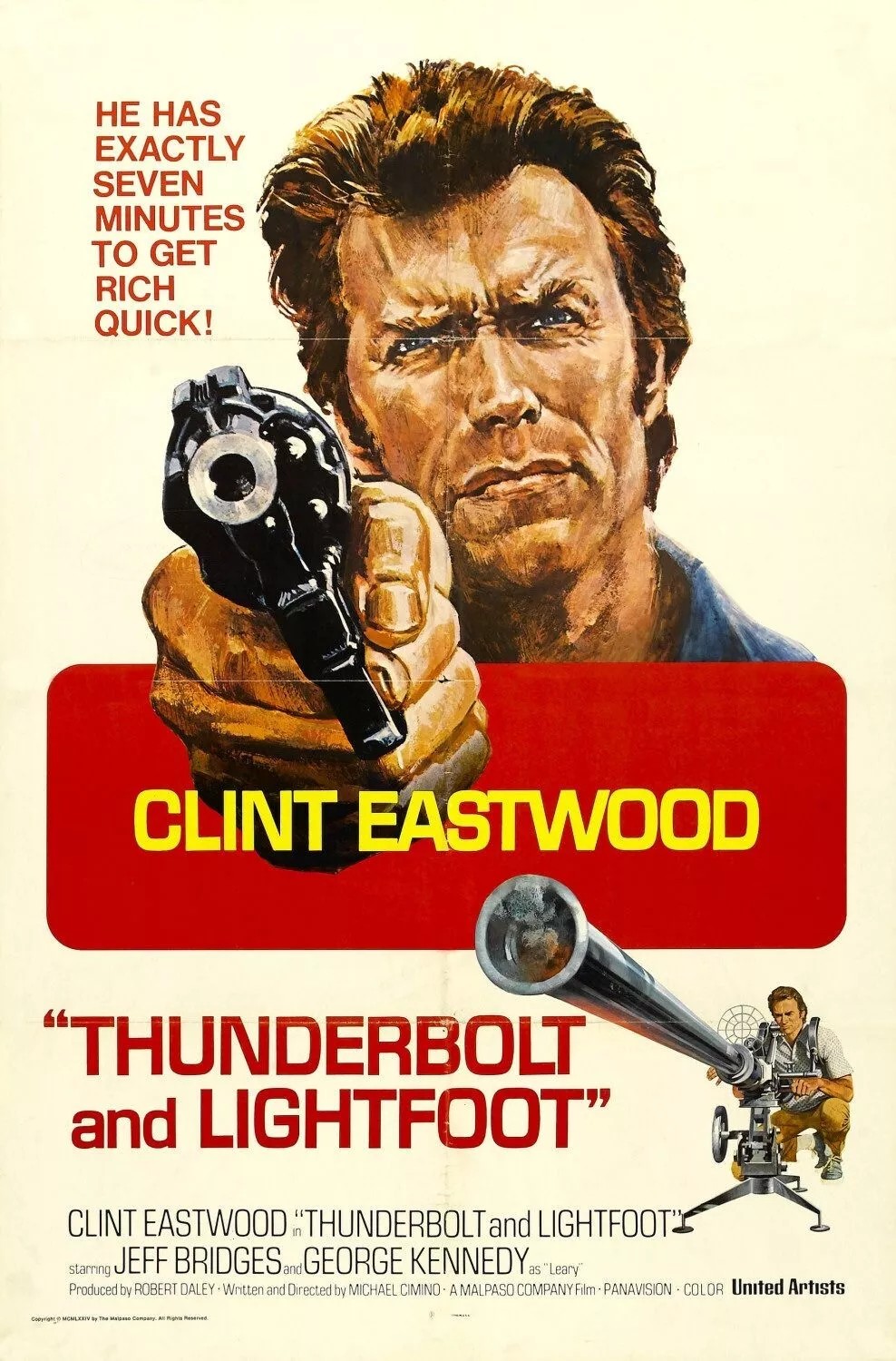
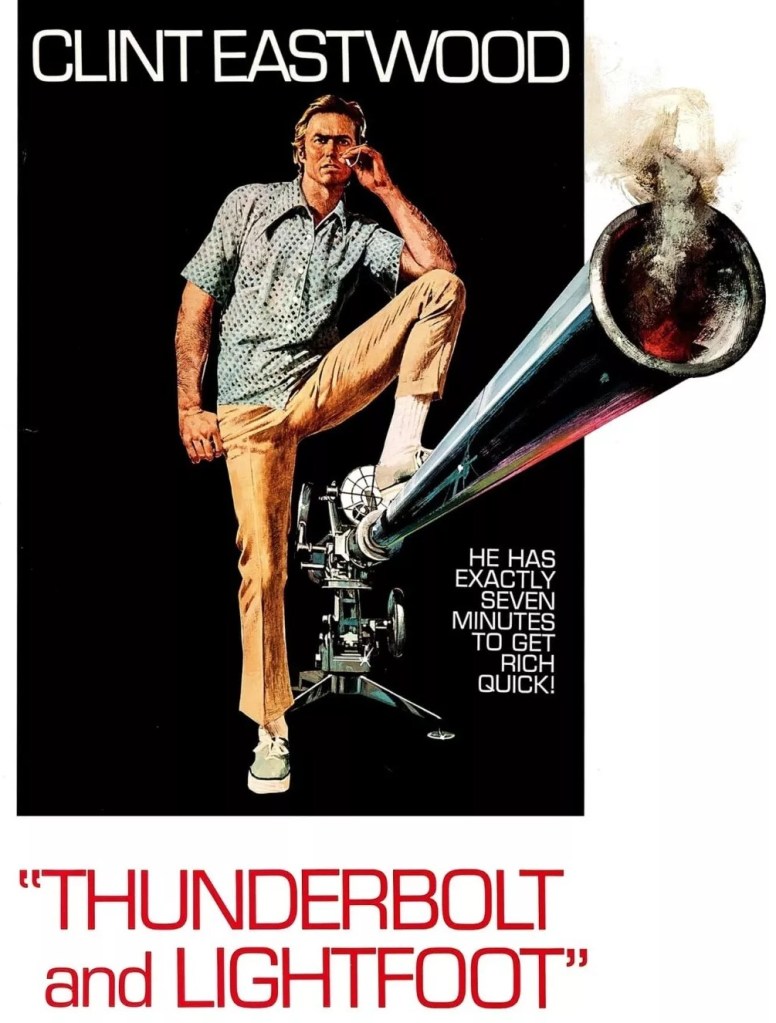
There’s a reason this has largely slipped from view, why it’s rarely included in any examination of the Clint Eastwood canon. For the most part it’s plain dull. When the best thing in it for large periods of time is the screen composition, then you know this is going to be an odd, not to mention tough, watch.
It’s confused as hell. Starts out as a road movie – and a desultory one at that – with a side hustle of a shaggy dog story, straightens out enough to fit into the nascent buddy movie genre before settling down into a heist. And all the time director Michael Cimino, with his use of widescreen and traditional arranging of the sometimes majestic scenery into thirds, thinks he is making a western.
Let’s play the phallic symbol card.
None of the characters seems to be much good at what they do. Thunderbolt (Clint Eastwood), on the run, doesn’t appear capable of evading the pursuing Red (George Kennedy), not a cop or bounty hunter as you’d expect, but an irate member of Thunderbolt’s former gang. And while Red seems excellent at tracking down his quarry, whose shifts of direction are almost whimsical, and even though he’s armed with the modern-day equivalent of a Gatling gun, he makes the basic mistake of not getting close enough to his target to make the bullets count.
The only one who comes out on top in the too-long opening section is Thunderbolt’s happy-go-lucky sidekick Lightfoot (Jeff Bridges) who has the knack of pulling the ladies and can drive. But their relationship is desultory, no zap, no funny lines in the vein of Butch Cassidy and the Sundance Kid (1969), and while clearly like the pair in Midnight Cowboy (1969) inclined to hold onto each other in the absence of anyone else it lacks the emotional power of the latter.
It takes forever to get to the point. Or the three narrative triggers, one of which involves Eastwood committing the most grievous sin a major star can ever commit – to be the one who carries the exposition. And boy does he go on. Anyways, he’s a bank robber and he planked his haul in a small two-room schoolhouse. But, blow me down, someone’s demolished the schoolhouse, without presumably happening upon the cash, and built a brand new one in its place.
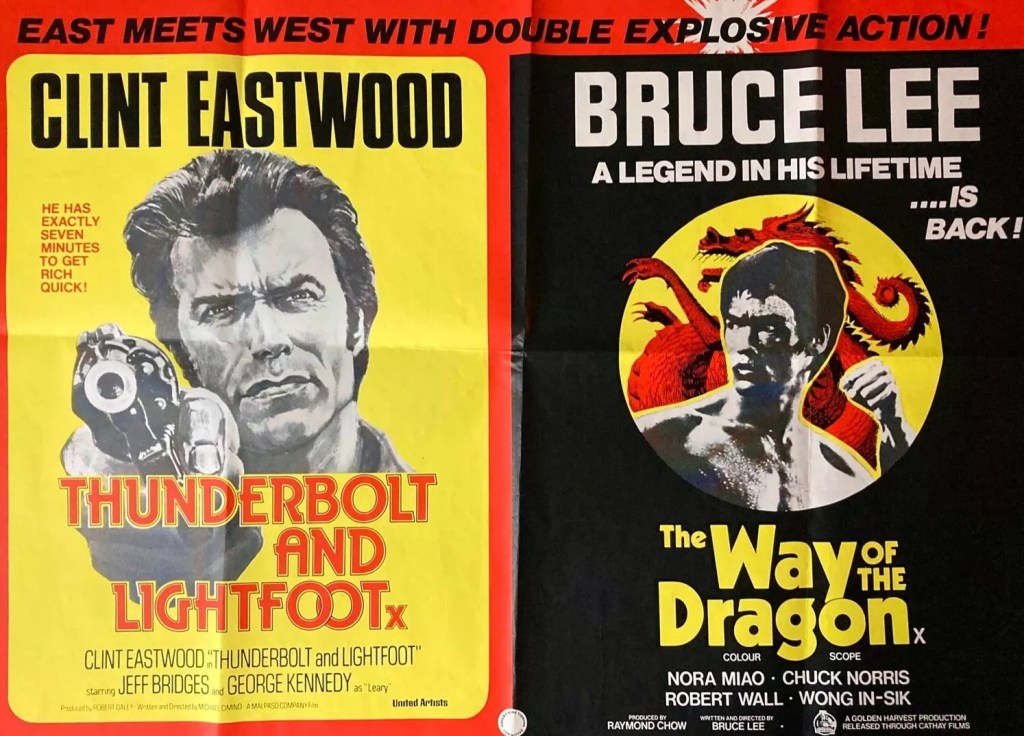
Clint Eastwood…Bruce Lee…Together!
Then, just to annoy Thunderbolt, the police, because this is just how cunning they can be, have given out that they recovered the loot. Red hasn’t fallen for this ploy, believing Thunderbolt has duped the gang and made off with the stash. Eventually, Red and Thunderbolt reconcile and Lightfoot suggests they hit the bank that was originally robbed because nobody would expect it.
Thunderbolt has acquired his nickname because his idea of a heist is not to bring on board some clever dick safecracker and employ an ounce of patience but merely to barrel through any obstacle with the help of 20mm cannon.
So now – at last – we have a story, but that’s over halfway through the picture and way too late to save it. So, yes, there’s some decent action and excitement, a double cross, car chase, shoot-out, and just to complete the shaggy dog element one of the robbers is killed by a dog.
Once it gets going it’s within the Eastwood bailiwick. At the time there was a mini-trend, started off by Easy Rider (1969), for road movies so moviegoers back in the day would probably accept this more than a contemporary audience who, like me, is sitting there wondering when the heck are they going to get on with it.
Something of change of pace for Eastwood, in that he plays his age, the older man, one in not so good physical shape at that, and not catnip for the ladies. Jeff Bridges (The Big Lebowski, 1998) certainly brightens up the screen, but George Kennedy (Cool Hand Luke, 1967) overacts.
Writer-director Michael Cimino, in his debut, exhibits the strengths that would elevate The Deer Hunter (1978) and the self-indulgence that would cripple Heaven’s Gate (1980).
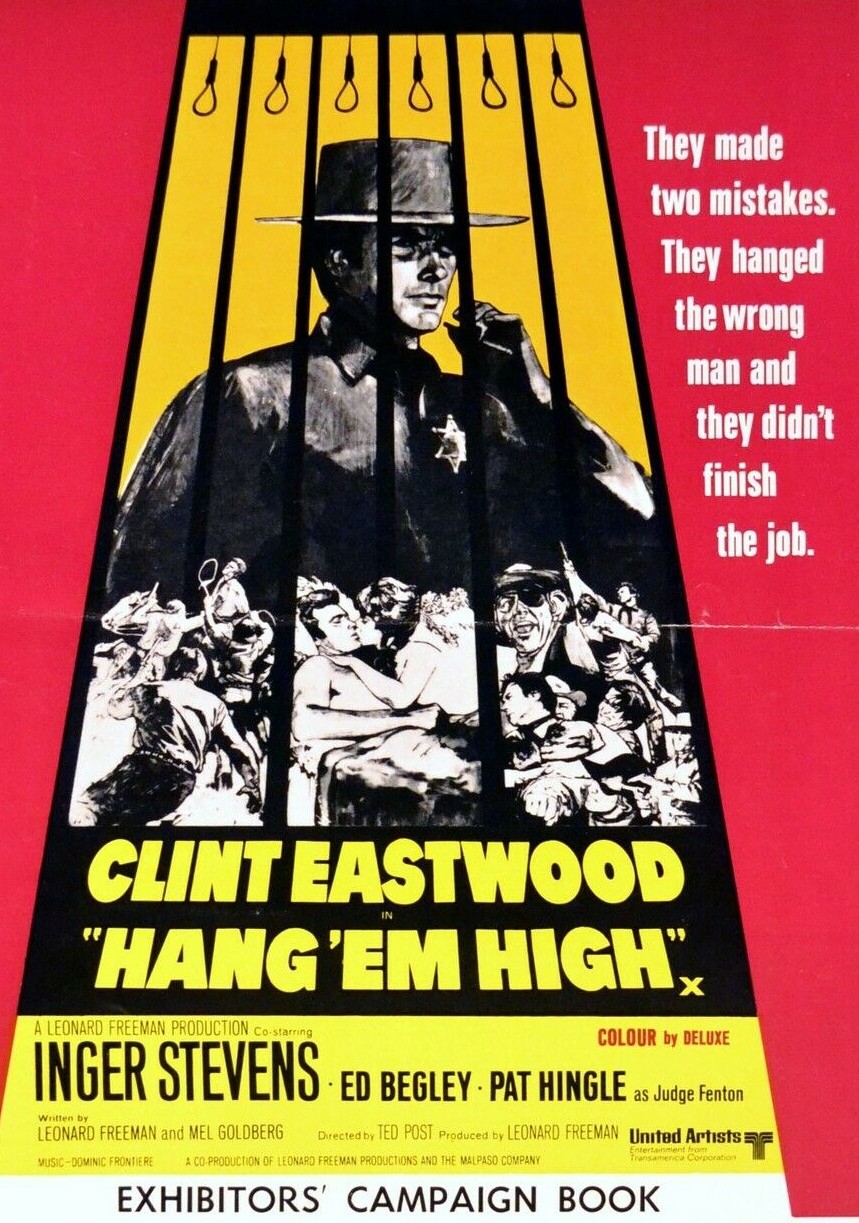
Clint Eastwood didn’t waste much time capitalizing on the unexpected success of the Dollars Trilogy. But the first was not released in the United States till 1967 and despite the success of the series across Europe was generally dismissed as a fluke, until American audiences suggested otherwise. The following year Eastwood appeared in three pictures, Hang ‘Em High, Coogan’s Bluff and Where Eagles Dare, which solidified his screen persona as portraying more with a twitch or a raised eyebrow than digging deep into the dialog.
Contrary to my expectations, Hang ‘Em High doesn’t quite fall into the trademark revenge mode of later westerns. It’s somewhat episodic, Jed (Clint Eastwood) often sent off on a tangent by Judge Fenton (Pat Hingle), allowing the lynch mob who failed to hang him in the first place a second chance at completing the job.
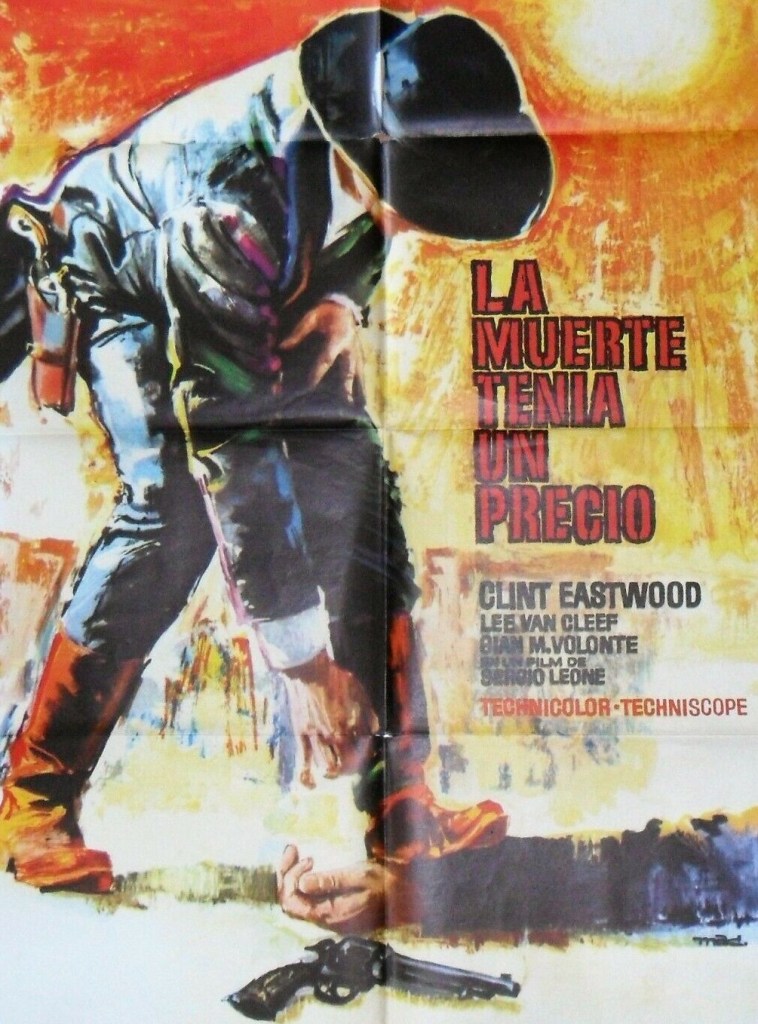
Following the success of the James Bond double bills, United Artists spun out its Clint Eastwood portfolio at every opportunity.
And while the presence of the second-billed Inger Stevens (Firecreek, 1968) suggests heady romance that doesn’t kick in until the third act and it’s more tentative than anything and its purpose is more, in narrative terms, to provide Jed with a correlative with which to compare his own obsession, bringing to justice the nine men who attempted to kill him.
Just to confuse things, the middle section isn’t about revenge or romance, but about justice. Specifically, it’s about showing that justice will be done, that in the unruly West, with insufficient enforcers of law and order, that crimes will not go unpunished, a gallows on constant display to make the point.
Surprisingly, it’s Jed who argues that some of this justice is just too summarily executed. He tries in vain to prevent the execution of two young rustlers who fell in with one of his potential assassins, Miller (Bruce Dern), but who refuse to take advantage of the situation when Miller overpowers Jed while he’s bringing the trio in to face the judge. Admittedly, they don’t go to his aid either, but the fact they resist piling in allows Jed to escape. However, rustling is a hanging offence, so they cannot escape the noose, certainly not in Fenton’s town.
There’s a switch in the mentality of Jed. Before he’s co-opted by Fenton to return to his former profession of lawman, Jed is of the school of thought that decides to take the law into his own hands. Even wearing a badge, you are allowed to shoot a man stone dead if he’s trying to escape, even if such action is severely hampered by him already being badly wounded, as lawman Bliss (Ben Johnson) demonstrates. But Bliss isn’t as callous as he sounds. He’s a contradiction, too, racing to the aid of Jed dangling in a noose in a tree, freeing him so he can face justice, even if that will most likely result in hanging.
So Jed upholds the law, preventing other citizens from taking the law into their own hands, Miller a target of the family of the owners he slaughtered before making off with their cattle.
We only see shop owner Rachel (Inger Stevens) fleetingly for most of the picture. She appears any time a new wagon load of criminals is jailed, scanning their faces for who knows what, though likely we’ve guessed it’ll be to find the killer of a loved one. Not only has her husband been killed by two strangers but while his corpse is lying on the ground beside her she’s raped. And although she eventually responds to Jed’s gentle moves, she still can’t let go of her “ghosts.”
Jed is put through the wringer. Not only an inch from death following the initial hanging but ambushed again by the same gang and nearly dying of pneumonia after being caught in a storm, the latter incidents permitting the kind of nursing that often fuels romance.
There’s an ironic ending. Captain Wilson (Ed Begley), leader of the gang, hangs himself rather than be shot by Jed.
The score by Dominic Frontiere (Number One, 1969) lurches. We go from heavy-handed villain-on-the-loose music to eminently hummable echoes of Ennio Morricone.
Clint Eastwood reinforces his marquee appeal, Inger Stevens delivers another of her wounded creatures, and Pat Hingle (The Gauntlet, 1977) is an effective foil. Bruce Dern (Castle Keep, 1969) does his best to steal every scene without realizing that over-playing never works in a movie featuring the master of under-playing.
Host of cameos include veterans Ben Johnson (The Undefeated, 1969), Charles McGraw (Pendulum, 1969) and L.Q. Jones (Major Dundee, 1965) plus two who had not lived up to their initial promise in Dennis Hopper (though he would revive his career the following year with Easy Rider) and James MacArthur (Battle of the Bulge, 1965).
Journeyman director Ted Post made a big enough impact for Eastwood to work with him again on Magnum Force (1973). Written by Leonard Freeman (Claudelle Inglish, 1961) and Mel Goldberg (Murder Inc., 1960).
More than satisfactory Hollywood debut for Eastwood and worth checking out to see that even at this early stage he had nailed down his screen persona.
Clint Eastwood the dumb schmuck. Never thought I’d be writing that. But our hero has parked his Dirty Harry persona and channelled much of his inner James Stewart or Tom Hanks, the upright fella who may be a bit of a jerk but is a decent guy underneath.
Our patsy, Phoenix, Arizona, detective Ben Shockley (Clint Eastwood), unshaven drunken bum, is dumb enough to imagine he’s been selected for a special mission because he’s the kind of cop who gets the job done, rather than because he’s the one most likely to fail. He’s sent off to Las Vegas to collect a witness for a trial. No big deal. Two-bit witness, two-bit trial. As soon becomes par for the course, people are apt to make fun of him, in this case a Las Vegas cop turning him away for asking for a guy by the name of Gus Mally. Guffaws all round till the cop takes pity on Shockley and informs him the witness is a woman (Sondra Locke), a feisty sex worker, who spends pretty much the whole of the movie making fun of him and every other sonova.
Shockley’s kinda disturbed to see that someone has made a book on Mally reaching Phoenix, the opening odds of 50-1 soon lengthening to 100-1. But he’s a trusting sort of fella (translated as dumb schmuck) so he thinks it’s a joke but everywhere he goes he gets ambushed and it takes a helluva long time – and only with Gus’s constant nudging – to realize that every time he phones back his position to his boss Commissioner Blakelock (William Prince) there’s awful consequence.
The firepower at everyone’s disposal – both Mob hoods and the cops – is so fearful that cars and houses are destroyed in a ferocious hail of bullets. The only time Shockley comes into his own, cop-style, is when he hustles some Hell’s Angels down and steals a motorbike. But guess what, the bad guys are still not just one step ahead, but in a different class altogether when it comes to pursuit, calling upon a helicopter armed with a sharpshooter.
Shockley even quails when another cop, co-opted into giving them a ride, starts making creepy sexual remarks to Gus, not realizing she can more than take care of herself as if she’s been dealing with hecklers all her life. Gus is quite a character. When she’s not screaming her head off to gain sympathy from Shockley, she’s trying to seduce him, or taking the piss out of him or just plain mocking his ineptitude and trusting personality.
She’s got better weapons at her disposal than he’ll ever have, a tongue that could strip paint, and a body she’s not frightened to use to get herself out of a sticky situation. Or in one particular instance, to save Shockley’s hide. It’s only after this that Shockley gives her any respect. And they come to more than a mutual understanding, as she begins to show genuine feelings for her escort, and we end up with the kind of relationship that’s always going to be raggedy around the edges because, as you’ve guessed, he’s one for keeping his emotions in check and makes do with a catchphrase, “Nag, nag, nag.”
Just what her purpose is in said trial you couldn’t care less about, she’s just a Maguffin to bring opposites together, soften her hard edges and toughen up his unsuspicious nature. There’s a heck of climax as they ride into town in an armor-plated bus and straight into the same kind of fusillade as they previously endured until between them they manage to nail the corrupt bad guys.
This is a hell of a ride, great concept, terrific believable characters, she’s sharp and sassy, and he’s toned down the arrogance. There’s genuine charisma between Clint Eastwood (Coogan’s Bluff, 1968) and Sondra Locke (The Heart Is A Lonely Hunter, 1968), helped by the fact they were already in an adulterous relationship, and in between falling into difficult situations it’s a blast watching them getting out of them.
Despite the virtual non-stop action, it’s a change of pace for Eastwood, a shift away from the screen persona on which his commercial attraction was built, and in some senses, even counting in the violence, it owes more to the dynamics of the screwball comedy than anything else, especially when the more practical woman is called upon to save the out-of-his-depth man. Written by Michael Butler and Dennis Shryack (they teamed up again for Pale Rider, 1985).
Outside of the top-billed trio of Julia Roberts, Sandra Bullock and Meg Ryan, Rene Russo stole the limelight as the decade’s leading lady, bolstering the credentials of such supposedly superior marquee names as Dustin Hoffman (Outbreak, 1995), Mel Gibson ( Lethal Weapon 3, Ransom and Lethal Weapon 4, 1992, 1996 and 1998), John Travolta (Get Shorty, 1995), Kevin Costner (Tin Cup, 1996) and Pierce Brosnan (The Thomas Crown Affair, 1999) – an almost unprecedented, for a female star of the period, roster of hits.
Not only that, but she had also come to the game late, 35 at the time of her debut in Major League (1989) and therefore well into the most dangerous age for a female star in Hollywood, her 40s, by the time she came to work with some of the industry’s biggest names. By comparison Julia Roberts was 23 at the time Pretty Woman (1990) was released, Meg Ryan 28 when she captured hearts in When Harry Met Sally (1989) and Sandra Bullock 32 when she snazzed Sylvester Stallone in Demolition Man (1993).
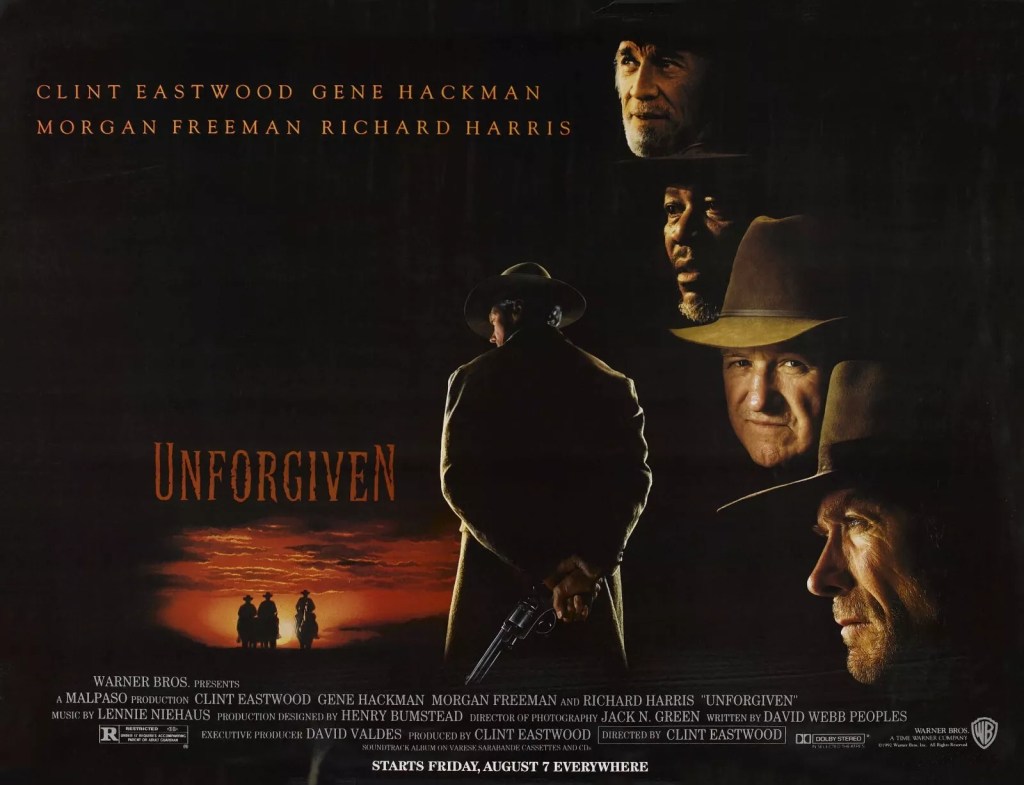
It’s worth remembering that Eastwood, the previous decade washed away with insipid box office, was entering a late career halcyon period, his critical and commercial esteem boosted by the Oscar-winning Unforgiven (1992). Previous male superstars close to retirement age weren’t called upon to put in a sprint or two. Sure, John Wayne and James Stewart could land a good punch, but that was generally in a confined space and nobody was calling on their athletic skills. But, here, Eastwood set the tone for later pictures like Taken – and he was a decade older than Liam Neeson in that one.
Russo, an MTA, oozed class and maturity, never looked as if she was out of her depth or if she would come off second best to any of the macho males she was generally surrounded with. This isn’t her greatest role – her duel with Brosnan takes that accolade – but comes pretty close.
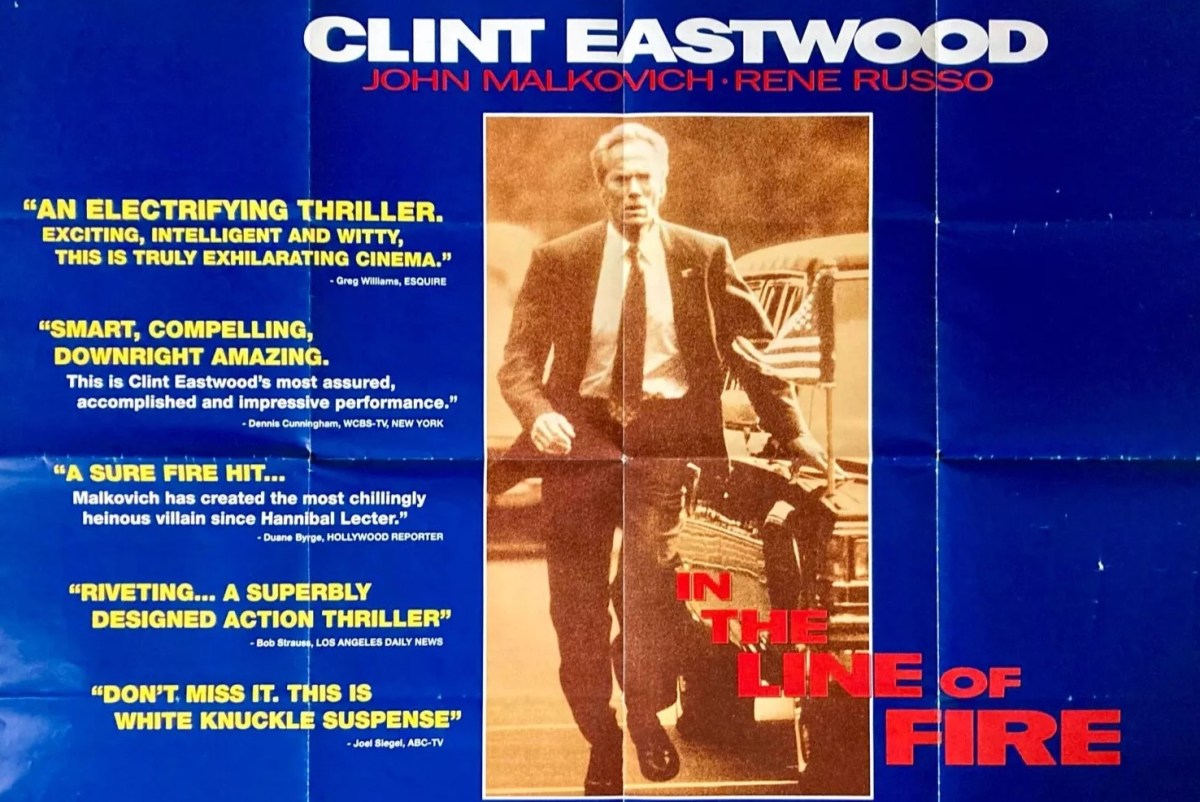
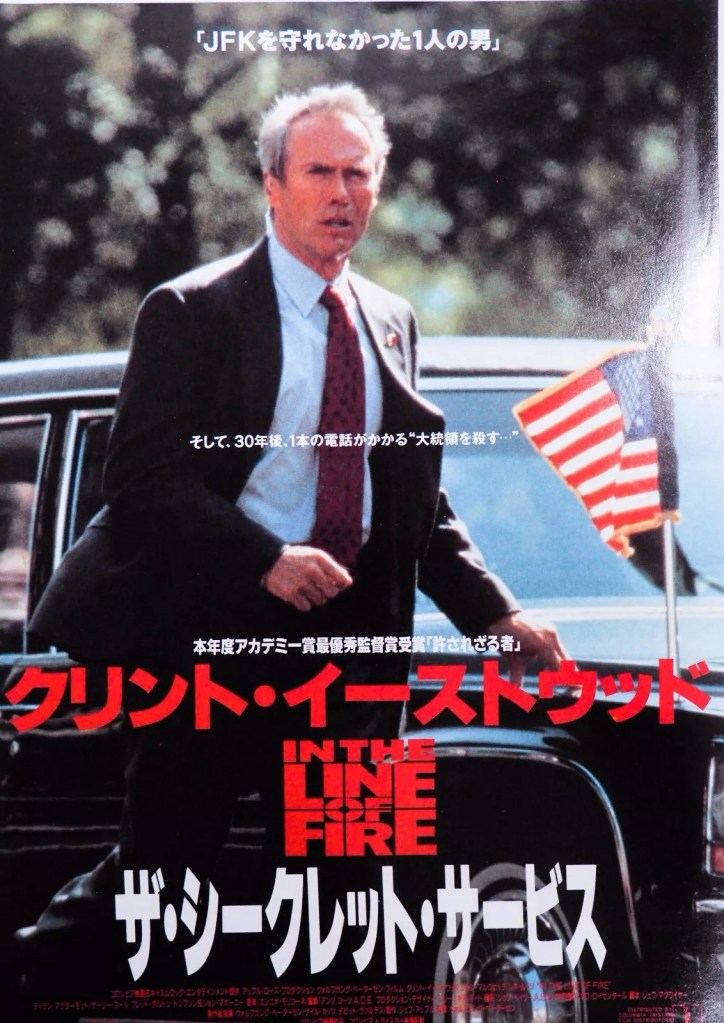
As Lilly Raine, she nurses ageing Secret Service agent Frank Horrigan (Clint Eastwood) over the line. Frank isn’t just perennially out of puff, but catches bad colds and makes such a basic error that he’s chucked out of the presidential protection elite, though kept on by boss Sam (John Mahoney) in a bid to track down assassin Mitch Leary (John Malkovich).
This is nuts-and-bolts action, a lot of time spent in basic detection, following up insignificant leads, but it’s also a classic hunter vs. hunted duel, with for the most part the assassin getting the upper hand, running rings round the entire Secret Service with his disguises and ability to remain more than one step ahead. Instead of a car chase, there’s a rooftop chase.
Horrigan is the kind of imperturbable cop who doesn’t mind partner Al (Dylan McDermott) being suffocated half to death if it gives him an edge on a villain. He’s got a chequered past, maligned by the Warren Commission in the Kennedy assassination report, feeling his age, but when life gets too tough tinkers away at the piano.
He has spicy exchanges with Lilly, taking sexism to what was an acceptable limit back in the day (now of course he’d be in the same dinosaur category as James Bond), and in due course, in quite oblique narrative fashion, wooing Lilly. The sex scene is treated as comedy, the first items to hit the carpet in the undressing malarkey are not panties and bra, but handcuffs and pistols. Hot romance is put on the back burner, which is just as well because Horrigan has his hands full not just with Leary but with a variety of superiors what with his inability to bite his tongue.
Meanwhile, we follow Leary as he coldly disposes of two men and two women in separate instances who have inadvertently caught him out. And he’s not going to make it easy for Horrigan. This isn’t the one-plan-man of previous assassin pictures, he doesn’t just have a back-up, instead employing all sorts of strategies to mislead and misdirect. And he’s not your usual nutter either. Clearly, he’s a worthy opponent, matching the enterprise, initiative and imagination of the anonymous killer of Day of the Jackal (1973). And in those days, what with developments in technology, an assassin can assemble his own gun rather than handing the task, as in Day of the Jackal, to a denoted weapons expert.
The stunning key sequence, astonishing in character terms, is when Horrigan passes up the option of shooting the assassin stone dead in favor of saving his own life – resulting in the irony (as Leary points out) of good guy being saved by bad guy. And in avoiding such action Horrigan condemns his partner to death. There’s as good a scene where I could swear Horrigan’s chin wobbles as he wonders if he could have prevented Kennedy’s death.
Sure, this is a variation on the serial killer trope of someone tormenting a potential victim, but the connections Leary attempts to build with Horrigan aren’t as far short as the cop would like to believe.
Director Wolfgang Peterson (Outbreak) is due considerable praise especially for his pacing, fitting in a complex narrative in a shade over two hours, building tension in myriad ways, but not being afraid to take a laid-back approach with the camera, long, lingering shots establishing mood and occasionally character. The sequence where Horrigan waits, somewhat wistfully, for Lilly to look back from a considerable distance after they have enjoyed an ice-cream together on a national monument is in many ways one of the finest nods to incipient romance ever put on celluloid.
Terrific acting all round. Written by Jeff Maguire (Victory, 1981).
Last hurrahs are rarely as sweet. But I’m beginning to wonder if the Warner Brothers very restricted U.S. domestic release isn’t a clever publicity ploy. You know the kind, attract the ire of critics who like nothing better than painting studios in a bad light and hope for a tsunami of social media outpourings. It’s now beginning to look more like a standard platform release, the kind employed to win Oscar favor.
Directors are often declared geniuses because they have a particular facility with visuals, can use the sweep of the camera or a particularly vivid composition, tackle controversial subjects, or build up a distinctive oeuver by returning again and again to a theme or genre. This is well outside Clint Eastwood’s comfort zone. For a start he’s not acting in it, it’s not a western and it doesn’t concern on-screen violence of any kind. His most common screen persona was of the man with a past trying to live a quiet life who is roused into anger and violence.
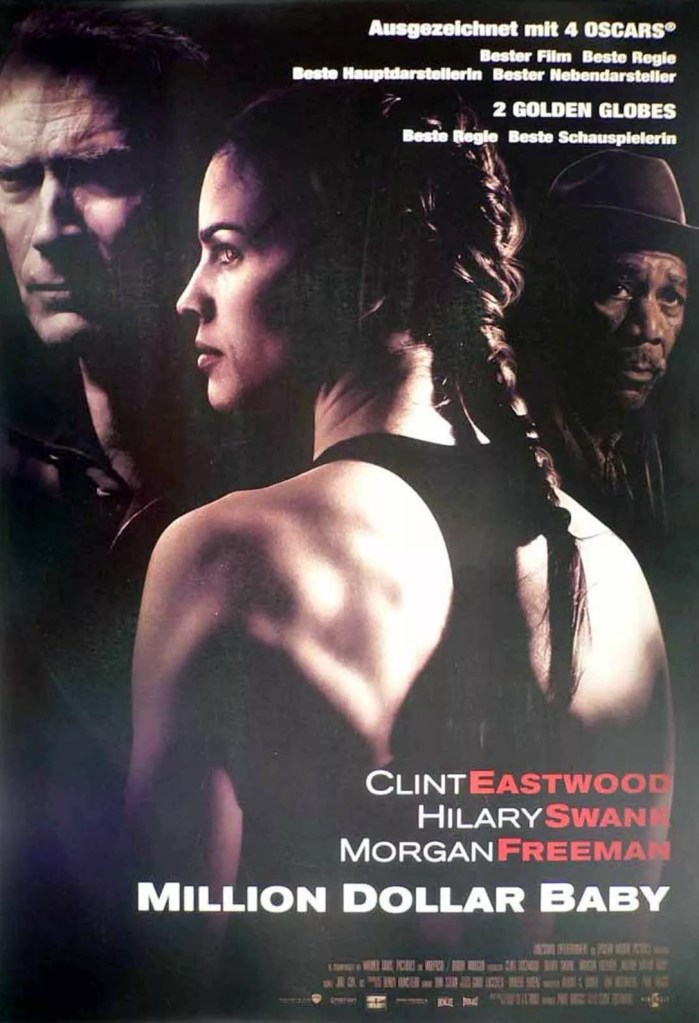
WB has been sparing on the poster front but you may notice a certain visual similarity between this old poster and the new one.
There’s none of that here. In fact, this all seems deliberately damped down. The tale is not told in faux documentary style and there’s no grandstanding. And yet this is one of the best directed movies I’ve ever seen. With no scene-stealing, it flies, and when it lands it’s with a thoughtful air. Just when you think it’s going to head off in he direction of one of two cliches – the high-risk pregnant wife giving birth at a dramatic juncture in the trial, or some zealous cop undertaking an equally dramatic last-minute investigation that tips the trial ass over tip – it damps down on those two.
The set up is ingenious. Recovering alcoholic Justin (Nicholas Hoult) discovers in the course of the murder trial on which he is a juror that he not only knows more about the incident in which the girlfriend of accused is killed, he may even be the accidental cause of her death. On the night in question he was nursing a drink in a bar and noticed the couple having an argument. Driving home on a wild and stormy night, he has a recollection of hitting something, knows it’s not, as he told he told partner Allison (Zooey Dutch), a deer.
Because, after several years of sobriety, he should never have been in a bar in the first place, and because there’s no evidence to the contrary – a field sobriety test should he have reported the incident – it’s automatically assumed that he would have consumed the whisky he bought in the bar. The hint of DUI would condemn him to 30 years in prison and not the new life as a father he has fought hard for.
Hello darkness would be the design theme.
So, in a ironic twist on Twelve Angry Men (1957), he’s the only person who stands up for the accused, but out of guilt rather than as with Henry Fonda an uplifted sense of morality. Guilt has certainly struck deep. For it’s insane for him to fight for the man’s innocence, to even raise questions of doubt, when everyone else is convinced he’s the killer. If the man is convicted, Justin will be let off. A hung jury might be a better outcome. A second trial would likely still end in conviction, as the circumstantial evidence and the accused’s drug-running background count against him, but at least Justin will not blame himself for sending an innocent man to prison.
The thing is, we don’t want Justin to be guilty. It’s an accident. Could have happened to anyone. At worst, had he fessed up at the time he would be cleared of any accusation of DUI, given the benefit of the doubt, what with the driving conditions and the fact that the victim was inebriated. He’s turned his life around. He adores his wife and looks forward to fatherhood.
He’s not the only one conflicted. Some of the jurors just want the trial over as fast as possible to get back to more pressing domestic issues. One character is dead set against anyone with anything to do with drugs. Overworked prosecutor Faith Killibrew (Toni Collette) is more concerned with a political future, running for district attorney. Ex-detective Harold (JK Simmons) commits the grievous sin – for a juror – of doing a bit of investigation on his own and is chucked off the jury.
What little information he does collect ends up with Faith. As a prosecutor she wants people put away, not let off. And she’s amassed sufficient evidence against the accused to get him sent down. So she’s not inspired with a desire for justice, the kind of firebrand character that would turn up in any other courtroom drama, digging away for an eternity, refusing to accept guilt as presented. She’s not a beacon for doing the right thing. Rather, the kind of person who doesn’t like the idea of nagging doubt upsetting her well-ordered life.
Given how many Clint Eastwood pictures end in violent showdown, perhaps his biggest directorial coup here is finishing the picture without that episode, it’s more reminiscent of the scene in American Gangster (2007) where Denzel Washington emerges from church to be confronted by a battalion of cops.
Couple of flaws – forensics so derelict there’s no suggestion that the blunt instrument that killed the victim could be a car is explained away by overworked scientists. That Faith doesn’t notice the photos of Justin sprayed around the house of Allison during her investigation reveals just how cursory a box-ticking exercise the detection is in her eyes.
Most of this plays out in the tortured eyes of Justin and in the unseen mind of Faith. With Justin, conflict is upfront, with Faith buried deep, laboriously roused from slumber.
Apart from Toni Collette and Nicholas Hoult, reunited after over two decades from their mother-and-son turn in About a Boy (2002), there is some distinctive playing – though under-playing would be more appropriate – from JK Simmons (Whiplash, 2014) and Kiefer Sutherland (The Lost Boys, 1987).
The boldness of the narrative – debut from screenwriter Jonathan Abrams – takes your breath away, avoiding the obvious route of concentrating on the innocent man, or on devious counsellors (all is played straight here) and the usual courtroom theatrics.
Absolutely superb performance from Hoult, who virtually has to do everything through his eyes. Had he been more over-the-top, Oscar would certainly have come calling, but deprived of that it’s an even more convincing performance. The low-ball direction swings this into a different class of courtroom picture, putting the audience in the situation of wanting the “bad guy” to get off.
Go see. Let Clint make you day (for likely) one last time.
Box office fans, excited no doubt at how Avatar: The Way of Water (2022), is charging up the all-time charts, might be surprised to discover that the concept of “worldwide” box office figures didn’t exist in the 1960s. Although foreign markets had proved important to Hollywood since the 1940s, there was no accepted way of measuring their impact.
Box office results in certain countries – Italy, France, Brazil, Australia etc – were reported only on an occasional basis and were never considered front page news. Global box office figures were more likely to appear courtesy of one of the profit participants. Star William Holden’s share of Bridge on the River Kwai (1957) and producer Sam Spiegel’s earnings on Doctor Zhivago (1965), for example, were widely reported. Or a studio might want to defray rising investor discontent by pointing how well a Stateside flop such as The Magnificent Seven (1960) had performed overseas.
But these were one-offs and it was impossible to get a handle on the worldwide results for an entire year of Hollywood output. The kind of global box office reporting we take for granted did not appear until the 1990s and often even then, for many pictures, it was only as a year-end figure.
However, during my digging into hordes of records for my book The Making of “The Magnificent Seven” I came upon a tranche of reports on foreign box office figures relating to United Artists for the years 1965 to 1969. And they make for fascinating reading, not least to discover which Stateside hits did poorly abroad and, conversely, what flops in the domestic market made up for it in foreign countries.
Volume of production at UA more than doubled over the period, from 17 pictures in 1965 to 38 in 1969, but the average budget came down from $3.68 million per movie to $2.14 million.
You won’t be surprised to learn that James Bond pretty much reigned supreme, taking three of the top four spots. But you might be taken aback to discover just how profitable this series was – over $100 million in rentals (the studio share of box office once cinemas have taken their cut) for three movies mentioned here – more than four times what they cost to make, and that would not take into account the colossal revenues accruing from merchandising.
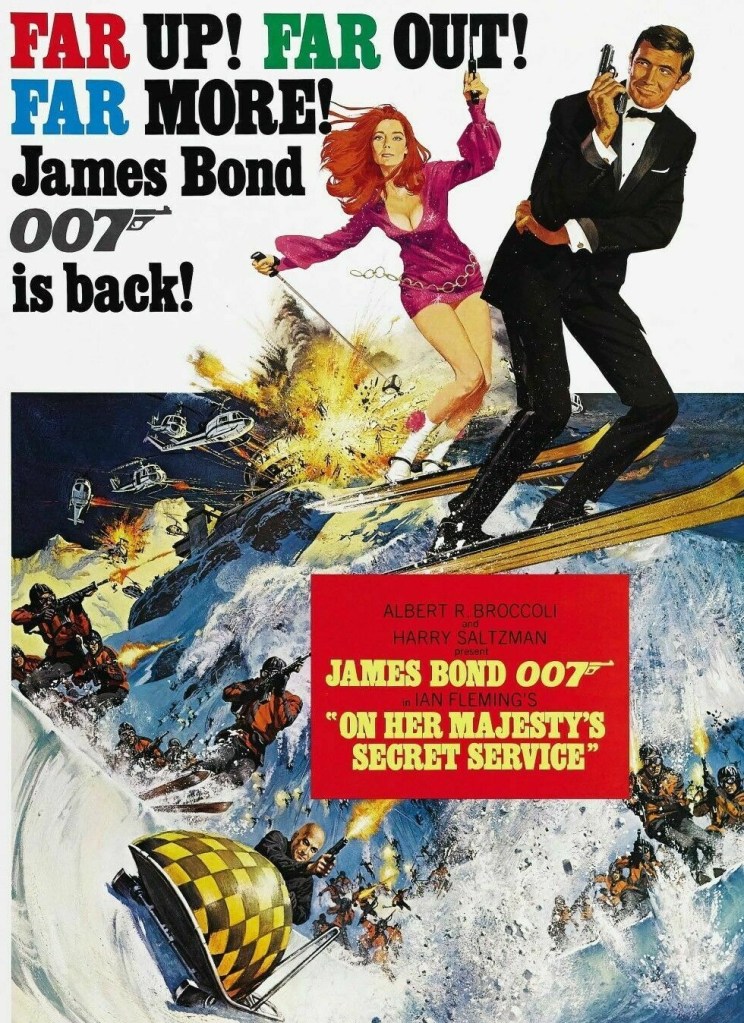
The 1965-1969 worldwide winner by some margin was Thunderball (1965), clocking up $48 million in worldwide rentals. In second place was You Only Live Twice (1967) on $36 million. but the prospect of a cosy one-two-three was nipped in the bud by Oscar-winning Midnight Cowboy (1969) on $26 million with On her Majesty’s Secret Service (1969,) hampered by losing the services of Sean Connery, settling for fourth after pulling in $23 million.
Fifth spot went to big-budget roadshow Hawaii (1966) starring Julie Andrews and Max von Sydow which sank $18.8 million worldwide followed by Norman Jewison’s low-budget crime story In the Heat of the Night (1967) on $16 million helped by Sidney Poitier at a box office peak and Rod Steiger, courtesy of an Oscar, at a career one. Placing seventh was big-budget all-star British World War Two epic The Battle of Britain (1969) which soared, largely on foreign grosses, to $15.5 million. Next, on $14.8 million, came roadshow musical Chitty Chitty Bang Bang (1968) starring Dick Van Dyke.
Biggest surprise of the year was the performance of family melding comedy Yours, Mine and Ours (1968) with out-of-favor stars Lucille Ball and Henry Fonda which closed in on $13 million. Rounding out the Top Ten was George Stevens’ Biblical roadshow The Greatest Story Ever Told (1965). However, its global figures of $12.1 million were a disappointment given its budget topped $21.2 million.
Just behind, on $12 million worldwide, setting another comedic hot pace, was Clive Donner’s What’s New Pussycat (1965). Despite having no roadshow credentials it boasted an all-star cast consisting of Peter O’Toole, Peter Sellers, Woody Allen, Ursula Andress, Romy Scheider and Paula Prentiss. Comedy also accounted for twelfth – the unfancied, though timely, Norman Jewison effort The Russians Are Coming, The Russians Are Coming (1966) starring Alan Arkin and Eva Marie Saint which coasted in with $11.8 million.
Thirteenth was Steve McQueen-Faye Dunaway romantic thriller The Thomas Crown Affair (1968) directed with considerable elan also by Norman Jewison. That flew in with $11.25 million, a cool million ahead of the second picture, Help!, by British pop sensation The Beatles.
Fifteenth place went to the final picture in the Sergio Leone trilogy The Good, the Bad and the Ugly (1968) starring Clint Eastwood which crested $10.2 million. John Frankenheimer’s World War Two thriller The Train (1965) with Burt Lancaster trying to outfox Paul Schofield tracked $9.75 million. But, as if to emphasize Clint Eastwood’s growing box office power, his first American western Hang ‘Em High came next on $9 million worldwide.
Second World War mission picture The Devil’s Brigade (1968) starring William Holden and Cliff Robertson in a Dirty Dozen-style knock-off paraded $8.6 million for eighteenth position. Comedy filled out the final two places in the Top 20. Jack Lemmon scored a suprise hit in Richard Quine’s How To Murder Your Wife (1965). Co-starring Virna Lisi and Englishman Terry-Thomas it romped away with $8.4 million. Although The Graduate (1967) had been a massive global success, United Artists only held the rights to certain territories but that was enough to pull in $7.7 million worldwide.
There wasn’t actually an informal Top 20 reported by United Artists over this five-year period. I’ve concocted it out of the reports below.
SOURCE: “United Artists Corporation and Subsidiaries Motion Picture Negative Costs for Pictures Released in the Year Ended 1965;” “United Artists Corporation and Subsidiaries Motion Picture Negative Costs for Pictures Released in the Year Ended 1966;” “United Artists Corporation and Subsidiaries Motion Picture Negative Costs for Pictures Released in the Year Ended 1967;” “United Artists Corporation and Subsidiaries Motion Picture Negative Costs for Pictures Released in the Year Ended 1968;” “United Artists Corporation and Subsidiaries Motion Picture Negative Costs for Pictures Released in the Year Ended 1969,” United Artists Files, Wisconsin Center for Film and Theater Research, University of Wisconsin.
Breezy western debut that created five legends: announced the arrival of a new directorial force in Sergio Leone; bestowed screen stardom on Clint Eastwood; instantly created a new mini-genre in the Spaghetti western; provided a platform for the distinctive music of Ennio Morricone; and best of all from the producers’ perspective made a mountain at the box office. You could add in a cavalier attitude to corpses and adding a notch to the development of that 1960s standby, the anti-hero. From now on the good guy could be a bad guy or so morally ambiguous as not to make a difference.
Look no further than the opening scene to note the alternative Leone approach to the western. An anonymous stranger (Clint Eastwood) arriving in town, observes, while drinking water from a well, a gang torment a small boy by firing bullets at his feet. Indifference to the taboo subject of violence to children became a Leone trademark, most evident when children are slaughtered in Once Upon a Time in the West (1969). Most astonishing of all here, the stranger, ostensibly our hero, does not intervene despite, as we shall soon discover, being a ferocious shot.
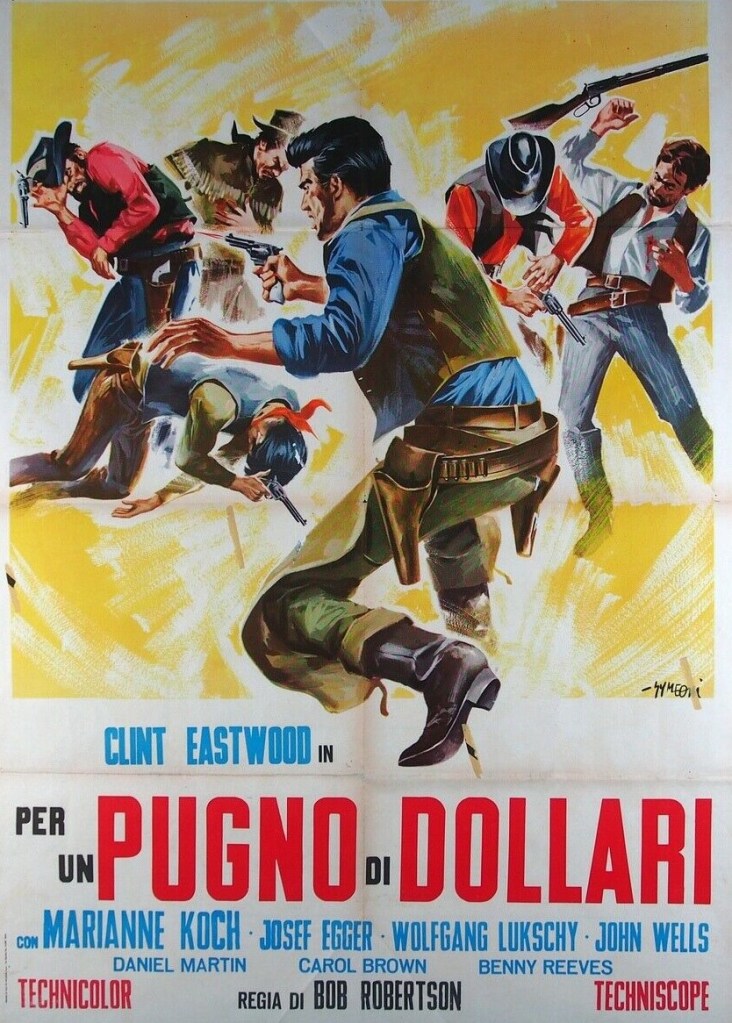
Who the heck is this Bob Robertson? A pseudonym for Sergio Leone, as if Robertson was particularly any better known than the debut director.Daniel Martin, oddly enough, is correct, but John Wells, Carol Brown and Benny Reeves are all made up.
Instead he learns that the child is being kept from his imprisoned mother Marisol (Marianne Koch), who has been taken from her husband Julio (Daniel Martin) by Ramon Rojo (Gian Maria Volonte). Rather than directly intervene a a good hero should, the stranger decides to profit from the situation. Realizing there are two opposition factions in town, the Rojos and the Baxters, he decides to play them off against each other, taking money in turn from each, demonstrating his credentials by shooting four men. That the Baxter clan includes the town sheriff (Wolfgang Lukschy) shows how powerful the Rojos have become.
In fact the stranger doesn’t orchestrate a straightforward shoot-em-up as you might expect but cleverly gets them to kill each other first of all by arranging for both families to confront each other in a makeshift cemetery where the stranger has deposited the bodies of two men, the supposed survivors of a massacre of Mexican soldiers escorting a gold shipment. The Rojos win this round.
After appearing as nothing but a ruthless opportunist, the stranger now turns into a hero, freeing Marisol, reuniting her with husband and son, and giving them money to go away. This kind act does not go unnoticed, the stranger captured and tortured, the Baxters massacred on the assumption he was acting on their behalf. The stranger escapes in a coffin, fashions himself some chest armour in a tin mine, and confronts the remaining Rojos in an old-fashioned, though with a typical Leone twist, gunfight.
Setting aside the body count, which enraged traditionalists, including the vast majority of critics who would later endorse the even more violent blood-letting of The Wild Bunch (1969), the trio of Leone, Eastwood and Morricone put their innovative stamp on the western.
Stylistically, it was in a class of its own (until, at last, Leone outdid himself with the further adventures of The Man with No Name and Once Upon a Time in the West). The operatic elements which feature so strongly in his later work, are here confined to the plethora of close-ups, more like portraits and extremely well-lit, the circular camera movement for the climax (again, more evident in Once Upon a Time in the West), and the stillness before the shoot-out, the way tension builds through nothing happening for a considerable amount of time, not through characters shifting to more advantageous position, but simply while the camera sits and broods.
Leone cut out exposition, generally a large part of the beginning of any western, the stranger having no emotional involvement in the situation. A normal western would focus on the forcibly estranged husband attempting to free the imprisoned wife, perhaps as in The Magnificent Seven (1960) hiring someone to do it for him. The stranger, in effect, sets out to profit from misery.
And he doesn’t say much. A character this monosyllabic would be a supporting actor in a traditional western, perhaps fulfilling a comic role or given some elaborate emotional back story for why words were so precious he wouldn’t spend them.
And he’s definitely iconic. In a later scene, Leone has Eastwood materializing out of the swirling dust in a scene that would easily have fitted the traditional western. But for the most part, he relies on audience reaction to a character who dresses in far from traditional fashion, most notably with his poncho and cigars. The western hero didn’t squint either. He walked not situations with his eyes open, indicative of his boldness and ability to face any situation.
Leone avoids classic western confrontation, the one-on-one scenes that usually occur close to the start where the hero either exhibits prowess or is humiliated. In what might be called “the Chicago Way” not only does nobody come to a gunfight with a knife, the bad guys come mob-handed.
Sure, that means the hero is shown to be even more deadly with a pistol, but it also permits Leone to extend the action by focusing not just on two opposing characters but a number of different faces. There are some other motifs at play in Leone’s debut – women are not all as submissive as Marisol, Consuelo, the Baxter matriarch, on hiring the stranger, says “I’m rich enough to appreciate the men my money can buy,” her power and wealth finding later echo in Once Upon a Time in the West.
Last but not least, is the Morricone sound. There had been great western themes before, plaintive as in High Noon (1952) and The Alamo (1960) or stirring like The Big Country (1958) and The Magnificent Seven (1960), but this appeared to arrive from a different orchestral planet.
If ever a movie could claim ownership of the title “a star is born” it’s this one. Perhaps it has remained so special because the triumvirate of Leone, Eastwood and Morricone had such illustrious careers, this merely a starting point rather than, as if often the case when Hollywood anoints a new star, the highlight.
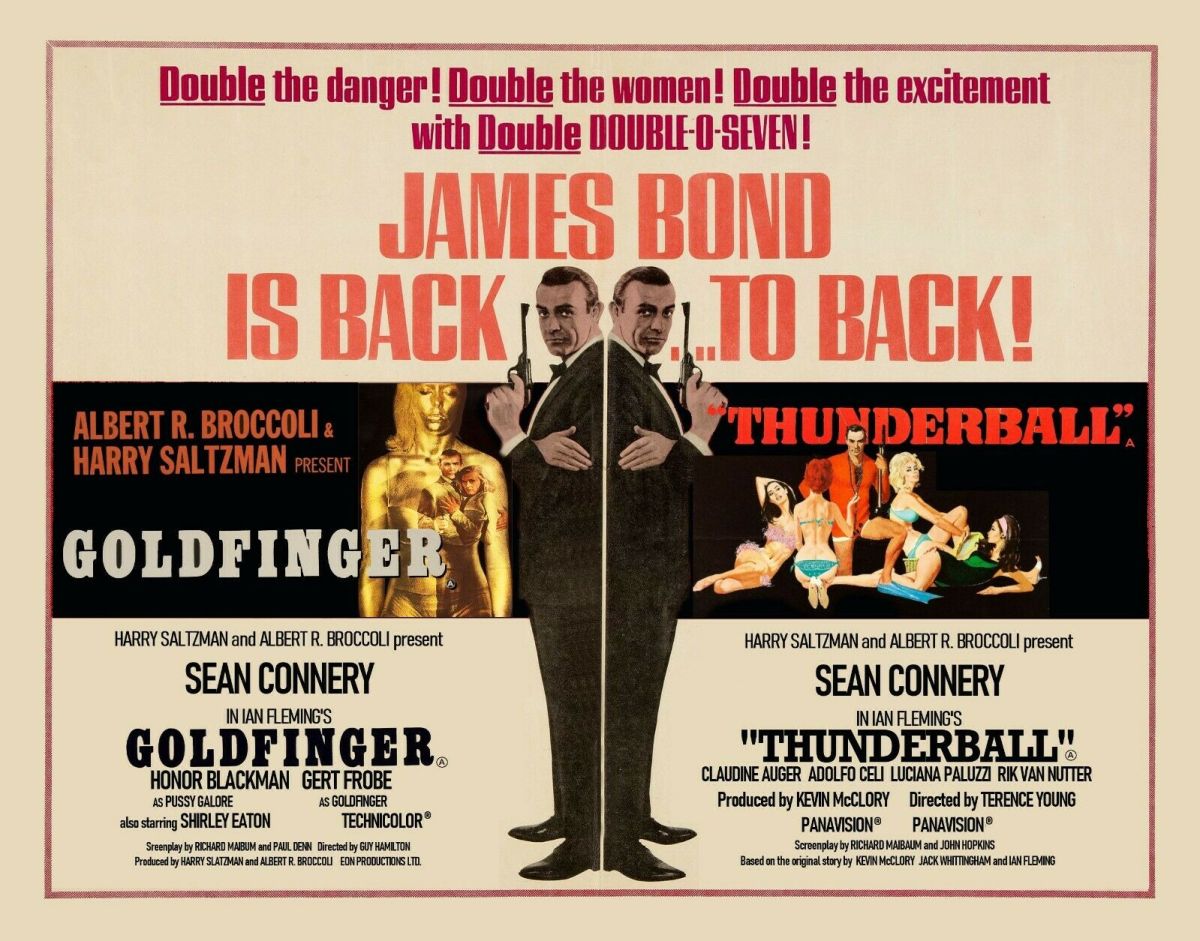
The 60th Anniversary celebration of the James Bond phenomenon in British cinemas that has been running for a few months now sent me back to examine the extent of the James Bond Reissue Double Bill.
As I mentioned a few weeks back, the Dr No (1962)/From Russia with Love (1963) revival in 1965 kicked off the biggest-ever demand for a screen character, one of whom the public never seemed to grow tired, certainly for the next decade until the first of the series were sold to television. Prior to United Artists’ approach with the Bonds, unless a picture had Oscar-driven box office power it would not even be considered for revival for around seven years, considered a generation in audience terms.
In Britain, the movies were guaranteed circuit releases on the Odeon chain. However, contrary to the approach in the United States, the movies were not thrown back into circulation right away and it wasn’t until three years later that the next double bill – Goldfinger (1964)/Thunderball (1965) – put in an appearance. But thereafter, there was no stopping the Bond bandwagon. In 1969 You Only Live Twice (1967) went out with either From Russia with Love or Dr No (cinemas could choose their preferred pairing).
In 1970, United Artists took a break from the Sean Connery reissue business by concentrating on the studio’s other big male star Clint Eastwood, doubling up For A Few Dollars More (1965) with A Fistful of Dollars (1964). But by 1971 it experimented with playing Connery and Eastwood together, first pairing You Only Live Twice/A Fistful of Dollars and later the same year Goldfinger/For a Few Dollars More. But in 1972 the studio reverted to type with Thunderball/Dr No and the following year Diamonds Are Forever (1971)/From Russia with Love.
In 1974 it was You Only Live Twice/Thunderball and few months later Dr No/Goldfinger. Come 1975 it was time for two of the later offerings to enter the revival business – Live and Let Die (1973) and On Her Majesty’s Secret Service (1969) followed at the end of the year by The Man with the Golden Gun (1974) and Live and Let Die. The next year brought a programme change – Diamonds Are Forever teamed up with new Bond Roger Moore in the non-Bond adventure Gold (1974).
In 1977, for the first time in nearly a decade the Bond reissue was absent from British cinemas although the following year saw a re-teaming of Live and let Die and The Man with the Golden Gun. But that pretty much spelled the end of the annual James Bond double bill, television by now too quickly eating up new product.
The British approach was almost conservative compared to the way the Bond revivals were handled in the US. After the sensational performance of Dr No/From Russia with Love in 1965 U.S. exhibitors had to wait only a year for Goldfinger/Dr No. United Artists showed little restraint, following a policy of “play them till they drop,” and launching the Connery/Eastwood combo in 1968 with You Only Live Twice/The Good, the Bad and the Ugly (1967) plus a straightforward Connery item Thunderball/From Russia with Love the same year followed by Goldfinger/Dr No in 1969.
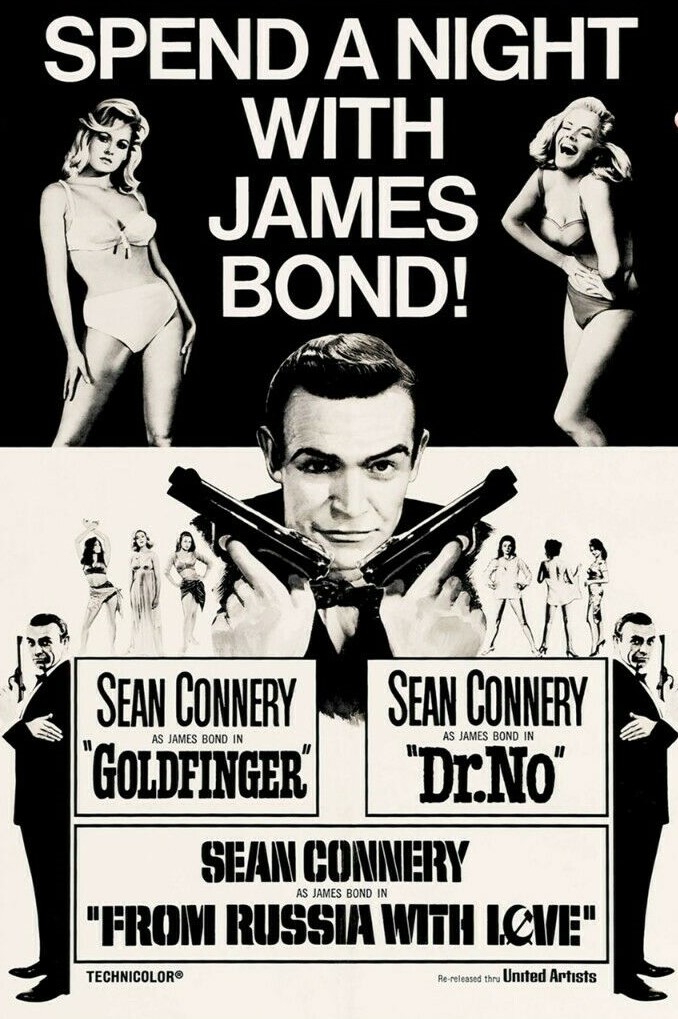
In the U.S. the year of the missing Bond reissue was 1970. But in 1971 United Artists reissued two Bond dualers six months apart. First out was Thunderball/You Only Live Twice and then Dr No/From Russia with Love. Ahead of the television premiere of Goldfinger in September 1972, UA brought back Goldfinger/From Russia with Love and then the triple bill (“Spend a Night with James Bond!”) of Goldinger/Dr No/From Russia with Love plus a double bill of Thunderball/You Only Live Twice, the last program incidentally knocking up a colossal gross of $122,000 – equivalent to $853,000 now – from 14 houses in New York in its opening week.
But the bonanza came to an end when television ponied up $17.5 million – equivalent to $126 million today – for the first seven pictures in the series. And this was before residuals kicked in from VHS, television resale and syndication, DVD, cable and streaming. Even when the MCU can guarantee billion-dollar revenues from many of its movies it’s doubtful if any one of its blockbusters made as much money as the best of the Bonds in their lifetime, much of that extra revenue coming from the way the revivals proved the enduring popularity of the series.
SOURCES: Allen Eyles, Odeon Cinemas 2: From J. Arthur Rank to the Multiplex (Cinema Theatre Association, 2005) p211-220; Brian Hannan, Coming Back to a Theater Near You (McFarland, 2016) p147-151, 175-177, 227.
Almost a curiosity in the Clint Eastwood canon from the later perspective, this modern western concerning a maverick Arizona cop pursuing a fugitive in New York could also be interpreted as a riposte to the violent avenger of the “Dollars” trilogy and Hang ‘Em High (1968). Like Rio Conchos (1964) there’s an action-packed start and finish and not much in between unless you count Coogan (Clint Eastwood) being beaten up, and like Firecreek, made in the same year but less of an audience attraction, a slow burn with little of the depth of the Vincent McEveety effort.
It fits more neatly into the “victim” niche of The Beguiled (1970) and Play Misty for Me (1971) with Eastwood, while attempting to present a macho image, set upon by predatory women. Here, although led into a trap by the girlfriend Linny (Tisha Sterling) of the wanted Ringerman (Don Stroud), the victim elements are mostly humorous, Coogan a fish-out-of-water taken advantage of by cab drivers and hoteliers and by a justice system that takes more note of due process than he is accustomed to. Otherwise, it’s pretty much a romance as Coogan, for whom persistence pays off, beds probation officer Julie (Susan Clark).
Coogan is a paid up member of the wham-bam-thank-you-ma’am fraternity, frolicking with an adulterous lover in Arizona, and displaying no qualms about getting it on with Linny. In the hands of Jack Lemmon this would be a comedy, so it’s a strange choice for Eastwood unless for experimental purposes, trying to set himself up more as Steve McQueen than John Wayne.
The picture opens with Coogan tracking down a Native American, and manacling him to a pole outside a house while he repairs inside for sex. Interrupted by a sheriff frustrated by his ways, he is despatched to New York where he manages, through a bluff, to have Ringerman removed from Bellevue mental hospital. On the way home, he is ambushed by Linny and some thugs, losing consciousness and his gun, neither going down well with the more bureaucratically-minded Lt. McElroy (Lee J Cobb) whose undercover stake-out plans he has also ruined.
Luckliy, Coogan has chanced upon probation officer Julie who can’t quite manage to deter his amorous advances and at an appropriate moment he sneaks a look at her files for his next lead. Not quite as sharp as he imagines, and clearly not much good at assimilating painful lessons, after a dalliance with Linny, he is astonished to be led into yet another trap. In the end, of course, he gets his man, courtesy of a motorbike chase. But there’s a curious ending. Not only does Julie, who he has betrayed with Linny, turn up to wave him off, but, as if he has now turned into a kinder, more humane specimen, he affords his prisoner a smoke, something he pointedly refused to do with the Native American.
It’s not dated particularly well and modern audiences will have trouble accepting domestic abuse and rape as comedic situations and eyebrows are scarcely going to be raised at the drug-addled Linny nor the club where naked women fly overhead on trapezes. The idea that intelligent women like Julie, weighed down with psych jargon and over-concern for offenders, just need a big hunk in their lives doesn’t fly either.
But if you accept the out-of-towner trope, and are happy to see Clint practising his squint and double take , you will find in between the action and “victim” agenda, a quite tolerable romance. It was a bold choice for a star best known for killing people. Tough guy that he is, he is flummoxed by the big city and has a hell of a job getting his man. On the other hand Eastwood and Clark have excellent chemistry. This is embryo Eastwood, almost as if he is trying on a variety of screen persona to see what will fit. After Dirty Harry (1971) there was little truck with romance except for The Bridges of Madison County (1995) and In the Line of Fire (1993) so it’s interesting to see his moves, albeit that the best romantic work he did was in the director’s chair with Breezy (1973).
Susan Clark is superb, all the professional confidence of Tell Them Willie Boy Is Here (1969) but the romantic cynicism replaced by an appealing hesitancy. Lee J. Cobb (Exodus, 1960) has little to do except be grumpy, Don Stroud (Madigan, 1968) doesn’t feature prominently enough while Tisha Sterling (Journey to Shiloh, 1968) makes the bigger impact.
Don Siegel (Dirty Harry) would become an Eastwood long-time confederate, directing him in six movies, of which this was the first. He had just made a Hollywood comeback after six years in the feature film wilderness with Madigan (1968), a tougher cop picture. I would be inclined to lavish more critical plaudits on the idea of playing around with the tough guy persona, but I’m not sure that was the intention.
The prospective casting was tantalizing. How about Clint Eastwood and Lee Marvin, a pairing for the ages, two of the toughest guys in screen history? Failing that, Eastwood and Charles Bronson, The Man With No Name vs The Monosyllabic Man? The role of Colonel Mortimer could also have gone to Henry Fonda or Robert Ryan before in one of the movie business’s oddest tales it ended up with Lee Van Cleef.
In due course Bronson and Fonda would work with Sergio Leone in the director’s best film, Once Upon a Time in the West (1969). Fonda’s agent had already dodged Leone’s entreaties once, having rejected A Fistful of Dollars (1964). Marvin was, in fact, all set, an oral agreement in place until a few days before shooting began on For a Few Dollars More he suddenly opted instead for Cat Ballou (1965), a decision that won him an Oscar and turned him into an unlikely star.
When none of his first choices proved available or interested, Leone turned to Van Cleef. Or, more correctly, a photo of the actor pulled from an old casting catalog. Although a western buff like Leone remembered Van Cleef from his debut in High Noon (1952) plus Gunfight at the O.K. Corral (1957), The Tin Star (1957) and a dozen other bit parts and supporting roles in westerns, Van Cleef had not been credited in a movie since The Man Who Shot Liberty Valance (1962).
He proved virtually impossible to track down. No small surprise there because he earned a living mostly as a painter now, a car accident having left him with a limp. He couldn’t run, much less ride anything but a docile horse. He required a stepladder to get mounted. Leone flew to Los Angeles and his first sight of Van Cleef, older than his photograph, proved his instincts correct, Van Cleef’s face “so strong, so powerful.” The salary on offer, for a down-on-his-luck actor scarcely able to pay a phone bill, was a fat purse of $10,000. (Eastwood’s salary was $50,000 plus a profit share compared to just $15,000 for the first film).
Leone put him to work right away, the day he arrived in Italy filming reaction shots. It was just as well his input that day was so simple because, as Clint Eastwood had discovered, the language barrier was a problem. Equally disconcerting was that Van Cleef had no idea why he had been chosen, and since A Fistful of Dollars had not been released in the U.S., no inkling of the kind of western the director had in mind. At Eastwood’s urging, he nipped out to a local cinema and returned with the understanding that the script was “definitely second to style.” Van Cleef was easy to work with, and although he could put away a fair amount of liquid refreshment it never interfered with his work. He came ready for direction.
Leone had not wanted to make a sequel. His original plan was a caper picture called Grand Slam or a remake of Fritz Lang’s classic M to star Klaus Kinski or an autobiographical drama – Viale Glorioso – set in the 1930s. Jolly, the producers of A Fistful of Dollars, offered him a 30 per cent profit share on that film if he made a sequel, as they felt he was legally obliged to do. Instead, furious with his treatment at their hands, the director hit upon the title of a sequel For a Few Dollars More, the actual storyline only coming to fruition when he came across a treatment called The Bounty Killer by Enzo dell’Aquilla and Fernando Di Leo, who in exchange for a large sum, surrendered their screen credits. Luciano Vincenzoni completed the screenplay in nine days, leavening it with humor, after the director and his brother-in-law Fulvio Morsella had produced a revised treatment, Leone also involved in the final screenplay.
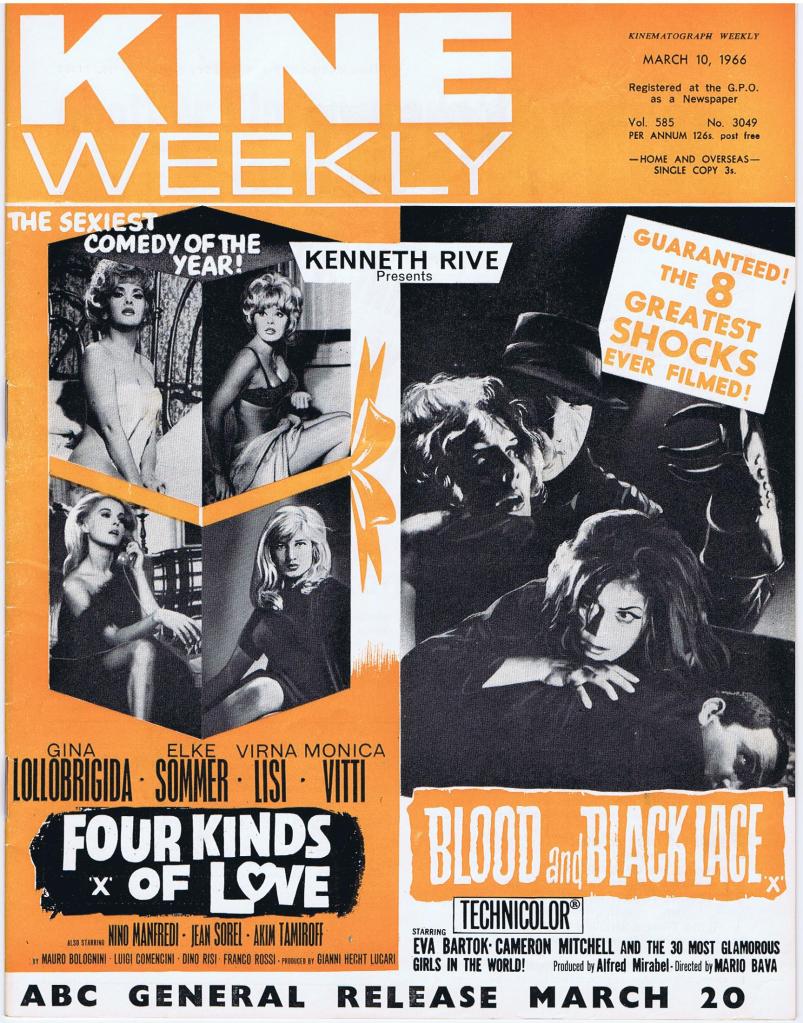
Jolly Films, the makers of “A Fistful of Dollars” already had experience of selling its films abroad. But as with Mario Bava’s “Blood and Black Lace” they were usually sold outright with no share of the box office and in turn sold as a supporting feature for a fixed price to an exhibitor.
Leone found a new backer in Alberto Grimaldi, an Italian entertainment lawyer who worked for Columbia and Twentieth Century Fox and had produced seven Spanish westerns. He promised to triple the first film’s budget to $600,000, with the director on a salary and 50 per cent profit share.
Success bred artistic confidence. A Fistful of Dollars had broken all box office records in Italy, grossing $4.6 million, and so Leone sought to improve on his initial offering and develop an “authorial voice.”
Thematically, with two principals, initially rivals who end up as “argumentative children,” it took inspiration from westerns like The Bravados (1958) – the photo and the chiming watch – and Robert Aldrich’s Vera Cruz which pitched Burt Lancaster against Gary Cooper. While bounty hunters had cropped up in Hollywood, they were not ruthless killers, actions always justified, rather than merely professionals doing their job. So in some sense Leone was drawing upon, and upending, films like Anthony Mann’s The Naked Spur (1953) and The Tin Star, Andre De Toth’s The Bounty Hunter (1954) and Budd Boetticher’s Ride Lonesome (1959). Just as Clint Eastwood’s bounty hunter underwent change, gradually the character played by Gian Maria Volonte evolved from a straightforward outlaw called Tombstone to a stoned, sadistic bandit named El Indio.
With artistic pretension came attention to detail. Leone required historical exactitude not just relating to weapons used, but their ballistics and range. Lee Van Cleef’s arsenal included a Buntline Special with removable shoulder stock, Colt Lightning pump action shotgun, Winchester ’94 rifle, and a double-barreled Lefaucheux. Carlo Simi’s town, constructed near Almeria, contained a two-storey saloon, undertaker’s parlor, barbershop, telegraph office, jail, hotel and an adobe First City Bank. And there was nothing pretty about it. The saloon was dirty and overcrowded, machines belching so much smoke it “looked as if a man could choke in there.” Filming took place between mid-April and the end of June 1965.
Perhaps the biggest area for improvement was the music. Ennio Morricone had scored another nine films since A Fistful of Dollars. Both director and composer had ambitious ideas about how to use the music. The score was not recorded in advance, nor was Morricone given a screenplay, instead listening while Leone told him the story and asked for individual themes for characters. Morricone would play short pieces for Leone and if met with his approval compose longer themes. Each character had their own leitmotif, sometimes the same instrument at different registers, the flute brief and high-pitched for Monco (Eastwood) but in a low register for Mortimer, church bells and a guitar representing El Indio. In a very real sense, they were experimenting with form. Bernardo Bertolucci regarded Morricone’s music as “almost a visible element in the film.” Musical ideas regarding El Indio’s watch, however, were developed at the rough cut stage, its repetitive melody becoming “sound effect, musical introduction and concrete element in the story.”
As well as creating music for audiences, Leone’s films are punctured with music that holds particular meaning for characters, here the watch and in Once Upon a Time in the West the harmonica, in both films flashback used to assist understanding.
The myth of why it took so long for either film to reach the United States was based on two misconceptions, firstly that Japanese director Akira Kurosawa, whose Yojimbo (1961) A Fistful of Dollars closely resembled, had blocked its progress, secondly that it relied on screenwriter Vincenzoni to make the breakthrough via a contact working for United Artists.
In fact, there were more obvious reasons for resistance from American distributors. In the first place, you could not discount snobbery. The notion that the country that had invented the western should now be reliant on importing them from Italy seemed a shade abhorrent. Although For a Few Dollars More was sold to 26 countries in a day at the annual Sorrento trade fair in 1965 – at the same fair a year earlier there had not been a single taker for A Fistful of Dollars – the United States was not among the buyers, distributors perhaps even more daunted by the prospect of introducing so much violence to American audiences reared on the traditional western.
Foreign movies that made the successful transition to the United States arrived weighted down with critical approval and/or awards or garlanded with a sexy actress – Brigitte Bardot, Anna Magnani, Sophia Loren among the favored – and risqué scenes that Hollywood dare not include for fear of offending the all-mighty Production Code.
But sex was a far easier sell in the U.S. than violence. And an actor with no movie marquee such as Clint Eastwood did not fill exhibitors with delight and even the notion that A Fistful of Dollars was a remake of Akira Kurosawa’s Yojimbo (1961) failed to stir the critics (as with The Magnificent Seven being a remake of Seven Samurai, most viewing the notion as repellent). So both the first and second pictures in the “Dollars” trilogy were stuck in distribution limbo for three and two years, respectively, before being screened in America.
And, initially, it had appeared that Italian audiences shared the same distaste for a cultural intruder such as A Fistful of Dollars. One cinema chain owner refused to book the film on the grounds that there were not enough female characters. A Fistful of Dollars was released in Italy in August, a dead period, since the month is so hot and everyone has abandoned the city for the beach. It opened – only in Florence and with neither publicity nor advertising – on August 27th 1964, a Friday, and did poor business that day and the next. But by Monday, it was a different story, takings had doubled and over the following two days customers were being turned away. New films typically played first-run for 7-10 days in Florence, A Fistful of Dollars ran for three months, triggering a box office story of Cinderella proportions.
But my research indicated there had been ample opportunity for an American distributor to snap up the rights to A Fistful of Dollars in 1965, two years before it was finally released there. In the first place, the music rights had already been purchased by New York firm South Mountain Music in March 1965 in expectation the film would acquire release that year. In December 1965 Arrigo Colombo, partner in Jolly, flew to the United States for the specific purpose of lining up a major distributor for A Fistful of Dollars. The company had previously secured U.S. distribution for horror product like Castle of Blood (1964) and Blood and Black Lace (1964) but those were outright sales.
With the movie already sold to Spain, West Germany, France and Japan, Colombo aimed to conclude a deal for the English-speaking market, “purposely holding back” from releasing the picture in those countries as he sought an all-encompassing contract. At that point, Kurosawa no longer stood in the way, that issue “now cleared up” settled in the normal fashion by financial inducement, in an “amicable settlement” Toho snagging the Japanese and Korean rights, the deal sweetened with a minimum $100,000 against a share of global profits. But Colombo went home empty-handed, unable to secure any deal and his temerity ridiculed by trade magazine Variety
Although Sergio Leone had one other legal obstacle to surmount that would not have got in the way of a U.S. distribution deal, the worst that could happen being that a contract might be struck with a different company. Italian companies Jolly Films/Unidis, which had backed the original, took umbrage at Leone going ahead with the sequel without their financial involvement, cutting them off from the profit pipeline. So in April 1966 they took Leone to court in Rome arguing that For A Few Dollars More “represented a steal as well as unlawful competition for its own Fistful.” Four months later the judge denied the claim on the grounds that “the character played by Clint Eastwood in each film is not characterized to such a degree that a likeness exists” (even though to all intents and purposes it was the same character, cigar, poncho, gun, bounty hunting!). Ironically, Italian laxity in such matters counted against Eastwood when he failed to prevent the distribution of a film based on two segments of Rawhide stitched together.
It would also be highly unusual if United Artists was not aware of both A Fistful of Dollars and For A Few DollarsMore since, in keeping tabs on the foreign performance of both Goldfinger (1964) and Thunderball (1965) the studio could scarcely fail to notice the Italian westerns close on their box office tail, the second western outpointing Thunderball in daily averages in Rome.
But the story still, erroneously, goes that it was the intervention of writer Vincenzoni which proved decisive. He had contacts in U.S, namely Ilya Lopert of United Artists. Grimaldi was, meanwhile, trying to sell U.S. and Canada rights relating to the second picture. Vincenzoni arranged for UA’s representatives to view A Fistful of Dollars in Rome and cut himself in for a slice of the profits when the distributor surprisingly purchased the entire series.
Since A Fistful of Dollars had already been sold to most major territories, UA could only acquire the North American rights – for a reported $900,000 – but for the other two films gained a considerably larger share of global distribution
United Artists was an unusual company among the Hollywood hierarchy, and not primarily due to recurrent Oscar success, but because it had, completely unexpectedly, hit box office gold with James Bond. There was nothing particularly odd about a series, as Tarzan, Sherlock Holmes etc (still flourishing in the 1960s) testified. What was distinctive about the Bonds was that each picture – the four so far had earned close to $150 million worldwide, not counting merchandising – had done better than the last, which went against the standard rule of sequels of diminishing returns and higher costs. Given the opportunity to buy into a ready-made series (two films in the can, the third in production) UA made an “attempt to calculatedly duplicate the (Bond) phenomenon” and in so doing “create a trend.” Assuming the movies would follow the Bond formula of increased grosses with each successive picture, the studio was prepared to spend “many hundreds of thousands” of dollars to establish the first picture.
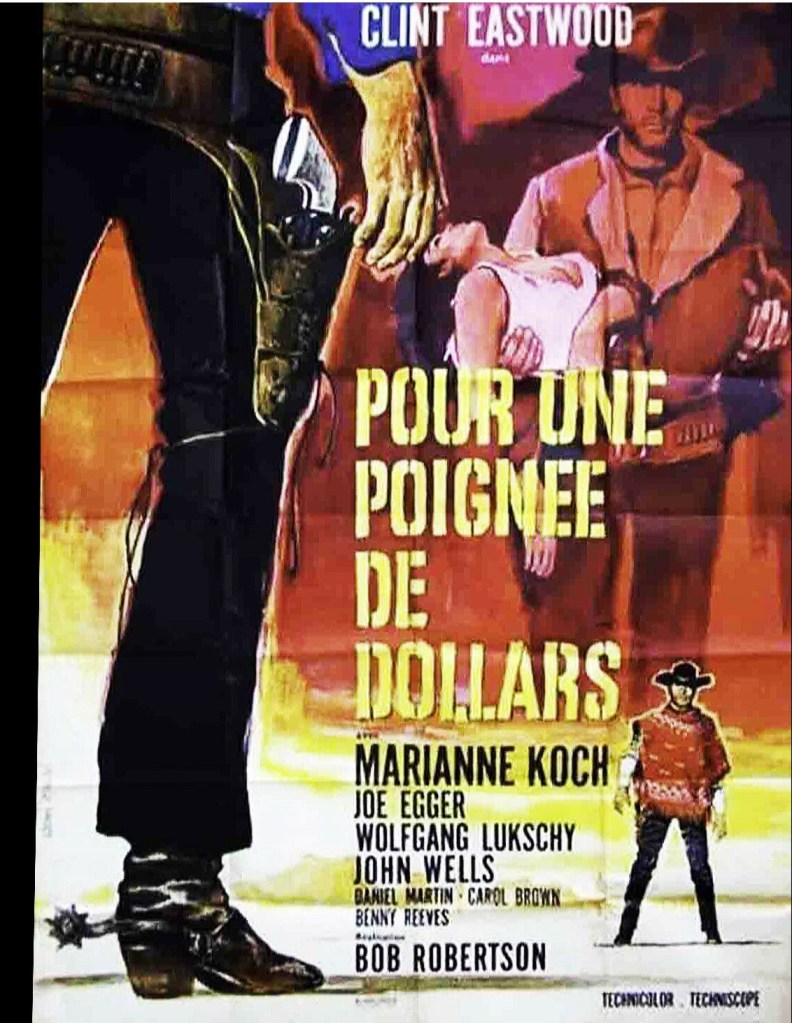
United Artists embarked on an unusual sales campaign to the trade. Instead of marketing the pictures one at a time, they started to promote the series with the tagline “A Fistful of Dollars is the first motion picture of its kind, it won’t be the last.” The advertising campaign was unusual in that it was based entirely around introducing the character rather than the story (much in the same way as James Bond had been), three separate slivers of the poster devoted to visual aspects, the cigar, gun and poncho, each carrying mention of “The Man With No Name,” such anonymity one of the talking points of the movies.
Cinema managers were briefed on release dates, A Fistful of Dollars in January 1967, the sequel for April and The Good, the Bad and the Ugly for Xmas that year. Like the Bonds, it was expected that box office would progressively, if not explosively, increase. The studio unveiled a “hard-hitting campaign” designed to “intrigue the western or action fan.”
However, the North American premiere was held not in the United States but Canada, at the Odeon-Carlton in Toronto. Having committed to a four-week engagement, a risky prospect for an unknown quantity, the cinema started advertising a teaser campaign three weeks in advance. During the first week, posters were not just focused on the “man with no name” but also “the film with no name” and the “cinema with no name,” all those elements removed from the artwork until the second week of the campaign. UA allocated $20,000 in marketing, up to four times the usual amount spent on a launch there, and was rewarded with strong results – “bullish but not Bondish” Variety’s verdict.
However, the UA gamble did not pay off, especially when taking into account the high cost of buying the rights allied to huge marketing costs. Initial commercial projections proved unrealistic. Despite apparently hitting the box office mark in first-run dates in key cities, the film was pulled up short by its New York experience. Shunted straight into a showcase (wide) release rather than a first-run launch, it brought in a pitiful $153,000 from 75 theaters – even The Quiller Memorandum (1966) in its second week did better ($150,000 from 25). As a consequence when For a Few Dollars More was released in April/May, UA held off boking it into New York until “a suitable arrangement” could be made, which translated into hand-picking a dozen houses famed for appealing to action fans plus 600-seat arthouse the Trans-Lux West.
United Artists predicted $3.5 million in rentals (the amount returned to studios after cinemas take their cut of the gross) for A Fistful of Dollars and $4.5 million with For a Few Dollars More. Neither came close, the latter the marginally better performer with $2.2 million in rentals (enough for a lowly 41st on the annual chart) with the first film earning $2.1 million in rentals (46th) way behind more traditional performers like Hombre ($6.5 million for tenth spot), El Dorado ($5.9 million in 13th) and The War Wagon ($5.5 million in 15th).
The vaunted Bond-style box office explosion never materialized and it might have helped if UA had kept closer watch on the actual revenues posted in Italy for the series. While For a Few Dollars More increased by $2 million the takings of A Fistful of Dollars, the final film in the trilogy, The Good, the Bad and the Ugly produced lower grosses than even the first.
However, it did look as if The Good, the Bad and the Ugly would come good. UA opened it in two first-run cinemas in New York where each house retained it for six weeks. But although the final tally of $4.5 million (24th spot in the annual rankings) was the best of the series, it did not herald returns that made it anywhere near comparable to the Bonds.
It’s possible the movies did better in terms of admissions than the box office figures show. Distributors pushing foreign product into arthouses were generally able to achieve a high share of the rental – 50 per cent the going rate – because they were able to set rival arthouses against each other and movies with a sexy theme/star had inbuilt box office appeal, La Dolce Vita (1960) and And God Created Women (1956) the classic examples. But that would not be possible when trying to interest ordinary cinemas with a film lacking in sex.
When I researched the early Bonds for a previous Blog, I found that United Artists had only managed to achieve bookings for Dr No (1962) by lowering its rental demand. Exhibitors paid the studio just 30 per cent of the gross. And I wondered if perhaps the same occurred with A Fistful of Dollars given the star, like Sean Connery, was completely unknown. Of course, it would not explain why the series did not grow as expected.
Of course, there was a surprising winner and an unexpected loser in the whole ‘Dollars’ saga. Clint Eastwood emerged as the natural successor to John Wayne with a solid box office – and later critical – reputation for American westerns starting off with Hang ‘Em High (1968) which beat The Good, the Bad and the Ugly at the box office, while Sergio Leone’s Once Upon a Time in the West (1969) proved a huge flop in the U.S.
Christopher Frayling, Sergio Leone, Something To Do With Death (Faber & Faber, 2000), p160-162, p165-200; “Italo’s Own Oater Leads Box Office,” Variety, December 2, 1964, p16; “South Mountain Buys Dollar Score,” Variety, March 10, 1965, p58; “Jolly’s Colombo Discovers N.Y.C. Busy at Xmas,” Variety, December 22, 1965, p3; “Tight Race for Box Office Honours in Italy Looms as Thunder Leads Dollars,” Variety, January 65, 1966, p15; “Dollars World Distribution for UA,” Variety, March 22, 1966, p22; “Clint Eastwood Italo Features Face Litigation,” Variety, April 13, 1966, p29; “UA Cautious on Links to Italo Fistful; Faces Slap from Kurosawa,” Variety, July 13, 1966, p7; “Rome Court Rejects Plea for Seizure of Few Dollars Made By Fistful Film,” Variety, August 3, 1966, p28; “Clint Eastwood vs Jolly on 2 Segs of Rawhide ‘Billed’ New Italo Pic,” Variety, September 7, 1966, p15; “Italy Making More Westerns, Spy Films Than Star Vehicles,” Box Office, October 31, 1966, p13; “Hemstitched Feature,” Variety, November 23, 1966, p22; “UA Division Holds Screenings of Westerns,” Box Office, December 12, 1966, pE2; Advertisement, Variety, December 21, 1966, p12-13; “UA Gambles Dollars As Good As Bonds,” Variety, December 28, 1966, p7; “Fred Goldberg Shows Ads on UA ‘Dollar’ Films,” Box Office, January 2, 1967, pE4; “Review,” Box Office, January 9, 1967, pA11; “Fistful of Dollars: Male (and Italo) B.O.,” Variety, January 18, 1967, p7; “Fistful of Dollars: The Glad Reaper,” Variety, February 1, 1967, p5; “This Week’s N.Y. Showcases,” Variety, February 8, 1967, p9; “Fistful’s Weaker N.Y. B.O. Clench,” Variety, February 8, 1967, p7; “Methodical Campaign Kicks Off Ideal Fistful Ballyhoo in Toronto,” Box Office, May 1, 1967, pA1; “Few DollarsMore Runs 30% Ahead of First Dubbed Italo-Made Western, So Bond Analogy Makes Out,” Variety, May 31, 1967, p4; “N.Y. Slow to Fall Into Line,” Variety, May 31, 1967, p4; “B’way Still Boffo,” Variety, July 12, 1967, p9; “Carefully Picked,” Variety, July 12, 1967, p4; “B’way Biz Still Big,” Variety, July 19, 1967, p9; “Big Rental Films of 1967,” Variety, January 3, 1968, p25; “B’way B.O. Up,” Variety, January 31, 1968, p9; “Big Rental Films of 1968,” Variety, January 8, 1969, p15.









 The Magnificent 60s