Battle of Midway (1976) ****

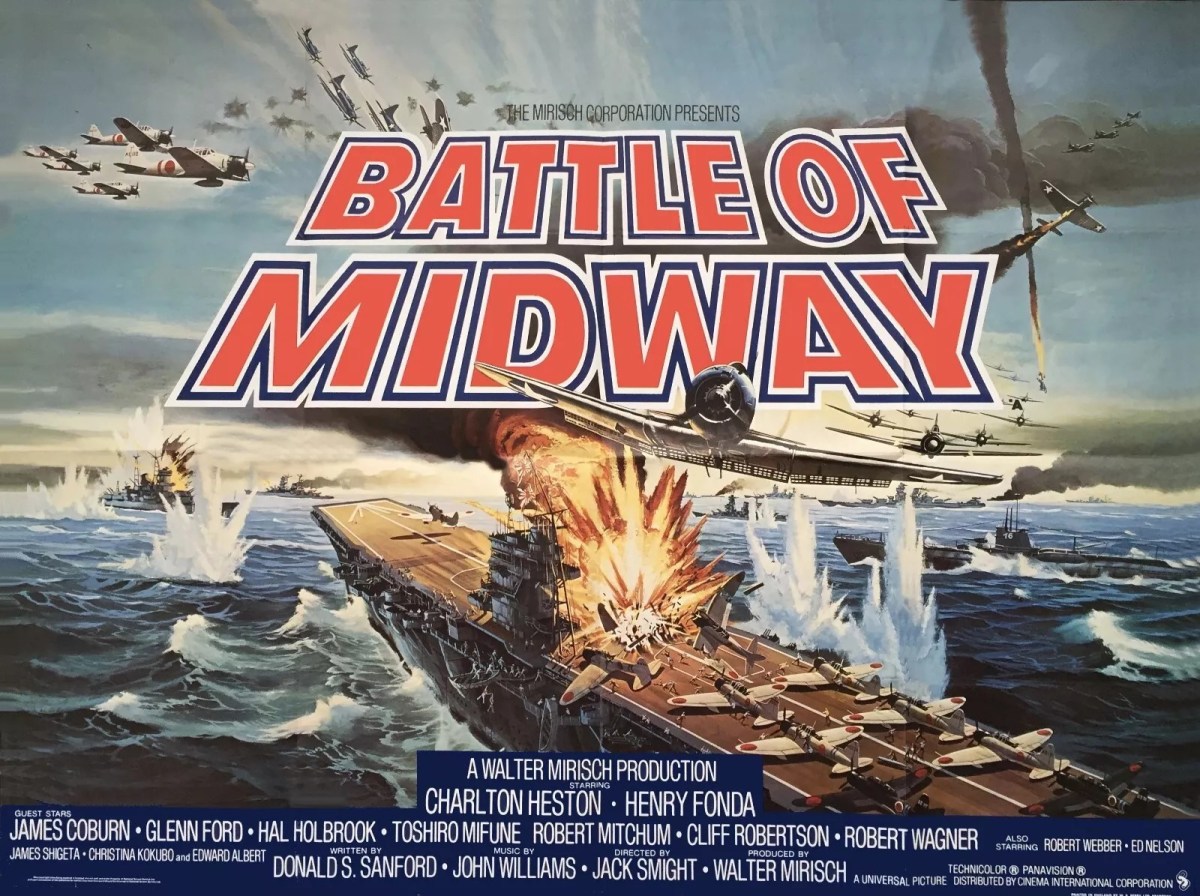
Even-handed documentary-style tale recounting of the most famous U.S. naval battle of all time, a turning point in the struggle for control of the Pacific in 1942. Both sides make mistakes, luck and judgement play an equal part.

I’d always assumed Midway was some abstract geographical position without any idea of its strategic importance – did the name mean it was halfway between the U.S. (or Hawaii) and Japan? But here I learned it was an actual island that the Japs planned to invade and the Americans intended to stop them. In some senses, it was bait, a way to draw the U.S. Navy out of Pearl Harbor. But the bait ran both ways. If the Yanks could coax the enemy out into the Pacific, they had a chance of gaining an advantage, even though the Americans were inferior in shipping tonnage.
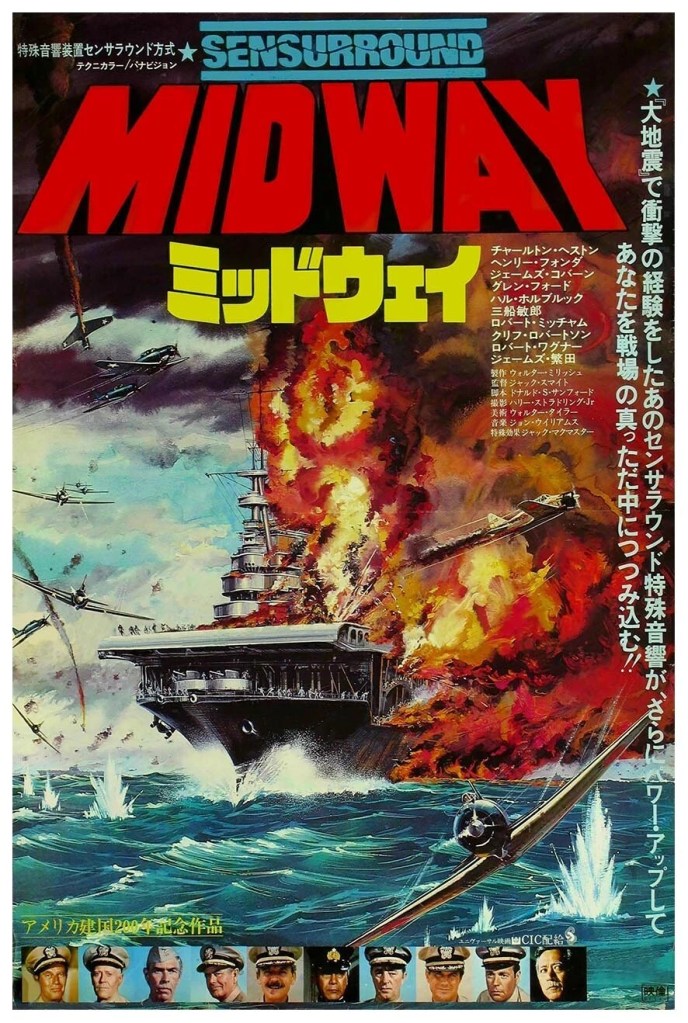
The Japs have been stung into action by the audacious American bombing of Tokyo. Admiral Yamamoto (Toshiro Mifune) uses the perceived threat of further attacks to gain official approval for his plan to invade Midway.

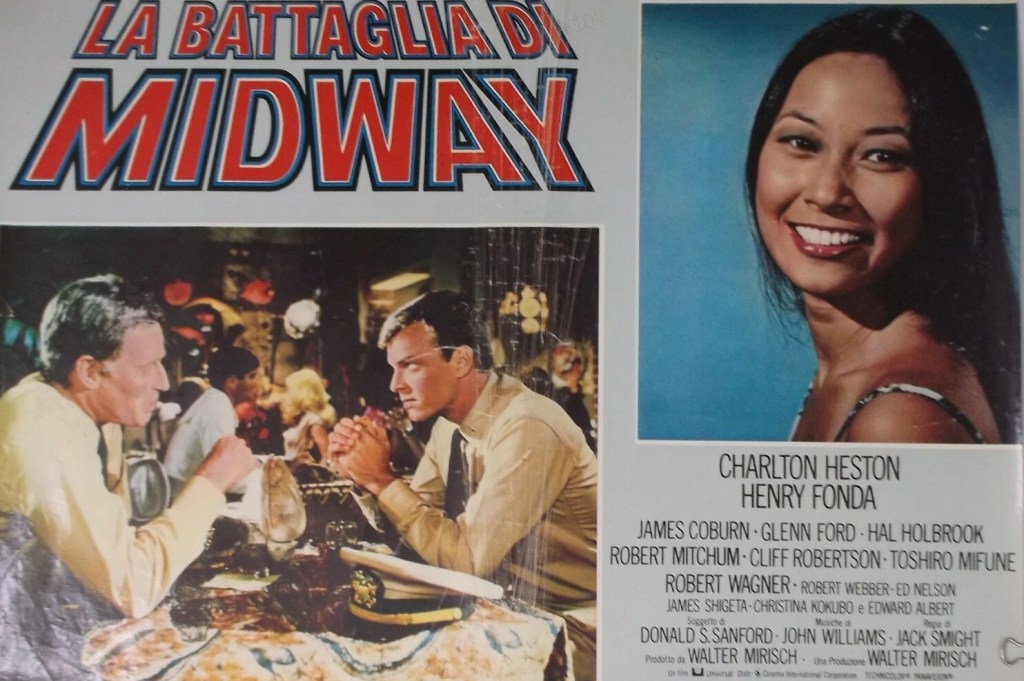
This is strictly a male show. However, in a bid to lower the testosterone levels a romantic subplot is inserted. The aviator son, Lt Thomas Garth (Eddie Albert), of top aide and former pilot Captain Matthew Garth (Charlton Heston) has an American-born lover Haruko (Christina Kobuko) of Japanese descent who’s being investigated for espionage and subsequently interned. On intervening, the father digs up a hodgepodge of racism – from both sides, Haruko’s parents against her forming a relationship with a non-Japanese. But the plan backfires causing a breakdown between father and son.

But that’s very much on the fringes and although it raises interesting cultural aspects, the movie concentrates mostly on the nuts-and-bolts of heading into a major engagement.

American intelligence, headed by Commander Joe Rochefort (Hal Holbrook), gets wind of the planned attack. But the clues are scant – the old trope of increased radio traffic not enough to convince – and while the audience knows the Japs are on the move with a mighty naval force including four top-class airplane carriers, the Americans remain ignorant almost until it’s too late.
Luckily, Admiral Nimitz (Henry Fonda), heading up the American naval contingent, is keen to inflict a blow on the enemy, even though he’s limited to two carriers and another just out of the repair yard. Each side relies on spotter planes to detect the enemy. But the Japanese, by imposing radio silence, shoot themselves in the foot, unable to switch tactics until too late. The hunch plays an important part.

There’s rarely much opportunity for individual heroics on a ship under fire, beyond rescuing someone. The fighter pilots are a better bet, especially since some of their forays are nearly suicidal given the firepower they attract. Matt Garth, who for most of the picture is an upscale backroom boy, is called into action with unexpected results.  

Most battle films tend to concentrate on the heroics often at the expense of understanding in any detail what’s going on. Thankfully, this is different. We are kept informed of every change in the conflict. And whereas you might think that dull, in fact I wouldargue that it adds substantially to the tension, and the fact that the only one of the commanders who looks as if he could throw a punch (Robert Mitchum) in the manner of John Wayne is confined to his bed thus forcing the movie to concentrate as much on brain as brawn.

Audiences at the time welcomed all the talking and this was a substantial hit. Snippets of old war footage were carefully sewn into the lining of the action, bringing the kind of authenticity that moviemakers reckoned moviegoers craved. For me, there was more than enough going on already.

Nimitz’s decision to go for broke rather than dive for cover results in victory but he’s no gung-ho commander, rather presented as a thoughtful but determined individual. The lack of backstage effort especially in the communications department was partly to blame for the humiliation of Pearl Harbor but here these guys share the glory.

Boasting the kind of all-star cast that used to be the hallmark of the 1960s roadshow, this has a bunch of top-notch actors, albeit most just flit in and out of the picture. Charlton Heston (Planet of the Apes, 1968) effortlessly shoulders the main burden with Henry Fonda (Once Upon a Time in the West, 1969) the fulcrum of all decision-making. Robert Mitchum (The Way West, 1967) , James Coburn (Our Man Flint, 1966), Glenn Ford (Rage, 1966), Cliff Robertson (The Devil’s Brigade, 1968) and Toshiro Mifune (Red Sun, 1971) all feature.

Jack Smight (Harper / The Moving Target, 1966) directs from a script by Donald S Sanford (Mosquito Squadron, 1969).

Thoroughly engrossing.

  • I’m doing a Behind the Scenes tomorrow.
Behind the Scenes: United Artists Goes to War on a Low Budget – “Submarine X-1” (1968) and Five Others

With the contraction of Hollywood production in the 1960s, cinemas worldwide were always crying for pictures – any pictures – that could take up a weekly slot or pad out a double bill. (The single-bill programming that is standard these days was not welcome in most cinemas, except a prestigious few, and audiences expected to see two movies for the price of their ticket). Indie unit Mirisch had scored such a big hit with aerial war number 633 Squadron (1964) – it recouped its entire cost from British distribution so was in profit for the rest of its global run – that Walter Mirisch persuaded distribution partner United Artists to attempt to capitalize on the idea and thus set in progress a series of war pictures to be made in Britain.

There would be cost savings through the Eady Plan. Each film would have a “recognizable American personality in the lead” and have American directors. Budgets would be held under $1 million. Half a dozen movies were planned, the first appearing in 1967, the last in 1970.

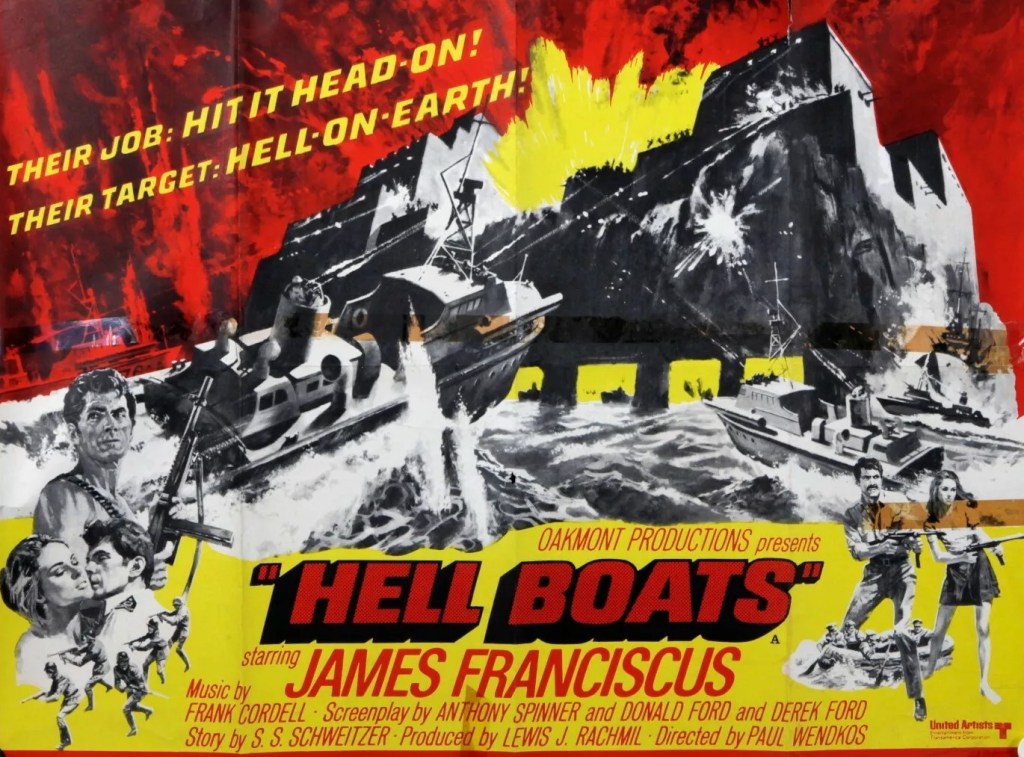
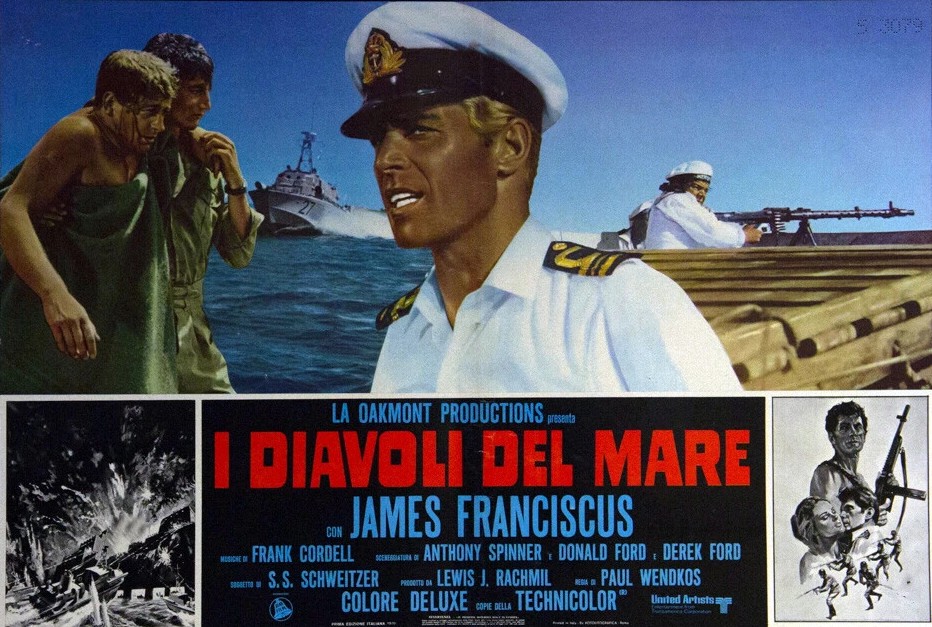
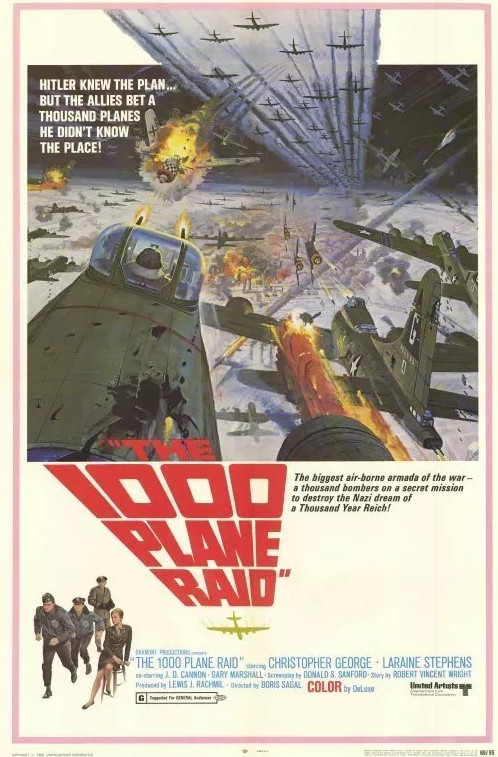
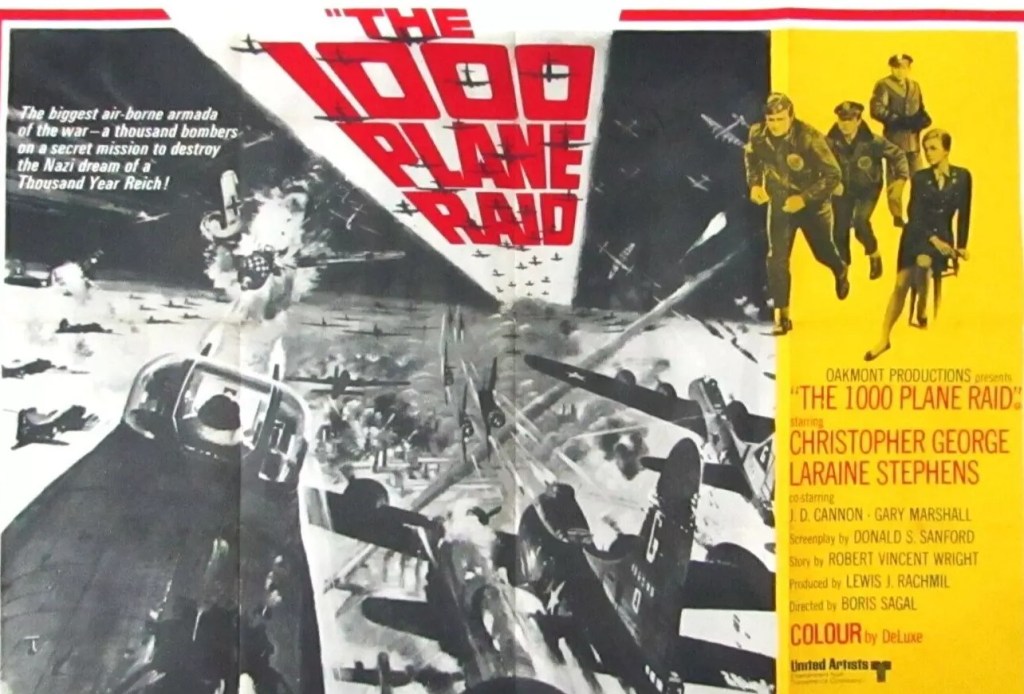
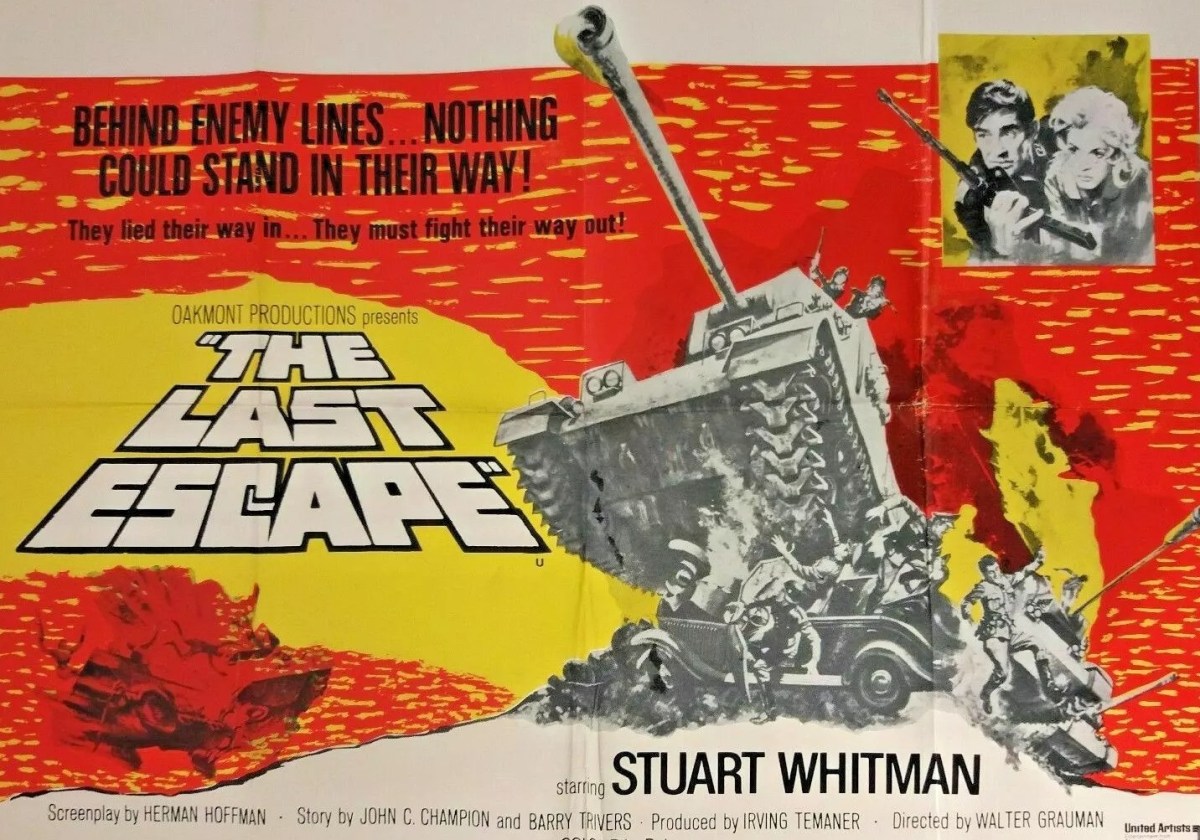
Quite whether James Caan (Red Line 7000, 1965) passed muster as a well-known enough star to qualify as a “personality” at the time he headlined Submarine X-1 (1968) is debatable, as was the presence of James Franciscus (The Valley of Gwangi, 1969) in Hell Boats (1970) and Christopher George (Massacre Harbor, 1968)  in The Thousand Plane Raid (1969) though Stuart Whitman (Rio Conchos, 1964)  exerted a higher marquee appeal for The Last Escape (1970). Veteran Lloyd Bridges (Around the World under the Sea, 1966) who headlined Attack on the Iron Coast (1968) was probably the best known, but these days that was mostly through television. And David McCallum owed whatever fame he had to television as part of The Man from U.N.C.L.E. double act and the idea that would still be enough to attract an audience for Mosquito Squadron (1969) seemed dubious.

Beyond setting up the project, Walter Mirisch had little to do with the actual production, putting that in the hands of Oakmont Production, which beefed up the action with judicious use of footage from other pictures. Invariably, reasons had to be given to explain why actors with American accents were members of the British fighting forces – most commonly they were represented as Canadian volunteers or might have British nationality by dint of having a British mother.

Storylines followed a similar template. At its heart was a dangerous mission. Leaders were invariably hated for some previous misdemeanor or because they were ruthless and drove the men too hard. If there was romance – not a given – it would border on the illicit. And someone required redemption.

And while none of the stars chose – or were chosen to – repeat the experience, Oakmont established something of a repertory company behind the scenes, writers, directors and producers involved in more than one movie.

Italian poster (photobusta) for “Hell Boats”. I found Japanese and Australian posters
for most of the films in the series.

Boris Sagal (Made in Paris, 1966) directed both The Thousand Plane Raid and Mosquito Squadron and then made his name with The Omega Man (1971). Paul Wendkos (Angel Baby, 1961) helmed Attack on the Iron Coast and Hell Boats. Walter Grauman who had kicked off the whole shebang with 633 Squadron returned for The Last Escape. William Graham (Waterhole #3, 1967) as the only outlier with just Submarine X-1 to his name.

Veteran producer Lewis Rachmil (A Rage to Live, 1965) oversaw three in the series – Hell Boats, Mosquito Squadron and The Thousand Plane Raid. Another veteran John C. Champion, younger brother of celebrated Broadway choreographer Gower Champion, was involved in a variety of categories. Champion is almost an asterisk these days, best known these days for producing the film Zero Hour! (1957) that inspired disaster parody Airplane! (1980). He was only 25 when he produced his first picture, low-budget western Panhandle (1948). He was behind another four low-budget westerns pictures before Zero Hour!, which had a decent cast in Dana Andrews and Linda Darnell. But that was his last movie for nine years as he switched to television and Laramie (1959-1963), barely reviving his movie career with The Texican (1966) starring Audie Murphy.

He produced Attack on the Iron Coast and Submarine X-1 and was credited with the story for both plus The Last Escape. Irving Temaner produced The Last Escape and received an executive producer credit on Attack on the Iron Coast and Submarine X-1.  Donald Sanford (Battle of Midway, 1976) was the most prolific of the writers, gaining screenplay credits for Submarine X-1, The Thousand Plane Raid and Mosquito Squadron. Herman Hoffman (Guns of the Magnificent Seven) wrote Attack on the Iron Coast and The Last Escape.

Cinema managers were not, it transpired, queuing up for the product. Most commonly, when reviewed in the British trade press, their release date was stated as “not fixed” which generally meant that United Artists was hoping the review would do the trick and alert cinema owners.

In the United States, they rarely featured in the weekly box office reports, though Portland in Oregon appeared partial to the product, Attack on the Iron Coast appearing there as support to Hang ‘Em High (1968), Mosquito Squadron supported The Christine Jorgensen Story (1970), Hell Boats supported Lee Van Cleef western Barquero (1970) while The Last Escape supported Mick Jagger as Ned Kelly (1970). To everyone’s astonishment a double bill of Hell Boats / The Last Escape reported a “big” $10,000 in San Francisco, but that proved an anomaly.

In Britain, the movies fulfilled their purpose as programmers, not good enough to qualify as a proper double bill, but accepted as supporting feature for a circuit release on the Odeon chain. Since UA supplied Odeon with its main features, it proved relatively easy to persuade the circuit to take the war films to fill out a program. This kind of second feature would be sold for a fixed price not sharing in the box office gross. However, they were given the kind of all-action poster they hardly deserved.

So in 1968 Attack on the Iron Coast went out with The Beatles Yellow Submarine. In 1969, Submarine X-1 supported slick heist picture The Thomas Crown Affair, which with Steve McQueen and Faye Dunaway in top form scarcely needed any help securing an audience. Hell Boats was supporting feature in 1970 to Master of the Islands (as The Hawaiians starring Charlton Heston was known). As well as accompanying it on the circuit Mosquito Squadron in 1970 made a very brief foray into London’s West End with thriller I Start Counting and then reappeared a few months later as an alternative choice of support for Billy Wilder flop The Private Life of Sherlock Holmes. If you went to see Burt Lancaster western Lawman in 1971 you might have caught The Last Escape – equally it could have been If It’s Tuesday, It Must Be Belgium (cinema managers could choose either).

United Artists, under the financial cost in the early 1970s, pulled the plug on “programmers” such as these. Walter Mirisch in his biography, disingenuously suggested that the six movies had done relatively well. But that wasn’t supported by the studio’s own figures.

Collectively, they made a loss of $1.7 million. Only Attack on the Iron Coast made it into the black and then by only $59,000. Hell Boats lost $700,000. None of the movies earned more than $200,000 in rentals in the United States.

Although Mirisch managed to keep budgets down to around the million-dollar mark, they would have had to be much smaller to see a profit. Ironically, it was the cheapest, Attack on the Iron Coast costing $901,000,  that made the most. Submarine X-1 lost $150,000 on a $1 million budget, Mosquito Squadron lost $253,000 on a $1.1 million budget while The Thousand Plane Raid lost $50,000 more on the same budget. The longer the series went on, the worse the losses – The Last Escape lost $449,000 on a $995,000 budget while for Hell Boats the budget was $1.36 million.

SOURCES: United Artists Archives, University of Wisconsin; Walter Mirisch, I Thought We Were Making Movies, Not History (University of Wisconsin Press, 2008) p204; Reviews, Kine Weekly – Feb 9 1968, Aug 31 1969, January 1970, April 18 1970; “Flops Loss-Cutting,” Variety, August 26, 1970, p6; “Picture Grosses,” Variety – March 13 1968, May 8 1968, April 24 1968, October 2 1968, June 10 1970, July 1 1970, July 8, 1970, August 12 1970, August 26 1970.

Tiger by the Tail (1968) ***

Back to those ingénues – or whatever-happened-to-Tippi Hedren. Christopher George’s villainous turn in El Dorado (1967) brought him as much immediate attention as James Caan and though he quickly achieved leading man status he never parlayed it beyond the likes of low-budget numbers such as The Thousand Plane Raid (1969).

But there was a more interesting ingénue on show here. Tippi Hedren had made the instant stardom type splash as Alfred Hitchcock’s go-to leading lady in The Birds (1963) and Marnie (1964). She reckoned she could do better without Hitchcock’s patronage, the director reckoned she was more trouble than she was worth, so there was a relatively amicable parting of the way.

Hedren didn’t find other directors queuing up for her services. Two small screen appearances and a supporting role in A Countess from Hong Kong (1967) were all she had to show for her stand of independence or hubris. Whereas in other circumstances signing up for this picture would have been seen as slumming it, this turned into more of an audition for a steady place in the B-movie division.

In the end she isn’t the stand-out any more than Christopher George is. The movie is too humdrum for that. But it’s the kind of narrative with murder, revenge, robbery, double-dealing and a sadistic villain that in the hands of bigger names with established screen charisma – say George Peppard and Jill St John – might have sparked more substantial interest.

There are three villainous schemes afoot. Vietnam war hero Steve (Christopher George) returns to his home town where his brother runs a race track. No sooner has Steve checked in than the brother is murdered during a million-dollar robbery. The murderers are then bumped off in an airplane explosion by heist mastermind Polk (Dean Jagger), the inside man.

Following on from that, the other four stockholders of the race course plan to ease out Steve, who’s inherited the majority stake from his brother, and buy the racetrack on the cheap, circumstances and the company’s own rules tilting the odds heavily in their favor. Sheriff Jones (John Dehner) also figures Steve for the murder of his brother, so he’s first of all got to prove his own innocence before going after the guilty.

He does a fair bit of running around, aided by barmaid-cum-singer Carlita (Charo) trying to put the jigsaw in place. He’s got some cute ideas how to winkle out the potential bad guys, one of which fingers stockholder Ware (Lloyd Bochner) who gets taken out before he can spill the beans.

Former girlfriend Rita (Tippi Hedren), one of the stockholders, runs hot and cold. Initially discouraging, she eventually warms to her old flame, then turns down the heat when she realizes he considers her a suspect in the robbery. Steve takes a good thrashing every now and then, but proves assiduous and occasionally spot-on in his deductions, though most of his investigation relies on fishing expeditions. Some of the finger-pointing is obvious but the denouement is not.

There was another ingénue here. Commonwealth United intended going down the “mini-major” or “instant major” route as exemplified by United Artists and Avco Embassy, where a new production outfit set up a hefty portfolio of movies, aiming for a release strategy of 6-12 a year, sufficient to be recognized by cinema owners desperate for product as a potential player. Established by real estate supremo Milton T. Raynor, it kicked off in 1968 with Tiger by the Tail and A Black Veil for Lisa starring John Mills and Luciana Paluzzi, followed by a heftier slate of seven pictures the following year.

Big-budget items packed with marquee names such as Battle of Neretva with Yul Brynner and Sylva Koscina, The Magic Christian headlined by Peter Sellers and Raquel Welch, and Oscar-winner Sandy Dennis in Robert Altman’s That Cold Day in the Park were mixed in with low-budget thrillers Paranoia starring Carroll Baker, Tippi Hedren comeback The Girl Who Knew Too Much and It Takes All Kinds with Vera Miles plus a pair of Jess Franco exploitationers, 99 Women and Venus in Furs. The project foundered almost immediately and by 1971 was $80 million in debt.

Whether Tippi Hedren ever acknowledged her debt to Hitchcock, it’s pretty clear here that she owed a ton to the way he presented her, not just the glossy façade, but bringing out the best of her acting. Her trademark fragility is little in evidence here without anything notable taking its place. Away from center stage, she doesn’t light up the movie.

Final picture of  R.G. Springsteen (Operation Eichmann, 1961) from a screenplay by Charles A. Wallace (The Money Jungle, 1965).

Run-of-the-mill crime picture or whatever-happened-to Tippi Hedren.

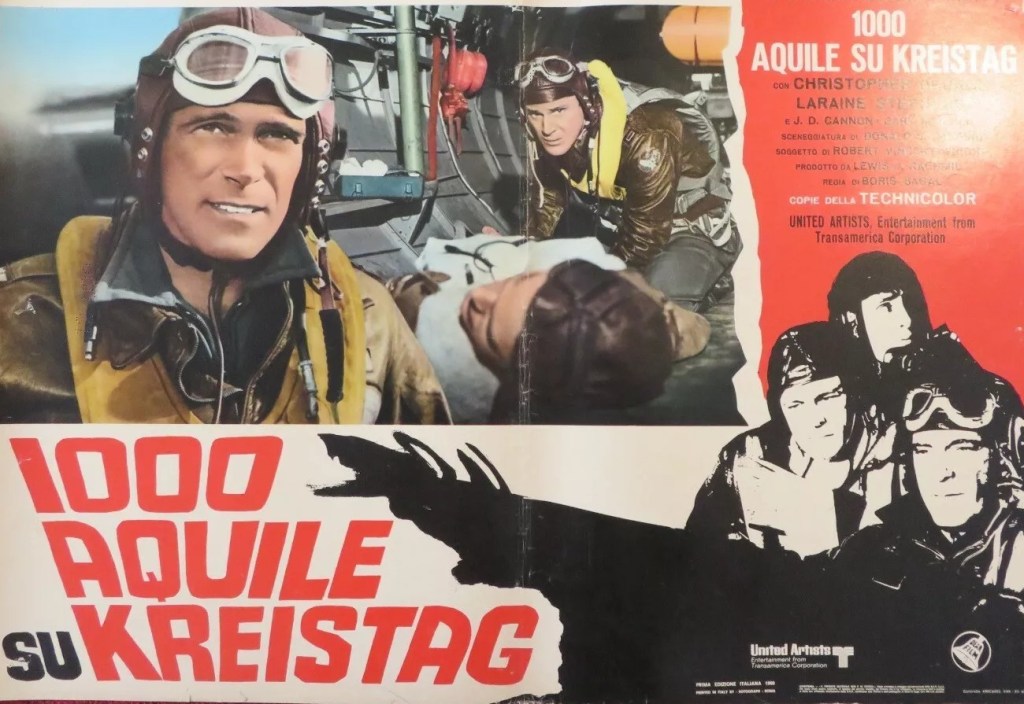
The Thousand Plane Raid (1969) ***

Let’s be honest. Like 633 Squadron (1964) and perhaps even, despite its all-star cast, Battle of Britain (1969), many in the audience will only be there for the hardware, the chance to see the flying battle buses that took the Allies to victory in World War Two. There’s not going to be much of a story anyway – rivalry between commanders, tension on the ground, a romance beginning or breaking apart, a stash of info dumps. That can hardly compare to the grace of the big birds in the air, usually a mixture of stock footage and new work with refurbished old planes.

This one has even re-purposed – perhaps stolen would be a better word – a mission from earlier in the war which was planned and carried out by the RAF so that it could be planned and in part carried out by the Yanks. Still, it was the Yanks putting up the money so I guess they can change history whenever they like.

U.S. Air Force Col Brandon (Christopher George), leading an American bomber group stationed in England, has worked out that while night-time missions result in fewer casualties they are increasingly failing to get the job done, only one on five bombs hitting the designated target. He reckons a gigantic air attack in daylight is the only way to succeed. His boss General Palmer (J.D. Cannon) grants him the chance to pitch his idea to the assembled RAF high command. Despite the risks, they agree and then need to come up with about million gallons of fuel and about a million-and-half tons of bombs, and requisition 30 airfields for the bombers and the same number for the fighter support.

Various elements make life tougher for Brandon. The mission chosen is much further afield than he originally imagined, the deadline is brought forward, his crew is unprepared and needs toughened up, plus his romance with WAC Lt Gabby Ames (Laraine Stephens) has hit a sticky patch and he’s having to deal with a cocky RAF fighter pilot Wing Commander Howard (Gary Marshal) who’s been seconded to the operation. To annoy Brandon further Howard befriends disgraced American pilot Lt Archer (Ben Murphy) who’s been accused of cowardice.

Before we can get to the big event, Brandon also undergoes a crisis of confidence and it’s as much as he can do to pull himself together in time. The screenwriter has arranged for the three main characters to end up in the one plane, allowing Archer to prove himself in battle and Howard to manage some heroics.

The sight of a huge array of WW2 planes in the air without the help of CGI still takes the breath away. Even though the final action pales in comparison with 633 Squadron or Battle of Britain it’s visually powerful enough to see us through.

By the end of the 1960s, B-pictures cost a lot more, but that didn’t necessarily result in better performances. Christopher George (El Dorado, 1966), signed up to a five-picture deal by United Artists, isn’t the breakout star. In fact there isn’t one, neither Laraine Stephens (40 Guns to Apache Pass, 1967) nor Gary Marshal (Camelot, 1967), in his second and final movie, making much of an impression. However, the picture was more notable for members of the supporting cast including J.D. Cannon (Krakatoa: East of Java, 1968), Ben Murphy (Alias Smith and Jones TV series, 1971-193), Bo Hopkins (The Wild Bunch, 1969), future director Henry Jaglom (A Safe Place, 1971) and Tim McIntyre (The Sterile Cuckoo, 1969).

One who certainly made the step up was director Boris Sagal (Made in Paris, 1966); in a couple of years he would be helming cult number The Omega Man (1971). Written by Donald S. Sanford (Midway, 1976).

Discover WordPress

A daily selection of the best content published on WordPress, collected for you by humans who love to read.

The Atavist Magazine

by Brian Hannan

WordPress.com News

The latest news on WordPress.com and the WordPress community.