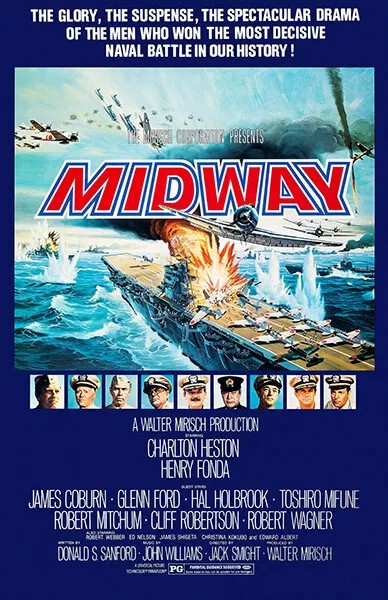
Producer Walter Mirisch could have afforded to rest on his laurels – he’d won the Oscar for In the Heat of the Night and been responsible for classics like The Magnificent Seven (1960) – and three sequels – and The Great Escape (1963). The 1970s had proved tougher, resulting initially in a string of pot boilers before hitting a home run with Mr Majestyk (1974) with Charles Bronson and knocking the ball out of the box office park with war picture Battle of Midway (1976), the former pulling in $20 million in rentals on a $2 million budget, the latter $50 million in rentals on a $7 million budget.
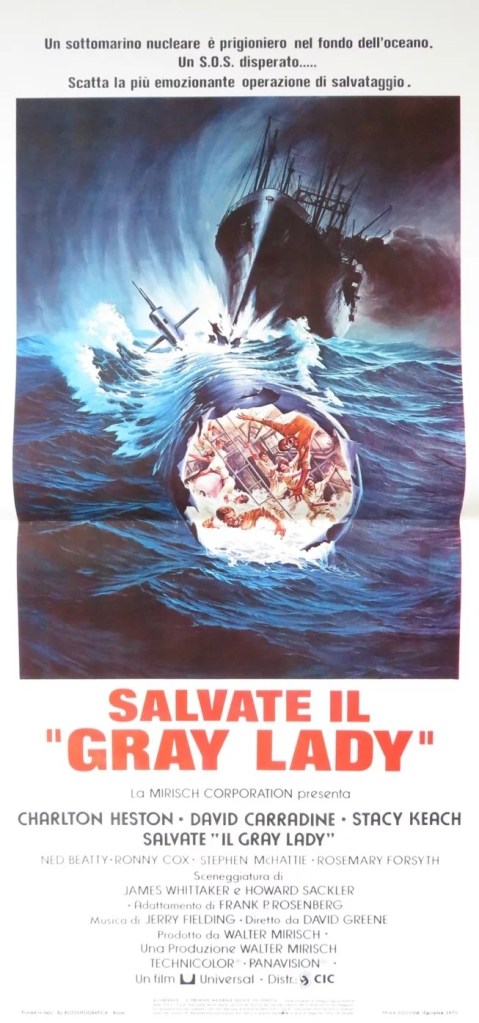
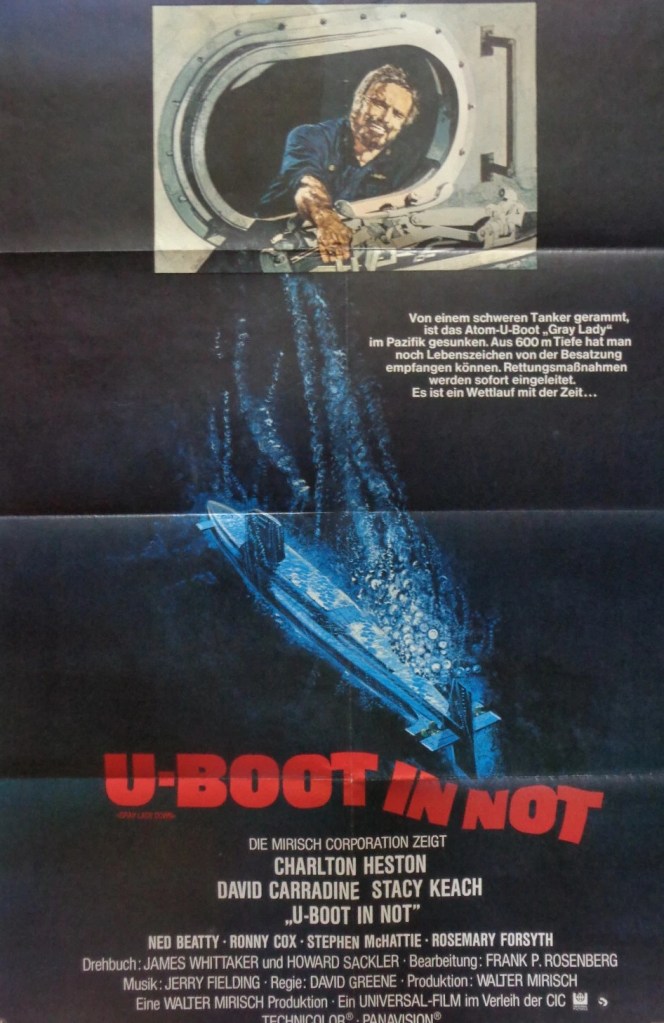
He had parted company with United Artists after nearly two decades in partnership and tied up a five-year deal with Universal. With Midway under his belt, he was the go-to producer for pictures on a naval theme. He had been sent a screenplay by James Whittaker about a submarine stranded at the bottom of the ocean. However, it turned out there was already a novel on the same subject, Event 1000 by David Lavallee, which result in various negotiations to determine the screenwriter credit, especially after playwright Howard Sackler (The Great White Hope, 1970) had completed a rewrite.
Charlton Heston, on a box office roll after Airport 1975 (1974), Earthquake (1974), Battle of Midway and Two Minute Warning (1976), was the obvious choice for the lead. But Mirisch had originally contemplated teaming Heston with Sidney Poitier (In the Heat of the Night). “He’s now backing away” from the idea, noted Heston in his diary in February 1976, “though I’m not sure why, save the cost of having us both in the film.” Heston was in strong demand, and turned down The Omen (1976) and The Pack (1977).
The film was slow coming together, “not much progress on the script…casting still slow” and there was the possibility of further delay to “mull” over the project. No director had been assigned by the end of February 1976. Following the Battle of Midway, the U.S. Navy was only too delighted to be involved. As well as following a disaster picture template, the movie was also tech heavy, featuring up-to-date ideas on rescue at sea.
The interior of the submarine, the main set, was constructed on a gimbal so that it could be tilted to achieve the effect of the sailors being thrown about as the sub sunk to the bottom and rolled over on a deep sea trench. Howard Anderson oversaw special effects work with models in a 44ft deep water tank which was filmed at CBS. Exteriors were shot at Universal with some work aboard a Navy escort vessel. Some material was also repurposed from Ice Station Zebra (1978).
To soak up the atmosphere of a real nuclear sub, Heston spent the day on USS Gurnard under the Pacific off San Diego. “I got a lot of useful little stuff,” commented Heston, “about the look and sound of submarine officers at work…the kind of thing nobody could tell you.” The sub contained a “vast array” of disparate and complex technology. “It was a very strange feeling to spend hours charging about under the ocean running mock torpedo attacks on surface vessels.” The experience also included drills for fire and flooding.
As shooting approached, Mirisch still had not done a deal for second lead Stacy Keach (Fat City, 1972). He was, however, “anxious” to recruit Ronny Cox (Deliverance, 1972). Ned Beatty, also form that film, came on board. David Carradine (Bound for Glory, 1976) and future Superman Christopher Reeve were added. Michael O’Keefe (The Great Santini, 1979) also made his movie debut.
Filming began on September 11, 1976. “I had very little to do,” noted Heston, “which was just as well, breaking in on a new film.” He played his only scene with Keach, “the tag of the picture and a key scene.” British director David Greene (Sebastian, 1968) was applauded for being as meticulous as William Wyler. More importantly, “he gives the actors a great deal and I find myself stimulated by almost all the suggestions he makes,” commented Heston. At one point, Greene decided to reshoot a major scene, bringing back offstage actors Heston thought he could do without. On the minus side, “he runs a rather loose ship.” Of his own contribution, the actor said, “I became preoccupied with giving an efficient performance rather than a creative one. The pressures I feel to be a consummate professional make me focus on getting it right.”
Filmed on a budget of just $5.25 million, it proved a huge hit, pulling in $19 million in rentals.
SOURCES: Walter Mirisch, I Thought We Were Making Movies, Not History (University of Wisconsin Press, 2008) p339-341; Charlton Heston, The Actor’s Life (Penguin, 1980) pp464-481.
The best of the late 70s disaster pictures and possibly the best of the whole short-lived genre, mixing technology, hair-rising tension and restrained emotion on top of a belter of a concept, sailors trapped in a submarine on the seabed with oxygen running out. But what lifts this above the norm is that it doesn’t follow the normal disaster picture template. Men do not rise easily to this challenge. Courage drains away as fast as time. Tempers flare and more than one of these hardy men collapse under the pressure.
The best scene in the picture is a man dealing wordlessly with loss and being a male of a certain era unable to shed a tear. So it’s all on the face. Capt Blanchard (Charlton Heston) has to shut himself away to grieve. And there’s a somber tone throughout. Corpses, covered only in a blanket, are laid out alongside the injured in an improvised sick bay. More than one person cracks. Even in a major crisis, bureaucracy gets in the way.
Blachard isn’t exactly the strong-jawed hero. As the situation grows more serious, his equanimity fails and he gets very snappy with the crew. And he’s also dealing with a heavy dose of guilt. Luckily, his major failing isn’t exposed to the crew, but his second-in-command points the finger.
Although the sub has been sent to the bottom courtesy of a collision in thick fog with a merchant ship boasting faulty radar, the accident should never have occurred. The sub shouldn’t have been on the surface. The only reason for that was Blanchard’s pride. This is his final voyage and he wanted to sail into harbor with is vessel atop the waves.
Now the sub is laid up in a deep trench and subject to “gravity slides”, the technical term for rock falls, which not only shift its position every now and then, pushing it deeper into the trench, but seal up the top of the escape hatch.
So the U.S. Navy’s new-fangled DSRV (Deep Submergence Rescue Vehicle) can’t do its job and an even more new-fangled experimental submersible, operated by Captain Gates (David Carradine) and his sidekick Mickey (Ned Beatty) is called in. But its operation is sabotaged when officious Capt Bennett (Stacy Keach), tasked with the rescue mission, insists on one of his own men going down instead of the more experienced Mickey.
The underwater scenes are thrilling, and there’s plenty of technical know-how on view and a bunch of impression jargon spouted, as the sub slips further away and the submersible moves into more perilous depths. In the days before CGI, this is superb stuff. And since the sub is now upside down you certainly see more than normal of your typical submarine.
Unlike earlier disaster numbers like Airport (1970), The Poseidon Adventure (1972) and Towering Inferno (1974), no time is wasted setting up the various characters, usually embroiled in emotional entanglement, and for sure there’s no nuns or pregnant women to get in the way of a tight narrative. Comic relief, if that’s what you’re looking for, is provided by the chirpy Mickey.
But when you get right down to it, this holds all the narrative aces. You know rescue is going to get complicated. The unexpected always gets in the way.
But the men under pressure a thousand feet blow the surface are really under pressure and it’s not long before the cracks begin to show and widen.
Unfortunately, this came at the tail end of the disaster cycle when public interest was waning, and perhaps precisely because there was a lack of male-female interaction and no nuns it proved less appealing.
Charlton Heston (Will Penny, 1968) is very impressive, especially when he strains to hold it together and the scene I mentioned is one of his most best pieces of acting. Ned Beatty (Deliverance, 1971) also has a top-notch stiff-upper-lip scene.
Topping the supporting cast are David Carradine (Heaven with a Gun, 1969) and Stacey Keach (Fat City, 1972). You can spot Christopher Reeve (Superman, 1978) in an early role. Rosemary Forsyth (The War Lord, 1965) has a small part, but onshore.
Ably directed by David Greene (Sebastian, 1968) from a screenplay by James Whittaker (Megaforce, 1982) and Howard Sackler (The Great White Hope, 1970) based on the book by David Lavallee
If you’re in the mood for a thrilling ride, hang on to your hat.
Mirisch could easily lay claim to be the top independent production outfit of the 1960s generating hits like The Magnificent Seven (1960), West Side Story (1961), The Great Escape (1963), The Pink Panther (1964) and its sequel A Shot in the Dark (1964), The Russians Are Coming, Russians Are Coming (1966), In the Heat of the Night (1967) and The Thomas Crown Affair (1968) plus a shelf load of Oscars and Oscar nominations. But dependence on a partnership with Billy Wilder in the 1970s and a more lackluster performance at the box office – with the noted exception of Fiddler on the Roof (1971) – spelled the end of its 17-year relationship with United Artists, which was reeling from financial losses and under new management.
The company found a new partner in Universal which had a series of deals with other major producers like Alfred Hitchcock, Zanuck and Brown (Jaws, 1975) and George Seaton (Airport, 1970). Mirisch was not in any financial trouble, having severed ties with UA after Mr Majestyk (1974), a major success abroad, and recovered its development costs for Wheels, based on the Arthur Hailey novel but the script rejected by UA, from Universal which turned it into a mini-series.
The Universal deal was initially not as good as that enjoyed at UA. Universal charged a twenty-five per cent overhead whereas UA had charged nothing and Universal was now doing direct deals with directors rather than relying on the likes of Mirisch to tie up the talent.
Many years before, Mirisch had commissioned a script on the Battle of Midway from Donald S. Sanford who specialized in war pictures but of the distinctly low-budget variety – Submarine X-1 (1968), The Thousand Plane Raid (1969) and Mosquito Squadron (1969), none of which had enjoyed any success.
Though all of the Mirisch war pictures had concentrated on Europe, Walter Mirisch, generally the creative driving force for the production company, in his previous incarnation with Allied Artists had some experience of the Pacific War, having produced Flat Top / Eagles of the Fleet (1952), set around an aircraft carrier during the Battle of Leyte Gulf, and was an avid reader of books about the Second World War.
John Ford and Louis de Rochmont had made documentaries about the Pacific naval battles. UA rejected the script twice, a shrewd move in the end because Tora! Tora! Tora! (1970) lost a packet for Twentieth Century Fox. The Sanford screenplay had initially taken more of a documentary approach but after gaining the interest of Charlton Heston, who had starred in Mirisch’s The Hawaiians (1970), the script was tweaked.
Programming a war picture was a risk for the studio. There hadn’t been a big-budget war picture in five years. And while Patton (1970) and Kelly’s Heroes (1970) ended up on the right sight of the ledger book, Tora!, Tora! Tora! and Too Late the Hero (1970) were stiffs.
Mirisch signed a two-picture deal with Universal, for Midway and Wild Card with a screenplay by Elmore Leonard (Mr Majestyk). Mirisch proposed to reduce costs by using footage from naval archives, converting the original 16mm film to 35mm. The producer also took footage from Japanese film Storm over the Pacific / I Bombed Pearl Harbor (1960) – the rights cost him $96,000. Footage of the Pearl Harbor attack in Tora! Tora! Tora! doubled for shots of the attack on Midway Island. A clip of the Dolittle raid on Tokyo from Thirty Secondsover Tokyo (1944) was used in the credit sequence after “subjecting it to a sepia bath.”
After the success of Earthquake (1975), Heston was back in the top ranks of box office stars and his involvement guaranteed the green light. The U.S. Navy offered its support, not surprising since Midway was considered its greatest success.
John Guillermin (The Towering Inferno, 1974) was hired to direct and Stirling Silliphant (In the Heat of the Night) signed up for a screenplay rewrite. Mirisch had determined to employ the all-star-cast device that had been an essential ingredient of many of the 1960s roadshow pictures, kicking off with Henry Fonda (The Boston Strangler, 1968), by now pretty much a spent force at the box office – he hadn’t made a picture in three years – but still a well-known name.
The amount of work involved for the other stars was minimal – mostly just one day – and, astutely, Mirisch called on stars who had worked for him in the past and who, like James Coburn (The Great Escape), Cliff Robertson (633 Squadron, 1964) and Christopher George (The Thousand Plane Raid) owed him something in terms of a career leg-up. Others included Robert Mitchum (The Sundowners, 1960), Robert Wagner (The Biggest Bundle of Them All, 1968) and Tom Selleck in an early role. Mitchum was the first of these stars to sign up, in March 1975, six weeks before the scheduled start date of April 27, followed two days later by Coburn.
Toshiro Mifune (Red Sun, 1971) headed up the Japanese cast and proved so meticulous in his preparations that he had his uniform made by Japanese tailors. The white gloves he wore had a finger shortened on the left hand because his character Admiral Yamamoto was missing a pinky. However, despite coaching in English by actress Miko Taka (Walk, Don’t Run, 1966), his dialog was revoiced by Paul Frees.
Guillermin demanded a bigger budget to accommodate more airplanes and equipment and a longer shooting period. Two months before filming was due to start, Mirisch put his foot down and told the director he couldn’t accommodate his requests as Universal had only provided funding on the basis of Mirisch’s original idea. Guillermin walked. As far as the public was concerned, the parting of the ways was due to a “conflict of schedules.” Jack Smight, who had directed Airport ’75 (1974), a box office success and also starring Heston, was his replacement.
The Navy lent aircraft carrier U.S.S. Lexington – the last remaining World War Two carrier – while it was at sea training pilots as long as the shoot didn’t interfere with those exercises. A limited number of World War Two vintage planes – in great condition having been cared for by their owners – were permitted on board. The Navy charged the crew for accommodation – Mirisch was housed in Admiral Strean’s quarters – and meals. “We had a detailed contract with the Navy,” recalled Mirisch, “in which we agreed to stay out of their way when asked.”
On board, the crew filmed scenes, some silent and others with dialog, and “made plates for rearview projection and aerial shots of our vintage planes so positioned that we could print them into flights of six or nine.” Charlton Heston, Glenn Ford (Rage, 1966) and Hal Holbrook (The Group, 1966) were aboard and the shoot went well. A scene involving Henry Fonda was shot at Pensacola. The Florida coast stood in for the Pacific. Additional exteriors were filmed in Los Angeles at Long Beach and Point Dune with interiors at Universal.
The construction of the interiors for the Japanese aircraft carriers was so authentic Mirisch was later asked to reassemble the set for the Smithsonian Institute for a presentation there. The interpolation of the old footage was crucial and it was planned in advance where such shots would appear. The old footage was precut and scenes were shot with actors with “scene missing” in those sequences into which the old footage could be dropped. Other devices were used to ensure the background in the old footage was more lively.
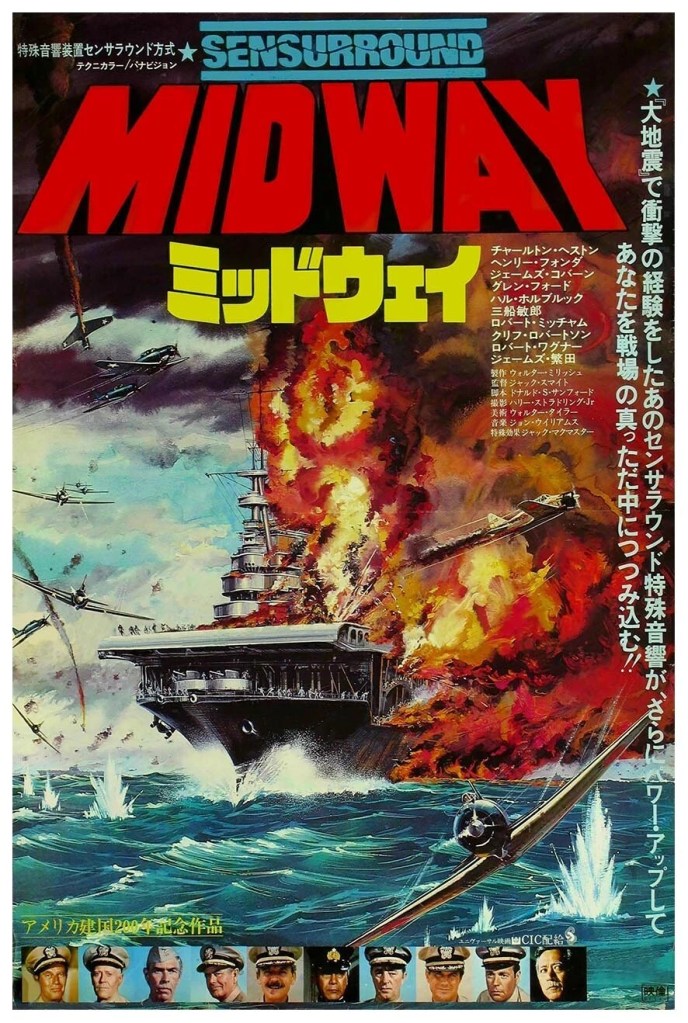
The final element was in cinematic presentation. Sensurround, a precursor of Imax, had been introduced with great success by Universal to Earthquake and this added greater realism to the battle scenes. While limited to those theaters which had installed the expensive equipment, and although the roadshow was long gone, it created an “event” aspect to those viewing it in that system. In his autobiography Mirisch suggested the addition of Sensurround was last minute and sparked by the success of Earthquake. But, in fact, Universal had announced a year in advance of opening that Battle of Midway would utilize Sensurround.
Some cinema owners were outraged at the stock footage, whose proposed inclusion had been kept from them when they went into the blind-bidding process at the start of the year. Mirisch countered that there was no alternative. “A great many aircraft,” he argued, “used in the battle no longer exist.” Universal’s terms were stiff – a minimum nine-week run starting at a 70/30 split for the first three weeks in the studio’s favor, a $75,000 advance guarantee from cinemas and 5% of the gross for use of Sensurround.
With the budget kept as low as a reported $4 million it was a massive hit, picking up $20.3 million in rentals (what the studio retains of the box office gross) – sixth in the annual box office league beaten only by Oscar-winner One Flew over the Cuckoo’s Nest, All the President’s Men with Robert Redford and Dustin Hoffman, demonic The Omen, Walter Matthau baseball comedy The Bad News Bears and Mel Brooks’ Silent Movie and just ahead of such offerings as Sidney Lumet’s Dog Day Afternoon with Al Pacino, and comedy Murder by Death but nearly doubling the take of the more critically-acclaimed Taxi Driver, Clint Eastwood western The Outlaw Josey Wales and thriller Marathon Man also starring Hoffman. The final domestic figure amounted to $21.8 million.
Foreign figures were astonishing, especially in Japan, where its gross exceeded $4 million. The benefits of the promotional tour undertaken by Heston in the Far East were soon obvious – in Manila it beat both Jaws and Earthquake. In the annual box office league there and Hong Kong, it ranked third. In Italy it proved a “big surprise”, coming in fourth behind King Kong, Taxi Driver and a local offering.
While a successful movie could expect to benefit from television viewings – this was before the video revolution – the movie had an unusual afterlife. NBC, which had bought the rights, wanted the film to be longer, so it could be shown over two nights, thus increasing advertising and setting it up as a more prestigious event. Largely by adding plotlines to the Heston character, the running time increased by nearly an hour, which proved a bonus for the future home screening revolution.
“Of all the films that I have made,” noted Mirisch, “it produced the greatest amount of profit.”
SOURCES: Walter Mirisch, I Thought We Were Making Movies Not History (University of Wisconsin Press, 2008) pp324-339; “Readying Midway,” Variety, February 5, 1975, p6; “Universal in New Shake,” Variety, July 23, 1975, p3; “Admiral Mitchum,” Variety, March 12, 1975, p18; ”Jap Feature Footage Inserted into Midway,” Variety, June 6, 1976, p7; “Midway Big in Manila,” Variety, August 11, 1976, p24; “Big Rental Films of 1976,” Variety, January 5, 1977, p14; “Jaws Led Bangkok,” Variety, February 9, 1977, p39; “International,” Variety, June 29, 1977, p35.
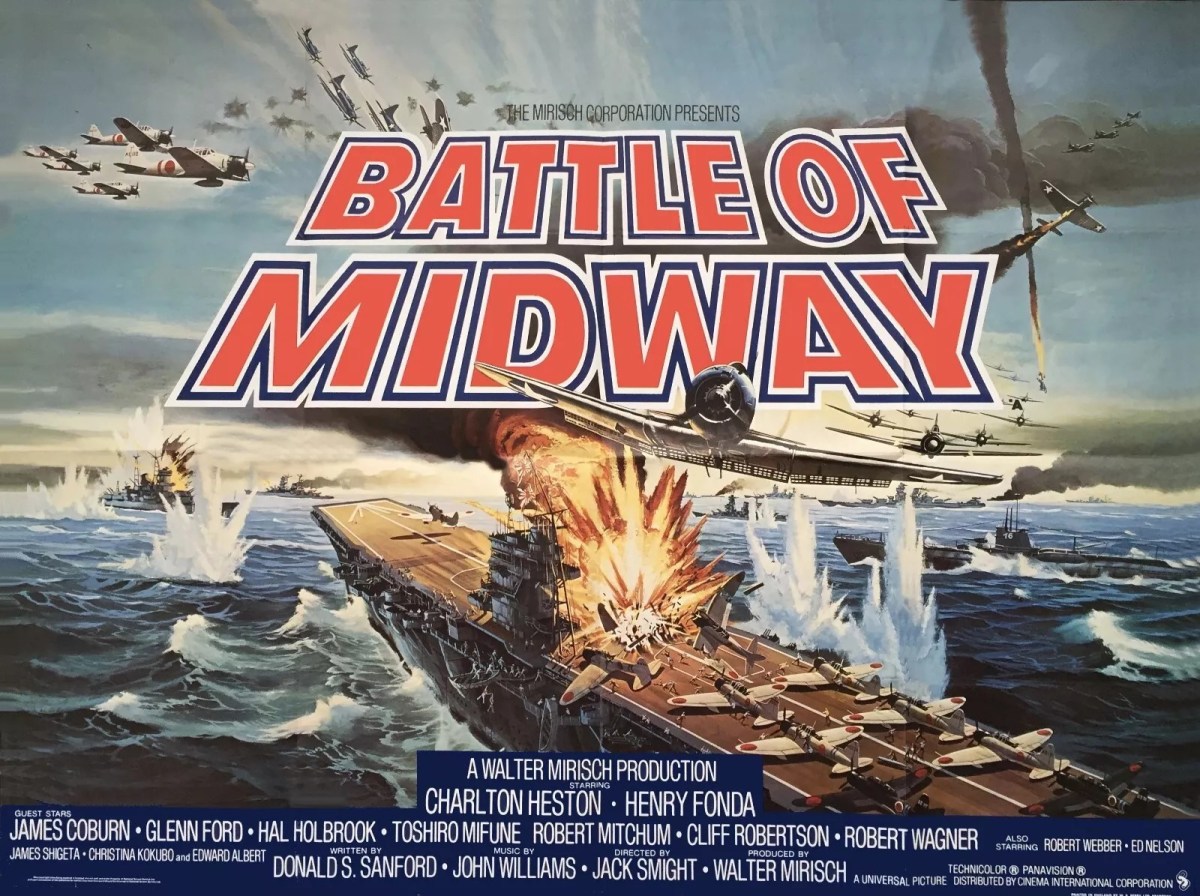
Even-handed documentary-style tale recounting of the most famous U.S. naval battle of all time, a turning point in the struggle for control of the Pacific in 1942. Both sides make mistakes, luck and judgement play an equal part.
I’d always assumed Midway was some abstract geographical position without any idea of its strategic importance – did the name mean it was halfway between the U.S. (or Hawaii) and Japan? But here I learned it was an actual island that the Japs planned to invade and the Americans intended to stop them. In some senses, it was bait, a way to draw the U.S. Navy out of Pearl Harbor. But the bait ran both ways. If the Yanks could coax the enemy out into the Pacific, they had a chance of gaining an advantage, even though the Americans were inferior in shipping tonnage.
The Japs have been stung into action by the audacious American bombing of Tokyo. Admiral Yamamoto (Toshiro Mifune) uses the perceived threat of further attacks to gain official approval for his plan to invade Midway.
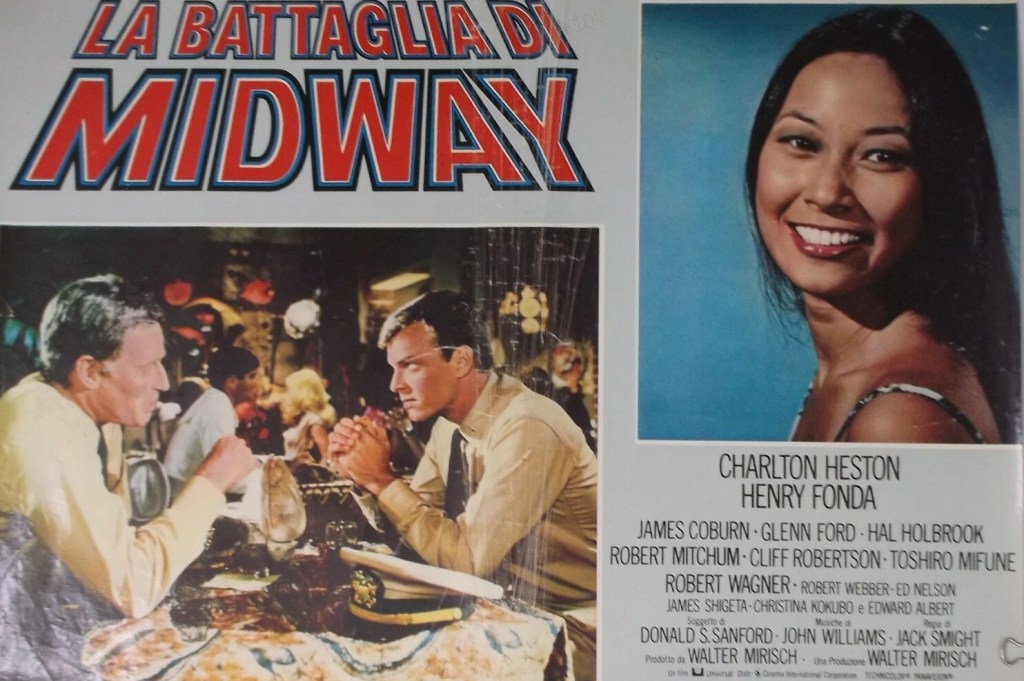
This is strictly a male show. However, in a bid to lower the testosterone levels a romantic subplot is inserted. The aviator son, Lt Thomas Garth (Eddie Albert), of top aide and former pilot Captain Matthew Garth (Charlton Heston) has an American-born lover Haruko (Christina Kobuko) of Japanese descent who’s being investigated for espionage and subsequently interned. On intervening, the father digs up a hodgepodge of racism – from both sides, Haruko’s parents against her forming a relationship with a non-Japanese. But the plan backfires causing a breakdown between father and son.
But that’s very much on the fringes and although it raises interesting cultural aspects, the movie concentrates mostly on the nuts-and-bolts of heading into a major engagement.
American intelligence, headed by Commander Joe Rochefort (Hal Holbrook), gets wind of the planned attack. But the clues are scant – the old trope of increased radio traffic not enough to convince – and while the audience knows the Japs are on the move with a mighty naval force including four top-class airplane carriers, the Americans remain ignorant almost until it’s too late.
Luckily, Admiral Nimitz (Henry Fonda), heading up the American naval contingent, is keen to inflict a blow on the enemy, even though he’s limited to two carriers and another just out of the repair yard. Each side relies on spotter planes to detect the enemy. But the Japanese, by imposing radio silence, shoot themselves in the foot, unable to switch tactics until too late. The hunch plays an important part.
There’s rarely much opportunity for individual heroics on a ship under fire, beyond rescuing someone. The fighter pilots are a better bet, especially since some of their forays are nearly suicidal given the firepower they attract. Matt Garth, who for most of the picture is an upscale backroom boy, is called into action with unexpected results.
Most battle films tend to concentrate on the heroics often at the expense of understanding in any detail what’s going on. Thankfully, this is different. We are kept informed of every change in the conflict. And whereas you might think that dull, in fact I wouldargue that it adds substantially to the tension, and the fact that the only one of the commanders who looks as if he could throw a punch (Robert Mitchum) in the manner of John Wayne is confined to his bed thus forcing the movie to concentrate as much on brain as brawn.
Audiences at the time welcomed all the talking and this was a substantial hit. Snippets of old war footage were carefully sewn into the lining of the action, bringing the kind of authenticity that moviemakers reckoned moviegoers craved. For me, there was more than enough going on already.
Nimitz’s decision to go for broke rather than dive for cover results in victory but he’s no gung-ho commander, rather presented as a thoughtful but determined individual. The lack of backstage effort especially in the communications department was partly to blame for the humiliation of Pearl Harbor but here these guys share the glory.
Boasting the kind of all-star cast that used to be the hallmark of the 1960s roadshow, this has a bunch of top-notch actors, albeit most just flit in and out of the picture. Charlton Heston (Planet of the Apes, 1968) effortlessly shoulders the main burden with Henry Fonda (Once Upon a Time in the West, 1969) the fulcrum of all decision-making. Robert Mitchum (The Way West, 1967) , James Coburn (Our Man Flint, 1966), Glenn Ford (Rage, 1966), Cliff Robertson (The Devil’s Brigade, 1968) and Toshiro Mifune (Red Sun, 1971) all feature.
Jack Smight (Harper / The Moving Target, 1966) directs from a script by Donald S Sanford (Mosquito Squadron, 1969).
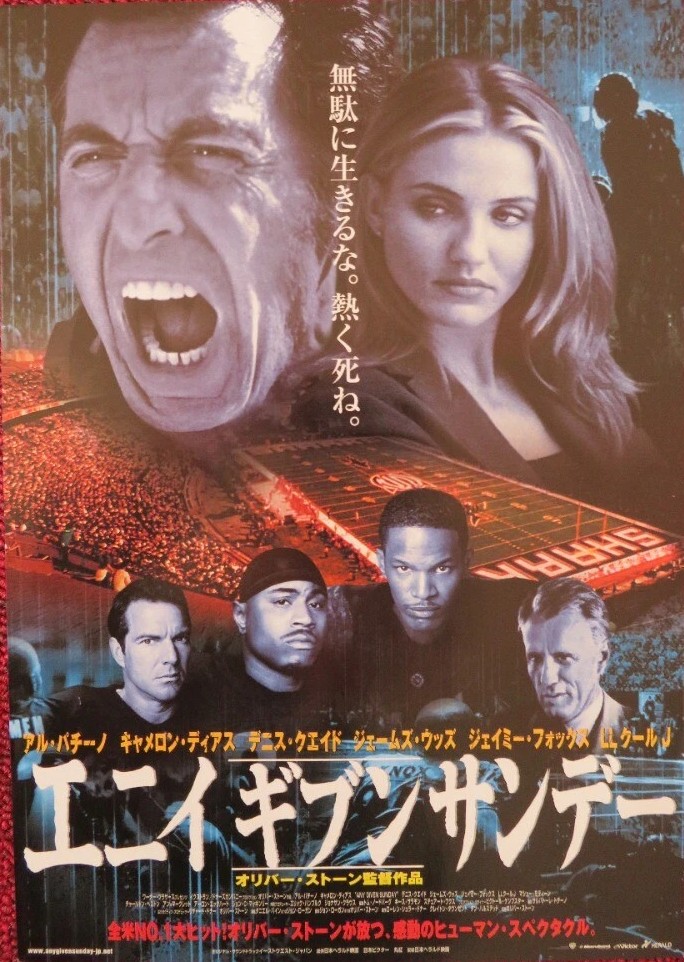
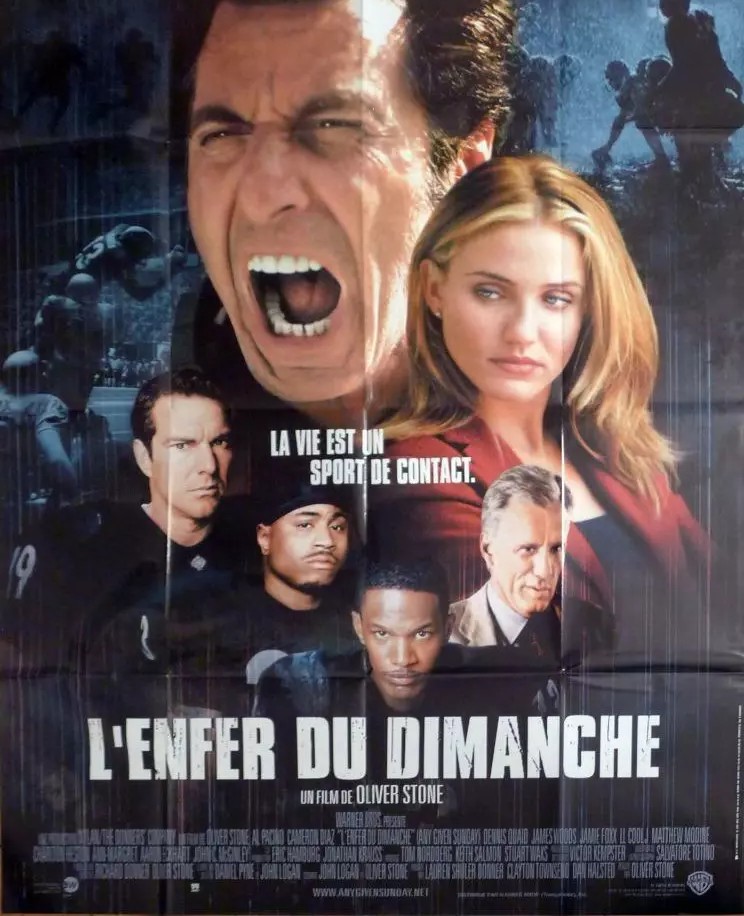
It’s always with trepidation that I go back to a banker, one of my favorite films, hoping that it will remain timeless, and still good enough for a place on my all-time personal Top Ten. I’d planned a double bill of Kingdom of Heaven (2005) and this but the former proved so disappointing that it took me a while to pluck up the courage to watch Oliver Stone’s kaleidoscopic American football epic.
My fears proved misplaced and this is bearing in mind that I know nothing about the sport and have little understanding of what always appear arcane rules that make little sense to someone brought up on the more disciplined (at least in my eyes, rules-wise) football/soccer (or the hybrid “soccerball” as my grandkids refer to it). I’ve always been a fan of sports movies, which means American sports movies, because with the exception of Chariots of Fire (1981) the British don’t seem to have the knack. So I’m used to following movies where I don’t necessarily understand what’s going on the field of play.
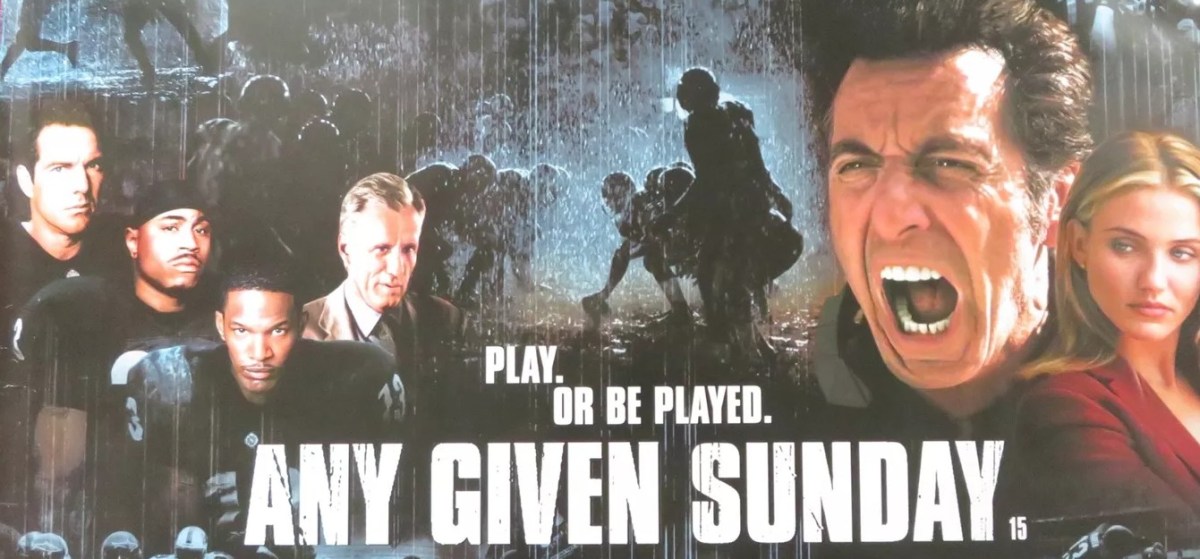
This is driven by three compelling narratives – all power duels of one kind or another, between owner Christina Pagniacci (Cameron Diaz) and various politicians, between her and coach Tony D’Amato (Al Pacino), and between Tony and arrogant rising star quarterback Willie Beaman (Jamie Foxx). And while all these battles are a mixture of discreet management and full-blown blood-and-thunder shouting matches, the movie is liberally sprinkled with tiny cameo moments that add depth.
There’s a blink-and-you-miss moment when team physician Dr Mandrake (James Woods) is seen in conversation on the sidelines with a blonde cheerleader. The next time you see her is when she chooses not to follow Mandrake when he is fired, as curt a signal as you’ll ever find that position rather than personality equates to worth. She appears for one more nanosecond and this time in conversation with his replacement Dr Powers (Matthew Modine).
The saddest moment is when cute sex worker Mandy (Elizabeth Berkley) tries to let Tony down gently that theirs is purely a financial, not romantic, transaction. But that’s run close when Willie’s girlfriend Vanessa (Lela Rochon) is given the brush-off by the established WAGs. And the toughest scene, amidst all these high-powered testosterone-driven adrenalin male and female junkies, is when injured star quarterback Cap Rooney (Dennis Quaid) is given the mother of all slaps by wife Cindy (Lauren Holly). All such moments are merely incidental to the three main narratives, as is the battle for music supremacy in the dressing room, when the head-bangers among the team turn the volume up to eleven.
Revenge is a theme. And that can run from setting loose your baby alligator in the team shower room, taking a buzz saw to a rival’s ultra-expensive automobile or his team-mates punishing Willie for his overweening arrogance by not protecting him on the field and allowing him to be battered by the opposition. Though there’s little as sweet as Tony handing Christina her come-uppance by stealing away Willie for his new team. But that’s run close by the grim smile of satisfaction on the face of the Football Commissioner (Charlton Heston) when he, too, brings her up short. And by Tony stiffing cocky pundit Jack Rose (John C. McGinley). Indulgence, by comparison, is sniffing coke off a naked woman’s breast. There’s even moments of comedy, Willie being duped into taking flowers to the coach when invited for dinner, and the holding-up-the-hand scene.
And all of this is before we get to the meat of the movie, the games that mean absolutely everything – more than sex, family and drugs – to the participants. Sometimes Tony, a 30-year-old veteran, conjures up the words to inspire his team, sometimes he doesn’t, occasionally he turns away from them in disgust, occasionally it’s left to the padre (in the days when “take a knee” meant something else) to inject some common sense into the overloaded equation.
If all these characters are larger-than-life that’s no surprise because there’s little room in the hard world of top-level sport for the shy and withdrawn. So shouting matches are titanic. Lives play out only in the fast lane. Winners get the prom queen, losers get…nothing. And unlike sports originating from Britain – like football/soccer/soccerball or cricket – there are no draws. If you’re not a winner, then you’re a loser.
The essential tale of staying on top, maintaining a winning role, reversing a losing one, getting to the playoffs, the holy grail of winning the Super Bowl (known here as the Pantheon) and the coveted ring that accompanies victory, is always going to be packed with drama. But director Oliver Stone (Platoon, 1986) adds other layers, the daughter whose father wanted a son, the coach who’s driven away everyone who ever loved him and now pays through the nose for nights of affection, the quarterback so infused with self-belief and victim mentality that he learns the hard way he needs help.
You can’t deny Stone his quirks, the lightning bolts or seemingly endless snatches of pop tunes and shadowy figures who appear out of nowhere, and cuts to cheerleaders or crowds, and the paraphernalia that surrounds the game. But not a moment is wasted.
The acting is top-notch. Al Pacino (The Godfather, 1972) gives one of his best performances, Cameron Diaz (The Mask, 1994) upends her cute screen persona, James Woods (White House Down, 2013) plays another version of his screen schemer, Jamie Foxx (Back in Action, 2025) gives notice of his talent. Written by John Logan (Gladiator, 2000), the director and Daniel Pyne (The Manchurian Candidate, 2004).
Best-ever sports movie (though maybe tied with Field of Dreams, 1989).
Without doubt retains its place on my All-Time Top Ten.
Charlton Heston was as hot as they come. He was coming off what would prove one of the biggest pictures of all time – and tucked away an Oscar as well – with Ben-Hur (1959) and followed it up with another hit El Cid (1961). He had no shortage of offers. He had pulled out of The Comancheros (1961), part of proposed three-picture deal with Twentieth Century Fox but with an unknown director rather than veteran Michael Curtiz who later helmed it with John Wayne. He had turned down Let’s Make Love (1960) with Marilyn Monroe and a remake of Beau Geste to co-star Dean Martin and Tony Curtis.
He entered into discussions with Nicholas Ray to film the bestseller The Tribe That Lost Its Head (never made) and The Road of the Snail (never made), rejected William the Conqueror (never made) and Cromwell (1970). He was turned down in turn by Otto Preminger for Advise and Consent (1961). “Zanuck’s man called from Paris,” he notes, “they have a new role for me in The Longest Day (1962).” That was another false lead.
In due course he signed up for Easter Dinner for producer Melville Shavelson (Cast a Giant Shadow, 1966) released as The Pigeon That Took Rome (1962). By this point he was being pursued by Samuel Bronston. “I had no idea how determined Sam was to have me follow El Cid with another film for him.” Bronston eventually got his wish. “No sooner had I turned down The Fall of the Roman Empire (1964) than they shoved it back a year on their schedule and began work on 55 Days at Peking (1963), converting the enormous and half-built set representing Rome into an equally enormous and even more beautiful set representing Peking.”
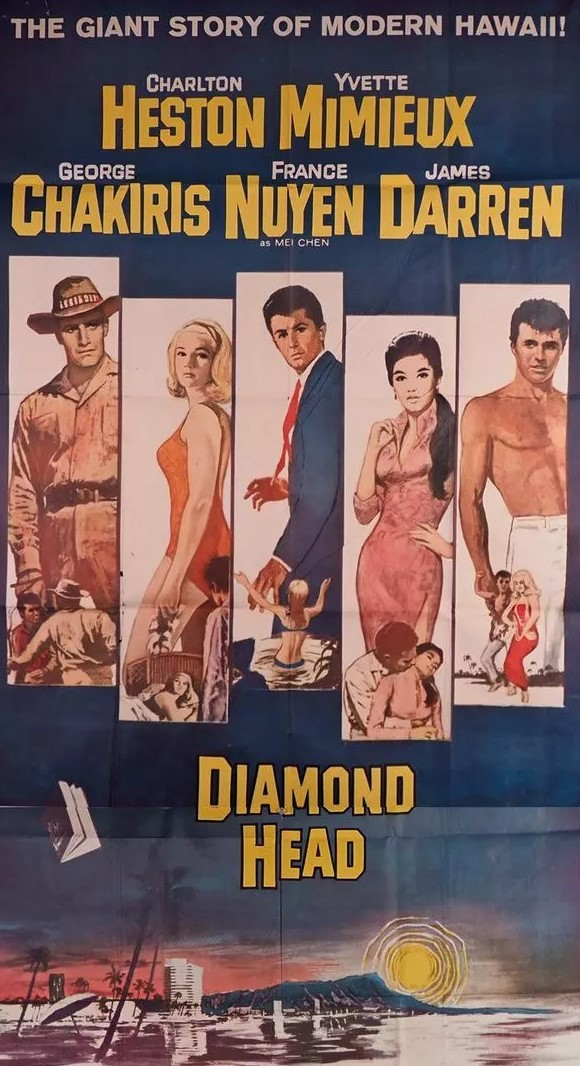
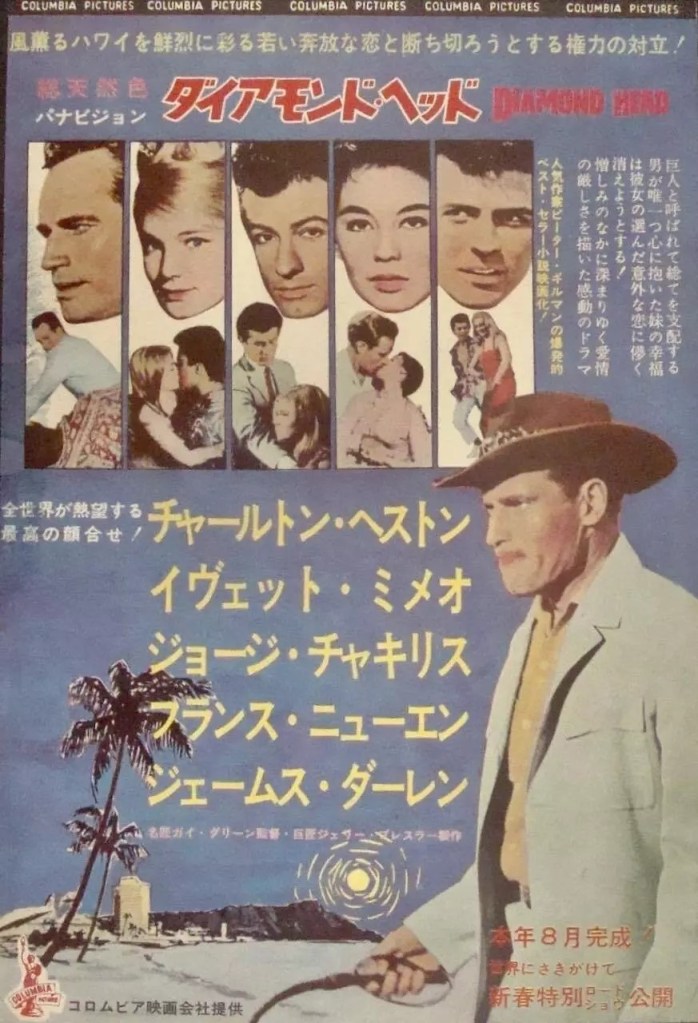
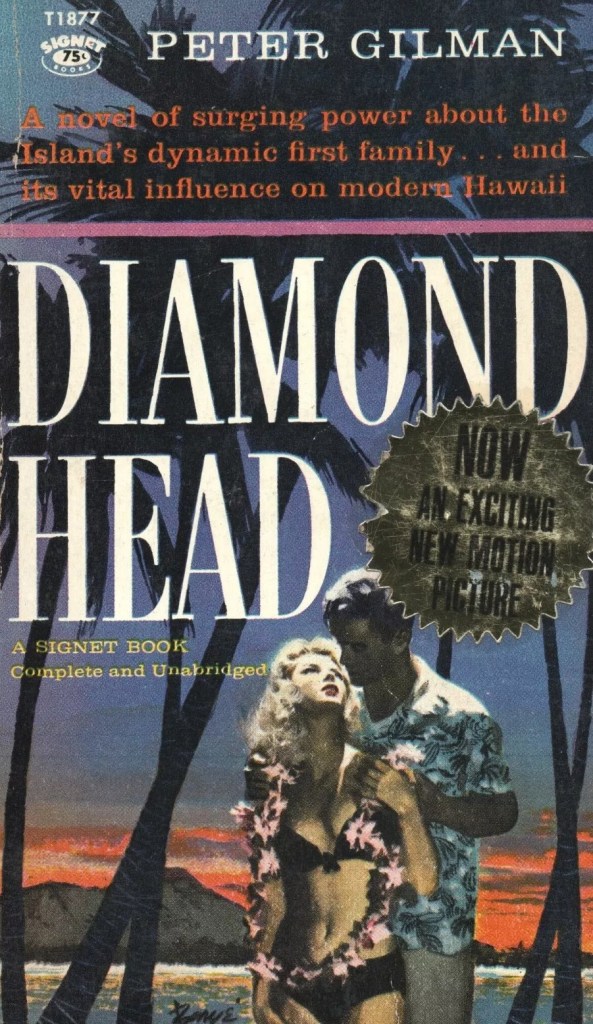
But that meant delay while the massive Bronston machine kicked into gear. In the meatime Heston was “attracted a bit by the opening pages” of Diamond Head with Columbia. “A good part in an overwritten and melodramatic script,” he observed, concluding, “If it’s treated with great care, it might work out all right.”
The project moved along apace. A couple of weeks after receiving the script in December 1961, he was in London meeting director Guy Green (Light in the Piazza, 1962) and producer Jerry Bresler, “an amiable man” though Sam Peckinpah might beg to differ after his experiences on Major Dundee, 1965. “He seems a very intelligent fellow,” Green observed, but queried, “how could a man refer with pride to the fact he had made a film called Gidget Goes Hawaiian?”
George Chakiris (hot after West Side Story, 1961) was already fixed as second male lead and Yvette Mimieux (Light in the Piazza) was being chased for female lead. She wasn’t available but Heston wasn’t keen on second choice Carroll Baker. Luckily, it turned out Mimieux could do the picture. “On the basis of what we saw in Light in the Piazza, she’s ideal for the part.”
But Heston reckoned the script needed work. He was also disgruntled with the costumes for Diamond Head, complaining, “Why is it designers like to costumes instead of clothes? It’s a grievous fault in a period film, but there’s no excuse in a modern story.”
By March, a few months after committing to the picture, he was out in Hawaii, on the island of Kauai, though the trip itself was not without incident, Heston “sick enough to call a doctor.” They were met with unseasonal rain. They were assured this was very unusual. But it wasn’t. In consequence, the first day’s filming was scrapped, filling the actor with the conviction “the whole project was doomed.” It was another three days before filming commenced – the shoot was plagued with rain.
While Heston was impressed enough with the director (“Guy Green works carefully and thoughtfully”) he was distracted by the lighting.
“Those brutes and reflectors loom larger in my mind…One of the banes of my career has been acting in exterior locations with arc lights and reflectors focused in my eyes, which are very light sensitive. (Dark-eyed actors have an unfair advantage, I’ve always felt.) Most people have no idea of the dimensions of this problem. They always ask you how you can remember the lines…they should wonder instead how you can concentrate on the scene when your every nerve is straining simply to keep your eyes open.” Negotiation with the cinematographer ameliorated the situation.
Similarly, Heston found the director responsive to his concerns. For a key scene with Mimieux, he believed “we can both do better” and taking this on board the director agreed on a reshoot the next day. “I have to project Howland’s need to be loved, though he conceals it. You can’t play this, of course, but it has to be in the scene, in the whole film, if we’re going to bring it off.”
As well as a multitude of media – Hawaii at this stage still a rare location, public interest boosted by the publication of James Michener’s Hawaii in 1958, and to a lesser extent, Diamond Head, a more modest bestseller. Swelling the ranks of visitors to the set was John Ford, obliquely sounding Heston out for an unspecified film, possibly Young Cassidy (1965).
Another issue proved to be the horse-riding. While Heston was an accomplished rider, others were not. “Anxious horse-riding…makes for anxious acting.” Even so, Heston found his mount “harder to handle than I figured.”
Heston’s last day of work was May 18. “I waited round most of the day to do one piddling shot from the dream. No dialog, just my face looming up out of the fog. It’s hard to tell what I think now except that I’m still high on Green. He may have made a film that rises above the melodramatic qualities of the script. He didn’t push me as hard as I should be pushed, but he gave me a lot all the same.”
It was October before Heston viewed the completed picture. His verdict: “Diamond Head looks very slick, smooth, not terribly real, and as though there might be some money in it.” Ever the critic, he added, “I have acted better.”
I’ve mentioned in other Blogs the part played by foreign markets in a star’s appeal – Clint Eastwood and Charles Bronson both owed their breakthroughs to foreign box office. Turns out that Heston was in the same league, though an established name when first discovering the size of his fan club abroad.
“My films did invariably well in the Far East and throughout Southeast Asia. Films that flopped elsewhere did fairly well, those that were hits elsewhere did incredibly. The fact that this pattern has continued unchanged accounts in no small degree for my continued viability in films.” Apparently, this was because he represented the Confucius virtues of responsibility , justice, courage and moderation. As if to emphasize his overseas appeal, Diamond Head opened first in Japan, in December 1962.
SOURCES: Charlton Heston, The Actor’s Life, Journals 1956-1978 (Penguin, 1980).
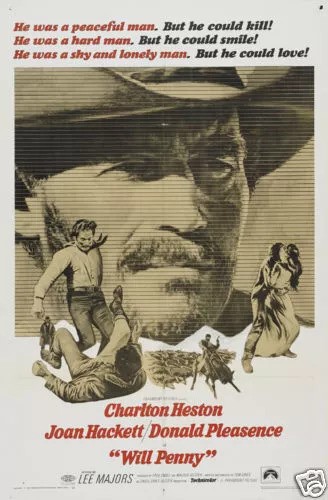
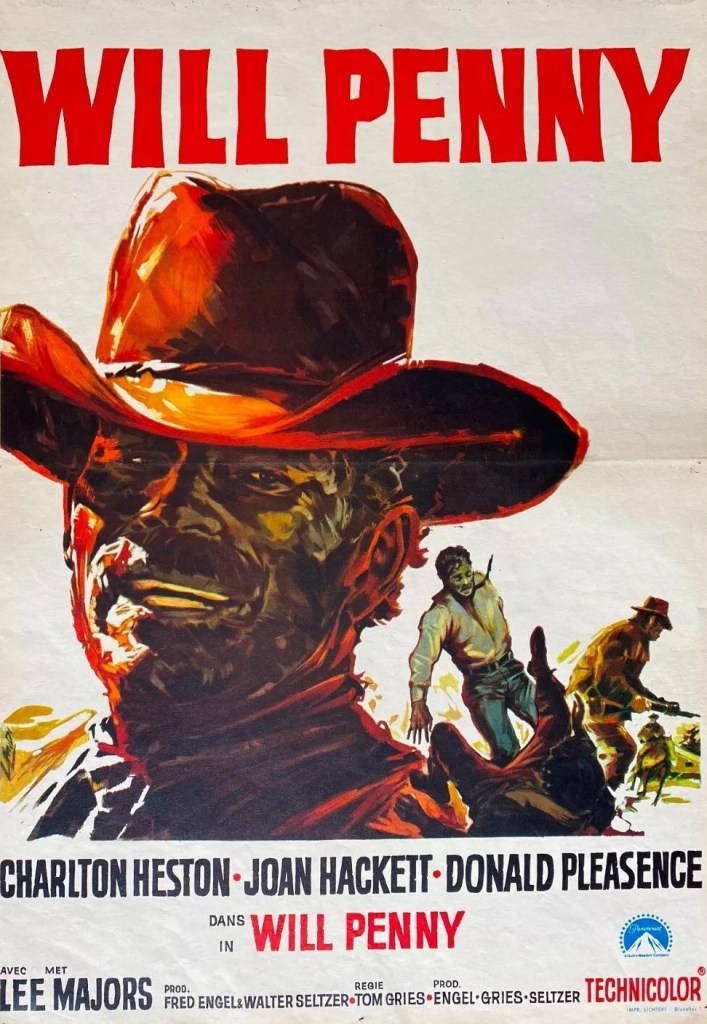
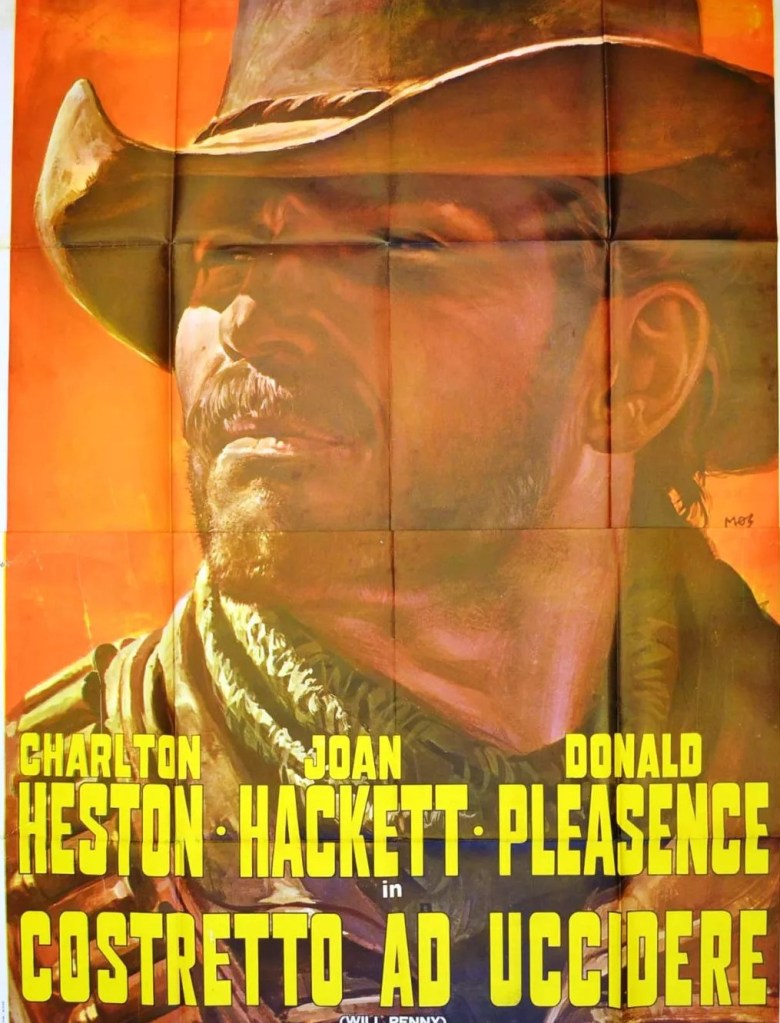
Tale of two westerns. On the one hand two undoubtedly fine performances contribute to an excellent realistic somewhat downbeat cowboy yarn. On the other hand a bunch of loonies jumping in every now and then as plot devices upset the wonderful tone. There had to be some other way, surely, to ensure itinerant illiterate 50-year-old cowhand Will Penny (Charlton Heston) and educated single mother Catherine (Joan Hackett) spend the winter together, other than him being bushwhacked by mad-eyed Preacher Quint (Donald Pleasance) and left to die.
This kind of sub-plot, you know where it’s going to end, even though, in this case, it goes down a few bizarre routes. Luckily, the main narrative continues to surprise in interesting fashion.
Like its modern equivalent The Misfits (1961), this mostly revolves around simple-minded cowboys who enjoy simple pleasures, drinking and fornicating, at the end of a hard trail ride. Will looks no further ahead than his next job. He’s easily the oldest of the cowboys and we’re introduced to him getting a telling off for trying to steal a few biscuits from the trail cook. He’s constantly razzed by the younger guys, though he’s able to take care of himself. At trail’s end, he hooks up with Blue (Lee Majors) and Dutchy (Anthony Zerbe) who, unexpectedly, find themselves in a shooting match with Quint’s family.
Dutchy comes off worst, a bad gunshot wound accidentally self-inflicted. The next few sequences are terrific. Dutchy, thinking he’s going to die, wants to go out drinking gutrot whisky and telling tall tales of heroism to Catherine who they encounter at a tiny trading post. There’s generally a callous disregard for the wounded. Even so, Blue and Will take the wounded, now drunk, man to the nearest town where the Dr Fraker (William Schallert) doubles as the local barber.
Will finds a job tending an outlying herd but finds the cabin that goes with it inhabited by Catherine and son Horace (Jon Gries). Out on the job, he’s attacked, robbed and left for dead by Quint and sons Rafe (Bruce Dern) and Rufus (Gene Rutherford). He manages to find his way back to the cabin and is tended by Catherine. Horseless and not fit for work, he decides to hole up in the cabin, fixing it up to withstand winter.
They’re wary of each other, but he bonds with the boy, and gradually they warm to each other, despite the two-decade age gap. She’s been let down so often by men, husband, trail escort etc, that she clearly finds something admirable in his dependability.
And we would probably be headed for a heartbreak ending. We’ve already seen how easy it is to be injured in the cowboy game, and how unemployable that renders a man, so the prospects of an ageing cowhand, who knows no other existence, settling down with an idealistic younger woman seem remote.
In any case, there’s a ways to go before that time comes since at Xmas the Quints reappear, beat Will up again and tie him up. You’d expect them to have their way with Catherine but there’s a twist in that Preacher has sized her up as a wife for one of her sons. While they are fighting over her, Will escapes.
Luckily, his old buddies come looking for him and he’s got a sack of sulphur (purpose never explained) so he smokes out the bad guys and they all get shot, leaving Will and Catherine with their heart-breaking moment.
As I said, two quite dfferent movies at odds with each other. Charlton Heston (Number One, 1969) is transformed. His trademark screen persona disappears under this quite different, diffident, awkward, character and there’s an argument to say this is his best-ever performance. The scenes where he tries to cover up his illiteracy, shies away from learning a Xmas tune, and explains his theories on the frequency of bathing are outstanding.
If you only know Joan Hackett from Support Your Local Sheriff (1969) you wouldn’t recognize her here, contained and watchful, rather than somewhat crazy in the James Garner picture.
While this pair gell, Donald Pleasance (Soldier Blue, 1970) et al stand out like a sore thumb as if they’ve decided to try and hijack the picture with some pointless over-acting. An excellent supporting cast includes Lee Majors (The Six Million Dollar Man) in his debut, Ben Johnson (The Undefeated, 1969), Slim Pickens (Rough Night in Jericho, 1967), Clifton James (Cool Hand Luke, 1967), Bruce Dern (They Shoot Horses, Don’t They, 1969) – in full chipmunk-teeth mode – and Anthony Zerbe (Cool Hand Luke).
Tom Gries (100 Rifles, 1969), as writer and director, makes an excellent impression.
The cowboy and homestead sections work incredibly well, what passes for action and plot drag it down. Still, on balance, well worth seeing.
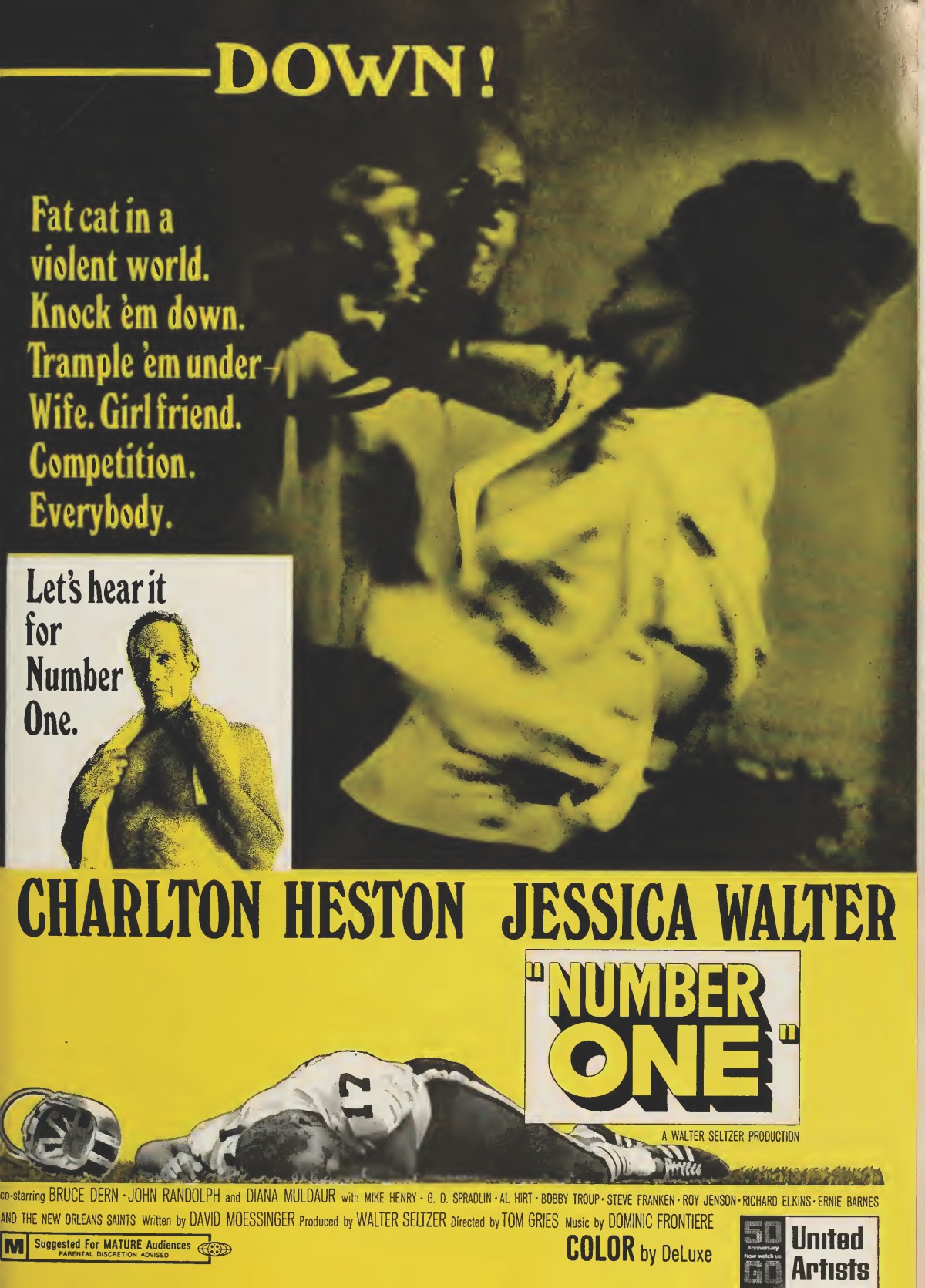
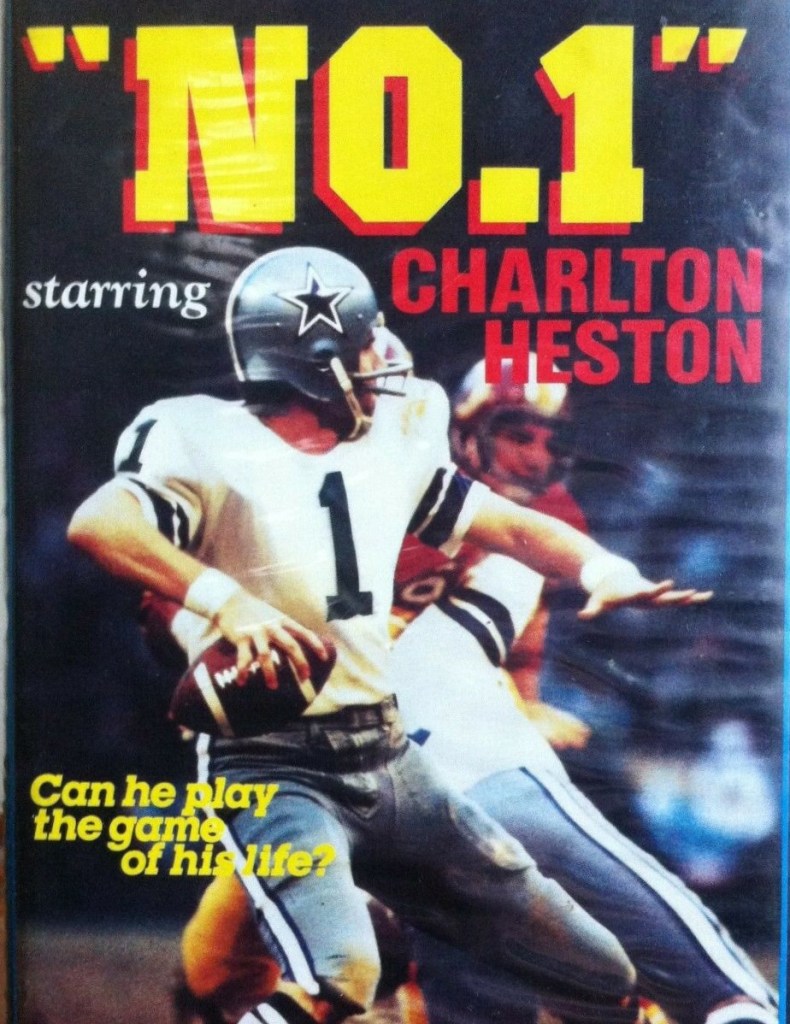
Apart from Ben-Hur and El Cid, most of Charlton Heston’s movies in the 1960s were domestic box office disappointments. Despite this, he was deemed to be still flying high at the marquee, placed seventh in the annual star rankings just as negotiations began in 1967 for Pro (the title changed to Number One just a few months before release). Given there was little interest in American sports in the rest of the world, it was deemed a gamble. That was not just reflected in the budget – a miserly $1.15 million- but in Heston’s salary of $200,000. He and director Tom Gries (Will Penny, 1968) agreed to “work at substantially lower incomes in exchange for a bigger percentage.”
But to make any decent money, of course the movie had to be a big hit. Compare that to the $750,000 he stashed away for The Hawaiians (1970), admittedly after Planet of the Apes (1968) hit the jackpot, but still. From The War Lord, Heston had “learned actors should not put their own money into scripts,” but taking a pay cut appeared a more sensible route.
The movie was a long time coming to fruition. Initially, the idea had been rejected by National General and Martin Ransohoff of Filmways who worked with MGM. By April 1966, Heston was dejected. “Nothing stirring on Pro,” he recorded in his journal. But he understood the need not to “peddle the project” since “it tarnishes my image as an eminently in-demand actor.” Franklin Schaffner (Planet of the Apes) was initially keen, but dropped out after United Artists insisted on smaller fees against a bigger back end, star, director and producer to share 75 per cent of the profits, the kind of deal you get offered “when you want to make a film more than a studio does.” Tom Gries (Will Penny, 1968) was the next directorial target.
By June 1967, the deal was done for Heston, Gries and Selzer. ”I’m damned if know who will write the script,” noted Heston, “No one very expensive, I guess.” In July, he was in San Diego “investigating pro footballers in their natural habitat.” The NFL agreed to allow the New Orleans Saints to participate. David Moessinger had written two screenplays, Daddy-O (1958) and The Caper of the Golden Bulls (1967), but struggled to meet Heston’s expectations.
The actor felt the writer hadn’t “succeeded in dramatizing the most difficult and the most important element of the story. Why Caitlin feels as he does.” His wife, Lydia, agreed. “If women’s can’t relate to the story, then it’s just a picture about a football player and we’re in trouble.” UA had set a deadline and the screenplay would decide whether it was a go or no. Heston planned to get Gries to work on the script, and he subsequently nailed the vital scene.
Even when UA gave the go-ahead there were problems integrating the shooting schedule with that of the Saints which would require filming training camp in summer 1968 and the rest in the fall. Bob Waterfield was teaching Heston how to quarterback. Soon he would have “delusions of adequacy.” But the training took its toll in the shape of a pulled muscle. In his first proper game, he was “blitzed” 16 times. He ended one day “taped and doped, in the traditional bed of pain.”
Meanwhile, casting proceeded. Heston had “mixed feelings” about Eva Marie Saint (The Stalking Moon, 1968) and Joanne Woodward (Big Hand for a Little Lady, 1966). Suzanne Pleshette (A Rage to Live, 1965) was considered as well as Jean Simmons (Rough Night in Jericho, 1967) – “I think she’d be good for it,” noted Heston. Finally, he pushed for Jessica Walter (Grand Prix, 1966) – “old enough to be plausible as the wife, young enough to manage the flashbacks” – only to find Gries not so keen and preferring Anne Jackson (How to Save a Marriage and Ruin Your Life, 1968). When the situation was resolved in favor of Walter, Heston discovered she was being lined up for a television drama about pro football. The second female lead went to Diana Muldaur.
Meanwhile, Heston was having trouble with Gries. “His attitude towards this film…is very questionable…perhaps it has to do with his recent achievements as a director in theatrical films…he’s finding the wine a bit heady.” Gries fell behind schedule, but finished ahead of it, saving about $30,000. An important scene showing Walters and Heston in bed before the wedding didn’t work and was cut.
Keeping tabs on the budget was producer Walter Selzer, who had worked with the star on The War Lord (1964) and Will Penny, and, would team up with him again for The Omega Man (1971), Skyjacked (1972), Soylent Green (1973) and The Last Hard Men (1976). “You have to be realistic about the subject matter,” said Selzer. “Every story has a certain price and if you try to cheat on your requirements it shows on screen.” That said, he was king of the penny pinchers. “We didn’t use a single piece of new lumber,” he boasted, meaning they didn’t built a single set, instead adapting or re-using old ones.
On location, he negotiated “locked-in” costs, “a flat pre-arranged price” for variety of elements which had a tendency to become variable, increasing costs, such as space on a sound stage, equipment and the editing suite. Cameraman Michel Hugo had to agree to shoot in any weather. “This is very important. Very often a cameraman will refuse to shoot if the weather is questionable, claiming the shots won’t match and then you have the whole company idle for a day when on location.” He nailed down composer Dominic Frontiere (Hang ‘Em High, 1968), paying him a flat fee, with Frontiere left with the task and cost of hiring an orchestra and rehearsal and recording space.
Despite showing his rear end in Planet of the Apes, Heston was touchy about the sex scene. “It’s not really a nudie scene but an intensely sexual scene,” he explained, “There’s not a bare breast seen.” Heston had enough controversy elsewhere. As president of the Screen Actors Guild he appeared not to note the irony that while he was pocketing hundreds of thousands of dollars a picture, he could complain that extras were the cause of the “major increase in costs” of movies.
He was also accused of being hypocritical, signing for Eagle at Escombray, directed by Alexander Mackendrick, to be made by CBS while at the same time, as union leader, pressurizing the Department of Justice to prevent television companies such as ABC and CBS entering the movie business. (It was never made.) For that matter, he shouldn’t have been trying to get National General to fund Pro either, since it owned a cinema chain, and that, too, went against previous Department of Justice rulings.
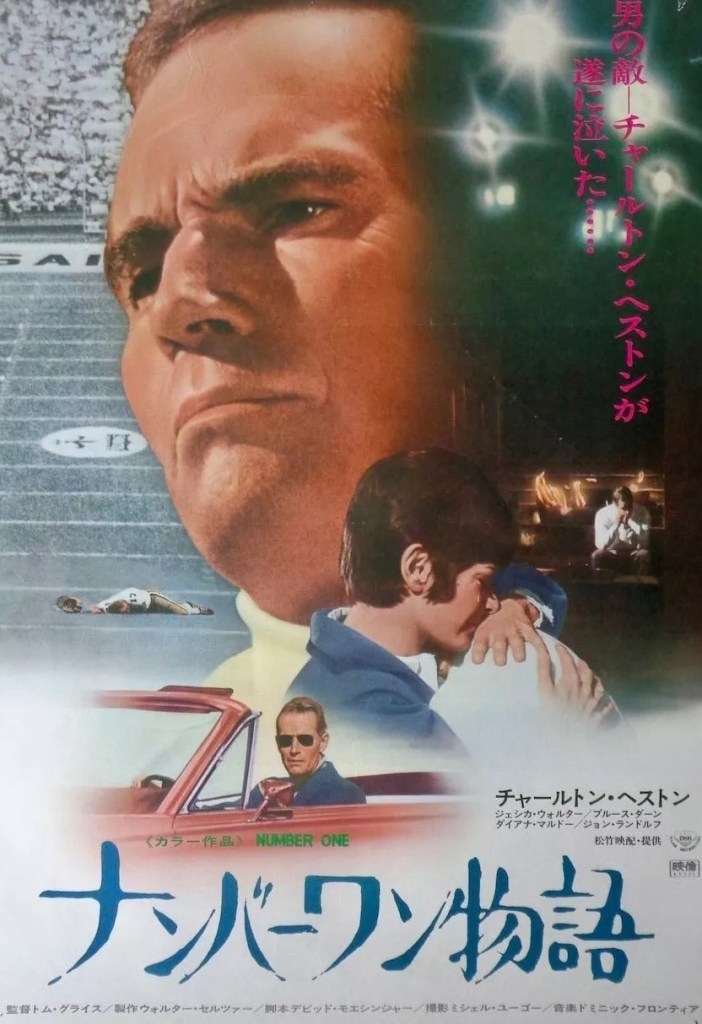
While Heston like the movie – “some of the best contemporary work I’ve done” – UA did not. The title changed to Number One. By the time the movie appeared, in August 1969, Heston couldn’t have been hotter, thanks to the unexpected success of Planet of the Apes. So the world premiere in New Orleans was allocated a full array of razzamatazz – in the parade were the New Orleans football team, its mascot, cheerleaders and a stream of antique cars, but there was a fire in Heston’s hotel.
Box office was less rosy. There was a decent $179,000 from 32 in New York, a “big” $9,000 in Washington, a “hotsy” $24,000 in Baltimore (and $20,000 in the second week), a “neat” $12,000 in San Francisco and a “trim” $27,000 in St Louis but mostly the figures were “mild”, “okay”, or “fair.” Outside of first run it couldn’t run up any juice. Estimated rentals were $1.1 million, so just about break-even, but United Artists, understandably despite Heston’s contention that it was about a man not American football, refused to give it any meaningful release overseas.
SOURCES: Charlton Heston, The Actor’s Life, Journals 1956-1976 (Penguin, 1980); “All-American Favorites of 1966,” Box Office, March 20, 1967, p19; “Charlton Heston Denies Conflict Between Eagle Role, SAG Policy,” Box Office, January 15, 1968, pW3; “Sports, Flop-Prone Theme Still Dared,” Variety, September 25, 1968, p2; Army Archerd, “Hollywood Cross-Cuts,” Variety, December 18, 1968, p22; Army Archerd, “Hollywood Cross-Cuts,” Variety, February 5, 1969, p34; “Number One Parade To Precede Premiere,” Box Office, August 18, 1969, pSE5; “Falling Stars,” Variety, September 3, 1969, p70; “Critics Wrap Up,” Variety, September 24, 1969, p26; “Variety Box Office Charts Results 1969,” Variety, April 29, 1970, p26. Weekly box office figures – Variety, 1969 : August 27, September 3, September 10, September 17, September 24
Quite possibly Charlton Heston’s best performance – as an ageing pro footballer refusing to bow down to the inevitable. Ron Catland (Heston) has much in common with Ned Merrill (Burt Lancaster) in The Swimmer (1968) as characters who believe they have been let down by the American Dream. And like that picture, plot is in short supply, it’s mostly a character study with sideswipes at the realities and inanities of American football.
An injury puts star quarterback Catland’s career in doubt. The media write him off, a younger quarterback Kelly (Richard Elkins) is waiting in line, while former colleague Ritchie Fowler (Bruce Dern) offers him a job in his car leasing business, or he could opt for a second career in computers, but Catland wants the only life he has ever known to go on forever.
There’s nothing inherently likeable about Catland. In fact, he’s downright mean most of the time, in part because of the falsity of his profession, management buttering you up when it’s contract time, then on your back once you have re-signed. He’s got a hero’s arrogance, has ignored from the outset the coach’s instructions, at odds with independent fashion-designer wife Julie (Jessica Walter), no children to shore up their marriage. Hardly surprising he drifts into another affair, “an occupational hazard” his wife calls it, this time with the fey Ann (Diana Muldaur) who owns a tennis shop.
You are probably familiar with the kind of football picture which climaxes with a last-minute touchdown or the more realistic movies like North Dallas Forty (1979) or the superlative Any Given Sunday (1999) where nonetheless the focus is on winning and characters are ramped up for dramatic effect. Or you might imagine Hollywood had been routinely churning out football movies like Knute Rockne All-American (1940) and Jim Thorpe All American (1951) for decades. But strangely enough the movie industry had not focused on this particular sport for well over a decade until the NFL documentary They Call It Pro Football (1967) and comedy Paper Lion (1968).
Number One sets out to set the record straight on the reality of being a football hero. And it’s by far the most realistic of the species. For every good-looking gal wanting to pass him a note on a napkin in a restaurant there are plenty fans turning on him for refusing to sign an autograph. For every sports reporter writing a puff piece, there are others tearing him to pieces in print.
The documentary-style approach by director Tom Gries (100 Rifles, 1969) serves the film well. This is a different kind of football team to the later fictional depictions. It’s a lonely life for a start. The players are rivals, not comrades. There’s little camaraderie. The dressing room is like a morgue. No practical jokes and tomfoolery. No over-the-top team talk by the coach and thank goodness no padre who pretends to walk every aching mile in their shoes. Any exhortation is almost a plea. Injury is mostly ignored. Legs are constantly strapped up. And when your career is over you might be reduced to bumming a loan from a current star. The politics are brutal.
New Orleans Saints cooperated with the production so the game scenes come across well though not obviously with the razzamatazz of Any Given Sunday and Heston has the physique for a sportsman. Primarily a television writer, David Moessinger (The Caper of the Golden Bulls, 1967) only crafted two films in the 1960s and this, the second and last, was an unusual effort, as the character twists and turns trying on the one hand to escape the cage of his career and on the other determined to squeeze the last drop out of his golden imprisonment.
Catlan still sees himself (at the age of 40, no less) as the best quarterback in the business and simmers with anger that his body is letting him down and that he has nothing in place to fill the gap that abandoning the game will create. Underneath the volatility is a hole of pain. There’s no sense either that he has enjoyed his time at the top, just that it has always one way or another been a struggle.
Although the movie was marketed with Heston as an aggressive individual, in fact it calls for a far wider range of emotions from Heston, and for this part he delivers in spades. Jessica Walter (Grand Prix, 1966) gives as good as she gets, Bruce Dern (Hang ‘Em High, 1968) as the fast-talking salesman and Diana Muldaur (The Swimmer, 1968) are excellent. But this is Heston’s film. It’s more of a reflective piece, none of the dramatic highs and lows of other football pictures.
Netflix would know how to sell this. Append the “based on a true story” credit and you’ll attract a global audience. I’ve no idea how true this tale is though I assume that at certain points in war using a pigeon may have been the most efficient method of communication. If this had been under the Netflix aegis there would surely have been a scene to explain that you can’t just point the bird in any old direction but that it automatically returns to its home, that aspect being pivotal to the movie, the reason it was made in the first place.
That is, if you believe in the rather fanciful notion, as shown in what appears to be an official newsreel, of said pigeon being presented with a medal for its part in the Allied invasion of Rome in World War Two. Luckily, there’s more to this picture than the intricacies of homing pigeons.
Not much more, I hasten to add, because the other significant plot point, which I suspect has a more substantial basis in truth, is that passing American soldiers had a tendency to impregnate (and abandon) Italian women. If you were to argue that Elsa Martinelli (who had just put John Wayne in his place in Hatari!, 1962) is what saves the picture you wouldn’t be far wrong. But you can’t complain about Hollywood churning out lightweight movies in the 1960s since a chunk of the current output falls into that category.
For no apparent reason, no espionage experience for example, Yank soldiers Capt MacDougall (Charlton Heston) and Sgt Angelico (Harry Guardino) are delegated to sneak into Rome, disguised as priests, and spy on the Germans. They are put up in the household of Massimo (Salvatore Baccaloni), an underground figure, but his daughter Antonella (Elsa Martinelli) takes against the pair since they are extra mouths to feed and if only the Americans would hurry up and enter the city the populace wouldn’t be starving. However, she makes nice when her sister Rosalba (Gabriella Pallotta) reveals she is pregnant by a previous Yank (whether he was the espionage business, too, is never revealed) and is desperate need of a husband.
The sergeant is quite happy to romance the girl since a couple smooching in the park makes good cover for him transmitting messages by radio. And when that form of transmission becomes too dangerous, the Americans rely on pigeons. Soon Angelico realises his feelings for Rosalba are real and proposes to her, even after she reveals her condition. But that means celebration to announce their forthcoming nuptials.
Short of any food, Antonella slaughters the pigeons, convincing MacDougall that the meal consists of squab. To cover up, the Italians steal a bunch of pigeons from the Germans. Of course, as you’ll have guessed, that means the pigeons will return to the enemy. But once MacDougall works this out, he starts sending the Germans false messages that prove (apparently) pivotal to the Germans hightailing it out of the city (hence the medal awarding).
Pretty daft and inconsequential sauce to be sure, but Antonella keeps matters lively, knocking back MacDougall at every turn, taking every opportunity to condemn men for starting wars, and presenting herself as something of a conniver, possibly willing to lead on the Germans in return for food (MacDougall when burglarizing a German villa comes across her naked in the shower). Her occasional swipes give the picture a harder edge than you’d expect, but, her fiance killed in the war, she leads MacDougall a merry dance in the manner of the romantic comedies of the day. Otherwise, the comedy is for the most part lame, the old hitting your thumb with a hammer one such moment.
Despite co-starring with Wayne and here Heston and later Robert Mitchum (Rampage, 1963), Martinelli didn’t fit into the Hollywood pattern of taking European stars and slotting them into the female lead opposite a succession of top male stars. Think Sophia Loren with Heston in El Cid (1961), with Gregory Peck in Arabesque (1966) and with Marlon Brando in The Countess from Hong Kong (1967) and headlining a few pictures on her own. Gina Lollobrigida led Rock Hudson by the nose in Come September (1961) and Strange Bedfellows (1965) and Sean Connery a merry dance in Woman of Straw (1964).
Martinelli seemed to fade too quickly from the Hollywood mainstream which was a pity because she’s the glue here. Charlton Heston (Number One, 1969) spends most of the time looking as if he wondered how he managed to allow himself to be talked into this. You want to point the finger, then Melville Shavelson’s (Cast a Giant Shadow, 1966) your man – he wrote, produced and directed it.





 The Magnificent 60s