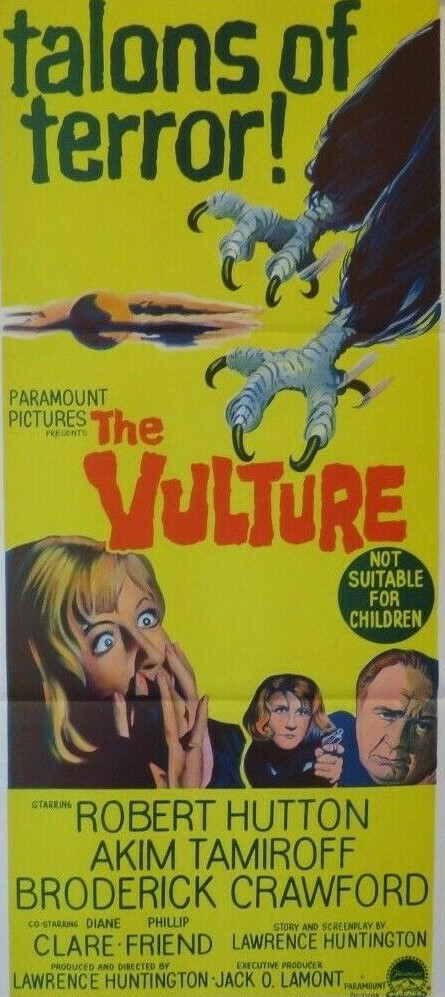
The Vulture (1966) **

The notion that the presence of Oscar-winning Broderick Crawford or that a bunch of expository scenes will divert audiences away from the lack of decent special effects, or story for that matter, comes sadly unstuck. There’s so much exposition that at times it feels like an audio book rather than a piece of cinema. The one great image – a skeleton in  laboratory – is treated with disdain. Not only has it “cult” written all over it but it must be a contender for the all-time “So Bad It Hasn’t A Hope Of Being Good” Award,

Which is a shame because on paper at least this might have sounded passable what with atomic transmutation, hidden treasure, grave-robbing, remote location, strange noises in the night, an incident in the 15th century, man buried alive, eerie tapping on windows, a creepy Church sexton, and a  mythological beast originating from the Incas or Aztecs or even Easter Island.  
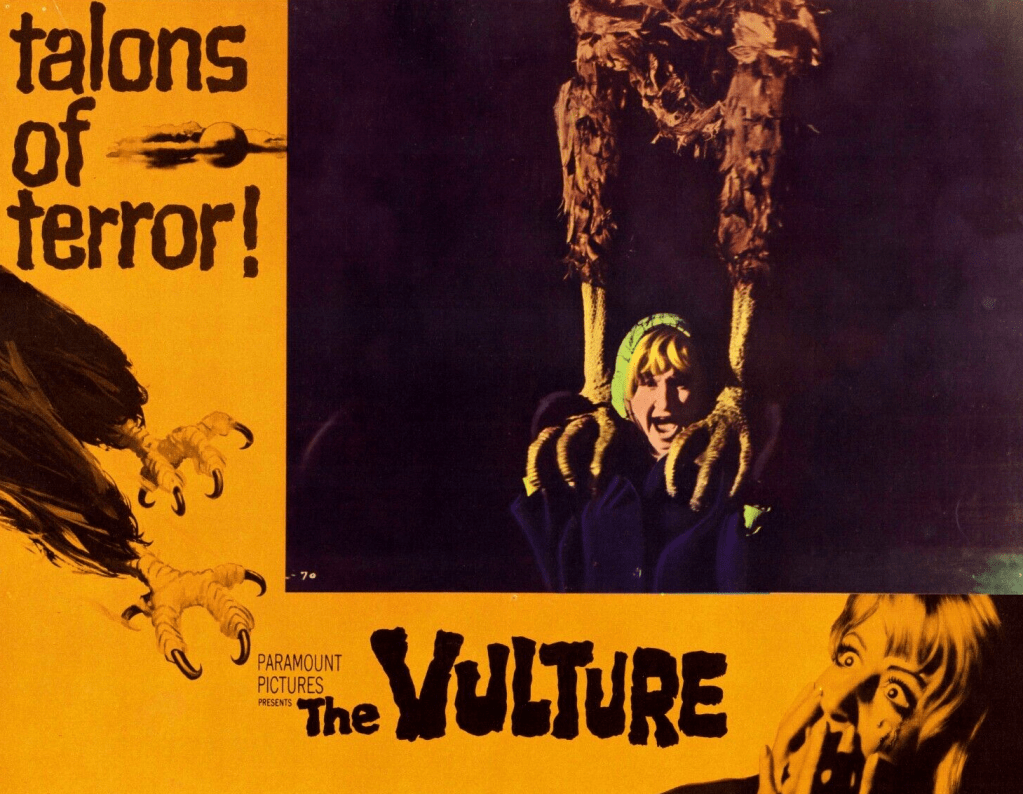
But it pivots on the kind of family curse, mysterious past, strange occurrences, that Sherlock Holmes might have been called in to resolve, especially as there seemed an awful lot of explaining to do and it’s easier to hang on to every word of the world’s most famous detective rather than a scientist banging on about the inexplicable. The first two-thirds is taken up with solving the mystery, it’s only in the last section when horror takes over that a genuine sense of tension emerges.

A woman taking a shortcut through a graveyard (as one does) spies a gravestone wobbling, earth erupting in front of her and has visions (enough to make her hair go white) of a huge bird with a man’s head. Visiting nuclear scientist Eric (Robert Hutton) takes an interest. His wife Trudy’s (Diane Clare) uncle Brian (Broderick Crawford) explains the legend of a Spaniard buried alive because he turned himself into a vulture and kidnapped a small child. His buddy, German professor Koniglich (Akim Tamiroff), expands on the story.
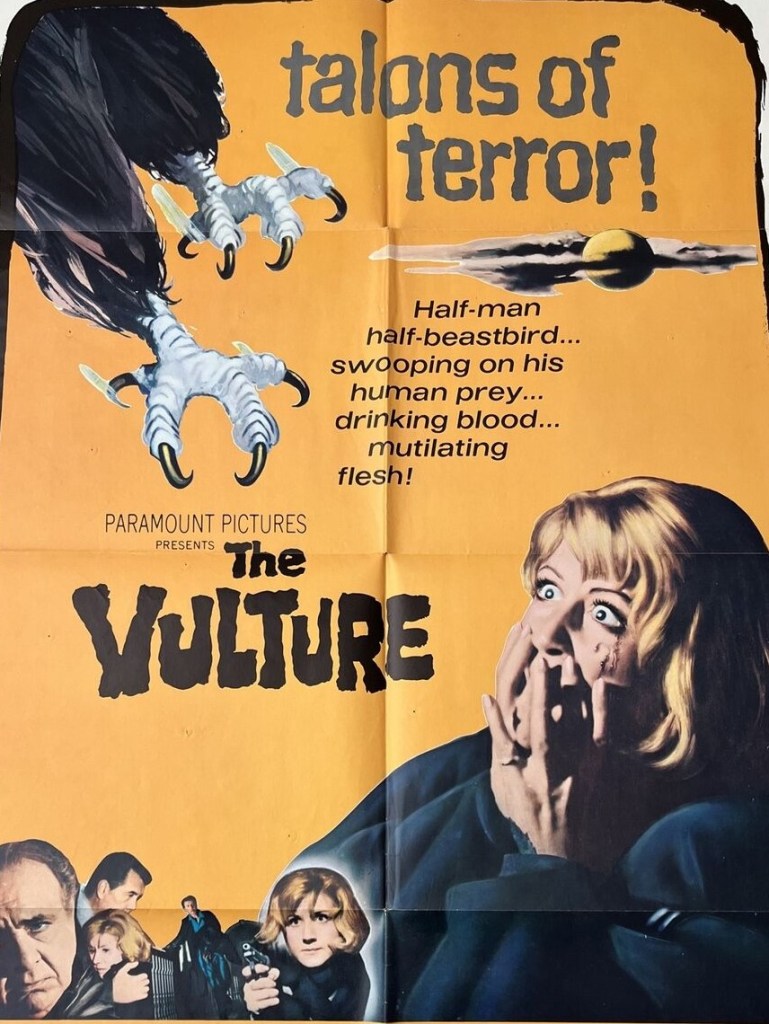
Gold coins are found scattered close to the grave. Boys find the bloody leg of a sheep on a beach and there’s a likely unreachable hiding place of a cave in the cliffs. Uncle Brian is of the obstinate variety and refuses to the toe the line and keep his windows firmly closed so he’s next to disappear. But there’s a hungry beast to feed so Brian’s brother Edward (Gordon Sterne) is the next victim. Trudy is despatched out of harm’s way to London but lured back by a mysterious telegram.

Meanwhile, hot on the trail, Eric finds Koniglich’s lair, a laboratory inhabited only by a skeleton, but with his own understanding of the possibilities of atomic science Eric works out the German must have employed nuclear power to fuse man and vulture and set out to wreak revenge.

It was obviously a toss-up between spending the tiny budget on a fading Hollywood star and supporting bad guy actor of some repute rather than on special effects. Quite how, at that time, anyone would have managed a convincing half-man-half-vulture is anybody’s guess and the prospect of making such a creature credibly fly would have been beyond comprehension so sensibly director Lawrence Huntingdon settles for the prospect, showing talons from time to time and letting audience imagination do the rest, and I am sure if you saw this as a child you would be bolting doors and windows.

Robert Hutton (They Came from Beyond Space, 1967) doesn’t have a chance of imposing himself on the picture since he is lumbered by buckets of exposition and supposition. Though he could take a lesson from Broderick Crawford (A House Is Not a Home, 1964) in how to milk a small role. Crawford is something of a clever red herring. Given his screen persona I had expected him to be the bad guy, at the point of his appearance in the picture notions of scientific dexterity not being a prerequisite. Akim Tamiroff (The Liquidator, 1965) plays down his villainous qualities so until we are introduced to his lab, he’s not the obvious bad guy either.

It might have worked better if the audience was filled in on more of the mystery than the investigator, perhaps witnessing Koniglich at least toying with his equipment, maybe making the screen glow the way dodgy scientists were inclined to do.

This was the final film in the 30-year career of director Lawrence Huntingdon (Drums Along the River, 1963) and if he couldn’t manage a swansong of the kind Clark Gable delivered with The Misfits (1960) then I guess the next best thing was a movie for cultists to savor.

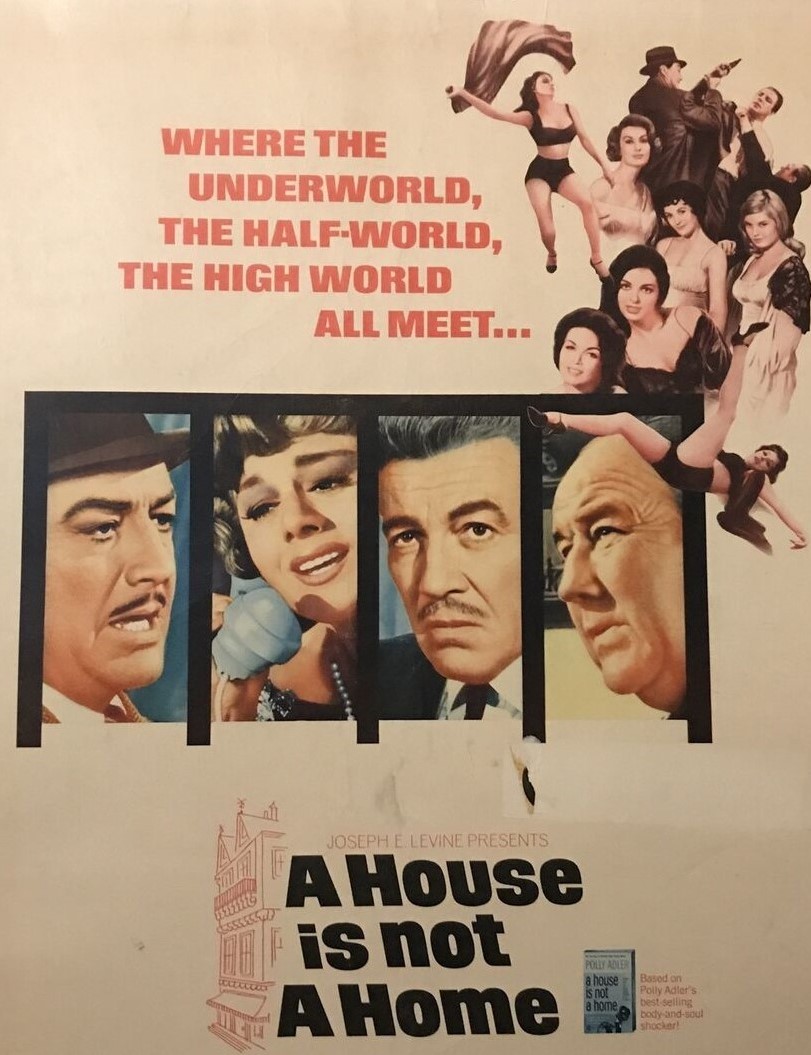
Selling Sex – The Pressbook for “A House Is Not a Home” (1964)

Selling sin had never been difficult in Hollywood, dating back to the Cecil B. DeMille silent epics and more recently when a series of films challenged the Production Code, the studio’s self-governing censorship system. In most films, however, sex had been a by-product of passion, a couple in love, or a glimpse of nudity. Nobody had ever attempted to foist onto the American public a picture about transactional sex, one that examined the basest elements of male desire.

If anyone could be relied upon to sell the unusual it was producer Joseph E. Levine, the master marketeer, who had spent millions to make millions with Hercules (1958) and more recently The Carpetbaggers (1964).  Only Levine had the audacity to market the picture as a “typical American success story” and present the Polly Adler, the New York madam at the center of the movie as “not a stereotype of a procurer” but as confidante of politicians and artists.

That at least was the upfront story, the version presented in the various articles peppering the Pressbook whose sole purpose was to win over the exhibitor. When it came to the public, the approach was a mixture of the imminently direct and the subtle.

In the straightforward department were a whole string of teasers under the headlines “She’s One of Polly’s Girls” featuring glamorous women in sexy outfits to soften up the potential moviegoer in advance. The women featured in virtually every advertisement to follow as “luscious playmates,” either taking center stage or in the background.

A graphic with an illustrated sexy women in little more than bra and panties sitting atop a house also appeared in several adverts. There were several ads along these lines and several different taglines.

“The story of a House of Pleasure…The woman who ran it…The beautiful girls who lived in it…The famous and the infamous who knocked lovingly on its door” set the tone.  Taking a similar approach was the tagline: “A motion picture for those who think they’ve seen everything and those who know they haven’t”  / “the body-and-soul shocker” / “Take a tour of New York’s most famous house! Meet the madam who ran it…the beautiful dolls who lived in it…the Johnnies whose ‘jack’ built it.” (“Jack” in this case meaning “money” in case your imagination runs to more lascivious ideas.)

Going down a more playful route, certainly subtle in comparison to the rest of the advertising, was a series of small ads that focused on aspects of an ordinary home – “the welcome mat is always out” / “the door is always open” – simple illustrations without sight of a sexy inmate.

Often promotional writers struggled to find enough interesting information to fill out a Pressbook but this was littered with fascinating snippets. Shelley Winters lived up to her reputation as a colorful actress by having thrown off the set a noted columnist, a photographer, a magazine writer and the film’s press officer – all in the one afternoon. Cesar Romero who plays gangster Lucky Luciano was born close to the gangster’s birthplace and had been gifted the underworld kingpin’s watch. Polly Adler, whose story the film tells, started writing her bestseller A House Is Not A Home as a thesis as part of a degree at UCLA and later took up painting.

Meri Welles, who essays suicide Lorraine, was actually in the property business, renting homes to movie stars like Rex Harrison. Broderick Crawford had previously won an Oscar as a crooked politician, similar to his role here, in All the King’s Men. Over 1,600 young hopefuls were auditioned over 18 days for the bit parts of Polly’s girls.

Leading the tie-ins was a new edition of the bestseller which had sold over 3 million copies. Brook Benton, then a top-selling pop star, had recorded the title theme by Burt Bacharach and Hal David which managed to avoid any mention of the type of house involved and there was always sheet music to add “promotional punch.” However, based on the notion of an ordinary house, exhibitors were encouraged to get in touch with household suppliers in order to run adverts along the lines of “a house is not a home without refrigerators” linked to the name of a local company.

However, the marketing team struggled somewhat to deliver the usual roster of gimmicks that could be applied by exhibitors, falling back on contests to complete a crossword and devise a limerick. Quite who dreamed up the idea of dressing up a promotional model in cap’n’gown and have her hand out diplomas inviting people to “meet the girls at Polly-Tech” was anybody’s guess and exhibitors might find it difficult to hire someone to parade the streets as a “walking book.”

A House Is Not a Home (1964) ***

Best remembered these days as the debut film for Raquel Welch (One Million Years BC, 1966), the rest of the film is well worth a look.

Hypocrisy had its heyday in The Roaring 20s when prohibition made bootleggers millionaires, helped bankroll other criminal activities like prostitution and encouraged cops and politicians to seek their share of the loot. No surprise then that the biopic of real-life madam Polly Adler (Shelley Winters) is knee-deep in corruption.  

Thrown out of her own home after being raped, Adler finds a knight in shining armor in the shape of bootlegger Frank Costigan (Robert Taylor) and is soon, at first apparently innocently, pimping out her friends. The reality of what becomes her profession is not ignored, the word “whore” bandied around, one girl, Madge (Lisa Seagram), turning junkie as a result while Lorraine (Meri Welles) commits suicide. As in Go Naked in the World (1961) Polly realizes that true love has no place in her world, a relationship with musician Casey (Ralph Taeger) unsustainable.

Adler, in her many voice-overs, explains why vulnerable women become sex workers – poverty, lack of family and lack of hope is her take on it – and she professes to view it as a business and preferable to working in a factory for pitiful wages, but the movie is at its best in linking the nether worlds of infamy and showing that the woman is always the loser.  Morality got in the way of portraying Adler as a winner, a successful businesswoman who brought a certain amount of style to the oldest profession. Women profiting from illegal activity would not be deemed heroic (to use the word loosely) until Molly’s Game (2017) and like Jessica Chastain in that film Adler’s love life is in tatters because, like her male counterparts, she devotes so much time to her business.

While any attempt to properly portray the period is hampered by lack of budget, it does provide an array of interesting and occasionally real-life characters, Lucky Luciano (Cesar Romero) for example. A brothel proves an ideal meeting place for crooks and politicians, the latter easily bought by contributions to their campaign funds. Cops are not shy about asking for donations to their Xmas funds or using the facility.

The Adler operation puts a glossy shine on the shady business since all her girls are glamorous. But still the movie pulls no punches except in the case of the madam herself, presented too often as an innocent and who saw nothing wrong in taking as much advantage of the vulnerable girls in her employ as the  clients who paid for them. Nonetheless, while Adler attempts to justify her life the film’s moralistic tone undercuts this.


Oscar-winner Shelley Winters (The Chapman Report, 1962), more often a supporting player at this point in the 1960s than the star, grabs the role with both hands and although unconvincing as the younger girl delivers a rounded performance minus the blowsy affectations that marred much of later work. One-time MGM golden boy Robert Taylor, pretty much in the 1960s reduced to television (The Detectives, 1959-1962) and low-budget pictures, shows a glimpse of old form as the smooth bootlegger.

Cesar Romero (Oceans 11, 1960) and Oscar-winner Broderick Crawford (All the Kings Men, 1949) head up a checklist of old-timers filling out the supporting cast. Future director Lisa Seagram (Paradise Pictures, 1997) as the junkie hooker makes the biggest impact among the girls.

From the flotilla of wannabes playing Polly’s girls, apart from Raquel Welch the only one to break into the big time was Edy Williams (Beyond the Valley of the Dolls, 1970). In the main they comprised beauty queens – Amede Chabot (Miss America), Danica d’Hondt (Miss Canada) and Leona Gage (Miss Universe) who had a small part in Tales of Terror (1962). Otherwise Sandra Grant became the most famous – for marrying singer Tony Bennett. Patricia Manning had the most screen experience, second-billed in The Hideous Sun Demon (1958), bit parts in television shows, and fourth-billed in The Grass Eater (1961). Inga Nielsen would later turn up as bikini fodder in The Silencers (1966), In Like Flint (1967) and The Ambushers (1967).

Director Russell Rouse (The Fastest Gun Alive, 1956) was better known for the screenplay of D.O.A. (1949) and had a story credit for Pillow Talk (1959). In fairness, although the film has no great depth, Rouse keeps it ticking along via multiple story strands, although occasional lapses into comedy fail to work. Lovers of curiosities might like to note that Rouse was the producer on an abortive American attempt to remake the classic British television comedy Steptoe and Son for U.S. audiences with Lee Tracy in the role of Albert and Aldo Ray as his son Harold.

This is hard to get hold of. Ebay will be your best bet. Youtube has a print but it’s not in great condition.

Discover WordPress

A daily selection of the best content published on WordPress, collected for you by humans who love to read.

The Atavist Magazine

by Brian Hannan

WordPress.com News

The latest news on WordPress.com and the WordPress community.