Hilarious credit sequence – I dare you not to laugh at the banana gag – sets the standard for this virtually silent slapstick vehicle featuring the cream of British television comedians. Hapless construction workers Eric Sykes (The Liquidator, 1965) and Tommy Cooper (The Cool Mikado, 1963) meet their match in the shape of a piece of wooden flooring. Running gags involve a car, a policeman with a bigger eye for a pretty girl than his duty, a car that is soon denuded of all its working parts, paint, rubbish and a pub.
But mostly this is driven by the antics of the bewildered pair, masters of the double-take and pained expression. Even when you think you can see the joke coming a mile off, some other piece of clever invention will take the idea in a completely different direction. Not reliant on clever dialogue, it’s one brilliantly imagined sequence after another. The plot, such as it is, is nothing but a succession of funny incidents.
British audiences were enjoying a small run of semi-silent comedies from A Home of Your Own (1965) through to Futtock’s End (1970), the hand of Bob Kellett behind this series of unlinked movies, but the difference between these and a gem like The Plank is that the latter was written and directed by a comedian (Eric Sykes) who understood timing and above all comic possibility. Clearly silent comedy classics provided much of the inspiration and Sykes has the sense not to spoof that genre but to create twists on originals.
The all-star comedy cast includes Jimmy Edwards (Bottoms Up, 1960), Carry On alumni Hattie Jacques and Jim Dale, Roy Castle (Dr Who and the Daleks, 1965), Sunday Night at the London Palladium television host Jimmy Tarbuck making his movie debut, Graham Stark (The Wrong Box, 1966) and the only straight actor among them Stratford Johns (BBC’s crime drama Z Cars, 1962-1965).
Too short at 45 minutes to qualify as a feature, it played for several years as a support to different movies and was often far more entertaining than the films it supported.
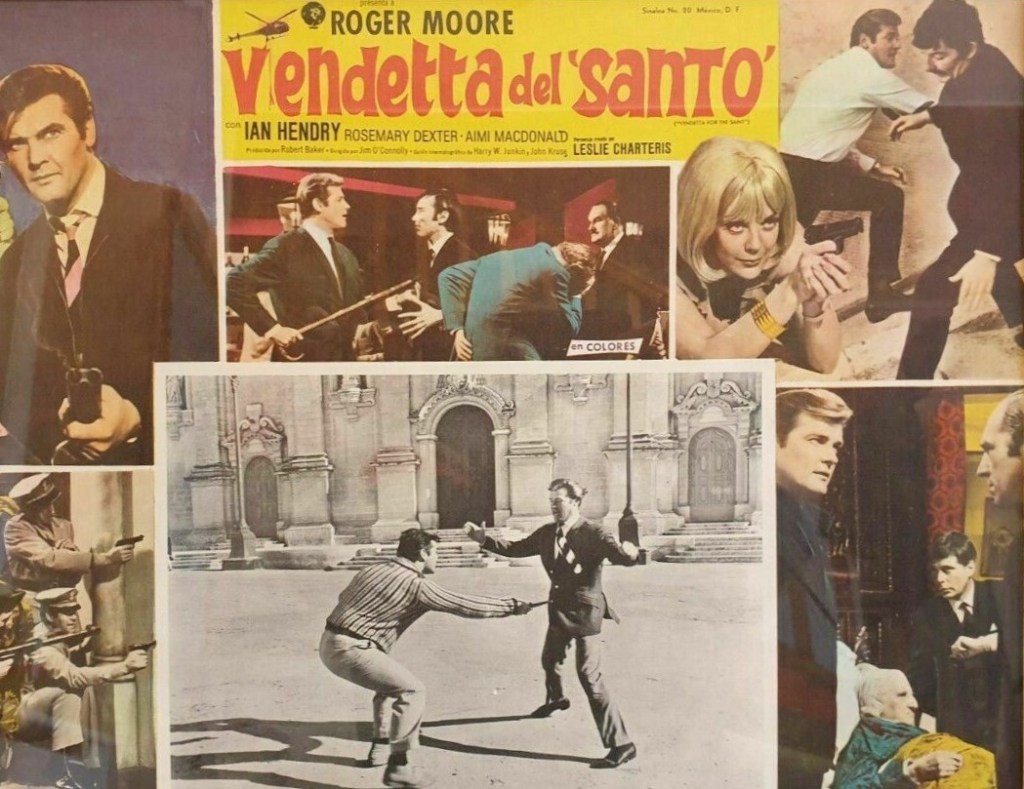
This big-screen version of small-screen hero is as pleasant a diversion as you can get. Nostalgia pretty much gives it a free pass and in any case the action, which punctuates the drama at regular intervals, was always going to be budget-restricted. Despite being in almost constant danger the insouciance of gentleman thief Simon Templar dictates that the pace is no more than languid.
As the title suggests, we’re in Mafia country, Templar (Roger Moore) drawn into a Cosa Nostra succession scenario as the result of a casual encounter with former bank clerk Houston (Fulton Mackay) later found dead. Houston has cast doubts on the real identity of Mafia Don Destiamo (Ian Hendry) one of several contenders to become the next Mafia overlord. Templar sneaks into Destiamo’s world by pursuing his niece Gina (Rosemary Dexter). Although outwardly respectable, Destiamo a bit too fond of using his cigar as a weapon of disfigurement, threatening his blonde English moll Lily (Aimi McDonald) in this fashion.
Part of Templar’s attraction is that although he has a nefarious side he is happy to walk those mean streets and has a strict moral code. And he moves in such elevated circles that he has a nodding acquaintance with dying Mafia chieftain Don Pasquale (Finlay Currie) who has yet to pick his successor.
The other part of his attraction is that he’s played with such suaveness by Roger Moore. For a good chunk of the time someone is trying to knife him, shoot him, blow him up, capture him, jab him with a truth serum, and generally trying to stop him. In fending off such attacks, or out-smarting the villains, there’s rarely a hair out of place. It’s not so much devil-may-care as devil-is-wasting-his-time with such an imperturbable fellow.
Although the action is pretty straightforward, Templar is not above a clever ruse – jamming a bus in a gateway preventing his pursuers continuing the chase – nor an old one such as tying sheets together to climb out of a window. While Malta stands in for Italy, the locations still look authentic enough, ancient stone buildings, the occasional horse pulling a cart. When the action/drama eases up, there’s always pleasant scenery.
Following MGM’s success in stitching together into a movie two episodes of The Man From U.N.C/L.E. television series (an idea of course the studio had pinched from Walt Disney’s cinematic re-presentation of Davy Crockett episodes) it was no surprise that ATV, then under the control of future movie mogul Sir Lew Grade (Raise the Titanic, 1980), decided to adopt the same idea. Although The Saint had been showing on British television since 1962, by the end of its run in 1969 it had stepped up to bigger budgets, 35mm and color. Given each episode lasted around 50 minutes, it was relatively simple to devise a two-part program shown over consecutive weeks on ITV in Britain and then release it throughout the rest of the world as a feature film. The first such project was The Fiction Makers (1968) followed by Vendetta for the Saint.
Roger Moore’s movie career had been in limbo since Romulus and the Sabines (1961) and there’s no doubt that his performance as Simon Templar and later in another glossier British television series The Persuaders (1971-1972) made him a candidate for James Bond. While his interpretation of Templar, especially the wry delivery, does bear some similarities to his incarnation as 007, that only holds true as long as you set aside the year’s supply of Brylcreem dumped on his hair, the shoulder-padded shoulders and the fact that he had not yet perfected his trademark move, the raising of the single eyebrow.
While no match for the quips prevalent in James Bond, Canadian screenwriter Harry W. Junkin – best known for his television work, his only other movies being a similar melding of television episodes of The Persuaders – and John Kruse (Hell Drivers, 1957) – had some neat one-liners. Despite the obvious limitations, director Jim O’Connelly (Berserk, 1967) does a decent enough job.
But Moore carries the show. Ian Hendry (The Hill, 1965) makes a passable villain but not a passable Italian. In general, not surprisingly since most characters were played by British actors, the accents are all over the place though Moore, courtesy of squiring Luisa Mattioli (later his wife) managed to deliver his Italian lines in an acceptable accent. Otherwise the only one who comes close is Rosemary Dexter (The Shoes of the Fisherman, 1968) and that’s because she was Italian. Worth checking out in the supporting cast are Finlay Currie (Ben Hur, 1959) and Fulton Mackay (BBC series Porridge, 1974-1977).
You can find a lot wrong with this without looking very hard but if you switch off your over-critical faculties you will be pleasantly surprised.
Dennis Wheatley was a prolific bestseller producing three or four titles a year, famous for a historical series set around Napoleonic times, another at the start of the Second World War and a third featuring the “four modern musketeers” that spanned a couple of decades. In addition, he had gained notoriety for books about black magic, which often involved series characters, as well as sundry tales like The Lost Continent. Although largely out of fashion these days, Wheatley set the tone for brisk thrillers, stories that took place over a short period of time and in which the heroes tumbled from one peril to another. In other words, he created the template for thriller writers like Alistair MacLean and Lee Child.
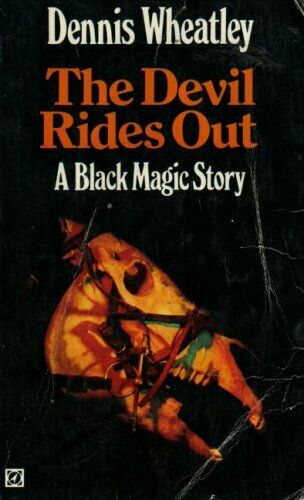
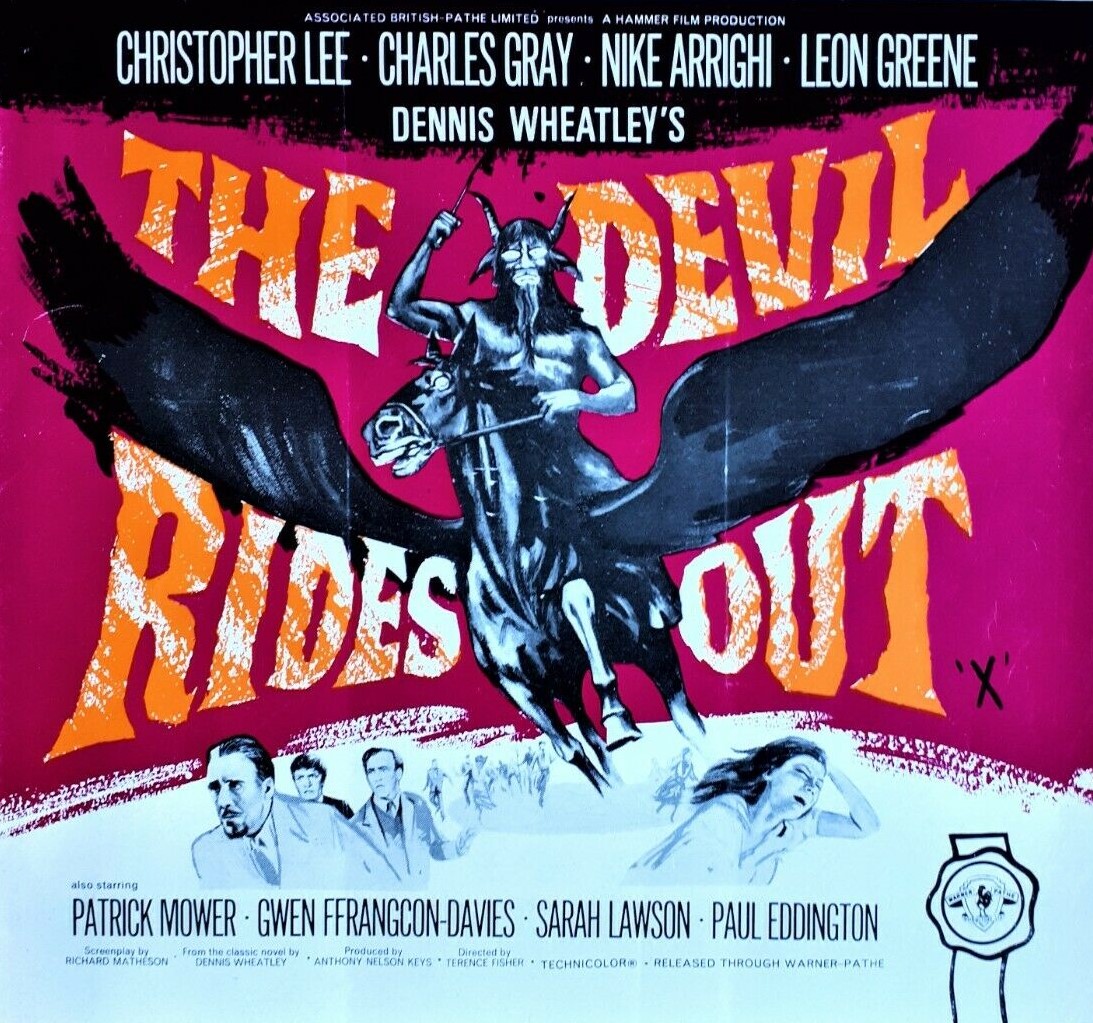
The Devil Rides Out, his fourth novel, published in 1934, featured the “musketeers” involved in his phenomenally successful debut The Forbidden Territory (1933), and introduced readers to his interest in the occult. Although of differing temperaments and backgrounds his quartet – the Russian-born Duke De Richleau (Christopher Lee in the film), American aviator Rex Van Ryn (Leon Greene) and wealthy Englishmen Richard Eaton (Paul Eddington) and Simon Aron (Patrick Mower) – are intrepid. And while screenwriter Richard Matheson stuck pretty much to the core of the Wheatley story, the film was hampered by the actors. The laid-back Paul Eddington hardly connects with the Wheatley characterization and Patrick Mower is too young for Aron.
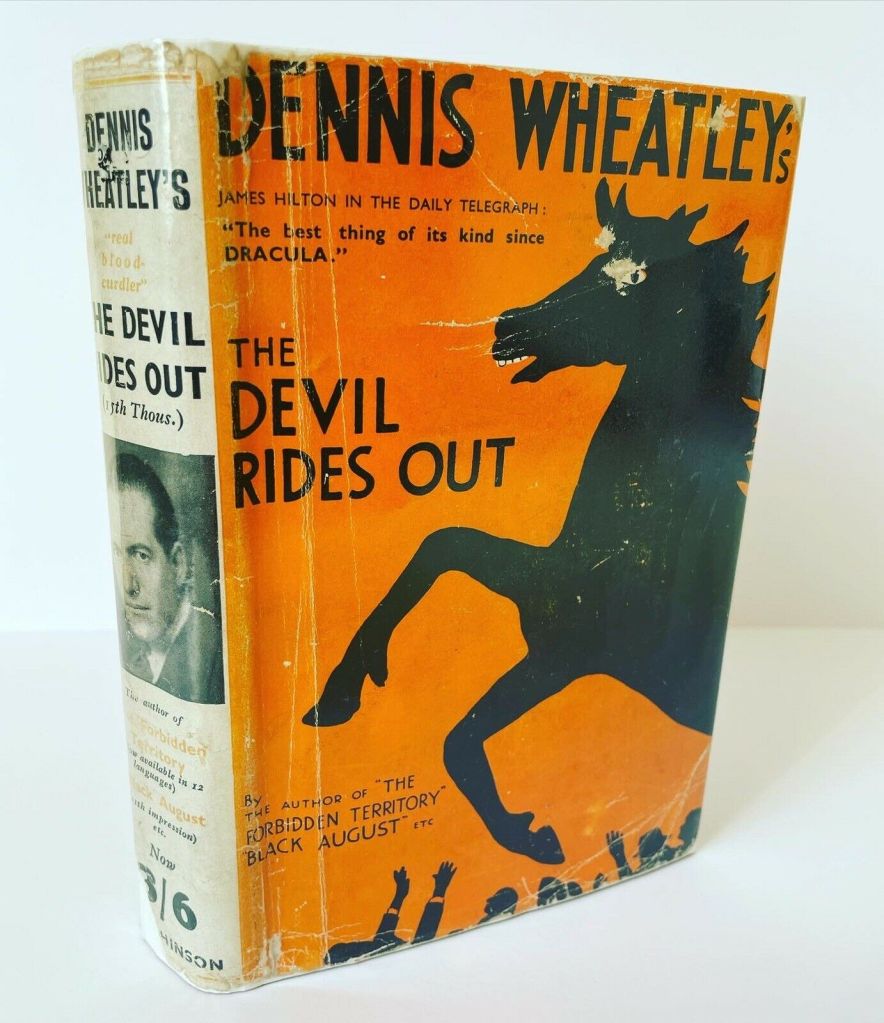
Original British hardback cover.
As with the book, the story moves swiftly. Worried that Aron is dabbling in the black arts, De Richleau and Van Ryn go haring down to his country house where they meet black magic high priest Mocata (Charles Gray) and discover tools for satanic worship. And soon they are embroiled in a duel of wits against Mocata, climaxing in creating a pentagram as a means of warding off evil.
In order not to lose the audience by blinding them with mumbo-jumbo the script takes only the bare bones of the tale, bringing in the occult only when pivotal to the story, and that’s something of a shame. A modern audience, which has grown up on enormously complicated worlds such as those created for Game of Thrones and the MCU, would probably have welcomed a deeper insight into the occult. While out-and-out thrillers, Wheatley’s novels often contained copious historical information that he was able to dole out even when his heroes were in harm’s way. The Devil Rides Out is not a massive tome so it’s a measure of the author’s skill that he manages to include not just a condensed history of the occult but its inner workings. Every time in the film De Richleau goes off to the British Library for some vital information, his departure generally leaves a hole, since what he returns with does not always seem important enough to justify his absence.
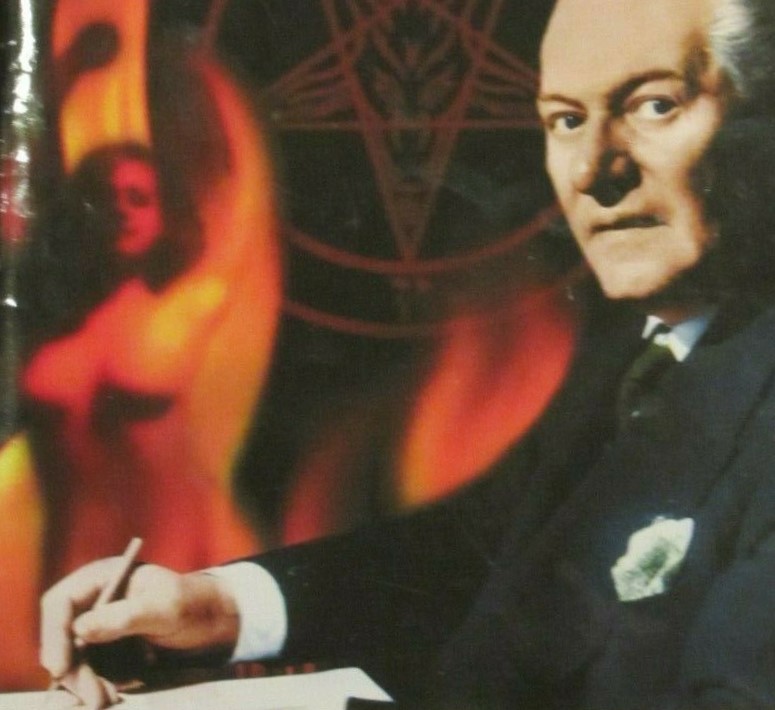
Author Dennis Wheatley.
But then the screenwriter was under far more pressure than a novelist. In some respects, this book like few others demonstrates the difference between writing for the screen and writing for a reader. With just 95 minutes at his disposal, Matheson had no time to spare while Wheatley had all the time in the world. Wheatley could happily leave the reader dangling with a hero in peril while dispatching De Richleau on a fact-finding mission, the action held up until his return. It’s interesting that Matheson chose to follow Wheatley’s characterization of De Richleau, who didn’t know everything but knew where to look. Matheson could easily have chosen to make De Richleau all-knowing and thus able to spout a ton of information without ever going off-screen.
But here’s where the book scores over the film. The reader would happily grant Wheatley his apparent self-indulgence because in the book what he imparted on his return, given the leeway to do so, was so fascinating. There are lengthy sections in the book which are history lessons where De Richleau supplies readers with the inside track on the satanic. In the opening section, once De Richleau and Van Ryn have rescued Aron, the author devotes a full seven pages to a brief introduction to the occult that leaves the reader more likely to want more of that than to find out how the story will evolve. He has hit on a magic formula that few authors ever approach. To have your background every bit as interesting as the main story is incredibly rare and it allowed Wheatley the opportunity to break off from the narrative to tell the reader more about the occult, which in turn, raised the stakes for the characters involved.
Effectively, there was too much material for a screenwriter to inflict upon an audience ignorant of the occult. Some decisions were clearly made to limit the need for lengthy exposition. But these often work against the film. For example, Mocata wants the Talisman of Set because it bestows unlimited power with which he can start a world war, but in order to accomplish that he needs to find people with the correct astrological births, namely Simon and Tanith. But this element is eliminated from the story, making Mocata’s motivation merely revenge. Matheson also removed much of the historical and political background, replaced the swastika as a religious symbol with the more acceptable Christian cross, and deleted references to Marie’s Russian background. Her daughter Fleur becomes Peggy. Matheson also treats some of the esoteric light-heartedly on the assumption that seriousness might be too off-putting.
Overall, the adaptation works, you can hardly argue with the movie’s stature as a Hammer classic, but the more you delve into the book the more you wish there had been a way for much of the material to find its way onscreen and to inform the picture in much the same way as the depth of history and character backstory adds to Game of Thrones.
Strong contender for Hammer’s film of the decade, a tight adaptation of Dennis Wheatley’s black magic classic with some brilliant set pieces as Nicholas de Richleau (Christopher Lee) battles to prevent his friend Simon (Patrick Mower) falling into the hands of satanist Mocata (Charles Gray).
Initially constructed like a thriller with Simon rescued, then kidnapped, then rescued again, plus a car chase, it then turns into a siege as Richleau and friends, huddled inside a pentagram, attempt to withstand the forces of evil. Sensibly, the script eschews too much mumbo-jumbo – although modern audiences accustomed to arcane exposition through MCU should find no problem accommodating ideas like the Clavicle of Solomon, Talisman of Set and Ipsissimus – in favour of confrontation.
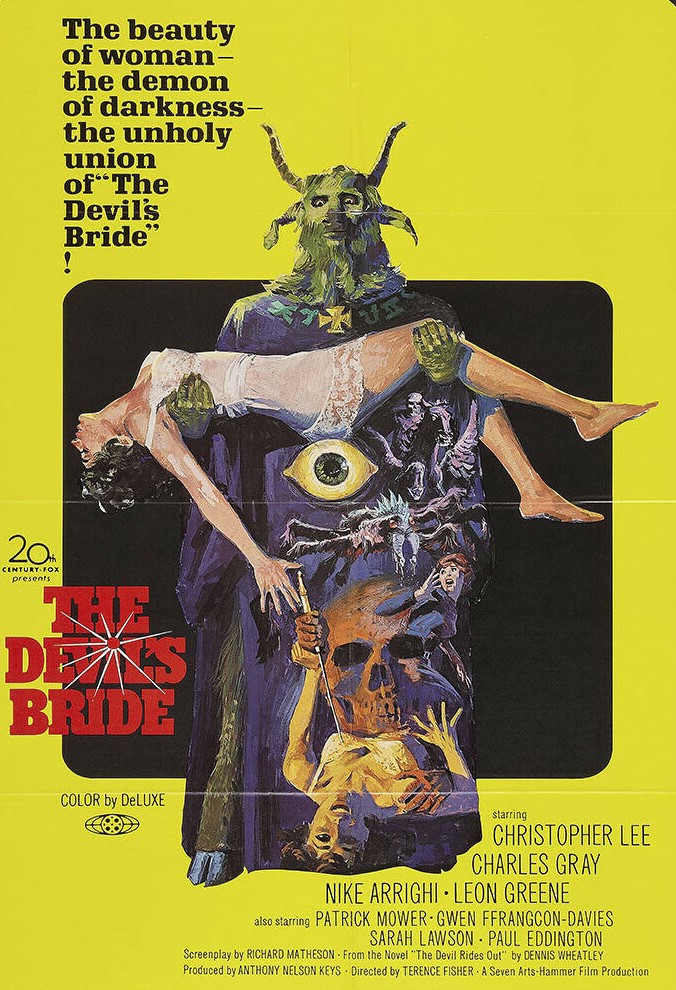
The title was changed for American audiences.
Unlike most demonic pictures, de Richleau has an array of mystical weaponry and a fund of knowledge to defend his charges so the storyline develops along more interesting lines than the usual notion of innocents drawn into a dark world. In some senses Mocata is a template for the Marvel super-villains with powers beyond human understanding and the same contempt for his victims. And surely this is where Marvel’s creative backroom alighted when it wanted to turn back time. Though with different aims, De Richleau and Mocata are cut from the same cloth, belonging to a world where rites and incantations hold sway.
While special effects play their part from giant menacing tarantulas and the Angel of Death, the most effective scenes rely on a lot less – Simon strangled by a crucifix, Mocata hypnotizing a woman, a bound girl struggling against possession. Had the film been made a few years later, when Hammer with The Vampire Lovers (1970) and Lust for a Vampire (1971) increased the nudity quotient, and after The Exorcist (1973) had led the way in big bucks special effects, the black mass sequence would have been considerably improved.
The main flaw is the need to stick with the author’s quartet of “modern musketeers” which means the story stretches too far in the wrong directions often at the cost of minimizing the input of De Richleau. In the Wheatley original, the four men are all intrepid, but in the film only two – De Richleau and American aviator Rex van Ryn (Leon Greene) – share those characteristics. At critical points in the narrative, De Richleau just disappears, off to complete his studies into black magic. Where The Exorcist, for example, found in scholarship a cinematic correlative, this does not try.
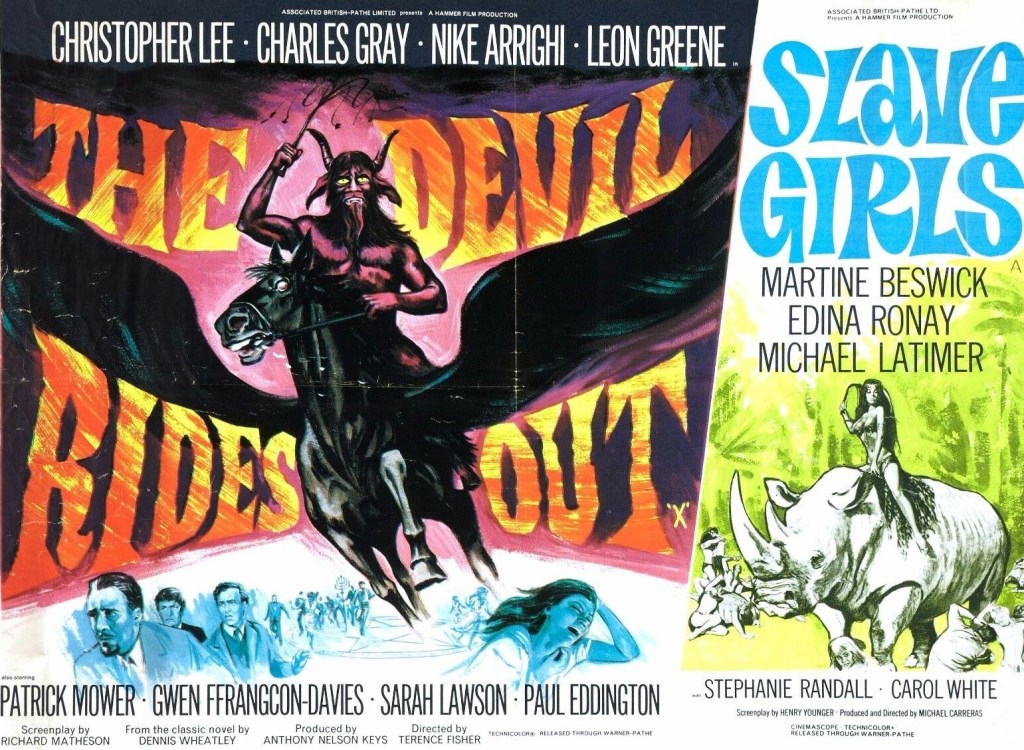
In Britain it was double-billed on the ABC circuit with Slave Girls.
Christopher Lee (She, 1965), pomp reined in, is outstanding as De Richleau, exuding wisdom while fearful of the consequences of dabbling in black magic, both commanding and chilling. Charles Gray (Masquerade, 1965) is in his element, the calm eloquent charming menace he brings to the role providing him with a template for future villains. The three other “musketeers” are less effective, Patrick Mower in his movie debut does not quite deliver while Leon Greene (A Challenge for Robin Hood, 1967) and Paul Eddington (BBC television’s Yes, Minister 1980-1984) are miscast. Nike Arrighi, also making her debut as love interest Tanith, is an unusual Hammer damsel-in-distress.
Hammer stalwart Terence Fisher (The Gorgon, 1964) creates a finely-nuanced production, incorporating the grand guignol and the psychological. Richard Matheson (The Raven, 1963) retains the Wheatley essence while keeping the plot moving.
Catch-Up: far from ubiquitous and with a wide range of roles Christopher Lee has appeared several times in the Blog – for Sherlock Holmes and the Deadly Necklace (1962), The Whip and the Body (1963), The Devil-Ship Pirates (1964), The Gorgon (1964), She (1965), The Skull (1965), The Brides of Fu Manchu (1966), Five Golden Dragons (1967), The Curse of the Crimson Altar / The Crimson Cult (1968) and The Oblong Box (1969).
As you will be aware I have been running a little series of how books were adapted into films and I thought it would be interesting to see what happened when the process was the other way round. I have in general about the lucrative business of novelisations of screenplays as movie tie-ins but never examined any single one in particular. But I came across this book in a secondhand bookshop on holiday and gave it a read.
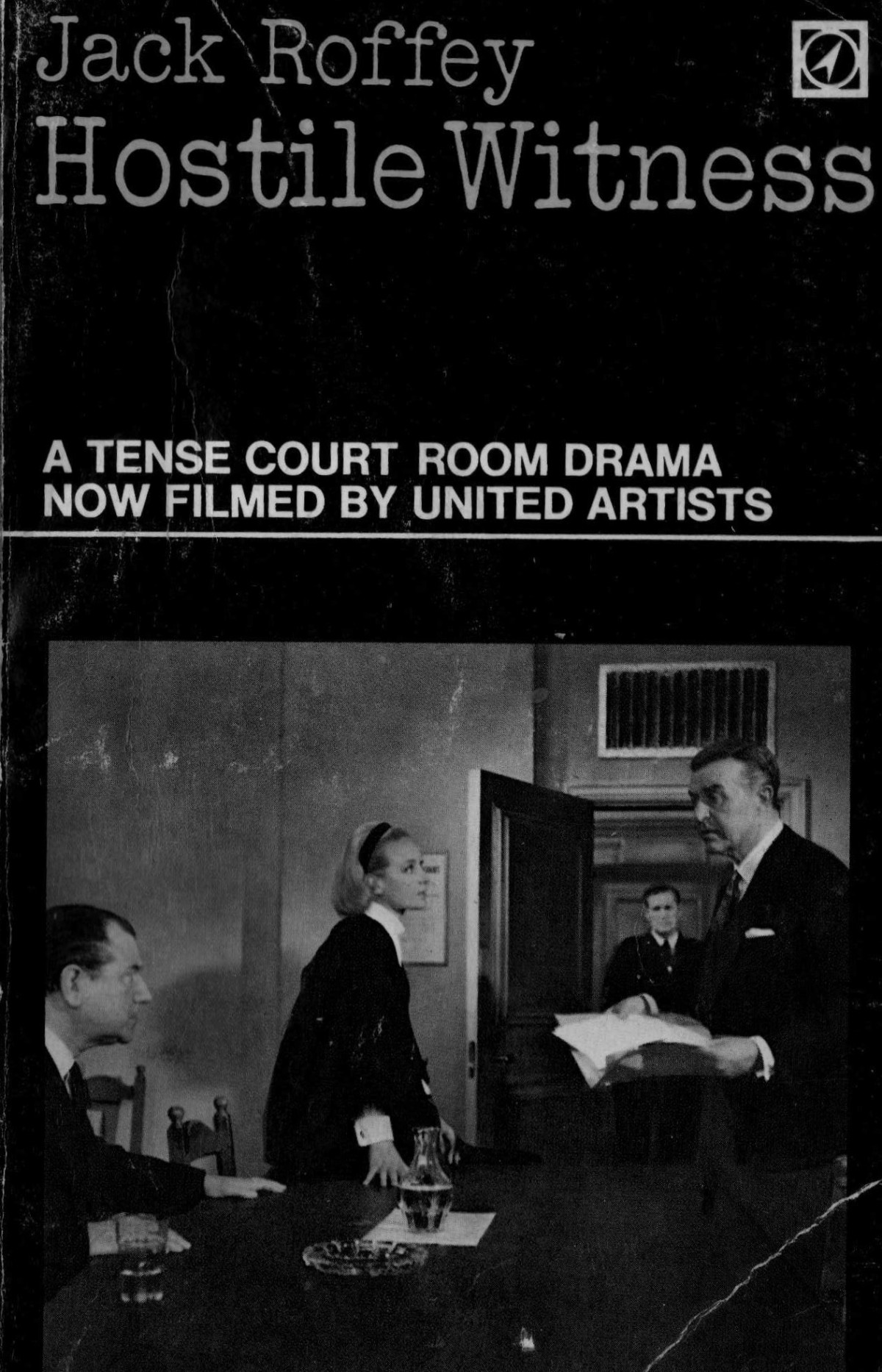
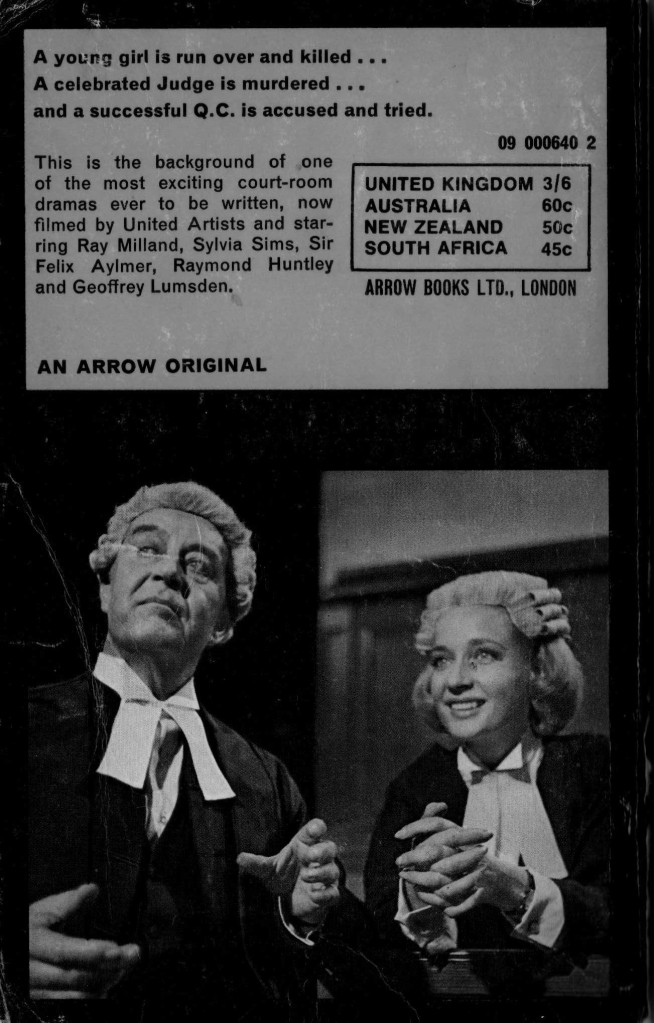
British writer Jack Roffey had turned his play – a hit in London West End and Australia though less so on Broadway – into a screenplay and was inveigled into making a quick buck by churning out the movie tie-in book, published straight into paperback in Britain by Arrow. It turned out to be an interesting exercise because the play was no longer in circulation and the film failed to get a proper release so the book had to survive on its own without the help of movie publicity or posters outside the chain cinemas.
The book is about 60,000 words long while the play/screenplay probably comprised fewer than 5,000 words so that was a lot of padding-out to do, if that was all the author could manage. Interestingly, Roffey proved himself an adept novelist, taking the opportunity to both clarify the proceedings and mystify the reader even more, accentuating the ambiguities of the initial work. Where the movie glosses over main protagonist Simon Crawford’s (Ray Milland in the film) mental difficulties until brought into question during the court case itself, in the book Roffey lays the groundwork more straightforwardly, recounting the period spent in hospital and, more importantly, his rapid decline after returning to work so that by the time he is arrested his mental health is very poor.
Sheila Larkin’s (Sylvia Syms) unspoken feelings for her boss remain just that, but there is a physical closeness – she catches him when he collapses, briefly nursing him, and she is presented as a woman more aware of her own sexuality. And the door is opened later in the book for a relationship – “intimacy umbrellaed them in soft folds, inviting positive expression.” Equally, when given the opportunity to take on the case, her first reaction is fear: “She couldn’t possibly accept it…it would be a terrifying responsibility for a junior of her standing” and she expects the episode to end in abject humiliation until she catches sight of her boss and registers the fear in his eyes. Thus, Roffey is able to get inside all the major characters rather than have the camera – and the shortage of screen time – dictate the point of view. Other characters, some incidental, are also more fully drawn.
While the play’s dialogue would not have sufficed to carry a book of this length, Roffey has to add considerably to his original material, and in most cases extended conversations are made to count. Perhaps most interesting of all since he is in charge, Roffey can dispense with the need to constantly cut back to the accused during the trial to register his facial reactions and that allows the personality of Sheila Larkins to flower and take true centre stage rather than be constantly undercut by continually focusing on Crawford. Roffey was also an expert on court procedure and the opportunity to delve into that gives the book greater authority.
The book is certainly enjoyable and well-written with some sharply observed characterisations. “Mr Justice Gregory came in, diffidently at first, like a small boy at the edge of a pond, who wonders if the ice will hold.” Simon Crawford is introduced in court in the opening page thus: “There was an affected boredom is the half closed grey eyes – a calculated indifference to the heat and the coming verdict.” While Sheila Larkins is the opposite – “properly wrung out.”
There’s style in the descriptions. “Gordon Mews is one of those peaceful backwaters that an earlier and more gracious London put aside for a rainy day, and promptly forgot about.” And the book moves along briskly, a crime thriller with the unlucky caught in a web that is closing in fast. Roffey is able to touch on more specifically Crawford’s disintegration and his shock at being tabbed a criminal. Like the film, it was more than passably entertaining.
Adapting a play into a film requires more specialist skills than transforming a book into a movie. A book either needs considerably trimmed (example, The Detective) or the requiring a complete overall (as with Blindfold). It’s much harder to muck around with a play which has usually been well-honed, edited down night after night, from a run on the stage. The main decision the writer charged with the adaptation has to make is a tricky one – whether to open it up or not. Can a play, especially a thriller, sustain the tension it achieved on stage without additional elements – and therefore appear “stagey” on film – or must it be expanded in the hope of generating greater tension or ambiguity, making characters more sympathetic or clarifying the plot. The story in both play and film concerns top lawyer Simon Crawford being arrest for murder.
Jack Roffey, adapting his own play, decided the original needed opening up. The play’s structure consisted of two acts, each containing two scenes. The first scene lasted 21 pages, scenes two and four 23 pages each, while scene three is considerably shorter just 12 pages. So, except for the third scene, the play’s rhythm is consistent. And while this might look as if most scenes last 20-plus minutes, an inordinately long time to sustain rhythm on the screen, there are lot of moment where various characters go offstage to concentrate action between fewer characters, thus heightening tension or creating character conflict.
A lot of information that was imparted purely via dialogue in the play transforms on screen into a series of extra scenes. This is especially true at the beginning. The movie’s opening scene, set in a court and concerning the trial of a brothel-keeper, was not in the play; it was dealt with in passing at the beginning of the play, as a character reporting on the outcome, albeit that some of the reported speech became dialogue in the film. It was probably felt that the movie audience had to be introduced right away to a courtroom since the play’s opening scene takes place entirely outside the courtroom, in the offices of the leading character Simon Crawford (Ray Milland). The play begins in the present and the back story, that Crawford is widowed, recently lost his daughter in a hit-and-run traffic accident, and suffered a nervous breakdown as a result, is dealt with as exactly that – events from the past. The film puts them in the present. We are shown the daughter, who clearly has a strong relationship with her father, we hear the accident (which occurs offscreen), witness Crawford’s unravelling and the murder that forms the core of the story. And we are also treated to some additional scenes, not in the play, including an initial police investigation.
The upshot is that it takes 25 minutes for Crawford to be arrested. Compare that to the play. He announces his imminent arrest within the first five minutes. For pure audience shock the play holds the upper hand. I’m not sure the film ever matches that moment. Pre-arrest, in the film, Crawford’s erratic behaviour and hospital confinement add to a sense that he might be unhinged or, in classic film noir, feeding the audience a line. His state of mind is complicated by making visual some incidents that were just verbal in the play.
There are three major departures from the play. The first was the introduction of a private eye whom Crawford takes by the throat in frustration at the gumshoe producing no results. This suggests early on that Crawford is capable of violence. But it also causes a complication. In the play there is only one main private eye, name of Armitage, whose evidence proves key in the case against Crawford, but he is missing and in fact never appears. Apart from testifying to Crawford’s murderous inclination the introduction of this other private eye, named Rosen, makes little sense. The second is to bring quicker to the fore the involvement of junior lawyer Sheila Larkin (Sylvia Syms in the film). In the play she takes over his defence when her senior quits on a point of principle but in the film it is almost from the start.
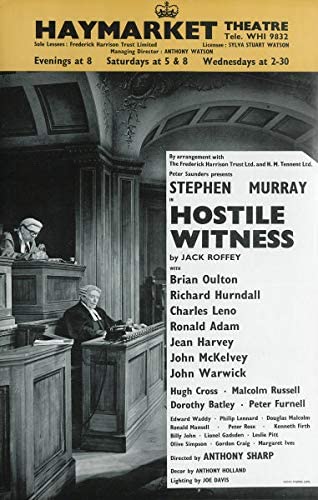
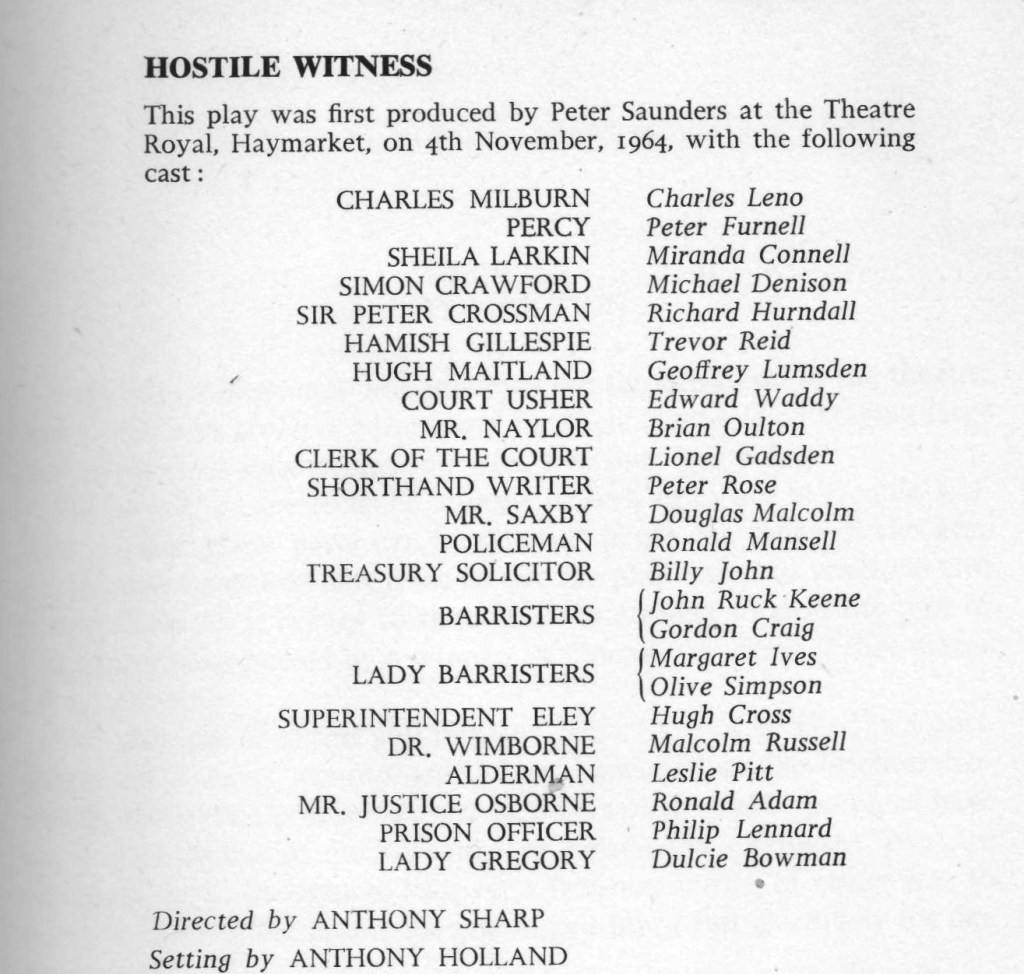
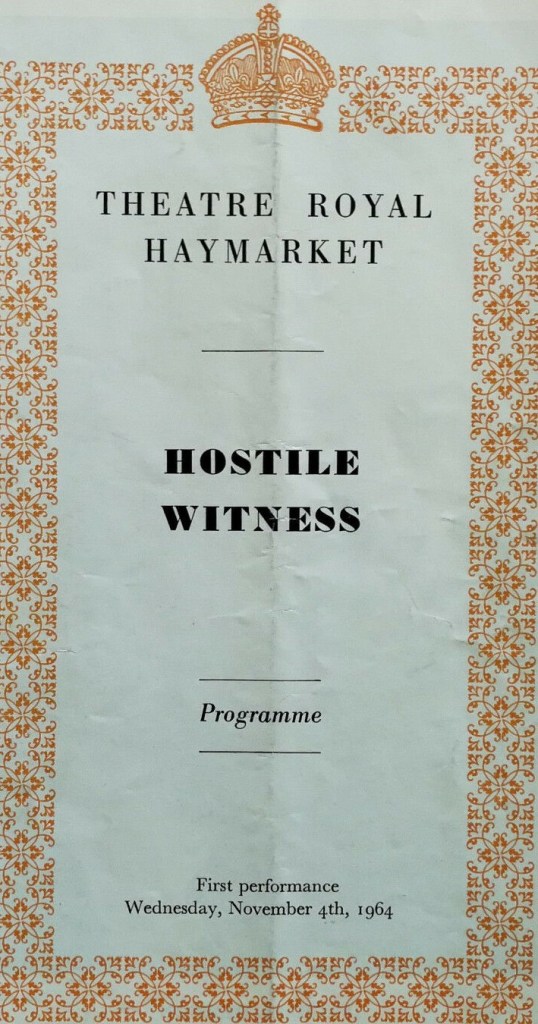
Programme for the premiere of the play in London’s West End.
The third development also involves Larkins. But I’m not sure this one works in building up Crawford-Larkins into a potential May-December relationship. In the play it seems more obvious that Larkins is a daughter substitute rather than a potential love interest but the film adds an additional scene where she brings celebratory goodies to the lawyer and her demeanor suggests sublimated ardor. The way director Ray Milland uses looks between the pair and an occasional touching of hands makes the alternative more obvious.
You could argue that the film could have simply had Crawford arrested in the first five minutes but that would have necessitated police interrogation. The device brilliantly used in the play of imminent arrest would have worked in the film, I believe, and made for a more explosive start, and then either sticking with the play structure or dealing with the backstory in flashbacks.
It’s worth noting that plays on the page look far more intense than screenplays. There is nothing but line after line of dialogue whereas a screenplay always has cuts or directions to interrupt the flow of material. Dialogue, of course, being what a play relies upon more than the camera, Roffey, as the adaptor, was lucky in having so many choice lines at his disposal. Ray Milland, in his role as director, unfortunately, was not able to add atmospheric heft.
Oddly enough, this is also straddles 1965 and the present time and falls victim to the same problems of following two storylines. In fact, this is a tad complicated in that not only is present-day journalist Ellie Haworth (Felicity Jones) investigating a romantic mystery from the past but the subject of her inquiry Jennifer Stirling (Shailene Woodley) is also investigating her own romance. Confused, you bet. Jennifer is suffering from that old Hollywood romantic standby – amnesia – and is alerted to her own mysterious past by the discovery of the letters that turn up half a century later in the hands of Ellie.
So really, there’s three storylines to keep up with: the contemporary exploration of the past, Stirling’s journey of self-discovery and in a series of flashbacks in the same period her forbidden romance – given she is already married – with charmer Andrew (Callum Turner). This 1960s is full-throttle glamour, playing out in the classy French Riviera, both Stirling and Andrew looking like they’ve just walked off a catwalk.
That it works surprisingly well is due to the three stories never getting mixed up (as in Last Night in Soho) and that in each period it is driven by detective work. People often forget there is nothing more satisfactory to solve than a romantic mystery rather than tracking down an ubiquitous serial killer. Three of the characters – Andrew, Ellie and her co-opted investigative partner Rory (Nabhaan Rizwan), an archivist, are absolutely terrific, the actors delivering star turns. Andrew comes over as attractive but deep, a committed financial journalist. On the other hand Jennifer is pretty much a spoiled brat, and in the hands of Shailene Woodley over made-up and looking ill-at-ease in her glad rags. Amnesia has the unfortunate effect of making her wooden.
The 1960s romance follows pretty much the standard Hollywood template that is somehow going to hit an iceberg. By comparison the contemporary slow-burning romance between Ellie and Rory is a joy. She is outgoing, spunky, sexually confident – in a neat reversal she can’t remember the name of the boy she wakes up in bed with – while Rory is an old-fashioned stuck-in-the-mud whom she manages to warm up.
Felicity Jones has been through the Hollywood wringer – earnest roles such as The Theory of Everything (2014) and On the Basis of Sex (2018) mixed in with blockbusters of the Inferno (2016) and Rogue One (2016) variety – but here she is just delightful, playing a very rounded character. Nabhaan Rizwan (The Accident tv series, 2019) is wonderfully endearing. They play exceptionally well off each other, a sort of latter-day Andie McDowell-Hugh Grant.
It would have been a very quiet cinemagoing week for me to end up watching this and I wasn’t going to review it at all except for being reminded of dual-time settings by Last Night in Soho. I have to say I was happily surprised, the various mysteries enough of a hook, the Jones-Rizwan tag team exhibiting true charisma. Hats off to director Augustine Frizzell (Never Goin’ Back, 2018) for recognizing their potential and for keeping the whole enterprise chugging along. It’s one of the few Netflix productions to deliver.
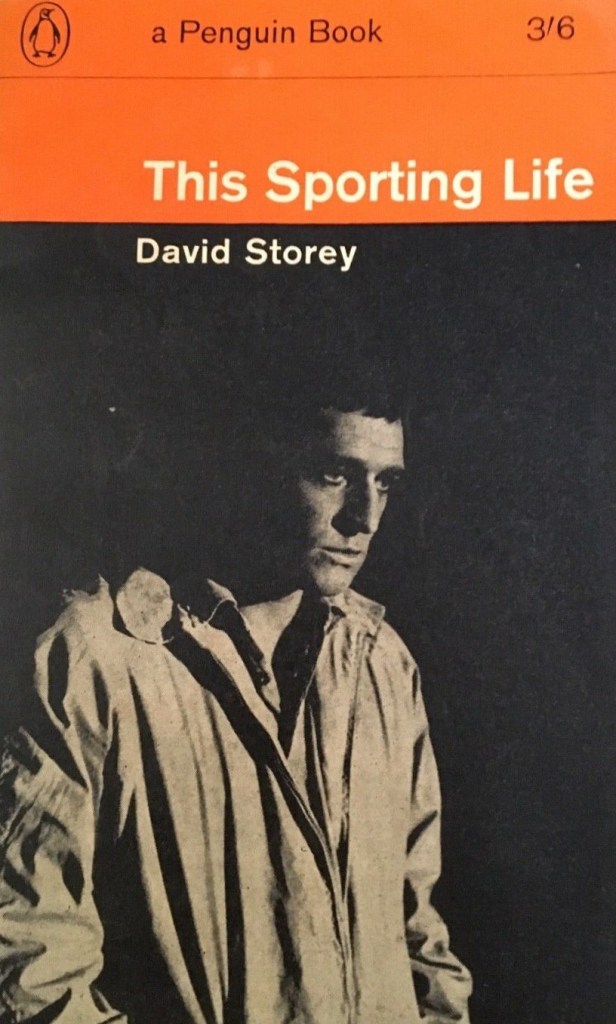
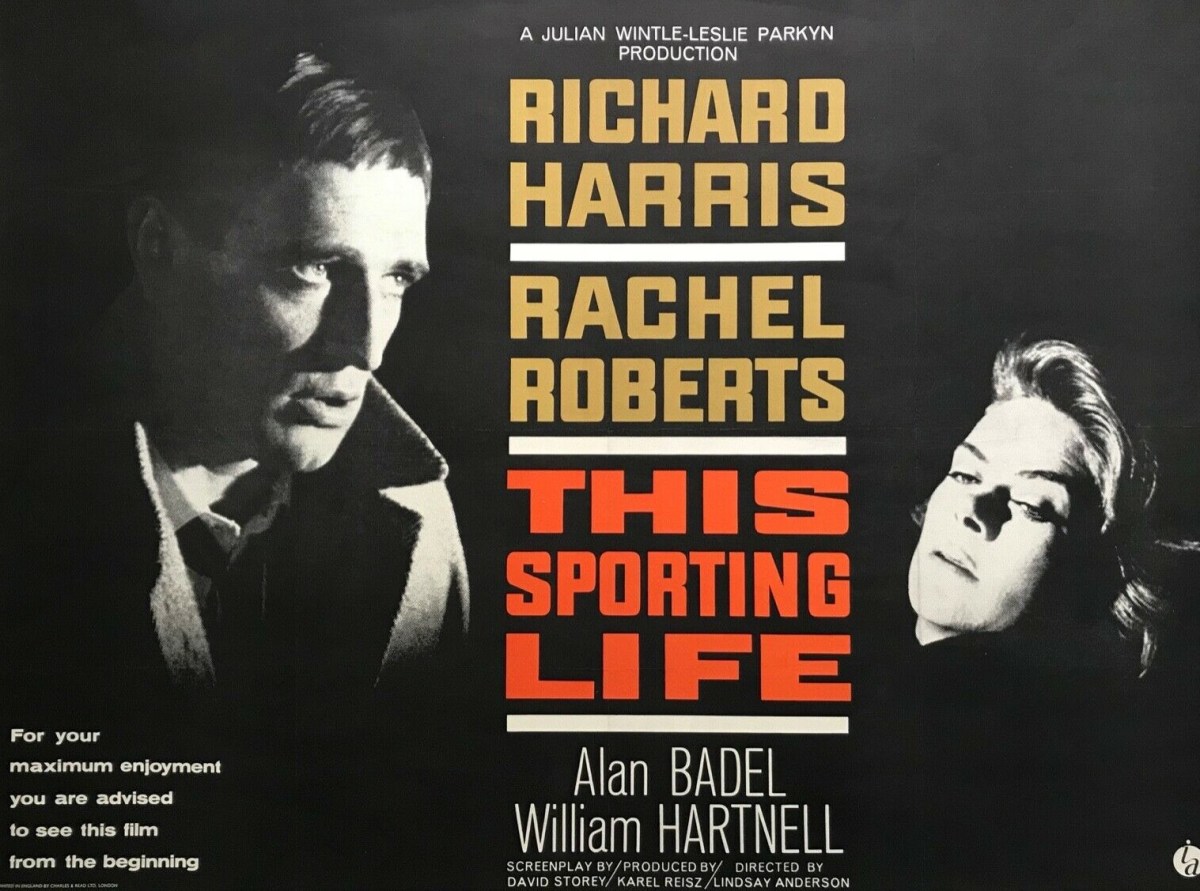
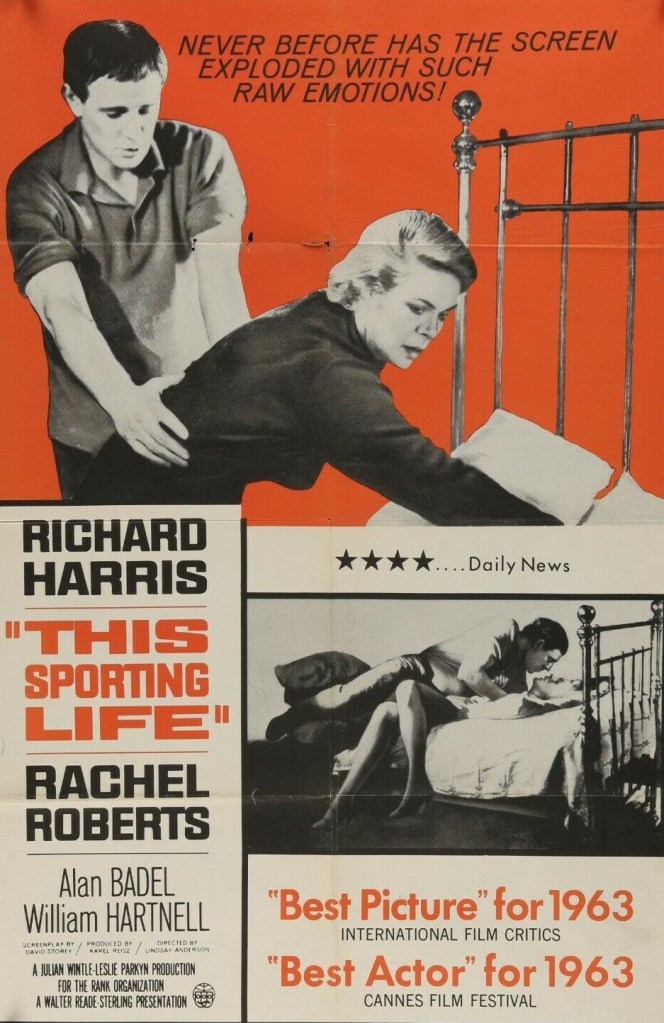
Star Albert Finney and director Karel Reisz of Saturday Night and Sunday Morning (1960) turned it down. Director Lindsay Anderson, screenwriter David Storey, author of the novel on which the film was based, and star Rachel Roberts all suffered from massive doubt in their own abilities.
Anderson was the last of a generation that included Reisz and Tony Richardson (Tom Jones, 1963) to make a movie. He was better known as film critic and theatre director. As far as the screen went, he had got only as far as five episodes of The Adventures of Robin Hood for television, and some documentaries and shorts. If he was going to make a movie it almost certainly depended on finance from British production outfit Woodfall which had backed Reisz and Richardson. However, Woodfall was outbid for the rights to This Sporting Life and Anderson only came into the frame when Reisz rejected the idea of directing the movie in favor of turning producer and giving Anderson his opportunity.
Cover of the Danish program.
“I was not sure I was up to it,” confessed Anderson. Theoretically a tale of a rugby footballer Frank Machin’s (name changed from the Arthur Machin of the book) rise and fall, Anderson wanted to explore the novel’s “dark poetry” and the ambiguities of the a central character who was by turn overbearing and sensitive and involved in a “tortured, impossible relationship.”
However, Storey, also making his movie debut, struggled with the script. Until the sudden success of This Sporting Life, the aspiring artist had lived a debt-ridden life as a supply teacher (17 schools in three-and-a-half years) in poverty-stricken London boroughs, writing his novels on train journeys north to fulfill his contract to play professional rugby. Reprinted prior to publication This Sporting Life, his debut novel, received excellent reviews and won the inaugural U.S. MacMillan Award worth $7,500.
When the film industry came sniffing Storey took tea with Stanley Baker at the Dorchester Hotel, lunched with Tony Richardson at the Trocadero and was wooed by director Joseph Losey at his Knightsbridge flat. Initial expectations were that the rights would go for £3,000, but a bidding war between Woodfall and Rank sent the bill up to £10,000 with the latter emerging victorious. Karel Reisz agreed to become producer on condition he could choose director, writer and cast. He introduced Storey to Anderson and to an initially interested Albert Finney.
Cover of the first edition of the British hardback.
Storey, a working-class son of a coal miner, and Anderson stood at different ends of British class divide. Initially suspicious of each other, they had opposite temperaments. “Lindsay was an optimist,” explained Storey,” I was a reclusive, and when in doubt, morbid.” Even after Storey completed a treatment and the pair went north to scout locations, the project remained in doubt, in part because Anderson did not understand the book and had a “curious lack of confidence” and in part because Storey resisted reshaping the material into something “new.” In fact, Anderson’s lack of confidence was so deep it took several months before he actually signed his contract.
Storey, too, suffered from revisiting the area where he had grown up. The death of a sibling cast a devastating shadow over the rest of his life, the Wakefield rugby ground in fact “scarcely a stone’s throw “from the child’s grave. “Wakefield was being opened up to me in a way I had never known before,” explained Storey, referring to the grand houses visited as possible locations whose exteriors he had glimpsed while working as a marquee laborer.
Despite “exhaustive consultations” with Anderson and Reisz, the script failed to gell. “I felt the authority I wanted was not there,” commented Anderson. Although actors are often decried for interfering with the script, in this case it was star Richard Harris who arrived at the solution.
British paperback film tie-in.
Anderson had been attracted to Harris from seeing him in the stage adaptation of J.P. Donleavy’s The Ginger Man. The director flew off to Tahiti where Harris was filming Mutiny on the Bounty (1962) to be met at the airport at five in the morning by the actor, “ his 18th century seaman’s hair down to his shoulders, bursting to tell me what he thought of the script we had sent him.”
Anderson recalled, “Within ten minutes we were at it…we talked and argued right through the day. I quickly realized he was right…we had lost what was most unique and brilliant in the novel…it was Richard, who, with passionate intransigence, brought us back to the book…in the evening after his shooting on the Bounty we sat in his bungalow going through the script and his own heavily-annotated copy of the novel…and slowly a conception emerged which began to satisfy us.”
Storey agreed with the new look which basically followed a subjective point-of-view rather than being cluttered by the novel’s flashbacks. “With an unequivocal endorsement of the book and the rejection of a script which had wearied me more than I’d imagined, I found rewriting the script in the manner in which the book had been written, from the inside looking out rather than the outside looking in, a surprisingly exhilarating task…Once Richard Harris had become identified with the part …the material was no longer a problem.”
Retaining that subjectivity was Anderson’s biggest issue An Oxford scholar, he had little innate understanding of Frank Machin’s world and in consequence “was liable to slip into an objective view of scenes that needed to be presented through Machin’s own temperament.” Harris proved instrumental in keeping the director on course.
Rachel Roberts twice turned down the role – Mary Ure (Look Back in Anger, 1959) was also in the frame with four other actresses – and failed to turn up for a screen test. Karel Reisz once commented how odd it was that “the two films that made this great-hearted flamboyant woman best-known (the other being Saturday Night and Sunday Morning) were ones in which she played withdrawn, bleak, ungiving women. Rachel’s great talent was to sink her personality into the part without losing access to her own sensuality. You felt the tension.”
Of This Sporting Life, Reisz added, “She had great doubts about her ability to play Mrs Hammond because she’s a very held back, undemonstrative woman. A passionate person, certainly, but someone who’s turned puritanical through so much constant repression of her feelings. Rachel was afraid of this: she didn’t know out of which part of herself to play the role.”
Lindsay Anderson was as unsure as Roberts: “She didn’t appear to me to be the Mrs Hammond character…Rachel was anything but repressed.” Actress Sybil Williams remembered finding a whole sheaf of notes in Rachel’s script about “the Mrs Hammond character she appeared to be playing so intuitively.” Said Anderson, “Richard Harris was bit awed by Rachel. She could acquit herself with a first-rate reading in just a couple of takes. Richard took a few more to feel he had got it right. Rachel’s security as an actress made him feelmore respectful towards her.”
The scenes between Harris and Roberts were endlessly rehearsed, involving a full 10 days prior to shooting and then during evening and weekends while in production. Roberts was playing a woman “whose feelings, though fierce, are almost continually suppressed: the relationship deepens without self-explanation…through incessant conflict…It called for an actress of exception ‘interior’ quality with real wildness within as well as the capacity for an iron restraint.”
Somewhere in the BBC archive is a programme, never aired, about the making of the film shot for its Monitor arts strand, although Storey was interviewed later on the show by Huw Wheldon, later BBC managing director.
Although Lindsay Anderson only made four more movies, the most memorable being If…(1968), and David Storey never wrote another screenplay, the pair achieved considerable success together when the author turned to writing plays such as Home (1970) and The Changing Room (1971), set in a rugby club.
If This Sporting Life appears to have two main characters driven by demons, part of the explanation as to how such creatures emerged from David Storey’s imagination can be found in his riveting memoir A Stinging Delight which traces a core of depression from his earliest days through to the times in later life when he was in and out of mental hospitals. Rachel Roberts also suffered from mental illness and committed suicide in 1980.
SOURCES: Lindsay Anderson, “Sport, Life and Art,” Films & Filming, February 1963, pages 17-20; David Storey, A Stinging Delight (Faber, 2021), pages 217-218, 221-223, 227-231, 233, 240-242; No Bells on Sunday, The Journals of Rachel Roberts, Edited with a documentary biography by Alexander Walker, Pavilion, 1984, pages 37, 55, 56, 58.
What began as the last gasp of the British New Wave working class kitchen sink drama has now after a six-decade gap resolved into a struggle over political and sexual ownership. Macho athlete Frank Machin (Richard Harris) jibes against his paymasters at a Yorkshire rugby league club – in similar fashion to Charlton Heston in Number One (1969) – while trying to hold sway over widowed landlady Margaret (Rachel Roberts). While documenting the class divide over which British writers and directors obsess, Lindsay Anderson’s debut takes a wry look at power.
Machin belongs to the Arthur Seaton (Saturday Night and Sunday Morning) class of loudmouth boors, determined to take as much as they can, riding roughshod over anyone who gets in their way, even attacking players of his own team. Although a fan favorite, his position at the club still requires backing from the moneyed directors, support that appears go awry when he rejects overtures from Mrs Weaver (Vanda Godsell), wife of a board director (Alan Badel). While Margaret eventually succumbs, her actions fill her with shame, the presents he buys making her feel like a kept woman.
Both Machin and Margaret are the rawest of creatures, forever appearing ready to topple into some emotional crevasse of their own making. At a time when marriage was the rock of society and women had little independence, a woman could dwindle away in face of scorn from neighbours, while a man lacking emotional intelligence would crumble in the face of his own fears.
The non-linear narrative blurs some aspects of the story. There is no reference to Machin’s background save that he was once a miner and still works somewhere unspecified to supplement his footballer’s income. He rejects the paternalism of ageing scout Johnson (William Hartnell) while appears to be seeking to resolve maternal issues, the widow with two small children at least a decade older, and although he could easily afford better accommodation refuses to move out.
His obsession with Margaret is never properly explained, except by her, who sees him as acting like an owner. Equally, Margaret is the opposite of the women in virtually every movie of the period, for whom marriage is the sole ambition. Whether she still grieves over the loss of her factory worker husband, who may have committed suicide, or loathes Machin’s dominant nature is never explained. It might have been better if they had married for unhappy husbands and wives tend to give each other both barrels, emotions never concealed. Or she could be in the throes of an undiagnosed depression – author David Storey suffered from this all his life – expressed as anger.
Machin is the other side of the British Dream – the assumption that anyone who escapes going down the pits or the mindless grind of the factory will automatically enjoy happiness. While Machin revels in his celebrity, he has no idea how to make his life happier. This is in contrast to the other footballers who either enjoy womanizing and drinking or are married or engaged and accept the unwritten rules of the game rather than fighting everyone.
There is plenty grime on show, and the football field has never been so pitilessly portrayed, and as a social document the movie fits in well to the small sub-genre of films depicting working class life, but the picture’s thrust remains that of two opposites who will clearly never meet except in the delusional head of Machin.
Power is demonstrated in various ways. Weaver has the clout to give Machin a hefty signing-on fee against the wishes of the board, Weaver’s wife takes her pick of the footballers to satisfy her sexual needs, Machin believes he is entitled to berate waiters in an upmarket restaurant, while Margaret is demeaned by accepting his present of a fur coat.
As ever with these films of the early 1960s there is a wealth of acting talent. Both Harris and Roberts were Oscar-nominated. Others making a splash in the cast were Alan Badel (Arabesque, 1966), Colin Blakely (The Vengeance of She, 1968), Jack Watson (The Hill, 1965), and if look closely you will spot double Oscar-winner Glenda Jackson (Women in Love, 1969). Future television stalwarts included William Hartnell (the first Doctor Who), Arthur Lowe (Dad’s Army, 1968-1977), Leonard Rossiter (Rising Damp, 1974-1978), Frank Windsor (Softly, Softly, 1966-1969) and George Sewell (Paul Temple, 1969-1971).
Lindsay Anderson (If… 1969) no doubt believed he was making an excoriating drama about the class struggle, but in fact has delivered a classic thwarted love story. David Storey wrote the screenplay based on his own novel.
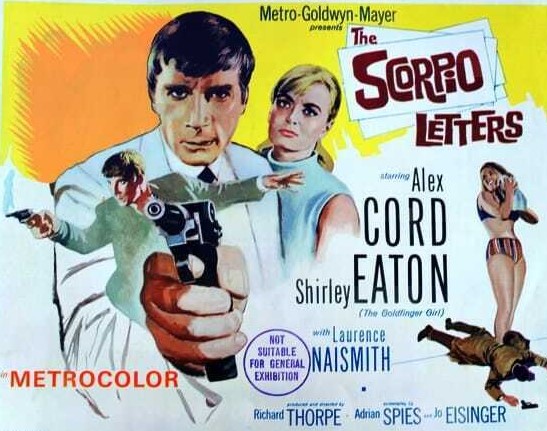
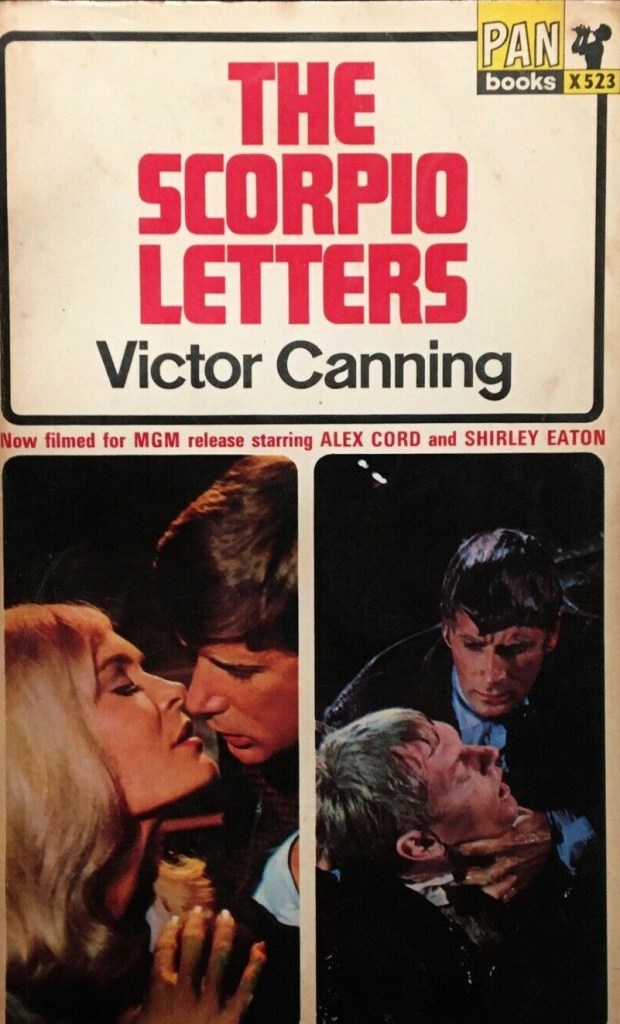
Desultory spy thriller with over-complicated story that’s worth a look mostly for the performance of Alex Cord (Stiletto, 1969). I can’t say I was a big fan of Cord and I certainly didn’t shower him with praise for his role as a disillusioned Mafia hitman in Stiletto. But now I’m wondering if I have been guilty of under-rating him.
Normally, critics line up to acclaim actors if they deliver widely differing performances – Daniel Day-Lewis considered the touchstone in this department after Room with a View and My Beautiful Launderette opened in New York on the same day in 1985. But usually screen persona rarely changes, amounting to little more than a heightened or amalgamated version of the actor’s character or features. Once Charles Bronson, for example, started wearing his drooping mustache he was never seen without. Actors may grow old, but never bald.
The macho mustachioed Cord of Stiletto is nowhere in sight. In fact, in The Scorpio Letters minus moustache and resisting attempts to reveal his musculature, he is almost unrecognizable. In this picture Joe Christopher (Alex Cord) is flip, resentful, thoughtful, occasionally pedantic, more natural than many of the crop of Hollywood new stars being unveiled at the time, and for once as a transplanted American in London rather scornful of British traditions. There’s a realistic flourish here, too, he is so poorly paid – and on a temporary contract – that he has to take the bus. And although he is an ex-cop fired for brutality, that level of violence ain’t on show here. Virtually the opposite of the character Cord created for Stiletto, I’m sure you’ll agree. So full marks for versatility and talent.
Unfortunately, the rest of the movie is not up to much, at the very bottom of the three-star review category, almost toppling into two-star territory. Christopher is investigating the death of a British agent who was the subject of a blackmail attempt. By coincidence – or perhaps not – another part of British Intelligence is investigating the same death and this brings Christopher into contact with Phoebe Stewart (Shirley Eaton) and eventually they work together to unravel a list of codenames and uncover the conspiracy with a bit of risk to life and limb.
But the pay-off doesn’t work despite all the exposition attempting to build it up and you’re left with a kind of drawing-room drama rather than exciting spy adventure. It’s determinedly London-centric with red buses, red postboxes, Big Ben, and The Horse Guards all putting in an appearance. The scene shifts to Paris and Nice without a commensurate heightening of tension. Despite a couple of neat scenes – a chase held up behind a wedding party, an irate German chef, an interrogation in a wine cellar – it’s much too formulaic.
Cord apart, Shirley Eaton (Goldfinger, 1964) adds some glamour, but her rounded portrait depicts a character with warmth rather than oozing sex. This is the kind of film that should be awash with character actors and up-and-comers but I recognized few names except for Danielle De Metz (The Karate Killers, 1967), Oscar Beregi (Morituri, 1965) and Laurence Naismith (Jason and the Argonauts, 1963).
One-time top MGM megger Richard Thorpe (The Truth about Spring, 1965) was coming to the end of a distinguished career which had included Ivanhoe (1952) and Knights of the Round Table (1953). This was his penultimate film. The appropriately-named Adrian Spies (Dark of the Sun, 1968) wrote the screenplay based on the Victor Canning thriller. Making his movie debut was composer Dave Grusin (Divorce American Style, 1967)
Albeit made on a budget of just $900,000, MGM intended the picture for theatrical release but with a short cinema window to make it available for a speedy showing on ABC TV. It was originally scheduled for a May 1967 theatrical release but MGM, contractually obliged to deliver the picture within a specified time to television, could not fit in an American release. So it made its debut in the “Sunday Night at the Movies” slot on February 19, 1967, and was shown in cinemas abroad. Nor was it shown first on U.S. television because the studio believed it to be a disaster. Reviews were positive. Variety (February 22, 1967, page 42) called it “very hip.”






 The Magnificent 60s