Blow-Up (1966) ****

Movies can break all sorts of rules but they can’t cheat.

A film has to stick to an internal logic. For example, it can’t portray a photographer so obsessed with his calling that he even takes a camera with him to an antique shop and starts shooting off roll and after roll capturing the area’s rundown streets but then the one time he really could do with a camera – to prove there is a corpse at his feet – he is somewhat remiss. Especially when that the movie turns on that plot point.

Setting aside what’s a somewhat contrived snapshot of “Swinging London” there’s a lot to admire here. The absence of music for one thing. Most of the movie runs without musical accompaniment, a bold move since so often we rely on the soundtrack to provide guidance for a scene or an overlay for the entire film. Here, Michelangelo Antonioni (Zabriskie Point, 1970) makes us falls back on our own interpretation.

David Hemmings (The Charge of the Light Brigade, 1968), all mop-top and intense stare, is a high-flying high-living fashion photographer in the David Bailey mold (casual sex with wannabe models a perk) who turns investigator on being confronted in a park by Vanessa Redgrave (Hemmings’ adulterous love interest in The Charge of the Light Brigade) after taking snaps she wants back. Tension is sustained by her sudden appearance at his studio, willing to pay with her body for the return of the photos, and then by Hemmings’ careful, photo-by-photo blow-up-by-blow-up analysis that slowly comes closer to the truth.

Everything in his world is judged through a lens, as if he can capture elusive truths, and he has aspirations to being more than a mere fashion adjunct, having spent time taking portraits of down-and-outs. He judges Redgrave as he would a model, she has a good stance and sitting posture. Even by the standards of the permissive society, he is a bit of sexual predator, taking advantage of two giggly model wannabes – Jane Birkin (Wonderwall, 1968) and Gillian Hills (Three, 1969).

But the photography scenes are well done and Antonioni captures the intimacy between model and photographer that create the best images. If you want to see what a model brings to modeling check out real-life model Veruschka posing in an outfit held together by the thinnest of threads, bringing to life the much-touted notion that a model makes love to a camera. If you can get past the cheat and the deliberate obtuseness this creates – and the tsunami of artistic interpretations it inspired about the director’s intent – then it remains intriguing.

This isn’t Hemmings’ greatest work – Fragment of Fear is much better – but it certainly provided him with a marketable movie persona. Redgrave is excellent as the nervy woman willing to do what is required and the movie might have worked better had she had been allocated more screen time and their duel had continued through other scenes. But then that would have been Hitchcock and not Antonioni.  

Sarah Miles (The Ceremony, 1963), Peter Bowles (The Charge of the Light Brigade) and John Castle (The Lion in Winter, 1968) have small parts. The film certainly captures the electricity of a photo shoot between a skilled photographer and pliant model, but it also works as an extended metaphor about the elusiveness of cinematic truth.

Despite my misgivings about the “cheat,” an intriguing and satisfying exploration of an artist seeking to jettison the fripperies of his art yet unable to avoid the temptation of enjoying the easy sexual benefits.

Nightmare (1964) ****

Now this is what you’re looking for when you take an unguided tour into the British B-movie. A tight gripping thriller with a parcel of twists, clever character perspective, some stunning cinematography, and pivoting on perception of insanity.

The opening is a cracker. Teenager Janet (Jennie Linden) stumbles along a dark prison-like corridor with little light hearing someone call her name. Entering a door, she spies a woman in a white nightgown lurking in the corner. She responds to the gentle calling. But once she lets the door close behind her and can’t get out, the woman screams that now they are both mad. And that’s just the first, atmospherically brilliant, nightmare.

Janet is soon removed from her posh boarding school, her constant nightmares too frightening for the other pupils. Driven home in a Rolls-Royce, accompanied by teacher Mary (Brenda Bruce) she passes the asylum where her mother is an inmate, but is surprised to find her legal guardian, charming lawyer Henry (David Knight), isn’t there to greet her. Instead there’s a nurse, Grace (Moira Redmond).

We soon learn she’s been effectively orphaned by her mother, who killed her father, Janet, eleven at the time, witnessing the murder. But without any proper home life, looked after primarily by kindly chauffeur John (George A. Cooper) and maternal maid Anne (Julie Samuel) and with the married Henry often absent, there’s little done to quieten down her obsession that she will follow her mother into madness.

The movie takes her perspective, watching her watching out for mystery, or in her point of view as she catches fleeting glimpses of a woman in white. The apparition looking only too realistic, not dashing out of view but turning and apparently beckoning Janet on and it doesn’t take much to push a disordered mind further out of kilter, leading to attempted suicide. Imagining Henry’s wife is the ghost, she stabs her to death.

End of Act One. Start of Twist No 1. You would expect the movie to follow Janet to the asylum where she would be reunited with her mother, knowing she had inherited those terrible genes, trapped in her insanity. But it goes somewhere more delicious instead.

Turns out nice Henry is not very nice at all. He contrived a situation to be rid of his wife and marry lover Grace instead. But, once married, it is Grace who becomes disturbed and the movie follows a similar arc in the second half. Unexplained goings-on. She believes Henry has another, secret, lover and is trying to drive his new wife crazy. She finds strange cigarettes in his pocket, a barman at a hotel recognizes him even though he claims never to have been there before.

The marriage quickly deteriorates although she stands her ground, telling him in no uncertain terms that she won’t put up with any philandering and slapping his face. He is charm itself, easily turning aside her insinuations and from his casual and disarming manner it’s easy to believe he is perfectly innocent. Of course, that’s before Janet’s doll turns up and locked doors open and there’s an apparition.

The beauty of this picture is the atmosphere, the intensity of the camera, the concentration on two vulnerable females, convinced by genuine or imagined guilt that they will succumb to the madness that appears to pervade this particular house. You think it’s going down one route and are annoyed you didn’t see the next twist coming.

There’s the kind of cinematic repetition that enamored critics of more critically acclaimed pieces like The Searchers (1956). It’s almost as though there’s a beam of insanity identifying the next victim. And that’s helped immeasurably by the lighting which allows no shadow on faces. Like an inverted film noir, where the light has nowhere to go, no atmospheric shadow to create, except to land square on the faces of those involved. This would be the Old Dark House except never has a building been so illuminated, not bright throughout, the illumination predisposed to land on faces rather than rooms.

There are a couple of finely composed scenes, one viewed through a staircase, neat revelations, visual and verbal, a fabulous ending with one character screaming and a telephone dangling off the hook.

You might be astonished to discover this is a Hammer picture. Nary a monster in sight. But then little is scarier than what happens inside the mind, when imagination runs riot without external assistance. That the victim is a teenager, prone to the mood swings of that age, makes it easier for Jennie Linden (Women in Love, 1969) to ramp up the emotions without her seeming too barmy from the outset. David Knight (The Devil’s Agent, 1962) is excellent, conniving he may be but the general demeanor of bonhomie never slips into stage villain. But Moira Redmond (The Limbo Line, 1968) is the pick as she morphs from accomplished accomplice to prospective victim.

Tightly written by Jimmy Sangster (Maniac, 1963), characters fully evolved, twists cleverly concealed, and with excellent direction by Freddie Francis (The Skull, 1965), not just the visuals but in drawing out of a fairly standard set of actors exactly what he needs to make this tick.

Well worth a look. A much under-rated B-picture.

Youtube has an excellent print.https://www.youtube.com/watch?v=EJizyBez6A0&t=1064s

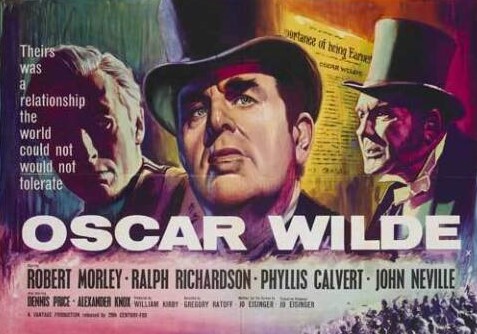
Oscar Wilde (1960) ****

You might be surprised to learn there were two Oscar Wildes. Not the famed writer and a doppelganger of course but two films on the same subject that were released in the same month. This is the low-rent version, costing a fraction of the rival The Trials of Oscar Wilde directed by Ken Hughes. It’s easy to be disdainful of the cheaper effort, with little cash available for scenery and costumes, but somehow it rises above budget limitations. Structurally, both movies focus on the trial – or in the case of The Trials of Oscar Wilde the three trials he endured – but the glossier pictures it has to be said glosses over a great deal.

While I enjoyed it at the time, I now find that in trying to make a modern martyr out of Oscar Wilde, the Ken Hughes picture built him up so much that it was difficult to find any flaw in his character. We never find out what was the actual slur the Marquis of Queensbury made on Wilde, resulting the playwright taking him to court for libel. And that version begins with Wilde and Alfred Lord Douglas (“Bosie”), son of the Marquis, already deep into their affair.

On the other hand, Oscar Wilde, the final film of Hollywood veteran director Gregory Ratoff (Intermezzo, 1939), starts at the beginning of their relationship with greater emphasis on Wilde’s practicality rather than his wit and Bosie’s (John Neville) tortured relationship with  his hypocritical father (Edward Chapman) who, while taking the moral high ground, keeps a mistress. On Wilde (Robert Morley) being described as a sodomite by the Marquis, Bosie’s desire to see his father humiliated in court verges on revenge. “You weren’t looking for a friend,” Wilde astutely tells his lover, “You were looking for a weapon.” Bosie is big on humiliation – he is the one to break the news of Wilde’s duplicity to the author’s wife (Phyllis Calvert). So determined is he on the court case that he fails to tell Wilde that his father has private detectives scouring London to find evidence.

While in court Wilde can keep the jury in stitches with his epigrams, he soon comes up against the Marquis’s formidable lawyer Sir Edward Carson (a quite stunning performance by Ralph Richardson). From Carson we learn a great deal more of Wilde’s practices, some of which nowadays would be termed grooming. Essentially, Carson paints a portrait of a predator, an older man (Wilde was 41) whose uses his wealth and wit to court many lovers, mostly aged around 20, but some as young as 16, barely the age of consent.. And when he felt his secret life was in danger of being exposed, he went so far as to pay for the passage to America of one of his lovers, Alfred Woods, to get him out of the way.

No matter that Wilde at the start can gloss over his promiscuity, complaining that Carson is misinterpreting innocent gestures of friendship, the cunning attorney soon has the author tied in knots as he wheels out one by one information regarding the various lovers.

It’s quite odd to realise that The Trials of Oscar Wilde in presenting the more accurate truth – that the author underwent three trials – fails to provide little more than a surface treatment of  the man’s real-life affairs. Oscar Wilde perhaps delves too deeply for audiences brought up to consider the author a martyr who deserves the free pass allocated all writers of genius. I found Oscar Wilde the more riveting watch because, of course, I already knew the outcome, but the sight of the famed writer, encouraged by the vengeful Bosie,  hung out to dry by his own hubris, and for a man of such wit to be outwitted in the courtroom by Carson was an exceptional watch.

Of course, the imprisonment of Wilde for the crime of being a homosexual is detestable. Even at the point this film was made homosexuality was a crime. So it’s fascinating to see how much The Trials of Oscar Wilde skirts round issues that Oscar Wilde had little problem in spelling out.

I was surprised how much I enjoyed Robert Morley’s performance. I may be wrong, but I think this was the only time he was accorded leading man status. Mostly, he was a supporting actor (The African Queen, 1951, say, or Genghis Khan, 1965) and often just playing a version of his self. Of course, he is outshone by a simply brilliant Ralph Richardson (Khartoum, 1966). John Neville (A Study in Terror, 1965) presents a more in-depth performance than in the rival picture. One-time British box office star Phyllis Calvert (The Golden Madonna, 1949) does well in a small but pivotal role. You might also spot Dennis Price (Tunes of Glory, 1960) and Alexander Knox (Mister Moses, 1965).

Lacking a budget to do much more, Gregory Ratoff sticks to the detail and draws out two superb performances, aided by a tight script by Jo Eisinger (Gilda, 1946; Cold Sweat, 1970) based on the play by Leslie and Sewell Stokes and the work of Frank Harris. As swansongs go, this is hard to beat.

Vastly underrated.

Catch it on YouTube.

NOTE: Oscar Wilde appeared in first run in Glasgow at the La Scala cinema in June 1960 one week ahead of The Trials of Oscar Wilde at the first run ABC Regal and ABC Coliseum.

Interlude (1966) ****

Kevin Billington’s debut benefitted from a brief fad for classical music soundtracks, Elvira Madigan kicking off the fashion the year before, 2001: A Space Odyssey, which opened at the same time as Interlude, trumping everything in sight. And as luck would have it, this was not the only movie about an orchestra conductor, Counterpoint with Charlton Heston released in America a couple of months before this one opened in Britain.

What makes the movie so enjoyable is that overlaying the sumptuous love story is the angst of a mistress. It’s sweetly set in wonderful British locations, riverside inns, olde worlde hotels, trendy restaurants, a few flashes of swinging London, luxurious mansions. The solid backdrop for something as fragile as romance.

There could not be two more opposites to attract, the rich Oskar Werner (Jules and Jim, 1962) in full-on arrogant mode, all dark glasses and leather gloves with enough petulance to sink a barge, and journalist Barbara Ferris (off screens since the lamentable Catch Us If You Can three years before) who lives in a bedsit with a goldfish called Rover. He drives a Rolls-Royce convertible, she a Mini. 

There are some very good touches. We first see the characters in mirrors. He plays a “concerto for wine glass and index finger.” There is the very serious British business of whether milk goes in first to a cup of tea.

The screenplay by Lee Langley and Irish playwright Hugh Leonard is sharp and often witty.  “I want to marry you,” says Ferris, before conceding, “I just don’t want to be your wife.” There is clear realization of the nature of his personality in her remark, “Instead of being what you want, I’ll be what you’ve got.”

Even when emotion is expressed there is a feeling that a lot is still suppressed. Ferris goes from high excitement to high dudgeon and carries within the seed of fear, a character who spends as much time in terror as in love. This is exacerbated when she spots of Werner’s wife, stoically played by Virginia Maskell, at the hairdressers and “all of the sudden” the wife who has existed in her imagination “has a face.”

John Cleese and Donald Sutherland have decent cameos, the former in a bit of an in-joke as a PR man wanting to get into comedy (“satire – that’s my field”), the latter as the womanizing brother of Werner’s wife.

Oddly enough, the music – Beethoven, Tchaikovsky, Mozart, Dvorak, Brahms and Rachmaninov – acts in the same manner as Easy Rider the following year, as extensive interludes to the developing drama. Perhaps it is where Dennis Hopper got the idea.

It is very rounded for a romance, the acting excellent and the undernote of despair well-wrought.

The Trials of Oscar Wilde (1960) ****

Currently occupying the top spot on Rotten Tomatoes, having replaced Paddington 2 (2017), this isn’t quite the five-star job that ranking suggests, and reflecting the era in which it was made as much as the eponymous character’s tribulations at the end of the nineteenth century, it is certainly a very fine movie. “The love that dare not speak its name” is as far as anyone goes in defining what exactly was famed writer Oscar Wilde’s crime, the word “homosexual” not permitted mention in 1960 any more than in the 1890s.

I had always been intrigued by the title, assuming it referred to a lifetime of trials, of the homosexual tortured by desire, the need to keep his preferences under wraps and to maintain an outward front of husband and father. But, in fact, it refers to the three trials which brought down Wilde. In the first he is not actually the one in the dock.

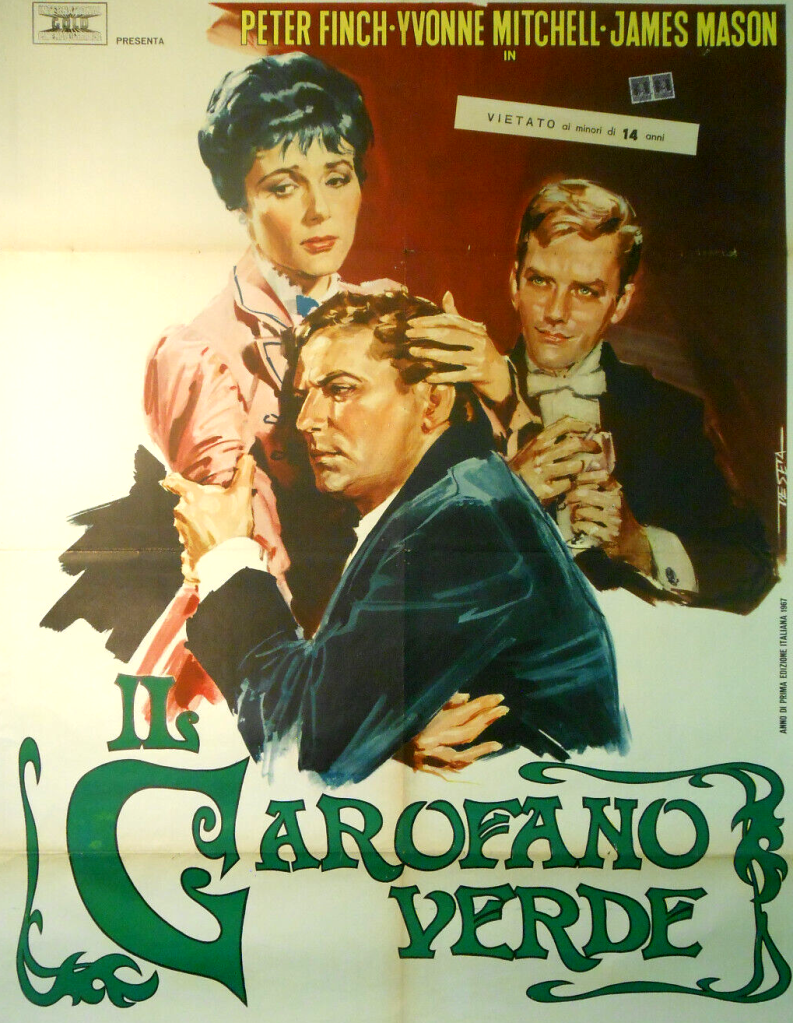
Where the British poster accentuated the shock value, foreign marketing was more discreet. It was known as “The Green Carnation” because Wilde was famed for wearing one in his lapel.

Pride of place there goes to the Marquis of Queensberry (Lionel Jeffries) – yes, the guy who invented the rules of boxing – who is defending himself against charges of slander. But when he wins that case, it is Wilde’s turn to face prison. But when the jury can’t make up his mind, the judge orders a re-trial which goes the way an outraged establishment wishes.

The problem for Oscar Wilde (Peter Finch) is that he doesn’t hide his desires under a bushel any more than he does his talent. And it’s this parading of lover Bosie, aka Lord Alfred Douglas (John Fraser), that is his undoing. And his hubris. Confronted by an enraged marquis, instead of backing down and ignoring the tittle-tattle, Wilde, at the height of his fame – novel The Picture of Dorian Gray and theatrical masterpieces like The Importance of Being Earnest triggers his downfall by accusing the nobleman of slander.

The beloved Oscar Wilde, full of clever retorts and trademark epigrammatic wit, holds sway in the first half, the derided version, somewhat baffled at the turn of events, takes over in the second half. Apart from his good looks, Bosie is not the kind of tragic and charismatic character you would expect to be the cause of such a titanic fall from grace. He is spoiled, extravagant, weak.

The initial angst is all in the mind of Wilde’s wife Constance (Yvonne Mitchell), left to dine alone while her husband is out on the town or in another man’s bed. Another woman, she explains, she could deal with, but not a man. Apart from his infidelity, theirs appears a strong enough relationship, he has fathered two children after all, is affectionate with his wife and adoring of his children, spending enough time with them to come up with one of his famous tales, The Happy Prince.

The movies were full of captivating males who had been led astray by another woman, so, to some extent, we are conditioned to accept the same behavior from a homosexual. But that is now. In 1960 this would have been as dangerous a project as you could imagine, so it’s to director Ken Hughes’ (Chitty Chitty Bang Bang, 1968) merit that he shies away from very little, pronouncing the tainted word the one exception.

It’s a marvellous evocation of the period, replete with hansom cabs and high society having the time of its life, and where everyone, even the marquis is the presence of a superior royal, knows his place. Wilde’s real crime was not knowing his place, hoping to skate past the growing whispers on talent alone, as if his crime could be regarded as one of the sparkling fictions he created. And he would probably have got away with it, writing a different chapter in the history of the suppressed homosexual, had he not taken the marquis to court.

Peter Finch (The Legend of Lylah Clare, 1968) – who won a Bafta for his performance – is exceptionally impressive as a man brought to his knees by compulsion. From the talk of the town to what in these parts we’d call the “talk of the steamie,” he maintains a supreme dignity, only surrendering to inner pain when drunk.

Lionel Jeffries (First Men in the Moon, 1964), whose forte was usually the absent-minded professor, is the surprising pick of the rest of the cast as the vindictive, apoplectic marquis. Yvonne Mitchell (Genghis Khan, 1965), scarcely permitted to show grief at the changes in her fortune, is convincing as the loving wife. But the other characters are provided with less material. James Mason (Age of Consent, 1969) has a cameo.

Ken Hughes holds back any sense of outrage – leaving that to the discerning audience – and presents a historical drama with the emphasis on reality. You won’t be able to watch this without almost screaming at the screen at the vainglorious characters who seek to deny sexuality.  

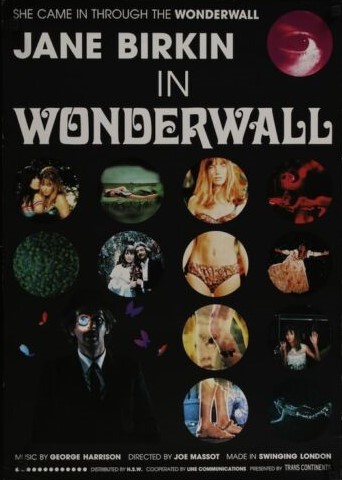
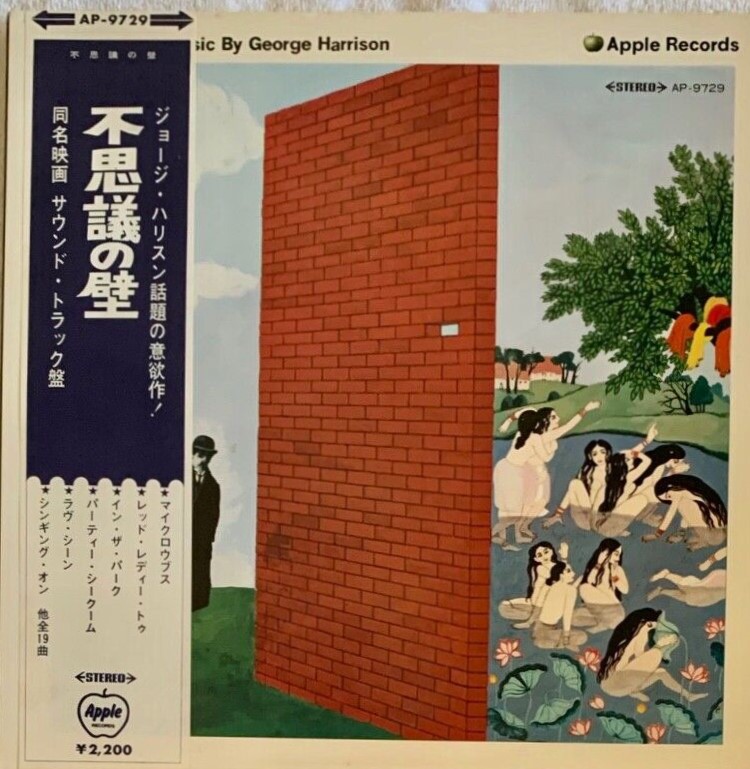
Wonderwall (1968) **

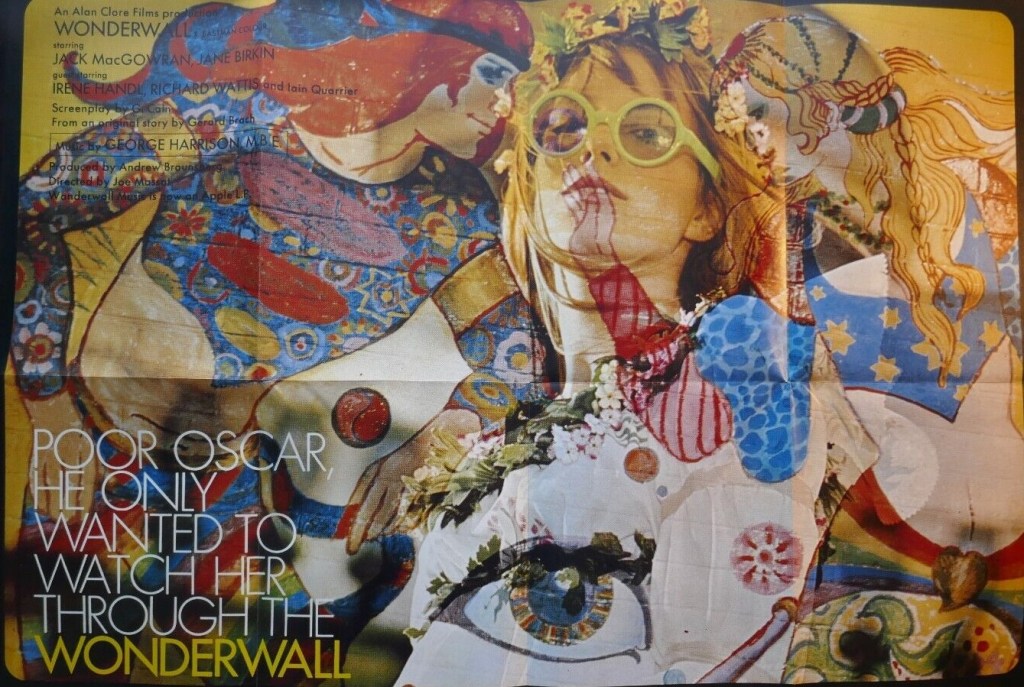
While psychedelic forays were all the rage in the late 1960s it’s hard to see how that excuses a movie that appears to exalt a peeping tom. Or at the very least appear to give him a free pass because he’s a barmy scentist and, more likely, because he saves the object of his spying from suicide. And you have to wonder what prompted George Harrison (at the time still a Beatle) to volunteer to provide the soundtrack.

Of course, the title has been popularised by the catchy Oasis song and star Jane Birkin achieved notoriety also on the musical front when her single “Je T’Aime” was banned by the BBC the following year (censorship having the opposite effect and sending it to the top of the charts, as any good marketing analyst could have predicted).

But there’s not much going on here that purports to be narrative and the psychedelics and fantasy sequences fail to remove discomfort over the context.

Professor Collins ( a wild-haired Jack MacGowran) spends his days glued to a microscope studying amoebas and perhaps in a nod to other less than savoury literary characters (Lolita, 1962 and The Collector, 1965, in case you haven’t guessed) collects butterflies and spends the evening in a chaotic apartment stacked high with old magazines (their content, given his later behavior, not what you might expect).

Disturbed by the noise of a party upstairs, he throws something at the wall, knocks something loose and finds a hole-sized light streaming into the darkness of his apartment. With nothing else to keep himself occupied, he peers through and is entranced by the long legs of model Penny Lane (Jane Birkin). Soon, he is checking out a photo shoot, a party, Penny making love to boyfriend (Iain Quarrier), the model rejecting her lover’s suggestions of a threesome with another equally lithe model (Anita Pallenberg), and later discovering she is pregnant.

In between, Collins has various fantasies about challenging the boyfriend to a duel. Initially, this is in the formal manner, with duelling pistols or rapiers, but soon takes the form of giant fountain pens or giant cigarettes. Occasionally, there’s a butterfly motif. Once, he imagines Penny as a mermaid swimming among the amoebas. His dead mother appears in a puff of smoke to tell him off.

And he didn’t get to being a professor without showing some initiative. So when he realises that a tiny hole limits his viewing pleasure, he starts to knock the wall down and watch the woman in widescreen, though somehow the wall is made of glass, thus preventing him intruding, and equally somehow the neighbors never seem to notice.

Of course, you could take it all as fantasy, that a lonely old man just wants to befriend a young woman, as if there was anything less creepy about that.

Naturally, if you’re inclined to ignore the creepiness, you might be tempted to start to praise the psychedelic, but I’m not sure that’s a very good starting point. If you’re into sitar music or George Harrison you will probably enjoy the score.

Jack MacGowran (Age of Consent, 1969) didn’t seem to feel he needed to do any more with the character than dress him as an eccentric. There’s certainly no sense of shame. If anything, thanks to the ending, he is afforded redemption. Jane Birkin (Blow-Up, 1966) isn’t called upon to do anything except appear soulful, and, of course, from time to time, nude. British character actors like Irene Handl and Richard Wattis appear in stock roles.

Joe Massot (The Song Remains the Same, 1976) directed and Gerard Brach (Repulsion, 1965) and Guillermo Cain (Vanishing Point, 1971) wrote the screenplay. But while Massot was a debutant, Brach’s involvement would have indicated something perhaps creepier still but with a more relevant outcome. A case study on how this got the green light in the first place would be most appreciated.

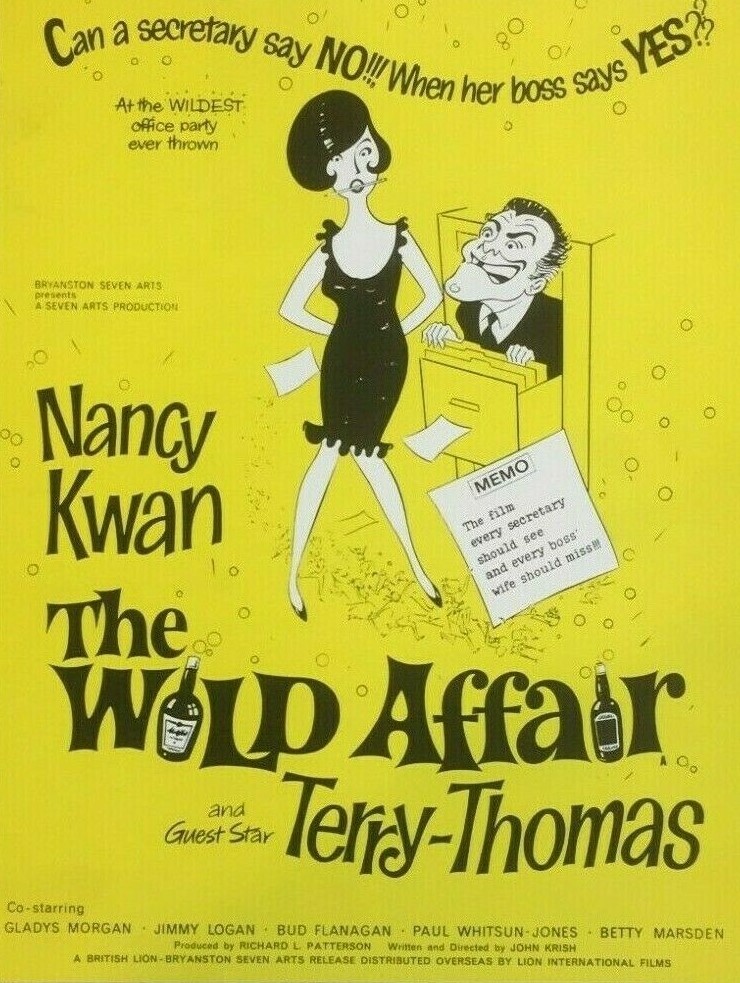
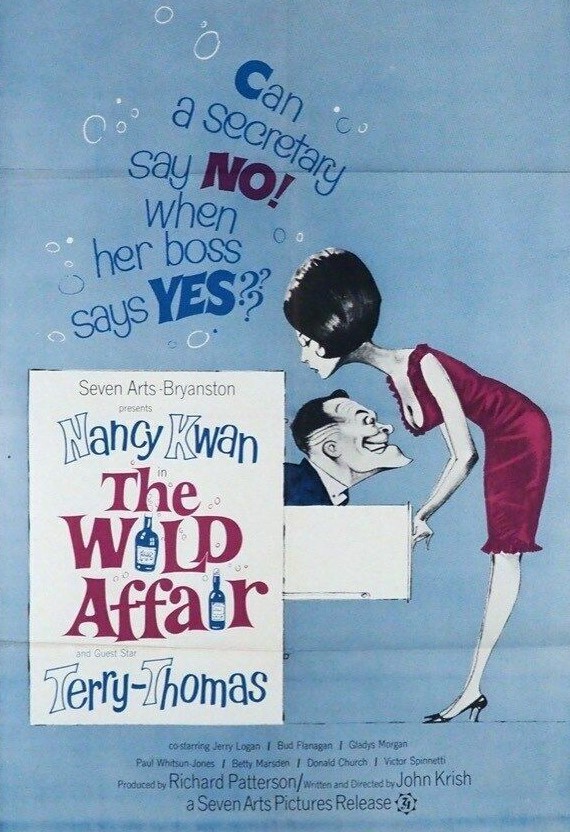
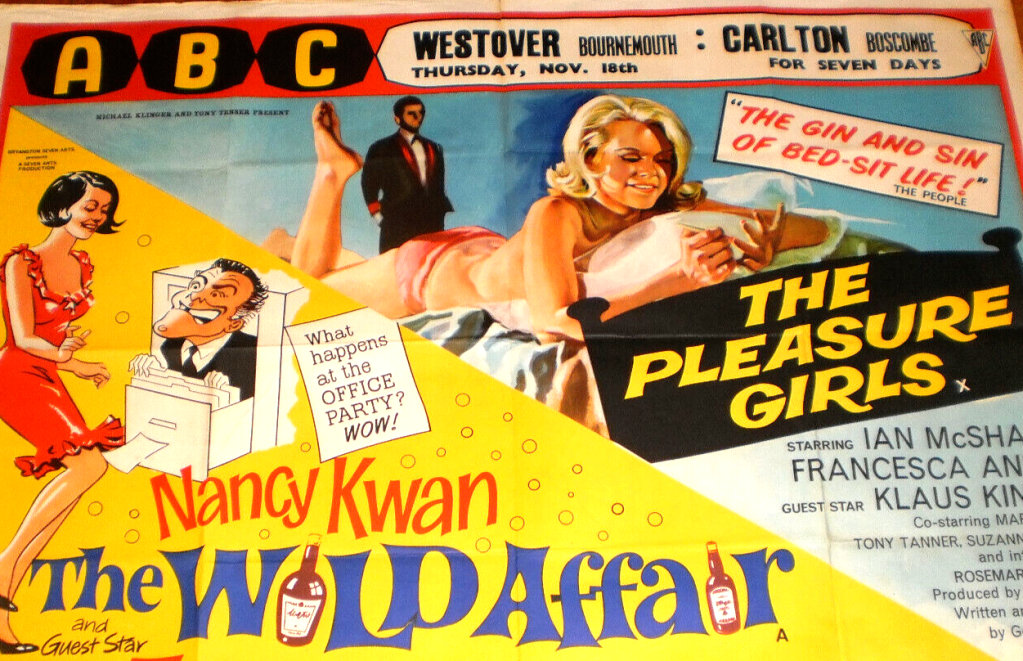
The Wild Affair (1965) ***

An unexpected gender equality twist as fiancée Marjory (Nancy Kwan) decides to embark on the equivalent of a stag party after seeing the state it left potential husband in. Although the full-scale Hen Party was a few decades away, Britain had given way to the Permissive Society, so, theoretically at least, a young lass on the brink of marriage could have a wild fling and with her last day at work coinciding with the office Xmas party she does her best.

Predatory men, of course, have a sixth sense regarding available women so there’s no shortage of suitors and she is egged-on by an alter-ego she calls Sandra who tut-tuts at her in the mirror when she fails to let herself go. Meanwhile, boyfriend Andy (Donald Churchill) has decided she will be bored silly at the party and plans to whisk her away for Xmas shopping.

The roster of potential lady-killers is headed by boss Godfrey (Terry-Thomas) forever maneuvring her into the confines of his office. Scottish salesman Craig (Jimmy Logan) wines and dines her in a private room. The company’s in-house designer Quentin (Victor Spinetti) tries to seduce by spouting poetry by D.H. Lawrence.

An office party being the kind of occasion where emotions run wild, tempers fray and home truths spill out, we discover Marjory is not the only one with romance in mind. An older secretary Mavis (Betty Marsden), lip perpetually a-quiver, more or less announces that Godfrey is the love of her life, ignoring, at least for the moment, that he has already embarked on an affair with model Monica (Joyce Blair).

Marjory switches from staid housewife-to-be (she has to quit her job on getting married, as was standard at that time) to exploring her inner Sandra, submitting to a make-over by Quentin that turns her into a vamp. With clothes by Mary Quant and a bob from Vidal Sassoon, she would have been quite the eye-catching catch had she remained still long enough for anyone to catch her. However, this being a comedy, and Marjory/Sandra an innocent among wolves much of the running time is spent getting her out of situations of her own making.

But although humor is to the fore, you get the sense this is a ground-breaking film desperate to break out into something more serious. Marjory challenges the notion that marriage ended careers, that women had to make do with sitting at home doing housework waiting for husband to return, in a life devoid of excitement or development.

If this is her idea of beginning married life, you certainly get the idea that her marriage will have a more feminist tinge than Andy might be expecting. The Sandra alter-ego, initially expressed as a flighty piece, soon develops into inner doubt, channeling a potential rebel. In some respects, this is standard stuff, middle-class girl sensing opportunity only to be taken advantage of and certainly this particular year appeared to be filled with characters on the cusp of change and/or consequence – Four in the Morning (1965), The Pleasure Girls (1965), The Hallelujah Trail (1965), Georgy Girl (1965), and you might even include Doctor Zhivago (1965). Female characters later in the decade would have fewer qualms.

So it has a time capsule feel, full of surreptitious suggestion. You get the impression that when Marjory quashes Sandra it’s only a temporary solution and that questions that remain unanswered will pop up at a later stage.

The ploy of the alter-ego in the mirror allows writer-director John Krish (Unearthly Stranger, 1963) to seed the comedy with more serious elements and ask questions that might be uppermost in the female mind. He throws in the occasional surreal moment such as the husband being trapped in a phone booth by a drunk (Frank Finlay) or an innovative way to stifle rising chaotic emotions. But some scenes could do with editing, namely the makeover scene which relies overmuch on reaction shots.

Nancy Kwan at last fulfils the potential shown in The World of Suzie Wong (1960), portraying a more complex character than the free-spirited Tamahine (1963). Terry-Thomas (Arabella, 1967) does too much mugging and his well of double-takes runs dry for this to be considered one of his better works. Joyce Blair (Be My Guest, 1965) makes the most of a man-eater role.

Silent American film superstar Bessie Love puts in an appearance and Scottish comedian Jimmy Logan is convincing in a dramatic part. Frank Finlay (A Study in Terror, 1965) is an inspired drunk and English comic Bud Flanagan has a bit part. Krish based the script on a  novel by William Samsom. If you want to learn more about “The Permissive Society,” check out a course run by the University of York, which dates it starting in 1957.

Strictly matinee material until you notice the undertones.

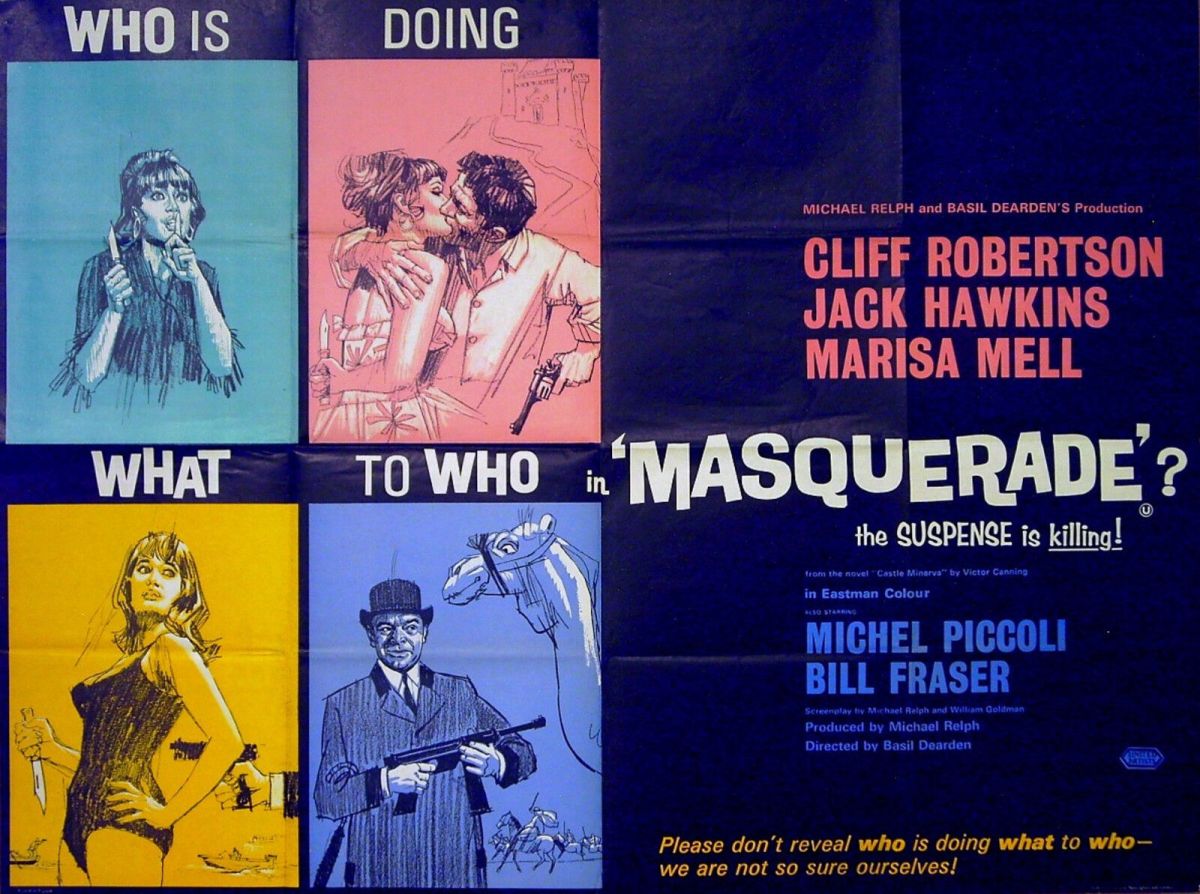
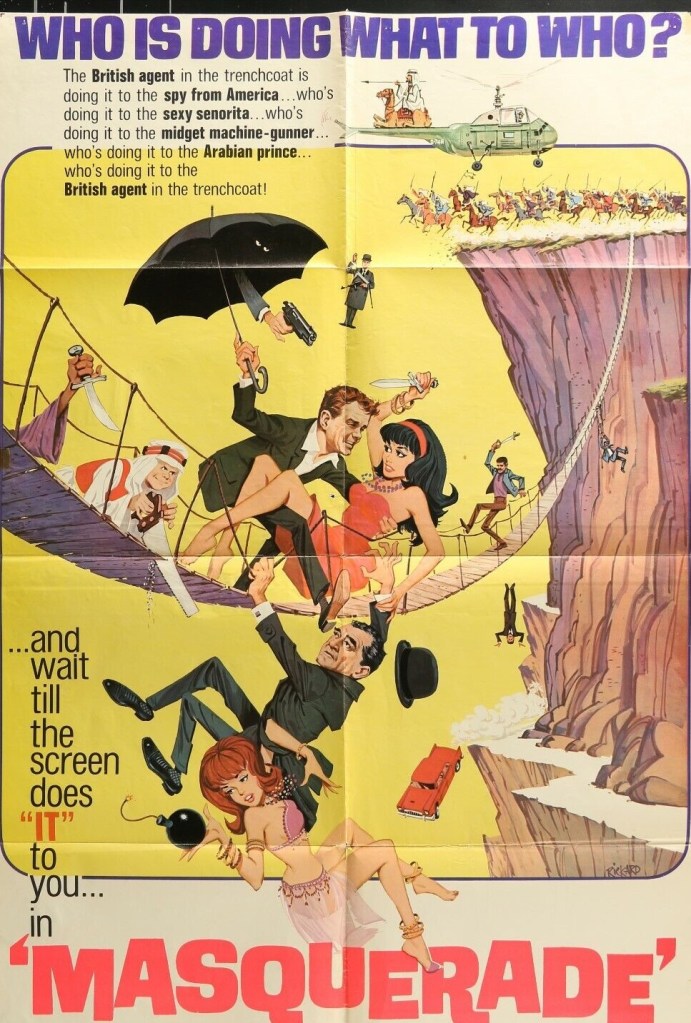
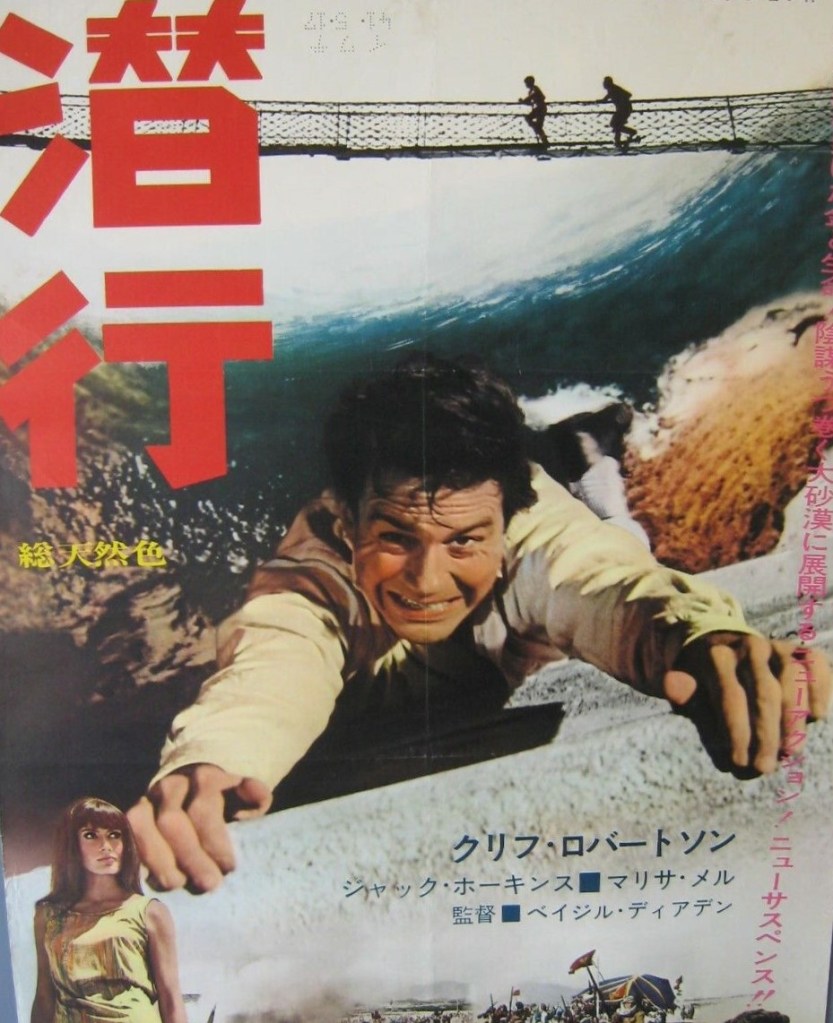
Masquerade (1965) ***

Made just before director Basil Dearden embarked on Khartoum (1965), this is probably best-known these days for being screenwriter – and ace self-publicist – William Goldman’s first credit. It’s based on Castle Minerva by Victor Canning whose previous filmed books included The Golden Salamander (1950) with Trevor Howard, The Venetian Bird (1952)  with Richard Todd, and The House of the Seven Hawks (1959) with Robert Taylor.

I’d like to say this is a self-aware thriller with spy and comedic elements but it veers awful close to either a cult film or a mess. Basic story has Frazer (Cliff Robertson) hired by former wartime commander and now British intelligence agent Col Drexel (Jack Hawkins) to look after an Arab princeling who has been kidnapped by the British (so much for Brits always being on the side of the angels) to help seal an oil concession in the Gulf.

Theoretically, the kidnapping is for the teenager’s own good, to prevent him being assassinated before he ascends to the throne…see it’s getting awfully complicated already. Anyway, it turns out he actually has been kidnapped by Drexel who has turned rogue in order to fund his retirement. The boy is held in some kind of fortress/castle in Spain and then another more sinister one.

Frazer meantime falls for the seductive charms of Sophie (Marisa Mell) who he thinks is a smuggler intent on stealing his boat but a) is part of the kidnap gang and b) in love with him enough to help him escape when he in turn is captured.

Did I mention the film also included a circus, a clown act, a gunfight on a dam, characters left dangling on a rope bridge, a lady in red, a balancing act along a perilous ledge, entrapment in a wine tanker (huh?) and an animal cage (double huh?), a vulture, men in bowler hats…

It is enlivened by visual gags – ultra-large footprints (from somebody wearing flippers). The dialogue sparkles as when the prince, with an overactive entitlement gland, says, “I am practically divine,” to which Hawkins deadpans “Your Highness, you are irresistible.” Add to that various cliché-twisting scenes – the double-dealing Sophie now overcome by love, says to Drexel: “Ask me anything you want and I will tell you the truth,” but every question he asks solicits the response, “I don’t know.” Then, imprisoned in a cage, after protracted cobbling together of lengths of bamboo to steal keys they turn out to be the wrong keys.

Throw in: British propriety  – Frazer’s  substantial fee for risking his life is reduced to a miserable sum once tax has been deducted; and a superb Arab charge on horseback with tracking cameras, either a rehearsal for Khartoum or the scene that got Dearden the gig.

Actually, the more I write about it the more fun it sounds and I wish it were, but it does not quite gel. Cliff Robertson (The Devil’s Brigade, 1968) and Marisa Mell (Danger: Diabolik, 1968) don’t convince – Robertson talks through gritted teeth without suggesting he has much inner grit – although Jack Hawkins (The Third Secret, 1964) and other British stalwarts like Charles Gray (The Devil Rides Out, 1968) and Bill Fraser (The Best House in London, 1969) and Frenchman Michel Piccoli (Danger: Diabolik) deliver the goods. It should have been a straightforward three-star job or – if qualifying as a cult – in the five-star class. It is definitely not an outright stinker. Perhaps best filed under “curiosity.”

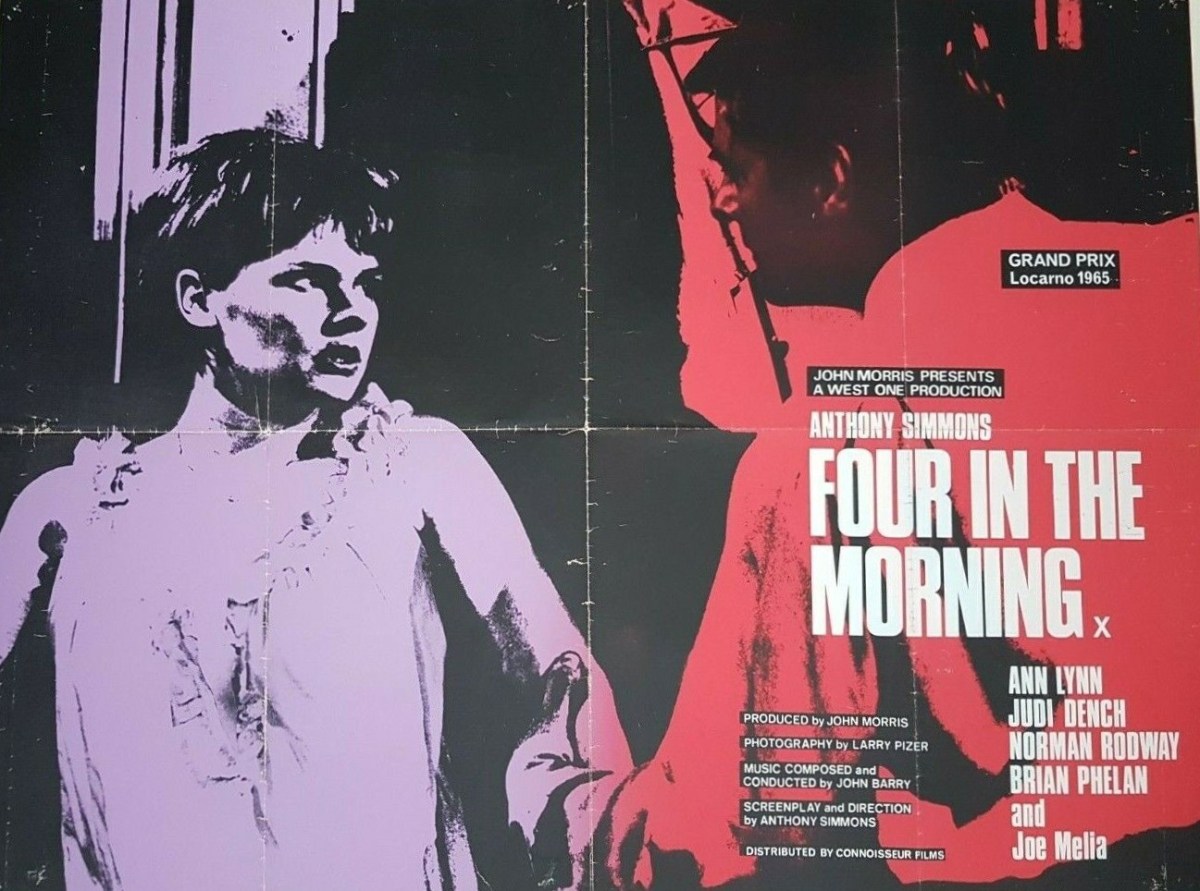
Four in the Morning (1965) ****

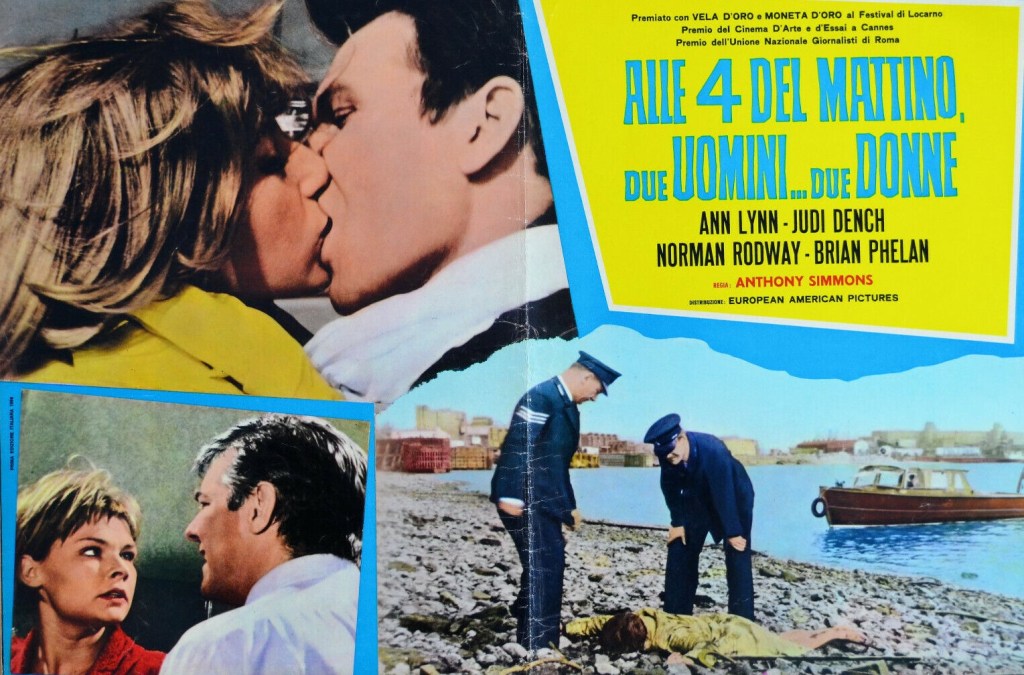
Directors learned this early that you only had to point the camera at Judi Dench (Oscar winner for Shakespeare in Love, 1998, but here in her first starring role) and even without the benefit of dialog she will always be compelling. And that’s just as well because this is one of those elliptical movies that were in fashion in the wake of Last Year in Marienbad (1960).

Less twisty and self-conscious for sure two apparently unconnected tales are conjoined by a mysterious drowning in the Thames. And this isn’t tourist London, either, but the working version, a city waking up, famed fruit and flower markets coming to life, ferryboat teaming with passengers, the skyline dominated by tiny dots setting off for the office.

In fact, the picture draws its power from three women, the aforementioned Dench as a young woman smothered by motherhood, marriage disintegrating, Ann Lynn (The System/The Girl-Getters, 1965) who breaks out of the supporting role cage where her character is generally fixed from the start to take advantage of a name-above-the-title role as a reticent lover to explore a gamut of emotions. Last of the trio is the drowned woman, whose callous treatment dominates the action.

If you ever wanted to find out what happens to a drownee here’s your chance. Unceremoniously dragged from the shore, transported to a mortuary in a coffin, head laid on a block of wood, clothes cut off, naked body sluiced with water, fingerprints taken, stored in a refrigerator, indignity run riot, it’s a harrowing sight.

As if to compound the movie’s arthouse sensibilities – and it won big at various film festivals – the characters remain anonymous. The wife (Judi Dench), stuck at home with a mewling teething infant, is disconcerted to find husband (Norman Rodway) has returned from a night on the town with  buddy (Joe Melia) in tow. They want to continue partying, waking up wife and baby, resulting in non-stop argument.

Divorced manager of an upmarket bar (Ann Lynn) tries to put off a boyfriend (Brian Phelan) pestering her for a date. Eventually, she relents and they embark on an initially unsatisfying date before she finally comes alive when he steals a speedboat and they power upriver. Even when passion takes over she remains wary of commitment.

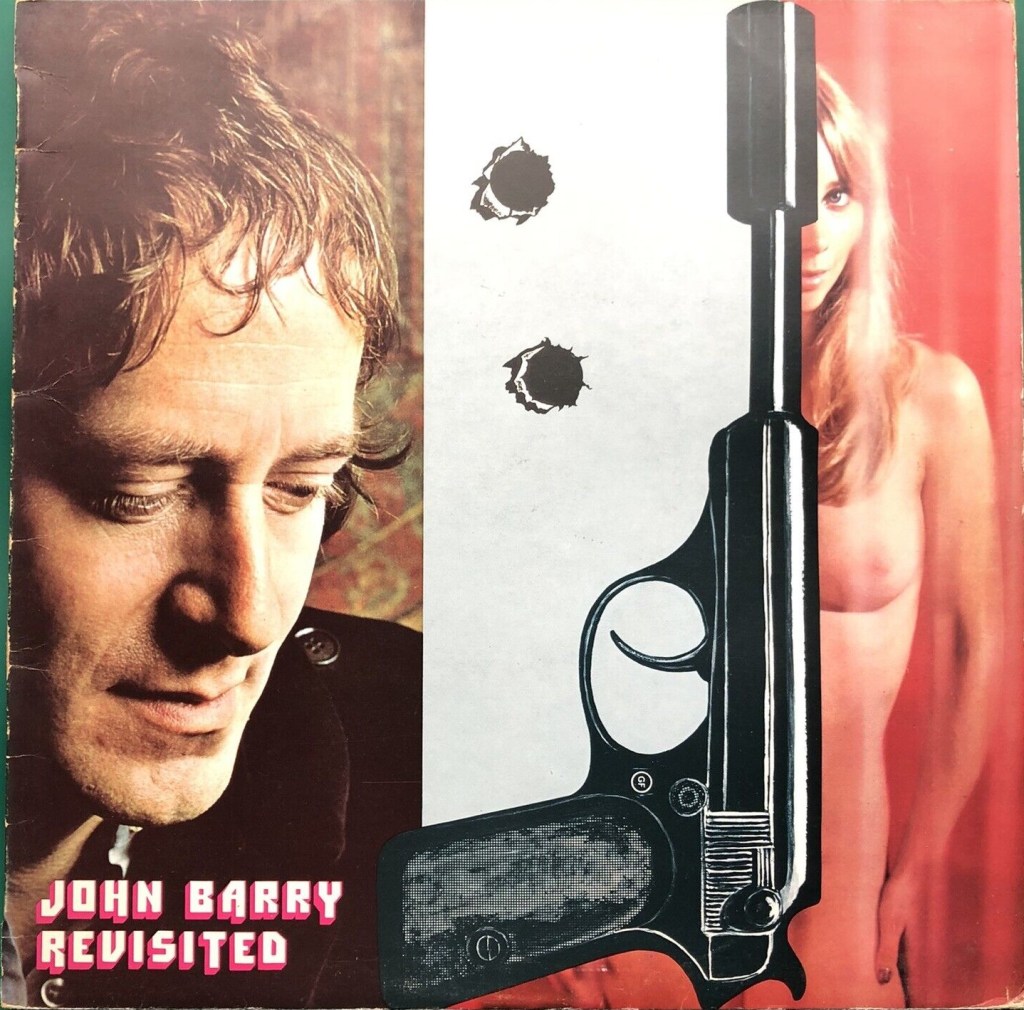
I chose this purely on the strength of the score. I first heard the theme on this album when I was in my teens. Fearing that my parents might veto the purchase because of the nudity on the cover – and since the record player was in the lounge – I showed suprising nous for a teenager, and stuck sticky tape over the offending bits. Of course, I then had to come up with a reason why there would be brown sticky tape on the album cover.

Beyond the to-and-fro of each couple’s situation, there’s little in the way of story, but the dialog is refreshing as it winds back and forth through a variety of emotions, including playfulness, a genuine sense that this is not about scoring points but exploring characters, each development the consequence of action however minimal. The mood is often bleak but always ruminative, a sense that emotions could tip at the touch of a switch, nothing quite defined, except that angst one way or another is going to hold sway.

Most British kitchen sink dramas of the period took place up north, not in the country’s capital, and the wife is too young to expect to be so hemmed in by motherhood, unable to grasp, what with the changing times, that she has still contracted, through marriage, to carry the burden of child-rearing.

The sting in the tale is that since the drowned woman is never identified that she turns out to be one or other of the women, my bet being on the wife, who seems at the end of her tether. This might have been more easily tagged as a couple of one-act plays except for the concentration on the drowning and the focus on girlfriend and suitor exploring various parts of the capital at its least tourist-y. But it’s almost a ghostly city, hardly the location for romance.

Judi Dench is superb – she won the Bafta that year as the Most Promising Newcomer – as she captures a character twisting and turning in a situation she never expected to be so depressing. But Ann Lynn, whose career did not have as much upward mobility, is equally expressive as she changes from morose to excited until heightened romance is sufficient to kill off any expectation of fulfilment. Norman Rodway (The Penthouse, 1967), Joe Melia (Modesty Blaise, 1966) and Brian Phelan (A High Wind in Jamaica, 1965) has less room for  development, tending to be more focused on pleasure than emotion.

This didn’t open too many doors for writer-director Anthony Simmons (Your Money or Your Wife, 1960) and he didn’t get behind a camera for another eight years and only made four films in total. Quite why he was so ignored remains a mystery because this is a haunting piece of work, with an excellent script. John Barry (The Lion in Winter, 1968) wrote evocative score.  

Worth seeing for Dench’s performance alone.

The System / The Girl-Getters (1964) ***

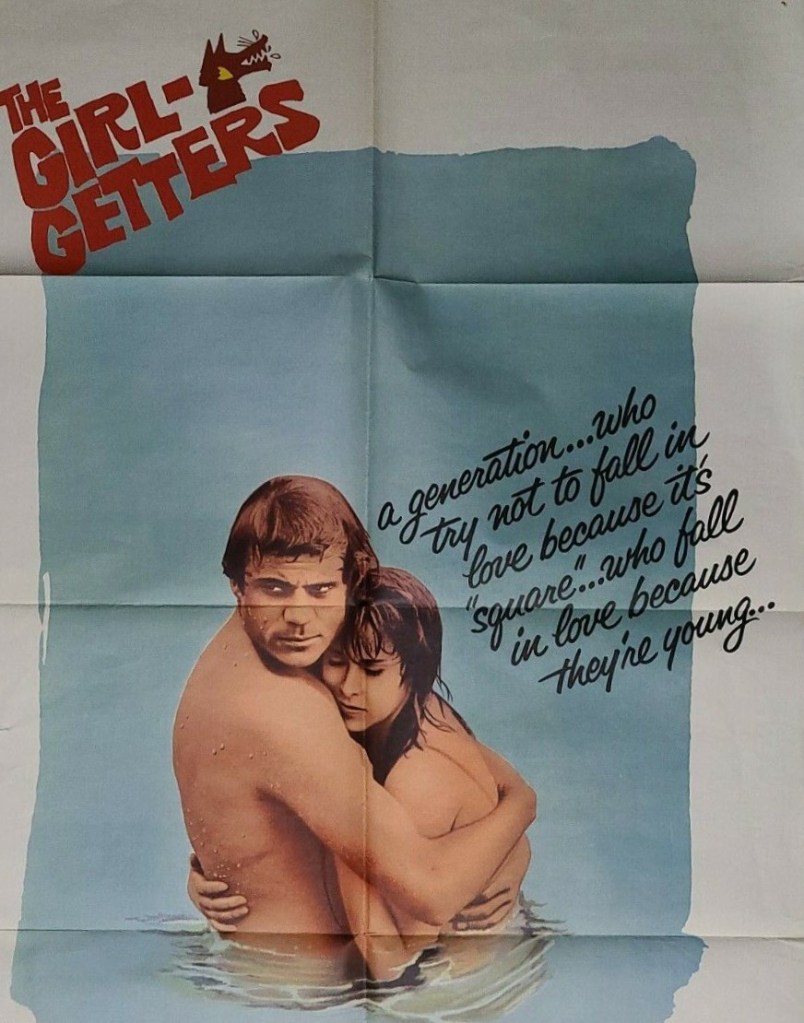
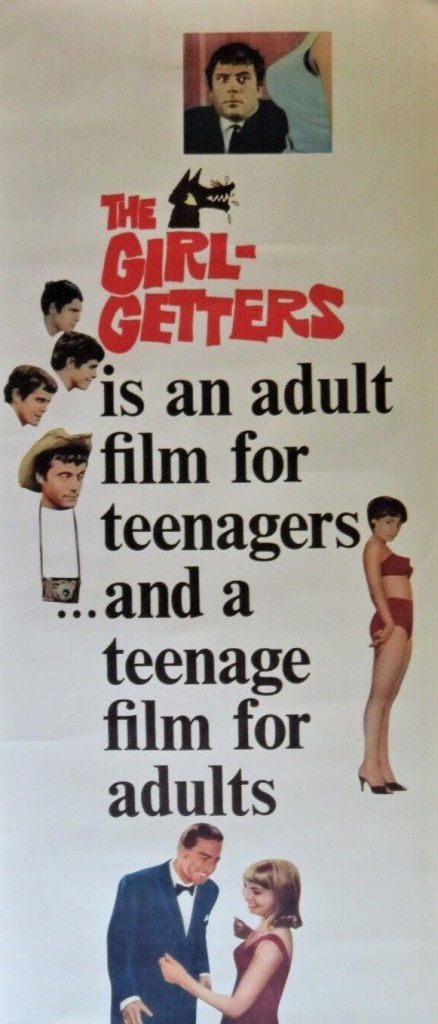
Surprisingly subtle performance from Oliver Reed (Hannibal Brooks, 1968), eschewing the trademark quick inhalation of breath and steely glare, as leader of a gang seducing impressionable young girls during the summer season in an English seaside town.  Surprisingly artistic touches – swipes, montage, a meet-cute involved blowing bubbles – from the more usually heavy-handed director Michael Winner (Hannibal Brooks). Surprising amount of rising talent including cinematographer Nicolas Roeg (Don’t Look Now, 1971).

And unlike the previous The Damned / Those Are the Damned (1963), the impromptu gang headed by Tinker (Oliver Reed) is not hell-bent on violence and destruction, and the various seducers, thankfully, could hardly be described as sexual predators. Young girls away on their own for the first time, disappointed not to find the love of their lives,  are still happy to settle for a holiday affair.

The American title is more appropriate and only an overbearing parent would dream of marketing it – effectively from the male perspective – as girls entering perilous territory rather than with the lightness of tourist romance a la The Pleasure Seekers out the same year. The “system,” a misnomer if ever there was one, involves the guys finding various ways of getting tourists’ addresses – Tinker as a beach photographer has the advantage here – in order to seduce them.

Sometimes the plan goes wrong and a girl gets pregnant leaving Nidge (John Alderton) not only abandoning the frolics but doing the decent thing by proposing. Oddly, there’s no sense of the guys competing with each other for the biggest tally of notches on a bed-post; in fact they’re a democratic bunch, dividing up the potential prospects equally.  Equally oddly, I guess, none of the women come across as virgins, no first-timer angst.

Tinker, who spends most of his time avoiding telling compliant girls what they are desperate to hear, i.e that he is in love with them and that the holiday affair might turn into something more permanent, falls for posh model Nicola (Jane Merrow).

There is some, for the time, risqué material, a view in very long shot of a nude woman, a girl in bra and panties (getting dressed after sex, so perhaps where Roeg got the idea from for the famed montage in Don’t Look Now), a brutal fight between rival photographers, camera smashing on the stairs. But there’s also Tinker’s humiliation by the jet set as he tries to fit in, thumped at tennis, and dumped by the married lover he ignores during the season. There’s surprising inventiveness, a demonic parade where effigies of bride and groom are burned on a pyre, a soulful scene of a bubble salesman blowing bubbles on a deserted beach at night.

The twist is of course that some girls come to the seaside town to find boys from whom they want no commitment, instead just the enjoyment of a casual fling. Should a man like Tinker happy to fall in love, more fool he.

Naturally, with a film aimed at the young crowd, there are snatches of pop performers – the Rockin’ Berries the most prominent – and a rock arrangement of Khachaturyan’s Sabre Dance that would four years later become, for someone else, a hit single.

Oliver Reed proves very engaging, especially when in playful mode, benefitting from lengthy screen time rather than being forced into a supporting actor’s scene-stealing. Jane Merrow (The Lion in Winter, 1968), excellent as the self-aware boy-getter, heads a raft of rising talent that includes David Hemmings (Blow-Up, 1966), almost unrecognisable with a side parting rather than the trademark mop of hair, and really a bystander here. John Alderton (Hannibal Brooks) is also permitted more artistic leeway, and takes it, rather than the comedic gurning of later years.

Look out for Julia Foster (Half a Sixpence, 1967), Barbara Ferris (Interlude, 1968), and Ann Lynn (Baby Love, 1969). Even Harry Andrews (The Hill, 1965) tones down his usual screen persona.

Considerably more thoughtful and visually interesting – and occasionally playful, for goodness sake – than anything else Winner produced during the decade. A good script by Peter Draper on his screen debut makes its points without either being too clever or too forceful.   

Discover WordPress

A daily selection of the best content published on WordPress, collected for you by humans who love to read.

The Atavist Magazine

by Brian Hannan

WordPress.com News

The latest news on WordPress.com and the WordPress community.