You might well enjoy this if a) you are in a very good mood, b) you love psychedelia, Pop Art and the Swinging Sixties, c) you fancy a spy film spoof or more likely d) you are a big fan of one or all concerned. Otherwise, you might be well advised to steer clear because it either takes the mickey out of a number of genres, not just espionage, or plays merry hell with narrative and character and is only loosely based on the source material by Peter O’Donnell.
Bear in mind it originated in a comic strip – later turned into a series of novels – that had more in common with the likes of Danger: Diabolik than the more straightlaced adventures emanating from DC Comics or Marvel. In particular, Modesty had a neat habit of distracting the villains by appearing topless in moments of crisis – a trick adopted in movies like 100 Rifles (1969) and El Condor (1970).
Fans of the comic strip/book may have been left indignant by the audacity of the filmmakers to introduce romance between Modesty and her sidekick Willie Gavin since in the book their relationship was strictly platonic. There was no place, in either comic strip or book, for the musical numbers that pepper the movie. And – check out The Swinger (1966) – for the notion of a character acting out a fictionalized version of herself.
You should be aware that Modesty is a very rich version of the gentleman sleuth, an idea that belonged to the old school, of a person, such as The Saint, bored with wealth, who takes on dangerous assignments in the eternal battle between good and evil.
Anyways, on with the story.
Modesty Blaise (Monica Vitti) is hired by the British government in the shape of MI5 chief Sir Gerald Tarrant (Harry Andrews), in return for immunity for her previous crimes, to deliver a secret shipment of diamonds, part-payment for oil imports, to Sheik Abu Tahir (Clive Revill). Modesty happens to be the sheik’s adopted daughter. Meanwhile, criminal mastermind Gabriel (Dirk Bogarde), believed to be dead, has his eyes on the consignment.
Meanwhile (again), Modesty upsets current lover Hagen (Michael Craig), Tarrant’s aide, by hooking up with old flame Willie Garvin (Terence Stamp). Meanwhile (again again), Garvin hooks up with another of his old flames, magician’s assistant Nicole (Tina Marquand), who has information on Gabriel.
Various assassins employing a variety of methods are sent to kill Modesty so a good chunk of the picture is her avoiding her demise. Gabriel is a pretty touchy employer, so upset by failure that he assigns his Amazonian bodyguard Mrs Fothergill (Rosella Falk) to eliminate all such assassins. Gabriel, however, is something of a contradiction, very sensitive to violence. And just in case you are not keeping up with the plot, conveniently, the bulk of the conversations between Tarrant and his superior (Alexander Knox) will fill you in.
Through a whole bunch of clever maneuvers on Gabriel’s part, Modesty and Willie are forced to steal the diamonds themselves. And, meanwhile, Hagen is on their tail, infuriated at being jilted.
In between the umpteen shifts in plot, which basically lurches like a ship in a storm, the screen is ablaze with color. Nobody complained much when Raquel Welch found it necessary to change her bikini ever few seconds, or that a musical required continuous costume changes, and Modesty here seems to have fallen into the same pattern, the changes in outfit often so swift you imagine she has a disorder.
And be warned, this is a poster film for Pop Art, so if it’s not clothes that are being swapped, it’s décor. You might put Terence Stamp’s blond barnet in the discordant category. You can’t really complain about the plot because espionage storylines are usually something of a conjuring trick with the impossible little more than a standard mission. There’s much to enjoy if you’re of a mind and subscribe to one of the four ideas outlined in the opening paragraph and like the idea of the otherwise critical darling Joseph Losey (Accident, 1967) giving way to stylistic overkill.
Monica Vitti (Girl with a Pistol, 1968) inhabits the role with the necessary verve though Terence Stamp (The Collector, 1963) looks as if he has walked into a spoof and Dirk Bogarde (H.M.S. Defiant / Damn the Defiant!) appears still in experimental mode, having dumped the British matinee idol, unsure of what his screen persona should be. Evan Jones (Funeral in Berlin, 1966) is generally to be blamed/praised for the screenplay.
A movie for which the word confection was invented.
Hungarian Andre de Toth’s somewhat cavalier career had become ultra-cavalier during the 1960s. Best known for westerns such as Ramrod (1947) with Joel McCrea, Springfield Rifle (1952) starring Gary Cooper and The Indian Fighter (1955) headlined by Kirk Douglas plus House of Wax (1953), he was not, you might have imagined, riding high in the critical stakes. Hollywood considered him a journeyman. Esteemed French magazine Cahiers du Cinema, which had championed Hitchcock in the face of mainstream indifference, believed otherwise and interviewed him for a 1967 issue.
He might have been the name of everyone’s lips for more hard-won commercial reasons had attempts in the late 1950s come to fruition of filming the Ian Fleming portfolio beginning with Dr No. Instead, he was deemed a spent force and during the ensuing decade limited to only four films: Man on a String (1960) and the Italian-funded Morgan The Pirate (1960), The Mongols (1961) and Gold for the Caesars (1963).
The Fleming enterprise had put him into the orbit of Harry Saltzman which led to a producing gig on Billion Dollar Brain (1966). Saltzman was also involved in The Deadly Patrol – the basis of Play Dirty – with French director Rene Clement (Rider on the Rain, 1970). According to de Toth, Saltzman wanted to elevate himself in movie circles. He “looked down on the Bond pictures” and wanted to make more serious movies.
And the pair clashed on style. “Genteel Rene wanted to make ‘a poetry of war.’ Harry wanted blazing guns and roaring tanks.” Saltzman feared Clement’s version “was going to be some kind of art movie.”
Play Dirty was originally set to be shot in Israel – even though insurance was impossible – as a favor to Arthur Krim, head honcho at United Artists which was providing the finance. In the end filming was switched to Spain, even though neither Saltzman nor Clement was familiar with the terrain of Almeria, and the reality fell far short of the Lawrence of Arabia landscape both envisaged.
De Toth, by now part of the Saltzman entourage, was again assigned production duties with a new script to be written by de Toth, John McGrath (Billion Dollar Brain) and Melvyn Bragg (Isadora, 1968) as long as the credits made room for Lotte Colin, Saltzman’s mother-in-law. Shuttling pages to Saltzman, de Toth had little conviction the revised screenplay was being passed on to the Frenchman.
Michael Caine, already contractually committed, was keen to make a movie “good, bad or indifferent” with Clement. Richard Harris, on a salary of £150,000, pulled out of the role of Capt Leach after script rewrites eliminated four of his major scenes. “I wasn’t going to play second fiddle to Caine,” raged Harris. (Nigel Davenport, originally in a supporting role, was upgraded to take his place). Caine didn’t like the script. But it was either go ahead or Saltzman lose out on all the money already spent. Sets were built with still no guarantee from Clement that he would actually turn up.
The inducement of receiving the final chunk of his salary, payable on completion of the picture, did the trick. At first Clement appeared fully committed, altering the script, and “observant and meticulous about details.” But soon mere tinkering escalated into demanding to “revamp the set, find new locations maybe in North Africa; in short, shoot another film.” When de Toth turned up on set, Clement vanished. Then the director went sick but refused to admit a doctor to his hotel room. A three-day enforced hiatus ended after De Toth was subjected to a barrage of abuse down the telephone by Saltzman and then instructed to get on the set and start shooting.
“It was a strange way to get the directorial assignment,” noted de Toth. “I would have been a hypocrite to deny I wasn’t happy. I had wanted to do a story like Play Dirty since I had wallowed in the blood of futility in Poland.” But that combat experience came in handy. “I had learned in Poland how to crawl under barbed wire with fishhooks dangling on it and if you were caught and the tin cans rattled you had no chance to start your last prayer.” De Toth’s acquaintance with the realities of war inform the film. Location manager Andrew Birkin, brother of actress Jane Birkin, described de Toth as “more of a sergeant-major and he made the picture that way which was probably the right way to do it.”
“Michael Caine was probably more disappointed than I and I understood him and his resentment of the film. He felt uncomfortable, insecure, in the film without Clement, which made his portrayal in Play Dirty so remarkable, considered by many one of his very best…My respect for his professionalism grew as we drilled.”
Unexpectedly in the desert, rain came to the aid of the already hard-pressed production. The downpour turned the sand into a flower garden. Shooting was postponed for two weeks allowing the cast and crew to bond and iron out the script.
Since the beginning of the decade Almeria, decidedly smaller than it usually appeared, was a an in-demand location, favored by King of Kings (1961), El Cid (1962), Lawrence of Arabia (1962), Cleopatra (1963) and, following the success of A Fistful of Dollars (1964) hugely popular for westerns. The local authorities had regulations in place regarding usage, limiting employing of the sand dunes made famous by Lawrence of Arabia. “You got them for two weeks because another picture was coming in.” Even so, competing movies often got in each other’s way.
Michael Caine recalled that one scene requiring German tanks to advance over the desert sands were “confronted round one of the dunes by a horde of American Indians in full battle cry in pursuit of a nineteenth-century stagecoach” for the western Shalako (1968). The noise of the tanks made the horses rear up, throwing off their riders, and the war picture production was delayed while all evidence of the western, including, of course, mounds of horseshit, were cleared away.
Caine remembered the experience more for the opportunity to meet Brigitte Bardot, the female lead on Shalako. One afternoon his peace was disturbed by the arrival of Bardot who uttered the immortal words, “I have been looking for you everywhere.” Caine leapt to his feet, knocking over a table of drinks.” Caine’s assumption that the French sex goddess had her eyes on him was wide of the mark. Instead, it was Bardot’s assistant, Gloria who was keen to make Caine’s acquaintance, the actor falling far short of Bardot’s taste in men, extremely young and very dark.
Despite disgruntlement about not working with Clement and over the picture in general, there was a happy ending for Caine. For his 35th birthday present, Saltzman presented him with an envlope containing his contract torn up into small pieces.” From being beholden to Saltzman, albeit his salary on a seven-year contract signed in 1965 was incrementally increased on an annual basis – the fee for The Ipcress File was just £6,000), Caine was now a free man.
Lotte Colin hated the end result and tried convincing Saltzman to shelve it – unlikely given the millions involved and the commitment to a distributor and not least because Caine’s name attached guaranteed audience interest . But she did succeed in removing elements of the Michel Legrand score. And she did replace de Toth on the screenplay credits.
Play Dirty disappointed at the U.S, box office bringing in a miserly $650,000 in rentals (the amount returned to studios once cinemas have taken their cut of the gorss). It did better overseas with $2 million in rentals. but since it cost $3 million it incurred a loss.
“Play Dirty” managed to offset some of its losses by being a regular on the reissue scene – though it would probably have been hired for a fixed fee rather than a percentage. It later showed up as the support to “Beach of the War Gods” (1973).
This proved to be de Toth’s last directorial assignment. But it might not have been. The bosses of new production shingle National General were ardent pacifists and wooed de Toth. Offered the choice of producing or directing western El Condor (1970) he chose the latter.
Nowadays de Toth is best described as a director’s director, an “unsung hero,” by the likes of Martin Scorsese who confesses to being “fascinated” by the “underlying anger and determination” that often makes the director’s movies “very disturbing.”
“Take Play Dirty for instance,” he observes. “The characters have no redeeming social value; they don’t think, they just act. They have a job to do and they’re going to do it. The nihilism, the pragmatism – it’s at least unsettling. Disguise becomes a way to survive that brings doom at the end.”
SOURCES: Andre de Toth, Fragments: Portraits from the Inside (Faber and Faber, 1996) p390-391, 399, 416,433-447; Michael Caine, What’s It All About? (Century, 1992) p247, 256; Michael Caine, From Elephant to Hollywood, The Autobiography ( Hodder and Stoughton, 2010) p142-144; Robert Sellers, When Harry Met Cubby, The Story of the James Bond Producers (The History Press, 2019) p182-184; De Toth on de Toth (Faber and Faber, 1997) p151, 158; “United Artists Corporation and Subsidiaries, Motion Picture Negative Costs for Pictures Released in the Year Ended January 3, 1970” (University of Wisconsin).
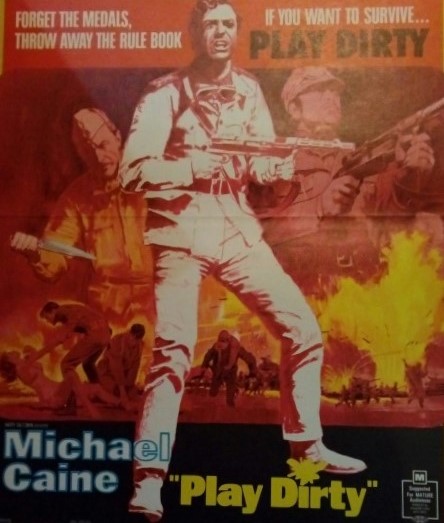
Heroism is a handicap in this grimly realistic, brutally cynical, ode to the futility of war. David Lean would have struggled to turn this stone-ridden desert into anything as romantic as his Lawrence of Arabia (1962) though he might have recognized the self-serving glory-hunting superior officers.
There’s a murkiness at the outset that is never quite clarified. You could easily assume that the long-range bunch of saboteurs led by Captain Leach (Nigel Davenport), with the peculiar habit of losing new officers, was involved in something more nefarious rather than doing its utmost to disrupt Rommel’s supply lines in North Africa during World War Two.
Brigadier Blore (Harry Andrews) appoints raw officer Captain Douglas (Michael Caine) to take charge of the next mission – a 400-mile trek to blow up a fuel dump. Col Masters (Nigel Green), in overall charge of the commandos, bribes Leach to ensure Douglas comes back alive. Blore is using this small unit as a decoy before deploying a bigger outfit to complete the mission with the singular aim of snaffling the glory for himself.
Leach proves insolently disobedient, forcing Douglas at one point to draw his weapon on his crew. But when it comes down to a question of heroism vs survival, Leach takes control at knifepoint, preventing Douglas going to the aid of the larger outfit when ambushed by Germans.
It’s mostly a long trek, somewhat bogged down by mechanics of desert travel. You’ll be familiar with the process of rescuing jeeps buried in sand dunes and of personnel sheltering from sandstorms, so nothing much original there. What is innovative is the terrain. Stones aren’t conveniently grouped together, edges softened by time, as on a beach. They’re jagged- edged and less than a foot or so apart so as to more easily shred tires. So there’s a fair bit of waiting while tires are replaced.
Some decent tension is achieved through sequences dealing with mines – threat removed in different fashion from Tobruk (1967) or, for that matter, The English Patient (1996) – and in crawling under barbed wire. But that’s undercut by the sheer brutality of the supposed British heroes slaughtering an Arab encampment and viewing a captured German nurse as an opportunity for rape.
A couple of twists towards the end raise the excitement levels but it’s less an action picture than a study of the ordinary soldier at war. Captain Douglas, the only character worth rooting for, soon loses audience sympathy by foolish action and behavior as criminal as his charges.
A few inconsistencies detract. For a start, there’s no particular reason to assign Douglas to this patrol. Primarily a backroom boy, he’s put in charge because he was previously an oil executive. But it hardly takes specialist knowledge to lob bags of explosives at oil drums. And the ending seems particularly dumb. I can’t believe Douglas and especially the canny Leach, both dressed in German uniforms, would consider walking towards the arriving British forces waving a white flag rather than stripping off their uniforms and shouting in English to make themselves known to the trigger-happy British soldiers.
And a good chunk of tension is excised by the bribery. Why not leave the audience thinking that at any moment the bloody-minded Leach would dispatch an interfering officer rather than offering him a huge bounty (£75,000 at today’s prices) to prevent it?
It suffers from the same affliction as The Victors (1964) in that it sets out to make a point and sacrifices story and character to do so. That individuals will be pawns in pursuit of the greater good or glory is scarcely a novel notion.
Having said that, I thought Michael Caine (Gambit, 1966) was excellent in transitioning from law-abiding officer to someone happier to skirt any code of conduct. There’s no cheery Cockney here, more the kind of ruthlessness that would emerge more fully grown in Get Carter (1971). Nigel Davenport (Life at the Top, 1965) adds to his portfolio of sneaky, untrustworthy characters. Equally, Harry Andrews (The Charge of the Light Brigade, 1968) has been here before, the kind of upper-class leader who behaves like a chess grandmaster.
In his first picture in half-a-decade Andre de Toth (The Mongols, 1961) produces a better result than you might expect from the material – screenplay courtesy of Melvyn Bragg (Isadora, 1968) and in her only known work Lotte Colin, mother-in-law of producer Harry Saltzman – and creates some exceptionally tense scenes and the occasional stunning image.
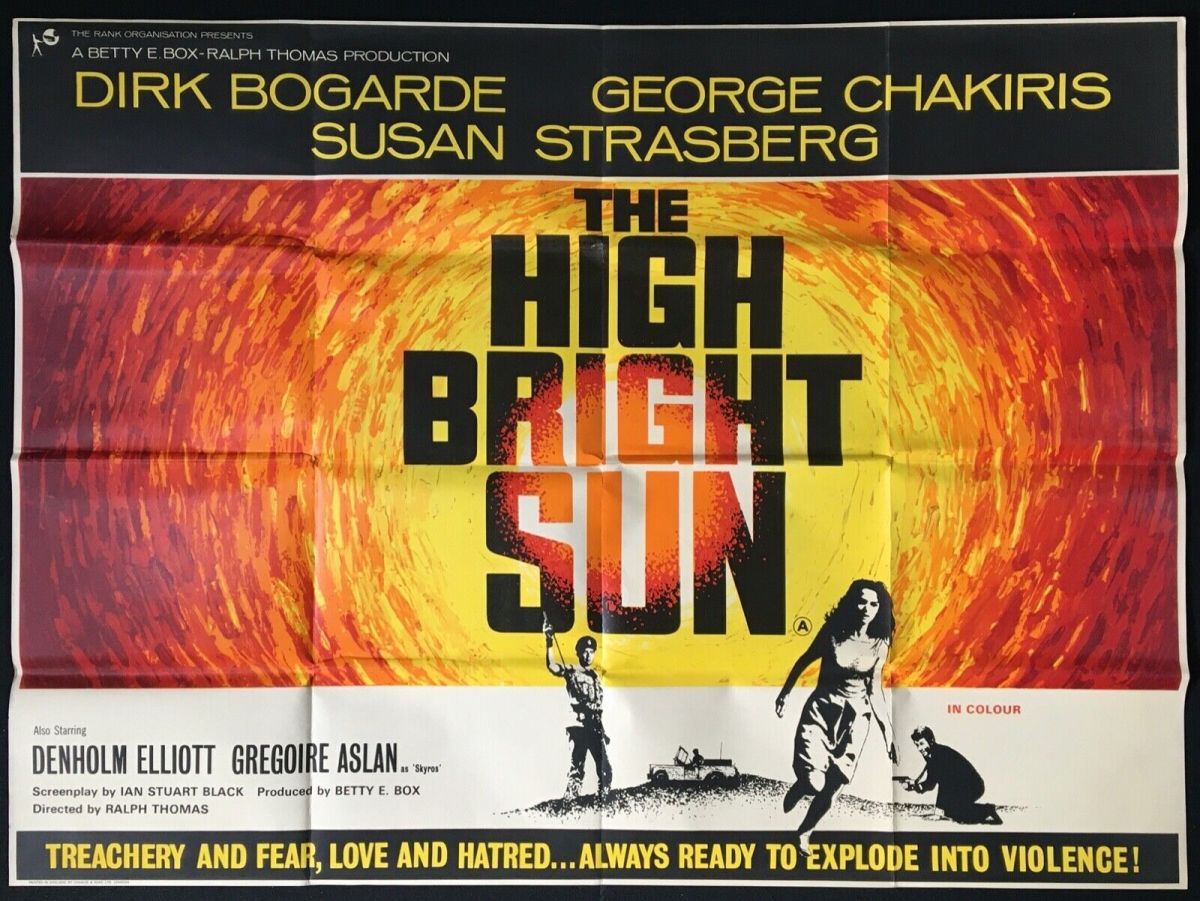
Surprisingly good thriller about loyalties in war time. Elevated above the norm by a series of stunning scenes often turning on the psychological. And taking a helluva bold risk as far as the billing is concerned. In dramatic and structural terms top-billed British star Dirk Bogarde (Justine, 1969) and rising American star George Chakiris (Diamond Head, 1962) take second place to the third-billed Susan Strasberg (The Sisters, 1969), although Bogarde’s stiff upper lip is tested in just about the most despicable fashion.
Also derives an interesting agency from differing audience perspectives. The British audience will view Major Maguire (Dirk Bogarde) as a hero trying to keep the peace in terrorist-racked Mediterranean island Cyprus. But virtually everyone else will side with Haghios (George Chakiris) and his bunch of freedom fighters in what was effectively a war of independence. Stuck in the middle, and expecting to be given a free pass, is Juno (Susan Strasberg), a young geologist staying with family friends named Andros but who, as an American, would be viewed as a neutral.
However, she has witnessed the arrival at the Andros home of terrorists, not just Haghios but General Skyros (Gregoire Aslan), leader of the Resistance. Not wanting to get her friends in trouble, and assuming they are not involved in terrorism, she resists the attempts of Maguire to get her to name names. But it’s only the cooler head of the general and the youngest member of the Andros clan, son Emile (Colin Campbell), that prevents her being shot dead on the spot.
Bluff and double bluff are the order of the day. She’s a prisoner – and a shocked one at that having witnessed British soldiers murdered by terrorists – but if she is seen to be prevented from leaving the house it will give the game away. So Maguire comes up with an acceptable ploy to get her out so that, in a calmer situation, he can gently interrogate her.
Unfortunately taking her out to dinner backfires, as they are spotted by Haghios who, assuming they are romantically involved, realises she can’t be trusted and signs her death warrant.
But she’s far from the plucky female and no good at playing the game of being hunted. In a brilliant sequence she takes all the wrong actions and it’s only happenstance and sacrifice that prevent her capture. And this is followed by an even edgier scene when she hitches a ride late at night with a lascivious local. But that’s nothing to her treatment by Maguire who, furious at her refusal to talk, parades her in the streets “like a sitting duck.”
There’s a whole strata of soldiers in open rebellion of a different kind. Maguire mocks his commanding officer, the inept Col Park (Nigel Stock), and he in turn is mocked by his junior, Lt Baker (Denholm Elliott) who taunts him about the affair he had with Maguire’s wife. And there are any number of stings in the tail. Believing she has finally escaped, Juno is confronted by Haghios and no Maguire in sight to come to her aid.
But the central tale is given over to Juno, the innocent caught up in bloody warfare, forced to witness barbarity at first hand, and unless she hankers after personal sacrifice inevitably induced to take sides.
Susan Strasberg is simply superb. At no time is she the feminine hero springing into reluctant action in some espionage or wartime drama. Instead, she is the innocent bystander who at any moment will turn into collateral damage. And she’s too confused even to summon up outrage at betrayal by both sides.
Dirk Bogarde looks as if he is playing your standard British officer of high breeding who can trade barbs and bullets with the enemy but mostly tries to extract information by gentler means. But he turns out to be just as savage in his ideals as the opposition. And his armour is pierced not only by having an adulterous wife but having to take abuse from her lover.
It was a typical Hollywood ploy to stick an innocent American in a war zone in order to expose a situation or attract audience sympathy either for the underdog or the oppressors – think Jack Lemmon in Chile in Missing (1982) or Sally Field in Iran in Not Without My Daughter (1991) – but I doubt if director Ralph Thomas was as naïve or politically-inclined to attempt that here and instead he treads a finer line of personal decision as he would later do in The High Commissioner/Nobody Runs Forever (1968). Sticking to the storyline and relying on actors who never resort to emotional extremes pretty much does the trick.
George Chakiris is wasted and I can only assume this was a sign of his career going downhill.
Not just far better than I expected, but bordering on the excellent.
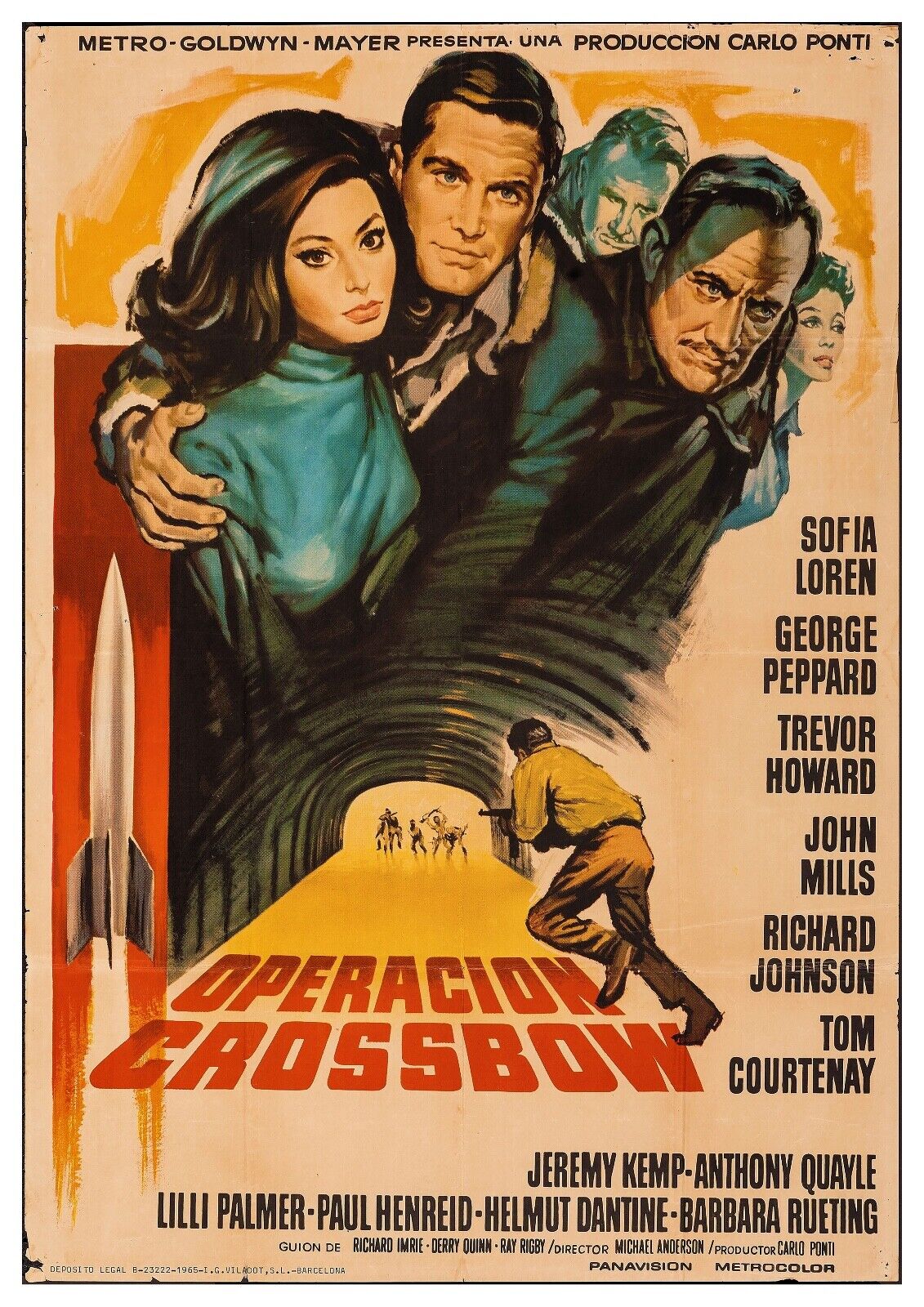
A clever mixture of detail and derring-do, World War Two picture Operation Crossbow (1965) – based on the true story of Allied infiltration of a German rocket factory – was a surprising hit at the British box office. The picture took a risk in keeping star George Peppard hidden from view for the first 28 minutes (top-billed Sophia Loren took nearly another 20 minutes to show up). Prior to their appearances the opening sequences were loaded up with a roll-call of British stars familiar with the genre in the vein of John Mills (Ice Cold in Alex, 1958), Trevor Howard (Cockleshell Heroes, 1955) and Richard Todd (The Dam Busters, 1955). Anthony Quayle, who puts in a later appearance, was also a war movie veteran after turns in Battle of the River Plate (1956), Ice Cold in Alex and The Guns of Navarone (1961).
Most war films relating to destroying a vital enemy base involved bombing (The Dam Busters, 633 Squadron, 1964), sinking (Sink the Bismarck!, 1962) or blowing things up (The Guns of Navarone, 1961). Operation Crossbow falls into the last-named category. The story breaks down into four sections: the discovery towards the end of the war by the British that the Germans are forging ahead with building V1 and V2 rockets; the recruitment and training of spies to parachute into Occupied France; a tense sequence abroad where complications arise; and, finally, attempts to obliterate the rocket plant.
Director Michael Anderson (The Dam Busters) switches through the genres from docu-drama to spy film to action adventure, further authenticity added by bold use (for a mainstream picture) of subtitles, all characters speaking in their native tongues. Various real-life characters are portrayed, among them photo reconnaissance expert Constance Babington Smith (Sylvia Sims), German aviatrix Hannah Reitsch (Barbara Rutting) and Duncan Sandys (Richard Johnson) who was on the British War Cabinet Committee.
Trevor Howard, at his irascible best, is the scientist pouring scorn on the idea of rockets – until they start raining down on London. Volunteers – Peppard, Tom Courtenay (Billy Liar, 1963) and Jeremy Kemp (who appeared with Peppard the same year in The Blue Max) – trained to spike the new weapon are recruited primarily on their language skills. Character is sketchy, Peppard designated a womaniser because he arrives in a taxi with two women.
But the operation has been assembled in such haste that not enough attention has been paid to the identities assumed by the agents. Courtenay’s character turns out to be wanted for murder. Peppard is accosted by his character’s divorced wife (Loren). So the mission faces immediate exposure. Although Loren’s role in terms of screen time amounts to little more than a cameo, she delivers a powerful emotional performance to a picture that could as easily have got by on tension alone. The harsh realities of war are shown in abundance. Twists come thick and fast in the second half, not least that Peppard’s face has become known, before the movie reaches a thrilling denouement.
There’s an odd tone to this comedy about that British obsession: class. The narrative arc is basically about come-uppance. But you would expect in any movie dealing with the upper-class that it is the poor man who comes out on top. But that’s not the case here and it’s not the case because, basically, the movie makers have decided that the confident charming guy buoyed up by a wealthy background should hold sway over the insecure chap undermined by his lack of breeding.
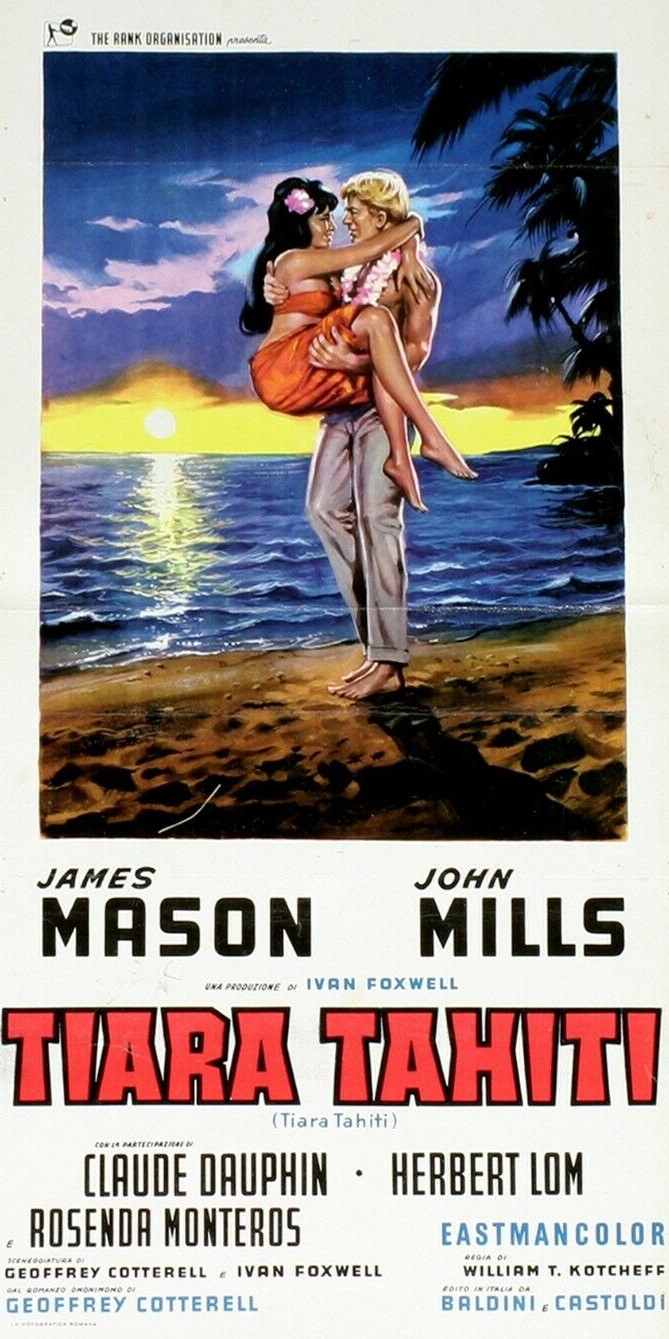
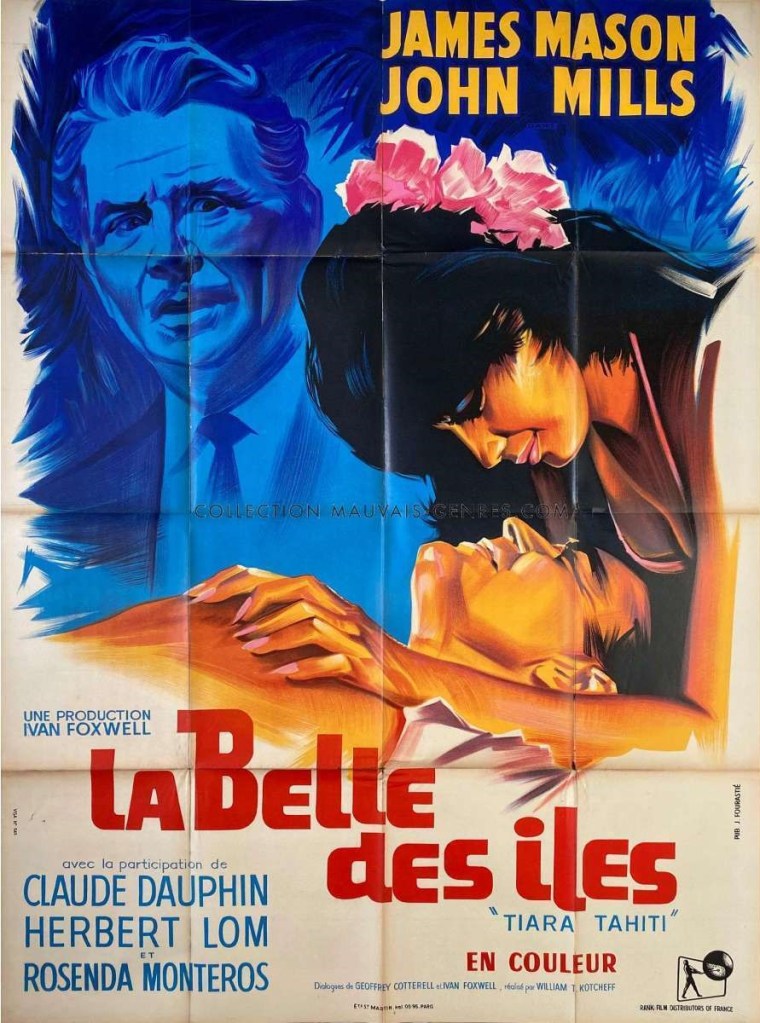
I doubt if they expected audiences to feel sorry for the jumped-up martinet Lt.Col Southey (John Mills) whose cushy number in post-war Germany is disrupted by the arrival of suave Capt Ainslie (James Mason). The former is reminded by the latter that he was once a lowly clerk in the stockbroking firm of which the captain, by dint of birth, held a managerial position. Soon Ainslie wins over the officers and humiliates Southey at every turn. To gain revenge, Southey informs on the junior officer who is arrested with illicit goods at the customs.
Several years later, Ainslie lives the life of Riley in Tahiti, beautiful girl Belle Annie (Rosenda Monteros) in tow catering to his every whim and under the false impression that he will soon take her back with him to London. He makes a living playing poker, and when luck runs against him can rely on the easily corrupted local police officer to keep his creditors at bay. Into this ostensible paradise arrives Southey, now chairman of an international hotel company, so important he can swan around the world answering to no one.
I had expected that having made it to the top of his profession by dint of hard work rather than accident of birth or having made the right connections, that Southey would have rid himself of his inferiority complex and that, somehow, he would get revenge on Ainslie for the humiliation in Germany. But that proves not to be the case and, in fact, any mention that Southey was once Ainslie’s mere clerk brings the high-flying businessman down to earth and he reverts to his previous jumped-up bumptious persona.
Only momentarily does Southey gain the upper hand, when the broke Ainslie seeks employment, but that lasts only until Southey reveals the part he played in Ainslie being cashiered from the Army. All along there’s been a sub-plot of a jealous Chinese storekeeper Chong (Herbert Lom, would you believe) trying to ease Ainslie out of the way so that Belle Annie will return to him. Chong arranges for a thug to bump off Ainslie. But when Ainslie survives the assault he blames Southey so that he can have the pleasure of ruining Southey’s career when he is kicked off the island.
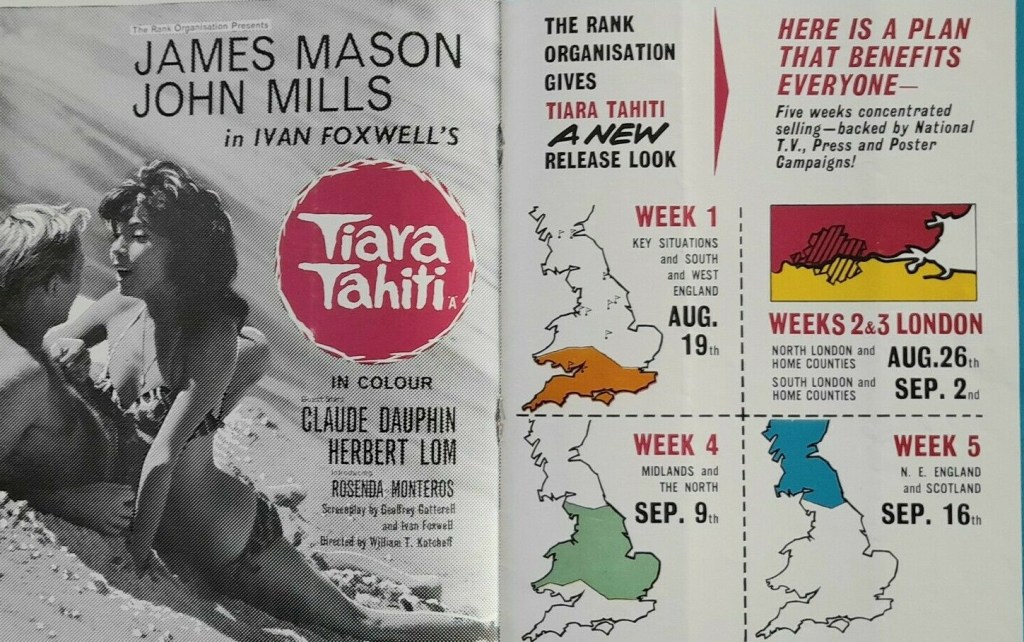
A significant change to the way films were distirbuted in Britain. Normally, it was London which got first bite of the cherry. Opening a film outside London was a bold move
I can’t have been the only viewer to sympathise with Southey, the man who got to high-ranking positions in the Army and business through his own hard graft while charmers like Ainslie used their class to ease their passage. I had imagined that it would be Southey who got his revenge, employing Ainslie in a lowly position rather than the other way round. And it may just be me but I didn’t believe the suggestion in the final scene that any enmity Ainslie felt towards Southey was all in Southey’s head.
Be that as it may, the acting carries this one. John Mills adds a comic element to his stiff-upper-lip officer last seen in the more dramatic Tunes of Glory (1960) while James Mason (Age of Consent, 1969) is the essential cad who can get away with anything thanks to bucketloads of charm.
Several scenes stand out. You wonder if the famed Robert De Niro “you talkin’ to me” in Taxi Driver (1976) had its origins in the scene where Mills talks to himself in a mirror to build up his confidence before confronting Mason. The scenes where Mason dupes the police officer into believing the cop’s novel is a work of genius are very funny. Mason also takes the mickey out of a middle-aged Englishwomen by pretending to be a native Hawaiian.
And that’s not forgetting the exuberance of Rosenda Monteros – mistakenly given the “and introducing” credit when she had previously appeared as the love interest in The Magnificent Seven (1960) – not quite as dumb as she sometimes appears, able to con Chong out of new dresses and ready at a moment’s notice to run away with an athletic young sailor. Not to mention, too, that her bare derriere makes an appearance in a bathing scene rather risqué for the period.
Debut of Canadian director Ted Kotcheff (Life at the Top, 1965, also dealing primarily with class) who has the sense to leave the actors to it. Written by Ivan Foxwell (A Touch of Larceny, 1960), it sticks too closely to the source novel by Geoffrey Cotterell, lumbering the movie with one sub-plot and a couple of characters too many, but excellent when concentrating on the warring protagonists.
Setting the class elements apart, this is all good fun, and the jousting between two of the greatest British actors of all time makes it more than well worth a viewing. It was a big hit in Britain at the time, not quite in the category of Dr No – oddly termed “a bizarre comedy drama” by trade magazine Kine Weekly and – second to Cliff Richard musical The Young Ones in the annual box office chart – but easily in the Top 25.
Setting aside my reservations about the tone and the perspective, I found this far more enjoyable than I expected as result of witnessing two class acts at the top of their game.
The predatory female was a late 1960s trope but this takes it stage further by suggesting that a woman can have it all, husband, lover and career fulfilment. Usually, it’s the powerful male that sets his mistress up in an apartment. It being British, Mrs Blossom (Shirley MacLaine), wife of bra manufacturer Robert (Richard Attenborough), stashes lover Ambrose (James Booth) in the attic.
There’s an element of Carry On in the focus on Robert’s profession, sniggering at the audacity of it all when it’s little more than an excuse to show a succession of half-naked girls modelling the product. The central conceit is ahead of its time, not so much one-size-fits-all, the Holy Grail of all manufacturers, but that women can have the bosom-shape they desire (rather than these days opting for the under-wired bra or going the whole hog with cosmetic surgery) through inflating the brassiere to suit.
Except toward the end, the bra business takes second place to the sex business as Mrs Blossom demonstrates exactly how to have your cake and eat it. Her shenanigans with Ambrose cause her to make greater effort with Robert. Although the male perspective occasionally intrudes: Mrs Blossom “ecstatic” at the prospect of making two men happy.
There’s not much going on plot-wise beyond Robert hearing strange noises in the attic and discovering a number of items, purloined by Ambrose, going missing, resulting in him seeking the help of a psychiatrist (Bob Monkhouse).
The whole enterprise is doused in modernity, probably post-ironic for all I know, Mrs Blossom’s painting tending towards Pop Art, some in-jokes (one dot on a canvas turns out to be a “sold” sticker). Since there’s not much else going on, Robert, kept sexually satisfied, hardly imagining his wife is engaged upon an affair, scarcely raising a scintilla of suspicion, the lovers carry on as if they are, in the best Hieronymus Merkin fashion, embarking on a welter of fantasies, primarily of the cinematic variety, so nods to Hitchcock, David Lean and even Raymond Chandler etc.
The climax at some kind of ticker-tape convention featuring Robert speaking atop a giant bra-clothed statue looks as though it consumed most of the budget. At bit more of the money could have been spent on jokes, because, without the danger of the illicit couple being found out, it lacks any real tension, unless you count a pair of bumbling and/or camp detectives (Freddie Jones and Willie Rushton) whose sole purpose appears to be to over-act. There’s a clever twist at the end.
Director Joseph McGrath (The Magic Christian, 1968) is something of an acquired taste. His main claim to fame at this point having helmed music videos for The Beatles and his scattergun approach rarely hits the target. One of the few examples where opening up a play (by Alec Coppel – of Vertigo fame!!) results in in racing in too many directions.
Shirley MacLaine (Sweet Charity, 1969), by now the decade’s most celebrated kookie, brings immense charm to the role and it has to be said it’s the acting in the main that keeps this on an even keel when the director is so clearly on a different planet. Richard Attenborough (The Flight of the Phoenix, 1965) is believable as a workaholic who lets off steam conducting an imaginary orchestra. James Booth (Fraulein Doktor, 1969), meanwhile, in a role that could have gone seven ways to Sunday, makes a convincing lothario.
Comedian Bob Monkhouse is surprising good as the madcap psychiatrist and you might have some fun spotting John Cleese, Barry Humphries and a young Patricia Routledge. Producer Joseph Shaftel (The Biggest Bundle of Them All, 1968) wrote the script with Denis Norden (The Best House in London, 1969).
Passable British crime B-picture, mainlining on sleaze, plot as flimsy as the costumes of the dancers, rescued by, flipping her screen persona on its head, a heartfelt performance by Jayne Mansfield. Career tumbling spectacularly after her Frank Tashlin heyday (The Girl Can’t Help It and Will Success Spoil Rock Hunter, both 1957) she was loaned out to any outfit that would have her. Director Terence Young’s (Dr No, 1962) career was also at a low ebb after Safari and Zarak (both 1956) while Carl Boehm (Peeping Tom, 1960) and future Carry On stalwart Barbara Windsor, minus trademark Cockney accent, were on the way up.
Ostensibly an expose of the Soho strip club business, invests too much time in cabaret, though Midnight Franklin’s (Jayne Mansfield) number is surprisingly well done. Parallel plots see journalist Robert (Carl Boehm) investigating the industry while rival night club owners Johnny Solo (Leo Genn) and Diamonds Dielli (Sheldon Lawrence) duke it out over the spoils.
As you might expect, such clubs are populated by seedy customers, some harmless like a Leipzig salesman falling for disinterested showgirl Lilliane (Danik Patisson), others on the creepier side like Mr Arpels (Martin Boddey) who tempts unwary girls with talk of setting them up in the movie business. Naturally, so many girls together, jealousies simmer and tensions flare, resulting, as you might expect, in a catfight. But that’s nothing compared to the beating handed out to Johnny by Diamonds’ thugs. Matters aren’t helped by Johnny’s manager Novak (Christopher Lee) being in the pay of the opposition.
Apart from wearing outfits that would give the censor of the time a heart attack, Midnight is really a sensible girl, hating violence, warning boyfriend Johnny to get out of the business before he ends up dead. She’s got few illusions left, hardly expecting Johnny to pop the question, but like Richard Widmark in yesterday’s Two Rode Together (1961) gradually becoming repelled by his actions.
For the most part she accepts that Johnny effectively pimps out his acts to wealthy customers like Arpels but recoils when he attempts to do so with Ponytail (Barbara Windsor) whom most people believe to be under-age. However, when Ponytail’s attempted rape turns into murder and the police turn up at the nightclub, Midnight, initially obeying the laws of omerta, turns on Johnny after she discovers his gun. But in a wonderful closing scene, she picks up the discarded flower he wore in his lapel and kisses it.
There’s some surprisingly potent dialogue and sharp one-liners – “that’s a very nice dress you nearly got on” / “I had a friend once but it didn’t take”/ “there’s not enough milk of human kindness around here to fill a baby’s bottle” / after a date with Arpels “some girls came back with promises…one came back with a baby.” A good bit more of such zingers and the movie would barrel along regardless of limp plot.
Energy is lost by focusing too long on the cabaret acts and on the growing romance between Robert and Lilliane. As glamorous fading nightclub star, Midnight provides the necessary oomph in more ways that one, but the movie would have benefitted by concentrating more on her ruefulness and self-awareness. Though besotted by Johnny, she knows he’s no lifetime ticket, tries to keep from herself as long as possible acknowledgement of his more sinister side, not so much knowing her place but aware which barriers not to cross. There’s a terrific scene in the middle of the night when she guesses he might be in trouble but hesitates over telephoning him in case this would be deemed over-familiar intrusion. Even she doesn’t know why she still hangs around a joint like this except “fish gotta swim, bird gotta fly.”
Bombastic on stage, she’s subtle off. You will come away believing Jayne Mansfield can actually act. But there’s nothing much to get excited about from the other performers, mostly in the stolid category, though it’s interesting to see what Barbara Windsor can do without reverting to a Cockney accent. Oscar-nominated Leo Genn (55 Days at Peking, 1963) proves that even crooks can possess a stiff upper lip. At this point with only a couple of horror pictures to his name Christopher Lee (The Devil Rides Out, 1968) could still be found in dramatic fare, but this is no break-put role.
Herbert Kretzmer, credited with the screenplay along with Harry Lee (All That Heaven Allows, 1955), would go onto worldwide fame and enormous wealth for Anglicizing French hit musical Les Miserables. While posters boast of Eastman color, which would have added to enjoyment of the dance routines, you can pretty much only find this in black-and-white and with ten minutes lopped off.
Wanna feel sorry for Jayne Mansfield, this is for you.
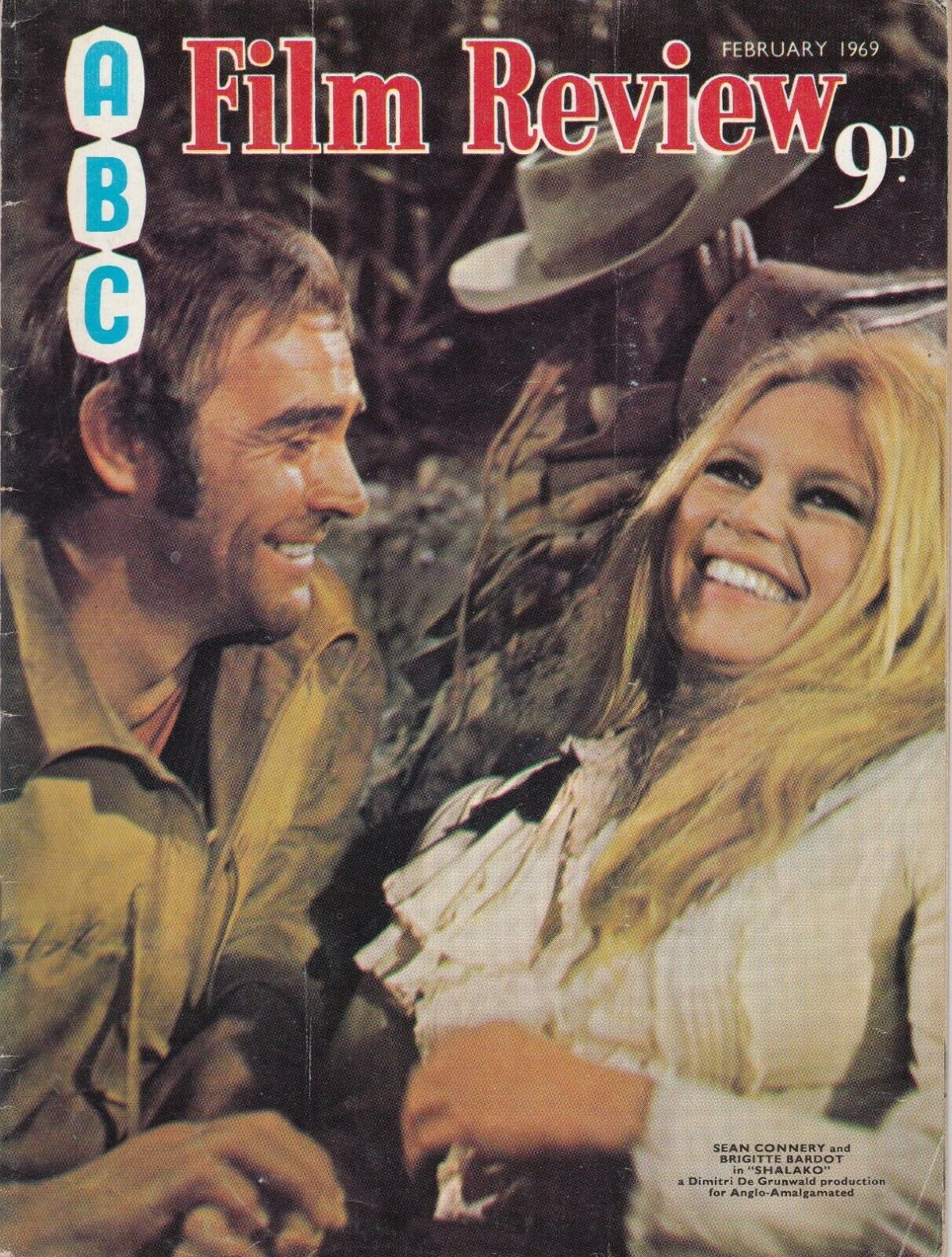
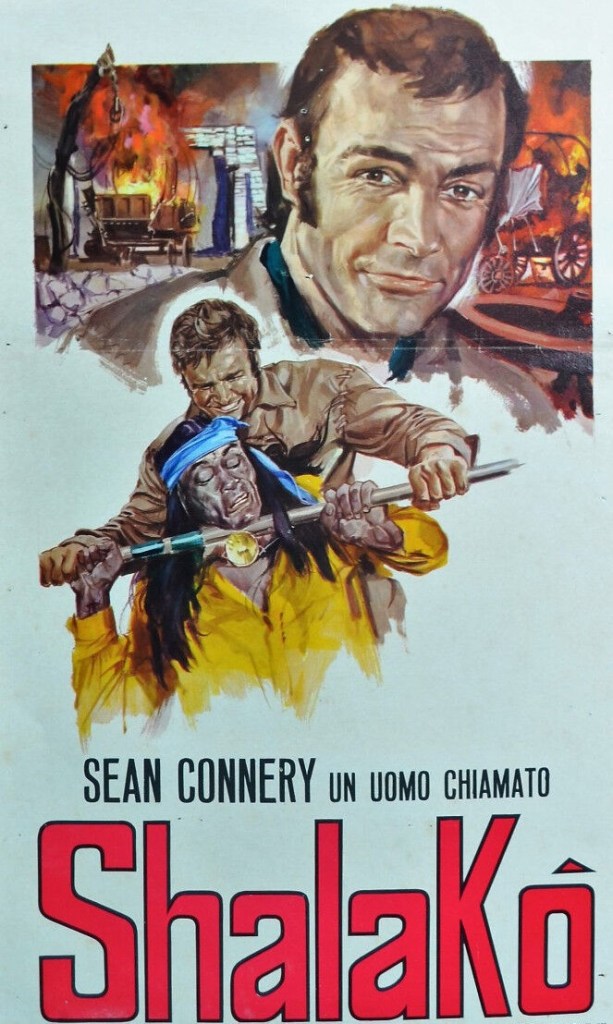
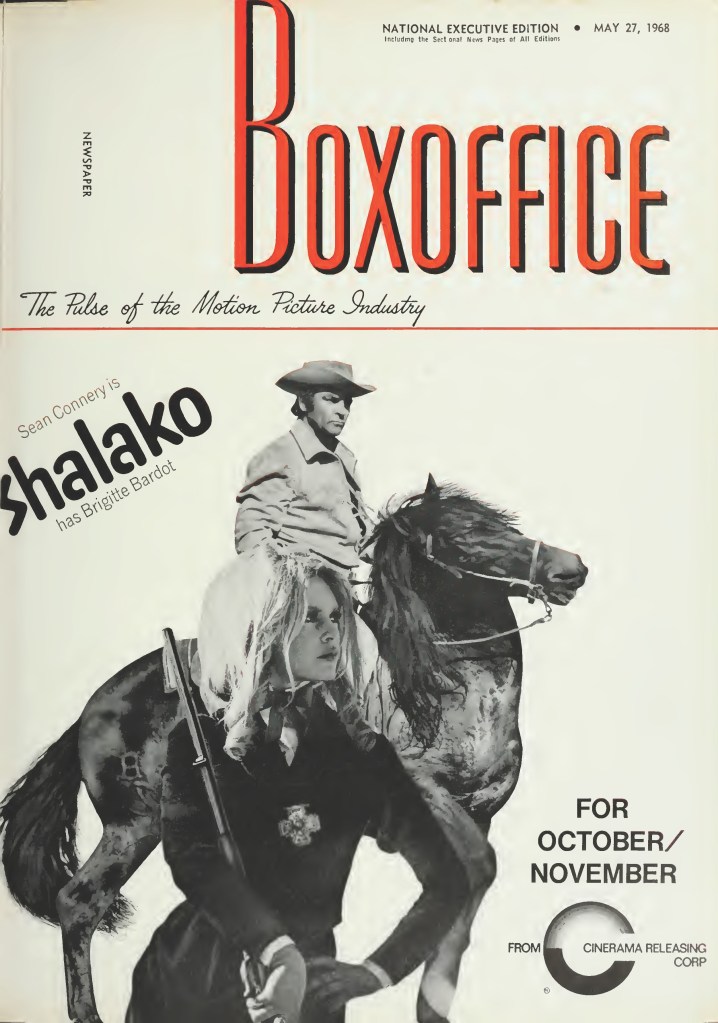
If you ever wondered just how a producer earns his crust, the convoluted process to make Shalako would provide a test case. British publicist turned producer Euan Lloyd had little on his calling card to gain entry to Hollywood, not even with the stars in tow for the project. Having worked for several years as a production assistant with Warwick Films, the British-based outfit headed by Cubby Broccoli and Irving Allen, he transitioned to associate producer on The Secret Ways (1961) but didn’t earn the moniker of producer until he pulled together an all-star cast for The Poppy Is Also A Flower (1966). Although released theatrically in Europe it was in reality a made-for-television number and screened as such in the United States.
So, actually, he was very much a neophyte producer. But early in his career he had become fast friends with Alan Ladd (Shane, 1953) and since they shared a love of westerns the actor had put him in touch with bestselling western author Louis L’Amour who was so taken with the Englishman’s enthusiasm he granted him a free option on any one of his un-filmed novels. Lloyd chose Shalako. “I could identify with that subject as it’s about a bunch of Europeans on safari in the West,” said Lloyd. (In fact, though as yet unfilmed, it was not as though nobody had tried. A report in Box Office magazine dated August 19, 1963, stated that Richard Carr was working on a screenplay for producer George Golitsin set for Universal).
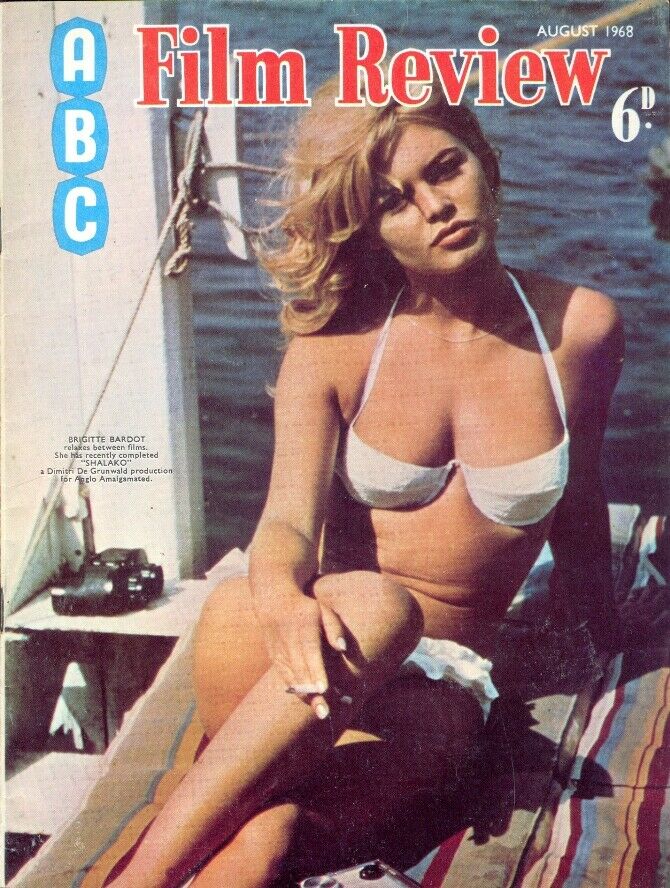
No connection to Shalako but little excuse necessary to showcase BB’s figure apparently.
On the production side, it would give him the excuse he required to put together a cast of non-Americans, stars from different nationalities who could open the distribution doors to significant European countries like France and Germany. His original starring pair were Henry Fonda (Firecreek, 1968) and Senta Berger, whom he knew from The Secret Ways and The Poppy Is Also A Flower. “Privately, she was the antithesis of the character she played in The Secret Ways…she came to mind as a very likely countess.”
He recruited Edward Dymytrk (Mirage, 1965), having got to know the director, a fugitive from the Communist witch hunt in the U.S., on the set of the British-made So Well Remembered (1947). Dmytryk had worked with Fonda on Warlock (1959). While appreciating Lloyd’s interest and keen to work again with Dmytryk, Fonda warned that he was not a strong enough marquee name to get the project off the ground.
To cover his back and using the names of his two stars and director, Lloyd set about pulling together finance from European sources. Although such co-productions were becoming more common, Lloyd must have set some kind of record by pre-selling the movie, in the end, to 36 different bodies. But still it wasn’t enough. Without an American partner, the movie was no-go. Fonda proved the sticking point and in 1967 Lloyd decided to go for broke with a bigger cast (Fonda was pretty gracious about being dumped, “I did warn you,” he said).
Sean Connery was not even initially on the list of proposed stars until Louis L’Amour alerted Lloyd to the length of the queues to see the latest Bond blockbuster (quite how a producer didn’t know that might be considered a mystery). Connery was incommunicado, filming a documentary in Scotland, but Lloyd managed to get in touch and seven weeks later he had what he believed, based on the Bond box office, was the biggest star in the world.
Part of the attraction for Connery of course was that for the first time he was receiving a salary ($1.2 million in total) commensurate with his box office. But it turned out as far as Hollywood was concerned, Connery had been taken in by his own publicity, studios pointing out that his non-Bond movies, Marnie (1964), The Hill (1965) and A Fine Madness (1966) had not approached his Bond box office.
Nor was Brigitte Bardot a golden name on the U.S. cinema scene. Until the mid-decade reissue of La Dolce Vita (1960), her first starring role And God Created Woman (1956) held the record for the biggest imported movie. But since them, except for Viva Maria (1966), her movies had been relegated to arthouses, hardly worth risking for a $400,000 salary – she was in Variety’s list of Top Ten Overpriced Stars.
Three major studios rejected the movie. Assuming all the majors would take the same view that “Connery will never make it away from Bond,” Lloyd targeted a mini-major, the kind of neophyte outfit that might pony up to get a big name on its forthcoming schedule, a way of proving it could play with the big boys. ABC, an offshoot of the television network, was hooked, paying $1.4 million for the privilege.
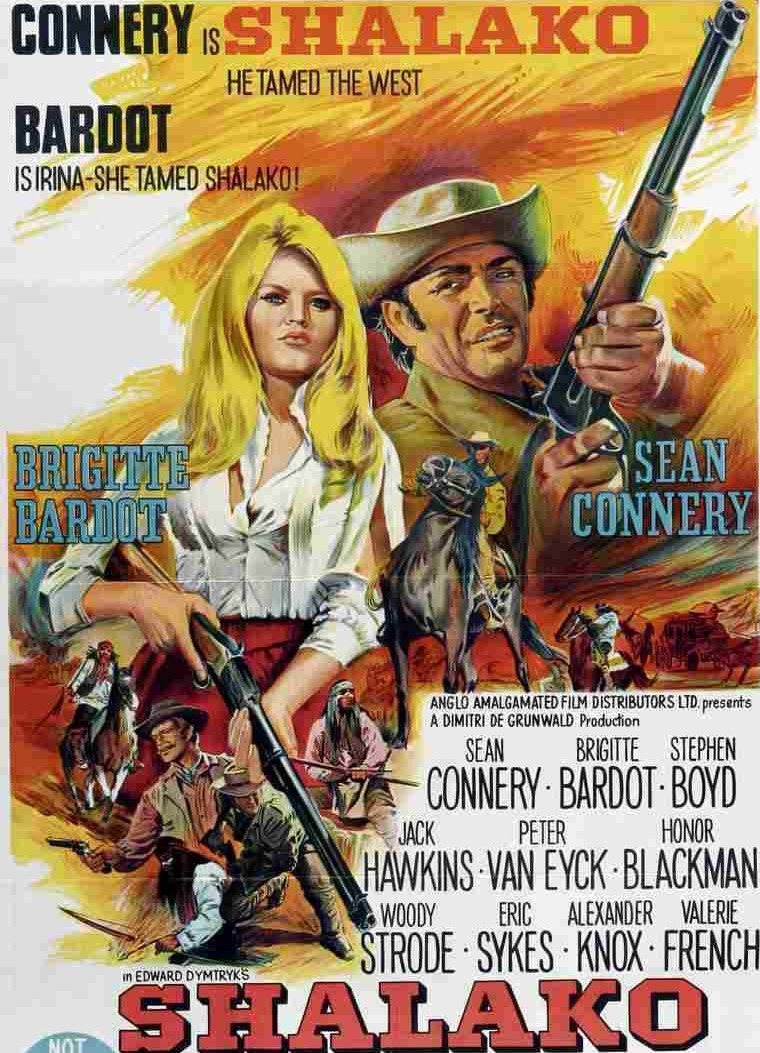
Trevor Howard, Karl Malden, Claire Bloom and Ingrid Pitt was all considered for roles. Even without them, as well as Bardot, the movie, in terms of credits, had the look of one of those all-star epics so beloved in the 1960s: Jack Hawkins (Lawrence of Arabia, 1962), Stephen Boyd whom Lloyd knew from being associate producer on Genghis Khan (1965) and German star Peter van Eyck (Station Six Sahara, 1963). And if Bardot wasn’t enough to get journalist tongues wagging, Connery would also be reunited with Honor Blackman from Goldfinger (1964). The cast also included Woody Strode (The Professionals, 1966), famed 1940s western star Don ‘Red’ Barry (The Adventures of Red Ryder, 1940) and English comedian Eric Sykes (The Plank, 1967).
Mexico was first choice of location until the devalued peso rendered it too expensive. Almeria in Spain, location of choice of many a spaghetti western, was the alternative. The biggest problem pre-shooting was that, to get into character, Connery had decided to grow a Mexican moustache, presumably not aware that moustaches were verboten for stars after The Gunfighter (1950) sank at the box office reputedly because Gregory Peck wore one. In the end, without the subject becoming a thorny issue, Connery shaved it off. He spent two weeks learning to ride under the tuition of Bob Simmons, a stunt arranger on the Bond pictures, so he could, indeed, sit as tall in the saddle as the great western stars. “He was a very proficient horseman by the time we started,” commented co-star Eric Sykes, “He looked as if he had been riding all his life.”
Meanwhile, Jack Hawkins (Masquerade, 1965) had undergone an operation for throat cancer and though he could speak his words were accompanied by a kind of belch and the voice for which he was so famous had disappeared. By coincidence Lloyd heard what he thought was Hawkins voicing a beer commercial. The distinctive tones belonged to Charles Gray (The Devil Rides Out, 1968) and he re-voiced Hawkins’ lines.
Despite Connery’s assertions to the contrary – his famous quote “she’s all girl but…all on the outside” was viewed as a detractory statement – Lloyd insisted it was a happy set. “I had absolutely no trouble from the cast during shooting and Sean and Brigitte performed perfectly and in harmony. Eddie Dmytryk was a man who knew exactly what he wanted and how to get it. The co-stars liked him enormously.”
Other sources paint a different picture, pointing to tension between Connery and Bardot over who was the bigger star, between Bardot and former lover Boyd, and between Connery and Dmytryk over the script. According to Eric Sykes, sitting beside Connery in between takes, the actor “would tear half a page or even a whole page of dialog out of his script…He was editing his part as he went along, apparently without reference to the director…One scene in particular with him and Brigitte Bardot, a long scene where they were sitting around a pool….it went on and on for about eight minutes…Sean’s editing turned it not a slick two- or three-minute scene…Eddie (Dmytryk) did not challenge it because when he saw what Sean had done he knew it was right.”
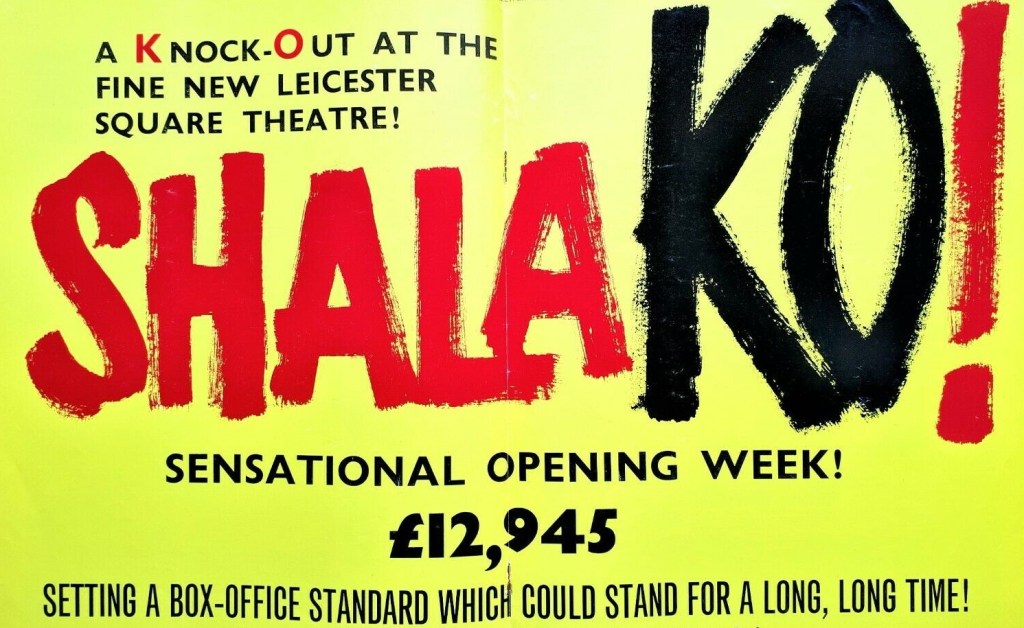
A big success in UK and Europe, it was a flop in the U.S. where ABC recorded a $1.2 million loss, but since every area was sold separately it is doubtful this shortfall would need to be repaid by the producer so counting the income from other sources it would have gone into profit. Incidentally, Connery was pictured wearing a moustache when the movie had its premiere and he was actually one of the few major stars who regularly wore a moustache in pictures and there are those who attribute his career longevity to cultivating a beard while still in his prime.
SOURCES: John Parker, Sean Connery, 1930-2020, The Definitive Biography (Bonnier Books, 2020) p171-176; Mac Mcsharry and Terry Hine, “The Way West,” Cinema Retro, Issue #2 May 2005, p38-42.
It’s a gripping and unusual opening. The jangling noise of metal beating upon metal. A trapped mountain lion surrounded by a posse of unkempt men. The beast driven into a killing zone. The camera ends up on a classy blonde in a top hat, Irina (Brigitte Bardot), drawing a bead on the animal. But as she shoots so does rugged cowboy Bosky (Stephen Boyd) and you can be sure his aim is more deadly. It wouldn’t do to have an upper-class European lady to be mauled to death by a vicious creature just because her ego got the better of her.
Except that’s not the opening. Instead, that’s sacrificed for a dumb theme tune and a few minutes over the credits watching titular hero Shalako (Sean Connery) doing what exactly? Nothing exciting that for sure. We see him riding I guess to prove he can sit as tall in the saddle as the stars of the genre like Alan Ladd, John Wayne, Gary Cooper, James Stewart, as if nobody expected James Bond to be able to complete such a transition. There’s a bit of waking up, more riding, drinking from a dirty stream, and more riding while composer Jim Dale struggles to find lyrics that rhyme with Shalako.
There’s a bit more exposition before Shalako does anything meaningful. We are introduced to a fistful of Europeans on a hunting party complete with butler (Eric Sykes) and guzzling champagne and escorted by a bunch of mean-looking cowboys looking on in envy though I doubt any would acquire a taste for champagne.
Then the real action starts. A bit’s been missed out explaining just why Irina took off on her own with just one man as escort to continue hunting and nobody thought fit to warn her this was Apache country. We know she’s in trouble because her escort is just about dead and Apaches are gathering. Enter Shalako to save the day. The first piece of dialogue between the most handsome man in the world and the screen’s most beautiful woman, a movie made just so Connery, at his Bond peak, and Bardot, in her most expensive picture, could strike sparks off each other, is hardly something to treasure. It’s almost priceless for its mundanity. “You all right?” grunts Shalako. “Yes,” replies the breathless heroine.
But trust the British to bring that epitome of British moviemaking, the class war, to that most democratic of movie species, the western. It’s ironic that in the country where freedom is a given – slavery long since abolished in the period this movie was set – members of the hunting party are fettered. Irina is little more than bait. You might as well have staked her out, hoping to snare German aristocrat von Hallstatt (Peter van Eyck). Marriage would cure the financial woes of her debt-ridden sister Lady Daggett (Honor Blackman) and husband Sir Charles (Jack Jawkins). Von Hallstatt doesn’t believe in making romantic overtures, it would be, like so many aristocratic marriages, a contract of convenience; he acquires beauty, she gets wealth.
To complicate matters Lady Daggett has a roving eye which has settled on Bosky, and to complicate matters even further, nobody should be firing rifles, even if only for sport, in Apache territory. It’s not long before the Apaches take umbrage and launch an attack. And it takes even less time for Bosky and his buddies to take off, leaving their charges poorly defended in a makeshift fort.
It takes way too long to sort out all these plot machinations and get to the meat of the story which is finding a way of putting Connery and Bardot together and when they are not the movie trundles along without much in the way of screen sparks. It could have done with an entirely different scenario. Something akin to Soldier Blue (1970) would have worked a treat, with roles reversed of course back to the traditional of experienced male tending the inexperienced female as they battle through enemy territory.
You needed to get this pair together – and quick – for the movie to find any steam at all. As it is, it’s somewhat laborious. While the action sequences are well done and Shalako scores in the western lore department, you wouldn’t have thought a mountaineering subplot could have produced so few thrills, its only purpose, plot-wise, to ensure that von Hallstatt acquires some credibility (he’s the mountaineer) and that the group can reach a plateau whose main attraction, as lovers of westerns will already be aware, is a pool where in the great Hollywood tradition a woman can disport herself half-naked. Shalako, in sneaking up on her, comes across like a bit of a peeping tom.
Sean Connery (The Hill, 1965) is convincing enough as a cowboy. He certainly doesn’t look out of place on a horse but it takes far too long for the expected romance to begin. Brigitte Bardot (Viva Maria!, 1965) is better than you might expect as a sharpshooter, but not quite in the fiery class of a Claudia Cardinale (The Professionals, 1966) or even Maureen O’Hara (The Rare Breed, 1965) and she’s not really given the dialog necessary to fully establish the independence of her character.
Director Edward Dmytryk (Mirage, 1965) does his best with an overly-complicated script and some cumbersome set-pieces and it would have worked far better if a few characters and reams of sub-plot had been chucked aside to bring the stars together quicker. While Connery does the riding and shooting well enough he lacks the grizzled lived-in face of his famed western predecessors and I get a sense of him trying too hard. And, as I said, it wouldn’t have taken much to pep up Bardot.
Having complained about the subsidiary characters, they are all well-drawn. Stephen Boyd (The Big Gamble, 1961) makes on helluva mean cowboy, Honor Blackman (Moment to Moment, 1966) is excellent as a predatory female. Aristocratic pair Peter van Eyck (Station Six Sahara, 1963) and Jack Hawkins (Masquerade, 1965) are the kind of actors who can denote fallen status with facial expression rather than requiring lumps of dialog. But Eric Sykes (The Plank, 1967) is really a British in-joke.
James Griffith and screenwriting partner Hal Hopper had previously worked on Russ Meyer epics like Lorna (1965). The original story came from a novel by Louis L’Amour (Catlow, 1971).
Out-with his guise as James Bond, Connery – excepting Robin and Marian (1976) and Cuba (1979) – was not one of the screen’s great lovers so this would have been the perfect chance to hone those particular credentials. But like the entire picture this was a missed opportunity. When the best scene is the brutal suffocation of Honor Blackman and not the two stars canoodling, you can see the target was missed by miles.










 The Magnificent 60s