Behind the Scenes: “Viva Maria”(1965)

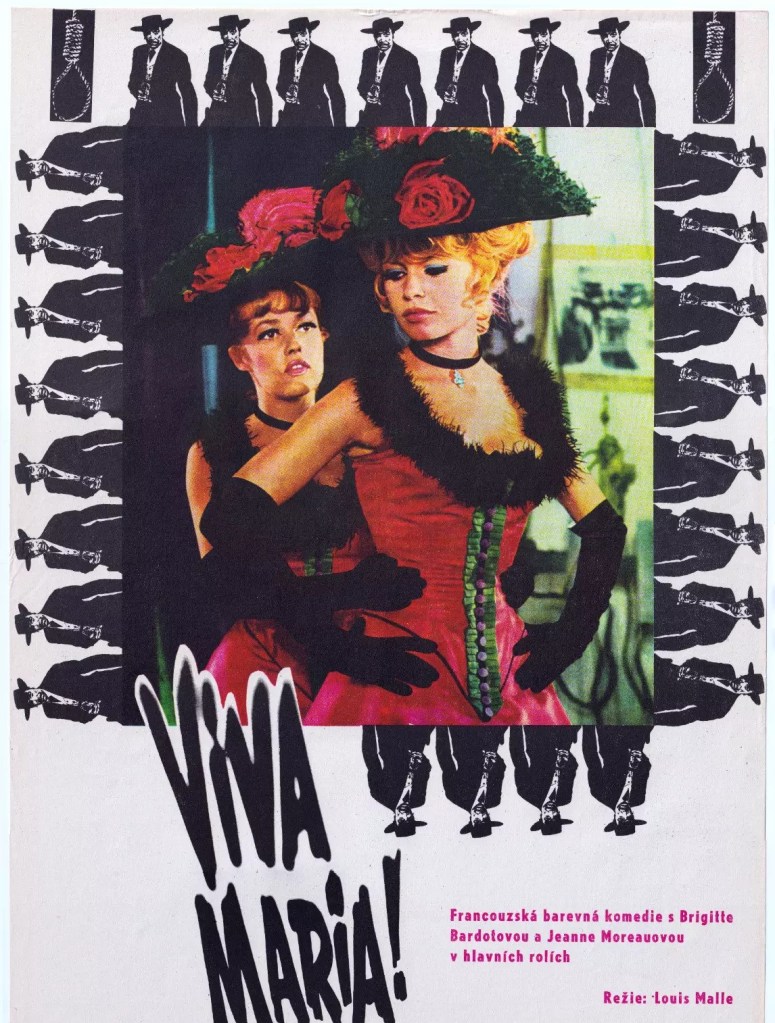
The shooting of Le Feu Follet in 1963 had proved so depressing for director Louis Malle that halfway through the filming, alone on a Sunday afternoon in his Parisian apartment, he jotted down the two pages that turned into Viva Maria! He had worked with Brigitte Bardot before on A Very Private Affair/ La Vie Privee (1962) but even with her presence it was made in virtual isolation. So he was unprepared for the brouhaha that awaited. The media had created a rivalry between the two stars – Bardot and Jeanne Moreau – which was ironic given it was a film about friendship.

Since this was Brigitte Bardot’s first movie-related trip across the Atlantic, her arrival presaged a media firestorm. Over 250 journalists, most representing international outlets, turned up for the first day of shooting. That media pressure created “an almost unbearable atmosphere.” Days were lost due to publicity commitments, as print journalists, photographers and television crews – including one from France making a 52-minute documentary – descended on the production. Such was the potential for chaos, paparazzi were banned. Bardot was more accustomed to media intrusion than her director, batting back inane questions with practised repartee. The qustion: “What was the happiest day of your life?” brought the response, “It was a night.”

This was only Malle’s sixth film. Unlike other directors who came to the fore in the French New Wave he had not first been a critic, but had attended cinematography school in Paris and his breakthrough came on the Jacques Yves-Cousteau documentary The Silent World (1956). Hired as camera operator, he was promoted to co-director. Both Elevator to the Gallows (1958) and the controversial The Lovers (1960) had starred Moreau. On the back of the critical success of Le Feu Follet/The Fire Within (1963), which won the Special Jury Prize at the Venice Film Festival, Malle struck a four-picture deal with United Artists.

He had been attracted to screenwriter Jean-Claude Carriere after becoming aware of his work on Diary of a Chambermaid for Luis Bunuel. They worked together on the script of Viva Maria! while Malle was directing the opera Rosenkavalier in Spoleto, where he had shot A Very Private Affair. Like most French filmmakers of his generation the western was “a very cherished genre.” With Viva Maria! he intended a spin on the American notion of two men, “two buddies,” in action together, along the lines of Robert Aldrich’s Vera Cruz (1954) starring Burt Lancaster and Gary Cooper.

But in movies like Vera Cruz, Fort Apache (1948) with John Wayne and Henry Fonda or John Wayne and Montgomery Clift in Red River (1948), the two stars, even if eventually settling their differences, were at odds for most of the picture.

“We thought it could be fun to put Bardot and Moreau in the same situation as Cooper and Lancaster,” said Malle. Both director and screenwriter had enjoyed a rich childhood fantasy based on the book editions of magazines like Le Monde illustre, so, in terms of locale, they provided inspiration. The movie aimed “to combine an evocation of childhood fantasies with a pastiche of traditional adventure films…it was never intended to be realistic – more projection of the imagination. Ideally, I was hoping the spectator would see it with the wonderment of the child.”

The notion of “floating between genres” didn’t sit easily with French critics and he was accused of “trying to do too many different things.” As with any big budget picture, problems multiplied, not just the difficult logistics but with the Mexican government, which, as John Sturges had found on The Magnificent Seven (1960) could take a tough line with movie makers. A previous censor Senorita Carmen Baez had stipulated that movies could not mention the 1910 Mexican Revolution, so to comply with that regulation the action was moved to an earlier date, 1904, and in an “unnamed South American country”

A combination of the number of locations – as well as Churabasco studios in Mexico City, the unit travelled to Guautla, Morelia, Tepotzlan, Cuernavaca, Vera Cruz, Puebla, Guanajuota and Hacienda Cocoyoc – and budget meant that the production could not afford to linger at any one locale, scenes had to be finished off within the planned schedule because the entire unit had to be on the move the next day.

In terms of shooting, Malle explained, “I always had to adjust and compromise…the sky was…desperately blue – the very hard light was a problem for the girls.” Ideally, Malle would have preferred shooting in the early morning or late afternoon, but time pressures and the production caravanserai meant the main scene was shot “with the sun at its zenith.”

Malle was later conscious that the film envisioned in the screenplay didn’t make it onto the screen. The irony, for example, of George Hamilton being cast as a Jesus Christ figure was lost on an audience which took him more seriously than intended. “It was comedy,” observed Malle, “but it was easy not to perceive it as comedy.” Similarly, Moreau’s “Friends, Romans, Countrymen” speech didn’t come across as humorous. “The audience either didn’t get it or took it seriously. That’s the danger of pastiche. It’s a very risky genre.”

He worried that the film’s budget – originally set at $1.6 million – and top-name stars might get in the way of the style of movie he was trying to make. At one point he suggested to UA that they cut the budget, switch to English and hire younger stars like Julie Christie and Sarah Miles, neither of whom at that point had enjoyed career breakthrough roles. The presence of the big stars “transformed the film into something else.”

The shoot was plagued by illness. Bardot and Malle were incapacitated while when Moreau slipped on a stone stairway breaking a shin bone and requiring stitches to a cut under her chin it was the third time she required time off, including suffering an affliction on her first day of shooting. An extra was killed on 24 May 1965 during the filming of the cavalry charge. Whether Malle took time off to get married to Anne Marie Deschodt on April 3 is unclear because, by then, staff were already having to work overtime to make up for lost days. The budget mushroomed to $2.2 million. Four weeks behind schedule, the movie, which had begun shooting on 25 January 1965 finally wrapped in June.

For its opening bookings in New York, at the Astor and Plaza, beginning 20 December 1965, the film was subtitled – by playwright Sandy Wilson of The Boyfriend fame no less – but thereafter was dubbed, Malle unhappy with the outcome, especially with the actress for Bardot. In the run-up to the launch, there was media overkill. Bardot  was mobbed by the media on arrival at JFK airport (and also on departure) and held another press conferences in New York.

Small wonder the press were so hyped. Bardot, considered the sex symbol of the decade, was putting in her first personal appearance in the U.S. While the movie opened to “smash” business at the Astor and Plaza first run, and knocked up a decent $127,000 from 25 houses on New York wide release – not far off A Patch of Blue on $160,000 from 27 but miles behind The Chase with $292,000 from 28 – that level of box office wasn’t repeated elsewhere.

In retrospect, it was obvious Bardot lacked the marquee status the studio anticipated. The bulk of her movies had played at arthouses or seedy joints, and they had all been sold on the kind of sexuality that kept them outside the mainstream. Noted Variety, “Brigitte Bardot has not made a box office dent in more than three years but her popularity with the press doesn’t seem to have flagged.” A not unknown phenomenon, of rampant media coverage not translating into receipts. A battle with the local censor in Dallas didn’t help. So all the hoopla was to no avail – it flopped in the U.S.

Elsewhere, the publicity teams took a more upscale approach. In Paris, the Au Printemps department store, the largest in the city, devoted a series of window and internal displays to the movie promoting different fashionable aspects. It finished third for 1966 at the Parisian box office, with 602,840 admissions not that far behind Thunderball’s 806,110 admissions but had twice the audience of the nearest U.S. competitor Mary Poppins and did three times the business of Those Magnificent Men in their Flying Machines, the next American movie on the list.

In Britain, flamboyant hairdresser Raymond created 24 different hairstyles as a fashion tie-in while Le Rouge Baiser created a different lipstick for each of the two main characters. Overall, it proved “one of the most successful fashion tie-ups ever,” the results seen at the box office.

It opened in London’s West End at the newly-built Curzon Mayfair which specialized not so much in arthouse pictures but upmarket, classy, fare, Who’s Afraid of Virginia Woolf (1966) followed it. It ran for eight weeks before embarking on a circuit release and returned to the West End the following year as support to another Moreau vehicle 10.30pm Summer. Bardot and Moreau were nominated for Baftas in the Best Foreign Actress section. It was ranked third out of foreign releases in Switzerland, sixth in Germany and made the top ten in Japan

Oddly enough, in socialist countries “it was very well received” and at Berlin University, according to Rainer Werner Fassbinder, “they were fascinated.” The two women represented different aspects of the struggle against repression, one promoting armed struggle, the other trying to achieve revolution without violence.

Overall it was a profitable venture. The poor $825,000 in U.S. rentals was compensated by an overseas tally of $4.1 million which meant, in the United Artist profit league for 1966, it finished seventh.

Malle only completed two pictures in his four-picture UA slate – Le Voleur / The Thief of Paris (1967) being the other. Another project set in the Amazon in 1850 came to nothing as did a separate deal to direct Choice Cuts for Twentieth Century Fox.

SOURCES: Malle on Malle, edited by Philip French (Faber and Faber, 1993) pp45, 49-54; “Bardot Due in Mexico,” Variety, December 9, 1964, p26; “Louis Malle’s Four for United Artists,” Variety, January 13, 1965, p3; “Bardot Swamped by Mex City Newsmen,” Variety, February 3, 1965, p17; “Filming Viva Maria in Mexico,” Box Office, February 15, 1965, p12; “Arnold Picker Chides Malle’s Pace,” Variety, April 7, 1965, p2; “No Newsmen at Can-Can,” Variety, April 28, 1965, p13; “Jeanne Moreau Injury,” Variety, May 19, 1965, p3; “Complete Viva Maria,” Variety, May 25, 1965, p15; “Extra Killed in Viva Maria Bit,” Variety, June 2, 1965, p5; “UA’s Viva Maria Booked for Astor, Plaza for Xmas,” Box Office, November 8, 1965, pE2; “Paris Window Display,” Box Office, November 22, 1965, pB1; “Malle Dickers UA on Three Films,” Variety, December 15, 1965, p5; “Picture Grosses,” Variety, December 22, 1965, p9; “International Sound Track,” Variety, December 22, 1965, p26; “TV Crafts Greeting to Bardot,” Variety, December 22; “Maria Viva $110,000,” Variety, December 29, 1965, p20; “Curzon Premiere for Viva Maria,” Kine Weekly, February 24, 1966, p3; “Viva Maria,” Kine Weekly, February 24, 1966, p21; “New York Showcase,” Variety, March 23, 1966, p10; “UA’s Location Plans Span Globe,” Kine Weekly, May 26, 1966, p36; “Thunderball As Topper,” Variety, June 1, 1966, p3; “1965-1966 Paris Film Season,” Variety, June 15, 1966, p25; “Story As Before,” Variety, July 13, 1966, p17; “Texas High Court Denies Viva Maria Re-Hearing,” Box Office, October 31, 1966, p7;  “U.S. Majors,” Variety, January 18, 1967, p24.

Viva Maria (1965) ****

Had it been a hit in the U.S., it could have changed the way women were portrayed on screen.

A box office smash could certainly have fired up a sequel (a key plank of the United Artists business model) and perhaps a reboot (Viva Marias! starring their daughters with or without the mamas). Could have led to the notion of Sophia Loren teaming up with Claudia Cardinale or Gina Lollobrigida and rescuing a captured male in a feminist twist on a western like The Professionals (1966). Imagine if it was Faye Dunaway and Jane Fonda carrying out the con caper in The Sting (1973).

Until Viva Maria!, two top female stars only appeared together in a movie as rivals for a male’s attention, or if one was the victim of nasty behavior from the other, or one was heading for an untimely death leaving the other to hog the screen in a tide of emotion.

Although it still remained virtually impossible to have a pair of female stars appearing together unless for weepie or noir purpose, the impact of Viva Maria was considerable. For a start, it invented the buddy movie four years ahead of that subgenre’s official inception in Butch Cassidy and the Sundance Kid (1969).

The poster preceded Clint Eastwood in pointing weaponry hardware menacingly at the potential audience, Gatling rather than a .44 Magnum. Speaking of Gatling guns, might have given Sam Peckinpah ideas for employing that weapon in The Wild Bunch (1969).

Neither molls nor victims, these women fell at the first woman’s picture trope. They were not rivals in love. Maria II (Brigitte Bardot) is of a polyamorous disposition and expresses no interest in Flores (George Hamilton) the revolutionary lover of Maria I (Jeanne Moreau). Forget Julie Christie sowing wild oats in Darling (1965) or any other of the other liberated ladies of the decade, Maria II is streets head, acquiring – and discarding – men by the bunch.

Nor is Maria II particularly interested in becoming that other female fixture of the 60s – the rebel – given that she spent most of her childhood as an accessory to her insurgent father’s violent acts, rolling out detonating wire or pressing the plunger in locales as varied as Ireland and Gibralter before watching her father died in an act of sabotage that went wrong.   

You would have thought that by this point in her career Brigitte Bardot (Shalako, 1969) could hardly get away with playing the innocent – setting aside her amoral intent – but audiences expecting titillation would have been surprised to see how quaintly she performs an accidental striptease which transforms their circus act, fortuitous really because Maria II has little sense of the rhythm required to be a stage performer.

Maria II resists becoming involved with Maria I’s messianic boyfriend but when he snuffs it she can hardly ignore his deathbed plea. The two Marias team up with the peasants to overthrow El Dictator (Jose Angel Espinosa ‘Ferrisquilla’) but not before they tangle with the Inquisition and the bad guys learn not to leave Gatling guns lying around. Would it be too much to argue that the female empowerment image of the decade is these two lasses spraying the enemy with bullets from the Gatling gun and, with more sense than Sam Peckinpah’s bunch, no intention of dying an heroic death.

It’s not a comedy in the normal sense, there’s no spoofing of revolution for a start, and it’s not so much filled with great one-liners as terrific sight gags. It’s more a drama with laffs. And, as you will be aware, revolution is good material for musicals – witness 1776 and Les Miserables, so don’t be surprised at the end to find our ladies treading the boards in Paris in a musical version of the revolution they have instigated.

Both Brigitte Bardot and Jeanne Moreau (Mademoiselle, 1966) throw acting caution to the winds, breaking out of the restraints of their screen personas, and almost as if freed from having to perform the dutiful female role of sacrifice, can turn their attention to embracing friendship and having a whale of a time doing so. George Hamilton (By Love Possessed, 1961) looks lost.

Most of what director Louis Malle (Atlantic City, 1980) attempts comes off though it might take you a little while to get to grips with the tone. Screenplay by Malle and Jean-Claude Carriere (Belle de Jour, 1967).

A blast.

Behind the Scenes: “Barbarella” (1968)

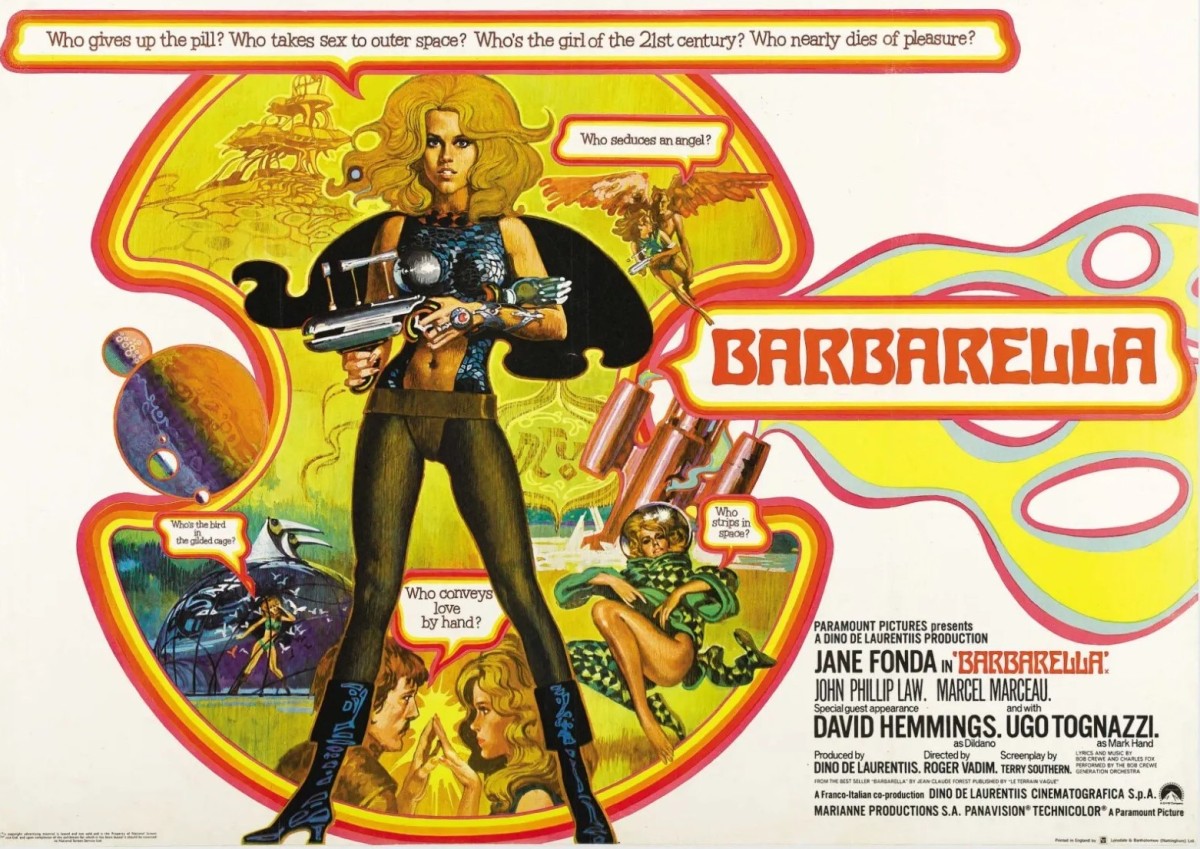
Two trends came together to create the ideal climate for the movie. The first was a fashion for filming comic books. By the mid-60s, Italy was at the forefront of this development thanks to the fumetti craze.

Mandrake, created in 1934 and first filmed in 1939, was being prepped by Duccio Tessari (My Son, the Hero, 1962). Though that stalled on the starting grid Dino De Laurentiis had bought the rights to Jean-Claude Forest’s Barbarella. He was also prepping Diabolik – at that point to be directed by Brit Seth Holt (Station Six Sahara, 1963) and fronted by Catherine Deneuve (Belle de Jour, 1967). Monica Vitti was being lined up to play Modesty Blaise (1966). For Barbarella De Laurentiis initially favored Franco Indovina (The Oldest Profession, 1967) in the director’s chair and Brigitte Bardot as the star.

The other element driving forth the venture was the involvement of Hollywood major Paramount in European production. Paramount had turned to Europe to “replenish its dwindled film vaults.” Formerly almost exclusively committed to U.S. production, by 1967 the studio was in the middle of a $60 million European spending spree, the cash spread over 30 movies made in the U.K. or mainland Europe where Italy took the lion’s share. Paramount struck a deal with De Laurentiis for Barbarella and Danger: Diabolik (1968) – eventually helmed by Mario Bava with John Philip Law and Marisa Mell – plus Arabella (1967) and Anzio (1968).

Paramount’s involvement should have excluded Vadim. He was persona non grata with the studio, having reneged on a previous three-picture deal, which he was paying off in $20,000 instalments. The budget of $3 million should have put the picture out his league. The Game Is Over had cost only $900,000 and none of his previous work suggested he might have the necessary skill to handle the special effects. And he was well known for declaring his opposition to studio interference.

But in terms of delivering sexy fare Vadim was in a class of his own. And God Created Women (1956) was the top-earning foreign picture in the U.S. He had made stars of Brigitte Bardot and Annette Stroyberg (Dangerous Liaisons, 1959) and he was in the process of turning the earnest Jane Fonda (In the Cool of the Day, 1963) into a sex symbol after plastering her nude body over billboards promoting La Ronde/ Circle of Love (1964) and stills from La Curee/The Game Is Over in Playboy.

Still, she was far from first choice. Following Bardot’s refusal, De Laurentiis approached Sophia Loren, but she was pregnant, and he did a screen test of Ira von Furstenberg (Matchless, 1967). Fonda was not as nailed-down a star as you might expect. Her affair with Vadim kept her out of the country, making the kind of picture that was generally perceived as salacious arthouse material and not likely to raise her marquee value in the U.S. Cat Ballou (1965), which should have propelled her to the very top, instead performed that trick for Lee Marvin after he won an Oscar for the dual role. After meaty roles in The Chase (1966) and Hurry Sundown (1967) and top-billed in comedy hit Barefoot in the Park (1967), she should have been able to write her own ticket. But she did demonstrate independence in choosing to align with Vadim for Barbarella and though it didn’t win her any acting accolades it smoothed the path towards They Shoot Horses, Don’t They (1969) and Klute (1971), for which she won the Oscar.

Vadim was smarting from damage done to his reputation by censors and the authorities. “I have become a black sheep for censors and I’m paying the penalty in everything I make. Anything I direct is automatically suspect. I believe I’m the only director who must get censor clearance before I can begin filming.” He wasn’t – technically, this applied to every director working Hollywood since all scripts had to be cleared in advance of filming by the Production Board. But in Italy even when films like The Circle of Love (1964) and The Game Is Over (1966) cleared censorship obstacles, the films were seized by the police and threats laid of obscenity charges.

However, he believed this time round he would be immune from threat since the film would contain “no reference whatsoever to moral concepts as we know them. We’re dealing with life in the year 40,000. It would be difficult in the realm of science fantasy for any censor to discover objectionable scenes.” Clearly, he assumed mere nudity would not raise eyebrows.

Vadim admitted, “When I made Barbarella, I found the most difficult thing was the detail.”

Attracted by the “wild humor and impossible exaggeration” of the original material, he “wanted to make something beautiful out of eroticism” and intended to film it as if “a reporter doing newsreel…as though I had just arrived on a strange planet.” And had a camera on his shoulder. He viewed the character as a “lovely average girl” though not so average in that she possessed “a lovely body.”

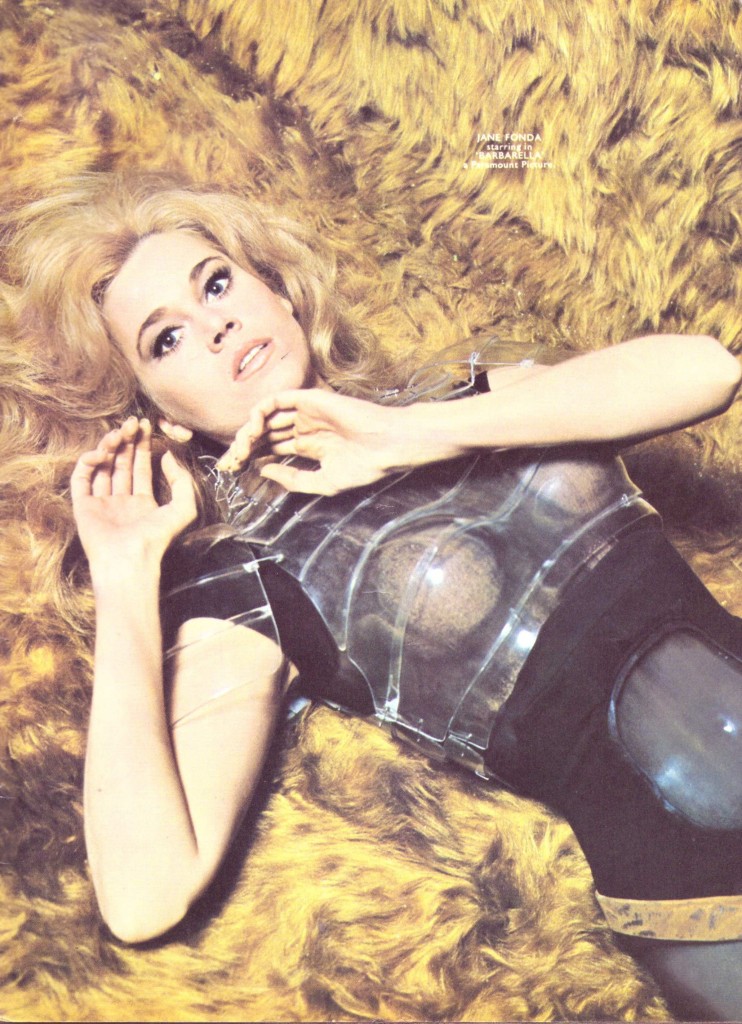
Fonda was determined to keep her character “innocent,” rejecting the idea of playing her as a vamp, “her sexuality was not measured by the rules of our society,” and neither “promiscuous” or “sexually liberated.”  Vadim interpreted her role somewhat differently, viewing it through the prism of a “shameless exploitation of her sexuality.”

With multiple writers on the project, the question of who wrote what has been open to argument. Impressed by their work on Danger: Diabolik – which employed a total of eight screenwriters – De Laurentiis parachuted in British pair Tudor Gates and Brian Degas. Original writer Terry Southern (Candy, 1968) claimed responsibility for the opening striptease and the doll robots.  Uncredited screenwriter Charles B. Griffiths (The Wild Angels, 1966) came up with the notion of the millennia of peace, Barbarella’s clumsiness and the suicide room. Even co-star David Hemmings got in on the act, claiming he inspired the nonsense Fonda spouted during their sex scene.

Southern suggested Anita Pallenberg for the role of the Black Queen after encountering her while working with The Rolling Stones – her voice was dubbed by plummy English actress Joan Greenwood. Jane Fonda brought John Philip Law into the equation after working with him on Hurry Sundown (1967).

The director employed some sleight-of-hand. Just like the later Ridley Scott on Alien, he didn’t inform his actors in advance what was about to happen in some critical scene, such as those involving the Excessive Pleasure Machine. Vadim wanted a natural response from Fonda and Milo O’Shea so omitted to tell them “what a big explosion there would be. When the machine blew up, flames and smoke were everywhere, and sparks were running up and down the wires.” Fonda was “frightened to death” and O’Shea was convinced he “was being electrocuted.

And Vadim summoned his inner Hitchcock for the scene when Fonda was attacked by the hummingbirds (actually, substitute wrens and lovebirds). Not getting the effect he wanted,  Vadim used a powerful fan to blow the flock onto the actress whose outfit was peppered with birdseed.  There was an unexpected two-week hiatus between filming the bird attack and the striptease. Fonda contracted a fever, forcing the movie to shut down halfway through its 12-week schedule. On her return, Vadim filmed the striptease to be shown over the credits which was intended to “camouflage censorable flesh.” The set for the strip was upside down, Fonda performing on a pane of glass facing a camera in the ceiling.

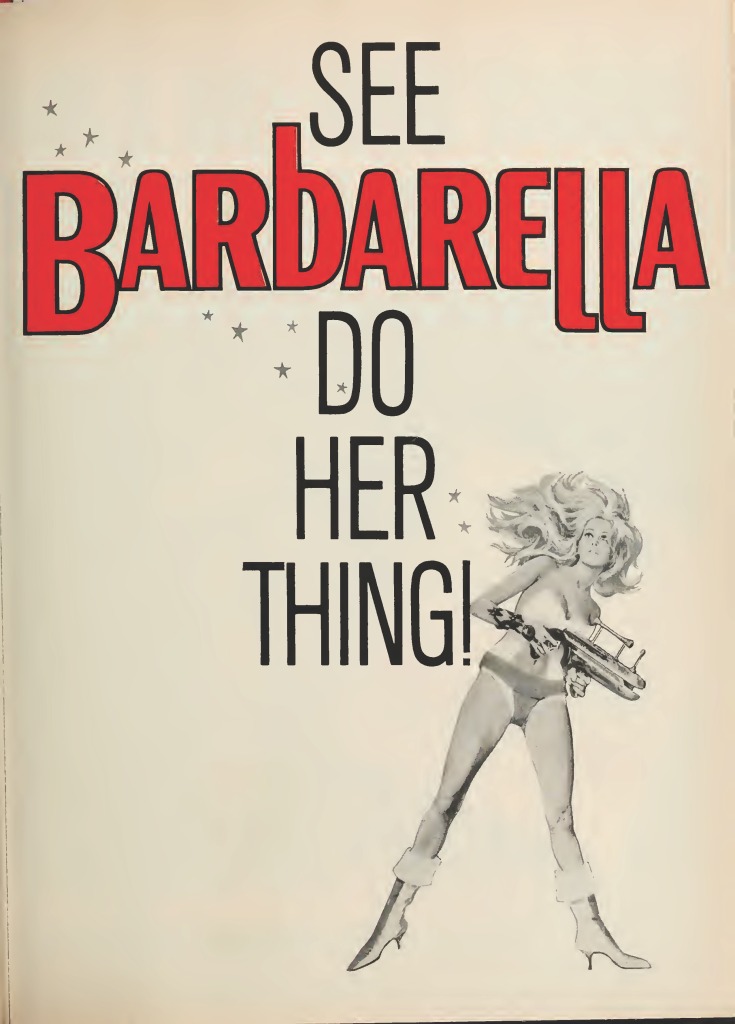
The sensational aspects of the movie had attracted exceptional media interest. Over 200 journalists visited the set including representatives from Vogue, Playboy, Time, Life, McCall’s, Seventeen, Paris Match and UPI and AP. Paramount kept the pot boiling with some advertisements that were exceptionally full-on for the times: “It’s the year 40,000 A.D. A scantily-clad space adventuress battles 2,000 hummingbirds who rip off her clothes, two dozen shark-toothed dolls who rip off her clothes, 100 purple rabbits who don’t rip off her clothes and an army of leather giants who attempt to whip her to death. In between she makes love a lot.”

By the time the movie appeared, Paramount had invested in another development. It was the first studio to set up a marketing department, not just a catch-all under which promotional and advertising efforts were undertaken, but a unit that took a systematic, research-based, approach to release strategy. As a result Barbarella was one of the first movies to achieve a global simultaneous release, the bulk of movies taking a step-by-step approach, U.S. first and then major countries overseas, following a pattern that could take up to 18 months to complete.

According to research undertaken by the marketing department it was “judged as a picture which would have a sensational first few weeks everywhere it played because of the impact of the subject matter, star (Jane Fonda) and promotional pizzazz. But research indicated word-of-mouth might be poor. The decision was made to open the picture everywhere at once – and that meant worldwide since there was fear that any ‘bad word’ on such a highly-touted pic could spread from country to country. Here, too, the prognosis proved letter-perfect. As any exhibitor will confirm, Barbarella was the film this fall which started out great then dropped off. In view of this Paramount is thought to have maximized its gross via the global saturation playoff pursued.”

In the U.S. Paramount ordered a record number of trailers and space age fashion shows, like one at Alexanders Department Store in New York, were the order of the day. In Britain, there was a phenomenal ad spend (the second-highest ever), Mary Quant boots, tie-ins with shoe stores, and both a hardback and paperback book.

But Barbarella proved to be a slow-burn at the box office. Initially, it was deemed to have ranked a lowly 46th in the annual U.S. rentals chart with just $2.5 million in the kitty, falling far short of Paramount’s box office smashes that year – The Odd Couple (ranked fifth) with $18.5 million in rentals and Rosemary’s Baby (ranked seventh) on $12.3 million. But, in fact, it more than doubled its rentals the following year and ended up with a highly-respectable $5.5 million at the U.S. box office. (And I hereby apologize to anyone whom I challenged on these figures).

The global release paid off. It ranked eighth in France, seventh in Switzerland, third in  Britain, 14th in Hong Kong and a big hit in Italy. However, the content denied it a sale to U.S. television. The movie was reissued in 1977 in the wake of Star Wars, and took a “handsome” $175,000 gross from 65 houses in New York. It was revived again after Flash Gordon (1980) and the following year when Paramount entered the laserdisk business among the first 30 oldies released it was the only one from the 1960s.

A sequel’s been on the cards since the film opened. Possibly rather tongue-in-cheek and with an element of the risqué sauce of the times, Paramount’s Robert Evans planned to trigger a second episode called Barbarella Goes Down, the title apparently relating to underwater adventures. Terry Southern was asked to write a sequel in 1990 while in the aftermath of Sin City (2005) director Robert Rodriguez came close to an $80 million version and Nicolas Winding Refn toyed with a television series. As of now, Sydney Sweeney (Anyone But You, 2023) appears most likely to hit the sequel button.

SOURCES: Patrick McGilligan, Backstory 3: Interviews with Screenwriters of the 60s, (University of California Press, 1997); Lisa Parks, “Bringing Barbarella Down to Earth”. In Radner, Hilary; Luckett, Moya (eds.). Swinging Single: Representing Sexuality in the 1960s, (University of Minnesota Press, 1999); Gail Gerber,and Gail Lisanti, Gail (2014). Trippin’ with Terry Southern: What I Think I Remember. McFarland, 2014);  Roberto Curti,  Diabolika: Supercriminals, Superheroes and the Comic Book Universe in Italian Cinema (Midnight Marquee Press, 2016); .Brian Hannan, Coming Back to a Theater Near You, A History of Hollywood Reissues 1914-2014 (McFarland 2016) p252; “Comic Strip Character Film Trend,” Variety, June 9, 1965, p23; “Vadim’s Autonomous Views,” Variety, August 24, 1966, p2; Gerald Jonas, “Here’s What Happened to Baby Jane,” New York Times, January 22, 1967;  “Paramount Getting 6 Pix from Italy in Bid to Build Prod,” Variety, February 1, 1967, p16;  “Par O’Seas Hatch By Dozen,” Variety, April 26, 1967, p5; “Italo Film Boom,” Variety, June 7, 1967, p20; “Barbarella Laid Low By Jane Fonda Virus,” Variety, August 16, 1967, p2; “I’ve Been A Black Sheep To Censor,” Variety, July 19, 1967, p22;  Marika Aba, “What Kind of Supergirl Will Jane Fonda Be as Barbarella?” Los Angeles Times, September 10, 1967; Roger Ebert, “Interview with Jane Fonda,” October 15, 1967; “Paramount Stressing Sex and Visual Fantasy,” Variety, October 18, 1967, p26; “Space Age Fashion Show,” Box Office, September 2, 1968, pA2; “Record Teaser Trailer,” Box Office, September 9, 1968, p13; “Eyebrows Up – Here’s Barbarella,” Kine Weekly, October 19, 1968, p23; “Big Box Office Winners of 1968,” Kine Weekly, December 14, 1968, p6; “What Makes a Director?”, Variety, January 8, 1969, p26; “Big Rental Films of 1968,” Variety, January 8, 1969, p15; “Swiss B.O. Race,” Variety, January 15, 1969, p41; “Shaws Dominate HK,” Variety, January 15, 1969, p41 “Par Puts the Science into Sell,” Variety, February 5, 1969, p33; “Int’l Filmgoing Tastes Tres Complex,” Variety, February 5, 1969, p35; “CBS Bid for Baby Doll,” Variety, October 29, 1970, p78; “All-Time Film Rentals,” Variety, January 7, 1970, p27; “New York Showcases,” Variety, November 2, 1977, p8; “Paramount’s Home Video to Market Viddisks,” Variety, April 29, 1981, p54.

Two Weeks in September (1967) ***

Soubriquets were not common currency in Hollywood. Names might be shortened to a Christian name or a surname, as in Marilyn or Garbo, and occasionally a reporter might suggest an unlikely familiarity by referring to a star as “Coop” and for sure Bogie must have been desperate for people to call him anything other than Humphrey, hardly a name that spun off the tongue for a supposedly hardbitten hero eschewing his middle-class origins. But the world swung on its axis when simple use of the star’s initials were enough to guarantee universal acceptance.

BB was born on a wave of controversy. After And God Created Woman (1956) broke box office records all over the world, a star was born. But one who seemed to live as much on the pages of newspapers as on the screen. She could forever be guaranteed to provide a revealing photograph to spice up the more puritan newspapers.

But BB’s global fame didn’t translate into worldwide box office in part because her movies were mostly X-certificate in the U.K. and, being made generally by foreign companies, slipping past the Production Code in the U.S. and therefore into arthouses or shady emporiums in both countries rather than mainstream houses.

This isn’t the best introduction to her canon, but in many senses it’s pretty typical. The camera adores BB and shuns anyone else in her presence. There’s not much story here – bored wife dashes off to a model assignment in London and has an affair and can’t decide whether he’s ready for divorce.

To fill in the time we get plenty Carnaby St fashion shoots, certainly put into the shade by the likes of Blow-Up (1966), but of the kind that used to be so common, beautiful women in outlandish clothes against backdrops like zoo animals or suits of armor and all the while flirting with photographers and being chatted up in night clubs by all and sundry. As you might expec, red buses and mini cars are common, though the chances of a cop on horseback at night seems to stretch it a bit.

Cecile (Brigitte Bardot) seems too lively for staid husband Philippe (Jean Rochefort) and burdens him with ensuring her happiness. But he seems, I guess unusually for the time for such a wealthy character, to be happy for her to continue in her profession. She’s never been unfaithful unlike model buddy Patricia (Georgina Ward). But all this cavorting brings out the lech in photographer Dickinson (Mike Sarne) and while she flirts with him she fancies for no apparent reason the doe-eyed Vincent (Laurent Terzieff) although his doe-eyed dog is livelier.

Anyway, off they go to Scotland for a romantic idyll since every filmmaker in the world has been duped by Scottish Tourist Board fantasies of sunshine, tartan, heather and miles of unspoiled beaches (unaware they are empty because the natives have more sense than to go diving into icy water in freezing temperatures). Mostly, what they get is damp streets and grey skies, though if you have BB romping  in the water then nobody’s really going to notice the awful weather. And, naturally, the highways and byways are filled with tartan-clad gents so Brigadoon rides again.

Not quite sure how “To Their Heart’s Content” – clumsy in translation as it is –
is turned into the dull “Two Weeks in September.” Though she hardly seems happy in the poster.

In any case, by the time September comes round, the sun has already packed up for the winter in Scotland, so there’s your get-out-of-jail-card in the title. Not much happens in Scotland either, mostly soulful camera work, soulful BB and dull-as-ditchwater Vincent. There’s a contrived ending.

What impresses most is how little BB you need to make a picture work, even one as patchy as this. It is almost the same template as an Elvis picture minus the songs. Just like BB, Elvis scarcely required a working script, just any excuse to get him on screen. Some stars possess screen charisman that it’s impossible to shift. Shame it was left to Serge Bourguignon (The Picasso Summer, 1969) to get more out of the faint storyline because he  was never that bothered with narrative and inclined just to get by on close-ups and scenery. With BB she was as much scenery as audiences ever seemed to require.

Hardly falls into the recommended bracket but nonetheless an interesting example of how Bardot could get away with the mildest of trifles.

Behind the Scenes: “Kitten with a Whip” (1964)

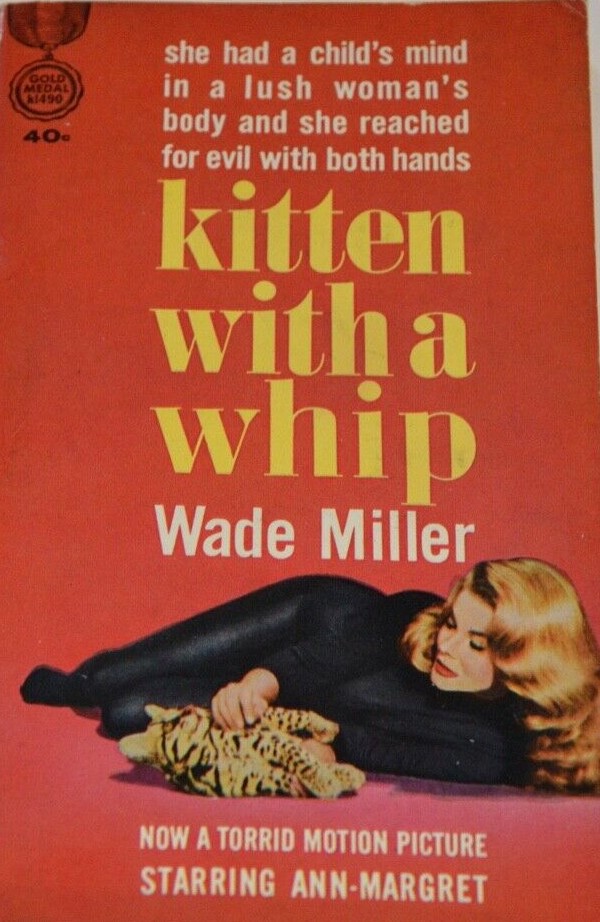
Ann-Margret was a late arrival on the scene. The voluptuous Mamie van Doren (3 Nuts in Search of a Bolt, 1964) had bought the rights to the novel by Wade Miller in September 1959 before selling them on the Universal a couple of months later, possibly in exchange for the starring role.

Wade Miller was the pseudonym of writing team Robert Wade and H. Bill Miller, who had teamed up at the age of 12, and wrote screenplays under another pseudonym, Whit Masterson. Together they had turned out  30 novels, and hundreds of short stories and their work had been the basis for, most famously, A Touch of Evil (1958). The later Yellow Canary (1963) and Warning Shot (1966) were based on their novels. The moment Hollywood came calling Fawcett publishing, through its Gold Medal paperback division. rushed out a movie tie-in edition, adding another when the film was due for release.

The second movie tie-in edition.

Laszlo Gorog (Too Soon to Love, 1960) was initially allocated the screenplay, but was quickly replaced by Alfred Benner (Key Witness, 1960). Nancy Kwan (Tamahine, 1963) and Steve Forrest (Yellow Canary) entered the frame when Richard Rush (Too Soon To Love) was being tipped to direct. Brigitte Bardot turned it down. And it languished in limbo for a couple of years before being handed to television director Douglas Heyes – a journeyman known for episodes of Laramie, Cheyenne, The Twilight Zone, The  Virginian, et al.

It wasn’t meant to be his debut feature. That was intended to be If One Is To Die from his own original screenplay, announced in 1961. But that was for Twentieth Century Fox. When that failed to materialize, and after a short spell back in television, he did double duty – writer and director, a role he had carried out countless times for television – for Kitten with a Whip

It was the last of the 11 movies scheduled by Universal for production in 1963, shooting beginning on December 27. The studio, at the forefront of developing new talent, put new recruit Patrica Barry (Send Me No Flowers, 1964) in the secondary female role.

That this got into the mix for Ann-Margret must have taken some determined wheeling and dealing for by 1963 the actress was in phenomenal demand, especially for someone with so little experience. She had contracts for over a dozen pictures. In part, she was the most exciting addition to a growing pool of new talent that included Michael Callan (The Interns, 1962), Alex Cord (Stagecoach, 1966), George Segal (The Quiller Mmorandum, 1966) and Peter Fonda (Lilith, 1964), but the fact that she could sing and perform made her doubly attractive since Hollywood had now worked out that hit singles and live performances were “the fastest route to the showbiz area…and the springboard to…film fields.”

Film adaptations of hit musicals, benefitting from the “broader pull of Hollywood productions” and “wider audience exposure,” boosted sales not just of the original soundtrack but also the original Broadway cast recording. Columbia’s Bye, Bye Birdie (1963) sold two million copies of the movie soundtrack and album and 1.5 million of the Broadway version.

There was a three-picture deal with Frank Sinatra’s Essex Productions that should have included Marriage on the Rocks (at that time known as Community Property, its original Broadway title) delayed until 1965 when the original director pulled out. Columbia was owed three movies, Twentieth Century Fox five. Every time she signed a new contract her price went up. She was the object of a bidding war. MGM appeared to be in the lead when it raised her going rate, ponying up $275,000 plus a percentage for two movies – Viva Las Vegas (1964) and Say it with Music (shelved). But Universal trumped that, $250,000 per picture for six movies, the first being Kitten with a Whip.  

Her arrival in showbiz had triggered  whirlwind of promotion. She snaffled her first headline in December 1960, at the age of 19, when Jack Benny added her to his nightclub act in las Vegas. Four months later her face adorned a full-page ad in Hollywood Reporter that announced her television debut on the Jack Benny Show on CBS April 2, 1961. By then Twentieth Century Fox was sniffing around and she landed a $1,000 a week contract.  The studio set her as female lead in State Fair (1962) but she was abruptly dropped and when reinstated it was as second female lead.

At this stage, publicity focusing around her voice. Signed to RCA Victor, she quickly became a top-selling artist. In return for delivering 12-24 singles and a number of albums over three years, the label committed to spending $50,000 a year in promotion. Columbia assigned George Sidney, director of Bye, Bye Birdie, to make an eight-minute promotional film.

After well-received turns in A Pocketful of Miracles (1962), Bye, Bye Birdie and female lead to Elvis Presley in Viva Las Vegas, Kitten with a Whip represented  departure, her first dramatic role. Although some observers later criticized her management team, in retrospect it’s clear that a sensible strategy was in operation, alternating lighter fare where she could sing and dance with more serious works (Once a Thief and The Cincinnati Kid, 1965, and Stagecoach the following year) where she did neither.

Exhibitors were so convinced she was the real deal that she was the youngest-ever winner of their Star of the Year Award, previous holders of the trophy including the more established likes of John Wayne, Gregory Peck, William Holden, Deborah Kerr and Doris Day, but only after they had been in the business for several years with umpteen box office hits to prove their worth.

Male lead John Forsythe, after years on television in Bachelor Father (1957-1962), was making a movie comeback. But he had signed an unusual contract with Universal, suggesting nobody was confident he was as genuine a prospect. The studio offered him a deal for two pictures a year, but one that also included television work for its television arm Revue.

Reviews were better than the actress might have expected. Eugene Archer, the second-string critic on the New York Times said “she demonstrated enough untrained talent to suggest interesting dramatic possibilities in better films.” Box Office opined that Ann-Margret delivered “a realistic and surprisingly effective characterization” but pleaded for studios to “let her return to lighter fare.”  Variety was dismissive: “display of over-acting.”

Exhibitors took a negative view. “Does this popular star a great deal of harm,” was typical of the response. Others were more forthright, describing the movie as a “glaring example of the type of show that shouldn’t be made.” Overall, it was not what anybody – critics, audiences, cinema managers – expected and not in a good way.  The St Paul Evening Dispatch took the MPAA’s Production Code to task for passing a picture of “sheer sadism, depravity without redeeming reason.”  

In some first run situations, it was the solo feature. Other cinemas paired with Lolita (1962), a somewhat obvious choice, or Lilith (1964) or British film Young and Willing (1962), Faces in the Dark (1960) with Mai Zetterling and Audie Murphy western Bullet for a Badman (1964). In some cities, it bypassed first run and went straight into the drive-ins. In smaller locales it went out on the lower half of a double bill.

Only in Pittsburgh did it score at the box office, “lofty” the assessment. It was deemed “sluggish” Washington, “slow” in Chicago and Los Angeles, and “slim” in  Columbus, Ohio. Of 21 movies released in the Winter Quarter, it was ranked lowest where it mattered most, at the ticket wickets, according to Box Office. It didn’t rake in $1 million in rentals, the amount required to earn a place on Variety’s annual box office chart.

Kitten with a Whip didn’t appear to harm the star’s career. Critics praised her work on Once A Thief and The Cincinnati Kid. But as her career first prospered and later crashed and burned it was considered something better not mentioned. John Forsythe fared less well. Outside of television, he only made five movies in five years.

Heyes’ movie career stuttered. He had been due to write and direct The 12th of Never, based on his own novel, to star Sandra Dee, one of Universal’s top marquee names,  in June 1964, but when that was cancelled returned to television until called back to direct Beau Geste (1966).

There might have been reassessment of the value of the original film when Gus Van Sant announced he planned a remake in 2007. On the other hand, that it was Lindsay Lohan’s favorite picture didn’t do it much good.

https://amzn.to/3FP3WxL

https://amzn.to/46Xr0q4

Behind the Scenes – “Play Dirty” (1969)

Hungarian Andre de Toth’s somewhat cavalier career had become ultra-cavalier during the 1960s. Best known for westerns such as Ramrod (1947) with Joel McCrea, Springfield Rifle (1952) starring Gary Cooper and The Indian Fighter (1955) headlined by Kirk Douglas plus House of Wax (1953), he was not, you might have imagined, riding high in the critical stakes. Hollywood considered him a journeyman. Esteemed French magazine Cahiers du Cinema, which had championed Hitchcock in the face of mainstream indifference, believed otherwise and interviewed him for a 1967 issue.

He might have been the name of everyone’s lips for more hard-won commercial reasons had attempts in the late 1950s come to fruition of filming the Ian Fleming portfolio beginning with Dr No. Instead, he was deemed a spent force and during the ensuing decade limited to only four films:  Man on a String (1960) and the Italian-funded Morgan The Pirate (1960), The Mongols (1961) and Gold for the Caesars (1963).

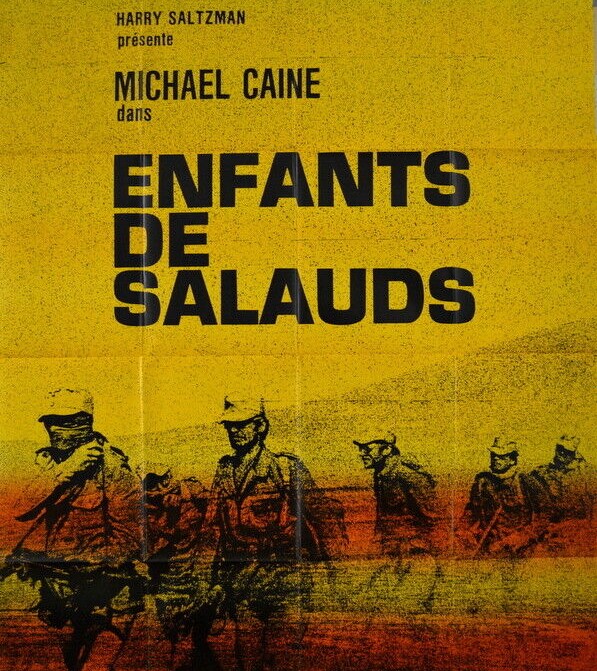
The Fleming enterprise had put him into the orbit of Harry Saltzman which led to a producing gig on Billion Dollar Brain (1966). Saltzman was also involved in The Deadly Patrol – the basis of Play Dirty – with French director Rene Clement (Rider on the Rain, 1970). According to de Toth, Saltzman wanted to elevate himself in movie circles. He “looked down on the Bond pictures” and wanted to make more serious movies.

And the pair clashed on style. “Genteel Rene wanted to make ‘a poetry of war.’ Harry wanted blazing guns and roaring tanks.” Saltzman feared Clement’s version  “was going to be some kind of art movie.”

Play Dirty was originally set to be shot in Israel – even though insurance was impossible – as a favor to Arthur Krim, head honcho at United Artists which was providing the finance. In the end filming was switched to Spain, even though neither Saltzman nor Clement was familiar with the terrain of Almeria, and the reality fell far short of the Lawrence of Arabia landscape both envisaged.

De Toth, by now part of the Saltzman entourage, was again assigned production duties with a new script to be written by de Toth, John McGrath (Billion Dollar Brain) and Melvyn Bragg (Isadora, 1968) as long as the credits made room for Lotte Colin, Saltzman’s mother-in-law. Shuttling pages to Saltzman, de Toth had little conviction the revised screenplay was being passed on to the Frenchman.

Michael Caine, already contractually committed, was keen to make a movie “good, bad or indifferent” with Clement. Richard Harris, on a salary of £150,000, pulled out of the role of Capt Leach after script rewrites eliminated four of his major scenes. “I wasn’t going to play second fiddle to Caine,” raged Harris. (Nigel Davenport, originally in a supporting role, was upgraded to take his place). Caine didn’t like the script. But it was either go ahead or Saltzman lose out on all the money already spent. Sets were built with still no guarantee from Clement that he would actually turn up.  

The inducement of receiving the final chunk of his salary, payable on completion of the picture, did the trick. At first Clement appeared fully committed, altering the script, and “observant and meticulous about details.” But soon mere tinkering escalated into demanding to “revamp the set, find new locations maybe in North Africa; in short, shoot another film.” When de Toth turned up on set, Clement vanished. Then the director went sick but refused to admit a doctor to his hotel room. A three-day enforced hiatus ended after De Toth was subjected to a barrage of abuse down the telephone by Saltzman and then instructed to get on the set and start shooting.

“It was a strange way to get the directorial assignment,” noted de Toth. “I would have been a hypocrite to deny I wasn’t happy. I had wanted to do a story like Play Dirty since I had wallowed in the blood of futility in Poland.” But that combat experience came in handy. “I had learned in Poland how to crawl under barbed wire with fishhooks dangling on it and if you were caught and the tin cans rattled you had no chance to start your last prayer.” De Toth’s acquaintance with the realities of war inform the film. Location manager Andrew Birkin, brother of actress Jane Birkin, described de Toth as “more of a sergeant-major and he made the picture that way which was probably the right way to do it.”

“Michael Caine was probably more disappointed than I and I understood him and his resentment of the film. He felt uncomfortable, insecure, in the film without Clement, which made his portrayal in Play Dirty so remarkable, considered by many one of his very best…My respect for his professionalism grew as we drilled.”

Unexpectedly in the desert, rain came to the aid of the already hard-pressed production. The downpour turned the sand into a flower garden. Shooting was postponed for two weeks allowing the cast and crew to bond and iron out the script.

Since the beginning of the decade Almeria, decidedly smaller than it usually appeared, was a an in-demand location, favored by King of Kings (1961), El Cid (1962), Lawrence of Arabia (1962), Cleopatra (1963) and, following the success of A Fistful of Dollars (1964) hugely popular for westerns. The local authorities had regulations in place regarding usage, limiting employing of the sand dunes made famous by Lawrence of Arabia. “You got them for two weeks because another picture was coming in.” Even so, competing movies often got in each other’s way.

Michael Caine recalled  that one scene requiring German tanks to advance over the desert sands were “confronted round one of the dunes by a horde of American Indians in full battle cry in pursuit of a nineteenth-century stagecoach” for the western Shalako (1968). The noise of the tanks made the horses rear up, throwing off their riders, and the war picture production was delayed while all evidence of the western, including, of course, mounds of horseshit, were cleared away.

Caine remembered the experience more for the opportunity to meet Brigitte Bardot, the female lead on Shalako. One afternoon his peace was disturbed by the arrival of Bardot who uttered the immortal words, “I have been looking for you everywhere.” Caine leapt to his feet, knocking over a table of drinks.” Caine’s assumption that the French sex goddess had her eyes on him was wide of the mark. Instead, it was Bardot’s assistant, Gloria who was keen to make Caine’s acquaintance, the actor falling far short of Bardot’s taste in men, extremely young and very dark.

Despite disgruntlement about not working with Clement and over the picture in general, there was a happy ending for Caine. For his 35th birthday present, Saltzman presented him with an envlope containing his contract torn up into small pieces.” From being beholden to Saltzman, albeit his salary on a seven-year contract signed in 1965 was incrementally increased on an annual basis – the fee for The Ipcress File was just £6,000), Caine was now a free man.

Lotte Colin hated the end result and tried convincing Saltzman to shelve it – unlikely given the millions involved and the commitment to a distributor and not least because Caine’s name attached guaranteed audience interest . But she did succeed in removing elements of the Michel Legrand score. And she did replace de Toth on the screenplay credits.

Play Dirty disappointed at the U.S, box office bringing in a miserly $650,000 in rentals (the amount returned to studios once cinemas have taken their cut of the gorss). It did better overseas with $2 million in rentals. but since it cost $3 million it incurred a loss.

“Play Dirty” managed to offset some of its losses by being a regular on the reissue scene – though it would probably have been hired for a fixed fee rather than a percentage. It later showed up as the support to “Beach of the War Gods” (1973).

This proved to be de Toth’s last directorial assignment. But it might not have been. The bosses of new production shingle National General were ardent pacifists and wooed de Toth. Offered the choice of producing or directing western El Condor (1970) he chose the latter.

Nowadays de Toth is best described as a director’s director, an “unsung hero,” by the likes of Martin Scorsese who confesses to being “fascinated” by the “underlying anger and determination” that often makes the director’s movies “very disturbing.” 

“Take Play Dirty for instance,” he observes. “The characters have no redeeming social value; they don’t think, they just act. They have a job to do and they’re going to do it. The nihilism, the pragmatism – it’s at least unsettling. Disguise becomes a way to survive that brings doom at the end.”

SOURCES: Andre de Toth, Fragments: Portraits from the Inside (Faber and Faber, 1996) p390-391, 399, 416,433-447; Michael Caine, What’s It All About? (Century, 1992) p247, 256; Michael Caine, From Elephant to Hollywood, The Autobiography ( Hodder and Stoughton, 2010) p142-144; Robert Sellers, When Harry Met Cubby, The Story of the James Bond Producers (The History Press, 2019) p182-184; De Toth on de Toth (Faber and Faber, 1997) p151, 158; “United Artists Corporation and Subsidiaries, Motion Picture Negative Costs for Pictures Released in the Year Ended January 3, 1970” (University of Wisconsin).  

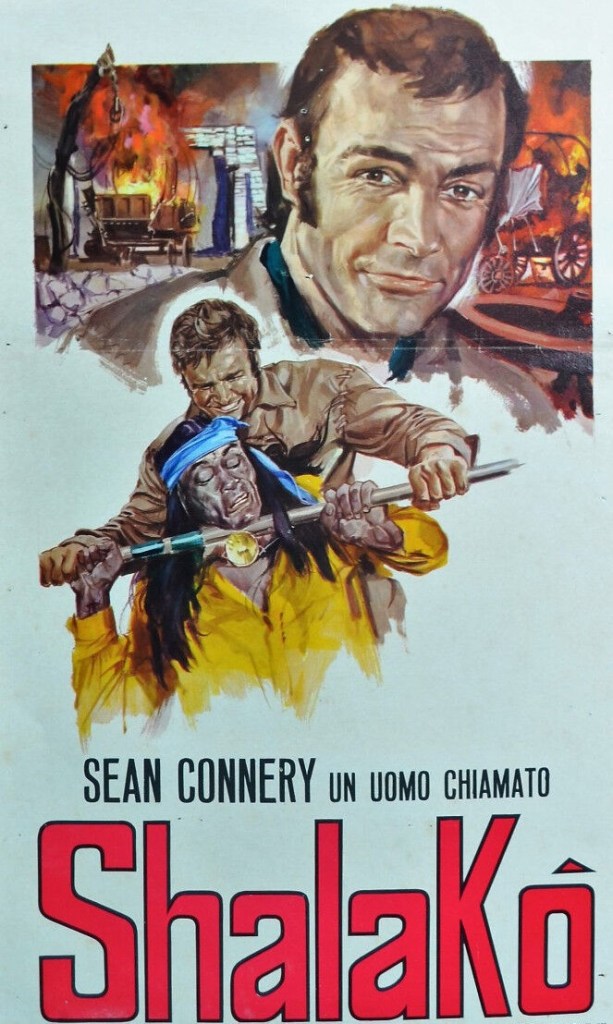
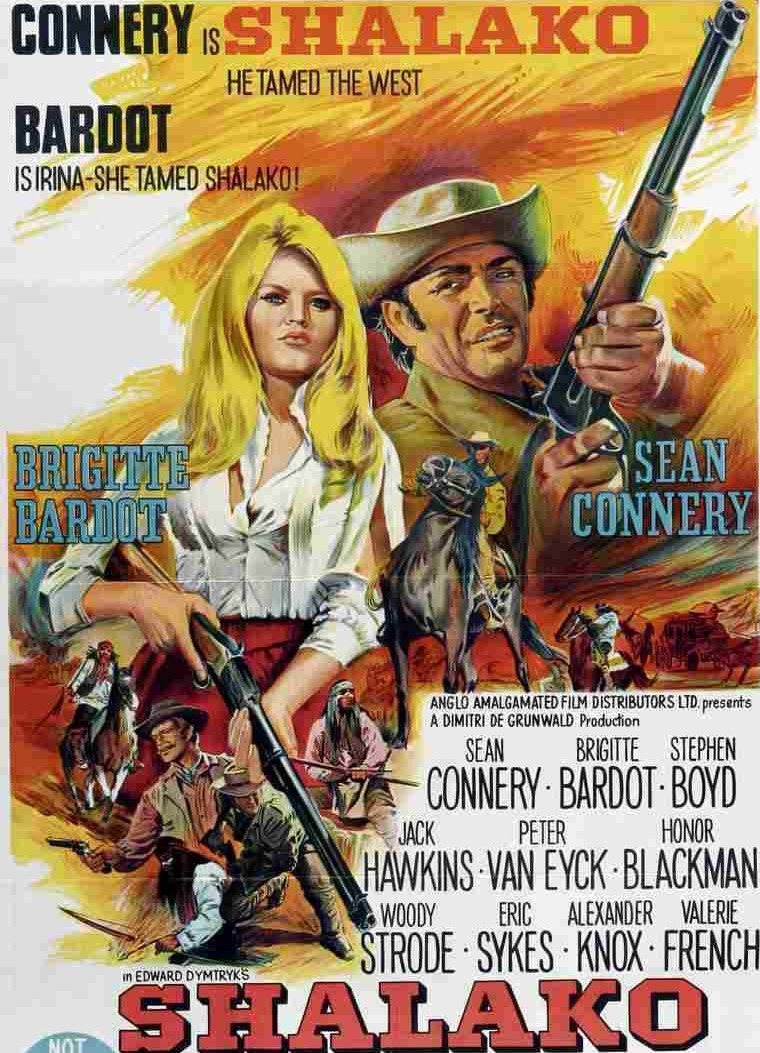
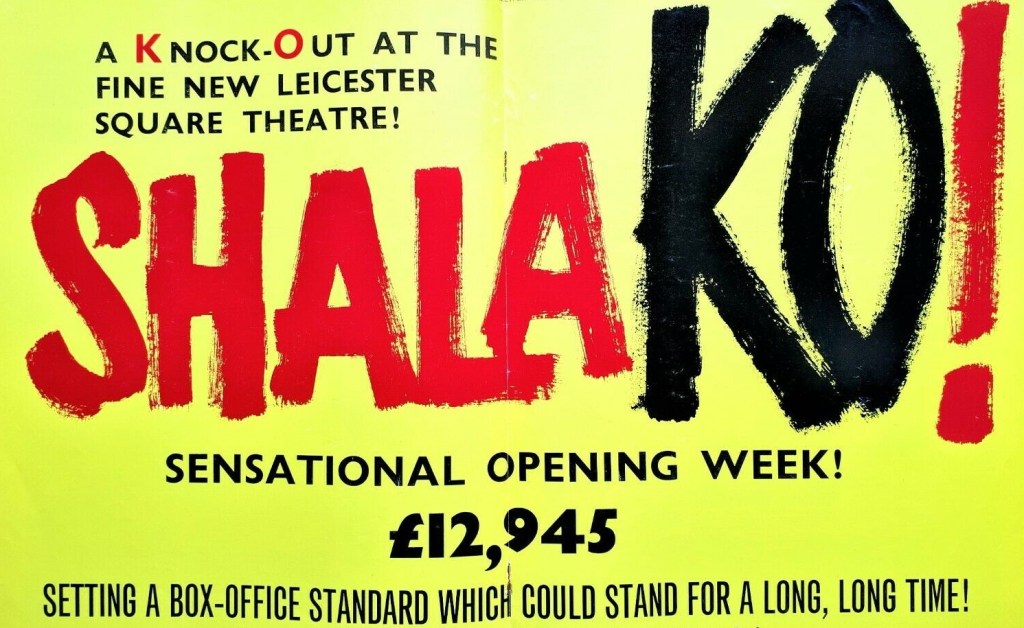
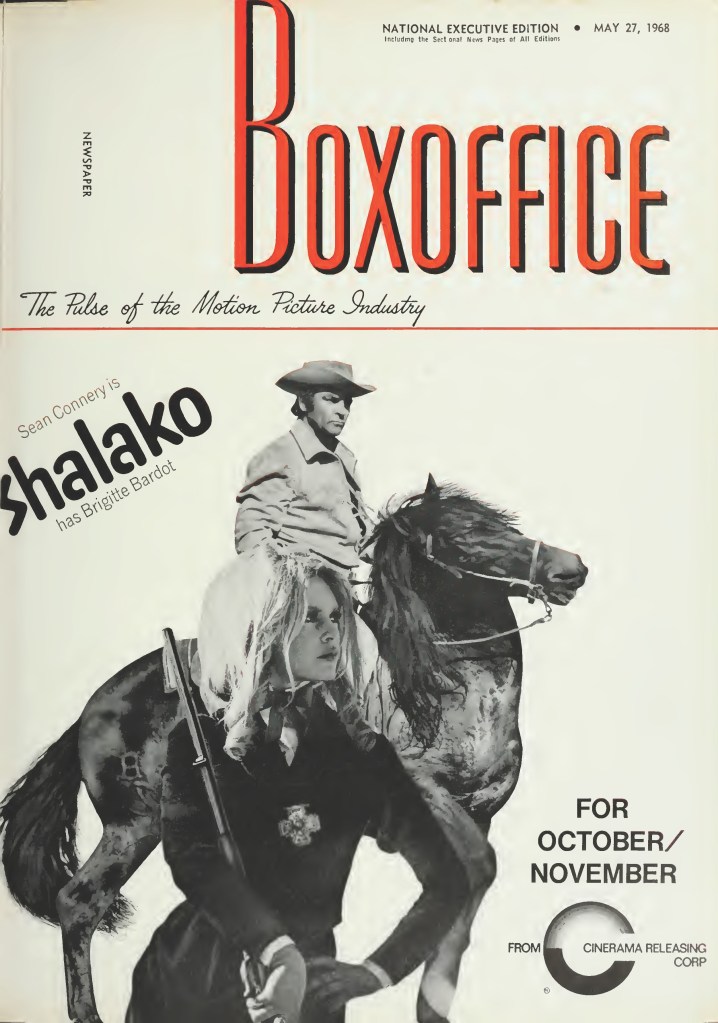
Behind the Scenes: “Shalako” (1968)

If you ever wondered just how a producer earns his crust, the convoluted process to make Shalako would provide a test case. British publicist turned producer Euan Lloyd had little on his calling card to gain entry to Hollywood, not even with the stars in tow for the project. Having worked for several years as a production assistant with Warwick Films, the British-based outfit headed by Cubby Broccoli and Irving Allen, he transitioned to associate producer on The Secret Ways (1961) but didn’t earn the moniker of producer until he pulled together an all-star cast for The Poppy Is Also A Flower (1966). Although released theatrically in Europe it was in reality a made-for-television number and screened as such in the United States.

So, actually, he was very much a neophyte producer. But early in his career he had become fast friends with Alan Ladd (Shane, 1953) and since they shared a love of westerns the actor had put him in touch with bestselling western author Louis L’Amour who was so taken with the Englishman’s enthusiasm he granted him a free option on any one of his un-filmed novels. Lloyd chose Shalako. “I could identify with that subject as it’s about a bunch of Europeans on safari in the West,” said Lloyd. (In fact, though as yet unfilmed, it was not as though nobody had tried. A report in Box Office magazine dated August 19, 1963, stated that Richard Carr was working on a screenplay for producer George Golitsin set for Universal).

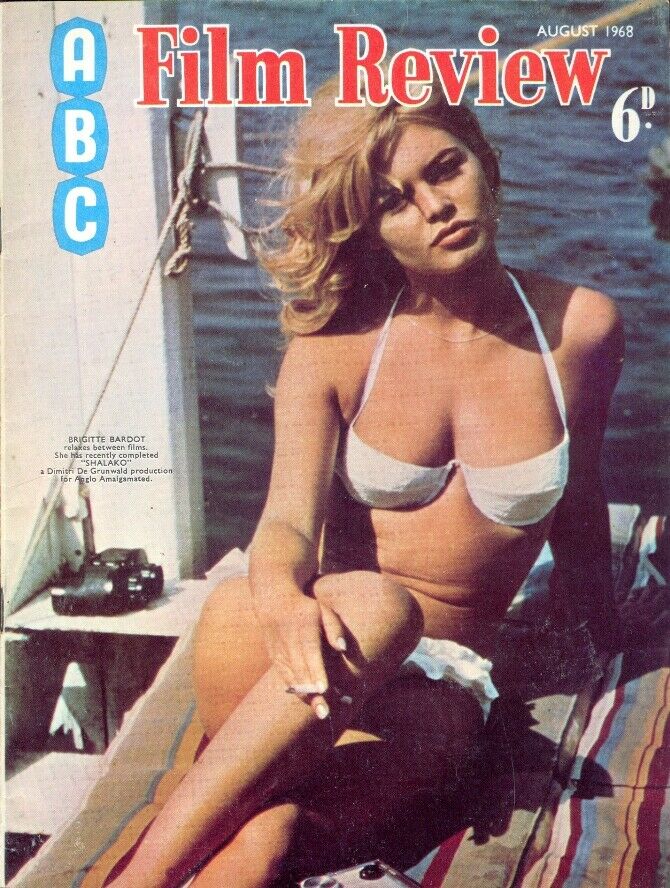
No connection to Shalako but little excuse necessary to showcase BB’s figure apparently.

On the production side, it would give him the excuse he required to put together a cast of non-Americans, stars from different nationalities who could open the distribution doors to significant European countries like France and Germany. His original starring pair were Henry Fonda (Firecreek, 1968) and Senta Berger, whom he knew from The Secret Ways and The Poppy Is Also A Flower. “Privately, she was the antithesis of the character she played in The Secret Ways…she came to mind as a very likely countess.”

He recruited Edward Dymytrk (Mirage, 1965), having got to know the director, a fugitive from the Communist witch hunt in the U.S., on the set of the British-made So Well Remembered (1947). Dmytryk had worked with Fonda on Warlock (1959). While appreciating Lloyd’s interest and keen to work again with Dmytryk, Fonda warned that he was not a strong enough marquee name to get the project off the ground.

To cover his back and using the names of his two stars and director, Lloyd set about pulling together finance from European sources. Although such co-productions were becoming  more common, Lloyd must have set some kind of record by pre-selling the movie, in the end, to 36 different bodies. But still it wasn’t enough. Without an American partner, the movie was no-go. Fonda proved the sticking point and in 1967 Lloyd decided to go for broke with a bigger cast (Fonda was pretty gracious about being dumped, “I did warn you,” he said).

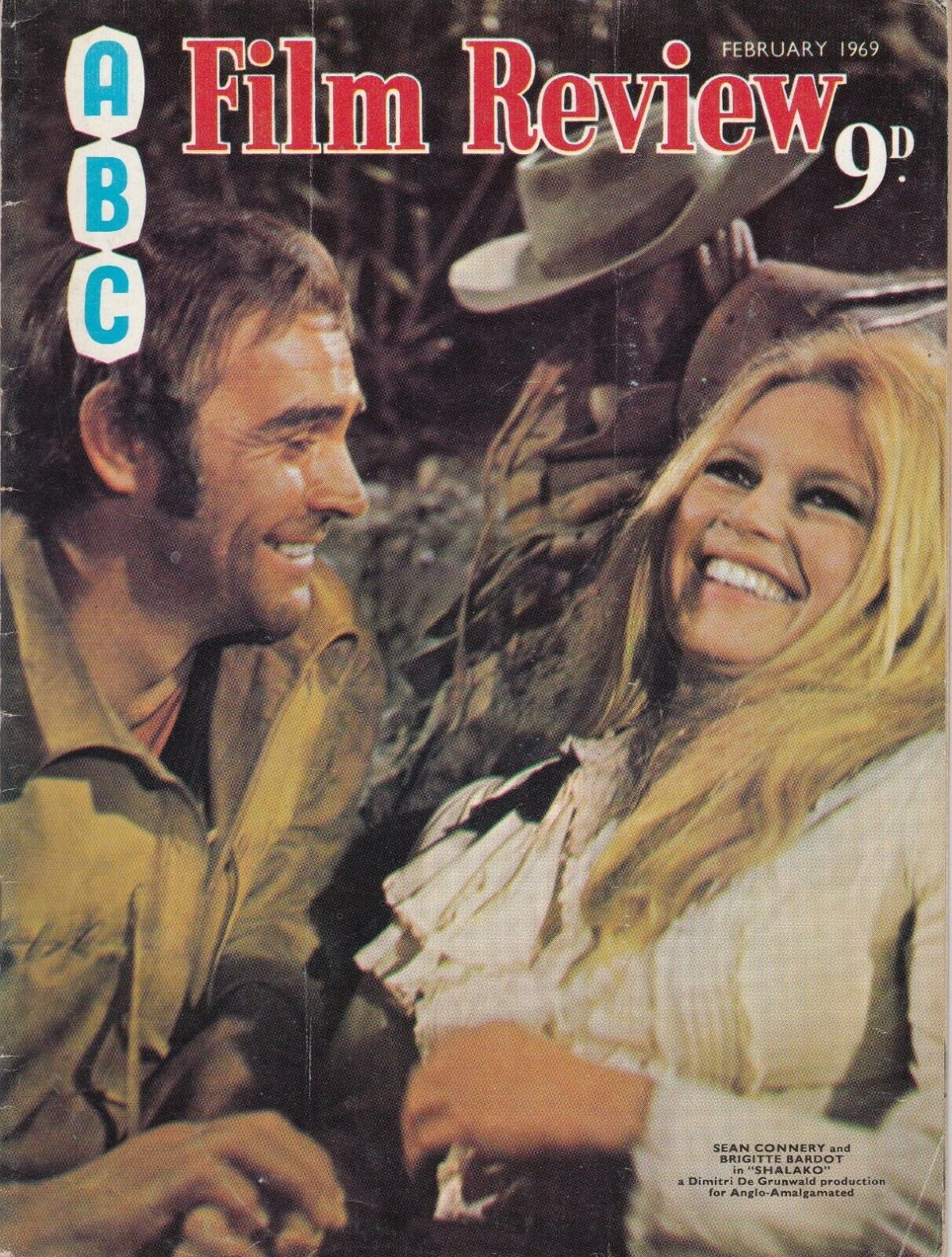
Sean Connery was not even initially on the list of proposed stars until Louis L’Amour alerted Lloyd to the length of the queues to see the latest Bond blockbuster (quite how a producer didn’t know that might be considered a mystery). Connery was incommunicado, filming a documentary in Scotland, but Lloyd managed to get in touch and seven weeks later he had what he believed, based on the Bond box office, was the biggest star in the world.

Part of the attraction for Connery of course was that for the first time he was receiving a salary ($1.2 million in total) commensurate with his box office. But it turned out as far as Hollywood was concerned, Connery had been taken in by his own publicity, studios pointing out that his non-Bond movies, Marnie (1964),  The Hill (1965) and A Fine Madness (1966) had not approached his Bond box office.

Nor was Brigitte Bardot a golden name on the U.S. cinema scene. Until the mid-decade reissue of La Dolce Vita (1960), her first starring role And God Created Woman (1956) held the record for the biggest imported movie. But since them, except for Viva Maria (1966), her movies had been relegated to arthouses, hardly worth risking for a $400,000 salary – she was in Variety’s list of Top Ten Overpriced Stars.

Three major studios rejected the movie. Assuming all the majors would take the same view that “Connery will never make it away from Bond,” Lloyd targeted a mini-major, the kind of neophyte outfit that might pony up to get a big name on its forthcoming schedule, a way of proving it could play with the big boys. ABC, an offshoot of the television network, was hooked, paying $1.4 million for the privilege.

Trevor Howard, Karl Malden, Claire Bloom and Ingrid Pitt was all considered for roles. Even without them, as well as Bardot, the movie, in terms of credits, had the look of one of those all-star epics so beloved in the 1960s: Jack Hawkins (Lawrence of Arabia, 1962), Stephen Boyd whom Lloyd knew from being associate producer on Genghis Khan (1965) and German star Peter van Eyck (Station Six Sahara, 1963). And if Bardot wasn’t enough to get journalist tongues wagging, Connery would also be reunited with Honor Blackman from Goldfinger (1964). The cast also included Woody Strode (The Professionals, 1966), famed 1940s western star Don ‘Red’ Barry (The Adventures of Red Ryder, 1940) and English comedian Eric Sykes (The Plank, 1967).

Mexico was first choice of location until the devalued peso rendered it too expensive. Almeria in Spain, location of choice of many a spaghetti western, was the alternative. The biggest problem pre-shooting was that, to get into character, Connery had decided to grow a Mexican moustache, presumably not aware that moustaches were verboten for stars after The Gunfighter (1950) sank at the box office reputedly because Gregory Peck wore one.  In the end, without the subject becoming a thorny issue, Connery shaved it off. He spent two weeks learning to ride under the tuition of Bob Simmons, a stunt arranger on the Bond pictures, so he could, indeed, sit as tall in the saddle as the great western stars. “He was a very proficient horseman by the time we started,” commented co-star Eric Sykes, “He looked as if he had been riding all his life.”

Meanwhile, Jack Hawkins (Masquerade, 1965) had undergone an operation for throat cancer and though he could speak his words were accompanied by a kind of belch and the voice for which he was so famous had disappeared. By coincidence Lloyd heard what he thought was Hawkins voicing a beer commercial. The distinctive tones belonged to Charles Gray (The Devil Rides Out, 1968) and he re-voiced Hawkins’ lines.

Despite Connery’s assertions to the contrary – his famous quote “she’s all girl but…all on the outside” was viewed as a detractory statement – Lloyd insisted it was a happy set. “I had absolutely no trouble from the cast during shooting and Sean and Brigitte performed perfectly and in harmony. Eddie Dmytryk was a man who knew exactly what he wanted and how to get it. The co-stars liked him enormously.”

Other sources paint a different picture, pointing to tension between Connery and Bardot over who was the bigger star, between Bardot and former lover Boyd, and between Connery and Dmytryk over the script. According to Eric Sykes, sitting beside Connery in between takes, the actor “would tear half a page or even a whole page of dialog out of his script…He was editing his part as he went along, apparently without reference to the director…One scene in particular with him and Brigitte Bardot, a long scene where they were sitting around a pool….it went on and on for about eight minutes…Sean’s editing turned it not a slick two- or three-minute scene…Eddie (Dmytryk) did not challenge it because when he saw what Sean had done he knew it was right.”

A big success in UK and Europe, it was a flop in the U.S. where ABC recorded a $1.2 million loss, but since every area was sold separately it is doubtful this shortfall would need to be repaid by the producer so counting the income from other sources it would have gone into profit. Incidentally, Connery was pictured wearing a moustache when the movie had its premiere and he was actually one of the few major stars who regularly wore a moustache in pictures and there are those who attribute his career longevity to cultivating a beard while still in his prime.

SOURCES: John Parker, Sean Connery, 1930-2020, The Definitive Biography (Bonnier Books, 2020) p171-176; Mac Mcsharry and Terry Hine, “The Way West,” Cinema Retro, Issue #2 May 2005, p38-42.

Shalako (1968) ***

It’s a gripping and unusual opening. The jangling noise of metal beating upon metal. A trapped mountain lion surrounded by a posse of unkempt men. The beast driven into a killing zone. The camera ends up on a classy blonde in a top hat, Irina (Brigitte Bardot), drawing a bead on the animal. But as she shoots so does rugged cowboy Bosky (Stephen Boyd) and you can be sure his aim is more deadly. It wouldn’t do to have an upper-class European lady to be mauled to death by a vicious creature just because her ego got the better of her.

Except that’s not the opening. Instead, that’s sacrificed for a dumb theme tune and a few minutes over the credits watching titular hero Shalako (Sean Connery) doing what exactly? Nothing exciting that for sure. We see him riding I guess to prove he can sit as tall in the saddle as the stars of the genre like Alan Ladd, John Wayne, Gary Cooper, James Stewart, as if nobody expected James Bond to be able to complete such a transition. There’s a bit of waking up, more riding, drinking from a dirty stream, and more riding while composer Jim Dale struggles to find lyrics that rhyme with Shalako.

There’s a bit more exposition before Shalako does anything meaningful. We are introduced to a fistful of Europeans on a hunting party complete with butler (Eric Sykes) and guzzling champagne and escorted by a bunch of mean-looking cowboys looking on in envy though I doubt any would acquire a taste for champagne.

Then the real action starts. A bit’s been missed out explaining just why Irina took off on her own with just one man as escort to continue hunting and nobody thought fit to warn her this was Apache country. We know she’s in trouble because her escort is just about dead and Apaches are gathering. Enter Shalako to save the day. The first piece of dialogue between the most handsome man in the world and the screen’s most beautiful woman, a movie made just so Connery, at his Bond peak, and Bardot, in her most expensive picture, could strike sparks off each other,  is hardly something to treasure. It’s almost priceless for its mundanity. “You all right?” grunts Shalako. “Yes,” replies the breathless heroine.

But trust the British to bring that epitome of British moviemaking, the class war, to that most democratic of movie species, the western. It’s ironic that in the country where freedom is a given  – slavery long since abolished in the period this movie was set – members of the hunting party are fettered. Irina is little more than bait. You might as well have staked her out, hoping to snare German aristocrat von Hallstatt (Peter van Eyck). Marriage would cure the financial woes of her debt-ridden sister Lady Daggett (Honor Blackman) and husband Sir Charles (Jack Jawkins). Von Hallstatt doesn’t believe in making romantic overtures, it would be, like so many aristocratic marriages, a contract of convenience; he acquires beauty, she gets wealth.

To complicate matters Lady Daggett has a roving eye which has settled on Bosky, and to complicate matters even further, nobody should be firing rifles, even if only for sport, in Apache territory. It’s not long before the Apaches take umbrage and launch an attack. And it takes even less time for Bosky and his buddies to take off, leaving their charges poorly defended in a makeshift fort.

It takes way too long to sort out all these plot machinations and get to the meat of the story which is finding a way of putting Connery and Bardot together and when they are not the movie trundles along without much in the way of screen sparks. It could have done with an entirely different scenario. Something akin to Soldier Blue (1970) would have worked a treat, with roles reversed of course back to the traditional of experienced male tending the inexperienced female as they battle through enemy territory.

You needed to get this pair together – and quick – for the movie to find any steam at all. As it is, it’s somewhat laborious. While the action sequences are well done and Shalako scores in the western lore department, you wouldn’t have thought a mountaineering subplot could have produced so few thrills, its only purpose, plot-wise, to ensure that von Hallstatt acquires some credibility (he’s the mountaineer) and that the group can reach a plateau whose main attraction, as lovers of westerns will already be aware, is a pool where in the great Hollywood tradition a woman can disport herself half-naked. Shalako, in sneaking up on her, comes across like a bit of a peeping tom.

Sean Connery (The Hill, 1965) is convincing enough as a cowboy. He certainly doesn’t look out of place on a horse but it takes far too long for the expected romance to begin. Brigitte Bardot (Viva Maria!, 1965) is better than you might expect as a sharpshooter, but not quite in the fiery class of a Claudia Cardinale (The Professionals, 1966) or even Maureen O’Hara (The Rare Breed, 1965) and she’s not really given the dialog necessary to fully establish the independence of her character.

Director Edward Dmytryk (Mirage, 1965) does his best with an overly-complicated script and some cumbersome set-pieces and it would have worked far better if a few characters and reams of sub-plot had been chucked aside to bring the stars together quicker. While Connery does the riding and shooting well enough he lacks the grizzled lived-in face of his famed western predecessors and I get a sense of him trying too hard. And, as I said, it wouldn’t have taken much to pep up Bardot.

Having complained about the subsidiary characters, they are all well-drawn. Stephen Boyd (The Big Gamble, 1961) makes on helluva mean cowboy, Honor Blackman (Moment to Moment, 1966) is excellent as a predatory female. Aristocratic pair Peter van Eyck (Station Six Sahara, 1963) and Jack Hawkins (Masquerade, 1965) are the kind of actors who can denote fallen status with facial expression rather than requiring lumps of dialog. But Eric Sykes (The Plank, 1967) is really a British in-joke.

James Griffith and screenwriting partner Hal Hopper had previously worked on Russ Meyer epics like Lorna (1965). The original story came from  a novel by Louis L’Amour (Catlow, 1971).

Out-with his guise as James Bond, Connery – excepting Robin and Marian (1976) and Cuba (1979) – was not one of the screen’s great lovers so this would have been the perfect chance  to hone those particular credentials. But like the entire picture this was a missed opportunity. When the best scene is the brutal suffocation of Honor Blackman and not the two stars canoodling, you can see the target was missed by miles.

Behind the Scenes: Sherlock Holmes and Other Stories, Thumbs Up or Thumbs Down, United Artists 1966 – Part Two

Although Billy Wilder had written a script based on The Life of Sherlock Holmes, he was not considered as its director. Mirisch was looking at a budget in the region of $2 million, which would rule out any big star. However, there were issues with the Conan Doyle Estate which was in the process of firing up other movies based on Sherlock Holmes, A Study in Terror (1965) being the most recent. That had been the brainchild of Henry Lester and perhaps to general astonishment these days Mirisch had  agreed Lester would be allowed to make more Sherlock Holmes pictures as long as they remained very low-budget, on the assumption, presumably, that the marketplace would treat them as programmers rather than genuine competition.

However, Mirisch and UA retained the upper hand as regards the Conan Doyle Estate and “could cut him (Lester) off at such time as we have made definite plans to proceed.”

There was another proviso to the deal. The Estate would agree to forbid any further television productions unless Mirisch decided it wished to go down the small screen route itself. It was odd that Mirisch had eased Billy Wilder out of the frame given the mini-major had enjoyed considerable success with the director on Some Like it Hot (1959) and The Apartment (1960), a commercial partnership that would extend to The Fortune Cookie (1966).

Instead, Mirisch lined up British director Bryan Forbes who would be contracted to write a screenplay based on the Wilder idea. The sum offered – $10,000 – was considered too low, but it was intended as enticement, to bring Forbes into the frame as director. If Forbes refused to bite, “the only other name suggested and agreed upon was that of John Schlesinger.”  Although David Lean was mooted, UA were not in favour. Mirisch didn’t want to risk paying for a screenplay before there was a director in position.

The offer of the Sherlock Holmes picture was seen as a sop to Forbes. At this meeting, Mirisch had canned The Egyptologists, a project which Forbes believed had been greenlit. And why would he not when he was being paid $100,000 for the screenplay. In bringing the project to an untimely close Mirisch hoped to limit its financial exposure to two-thirds of that  fee. Should Forbes balk at Sherlock Holmes, he was to be offered The Mutiny of Madame Yes, whose initial budget was set at $1.5 million, plus half a million for star Shirley Maclaine. Another Eady Plan project, this was aimed to go before the cameras the following year. If Forbes declined, then Mirisch would try Norman Jewison with Clive Donner and Guy Hamilton counted as “additional possibilities.”

As for Billy Wilder he had much bigger fish to fry. He was seeking a budget of $7.5 million to adapt into a film the Franz Lehar play The Count of Luxembourg to pair Walter Matthau and Brigitte Bardot. Should Matthau pass, Wilder would try for Cary Grant (whose retirement had not yet been announced) or Rex Harrison. Both sides played negotiation hardball. UA currently in the hole for $21 million for The Greatest Story Ever Told (1965) and Mirisch, having pumped $13 million into the yet-to-be-release Hawaii (1966), didn’t want to commit to another unwieldy expensive project. So Mirisch insisted the project advance on a “step basis” allowing UA to reject the project after seeing the screenplay. Wilder countered by insisting that if it went into turnaround he, rather than the studio, would have the right to hawk it elsewhere (generally, studios tried to recover their costs if a movie was picked up by another studio). But Wilder was also in placatory mood and even if UA rejected this idea he was willing to work with the studio on a Julie Andrews project called My Sister and I.

However, UA and Mirisch were all show. “After Billy left the meeting,” read the minutes, “it was agreed we would not proceed with The Count of Luxembourg since we did not want to give Billy the right to take it elsewhere if United Artists did not agree to proceed.” Harold Mirisch was detailed to give Billy the bad news, but use a different excuse.

Mirisch was also on the brink of severing links with Blake Edwards. Negotiations for a new multiple-picture deal were to be terminated, which would mean the director would only earn his previous fee of $225,000 for What Did You Do in the War Daddy? It was also sayonara for Hollywood agent Irving Swifty Lazar, whose current deal was not working out to the studio’s satisfaction.

Other long-term deals with directors were under discussion. While its previous John Sturges movie, The Hallelujah Trail (1965), had flopped, UA was still keen on the Mirisches pursuing a long-term deal with the director, feeling that he was a “good picture-maker with the right project.” To that end, it was suggested Mirisch reactivate Tombstone’s Epitaph, but emphasising Stuges had to bring the cost down.

At this point nobody knew Norman Jewison was embarking on all almighty box office roll – The Russians Are Coming, The Russians Are Coming set to hit the screens, In the Heat of the Night at screenplay stage, so Mirisch was prescient in trying to put together a long-term deal with the director. Wind on Fire and Garden of Cucumbers were seen as tentpoles for a multi-picture deal. Mirisch had already agreed a $50,000 producer’s fee for Wind of Fire, payment of one-third of which was triggered for supervising the screenplay.

The meeting also gave the greenlight to Death, Where Is Thy Sting-A-Ling, a project that would be later mired in controversy with shooting ultimately abandoned. The go-ahead was given with the proviso the Mirisches secured the services of Gregory Peck or an actor of his stature.  Budget, excepting Peck’s fee, was just over $3 million and it was another one hoping to take advantage of the Eady Plan.

This kind of production meeting was probably more typical than you would imagine, studios trying to keep talent sweet while not committing themselves to dodgy product. It’s perhaps salutary to note that of the projects under discussion, only a handful found their way onto cinema screens. Garden of Cucumbers (as Fitzwilly), How To Succeed in Business, having met budget restraints, and Tombstone’s Epitaph (as Hour of the Gun) with James Garner all surfaced in 1967 and Inspector Clouseau the following year. Neither of the Steve McQueen projects survived nor the pair proposed by Billy Wilder. High Citadel, Saddle and Ride, The Narrow Sea, The Great Japanese Train Robbery, and The Cruel Eagle failed to materialize. Billy Wilder eventually made The Private Life of Sherlock Holmes under the Mirisch auspices but not until 1970. 

Beat Girl / Wild for Kicks (1960) **

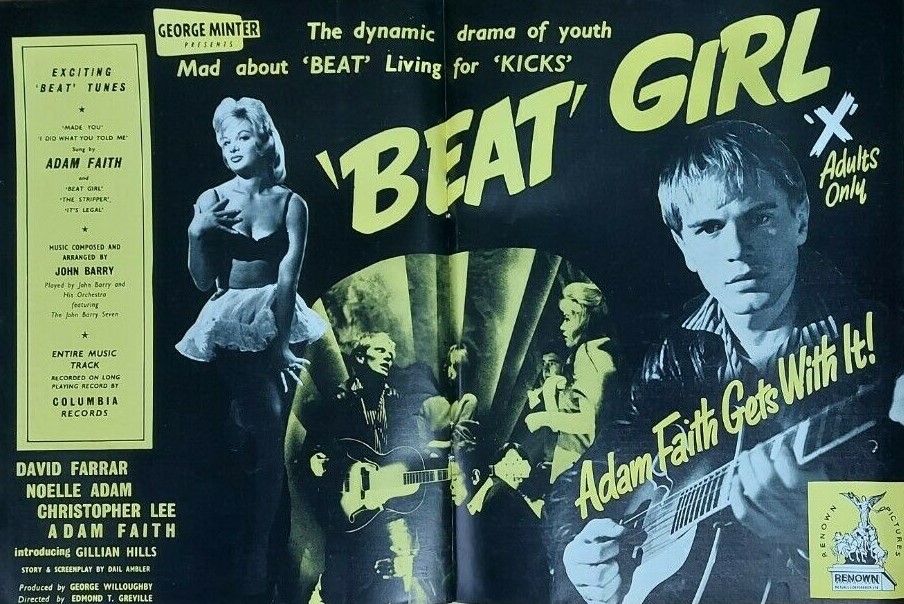
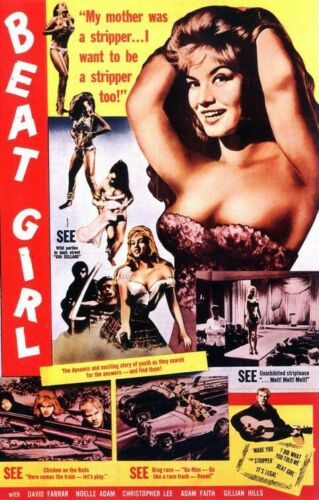
More social document than drama, but that aspect somewhat diluted by the moviemakers’ attempts at exposing rebellious youth while taking for granted more sordid adult behavior. Sold under the exploitation banner – “this could be your teenage daughter” – narrative flow is interrupted now and then to showcase Adam Faith’s singing and to accommodate a few striptease acts. Probably more interesting is the array of new talent on show.

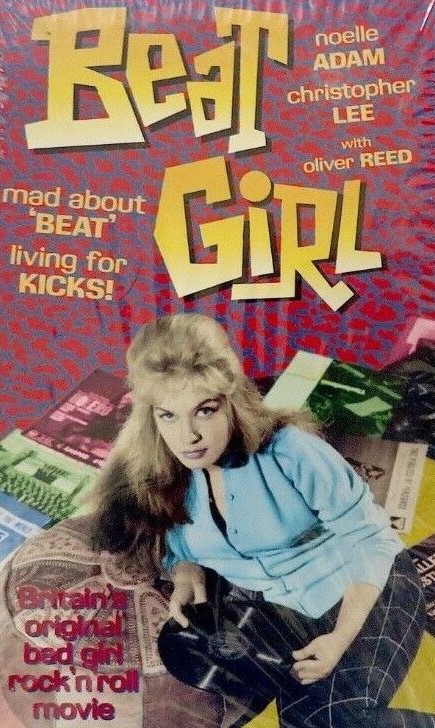
Spoiled teenager Jennifer (Gillian Hills) heads for the wild side of town to experience the beatnik lifestyle in Soho coffee shops and cellars. That there’s no drugs involved and that alcohol is considered “square” – as for that matter is violence – may come as a surprise to students of the period. Apart from one episode of road-racing and playing “chicken” along a railway track, most of the time the gang listen to music or go dancing until Jennifer gets it into her head that joining a striptease show might give her life the thrill it is missing.

VHS cover.

This is prompted by the discovery that her new too-young stepmother Nichole (Noelle Adams) has been a stripper and most likely a sex worker in Paris before marrying wealthy architect Paul (David Farrar), cueing a round-robin of confrontations. Strangely enough, from the narrative perspective, none of the young bucks appear romantically interested in the provocatively-dressed Jennifer and so it is left to creepy club owner Kenny (Christopher Lee) to make a move.

The gaping hole left by lack of narrative drive is not offset by immersion in the beatnik or striptease scene. Back in the day the British censors took the editing scissors to the striptease  but although restored versions available now contain nudity you are left wishing that there was some lost element to the beatnik sections that would have given the picture the energy it required.

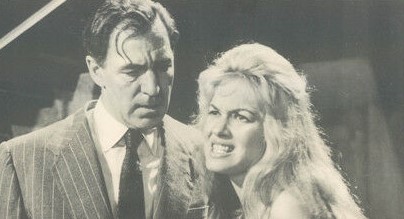
Gillian Hills (Les Liaisions Dangereuses, 1959), comes over as a cross between Brigitte Bardot and Diana Dors without having an ounce of the sex appeal of either. All pout and flounce, she is unable to inject any heart into her two-dimensional character, although given her youth and inexperience this was hardly surprising. Former British star David Farrar (Black Narcissus, 1947) was coming to the end of his career and in a thankless role as a frustrated father could do little to rescue the project.

Father and headache of a daughter – David Farrar and Gillian Hills.

French actress Noelle Gordon (Sergeant X of the Foreign Legion, 1960) could have been Jennifer’s mother given her own tendencies towards wiggle and pout but at least she makes a stab at trying to overcome her step-daughter’s hostility.

In the main, the picture’s delight is bringing to the fore a whole chorus of new faces. Pick of the supporting cast is Shirley Anne Field (Saturday Night and Sunday Morning, 1960) who doesn’t just have a knowing look but looks as if she knows what’s she doing acting-wise. Making his movie debut was teen pop idol Adam Faith, who had made his name playing in coffee bars. He had already notched up a couple of number one singles, but doesn’t quite set the screen on fire. Peter McEnery (The Fighting Prince of Donegal, 1966) plays his inebriated pal. You can also spot Oliver Reed (Women in Love, 1969), Julie Christie (Doctor Zhivago, 1965), Claire Gordon (Cool It, Carol, 1970) and Nigel Green (Jason and the Argonauts, 1963).

Perhaps the most important debut belonged to composer John Barry. He had already been working with Adam Faith. Barry’s music for the film was the first British soundtrack album ever released, reaching number eleven on the charts, and opening the doors for future soundtrack albums, not least of which was the rich vein of theme tunes produced by Barry in the next few years. 

French director Edmond T. Greville, who brought little panache to the subject matter, would redeem himself with his next picture The Hands of Orlac (1960). 

This doesn’t fall into the “so-bad-it’s-good” category, nor has it been unfairly overlooked, and probably is better known as an example of the kind of exploitation B-picture that the Americans do so much better and a reminder that, except on rare occasions such as The Wild One (1953), older moviemakers seem incapable of capturing the essence of youth.

Discover WordPress

A daily selection of the best content published on WordPress, collected for you by humans who love to read.

The Atavist Magazine

by Brian Hannan

WordPress.com News

The latest news on WordPress.com and the WordPress community.