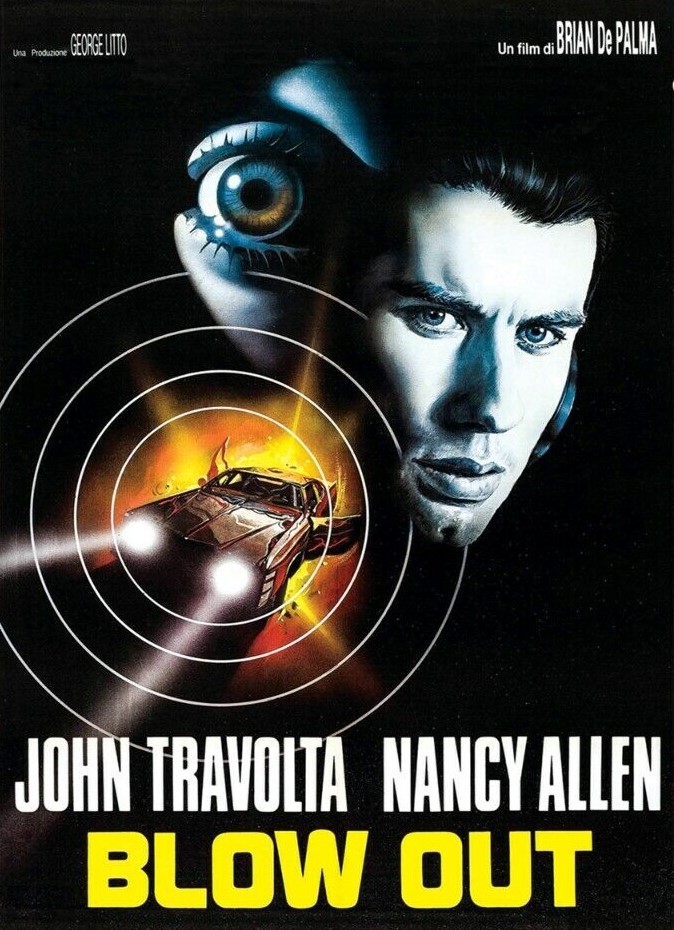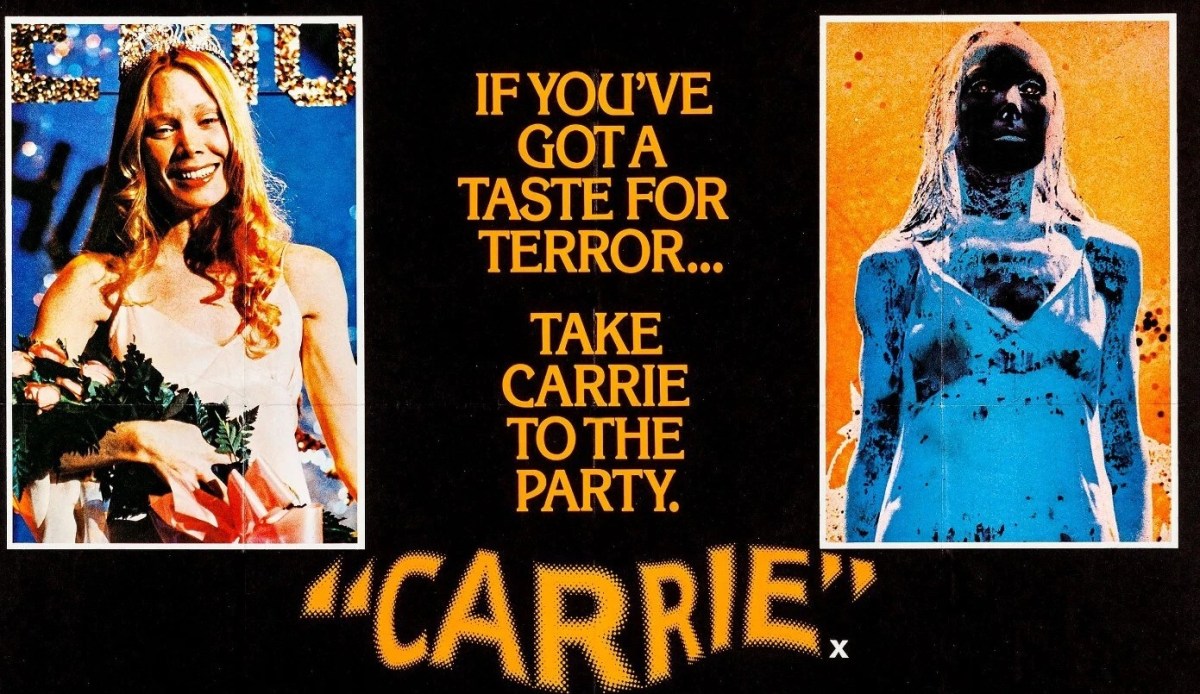
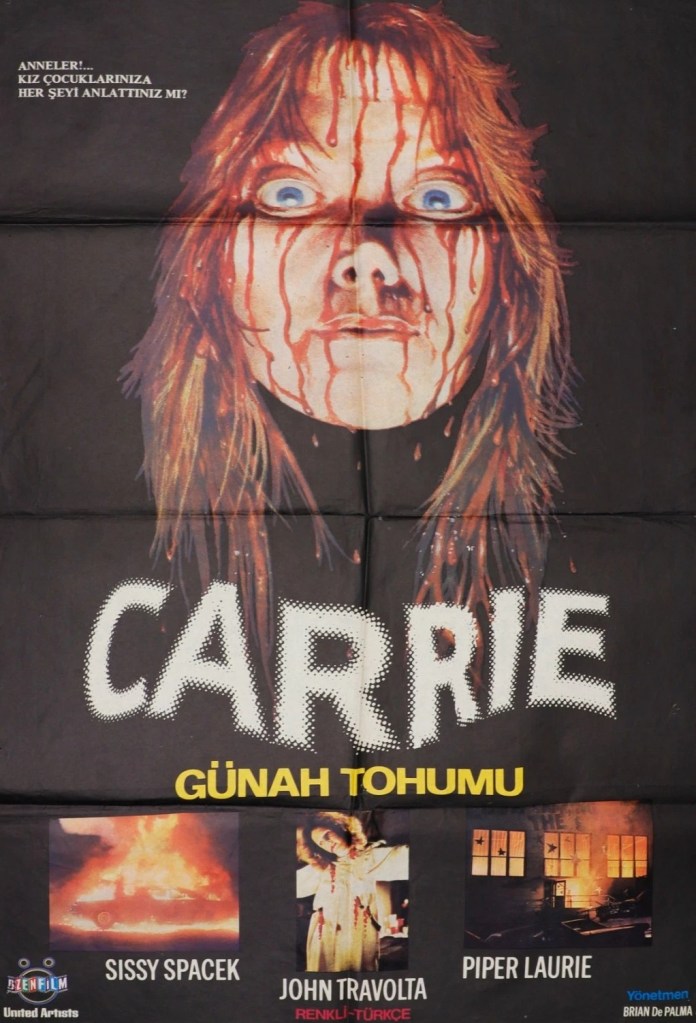
Carrie (1976) *****

Could have easily gone so badly wrong. You got Mean Girls vs Teen Romance. Demented Mother of Elmer Gantry vs Demented Daughter of Psycho. Why did nobody ever think before that slow-mo that used to be the preserve of lovers gambolling in fields and cowboys being bloodily gunned down could be as easily employed to watch naked girls in the shower. Throw in split-screen and a couple of other technical devices. And the shock ending which triggered a new cycle.

There’s a heck of lot of face-slapping that wouldn’t pass muster today and not exclusively male either, hard-ass teacher Miss Collins (Betty Buckley) setting about venal pupil Chris (Nancy Allen), Chris giving as good as she gets from boyfriend Billy (John Travolta). And if you were a rising star like John Travolta you might think twice about the effect on your career of battering a pig to death with a sledgehammer. Try those capers now and you’d run into the woke police.

But it’s surprisingly feminist. Women twist their men round their little finger, the headmaster does the bidding of Miss Collins, All-American Boy Tommy (William Katt), decked out in a super perm, accedes to the barmy request of his girlfriend Sue (Amy Irving), attempting to assuage her guilt over her role in bullying Carrie (Sissy Spacek), to give up her place at the Senior Prom to the nerd, and Chris has no problem getting Billy to go along with her scheme for humiliating vengeance.

In another movie, Carrie, an eternal victim, would have been the Final Girl but such is her wrath nobody’s left standing to qualify for that position. Nobody escapes, innocent and guilty alike, put to the sword. There’s sex in all its disguises, ranging from a virgin’s first tender kiss to a blowjob to sin to rampant voyeurism.

That it works so well is in part due to the malevolence of all concerned, the above mentioned whacking, the mother locking the child in a closet, the gleeful girls tormenting Carrie, and Carrie spiteful in her blood-soaked vengeance. The telekinesis on which the tale depends is cleverly introduced, a few minor incidents hinting at this unnatural power, Carrie herself doing the research rather than consulting a specialist and weighting the picture down with turgid exposition.

The neat running time – barely topping 90 minutes – eliminates any slack. And director Brian De Palma (The Untouchables, 1987) has sufficient command of the tension and occasional moments of bravura that it’s touched on the ironic climax before you realize quite where it’s going. Atmospheric score by Pino Donaggio (Don’t Look Now, 1973) guides us along, the haunting melody that wouldn’t be out of place as a love theme lets us know there’s more to the shower scene than we might expect while the sharp chords accompanying the slaughter reminiscent of Psycho (1960).

Announced to the world Stephen King as writer of immensely cinematic books, and made De Palma a commercial name. Sissy Space (Prime Cut, 1972) and Piper Laurie (The Hustler, 1961) were nominated for Oscars and the movie served as launch pad for several of the cast, most notably John Travolta (Saturday Night Fever, 1977), including Nancy Allen (Dressed to Kill, 1980), William Katt (Big Wednesday, 1978) and Amy Irving (Micky +  Maude, 1984). Written by Lawrence D. Cohen (Ghost Story, 1981).

Still a terrific watch.
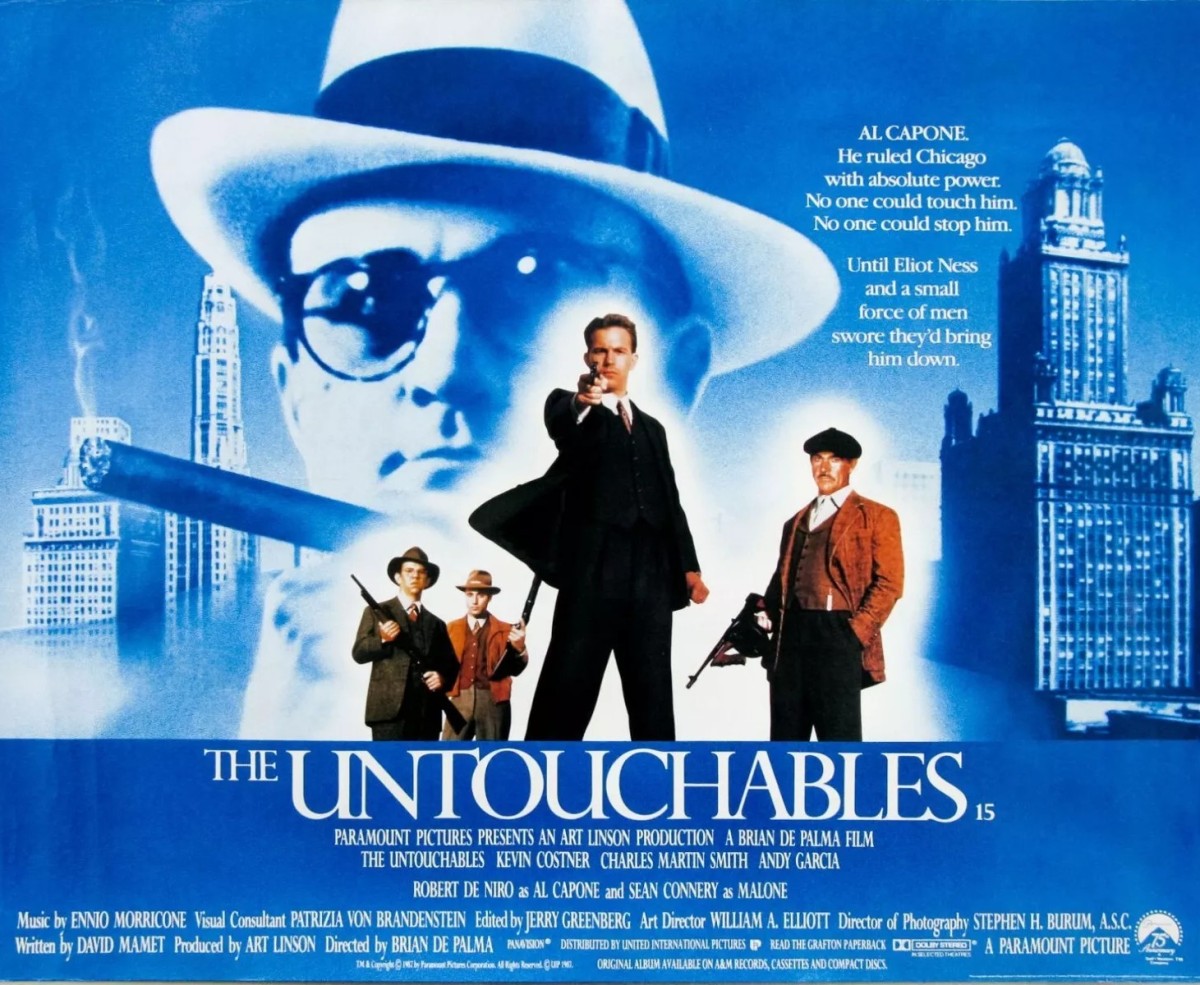
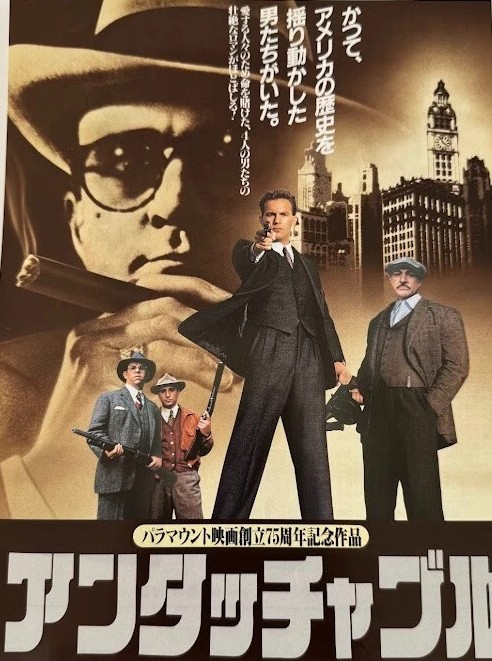
The Untouchables (1987) *****

The greatest crime picture ever made, outside of The Godfather Parts I and II (1972/1974). A sledgehammer of a narrative that moves like an express train, only slowing down for a number of bravura sequences. Riddled with fabulous lines, built on great performances, and seeded early on with subsidiary characters who will later play significant roles. In any analysis it reads like a greatest hits.

The bloodied finger of Al Capone (Robert DeNiro) holding court to fawning journalists; the little girl’s plaintive cry of “Mister” before she’s blown to kingdom come; the love note included in the lunch of Elliot Ness (Kevin Costner); “poor butterfly” as the first raid goes wrong; the introduction of Malone (Sean Connery) “here endeth the lesson”; the trading of racist insults with recruit George Stone (Andy Garcia); Capone bludgeoning an associate to death with a baseball bat; in the safety of a church, Malone explaining “the Chicago way”; the first big cinematic sequence – the shootout at the border with meek accountant Oscar Wallace (Charles Martin Smith) making his bones and sneaking a drink of beer; Malone “killing” the dead man; “touchables” smeared in blood in the lift; Malone’s fistfight with crooked boss Dorsett (Richard Bradford); Malone’s murder by hitman Frank Nitti (Billy Drago); the second, and greater, bravura sequence – the shootout on the steps of the railway station; Ness pushing Nitti off the rooftop; the disbelieving Capone sentenced.

And those are just the broad strokes. Peppered throughout is the issue of Capone’s tax evasion, the crime that brings him down, with virtually all Wallace’s contribution being reading from documents relating to this. Nitti appears in the second scene, leaving the bomb that will blow the little girl to kingdom come, and again at Ness’s house.

And this is so old-fashioned that not only are we rooting for the good guys but none of those involved has marital or alcohol problems. Cops like Malone may be disillusioned but they don’t take their disenchantment out on the bottle. Anyone who talks about marriage agrees it is a good thing.

Character introduction doesn’t go down the iconic route of The Magnificent Seven (1960) or The Dirty Dozen (1967). Chicago’s Finest sneer at Ness behind his back. Another director would have been tempted into a bolder entrance for Malone. But he’s a loser, still a beat cop in middle age, and on the late shift at that. He doesn’t just know his job, detects Ness is packing a gun, but he’s capable of a sardonic quip or two. Who’d claim to be working for the humiliated Treasure Dept is they weren’t? And he’s not so stand-up as he appears, playing with a key chain like worry beads, keeps a sawn-off shotgun in his record player.

And that’s before we go into the dialog. Screenwriter David Mamet (Glengarry Glen Ross, 1992), revered as America’s greatest living playwright, turns on the style. “You can get further with a kind word and a gun than with just a kind word”;  “They pull a knife, you pull a gun”; “do you know what a blood oath is?”; “team!”; “brings a knife to a gun fight”; “all right, enough of this running shit;” “can’t you talk with a gun in your mouth?” “his name wasn’t in the ledger,”  “did he sound anything like that?”

And that’s before we get to the score by Ennio Morricone, his best in terms of the consistency of theme (rather than just one standout tune) since Once Upon a Time in the West (1969). Or the rocking title sequence.

Turned Kevin Costner (Horizon, An American Saga – Chapter 1, 2024) into a star, a position, with dips here and there, he’s maintained for half a century. Andy Garcia (Black Rain, 1989), too, though for a shorter duration. Not everyone was impressed by Robert DeNiro’s (The Alto Knights, 2025) florid interpretation, but I wasn’t one of them. Brought Sean Connery (The Russia House, 1990) long overdue recognition for his acting, though it’s worth remembering that the Oscar voters who gave him a standing ovation could have handed him the gong a good time before for any number of excellent portrayals.

Director Brian DePalam (Carrie, 1977) was an Oscar shut-out. And when I look at the films that took precedence in the Best Film nominations, there’s only one, Moonstruck, that I’d seek out.

This is a thunderous achievement, and I can’t wait for 2027 when Paramount surely will bring it back to the big screen for a 40th anniversary celebration.

Unmissable.

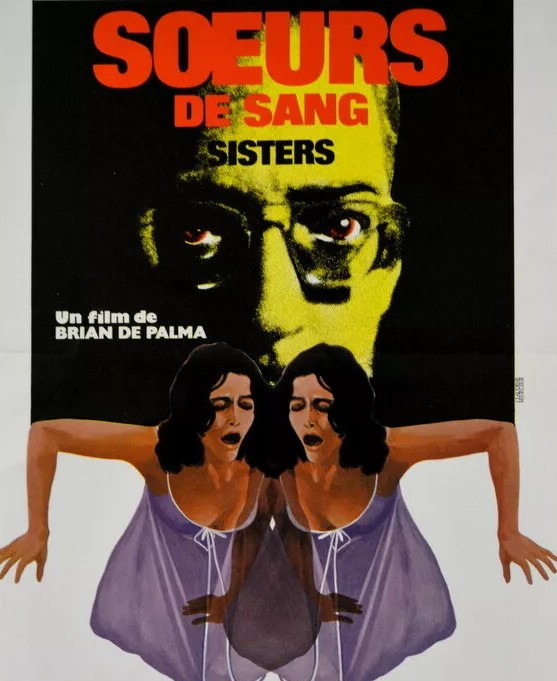
Sisters / Blood Sisters (1973) ****

Trust Brian De Palma to invent a gameshow called “Peeping Toms.” And give Hollywood an insight into the delicious malevolence to come later in his career. Often compared to Hitchcock, this is Hitchcock diced and sliced, awash with style. Not simply inspired use of split screen but an ending Edgar Allan Poe would have been proud of. De Palma plays with and confounds audience expectation and has mastered enough of the Hitchcock approach to make the villainess more attractive than the heroine. If you’re in the mood for Hitchcock homage, this is a good place to start.

Both main characters are strictly low end, sometime model Danielle (Margot Kidder) gameshow fodder, journalist Grace (Jennifer Salt) handed run-of-the-mill reporting jobs instead of, as she would prefer, investigating police corruption. Grace also has to contend with a mother (Mary Davenport), in typical non-feminist fashion, determined to marry her off.  

While the Siamese twin notion is straight out of the B-movie playbook and right up the street of exploitation maestros AIP, De Palma takes this idea and hits a home run. But you’ll have to be very nimble to keep up with the narrative.

Danielle meets Philip (Lisle Wilson) at the gameshow and after dinner she invites him to her apartment for sex. In the morning, he buys a surprise birthday cake for Danielle and her twin Dominique. On his return, he is murdered, an act witnessed by Grace, a neighbor across the street. She calls the police but before they can arrive Danielle’s ex-husband Emil (William Finley) – introduced to the audience, incidentally, as a creepy stalker – cleans up the mess and hides the corpse in the fold-up bed-couch.

Fans of the forensic may have trouble with this section as these days blood is more difficult to hide, but that’s evened up by the notion that a pushy journo would be allowed to sit in on the investigation. But heigh-ho, this was back in the day, so anything goes, and in any case, a la Hitchcock, it’s the woman who enters harm’s way. The cops, annoyed to hell by Grace, give up on the case and the reporter, having found the cake carrying the names of both twins,  manages to destroy the evidence.

Great set of reviews that only served to confuse the public.
An audience searching for schlock doesn’t want art.

Grace isn’t the kind of reporter easily thwarted so she hires private eye Larch (Charles Durning) who burgles the apartment and finds proof Danielle has been separated from her Siamese twin, who died during the operation. Grace follows Emil and Danielle to a mental hospital where, in a brilliant twist, mistaken for a patient, she is sedated and becomes an inmate. Later, hypnotised by Emil, she is convinced there has been no murder.

You’re going to struggle with the sharp turn exposition takes, but, heigh-ho, how else are we going to uncover the truth. Effectively, we learn that sex releases murderous thoughts in Danielle. The detail is a good bit creepier than that, but I wouldn’t want to spoil too much.

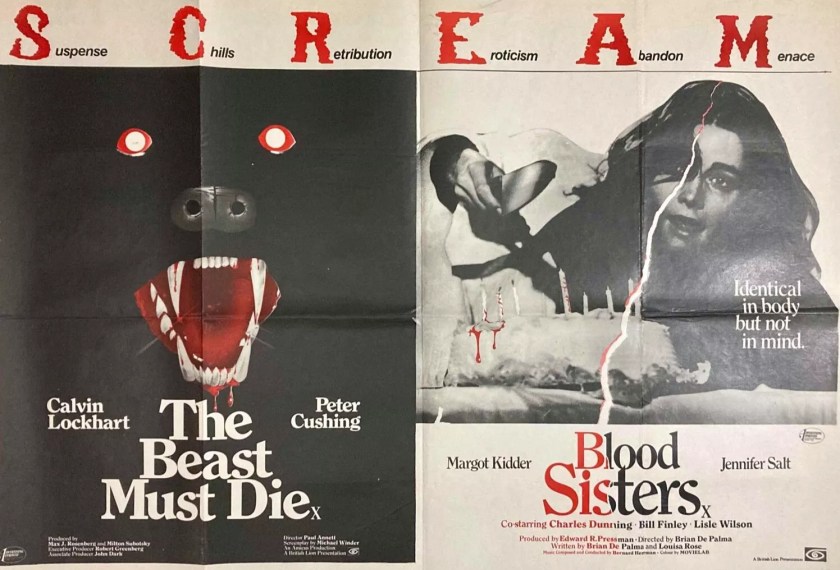
In many places it was seen as the lower part of a schlock double bill. A reviewer in the trades was correct when he predicted it was “certain to be an underground fave for some time” (i.e.limited to cult appeal) since well-reviewed horror pictures didn’t attract an initial audience.

But the ending is a corker. Grace is a prisoner. There’s another twist after that, but the notion of the investigator driven mad and ending up a prisoner of their own delusions, true Hitchcock territory, is honed to perfection here.

De Palma uses the split screen in the same way as Hitchcock employed the cutaway shot to increase the tension of potential discovery. Several sequences are rendered very effectively through this device.  Oddly enough, Grace doesn’t fit the Hitchcock mold of classy heroines. She’s way too feisty and independent and there’s almost a feeling that she gets what she deserved for tramping uninvited around a vulnerable person’s life. Here, Danielle is the victim, taken advantage of by the medical profession and her creepy husband, separation from twin ravaging her intellect.

Margot Kidder (Gaily, Gaily, 1969) and Jennifer Salt (Midnight Cowboy, 1969) are both excellent in difficult roles. Charles Durning (Stiletto, 1969) makes a splash in the kind of role that made his name. As a bonus, there’s a great score from Bernard Herrmann (Psycho, 1960).

But this is De Palma’s picture, serving notice to Hollywood that here was a talent of Hitchcockian proportions.  

Murder a la Mod (1968) ***

Take all the best elements of the Brian De Palma canon – conflicting perspective, stylish camerawork, complex narrative, diffuse sexuality, a sense of a director on the prowl, what you think you see not actually what is taking place. Take all the worst elements of the Brian De Palma oeuvre – conflicting perspective, stylish camerawork, complex narrative, diffuse sexuality, a sense of a director on the prowl, what you think you see not actually what is taking place. Yep, the very elements that make his movies work are usually what make them not work at all.

Here, in embryo, is the director of the future – the one whose understanding of cinema, excess, and willingness to take chances delivered such gems as Sisters (1972), Obsession (1976), Carrie (1976), Blow Out (1980), Dressed to Kill (1981), Scarface (1983) and The Untouchables (1987). And such misfires as The Fury (1978), Home Movies (1979), Body Double (1984), Bonfire of the Vanities (1990) and Femme Fatale (2002).

File this under “lost movie,” too self-conscious for arthouse, not enough narrative drive to be commercial, but sufficient experimentation to make it interesting.  Setting aside the director’s  penchant for showing off, this is as full of twists as many of his later films. As in Dressed to Kill the purported heroine is killed off, as in Body Double the narrative is on the sleazy side, extremely sleazy if you consider the snuff movie section, as in Blow Out we’re not sure who or what to believe, and in homage to Psycho (1960) the good girl turns bad in order to smooth out a relationship with a married man.  

Ironically, the opening is an unintended ironic homage to Me Too as an off-camera director tries to get a succession of girls to take off their clothes – and perhaps someone will do a study of just how many starlets were led to the casting couch in this fashion or convinced that nudity was the only way to advance their career. Each of the women have but one line to speak, about only doing this to finance a divorce. For one unfortunate, this is the last screen test she’ll undertake as she is slashed to death.

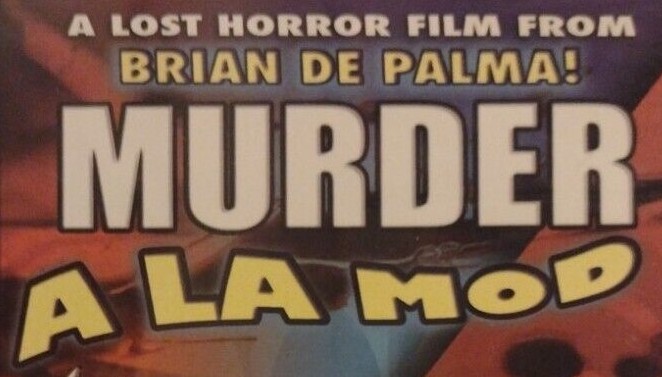
Yep, I couldn’t find any more posters of the movie I’m reviewing so I’m making do with something else from the De Palma back catalog.

Karen (Margo Norton) discovers her lover Chris (Jared Martin), who she believed to be a widower, is in fact not only married but a director of sexploitation films and complicit in a peeping tom scam. He is only doing this, he says, to finance a divorce. She is so in love that, apparently in keeping with the times, she accepts being slapped around. And so in love that, to prevent him wasting his talent by demeaning himself on such shoddy goods, she steals cash from socialite pal Tracy (Ann Ankers) to fund the divorce.

After a fake attack by nutcase Otto (William Finley) with a prop ice-pick, Karen is done to death by a real assailant with a real ice-pick. So then the tale shifts into Rashomon territory as we follow the perspective of different characters in different time periods, each time uncovering a bit more of the truth – or perhaps the fiction, who knows.

It’s quite a bold statement of directorial confidence to play bait-and-switch with the narrative, as characters who seemed resolutely in the background lurch into the foreground and at times the camera jiggery-pokery gets in the way of the narrative jiggery-pokery.

But there’s enough going on to maintain audience interest, even if sometimes the novelty of direction seems an indulgence too far. Possibly, from the contemporary viewpoint, this is better viewed as a historical document, a condemnation of the lure of cinema, how the male hierarchy believed that females were so submissive that they could easily be persuaded, with the offer of very little in the way of a concrete career, to disrobe, and almost taking the attitude that should someone object it mattered little because there were plenty others willing to put ambition before principle.

One of the best scenes is a creepy ogling bank manager, the kind of ugly male who assumes that from his position of authority he is superior to a woman who is way out of his league and far wealthier than he’ll ever be. Though why she is dumb enough to leave her valuables in an unlocked car is anybody’s guess, except for narrative convenience and the opportunity to rack up some Hitchcockian tension when a cop suddenly appears and begins to interrogate the woman the audience knows is a thief.

There’s a DVD around somewhere plugging this as the “lost” De Palma movie, but you can catch it for nothing and judge just how indicative of De Palma’s talent it might be – and how much he was served later by hiring better actors – on Youtube.

Discover WordPress

A daily selection of the best content published on WordPress, collected for you by humans who love to read.

The Atavist Magazine

by Brian Hannan

WordPress.com News

The latest news on WordPress.com and the WordPress community.