Cauldron of Blood / Blind Man’s Bluff / The Corpse Collector (1968) ***

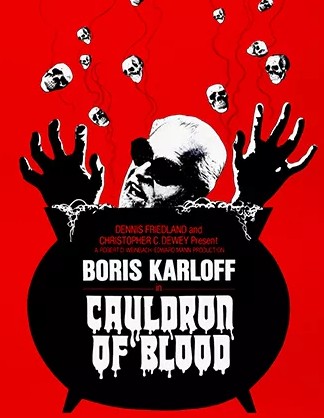
Superior “lost” horror picture that suffered from minimal initial release and is now rapidly entering the cult dominion. Effective and occasionally very stylish entry to the genre. Apart from Boris Karloff (The Sorcerers, 1967) playing against type, it’s not populated by the usual horror actors but a surprisingly mainstream cast including suave Frenchman Jean-Pierre Aumont (Castle Keep, 1969), Swede Viveca Lindfors (Sylvia, 1965) and Mexican Rosenda Monteros (The Magnificent Seven, 1960). In keeping with a new trend mostly personified in the espionage division, a woman is the villain of the piece.

Begins with an excellent sequence that twists on audience expectation. A young woman sunbathing on a deserted beach is viewed through a telescope. A hand touches her cheek, arousing her from her slumber. You expect her to react, and she does but not as much as you would imagine. It’s only the old guy who rents out beach umbrellas telling her he’s closing shop. We cut to someone in a trench coat with a garotte. It’s not the girl he stalks, but the old fella.
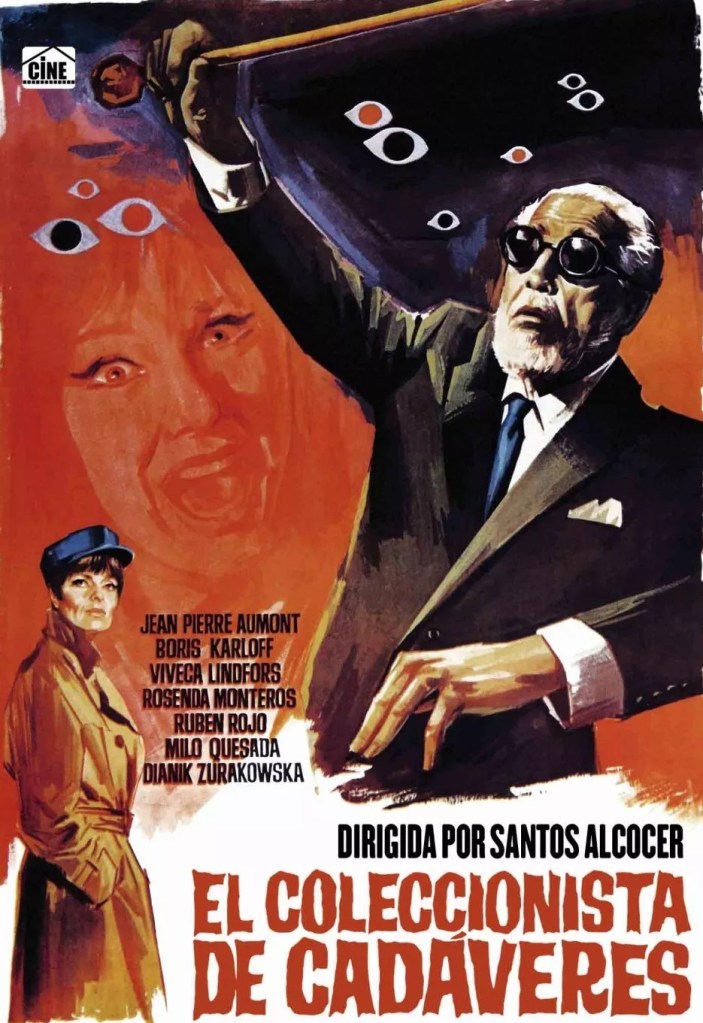
Surprising number of effective scenes beginning with a terrifying nightmare sequence of a young girl being whipped and then attacked by a skeleton. Outside of the dream landscape, a mute maid is whipped.  And a clever note when a young woman pours a glass of red wine, like blood, into her bath, prefiguring trouble to come. There’s a monkey crouched in the beams of a mansion impervious to various nefarious episodes taking place below. And some trick photography of a girl running only to disappear, captured in an overhead shot. A killer dresses up in a skeleton costume.

Journo Claude (Jean-Pierre Aumont) arrives to interview blind sculptor Franz (Boris Karloff) who lives in seclusion and is cared for by wife Tania (Viveca Lindfors). Claude tackles the rumor that the reason for Franz’s very realistic sculpture is that he uses human bones, a suggestion that is batted away.

Claude makes the acquaintance of artist Valerie (Rosenda Monteros) and her nude model Elga (Dyanik Zurakowska), encounters old drunken buddy Pablo (Ruben Rojo) and unleashes his entrepreneurial instinct, planning with other villagers to buy up all the property and cash in on the tourist boom he expects to generate by his coverage of the sculptor.

It’s not just poor old guys who are disappearing; Pablo’s dog is also for the garotte. And all is not well in the sculptor’s household. He accuses his wife of trying to kill him, but botching the job, resulting in his blindness. “I am not your prisoner, you are mine,” he claims, pointing to the fact that he now requires so much care. Later, he accuses her of salting away his money.

The mansion has an underground lair where Tania bleaches bones in a cauldron (like the scene in Jaws, 1975, where sharks undergo similar treatment) and where she meets her lover Shanghai (Milo Quesada) who carries out the killings as well as the occasional rape. Franz believes his wife is merely indulging in a bit of grave robbing to supply him with carcasses for his art.

Suspicions are not raised in the village though Valerie, who turns out to have practical experience of the mechanics of sculpture, reckons too much smoke emanates from the Franz chimney. Elga and Pablo are next to fall victim. When Valerie discovers Pablo’s body, she is added to the list.

And that sets up a quite splendid three-part climax. Racing to the rescue, Claude uses his car as a battering ram to enter the house and then engages in fisticuffs with Shanghai. But, in another twist, that fight takes a helluva time to reach a conclusion so that Valerie remains trapped and with legs bound and drugged must tackle Tania on her own. Meanwhile, the blind sculptor tries to take on his wife. This is a marvelous section where she dupes him with various noises.

Jean-Pierre Aumont is outshone by both Viveca Lindfors and Rosenda Monteros.

Quadruple hyphenate Edward Mann (Island of Terror, 1966) – writer, producer, director and composer of the theme tune – has a splendid time leading the audience astray and producing some moments of sheer terror.
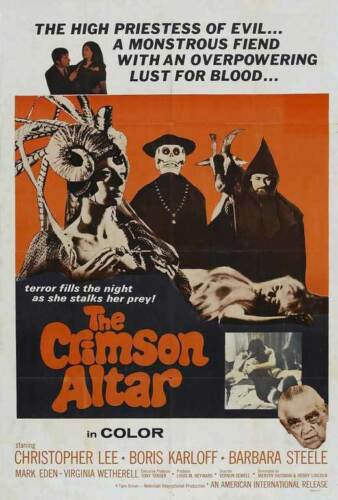
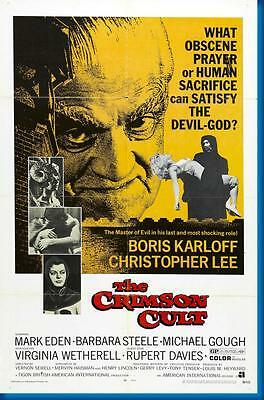
The Crimson Cult / The Crimson Altar/ Curse of the Crimson Altar (1968) ***

Horror is a small world and at any moment you are likely to bump into stars of the caliber of Christopher Lee, Boris Karloff and Barbara Steele – or in this picture all three. Investigating his missing brother Peter sends antiques dealer Robert Manning (Mark Eden) to a remote country mansion where he encounters owner Morley (Christopher Lee), his seductive niece Eve (Virginia Weatherall), the wheelchair-bound authority on witchcraft Professor Marsh (Boris Karloff), deaf mute Elder (Michael Gough) and a centuries-old mystery.

Morley can legitimately deny that Peter has ever set foot on the premises since it was common for the brother to adopt an alias when seeking out significant antiques. By the time Robert amasses sufficient clues to challenge Morley on this particular issue, it appears that further ideas of more sinister goings-on may be illusory. On his first night Robert observes an annual celebration of the Black Witch but although an effigy is burned this festival appears to have more to do with the innocent consumption of alcohol and heady bouts of sex than satanism.

And after a while, Robert indulges in carnal delight with Eve. However, he is plagued by a nightmare that involves a grotesque trial by a jury wearing animal heads. Gradually, he learns Morley, meanwhile, is such a congenial host, and his niece delightful and sybaritic company, that the finger of suspicion points at Elder, who does take a pot shot at Robert, and the professor who has a collection of instruments of torture.

Were it not for veteran director Vernon Sewell (Urge to Kill, 1960) beginning proceedings with some kind of black mass complete with floggings and female sacrificial victim, the audience might have been kept in greater suspense. As it is, the non-violent annual celebration throws us off the scent as does the seduction of Eve and the prospect that Robert’s nightmare is little more than psychedelic hallucination. The denouement is something of a surprise. The ritualistic aspects of the picture are well done and given this is a Tigon film rather than Hammer you can expect harsher treatment of the S&M element, especially for the period.  

The eerie atmosphere and well-staged witchcraft scenes are a plus, but, despite the involvement of a handful of horror gods, the movie’s reliance on lesser players to drive the narrative is a minus. Lee, Karloff and Steele (though in a more minor role) are all excellent as is the demented Michael Gough but Mark Eden (Attack on the Iron Coast, 1968) is too lightweight to carry the picture although Virginia Wetherall in her first big part suggests more promise.  More of Lee, Karloff and Steele would have definitely added to the picture but since this type of film often requires the young and the innocent to take center stage that was not to be.

Directed by Vernon Sewell (The Blood Beast Terror, 1968) from a script by Dr Who writers Mervyn Haisman and Henry Lincoln and Jerry Sohl (Die, Monster, Die, 1965).

Worth a watch.

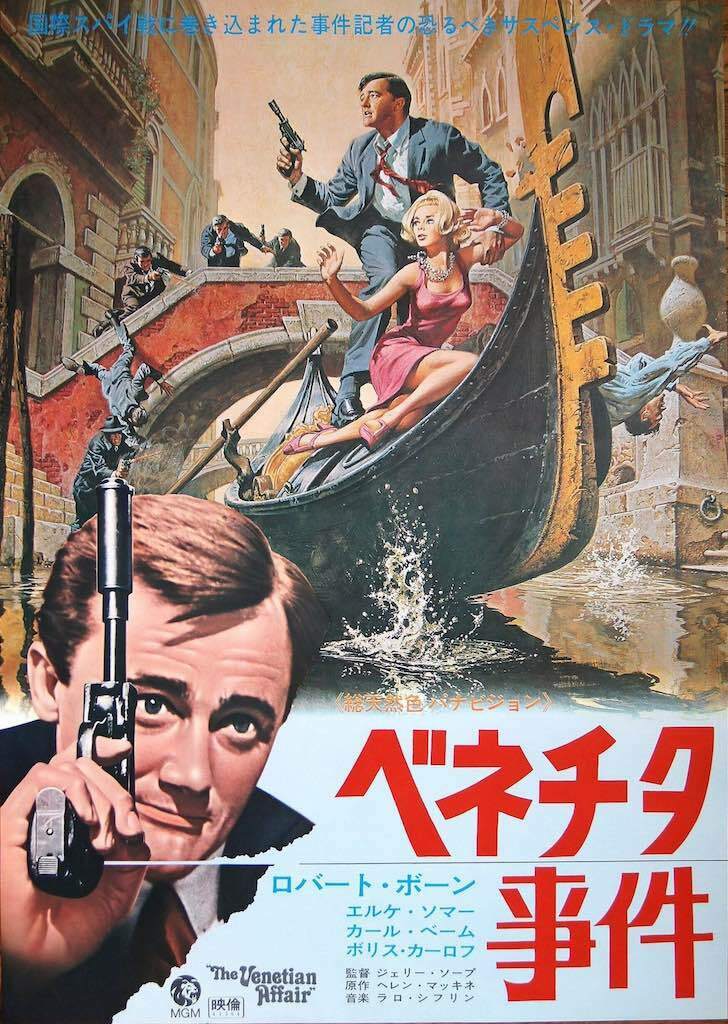
The Venetian Affair (1966) ****

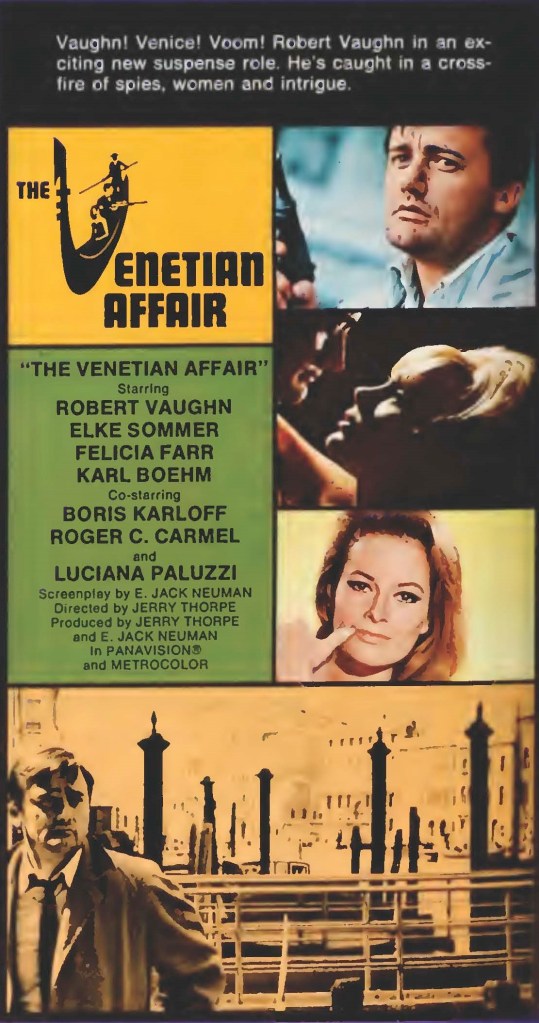
Robert Vaughn gives a terrific performance as a numbed alcoholic ex-C.I.A. journalist Bill Fenner drafted into Venice to investigate a plot involving ex-wife and Communist defector Sandra Fane (Elke Sommer). He’s the spy who lost it rather than a flashy contemporary of James Bond. This occasionally very stylish number kicks off with a terrific credit sequence that concludes with a suicide bomber blowing up a nuclear disarmament conference. Unshaven and with a Columbo cast-off overcoat, Fenner discovers Fane was key to the bombing, the bomber an otherwise distinguished diplomat with no known proclivities in the area of mass murder.

Although sold as an action picture, nobody is ripping through the canals as in a Bond film, and it is altogether a more somber, reflective, intelligent movie. Fenner’s feelings for his ex-wife are palpable when, in her apartment, he tenderly touches her clothes and smells her perfume. Far from being party to the plot, it appears Sandra has had a change of heart and wants to defect back, leaving Fenner in a perilous dilemma. Does he believe her or is she just using him? It is beginning to sound like a modern-day film noir, except he is already being used by the C.I.A., his presence in Venice a device to draw Sandra out, C.I.A chief Rosenfeld (Edward Asner) every bit as ruthless as the villains.

His investigations lead him to Dr Pierre Vaugiraud (Boris Karloff) and power broker Robert Wahl (Karl Boehm) who has a mind-altering drug that can make a man terrified of a mouse, send him into a trance and on his way to deliver savage retribution. There is death aplenty, fisticuffs and chases and Sandra, in hiding disguised as a nun, is worth waiting for.

Based on the bestseller by Scottish novelist Helen MacInnes, who challenged Alistair MacLean in her day, the project was at one point to be directed by Guy Hamilton. Coincidentally, David McCallum, Vaughn’s co-star in The Man from U.N.C.L.E. television series, was in Venice at the same time shooting Three Bites of the Apple.

Television stalwart Jerry Thorpe making his debut contributes some interesting moments. Interpreters listening in to the conference hear the magnified ticking of the bomb moments before explosion. The sequence on a train is well done and the activity surrounding the mouse is first class. Vaughn is superb in a downbeat role – shaking off his Napoleon Solo television persona- never sure if he is being duped, on the rack from falling back in love, and emerging from an alcoholic haze with a few decent ruses up his sleeve.

There’s a solid cast, Asner menacing even as a good guy, Karl Boehm a charismatic villain, Karloff memorable in his last performance in a non-horror picture, and interesting appearances by Felicia Farr as a C.I.A agent masquerading as the murderous diplomat’s unsuspecting mistress and Luciana Paluzzi as the girlfriend of an agent. Lalo Schifrin produces an outstanding score.

It was a flop first time round because audiences, partly duped by the title (all Uncle episodes incorporated the word “Affair” although the book, in fairness, was written long before the television series was envisioned) expected to pay to see Napoleon Solo, or something quite like him, on the big screen, with all the pizzazz and gimmickry of the small-screen show. Unfairly under-rated, this is a really satisfying thriller set against a murky Cold War background with Vaughn, trapped between love and redemption, the only character with a streak of morality.

Time to revive this.

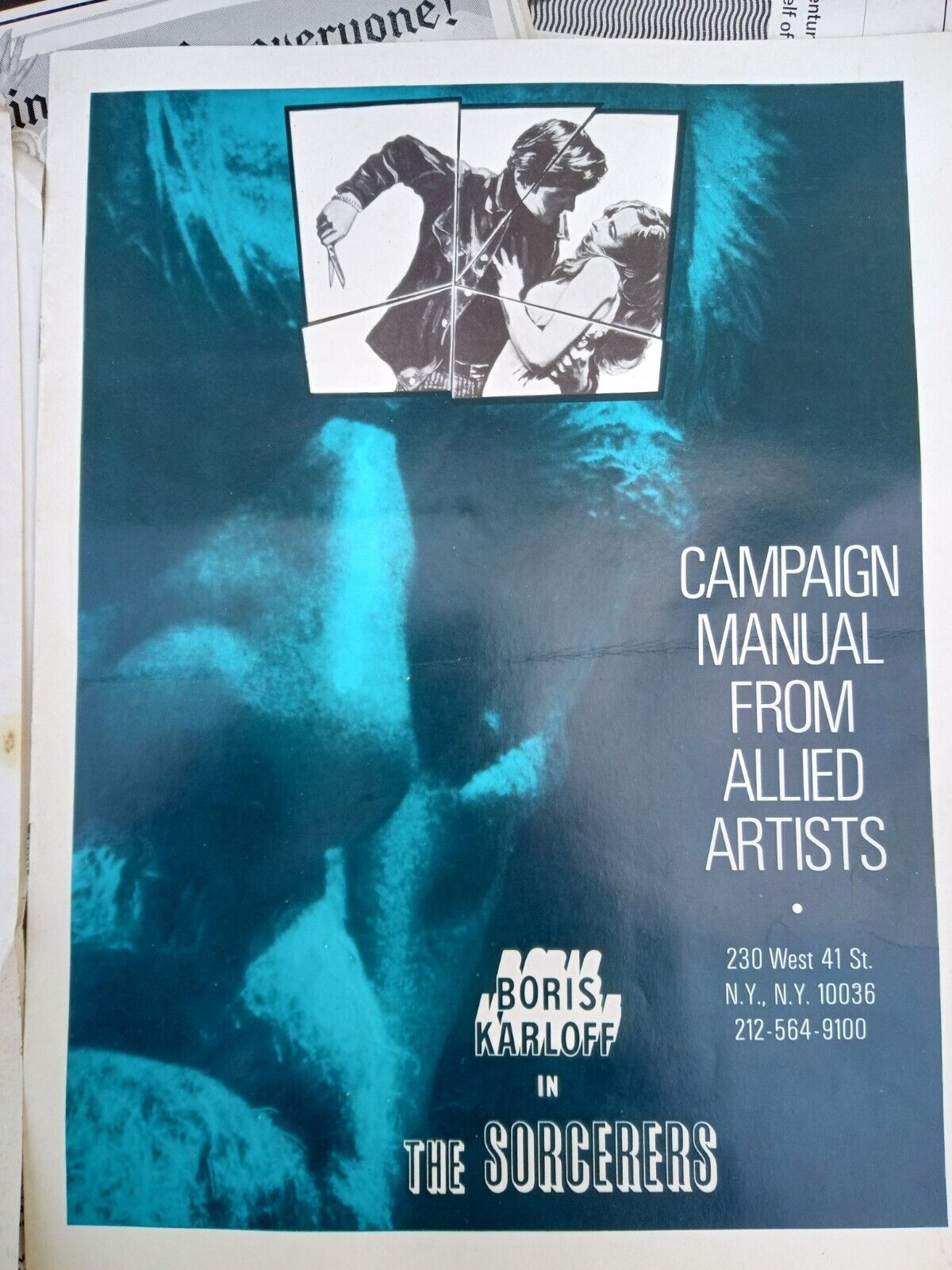
Selling Boris Karloff, Or At Least Trying To: Pressbook for “The Sorcerers” (1967)

Exhibitors measured a movie’s commercial potential in large part by the size and shape of the Pressbook. There was a correlation between a studio’s marketing budget and box office expectation.

This was the era of the 16-page A3 (twice size of a sheet of A4 paper) Pressbook/Campaign Manual that would contain what a cinema manager required to make the most of the picture through newspaper exploitation. This included snippets that would be passed on as nuggets for the editor of the entertainment section – incidents that occurred on set, details of location, hitherto unknown facts about the stars, interesting quotes – and for the newspaper’s non-editorial section that came in the form of a series of  different advertisements, six or seven not unusual.

These adverts were core to what you might see in your local newspaper. The cinema manager simply cut out the preferred size of advert – they were offered a huge range of sizes that often took up to half the Pressbook – and handed that in to the newspaper which duly, with cinema name attached, used it to make up the printed ad.

The point of the A3 Pressbook was to accommodate ads that size (11.7 x 16.5 inches / 297 x 420mm) and encourage the cinema manager to consider paying for such a hefty space in a newspaper. Beginning with the giant size indicated studio confidence, which, it hoped, the cinema manager would match. Of course, should he or she not, then there was a wealth of smaller-sized ads – which might themselves start at roughly A4  (8.3 x 11.7 inches / 210 x 297mm) that the cinema manager might feel more appropriate to the picture house’s marketing budget.

The various ads accommodated a number of different taglines and images, so that a cinema manager could choose the best one for targeting their specific audience – most commonly, for example. an action picture might be sold on the love interest.

The Sorcerers was released in the U.S. by Allied Artists. Once a big name, producing Friendly Persuasion in 1956, it had now fallen on harder times and largely reverting to its Monogram origins except for a financial boost from the unexpected success of the French-made A Man and a Woman (1966). Whatever imapct that had on Allied’s coffers did not translate into expenditure on the Pressbook for The Sorcerers. Cinema mangers would not have been filled with any great confidence. In size and in the advertisement material it did not shout box office winner.

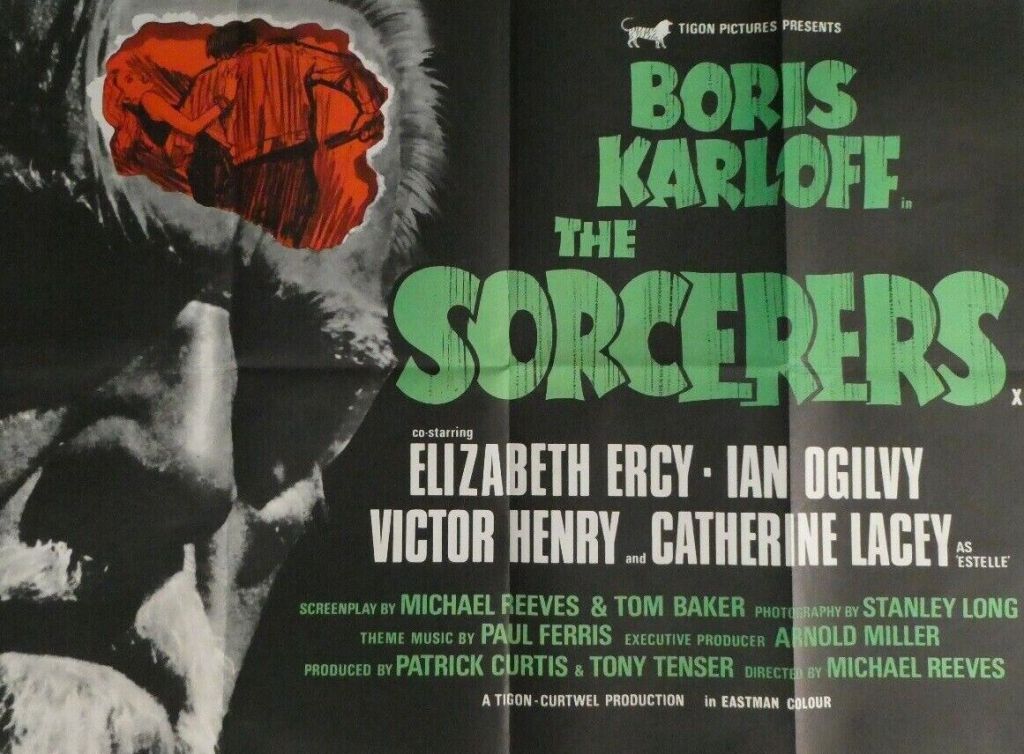
This is an ad from the British campaign which showed more originality than in the U.S.

The Pressbook was 8-pages A4, of which more than half was advertisements, one full-page A4. But there was only, effectively, one ad, though presented over five pages in twelve different sizes, from the aforementioned A4 down to what would be little more than a slug, one inch running the width of one newspaper column (about two inches).

Boris Karloff’s brooding features, intercut with a man knifing a woman, dominate the advert. There is a tagline: “He turns them on…he turns them off…to live…love…die or KILL!” At the foot of the ad is a montage of young things, dancing, kissing, a girl in backless dress the height of the titillation portrayed. The rest of the near-dozen adverts are all exactly the same, with, as the adverts grow smaller, bits of the main ad dropped out.

The problem with marketing any film starring Boris Karloff was the actor himself. Although a legendary name in movies thanks to Frankenstein, that career-making role had been three decades before and anyone who had seen it in the 1960s had done so on television where it was shorn of a lot of its power. Karloff had only intermittently popped up in horror movies during the 1960s, most recently in Die, Monster, Die (1965).

Director Michael reeves (left) with Tony Tenser of Tigon and Karloff.

Karloff was not, to put it mildly, a major marquee attraction. And part of the reason was his determination not to be typecast. So, in the 1940s and 1950s he was more likely to be seen on stage, in Arsenic and Old Lace or The Lark, for example, or on television. He only made eight movies during the 1950s.

There had been some kind of horror comeback in 1963 with The Raven, The Terror, Black Sabbath and The Comedy of Terrors, but since then movie appearances had been sparse. And, of course, for an actor of his age, there was nothing new to say, although perhaps just to remind people that he had been born William Henry Pratt in England.

None of the other performers were remotely well-known. Ian Ogilvy had supporting roles in She Beast (1966) and Stranger in the House / Cop-Out (1967). Elizabeth Ercy had small parts in Doctor in Clover / Carnaby M.D. (1966) and Fathom (1967). Each was given an one-eighth page biography. Despite directing She Beast, Michael Reeves wasn’t mentioned at all.

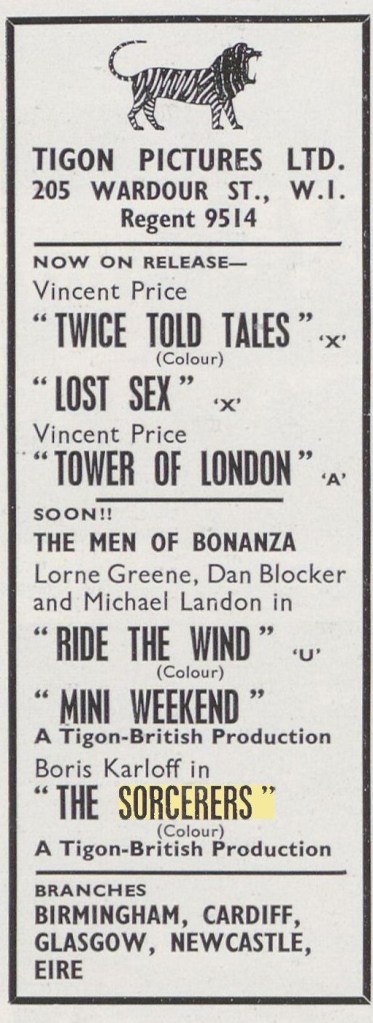
The company you keep. Tigon’s line-up for 1967.

So you get the distinct impression from the Pressbook that it’s Karloff or nothing and since the actor, as noted, was hardly a major player, nobody was going to much trouble to sell the picture.

The Pressbooks I’ve presented in previous features in the Blog have all had considerably more going for them, but this was the downside of the movie business. When there wasn’t much to sell, the distributor wasn’t going to waste his money trying to achieve the impossible.

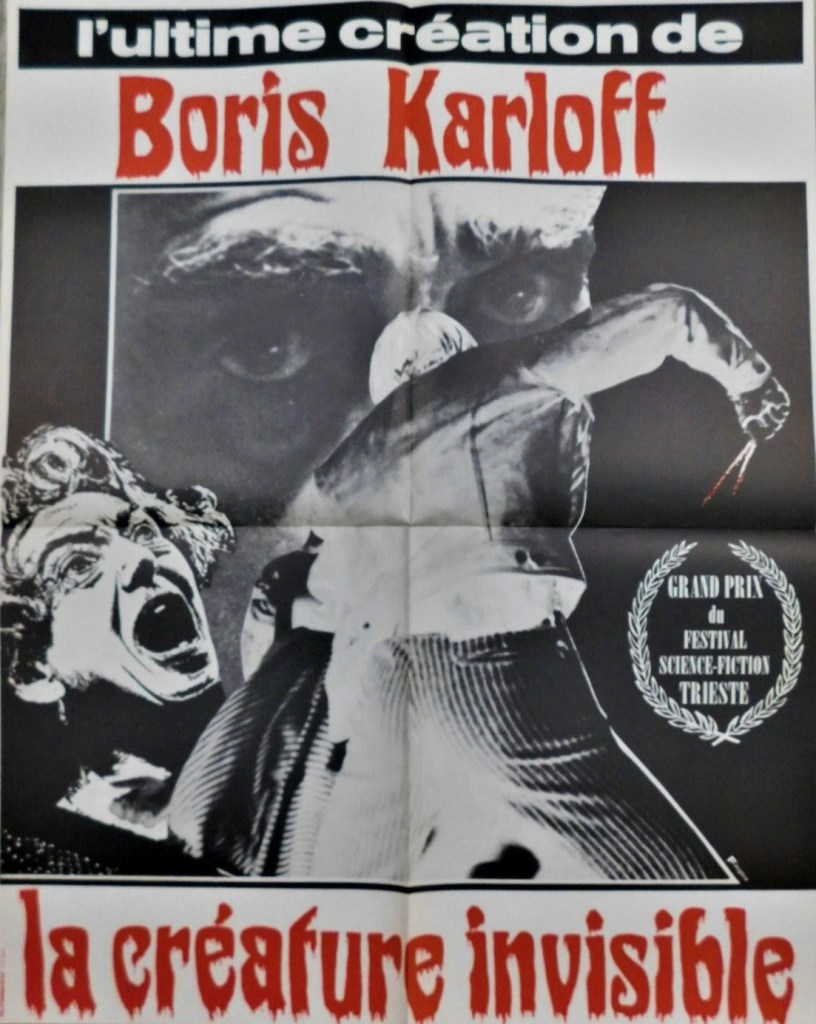
The Pressbook, printed in 1967, did not appear to achieve any success. The movie did not win a single first run or showcase booking in any of the major cities whose box office was reported by Variety magazine. However, in July 1968, the film was awarded the Grand Prix at the Trieste Sci Fi Festival, with Elizabeth Ercy named Best Actress. That did not appear to brighten the movie’s prospects.

But in 1969, it turned up at the bottom of two horror triple bills. In Boston in first run at the Center it grossed $7,000 (Variety, February 19, 1969, p8) supporting Island of the Doomed (1967) and Castle of Evil (1966). In Los Angeles in a Karloff triple, it was topped in the billing by The Comedy of Terrors and The Raven, earning a decent $110,000 from 12 houses. (Variety, April 30, 1969, p8), it was top-billed in first run in Chicago taking in a “neat” $5,500 at the Monroe (Variety, October 15, 1969, p8).

But it’s possible these few bookings and doubtless others on the drive-in circuits and in smaller towns might still have helped turn a profit on the picture since it only cost $210,000 to make in the first place.

The Sorcerers (1967) ***

I should point out before we go any further there’s a Raquel Welch connection. Husband Patrick Curtis was a producer and La Welch is down as an assistant producer, at a time when the pair were setting up their own production company Curtwel. Hard to see where Raquel would have fitted in but wouldn’t it have been sensational to have her as the devious mastermind?

The concept is better than the execution. There is an inconvenient truth about science. Successful experiments often require guinea pigs. Brain-washing was one such scientific notion, generally seen as an invention of those dastardly Communists a la The Manchurian Candidate (1962) although The Mind Benders (1963) suggested it was as common in the British halls of academe. As indicated by the title here brain washing could be termed  modern-day witchcraft.

But where government scientists could hide behind the greater good, personal advantage is the notion here. And it did make me wonder how many scientists took vicarious pleasure in seeing guinea pigs doing their bidding, enjoying the power to inflict change on the potentially unwilling.

Professor Monserrat (Boris Karloff) and wife Estelle (Catherine Lacey) have invented a machine that through hypnotism can alter a subject’s mind in the longer term, make them prone to acts of savagery. Their chosen target is young man-about-town Mike (Ian Ogilvy). Bored with gorgeous girlfriend Nicole (Elizabeth Ercy) and ripe for adventure he is despatched on an orgy of violence, rape and murder.

What makes this potentially fascinating is that while the Professor draws back from the experiment, Estelle wants to continue. The sadistic female was coming into her own during this decade, Elke Sommer and Sylva Koscina as a deadly tag-team in Deadlier than the Male (1967), Suzanna Leigh in Subterfuge (1968), but these were sidekicks, pawns in the control of devious men.

Estelle wins a battle of wills against her husband and his weak opposition fails to deter her from authorizing ever more despicable acts, as if she is unleashing her own pent-up aggression. Not only can she control her husband but she is in command of the virile young Mike. Sensibly, the film stops short of setting her up as a James Bond-style megalomaniac, but there is something more infernal in committing these acts from a small run-down apartment rather than some underground space-age cavern.

Turning Boris Karloff into a bad guy tripped up by conscience is a neat casting trick. But making him prey to his initially subservient wife is a masterstroke. Her violence is gender-neutral, as happy to force Mike into battering a work colleague as attempting to rape a young woman.

And there is also a sense of the old taking revenge on the young. The old have been left behind in a Swinging London awash with discos and barely-existing morals. Why shouldn’t old people tap into base desire, and better still, not have to lift a finger, their victim carrying the can for every deed. 

It’s stone cold creepy. And would  been a much tighter – and scarier – picture if director Michael Reeves (Witchfinder General, 1968) had not wasted so much time with the dull youngsters, complete with pop groups performing in a nightclub. Ian Ogilvy (Witchfinder General) doesn’t bring much to the party, no more than your standard good-looking young fellow.  

Boris Karloff (The Crimson Cult, 1968) is much better value especially when excitement at his new discovery wears off and he realizes he is playing second fiddle to his wife. For once, there’s nothing inherently evil in him. But Catherine Lacey (The Servant, 1963) is easily the pick, delivering a well-judged performance, assisting her husband in his endeavors until the time is right to take over. You might spot Susan George (The Straw Dogs, 1971) and Sally Sheridan, both a Fu Manchu and Bond girl. Tom Baker (Witchfinder General) co-wrote the script with Reeves.

Provides more to ponder than actually appears on the screen.

The Crimson Cult/ Curse of the Crimson Altar (1968) ***

Horror is a small world and at any moment you are likely to bump into stars of the caliber of Christopher Lee, Boris Karloff and Barbara Steele – or in this picture all three. Investigating his missing brother Peter sends antiques dealer Robert Manning (Mark Eden) to a remote country mansion where he encounters owner Morley (Christopher Lee), his seductive niece Eve (Virginia Weatherall), the wheelchair-bound authority on witchcraft Professor Marsh (Boris Karloff), deaf mute Elder (Michael Gough) and a centuries-old mystery.

Morley can legitimately deny that Peter has ever set foot on the premises since it was common for the brother to adopt an alias when seeking out significant antiques. By the time Robert amasses sufficient clues to challenge Morley on this particular issue, it appears that further ideas of more sinister goings-on may be illusory. On his first night Robert observes an annual celebration of the Black Witch but although an effigy is burned this festival appears to have more to do with the innocent consumption of alcohol and heady bouts of sex than satanism.

Thanks to career reinvigoration after Peter Bogdanovich’s “Targets” (1967)
Boris Karloff gained top billing in the British release.

And after a while, Robert indulges in carnal delight with Eve. However, he is plagued by a nightmare that involves a grotesque trial by a jury wearing animal heads. Gradually, he learns that Morley, meanwhile, is such a congenial host, and his niece delightful and sybaritic company, that the finger of suspicion points at Elder, who does take a pot shot at Robert, and the professor who has a collection of instruments of torture.

Were it not for veteran director Vernon Sewell (Urge to Kill, 1960) beginning proceedings with some kind of black mass complete with floggings and female sacrificial victim, the audience might have been kept in greater suspense. As it is, the non-violent annual celebration throws us off the scent as does the seduction of Eve and the prospect that Robert’s nightmare is little more than psychedelic hallucination. The denouement is something of a surprise. The ritualistic aspects of the picture are well done and given this is a Tigon film rather than Hammer you can expect harsher treatment of the S&M element, flagellation delivered by women, especially for the period.  

In the U.S. – where it was shown both as “The Crimson Cult” and “The Crimson Altar” – Christopher Lee was accorded prime billing status.

The eerie atmosphere and well-staged witchcraft scenes are a plus, but, despite the involvement of a handful of horror gods, the movie’s reliance on lesser players to drive the narrative is a minus. Lee, Karloff and Steele (though in a more minor role) are all excellent as is the demented Michael Gough but Mark Eden (Attack on the Iron Coast, 1968) is too lightweight to carry the picture although Virginia Wetherall in her first big part suggests more promise.  More of Lee, Karloff and Steele would have definitely added to the picture but since this type of film often requires the young and the innocent to take center stage that was not to be.

The Venetian Affair (1966) ****

Robert Vaughn gives a terrific performance as a numbed alcoholic ex-C.I.A. journalist drafted into Venice to investigate a plot involving ex-wife and Communist defector Elke Sommer. He’s the spy who lost it rather than a flashy contemporary of James Bond. This occasionally very stylish number kicks off with an excellent credit sequence that concludes with a suicide bomber blowing up a nuclear disarmament conference. Unshaven and with a Columbo cast-off overcoat, Vaughn discovers Sommer was key to the atrocity, the bomber an otherwise distinguished diplomat with no known proclivities in the area of mass murder.

Although sold as an action picture, nobody is ripping through the canals as in a Bond film, and it is altogether a more somber, reflective, intelligent  movie. Vaughn’s feelings for his ex-wife are shown when, in her apartment, he tenderly touches her clothes and smells her perfume. Far from being party to the plot, it appears Sommer has had a change of heart and wants to defect back, leaving Vaughn in a perilous dilemma. Does he believe her or is she just using him? It is beginning to sound like a modern-day film noir, except he is already being used by the C.I.A., his presence in Venice a device to draw Sommer out, C.I.A chief Rosenfeld (Edward Asner) every bit as ruthless as the villains.

His investigations lead him to Dr Pierre Vaugiraud (Boris Karloff) and power broker Robert Wahl (Karl Boehm) who possesses a mind-altering drug that can make a man terrified of a mouse, send him into a trance and on his way to deliver savage retribution. There is death aplenty, fisticuffs and chases and Sommer, in hiding disguised as a nun, is worth waiting for.

Based on the bestseller by Scottish novelist Helen MacInnes, who outsold Alistair Maclean in her day, the project was at one point to be directed by Guy Hamilton. Coincidentally, David McCallum, Vaughn’s co-star in The Man from U.N.C.L.E. television series, was in Venice at the same time shooting Three Bites of the Apple.

Vaughn is superb in a downbeat role – shaking off his Napoleon Solo television persona- never sure if he is being duped, on the rack from falling back in love, and emerging from an alcoholic haze with a few decent ruses up his sleeve. It’s often forgotten that this is an Oscar-nominated (for The Young Philadelphians, 1959) star and that the subtlety of his performance in The Magnificent Seven (1960) is generally overlooked.

Television stalwart Jerry Thorpe making his debut contributes some interesting moments. Interpreters listening in to the conference hear the magnified ticking of the bomb moments before explosion. A sequence on a train is well done and the activity surrounding the mouse is first class. There’s a solid cast, Asner menacing even as a good guy, Karl Boehm a charismatic villain, Karloff memorable in his last performance in a non-horror picture, and interesting appearances by Felicia Farr as a C.I.A agent masquerading as the murderous diplomat’s unsuspecting mistress and Luciana Paluzzi as the girlfriend of an agent. Lalo Schifrin produces an outstanding score.

It was a flop first time round because audiences, partly duped by the title (all Uncle episodes incorporated the word “Affair” although the book, in fairness, was written long before the television series was envisioned) expected to pay to see Napoleon Solo, or something quite like him, on the big screen, with all the pizzazz and gimmickry of the small-screen show. Unfairly under-rated, this is a really satisfying thriller set against a murky Cold War background with Vaughn, trapped between love and redemption, the only character with a streak of morality.

Discover WordPress

A daily selection of the best content published on WordPress, collected for you by humans who love to read.

The Atavist Magazine

by Brian Hannan

WordPress.com News

The latest news on WordPress.com and the WordPress community.