Behind the Scenes: “The Hustler” (1961)

It should have been Frank Sinatra in the leading role, not Newman. Sinatra acquired the rights to the Walter Tevis semi-biographical novel published in 1959. When Sinatra moved onto something else and director Robert Rossen took up the slack still Newman should have been ruled out courtesy of a planned re-teaming with Elizabeth Taylor – they had worked together on Cat on a Hot Tin Roof (1959) – for the screen adaptation of Broadway hit Two for a Seesaw. Bobby Darin (Pressure Point, 1962) was being lined up instead. When illness put paid to Taylor’s involvement, Newman would have remained tied to Two for the Seesaw except he had co-star approval and none of the actresses suggested measured up.

Based on reading half the script, Newman, calling his agent at six o’clock in the morning to confirm interest, jumped at the role. Though Exodus (1960) had been a success, and he had managed to ease himself out of his contract with Warner Bros, he was not considered hot box office and he needed a part not just to consolidate his commercial standing but to provide a professional springboard that would shape his career. His previous outing, Paris Blues (1961), hadn’t carved out a clear path. As well as his salary, the actor was in line for ten per cent of the profits.
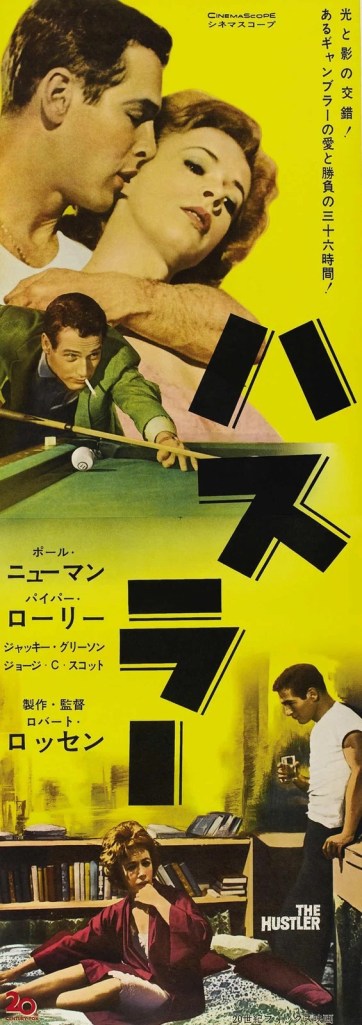
Initially, the picture was backed by United Artists and it featured in their adverts in the trade magazines in 1959. The studio had shelled out an advance to Rossen to option the rights. But when the director couldn’t find a “box office star as insurance” UA pulled out. By this point, the end of 1959, there was at least a screenplay, Rossen having called upon the services of Sydney Carroll (Big Deal at Dodge City, 1966).

Rossen shopped the package to Twentieth Century Fox which, somewhat surprisingly, signed up to the project when no major star was attached, especially as, according to Rossen, the picture “pulled no punches” with its “frank approach to people and life.” UA had promoted itself as the go-to studio for independents but by Rossen’s reckoning Fox was superior in that department because backing the movie “took some guts.”

Fox chief Spyros Skouras wasn’t keen on the title, believing, understandably, that The Hustler might signal to audiences that it was a story about prostitution. It was changed first of all to A Stroke of Luck and then to Sin of Angels. However, UA objected to the latter title on the grounds it had already registered a similar title The Side of the Angels and with some reluctance Skouras agreed to go with the original title.

It was a critical picture for Rossen, who hadn’t had a solid hit in a decade and hadn’t made a picture that could be mentioned in the same breath as All the King’s Men (1949). In part his low output was due to being blacklisted during the anti-Communist witch hunt of the early 1950s, although finally cleared. But it was as much due to his unusual method of working. “You gamble time which is money,” he said, “because you may work for six months or a year then realize the property is not quite right and your drop the while idea.” That ran counter to the general Hollywood practice where studios would press ahead with inferior product precisely because so much time and money had been spent on it. Rossen’s office was littered with abandoned projects.
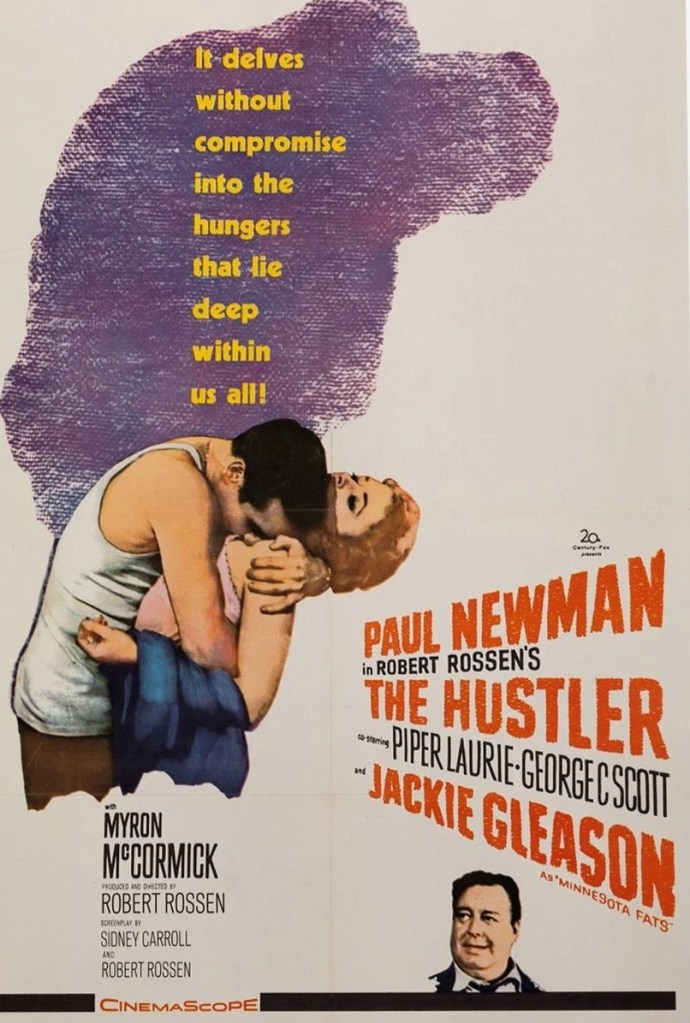
Female lead Piper Laurie was also in the market for a comeback. She had bowed out of the business after Until They Sail (1958) – also starring Newman – fed up with ingénue parts, although the director had initially favored daughter Carole Rossen (The Arrangement, 1969) for the role. At one point Rossen identified Yves Montand for a top supporting role. Co-star Jackie Gleason (Soldier in the Rain, 1963), known at this time as a television comedy actor, was already a decent pool player and Newman was coached by Willie Mosconi, a fourteen-time world billiards champ. Except for one maneuver the two actors managed to achieve all the shots caught on camera. Newman believed he was good enough to beat Gleason and it cost him $50 to be proved wrong.

George C. Scott, primarily known for his work on the stage, had attracted attention with an Oscar-nominated turn in Otto Preminger courtroom drama Anatomy of a Murder (1959).

The film, budgeted at $2.1 million, was shot on location in New York City in the winter and spring of 1961. “You get certain values,” noted Rossen, “ in New York that you can’t get on the Coast (Hollywood).” The pool scenes were filmed at Ames Billiard Academy, established in 1946, near Times Square and McGirr’s. Other locations included a townhouse on East 82nd St which doubled as the Louisville home of the billiard player Findley and the Greyhound Bus Station in Manhattan even though it lacked a dining area and the one built on the premises confused regular customers.

Rossen spent five weeks of the 10-week schedule on the pool action. Sarah’s apartment, however, was located on a sound stage. The director, under pressure to revive his career and suffering from diabetes, was tough on the crew but went easy on the cast. He hired street thugs as extras to add authenticity. He fell foul of electricians and they fell foul of him after he exposed a blackmail scam whereby the electricians responsible for inspecting the unit  complained of code violations when it was the same inspectors who should have ensured everything complied with regulations. .

The part was custom-made for Newman. “I spent the first thirty years of my life looking for a way to explode,” recalled the actor. He found an outlet for that problem through acting and he reckoned for Fast Eddie Felson it was pool. “It was one of those movies when you woke every day and could hardly wait to get to work because you knew it was so good that nobody was going to be able to louse it up.”

Though studio 20th Century Fox did its best to louse it up, originally objecting to the location shoot, looking to cut down the running time, especially telescoping the pool sequences it felt might bore the female audience. Desperate to hold onto his vision, Rossen hired Arthur P. Jacobs, then a top-flight PR honcho (and later producer of Planet of the Apes, 1968), who contrived to set up a celebrity screening where the positive response stopped Fox in its interfering tracks. Due to the Actors Strike the previous year, product was in short supply, so although The Hustler was one of 19 pictures opening in September 1961 it didn’t face tough competition, the biggest movies it contended with were Rock Hudson-Gina Lollobrigida comedy Come September and upscale horror The Innocents with Deborah Kerr.

Reviews were positive although in an editorial Box Office magazine railed against a picture which cinemas could not sell to a family audience for a matinee performance.

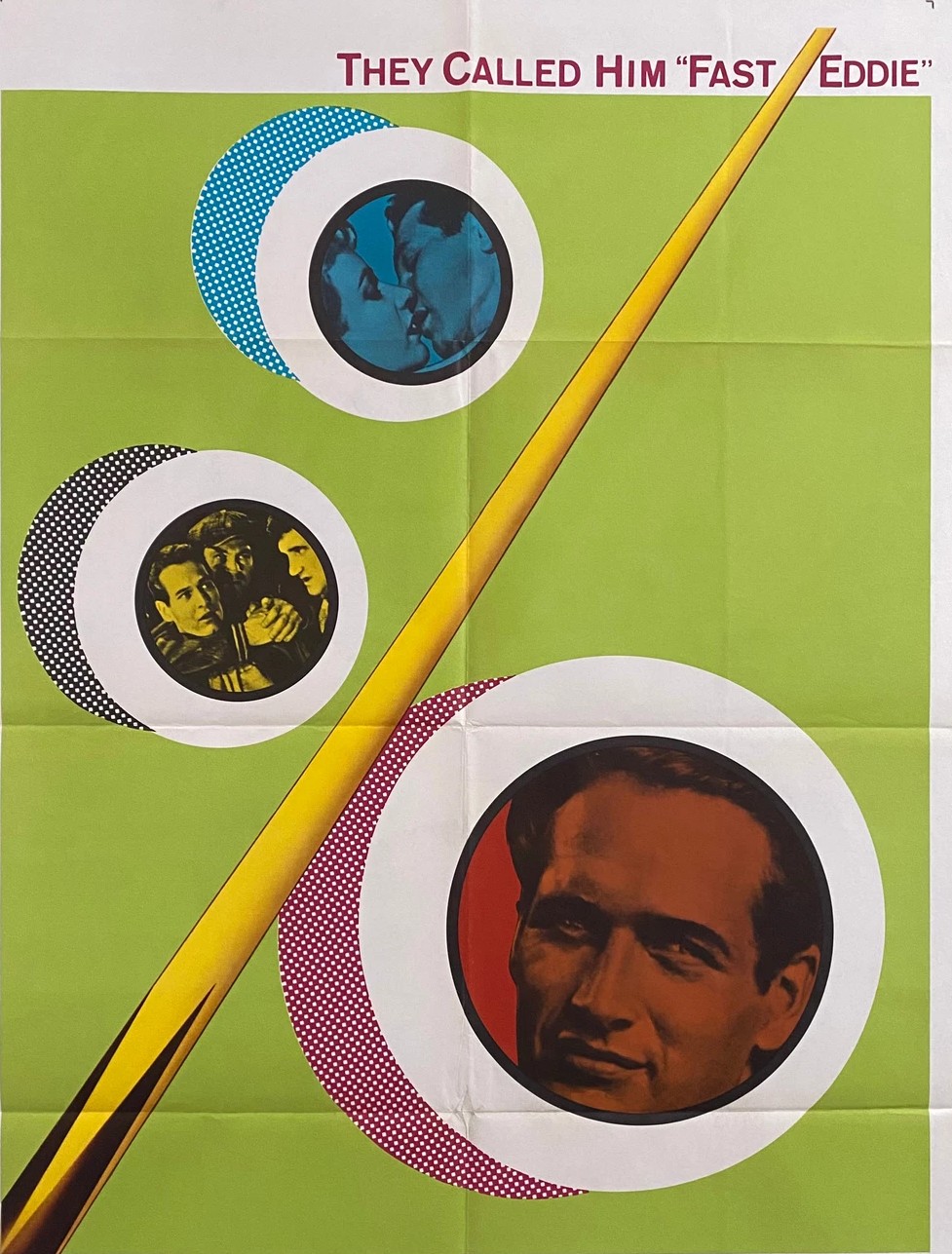
A surprise box office hit, at least initially, in first run in the big cities, The Hustler creamed  a “wow” $64,000 in opening week at the 3,665-seat Paramount in New York. There was a “boffo” $36,000 in Chicago, a “fast” $20,000 in Detroit, a “hotsy” $15,000 in Cleveland, a “wow” $14,000 in Pittsburgh and a “smash” $11,000 in Providence. The poster which effectively showed Paul Newman thrusting his head into Piper Laurie’s bosom attracted adverse criticism and caused Chicago newspapers to take a stronger line on movie ads.

It was nominated for nine Oscars with Newman, Laurie, Gleason and Scott all earning acting nods, and Rossen up for two gongs in his capacity as director and producer, as well as potentially sharing one with Sydney Carroll for the screenplay. In the event the only winners were for Eugen Schufftan for Cinematography and Harry Horner and Gene Callahan for Art Direction. At the Baftas it was named Best Film while Newman won Best Foreign Actor and Piper Laurie was also nominated.

Oscar nominations ensured the picture went out on speedy reissue in February and March 1962 resulting in domestic rentals of $2.8 million and a decent run abroad.

Robert Rossen only made one more picture. Paul Newman reconfigured his career and George C. Scott added to his lustre. Jackie Gleason got a shot at top billing with Gigot (1962) but Piper Laurie didn’t make another movie until Carrie (1976).

SOURCES: Daniel O’Brien, Paul Newman (Faber & Faber, 2005) pp79-85; Shawn Levy, Paul Newman, A Life (Aurum, 2009) pp 175-182; Aubrey Solomon, Twentieth Century Fox, (Scarecrow Press, 2002) p229 and p253; Advertisement, United Artists, Variety, June 24, 1959, p21; “New York Sound Track,” Variety, August 12, 1959, p17; “Gleaned on a Gondola,” Variety, August 26, 1959, p20; “New York Sound Track,” Variety, November 16, 1960, p17; “Fox Nicer to Indies than UA,” Variety, March 8, 1961, p3; “New York Electrical Inspectors,” Variety, March 29, 1961, p5; “Sins of Angels Tag disputed,” Variety, March 29, 1961, p7; “Artistic Comeback,” Variety, May 24, 1961, p4; “Skinpix Can’t See,” Variety, October 18, 1961, p17; “Hustler Re-Release,” Box Office, January 22, 1962, pSW8. Box office figures: Variety October-November 1961.  

Come September (1961) ***

The quite superb concept that underpins the traditional unsettling of Rock Hudson is sabotaged by the inclusion of an unnecessary generation gap element and because one of the youngsters is singer Bobby Darin that throws a musical spanner into the works. The basic set-up is that Lisa (Gina Lollobrigida), the Italian lover of wealthy American Robert (Rock Hudson), is fed up with the part-time nature of their relationship. Although their affair dates back six years, it only lasts for the one month (September) he vacations each year in his luxurious villa on the Ligurian coast.

She’s so annoyed at his lack of commitment that she’s about to marry posh Englishman Spencer (Ronald Howard), that imminent event only put off by the unexpected earlier-than-usual arrival of Robert. Matters are further complicated because his enterprising Italian butler Maurice (Walter Slezak) hires out the villa to paying guests for the other eleven months. To explain the owner’s sudden arrival, Maurice persuades his guests to go along with the notion that Robert is a former owner fallen on hard times deluded into thinking he still possesses the property.

The guests are a gaggle of young women, including psychology major Sandy (Sandra Dee) who proceeds to analyze Robert, and they are herded around by formidable chaperone Margaret (Brenda de Banzie) who prevents Lisa sneaking into her lover’s bedroom.

So enough plot to be getting on with. You’d assume Spencer is going to turn up, maybe with his equally formidable sisters, to cause ructions at the villa. Lisa appears to enjoy making Robert wait the way he has kept her wait, so a gentle shift in power, and there’s going to be an inevitable bust-up so we expect a quick shift into the will-she-won’t-she scenario. Plus, there’s the whole issue of Robert claiming back his villa and dealing with the over-entrepreneurial Maurice.

Instead, the second act enters a whole new realm. Unless one of the girls was going to make a play for Robert, there’s not much reason for them to be there except for the nuisance value and to allow Margaret to flex her authority. An unwelcome quartet of young men, led by Tony (Bobby Darin), embark on the equally unwelcome task of wooing of the young ladies, Tony having his eyes on Sandy. Although various romantic entanglements are enacted, that’s not what takes center stage.

Instead, the bulk of the middle section scarcely involves the Robert-Lisa quandary and instead it’s devoted to an endless battle between Tony and Robert as the younger specimen attempts to prove he is mentally and physically superior. Now the one element that had made these Rock Hudson comedies work was his helplessness. He may occasionally be smart or wealthy but the whole point of these stories was for a woman to run rings around him or at the very least drag him way out of his comfort zone.

Seeing Robert best Tony – endlessly – takes the shine off the picture and it’s not until Robert is revealed as a sanctimonious hypocrite, living by a double standard, that the movie catches fire again as Lisa storms off in a huff and we can settle down to some good old-fashioned will-she-won’t-she.

This proves a very successful change of pace for Gina Lollobrigida, and she reveals herself to be such a splendid comedienne that it became part of her repertoire – reunited with Hudson for Strange Bedfellows (1965) and leading a pack of men a merry dance in Buona Sera Mrs Campbell (1968).

There’s nothing particularly wrong with Rock Hudson. He’s good comedy value, but the second act ruins it. Bobby Darin (Pressure Point, 1962) and Sandra Dee (A Man Could Get Killed, 1966) act as if they’re in a completely different movie, of the frothy beach variety. Walter Slezak (The Caper of the Golden Bulls, 1967) is an adept scene-stealer. Look out for Joel Grey (Cabaret, 1972) in an early role and Brenda de Banzie (I Thank a Fool, 1962).

Directed by Robert Mulligan (The Stalking Moon, 1969) with a screenplay by Oscar-winning Stanley Shapiro (Bedtime Story, 1964) and Maurice Richlin (All in a Night’s Work, 1961).

A hybrid that rocks the wrong boat.

Pressure Point (1962) ****

Central to this under-rated tale of psychopathy and racism is one extraordinary scene, possibly the most exceptional bar-room sequence ever filmed. In the annals of imaginative repulsion, it ranks alongside the rape committed by Alex and his “droogs” in Stanley Kubrick’s A Clockwork Orange (1971). It begins with mere intimidation as an unnamed young man (Bobby Darin) begins to etch into a bar-counter the lines and symbols of Tic-Tac-Toe (aka Knots & Crosses or Noughts and Crosses). Discovering tins of paint, the man and his gang proceed to cover the entire bar – floor, walls, ceiling, even tables – with the same symbols.

The humiliation is ratcheted up a notch when, after forcing the tavern owner (Howard Caine)  to lie on the floor behind the counter, the bar hostess (Mary Munday), rigid with fear, is tormented. Using lipstick rifled from her handbag, the young man decorates her face in the same fashion before pulling down the back of her dress and doing the same there. Fortunately, the scene – although unlikely the reality – ends at this point.

Other potent scenes show how the man arrived at his crazed state, smothered with affection by a weak mother (Anne Barton) who has taken to bed by choice in order to escape his drunken, raucous father (James Anderson) who taunts his ineffective wife by flaunting to her face his casual pick-ups and making love to them in the same room. Indicative of the lonely child’s disturbed personality is that when he invents an imaginary playmate, it is to have someone to subjugate, making his fictional friend lick his boots.

Imprisoned during the Second World War for sedition, the man, suffering from blackouts and nightmares – in which he imagines himself clinging to the edge of a giant plughole before being swept away by a torrent of water from the taps – becomes a patient of a young, also unnamed, doctor (Sidney Poitier) whom he subjects to racial abuse.  The doctor, physically bigger and more imposing than the patient, would like to simply give him a good thumping, but his profession necessitates that he treats this objectionable person as just another patient. And eventually they come to enough of a concord that the patient accepts treatment although the doctor suspects that his core personality has not changed.

The movie is layered with themes other than psychopathy and psychiatry. While the racist element is to the fore, including the doctor’s need to prove himself in a white man’s world, director Hubert Cornfield also explores the growth of right-wing extremism among the disaffected who see no contradiction in still espousing traditional American values, for example giving the Nazi salute while singing in all sincerity the national anthem. The African American doctor has to come to terms with lack of objectiveness when dealing with such an abhorrent person.

The movie flits between scenes between the two protagonists staged in a stagey manner and  expressionistic almost dreamlike sequences representing the patient’s upbringing such as being menaced by his butcher father among the swinging carcasses of the store. The patient flashbacks are shown without dialog, explanation given in voice-over – far more potent use of this device than in Nothing but the Best (1964) – by either the patient or the doctor.

Reliance on visual dexterity, however, detracts from the tension and director Hubert Cornfield (The 3rd Voice, 1960) is also hampered by an unnecessary framing device which results in the story being told in flashback – and a conflation of flashbacks: of Poitier’s problems as a young doctor dealing with a difficult patent and the patient’s own life story. So the pressure indicated by the title is often undercut and does not build as much as you might expect. Critical reaction in those days pivoted on the racism elements, but a contemporary audience is almost certainly going to be more influenced by sequences involving the patient, so the picture automatically becomes more involved and Cornfield’s visual mastery more appreciated.

You can detect the influence of producer Stanley Kramer. In his capacity as director he had explored psychiatric therapy and antisemitism in Home of the Brave (1949) and racism in The Defiant Ones (1958) also with Poitier. As producer he was responsible not only for selection of the original material, based on a short story The Fifty-Minute Hour by Robert M. Lindner, but also imposing the present-day framing device, which Kramer wrote, on the picture. Those scenes relate to another psychiatrist (Peter Falk) coming to a much older and experienced Poitier for advice after hitting a brick wall with a similarly repugnant patient, Poitier telling the story of his treatment of the Bobby Darin patient as a way of showing that even the worst patients are treatable.

This is quite a different Sidney Poitier than you might be used to. Wearing suit and tie, and spectacles, this is a more restrained, measured performance. Poitier’s taboo-busting Oscar nomination for The Defiant Ones had not progressed his career that much, still restricted to starring roles in low-budget pictures. But Kramer broke another taboo in Poitier’s favor with this one, casting him a role not initially written as an African American.

Bobby Darin (Come September, 1961) had parlayed his status as hit recording artist into a burgeoning movie career but does not quite display the menace necessary for a fully-fledged psycho. Peter Falk (Machine Gun McCain, 1969) has a small one-tone role. The jazz-nuanced music by Ernest Gold (Exodus, 1961) is worth a listen. And if someone can tell me who designed the striking credit sequence, I would be very pleased.

Incidentally, the title of Lindner’s short story is ironic. Patients pay for one hour of a psychiatrist’s time but in reality only receive 50 minutes in order for the professional to achieve a swift turnaround and keep his/her appointment timetable scheduled to the hour.

Tic-Tac-Toe, in case you are unfamiliar with this two-person childhood game, consists of drawing lines to create nine squares and filling those with either a zero or a cross. The object of the exercise is to create a complete line of either symbols.

Still very powerful.

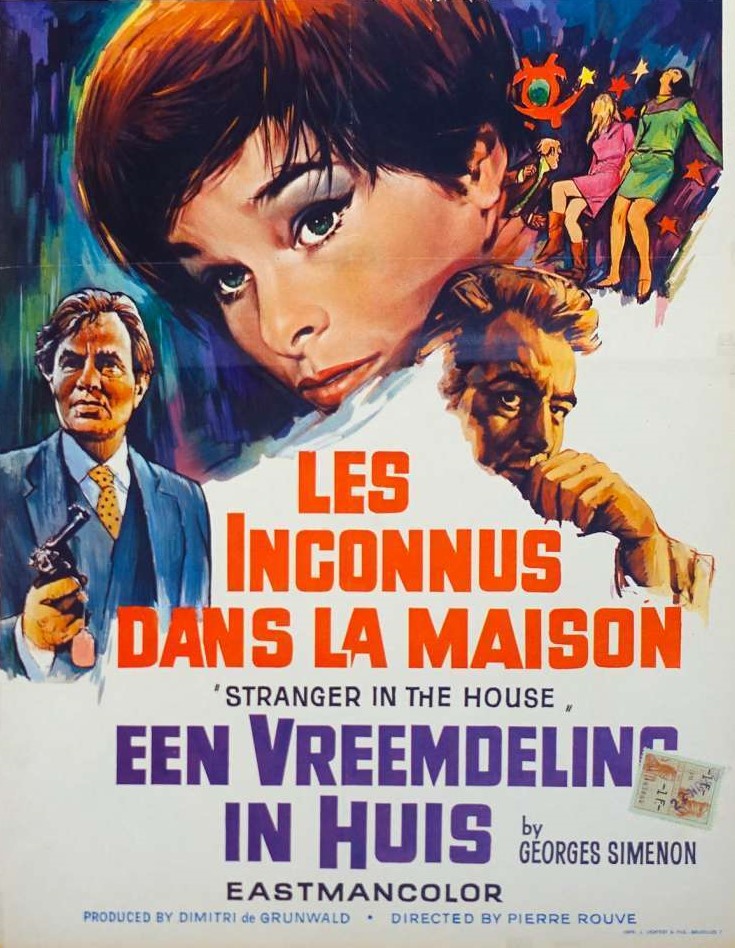
Stranger in the House / Cop-Out (1967) ***

Standout performance by James Mason (Age of Consent, 1969) holds together this curiosity. Based on a novel by Georges Simenon from 1951, it is updated to the Swinging Sixties and transposed from France to the English provincial town of Winchester (possibly chosen thanks to the hit single the previous year). While featuring an investigation, but minus Maigret, it’s essentially a character study.

Given John Sawyer (James Mason) is a depressed, divorced, retired lawyer, it could easily have sunk under the weight of cliché. Realistic portrayals of depression, except amongst those confined to institutions, were rare in this era. The bulk of the audience would probably view him just as a grumpy old man.

Sawyer is not only estranged from everyone, distancing himself from daughter Angela (Geraldine Chaplin), but sliding into oblivion and even when offered potential redemption can scarcely lift his head above a parapet of boredom, almost catatonic in his attitude, overwhelmed by the loss of wife and, presumably, the esteem that came with his career. A member of the upper middle-class, he shows surprising sensitivity to the underprivileged, outsiders, especially migrants, usually dismissed with a racist epithet, and sex workers whom he treats as victims rather than a corrupting influence.

When the corpse of young American ship’s steward Barney (Bobby Darin) is found in his disused attic, suspicion falls on his daughter’s unemployed Greek boyfriend Jo (Paul Bertoya). Turns out Barney is a nasty piece of work, blackmailing Angels and her friends for trespassing on his ship.

As well as being put up initially in an empty warehouse by Desmond (Ian Ogilvy) whose father, a department store magnate who owns the building, a former cinema, and later in Sawyer’s attic, Barney extracts cash and sexually humiliates his victims. Attempted rape of Angela comes with his conviction that she’ll “thank me for it.”  

Eventually, Sawyer is convinced to take on the case and is up against his daughter’s pompous employer and his wife’s lover Hawkins (Bryan Stanion). Maigret would have solved this in a trice but the joy of this is Sawyer’s indifference to the police procedural. He spends most of the time during the trial attempting to make a necklace out of paper clips, asks virtually no questions of witnesses, and makes no pretence of interest in the proceedings.

Among his unusual techniques are summoning up references to Dostoevsky’s Crime and Punishment.  Unusually, the pay-off doesn’t come in a courtroom but at the twenty-first birthday celebration of the entitled Desmond when to attract attention Sawyer whips off a tablecloth, sending glasses and crockery crashing, and introduces a woman in red.

Estrangement from his daughter could easily be his fault, too wrapped up in a high-flying career to pay the child much heed, but that indifference might as easily be ascribed to the possibility, as his wife taunts him, that the girl is not his.

There’s much to admire in the observations of ordinariness, loneliness, a class system filled with puffed-up mediocrities revelling in the slightest sliver of power, female advancement often requiring dispensing sexual favors to predatory employers or some form of begging.

There’s a brief appearance by Eric Burdon and the Animals, a modelling assignment using the cathedral as backdrop, and drugs. Difficult to imagine though that the pistol holstered by a carnival booth operator could be the real thing.

James Mason’s employment of a limp (result of a war wound) probably went against any genuine assessment of the subtlety of his performance. Geraldine Chaplin (The Hawaiians, 1970) builds up her character with action rather than dialog, showing tenderness where you might expect anger. Bobby Darin (Pressure Point, 1962) essays another creepy thug.

Paul Bertoya (Che!, 1969) is underused. Ian Ogilvy (The Sorcerers, 1967) is so smug you want to thump him. Look out for Pippa Steel (The Vampire Lovers, 1970), Moira Lister (The Double Man, 1967) and Yootha Joyce (Our Mother’s House, 1967).

In his sole directorial assignment Frenchman Pierre Louve, who wrote the screenplay, has better luck dissecting English mores than finding the essence of Simenon, whose non-Maigret novels generally concentrated on a man under pressure. While Mason delivers a fine performance, and his depression is obvious, there’s no sense of him teetering on the edge, more a general decline. In fact it’s the opposite, returning to the legal fray provides him with redemption.  

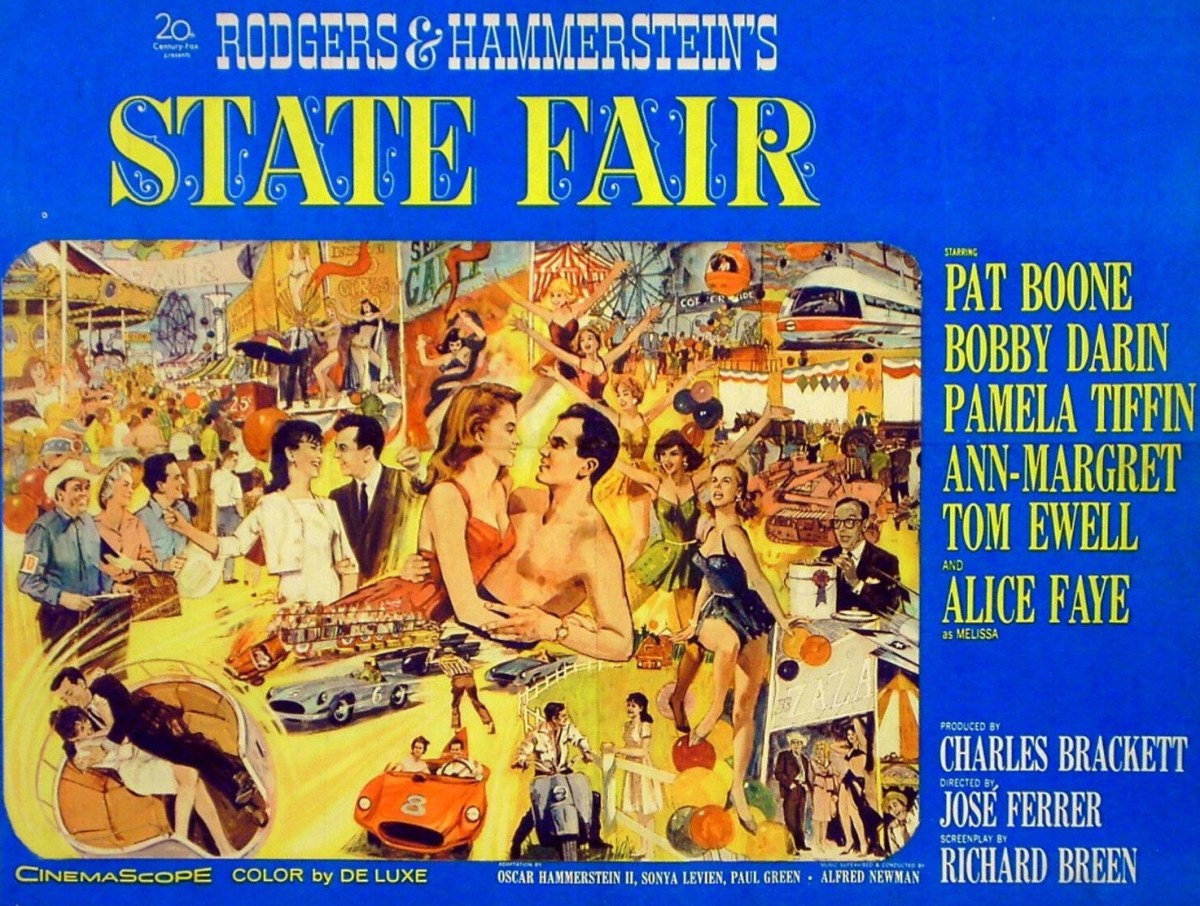
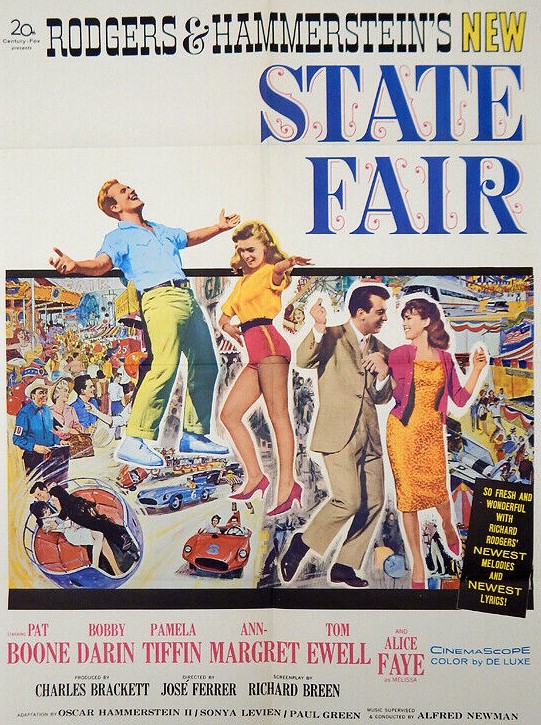
State Fair (1962) ***

Ann-Margret lights up this corny-as-they-come musical. A car-racing sub-plot is about the only attempt to update it from the previous version in 1945. But if you like a love story, you’ve got three, that is if you include Blueboy the pig’s amorous advances. The remake avoids the edginess that had been introduced to movie musicals by West Side Story (1961) and settles for family-friendly and lightweight.

But there is something very American about the Frakes, a family of farmers. They all want to be winners at the annual state fair, parents Abel (Tom Ewell) and Melissa (Alice Faye) desperate to come home with trophies, she for her mincemeat, he with his pig. Son Wayne (Pat Boone) is also intent on victory, in a car race. Daughter Margy (Pamela Tiffin) would be happy with a bit of romance.

Wayne is very taken by showgirl Emily (Ann-Margret) while commentator Jerry (Bobby Darin) has eyes for Margy. The romances are not quite as innocent as you’d expect. Emily makes it clear she’s had other men, making her in Wayne’s eyes “a bad girl,” and that anything that happens at a state fair stays at a state fair, while she goes merrily on her way to her next conquest. Jerry is considerably less open with Margy, happy to string her along until he gets his chance at the big time.

Blueboy, who snorts like billy-o on seeing a female pig in the next stall, has to do all his courting behind bars.

This is more of a musical than the original. Oscar Hammerstein II now deceased, Richard Rodgers adds four more songs on his own, so there’s a bit more mooning and prancing about.

Although “It Might as Well Be Spring” was viewed as the standout song, the standout performance belonged to Ann-Margret who adds spectacular zip, showing off her figure is a series of dance moves on stage leading a male ensemble.

Oddly enough, of all the prospective competition winners, Wayne is the only loser. But that’s out of choice as he rams into a rival to drive him off the track and prevent him winning. Equally oddly, in this context, that’s seen as something of a victory, putting a bully in his place. The racing sequence, and thankfully minus any song, is a highlight.

The humor, deriving mostly from the parents, is slightly labored. Blueboy is let down by the script which doesn’t permit him to build up enough personality to make the audience root for him. But the sequence where three judges taste the alcohol-enhanced mincemeat works well. While at the outset the parents appear merely there as filler, they eventually come into their own in a demonstration of mature love.

Ann-Margret brings a touch of Vegas to the state fair.

Quite what made director Jose Ferrer (Return to Peyton Place, 1961) – an Oscar-winning actor – think he was cut out for a musical is anybody’s guess since, in the first place, this would only be his seventh picture in 11 years and, in the second place, he had no experience in this line. There are too many scenes just of the fair, a souped-up job that was more like an outdoor exhibition than a mom-and-pop local affair. While he lacks the flair of the big time Hollywood directors of musicals, for most of the songs he just points the camera and lets the actor get on with it, the dramatic scenes working reasonably well.

But since only Ann-Margret is called upon to show any real angst he’s quite limited in opening up the movie’s emotional appeal.

Ann-Margret (The Swinger, 1966), changing from natural brunette to flame-haired, steals the picture by far, not just on stage but revealing the screen persona that would take her to the top. Pamela Tiffin (The Pleasure Seekers, 1964, where she played second fiddle to Ann-Margret) is left in the shadows by Ann-Margret’s sizzling performance. Pat Boone (The Main Attraction, 1962) and Bobby Darin were better known as crooners which tends to mean they’re better with songs than dialogue, as is the case here, though Darin was excellent in the non-musical Pressure Point (1962).

Former top Fox star Alice Faye (In Old Chicago, 1938), making a comeback after 17 years, has little to do but frown and Tom Ewell (Tender Is the Night, 1962) has little to do but gurn and moon over his pig.

But, hey, it’s a musical and different rules apply. Fairly passable entertainment with some decent songs and the added bonus of Ann-Margret.

Pressure Point (1962) ****

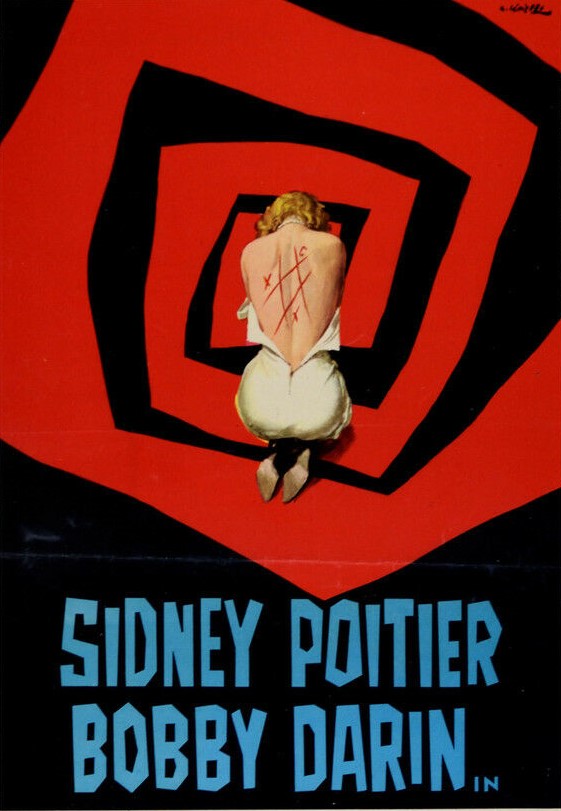
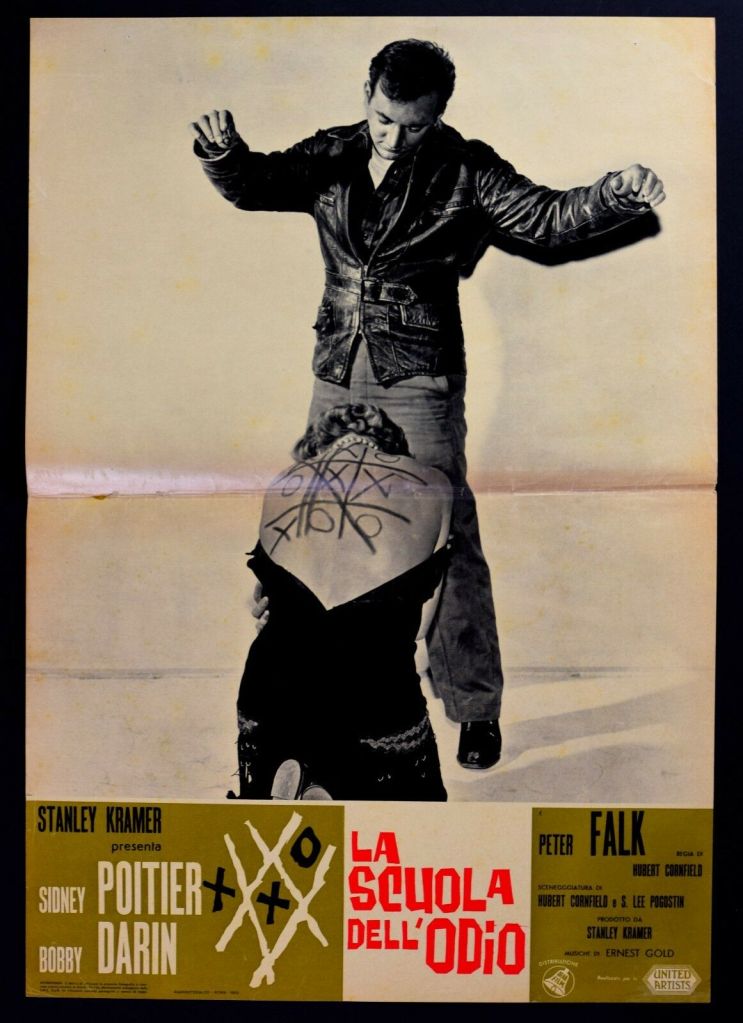
Central to this under-rated tale of psychopathy and racism is one extraordinary scene, possibly the most exceptional bar-room sequence ever filmed. In the annals of imaginative repulsion, it ranks alongside the rape committed by Alex and his “droogs” in Stanley Kubrick’s A Clockwork Orange (1971). It begins with mere intimidation as an unnamed young man (Bobby Darin) begins to etch into a bar counter the lines and symbols of Tic-Tac-Toe (a.k.a. Knots & Crosses or Noughts and Crosses). Discovering tins of paint, the man and his gang proceed to cover the entire bar – floor, walls, ceiling, even tables – with the same symbols.

The humiliation is ratcheted up a notch when the gang leader forces tavern owner (Howard Caine)  to lie on the floor behind the counter where he cannot see the bar hostess (Mary Munday), rigid with fear, being tormented. Using lipstick rifled from her handbag, the man decorates her face in the same fashion before pulling down the back of her dress and doing the same there. Fortunately, the rest of the scene, presumably ending in rape, is left to our imagination.

Italian poster showing image from the Tic-Tac-Toe scene. A variation of this was shown in the main image which removed the domineering man and concentrated on the humiliated woman.

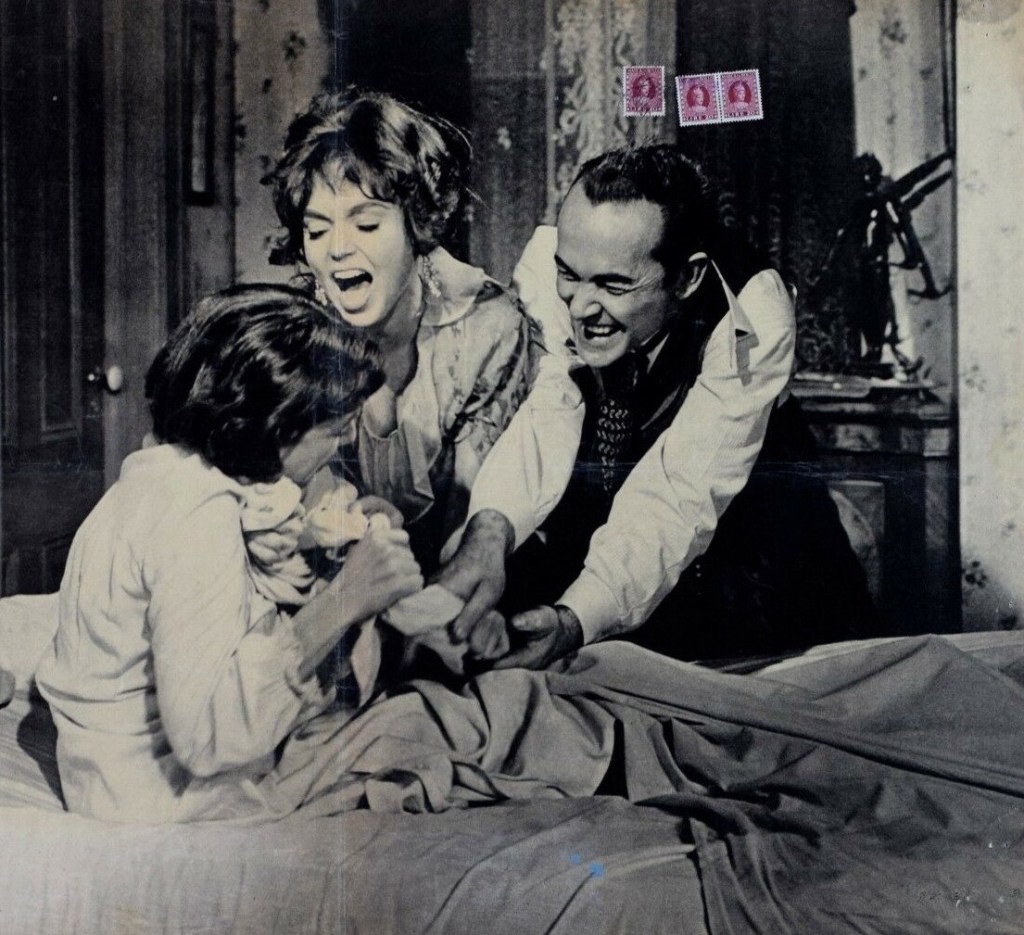
Other potent scenes show how the man arrived at his crazed state, smothered with affection by a weak mother (Anne Barton) who has taken to bed in order to escape his drunken, raucous father (James Anderson) who taunts his ineffective wife by flaunting in her face his casual pick-ups and making love to them in the same room. Indicative of the lonely child’s disturbed personality is that when he invents an imaginary playmate, it is to have someone to subjugate, making his fictional friend lick his boots.

Imprisoned during the Second World War for sedition, the man, suffering from blackouts and nightmares – in which he imagines himself clinging to the edge of a giant plughole before being swept away by a torrent of water from the taps – becomes a patient of a young, also unnamed, doctor (Sidney Poitier) whom he subjects to racial abuse.  The doctor, physically bigger and more imposing than the patient, would like to simply give him a good thumping, but his profession necessitates that he treats this objectionable person as just another patient. And eventually they come to enough of a concord that the patient accepts treatment although the doctor suspects that his core personality has not changed.

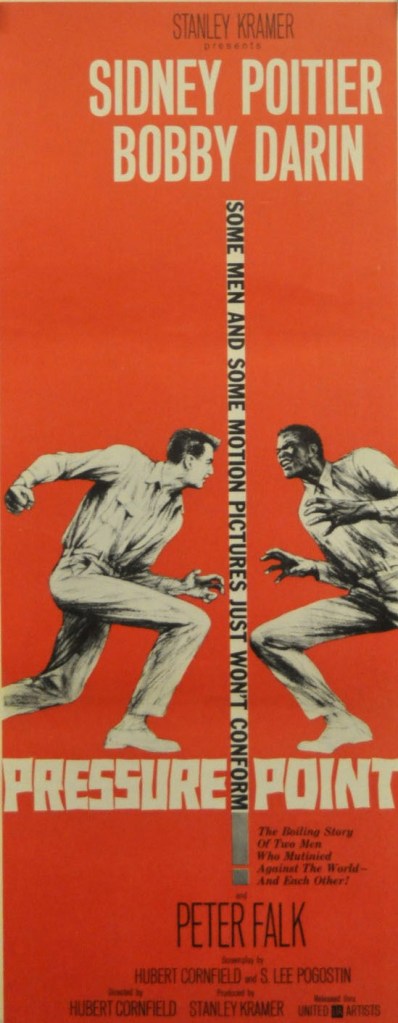
The U.S. poster was different to that used in Italy. This is pretty much a straight rip-off of “The Defiant Ones” (1958).

The movie is layered with themes other than psychopathy and psychiatry. While the racist element is to the fore, including the doctor’s need to prove himself in a white man’s world, and the lack of diversity in this particular medical field at that time, director Hubert Cornfield also explores the growth of right-wing extremism among the disaffected who see no contradiction in still espousing traditional American values, for example giving the Nazi salute while singing in all sincerity the national anthem. The African American doctor has to come to terms with lack of objectiveness when dealing with such an abhorrent person.

The movie flits between scenes between the two protagonists staged in a stagey manner and  expressionistic almost dreamlike sequences representing the patient’s upbringing such as being menaced by his butcher father among the swinging carcasses of the store. The patient flashbacks are shown without dialogue, explanation given in voice-over by either the patient or the doctor.

The father torments the mother by bringing a casual pick-up to their bedroom.

Reliance on visual dexterity, however, detracts from the tension and director Hubert Cornfield (The 3rd Voice, 1960) is also hampered by an unnecessary framing device which results in the story being told in flashback – leading to a conflation of flashbacks: the older Poitier explaining his earlier problems dealing with a difficult patent and listening in turn to the patient’s own life story. So the pressure indicated by the title is often undercut and does not build as much as you might expect. Critical reaction in those days pivoted on the racism elements, but a contemporary audience is almost certainly going to be as influenced by sequences involving the patient, so the picture automatically becomes more involved and Cornfield’s visual mastery more appreciated.

You can detect the influence of producer Stanley Kramer. In his capacity as director he had explored psychiatric therapy and anti-semitism in Home of the Brave (1949) and racism in The Defiant Ones (1958) also with Poitier. As producer he was responsible not only for selection of the original material, based on a short story The Fifty-Minute Hour by Robert M. Lindner, but also imposed the framing device, which Kramer wrote. Those scenes relate to another psychiatrist (Peter Falk) coming to a much older and experienced Poitier for advice after hitting a brick wall with a similarly repugnant patient, Poitier telling the story of his treatment of the Bobby Darin patient as a way of showing that even the worst patients are treatable.

This is quite a different Sidney Poitier than you might be used to. Wearing suit and tie, and spectacles, this is a more restrained, measured performance. Poitier’s taboo-busting Oscar nomination for The Defiant Ones had not progressed his career that much, still restricted to starring roles in low-budget pictures. But Kramer broke another taboo in Poitier’s favor with this one, casting him a role not initially written as an African American.

Bobby Darin (Come September, 1961) had parlayed his status as hit recording artist into a burgeoning movie career but does not quite display the menace necessary for a fully-fledged psycho. The likes of Richard Widmark would have been a more convincing adversary. Peter Falk (Machine Gun McCain, 1969) has a small one-tone role. The jazz-nuanced music by Ernest Gold (Exodus, 1961) is worth a listen. And if someone can tell me who designed the striking credit sequence I would be very pleased.

Incidentally, the title of Lindner’s short story is ironic. Patients pay for one hour of a psychiatrist’s time but in reality only receive 50 minutes in order for the professional to achieve a swift turnaround and keep his/her appointment timetable scheduled to the hour. Tic-Tac-Toe, in case you are unfamiliar with this two-person childhood game, consists of drawing lines to create nine squares and filling those with either a zero or a cross. The object of the exercise is to create a complete line of either symbols.

Catch-Up: Sidney Poitier films previously reviewed in the Blog are The Long Ships (1964), The Bedford Incident (1965) and Duel at Diablo (1966).

Discover WordPress

A daily selection of the best content published on WordPress, collected for you by humans who love to read.

The Atavist Magazine

by Brian Hannan

WordPress.com News

The latest news on WordPress.com and the WordPress community.