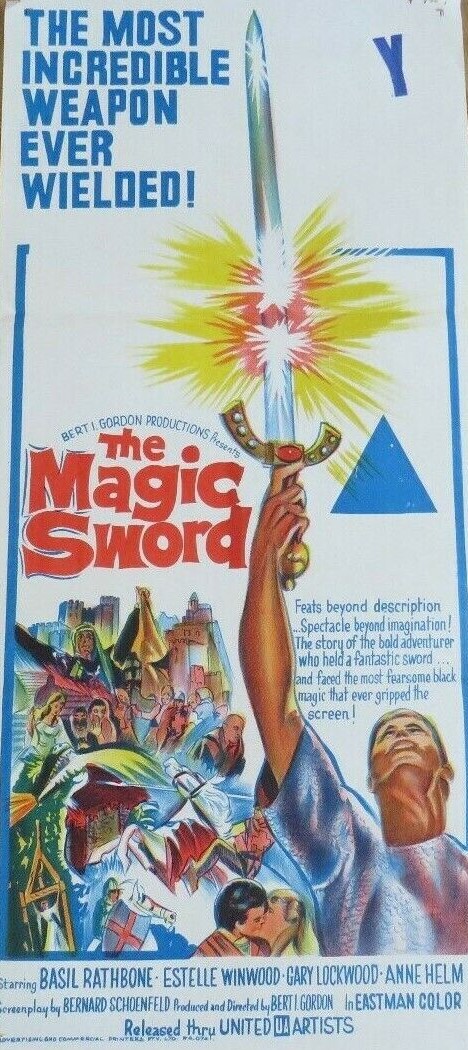
The Magic Sword (1962) ***

Where’s Ray Harryhausen when you need him? Not much wrong in this fun low-budget adventure that a few doses of Dynamation wouldn’t fix. While it means the monsters don’t cut it – man in mask with a dodgy perm playing an ogre, two-headed dragon whose flames appear superimposed – the rest of it is as up to scratch as you might expect from a genre that relies on exploiting old myths.

And we do get a look at Gary Lockwood (The Model Shop, 1969) in embryo and Basil Rathbone (The Comedy of Terrors, 1963) having a whale of a time as a villain who somehow (point plot not explained) has lost his magic ring. That means he’s going to strike a deal with loathsome knight Sir Branton (Liam Sullivan) – who happened across it (plot point unexplained) – to kidnap Princess Helene (Anne Helm). He’s somewhat hindered in explaining his plans because his voice is often drowned out by the thunder he can summon just by lifting his arms.
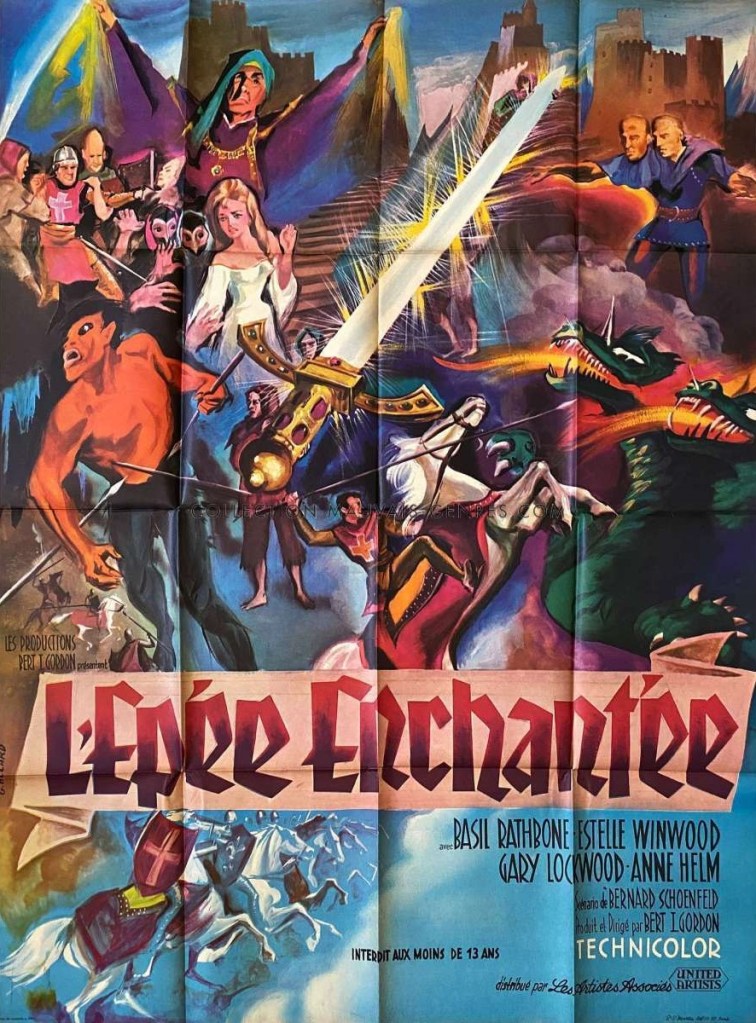
But it’s magic vs. magic as the pair come up against sorceress Sybil’s (Estelle Winwood) adopted son Sir George (Gary Lockwood) who’s stolen a set of enchanted artefacts including the titular sword, armor, a shield and the fastest horse in the world and heads off to rescue fair maiden from the castle of Lodac (Basil Rathbone) where the aforementioned dragon is on a steady diet of consuming a human being (or two, if twins or sisters are to hand) once a week.

Sybil, who seems to exist in some kind of darkroom, constantly lit by red, is a hoot, when not turning herself into a cat, unable to recall spells, not surprising since her memory has to span 300 years. Her coterie includes a chimp who does nothing (what’s the point of that, you might wonder, though perhaps magic is involved in just getting it to sit still) and a two-headed man, both faces speaking the same words at the same time.

There’s a tilt at a magnificent seven scenario as Sir George brings to life six sidekicks, a multi-cultural melange if ever, or a stab at attracting audiences from six different countries if you like. You need to be mob-handed at this game because the bunch, assisted or sabotaged by the accompanying Sir Branton, need to overcome The Seven Curses of Ladoc (the film’s alternative title in various parts), including the ogre and a malodorous swamp, and sure enough those dangers soon cut the motley band down to size.

Meanwhile, the imprisoned princess has watched the dragon eat, and is tormented by dwarves (though the caged elves turn out to be friendlier). There’s going to be two showdowns, not one, since Lodac has no intention of allowing Sir Branton the glory of rescuing said princess and therefore winning her hand in marriage. He is hell-bent on revenge, since the king’s father had burned his sister at the stake as a witch.
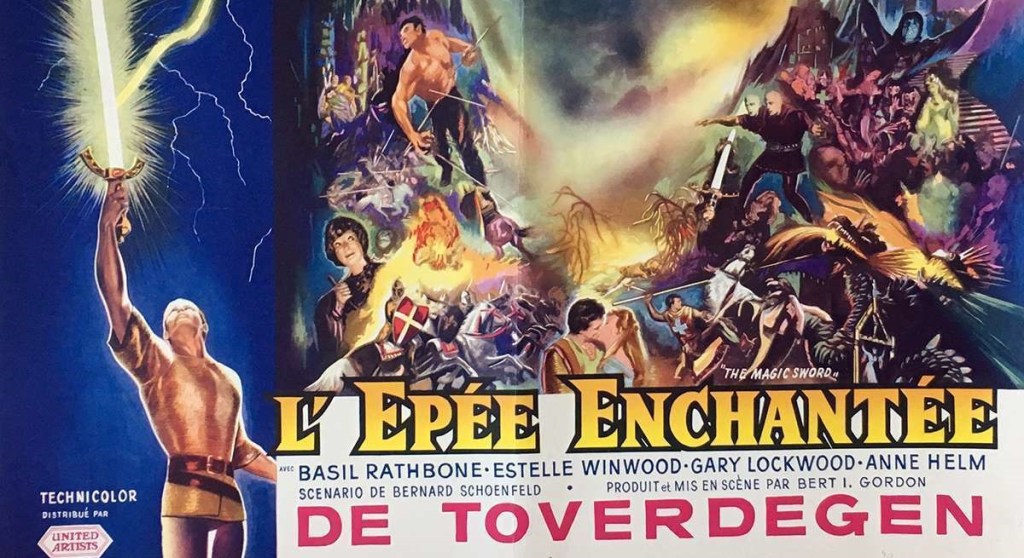
The meet-cute if you like is princess and potential rescuer facing each other across a dungeon while tethered by rope to stakes. Sybil does try to help but damned if she can remember the final words of her spell.

Gary Lockwood, in his first leading role, takes the whole thing seriously, and only made two more films before something in this role and It Happened at the World’s Fair (1963) and Firecreek (1967) tipped off Stanley Kubrick that here was a star in the making for 2001: A Space Odyssey (1968). So it does show that no part, however preposterous, is worth turning down.

Basil Rathbone would steal the show – as he should being top-billed – were it not for the fun-loving Estelle Winwood (Games, 1967) as the dotty aunt kind of sorceress. What Hollywood dictat I wonder determined that leading actresses often made their entrance swimming naked in a pool. Anne Helm (The Interns, 1962) doesn’t have much to do except look scared. You might spot Danielle De Metz (The Scorpio Letters, 1967).

With Sybil to dupe, all the curses to overcome and deal with the duplicitous Sir Branton, the pace never lets up. And it’s short (just 80 minutes) so no time for dawdling.

Director Bert I. Gordon (The Amazing Colossal Man, 1957) has been here before with the special effects that appear dodgy to the contemporary eye but were ground-breaking at the time when SFX did not command multi-million-dollar budgets. Screenplay by Gordon and Oscar-nominated Bernard C. Schoenfeld (13 West Street, 1962).

While Harryhausen tales were always redeemed by the special effects, this is perfectly acceptable late-night entertainment when the critical guard is down.

Behind the Scenes: “The Blood Beast Terror” (1968)

Sherlock Holmes vs Sherlock Holmes was the initial tantalizing casting prospect. Basil Rathbone, the most venerated actor to don the distinctive deerstalker, and Peter Cushing, just signed up by the BBC for a new 16-episode series, the former signed to play the villain, the latter his nemesis in a film that started out with the title of The Death’s-head Vampire, the first film by a new production shingle Tigon Films.

While Tigon was new, with a distinctive logo, its driving force was well-known British producer Tony Tenser who with partner Mike Klinger had initially specialized in exploitation pictures with titles such as Naked as God Intended (1961) and London in the Raw (1964). The pair split after the artistic and commercial success of Roman Polanski’s Cul de Sac, Tenser initially setting up under his own name for Mini-Weekend/Tomcat (1966), mining the exploitation vein as before, and The Sorcerers (1967) a new venture into the horror market. Expanding the business with fresh capital and new partners, Tigon was born.

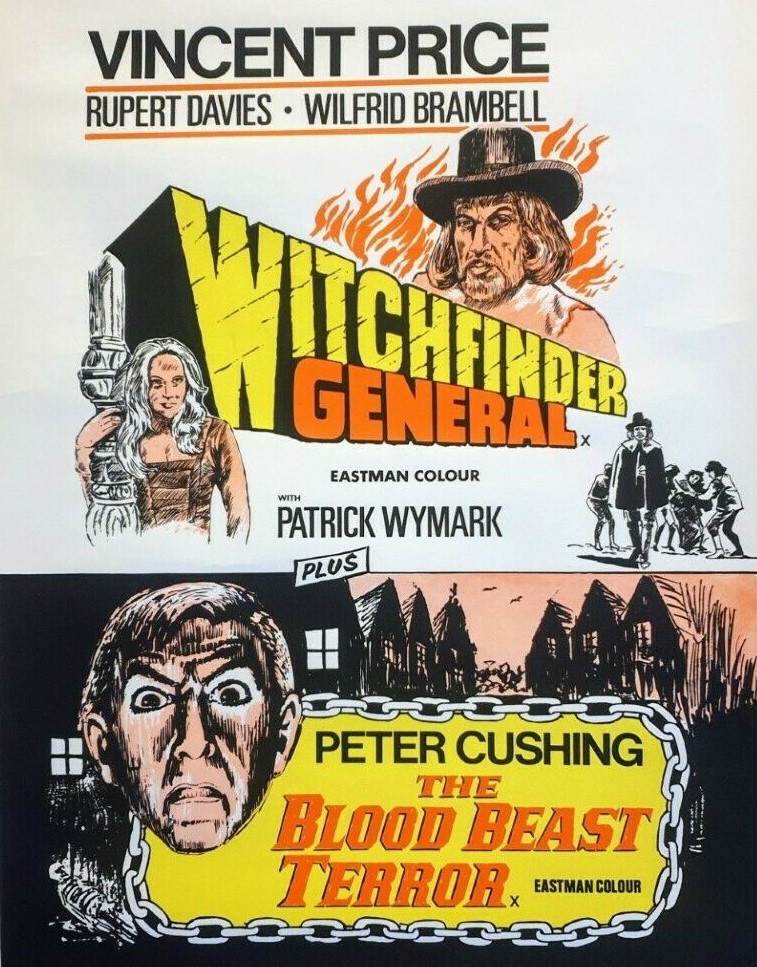
Supporting feature to “Witchfinder General” on ABC circuit release in Britain.

Explaining the new departure, Tenser said, “Films needs to be inexpensive. They need to sell, they need to appeal to an international audience, and one subject that always finds a market is horror.” Horror budgets were low, the genre did not require big stars, and the films had a surprisingly long shelf life.

First movie on the new company’s agenda was not The Death’s-head Vampire. Instead, Tenser had hooked Raquel Welch for a ghost story The Devil’s Discord to be produced by her husband Patrick Curtis, who had performed a similar task on The Sorcerers, and star Peter Cushing (The Skull, 1965). When that fell through, he held onto Cushing for a proposed Horror of Frankenstein and when that also bit the dust turned to him for The Death’s-head Vampire on a budget of just £40,000 (about $100,000). Offered the choice of playing villain Dr. Mallinger or Detective Inspector Quennell, the actor plumped for the “goodie,” Basil Rathbone lined up for the other role. The concept of older man/younger woman with action concentrated on an isolated house and the surrounding countryside was a horror trope.

Vernon Sewell (Strictly for the Birds, 1964), entering his third decade as a director, had worked with Cushing on Some May Live (1965) and was primarily known for low-budget and B-movies, and more importantly from Tenser’s perspective, sticking to a budget without any artistic pretensions or improvisation. He didn’t waste time on anything that would not be captured by the lens. He was calm on set, “nothing fazed him.” Cushing was a kindred spirit, never complaining, except famously, on this picture, when he told Sewell it was the “worst picture” he had ever made. The pair, however, had a very good working relationship to the extent that Sewell never offered Cushing any advice on the role –“he didn’t need my input.”

The Sherlock Holmes connection is promoted in this poster.

Just over two weeks before the August 1967 start date, Basil Rathbone died of a heart attack. Robert Flemyng, the last-minute replacement, was Cushing’s opposite, complaining all the time. The cast was rounded out by 32-year-old Doctor Who star Wanda Ventham (mother of actor Benedict Cumberbatch) and 18-year-old Vanessa Howard whose career highpoint thus far had been a duet with Cliff Richard for a television presentation of Aladdin (1967).

Interiors were shot at Goldhawk Studios, a converted three-story building in London’s Shepherd’s Bush, with exteriors at Grims Dyke, the former home of W.S. Gilbert, in north-west London. The 19th century manor house had lain empty since 1963.

Roger Dickens, who had cut his teeth on Thunderbirds Are Go! (1966) and worked on 2001: A Space Odyssey (1968) and would be later lionized for the mini-beast bursting out of John Hurt’s stomach in Alien (1979) was responsible for creating the monster. The model for the giant larvae was a much simpler task than creating a believable female giant insect. He took a mold of Ventham’s face, giving the features a repellant slant,  using costume jewelry for the eyes, adding a furry cap and two-foot long antennae, a representation  that would only really work if you scarcely saw the creature. For art designer Wilfred Woods his woods set turned into a disaster when the trees wilted and lost their leaves.

Opinions differ as to whether Tenser interfered with production. He saw his role during the film process to ensure that the project followed the script. “Sometimes you can put something in a film which will hinder the selling, sometimes you need to put something in which will help the selling.”

Comedian Roy Hudd, playing the morgue attendant, thought the script so awful he was delighted to work with Cushing on improvements. 

When John Ford’s boast that he never shot an extra foot of film in order to prevent a producer turning in a different film has resulted in many a masterpiece, the same did not hold true for Sewell. Sticking so close to the script, not filming anything that was not absolutely necessary meant that the movie was too short. Editor Howard Lanning commented: “I put in everything that was available. Even with expanding the lecture scene and the amateur dramatics as long as possible, to the detriment of pace, the picture clocked in at just 81 minutes, not the length expected of a main feature.

To ensure the movie came in at the required length, Tenser added the African sequence at the beginning (an extra five minutes) and re-shot the morgue material (two more minutes), encouraging Cushing and Hudd to improvise. The final product was over-budget and a week late. The version shown to the censor was 87 minutes though the official running time was a minute longer.

Tenser now deemed the working title as insufficient, preferring “something catchy and something that told people what you were selling.” His first stab at a new title was Blood Beasts from Hell. But in the final analysis it was altered to The Blood Beast Terror. Hoping to sell it to a circuit as a main feature it was originally shown in a double bill with Castle of the Living Dead, but despite the supposedly attractive title, audiences were not interested. To cut his losses, the film was repackaged as the support to another Tigon production Witchfinder General (1967) which meant Tenser would not have to share receipts with another distributor.

The Blood Beast Terror did not prove so sellable overseas either. It was shelved in France until 1971, although, sold for a flat fee, it did well in South America. A.I.P. who had U.S. distribution rights to Witchfinder General – title altered to The Conqueror Worm – had no interest in The Blood Beast Terror but it was picked up by Pacemaker Pictures who were also in title-changing mood and released it in summer 1969 as Vampire Beast Craves Blood on a double bill with Curse of the Blood Ghouls (1964).

Tenser’s predictions of long shelf life were correct. In Britain, the movie was reissued on a late night double bill with The Secret of Blood Island (1961), and then was revived with The Devil’s Hand (1961) before being re-teamed with Witchfinder General on a Sunday’s-only screening. Although none of these would be circuit releases in the sense of a nationwide day-and-date opening, they were nonetheless likely to get reasonable bookings to fit specific engagement profiles. In the States where there was endless demand for horror triple- and quadruple bills and all-nighters, The Blood Beast Terror received ongoing bookings.

SOURCES: John Hamilton, “The Making of the The Blood Beast Terror,” Little Shoppe of Horror, Issue No 43, p67-91; John Hamilton, “Regretting Nothing: John Sewell, Little Shoppe of Horror, Issue No 43, p92-98.

Discover WordPress

A daily selection of the best content published on WordPress, collected for you by humans who love to read.

The Atavist Magazine

by Brian Hannan

WordPress.com News

The latest news on WordPress.com and the WordPress community.