Sweeney! (1977) ****

The two-fisted trigger-happy cops that had changed the Hollywood landscape since Clint Eastwood burst onto the scene hadn’t found much correlation in the small-screen. Television producers were particularly averse to violence and even a new generation of sleuths were only a tad above the cosy crime of previous decades. Since James Bond easily covered the random killing aspect in British movies, there seemed little room for anyone else.

Sweeney! (1977), a speedy spin-off from a successful British independent television series, proved them wrong, the movie censor permitting considerably more leeway on the violence front.  These cops are just itching to lay a hand on gangsters and, as if transplanted from Chicago, bring baseball bats and pistols to a fight.
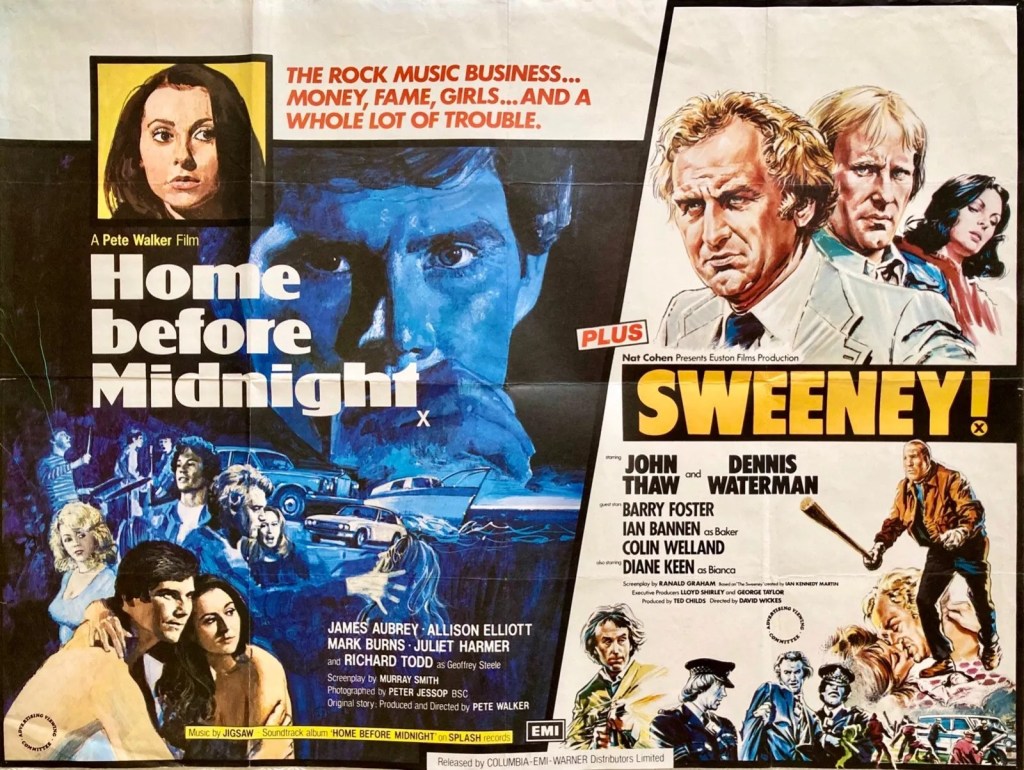
The action only slows down when the subplot gets mired in delivering a political message about big business and corruption or when one of the characters has to take time out to explain the meaning of the title. Turns out there’s a sneaky high-end operator Elliott McQueen (Barry Foster) who runs a string of high-class sex workers to hook politicians like Charles Baker (Ian Bannen). When Baker’s girlfriend Janice (Lynda Bellingham) ends up in the mortuary – suicide the official verdict – McQueen applies pressure to get an oil deal done.

Baker’s gals are expert in what these days would be known as providing the “Girlfriend Experience” though the blokes they service aren’t the ones paying. But a police informant, soft on Janice, believes she was murdered and calls in Detective Inspector Jack Regan (John Thaw) to informally investigate.

When Regan treads on McQueen’s toes it triggers a spate of violence. First the informant is blown away by a machine gun from thugs disguised as coppers. Then a nosy journalist (Colin Welland) is blown up. Then Regan is stitched up and suspended from duty. Naturally, Regan persists with a surreptitious investigation. But the thugs aren’t so covert and he interrupts a gangland hit on Bianca (Diane Keen), another of the “girlfriends” who knows too much.

Not much detection required, really, when the criminals are so open about their criminality and even the most high-ranking politician or sanctimonious cop is going to find it hard to let machine-gun-toting gangsters roam through London. So there’s plenty bloody action and  quite a clever pay-off.

The rampant violence in British cinema earlier in the decade had been confined to the gangsters of Get Carter (1970) and Villain (1971) and to pictures wrapped in halos of critical protection such as A Clockwork Orange (1971) and Straw Dogs (1971). Sweeney! ushered in a new era, when cops could adopt the same methods as criminals.

Regan was the rumpled cop, his sidekick Det Sgt Carter (Dennis Waterman) theoretically the more handsome, except his boss had as much success with women. What both were best at was riling superiors and arguing with everyone. You’d need a good grasp of the various policing departments to keep up – here we have Special Branch and The Flying Squad (The Sweeney) and ordinary coppers.

The predilection for selective use of Cockney rhyming slang was a feature of the British crime picture. Flying Squad translated as Sweeney Todd and was then truncated to The Sweeney. Oddly enough there was no rhyme for Special Branch and Scotland Yard, despite the advent of The Shard, has not made its way onto the rhyming dictionary.

British studios had increasingly turned to television as production levels tumbled, but generally in the comedy genre, Up Pompeii (1971), On the Buses (1971) and Steptoe and Son (1972), plus vaious sequels, registering the biggest box office.

John Thaw and sidekick Dennis Waterman proved to be long-term stalwarts of British television, the former heading up Redcap (1964), The Sweeney (1975-1978), Inspector Morse (1987-2000) and Kavanagh QC (1995-2001), the latter following The Sweeney with Minder (1979-1989) and New Tricks (2003-2015). Diane Keen starred in The Feathered Serpent (1976-1978), The Cuckoo Waltz (1975-1980), Rings on their Fingers (1978-1980), Foxy Lady (1982-1984), You Must Be the Husband (1987-1988) and various others. Lynda Bellingham, in a bit part as a naked corpse, would become a favorite through a long-running commercial.

By this time Britain had also produced a core of strong supporting actors, not of the quality of the previous generation of Laurence Olivier or John Gielgud, but with a considerable portfolio behind them, Barry Foster second-billed in Frenzy (1972), Ian Bannen Oscar-nominated in The Flight of the Phoenix (1966).

Directed with huge enjoyment by David Wickes in his movie debut from a screenplay by Ranald Graham (Shanks, 1974)  and Ian Kennedy Martin (Mitchell, 1975).

Gotcha!

Twisted Nerve (1968) ***

Another rich kid with mental health issues though without Orson Welles to offer expiation. The cause of this character’s illness is undetermined but it’s easy enough to spot the trigger to violence. The lad’s father is dead and his mother’s new husband, a wealthy banker, wants him out of the way, or at least out of the house, or at least, given he’s twenty-one, out working rather than mooning about the house all day.

And this was certainly the year for the movies exploring split personality – if such shallow treatment could be deemed investigation – what with Tony Curtis and Rod Steiger in serial murderous form in, respectively, The Boston Strangler (1968) and No Way to Treat a Lady (1968). And for movie fans it was an unexpecteldy speedy reteaming for Hayley Mills and Hywel Bennett after the humungous success of The Family Way (1967) in which the actress shed her child-star persona in no uncertain manner and the British film industry was, apparently, suddenly blessed with a duo with marquee appeal.

A poster that gives the game away. And an apostrophe issue.

This takes the Rod Steiger route of charming killer rather than a Tony Curtis puzzled and horrified by the demands of his ulterior personality. Given the emphasis on mental illness these days, Twisted Nerve is the hardest of the trio to take, since it’s effectively a play on an old gimmmick, deviousness concealed inside appeal.

Martin (Hywel Bennett) faced with expulsion from his house by overbearing substitute father Henry (Frank Finlay) pretends to scoot off to France but instead inveigles himself into the boarding house run by Joan (Billie Whitelaw) after tricking her librarian daughter Susan (Hayley Mills) into extending a sympathetic hand to his alter ego, the childish Georgie, whose behavior falls only a little way short of sucking his thumb and clutching a teddy bear.

Joan’s initial cynicism gives way to maternal feelings when he clambers into her bed in the middle of the night after a supposed nightmare. (And not with sexual intent.)

Occasionally, Martin cannot control his true feelings, despite Susan rebuffing his romantic overtures. Father is the first victim, substitute mother Joan the second and it’s only a matter of time before Susan becomes a target either for his stifled sexuality or his inner venom.

This would probably work just as well minus the schizophrenic element. In fact, there’s too much of tipping the nod to the audience. Eventually, Susan’s suspicions are aroused but  director Roy Boulting (The Family Way) is no Alfred Hitchcock able to manipulate an audience. So, mainly, what we are left with is Hywel Bennett’s ability to pull off a double role rather than his victims’ susceptibility to his charms.

Hayley Mills’ character could do with fattening up, otherwise she’s just the dupe, bright, bubbly, self-confident and attractive though she is, although her mother, in passing, is given more depth, a lonely attractive widow prone to sleeping with her attractive guest Gerry (Barry Foster) and, unnerved to some extent by her daughter’s growing independence, wanting a son to mother.

It’s only un-formulaic in the sense that the director is playing with an audience who were not expecting anything like this as a story fit for their two newest adult stars so hats off especially to Bennett for considering a role that could as easily have typecast him for the rest of his career. As I said, setting aside the mental illness elements, Bennett is good fun, as he toys with both aspects of his character, adeptly dealing with those who would patronise him, and like Leopold and Lowe convinced he can get away with the perfect crime, whose planning and attention to detail is noteworthy.

As with the Chicago killers it’s only accident that gives him away, although the policeman here (Timothy West) is less dominant than his American counterpart.

Clearly filmmakers of the 1960s were beginning to grapple with mental illness but either lurching too far towards romance as a way of instigating tragedy as with Lilith (1964) or to the most violent aspects of the condition as with virtually anything else beginning with Psycho (1960).

Worth a look for Hywel Bennett’s chilling performance – template for Edward Norton’s turn in Primal Fear (1996) – and Hayley Mills fans won’t want to miss it. Strong performances by Billie Whitelaw (The Comedy Man, 1964), Barry Foster (Robbery, 1967) and Frank Finlay (The Shoes of the Fisherman, 1968) help enormously. There was quite an input into the screenplay. Along with Boulting, Leo Marks (Sebastian, 1968) doing the heavy lifting adapting work by Roger Marshall (Theatre of Death, 1967) and, in his only movie credit, Jeremy Scott. Great score by Bernard Herrmann.

Well done with misgivings.   

Robbery (1967) ****

The explosive gut-wrenching high octane car chase that kicked off this thriller – and provided British director Peter Yates (Bullitt, 1968) with a Hollywood calling card – is somewhat out of place in this intriguing documentary-style fictionalised account of the British heist of the century, the Great Train Robbery of 1963. Setting aside that the chase would have been better employed as the climax, it does provide the cops with enough leads to keep tabs on some of the criminals, ensuring the authorities become aware of the gigantic theft planned.

But Yates’ unusual approach takes us away from the usual crime picture. You can say goodbye to the cliched villain for a start. Mastermind Paul Clifton (Stanley Baker) dresses like a suave businessman. Wife Kate (Joanna Pettet) rails against him for betrayal, not sexual infidelity, but for pretending he had given up the life of crime. And there is any amount of nuance. We don’t discover that Clifton lives in a huge mansion with a massive drive until the very end, we don’t know who else the police are tailing until they are picked up, we are not let in on the secret of Clifton’s escape until suddenly he is taking off in a light airplane. And there is the unexpected. A suspect is identified in a line-up by a witness slapping his face, a message sent to Kate from Paul via a dog.

Cop James Booth questions gangster’s moll Joanna Pettet.

Nor, beyond the basics, are we let in on the details of the plan, more time spent on recruitment, and not the usual suspects either, Robinson (Frank Finlay) – broken out of prison for this specific job – brought unwillingly on board because, as a former bank employee, he can check the stolen notes. I should point out, which may not be obvious to a contemporary audience, that banks shifted money over the weekend via the London-Glasgow night train that carried the mail. Given the £3 million being transported, the train is staffed not by a regiment of security guards but by postal workers sorting letters.

There’s nothing desperately clever about the plan anyway beyond its audacity. Signals are changed to make the train stop at the allotted point, the robbery takes place in military fashion, timed to the minute, some sacks left behind when time is up.

What’s cleverest is the hideout, an abandoned airfield, with underground passages. The gang doesn’t intend to run while the heat is at its hottest but some time later, the cash divvied up, Clifton’s share sent as cargo overseas. Clifton knows the consequences will involve road blocks, house searches, cars impounded, arrests but “without the money they can’t prove anything.” A junkyard owner is paid – too handsomely as it transpires – to clean the vehicles used of fingerprints and other potential giveaways (not much else in the days before DNA). And no matter Clifton ruling with a rod of iron, there is always the idiot who doesn’t quite stick to the plan.   

Most of the picture is detail, not just the meticulous planning but the equally meticulous hounding by the cops, interrogating getaway driver Jack (Clinton Greyn), identity parades, telephones tapped (or a crude version of it), with only the occasional hunch to keep the police, led by the dogged Inspector Langdon (James Booth),  on the right track. A few years before cops in movies were uniformly identified as either corrupt or useless, sometimes both, this bunch are shown to be relatively efficient, though still prone to underhand means.

Dominating proceedings is the moustached figure of Stanley Baker (Sands of the Kalahari, 1965) whose brusque no-nonsense manner sets the tone. He’s a cut above the normal criminal not just in ambition but ingenuity and while he rules the roost in the gang he’s less at home at home where Kate gives him a hard time. James Booth (Fraulein Doktor, 1969) is impressive as the pursuer, well-versed in gangland lore, inclined to look beyond the obvious. With only  a few scenes Joanna Pettet (The Best House in London, 1969) makes a mark.

In supporting parts you will spot Barry Foster (The Family Way, 1966), who seems to have the knack of catching the camera’s attention with a look or the turn of his head, and Frank Finlay (A Study in Terror, 1965), and a host of British character actors like George Sewell (The Vengeance of She, 1968) and Glynn Edwards (The Blood Beast Terror, 1968).

But the honors go to Peter Yates (Summer Holiday, 1963), not just for the stunning car chase which Hollywood would forever emulate, but the constant tension, the cutting back and forth between cops and robbers, and between the overtly dramatic and the subtle. He also had a hand in the screenplay along with George Markstein (The Odessa File, 1974) and in his only movie Edward Boyd (The View from Daniel Pike, 1971-1973).

Discover WordPress

A daily selection of the best content published on WordPress, collected for you by humans who love to read.

The Atavist Magazine

by Brian Hannan

WordPress.com News

The latest news on WordPress.com and the WordPress community.