Man in the Dark / Blind Corner (1964) ***

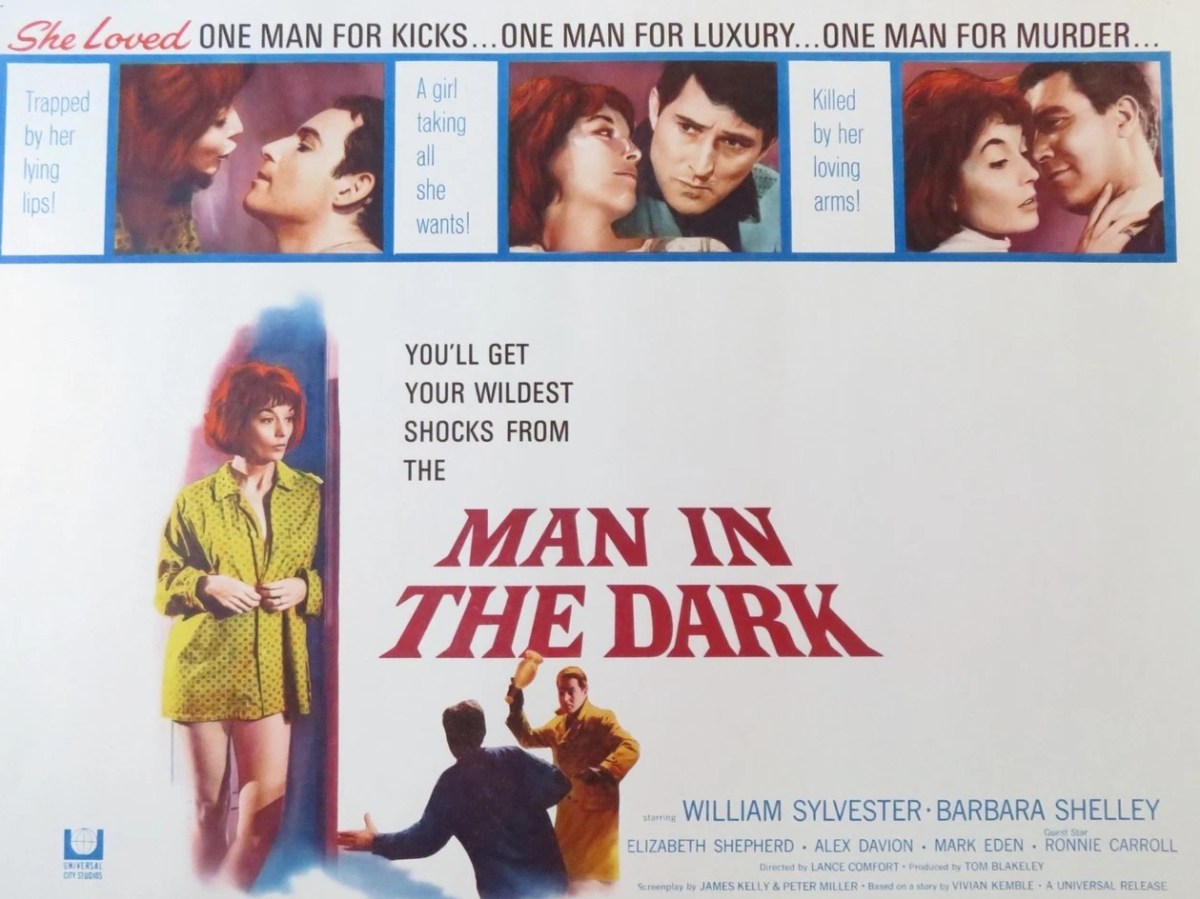
Hammer Scream Queens rarely make an impact outside the genre, so it comes as something of a surprise to find Barbara Shelley effortlessly making the transition from The Gorgon (1964) to a slinky femme fatale spinning a deadly web around three men. While British femme fatales tend not to go all-out full throttle in terms of seduction and revenge, that suits the set-up here which is distinctly slow-burn. In fact, you might be persuaded to accuse the production of time-wasting or padding-out the story with its occasional diversions into song numbers (though that is a trope of these B-features) until you discover later on that there’s a very good reason for listening to the dulcet tones of pop singer Ronnie Carroll.

While there are echoes of Faces in the Dark (1960), blind composer Paul (William Sylvester) here is a far more sympathetic character especially once audiences latch on to what he as to put up with. And where Wait until Dark (1967) majors on terror, here the approach is much more subtle. And while audiences might wince at Audrey Hepburn’s predicament, here they will be appalled to see Paul’s wife Anne (Barbara Shelley) virtually taunt him by not just parading her secret lover Ricky (Alexander Davion), a penniless artist, but caressing him and pecking his cheek with kisses as if to test her husband’s radar.

Not only is Paul the forgiving type – turning a blind eye to his wife’s regular late nights – but he is devoted to Anne and considers himself lucky that she has stuck by him and it never occurs to him that his wealth plays a significant part in that bargain, Anne, a little-known former actress, unlikely to enjoy such bounty any other way. He’s so in love with his wife that he knocks back his secretary Joan (Elizabeth Shepherd) who has a good idea her employer is being played for a fool.

Under the guise of Ricky painting her portrait, Anne manages to legitimately spend a considerable amount of time with her lover and fine-tune her plans to rid herself of Paul. There’s a fairly easy option. Paul is an alcoholic and given to standing in an open balcony. He could easily lose his footing and topple over should there be someone around to give him the initial nudge.

Ricky is pencilled in as the murderer. And though he initially baulks at the idea, the prospect of both losing Anne and resolving at the same time his financial problems is too tempting. By now, Paul is aware of the tryst, having been alerted to the couple smooching in a restaurant, by his best pal and manager Mike (Mark Eden). Once we realize that Paul has been taping his wife’s telephone conversations, you are misdirected into thinking he will be better prepared. But this isn’t America or even sleazy Soho and there’s not a gun to hand or even a knife so Paul is vulnerable to an assailant and even as weak-minded an individual as Ricky seems to grow in confidence the minute the tussling begins.

Even then Ricky is so incompetent Paul needs to coach him into how to get away with the perfect murder and once we get to this stage it’s clear there’s something else going on and we’re in for a torrent of twists, delectably delivered. Ricky is informed that he’s a patsy, that Anne is in love with Mike and that in a courtroom she will act her socks off as the innocent victim of an overzealous lover – “a choked sob will escape her –  she did that in The Act of Cain” or “she might fall into a crumpled but not unattractive faint” as she did in Murder Undaunted.”

When Anne arrives, accompanied by Mike, to check on Ricky’s handiwork, the game is clearly up. But Paul has police hidden in the bedroom to hear what amounts to Anne’s confession. All three are locked up and Paul heads off into the sunset with his secretary.

Barbara Shelley creates a sizzling tension of her own and is a superb femme fatale, dangling three men on a string. Alexander Davion (Paranoiac, 1963) and Mark Eden (Curse of the Crimson Altar, 1968) don’t get a look-in though simply by being stoic and then clever William Sylvester (Devils of Darkness, 1965) manages to hold his own.

Quite a different proposition to Tomorrow at Ten (1963), also helmed by Lance Comfort, where the tension is upfront. You’d say this was a weighted piece of direction, with much of the pressure in the early stages reliant on whether Paul will see through his wife. Those scenes where she toys as much with her lover as her husband are unique. Written by the team of James Kelly and Peter Miller (Tomorrow at Ten) plus Vivian Kemble (Olympus Force, 1988).

Takes a while to come to the boil but well worth the wait.

Catch it on Talking Pictures TV under the title Blind Corner.
Village of the Damned (1960) ****

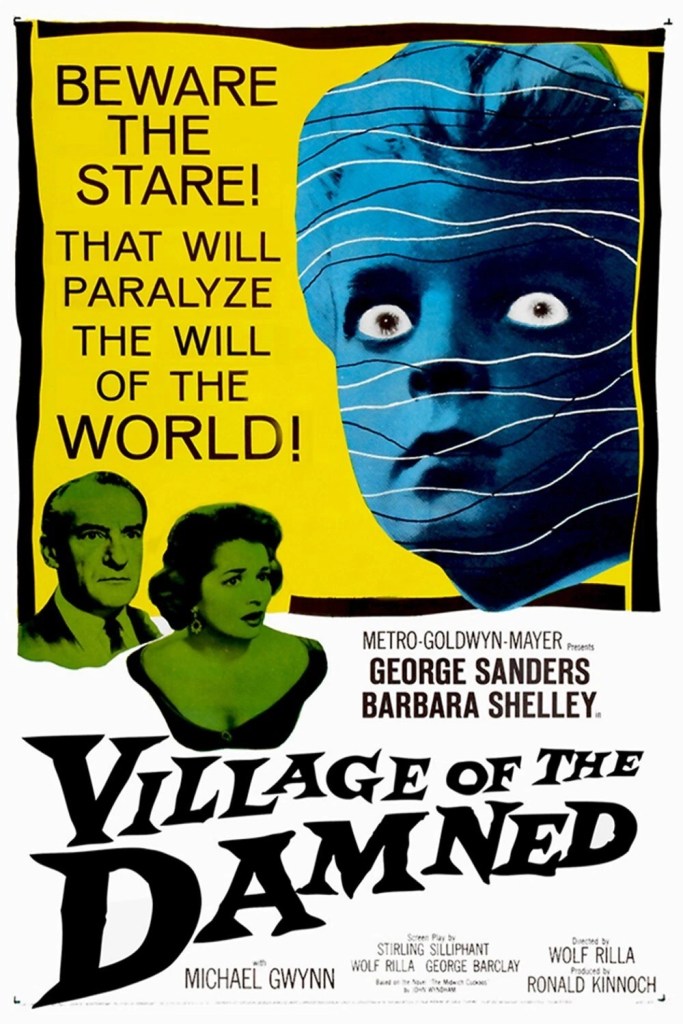
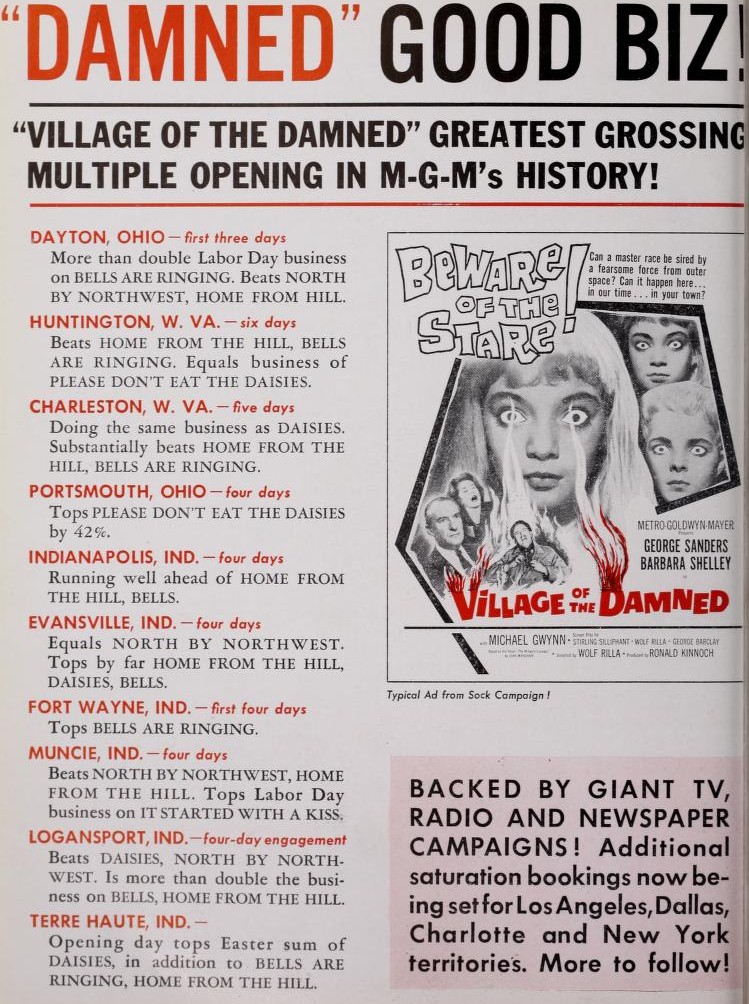
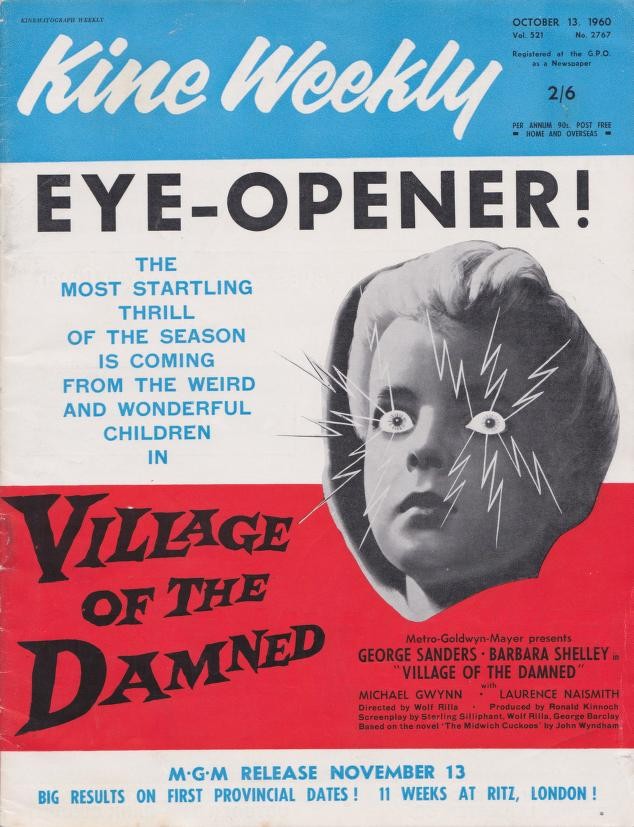
Superb chiller that, unusually, takes time to develop several strands over a longer time frame than is normal for a genre where the immediate takes preference. Opens a new dimension of terror, too, with the brain control sub-genre that would spill over into brainwashing. You could also, if you were of a mind, point to the genuine growing social power of the young as emphasized later in the decade with movies about hippies. It might not be too much of a stretch to point to the “Youthquake” at the end of the 1960s when pandering to a youthful audience nearly destroyed Hollywood.  

Terrific opening sequence of everyone in the small village of Midwich dropping to the ground, the immobilized driver of a bus crashing off the road, the driver of a tractor hitting a tree, taps left running, telephone calls cut off, all manner of accidents ensue. You think everyone’s dead, as do the military, called in to investigate. They cordon off the area, employ canaries and then humans to discover how far the danger spreads. But when a soldier who is dragged out unconscious from the forbidden zone wakes up, they soon realize the population is merely unconscious.

Childless couple Professor Gordon Zellaby (George Sanders) and younger wife Anthea (Barbara Shelley) are among those affected, apparently suffering no side effects for having been knocked out for around four hours. A couple of months later Anthea is delighted to report she’s pregnant. She’s not alone. But for many of the villagers what would be a cause for celebration causes untold grief. One husband returns home after a year away to find his wife is pregnant. In the days when pre-marital sex was frowned-upon, virgins, similarly affected, are shamed.

The pregnancies don’t run to the normal period either, and fully-grown children are born within a few months. What’s more, they all look as if they have inherited the same genes. Their blonde hair and striking eyes suggest they share the same father. Soon it transpires they can not only read minds but control them, causing at least two people to commit suicide.

Turns out this is a global problem, several other communities afflicted with the same condition, the Russians so concerned at the prospect that they bomb one village to oblivion, other cultures simply murdering the children.  Here, being English, where fair play still rules regardless of potential threat, the children are taken under the wing of Professor Zellaby, though the military, having sealed off the area, wait in the wings, itching to wipe out the troublemakers.

Quickly, it becomes a duel for power, the children will do anything to protect their species, Professor Zellaby at first wanting just to study the kids and understand them but soon recognizing the threat.

In between bouts of action, most of which is discreetly handled, none of the deliberately shocking scenes that might have emanated from an exploitationer, the authorities have plenty of time to ponder their existence. A leap in genetic mutation, or extraterrestrial origins, are among the options considered.

Eventually the villagers react like terrified Transylvanians confronting Dracula and attempt to set fire to the building where the children are housed but reckon without the brain control that can be exerted. In the end Professor Zellaby comes up with a self-destructive solution.

This is formidable stuff, all the more so, because in the days when most monsters grew fangs or claws or developed huge bodies and were otherwise physically frightening, the worst these kids get up to is to have a striking glow in their eyes, a startling contrast to their blonde hair, calm demeanor and neat uniform clothing.

Tremendously well done and it helps to have cast mainstream actors like George Sanders (Warning Shot, 1967) and Barbara Shelley (only later did she become a Scream Queen) and others who don’t carry the tinge of the horror genre.

Very well paced by German director Wolf Rilla (The World Ten Times Over, 1963) who resists the temptation to overplay his hand, achieving much more by leaving it to your imagination. Stirling Silliphant (The Slender Thread, 1965), George Barclay (Devil Doll, 1964) and the director adapted the groundbreaking novel The Midwich Cuckoos by John Wyndham. Horror maestro John Carpenter remade this in 1995, which only wnent to show how more successful the restraint of the original was.

Top notch.

Quatermass and the Pit / Five Million Miles to Earth (1967) ****

Five million dollars.  That’s roughly the budgetary difference between Hammer’s Quatermass and the Pit and Twentieth Century Fox’s Fantastic Voyage. Although the protagonists in the latter face the unexpected, the movie is (as would be 2001: A Space Odyssey, 1968) an exercise in awe, in controlled exploration of wonder, whereas Quatermass, lacking the money for special effects, concentrates more on story and human impact. The government funds the experiment in Fantastic Voyage while Professor Quatermass (Andrew Keir) finds nothing but obstruction from his superiors.

Quatermass and the Pit is a masterpiece of stealthy exposition. Virtually every minute brings another development, gradually building tension, stoking fear. The principals – Dr Roney (James Donald), Barbara Judd (Barbara Shelley) and the professor – are cleverly kept apart during the early stages. A human skull discovered on a building site for a London Underground station is followed by a skeleton. Palaeontologist Roney determines it is five million years old, older than any previous find.

A metallic object is found nearby. First guess is an unexploded bomb from the Second World War. But it’s not ticking. And a magnet won’t stick to it. Col Breen (Julian Glover) is called in along with hostile rocket expert Quatermass. They have been locking horns from the outset.

There’s a whole bunch of apparent red herrings, mostly of the demonic variety. The location, historically associated with weird occurrences, is a nickname for the Devil. A pentagram is detected. Touching the object can give you frostbite. Col Breen argues it’s a leftover German propaganda machine from World War Two. A hideous dwarf and other spectral images are sighted. Telekinesis is involved. And tremendous vibrations.

Some people, such as Barbara, have a more receptive brain and can play memories millions of years old that reveal the alien truth. But this is an alien race with genocidal tendencies and able to unleash psychic energy.

The genre requires the scientists to discover an improbable solution which of course they do. Given the miserly budget, the special effects are not remotely in the Fantastic Voyage league. But that hardly matters. The movie coasts home on ideas, marrying sci-fi, the demonic, dormant and institutionalized evil, the militarization of the Moon and the ancient infiltration of Earth by Martians, no mean achievement, and a vivid narrative.

Director Roy Ward Baker (aka Roy Baker) provides many fine cinematic moments as he chisels away at the story, finding clever methods of revealing as much of the aliens as the budget will permit, focusing on very grounded characters, concentrating on conflict, and human emotions, mainlining fear rather than awe, building to an excellent climactic battle between man and monster.

Barbara Shelley (The Gorgon, 1964) is the pick of the stars, in part because she is at such a remove from her normal Hammer scream-queen persona, but more importantly because she brings such screen dynamism to the role. It’s refreshing to see her step up, as she carries a significant element of the story. Oddlyenough, although she has as good a movie portfolio as Andrew Keir and is certainly superior to James Donald, the denoted star, in that department, she is only billed third.

While Andrew Keir (The Viking Queen, 1967), warm-hearted for an intellectual, and James Donald (The Great Escape, 1963), trying to keep a cool head in the middle of inclination to panic, are good, they don’t bring anything we haven’t seen before. Julian Glover (Alfred the Great, 1969) is never anything but imperious and/or irascible, so ideal casting here.

The innovative electronic music was down to Tristram Cary and the unsettling credit sequence deserves some recognition. Nigel Kneale, who originally explored similar ideas for the character on television, came up with the screenplay.

Discover WordPress

A daily selection of the best content published on WordPress, collected for you by humans who love to read.

The Atavist Magazine

by Brian Hannan

WordPress.com News

The latest news on WordPress.com and the WordPress community.