Deathstalker (1983) *** – Seen at the Cinema

Back in ye olde times before streaming killed off the ancillary market, you could make a decent buck from Z-list pictures that made no attempt to target the entire world but were quite content to feed the maw of a limited genre. Sword-n-sorcery never required anyone who could actually act, just topless beefcake and cheesecake, skin glistening as much as possible, special effects limited to an occasional explosion, monsters little more than rejects from the Star Wars cantina.

Chuck them out to an exhibition industry not so much starved of product as waiting an age to get their hands on a big-budget number, which like roadshow a couple of decades before remained in the biggest cinemas for months, and you would turn an easy profit. This one set the makers back a mere half a million bucks and picked up $1.2 million (in rentals) on U.S. release alone and, more importantly, another $2 million from video rental and the same again likely from sell-through and the same again when DVD appeared and again when cable started to run out of A-list and B-list features and scrabbled about for anything that could fill a slot. And that’s before you started talking about the overseas market, this kind of adventure, with heads, arms, eyes and fingers lopped off (and occasionally fed to pet monsters)  more acceptable worldwide than comedies or musicals

Yep, you’re right, this is exactly the same advert with the title color changed.

Heck, you didn’t even need much of a plot – any Lord of the Rings rip-off would do, a series of inanimate objects that combined to invest the owner with immeasurable power – and you didn’t even require to hide nudity under the guise of “sexposition” a la Game of Thrones, any passing gal liable to have her clothes ripped off or belong to some half-naked harem or be happy to step up for a bout of mud-wrrestling.

Must be World Deathstalker Day because a pair from this series turned up at my local multiplex courtesy of the people at DMP, who otherwise specialize in sci-fi and horror all-nighters or mini-festivals. Or it could be that Lana Clarkson attracted a cult following after being murdered by Phil Spector. Deathstalker, filmed in Argentina since you ask,  originally came out when my cinemagoing habit took a back seat to parenting so would have passed me by and I don’t remember getting a VHS/DVD fix, so I thought I’d toddle along and see why this deserved the reissue treatment along with this week’s other revival fave, Interstellar, which could at least claim tenth anniversary status.

Plot – since you insist – has our eponymous hero (Rick Hill) – no, hero’s too strong a word because he’s reluctant to put himself out for anybody unless it involves womanizing and financial reward – setting out, having been handed a powerful sword by a passing witch, to relieve the sorcerer Munkar (Bernard Erhard) of his power. Along the way he encounters a similar heroic hunk Oghris (Richard Brooker) and female warrior Kaira (Lana Clarkson) and gets sidetracked into attempting the rescue of kidnapped Princess Codile (Barbi Benton) and then taking part in a gladiatorial tournament and of course can’t help but get distracted by the half-naked women.

Munkar is a Machiavellian villain. He uses the tournament to get rid of any challengers to his throne, since they’ll kill each other in combat and he can murder the winner. Only Deathstalker is an obstacle, since his sword renders him invulnerable, and Oghris is easily tempted to turn traitor to solve that little problem. Contemporary audiences might run shy of this type of picture because, essentially, it’s Misogyny Central and there are three attempted rapes in the first five minutes and there’s hardly a minute goes by without some female losing their clothes.

Still, presumably, it does what it says on the tin, plenty action, ogres, imps, hog-faced warriors and naked women in abundance, and the usual narrative malarkey that you won’t need a degree to keep up with (unlike Interstellar, for example). And if you’re a fan of the celestial choir this one’s for you as any time Deathstalker raises the sword to the sky that comes on to indicate he’s not getting electrocuted by the sudden bolts of light saber stuff. You can come to scoff or enjoy for the genre romp it is, laugh at intentional and unintentional jokes, and sit back in wonder at the ten minutes of animated Intermission adverts that arrive at the rate of one a minute that were served up back in the day to entice Drive-In patrons to the delights of the Refreshment Counter.

Director John Watson (Under the Gun, 1987) stuck to the admittedly limited knitting, throwing in close-ups whenever the action stalled, allowing his star to demonstrate his array of knitted eyebrows and drawn lips.  Howard B. Cohen (Barbarian Queen, 1985) dreamt this one up.

Can’t say I complained too much once I knew what I was letting myself in for and a joy to see, in some eyes, a less-than-worthy vehicle being restored to the big screen.

The Four Horsemen of the Apocalypse (1962) **

Hollywood isn’t known for its sensitivity, and this is one of those major misjudgements. An incredibly rich family, ripe with entitlement, find World War Two tough going, in the main because as in Counterpoint (1968), they consider themselves exempt. Being Argentinians, they are neutral.

Unfortunately, it just so happens, with that wealthy person’s penchant for flaunting their wealth in the world’s richest cities, they end up in Paris on the eve of war, ignoring the warning of family patriarch (Lee J. Cobb) who is convinced the titular “four horsemen of the apocalypse” (war, conquest, death and pestilence, in case you don’t know your Bible) are on the march. Not that we see much of that in the French capital, except in newsreel, details of the war delivered in snippets of dialog (“haven’t you heard about Dunkirk?”), and street-loads of refugees.

Because, don’t you know it, our major players, the Desnoyers and Laurient families, are largely immune. Man-about-town and Argentinian art connoisseur Julio Desnoyers (Glenn Ford) – ignoring the entreaties of his father Marcelo (Charles Boyer) to scarper – is making a move on married Frenchwoman Marguerite Laurient (Ingrid Thulin), bored by newspaper editor husband Etienne (Paul Heinreid) who spends way too much time worrying about impending war.

Julio is so rich that even after the German invasion sends the poor of the city – and its Jewish population – racing about terrified for their lives, he can swan around, enjoying fine food in top-class restaurants much as before and even has the temerity to tell a high-ranking German General von Kleig (George Dolenz) that his wealth makes him immune. The general reckons that his rank gives him any woman he wants. “She’s mine,” is Julio’s rather misogynistic retort when the general attempts to appropriate Marguerite.

Meanwhile, though Julio is still slow to catch on, his sister Chi Chi (Yvette Mimieux) has only gone and joined the Resistance and Etienne has also upset the new masters, so Julio has to go begging cousin Heinrich (Carl Boehm), who has exploited his German origins to achieve military high rank, to provide them with a get-out of-jail-free card.  

When Etienne is released, Marguerite is initially inclined to stick with Julio until guilt gets the upper hand. Julio, with no lover to keep him happy, eventually throws his lot in with the Resistance, but there’s no happy ending for anyone.

Director Vincente Minnelli (Two Weeks in Another Town, 1962) is terrific at marshalling his set pieces, using widescreen to excellent advantage, cramming extra bodies in at the edges, but since these sequences tend to be little more than extended talk-fests – the activities that got Chi Chi and Etienne imprisoned are ignored – no amount of directorial skill in the world is going to salvage a movie so weighted down with dead wood.

Glenn Ford (Rage, 1966) does his very best to give the viewer something to hold onto. He avoids every shade of angst in his determination to have as much as fun as possible regardless of any situation. He’s scarcely had the chance to be so carefree on screen and he is at his charming best, and he does lift what is otherwise a somber encounter.

Ingrid Thulin (Return from the Ashes, 1965) has her moments, especially when her diplomatic skills prevent a party being ruined, and she enjoys some flighty repartee with Ford, but once the romance gets heavy her personality undergoes a U-turn and she’s holding onto angst for dear life. And there’s a twist in her character that makes no sense. When Etienne emerges from prison a broken man, she gives him both barrels, and declares her love for Julio only for shortly after to recant and dump Julio. Seems mighty insensitive and bordering on cruelty to deal her husband such a blow when he has been tortured by the Nazis. Though she might not have been so forgiving had she worked out just why Etienne was freed and Chi Chi not.

After the colossal success of Ben-Hur (1959), which set the roadshow ball rolling, MGM was on a remake crusade. As well as Ben-Hur, it had remade Cimarron (1960) – the original 1931 version an Oscar-winner and hot box office. The fact that that flopped didn’t deter the studio. The silent version of The Four Horsemen of the Apocalypse (1921), set against the background of World War I,  transformed Rudolph Valentino into a superstar and netted MGM a fortune. The new version sank like a stone, perhaps because it was too wordy for roadshow, or perhaps, more likely, Judgement at Nuremberg (1961) had taken a bolder look at World War Two.

A mis-hit.

REVIEWED PREVIOUSLY IN THE BLOG: Glenn Ford in Experiment in Terror (1962), Love Is a Ball (1963),  Advance to the Rear / Company of Cowards (1964), Fate Is the Hunter (1964), The Money Trap (1965), Is Paris Burning? (1966), Rage (1966), The Last Challenge / The Pistolero of Red River (1967), A Time for Killing (1967), Day of the Evil Gun (1968), Heaven with a Gun (1969; Ingrid Thulin in Return from the Ashes (1965); Yvette Mimieux in The Time Machine (1960), The Wonderful World of the Brothers Grimm (1962), Diamond Head (1962), Joy in the Morning (1965), The Reward (1965), The Caper of the Golden Bulls (1967), Dark of the Sun (1968), The Picasso Summer (1969); Vincente Minnelli directed Two Weeks in Another Town (1962) and Goodbye Charlie (1964).

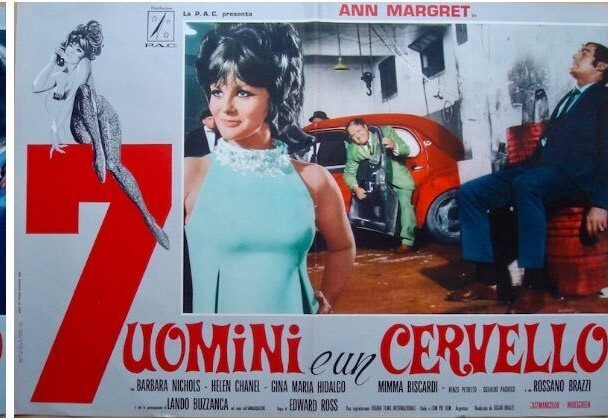
Criminal Affair/Seven Men and one Brain / 7 Uomini et un Cervello (1968) ***

After Murderers Row (1967), Ann-Margret flipped Hollywood the finger. At one point in the early 1960s contracts had been oozing from every pore, multiple deals with multiple studios, even one to star opposite Frank Sinatra. And despite showing considerable acting talent as a mother rather than moll in Once A Thief (1965), the career she had envisaged had not materialized.

In part, her reign as a glamor queen had been usurped by Raquel Welch, who had out-bikinied her in One Million Years B.C. (1966) and Fathom (1967), or by the slimmer versions of beauty emanating from Britain in the shape of Julie Christie or from French exile in the shape of Jane Fonda.. But mostly, you would say, her box office hadn’t matched her salary and she was learning fast that promise can only take you so far. So, she took a leaf out of La Welch’s book, and headed for Italy, for a three-year four-picture sojourn.

She was probably the biggest Hollywood star to head there during the whole decade, not the never-was-es and has-beens who usually made the Transatlantic crossing. But if she had thought she would get the pick of the roles, juicy parts directed by top arthouse names, she was sadly mistaken. It was clear Hollywood-on-the-Tiber viewed it the other way round, and saw her as adding some box office pizzazz to, by Hollywood standards, less well-made productions. This was her final effort.

I never thought I’d be saying this but in Criminal Affair Ann-Margret gets in the way of a neat heist thriller that occasionally slips into the broad Italian comedy unbeloved by everyone outside Italy. But this one does have a clever premise and like many of the best robbery movies the set-up is intriguing.

Criminologist professor Simpson (Rossanno Brazzi), classes filled with more adoring female students than Indiana Jones, has more than an academical interest in his subject, having planned and executed one jewel theft, and in traditional gangster fashion pulled a fast one on his confederates.  As luck would have it, his bosses grant him an all-expenses paid sabbatical to Buenos Aires where he plans to pull off the crime of the century.

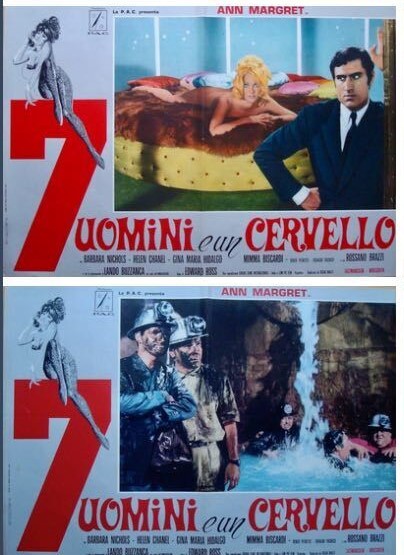
FYI, that ain’t Ann-Margret on the bed and, despite the opportunity to get her soaking wet as was always a prerequisite regarding women when water was introduced, she doesn’t appear in the sewer scene either.

Accompanying him is mooning secretary Leticia (Ann-Margret) who prefers sporting herself in sexy ensembles or nothing at all to attract his attention rather than undertaking the more mundane tasks her job title might suggest. All to no avail, so it would seem, although she does, without her knowledge, play a vital role in his plan, as do some parakeets.

Academic profile opening doors, Simpson is able to scour police files to find his team, with one particular set of skills, that they can sing and properly for the grand plan is to stage a robbery at the opening night of La Traviata in the city, attended by the high and mighty who have paid colossal sums for the privilege.

He enrols other accomplices such as Georgette (Helene Chanel) whose task is divert the owner of the box overlooking the stage for which Simpson has another use. Her presence and that of the diva (Barbara Nichols) enrages Leticia, who resorts to swimming naked in the pool, flirting with the muscular butler and when that fails bombarding Simpson with dinner plates.

The use of the sewer is something of a heist trope, although there’s an original method of covering up the drilling and explosion, but mostly through misdirection we don’t quite work out how Simpson is going to fleece the opera house. Improbable a ruse as it is, nonetheless, as befits his high opinion of himself, the concept is a work of genius. Complications arise when the jewel robbers pursue him to Argentina. The film pretty much dispenses with the other heist trope, of spending much time on the character development of his new thieving team, beyond some obvious comedy.

The fact that Leticia has little to do deprives the picture of any reason for her presence, except as a dupe, physical attributes a distraction when necessary, and her lack of awareness that she is playing a key role leads to the movie’s sting in the tail.

But, in terms of the way the heist plays out, any actress could have played the part. It didn’t need to be Ann-Margret. And there’s not even any excuse, in a movie where singing is central, for her to sing. It’s possibly the most redundant role she ever took on. A bit more screenplay could have fixed that, had her character been developed along the lines of that of La Welch in her Italian-made heist picture The Biggest Bundle of Them All which appeared the same year.

And it might have better just to concentrate more on Rosanno Brazzi  (The Battle of the Villa Florita, 1965) because he has mother issues, carries his absent-minded personality disguise well, and allocate more time to the intricacies of the plot and his pursuers. Viewed just as a heist picture without the unnecessary diversions of the female lead and the comedy it pretty much makes the grade. On the other hand Ann-Margret’s existence might simply have been that since he was also director he couldn’t carry the acting side of the picture on his own.

No doubt, though, I will have to check out, for your benefit, Ann-Margret’s other Italian trio.

You can catch this on Youtube though the print is a bit washed-out. https://www.youtube.com/watch?v=Swf2yWL6E4Q

Discover WordPress

A daily selection of the best content published on WordPress, collected for you by humans who love to read.

The Atavist Magazine

by Brian Hannan

WordPress.com News

The latest news on WordPress.com and the WordPress community.