4 for Texas (1963) ****

To my mind the best of the Frank Sinatra-Dean Martin collaborations, outside of the more straightforwardly dramatic Some Came Running (1958), and for the simple reason that here the two stars are rivals rather than buddies. The banter of previous “Rat Pack” outings is given a harder edge and it is shorn of extraneous songs.

I came at this picture with some trepidation, since it did not receive kind reviews, “stinks to high heaven” being a sample. But I thought it worked tremendously well, the ongoing intrigue intercut with occasional outright dramatic moments and a few good laughs.

It’s unfair to term it a comedy western since for a contemporary audience that invariably means a spoof of some kind, rather than a movie that dips into a variety of genres. In some respects it defies pigeonholing. For example, it begins with a dramatic shoot-out, stagecoach passengers Zack Thomson (Frank Sinatra), a crack shot with a rifle, and pistolero Joe Jarrett (Dean Martin) out-shooting an outlaw gang headed by Matson (Charles Bronson). When director Robert Aldrich (Sodom and Gomorrah, 1962) has the cojones to kill off legendary villain Jack Elam in the opening section you know you are in for something different.

After out-foxing Matson, Jarrett attempts to steal the $100,000 the stagecoach has been carrying from its owner Thomas. Jarrett looks to be getting away with it until he realizes he is still in range of Thomas’s rifle. Then Thomas looks to have secured the money until Jarrett produces a pistol from his hat. And that sets the template for the movie, Thomas trying to outsmart Jarrett, the thief always one step ahead, and the pair of them locking horns with corrupt banker Harvey Burden (Victor Buono), in whose employ is Matson.
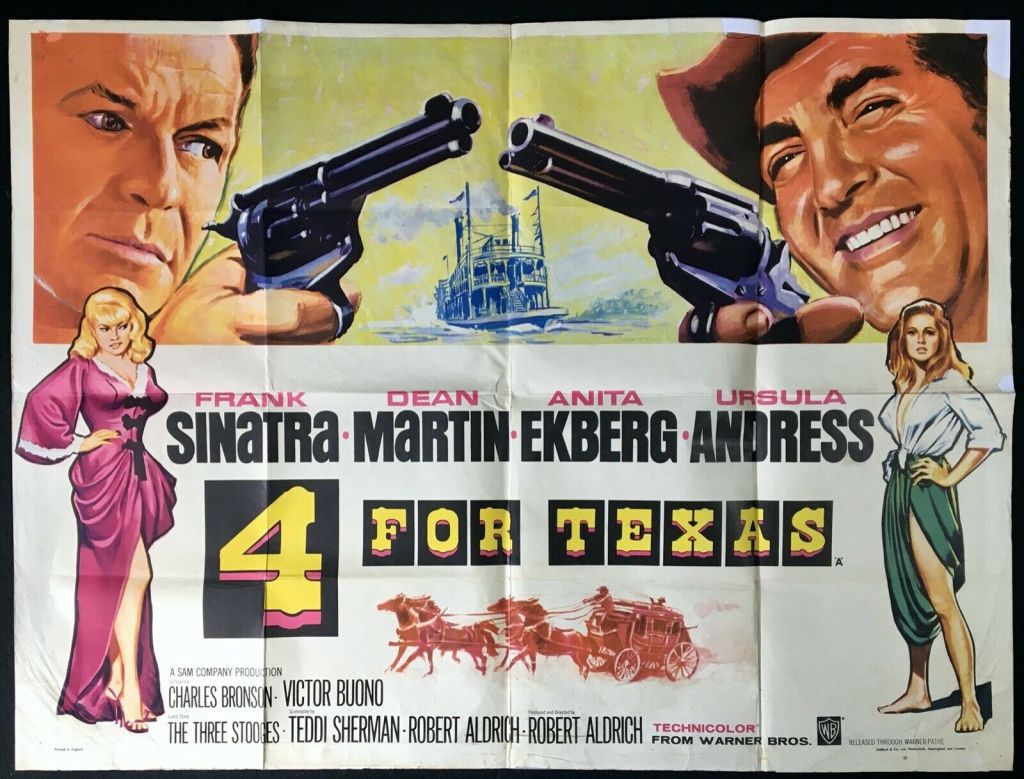
The movie is full of clever twists, cunning ruses, scams, double-crosses, reversals and sparkling dialog. Whenever Jarrett and Thomas are heading for a showdown, something or someone (such as Matson) gets in the way. While Thomas has the perfect domestic life, fawned over by buxom maids and girlfriend Elya (Anita Ekberg), Jarrett encounters much tougher widow Maxine (Ursula Andress) who greets his attempts to invest in her riverboat casino by shooting at him. 

Take away the comedic elements and you would have a plot worthy of Wall Street and ruthless financiers. The story is occasionally complicated without being complex and the characters, as illustrated by their devious intent, are all perfectly believable.

It’s a great mix of action and comedy – with some extra spice added by The Three Stooges in a laugh-out-loud sequence – and it’s a quintessential example of the Sinatra-Martin schtick, one of the great screen partnerships, illuminated by sharp exchanges neither lazily scripted nor delivered. Even the blatant sexism is played for laughs.

Sinatra and Martin, especially, are at the top of their game. Forget all you’ve read about Aldrich and Sinatra not getting on. Sinatra never got on with any director. But an actor and director not getting on does not spell a poor picture. Sinatra brings enough to the table to make it work, especially as he is playing against type, essentially a dodgy businessman who is taken to the cleaners by both Martin and Buono.

The only flaw is that Ursula Andress (Dr No, 1962) does not turn up sooner. She has a great role, mixing seductiveness and maternal instinct with a stiff shot of ruthlessness, not someone to be fooled with at all, qualities that would resonate more in the career-making She (1965).  Anita Ekberg (La Dolce Vita, 1960) on the other hand is all bosom and not much else. Charles Bronson (The Magnificent Seven, 1960) demonstrates a surprising grasp of the essentials of comedy for someone so often categorized as the tough guy’s tough guy.

The biggest bonus for the picture overall is the absence of the other clan members – Sammy Davis Jr, Peter Lawford and Joey Bishop – who appeared in previous Rat Pack endeavors Oceans 11 (1960) and Sergeants 3 (1963). Without having to laboriously fit all these other characters in, this film seems to fly along much better. As I mentioned, the fact that Sinatra and Martin play deadly enemies provides greater dramatic intensity.

Robert Aldrich was a versatile director, by this point having turned out westerns (Vera Cruz, 1954), thrillers (Kiss Me Deadly, 1955), war pictures (The Angry Hills, 1959), Biblical epic Sodom and Gomorrah (1962) and horror picture Whatever Happened to Baby Jane? (1962). But 4 for Texas called for even greater versatility, combining action with quickfire dialog, a bit of slapstick and romance and shepherding the whole thing with some visual flair.

If you are a fan of Oceans 11 and Sergeants 3 you will probably like this. If you are not, it’s worth giving this a go since it takes on such a different dynamic to those two pictures.

The Alphabet Murders (1965) ***

Just about the barmiest idea ever. Just about works. Tony Randall (Bang! Bang! You’re Dead / Our Man in Marrakesh, 1966), a cross between David Niven’s younger brother and a distant relation of Inspector Clouseau, would be nobody’s notion of a perfect Hercule Poirot. But back in the day, Agatha Christie’s famed detective was not a hallowed concept.  

In fact, in movie terms he was pretty much a nobody, not a single big screen appearance in three decades, the forgotten man of cinema sleuths, not a patch on Sherlock Holmes or Maigret who had enjoyed umpteen iterations. So that character, if you like, was there for the taking, up for grabs, not one so sacrosanct it was imprinted on audience minds.

You could do what you liked as long as he had a moustache, spoke with an exaggerated foreign accent and every now and then pointed to his head and mumbled something about little grey cells.

MGM had had some fun and box office success with Christie’s other famous criminal creation Miss Marple in a quartet of low-budget pictures in the light comedy vein starring Margaret Rutherford beginning with Murder, She Said (1961) and clearly believed the same recipe would work wonders with a character generally considered too stiff to work at all.

This is a chucklesome broth, some astute detective work mixed up with all sorts of sight gags. Frank Tashlin (The Glass Bottom Boat, 1966) is at the helm and the writing team of Jack Seddon and David Pursall who reimagined Miss Marple adapt the mystery.

It kicks off with the very contemporary trope of talking to the camera as real-life actor Tony Randall walks off an MGM set and transforms himself into Poirot. Hastings (Robert Morley), who in the novels is more an amiable companion, a kind of Dr Watson, is here portrayed as somebody high up in the British Secret Service trying to whisk Poirot out of the country. Mostly, he acts as a comedy foil.

After being attacked by a beautiful masseuse, Poirot finds himself on the trail of a serial killer who conveniently leaves an ABC London Guide at the scene of the crime and kills in alphabetical order (with a bent for alliteration) which would make the attempt on the detective’s life a bit of an aberration (that even Poirot doesn’t apparently notice). Anyway, the first victim is an Aquabatic, the second Betty Barnard (Grazine Frame). Poirot is on the case by the time the third likely victim Sir Carmichael Clarke (Cyril Luckham) hoves into view.

As luck would have it, a fourth contender Duncan Doncaster (Guy Rolfe) is both psychiatrist to chief suspect Amanda Beatrice Cross (Anita Ekberg) and lover of Clarke’s wife Diane (Sheila Allen). Inspector Japp (Maurice Denham) of Scotland Yard and Poirot are invariably at cross purposes.

The detective has a special set of skills, including cooking to restaurant standard, being able to vanish in a trice, horse-riding, and knocking down two sets of ten-pin bowling pins at the same time.  

That the comedy works is mostly thanks to the likes of Airplane (1980) which has accustomed contemporary audiences to barmy, almost literal sight, gags, faces elongated via shaving mirrors, while a cop elucidates a clever plan we are only shown the back of the map he’s pointing to, a conversation takes place over the sleeping body of a snoring wife, a business card tossed nonchalantly onto a desk ends up in a coffee cup, Hastings is trapped in the trunk of a car with a comely wench

You still get your London tourist features – the docks, bus stops, military parade, horse riding in Hyde Park – but these are invariably set-ups for sight gags. A naked Hastings invades the parade, fog shrouds the docks, Poirot’s horse leaps over (wait for it!) a park bench.

This version of Poirot might be heresy to some, and too jaunty by half, but there’s too much serious detection – and some classic Poirot intuition – to dismiss it as entirely a spoof, and I spent too much time chortling to dismiss it as a waste, so it lands in an odd halfway house, but I suspect that’s very much where Tashlin intended it to land.  

Worth a look if only to suspend your disbelief.

PREVIOUSLY REVIEWED IN THE BLOG: Frank Tashlin’s The Glass Bottom Boat (1966); Tony Randall in Let’s Make Love (1960), Lover Come Back (1961), Send Me No Flowers (1964), Bang! Bang! You’re Dead (1966); Anita Ekberg in 4 for Texas (1963); Robert Morley in Oscar Wilde (1960), Nine Hours to Rama (1963), Hot Enough for June (1964), Of Human Bondage (1964), Topkapi (1964), Genghis Khan (1965), The Loved One (1965), A Study in Terror (1965), Some Girls Do (1969).

4 for Texas (1963) ****

To my mind the best of the Frank Sinatra-Dean Martin collaborations, outside of the more straightforwardly dramatic Some Came Running (1958), and for the simple reason that they are rivals rather than buddies. The banter of previous “Rat Pack” outings is given a harder edge and it is shorn of extraneous songs.

I came at this picture with some trepidation, since it did not receive kind reviews, “stinks to high heaven” being a sample. But I thought it worked tremendously well, a delightful surprise, the ongoing intrigue intercut with occasional outright dramatic moments and a few good laughs.

It’s unfair to term it a comedy western since for a contemporary audience that invariably means a spoof of some kind, rather than a movie that dips into a variety of genres. In some respects it defies pigeonholing. For example, it begins with a dramatic shoot-out, stagecoach passengers Zack Thomson (Frank Sinatra), a crack shot with a rifle, and pistolero Joe Jarrett (Dean Martin) out-shooting an outlaw gang headed by Matson (Charles Bronson). When director Robert Aldrich (Sodom and Gomorrah, 1962) has the cojones to kill off legendary villain Jack Elam in the opening section you know you are in for something different.

After out-foxing Matson, Jarrett attempts to steal the $100,000 the stagecoach has been carrying from its owner Thomas. Jarrett looks to be getting away with it until he realizes he is still in range of Thomas’s rifle. Then Thomas looks to have secured the money until Jarrett produces a pistol from his hat. And that sets the template for the movie, Thomas trying to outsmart Jarrett, the thief always one step ahead, and the pair of them locking horns with corrupt banker Harvey Burden (Victor Buono), in whose employ is Matson.

The movie is full of clever twists, cunning ruses, scams, double-crosses, reversals and sparkling dialog. Whenever Jarrett and Thomas are heading for a showdown, something or someone (such as Matson) gets in the way. While Thomas has the perfect domestic life, fawned over by buxom maids and girlfriend Elya (Anita Ekberg), Jarrett encounters much tougher widow Maxine (Ursula Andress) who greets his attempts to invest in her riverboat casino by shooting at him.  

Take away the comedic elements and you would have a plot worthy of Wall Street and ruthless financiers. The story is occasionally complicated without being complex and the characters, as illustrated by their devious intent, are all perfectly believable.

It’s a great mix of action and comedy – with some extra spice added by The Three Stooges in a laugh-out-loud sequence – and it’s a quintessential example of the Sinatra-Martin schtick, one of the great screen partnerships, illuminated by sharp exchanges neither lazily scripted nor delivered. Even the blatant sexism is played for laughs.

Sinatra and Martin, especially, are at the top of their game. Forget all you’ve read about Aldrich and Sinatra not getting on. Sinatra never got on with any director. But an actor and director not getting on does not spell a poor picture. Sinatra brings enough to the table to make it work, especially as he is playing against type, essentially a dodgy businessman who is taken to the cleaners by both Martin and Buono.

The only flaw is that Ursula Andress (Dr No, 1962) does not turn up sooner. She has a great role, mixing seductiveness and maternal instinct with a stiff shot of ruthlessness, not someone to be fooled with at all, qualities that would resonate more in the career-making She (1965).  Anita Ekberg (La Dolce Vita, 1960) on the other hand is all bosom and not much else. Charles Bronson (The Magnificent Seven, 1960) demonstrates a surprising grasp of the essentials of comedy for someone so often categorized as the tough guy’s tough guy.

The biggest bonus for the picture overall is the absence of the other clan members – Sammy Davis Jr, Peter Lawford and Joey Bishop – who appeared in previous Rat Pack endeavors Oceans 11 (1960) and Sergeants 3 (1963). Without having to laboriously fit all these other characters in, this film seems to fly along much better. As I mentioned, the fact that Sinatra and Martin play deadly enemies provides greater dramatic intensity.

Robert Aldrich was a versatile director, by this point having turned out westerns (Vera Cruz, 1954), thrillers (Kiss Me Deadly, 1955), war pictures (The Angry Hills, 1959), Biblical epic Sodom and Gomorrah (1962) and horror picture Whatever Happened to Baby Jane? (1962). But 4 for Texas called for even greater versatility, combining action with quickfire dialog, a bit of slapstick and romance and shepherding the whole thing with some visual flair.

If you are a fan of Oceans 11 and Sergeants 3 you will probably like this. If you are not, it’s worth giving this a go since it takes on such a different dynamic to those two pictures.

Catch-Up: Previously reviewed in the Blog: Oceans 11 and Sergeants 3; Frank Sinatra in The Naked Runner (1967); and Ursula Andress in The Blue Max (1966) and The Southern Star (1969).

Discover WordPress

A daily selection of the best content published on WordPress, collected for you by humans who love to read.

The Atavist Magazine

by Brian Hannan

WordPress.com News

The latest news on WordPress.com and the WordPress community.