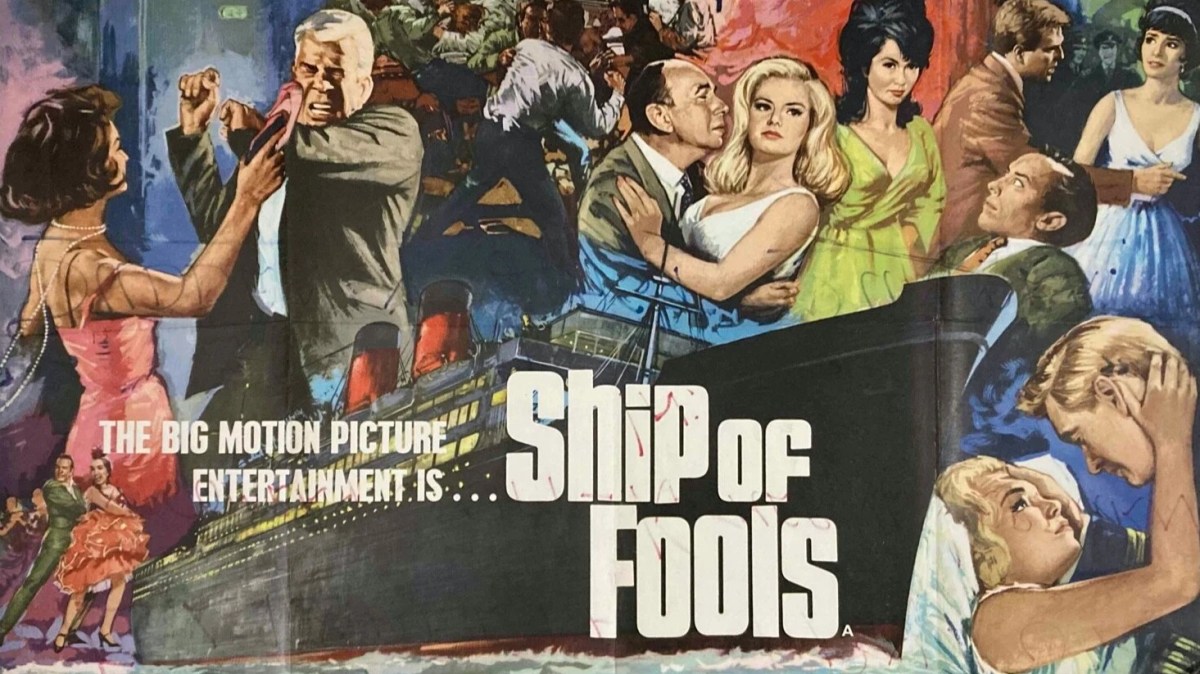
Ship of Fools (1965) ****

Too easily dismissed as soap opera masquerading as a movie making a serious point, this is redeemed and, in some respects, elevated by the performances. If anything, the two political aspects are underdone. The heavy air that hangs over proceedings given the German passengers are heading back to Nazi Germany at the start of Hitler’s reign in 1933 with no idea of the outcome is only there in the audience’s mind. That the racism is underplayed is in part due to the fact that those victimized, a Jew and a disabled man, refuse to act as victims and indeed bond.

The other political aspect, of Spaniards being deported from Cuba for economic reasons, would have more resonance today. But they, too, are heading for consequence and the Spanish Civil War which would break out a few years later. Director Stanley Kramer was noted, indeed often ridiculed, for tackling weighty subjects in movies like The Defiant Ones (1958), On the Beach (1959), Judgement at Nuremberg (1961) and Inherit the Wind (1961). That was tempered somewhat when he went off-piste for It’s a Mad, Mad, Mad, Mad World (1963) and although that’s generally remembered for its hilarity what’s often overlooked is the director’s dexterity in handling a busload of characters and narratives, his pacing and his understanding of character.
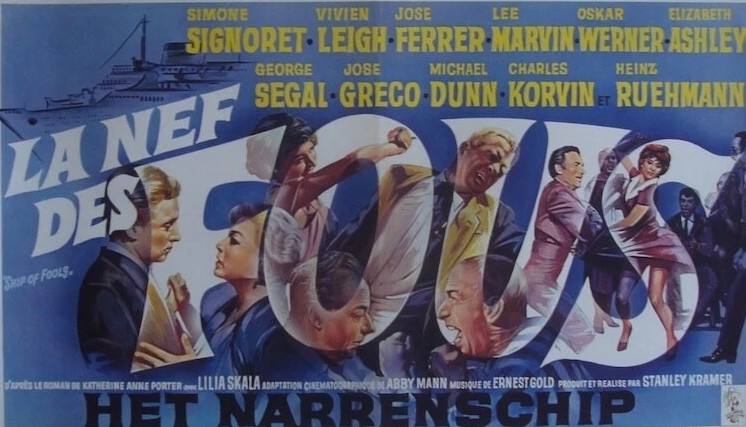
Deduct the comedy and you have a similar approach here, the meshing of various narrative arcs while allowing character to flourish so the general smorgasbord of, if I’m allowed such an obvious notion, ships passing in the night is what gives this more heft.  And the fact that the audiences knows more than the characters about what the future holds permits the director just to concentrate of character interaction.

Unusually, for a historical movie of the period, it’s the females who dominate and have the best storylines. The ship is so full that upscale single passengers who might otherwise have the choice of dining alone are thrown together thus divorcee Mary Treadwell (Vivien Leigh) shares a table with former baseball player Bill Tenny (Lee Marvin).

Their paths unexpectedly cross in unusual fashion. Both are seeking love, though in reality Tenny is happy to settle – and pay for – sex. Mary finds Captain Thiele (Charles Korvin) ignoring her subtle advances while in turn she dismisses the lieutenant. When a drunken Tenny without warning bursts into her cabin, she responds with ardor until she realizes he thinks she’s a prostitute.
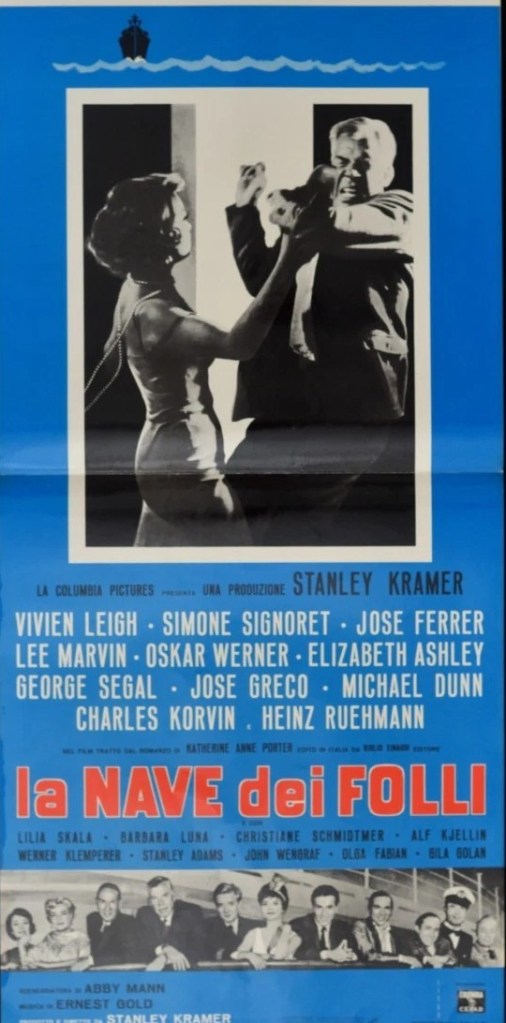
La Condesa (Simone Signoret) is a civil rights activist who finds a fellow traveler in Dr Schumann (Oskar Werner). Although, initially, she mines him to feed her opiate addiction, it’s soon apparent they  are falling in love, although that doesn’t end well. Not much ends well in the romance department, Jenny (Elizabeth Ashley), while initially supportive of artist David (George Segal), soon realizes that his art will take dominance in their relationship.

The older Rieber (Jose Ferrer), with the most pronounced Nazi sympathies, has taken up with younger blonde Lizzi (Christiane Schmidtmer), among whose physical attractions is that she’s a great table tennis player, until she discovers he’s married.

Flamenco dancer Elsa (Gila Golan) is pimped out by her father Pepe (Jose Greco). Social exclusion leads Jew Lowenthal to bond with Glocken who suffers from dwarfism and when German World War One hero Freytag is forced to join them that permits most of the discussion about the state of Germany.

Otherwise, the fact that a mastiff is permitted to sit at table is more to do with aristocratic entitlement than any other social condition. 

For once, Kramer is more interested in character than scoring points. So what might have been heavy going turns into an acting class. To accommodate its portfolio of ageing superstars Hollywood had returned to the subgenre of movies about ageing beauties. Double Oscar-winner Vivien Leigh’s previous outing The Roman Spring of Mr Stone (1961) belonged in that category but this latest reincarnation was a class above, a truly tender examination of loss. However, it was Simone Signoret (The Deadly Affair, 1967) who was Oscar nominated.

Michael Dunn (Justine, 1969) and Oskar Werner (Interlude, 1968) were nominated and while Lee Marvin (Point Blank, 1967) and George Segal (The Bridge at Remagen, 1968) were overlooked the latter two clearly scored points judging by their future acceptance in the Hollywood hierarchy, Marvin in particular alerting the industry to untapped talent, a point made more emphatically in his next picture Cat Ballou for which he won Best Actor. Ship of Fools missed out to The Sound of Music for Best Film. Nominated for eight awards it picked up two, ernest Laszlo for Cinematogrpahy and Robert clatworthy and Joseph Kish foir Art Direction

You might also spot Alf Kjellin (Ice Station Zebra, 1968), Barbara Luna (Firecreek, 1968) and Gila Golan (The Valley of Gwangi, 1969).

Even without the political overhang, this holds together as Grand Hotel on the high seas with Stanley Kramer in his element employing compelling characters to flesh out an interesting narrative. Written by Abby Mann (Judgement at Nuremberg) from the Katherine Anne Porter bestseller.

While the politics add a contemporary veneer, watch it for the acting.

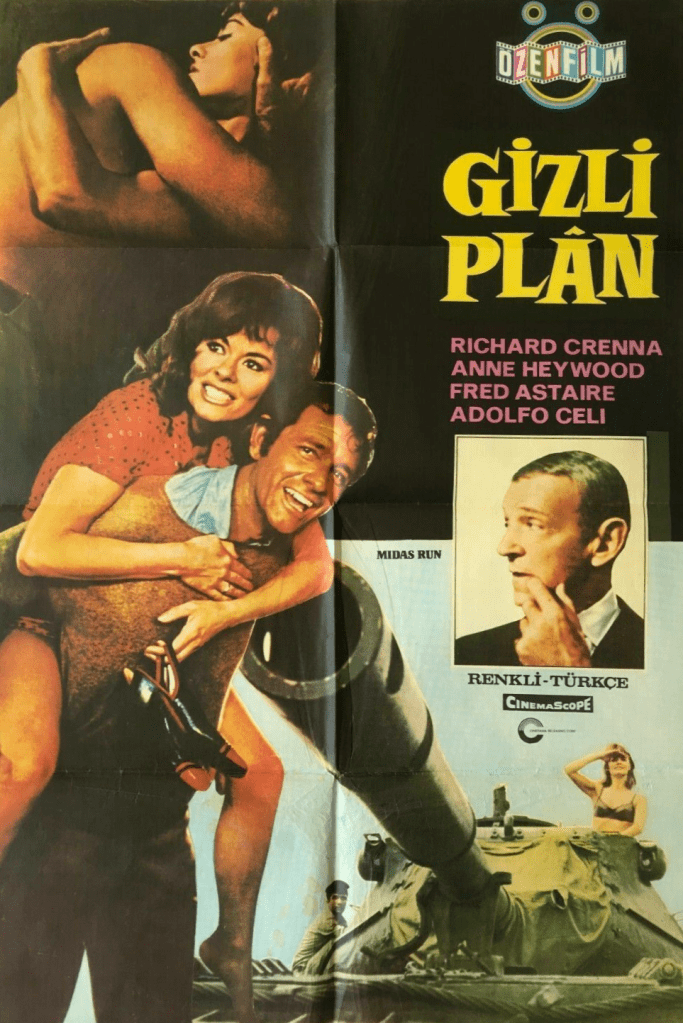
The Midas Run (1969) ***

You ever wonder what triggers criminality? Don’t deny an upper class English civil servant his knighthood, don’t fire an American university lecturer for an anti-war demonstration, don’t humiliate your beautiful wife by making her part of a business transaction. They might all feel robbery is the best revenge.

The highly respected Pedley (Fred Astaire) has talked his superiors in government into the notion that the best way to ship a consignment of gold is by passenger rather than commercial airplane. He recruits wannabe author Mike (Richard Crenna) who, in turn, comes to the rescue of glamorous Sylvia (Anne Heywood) when she is being sold off to sweeten a business deal.

The apparently eccentric casting was based on unfulfilled promise. Fred Astaire, who had not starred in a film for over decade, had made a comeback for Finian’s Rainbow (1968). But that had flopped, putting a dent in his marquee credentials and dramatic roles were hardly the forte of this twinkle-toed dancer. Richard Crenna’s bid for leading man status in Star! (1968) had spectacularly derailed at the box office.

Anne Heywood, the only one of the three principles to have a recent hit, in unexpected sleeper The Fox (1967), found no demand consequently for her services except from lover, future husband and biggest fan, producer Raymond Stross who had bankrolled the lesbian drama, and assigned her female lead here. You could extend your incredulity to the involvement of Swedish director Alf Kjellin,who hadn’t made a picture since Siska seven years before, and like most of his countrymen was seen as producing arthouse fare.

The biggest problem in a gold heist, as anyone watching the current television series The Gold will be aware, is shifting loot that weighs a ton. So Mike and Sylvia hire some Italian crooks to supply a couple of petrol tankers to hide and transport the bullion after the airplane has been forced down over Italian airspace by an Albanian fighter plane, Mike driving the World War Two tank that supplies the ground-based pressure.

As with any heist picture, robbery is only the beginning, double-cross the middle and triple-cross the end. Pedley, who has accompanied the shipment, is delegated by the British secret service to recover the gold, aided by suspicious assistant Wister (Roddy McDowall).  The twist here is that he not only recovers most of the gold, apart from some secreted away by the now romantically-inclined twosome, but points the finger at his accomplices, including the fence General Ferranti (Adolfo Celi).

It then becomes a question of whether the younger crooks can evade his clutches, whether Wister can confirm his suspicions that the investigation has proceeded a tad too conveniently, and discover what the heck the bowler-hatted Englishman is up to. And, of course, whether Mike can trust Sylvia. It wouldn’t be the first – or last (see Perfect Friday, 1970) – grand theft in which the male has been the dupe.

Along the way there is some clever comedy, a play on the British assumption that everyone in the world naturally speaks English, the implicit trust that the upper-classes place in each other, and the stock view that any Italian, law enforcer or crook, can be distracted by a pretty face or comely derriere.

On the downside, the set-up takes too long coming to fruition, especially a mid-movie  interlude that seems intend on channelling the worst romantic notions of the era, idyllic strolls in fields, that I half-expected a burst of slow-motion trotting, or some metaphor for the orgasm. There is some little understood banter about war games. And, for obvious reasons, La Heywood strips down to brassiere in the overheated tank (Mike manages to resist such un-English impulses) though she has previously indulged her innovative ideas about dress, turning a bedsheet into a fashionable toga at a moment’s notice.

There’s nothing particularly new here but Fred Astaire makes a deft impression as a typical upper-class Englishman, accent not found wanting, and successfully reinvents himself as a dramatic actor, that highpoint an Oscar nomination for The Towering Inferno (1974). Anne Heywood, once you realise she is playing all sides against each other, slips easily into the femme fatale role. Richard Crenna’s acting appears limited since his character, despite occasional initiative, is outwitted by all and sundry, and that was scarcely a good look in those days for the leading man to be out-thought by the leading woman.

Effortless, and harmless enough for a matinee.

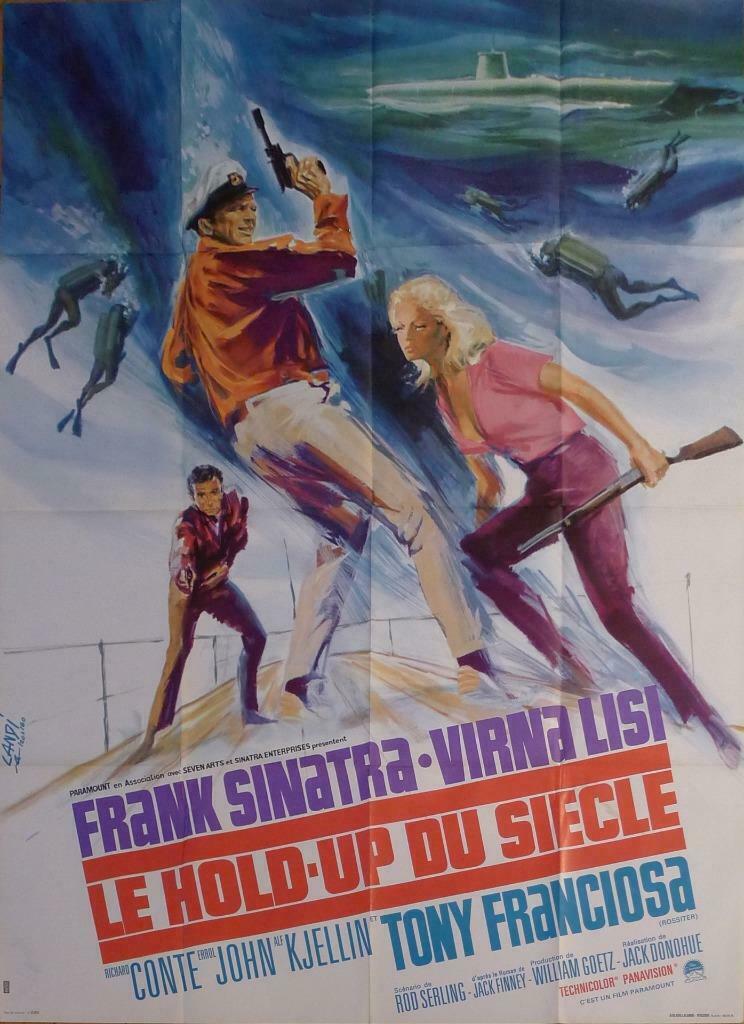
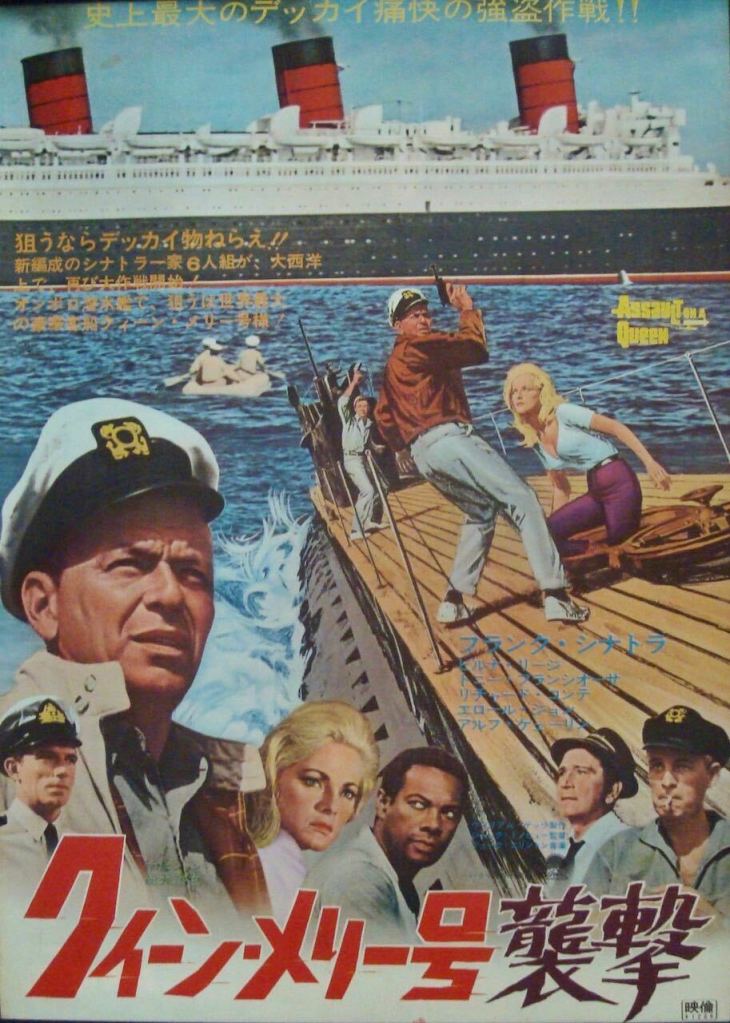
Assault on a Queen (1966) ***

I always wondered why this was a flop. I’m still baffled. Not only is it a perfectly serviceable caper picture, but it’s also high-concept before the term was invented, a World War Two submarine involved in holding up high-end ocean liner Queen Mary (yep, the real thing, thanks to cooperation from owners Cunard). 

The dialogue’s crisp, the robbery well-planned, a good number of twists, plenty underwater thrills, hostility between crew members, and sexual tension kept high by the presence on board of the Italian Miss Big. Diver Mark Brittain (Frank Sinatra) is sucked into a treasure hunt in part because he needs the money and in part through the sexual magnetism of Rosa (Virna Lisi), the expedition backer, who already has suave Vic (Anthony Franciosca) on a string.

The plan evolves into piracy when Brittain discovers a World War Two German submarine on the seabed. As it happens, skippering the salvage vessel is former German U-boat captain Eric (Alf Kjellin). After Mark successfully raises  the sub, it’s game on, Vic’s qualms wilting under Rosa’s seductive gaze. The other team members are engineer Tony (Richard Conte) and wireless operator Linc (Errol John). The prize is a cool million in cash and gold bullion.

Catch No 1: the sub can’t stay submerged for more than an hour. Catch No 2: it’s not that seaworthy and could spring a leak at any time (“don’t just look for water, listen for it,” advises Eric). Catch No 3: in order to successfully board the Queen Mary looking for vital equipment, one of these very American Yanks has to pass himself off as a British sub captain on a secret mission.

Potential Catch No 4 has already been dealt with – if the Queen Mary officers rumble the ruse and call the thieves’ bluff the hijackers plan to put a dummy torpedo up the spout and fire it into the ship’s hull. Catch No 5: there’s so much pent-up hostility among the team the whole endeavor could be sunk. Mark and Vic are vying for Rosa’s favors and clever bombshell that she is she intends to keep it that way, stringing both along.

Racist Vic takes against Eric and also resents splitting the loot with late arrival Tony. Alf not only resents Mark, also a former sub officer, for ending up on the war’s winning side, but exhibits psychopathic tendencies and might just for the hell of it blow a passing tanker out of the water. Like any gang, each member brings something specific to the party. And without giving too much away, the  endgame turns into a battle of wits, especially when the unexpected occurs.

I’m a big fan of Sinatra’s acting style. He is so natural, his gestures don’t look like they’ve been rehearsed for hours in a mirror, you’ll never accuse him of Method acting, or picking parts with Oscars in mind, but somehow he still manages to inhabit his characters.

This is a fascinating role for Virna Lisi (How to Murder Your Wife, 1965), reminiscent of film noir in the way she handles men, but also years ahead of her time not just in combining  sexual and financial independence but of being the boss funding the heist and recruiting the team, and soon has the reluctant Mark playing ball with no sense that’s ultimately she’s going to fall at his feet.

Anthony Franciosca (Rio Conchos, 1964) is mostly a distraction, engaged in a private feud with James Coburn as to who has the brightest and biggest screen teeth. Richard Conte (Lady in Cement, 1969) and Alf Kjellin (Midas Run, 1969) are the physical and mental muscle, respectively, and Trinidadian Errol John (Man in the Middle, 1965) essays an interesting role. Jack Donohue (Marriage on the Rocks, 1965) keeps it all ticking along.

Rod Serling (Planet of the Apes, 1968) devised the screenplay from the novel by Jack Finney (Good Neighbor Sam, 1964). So why did critics and the public have such a downer on the picture? Critical attitudes to the star were easier to understand. Sinatra’s films were generally disliked, and knowledge of his one-take preference allowed critics to thumb their collective noses at his acting, assuming he put no effort into it.

Rumors of his underworld connections were beginning to emerge, he had just married Mia Farrow, less than half his age, and the Beatles and the British invasion had usurped his position in the pop rankings. The general feeling was he was on the way out so why not boot him while he was down. This was despite him receiving some of the best notices of his career for Von Ryan’s Express (1965).

Audiences might have been expecting another Rat Pack lark in the vein of Ocean’s 11 (1960) or felt the supporting cast lacked lustre, Lisi a little known commodity, this only her second Hollywood picture, Franciosca still the second banana, and Hardy Kruger would certainly have invested the German with more malevolence. Otherwise, it’s hard to see what there is to complain about. As I mentioned the dialogue was good, characters simmering, and the story satisfying enough.

Sure, a better director might have extracted more tension from the set pieces, lifted the pace, and added a booming score as with Ice Station Zebra (1968).

It might not be the best heist picture ever made, but it’s too good to be dismissed.

Discover WordPress

A daily selection of the best content published on WordPress, collected for you by humans who love to read.

The Atavist Magazine

by Brian Hannan

WordPress.com News

The latest news on WordPress.com and the WordPress community.