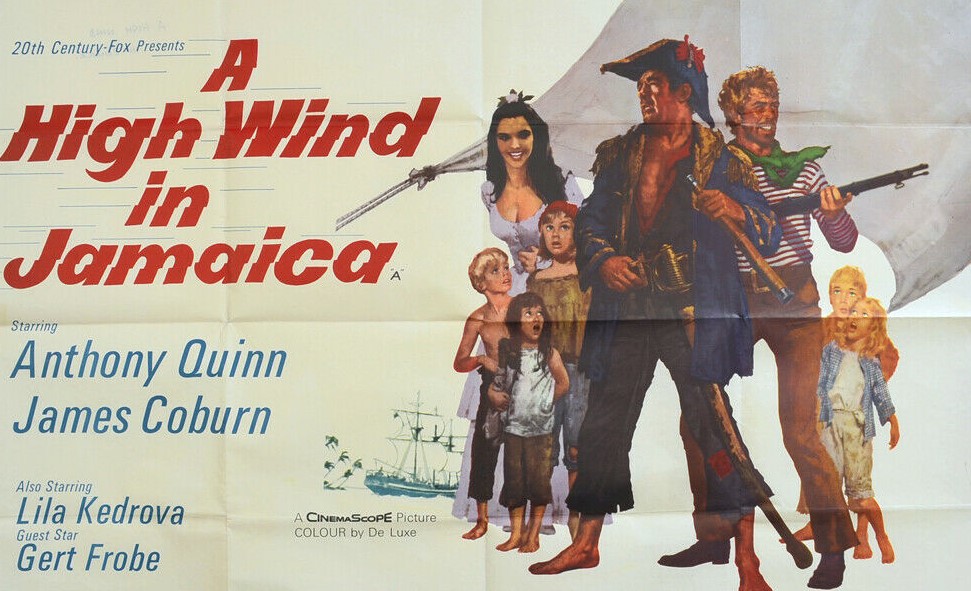
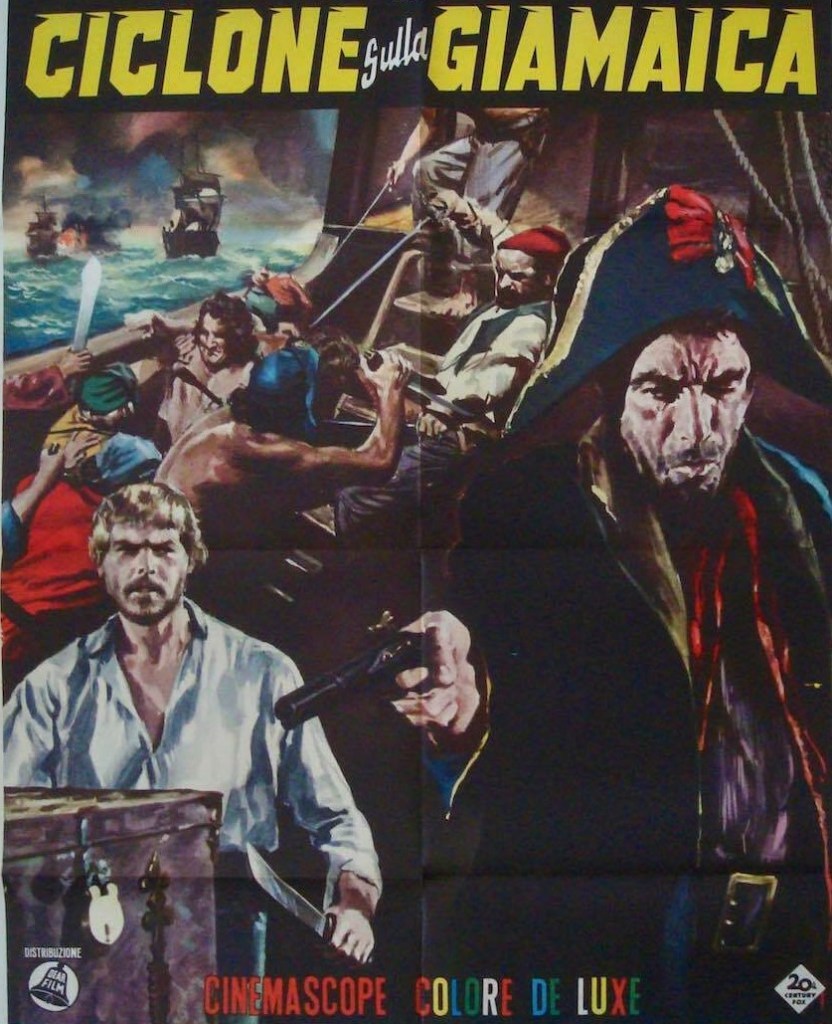
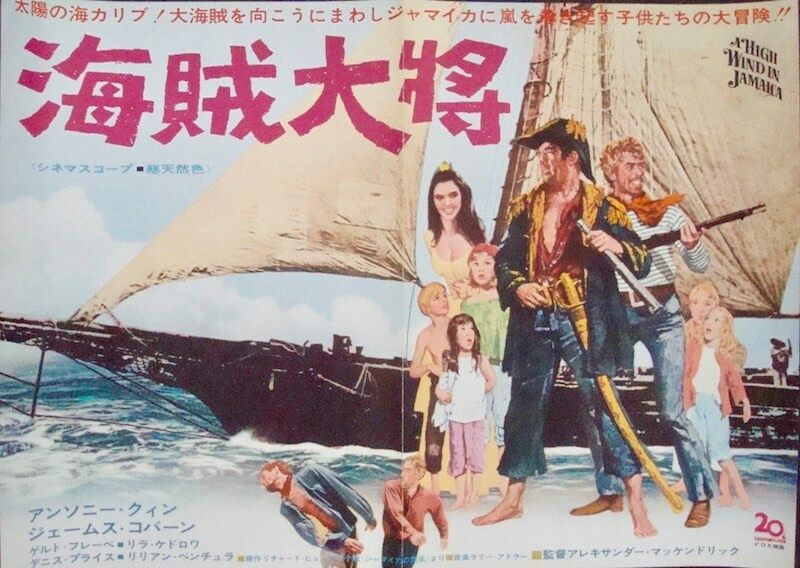
Forget swashbuckling shenanigans in the Captain Blood (1935) and Pirates of the Caribbean (2003) vein, this has more in keeping with Lord of the Flies (1963) as a bunch of third-rate pirates get more than they bargained for after kidnapping a bunch of English children.
The pirates are clever enough when required, using the ruse of pretending to be a ship in distress to defeat an enemy, capable of torturing a captured captain into revealing concealed treasure, or hiding from pursuit by disguising the masts with palm leaves, but generally short on intelligence. That the kidnapping is unintentional, no sensible pirate wanting the British Navy breathing down its neck, gives an indication of the mentality of Captain Chavez (Anthony Quinn) and his mate Zac (James Coburn). Nor are the children Disney-cute and far from being petrified they see it as a great adventure while the crew are superstitious about having the youngsters aboard.
The kids have great fun running rings round the pirates, stealing Chavez’s hat, climbing the rigging, and ringing the bell, while turning round the ship’s figurehead provokes another bout of superstition. When the kids are eventually imprisoned in a rowboat to prevent upsetting the crew they still manage to do so by playing a game that the crew take too seriously.
An attempt to abandon the children on the island of Tampico fails when the oldest boy John (Martin Amis) dies by accident. The children are unperturbed by his death, the only question raised is who can have his blanket. Much to his surprise Chavez discovers he has a strong paternal side, protective when he discovers that one of his captives is a young woman rather than a child, and going against the wishes of his crew when he tends to a knife wound on Emily (Deborah Baxter).
The children are far more grown-up and matter-of-fact than the childish crew, consumed by superstition, and Chavez, consumed by emotion. Although there is considerable comedy to be had from the children’s endeavors, it’s largely an adult film about children. In general, they don’t react the way they would in a Disney picture, nor in the manner which many adults would expect. The sexual tension of the book is considerably underplayed. But the fact that the adults are brought into harm’s way by sheer folly, and their reactions to life are essentially childish, creates a contrast with the more savage attitudes of the children. Emily essentially exposes Chavez’s guilty conscience.
While there is ambivalence aplenty, the depths the book explored go unexplored here, much to the benefit of the picture. The movie dances a tightrope as the children who would otherwise expect to trust an adult grow to learn how to distrust, a rather sharper lesson in growing up than they might have anticipated from their middle-class innocent lives.
Alexander Mackendrick (The Ladykillers, 1955) excels in ensuring the tightrope remains in place while taking advantage of the opportunity for comedy, the realization that this adventure is far from fun only becoming gradually apparent.
Anthony Quinn (Shoes of the Fisherman, 1968) reins in his tendency to ham things up, and his development from unbridled pirate to responsible adult is an interesting one. James Coburn (Dead Heat on a Merry-Go-Round, 1966) reins in the flashing teeth and reveals a more ruthless side than his captain anticipated. Deborah Baxter (The Wind and the Lion, 1975) is easily the pick of the kids although future novelist Martin Amis with his trademark sneer gives her a run for her money.
Lila Kedrova (Torn Curtain, 1966) appears as a brothel madam, Nigel Davenport (Sebastian, 1968) as the father and Gert Frobe (Goldfinger, 1964) as the captured captain. The cast also includes Dennis Price (Tamahine, 1963) and Vivienne Ventura (Battle Beneath the Earth, 1967).
Stanley Mann (Woman of Straw, 1964), Ronald Harwood (The Dresser, 1983) and Denis Cannan (Woman of Straw) wrote the screenplay based on the celebrated Richard Hughes novel.
Apart from Ben-Hur and El Cid, most of Charlton Heston’s movies in the 1960s were domestic box office disappointments. Despite this, he was deemed to be still flying high at the marquee, placed seventh in the annual star rankings just as negotiations began in 1967 for Pro (the title changed to Number One just a few months before release). Given there was little interest in American sports in the rest of the world, it was deemed a gamble. That was not just reflected in the budget – a miserly $1.15 million- but in Heston’s salary of $200,000. He and director Tom Gries (Will Penny, 1968) agreed to “work at substantially lower incomes in exchange for a bigger percentage.”
But to make any decent money, of course the movie had to be a big hit. Compare that to the $750,000 he stashed away for The Hawaiians (1970), admittedly after Planet of the Apes (1968) hit the jackpot, but still. From The War Lord, Heston had “learned actors should not put their own money into scripts,” but taking a pay cut appeared a more sensible route.
The movie was a long time coming to fruition. Initially, the idea had been rejected by National General and Martin Ransohoff of Filmways who worked with MGM. By April 1966, Heston was dejected. “Nothing stirring on Pro,” he recorded in his journal. But he understood the need not to “peddle the project” since “it tarnishes my image as an eminently in-demand actor.” Franklin Schaffner (Planet of the Apes) was initially keen, but dropped out after United Artists insisted on smaller fees against a bigger back end, star, director and producer to share 75 per cent of the profits, the kind of deal you get offered “when you want to make a film more than a studio does.” Tom Gries (Will Penny, 1968) was the next directorial target.
By June 1967, the deal was done for Heston, Gries and Selzer. ”I’m damned if know who will write the script,” noted Heston, “No one very expensive, I guess.” In July, he was in San Diego “investigating pro footballers in their natural habitat.” The NFL agreed to allow the New Orleans Saints to participate. David Moessinger had written two screenplays, Daddy-O (1958) and The Caper of the Golden Bulls (1967), but struggled to meet Heston’s expectations.
The actor felt the writer hadn’t “succeeded in dramatizing the most difficult and the most important element of the story. Why Caitlin feels as he does.” His wife, Lydia, agreed. “If women’s can’t relate to the story, then it’s just a picture about a football player and we’re in trouble.” UA had set a deadline and the screenplay would decide whether it was a go or no. Heston planned to get Gries to work on the script, and he subsequently nailed the vital scene.
Even when UA gave the go-ahead there were problems integrating the shooting schedule with that of the Saints which would require filming training camp in summer 1968 and the rest in the fall. Bob Waterfield was teaching Heston how to quarterback. Soon he would have “delusions of adequacy.” But the training took its toll in the shape of a pulled muscle. In his first proper game, he was “blitzed” 16 times. He ended one day “taped and doped, in the traditional bed of pain.”
Meanwhile, casting proceeded. Heston had “mixed feelings” about Eva Marie Saint (The Stalking Moon, 1968) and Joanne Woodward (Big Hand for a Little Lady, 1966). Suzanne Pleshette (A Rage to Live, 1965) was considered as well as Jean Simmons (Rough Night in Jericho, 1967) – “I think she’d be good for it,” noted Heston. Finally, he pushed for Jessica Walter (Grand Prix, 1966) – “old enough to be plausible as the wife, young enough to manage the flashbacks” – only to find Gries not so keen and preferring Anne Jackson (How to Save a Marriage and Ruin Your Life, 1968). When the situation was resolved in favor of Walter, Heston discovered she was being lined up for a television drama about pro football. The second female lead went to Diana Muldaur.
Meanwhile, Heston was having trouble with Gries. “His attitude towards this film…is very questionable…perhaps it has to do with his recent achievements as a director in theatrical films…he’s finding the wine a bit heady.” Gries fell behind schedule, but finished ahead of it, saving about $30,000. An important scene showing Walters and Heston in bed before the wedding didn’t work and was cut.
Keeping tabs on the budget was producer Walter Selzer, who had worked with the star on The War Lord (1964) and Will Penny, and, would team up with him again for The Omega Man (1971), Skyjacked (1972), Soylent Green (1973) and The Last Hard Men (1976). “You have to be realistic about the subject matter,” said Selzer. “Every story has a certain price and if you try to cheat on your requirements it shows on screen.” That said, he was king of the penny pinchers. “We didn’t use a single piece of new lumber,” he boasted, meaning they didn’t built a single set, instead adapting or re-using old ones.
On location, he negotiated “locked-in” costs, “a flat pre-arranged price” for variety of elements which had a tendency to become variable, increasing costs, such as space on a sound stage, equipment and the editing suite. Cameraman Michel Hugo had to agree to shoot in any weather. “This is very important. Very often a cameraman will refuse to shoot if the weather is questionable, claiming the shots won’t match and then you have the whole company idle for a day when on location.” He nailed down composer Dominic Frontiere (Hang ‘Em High, 1968), paying him a flat fee, with Frontiere left with the task and cost of hiring an orchestra and rehearsal and recording space.
Despite showing his rear end in Planet of the Apes, Heston was touchy about the sex scene. “It’s not really a nudie scene but an intensely sexual scene,” he explained, “There’s not a bare breast seen.” Heston had enough controversy elsewhere. As president of the Screen Actors Guild he appeared not to note the irony that while he was pocketing hundreds of thousands of dollars a picture, he could complain that extras were the cause of the “major increase in costs” of movies.
He was also accused of being hypocritical, signing for Eagle at Escombray, directed by Alexander Mackendrick, to be made by CBS while at the same time, as union leader, pressurizing the Department of Justice to prevent television companies such as ABC and CBS entering the movie business. (It was never made.) For that matter, he shouldn’t have been trying to get National General to fund Pro either, since it owned a cinema chain, and that, too, went against previous Department of Justice rulings.
While Heston like the movie – “some of the best contemporary work I’ve done” – UA did not. The title changed to Number One. By the time the movie appeared, in August 1969, Heston couldn’t have been hotter, thanks to the unexpected success of Planet of the Apes. So the world premiere in New Orleans was allocated a full array of razzamatazz – in the parade were the New Orleans football team, its mascot, cheerleaders and a stream of antique cars, but there was a fire in Heston’s hotel.
Box office was less rosy. There was a decent $179,000 from 32 in New York, a “big” $9,000 in Washington, a “hotsy” $24,000 in Baltimore (and $20,000 in the second week), a “neat” $12,000 in San Francisco and a “trim” $27,000 in St Louis but mostly the figures were “mild”, “okay”, or “fair.” Outside of first run it couldn’t run up any juice. Estimated rentals were $1.1 million, so just about break-even, but United Artists, understandably despite Heston’s contention that it was about a man not American football, refused to give it any meaningful release overseas.
SOURCES: Charlton Heston, The Actor’s Life, Journals 1956-1976 (Penguin, 1980); “All-American Favorites of 1966,” Box Office, March 20, 1967, p19; “Charlton Heston Denies Conflict Between Eagle Role, SAG Policy,” Box Office, January 15, 1968, pW3; “Sports, Flop-Prone Theme Still Dared,” Variety, September 25, 1968, p2; Army Archerd, “Hollywood Cross-Cuts,” Variety, December 18, 1968, p22; Army Archerd, “Hollywood Cross-Cuts,” Variety, February 5, 1969, p34; “Number One Parade To Precede Premiere,” Box Office, August 18, 1969, pSE5; “Falling Stars,” Variety, September 3, 1969, p70; “Critics Wrap Up,” Variety, September 24, 1969, p26; “Variety Box Office Charts Results 1969,” Variety, April 29, 1970, p26. Weekly box office figures – Variety, 1969 : August 27, September 3, September 10, September 17, September 24
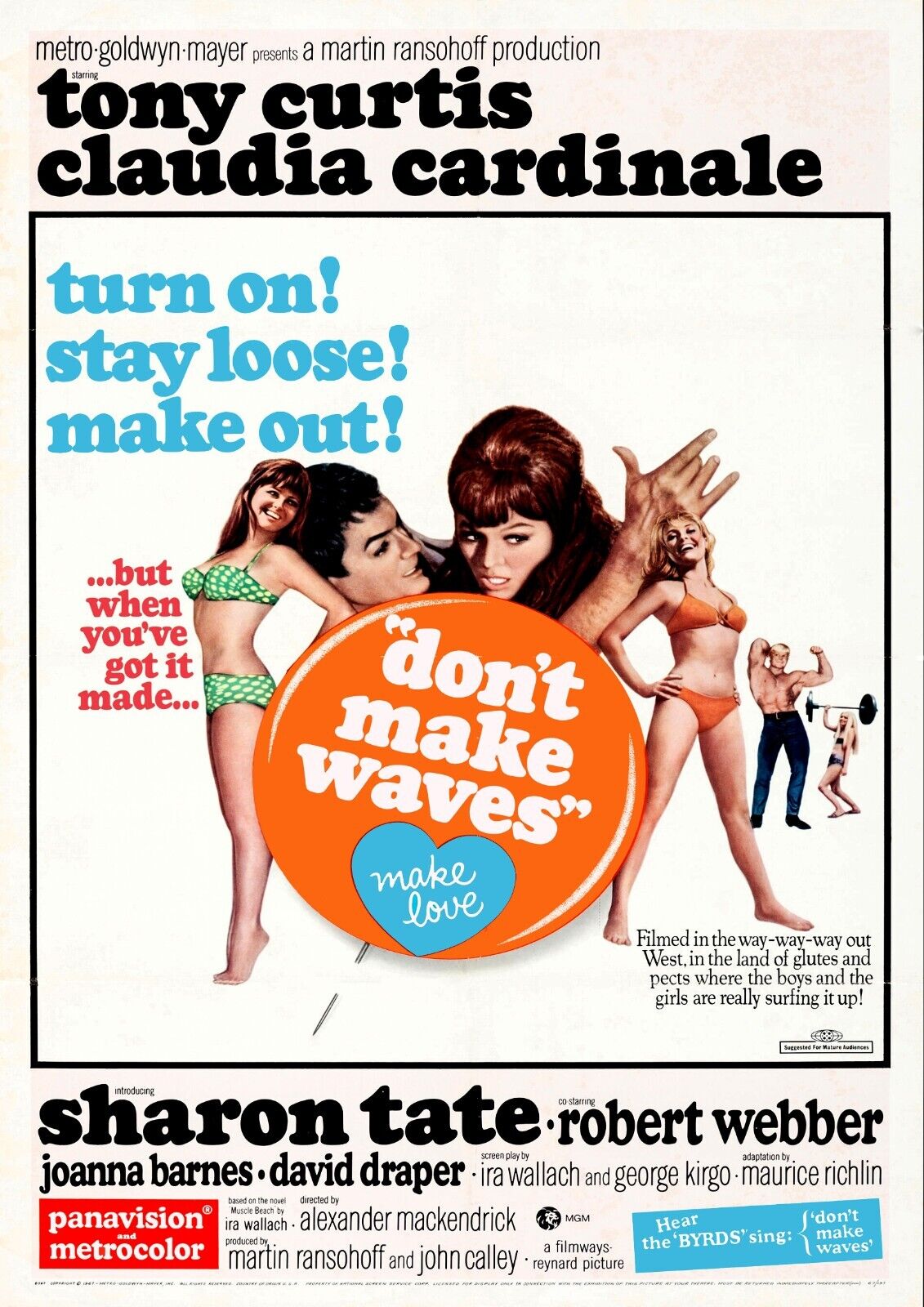
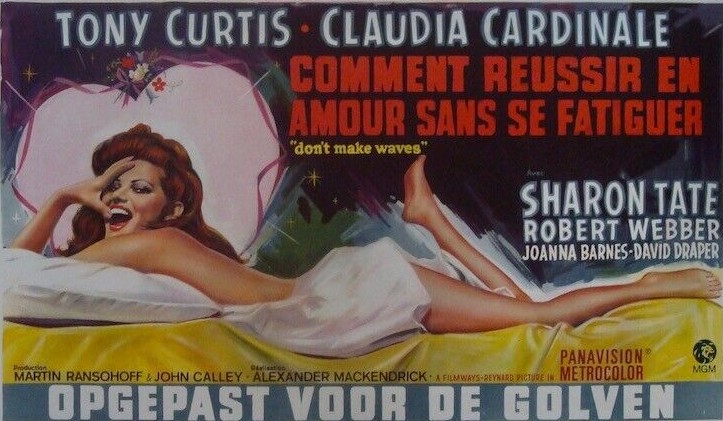
Unfairly maligned on release. Part throwback screwball comedy, part farce, part satire and in low-key fashion the first disaster movie. Oddly enough, that wild combination hits the mark. Tony Curtis makes amends for Boeing Boeing (1965). Claudia Cardinale on top form as a ditzy brunette. Last hurrah for Ealing Comedy grey eminence Alexander Mackendrick (A High Wind in Jamaica, 1965). Plus Sharon Tate as a sky-diver. What’s not to like?
Hardly surprising though at the time it got the thumbs-down from critics and the cold shoulder from audiences. A very late arrival to the short-lived beach movie cycle and unlikely to compete with the harder-edged satires like The Russians Are Coming, The Russians Are Coming (1966) and Divorce American Style (1967) or the latest off the Neil Simon conveyor belt Barefoot in the Park (1967).
Marvelous opening with sight gags galore sees vacationer Carlo (Tony Curtis) wrestling with a runaway car then seeing hapless wannabe artist Laura (Claudia Cardinale) accidentally setting fire to the vehicle. To make amends for destroying all his belongings, she invites him to stay the night. Unfortunately, her married lover Rod (Robert Webber) turns up, cueing a whole layer of farce, traditional bedroom-style here but later even better in the office, properly done this time compared to Boeing Boeing.
The next day Carlo is rescued from drowning by Malibu (Sharon Tate) with whom he promptly falls in love and attempts to separate her from her hulk of a boyfriend Harry (David Draper), all muscle but little brain and prone to easily-exploited bouts of depression.
Carlo is the smarter younger brother of the character in Boeing Boeing, managing to muscle in on Rod’s swimming pool business and demonstrating his sharp salesmanship skills. Except that Laura is so shrill and a kept woman, you’d expect him to be more interested in her than Malibu, but then where would be we be without a love triangle. In an odd sub-plot involving an astrologer (Ed Bergen), Carlo manages to win over Malibu. Meanwhile, Rod’s smarter wife Diane (Joanna Barnes) infiltrates her husband’s cosy love nest.
Although Carlo is effectively set up as somewhat shifty hero he undergoes a series of humiliations, brought down to earth by being repeatedly picked up and carried like a doll by Harry, and being drowned in mud. Other times he lives high on the hog, realizing he could make a killing here.
There’s no great plot, just the usual misunderstandings, but, unusually, characters are given moments of self-reflection and self-deprecation, and the satire focuses on the self-involvement of the beautiful people. There’s a fair bit of ogling but the camera is gender-equal, the toned bodies of the muscle men given as much attention as any passing female in a bikini.
I found myself chuckling all over the place, mostly at the antics of Carlo. This is a pretty good performance by Tony Curtis, mugging kept well under control but adept at physical comedy. And Claudia Cardinale (Once Upon a Time in the West, 1968) is equally game, drenched for a good chunk of time, and hit by sudden self-awareness as the tale unfolds. You might balk at her high-tempo performance but otherwise the set-up wouldn’t work. If she wasn’t so annoying why would Carlo look elsewhere for romance?
The disaster element involves a runaway clifftop house, a situation created by the unlucky Laura, and it doesn’t take much to see what elements The Poseidon Adventure filched, playing it for drama rather than comedy.
While not in the same category Mackendrick classics The Man in the White Suit (1951), The Ladykillers (1955) or even The Sweet Smell of Success (1957) – co-starring Curtis – this is not to so far off. Mackendrick excels at building the comedy, confidently marshals the farce, but, more importantly, doesn’t lose sight of the characters in the ensuing chaos.
Producer Marty Ransohoff tries to pull a fast one by slapping an “introducing” credit on Sharon Tate, conveniently ignoring her performance in the previous year’s Eye of the Devil (1966). She’s less iconic here – unless you imagine that with her bronzed face she’s a distant cousin of George Hamilton – but she’s far from the dizzy blonde, much more pragmatic, the one who switches electricity back on after the blackout, and with her own oddball ways. Trivia note: they modelled “Malibu Barbie” on Tate.
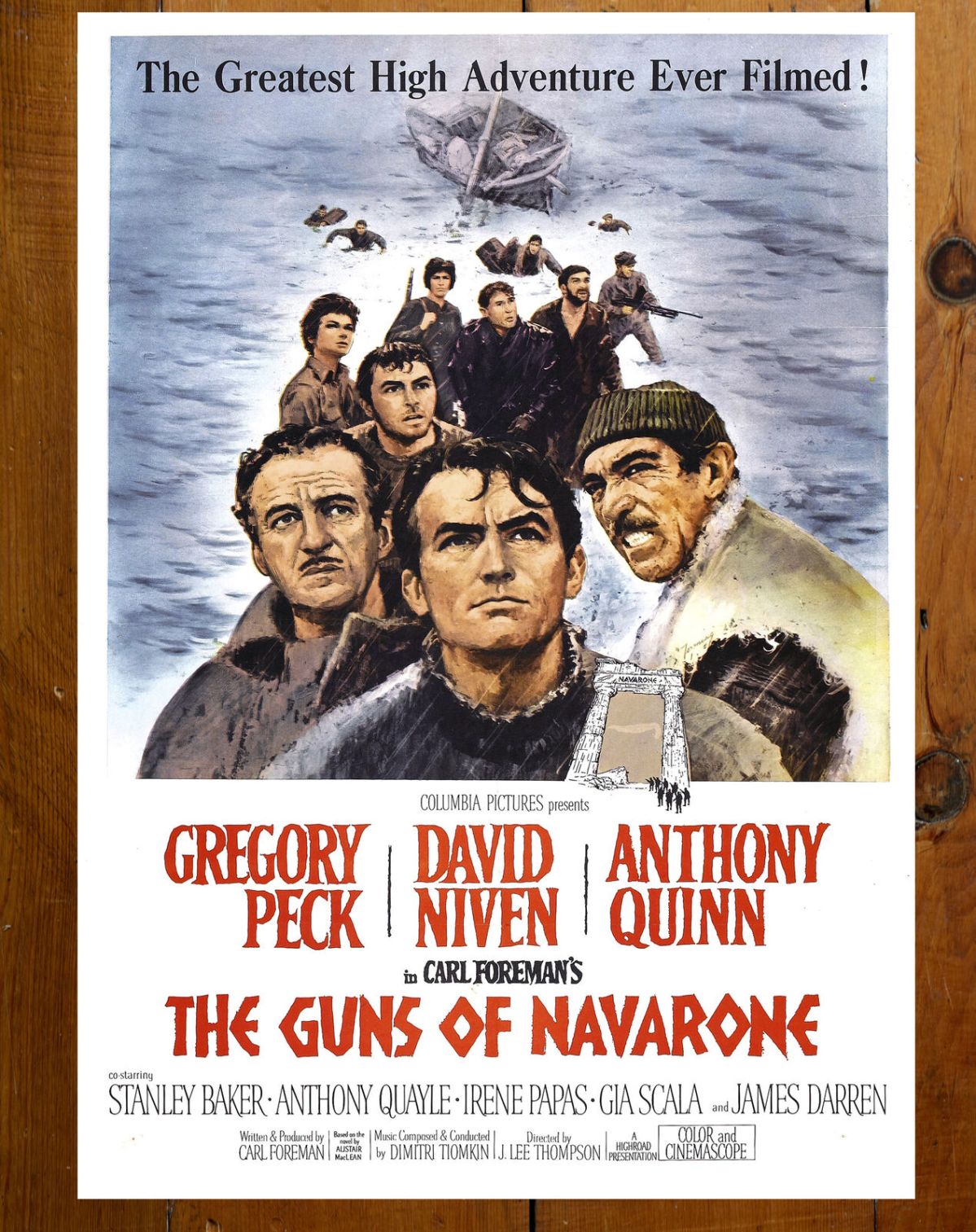
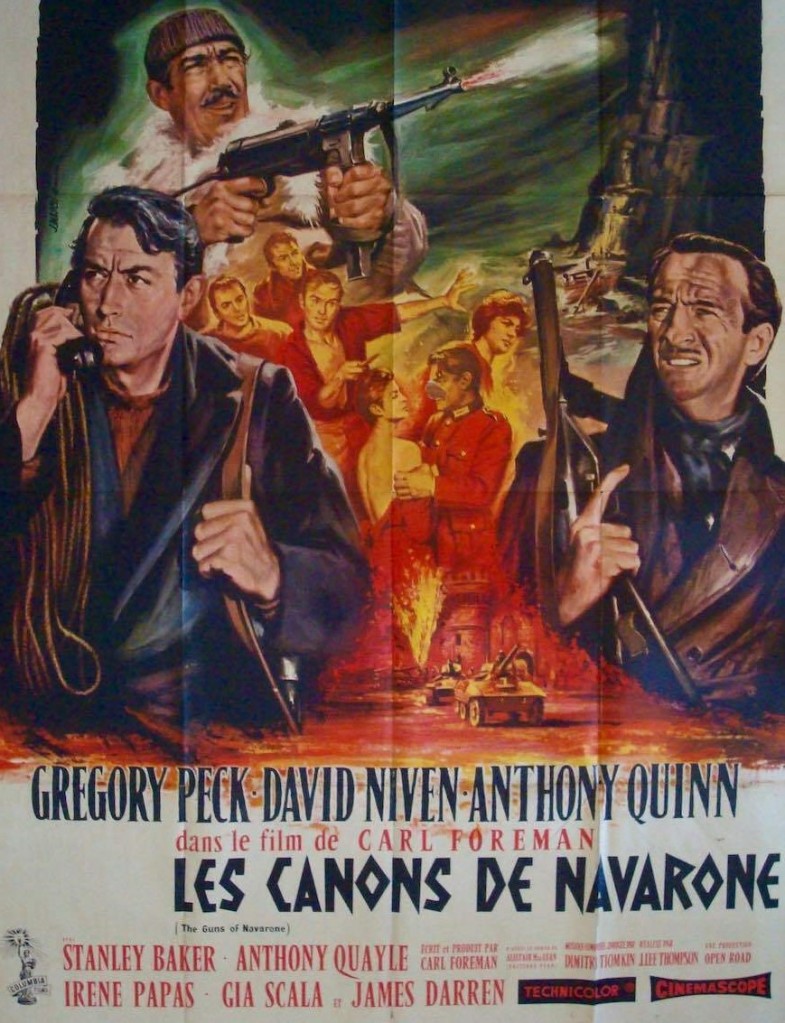
It’s time to celebrate the 60th anniversary of The Guns of Navarone – world premiere on April 27, 1961, in London and New York opening on June 22, 1961. Although the picture set a new benchmark in high-octane entertainment, a fast-moving war thriller packed with twists and a genuine all-star cast, it was far – very far – from the sure thing it appears in retrospect.
Box office smash in Britain.
For a start, U.S producer Carl Foreman, a victim of the McCarthy anti-communist witch-hunt of the early 1950s, was unable to assemble any of the talent he had set his heart on. He lost his preferred male cast of William Holden and Cary Grant and original scriptwriter Eric Ambler, the thriller writer famed for The Mask of Dimitrios and other novels.
He had a registered a major publicity coup by engineering the screen debut of opera diva Maria Callas, one of the most famous people in the world, but she also dropped out as did his other initial choice for leading lady. On top of that, once filming began he lost his director, Alexander Mackendrick, who had not only achieved a critical and commercial success with the British Ealing comedy The Ladykillers (1951) but also crossed the Atlantic to make the acclaimed The Sweet Smell of Success (1957) starring Burt Lancaster and Tony Curtis, to prove he could handle big Hollywood stars.
On top of that David Niven nearly lost his life during production and by the time the picture appeared Gregory Peck had suffered so many box office flops that he was a potential liability. And Foreman’s own marriage was in trouble.
Building the massive guns set.
It was a wonder it was made at all for Foreman was nobody’s idea of a sure thing. Although he had made his name as a screenwriter with three Oscar nominations for Champion (1949), The Men (1950) and High Noon (1952), his career was in ruins after being slung out of America for his supposed communist sympathies. He set up in London where he wrote screenplays under pseudonyms. But in 1956 won a four-picture production deal with Columbia at a time when that studio was investing heavily in making films in Britain to take advantage of the government’s Eady Levy (effectively, a tax rebate) and cheaper costs. But his first film, The Key (1958) with William Holden and Sophia Loren flopped in the U.S. Columbia persevered, seeing Foreman as the man to tackle its biggest-ever European production.
The Guns of Navarone almost fell at the first hurdle. Foreman’s first choice of location was Cyprus which was threatening to erupt into a civil war. At the last minute, he changed his mind and shifted production to Rhodes. Foreman, who also acted as screenwriter, made considerable changes to the book by British bestselling thriller writer Alistair Maclean, not least of which was introducing female characters to a story that had been resolutely all-male.
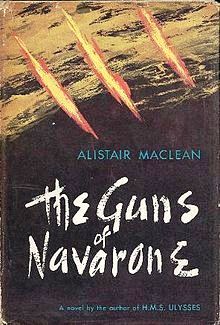
Original hardback book cover.
There was tension on set – four-time Oscar nominee Gregory Peck was annoyed at sharing the screen with two winners David Niven (Best Actor for Separate Tables, 1958) and Anthony Quinn (twice Best Supporting Actor for Viva Zapata, 1952, and Lust for Life, 1956). Replacement director J. Lee Thompson (Ice Cold in Alex, 1958) managed to sink a ship on loan from the Greek navy. The Actor’s Strike in Hollywood nearly forced the departure of the two younger stars.
The set for the titular guns was the largest ever built, costing £100,000, and even though that proved a design miracle, that, too, was not exempt from disaster, having to be rebuilt after a thunderstorm destroyed part of the set. The injury to David Niven was so severe he nearly died, putting the production in jeopardy. Even when the film approached completion there were other obstacles in the way, composer Dmitri Tiomkin (The Alamo, 1960), for example, demanding a record fee and Foreman locking horns with Columbia over his insistence on launching the picture as a roadshow, request which was ultimately denied, and one of the reasons for the film’ release delay,
I’ve written a book about The Making of The Guns of Navarone. Originally published in 2013, it has been revised with over 30 illustrations added for a new edition to tie in with the 60th anniversary – available both in print and Kindle versions. Needless to say, it would also make an ideal present for Father’s Day.
If you’re interested in this kind of book, you might like to know that I’ve also written The Making of The Magnificent Seven.
To celebrate the 60th anniversary of the opening of The Guns of Navarone I am offering a copy of my book “The Making of The Guns of Navarone.” This is a revised and enlarged edition – the first time with illustrations (over 30 of them) – of the original version which was published in 2013.
The Royal World Premiere of the film took place at the Odeon Leicester Square, London, on April 27, 1961. But it was not released in the U.S. until June, opening at the Criterion and Murray Hill cinemas in New York. At all three cinemas it broke the box office record.
All you have to do to enter is guess from all the films reviewed in the Blog in April which five proved the most popular (judged from the number of views).
Put the five you have chosen in ascending order.
Email your answers to me at bhkhannan@aol.com
The person who gets the most right in the proper order will be declared the winner.
The book will be posted free of charge anywhere in the world and, being the author, I can arrange for it to be signed. The closing date is Monday, May 17.






 The Magnificent 60s