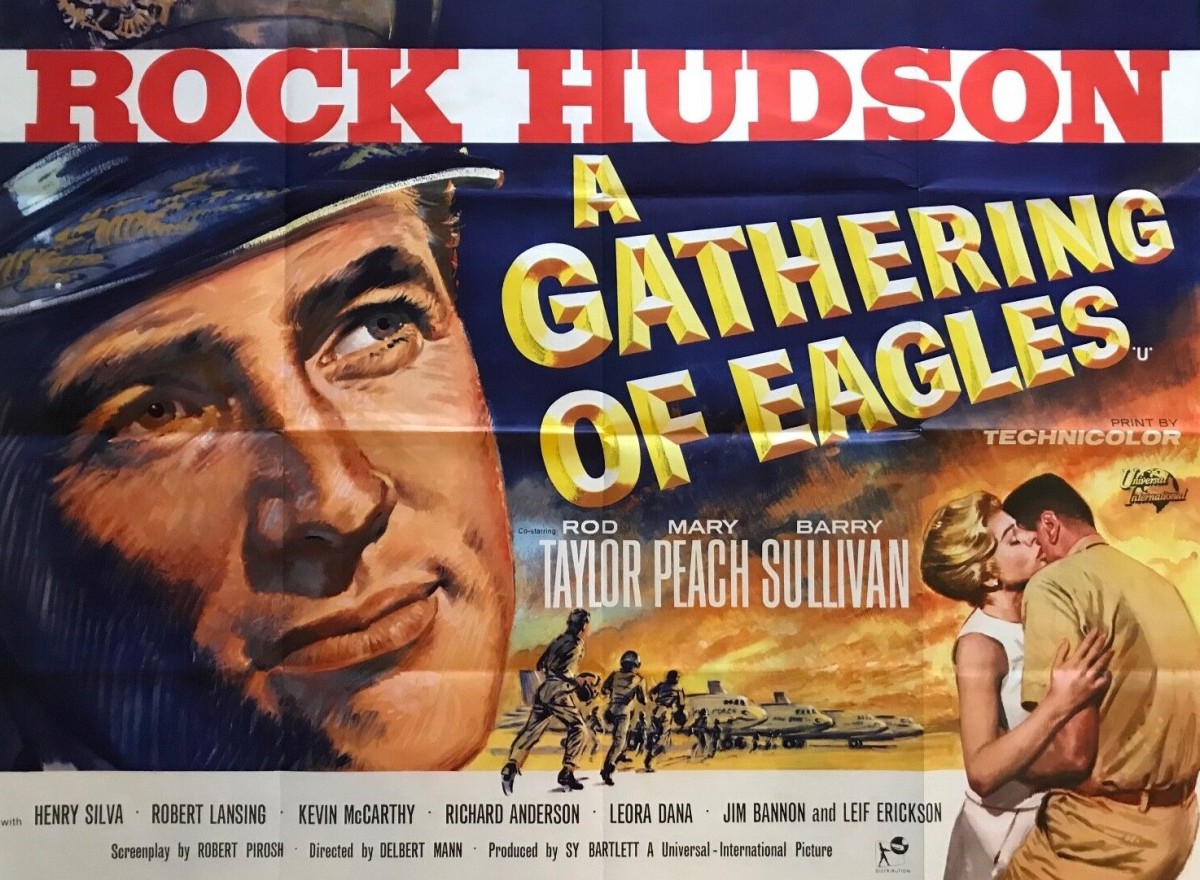
Machines get in the way of this tale of men under pressure. Often viewed as a PR exercise for the Strategic Air Command to counter complaints about competence, and signally out of tune with a Hollywood faction that was beginning to view investment in nuclear weapons as a serious mistake, as epitomized by Fail Safe (1964), Dr Strangelove (1964) and The Bedford Incident (1965).
Not helped by action being under the auspices of simulation and not genuine war, filmmakers lacking the later bravura that just invented a side event, Top Gun, 1986, for example, to give audiences something to root for. Nor by a warehouse of info dumps.

That said, once it comes to the usual turf wars besetting any element of the military, the tension ponies up and there’s a real film underneath. There’s a surprising contemporary element to the narrative, two actually, firstly the arguments over leadership, and, secondly, the impact of PTSD, the endless deadline-based simulations as tough as being at war.
Hard-line efficiency expert Col Caldwell (Rock Hudson) is parachuted into a front-line B-52 Cold War command to toughen up sloppy procedure, bringing him into conflict with second-in-command Col Farr (Rod Taylor), a Korean War buddy. Caldwell rules by the book, Farr allows his men greater leeway. It comes down to the question of whether morale should be an issue or if men are expected to do their utmost even if they hate their leader. This debate about leadership style is prevalent today.
Caldwell is so tough he will sacrifice his buddy to get the job done better. And if people can’t handle the pressure they are better off out of the firing line. But since asking for a transfer to a less arduous berth would be viewed as a shameful admission of weakness, the only option for those who can’t cope is suicide. But since attempted suicide would not, as today, be viewed as a cry for help, anyone such attempt reduces the airman,, such as Col Fowler (Barry Sullivan) to a hospital bed where pity rains down on him.

The pressure comes in the shape of not just keeping on top of everything should the Russians suddenly decide to launch a missile attack, but dealing with intense simulations which appear out of the blue and require everyone to spring into battle stations. And in another prescient element, everyone is analysed to within an inch of their lives, marked down for the tiniest deviation from protocol, or not reaching the correct flight level or going too fast or too slow.
Caldwell is further hampered by English wife Victoria (Mary Peach) who fails to understand the pressure under which her husband, and all men in the base, operate, the kind of ground crew whose first question, on recovering from an operation, will not concern wife and kids but an airplane or a mission.
To add emotional heft, she is meant to have potentially fallen for Farr, and although rumors reach Caldwell’s superiors there’s no evidence of that. In the original script, the affair is spelled out, and such material was filmed, but it disappeared in the editing room. Perhaps because it proved that emotion was the Achilles heel of even the most efficient operation. In the actual movie, Victoria denies an affair and we believe her, but if an audience was shown her – and Farr – to be lying that casts a different complexion and at some level suggests betrayal.
In the air, despite assistance from the Strategic Air Command, the hardware is now out-dated, so of historical interest only, and while the movie fails to capture the tenor of the times, the situation of men under pressure has not changed.
Rock Hudson (Tobruk, 1967) is intensity on fire, Rod Taylor (Chuka, 1967) more laidback than in later films. Mary Peach (No Love For Johnnie, 1961) doesn’t have much of a filter between adoration and fury. Look out for Henry Silva (The Manchurian Candidate, 1962), Barry Sullivan (Harlow, 1965) and Kevin McCarthy (Hotel, 1967).
As you might expect, director Delbert Mann (Buddwing / Mister Buddwing, 1966) is more at home on the ground than in the air. Responsible for the screenplay were Sy Bartlett (Che!, 1969), also the producer, who had covered similar ground in Twelve O’Clock High (1949), and Robert Pirosh (Hell Is for Heroes, 1962)
The Top Gun of its day, bettered remembered now for the debate on leadership.

 The Magnificent 60s