The Oblong Box (1969) ***

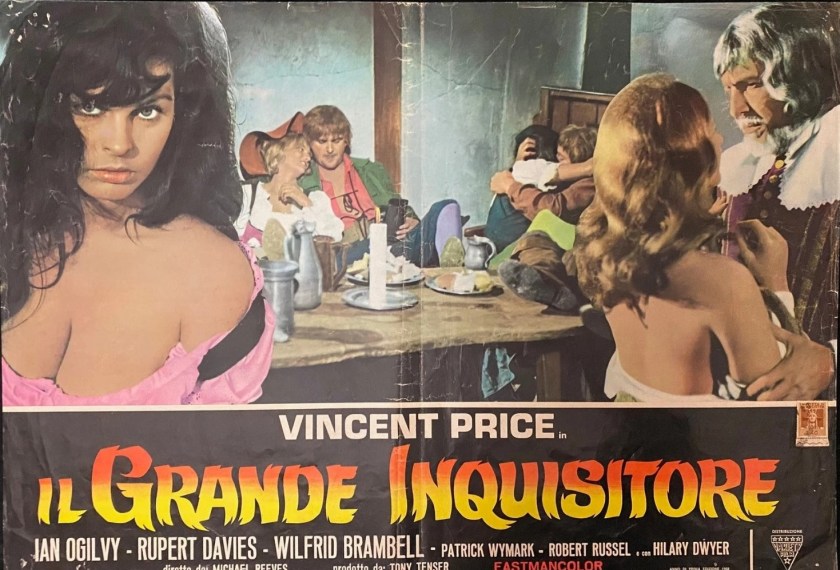
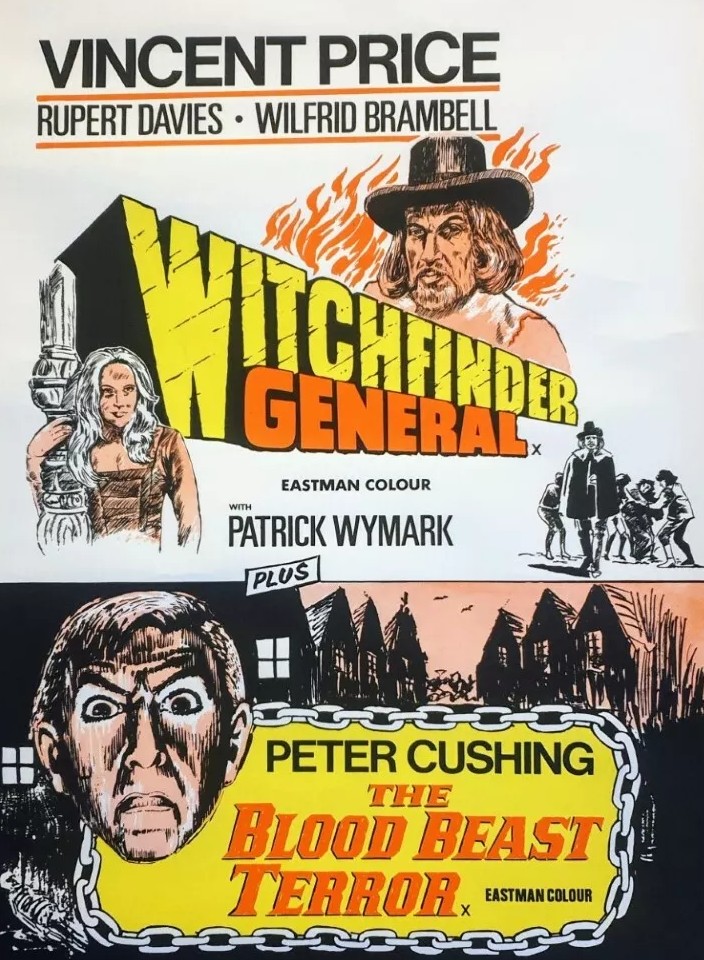
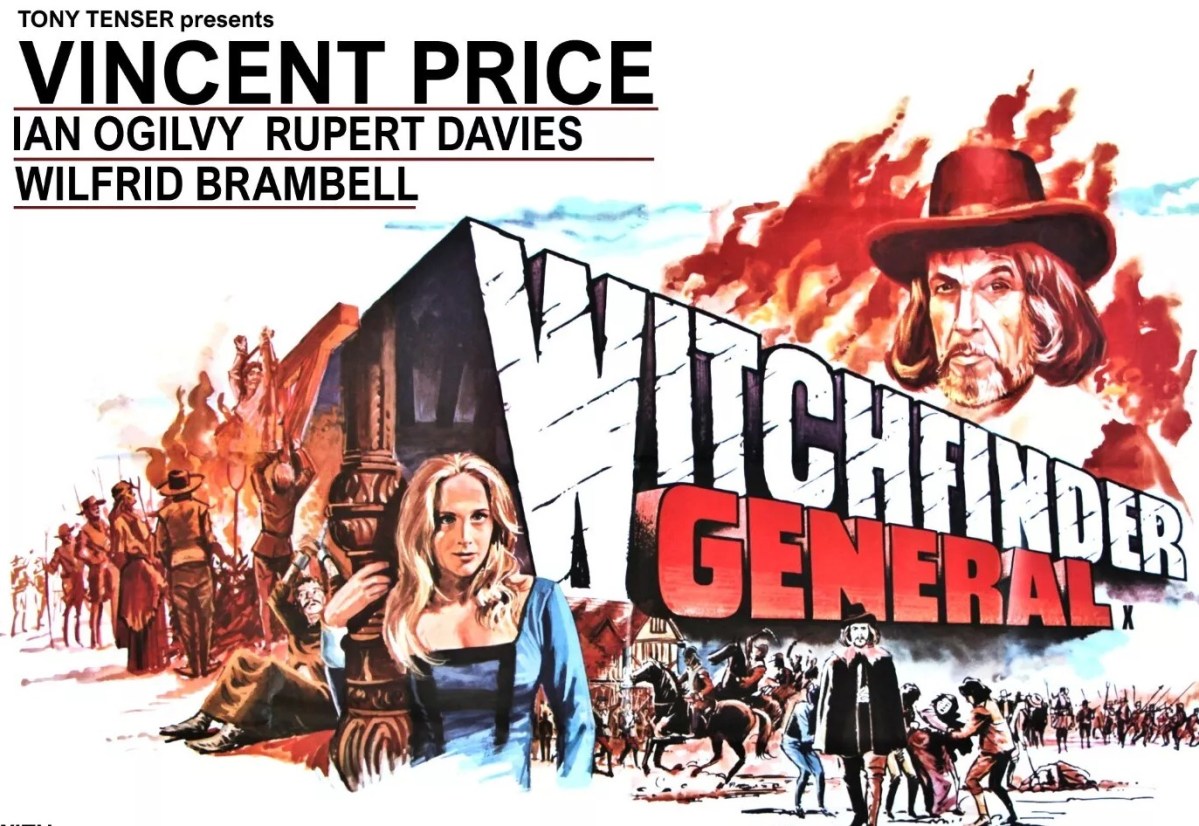
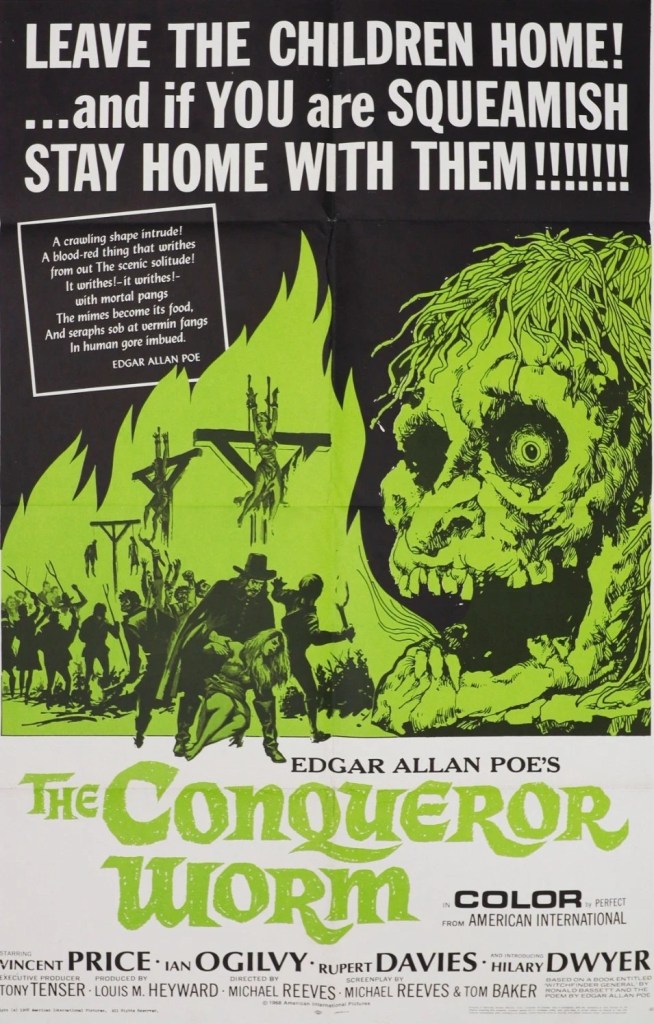
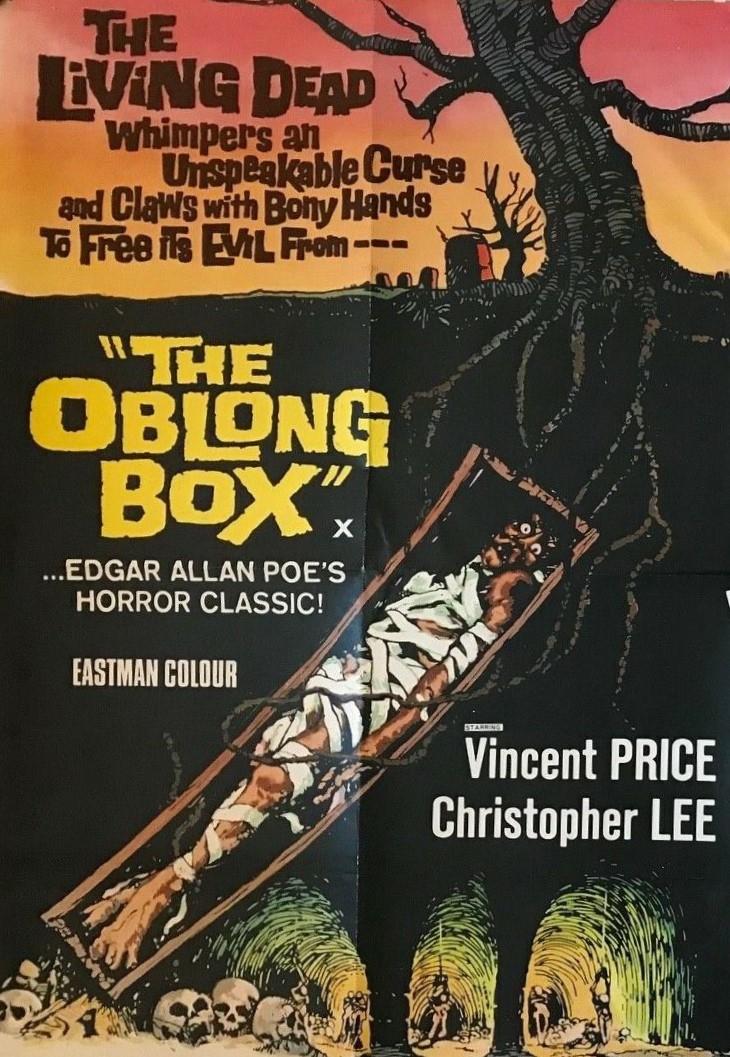
Vincent Price and Christopher Lee – two scions of 1960s horror – together, yet anyone expecting a clash of the giants would be sorely disappointed as they only share one short scene. This is a typical American International Pictures venture, based even more typically on an Edgar Allan Poe story, with some stylistic direction – the extreme close-up never more effectively utilized – from Gordon Hessler in his third feature.

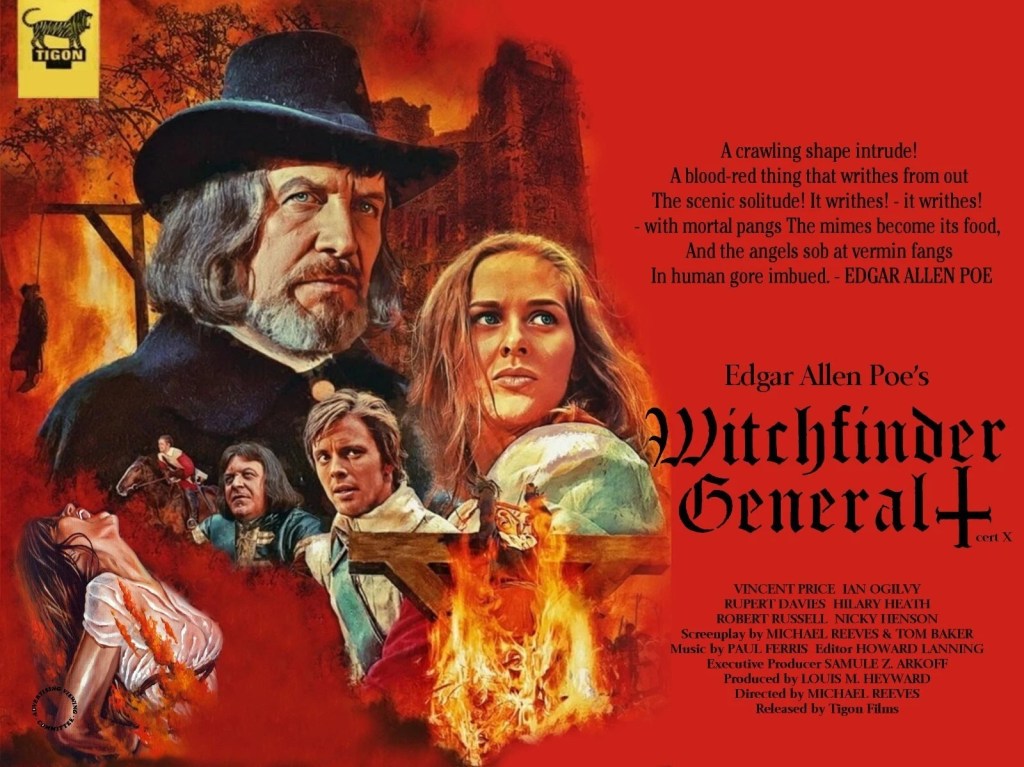
Given that German-born Hessler (Catacombs/The Woman Who Wouldn’t Die, 1965) was a last-minute substitute for English director Michael Reeves (Witchfinder General, 1968), he made an exceptionally good job of a complicated plot. The production was even more complicated than that since it was originally intended as a Spanish co-production to be shot in Spain. And at one point writer Lawrence Huntingdon (The Vulture, 1966), who did have form as a director (Death Drums Along the River, 1963), was reportedly also carrying out producer-director duties.

What seems like a mishmash of different stories – African sorcery, grave-robbing, disfigurement, forgery, blackmail, lifetime imprisonment, medical experiment, buried alive, a monster in a scarlet mask – soon comes together in a tense tale of retribution and revenge.

Nineteenth century English aristocrat Julain Markham (Vincent Price) has withdrawn to his country manor, for unknown reasons distancing himself from his fiancée Elizabeth (Hilary Dwyer), but in reality to conceal from the world the fact that he has locked up his own brother, Sir Edward (Alister Williamson). When the brother, a disfigured monster, escapes he embarks on a murder spree.

The various storylines keep the narrative sufficiently entangled to sustain tension. Despite what may appear to a modern audience as primitive special effects, several scenes are bone-chilling largely through directorial manipulation. The Gothic look – graveyards, castles, the village – adds to the atmosphere. The violence was trimmed in America to avoid an “R” rating, but led to the film being banned in Australia.

There is more overt sexuality than normal, a scheming whore Heidi (Uta Levka) tempting a man with her bare breasts, and maid Sally (Sally Geeson) entranced by the monster.

The various plot strands appeared to confuse critics at the time and even now the film receives comments that it is “vague” but at a time when Hammer’s output usually comprised a straightforward – and somewhat limited narrative – I found AIP’s approach to this picture a welcome development. The slowly emerging story set the film up as much as a thriller as a horror.

It’s a bit of a reversal for Vincent Price (Witchfinder General, 1968) to be playing the good guy but that works to the movie’s advantage because you spent most of the time thinking this is just a scam and at some point he will show his true colors. Hilary Dwyer (Witchfinder General) is excellent and Sally Geeson (What’s Good for the Goose, 1969) is an example of the type of woman attracted to rather than revulsed by a killer.

Well worth a look if only to enjoy the distinctive Hessler style.

Behind the Scenes: “A Swingin’ Summer” (1965)

Might be a stretch to imagine A Swingin’ Summer has anything of note to add to the momentous cinematic history of the decade except for it falling into a booming phenomenon – the actor-producer. John Wayne (The Alamo, 1960), Paul Newman (Rachel, Rachel, 1968), Jack Lemmon (Cool Hand Luke, 1967) and Kirk Douglas (Lonely Are the Brave, 1962) led the way in actors taking complete control of their careers and putting together the movies they wanted to make rather than pitching up as hired hands.

Dale Robertson was an unexpected entrant into the hyphenate business, never having achieved the marquee clout of others, best known for string of B-westerns and the television series Tales of Wells Fargo (1957-1962). Television could be lucrative, especially if you were the star of a long-running show, but the longer you worked on the small screen the more you jeopardised the continuation of a big screen career. Law of the Lawless (1964) was his first movie for six years.

Advert in “Variety” heralding the arrival of Dale Robertson’s new business.

But Dale took an unusual approach to the production business, planning even more control than his predecessors, by setting up a distribution company, United Screen Arts (“USA” a useful acronym”). He had a simple credo, the “clean family film” seen as niche market worth exploiting at a time when only Disney paid it any continuous attention and when Hollywood stood accused of eroding family values with salacious product.

He had teamed up with Earl Collins, intending to release a dozen pictures a year, claiming their operation would be “the salvation of the independent producer.” On top of that, they spent $200,000 acquiring for U.S. television syndication rights to 39 foreign films starring the likes of Elke Sommer and Bebe Loncar.  There was talk of The Redeemer, a low-budget rival to The Greatest Story Ever Told, of handling British film The Quare Fellow and Tom Laughlin’s debut The Young Sinner which had been languishing in distribution limbo for four years.

But the company’s first move was, as trumpeted, into the family market, straight into the lion’s den with The Man from Button Willow (1965), an animated feature, Robertson lending his voice to the main character. And while the family market could offer substantial returns as Mary Poppins (1964) had proved, there was an even more attractive subgenre awaiting exploitation: the teen market.

Your face looks familiar – Dale Robertson with “billboard girl” Raquel Welch in tv show “Hollywood Palace.”

It was estimated that U.S. teenagers had $11 billion in pocket money to spend on records, clothes and movies. Teenagers assumed to have outgrown the Disney animated features were too young to be permitted entrance to more racy fare. But the Britpop explosion, headlined by The Beatles, had emphasised this market’s buying power.

From just a handful of pictures targeting the older young, there were now close on 20 features heading its way, split almost evenly between beach movies and those featuring pop stars – The Dave Clark Five, The Mersey Beats among other British exports along with Elvis Presley – or movies with little attempt at narrative, no more than a “filmed variety show with little variety.”

These movies exhibited acceptable anomalies, one of which was that the pop stars playing the lead roles retained their own first names in order “to speed up and simplify teener identification with their roles.” Remove parents and the threat of a morals clause, and it was a fresh approach to sexuality, and with nudity never an option well within the Production Code definitions of harmless fun.

AIP had successfully segued from its Edgar Allan Poe line of horror movies to beach pictures. Beach Party (1963), with over 10,000 bookings so far, had kick-started the mini-genre, and another half-dozen AIP offerings had entered the movie food chain. Along the way it made stars of Frankie Avalon and Annette Funicello who acted as a junior version of Doris Day and Rock Hudson, bedroom shenanigans reimagined as more innocent beach shenanigans, and instead of being dressed to kill the main characters were as undressed as much as possible, bikinis and shorts the order of the day.

Dale Robertson set out to tap into this market, A Swinging Summer “custom-tailored for the vast teenage audience.” USA lacked the $500,000-$700,000 budget of AIP which permitted the presence of older stars like Dorothy Malone, Vincent Price and Peter Lorre. USA’s aim was, effectively, a C-picture with sunshine and music. Record companies were happy for screen exposure for their artists, so guest spots, which might otherwise have stopped the narrative dead in its tracks, turned into highlights.

With a no-name cast – Robertson knew Raquel Welch from television variety show Hollywood Palace – and a simple location at Lake Arrowhead in California, the movie was quickly filmed in summer 1964 but held back a year. USA managed tie-ups with Suzuki and Yamaha motorbikes, the former promising a free ride to anyone brandishing a ticket stub, and with record company Moonglow, which offered prizes of the latest album by The Righteous Brothers. A press conference and screening was held for 300 high school newspaper editors and Robertson managed to put together a nationwide tour with some of the participants, although its biggest piece of publicity came from a woman who got her finger stuck in the spoke of a steering wheel during a drive-in screening in Milwaukee.

A few years before or a few years after, A Swingin’ Summer would have been support material, speedily in and out of theaters. But riding a short-lived zeitgeist and taking advantage of the unexpected rise in popularity of Raquel Welch it did much better.

There was a saturation release in 71 houses in North Carolina, “impressive grosses” at the Pacific Drive-In circuit, topped by a record-breaking opening in the Crest Theater in Bakersfield, a good $7,500 at the Twin Drive-In in Cincinnati, a very healthy $28,000 in a New Orleans break, and $26,500 from five cinemas in Kansas City. First-run proved hard to come by but it still snapped up $7,500 at the 2,432-seat Fox in Denver. Supporting features included Major Dundee and Wild in the Country.

There were sightings through 1967, no doubt on account of Raquel Welch’s growing popularity. And if it wasn’t a shoo-in for big city center palaces, it found a hearty welcome in smaller operations in small towns. “The best beach picture ever played,” was the opinion of the Fayette Theater in Fayetteville while at the New Theater in Arkansas it was considered “one of the smaller pictures” that outgrossed bigger-budgeted efforts.

But this was a short-lived phenomenon, and within a few years a beach picture would be a rawer affair like The Sweet Ride (1968) and music would have segued from pop into drugs and rock’n’roll.

Dale Robertson’s foray into production was equally short-lived, moving back into television and developing a night club act. The beach genre generated not one long-term talent outside of Raquel Welch.

SOURCES: “Swingin’ Summer Release To United Screen Arts,” Box Office, February 22, 1965, p10; “Advert,” Variety, February 24, 1965, p21; “Teenagers And Their Pocket Money, A Film Market Unto Themselves,” Variety, March 10, 1965, p4; “Kansas City,” Box Office, May 31, 1965, pC4; “Dale Robertson’s Distribution Credo,” Variety, June 16, 1965, p11; “A Swingin’ Film,” Box Office, June 27, 1965, pNC2; “USA’s Summer Starts Strong in Bakersfield,” Box Office, June 27, 1965, pW5; “Swingin’ Summer Set for Pacific Drive-ins,” Box Office, August 9, 1965, pW5;  “Honolulu,” Box Office, September 13, 1965, pW4; “USA’s Swingin’ Summer Opens in 71 NC Dates,” Box Office, September 20, 1965, pSE4; “USA Sets Record Tie-Up for Swingin’ Summer,” Box Office, September 20, 1965, pB1; “USA, KFWB Host Schools To Promote Summer,” Box Office, November 1, 1965, pA3; “The Exhibitor Has His Say,” Box Office, October 24, 1965, pB4; “The Exhibitor Has His Say,” Box Office, September 11, 1967, pA4. Variety box office figures: June 9, 1965, p9; August 4, 1965, p9; September 22, 1965, p9.

War-Gods of the Deep / City Under the Sea (1965) ***

Hollywood careers rarely end in a blaze of cinematic glory. Sudden death ensured Clark Gable and Marilyn Monroe (The Misfits, 1961) and Spencer Tracy (Guess Who’s Coming to Dinner, 1967) went out with a bang but more likely a  career is just going to tail off and end with this kind of whimper. Director Jacques Tourneur, in any case, was long past a heyday that saw him set the horror genre agog with Cat People (1942), I Walked with a Zombie (1943) and The Leopard Man (1943).

If that wasn’t enough to solidify his credentials he dipped into another genre, the nascent film noir, and helmed gems like Experiment Perilous (1944) with Hedy Lamarr and Out of the Past (1947) with Robert Mitchum. Thereafter came swashbucklers The Flame and the Arrow (1950) headlining Burt Lancaster and Anne of the Indies (1951) plus crime drama Appointment in Honduras (1953) with the ever-dependable Glenn Ford and Joel McCrea western Wichita (1955). Then, miraculously, it was back to horror with Night of the Demon (1957) and the late flurry of The Comedy of Terrors (1963).

You can tell where I’m going with all this. War-Gods of the Deep has nothing on any of these pictures. The backstory is much more interesting than the actual film.

Basically, this is one of those pictures where an unlikely pair, American Ben Harris (Tab Harris) and eccentric Brit Harold Tufnell-Jones (David Tomlinson) get themselves into an unlikely situation and have to get themselves out of it.

Set in the smugglers’ paradise of the British Cornish coast around the turn of the last century, on a hotel on top of a cliff, the duo need to track down another American, Jill (Susan Hart), who has disappeared down a plughole, sorry mini-whirlpool. This leads to a legendary underwater city where smugglers led by Sir Hugh (Vincent Price) have found the secret of eternal life, a paradise now endangered by tremors from a nearby volcano.

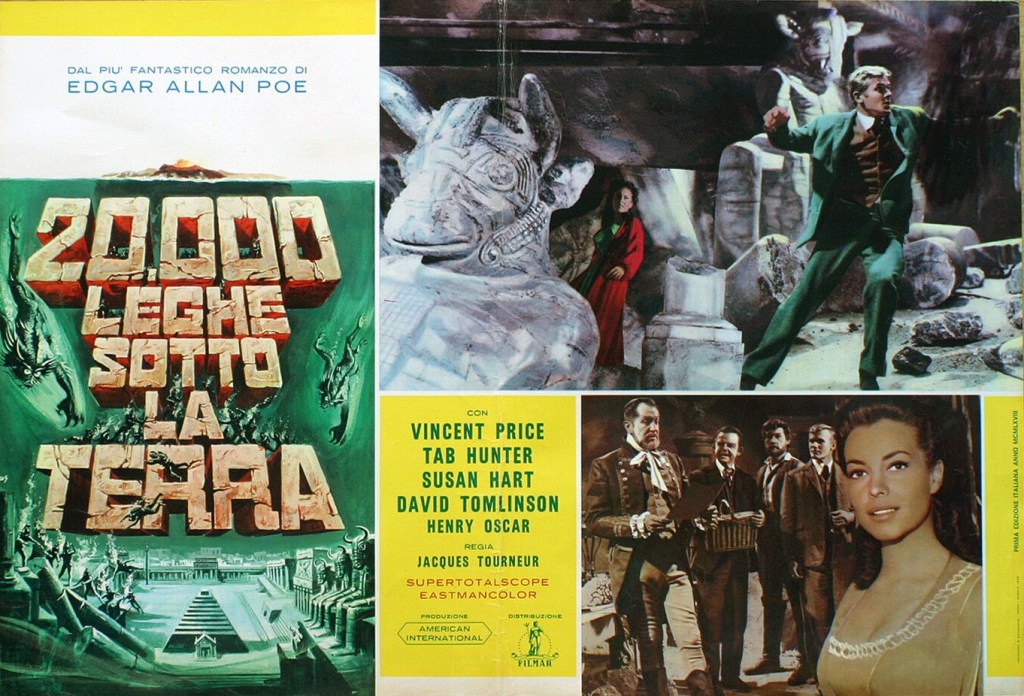
The Italians didn’t fancy the two titles on offer so came up with their own
by purloining the Jules Verne classic.

He sent his enslaved Gill-Men to kidnap Jill in the erroneous belief that she is his dead wife. Bored out of their minds with listening to Sir Hugh prattling on endlessly about how the underwater city came into being and how important he is to the whole affair and what imminent dangers the inhabitants now face, and of course faced with their own imminent demise as sacrificial victims, the pair decide to scoot, having found a willing accomplice.

There’s a chase and whatever, and some undersea adventure, but there’s not much to it.

However, what you do get when you add someone like Tourneur – and to that extent Vincent Price and his ominous tones – to this listless mix is atmosphere. Tourneur can inject eeriness almost just by switching on a camera, despite a very stage-bound picture, and he knows how to add a music score that tremendously aids his enterprise. The opening section by the shore and in the hotel adds the necessary element of mystery to make the whole idea float.

There clearly wasn’t enough of a budget for the Gill-Men to appear as anything but peripheral figures which actually might have helped since, the state of special effects in that time might have made them laughable rather than distantly disturbing.

The best you can say is that Tourneur made the best of a bad job. Vincent Price (Diary of a Madman, 1963) only has to turn up to inject an element of danger. Tab Hunter (Ride the Wild Surf, 1963) and Susan Hart (Dr Goldfoot and the Bikini Machine, 1965) needn’t have bothered turning up for all they bring to the party. And David Tomlinson (Bedknobs and Broomsticks, 1971)  brings far too much, saddled with a pet comic chicken for no apparent reason except to extract a few laughs.

AIP, having made its name in the horror department by raiding the portfolio of Edgar Allan Poe, turned up this source material deep in that vault. But the only connection to Poe is the original idea –  which was not that original, other poets having plumbed those depths prior –  and that appears only in occasional desultory recitations of the poem. But, as a marketing tool, hey, Edgar Allan Poe, that’ll scare their socks off!

So, you are warned, but also you can’t help but warm to this final movie by one of the Hollywood greats as he tries to put a sheen on something that in other hands would have sunk like a stone.

Behind the Scenes: Genghis Khan (1965)

Genghis Khan began life in the early 1960s as the main plank of a reboot for American International, the low-budget production company best known for churning out B-features in the horror, motorcycle and generally exploitation vein.

Greenlit in 1962 with a $4.5 million budget it was intended to be a Xmas 1963 release. American International planned to partner with British company Anglo-Amalgamated. As late as 1964 it was still seen as a launchpad for the mini-major’s leap into the bigger leagues with a starring role for company protégé Susan Hart (Ride the Wild Surf, 1964) but when production stumbled it was picked up by independent American producer Irving Allen who used Britain as a production base.

Allen had set up Warwick Films in conjunction with Albert Broccoli making films like Hell Below Zero (1954) with Alan Ladd and Fire Down Below (1957) with Rita Hayworth and Robert Mitchum. When Broccoli moved into the James Bond business, Allen ventured out on his own with Viking adventure The Long Ships (1964) starring Richard Widmark and Sidney Poitier. Although European co-productions had been all the rage for some time, this was an unusual venture in that a large chunk of the funding came from Yugoslavian operation Avala.

For Genghis Khan, Allen drew on Avala again, plus $1.5 million from German company CCC and $2.5 million from Columbia Pictures. Avala was a mainstream coproduction outfit with a couple of dozen projects in the works including The Fabulous Adventures of Marco Polo with Horst Buchholz and Omar Sharif, western Buffalo Bill – Hero of the West with Gordon Scott and Uncle Tom’s Cabin headlining Herbert Lom after James Mason pulled out. The final budget topped out at $5 million, small potatoes for an ambitious historical epic, less than half the sums allocated  El Cid (1961) or Spartacus (1961) for example.

Yul  Brynner had been approached for the leading role but his $400,000 fee ruled him out given the total spend on the principals was around that sum. Reportedly, Stephen Boyd earned $250,000, but Sharif was on a pittance. Exteriors were shot in Yugoslavia and interiors in Berlin. It was made in Panavision on the 2.35:1 widescreen format and although lensed with 35mm cameras was blown up to 70mm for roadshow release in Germany and Australia. The world premiere was scheduled, unusually, for Germany, for the new Royal Palast in Berlin but when that was not ready in time shifted to  the Cinerama Grindel cinema in Hamburg at the end of April, 1965.

It opened in simultaneous roadshow in Berlin, Dusseldorf, Munich and Stuttgart. It proved a strong draw in Germany, pulling in $1 million in rentals, a quarter of the total European business, and one-sixth of the global total. After a dual premiere in Dallas and Houston in June, it rolled out in general release in America.

There was some controversial publicity after Playboy magazine ran a photographic spread of Telly Savalas in a bath with some topless women, a scene edited out of the picture. A couple of five-minute featurettes – Instant People focusing on actors being made up for their roles and The Director Is a General featuring Henry Levin marshalling the battle scenes – went out on local television.

It opened in Los Angeles the same week as newcomers What’s New, Pussycat, roadshow The Great Race, war picture Operation Crossbow and comedy The Art of Love starring James Garner. Response was muted, and total rentals hardly exceeded $2.25 million, leaving it in 60th position in the annual U.S. box office race. The extent of Columbia’s disappointment could be measured by the speed with which it was sold to television, appearing on CBS the year after launch.  

Sources: “Genghis Khan Invasion of Big Budget Market by American International,” Variety, Jul 18, 1962, 4; “American Int’n’l Setting 3-Film Deal with Anglo-Amalg.,” Variety, Aug 1, 1962, 13; “10 Years Ago Nicholson and Arkoff…,” Variety, Jul 22, 1964, 7; “American International’s Susan Hart, Bobbi Shaw First on Exclusive,” Variety, Aug 5, 1964, 24; “Genghis at $4,250,000 a New German High,” Variety, Oct 14, 1964, 3; “Upcoming Product of American Int’n’l,” Variety, Oct 14, 1964, 6; “World Preem for Khan in Berlin,” Variety, Apr 28, 1965, 24; “Khan May Launch New Berlin House,” Variety, May 17, 1965, 31; “Yugoslavia’s Stake in Yank Films, Avala Owns 51% of Genghis Khan,” Variety, Jun 16, 1965,3 ; “Playboy: Code’s Last Stand,” Variety, Oct 27, 1965, 7; “Big Rental Pictures of 1965,” Variety, Jan 5, 1966, 6.

Discover WordPress

A daily selection of the best content published on WordPress, collected for you by humans who love to read.

The Atavist Magazine

by Brian Hannan

WordPress.com News

The latest news on WordPress.com and the WordPress community.