Ten Little Indians (1965) ***

This is more like it. Classic Agatha Christie mystery told in classic fashion but devoid of either of her major sleuths, Hercule Poirot or Miss Marple, and set in the grander equivalent of the country house locale that had become something of a trademark. Here it’s the kind of castle perched atop a mountain, accessible only by cable car unless you have mountaineering skills, that you would need the combined services of Clint Eastwood and Richard Burton to affect a rescue, and as with Where Eagles Dare (1968) the conditions are distinctly wintry.

Ten strangers, including the two servants, have been invited to this retreat by the mysterious Mr Owen. They soon learn they are cut off, telephone lines down, cable car out of commission for a couple of days, nearest village a straight drop 15 miles down a perilous cliff.

All they have in common, as they discover via a taped message delivered by their host, is that they all got away with murder or at the very least a dubious death. There is a private eye on hand, former cop Blore (Stanley Holloway), but he’s lacking in the little grey cells that Poirot put to such clever use in such circumstances. So, like a troupe of actors let down by some stage entrepreneur, they have to get the show on the road themselves, a combined effort to solve the problem.

Not so much why they are gathered here, but why they keep on getting bumped off, and rather in the fashion of the titular song. The movie business wasn’t awash with serial killers though this decade would see nascent interest in this sub-genre, witness Psycho (1960) and The Boston Strangler (1968). But Ms Christie mysteries never really seemed to get going until the death toll had reached multiple figures.

The good element of this kind of movie with a large cast is that each character gets a moment in the sun, here that spotlight largely concerned with what crime they committed for which they were never truly punished. Pop singer Mike (played by pop singer Fabian) gets the ball rolling, explaining that his only punishment for killing someone while driving under the influence was a temporary withdrawal of his license.

And so it goes on, everyone wondering who will be next to be despatched and going from the initial conclusion that Owen is responsible and is hidden somewhere in the house to the obvious one that Owen is one of them. I have to confess I’m easily gulled by the murder mystery and I hadn’t reached that conclusion myself.

The movie’s not necessarily filled with that kind of twist – although there certainly are a good few, some people not as guilty as they might appear, not quite who they appear to be –  more you glancing at the cast list and wondering, by dint of billing or box office pull, who will be next for the chop and unless the director has got the Hitchcock vibe it’s not going to be one of the leads.

So it’s a choice of Hugh Lombard (Hugh O’Brian), secretary Ann Clyde (Shirley Eaton), actress Ilona Bergen (Daliah Lavi), General Mandrake (Leo Genn), Judge Cannon (Wilfrid Hyde White), Dr Armstrong (Dennis Price) and the aforementioned Blore plus servants the Grohmanns (Marianne Hoppe and Mario Adorf). And this isn’t your standard serial killer either with a constant modus operandi that will eventually, through standard detection, trap him or her. Instead, variety is the key. Death by fatal injection, knife, poison, slashed rope.

As the numbers whittle down, and you even feel sorry for the actions of some, the actress, for example, whose husband committed suicide when she left him, the tension mounts. You won’t be on the edge of your seat because there are just too many characters involved for you to become overly concerned with their plight but it’s still has you on the hook. You do want to know whodunit and why and you can be sure Ms Christie, as was her wont, will have some clever final twist.

At least, unlike the later variations on the genre, nobody’s been bumped off because they are too fond of sex, and the violence itself is restrained, almost dignified, and there’s no sign of gender favoritism.

All in all, entertaining stuff, though since by now this kind of murder mystery, given we’ve been through various iterations of Poirot – Albert Finney, Peter Ustinov, Kenneth Branagh et al, not to mention numerous Miss Marples – a lot of this feels like cliché (though that’s a bit like a contemporary audience considering John Ford’s Stagecoach old hat, not realizing this was where many of those western tropes were invented or polished to a high level). And I had to say I had a sneaky hankering for some of the out of left field goings-on of The Alphabet Murders (1965).

Sad to see Hollywood not taking advantage of Daliah Lavi’s acting skills, under-estimated in my opinion after her terrific work in The Demon (1963) and The Whip and the Body (1963). But then this wasn’t Hollywood calling but our old friend producer Harry Alan Towers (Five Golden Dragons, 1967) who specialized in dropping a biggish American name into a B-list all-star-cast.

George Pollock, who helmed this decade’s four Miss Marple movies, enjoys keeping the mystery alive without resorting to a central know-it-all. Everyone cast does what they’re expected to do. Towers wrote the screenplay with his usual partner Peter Yeldham.

Worth considering alongside The Alphabet Murders, but stands up well on its own.  

PREVIOUSLY REVIEWED IN THE BLOG: Hugh O’Brian in In Harm’s Way (1965), Texas: Africa Style (1967); Daliah Lavi in The Demon (1963), The Whip and the Body (1964), Lord Jim (1965), The High Commissioner (1968), Some Girls Do (1969).

The Alphabet Murders (1965) ***

Just about the barmiest idea ever. Just about works. Tony Randall (Bang! Bang! You’re Dead / Our Man in Marrakesh, 1966), a cross between David Niven’s younger brother and a distant relation of Inspector Clouseau, would be nobody’s notion of a perfect Hercule Poirot. But back in the day, Agatha Christie’s famed detective was not a hallowed concept.  

In fact, in movie terms he was pretty much a nobody, not a single big screen appearance in three decades, the forgotten man of cinema sleuths, not a patch on Sherlock Holmes or Maigret who had enjoyed umpteen iterations. So that character, if you like, was there for the taking, up for grabs, not one so sacrosanct it was imprinted on audience minds.

You could do what you liked as long as he had a moustache, spoke with an exaggerated foreign accent and every now and then pointed to his head and mumbled something about little grey cells.

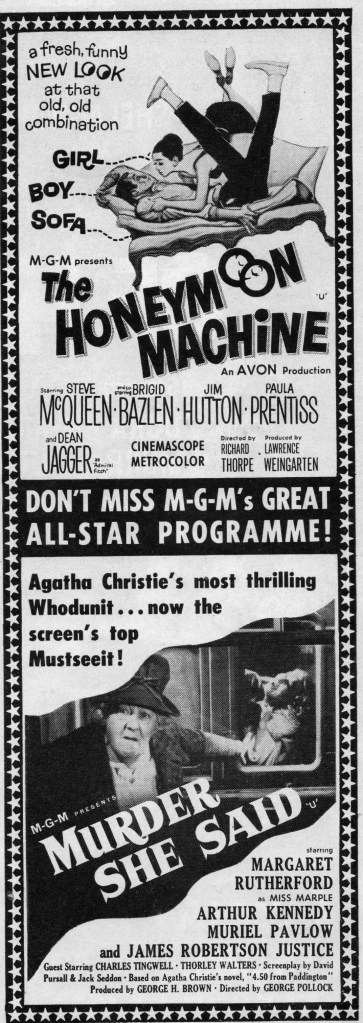
MGM had had some fun and box office success with Christie’s other famous criminal creation Miss Marple in a quartet of low-budget pictures in the light comedy vein starring Margaret Rutherford beginning with Murder, She Said (1961) and clearly believed the same recipe would work wonders with a character generally considered too stiff to work at all.

This is a chucklesome broth, some astute detective work mixed up with all sorts of sight gags. Frank Tashlin (The Glass Bottom Boat, 1966) is at the helm and the writing team of Jack Seddon and David Pursall who reimagined Miss Marple adapt the mystery.

It kicks off with the very contemporary trope of talking to the camera as real-life actor Tony Randall walks off an MGM set and transforms himself into Poirot. Hastings (Robert Morley), who in the novels is more an amiable companion, a kind of Dr Watson, is here portrayed as somebody high up in the British Secret Service trying to whisk Poirot out of the country. Mostly, he acts as a comedy foil.

After being attacked by a beautiful masseuse, Poirot finds himself on the trail of a serial killer who conveniently leaves an ABC London Guide at the scene of the crime and kills in alphabetical order (with a bent for alliteration) which would make the attempt on the detective’s life a bit of an aberration (that even Poirot doesn’t apparently notice). Anyway, the first victim is an Aquabatic, the second Betty Barnard (Grazine Frame). Poirot is on the case by the time the third likely victim Sir Carmichael Clarke (Cyril Luckham) hoves into view.

As luck would have it, a fourth contender Duncan Doncaster (Guy Rolfe) is both psychiatrist to chief suspect Amanda Beatrice Cross (Anita Ekberg) and lover of Clarke’s wife Diane (Sheila Allen). Inspector Japp (Maurice Denham) of Scotland Yard and Poirot are invariably at cross purposes.

The detective has a special set of skills, including cooking to restaurant standard, being able to vanish in a trice, horse-riding, and knocking down two sets of ten-pin bowling pins at the same time.  

That the comedy works is mostly thanks to the likes of Airplane (1980) which has accustomed contemporary audiences to barmy, almost literal sight, gags, faces elongated via shaving mirrors, while a cop elucidates a clever plan we are only shown the back of the map he’s pointing to, a conversation takes place over the sleeping body of a snoring wife, a business card tossed nonchalantly onto a desk ends up in a coffee cup, Hastings is trapped in the trunk of a car with a comely wench

You still get your London tourist features – the docks, bus stops, military parade, horse riding in Hyde Park – but these are invariably set-ups for sight gags. A naked Hastings invades the parade, fog shrouds the docks, Poirot’s horse leaps over (wait for it!) a park bench.

This version of Poirot might be heresy to some, and too jaunty by half, but there’s too much serious detection – and some classic Poirot intuition – to dismiss it as entirely a spoof, and I spent too much time chortling to dismiss it as a waste, so it lands in an odd halfway house, but I suspect that’s very much where Tashlin intended it to land.  

Worth a look if only to suspend your disbelief.

PREVIOUSLY REVIEWED IN THE BLOG: Frank Tashlin’s The Glass Bottom Boat (1966); Tony Randall in Let’s Make Love (1960), Lover Come Back (1961), Send Me No Flowers (1964), Bang! Bang! You’re Dead (1966); Anita Ekberg in 4 for Texas (1963); Robert Morley in Oscar Wilde (1960), Nine Hours to Rama (1963), Hot Enough for June (1964), Of Human Bondage (1964), Topkapi (1964), Genghis Khan (1965), The Loved One (1965), A Study in Terror (1965), Some Girls Do (1969).

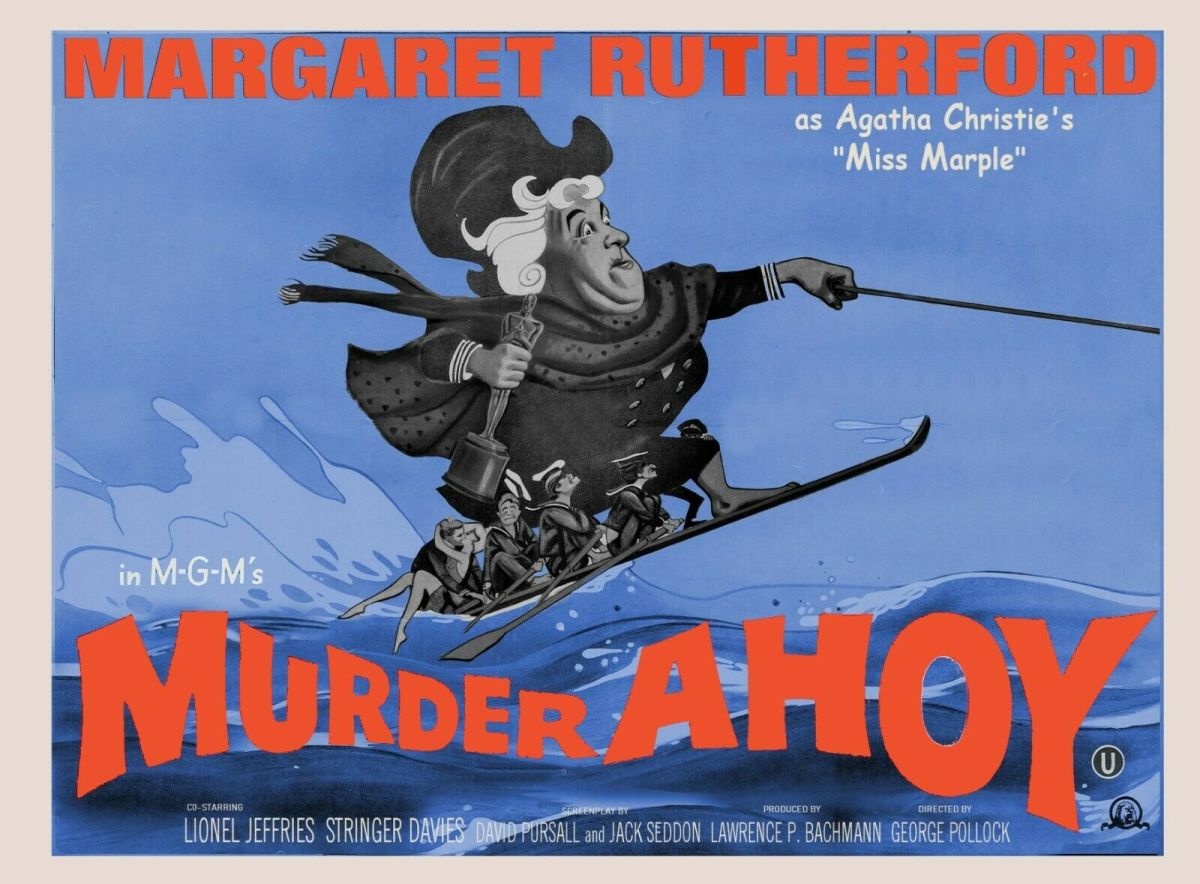
Murder Ahoy! (1964) ***

Agatha Christie tales were in a mostly B-movie limbo in the 1960s, despite Billy Wilder’s Witness for the Prosecution (1957) and would have to wait another decade before glorious all-star resurrection in Sidney Lumet’s Murder on the Orient Express (1974). In the meantime, audiences made do with Margaret Rutherford’s Miss Marple in an MGM quartet – all directed by George Pollock – that ended with Murder Ahoy! Rutherford did not enjoy the national treasure status of the likes of Maggie Smith and Judi Dench these days but she had been elevated to late-career fame by winning the Best Supporting Actress Oscar for The VIPs (1963). But she never quite made the cinematic impact anticipated after Blithe Spirit (1945) and she was mostly seen in roles that called for eccentricity or determination, characteristics associated with Christie’s second most famous sleuth.

The title had led me to expect a picture set on a liner or a cruise ship. Instead, this being a cheaply-made British black-and-white feature, we are limited to a sojourn on a sail training ship which remains moored at all times. Nonetheless, Rutherford is resplendent in naval attire and disports herself as if she were the captain. Her excuse to get on board is the sudden death of a member of the committee overseeing said ship just before he makes an announcement. Miss Marple relies on a good deal more than Hercule Poirot on little grey cells and through laboratory experiment determines the man died from strychnine poisoning. Among her other hidden talents are signaling mastery and dexterity with a sword and she drops popcorn on corridor floors to warn of imminent arrivals when she invades cabins. The suspects include Lionel Jeffries (First Men in the Moon) at his pompous best, Derek Nimmo (BBC’s Oh, Brother), and William Mervyn while Nicholas Parsons (ITV game show Sale of the Century) makes an appearance as a doctor, described in double entendre fashion as “brisk.”   

The Marple films usually ended up on the bottom half of a double bill in the UK.

Naturally, there is more murder, and the subplots include burglary, secret romance (Joan Benham) and thwarted romance (Norma Foster). However, nothing can deter Miss Marple and she soon puts the world to rights. It’s an engrossing enough little film, the resolution a surprise, and Rutherford has skill and charm enough to almost trademark the role. At one time in the 1960s in the USA the Marple pictures were revived as double bills but generally in Britain treated with less regard. Although you could argue that MGM could have bolstered the standards of production, much of the merit derives from the quaintness and the quintessential English lives portrayed. As a bonus there are moments of well-observed comedy and a very inventive score from Ron Goodwin whose 633 Squadron appeared the same year.   

Discover WordPress

A daily selection of the best content published on WordPress, collected for you by humans who love to read.

The Atavist Magazine

by Brian Hannan

WordPress.com News

The latest news on WordPress.com and the WordPress community.