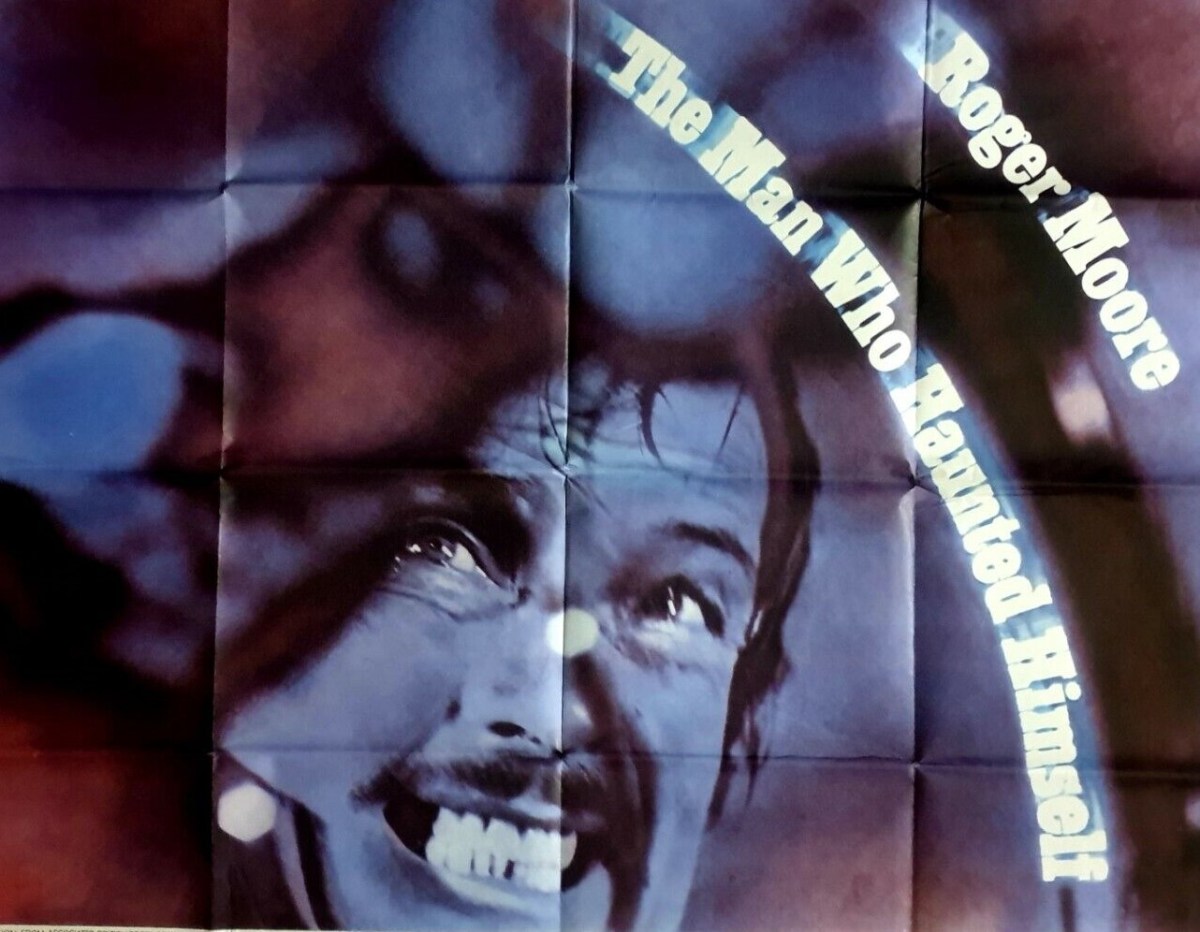
The Man Who Haunted Himself (1970) ****

I grant you, not many movies pivot on a broken matchstick. Nor, for that matter, play around with the screen persona of the imperturbable Roger Moore (Vendetta for the Saint, 1968) or call upon him to do more than raise an occasional eyebrow. No doubt I’m committing heresy in comparing this to The Wicker Man (1973) but there’s a certain similarity in the innocent being dragged into deep waters and, as in that picture, instead of our hero triumphing against sinister forces, ending up a victim.   

While the main narrative thrust is a doppelganger, the initial plot concerns murky business dealings, boardroom betrayal, and corporate espionage set against the backdrop of high living, upscale car, trophy wife, a spot of fun in a casino. The final film of Basil Dearden (The Assassination Bureau, 1969), who died prematurely aged 60, deals with the shattering of the life of strait-laced Pelham (Roger Moore).

He is fastening his car seat-belt a full decade before that was mandatory in Britain, punctuality his mantra, keeps to the speed limit, an immaculate dresser, and while hard work has taken its toll on his marriage he’s not the kind to have a mistress stashed away. But he crashes his car when, against all odds, he seems possessed by the desire to race along at 100mph, overtaking like crazy. For a moment, in surgery, his body registers two heartbeats.

Then people start reminding him of out-of-character activities, thrashing everyone at the club at snooker (and for money stakes), hitting the casino, receiving a nod-and-wink for under-the-table business dealings, while fashion photographer Julie (Olga Georges-Picot) makes sexual demands.

And outside his house his wife Eve (Hildegard Neil) spies a very swanky sports car and begins to suspect her husband is having an affair. Naturally, the upstanding Pelham tries to track down this imposter who has the habit of marking his territory with a broken matchstick. Some occurrences are downright weird. On meeting colleague Alexander (Anton Rogers) for a drink, he discovers he’s already had a drink. There’s the question of a piece of jewellery for Julie that he doesn’t recall buying. An astonished barber wonders why his client would need his hair cut two days in a row. And is someone stealing his shirts and ties?

This is the kind of picture where the normal resolution would be some kind of gas lighting, or tip into film noir with wife and/or the femme fatale involved in conspiracy, or at least some reasonable explanation for the dodgy goings-on.

Britain was going through a doppelganger mini-epidemic, Doppleganger/ Journey to the Far Side of the Sun appearing the year before, but that was a more straightforward sci-fi, being set in the future. And, of course, sci-fi was going through a new cycle what with 2001: A Space Odyssey (1968), Barbarella (1968) and Planet of the Apes (1968).

But it would be a tough call to place this in the same straightforward sci-fi category. The better fit, as I suggested, is The Wicker Man, the background one of a character upset by a different version of normality rather than inhabiting another world or discovering things have changed in the future. And there’s a psychological twist too, the sense of man losing grip on reality, battling  a madness he cannot escape, and while it could have done with dwelling on that aspect a while longer, nonetheless Dearden still achieves his result.

Roger Moore is excellent in twin roles, Hildegard Neil makes an interesting debut and Olga-Georges Picot (Farewell, Friend / Adieu L’Ami, 1968) brings surprising depth to her limited role.

The twisty stuff was written by Michael Relph (The Assassination Bureau) and Dearden based on the bestseller The Strange Case of Mr Pelham by Anthony Armstrong.
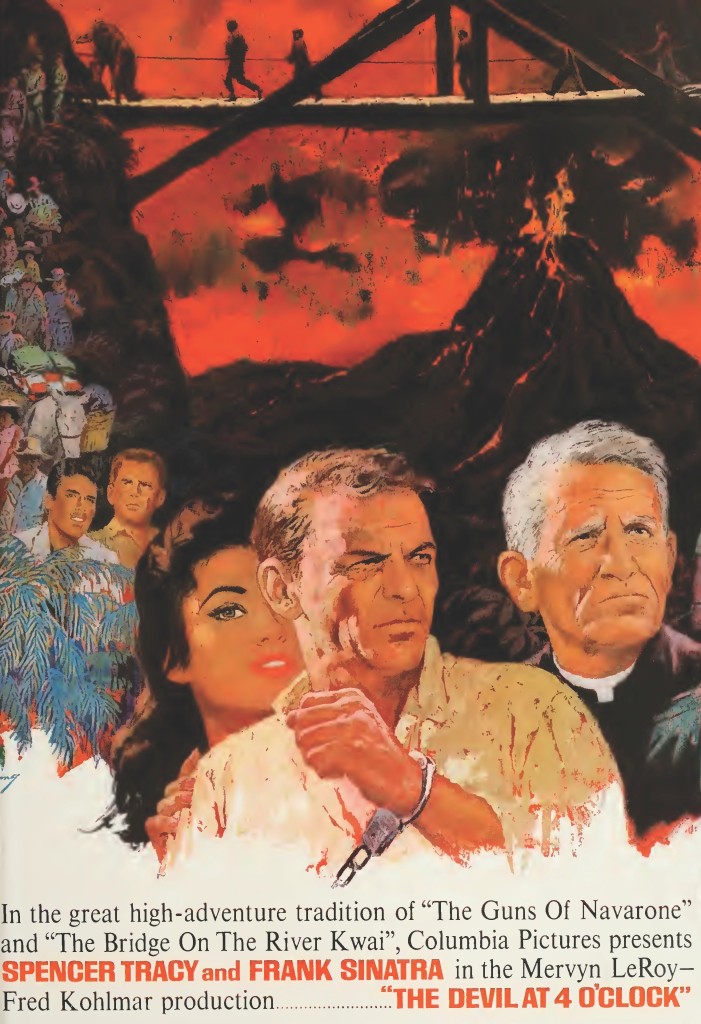
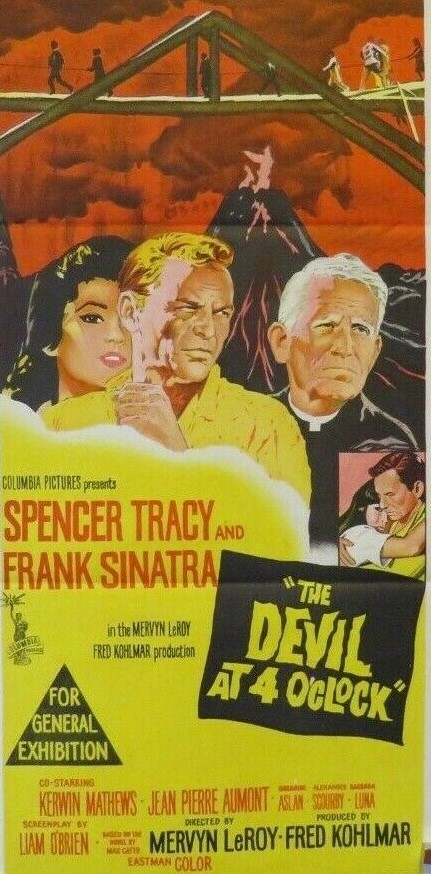
The Devil at 4 O’Clock (1961) ***

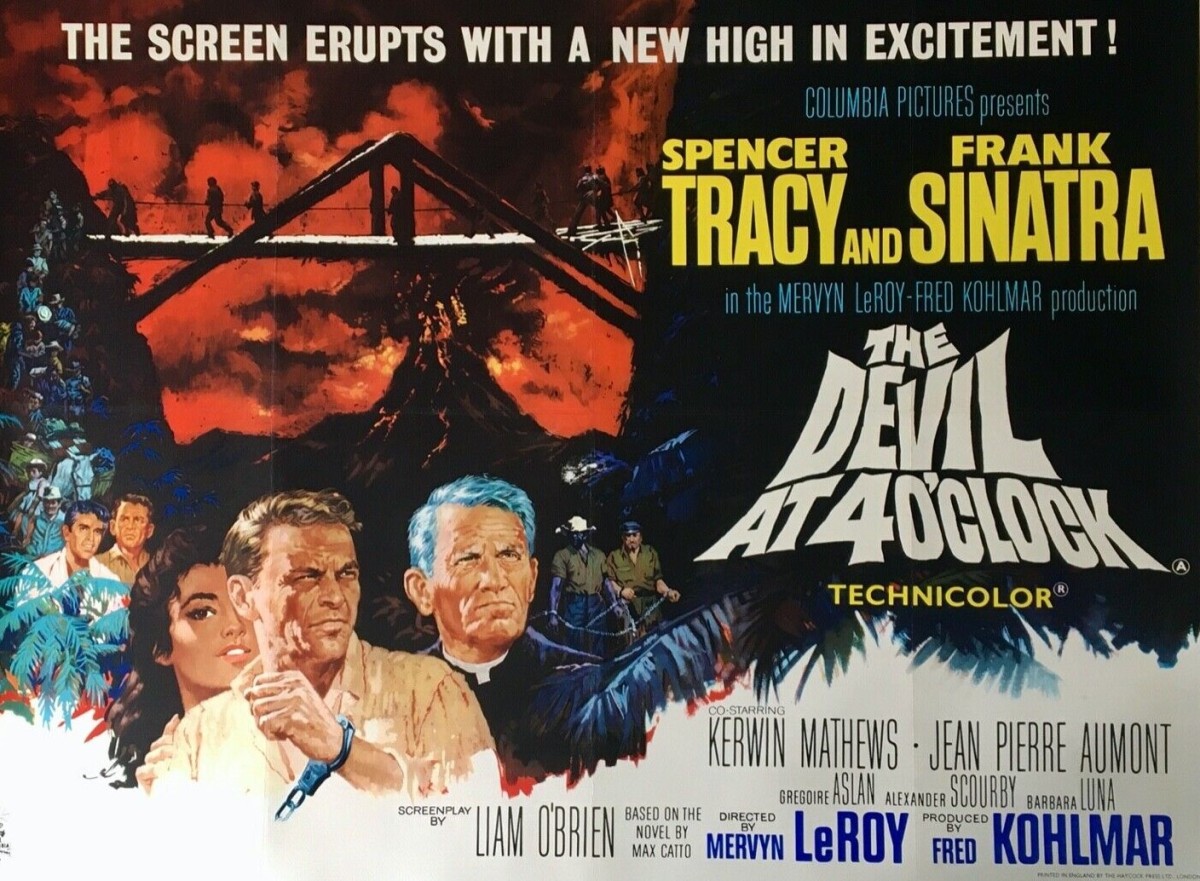
You took on Spencer Tracy (Judgment at Nuremberg, 1961) at your peril. Not even the best efforts of a volcano can wrest the screen from him. And certainly Frank Sinatra (The Detective, 1968) is put in the shade. And if you wanted to work with Tracy you had to cede, no matter how high-flying your career might be, top billing. Both names are above the title and if they were actually equally ranked they would appear in alphabetical order. And it wasn’t until a later disaster picture, The Towering Inferno (1974), that someone solved the tricky problem of designating equal billing by having Paul Newman’s name first on the left of the poster, but Steve McQueen’s name higher on the right.

Anyway, theoretically, nobody should be bothering much who is in a disaster picture when, again theoretically, the audience has come to gawk at the special effects – exceptional for the time but looking tame now. But Hollywood had learned from experience – and the same rules would apply in the disaster boom of the 1970s – that there was no point spending all that money on effects if there was not enough interest in the characters leading up to the disaster element, and also learned you needed stars to attract audiences in the first place.

In the tradition of…previous Columbia hits. Contractual billing agreements referred to the placing of names not faces on the poster , so Columbia could stick Sinatra in the center and
there was nothing Tracy could do about it.

So this scenario has old whisky priest Fr Doonan (Spencer Tracy) getting ready to leave a Pacific island, replaced by the younger Fr Perrau (Kerwin Matthews), while three convicts, led by Harry (Frank Sinatra), on the way to long prison stretches elsewhere make an unexpected pit stop. The rule is that Fr Doonan can make use of any prison labor so he hives them up the mountain to fix the hospital housing lepers that the authorities wish to keep a secret in case it scares off the tourists. Naturally, it’s not long before Harry is making a romantic pitch for  blind nurse (Barbara Luna) but that takes second place to hatching an escape plan.

Running away is only foiled when the volcano begins erupting and as the island authorities begin the evacuation it’s up to the priest and the convicts – Harry’s romantic instinct overcoming reluctance – to fetch the kids in the leper colony. Fr Doonan could have come straight from Boys Town (1938), the kind of two-fisted man of the cloth who tells it like it is, has no compunction about upsetting anyone who gets in his way, but with right on his side generally wins the day. The Governor (Alexander Scourby) isn’t viewed as a bad guy so much by refusing to acknowledge the lepers – especially as by that time the disease was not contagious, priest and hospital workers haven’t caught it, though begging the question why  young kids still did –  as by allowing brutal treatment of the prisoners, sticking three overnight in suffocating heat in a hole in the ground intended for one.

Narrative edge is added by the obstracizing of the lepers – at the time people contracting various illnesses would be treated as lepers and anyone with a serious mental condition stuck away out of sight. But the characters don’t occupy the moral twilight of the later disaster pictures, where the unscrupulous were often offered redemption. Here, the best we’ve got is a rehabilitated sex worker acting as hospital matron and the convicts agreeing to help out.

Kind of suffers from not enough scenes between the priest and Harry, they almost occupy separate narrative threads, but then Frank Sinatra’s got enough on his plate to avoid looking creepy when making advances on a woman who can’t see him. In fact, there’s a serious scene-stealer, another convict Marcel (Gregoire Aslan), getting in the way, his jovial devil-may-care attitude lifting the gloom.

As ever, the main audience concern is who lives and who dies and here the makers throw a curveball and you could interpret the ending as both triumphant and downbeat. The special effects are still pretty good – sensational for the time if truth be told – especially for the pre-CGI era, but the earthquake aspects come in ahead of the rolling lava, which no matter which way you cut it always resembles slow thick soup, although the explosion, done for real using tons of TNT, makes a mark. Technically, the makers pull a fast one in ignoring the tidal wave that follows an eruption, thus allowing most of the islanders to escape by sea.

It being the jungle there’s always a tricky bridge to navigate – Indiana Jones encountered a similar trope decades later – but there’s no snakes or big beasts to cause a narrative diversion. Whatever it is about Spencer Tracy’s screen presence that allows him to inhabit characters with such ease he brings in spades to the priest. Sinatra looks as though he’s learning a thing or two because his Harry bears some similarities in the the down-at-heel unkempt appearance and the lack of scene stealing.

In case you’re wondering, the “four o’clock” of the title is a deadline but appears too late in the picture to create the required tension. Hollywood veteran Mervyn LeRoy (Moment to Moment, 1966) is at helm. Screenplay by Liam O’Brian (The Great Imposter, 1960), in his last movie, from the bestseller by Max Catto (Seven Thieves, 1960).

Worth it for Tracy and Sinatra and Aslan and to see how they managed sfx in ye olden days.

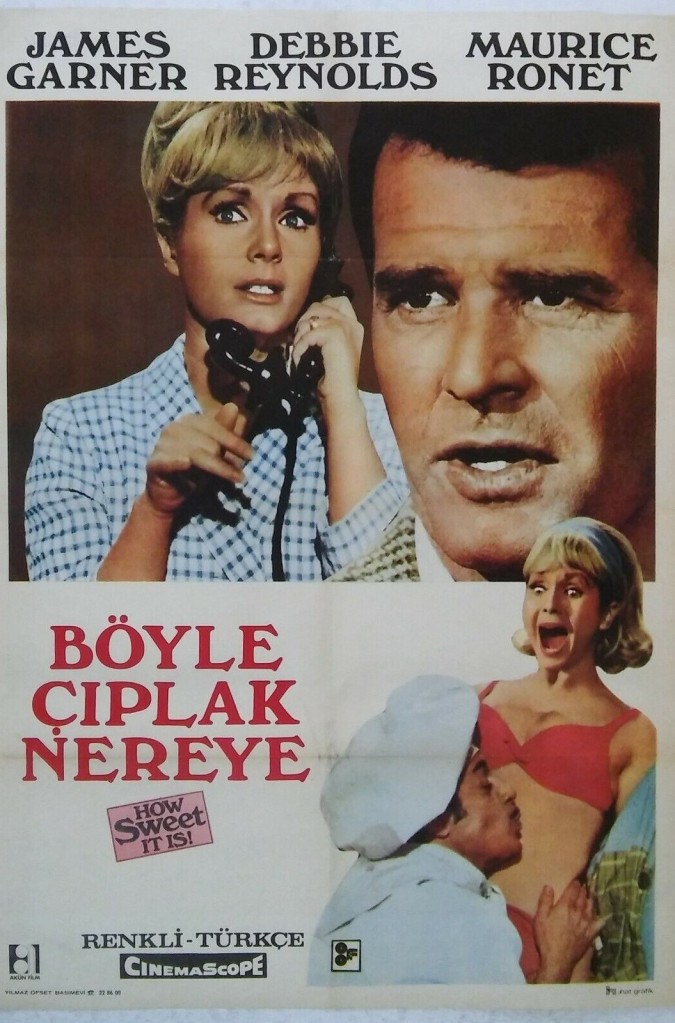
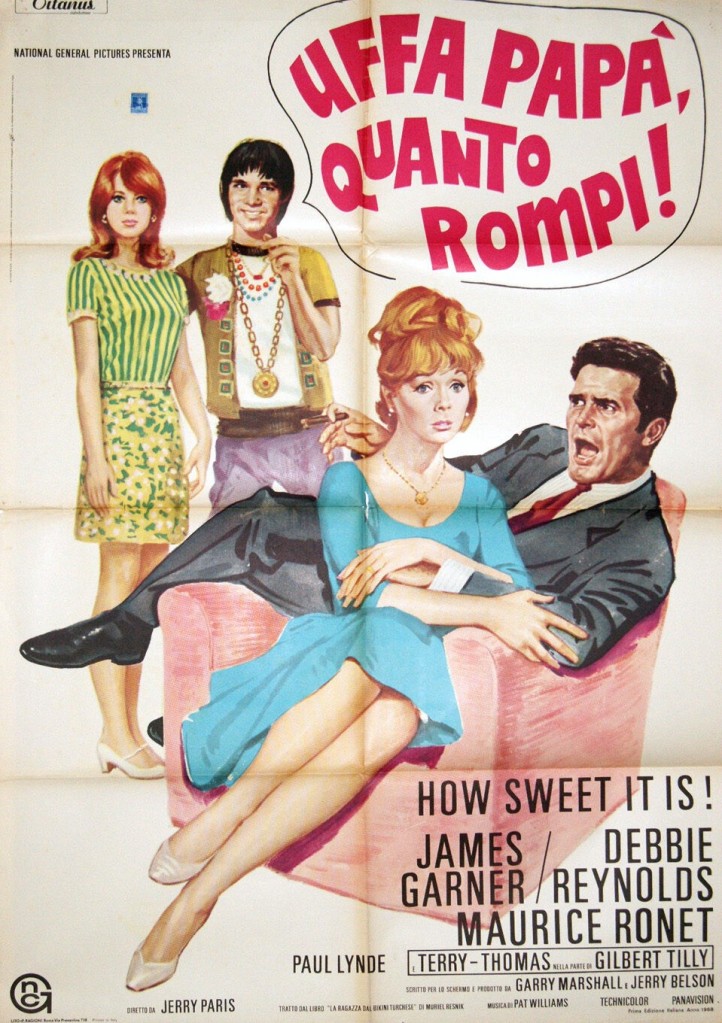
How Sweet It Is (1968) ***

You’d have thought by now leading men would be running shy of Debbie Reynolds, aware just how easily she would steal the picture out from under the top-billed star (witness Goodbye Charlie, 1964). But she had producers clamouring for the fizz she brought. Her comic skills, and willingness to entertain slapstick, were matched only by Doris Day. Especially helpful when she’s saddled with a convoluted plot that’s one-third generation gap comedy, one-third If It’s Tuesday It Must Be Belgium and one-third the kind of creative thinking that determines that somehow or other the female star must end up in a brothel. Throw in some flower power, split-screen, stills montage and slow-mo and you’ve covered all the bases.

In this hit-and-miss line-up, by far the most amusing element is that it’s the adults – photographer Grif (James Garner) and wife Jenny (Debbie Reynolds) – who are sex-obsessed, sneaking away at every opportunity for a bit of hanky-panky, trying to avoid the disapproving eyes of their virginal teenage son Davey (Donald Losby).

An odd example of creative license here. Poster designers had decided that red was the color no matter what. In the last section of the movie Debbie Reynolds parades in a blue – not red – bikini and the book on which it is based is called “The Girl in the Turqoise Bikini.” I’m not sure the color of the bikini is that much of a plot point unless it’s to hook readers of the original novel, but it’s mighty strange for the poster people just to change the color.

The narrative determines that Davey joins girlfriend Bootsie (Hilarie Thomson) and her lithe gal pals on a tour of Europe accompanied by Grif who has been commissioned to photograph the trip. Much to Grif’s horror, Jenny decides she’s going to follow them and hires out a swanky pad where the grown-up lovebirds can make a nest at some undetermined point.

The picture quickly loses interest in Grif and the girls, beyond an attractive tour guide making a pass at Grif and of course their bus getting stuck in the mud. Not only is the Jenny segment more intriguing – turns out she’s been conned by Gilbert Tilly (Terry-Thomas) into handing over a thousand bucks for a chalet he’s not entitled to hire out – because she gets romanced in high French style (champagne and flowers in case you’re bursting to know) by legal lothario Philippe (Maurice Ronet) and every now and then finds herself wearing little more than a bikini and sometimes nothing at all.

Takes a heck of a long time for the two stories to dovetail so that Grif can flounce off in a huff, punch the living daylights out of the Frenchman, and give the screenwriter the excuse to plonk Jenny down in a brothel (that part, I have to admit, is neatly done). There’s also some unusual class comedy at the chateau, Philippe initially being mistaken for a butler, then having to bunk down with his servant because (guess what) this mansion has only one main bedroom.

For no apparent reason there’s an odd section at the start. Instead of flying to Europe, they take the ship and for no apparent reason they’re stuck on C-deck with a lip-pursing purser (Paul Lynde) who insists males and females must sleep apart and share cabins with strangers. Slot into the miss department the opening with the old trope of the husband coming home to find his wife in bed with another man, except it’s Davey and the parental lovers are enjoying some afternoon delight, though quite how you can stretch that to Davey taking a carving knife up the stairs beats me.

James Garner is no more convincing a photographer than he was in The Pink Jungle (1968) and he hardly gives Debbie Reynolds a run for her money, as if he doesn’t know how to bring this character to life. Except for excelling at the risqué, and she a willing accomplice, he’s coming over like the straight man to her comedienne. Debbie Reynolds is superb, reactions honed to the bone, throwing herself into the part, undergoing whatever humiliation will snare a laugh.

Garner briefly resurrected his career with Support Your Local Sheriff (1969) before he hit the slide (see the previous Behind the Scenes article) and to my astonishment this signalled pretty much the end of Reynolds’ screen career, nothing for the next decades except What’s the Matter with Helen (1971) and a bit part (as herself) in The Bodyguard (1992). You can hardly blame her for screenwriters not coming up with the right material to take advantage of her supreme comedic gifts. Alexandra Hay (The Model Shop, 1969) is wasted, you might just as well have dabbed her role “the sexy blonde.”

Director Jerry Paris (Never a Dull Moment, 1968) throws everything he can at the screen without much success. Future director Garry Marshall (Pretty Woman, 1990) and producer Jerry Belson (Fun with Dick and Jane, 1977) in his movie debut formulated the screenplay from the bestseller by Muriel Resnik.

Far from the last comedy hurrah you would have wished for the actress, but all you’re going to get.  

Seven Days in May (1964) ****

Democracy is a dangerous weapon in the hands of the people. Can they be trusted to make the correct decision? That’s in part the thematic thrust of this high-octane political thriller that pits two of the greatest actors of their generation in a battle to decide the fate of the world. This was the era of the nuke picture – Dr Strangelove (1962), Fail Safe (1964), The Bedford Incident (1965) – all primed by the real-life Cuban Missile Crisis and the growing threat of the Cold War.

Just as the President (Fredric March) is about to sign a nuclear treaty with the USSR, much to the fury of the majority of Americans judging by opinion polls, Colonel Jiggs Casey (Kirk Douglas) uncovers signs of a military coup headed by hawk General James Mattoon Scott (Burt Lancaster). The movie divides into the classic three acts. In the first, Casey investigates the existence of a secret army unit in El Paso comprising 3,600 men trained to overthrow the government and needs to persuade the President the country is in danger. The second act sees the president hunting for find proof of the imminent coup and identifying the conspirators. The third act witnesses showdowns between the President and Scott and Scott and Casey.

At the heart of the story is betrayal – Scott of his country’s constitution, Casey of his friend when he takes on the “thankless job of informer.” Casey proves rather too ruthless, willing to seduce and then betray Eleanor Holbrook (Ava Gardner), Scott’s one-time mistress. Both Holbrook and the President prove to have higher principles than Casey.

For both Kirk Douglas and Burt Lancaster who operate at a high threshold of intensity and could easily have turned in high-octane performances the tension is even better maintained by their apparently initial low-key confrontations. Douglas has a trick here of standing ramrod straight and then turning his head but not his body towards the camera.  

As a pure thriller, it works a treat, investigation to prove there is a conspiracy followed by the deaths and disappearances of vital people and finally the need to resolve the crisis without creating public outcry. The only flaw in the movie’s structure is that Casey cannot carry out all the investigations and when presidential sidekicks Paul Girard (Martin Balsam) and Senator Clark (Edmond O’Brien) are dispatched, respectively, to Gibraltar and El Paso the movie loses some of its intensity. But the third act is a stunner as the President refuses to take the easy way out by blackmailing Scott over his previous relationship with Holbrook.  

Of course, there is a ton of political infighting and philosophizing in equal measure and speeches about democracy (“ask for a mandate at the ballot box, don’t steal it”) and the constitution and the impact of nuclear weapons on humanity. But these verbal volleys are far from long-winded and pack a surefire punch. The coup has been set up with military precision and must be dismantled by political precision.

The film was awash with Oscar talent – Burt Lancaster, Best Actor for Elmer Gantry (1960) and, at that point, twice nominated; thrice-nominated Kirk Douglas; Fredric March, twice Best Actor for Dr Jekyll and Mr Hyde (1931) and The Best Years of Our Lives (1946) plus  three other nominations besides; Ava Gardner nominated for Best Actress (Mogambo, 1953); and Edmond O’Brien named Best Supporting Actor for The Barefoot Contessa (1954).

None disappoint. March is especially impressive as a weak president tumbling in the polls who has to reach deep to fight a heavyweight adversary. Lancaster and Douglas both bristle with authority. Although Lancaster’s delusional self-belief appears to give him the edge in the acting stakes, Douglas’s ruthless manipulation of a vulnerable Ava Gardner provides him with the better material. Edmond O’Brien as an old soak whose alcoholism marks him out as an easy target is also memorable and Ava Gardner in recognizing her frailties delivers a sympathetic performance.

Rod Serling (The Twilight Zone) does a terrific job of distilling a door-stopper of a book by Fletcher Knebel and Charles W. Bailey II.  But the greatest kudos must go to director John Frankenheimer – acquainted with political opportunism through The Manchurian Candidate (1962) and with Burt Lancaster (The Birdman of Alcatraz, 1962) – for keeping tension to the forefront and resisting the temptation to slide into political ideology.

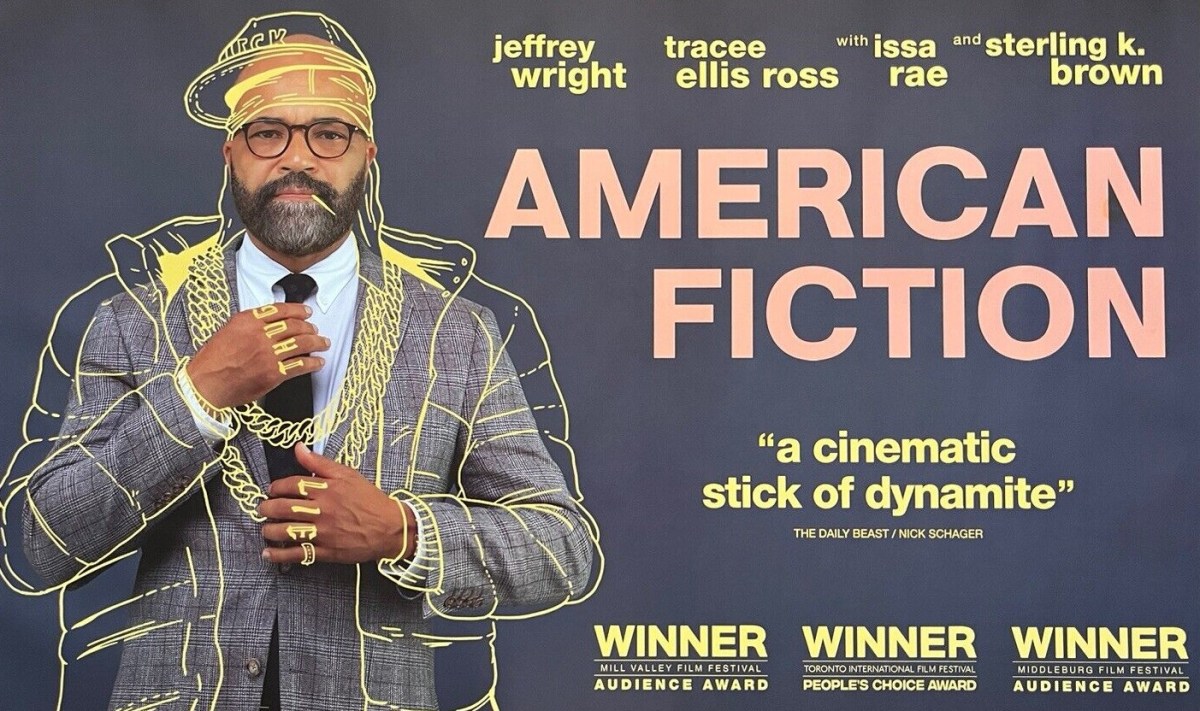
American Fiction (2024) *** – Seen at the Cinema

I thought we were in for a treat when our hero is told not to be rude to anyone important. Kick ass, here we go. Nope. Worthy but dull. One part cosmic joke, three parts soap opera, only relieved by the kind of subdued acting that’s become very much the contemporary Oscar-nominated trend (see The Holdovers, Oppenheimer). And with a narrative thrust that is, unfortunately, laughable. I grew up in Glasgow, Scotland, which for generations lived under the cloud of No Mean City, a portrayal of the city as gangster heaven, and we are nothing on what Hollywood did to the Native Americans so, spare me, anyone saying they have been unfairly treated by any part of the media.

Let’s get the soap out of the way first. Monk (Jeffrey Wright) is an out-of-fashion literary novelist eking out a living as a English professor whose students are on the verge of cancelling him. He hives off to the family home where he discovers – discovers! – his mother (Leslie Uggams) is suffering from Alzheimer’s, brother Clifford (Sterling K. Brown) is gay and a coke addict and his sister Lisa (Tracey Ellis Ross) is so ill from heart disease she drops down dead in front of him.

When his latest novel is rejected he decides he will rip off current bestseller Sintara Golden (Issa Rae) and write a book in gangsta patois. Lo and behold it works and what began as him cocking a snook takes on a more serious dimension when he is offered a $750,000 advance. And guess what, suddenly his principles go hang, and not because he’s just a greedy skunk like everyone else but because he’s been handed a get-out-of-jail-free card in that how, otherwise, with a divorced coke addict brother more interested in his latest lover and a dead sister – both I hasten to add high up in the medical profession, sister a consultant, brother a plastic surgeon – is he going to pay for his mother’s care. So he goes along with the gig and the problems multiply as he lives the hypocrisy he claims to abhor.

The idea of someone duping the publishing industry is hardly new. Bestselling British literary author William Boyd sent in a novel under a pseudonym but written in his own style that had attracted a gazillion sales and that was rejected. Polish novelist Jerzy Kosinski sent in one of his own award-winning novels without a word changed and had that rejected. So the publishing industry, like Hollywood and like the media, is just too easy a target unless the weapon is a lot sharper than this.

And hopefully this is a short-lived trope (Argylle went down a similar route), but we see his characters come alive in front of him and play out terrible scenes from his joke fiction.

Source novel.

Yep, so someone is making a point, that Black Literature has lost its way and why can’t Black authors be heralded for writing about ancient Greece (obviously not in your typical blood-sex-and-thunder fashion) or other arcane subjects or even, as shown here, take as their subject matter well-off university-educated rather than poverty-stricken characters and explore their issues (the same as everyone else’s since you’re asking).

Outside of Monk who spends most of the time locked in his head with a bit of light relief with fan-turned-lover Coraline (Erika Alexander), the only person who doesn’t take this stuff seriously is the sister who died too soon, deflating our literary hero by telling him his books come in handy for steadying loose table legs. Debut offering by writer-director Cord Jefferson based on the novel Erasure by Percival Everett.

Kept afloat, just, by Jeffrey Wright (No Time to Die, 2021) mainlining on repression but that’s about it.

North Sea Hijack / ffolkes (1980) ****

Shouldn’t work at all not with star Roger Moore gussied up like a maiden aunt, fussing over needlepoint and cats, dolled up in tweeds and sporting an unkempt beard and a ginger wig. Our only clue in the early stages that he’s anything approaching a tough guy is that he knocks back whisky like soda pop.

And bear in mind this was a couple of years before the Brits could blithely call in the SAS (Who Dares Wins, 1982) for a ticklish rescue op and more than a decade before it became the norm to rely on a handily-available one-man band of the Die Hard persuasion and even longer before you had to worry about upsetting the pet or elderly neighbor of your local retired assassin.

When the movie flopped in the U.K. it was re-branded as some kind of James Bond number with scantily-clad women.

That it does work is very much down to Moore as the opposite of the standard Hollywood hero, avoiding rather than provoking trouble for strategic reasons, and realizing that, even with the deadliest of deadlines, time could be on his side and be used to un-nerve his opponent. After the film flopped spectacularly, Moore claimed he was miscast, but, in fact, despite the box office failure, the opposite is true. Without him brilliantly treading a very fine line this would have easily teetered into spoof.

A bunch of gangsters – not terrorists, plain cash the motive not some obscure cause – led by Kramer (Anthony Perkins) take over an oil platform supply ship, force Capt Olafson (Jack Watson) and crew, including, unusually for the time a female chef Sanna (Lea Brodie), to park under the oil platform while a couple of the gang plant explosives – to be set off as a warning – under the smaller drilling rig located some distance away, threatening to blow the whole operation sky-high if the British government doesn’t meet a ransom demand of $25 million.

As it happens the mysterious section of government that sometimes even Prime Ministers don’t know exists (as with beekeeping within the C.I.A.) has already recognized such a potential issue and hired ffolkes (Roger Moore) and his self-styled team of “fusiliers” to come up with a solution. Once the female Prime Minister (Faith Brook) – Margaret Thatcher was already in power at this point – is apprised of the cost in loss of revenue and human lives, she gives the go-ahead.

Ffolkes is despatched by helicopter with Admiral Brinsden (James Mason) and a high-ranking lackey. The supply ship crew, meantime, led by Sanna, have attempted to poison the invaders but that’s thwarted by the ruthless Kramer who by now has been chucking any dissenters over the side.

Kramer’s a clever guy. His ploy is smart. Theoretically, the drilling rig is financially worth a lot more than the platform, but that loss would account for a fraction of the lives of those on board the platform, and measured in public relations terms by any government deemed the smaller catastrophe. The platform will only be destroyed if the government is foolish enough not to meet his second deadline – if they fail to hit the first it’s just the rig that ends up in Davy Jones’ Locker.

But ffolkes is as cunning and plans a fake destruction of the rig to remove that ace in Kramer’s pack. The resulting explosion is so convincing, especially since it takes place at night, that the stakes are raised in ffolkes favor. But that’s only until Kramer smells a rat and refuses to allow ffolkes on the supply boat, ensuring the cat-lover has to resort to the more dangerous and potentially deadline-breaching Plan B. Nor, despite early action pointing to ffolkes’ efficiency, is he invulnerable in the tough-guy department, needing rescued twice, once by Sanna, hiding in a lifeboat after her failed poisoning mission.

And it does rely on the occasionally dense Admiral learning a simple trick with a cigarette packet.

This probably flopped because audiences expected some version of James Bond (it appeared within Moore’s stint as 007 in the two-year gap between Moonraker and For Your Eyes Only) or at least the cigar-chomping mercenary in The Wild Geese (1978). If Moore had carried out the required action in tweeds or naval uniform it might have been more easily accepted than dressed in a bright red frogman’s outfit (choice of that color a flaw in an op intended as subterfuge).

The irrepressible sexist character he represented might be more of a challenge to a contemporary audience but it’s delivered without malice and, theoretically at least, his aversion to women (and no overt hint of homosexuality I might add, though you could make your own mind up on that score) is explained. And Sarah (Jennifer (Hilary) , the oil platform skipper’s secretary, is his match, though that’s mostly with dry asides and rolling eyes.

There’s a bit of a sexist joke – although somewhat of a cliché – when our man discovers one of the crew is a woman and not a man. But that’s far better than the out-and-out misogyny of one of the gangsters whose reaction to cornering Sanna is attempted rape.

So, not the all-action yarn you – and audiences back in the day – might have expected, but, still pretty good fun. Director Andrew v. McLaglen melds elements of his The Wild Geese, and Shenandoah (1965), Moore’s performance reminiscent of the slow-burn of the James Stewart character. Screenplay by Jack Davies (Gambit, 1966) based on his bestseller.

Scarcely a lifted eyebrow in sight. Great fun – you couldn’t get more retro – and certainly had me chuckling – and free on YouTube.

The Four Horsemen of the Apocalypse (1962) **

Hollywood isn’t known for its sensitivity, and this is one of those major misjudgements. An incredibly rich family, ripe with entitlement, find World War Two tough going, in the main because as in Counterpoint (1968), they consider themselves exempt. Being Argentinians, they are neutral.

Unfortunately, it just so happens, with that wealthy person’s penchant for flaunting their wealth in the world’s richest cities, they end up in Paris on the eve of war, ignoring the warning of family patriarch (Lee J. Cobb) who is convinced the titular “four horsemen of the apocalypse” (war, conquest, death and pestilence, in case you don’t know your Bible) are on the march. Not that we see much of that in the French capital, except in newsreel, details of the war delivered in snippets of dialog (“haven’t you heard about Dunkirk?”), and street-loads of refugees.

Because, don’t you know it, our major players, the Desnoyers and Laurient families, are largely immune. Man-about-town and Argentinian art connoisseur Julio Desnoyers (Glenn Ford) – ignoring the entreaties of his father Marcelo (Charles Boyer) to scarper – is making a move on married Frenchwoman Marguerite Laurient (Ingrid Thulin), bored by newspaper editor husband Etienne (Paul Heinreid) who spends way too much time worrying about impending war.

Julio is so rich that even after the German invasion sends the poor of the city – and its Jewish population – racing about terrified for their lives, he can swan around, enjoying fine food in top-class restaurants much as before and even has the temerity to tell a high-ranking German General von Kleig (George Dolenz) that his wealth makes him immune. The general reckons that his rank gives him any woman he wants. “She’s mine,” is Julio’s rather misogynistic retort when the general attempts to appropriate Marguerite.

Meanwhile, though Julio is still slow to catch on, his sister Chi Chi (Yvette Mimieux) has only gone and joined the Resistance and Etienne has also upset the new masters, so Julio has to go begging cousin Heinrich (Carl Boehm), who has exploited his German origins to achieve military high rank, to provide them with a get-out of-jail-free card.  

When Etienne is released, Marguerite is initially inclined to stick with Julio until guilt gets the upper hand. Julio, with no lover to keep him happy, eventually throws his lot in with the Resistance, but there’s no happy ending for anyone.

Director Vincente Minnelli (Two Weeks in Another Town, 1962) is terrific at marshalling his set pieces, using widescreen to excellent advantage, cramming extra bodies in at the edges, but since these sequences tend to be little more than extended talk-fests – the activities that got Chi Chi and Etienne imprisoned are ignored – no amount of directorial skill in the world is going to salvage a movie so weighted down with dead wood.

Glenn Ford (Rage, 1966) does his very best to give the viewer something to hold onto. He avoids every shade of angst in his determination to have as much as fun as possible regardless of any situation. He’s scarcely had the chance to be so carefree on screen and he is at his charming best, and he does lift what is otherwise a somber encounter.

Ingrid Thulin (Return from the Ashes, 1965) has her moments, especially when her diplomatic skills prevent a party being ruined, and she enjoys some flighty repartee with Ford, but once the romance gets heavy her personality undergoes a U-turn and she’s holding onto angst for dear life. And there’s a twist in her character that makes no sense. When Etienne emerges from prison a broken man, she gives him both barrels, and declares her love for Julio only for shortly after to recant and dump Julio. Seems mighty insensitive and bordering on cruelty to deal her husband such a blow when he has been tortured by the Nazis. Though she might not have been so forgiving had she worked out just why Etienne was freed and Chi Chi not.

After the colossal success of Ben-Hur (1959), which set the roadshow ball rolling, MGM was on a remake crusade. As well as Ben-Hur, it had remade Cimarron (1960) – the original 1931 version an Oscar-winner and hot box office. The fact that that flopped didn’t deter the studio. The silent version of The Four Horsemen of the Apocalypse (1921), set against the background of World War I,  transformed Rudolph Valentino into a superstar and netted MGM a fortune. The new version sank like a stone, perhaps because it was too wordy for roadshow, or perhaps, more likely, Judgement at Nuremberg (1961) had taken a bolder look at World War Two.

A mis-hit.

REVIEWED PREVIOUSLY IN THE BLOG: Glenn Ford in Experiment in Terror (1962), Love Is a Ball (1963),  Advance to the Rear / Company of Cowards (1964), Fate Is the Hunter (1964), The Money Trap (1965), Is Paris Burning? (1966), Rage (1966), The Last Challenge / The Pistolero of Red River (1967), A Time for Killing (1967), Day of the Evil Gun (1968), Heaven with a Gun (1969; Ingrid Thulin in Return from the Ashes (1965); Yvette Mimieux in The Time Machine (1960), The Wonderful World of the Brothers Grimm (1962), Diamond Head (1962), Joy in the Morning (1965), The Reward (1965), The Caper of the Golden Bulls (1967), Dark of the Sun (1968), The Picasso Summer (1969); Vincente Minnelli directed Two Weeks in Another Town (1962) and Goodbye Charlie (1964).

The Pawnbroker (1964) *****

Director Sidney Lumet (The Group, 1966) could have made an excellent film just about the customers of a pawn shop, the haunted individuals haggling for more cash than they will ever be paid, the sad sacks, junkies, lost souls and general losers whose stories are told in the items they pawn or redeem – candlesticks, lamps, radios, musical instruments, occasionally themselves. You don’t need to be a pawnbroker to know that three tough guys turning up with a pricey lawnmower are dealing in stolen property.

And it comes as something of a surprise to learn that the pawnbroker is involved in some kind of money-laundering scam for a local gangster. Clearly shot on location on a bustling low-rent area, north of 116th St in East Harlem, New York, there’s enough going on in the streets – the markets, the tenements, poolrooms, the bustle, the eternal noise – to keep you hooked.

But you might think twice about positing as your hero an “absolute bastard” as Lumet himself described shop owner Sol Nazerman (Rod Steiger). He is more haunted than any of his clientele, a Holocaust survivor, plagued by flashbacks to the concentration camp where he witnessed his son die and his wife raped. He is devoid of life, completely shut down to any emotion, rejecting overtures of friendship, and his life is played out in tiny elliptical shreds.

He does not even derive any enjoyment out of his affair with a widow and although he claims to worship money – according to him the only absolute outside of the speed of light – that brings no fulfillment either. He is accused of being among “the walking dead.” It is surprising he has lasted so long without imploding After his war experience, you would have to wonder at a man who spends his life behind the bars of the grille in his shop and just in case he considers escaping from his predicament designer Richard Sylbert (Chinatown, 1973) incorporates other visual aspects of imprisonment into the production.

Around Sol are a set of very lively characters, his ambitious assistant Jesus (Jaime Sanchez) trying to go straight and his girlfriend (Thelma Oliver), a very smooth and wealthy gay gangster (Brock Peters), and a trio of small-time hoods with whom the assistant is friendly. But also the deranged and the lonely. A widowed social worker Marilyn (Geraldine Fitzgerald) who suffers from the “malady of loneliness” offers him friendship but is rejected.

There is little plot to speak of but just enough to teeter him on the brink of self-destruction. So it is primarily a character study. Unusually, Lumet observes without any sentimentality those around Steiger. “Sol has buried himself in this,” Lumet wrote in Films and Filming magazine (October 1964, p17-20) “because he needs to be with people that he can despise…This is a man who is in such agony that he must feel nothing, or he will go to pieces.” There is no redemption and he lacks the courage to commit suicide. It’s a stunning, bold picture, as raw as you can get without turning into a bloodsucker.

The film had a few firsts. It was the only mainstream American picture to deal with the Holocaust from the perspective of a survivor (although films like Judgement at Nuremberg, 1961, had shown aspects of the camp victims). It broke mainstream conventions on nudity, bare breasts being seen for the first time. Lumet experimented with incredibly short cuts – just one-frame and two-frames in places (a technique he had first used in television)- when the standard assumption was that audiences required three frames to register an image.

Rod Steiger (No Way to Treat a Lady, 1968) gives a very restrained performance, especially for an actor known for his volubility and over-acting. He seems to sink into the role. Brock Peters (Major Dundee, 1965) plays not just the first openly gay person in a mainstream picture, but the first gay African American.

Excellent support includes Jaime Sanchez (The Wild Bunch, 1969), Thelma Oliver (Black Like Me, 1964) and Geraldine Fitzgerald (Rachel, Rachel, 1968). Quincy Jones made his debut as a movie composer. If you listen closely you might detect a piece of music later made famous by the Austin Powers pictures and if you look closely to might spot a debut sighting of Morgan Freeman. Screenplay by the writing team of David Friedkin and Morton Fine (The Fool Killer, 1965) based on the bestseller by Edward Lewis Wallant.

Unmissable.

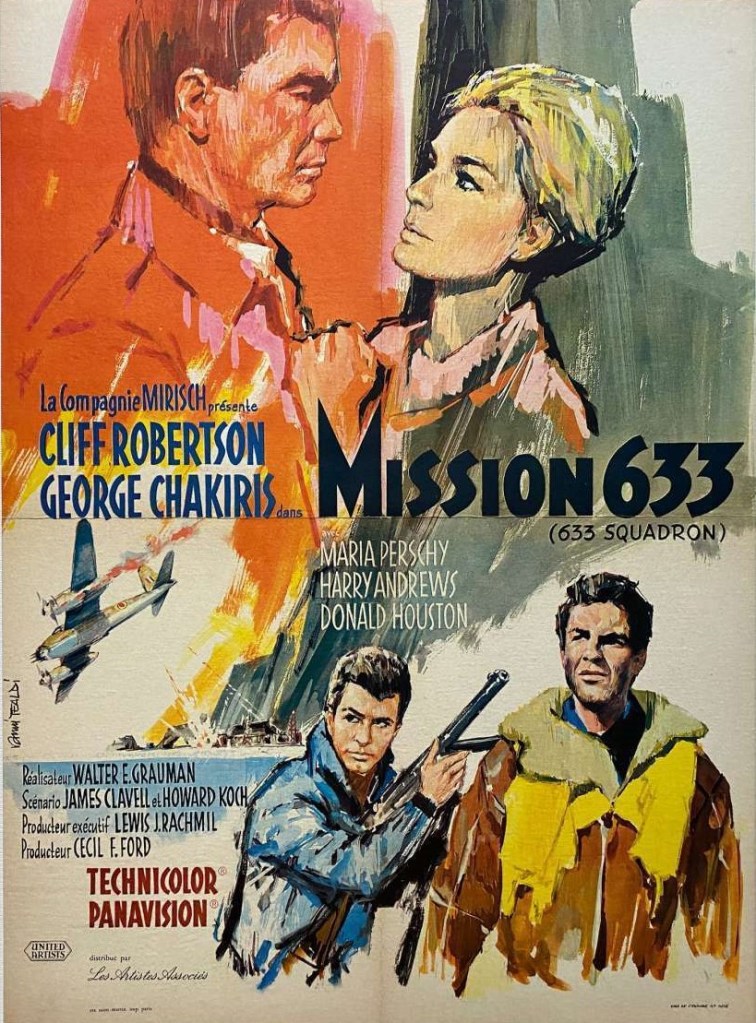
633 Squadron (1964) ***

You can keep your current and future Oscar winners, George Chakiris (for West Side Story, 1961) and Cliff Robertson (for Charly, 1968). The stars here are the mechanical birds, the Mosquito bombers, and the Ron Goodwin score, a thundering rehearsal for Where Eagles Dare (1968).

The aerial photography was pretty amazing for the day, though there were no Top Gun: Maverick shenanigans with actors supposedly actually flying the planes, just sitting there with an occasional turn or yank of the controls.  Even so, watching the planes take off, land, propellers describing perfect arcs, being attacked on ground or in the air, firing back, and the (apologies) bird’s eye view of dashes along precipitous cliffs takes up a huge amount of the running time.

You’ll know by now there was no actual 633 Squadron – but there was an international squadron (see the current Masters of the Air) to accommodate the various accents on show – and that the mission is also fictional, though the idea that the Germans had chosen the Norwegian fjords to hide a factory making rocket fuel for the V1s currently in production elsewhere wasn’t too far off the mark given (see The Heroes of Telemark, 1965) they were using that country for atomic bomb experiments.

The British know the rockets are inevitable, impossible to completely destroy them, but as long as they don’t interfere with D-Day that will be good enough. Wing Commander Grant (Cliff Robertson), although his squadron is exhausted from flying too many daily missions, has his leave curtailed, and told he’s on a strict deadline to destroy the factory.

Like the factory in The Heroes of Telemark, it’s virtually impossible to hit, buried beneath too much rock, but the Germans ain’t that clever, and it’s the rock that is the weakness. The theory is hit the overhang with sufficient bombs and the mountain will come tumbling down and destroy the factory.

Norwegian Resistance fighter Lt Bergman (George Chakiris) is on hand to explain just how difficult the task is, flying at extremely low altitude along fjords guarded by anti-aricraft guns. To add more tension, or just for the hell of it, Air Vice Marshal Davis (Harry Andrews) keeps on truncating the already tight deadline. The pilots have barely got time for a few practice runs along Scottish glens before it’s M-Day (no idea where that daft moniker came from, presumably a D-Day discard).

But there is just enough time for Grant to make pretty with Bergman’s refugee sister Hilde (Maria Perschy). Although after Bergman returns to help out his mates and is unhelpfully captured by the Nazis, Grant has to bomb the Gestapo building to kill him before he can be tortured and give out vital information.

In another film, Hilde would have been a spy or cut off the burgeoning romance after discovering Grant’s mission, but instead she’s not in the espionage line and she thanks the wing commander for sparing her brother torture. In the only major twist in the picture, it turns out Grant was too late, for there’s a nasty welcome committee awaiting the bombers.

Not quite the Boy’s Own derring-do adventure tale I remember, what with the torture and the climax, but it was still in my day one of the few films that appealed heart-and-soul to the pre-teen and teenage boy, along with The Magnificent Seven and The Great Escape, in part, I guess, because it was so thrifty in terms of character development.

No time is wasted giving everyone a character arc, beyond the usual daredevil and someone getting married, the characters are sketchy beyond belief, but who the hell cares, let’s get on with the action. So, it certainly delivers on that score. But watching as an adult, and I’ve probably not seen this in four decades, it’s a good bit tougher than the surface might suggest, eating away at the idealism of war, of the noble sacrifice, and tuning in better than most World War Two pictures to raw finality.

Perhaps it’s emblematic that the best cinematic introduction is given to the arrival of the new-style bombs, although Hilde turning up to a torrent of wolf whistles in the bar runs it close, and she does have a habit of leaning out a window to give the audience a glimpse of cleavage every now and then.

No wonder we all came out humming the Goodwin theme. You can’t escape it. It’s in virtually every scene. Memorable final line uttering by the air vice marshal, “You can’t kill a squadron.”

It would have set the bar high for aerial photography, except that by showing how it could be done, triggered a small flurry of similar pictures, most notably The Blue Max (1966) and The Battle of Britain (1969).

Walter Grauman (A Rage to Live, 1965) clearly adores the machines more than the humans, but the script by James Clavell (The Great Escape, 1963) and Howard Koch (The Fox, 1967) based on the novel by Frederick E. Smith doesn’t give him much option.

Still worth a watch.

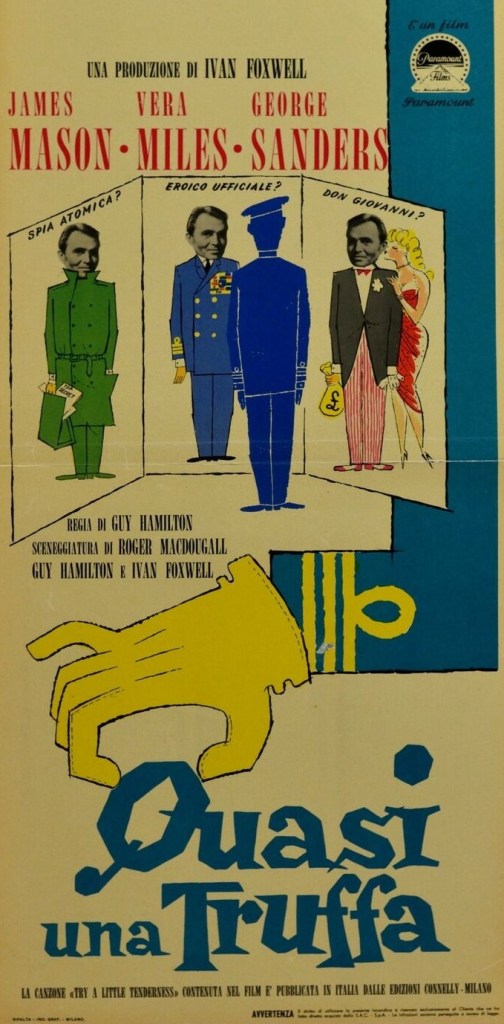
A Touch of Larceny (1960) ****

Magically fits into the “lost” film category that I’ve been banging on about recently, films, for a variety of reasons, denied cinematic release. Or at least that’s according to Rotten Tomatoes which declares “there are no featured reviews…because the movie has not (been) released yet” despite the fact that it was a big hit in cinemas over six decades ago.

Happening upon this nugget of information in a casual trawl of RT I thought I’d see if this “lost” movie was as good as The Appointment (1969) perhaps or Fade In (1969) or whether it should never be seen.

Imagine my surprise to find a highly entertaining picture best described as a one-man caper that takes aim at the Establishment and the Media, wrapped in a very witty rom-com, and helped along by the kind of Whitehall characters making a meal out of doing nothing as lampooned in BBC TV series Yes, Minister

The central conceit sounds so lame from the outset that you think this confection is going to collapse the minute it is put into practice, but, in fact, a good few twists inflate the idea until it floats along quite merrily towards a happy conclusion. And if you only remember James Mason from dour turns in The Deadly Affair (1967) or as the smarmy villain in North by Northwest (1959), you’re in for a treat.

For this is the actor at his most winning, so charming he almost edges into the adorable class, and this while playing a rake, the seducer’s seducer, but with the quickest of quick wits to get him out of any scrape. We begin and end with a demonstration of such speedy thinking.

Surprised by the return of his latest conquest’s husband, Commander Max “Rammer” (the nickname nothing to do with sexual prowess) Easton simply dons his naval uniform, whisks up the woman’s dog, his presence explained as delivering a poor creature lost in the street. As easy as pie.

His life is one of ease. When he says he works at the Admiralty, “working” might be a stretch, although “lolling about” would hardly be in the job description, the sole purpose of his desk somewhere to lay his feet, and has an airy dismissal at hand for any Whitehall buffoon inclined to pepper their language with Civil Service gobbledegook.

Bumping into an old war chum Sir Charles Holland (George Sanders), now an ambassador,  they were submarine commanders in World War Two, allows him brief acquaintance with American widow Virgina (Vera Miles). Naturally, he snaffles one of her gloves so as to have an excuse to return it. Realizing his game, she bats him back with effortless repartee, saving for the last the fact that she is engaged to be married to Sir Charles.

Given he is so practised at this game, he manages to inveigle his way into her life – Sir Charles away on urgent business – determines that her fiance’s main attraction is his dosh, and comes up with a barmy scheme to put himself in the wealthy category. His notion is to pretend to be a spy, drop a top secret document down behind a filing cabinet, vanish to a remote Scottish island, wait for his colleagues to raise the alarm, someone discover the document is missing, and the newspapers to brand him a traitor, at which point he will pop back up and sue the media for libel, and become rich enough to suit Virginia.

Yep, it seems a crazy notion, especially as Virginia, though clearly enjoying his company, has kept him at a decided arm’s length. Unfortunately, once the hue-and-cry is raised, Virginia makes the mistake of telling her husband it’s all a big con. But that puts Sir Charles in a bind, because to fess up might put his fiancé, and by extension himself, in a difficult position.

So they do nothing. Meanwhile, on his deserted tiny island off the coast of Scotland, Easton is living it up, dining off his ample supplies, occasionally catching a fish or a lobster, certainly enough booze to keep up his spirits, tuning into the radio to keep up with the news, waving half-heartedly at any passing ship, rehearsing his lines for when he is rescued. He’s even brought along a canister of petrol so he will have no trouble lighting damp driftwood and seaweed to make the bonfire he will require to attract attention.

So far, so barmy. But now the first twist. He chucks into the sea all evidence of his high living. He slips on a rock, falls into the water and the precious fuel sinks to the bottom. Now, he is a genuine castaway, soaked, starving, freezing. Second twist, the passengers on the boat that turns up to rescue him greet him by name.

So now we’re in for a devilish third act, the cops tipped the nod without getting the full story, Virginia the obvious culprit, Easton, back to the wall, requiring some fiendish ingenuity to get himself out of the mess. After a bundle of twists coming quick and fast, the romantic entanglement is disentangled, Easton still set to be rich by selling his tale (“the real true story” i.e. fictional hogwash) to the media who no doubt toss in a sweetener in gratitude for not being sued.

Not only is it delivered in effortless style by director Guy Hamilton (The Battle of Britain, 1969), and Mason at the top of his game, matched by Vera Miles (Psycho, 1960), but it is very short, clocking in at just over 90 minutes.  Roger MacDougall (The Man in the White Suit, 1951), Ivan Foxwell (Tiara Tahiti, 1962) and the director concocted the screenplay from the novel by Paul Somers.

Great fun, the repartee and the final third an absolute treat while poking gentle fun at the Establishment.

Rather than belonging to the “lost” category, it sits comfortably in the “they don’t make ‘em like that anymore” section.

Discover WordPress

A daily selection of the best content published on WordPress, collected for you by humans who love to read.

The Atavist Magazine

by Brian Hannan

WordPress.com News

The latest news on WordPress.com and the WordPress community.