While once the main interest in this piece would have come from fans of Judy Garland, lapping up her penultimate movie appearance, the prevalence of mental illness these days especially among the young, in part due to Covid and the scourge of social media, should switch audience attention – especially among contemporary viewers – back to the subject matter.
Garland’s stock had risen somewhat after her performance in Judgement at Nuremberg (1961), her first movie in seven years, but, given the travails of her private life, would most likely have been sympathetic to anything that cast a light on mental illness. The bulk of movies covering this ground tended towards the lurid, as exemplified by Shock Corridor (1963) and Shock Treatment, (1964) rather than the more tragic Lilith (1962). Whatever the approach, they focused on adult conditions. Here it’s the treatment of children.
Appreciation of the social conscience of star Burt Lancaster has largely gone unnoticed but this was the era when his movies touched upon crooked evangelism (Elmer Gantry, 1960), teenage gangs (The Young Savages, 1961), the Holocaust (Judgement at Nuremberg, 1961) and the effects of long-term imprisonment (The Birdman of Alcatraz, 1962). He was even an animal rights protester in The List of Adrian Messenger (1963).
Parental attitude to offspring with mental conditions is encapsulated in the opening sequence. Outside a hospital a young boy is tempted out of an automobile. Once out, the driver (the father) races off so fast the car door is still swinging open. Mentally or emotionally disturbed children were dumped, ostracized or abandoned by society, sometimes shut up in institutions along with adults, with treatment belonging to the Dark Ages.
Drawing on the ground-breaking approach of Vineland Training School in New Jersey and the Pacific Hospital in Pomona, California (pupils from the latter played the students in the film), the movie attempts to cast a light on the forgotten and to show that, with proper care and education, they need not be such victims of their circumstances.
The movie focuses on Dr Clark (Burt Lancaster), head of the Crawthorne State Training School, whose pioneering work combines tender encouragement with firm application, and the new music teacher Jean (Judy Garland) who challenges his approach. Instigating this crisis is 12-year-old Reuben, the child we see offloaded at the start, for whom Jean develops an unhealthy bond. She thinks Dr Clark is too strict and that his methods don’t work with someone as vulnerable as Reuben. Clark’s aim is to make the children so self-sufficient they are not condemned to a life in an adult institution.
Jean’s intervention creates a crisis in the child’s life but also brings home the unwelcome truth of the difficulties parents have of dealing with their children.
And while the tale is essentially confected to make the necessary points and Dr Clark and Jean epitomize opposite attitudes to handling the treatment of children, the story is really a documentary in disguise, bringing to light advances in care, and with the children not played by actors, brings a greater reality to the work.
Burt Lancaster, as ever, is good value and Judy Garland steps up to the plate. Gena Rowlands (Machine Gun McCain, 1969) and John Marley (Istanbul Express, 1968) also feature.
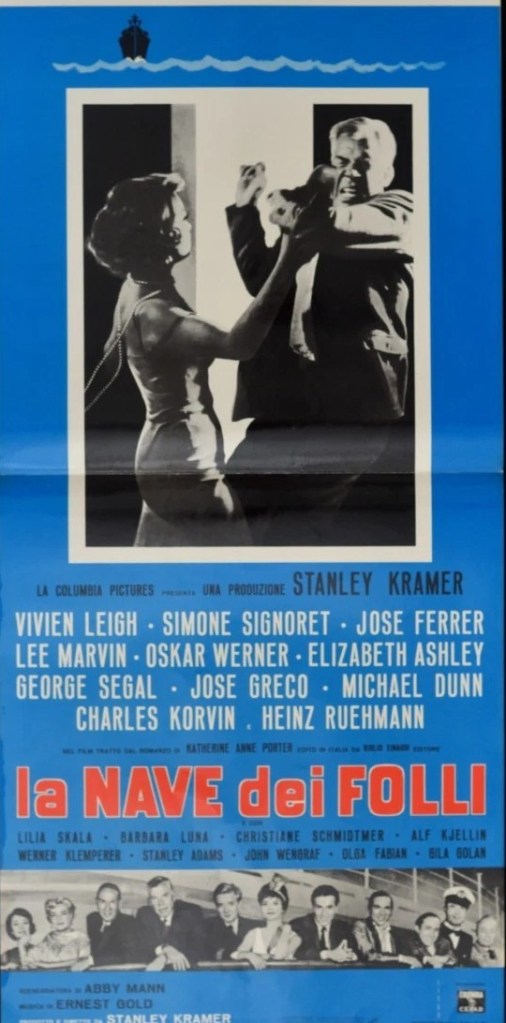
While this fits neatly into Lancaster’s portfolio, it stands out for the wrong reasons in the pantheon of critically-acclaimed actor-turned-director John Cassavetes (Faces, 1968). In fact, what he produced went against what producer Stanley Kramer (better known as a director – Judgment at Nuremberg, for example) wanted and the version we see is the one Kramer recut. Written by Abby Mann (Judgment at Nuremberg) from his original teleplay.
You might expect this to be awash with sentimentality but that’s far from the case.
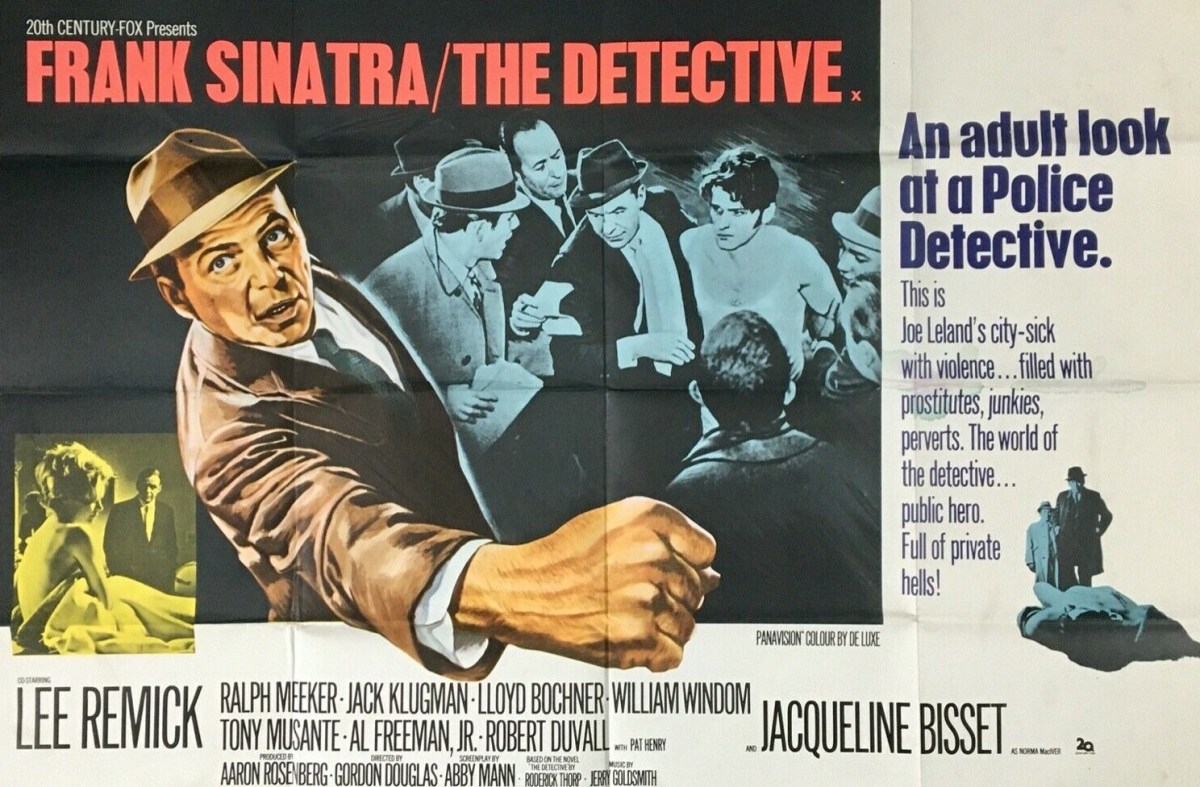
Perhaps the boldest aspect of this raw look at the seamier side of life as a New York cop is that perennial screen loverboy Frank Sinatra plays a cuckold. Prior to what is always considered the more hard-hitting cop pictures of the 1970s – Dirty Harry (1971), The French Connection (1971), Serpico (1973) – this touched upon just about every element of society’s underbelly. Despite an old-school treatment, more a police procedural than anything else, homosexuality, nymphomania, corruption, police brutality, and a system that ensured poverty remained endemic all fell into its maw. And, for the times, several of these issues were dealt with in often sympathetic fashion.
Joe Leland (Frank Sinatra), an ambitious but principled detective gunning for promotion, investigates the murder of a prominent homosexual while dealing with the disintegration of marriage to Karen (Lee Remick) and colleagues on the take. When other cops want to beat confessions out of suspects or strip them naked to humiliate them, Leland intervenes to prevent further brutality. He is not just highly moral, but takes a soft approach to criminals, not just playing the “good cop” part of a good cop/bad cop double-act but genuinely showing sympathy. Not only does Leland leap to the defense of those he feels unfairly treated, but he trades punches with those meting out unfair treatment. In addition, he clearly feels guilt over sending to the electric chair a man he believes should be treated in a mental institution.
Although at first glance this appears a homophobic picture, it is anything but, Leland showing tremendous sympathy towards homosexual suspect Felix (Tony Musante) – whom his colleagues clearly despise – to the extent of holding his hand and gently cajoling him through an interview. Later, rather than condemn a bisexual the film shows empathy for his torment. Certainly, some of the attitudes will appear dated, especially the idea of sexual expression as a brand of deviancy, but the film takes a genuinely even-handed approach. Through the medium of Leland’s perspective, it is clearly demonstrated that it is other police officers who have the warped notions.
Having solved the first murder, Leland takes up the case of an apparent suicide at the behest of widow Norma McIver (Jacqueline Bisset), only for this to lead not only to civic corruption on a large scale but back to the original investigation. Leland also has a wider social perspective than most cops and there is a terrific scene where he berates civic authorities for creating a system that perpetuates poverty. The ending, too, casts new light on Leland’s character.
By this point, most screen cops were defined by their alcoholism and ruined domestic lives, but this is altogether a more tender portrait of an honest cop. Leland’s relationship with Karen is exceptionally well done. Normally, of course, it is the man who strays. This reversal in the infidelity stakes adds a new element. Karen has more in common with an independent woman like the Faye Dunaway character in The Arrangement (1969).
While playing the good cop would come relatively easy to an actor like Sinatra, carrying off the role of the hurt husband is a much tougher ask. Coupled with his sensitive approach to criminals, this is acting of some distinction. This is the last great Hollywood role by Lee Remick (No Way to Treat a Lady, 1968) and she brilliantly portrays a woman trapped by her self-destructive desires.
Jacqueline Bisset leads an excellent supporting cast that includes Jack Klugman (The Split, 1968), Ralph Meeker (The Dirty Dozen, 1967), Robert Duvall (The Godfather, 1972), Lloyd Bochner (Point Blank, 1967) and Al Freeman Jr. (Dutchman, 1966).
While Gordon Douglas (Claudelle Inglish, 1961) was viewed very much as a journeyman director, he brings an inventive approach and some surprising subtleties to the picture. He opens with a very audacious shot. It looks like you are seeing skyscrapers upside down, as if a Christopher Nolan sensibility had entered a time warp, until you realize it is the city reflected off a car roof. There are some bold compositions, often with Sinatra appearing below Remick’s sightline, rather than the normal notion that the star must be taller or at least the same height as everyone else.
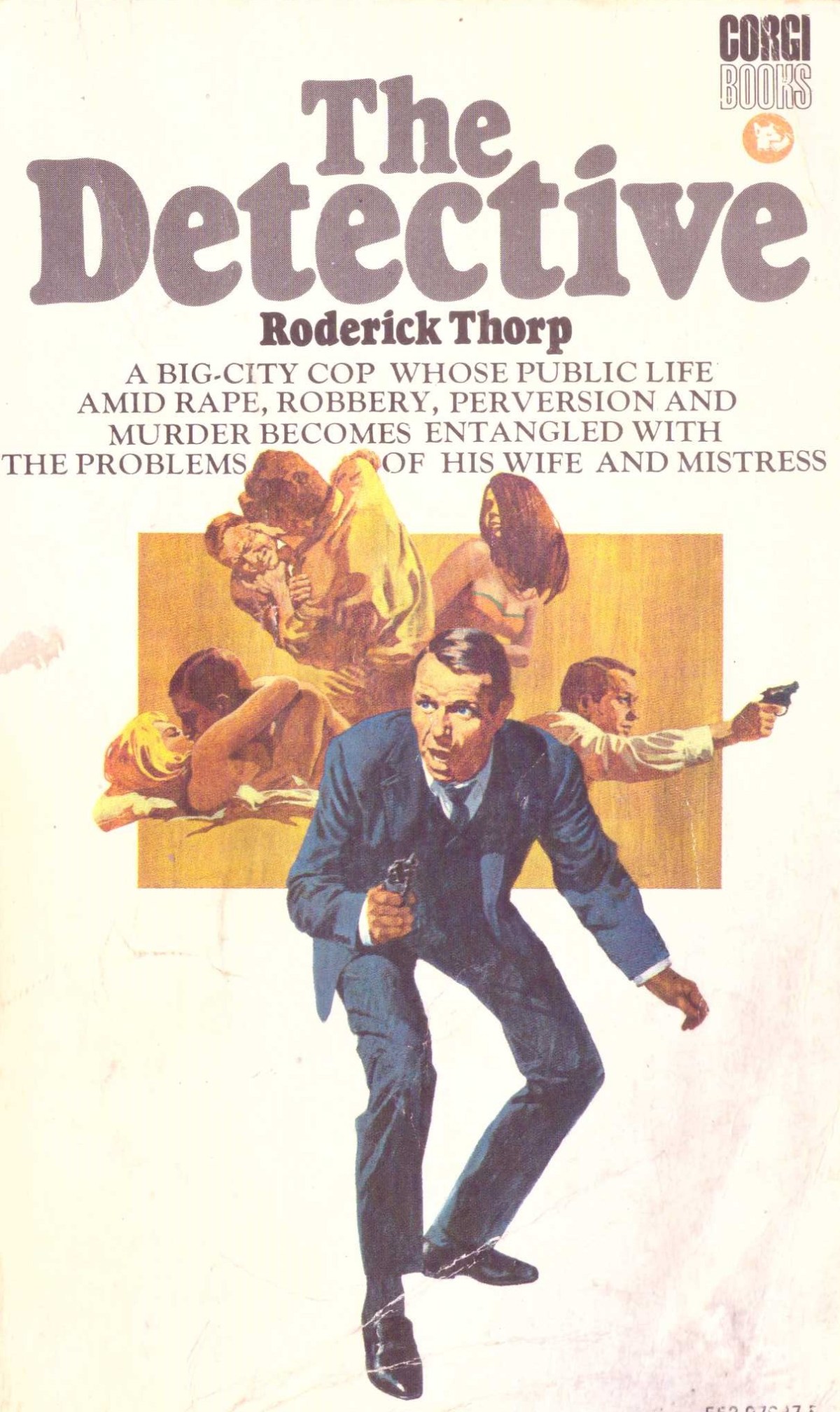
Oscar-winning Abby Mann (The Judgement at Nuremberg, 1961) adapted the bestseller by Roderick Thorp who achieved greater fame much later for writing the source novel for Die Hard (1988). Nothing Lasts Forever was a sequel to The Detective. For the Bruce Willis film Joe Leland became John McClane. Sinatra, although 73 at the time, was offered that role first as part of his original contract for The Detective.
Sinatra’s wife Mia Farrow was initially contracted to play the part of Norma McIver but pulled out when Rosemary’s Baby (1968) overshot its schedule. Partly in revenge, Sinatra sued her for divorce.
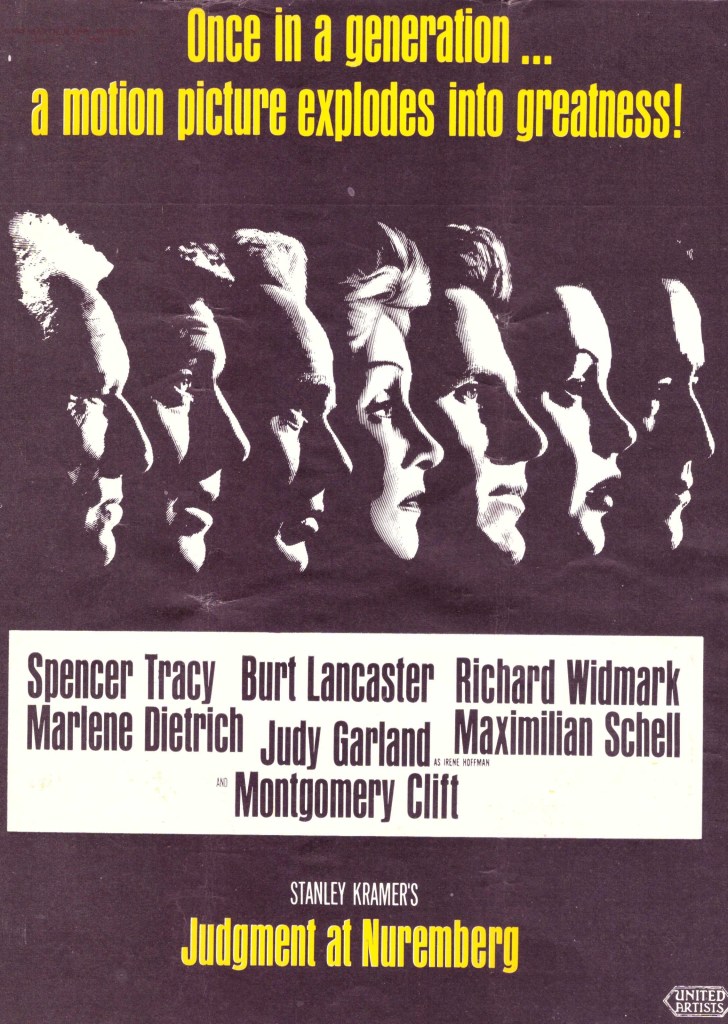
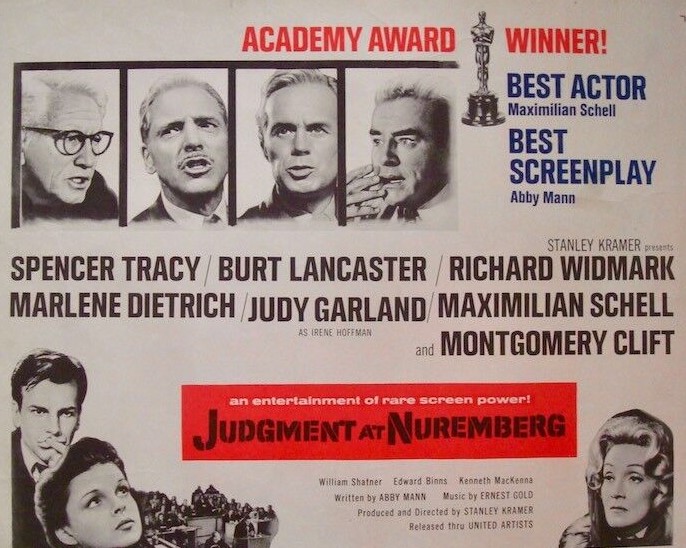
Laurence Olivier could have played a Nazi long before his celebrated villainous turn in Marathon Man (1976). He was producer-director Stanley Kramer’s first choice to play Chief Judge Dr Ernst Janning. He turned the role down in favor of getting married to actress Joan Plowright. Kramer had already decided an all-star cast was required to attract an audience for the grim picture.
The screenplay was an extended version of Abby Mann’s teleplay that had screened on the ABC in 1959. Although Marty (1955) had transitioned with box office and critical success from television to cinemas, that boom was long over.
United Artists, with whom Kramer had a multi-picture deal, were not keen. “I did what looked like a compromise to them, but what I had been planning to do anyway. I promised to fill the cast with stars of such magnitude that their presence would almost guarantee the film wouldn’t lose money.”
There were a couple of other obstacles to overcome. A stage version of the teleplay was being planned for London and Paris and Kramer had to take out an injunction against a documentary with a similar title, Verdict at Nuremberg.
Kramer was known as an issues-driven director, his debut Not As a Stranger (1955) tackling the medical profession, The Defiant Ones (1958) racism and in On the Beach (1959) nuclear war. Along with Otto Preminger, he was viewed as a director of “worthy” pictures, not always a recommendation in the eyes of the critics, but as long as the movies made money and attracted Oscar interest likely to remain attractive to studios. Kramer was just about the only producer (High Noon, 1952, and The Caine Mutiny, 1954, on his calling card) who made a successful career-long transition to direction.
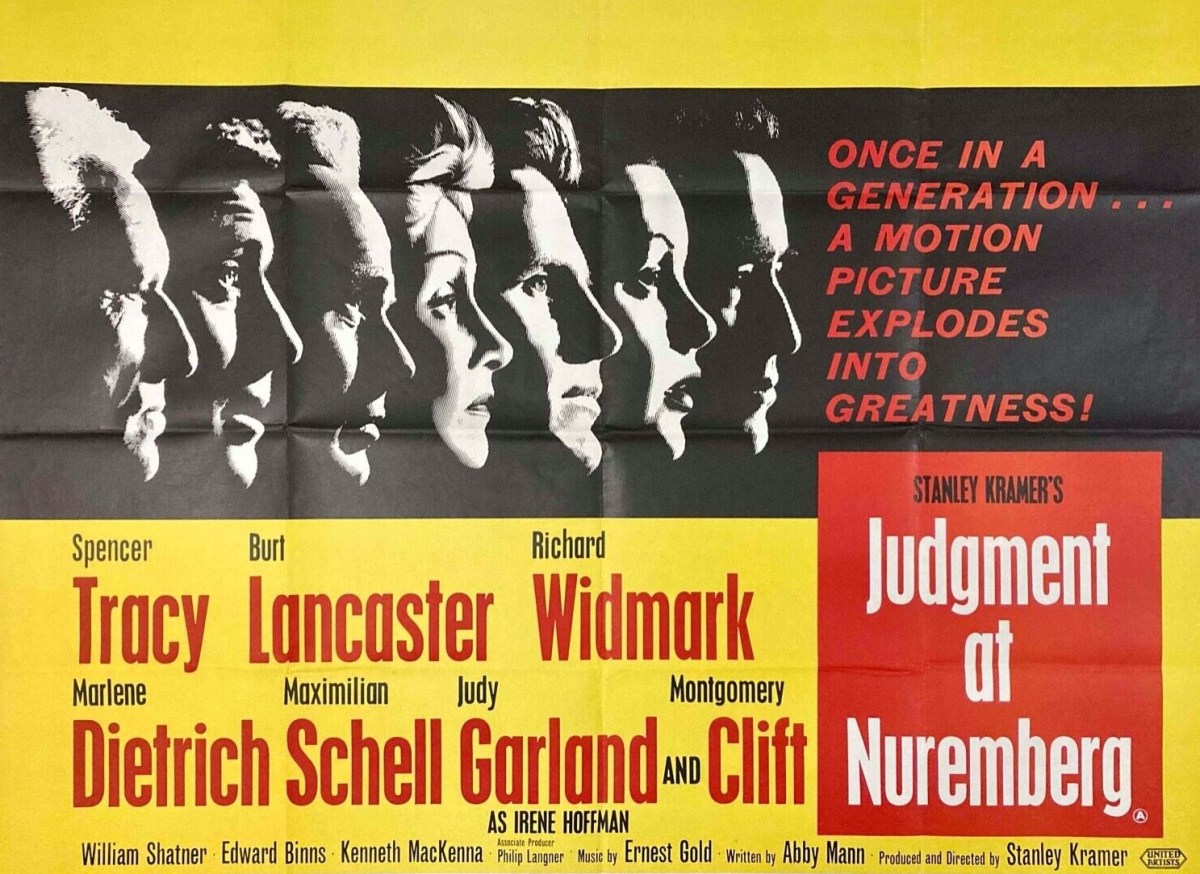
With the exception of Olivier, replaced with Oscar-winner Burt Lancaster (Elmer Gantry, 1960) – not incidentally second choice either, the director preferring to have used a German actor – Kramer hired all his first choices. Spencer Tracy, in fact, was the first recruit. After working with him on Inherit the Wind (1960), Kramer got it into his head when considering a picture to ask himself what part there might be for Tracy.
The actor provided “A depth and candor that would make people notice.” Maximilian Schell (Topkapi, 1964) reprised the role he had essayed on television, a man “living in a complicated gray zone.”
Kramer had a reputation for hiring singers and dancers – Gene Kelly, Fred Astaire, Frank Sinatra – for dramatic roles and he continued in that vein by hiring Judy Garland. It was a difficult decision. He theorized that “the very disorders that made it difficult to work with her fitted perfectly with the role.”
You could have said the same of Montgomery Clift (Freud, 1962), “reduced almost the level of the unsound person he was portraying.” Given the actor’s problems remembering lines, Kramer allowed Clift to basically ad lib, when attacked on the witness stand permitted to reach “for a word in the script” that appeared the correct emotional response to “convey the confusion in the character’s mind.” While Clift did not often adhere to the script, whatever he said worked well enough. Rarely has a director been so sympathetic to a troubled actor. “He needed someone to be terribly kind,” said Kramer, “someone who would consistently bolster his confidence and tell him he was wonderful.
Marlene Dietrich, who had firsthand experience of Nazi Germany at first hand, having fled the country, actually knew the general whose wife she was portraying, which helped to “deepen my understanding of the emotions of Hitler’s victims,” conceded Kramer. Opening up about her experiences and fears allowed Kramer to extend the scope of the character.
While the courtroom where the original trial had taken place was not available for hire – it was in current use – Kramer was permitted to measure and photograph the room to reconstruct it on a soundstage. Only 15 pr cent of the movie was shot in Germany.
The experience of filming Inherit the Wind, another courtroom drama, taught Kramer the need to have fluid camerawork since talk and gesture tends to be static. “I learned to move the camera often to achieve a sense of movement for the viewer.”
Abby Mann was required to open up the teleplay, move the action outside the courtroom – scenes in the judge’s accommodation, on the derelict streets, in restaurants – and avoid cinematic claustrophobia and making it a “pious sermon.” “In my opinion,” argued Kramer, “Judgment at Nuremberg conveys a moral not always honoured, then or now, in the world of politics.”
Kramer had a particular method of pre-production. He built all his sets six weeks before filming began. As part of that process, he sat down with his cinematographer and went through the script scene by scene working out the lighting and camera positions. Then he called in the actors and took them through the sets and roughly his shooting thought-process, taking on board any queries and suggestions. Film like this “sort of demanded it be shot in sequence with a single camera,” explained cinematographer Ernest Laszlo (Fantastic Voyage, 1966).
The 360-degree turning of the camera was not as revolutionary as you might imagine – although, according to critics, Michelangelo Antonioni invented it for The Passenger (1975). Laszlo had done if before on The Hitler Gang (1944) for director John Farrow. But this was infinitely more complicated set-up with the revolving camera in constant use to allow Kramer the required fluidity.
“I used two key lights,” said Laszlo. “Shooting this I used one and then as we went round I used the other.” It wasn’t as simple as it sounds, the lights needed to be positioned with mathematical precision so the audience wasn’t aware of any change in the lighting.
“The circling camera saved us photographically,” said Kramer, preventing the picture from seeming “slow and cerebral.” As smooth as it appears on screen it was cumbersome. The entire crew involved had to carry cables and equipment round in a circle. But it permitted Kramer to pick up the judges without cutting to them.
Kramer also used the camera to achieve another transition. As the picture began, German actors spoke in German (with translators offscreen) to show the trial was mostly in German. But for the movie to work, the dialog needed to be in English. “We started the transition scene with Schell addressing the court in German. Laszlo’s camera zoomed in on him, then turned elsewhere, then turned again to Schell so that we were able to switch his speech from German to English in perfect cadence as the camera came in on him the second time. His English picked up from his German so naturally you could almost let it pass without noticing.”
Kramer conceded there might, in fact, be “too much camera movement.” But that was in part dictated by a “very authentic situation, a long courtroom, very wide, and the spacing between the original attorney’s box and the witness box was at least forty feet. That’s a long distance if your try to photograph it.” Also, it wasn’t like a normal Hollywood or American trial, where the lawyers can prowl in front of judge and jury. Here, the attorneys could not move from their box.
“Unless you want to play ping-pong in the cutting room, you have to move the camera…I felt trapped by these three positions – the judges, the attorneys and the witnesses in that big spread. So, the forty feet was compressed to twenty-eight feet. We had to put a lot of light on the far figures to hold the forms in focus,” resulting in the actors “perspiring a lot during these shots.”
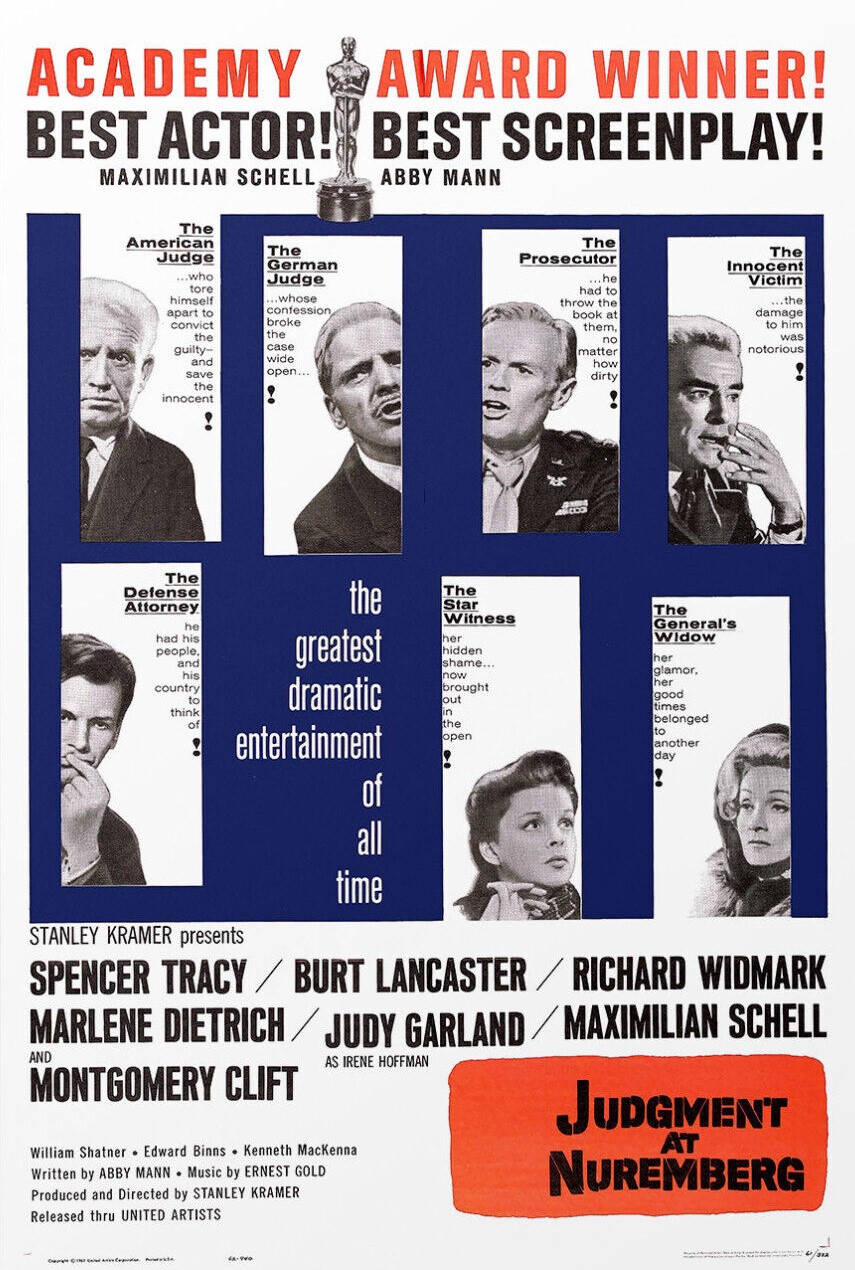
The movie, rolled out as a roadshow, did better than expected, the all-star cast proving a major draw, global box office netting a healthy profit. Schell won the Oscar as did Abby Mann, Kramer was nominated in his dual capacity as producer and director.
SOURCES: Stanley Kramer, It’s a Mad, Mad, Mad, Mad World: Life in Hollywood (Harcourt Brace & Company, 1997) p179-197; Donald Spoto, Stanley Kramer Film Maker (Samuel French, 1990)p230-233; “An AFI Seminar with Ernest Laszlo, American Cinematographer, January 1976, p52; “Judgment at Nuremberg Still Slated for Legit,” Box Office, February 3, 1960, p6; “Kramer Gets Injunction,” Box Office, December 11, 1961, p14.
Stanley Kramer never caught a decent academic/critical break. Subject matter worthy, execution poor, was the overall consensus. But Judgement at Nuremberg, with its long tracking shots, sometimes turning 360 degrees around a character, should have changed all that. But the kind of critics who would have appreciated such bravura technique weren’t around at the time and even when Antonioni’s The Passenger (1975) appeared nobody thought to reference Kramer, believing this was a new cinematic invention by the esteemed Italian maestro.
So, Judgement at Nuremberg is remembered, if at all, for the subject matter and elevated by the performances rather than the director’s input. Most people misremember what the movie’s about. The main concern here isn’t the war criminal, the men personally involved in running the ghettos. Instead, it’s about those behind the scenes who could, theoretically, have prevented the camps flourishing, or at least challenged their opening.
Those on trial were freedom fighters of a different sort. As judges, the top tier of the legal system, their job was not just to uphold law and order and individual freedoms, but to take government to task for illegal action. It’s a basic tenet of the democratic world that governments cannot act in autocratic fashion but work within public accord.
Should the legal guardians find fault with government activity, their job is to take the ruling body to task – the European Court of Human Rights was set up with exactly that principal in mind, and various British and American law agencies have over time called a halt or questioned government proposals.
Some of the judges were clearly ill-fit for the task, lick-spittle jobsworths, desperate to hold onto rank and privilege, many sharing the same anti-semitic views as Hitler. But the Allied forces, being democratic, have to proceed along proper lines, taking potential criminals to court and allowing them legal defence.
So the main target is Dr Ernst Janning (Burt Lancaster), German’s pre-eminent legal force, a quiet, dignified man, who refuses to fawn or react to the charges. On the attack is prosecutor Col Tad Lawson (Richard Widmark). Acting for the defence is the wily, emotional, Hans Rolfe (Maximilian Schell) who is not above comparing the Holocaust to the Americans dropping the atom bomb on Hiroshima, indiscriminate terror brought on innocent civilians the result of both actions. He also brings to the court’s attention the distasteful theories that once held sway in high American legal circles as promulgated by Oliver Wendell Holmes, a Supreme Court judge, whose views on eugenics aimed at withholding procreation rights from the mentally handicapped.
As referee we have Dan Heywood (Spencer Tracy), the American chief judge, who didn’t want the job and was way down the pecking order of those best qualified. And he’s a bit of a detective on the side, trying to discover how much ordinary people – such as the flirtatious Mrs Bertholdt, widow of an executed German general, as well as the housekeeper and butler looking after him in some style – knew about the atrocities as they were taking place.
In the background is an Allied command not wishing to stir up any more controversy, conscious of the rising power of the Communist bloc, seeing West Germany as a bulwark against Stalin, concerned that forcing the country’s inhabitants to wallow in the past will turn their political minds towards the east rather than the west.
In due course, a variety of witnesses are called, testifying to ill-treatment under the German government including the backward Rudolph Pedersen (Montgomery Clift) and Irene Hoffman (Judy Garland).
What makes this so different is that innocence or guilt is not what’s under scrutiny, but reason. Why did such high-minded legal experts like Dr Janning give in to Hitler. And when? And do they recognise their role in providing Hitler with credence to continue with his massacre of the Jews?
Individual conscience and, conversely, collective guilt, might have been the driving force then but they are more than relevant today when actions in war come under even greater scrutiny and politicians are held to account. Perhaps, it’s ironic how little judgement was passed in the end on those convicted in these trials. Nobody was hanged, nobody received even a life sentence. In fact, by the time the movie was released, all were free men.
Stanely Kramer, the Scorsese or Nolan of his era regarding running time (it clocks in a just shy of three hours), does a superb job with his even-handed approach. While his technical skills were perhaps under-appreciated, he certainly knows how to command an audience’s attention and draws terrific performances from his actors.
Maximilian Schell, who won the Oscar, is perceived as the standout, but for me the highpoints were Burt Lancaster (The Swimmer, 1968) and Montgomery Clift (Freud, 1962). Abby Mann’s (The Detective, 1968) screenplay was an expanded version of his teleplay of two years before.
Has more than enough humanity to keep you riveted.
Screenwriter Abby Mann (Judgement at Nuremberg, 1961) had his work cut out adapting Roderick Thorp’s tombstone of a novel that ran to over 500 pages. The first job was to make the book – set mostly in the 1940s – contemporary. The book’s fictional locations of Port Smith and Manitou were transposed to New York. Joe Leland was younger in the book – in his mid-30s compared to the 50-plus Frank Sinatra.
And while the principals remained the same, the screenwriter employed some distinctive structural sleight of hand to keep apart the two investigations occupying Leland, the murder of a homosexual and the apparent suicide of a businessman. In the book the first investigation takes place in the past and is told in a long, detailed, flashback, while the suicide case takes up the present. For the film Mann relocated both crimes to the same timeframe, with the suicide simply following on to the murder.
But there was one distinct change. When Leland in the book investigates the suicide, he is doing so as a private eye, not a cop. He had resigned from the force after seeing a criminal sent to the electric chair. A minor alteration was also involved in the suicide case in that the widow Norma (Jacqueline Bisset in the film) was six months pregnant in the book.
More significantly was the swapping over of the sexual characteristics of Leland’s estranged wife (Lee Remick in the film) and the widow. In the film Remick is the nymphomaniac. In the book, it is the other way round, although Norma, after marriage, has that tendency under control.
Although Leland is a decent enough policeman, he makes none of the overt pitches for decency that occur in the film. That is all Abby Mann’s invention. And the scene in the picture where Leland objects to the stripping of a suspect is lifted from another episode in the book, one in which Leland has no involvement. While incorporating minor aspects from the book such as the annoying politician and civic corruption, Mann invented the atmosphere of the police station, the friction between the various cops and Leland’s ruthless ambition.
As I noted in my Blog on the novel A Cold Wind in August (published in 1960), fiction writers had far greater flexibility as regards sexuality than movie makers and Thorp’s 1966 novel reflects that trend. Although the book falls into the category of police procedural, and Thorp himself worked for his father’s detective agency, the sprawling canvas offers as much insight into human relationships as crime and investigative processes.
In some respects this is a textbook adaptation, stripping away the various layers of a dense book to focus on the essential narrative, then both trimming and expanding the main relationships to suit the new plotline. Virtually unspoken in both book and film are Leland’s reaction to the situations that have arisen as a result of his action, not because the writer in either circumstance was dodging the issues, but because both reader and moviegoer could work it out for themselves without introducing melodrama where it was not required.