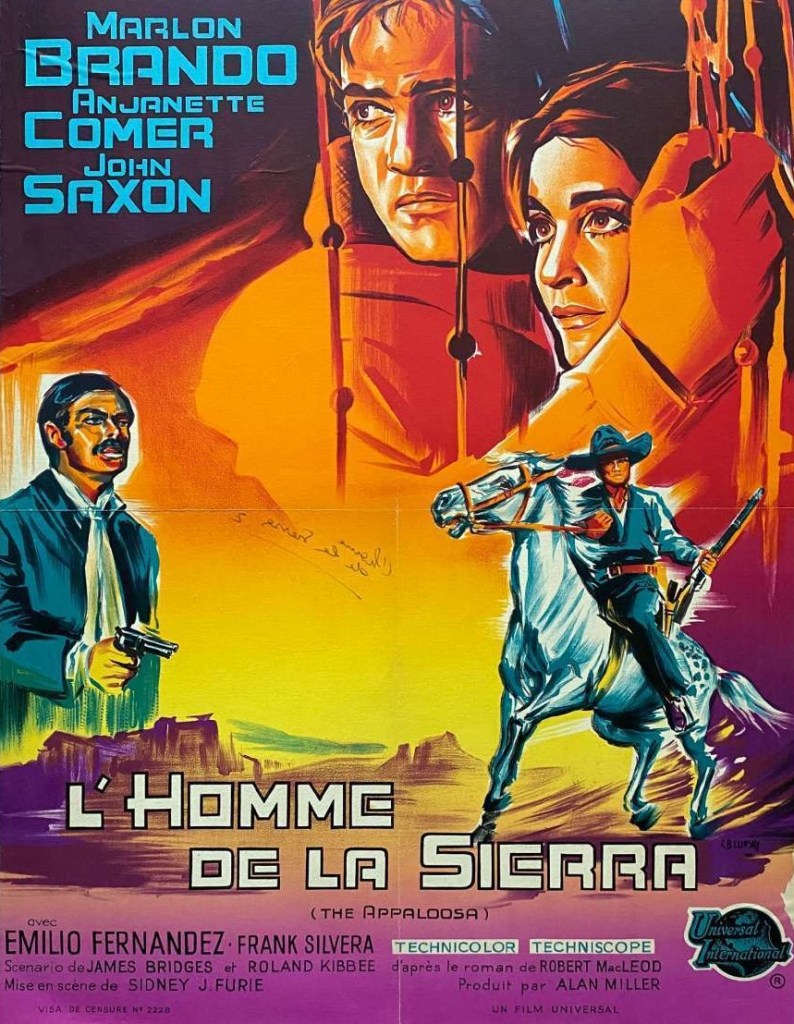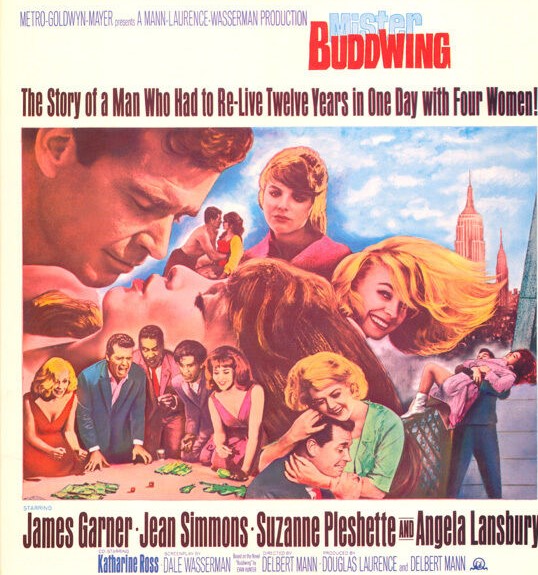
Mister Buddwing/Buddwing (1966) ****

Perhaps it was something in the ether that this very under-rated Kafkaesque examination of fractured identity emerged the same year as John Frankenheimer’s equally maligned Seconds and the year after the more successful Mirage. A superb opening sequence transports us to a world of alienation and discordance, often the only sound that of a man’s footsteps.

Face unseen, yet camera in his point of view, in the early morning a man (James Garner) examines the pockets of his suit, pulling out some pills and a piece of paper with a telephone number, pulls off a ring with the inscription “from G.Y.” He begins to walk, shakily, camera still in his POV until he arrives at an upscale New York hotel and sees himself in the mirror. That doesn’t help. He still doesn’t recognize himself. Using the lobby phone, he calls the telephone number.

It’s a woman called Gloria (Angela Lansbury). She calls him Sam. She gives him her address because that, too, has slipped his memory. Visual stimuli outside make him think his name is Buddwing. Sam Buddwing has a reassuring feel to it.

But when arrives at Gloria’s apartment, she doesn’t recognize him. Though married, she “puts out” so he could be a casual sexual acquaintance. When she pours him coffee, unable to remember how he takes it, he bursts into tears.

And so begins a disturbing odyssey, “a tug of war in his mind,” as he tries to piece together his memory and find his lost self.  Memory is triggered by the sight of a woman across the street getting into a cab. Instinct tells him this is Grace. He follows in another cab, encountering a disgruntled customer who tells him an odd tale about taking a drunken woman to Oyster Bay. She disappears inside Washington Square College. He thinks he might be the escaped mental patient Edward Volloch mentioned in a newspaper headline. Unasked, a man called Schwarz sits down at this table in a cafeteria and suggests he must be Jewish.

He finds “Grace” (Katharine Ross) on a park bench. Even though she fails to recognize him and tells him her name is Janet, he drifts back to his time with the real Grace who cuts his hair on a beach, runs from a downpour into a church. He tells her he wants to become a composer.

When Janet evades him he is confronted by a cop but, of course, has no proof of identity. The scene turns ugly and uglier still when chased by a vagrant  and he starts to see double.

And so it goes on. He finds two more versions of Grace. On hearing of his condition, the first, an actress (Suzanne Pleshette), encourages him to “be what you want to be” while Buddwing opines “we are all impersonating an identity.” The second, a drunk (Jean Simmons) appears to be the source of cab driver’s story

The actress attempts suicide after becoming pregnant, the drunken woman takes him to a crap game, where, taking turns rolling the dice, they win a heap of cash.   

All in all it’s a brilliant jigsaw, avoiding the sci-fi elements of Seconds and the thriller aspects of Mirage, but with the brooding atmosphere of both. But where the character in the Frankenheimer makes a deliberate decision to change identity and Gregory Peck in Mirage is able to put together the various pieces of his life, Buddwing simply stumbles along, totally unconvinced of his identity – at one point he is “nobody” – building up an idea of his life only as an adjunct to the mysterious Grace who keeps changing shape and personality until it seems completely incongruous that the first innocent Grace (Ross) could merge into the more blustery, sexually aggressive, Grace (Simmons).

Of course, when he does discover the truth, by random connection, that’s as shocking as anything else, shattering the somewhat idealized picture of the self he has contrived from the various jumbled meetings with the various disconnected women. Equally, the ending could be another illusion.

This might also play out as a metaphor for the screen life of James Garner (The Americanization of Emily, 1964) who had been trying to rid himself, not entirely successfully, of his previous persona as Maverick in the television series. His company, Cherokee, co-produced the picture, which smacks of the same determination to be taken more seriously as Rock Hudson with Seconds, a move that did not go down well for either with public or critics. But Garner is every bit as good as Hudson and he spends much of the film either in  hollow-eyed bafflement or in idyllic circumstance on the cusp of turning sour.

Once Angela Lansbury appears, you get the sense this is going to be episodic and that the female cast will appear in the reverse order of their billing. But Katharine Ross (Tell Them Willie Boy Is Here, 1969) apart, a newcomer, the other three more experienced actresses rip up their screen personas. Angela Lansbury (Harlow, 1965) is an addled woman of easy virtue.  Suzanne Pleshette (A Rage to Live, 1965) takes her character to suicidal levels while Jeans Simmons (A Rough Night in Jericho, 1968), especially notable, essays her inner dirty-mouthed drunken Elizabeth Taylor.

And this is hardly the stuff director Delbert Mann (Fitzwilly, 1967) is made of, despite an Oscar for Marty (1955) better known for light comedy. But he never takes the easy way out, sticking it to Buddwing as a man endlessly tormented by himself. Dale Wasserman (Quick Before It Melts, 1964) wrote the tantalizing script from the bestseller by Evan Hunter (Last Summer, 1969).

A mesmerizing watch and time it was given the same retrospective treatment as the cult Seconds.
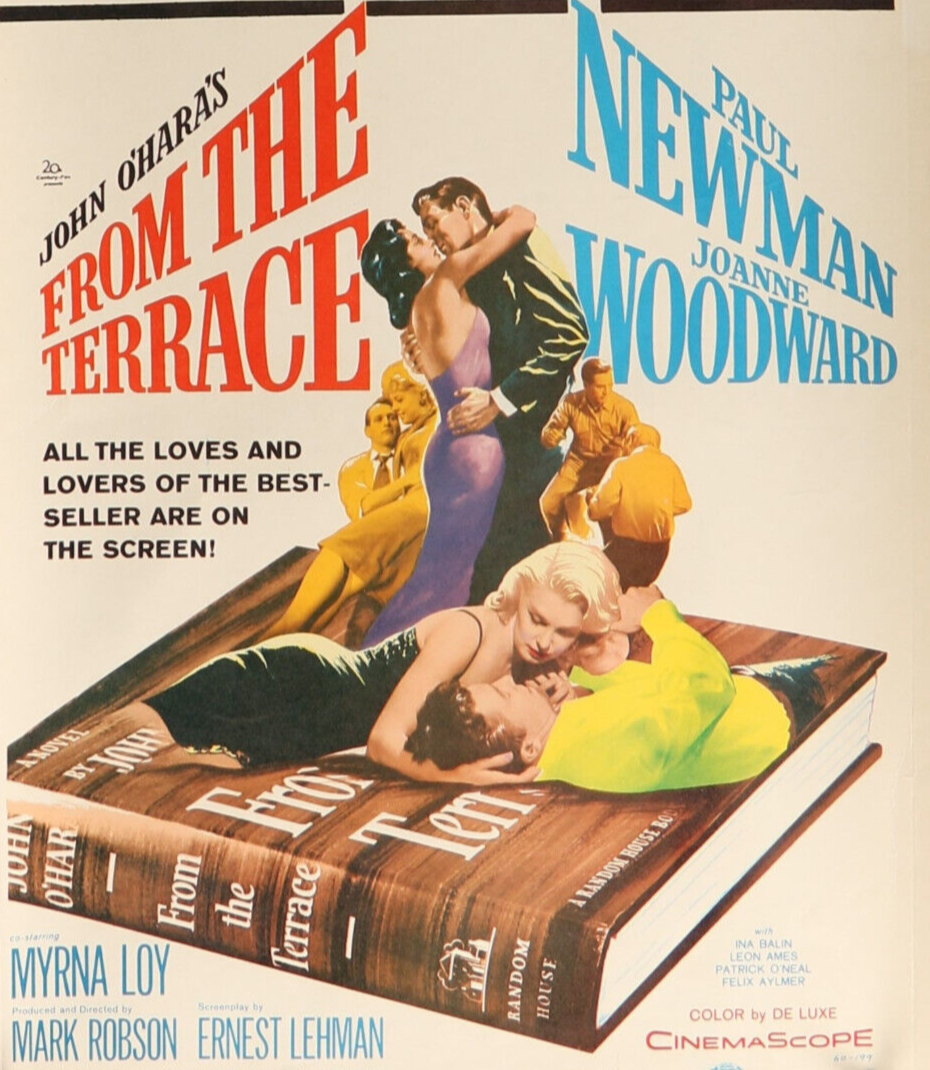
From the Terrace (1960) ***

When your plot pivots on the hero diving into an icy pond to save the grandchild of a Wall St multi-millionaire – and reaping the career benefits – you are kind of in trouble. Not as much, though, as having a self-righteous hypocritical prig of a hero who lacks the self-awareness,  a mark of the John O’Hara bestseller on which the film is based, to realize he is turning into a carbon copy of his father.

But it is handsomely-mounted and a decent enough melodrama with an excellent cast, though you would have to say, given the better material, Joanne Woodward (A Big Hand for the Little Lady, 1966) out-acts husband Paul Newman (The Prize, 1963), adding a rather contemporary element of a free-loving wife who manipulates the constraints of an era (post WW2) when divorce in high society was highly frowned-upon.

It’s a shame it drifts into predicable melodrama because the initial stages are niftily put together. A woman (Myrna Loy) is found dead drunk on a train, steel magnate husband Samuel (Leon Ames) ensuring he is not at home for her return, both actions meaning nobody is there to welcome only son David Alfred Eaton (known as Alfred at the start of the film and David at the end for odd reasons) when he returns from the war.

A few quick scenes establish that: the father holds a grudge against the living son because he has not got over his dead son;  he has ignored his wife in favor of his career; he bullies his staff; the wife has embarked on an affair.

David Alfred’s character is quickly established: he refuses to be stiffed by a cab driver; is adored by the household staff; refuses to work in his father’s business; and beats up his mother’s lover.

After that, for all the emotional shifts through the gears, it slows down, not so laborious as devoting too much time to the inner workings of high society – O’Hara’s metier – rather than the new small-plane-building business into which David Alfred pours his energy. That is, if he has much energy left over after stealing Mary (Joanne Woodward) from fiancé Jim (Patrick O’Neal), a psychiatrist.

You are probably already aware that society operates in various strata. A mill owner is only on the verge of society and looked down upon by the likes of Mary’s wealthier parents who in turn are no match for the grand life enjoyed by the aforementioned Wall St broker MacHardie (Felix Aylmer). Snobbery is rife and money talks. And if you lack the dough you’ve got no say in anything as David Alfred discovers in an aeronautical business venture, his partner Lex (George Grizzard), who has put up all the money, excluding him from key decisions.

Luckily, while driving in the countryside there’s a drowning child to be rescued and a grateful grandfather willing to set you up in his business. But that means sacrifice. David Alfred is away from home so much his neglected wife instead of turning to alcohol merely turns to men. There’s a wonderful scene when after a telephone call with her husband promising not to see Jim again (at this point no impropriety apparently committed as far as David Alfred is concerned), Mary lies down on the bed and turns to an unseen figure and says, “You’re not to come up here any more.”

But there are too few scenes so slickly written. On a job in Pennsylvania David Alfred falls for industrialist’s daughter Natalie (Ina Balin), and as though this is key to their romance tells her to call him David rather than Alfred. As his stock rises in the company, he maintains a hypocritical front with his wife, who he knows is now engaged in various affairs, denying her suspicions that he is having a fling with Natalie.  Mary is quite happy to maintain an open marriage since her status depends on her husband’s position and she still quite fancies him now and then.

You can see how this is going to end, but self-righteousness allows David Alfred to ignore that he is merely repeating the mistakes of his father. In sharp contrast to his wife who is all too conscious of her failings but contrives to make the best of the situation, and would happily continue in an unhappy marriage if only he would play ball. Although nothing is made of this, it’s obvious that David Alfred, despite his progress in the Wall St company, doesn’t have the business cojones of his father. He quit the plane business because Lex wanted to spend more time perfecting the prototype rather than rushing to the market in order to make money quickly. By following his own instinct, Lex is later proved correct, the business grown so big it attracts the attention of MacHardie.

There’s a sense here of Paul Newman pulling his shots. Though he is ruthless in making wife play second fiddle to career, and has no qualms really about playing away from home, nor about edging out MacHardie’s ineffectual son-in-law from the business, he lacks the killer instinct. The ruthlessness and amorality that made The Hustler (1961) and Hud (1962) so enjoyable is sadly missing. Handsome box office idols – the likes of William Holden apart – were reluctant to play the devious.

Mark Robson (Von Ryan’s Express, 1965) directs as if this is an upmarket Peyton Place and can’t resist at least one close-up of Newman’s baby blues. The script by Ernest Lehman (The Prize) only occasionally sparkles but I suspect there was a lot to trim from the O’Hara doorstopper. As I said, Joanne Woodward is the stand-out and you will be surprised to learn that Patrick O’Neal is also minus his later ruthless screen persona. Felix Aylmer (Masquerade, 1965) and Ina Balin (The Commancheros, 1961) are the pick of the supporting cast.

An interesting more than a riveting watch, mostly to see Newman before he reached screen maturity.

No Highway in the Sky / No Highway (1951) ****

Having just read the Nevil Shute novel on which this movie is based, I was keen to see how it transferred to the screen. It got off to a great start with the casting. James Stewart was several classes above the author’s  description of the main character, but Marlene Dietrich more than fitted the bill of the Hollywood star as a passenger in the early days of Transatlantic air travel.

Widowed aeronautics research engineer Dr Honey (James Stewart), accent explained by him being a Rhodes Scholar who stayed on in Britain, is so absent-minded that he tries to enter a neighbor’s house and when he gets angry in a discussion with a visitor to his own house puts on his hat and coat and decides to leave. He has discovered a potential flaw in a new range of British airplanes and is despatched by boss Dennis Scott (Jack Hawkins) to Canada to examine the remains of a crashed prototype, the accident previously ascribed to pilot error.

It was called “No Highway” in Britain as that was the title of the novel.

However, once on board, he discovers the plane is perilously close to the danger level of flying time his research indicated. In between frightening the life out of stewardess Marjorie (Glynis Johns) and star Monica (Marlene Dietrich) with his predictions of doom and instructing them where best to hide in the plane in the event of crash-landing in the ocean, he tries to get the pilot to turn back. When that fails, he inadvertently charms the life out of stewardess and star.

When the plane lands, even closer to the danger zone in terms of flying hours, and still no one listening to his concerns, he manages to render the plane unflyable. The aeroplane company refuses to fly him home, leaving him stranded. That provides enough time for Monica and then Marjorie to turn up unannounced at his home in England to help look after his young daughter Elspeth (Janette Scott). When Honey finally returns, he faces an inquiry, and looks set to lose his job, virtually unemployable thanks to his antics in Canada. At the last minute, he is reprieved, fresh evidence from the crashed plane proving his research correct.

Meanwhile, Monica, forced to return to Hollywood, loses out in the battle for Honey’s affections. Marjorie, a former nurse and imminently more practical, is in any case better placed to help look after a growing girl, and eventually Honey sees sense and asks her to marry him.

Really well done with terrific performances all around, but vastly helped by the screenwriters who dumped three sub-plots in order to stick to the knitting of the tale. Honey, far removed from the man in the street persona that saw James Stewart through his Frank Capra movies, attracted female interest through his principled stand. Most importantly, the writers removed the section where Elspeth is seriously ill in her father’s absence. Secondly, in the book Scott was sent to Canada to find the crashed plane, involving a trek through perilous terrain, but that’s been excised, the search completed off-screen by others, the vital information relayed by letter. Thirdly, the remains of the tail, which had previously not been found, were located in the book by supernatural means, Elspeth being called upon to use a planchette to help find it.

In removing all this material, the movie is re-shaped partly as a Capra movie, with the downtrodden Honey achieving success through persistence, but, more importantly, allowing the movie to focus on the potential love interest. Needless to say that is determinedly old-fashioned, both women having forged successful careers now viewing work that was initially exciting rapidly pall. The book sets Monica thinking how much better life would have been if as a humble office girl she had married the kind but not handsome man who had caught her eye instead of now being thrice-divorced. Marjorie is even more old-fashioned, seeing a genius who needs looked after as much as his daughter requires a mother.

So there’s no point going anywhere near this if you’re not willing to accept a past where a woman’s role was primarily seen as a home-maker. But don’t jump to pointing the finger at the author as being equally old-fashioned because a later book, A Town Like Alice, not only turns the main character into a war hero but depicts her as a successful entrepreneur.

James Stewart (The Rare Breed, 1965) takes a considerable chance on playing the absent-minded professor but his endless well of screen charm allows him to pull it off brilliantly. Marlene Dietrich, top-billed when teamed with Stewart for Destry Rides Again (1939), has an excellent role as a rueful prima donna. Glynis Johns (Lock Up your Daughters!, 1969) is equally at home with a part that calls for her not to just fall at Honey’s feet. She was one of handful of British rising stars. Jack Hawkins (Masquerade, 1965) was on the cusp of being named Britain’s biggest box office attraction while Kenneth More (The Comedy Man, 1964) was a few years away from receiving that honor. Janette Scott (Day of the Triffids, 1963) gave notice of her talent.

As much as James Stewart’s career was linked to Frank Capra and Alfred Hitchcock, Henry Koster (Mr Hobbs Takes a Vacation, 1962) made five pictures with the actor, all excepting this comedies, including Harvey (1950). He does a fine job of keeping Stewart from spinning away too much in the direction of the geek professor and keeping the story pinned down.

Nevil Shute was an engineer to trade – he had worked in the British airship industry – so his books tend to be peppered with the scientific. That’s easy to digest when reading, but harder to absorb when watching a movie. R.C. Sheriff (The Dam Busters, 1955) and Oscar Millard (Angel Face, 1952) do an excellent job of condensing the novel, finding cinematic ways of getting across important material.

I had come at this, as I said, mainly to see how the author’s work was translated to the screen, but came away totally absorbed in a fine picture. What was left out helped the picture while the author’s later A Town Like Alice (1956) lost half its power by ending halfway through the original story which later saw the courageous heroine go onto to become a serial entrepreneur in a male-dominated society in Australia.

Obviously, I’ve deviated from my chosen field of 1960s pictures, but this is well worth a watch.

You can catch it on YouTube in a number of versions – the original, a colorized version, one with English subtitles and one where a musician has made his own edit and dubbed his own modern score on the picture.

Behind the Scenes: The Roadshow Conundrum

Widescreen – Cinemascope, Vistavision et al – had brought audiences back to the cinema in the 1950s so the next decade, with box office cratering, Hollywood doubled down on an even bigger concept, big-budget 70mm extravaganzas, sometimes with the added benefit of Cinerama, to be shown in separate performances (two shows a day rather than four or five) which challenged the prevalent continuous performance system of exhibition.

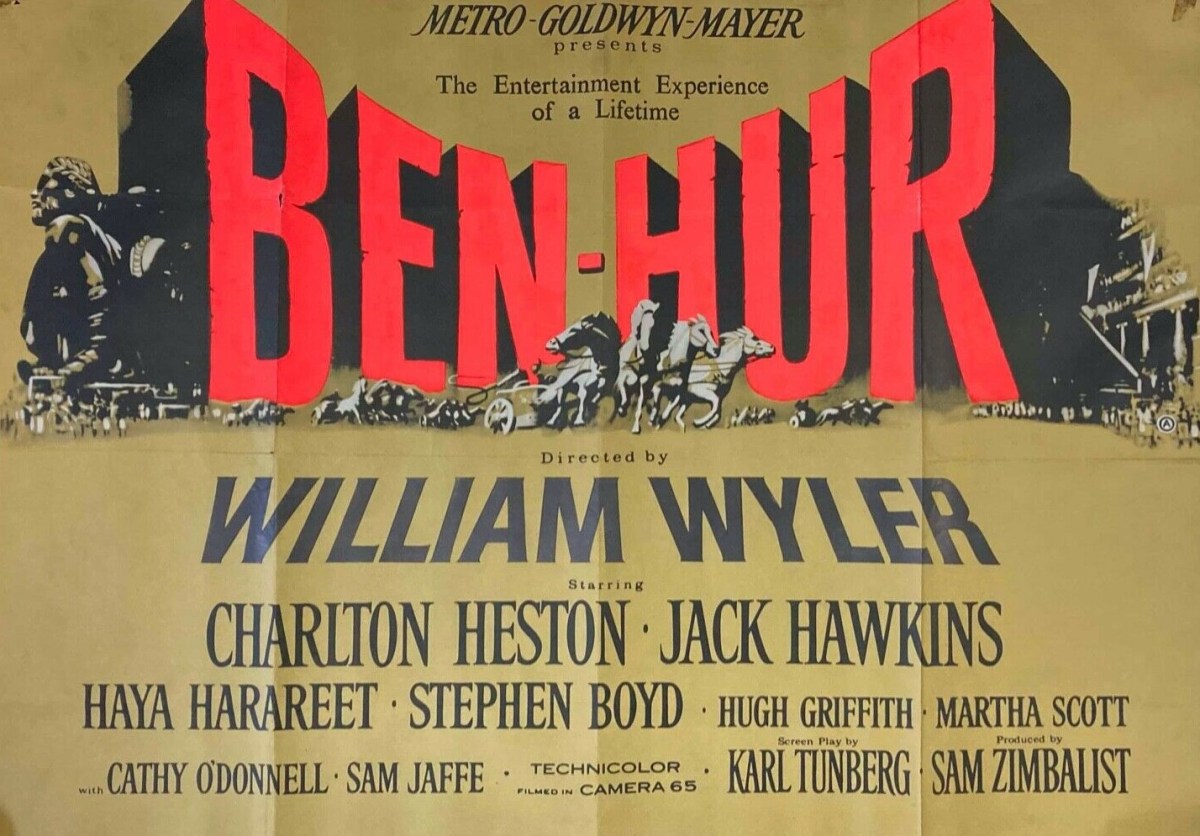
From an academic perspective the project appeared – with minor hiccups – a major success as Ben Hur (1959) gave way to West Side Story (1961), Lawrence of Arabia (1962) and How the West Was Won (1962)and from there to the solid gold box office of The Sound of Music and Doctor Zhivago (both 1965). But there were obstacles to overcome.

Firstly, you needed the cinemas. The U.S. had little problem filling that need, exhibition was going through an explosion on a scale unseen since 1950. From 1961 work began on building 170 cinemas and 72 drive-ins and the rate of construction would scarcely abate for the rest of the decade, allowing plenty room for houses to decide to pitch their tent as roadshow cinemas. It was the oppsite situation in the United Kingdom, with hardly any cinemas beng planned. most of what were termed new cinemas little more than the converation of a giant cinema into two or three more screens. In Glasgow, for example, the Coliseum which revamped in a 70mm Cinerama house was nothing more than a redeployment of an existing cinema while the ABC2 towards the end of the decad was built by splitting the existing ABC Regal. In Britain roadshow capacity was constrained compared to the American experience.

Secondly, cinemas had to install the expensive 70mm projection equipment, though the prospect of increased ticket prices generally softened the blow of that outlay.

Thirdly, And then studios had to find enough cinemas willing to fall in with their concept and agree to hand over their houses for the long runs deemed essential to the success of these movie behemoths, often clocking in around the three-hour mark.

Follow the release of the roadshows in the world’s biggest cities like New York, London, Paris and Tokyo and you will find there was no shortage of cinemas willing to accommodate the grand plan. But go further afield, beyond areas where academics and historians usually pitch their tents, and you will find a different story.

Until recently, I had been one of the historians who accepted the notion that roadshow fitted seamlessly into the exhibition business, that 70mm pictures ran for months – if not years – at a time in countless venues worldwide. But when I started to examine the roadshow from the perspective of my home town of Glasgow, in Scotland –  the country’s biggest city and outside of London the one with the biggest appetite for movies – I found a different story. And I wonder if that experience was replicated all over the world rather than the previously accepted model.

At the start of the 1960s Glasgow – whose ten first run cinemas lay along two intersecting streets – boasted just one roadshow house, the Gaumont, which currently, and for the previous 18 months, had been showing South Pacific (1958). The Gaumont only scheduled nine shows a week, one per evening plus matinees on three days, rather than the 12 or 15 shows a week more likely in New York or London. One of the roadshow’s big selling points – films playing until demand ceased – was also its Achilles heel. A movie that performed as well as expected could not be shifted. So there was no room at the cinematic inn for the flurry of roadshows headed Glasgow’s way. There was going to be an unavoidable queue unless distributors did the unthinkable and skipped roadshow in favour of general release.

The situation wasn’t helped by the British deciding that movies not made with roadshow in mind such as The Nun’s Story (1959) should be given the separate performance increased price treatment.

For a time in Glasgow the ABC Regal in Sauchiehall St – along with the Odeon in Renfield St the city’s most dominant picture house – offered temporary relief. In fact it had already stepped into the breach for The Nun’s Story. But since the Regal was the jewel in the crown of the ABC chain’s distribution network in the West of Scotland that caused further release issues. Independent arthouse the Cosmo was also willing to step up to the plate, hosting the two-year-old Gigi (1958).

But it wasn’t until September 19, 1960, that Ben-Hur (1959), considered the hottest picture on the planet, was given an opening at the Regal. That was good news and bad news. It ran for nine months which was great for the Regal but it caused a massive backlog in the ABC circuit which had to offload top product to rival cinemas. The Regal was clearly so crucial to the ABC operation that it didn’t dip its toes into roadshow waters for another year, for King of Kings (1961), but at Xmas rather than Easter which possibly accounted for its poor performance – only five weeks of a run. Before the ABC Coliseum reopened as a roadshow/Cinerama venue in September 1963 with MGM’s How the West Was Won (1962) – almost a year after its London opening – the only roadshow given screen-time at the Regal was Mutiny on the Bounty (1962) which ran for six weeks.

But with the Regal refusing to play ball most of the time, what happened to the rest of the industry’s roadshow releases? The Gaumont took what it could – Lawrence of Arabia (26 weeks), The Longest Day (23), Can-Can (18), Spartacus (15), West Side Story (14), The Alamo (13) and El Cid (13) the standouts, playing for a “season” or more. Exodus and Judgement at Nuremberg were poorly received, just three and two weeks respectively.

And that was the final flaw in the Hollywood grand notion. When these big roadshow movies hit a box office brick wall, the cinemas primed to receive the product had to find other movies to prop up the system. The idea of being just an occasional source for roadshow might work for the likes of the ABC Regal, but provided an unnecessary complication for the Gaumont, the city’s de facto roadshow house. It was helped out by movies made in 70mm  that American distributors quickly shuffled into general release such as Barabbas, which ran in Glasgow for seven weeks at the Gaumont.

To plug holes left by lack of audience interest in the likes of Exodus or Judgement at Nuremberg, the Gaumont simply improvised. Solomon and Sheba was not made with roadshow in mind but with big stars in Yul Brynner and Gina Lollobrigida, a Biblical setting and healthy running time, it was deemed worthy of roadshow, running for nine weeks.

A less obvious contender for roadshow was The Guns of Navarone, but the excellent cast and British tub-thumping turned it into a contender and it ran for a quite astonishing 21 weeks, especially as that included more performances than usual, a matinee every day rather than three allocated days.

The appearance of Psycho at the Gaumont was a clever trick. Alfred Hitchcock had determined that the film, to maintain its shock value  and for the publicity value of such a move, must be shown out of the standard continuous performance system. To fulfil that obligation it ran as a separate performance number and at the only cinema in town known for regularly taking that exhibition route, so less of a shock to the public, but with three performances a day to meet demand. That as another nine weeks eaten up.

For the rest of the time, when the roadshow well was dry or failed to hit box office targets, Gaumont simply turned general releases into roadshow, 35mm and all. Song without End starring Dirk Bogarde ran for four weeks, Tunes of Glory with Alec Guinness and John Mills locking horns.  Some pictures, deemed too weak for roadshow, like Cimarron, Pepe and Gypsy were simply chucked into general release in Glasgow.

Once the production of roadshows hit its stride in the mid-60s, with both the Gaumont and Coliseum in play, most of the 70mm features found a home, the Regal called in occasionally to help out (as with My Fair Lady and Cheyenne Autumn)  although the British predilection for blowing up 35mm movies given a general release in the U.S. to fit the 70mm roadshow format (The Dirty Dozen and Where Eagles Dare the most notable) meant demand always outstripped supply.

The roadshow business also served to highlight differences between cities. The length of time a roadshow picture ran was never consistent and some of the difference were quite marked, a film that was a huge success in one city not quite as sterling a performer in another.

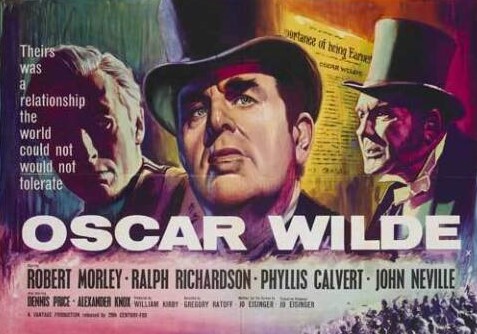
Oscar Wilde (1960) ****

You might be surprised to learn there were two Oscar Wildes. Not the famed writer and a doppelganger of course but two films on the same subject that were released in the same month. This is the low-rent version, costing a fraction of the rival The Trials of Oscar Wilde directed by Ken Hughes. It’s easy to be disdainful of the cheaper effort, with little cash available for scenery and costumes, but somehow it rises above budget limitations. Structurally, both movies focus on the trial – or in the case of The Trials of Oscar Wilde the three trials he endured – but the glossier pictures it has to be said glosses over a great deal.

While I enjoyed it at the time, I now find that in trying to make a modern martyr out of Oscar Wilde, the Ken Hughes picture built him up so much that it was difficult to find any flaw in his character. We never find out what was the actual slur the Marquis of Queensbury made on Wilde, resulting the playwright taking him to court for libel. And that version begins with Wilde and Alfred Lord Douglas (“Bosie”), son of the Marquis, already deep into their affair.

On the other hand, Oscar Wilde, the final film of Hollywood veteran director Gregory Ratoff (Intermezzo, 1939), starts at the beginning of their relationship with greater emphasis on Wilde’s practicality rather than his wit and Bosie’s (John Neville) tortured relationship with  his hypocritical father (Edward Chapman) who, while taking the moral high ground, keeps a mistress. On Wilde (Robert Morley) being described as a sodomite by the Marquis, Bosie’s desire to see his father humiliated in court verges on revenge. “You weren’t looking for a friend,” Wilde astutely tells his lover, “You were looking for a weapon.” Bosie is big on humiliation – he is the one to break the news of Wilde’s duplicity to the author’s wife (Phyllis Calvert). So determined is he on the court case that he fails to tell Wilde that his father has private detectives scouring London to find evidence.

While in court Wilde can keep the jury in stitches with his epigrams, he soon comes up against the Marquis’s formidable lawyer Sir Edward Carson (a quite stunning performance by Ralph Richardson). From Carson we learn a great deal more of Wilde’s practices, some of which nowadays would be termed grooming. Essentially, Carson paints a portrait of a predator, an older man (Wilde was 41) whose uses his wealth and wit to court many lovers, mostly aged around 20, but some as young as 16, barely the age of consent.. And when he felt his secret life was in danger of being exposed, he went so far as to pay for the passage to America of one of his lovers, Alfred Woods, to get him out of the way.

No matter that Wilde at the start can gloss over his promiscuity, complaining that Carson is misinterpreting innocent gestures of friendship, the cunning attorney soon has the author tied in knots as he wheels out one by one information regarding the various lovers.

It’s quite odd to realise that The Trials of Oscar Wilde in presenting the more accurate truth – that the author underwent three trials – fails to provide little more than a surface treatment of  the man’s real-life affairs. Oscar Wilde perhaps delves too deeply for audiences brought up to consider the author a martyr who deserves the free pass allocated all writers of genius. I found Oscar Wilde the more riveting watch because, of course, I already knew the outcome, but the sight of the famed writer, encouraged by the vengeful Bosie,  hung out to dry by his own hubris, and for a man of such wit to be outwitted in the courtroom by Carson was an exceptional watch.

Of course, the imprisonment of Wilde for the crime of being a homosexual is detestable. Even at the point this film was made homosexuality was a crime. So it’s fascinating to see how much The Trials of Oscar Wilde skirts round issues that Oscar Wilde had little problem in spelling out.

I was surprised how much I enjoyed Robert Morley’s performance. I may be wrong, but I think this was the only time he was accorded leading man status. Mostly, he was a supporting actor (The African Queen, 1951, say, or Genghis Khan, 1965) and often just playing a version of his self. Of course, he is outshone by a simply brilliant Ralph Richardson (Khartoum, 1966). John Neville (A Study in Terror, 1965) presents a more in-depth performance than in the rival picture. One-time British box office star Phyllis Calvert (The Golden Madonna, 1949) does well in a small but pivotal role. You might also spot Dennis Price (Tunes of Glory, 1960) and Alexander Knox (Mister Moses, 1965).

Lacking a budget to do much more, Gregory Ratoff sticks to the detail and draws out two superb performances, aided by a tight script by Jo Eisinger (Gilda, 1946; Cold Sweat, 1970) based on the play by Leslie and Sewell Stokes and the work of Frank Harris. As swansongs go, this is hard to beat.

Vastly underrated.

Catch it on YouTube.

NOTE: Oscar Wilde appeared in first run in Glasgow at the La Scala cinema in June 1960 one week ahead of The Trials of Oscar Wilde at the first run ABC Regal and ABC Coliseum.

Planet of the Apes (1968) *****

Still astonishing that the two movies that rocked sci-fi to its core came out the same year. Initially beloved mostly by dopeheads 2001: A Space Odyssey quickly achieved ultra-academic status. But it’s difficult to ignore the fact that that Planet of the Apes had the greater long-term effect, given it spawned umpteen sequels and two sets of remakes.

You could also argue that the concept is even bolder than the Kubrick, not just man’s treatment of animals, but the idea of man being subject to a superior species, and inside an action-packed picture there’s plenty of time to digest the unimaginable and engage in debate about the nature of man. The elevator pitch might have been: “Take Hollywood’s strongest hero and torture him one way or another.”

Part of the movie’s genius is the unsettling opening, swirling, almost deranged, camerawork, a discordant score, the confident occupants of a spacecraft heading into the unknown finding the kind of unknown that fills them with dread rather than awe. Two thousand years into the future a spaceship doesn’t gently touch-down on a strange planet, but crashes into it, luckily landing in a lake, the three survivors escaping the sinking craft.

The audience knows a great deal more than they do, that the arid desert in which they find themselves stretches everywhere. But then they realize, with supplies that will last only three days, the soil here will not support life. But they are quickly upbeat when they find a small plant followed by substantial greenery. The sight of crucified figures on a hill is put to one side when they hear running water and rush to dive naked into a pool, confidence restored that they won’t die of thirst and should at least be able to eat vegetable matter.

The pool is a clever reversal. Usually open water is there for a female to disport herself. Now we’re seeing Charlton Heston’s bare backside. And another reversal: when clothes disappear it’s usually so a female has to come out of the water exposed.

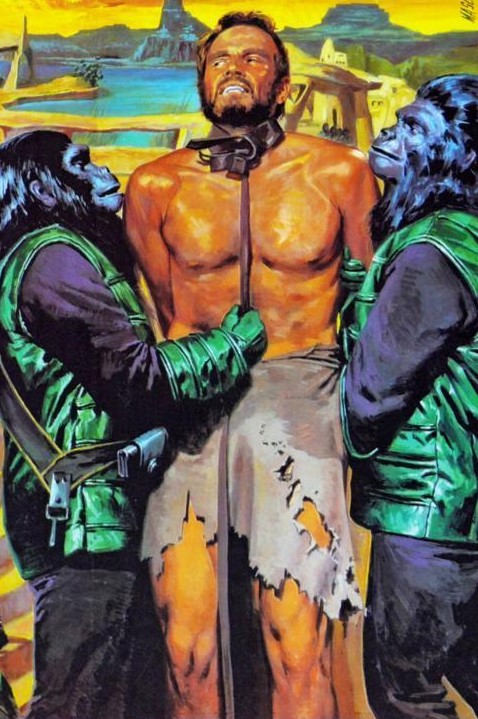
But from the sight of the crucified apes, for the next seven minutes, their world is completely turned upside down. Chasing after their clothes they find inhabitants, automatically assumed to be inferior because they are mute and dressed like cavemen. But then the tribe hears a noise and panics. We see horses hooves, the tops of the flailing sticks used to beat prey out from the undergrowth, rifles, the natives, like dumb beasts, being driven into nets.

Then the first sight of an ape astride a horse wielding a gun. There can’t have been a more astonishing image, not even from the mind of Stanley Kubrick, in the whole of Hollywood sci-fi. Man is not just an alien in a world ruled by apes, but treated like an animal and only kept alive for scientific experiment. That man is rendered mute is hardly surprising because the apes don’t expect their captives capable of uttering an intelligent word.

From then on we’re in familiar and unfamiliar territory. There’s little more cliched than a captive trying to escape, success and failure the next beats. There’s little more cliched than a captive striking up a relationship with an imprisoned female, the pair contriving to achieve freedom.

Where this breaks new ground is that, in addition to making a connection with Nova (Linda Harrison), Taylor (Charlton Heston) woos a female ape scientist Zira (Kim Hunter) who tries to help him become accepted by her people. In the opening section, Taylor had opined, “somewhere in the universe there must be something better than man” but in the arrogance of humanity had assumed he be treated as an equal rather than an inferior.

So it becomes a duel of words. Taylor forced into being told how terrible humans are, and it’s hard to argue with the ape conclusion, while at the same time making the case for mankind, and especially himself, as a special type of species. There’s more than enough meat in the script, riddled with brilliant lines, to make audiences think deeply about the impact of man on the world. You could cast your mind back to the slaves of Spartacus (1961), trying to be accepted as equals, forced into revolt when that is denied. And to some extent that’s the imagined set-up here: Taylor will escape and establish some kind of resistance movement.

But that’s not what director Franklin J. Schaffner (The War Lord, 1965) has in mind at all. He’s been leading us by the nose to the most stunning ending in all of sci fi, and one of the most astonishing climaxes in the entire history of the movies, a shock wrung through with irony.

The movie is a supreme achievement, in springing its multitude of audience traps, turning  the world upside down. Jarring soundtrack and discomfited camerawork add to the stunning images. The ape world is revealed as complex, filled with engaging characters.

Outside of Number One (1969), this is Charlton Heston’s best performance as he moves through a range of emotions, cocky, puzzled, confident, baffled, captive, pleading, arguing the case for humanity, before spilling out into straightforward heroic mode of escapee. For the first time ever Hollywood now had a genuine box office star to headline sci-fi pictures and Heston would carry the torch for The Omega Man (1971) and Soylent Green (1973)

At every level a masterpiece.

Interlude (1966) ****

Kevin Billington’s debut benefitted from a brief fad for classical music soundtracks, Elvira Madigan kicking off the fashion the year before, 2001: A Space Odyssey, which opened at the same time as Interlude, trumping everything in sight. And as luck would have it, this was not the only movie about an orchestra conductor, Counterpoint with Charlton Heston released in America a couple of months before this one opened in Britain.

What makes the movie so enjoyable is that overlaying the sumptuous love story is the angst of a mistress. It’s sweetly set in wonderful British locations, riverside inns, olde worlde hotels, trendy restaurants, a few flashes of swinging London, luxurious mansions. The solid backdrop for something as fragile as romance.

There could not be two more opposites to attract, the rich Oskar Werner (Jules and Jim, 1962) in full-on arrogant mode, all dark glasses and leather gloves with enough petulance to sink a barge, and journalist Barbara Ferris (off screens since the lamentable Catch Us If You Can three years before) who lives in a bedsit with a goldfish called Rover. He drives a Rolls-Royce convertible, she a Mini. 

There are some very good touches. We first see the characters in mirrors. He plays a “concerto for wine glass and index finger.” There is the very serious British business of whether milk goes in first to a cup of tea.

The screenplay by Lee Langley and Irish playwright Hugh Leonard is sharp and often witty.  “I want to marry you,” says Ferris, before conceding, “I just don’t want to be your wife.” There is clear realization of the nature of his personality in her remark, “Instead of being what you want, I’ll be what you’ve got.”

Even when emotion is expressed there is a feeling that a lot is still suppressed. Ferris goes from high excitement to high dudgeon and carries within the seed of fear, a character who spends as much time in terror as in love. This is exacerbated when she spots of Werner’s wife, stoically played by Virginia Maskell, at the hairdressers and “all of the sudden” the wife who has existed in her imagination “has a face.”

John Cleese and Donald Sutherland have decent cameos, the former in a bit of an in-joke as a PR man wanting to get into comedy (“satire – that’s my field”), the latter as the womanizing brother of Werner’s wife.

Oddly enough, the music – Beethoven, Tchaikovsky, Mozart, Dvorak, Brahms and Rachmaninov – acts in the same manner as Easy Rider the following year, as extensive interludes to the developing drama. Perhaps it is where Dennis Hopper got the idea.

It is very rounded for a romance, the acting excellent and the undernote of despair well-wrought.

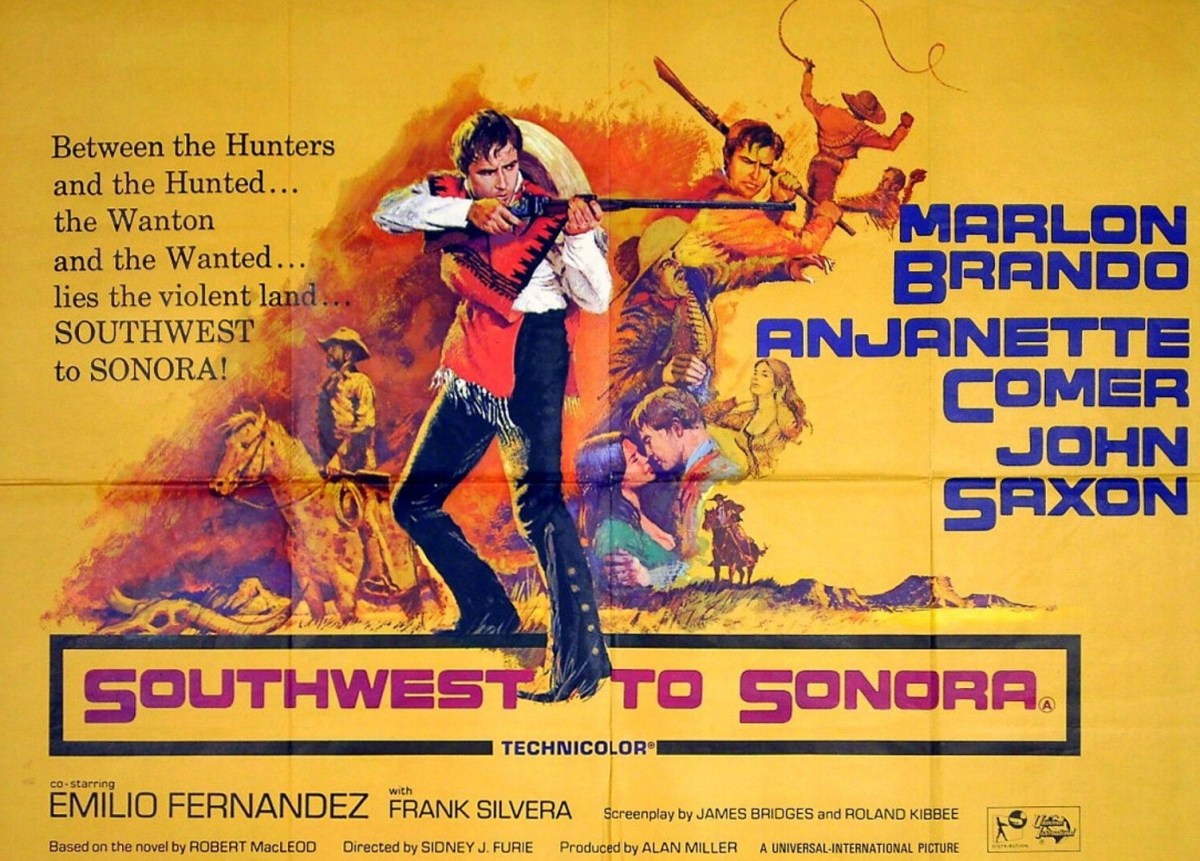
The Appaloosa/Southwest to Sonora (1966) ****

High expectation can kill a picture. Low expectation can have the opposite result. I came at The Appaloosa with the latter attitude in mind. I knew the picture had been a big flop and that critics had carped – as they had done through most of the 1960s – about the performance of Marlon Brando.

Neither was director Sidney J. Furie’s style to everyone’s taste. And it seemed an odd subject – Texan takes on Mexican warlord to recover a stolen horse. It is surely a slow burn, but it certainly worked well beyond my anticipation. There’s not much more to the story than two guys fighting over a horse.

First of all, Brando’s performance came across as natural, not mannered. Secondly, this was a real character. He was not a John Wayne striding into action to protect the underdog or a woman or out of some goddam principle.

At first it did seem odd that Matt Fletcher (Marlon Brando) placed so much importance on the horse given that said warlord Chuy Meena (John Saxon) had offered him a more than fair price for it. But in one brilliant two-minute scene, expertly directed and with virtually no close-ups – the actor caught mostly with his back to the camera or in silhouette – we discover why. Fletcher has been such a disappointment to his father that bringing home such an animal was proof that he had made something of himself. A buffalo hunter to trade, he was on the verge of starting a new life.

The second aspect of this intriguing picture was that Medena placed so much importance on a horse when he could easily buy any horse he wanted. But he was faced with losing face. His wife Trini (Anjanette Comer) had tried to escape from him on the horse and the only remedy was to persuade the watching federales that Fletcher had previously sold him the horse.

When Fletcher refuses, Medena takes the horse by force. Fletcher, in retaliation, and to save his own sense of pride, tries to take it back. He is not represented as a superhuman John Wayne or savage Clint Eastwood, but an ordinary guy who soon finds himself out of his depth. So ordinary that the first time he aims his rifle he misses the target by a mile.

Nor is he burdened with an over-enlarged empathy gland. He not only refuses to help Trini, but steadfastly refuses to take her with him, not even as far as the border, until in another of the film’s lengthy scenes she explains the reasons for her escape attempt.

Few films have exceeded it for atmosphere. This Mexico is grim, pitiless. Hostility and suspicion are endemic. Women are abused and discarded. The standout scene is Medena and Fletcher arm-wrestling over scorpions, played out against a soundtrack of scraping chairs and the poisonous insects scrabbling on the table. 

This is a brooding western featuring the actor with the best eye for brooding in the business. Sidney J Furie (The Ipcress File, 1965) is gifted – or afflicted depending on your point of view – with an eye for the unusual camera angle. Here I think the gift not the affliction is on show.

When you watch this and The Chase (1966) together it’s hard to see what on earth got the critics so rattled about Brando’s mid-decade performances. This is realistic acting at his best. Where John Wayne or Clint Eastwood present a superhuman screen persona, even if for part of a picture they are downtrodden, Brando was happy to play very human characters. In both pictures he is just an ordinary joe – forced into action by circumstance.

Genghis Khan (1965) ****

Hollywood was never reined in by the strictures of history, much preferring fiction to fact for dramatic effect, and that’s largely the case here, although the titular hero’s real life remains shrouded in myth.

If you do catch this surprisingly good feature, make sure it’s not one of the many pan-and-scan atrocities on the market. I watched this in the proper Panavision ratio which meant it occupied only one-third of my television screen, but in that format it’s terrific. It’s a bit of an anomaly for a decade that churned out high-class historical epics like El Cid (1961) because this clocks in about a hour short of other films in the genre and there’s no star actor or director to speak of and no Yakima Canutt to handle the second unit action scenes.

Omar Sharif’s marquee value at this point was so low that if you check out any of the original posters you’ll note that his name hardly rates a mention and he also comes at the very end of the opening screen credits. Although this is post-Lawrence of Arabia (1962), it’s pre-Doctor Zhivago (1965), suggesting nobody had a clue how to market his talents.

Director Henry Levin was a journeyman, fifty films under his belt, best known for not a great deal except for, following this, the second and third in the Matt Helm spy series. Given this film was critically ignored on release and since, and a flop to boot, it definitely falls into the “Worth a Look” category. Although there are few stand-out scenes of the artistic variety such as pepper Lawrence of Arabia or El Cid, this is still well put together and Levin shows an aptness for the widescreen.

The narrative breaks down into three parts – the first section describing enslavement of Genghis Khan (Omar Sharif) by nemesis Jamuga (Stephen Boyd – the picture’s star according to poster and screen credits) – before banding together rival tribes in revolt; the second part a long trek to China; and the third encompassing a final battle and hand-to-hand combat with Jamuga. For a two-hour picture it has tremendous sweep, not just the scenery and the battle scenes, but political intrigue, romance, a rape scene and even clever comedy. Genghis Khan  believes his glory is predestined, but he has very modern ideas about the role of women.

The best section, oddly enough, is set in China where Genghis engages in a duel of wits with the distinctively contradictory Emperor (Robert Morley), but that’s not to detract from the film’s other qualities, the action brilliantly handled, especially the chaos of battle, the romance touching, and the dialog intelligent and often epigrammatic.

Unlike James Mason (Age of Consent, 1969) who makes a calamitous attempt at a Chinese accent, Robert Morley (Some Girls Do, 1969), costume apart and looking as if he has just walked out of an English country house, but his plummy tones belie a very believable character. Stephen Boyd (Assignment K, 1968) shines as the villain of the piece. Telly Savalas (Battle of the Bulge, 1965) and Woody Strode (The Professionals, 1966) have decent parts as Khan’s s sidekicks, the former unexpectedly bearing the brunt of the film’s comedy. French actress Francoise Dorleac (Billion Dollar Brain, 1967) is effective as Sharif’s wife.

Hitchcock stole one of his most famous ideas from Genghis Khan. About the only scene in Torn Curtain (1966) to receive universal praise was a killing carried out to a soundtrack of nothing more than the grunts of assailant and victim. But, here, where the score by Yugoslavian composer Dusan Radic was extensively employed, the rape scene is silent and just as stunning. If the only prints widely available are of the pan-and-scan variety I’m not surprised the film has been for so long overlooked, but if you can get hold of one in the preferred format you will be in for a surprise.      

The Glass Bottom Boat (1966) ***

I’ve never gone out of my way to watch a Doris Day picture with the exception of musical Calamity Jane (1953) when it became a camp classic as well as Hitchcock’s The Man Who Knew Too Much (1956) and films where she happened to be co-starring with Cary Grant.

So I came to The Glass Bottom Boat with low expectations, especially as this was towards the end of her two-decade career and her co-star was Rod Taylor, a different level of star to Grant and Rock Hudson. By now, she had dropped the musical and dramatic string to her bow and concentrated on churning out romantic comedies and also been supplanted by Julie Andrews as Hollywood’s favourite cute star.

But on the evidence here I can certainly see her attraction. This is entertaining enough. And she sings – the theme song, one other and a riff on one of her most famous tunes “Que Sera Sera.” Unless there’s a symbolism I’ve missed, the title is misleading since the boat only appears in the opening section to perform the obligatory meet-cute with Taylor as a fishermen hooking Day’s mermaid costume.

The plot is on the preposterous side, Day suspected as a spy infiltrating Taylor’s aerospace research operation. It’s partly a James Bond spoof – when her dog is called Vladimir you can see where the movie is headed – with all sorts of crazy gadgets. But mostly the plot serves to illustrate Day’s substantial gifts as a comedienne. For an actress at the top of her game, she is never worried about looking foolish.

And that’s part of her appeal. She may look sophisticated even when, as here, playing an ordinary public relations girl, but turns clumsy and uncoordinated at the first scent of comedic opportunity. There’s some decent slapstick and pratfalls and some pretty good visual gags especially one involving a soda water siphon. A chase scene is particularly inventive and there’s a runaway boat that pays dividends. But there are a couple of effective dramatic moments too, emotional beats, when the romance untangles.

She’s in safe hands, director Frank Tashlin responsible for Son of Paleface (1952) and The Girl Can’t Help It (1956). I also felt Rod Taylor was both under-rated and under-used, never given much to do onscreen except stick out a chiseled jaw and turn on the charm. Although he had been Day’s sparring partner in her previous picture Do Not Disturb (1965) he’s not in the Cary Grant-Rock Hudson league.

It’s also worth remembering that the actress had her own production company, Arwin, which put together over a dozen of her pictures, including this one, so she would be playing to her strengths rather than those of her co-star. On the bonus side, watch out for a blink-and-you-miss-it cameo by Robert Vaughn (The Man from Uncle), and a featured role by Dom DeLuise as a bumbling spy.    

Discover WordPress

A daily selection of the best content published on WordPress, collected for you by humans who love to read.

The Atavist Magazine

by Brian Hannan

WordPress.com News

The latest news on WordPress.com and the WordPress community.