The Frightened City (1961) ***

Sean Connery in an early role as a gangster is not the only reason for watching this brisk British thriller about a London protection racket. Primarily told from the point-of-view of the bad guys, this explores how a ruthless Mr Big builds up a criminal empire. Waldo (Herbert Lom), a bent accountant, brings together the six major gangs involved in extorting money from pubs and stores into a democratically-run syndicate.  He then moves on to demanding bigger sums from bigger enterprises such as construction businesses. However, when the gangsters fall out they go to war.  

This film is way ahead of the game in presenting gangsters as displaying any intelligence. Generally, they were depicted as brutes who ruled by force. But criminality at the top level demanded as much organization as in a legitimate business. Personalities had to be harnessed to work together rather than shoot each other on sight. Such skills had to exist in order for gangsters to operate on any scale. This picture examines how this was done.

The cops led by Det Insp Sayers (John Gregson) are almost a sub-plot and the story would have adequately run its course without their involvement. Sayers sails close to the wind in hoping to “tilt the scale of justice in our direction for a change.” Paddy (Sean Connery) doesn’t appear until about 20 minutes as a karate-expert cat-burglar turned enforcer. Paddy’s involvement with the syndicate ends when his code of honor is breached and he turns on his employers. His code is not so sacrosanct that it prevents him cheating on girlfriend Sadie (Olive McFarland). But he does display the virility to fill James Bond’s shoes.

There’s far more violence that would be expected in a British crime picture of the era. Night clubs, shops and pubs are wrecked and there’s plenty of fisticuffs and when the gangsters go head-to-head they upgrade to grenades. There’s a bit more plot than the running time can deal with so director (and producer and co-writer, along with Leigh Vance of Crossplot, 1969, fame) John Lemont occasionally resorts to cliché devices like newspaper headlines. Canadian Lemont – most famous for writing the first serial on ITV, Sixpenny Corner – was an auteur of the old-fashioned (and unheralded) kind, and previously writer-director of The Shakedown (1960). 

Top billing was a step up for Herbert Lom (Gambit, 1966) and he made the most of it, delivering a suave villain among the thugs. John Gregson (Night of the Generals, 1967) Table, 1959) was a solid British star and ideal cop material (he was later British television’s Gideon). Yvonne Romaine, as Connery’s new squeeze, a nightclub singer exploited by Lom more for her looks than her voice, was known to audiences after Curse of the Werewolf (1961). This was a sophomore outing for Scottish television actress Olive McFarland (So Evil So Young, 1961). Unusually, for a British picture at this time, the theme tune written by Norrie Paramour was covered by The Shadows and turned into a hit.

At this point in his career, Connery had already had two bites of the cherry without much success – romancing Lana Turner in Another Time, Another Place (1958) and Disney’s Darby O’Gill and the Little People (1959). He would make another three films before his breakthrough with Dr No (1962) but the Pressbook showed signs that he was headed for the heights.  Co-star Yvonne Romaine (and her distinctive body measurements) were accorded three separate stories in the Pressbook, compared to one each for Lom and Alfred Marks, at that point better known as a comedian. While no articles about Connery were featured, when it came to the advertising campaign Connery (and Romaine) outshone their co-stars.  

Producers were contractually bound in relation to the size of credits that appeared on any advertising. But there were no such regulations regarding the visuals of an advert. Although top-billed, Lom is not shown on any of the adverts. Given greatest prominence was Yvonne Romaine. There were thirteen different ads and she appeared in them all. Although Connery was third-billed and she was two rungs below in the credit stakes, he was the junior partner when it came to the artwork. While, Connery appeared in eleven in only one did he overshadow Romaine and in another they were visually-speaking accorded roughly the same status. But otherwise, she hogged the adverts.  

The Pressbook was small by American standards, consisting of six A3 pages, the bulk of which was given over to adverts. But what it lacked in pages it made up for in taglines – of which there were six main types.

The picture was not seen much in the United States, sent out in first run as the lower half of a double bill in only a handful of big cities, so there’s a fair chance it’s completely unknown except to Connery completists. It later appeared on the reissue circuit when Connery was a bigger name.

Worth a look as an example of the British crime movie trying to break out of the confines of the genre, and even more so as an early example of the Connery screen charisma.

Secret World (1969) ****

Jacqueline Bisset is the big draw here. After breaking into the Hollywood bigtime with female leads in The Detective (1968) and Bullitt (1968) she put her newfound marquee weight behind a low-budget French arthouse picture.  But ignore the marketeers best efforts to present this as malevolent in the style of The Innocents (1961) or the illicit template of The Nightcomers (1971) or Malena (2000).

No children were corrupted in the making of this picture. Instead, it’s a slow-burn thoughtful exposition of a child coming to terms with loss and a young woman discovering she is more than a mere sexual plaything. Any explosive drama comes from father-son rivalry but mostly it’s a reflective, absorbing movie that follows twin narratives, the attraction of the orphaned introspective 11-year-old Francois (Jean-Francois Vireick) to the English mistress of his uncle Philippe (Pierre Zimmer) and the damage her arrival causes to a fractured household.

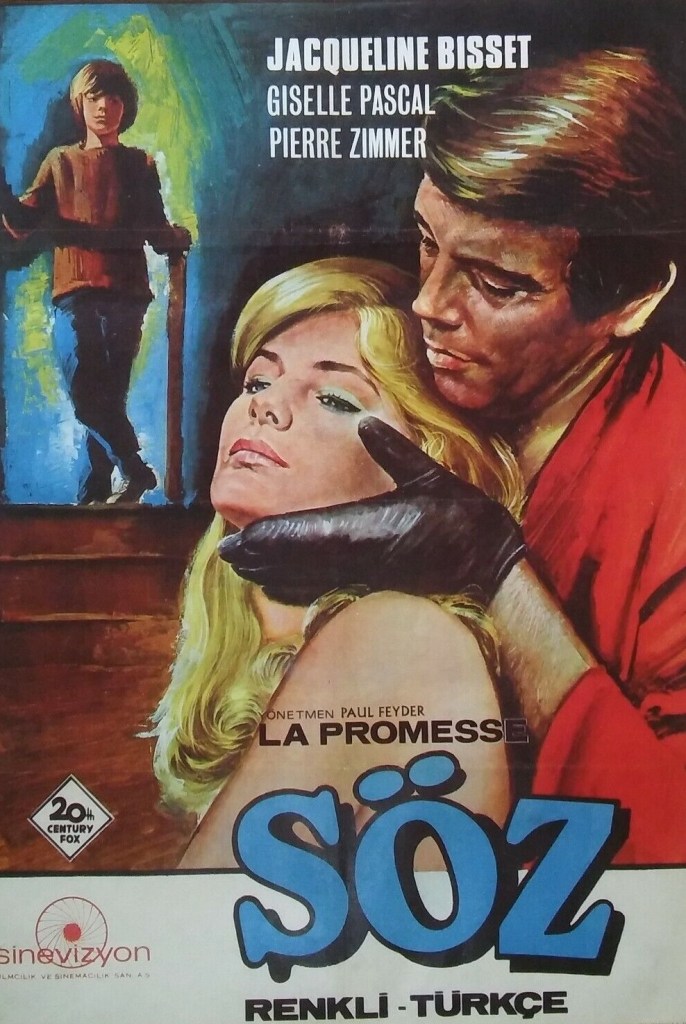
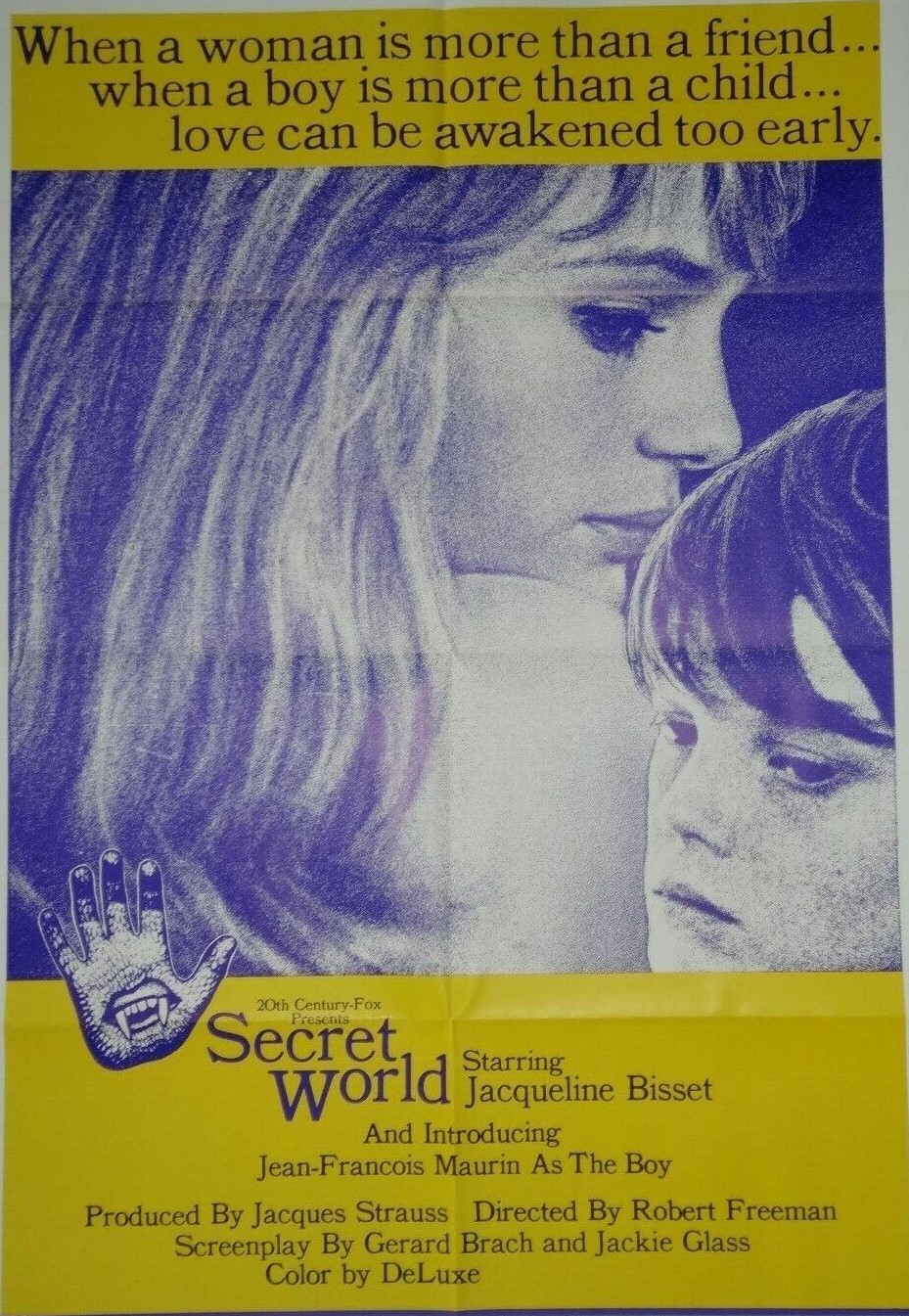
The leather glove oveprlays its hand in the poster, suggesting a great deal more sexuality
than is actually the case, but nonetheless – and take this as subtle – creates
an element of ambiquity about the demure Wendy.

Astonishingly, given its arthouse credentials – long takes, glorious cinematography, brooding close-ups – this was the final film for both directors (no idea why there were two) Paul Feyder (in his debut) and a sophomore effort from Robert Freeman (The Touchables, 1968). Given a screenplay by regular Polanski collaborator Gerard Brach (Wonderwall, 1968) and an intrusive heavy-handed score, you get the impression of two separate movies struggling to fit a single canvas.

On the one hand, you’ve got a perfectly acceptable romantic intrigue, Philippe and son Olivier (Marc Porel) fighting, sometimes metaphorically (games of chess etc), sometimes physically (a punch-up), over the woman, passed off as the daughter of a wartime colleague, and a wife Monique (Chantal Goya) refusing to stand on the sidelines, switching hairstyle to blonde and employing various wiles to prevent the affair. While the male rivalry is overt, the wife’s manipulations are more subtle.

On the other hand, you’ve got the lonely boy, who indulges his imagination, spinning tales of monsters in a lake and spies in the vicinity, mostly ignored by his relatives, hiding out with a pet rabbit in a treehouse, occasionally filching small items, creating a crown out of a stolen brooch and pieces of tree bark. There’s a lot that’s presented without explanation. For example, a couple of months after his parents died in a car crash that he alone survived, he mopes around in a jumper full of holes, either a sign how little his adoptive parents care for him, or perhaps the item of clothing he was wearing the day his mother died.

You can view his behavior – creeping into Wendy’s room at night when she’s asleep – as creepy or just the hankering of a small boy after a substitute mother. But mostly, he lives a life of wistfulness, longing for what he once had, unable to fit into a household split by various emotions. When he snips a lock of Wendy’s hair, or snaffles a bottle of her perfume, it’s to add to his little box of mementoes rather than from any underlying sexual motive. And it’s hard to view his growing feelings for Wendy as early stirrings of sexual attraction. When at one point he falls asleep on her bosom, you couldn’t interpret that as anything more than maternal instinct.

That’s not to say there isn’t tension. But that’s almost entirely played out in the context of father, son and wife. Francois is a welcome gooseberry defusing the unwelcome attentions of Olivier, whose overtures Wendy constantly thwarts. Olivier, well aware of the role Wendy plays in her father’s life, mocks his mother’s attempts to hold onto her errant husband. Wendy, meanwhile, abhors the role she is forced to play, the trophy mistress, and reacts in maternal fashion to the lonely child.

Excepting the intensity of the father-son relationship, the screenplay underplays while still developing character more fully than you might expect.. The child is as manipulative as his aunt in finding ways to spend time with the object of his affection.

Mostly, this has been dismissed as a poor example of the French arthouse picture or as a Bisset vanity number or for illicit elements than never catch fire. But, in reality, it’s a superb character study set in an unromanticised French countryside – rats need shooting, for example, massive tray of cheese served up for dessert rather than the grand wine cellar you might imagine a chateau to contain, or clothes or other ostentatious examples of wealth.

There is so much that is incisively ordinary. Philippe insists on measuring the boy’s height.  Monique drops her chilly façade to help the newcomer get rid of a wasp. The arrogant Olivier loses all credibility when he runs away from a gang. The children play out childish rituals. Francois douses the rabbit in Wendy’s perfume so he can keep the smell of her close.  

The secret world here is four-fold, the one Philippe foolishly and brazenly attempts to maintain, the one Olivier hopes to possess, the one Francois enjoys and the idyll from which Wendy is shaken out of.

The direction is very confident, none more so, oddly enough, than in the only sex scene, which takes place primarily off-screen, although with the lascivious involvement of a leather-gloved hand.

Rich in detail, supremely atmospheric, well worth a look.    

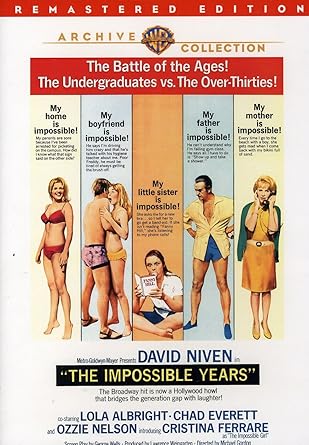
The Impossible Years (1968) ***

Generation gap comedy driven by unmentionables and the prospect of perplexed father getting more pop-eyed by the minute. By default, probably the last bastion of morality before censorship walls – the U.S. Production Code eliminated the following year – came tumbling down and Hollywood was engulfed in an anything goes mentality. Denial enters its final phase, quite astonishing the mileage achieved by not letting the audience in on what’s actually going on.  

Psychiatrist lecturer Jonathan (David Niven) finds his chances of promotion potentially scuppered after lissom teenage daughter Linda (Christine Ferrare) is arrested at a demonstration carrying a banner bearing an unmentionable word. That brings to the boil the notion that Linda may not be quite so sweet as she appears, Jonathan previously willing to overlook minor misdemeanors like smoking and speeding. But it turns out Linda may also have lost her virginity, that word also verboten, and may even be, worse, illegally married.

So the question, beyond just how manic her parents can be driven, is which male is her lover: the main candidates being a trumpet-blowing teenage neighbor and let) or laid-back artist hippie who has painted her in the nude.

Innuendo used to be the copyright of the Brits, in the endlessly smutty Carry On, series, but here the number of words or phrases that can be substituted for “sex” or “virgin” must be approaching a world record, but delivered with gentle obfuscation far removed from the leering approach of the Brits.

It’s a shame this movie appeared in the wake of bolder The Graduate (1967) because it was certainly set in a gentler period and its tone has more in common with Father of the Bride (1950). Setting aside that most of the adults, for fear of offending each other, can’t ever say what they mean, the actual business of a young woman growing up and demanding freedom without ostracising her parents is well done, Linda stuck in the quandary of either being too young or too old to move on in her life.

The scenes where that issue is confronted provide more dramatic and comedic meat than those where everyone is grasping, or gasping like fish, for words that mean the same as the other words they refuse to utter.

Parental issues are complicated in that Jonathan has set himself up as an expert on dealing with the problems growing children present. He views himself as hip when, as you can imagine, to  younger eyes, he’s actually square. And he’s also worried his younger daughter Abbey (Darlene Carr) will start to emulate her sibling.

Compared to today, of course, it’s all very innocent and I’m sure contemporary older viewers might pine for those more carefree times. It doesn’t work as social commentary either, given the rebellion that was in the air although it probably does accurately reflect how adults felt at confronted by children growing up too fast in a more liberal age.

David Niven (Prudence and the Pill, 1968) brings a high degree of polish to a movie that would otherwise splutter. He’s playing the equivalent of the stuffy Rock Hudson/Cary Grant role in the Doris Day comedies who always get their comeuppance from the flighty, feisty female. That fact that it’s father-and-daughter rather than mismatched lovers only adds to the fun. And there were few top-ranked Hollywood actors, outside perhaps of Spencer Tracy (Guess Who’s Coming to Dinner, 1967) who audiences would be interested in seeing play a father.

The unmentionable conceit wears thin at times but Niven and Cristina Ferrare (later better known as the wife of John DeLorean) do nudge it towards a truthful relationship. Former movie hellion Lola Albright (A Cold Wind in August, 1961) is considerably more demure as the Jonathan’s wife. Chad Everett (Claudelle Inglish, 1961) breezes in and out.

Although at times giving off a “beach party” vibe, it manages to examine the mores of the  time.

Director Michael Gordon has moved from outwitted controlling mother (For Love or Money, 1963) to undone controlling father without dropping the ball. It’s based on the Broadway play of the same name by Robert Fisher and Arthur Marx.

Lightweight for sure but worth it for David Niven and the sultry Ferrare.

For Love or Money (1963) ***

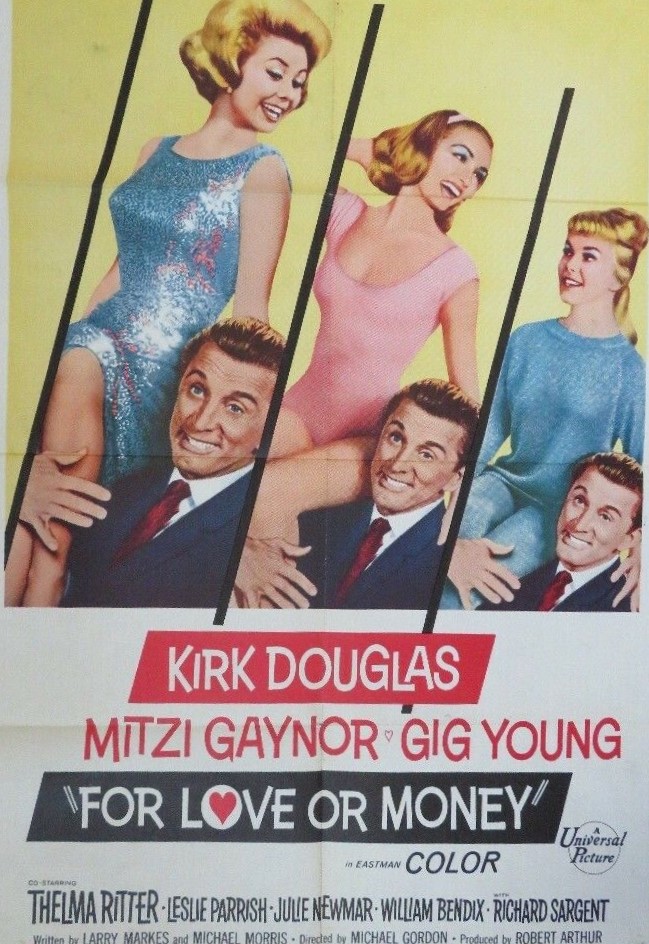
Kirk Douglas (The Brotherhood, 1968) had been so intent on establishing his dramatic credentials as a Hollywood high flier that he hadn’t appeared in a comedy in six years when he was second-billed to Susan Hayward in Top Secret Affair (1957).  

So after all the sturm und drang of heavyweight numbers like Strangers When We Meet (1960), Spartacus (1961), and Lonely Are the Brave (1962) it was always going to be interesting to see if he could drop the commanding persona long enough to hit the laugh button. He’s helped by a screenplay that while suggesting he is in control shows him run ragged by a quartet of females.

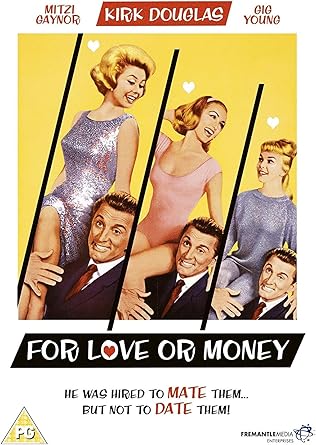
Millionaire widowed mother Chloe (Thelma Ritter) hires singleton lawyer Deke (Kirk Douglas) for $100,000 – enough to pay off his debts –  as some kind of matchmaker, not given the task of finding suitable husbands for her daughters, but to make sure that trio of spoiled women get hitched to men chosen by her.

The plan is for the Kate (Mitzi Gaynor), the most organized, to marry rich playboy Sonny (Gig Young), health nut Bonnie (Julie Newmar) to take up with child love Harvey (Richard Sargent) and hippie art lover Jan (Leslie Parrish) to be landed with dull taxman Sam (William Windom). Sonny is Deke’s best friend, they share a yacht.

Nothing tuns out the way it should in part because Deke is more attractive than any of the other males on offer and in part because the heiresses are disinclined to do what anyone tells them. Deke spends all his time getting into hot water, dashing into another room to take phone calls that inevitably create further confusion, while manfully trying to ensure that the male suitors present their most attractive sides to their potential brides.

There’s not a great deal to it. It’s not exactly farce, but given the daughters live on top of each other, quite easy for Deke to race from one apartment to another, and say the wrong thing at the wrong time. The juggling act is never going to work out, especially as Kate is love struck by Deke, though if she could see how easily he flirts with her siblings she might be less keen. There’s finale on a boat or, should I say, in falling off a boat.

I wouldn’t say it’s a hoot but it’s an excellent lightweight concoction that comes to life by inspired casting. None of the women is your typical Hollywood fluff, all present interesting characters, leaders in their own ways, and with a lifetime of standing up to their domineering mother unlikely to fall over at the sight of any decent male.

Thelma Ritter (Boeing, Boeing, 1965) is easily the pick. The six-time Oscar nominee, generally seen in dowdy parts as a maid or similar, is dressed to the heavens, all glammed up as the millionairess without losing any of her trademark snippiness or drollery. Mitzi Gaynor (South Pacific, 1958), in her final screen role, has a well-written part as an efficient businesswoman and proves more than a match for Deke.

Julie Newmar (The Maltese Bippy, 1969) is a delight as the health nut whose physical demeanor is proof of her regime while Leslie Parrish (The Manchurian Candidate, 1962) bounces along with a coterie of artists.  Gig Young (Strange Bedfellows, 1965) can do this kind of role in his sleep but he’s no less effective for having acquired that skill of the guy who never gets the girl. And there’s a rare sighting of Hollywood tough guy William Bendix (The Blue Dahlia, 1946) in a comedy.

But none of this would work without Kirk Douglas. And it works because he plays it straight. He doesn’t give in to the temptation of mugging to the camera, eye-rolling and pratfalls. You could easily get the idea the actor thought he was in a drama, especially as he’s the one in the kind of quandary that we’ve seen him ignore before, when ambition trumps morality or romance, as with Ace in the Hole (1951) or Strangers When We Meet. In some senses, the casting relies on audiences being aware of that sneaky side of his screen persona, the one where he doesn’t always do the right thing. And here, you could easily see him opting for the loot over the girl.  

Director Michael Gordon (Texas Across the River, 1966) is adept at winkling out the comedic moments in stories that are played straight. The team of Larry Markes and Michael Morris (Wild and Wonderful, 1964) wrote the screenplay with the emphasis on situation comedy rather than farce.

Good, clean fun and great performances.

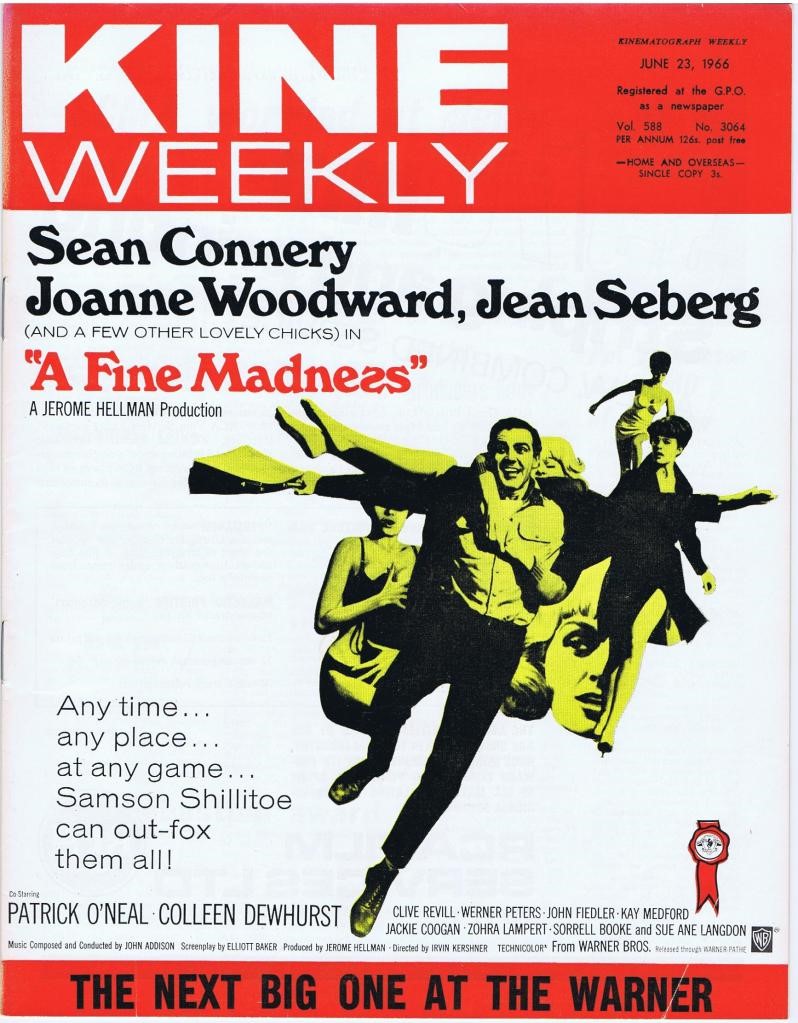
A Fine Madness (1966) **

Let’s start with the Hollywood happy ending. Poet Samson (Sean Connery) slugs pregnant second wife (Joanne Woodward). He’d have punched her lights out before if only she hadn’t been so good at diving out of the way. As it is he manages to throw her down the stairs. The film kicks off with him ill-temperedly whacking her over the head with a pillow.

This is the kind of film where violence against women is treated as a running gag.

Let’s try to sell it as a wacky comedy.

Lydia (Jean Seberg), wife of psychiatrist Dr West (Patrick O’Neal) treating Samson for writer’s block, doesn’t have the courage to make it plain to his creepy colleague Dr Vorbeck (Werner Peters) that she doesn’t fancy him when he endlessly paws her and slaps her rear so he takes this as the green light to attempt to rape her. That’s another running gag.

Surly loud-mouthed bully Samson gets a free pass because he’s an artist, a poet with one poor-selling volume of poetry, and unable to find the time or space to complete his masterpiece. He would have more time if he didn’t spend so much of it chasing women.

At my count, he gets through at least four – Lydia, office secretary Miss Walnicki (Sue Ann Lngdon), a client (he cleans carpets for a living) Evelyn (Zohra Lampert), and Dr Kropotkin (Collen Dewhurst), another colleague of Dr West, not to mention the current wife he drives demented and the previous wife for whom he is being aggressively pursued for alimony.

You can see how director Irvin Kershner was a shoo-in for The Flim-Flam Man/One Born Every Minute (1967) because at every opportunity he tries to turn simple dramatic confrontation that enhance the story into needless chases that divert it and extract slapstick from material that in no way suggests it’s ripe for such an approach.

Trivia lovers note: The John “Redcap” Thaw in the supporting feature “Dead Man’s Chest” is the same John Thaw from “The Sweeney” and “Morse“.

There’s a story in here somewhere and a pretty barmy one at that if you set aside the poor poet’s endless battle against a world that fails to understand his genius and his dodging of the alimony. Rightfully diagnosed as some kind of sociopath by yet another of Dr West’s colleagues, the needle-happy Dr Menken (Clive Revill), he is admitted to a psychiatric hospital initially as a way of dodging his creditors and providing him with space and time to write.

Again, his most creative use of his time is to make out with Lydia and Krokoptin. But since he is spotted in a hydro-bath/ripple bath with  naked Lydia, the vengeful husband gives the go-ahead to perform some kind of lobotomy on the poet, on the assumption it will dull his violent tendencies. (It doesn’t work.) The opportunity to satirise the psychiatric profession takes second place to another opportunity for a chase.

Anomalies abound. Samson’s character is clearly drawn on Welsh poet Dylan Thomas who exploited his fame and made his money on recital tours. Performing is against the broke Samson’s principles and he turns viciously on his audience of appreciative women. Despite demanding center stage, when offered it he turns it down. He lambasts middle-aged women but has little against those younger members of the species more susceptible to his charms. He only has to tell Miss Walnicki she has “pouty lips” and she falls into his arms.

All this has going for it are the performances. Sean Connery (Marnie, 1964), it has to be said, certainly exhibits screen charisma though this is not as far removed as he would like from the macho James Bond. Joanne Woodward (From the Terrace, 1960) – switching from her normal brunette to blonde – is excellent as the downtrodden waitress wife, but on the occasions when she is spiky enough to put him in his place soon regrets her temerity.

Jean Seberg (Pendulum, 1969) – switching from blonde to brunette and paid more ($125,000 to Woodward’s $100,000) – is good as the sexually frustrated rich housewife. And Patrick O’Neal (Stiletto, 1969) looks as if he is desperate to throw a punch. Elliott Baker (Luv, 1967) wrote the screenplay based on his own novel.

You do sometimes wonder at the knuckle-headedness of stars. Was this all that was offered to Connery at his James Bond peak? Or was it a pet project? I doubt if it would have been made with another big star – you couldn’t see even the macho Steve McQueen entering this territory and the likes of Paul Newman wouldn’t go near it.

Theoretically, studio head honcho Jack Warner gets the blame for this. He didn’t like Kershner’s cut and ordered it re-edited but I’d be hard put to see how his hand could be any less heavy than that of the director.

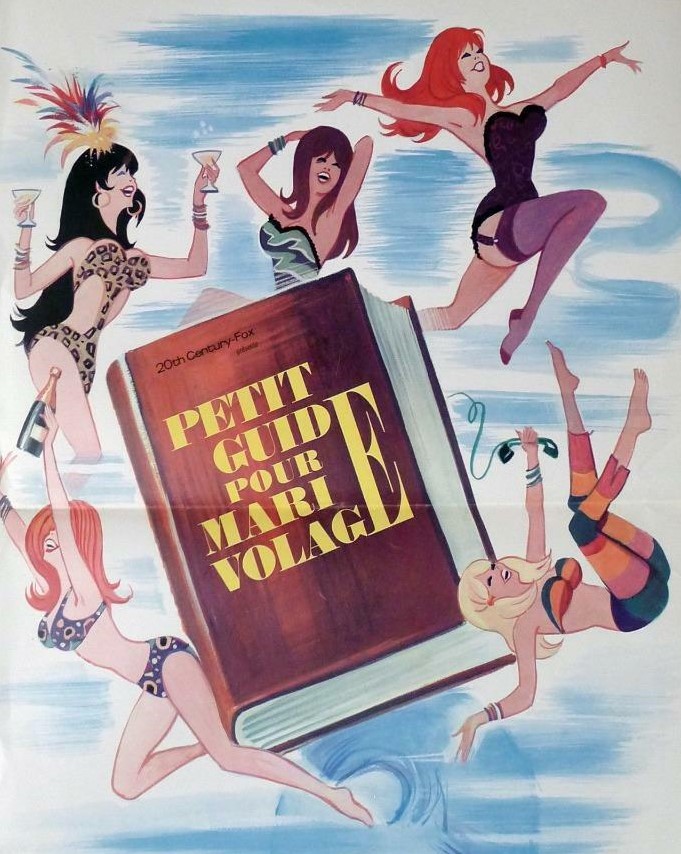
That’s two stinkers in a week. If you want proof of just how rampant sexism was in Hollywood check out a double bill of this and A Guide to a Married Man (1967).

An insult.

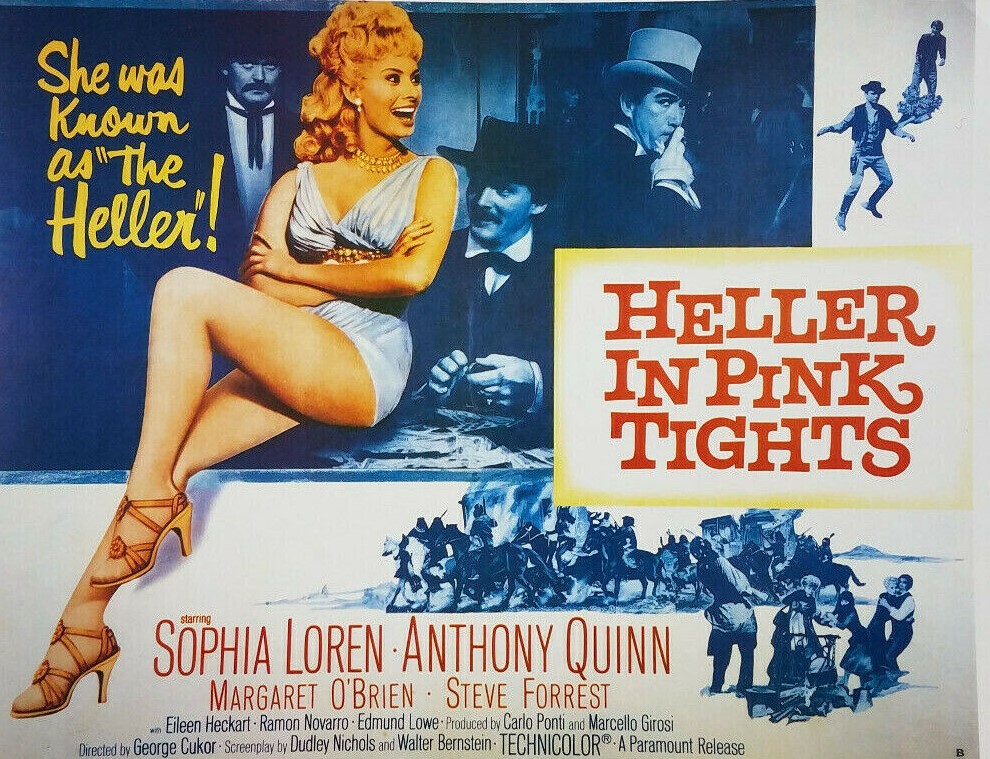
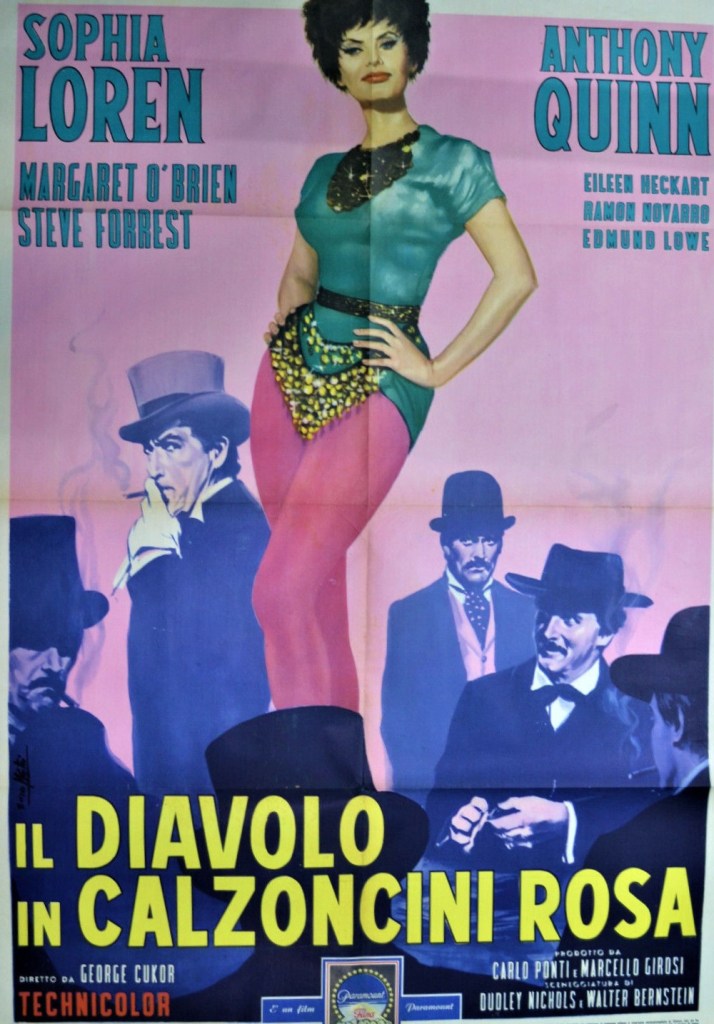
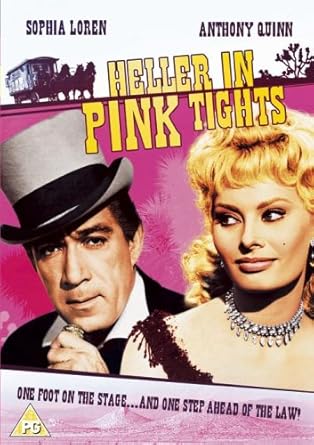
Heller in Pink Tights (1960) ****

Taken on its own merits, George Cukor’s western is a highly enjoyable romp. Hardly your first choice for the genre, Cukor ignores the tenets laid down by John Ford and Howard Hawks and the film is all the better for it. Although there are stagecoach chases, gunfighters and Native Americans, don’t expect upstanding citizens rescuing good folk. Instead of stunning vistas Cukor chooses to spend his budget on lavish costumes and sets.

You can see he knows how to use a colour palette, and there is red or a tinge of it in every scene (to the extent of rather a lot of red-haired folk), and although this might not be your bag – and you may not even notice it – it is what makes a Cukor production so lush. The film might start with comedic overtones but by the end you realise it is serious after all.

Angela (Sophia Loren) is the coquettish leading lady and Tom (Anthony Quinn) the actor-manager of a theatrical company managing to stay one step ahead of its creditors, in the main thanks her propensity for spending money she doesn’t have. Of course, once gunfighter Clint (Steve Forrest) wins Loren in a poker game, things go askew. 

Anthony Quinn (Guns for San Sebastian, 1968) had never convinced me as a romantic lead, but here there is genuine charisma between the two stars. Sophia Loren (Five Miles to Midnight, 1962) is at her most alluring, in dazzling outfits and occasionally in costumes as skin-tight as censors would allow in those days, but with a tendency to use beauty as a means to an end, with the conviction that a smile (or occasionally more) will see her out of any scrape. There is no doubt she is totally beguiling. But that is not enough for Quinn, as she is inclined to include him in her list of dupes.

While primarily a love story and a tale of theatrical woes set against the backdrop of a western, when it comes to dealing with the tropes of the genre Cukor blows it out of the water.  We open with a stagecoach chase but our heroes are only racing away from debt until they reach the safety of a state line. We have a gunfighter, but instead of a shoot-out being built up, minutes ticking by as tension rises, Cukor’s gunman just shoots people in sudden matter-of-fact fashion.

Best of all, George Cukor (Justine, 1969) extracts tremendous comedy from the overbearing actors, each convinced of their own genius, and the petty jealousies and intrigue that are endemic in such a troupe. An everyday story of show-folk contains as much incipient drama as the more angst-ridden A Star Is Born (1954), his previous venture into this arena.

From the guy who gave us The Philadelphia Story (1940) with all its sophisticated comedy, it’s quite astonishing that Cukor extracts so much from a picture where the laughs, mostly from throwaway lines, are derived from less substantial material. Quinn (his third film in a row with Cukor) has never been better, no Oscar-bait this time round, just a genuine guy, pride always to the forefront, king of his domain inside his tiny theatrical kingdom, out of his depth in the big wide world, and unable to contain the “heller.”

I won’t spoil it for you but there are two wonderful character-driven twists that set the world to rights.

There is a tremendous supporting cast with former silent film star Ramon Novarro (Ben-Hur: A Tale of the Christ, 1925) as a duplicitous businessman, former child star Margaret O’Brien, another star from a previous era in Edmund Lowe (Cukor’s Dinner at Eight, 1933), and Eileen Eckhart. Dudley Nichols (Stagecoach, 1939) and Walter Bernstein, who wrote a previous Loren romance That Kind of Women (1959) and had a hand in The Magnificent Seven (1960), do an excellent job of adapting the Louis L’Amour source novel Heller with a Gun, especially considering that contained an entirely different story.

Without a doubt it’s Cukor’s picture but Loren and Quinn combine to make it such a believable delight.

Behind the Scenes: The Old Double Bill Business – Part Two

British circuit ABC’s major rival, the Rank Organisation, effectively operated three chains. The main chain was known as the Odeon, but it also ran a subsidiary operating as Gaumont. Since you would often find an Odeon and a Gaumont in the same city or large town, it made sense that they were not in competition.

By and large, Rank put its biggest potential blockbusters on the Odeon circuit with lesser titles doing the rounds of the Gaumonts in what was termed rather confusingly as the “National Release”, with that chain also used to mop up box office excess should a film have done exceptionally well on the major circuit, John Wayne western The Commancheros (1961) and the second James Bond adventure From Russia with Love (1963) moving from one to the other in a short space of time. Rank was also a major player in the roadshow business, the Gaumont in Glasgow, for example, the venue for such long-runners as The Sound of Music (1965).

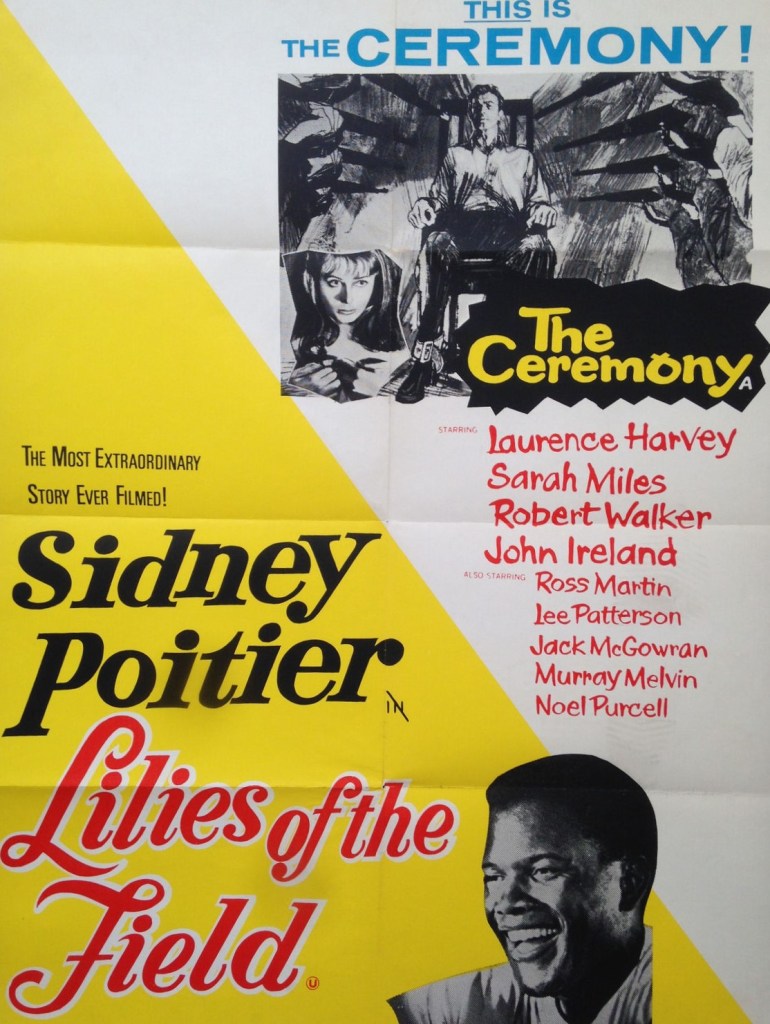
Clever presentation makes it look as though it’s up to the audience or the cinema to decide which is the main feature – technically, it was “The Ceremony.”

Perhaps because it felt obliged to feed movies into two streams rather than one, the Rank cinemas were less inclined at the start of the decade to go full tilt down the double bill route. You might have thought with so many cinemas to support that the obvious approach would be to limit the number of double bills made available.

In fact, the opposite was true. Perhaps more aware of the need to give the moviegoer value-for-money, Odeon offered far fewer single bills than rival ABC. Whereas ABC programmed in somewhere between 28 and 37 single bills every year during the 1960s, Odeon had less. Its peak was 21 in 1960. But that was followed by a dramatic tail off, the next highest year saw 15 single bills in 1967, quite a few of these being roadshows entering general release for the first time. For the entire decade Odeon averaged around 13 single bills a year.

In other words, while ABC in a busy year for double bills might get through a total of 76 films, Odeon’s output would be 90-100.

However, the kind of double bill you might see at an Odeon was, until later in the decade, an inferior product to what you would watch at an ABC cinema. Odeon was prone to stuffing its programs with filler material, genuine old-fashioned B-movies, often running little over an hour rather than the 90/100-minute picture audiences might expect from a genuine double bill.

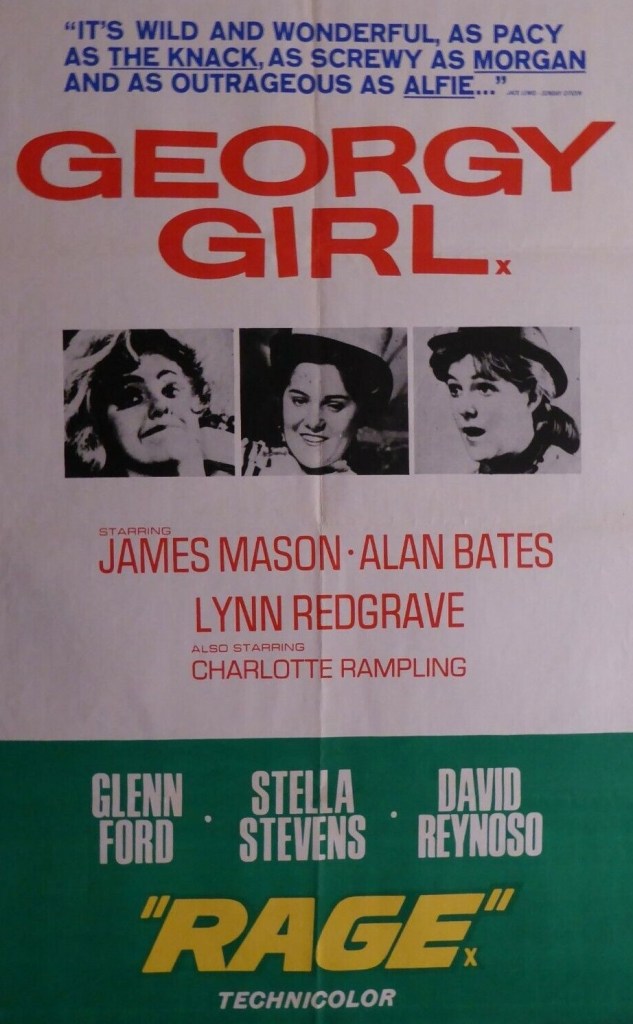
Suprised to see “Rage” getting such a wide release as support here. “Georgy Girl” was such a hit in first run it took an age to move into general release.

Whereas there was a decent chance that a movie on the lower part of a double bill shown on the ABC circuit would have a recognizable star, it was almost certain that you would never have heard of any of the stars in films carrying out the same role on the Odeon circuit.

For example, supporting Peter Sellers-Sophia Loren comedy The Millionairess (1960) was the undistinguished Squad Car (1960) starring Vici Raaf. The Magnificent Seven (1960) was accompanied by Police Dog Story (1961) starring James Brown. Womanhunt with Steve Peck was allocated to The Commancheros (1961) and The Deadly Duo with Craig Hill to Dr No (1962).

Alternatively, Odeon would dig into the vaults and team up one new feature with an oldie. So musical State Fair (1962) was stuck with The Desert Rats (1953) starring Richard Burton; Glenn Ford-Lee Remick thriller The Grip of Fear (aka Experiment in Terror, 1962) with Operation Mad Ball (1957) headlining Jack Lemmon; Stephen Boyd psychological thriller The Third Secret (1964) with Frank Sinatra revival Can-Can (1960).

Other times, the double bill was a pair of oldies, Billy Wilder courtroom drama Witness for the Prosecution (1957) teamed up with James Stewart western The Far Country (1954) or the start of the James Bond reissue onslaught beginning with From Russia with Love (1963)/Dr No (1962).  Sandra Dee comedy I’d Rather Be Rich (1964) initially on the lower half of a double bill with Send Me No Flowers (1964) was within a few months performing the same function for Gregory Peck amnesia thriller Mirage (1965).

And just like ABC, some of the double bills didn’t work out. Romantic comedy Two and Two Make Six (1962) starring George Chakiris and Janette Scott coupled with heist picture Strongroom (1962) failed to make it past the first few days. Billy Wilder’s Kiss Me, Stupid (1964) and The Sicilians (1964) was yanked off the screens after dire returns. In the case of the Madigan/Games double bill it was the latter that met with audience hostility.

So it took Odeon some time to hit its stride and pitch together the kind of double bill program that might attract a decent audience. Good examples would be: The Ceremony (1963) starring Laurence Harvey dualed with Sidney Poitier in Oscar-winning form in Lilies of the Field (1963); and Oscar fave Georgy Girl (1965) and rabies thriller Rage (1966) featuring Glenn Ford and Stella Stevens..

You might well attract customers for the remake double bill of Beau Geste (1966) and Madame X (1966); and French hit A Man and a Woman (1966) and Sailor from Gibralter (1967) with French star Jeanne Moreau.

I would have made time to see George Peppard-Dean Martin western Rough Night in Jericho (1967) with what was intended as a star-making turn from Robert Wagner in Banning (1967). The St Valentine’s Day Massacre (1967) and George C. Scott-Michael Sarrazin One Born Every Minute (aka The Flim-Flam Man, 1967) seemed an interesting program. And you wouldn’t go far wrong with spy thriller Danger Route (1967) and John Sturges western Hour of the Gun (1967).

I remember being highly entertained by a double bill of John Wayne as an oil wildcatter in The Hellfighters (1969) and Doug McClure and Jill St John in swashbuckler The King’s Pirate (1969). Thought went into programming together heist movie Duffy (1968) starring James Coburn and spy thriller Hammerhead (1968); fashion-set drama Joanna (1968) and Pretty Poison (1968); and George Segal war picture The Bridge at Remagen (1969) and Robert Mitchum western Young Billy Young (1969).

But sometimes you got the impression the Odeon circuit was hard put to find relevant product and was happy to stick out in the lower part of the double bill a movie that had been sitting on the shelf such as Ann-Margret small town drama Bus Riley’s Back in Town (1965) which went out as support to Rock Hudson and Claudie Cardinale in Blindfold (1966) or Jerry Lewis comedy Way, Way Out (1966) supporting Raquel Welch as Fathom (1967).

The 10th Victim (1965) took an age to be slotted in below The Night of the Big Heat (1967).  Claude Chabrol’s The Road to Corinth with Jean Seberg was two years old when packed off  with the second Bulldog Drummond adventure Some Girls Do (1969). British sex drama The Touchables (1968) waited a year before emerging in the wake of James Coburn-Lee Remick thriller Hard Contract (1969).

Sometimes, double bills revealed the hard truth about fading marquee pull. Glenn Ford films were often on the lower part of a double bill and so were offerings by Tony Curtis, James Garner, Anthony Perkins, Ann-Margret and Robert Mitchum.

By the end of the next decade, Odeon was still more reliant on double bills than ABC, though often these programmes were made up of reissues of Bond, Pink Panther, Three Musketeers, the Confessions series and Rocky/Network (both 1976) while the likes of early Stallone vehicle The Lord of Flatbush (1974), documentary Let The Good Times Roll (1973) and romance Jeremy (1973) were revived as supporting features.

Britain had some smaller circuits in operation but both Granada and Scottish outfit Caledonian Associated Cinemas tended to cherry-pick from either the Odeon or ABC releases.

SOURCE: Allen Eyles, Odeon Cinemas 2: From J. Arthur Rank to the Multiplex (CTA, 2005) p206-214, 219-220.

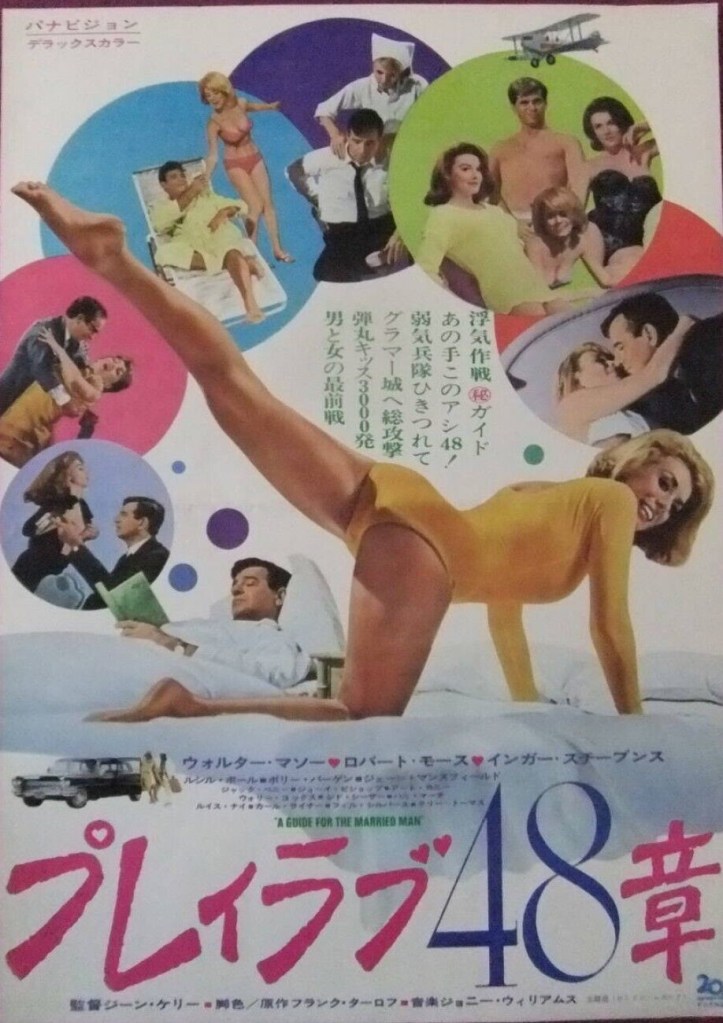
A Guide for the Married Man (1967) **

Little has dated as badly as this male supremacy sexist hogwash. While Billy Wilder can manage to inject some sophistication and even elegance into the thorny subject of adultery and male philandering (The Apartment, 1960), director Gene Kelly has little to offer but crudity.

Walter Matthau (The Fortune Cookie, 1966), top-billed for the first time, does little more than act as listener to neighbour Ed (Robert Morse), supposed expert on wifely deception and link man to a series of lame unconnected sketches featuring a battalion of cameo stars.

It’s more likely to be remembered for being the final film Jayne Mansfield (Playgirl after Dark/Too Hot to Handle, 1960) made before her premature death. Her episode might well sum up the depths of hilarity this opus stoops to – the compelling issue of what to do when your illicit companion loses her bra in your bedroom.

Perhaps the only amusing note is the notion that this has come from the pen of the Oscar-winning Frank Tarloff (Father Goose, 1964), responsible also for the source novel, drawing on the experiences of a bunch of “swingers” reputedly enjoying to the full the sexual excesses of the decade, a decidedly middle-aged gang intent on not leaving all the fun to the hippies and the liberated young

The women here are straight out of The Stepford Wives template of female docility, existing only to please their men, any passing woman automatically in the stunner bracket intent on demonstrating every wiggle possible. Worse, one is so weak that she can be easily manipulated into believing that she did not, in fact, catch her husband in bed with another woman once the wily man falls back on that old political adage of plausible deniability.

What makes the antics of Paul (Matthau) and Ed so reprehensible is that their wives are trusting knock-outs in the first place. Ruth (Inger Stevens), Paul’s other half, not just a keep-fit fanatic but a fabulous cook, able to present a superb meal on a miniscule budget.

So we are meant, I suppose, to sympathize with Paul’s flawed efforts at beginning an extra-marital affair. Or at the very least laugh at his failures, rather than mock his inadequacies as a husband. Paul’s main target is divorcee Irma (Sue Anne Langdon) but it’s no surprise Ed beats him to the punch. There’s an old-fashioned morality lesson at the end but I was hoping, instead, for a twist whereby smug Paul discovered his wife was playing away from home. Although, admittedly, that would be out of character for Ruth.

You might get through this if cameos are your thing and you want to spent a whole movie waiting for an appearance by It’s A Mad, Mad, Mad, Mad World (1963) alumni Sid Caesar, Jack Benny, Phil Silvers and Terry-Thomas plus the likes of Lucille Ball (Yours, Mine and Ours, 1968), Polly Bergen (Kisses for My President, 1964), Art Carney (Harry and Tonto, 1974), Carl Reiner (The Russians Are Coming, The Russians Are Coming, 1966), Linda Harrison (Planet of the Apes, 1968) and Jeffrey Hunter (Custer of the West, 1967).

Walter Matthau just about keeps this afloat and lucky for his career he had The Odd Couple (1968) up next. Inger Stevens (Firecreek, 1968) is wasted.

This was a box office riot on initial release, but times have changed. Gene Kelly (Hello, Dolly!, 1969) directs with a leaden hand. 

Guide to a Slimeball might be a better title.

The Stalking Moon (1969) ****

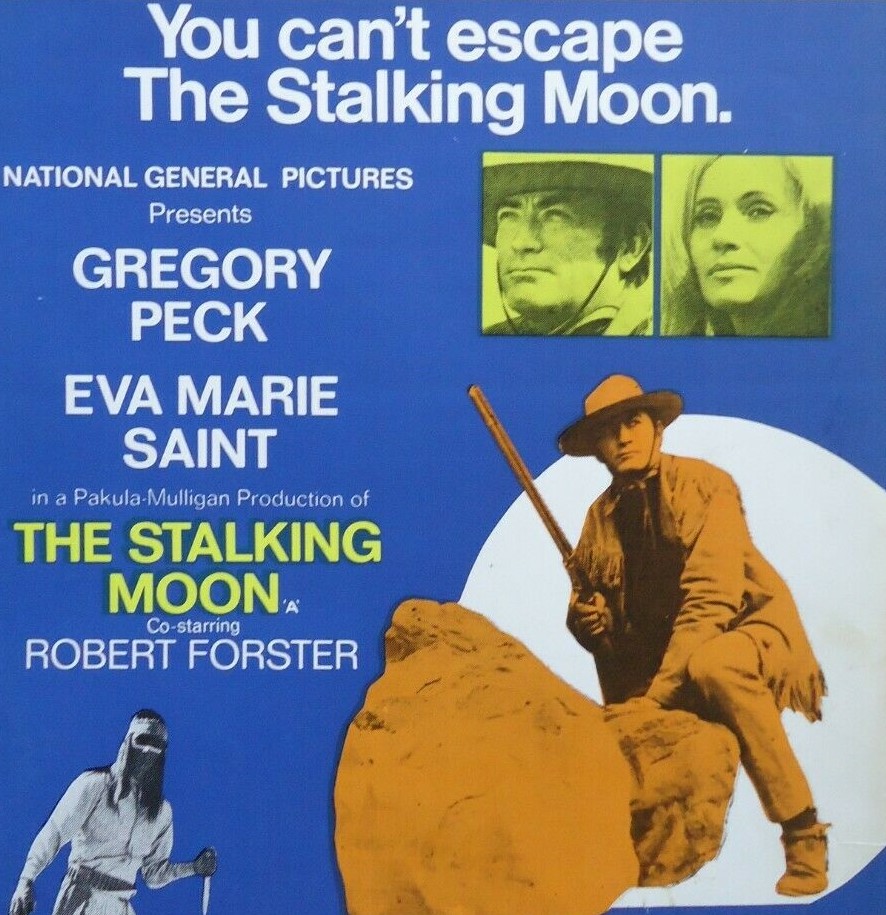
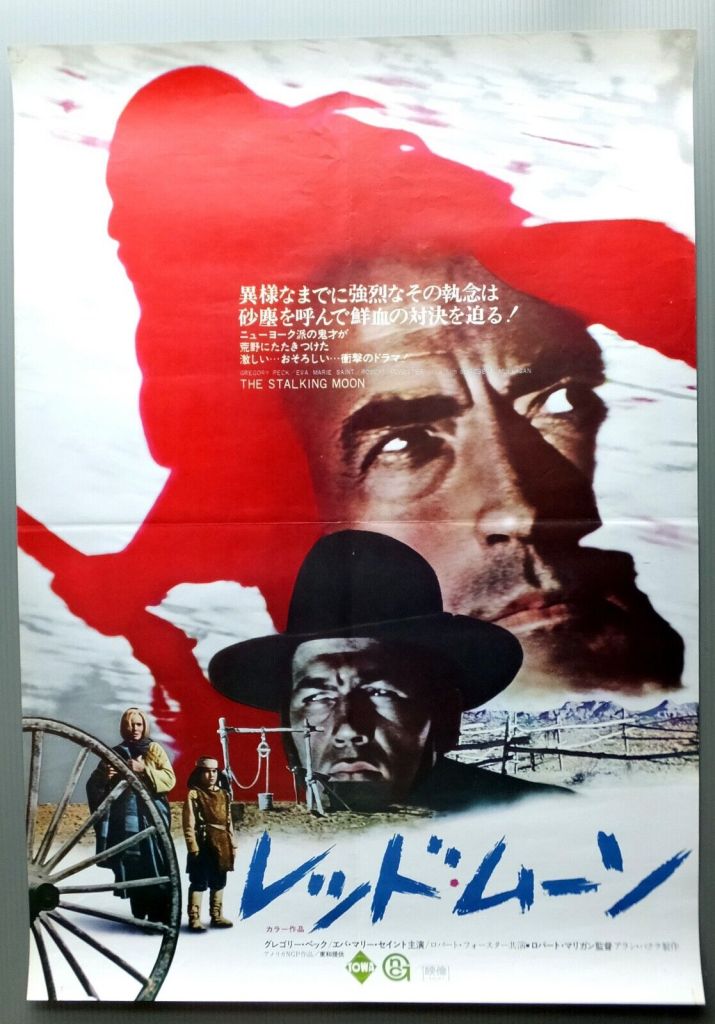
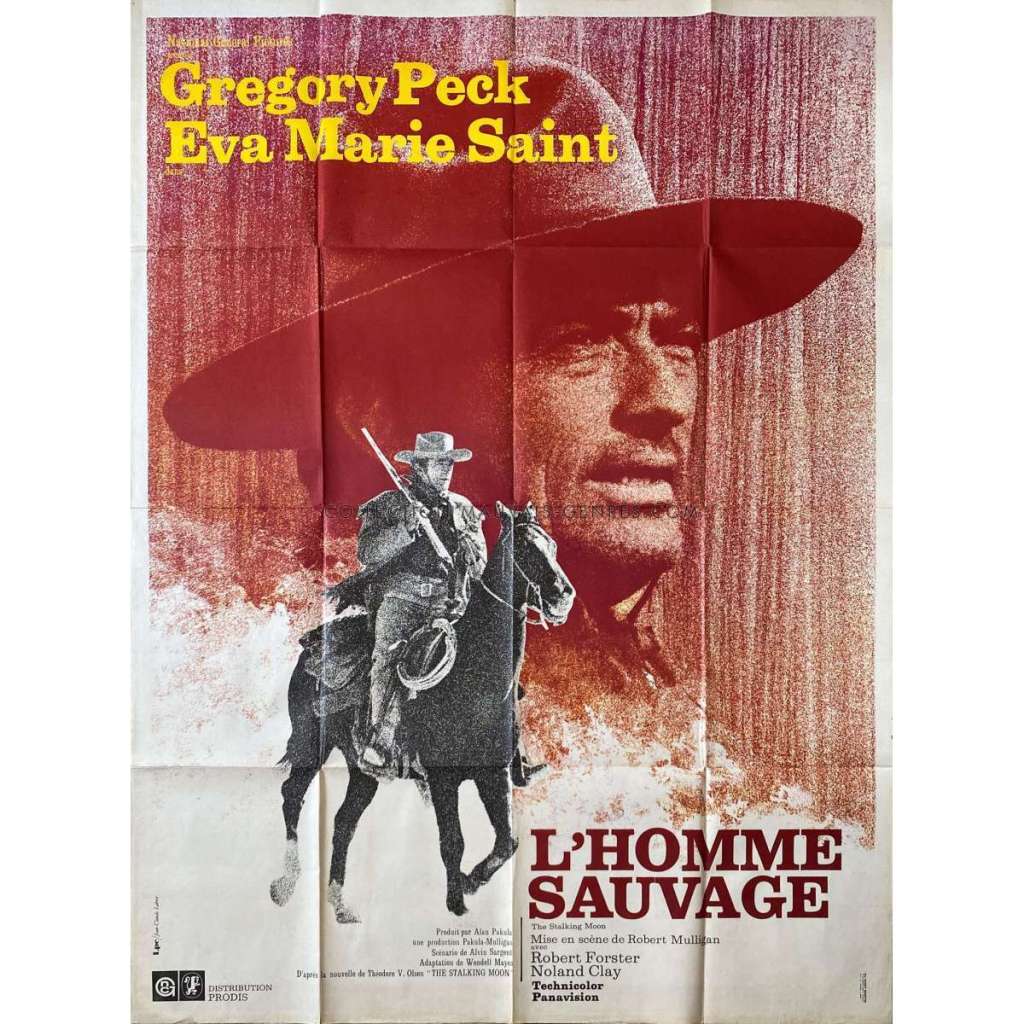
About-to-retire Indian scout Sam Varner (Gregory Peck) helps the U.S. Cavalry round up Indians to take to reservations. One of these is American Sarah Carver (Eva Marie Saint) who, with her Apache son, is attempting to escape her vengeful Apache husband Salvaje (Nathaniel Narcisco). Varner agrees to take her to the nearest stage coach post, and then to a train depot, and, finally, to his ranch in New Mexico where they enjoy a period of security. But wherever she goes, death follows, culminating in a shootout in the hills around his ranch.

But the treatment by director Robert Mulligan (Up the Down Staircase, 1967) is far more complicated, often asking questions that cannot be answered, and placing the principals in situations that cannot be easily resolved. Sarah Carver has not gone running in order to find a man to save her; she does not think she can be saved and accepts the inevitable. She feels guilty for “lacking the courage to die,” of accepting Salvaje as her husband instead of dying along with the rest of her family when attacked a decade before by Indians.

She is weak in other ways, hiding the identity of her husband from the Army and everyone else in case she is abandoned. She shows no great bond with her son, who, several times, attempts to escape.

Sam Varner is very much an ordinary guy, just wanting to quit the Army and work his ranch. He is not the traditional extrovert western hero, nor the man who reluctantly takes up arms.  He has no wish to get involved with Carver and each time he does agree to help it is with a time-limited condition attached and these scenes lack any sense of meet-cuteness, no romantic interplay hastening him to a decision, little expectation that either party is angling to fall in love.

It is practicality rather than intimacy that makes them share a blanket during a dust storm and he asks her to come to his ranch because he will get on with the work quicker if he has someone to cook. In fact, his honesty prevents that: he confronts her over the fact that she “put us out here knowing all the time that he’d come after us” and making her face the corpses of men who died because she hid the truth. He is honest with his emotions and he is determined (“I got a place to go and I’m going”). But he bears none of the normal western hero’s traits, neither a hard drinker, loner, or gunman. He is not gauche like James Stewart or malevolent like Clint Eastwood. 

Even more unusual is the treatment of Salvaje. Despite the savagery of his actions, there is within him a sense of honor. He only chases his wife because she has stolen his son; there could be no greater affront to his dignity. The story is told from the point of view of the pursued i.e. Sarah Carver. But, by turning that perspective on its head, The Stalking Moon more easily fits into the category of revenge western, characteristically a picture concerning chase and pursuit by someone who has been wronged.

The director takes a bold step in the presentation of Salvaje. He is not seen at all in the first hour, then in just a few glimpses of a shape, his face only revealed at the climax. He is a ghost and a killing machine combined. Like a latter-day “Terminator,” he cannot be stopped, so skilful he evades capture, and relentless.

It is also, unusually for a western, a thriller. The tension mounts from the discovery, at the 10-minute mark, of Salvaje’s first three victims, all fully-armed soldiers, and the news, one minute later, that he single-handedly killed four troopers previously. At Hennessy, a staging post, when Varner and Carver go out into a dust-storm to search for her son who has run away, they return to find all dead. Everyone they left behind at Silverton, a train depot, is also killed.

Initially, Carver appears impatient, not willing to wait five days for an Army escort, but once she reveals who the boy’s father is, the reason becomes clear, and her desire for speedier transition creates more tension. Even in New Mexico, the death toll mounts, once Salvaje arrives. Now the trap closes in on them. Even the ranch house cannot prevent Salvaje from sneaking in and kidnapping his wife, leaving her for dead outside.

When Varner and a fellow scout, the half-breed Nick Tana (Robert Forster), attempt to turn the tables on Salvaje and track him down, it ends in Tana’s death. Although most of the tension comes from the will- he-won’t-he dynamic, there are number of Hitchcockian touches such as offscreen sound cues triggering alarm in characters. In two instances, a door provides shock.

Far from providing the expected relief, the ranch house merely provides a claustrophobic setting for the characters. Varner is trapped with an inarticulate pair. Instead of arrival at the ranch house precipitating emotional response and romantic interlude, as would be par for the course for other westerns, Varner finds himself stuck with a woman who refuses to talk and a boy who does not understand a word he says. The seven-minute scene where he sits down to eat and then has to virtually command mother and son to join him and encourage them to talk even if it is just to say “pass the peas” is one of the most awkward ever filmed. 

The movie is so darned awkward that you never laugh even at the few moments of comedy, the complicated issuing of train tickets, Varner keeping up a one-sided conversation at the table, Nick’s attempts to teach the boy poker. Relationships are more likely to remain in limbo than move on to any romantic or sentimental plane.

The film has a tight structure, the first 40-odd minutes setting up the story and tracing Varner and Sarah’s journey to the ranch house, the next 20 minutes at the ranch alternating between comfort and discomfort as emotional release battles with restraint, the final 40 minutes the physical battle between the mostly unseen enemy and the farm occupants. 

Stylistically, it is exceptional. The first section is all open vistas, characters minute figures on vast landscapes, the middle section suggests harmony with nature, and the final battle alternating between being the hunter and the hunted. When we first see Varner he is picked out along the edges of the screen as he leaps up or down or across rocky hillsides. That he appears and disappears at will could almost be the motif for the film.

Virtually everyone is in long shot or medium shot for the first half. Varner appears on the periphery of the screen and the action. He enters scenes where something important is being discussed, such as Sarah’s pleading to be allowed to leave the Army camp quickly. Most directors present Gregory Peck with aura intact, keeping him motionless on the screen to maintain his authority, but here he is always on the move, walking across open ground or confined spaces or darting across hillsides or through bushes, dashing on foot down slopes or racing on horseback.

Although the script – by Alvin Sargent (Gambit, 1966) and Wendell Mayes (Von Ryan’s Express, 1965) based on the T.V. Olson (Soldier Blue, 1970) novel –  was viewed in many quarters as being underwritten, in particular Sarah’s role, and that there were too many silences for comfort, in the view of many  that is the strength of the picture. There is none of the easy dialogue, crackling lines, coarse confrontation, sentiment or raw emotion of other westerns.

The movie hardly even skirts a cliché. This is in a class of its own in terms of the distance characters maintain between each other. Varner has very little to say, Sarah’s guilt restricts her vocabulary. In one regard the thriller element gets in the way of a study of two remote characters.

If I have any reservations about The Stalking Moon it is that is neither enough of a thriller nor enough of a character study. George Stevens might have sought emotional resolution and producer Alan J. Pakula, who later went on to direct Klute (1971) and The Parallax View (1974), might have proved more adept at marrying the thriller elements to personal anguish. Although The Stalking Moon may not have entered the pantheon of the greatest westerns, it is a very noble effort indeed, its slow pace and lack of dialogue providing it with a very modern appeal.

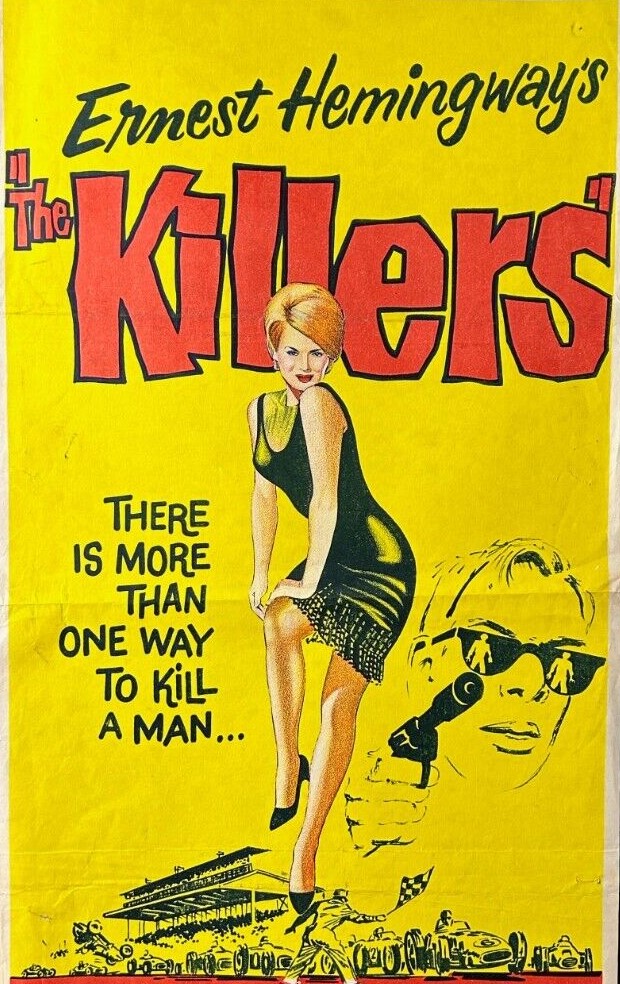
The Killers (1964) ****

Angie Dickinson (Jessica, 1962) is the standout as the cold-blooded double-crossing femme fatale in this slick tale of a double heist. Sure, Lee Marvin (The Professionals, 1966) attracted the bulk of the critical attention as the no-nonsense hitman and John Cassavetes (Machine Gun McCain, 1969) attempts to steal the show as the dupe, but Dickinson walks away with it. Although he makes a vicious entrance, Marvin really only tops and tails the movie.

Violence wasn’t the marketable commodity it proved later in the decade, and this was initially made with television in mind, so it’s surprising how stunning the brutality remains today. In the opening sequence, set in a home for the blind, hitmen Charlie (Lee Marvin) and Lee (Clu Gulager) knock around a sightless receptionist before moving on to shooting at point-blank range their victim, ex-racing driver Johnny North (John Cassavettes). But when they get to thinking why they were paid way over the odds to shoot North, they discover he was involved in a million-dollar heist and before you can say flashback we tumble into the story of how gangster’s moll Sheila (Angie Dickinson) lured him into participating in the robbery organized by boyfriend Jack (Ronald Reagan).

There’s nothing particularly complicated about Jack’s plan – hijacking a mail truck on a remote road – but the movie takes its sweet time getting there, focusing on Johnny’s racetrack antics and on Sheila nudging Johnny into the illegal kind of pole position. She’s pretty convincing as the all het-up lover to the extent of persuading Johnny to double-cross Jack but her convictions only run one way – to whatever best suits herself.

Eventually, it appears as if the million bucks has disappeared into thin air. Jack presents himself as an honest businessman, but Sheila only holds to the party line for as long as it takes the hitmen to dangle her from a fourth-storey window. But gangsters are rarely as amenable or as dumb as the schmucks they snooker, so Jack is more than able to take care of himself and his property (counting the loot and Sheila in that category).

There might be twists a-plenty but the main narrative thrust is which way will Sheila spin? Was she ever even in love with Johnny? Or having snared Johnny and then managed to convince him to double-cross Jack did she plan to run off with the money herself? Or was she going to double-cross him all along once his usefulness was over?

And even if her heart is in the right place, then that’s plain tragic, stuck with the lout, unable to break free, perhaps playing all the alpha males off against each other her only hope of maintaining her fine lifestyle while not ending up another casualty.

A surprising chunk of time is spent on the racecourse, not just building up the romance and  endorsing Johnny’s driving skills, and as well as the tension of a specific race – and the possibility that too much loving could fatally damage the driver’s track ambitions – you are kept in some kind of narrative limbo as you keep wondering when the heck the killers are going to re-enter the equation.

Don (here credited as Donald) Siegel (Coogan’s Bluff, 1968) directs with considerable aplomb, especially as this carries a television-movie-sized budget and that he hadn’t had a stab at a decent picture since making his initial mark with Invasion of the Body Snatchers (1956). From the iconic opening shot of a pair of dark sunglasses to the sad greed-soaked finale, Siegel’s brilliant use of sound and movement plays in stark contrast to moments of stillness and silence. Throw in aerial tracking sequences, realistic race scenes, and one bold shot of a handgun being pointed at the audience (a similar shot in his Dirty Harry, 1971, ruffled more feathers and generated more critical note).   

But the director’s cleverest ploy is to introduce the hitman, then dive elsewhere, leaving audiences begging for more. So it’s just as well that Angie Dickinson delivers in spades. You need to believe she could be as conniving as she is seductive for the entire tale to work. She is the linchpin far more than Lee Marvin.

And that’s to take nothing away from his performance, a far cry from the over-the-top villains of The Commancheros (1961) and The Man Who Shot Liberty Valance (1962), setting up the template for the later quiet-spoken thug of Point Blank (1967).  

As highly watchable as this is, it wasn’t a career breakout for any concerned. Lee Marvin was just a supporting actor on Ship of Fools (1965) and far from first choice for Cat Ballou (1965), the movie that did make his name. Don Siegel wasn’t offered another movie for four years. Angie Dickinson tumbled down the credits, reduced to second female lead in The Art of Love (1965) and working in television or in movies as a supporting actor until the low-budget The Last Challenge/Pistolero of Red River (1967).

Ronald Reagan bowed out of the movies after this. Clu Gulager, who had a running role in The Virginian (1963-1968) only made three movies in the next seven years.

Gene Coon (Journey to Shiloh, 1968) adapted the short story by Ernest Hemingway which when previously filmed in 1946 marked the debut of Burt Lancaster with the sultry Ava Gardner as the femme fatale.  

Striking, tense, and a must for fans of Dickinson, Marvin and Siegel.

Discover WordPress

A daily selection of the best content published on WordPress, collected for you by humans who love to read.

The Atavist Magazine

by Brian Hannan

WordPress.com News

The latest news on WordPress.com and the WordPress community.