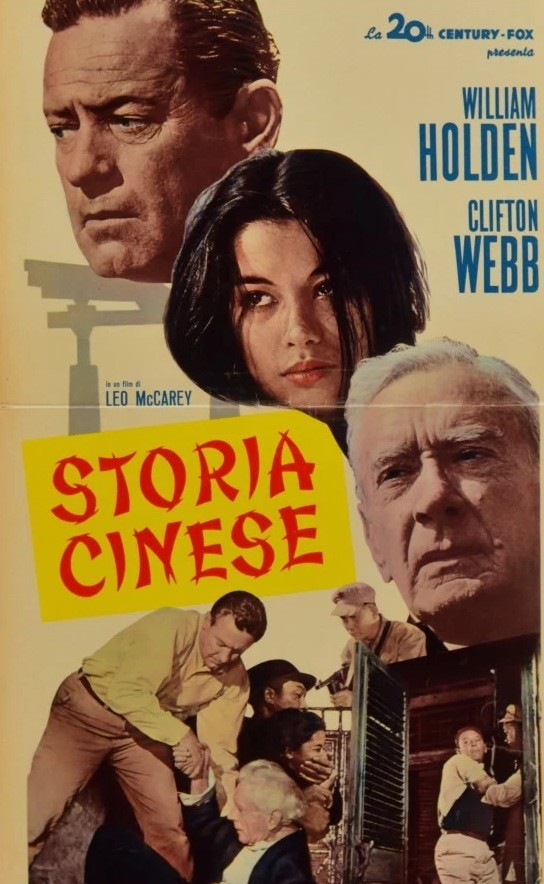
Satan Never Sleeps (1962) **

Of all the misguided sentimental anti-Communist drivel, this is a very poor swansong for triple Oscar-winning director Leo McCarey (Going My Way, 1944). A tone that’s awkward enough all the way through goes straight through the wringer when we are asked to accept without question the actions of a rapist. Such genocidal rape as the conqueror visits on the conquered would sit less comfortably with a contemporary audience.

Most of the problem is the set-up. Apart from those pesky Communists invading a Christian Mission, in other circumstances this would have settled into a verbal sparring match between about-to-retire old priest Fr Bovard (Clifton Webb minus trademark moustache), full of tetchy quips, and his younger replacement Fr O’Banion (William Holden) trying to shake off the unwelcome advances of even younger native Siu Lan (France Nuyen). There would be a servant or maybe a more high-flown doctor whom O’Banion could push Siu Lan onto.
There’s laffs  aplenty if you’re easily satisfied with the likes of a servant (Burt Kwouk in an early role) who believes thieving is compatible with Christianity, O’Banion’s woeful attempts at cooking and his inability to shoo away the ardent Siu Lan, and the priests risking breaking a golden rule of their religion to enjoy a glass of wine before the clock strikes midnight.

The arrival of the Communists is not initially too tiresome, Bovard doing his best headmaster impression keeps them in line, Communist leader Chung Ren (Robert Lee), an ex-Christian, sweet on Siu Lan. Things get tricky when Chung Ren’s attempts to forcefully claim the woman are deterred by O’Banion who is tested several times on the old Christian principle of turning the other cheek before resorting to unchristian violence.

Chung Ren then rapes Siu Lan anyway. But when she stabs him in the back and the rapist is forced to ask O’Banion to go to another mission to fetch the necessary penicillin to prevent infection spreading, the older priest is inclined to ignore the request and let him die. O’Banion thinks he has struck a deal to free the old priest in exchange for fetching the medicine, but Chung Ren reneges on the agreement and the priests are tortured and stand trial.

Meanwhile, Chung Ren has a change of heart, or so it seems, after Siu Lan gives birth to his son. But, actually, this might be more to do with the fact that he has been demoted for not being a good Communist, inclined to enjoy the finer things in life rather than share them out with his comrades. And it’s only when he’s told he’s going to be sent away to some kind of Chinese Gulag that his principles make an appearance and he helps the two priests and Siu Lan and her baby to escape.

I could see maybe Siu Lan being forced into marriage by Chung Ren in the Communist state while he was in a position of importance; she would have no choice in the matter. But for her to show the same acceptance in a democracy outside China smacks of the worst kind of wishful thinking. Sure, the Christian God is all-forgiving and, technically, all Chung Ren would have to do was confess the sin of rape and equally technically he would receive absolution and therefore in the Church’s eyes be free to marry.

But O’Banion overheard the rape. He’s a witness. That’s no use in the Communist society, but in a democracy you would have thought he would have been seeking prosecution. As he was a witness and this was not something protected by the sanctuary of the confession, he would not just be perfectly within his rights but would have to seek out rule of law.

I have never heard of a rapist and the woman he raped living happily ever after and I doubt if it would ever have been considered conceivable even in the early 1960s.

That aside, William Holden (The Devil’s Brigade, 1968) and Clifford Webb, in his last picture, are good value as the squabbling priests, less so when they venture into dubious morality. France Nuyen (A Girl Named Tamiko, 1962) doesn’t get a fair shake, required to be the cliché happy grinning native and then provided with no opportunity to state her case against her rapist before she’s pushed, for the sake of a fairy tale ending, into marriage.

Written by the director and Claude Binyon (North to Alaska, 1960) from the bestseller by Pearl S. Buck.
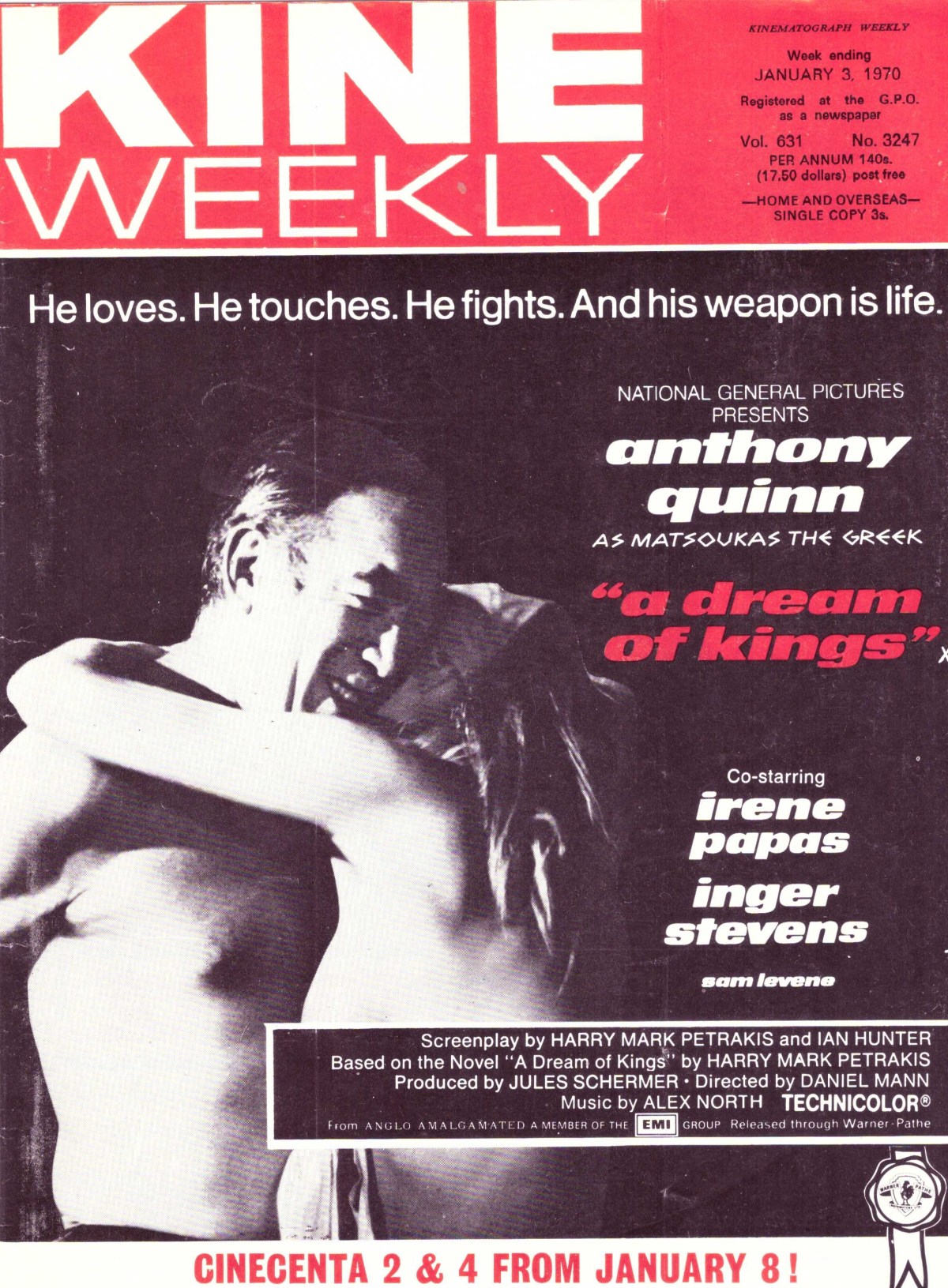
A Dream of Kings (1969) *****

Sometimes great movies just disappear. Even if they pick up some critical traction on initial release, as here, they flop at the box office. And they are not revived because the production company goes bust or the rights are complicated. Or, more likely, they don’t fit into audience expectation. All three stars here completely play against type, outliers in career portfolios. We have become so accustomed to the attraction of stars according to their screen personas that unless they are known to completely change their screen characters with every outing anything that’s different to the norm becomes unacceptable.

Director Daniel Mann (Ada, 1961) was best known for producing Oscar-winning or Oscar-nominated performances from female stars. He was immensely skilled at making audiences sympathize with the most flawed women. Here, he does the same for Anthony Quinn, in a performance that should have had Oscar voters lining up but was dismissed for all the wrong reasons. Theoretically, one of the film’s problems is the dialog. We are so used to a script full of cut-and-thrust or witty putdowns that we fail to recognize a screenplay, that in much the same way as a stage play – but without that form’s inherent artificiality – lets characters live and breathe, explore depths that are just not possible except in fleeting moments in the normal construction of a movie.

Most scenes here begin one way and then move in all sorts of directions, sometimes ending up back where they started, but most often going somewhere unexpected, not in the sense of a sudden twist, but in digging deeper into relationships and understanding that marriages are built on shifting sands, and not all of them perilous. There’s a lot of dialog and when you get a lot of long speeches it can make the actors look as though they’re hamming it up when in fact what they’re doing is opening up the character.

We shouldn’t like Matsoukas (Anthony Quinn) at all. He’s a gambler, a womanizer, drinks, comes home at sunrise, has nothing you’d call a real job.

And yet.

In his company you enter a world of possibility. By sheer force of personality he lifts gloom, even when it’s his actions that have caused it. He can convince the most downtrodden weaklings that they have something of worth.

When nobody has anything good to say about old drunk Cicero (Sam Levene), Matsoukas tells him he has a poker dealer’s graceful hands and provides solace just by befriending him. He convinces a 72-year-old man that the loss of his libido is not down to the old guy’s age but because in four years of marriage he has lost interest in his 31-year-old wife because she’s the one who has aged, physically less appealing, and then he teaches the desperate soul the gentle art of seduction, how to win a woman’s heart by putting her on a pedestal, treating her like a goddess, kissing her softly on eyes and ears rather than pawing her in frantic passion.

Just what Matsoukas’s job is – on the door it says “counsellor” which would suggest something  legal  – but in fact he’s a male version of an old wife and provides solutions to odd problems, a mother worried that her teenage son masturbates, for example.

He is the sort of guy who can wring triumph from disaster. He has just lost a bundle of dough at poker but the way he tells it you’d think he’d won. Instead, he appreciates the drama of it all, the way it makes a great tale even if he’s the loser. Naturally, wife Caliope (Irene Papas) doesn’t see it his way. She’s on her knees with trying to feed her three children from the scraps that fall from his gambling. Though when he wins big, they live like kings.

Although he still has a lusty sex life with Calope, and can mostly coax her round, he has fallen for widowed baker Anna (Inger Stevens), attracted to her in part to alleviate her grief, pull her out of the darkness.

And he cannot face up to the potential loss of his young son who has three months to live and has it fixed in his own mind that the boy will be cured if Matsoukas can expose him to the sunshine and the ancient gods of his Greek homeland, though he lacks the $700 required for the air fare.

Each sequence is long, carefully calibrated, giving time for the exploration of a wealth of emotions. Outside of the three main narratives are two other stand-out scenes. In his sermon a priest rails against the evils of life insurance that makes people welcome death yet argues, ironically, that death is a great joy and should not be feared. And there’s a party where Matsoukas on the dance floor is a magnet for every woman in the room.

This is an Anthony Quinn (The Shoes of the Fisherman, 1968) devoid of all trademark abrasiveness, the loud voice gone, trying to gouge every ounce of joy from a forbidding world. He has a very tender relationship with his dying son, inventing a game with fake telephones to deal with the boy’s fears, and is very playful with his two daughters. He is constantly wooing his wife, in part to ease the pain he causes her, but mostly because he wants them to get the most out of life.

This is a different Irene Papas (The Brotherhood, 1968) too, not the fiery woman or dutiful wife of her screen persona. Whatever anger she feels is subsumed by sorrow and she is always willing to let her husband fire up her heart as in the old days. Actresses don’t get such complex roles these days.

And all the pent-up fragility of Inger Stevens (Five Card Stud, 1968) is suddenly let loose as she twists her entire screen persona of tough woman in a man’s world – usually a western – on its head. Her scenes with Quinn are breathtaking. Unfortunately, this was her final film – she committed suicide shortly after. But she could not have found a better swansong, one that extended her range.

As he always does, Daniel Mann doesn’t take his main character’s side, but while extracting sympathy for character predicament and perspective, still lets the audience make up his mind. This could easily have gone all maudlin, the child miraculously recovering, the flight to Greece to find a rare cure, all Matsoukas’s delusion revealed as nothing more than true faith, but it’s more hard-edged than that. At the end Matsoukas has his exterior carapace ripped apart, beaten up, ostracized for committing the worst crime of a gambler – cheating – in dire straits.

And yet.

Written by Ian McLellan Hunter (Roman Holiday, 1953) from the bestseller by Harry Mark Petrakis.

I just adored this.

The Canadians (1961) ***

You ever wondered what happened to the Native Americans after they wiped out Custer at the Battle of the Little Big Horn. Well, they scarpered north to Canada, which flew the British flag, being part of the very powerful British Commonwealth, and where they were, effectively, out of reach of any pursuing forces. Any legitimate forces, that is. Nothing to stop an irate Yank rancher crossing the border to claim back a herd of horses he reckons the Sioux stole during their escape.

Otherwise, the Sioux would be relatively safe. But that safety was conditional. The might of Canada would not bear down on them as long as they didn’t resort to violence against that country’s citizens, as long as a rifle wasn’t shot in anger or a cartridge found beside the body of a white man.

Sure is a misleading poster, suggesting some kind of full-scale cavalry attack, when the grand total of Canadians involved is three.

So that was quandary number one. Quandary number two was that the unit set on enforcing this rule was the Royal Canadian Mounted Police. And though part of the uniform was a splendid leather holster, it was empty. They didn’t carry guns. They didn’t need to, as is sanctimoniously explained, because using weapons in law enforcement only caused more killing and, in fact, it was reckoned, there would be a lot less American outlaws if they had not been brought up in a society that worshipped guns.

And that lack of weaponry creates another predicament for the RCMP because rancher Boone (John Dehner) is going on the principle that killing a Native American is not a crime in his homeland and raids the Sioux camp, shooting people, including a two-year-old child, and kidnapping the child’s mother, an unnamed white squaw (Teresa Stratas). The kidnapping will justify any action he takes. Because if she’s been stolen from America, then it’s not a kidnap but a rescue, and that justifies any violence.

But RCMP leader Gannon (Robert Ryan), inevitably, in the only cliché in the picture, about to retire, reckons that’s up to a judge to decide. So with his two colleagues, the experienced McGregor (Torin Thatcher) and a rookie Springer (Burt Metcalfe) he’s intent on bringing them in. He’s helped in this enterprise by the Sioux acting as distant bodyguard.

Though naturally it’s only a matter of time before the Americans try to escape, especially as it soon transpires that Boone is lying when he says he knows the woman and has come north expressly to bring her back.

And this would be quite a curiosity, given the only real tension is how the RCMP can hold onto their captives for the week it takes to reach a town, and whether the Native Americans might reckon justice won’t be served and hand it out their own way.

You might remember the audience shock when Henry Fonda gunned down a young boy in Once Upon a Time in the West (1969), those baby blues turned steely. Well, that brutality has its unexpected precedent here, although, except for the mourning mother, not so much is made of it.

With the Canadians outnumbered – there’s three other Americans, all of the outlaw persuasion, Greer (Jack Creley), Ben (Scott Peters) and Billy (Richard Alden) – and unable to use weapons, you’re thinking how in heck is this going to last the pace. But, in fact, though presented as some kind of western, it’s a character-driven piece.

Gannon is an unlikely singleton, but he’s got too high hopes for a lawman and never found a  woman he wanted to settle down with, and he’s got that principled look about him so he’s probably not one for one-night stands or creeping around brothels. The squaw’s child wasn’t the result of rape. Although initially trying to escape captivity, she fell in love with a Native American because he looked at her in a way no white man had, since she was so physically unprepossessing, and a bit like Lin in The Green Berets (1968) knows that she is likely to be ostracized by her own people if she returns to her home town.

You have to feel sorry for Boone, too. He’s not some kind of entitled whelp who inherited land and wealth. He saved up his hard-earned cash working as a ranch hand and bought one horse, then its mate, then started breeding, building up his herd the slow way, and he can’t afford to lose upwards of forty horses.

But the one you would extend most sympathy for is Greer. Being a legal outlaw – employed for gunslinging skills on a legitimate enterprise – is not his long-term goal. He repeatedly asks Boone for a job back at the ranch when this task is complete, only to be turned down with utter contempt. And he has a code. He won’t kill an unarmed man. Boone will, and an unarmed female to boot. Ben has no such code and reckons any woman is ripe for the taking and attempts to rape the squaw.

So the tension is mostly wondering how this is going to end, with the Canadians outnumbered and only able to call on their fists as weapons, and you soon work out there’s not enough time left in the picture to get to that destination and go through all the malarkey of a trial, or for the lonely Gannon to strike up a romance with the woman.

The Sioux come to the rescue once the Yanks have escaped and killed the woman. And it’s a peach of a solution. Remember, they can’t fire a shot. So they don’t. They get a herd of wild horses, for all we know the ones Boone is looking for, to do the dirty work. They stampede the horses and drive the bad guys over a cliff.

Very interesting debut for writer-director Burt Kennedy (The Rounders, 1965). Rare starring role for Robert Ryan (Ice Palace, 1960) who makes the most of it. Teresa Stratas was an opera singer so gets to sing.  Otherwise, Jack Creley, who had a long-running role in the Marvel television series in the 1960s, is the pick.

Much better than I expected.

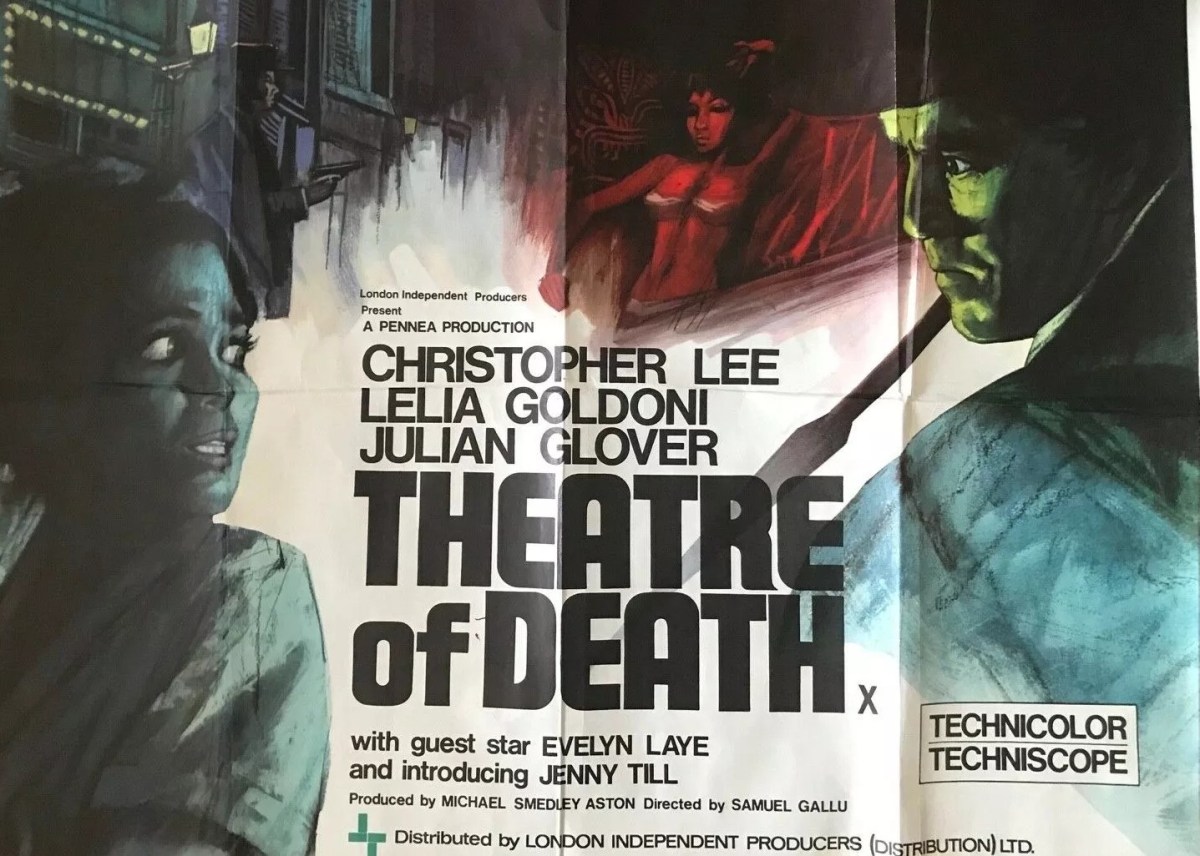
Theatre of Death (1967) ***

Takes considerable brass neck to treat master of the macabre Christopher Lee as nothing more than a red herring. A very slow slow-burn with a pinch of the vampiric, quartet of characters with a mysterious past, Grand Guignol Parisian setting, some decided sleight of hand and a series of murders staged to huge audience delight (in the titular theater, you understand) turns this into a more interesting venture than you might expect. In more literary hands, the incident on which this pivots could well have turned into tragedy.

Impresario Darvas (Christopher Lee) has launched The Theatre of Death, a show comprising a series of highly realistic sketches in which characters appear to be brutally killed. At a first night party he hypnotizes neophyte actress Nicole (Jenny Till) into nearly burning star Dani (Lelia Goldoni) in the face with a branding iron during a sketch about witches, disaster prevented by the intervention of Dani’s boyfriend Charles (Julian Glover). He’s a police surgeon called in to help investigate a series of murders with vampire overtones. Just as sinister is hypnotism which apparently can be self-imposed.

Charles begins to suspect Darvas. And small wonder the audience does too. Darvas has a lair, trap doors, secret passageways, concealed voyeuristic viewpoints and the kind of cat that only a villain strokes. Darvas clearly believes Nicole is more than just a protégée but a tool in his hands who can be called upon to act “when your conscience is asleep,” and given his predilection for brutality, even if apparently only staged, you have to think she will be called upon to do more than act. There’s even a suggestion that he might be able to inhabit her body.

Everyone has secrets. Darvas’s father disappeared in mysterious circumstances, Charles can’t operate following an unspecified accident, Dani spent two years in a mental asylum and Nicole barely survived being trapped in an avalanche in the Alps. Darvas humiliates Dani and promotes Nicole.

The murders switch from a trio of young women to men. Inspector Micheaud (Ivor Dean) is baffled. Naturally, he doesn’t want to risk the public ridicule of announcing there is a vampire on the loose in Paris (though some decades later, as you will be aware, a werewolf, of American origin, was roaming free), setting aside the fact that the French capital had been the scene for various nefarious acts in locales as varied as the Rue Morgue, Notre Dame and the Opera.

Darvas remains the obvious suspect until director Samuel Gallu (The Limbo Line, 1968) pulls a Hitchcock – or should that be, after A Poppy Is Also A Flower/Danger Grows Wild (1966), a Terence Young – and kills off his star halfway through. Initially, Darvas is reported as missing, but his cloak is found covered in blood. Naturally, we are led to believe he is going to turn up, and be identified as the killer.

But nope, in a considerable coup de theater (or coup de cinema), he’s been done away with by the real killer who is cleverly covering their tracks by getting Dani to write a suicide note before killing herself.

It’s certainly a shock to discover that the killer is Nicole, who is very partial to blood after being fed the blood of her brother while trapped in the avalanche. Quite why she has managed to conceal her thirst for so long is never revealed. However, there’s an unforeseen ironic twist which prevents her terrorizing the Parisian citizens any further.

Christopher Lee (Dracula, Prince of Darkness, 1966) is in Hamlet mode, hair combed forward, eyes bristling with intensity. Julian Glover (Alfred the Great, 1969) doesn’t really have enough dramatically to do. Neither Lelia Goldoni (Hysteria, 1965) nor Janet Till (A Challenge for Robin Hood, 1967) does much to burnish their reputation. Written by Ellis Kadison (The Gnome-Mobile, 1967) and Roger Marshall (Invasion, 1966).

Works very well by playing with audience expectation

I Thank a Fool (1962) ***

One of those bonkers pictures whose nuttiness is initially irritating but ends up being thoroughly enjoyable once you give in to the barmy plot and overheated melodrama. Murder, suicide, madness, illicit sex, blackmail – and that’s just the start of this farrago of nonsense. And set in Liverpool before The Beatles made it famous.

Christine (Susan Hayward), a doctor, is jailed when she kills her married seriously ill lover in a mercy killing. She’s not convicted of the murder but of the lesser crime of medical malpractice, but after serving an 18-month sentence finds she is unemployable, even in more lowly professions where her prison stretch counts against her.

When she is hired by the attorney Stephen (Peter Finch) who prosecuted her to look after his mentally ill wife Liane (Diane Cilento), the audience will already smell a rat given that Christine has changed her name and therefore the lawyer must have made considerable effort to track her down. His argument is that since she is no longer a qualified practitioner, she cannot advocate to have his wife committed to a mental institute, as a proper doctor would be required to, since Liane is clearly a danger to herself and other people. Your immediate suspicion is that Christine has been hired to take the rap once Liane is bumped off.

And it doesn’t take long for Christine to work out that not everything adds up. Liane is given enough rope to hang herself, access to a car to cause an accident, access to a horse which could easily bolt or fall.

Liane has been told her Irish father died in an accident where she was driving, the incident that triggered her madness. But when we discover the father, Captain Ferris (Cyril Cusack), is very much alive that’s the cue for a slew of unlikely events. When Liane finds her father, he’s not in the least a candidate for canonization, but an alcoholic. That triggers further mental trauma. And another accident, self-inflicted. After Christine administers pills, the young woman is found dead.

Bit of a stretch to compare it to the movies
mentioned in this poster.

Naturally, an inquest brings up Christine’s past and suspicion falls on her. And that would be par for the course, and it would be up to the condemned woman to find a way to prove her innocence. But that takes us into even murkier depths.

There’s bad blood between Capt Ferris and Stephen and the inference that this was only resolved by the father offering his underage daughter to the lawyer to be followed by the unscrupulous father blackmailing Stephen. Then it turns out there’s no case to answer and that Christine is innocent because, blow me down, Liane committed suicide.

But what should have been a straightforward, if unlikely, murder plot comes unstuck because it can’t make up its mind what it wants to be. Too many ingredients are thrown into the pot and the result is a mess.

Even the queen of melodrama Susan Hayward (Stolen Hours, 1963) can’t rescue this. And the pairing with Peter Finch (Accident, 1966) doesn’t produce the necessary sparks. Despite a variable Irish accent, Diane Cilento (Hombre, 1967) comes off best as the wayward deluded young woman.

Robert Stevens (In the Cool of the Day, 1963) directs from a screenplay by Oscar-nominated  Karl Tunberg (The 7th Dawn, 1964) adapting the bestseller by Audrey Erskine-Lindop.

Had every opportunity to be a star attraction in the So Bad It’s Good sub-genre but fails miserably. Still, if you enter into the swing of things, remarkably tolerable.

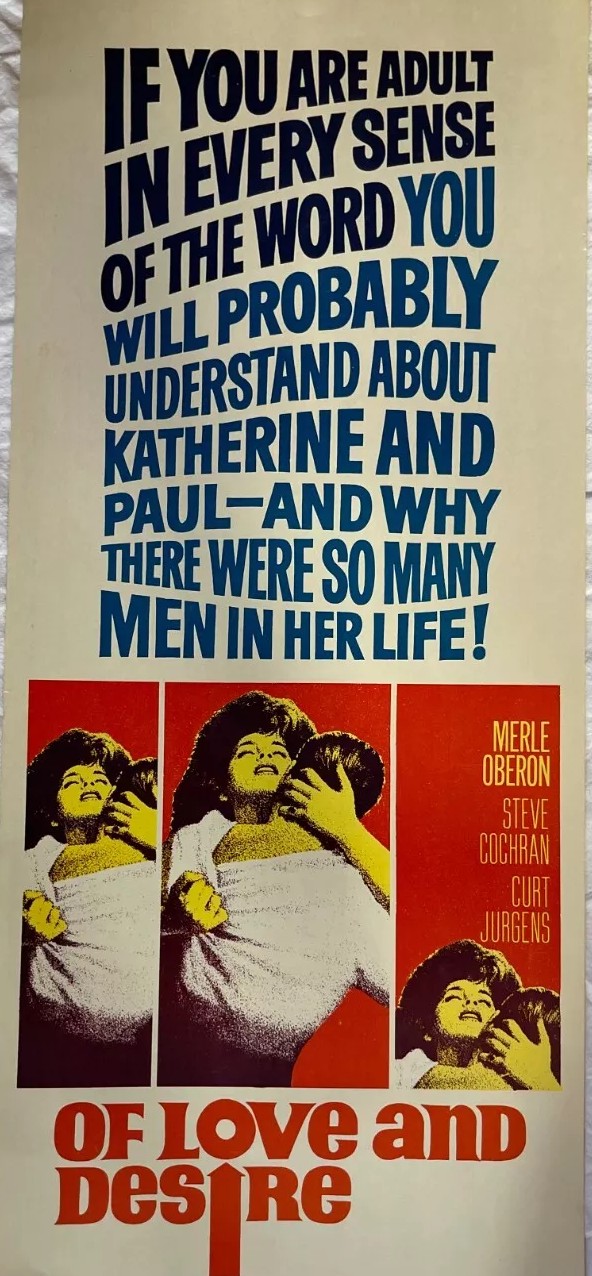
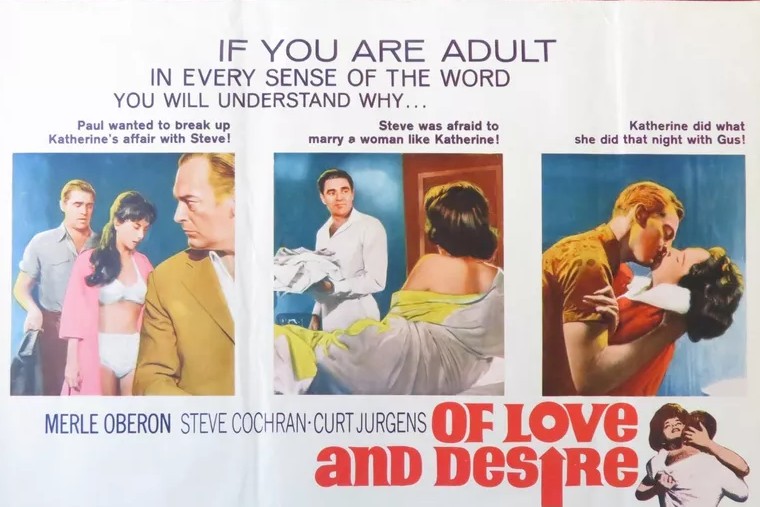
Of Love and Desire (1963) ***

As contemporary as you could get with the core theme of a sexually independent woman picking and choosing her men. Otherwise, a smorgasbord of talent. Star Merle Oberon (Hotel, 1966) hadn’t appeared in a movie in seven years, for co-star Steve Cochran (Tell Me in the Sunlight, 1967) the screen absence was two years, Curd Jurgens (Psyche 59, 1964) was still very much a jobbing actor restricted to playing good and bad Germans, and director Richard Rush (Psych-Out, 1968), in his sophomore effort, was as erratic in the early part of his career as he would be in his later (six years between Freebie and the Bean, 1974, and The Stunt Man).

Of course, this being a somewhat mealy-mouthed decade, psychological mumbo-jumbo was required to explain the woman’s actions rather than the notion that a woman could enjoy being sexually unrepressed and free of desire for marital security. So if you manage to separate the actual movie from the required fitting-in to moral standards, it’s a darned interesting examination of the kind of free spirit later exemplified by Darling (1965) or Modesty Blaise (1966).

Mining engineer Steve (Steve Cochran) on a job in Mexico begins an affair with wealthy Katherine (Merle Oberon), half-sister of his employer Paul (Curt Jurgens). There’s nothing of the usual will-she-won’t-she in this romance, she virtually flings herself at him. Not only that, the morning after, she arranges for all his belongings to be shipped to her splendid mansion, proof of who is usually in control. Just as, more traditionally, males are instantly aroused by beautiful women, she is excited in the presence of an attractive man and makes no bones about it, not too bothered about consequent scandal even though she does her best to keep her activities discreet.

Paul isn’t so happy with the affair. He clearly prefers her unhappy and dependent on him for emotional support. And a bit like Julie in Steve Cochran’s later picture Tell Me in the Sunlight, there’s certainly an assumption that she jumps from man to man, though out of boredom rather than financial security.

So Paul sets out to sabotage the affair by putting in Katharine’s way previous boyfriend  Gus (John Agar) who feels he is owed some sex and is determined she repay the debt. Although she almost succumbs and is subsequently ashamed of how easily her desire is inflamed, she resists and after he has had his way with her attempts to commit suicide.

But the question of rape is never raised and to Steve it appears she has merely resorted to type, falling into bed with the closest man. And in the time it takes to resolve the situation, we are treated to the psychological mumbo-jumbo which falls into two parts. In the first place, there has clearly been a strong sexual attraction between Paul and Katharine, and the strength of their emotional bond is in some ways a substitute for not indulging in incest. Secondly, her fiancé, a fighter pilot, was killed in the Second World War. Based on no evidence whatsoever, she has convinced herself that he committed suicide because she refused to have sex with him before marriage. To make up for that, she gives herself to any man who comes along. Yep, claptrap with a capital C. Which somewhat torpedoes the picture, which had been heading comfortably towards a feminist highpoint.

Merle Oberon almost turns the clock back a couple of decades to Wuthering Heights (1939) and her role there in physically expressing forbidden desire. You can almost feel her quivering with pent-up sexuality and she is unexpectedly superb, in what is essentially a B-picture, especially as the opportunity to tumble into melodrama – which she can’t escape in the final act – so obviously beckons. That the first two acts work so well is primarily down to her believable characterization. And Steve Cochran is no slouch either, shaking off the coil of his pervious incarnation as a tough guy. Curt Jurgens is creepy and sinister.

Director Richard Rush manages to hold his nerve until the end and then it all runs away from him into turgid melodrama. Screenplay contributions from the director, producer Victor Stoloff, Jacquine Delessert  in his debut and Laszlo Gorog (Too Soon to Love, 1960, Richard Rush’s debut)

Nearly but not quite a feminist breakout.

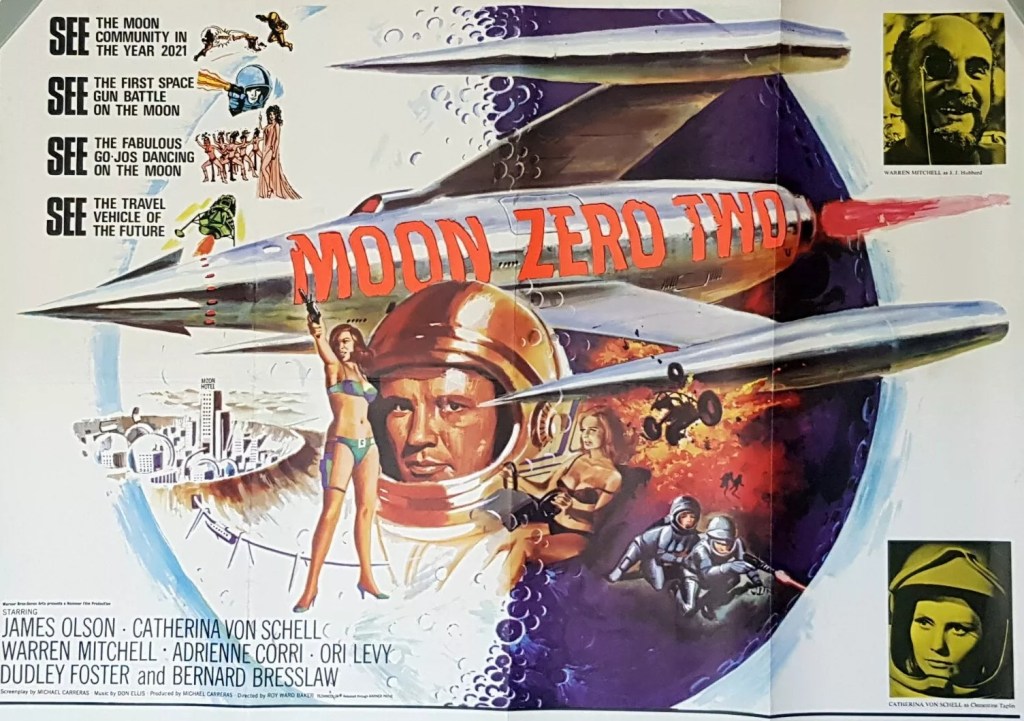
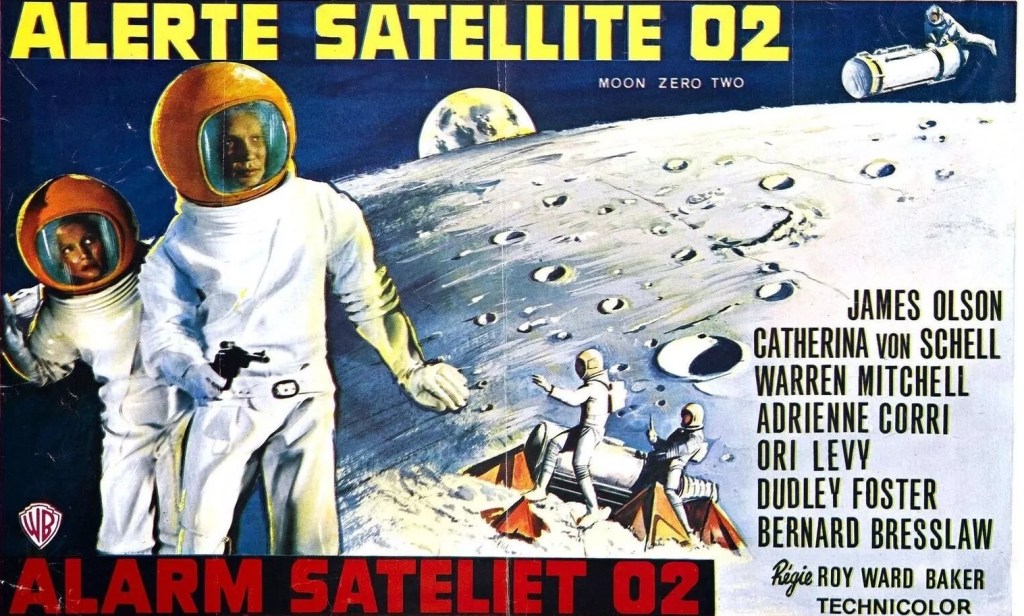
Moon Zero Two (1969) **

Not much that’s redeemable from this British sci fi effort. Maybe the idea of the “dirty universe” clogged up by waste with salvage hunters retrieving bits of old satellites and space objects. Or maybe an early version of “unobtainium,” the rare mineral that’s going to make someone very rich, in this a solid block of sapphire and some mined nickel. Or maybe the colonizing of the Moon for gain rather than the advance of science.

But that’s about it. Takes about 30 minutes for a story to emerge, the rest of the time taken up with info dumps and character background, so we know that ace pilot Bill (James Olson) was the first man on Mars and wants to repeat the same feat for Mercury, Jupiter and other distant planets and would rather become a salvager than lower himself to become a passenger pilot. His girlfriend Liz (Adrienne Corri) is an officious official and threatens him with being grounded on safety grounds.

But that kind of bureaucracy is par for the course in British sci fi which liked to clutter up the narrative with accountants (The Terronauts, 1967, et al) and various levels of officialdom. And there’s another British trope. Take a well-known comedian and turn him into an unlikely tough guy of sorts – Eric Sykes as an assassin in The Liquidator (1965) would be in pole position but Carry On regular Bernard Bresslaw runs him close here as a gun-toting bodyguard.

Or maybe the Brits just like a hybrid. Stick some comedy into sci fi. Certainly the animated credits suggest this is going to major on comedy, which turns out not to be the case unless you were laughing at how inept the whole project is.

Especially when director Roy Ward Baker simply resorts to slo-mo to suggest loss of gravity in space. And when the space outfits look as if they were run up by someone’s ancient auntie. Just to show the bad guy is a bad guy, entrepreneur J.J. Hubbard (Warren Mitchell) wears a monocle. He hires Mike to go find the sapphire asteroid and bring it back to the Moon, where it can be dumped on the “far side”, well away from any nosey parkers, to make it look as if it had landed there on its own, thus bypassing Space Law.

But Mike’s already made the acquaintance of Clem Taplin (Catherine Schell) who’s hiked up from earth to search for missing geologist brother and once Mike’s located the sapphire he heads out into the far side of the Moon to find the brother. They find him all right but by this point he’s just a skeleton though he has uncovered nickel deposits. He’s been killed by Hubbard and the couple are ambushed and have to shoot their way out (the efficacy of bullets in space in never explained) in a manner that suggests, as the posters liked to proclaim, a “space western.”

Mike gets his revenge by stranding all the bad guys he hasn’t already killed on the sapphire in space.

It would have probably been okay if any of the actors had shown any screen spark. But they’re all lumpen, although perhaps you can blame the restraints of the space costumes, or maybe even just the script. Oddly enough James Olsen would make his mark in sci fi adventure The Andromeda Strain two years later, but that had both better direction (by Robert Wise) and a more intriguing script (from Michael Crichton).

You might as well have wrapped up Catherine Schell (On Her Majesty’s Secret Service, 1969) in cotton wool for all the impact she was able to make. Warren Mitchell (The Assassination Bureau, 1969) looks as if he’s desperately trying to stifle a grin.

Hammer boss Michael Carreras (The Lost Continent, 1968) wrote the screenplay, and produced, so he should at least share the blame with Roy Ward Baker (Quatermass and the Pit, 1967).

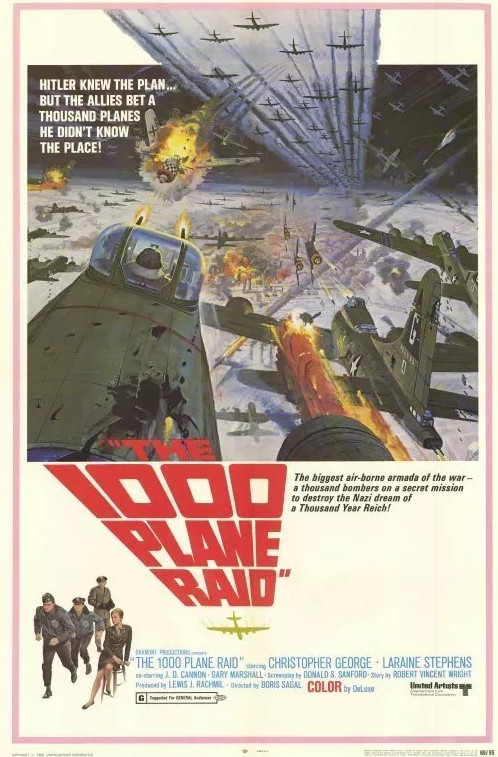
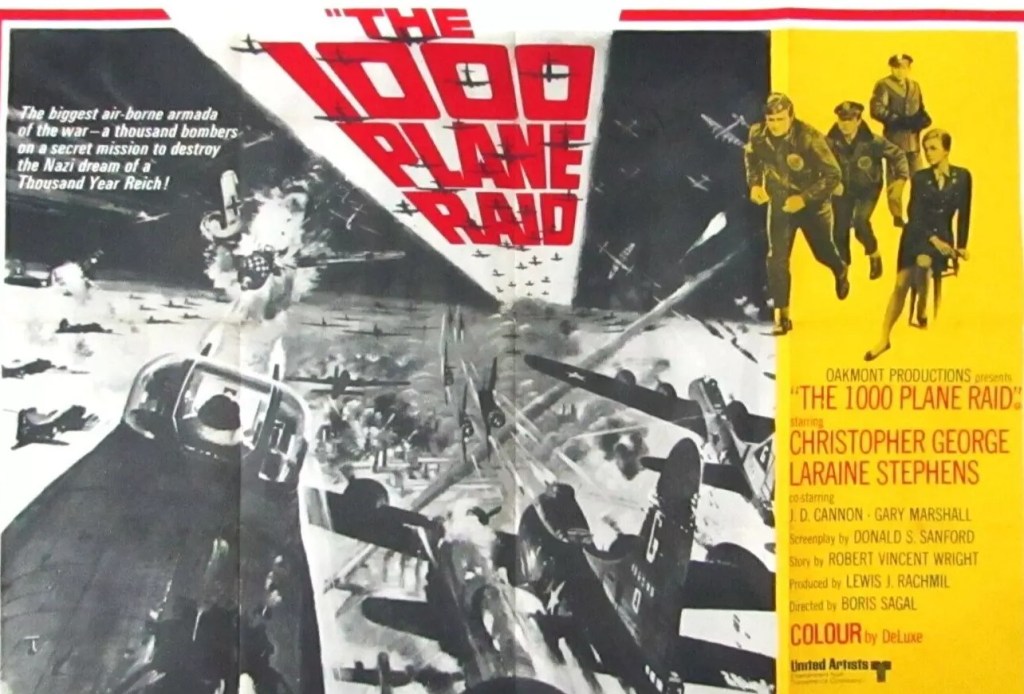
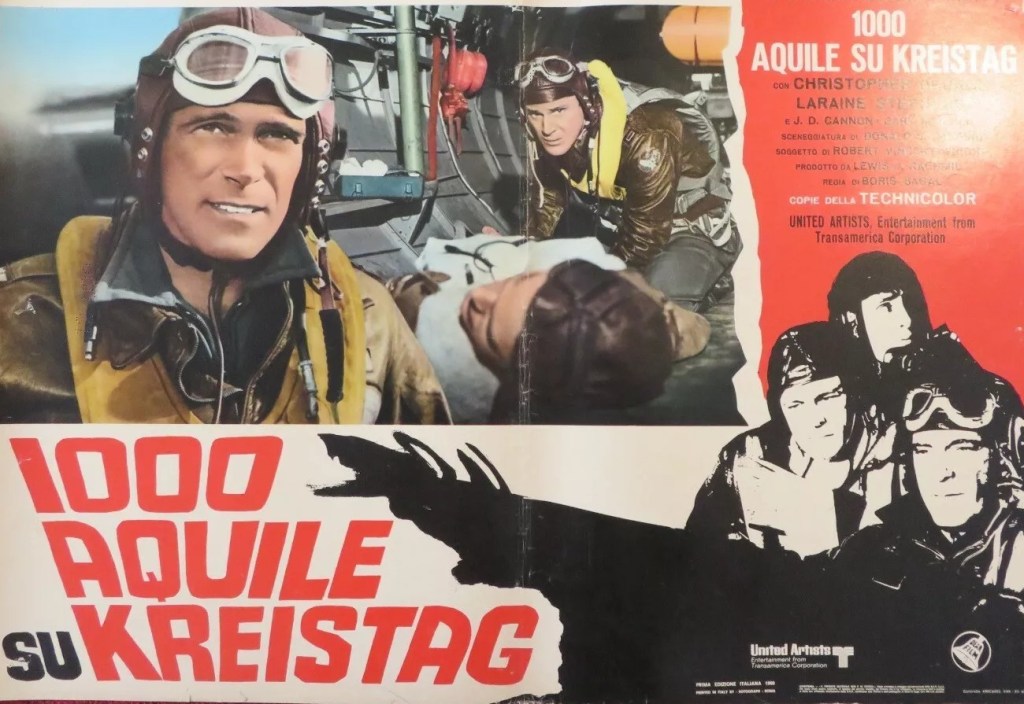
The Thousand Plane Raid (1969) ***

Let’s be honest. Like 633 Squadron (1964) and perhaps even, despite its all-star cast, Battle of Britain (1969), many in the audience will only be there for the hardware, the chance to see the flying battle buses that took the Allies to victory in World War Two. There’s not going to be much of a story anyway – rivalry between commanders, tension on the ground, a romance beginning or breaking apart, a stash of info dumps. That can hardly compare to the grace of the big birds in the air, usually a mixture of stock footage and new work with refurbished old planes.

This one has even re-purposed – perhaps stolen would be a better word – a mission from earlier in the war which was planned and carried out by the RAF so that it could be planned and in part carried out by the Yanks. Still, it was the Yanks putting up the money so I guess they can change history whenever they like.

U.S. Air Force Col Brandon (Christopher George), leading an American bomber group stationed in England, has worked out that while night-time missions result in fewer casualties they are increasingly failing to get the job done, only one on five bombs hitting the designated target. He reckons a gigantic air attack in daylight is the only way to succeed. His boss General Palmer (J.D. Cannon) grants him the chance to pitch his idea to the assembled RAF high command. Despite the risks, they agree and then need to come up with about million gallons of fuel and about a million-and-half tons of bombs, and requisition 30 airfields for the bombers and the same number for the fighter support.

Various elements make life tougher for Brandon. The mission chosen is much further afield than he originally imagined, the deadline is brought forward, his crew is unprepared and needs toughened up, plus his romance with WAC Lt Gabby Ames (Laraine Stephens) has hit a sticky patch and he’s having to deal with a cocky RAF fighter pilot Wing Commander Howard (Gary Marshal) who’s been seconded to the operation. To annoy Brandon further Howard befriends disgraced American pilot Lt Archer (Ben Murphy) who’s been accused of cowardice.

Before we can get to the big event, Brandon also undergoes a crisis of confidence and it’s as much as he can do to pull himself together in time. The screenwriter has arranged for the three main characters to end up in the one plane, allowing Archer to prove himself in battle and Howard to manage some heroics.

The sight of a huge array of WW2 planes in the air without the help of CGI still takes the breath away. Even though the final action pales in comparison with 633 Squadron or Battle of Britain it’s visually powerful enough to see us through.

By the end of the 1960s, B-pictures cost a lot more, but that didn’t necessarily result in better performances. Christopher George (El Dorado, 1966), signed up to a five-picture deal by United Artists, isn’t the breakout star. In fact there isn’t one, neither Laraine Stephens (40 Guns to Apache Pass, 1967) nor Gary Marshal (Camelot, 1967), in his second and final movie, making much of an impression. However, the picture was more notable for members of the supporting cast including J.D. Cannon (Krakatoa: East of Java, 1968), Ben Murphy (Alias Smith and Jones TV series, 1971-193), Bo Hopkins (The Wild Bunch, 1969), future director Henry Jaglom (A Safe Place, 1971) and Tim McIntyre (The Sterile Cuckoo, 1969).

One who certainly made the step up was director Boris Sagal (Made in Paris, 1966); in a couple of years he would be helming cult number The Omega Man (1971). Written by Donald S. Sanford (Midway, 1976).

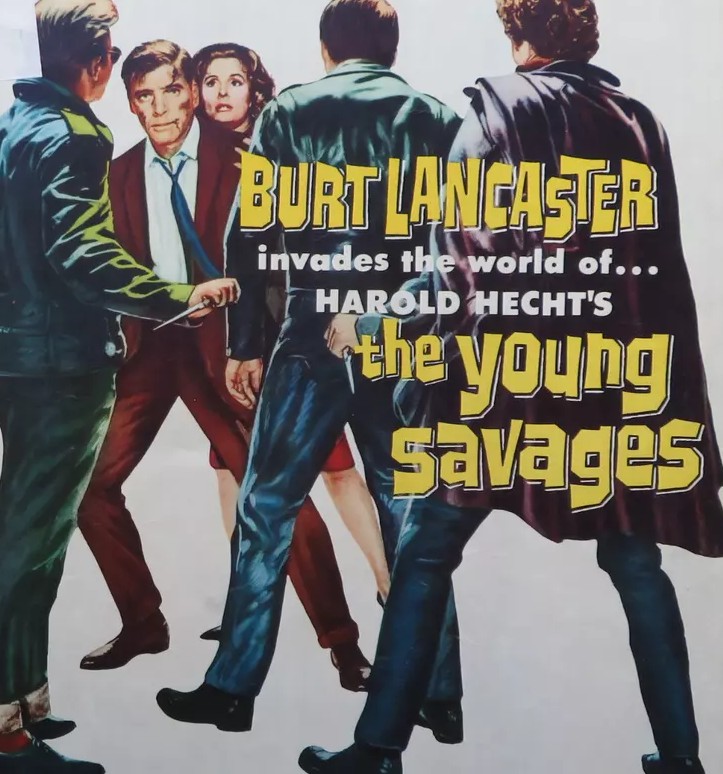
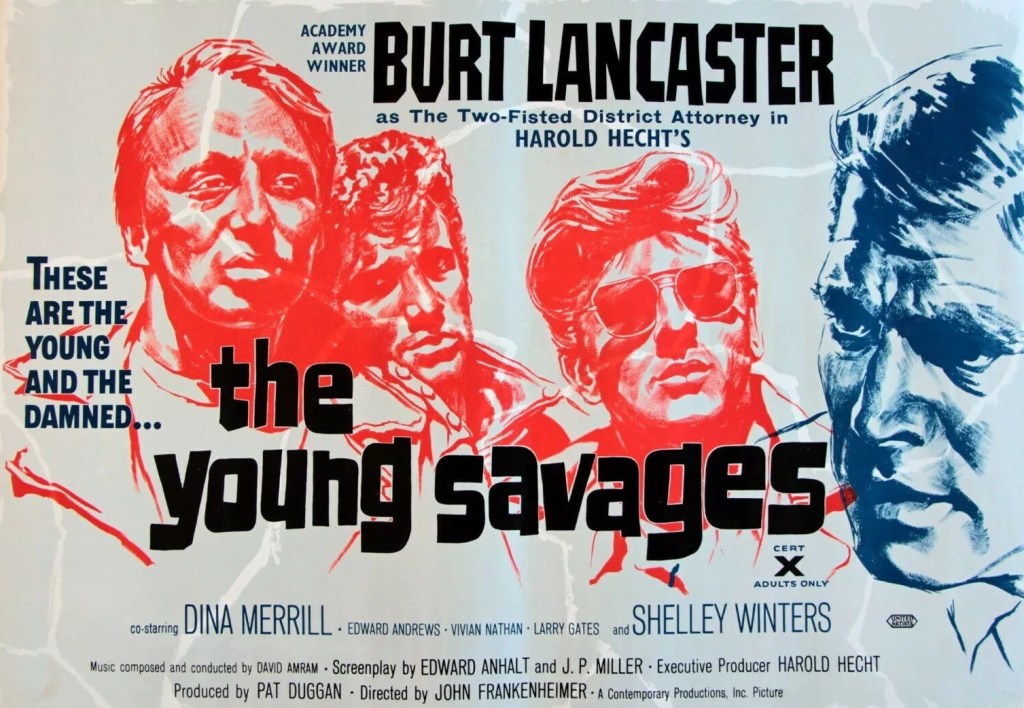
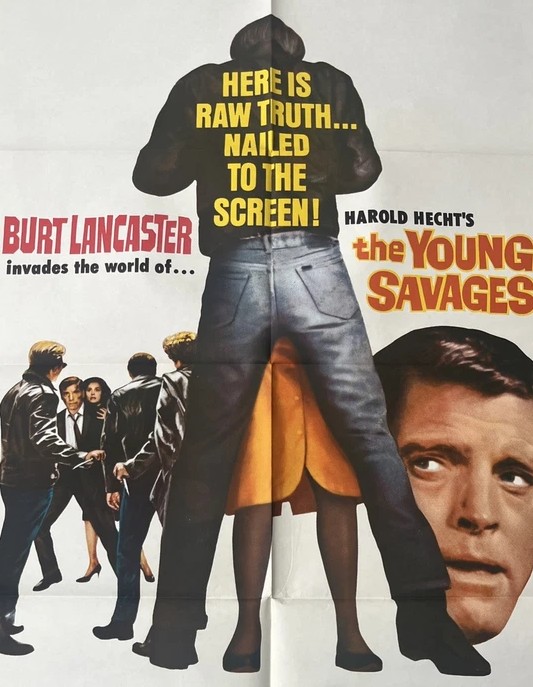
The Young Savages (1961) ****

You have to put out of your mind any thoughts about West Side Story, released the same year and also dealing with teenage gangs in New York. But whereas the musical tapped into Shakespeare and tugged at audience heartstrings with a tragic love story, The Young Savages is what used to be called an “issue picture,” a realistic portrayal of a growing problem in society.

Rather than the sullen relatively harmless rebels of Rebel without a Cause (1955) or this decade’s Easy Rider (1969), the question of youth disenfranchisement and the growth of a culture, here majoring in violence, at an opposite extreme to social norms, was beginning to take hold. Where earlier immigrants emerging from New York housing hellholes had tended to graduate to straightforward crime, which occasionally spilled over into the main street, now youths were engaging in turf wars, knives rather than machine guns the weapon of choice, which took place in full view of a terrified population.

Oddly enough the movie opens with the same motif as West Side Story, the feet of a gang, but rather than expressing their frustration through dancing, these feet, belonging to three members of the Italian-American Thunderbirds mob, are marching through the streets of New York, brushing aside passersby, knocking over toy prams, on their way to kill a member of the rival Puerto Rican Horseman gang.

When arrested, they claim self-defense. The only flaw in that argument is the victim Roberto Escalante (Jose Perez) is blind.  Naturally, there is a public outcry and calls for the death penalty. Prosecutor Hank Bell (Burt Lancaster), who had grown up in the same streets as the gangs but managed to make a life for himself outside its confines, is hellbent on extracting the maximum punishment. Bell was born Bellini but changed his name to hide his background, make it easier for him to serenade Vassar graduates and advance his career.

That leads to complications, and it’s hard to say which is the more compelling. His more liberal wife Karin (Dina Merrill), the Vassar item, is appalled. District attorney Dan Cole (Edward Andrews), who fancies his chances as a politician, faces public backlash if he doesn’t take tough action. And Hank had a romantic fling in the past with the mother Mary DiPace (Shelley Winters) of one of the accused.   

But Hank hasn’t quite thrown off the shackles of his upbringing, and though currently an upstanding member of society, he finds his principles taking a battering when he is himself attacked and discovers just how easy it is to resort to violence. Karin, too, finds her liberal attitude shot to pieces when she is also attacked.

Even without personal involvement of the husband and wife in being forced to face up individually to the violence pervading the city, the focus is on the exploration of how such violence becomes endemic in those parts of society left behind in the pursuit of the Great American Dream.

There’s plenty issues to deal with: poverty for a start, lack of ethnic tolerance, hatred of one immigrant group to another, politicians making capital out of the situation, parents powerless to prevent their children growing up as hoodlums, youngsters seeking identity and respect from joining a gang, and the growth of the gangs themselves as a social dynamic.

As you might expect, there are no easy answers. In fact, there are no answers at all. A movie like this can only lift the stone without being able to effect what’s happening underneath. But in some respects, that’s the aim of the issue picture, an early type of virtue-signaling. None of the issues raised have gone away, more likely they’ve just got worse.

But that’s not to downplay the film’s impact. There’s an inherent honesty here in the decision of debutant director John Frankenheimer (The Manchurian Candidate, 1962) not to take sides.    

Burt Lancaster (The Swimmer, 1969) delivers another excellent performance. Dina Merill (Butterfield 8, 1960) thrives in a solid role and Shelley Winters (A House Is Not a Home, 1964) is effective. Watch out for the debut also of Telly Savalas (The Assassination Bureau, 1969).  Written by Edward Anhalt (Becket, 1964) and J.P. Miller (Days of Wine and Roses, 1962) from the bestseller by Evan Hunter, who had explored similar youth issues in The Blackboard Jungle filmed in 1955.

Still powerful stuff.

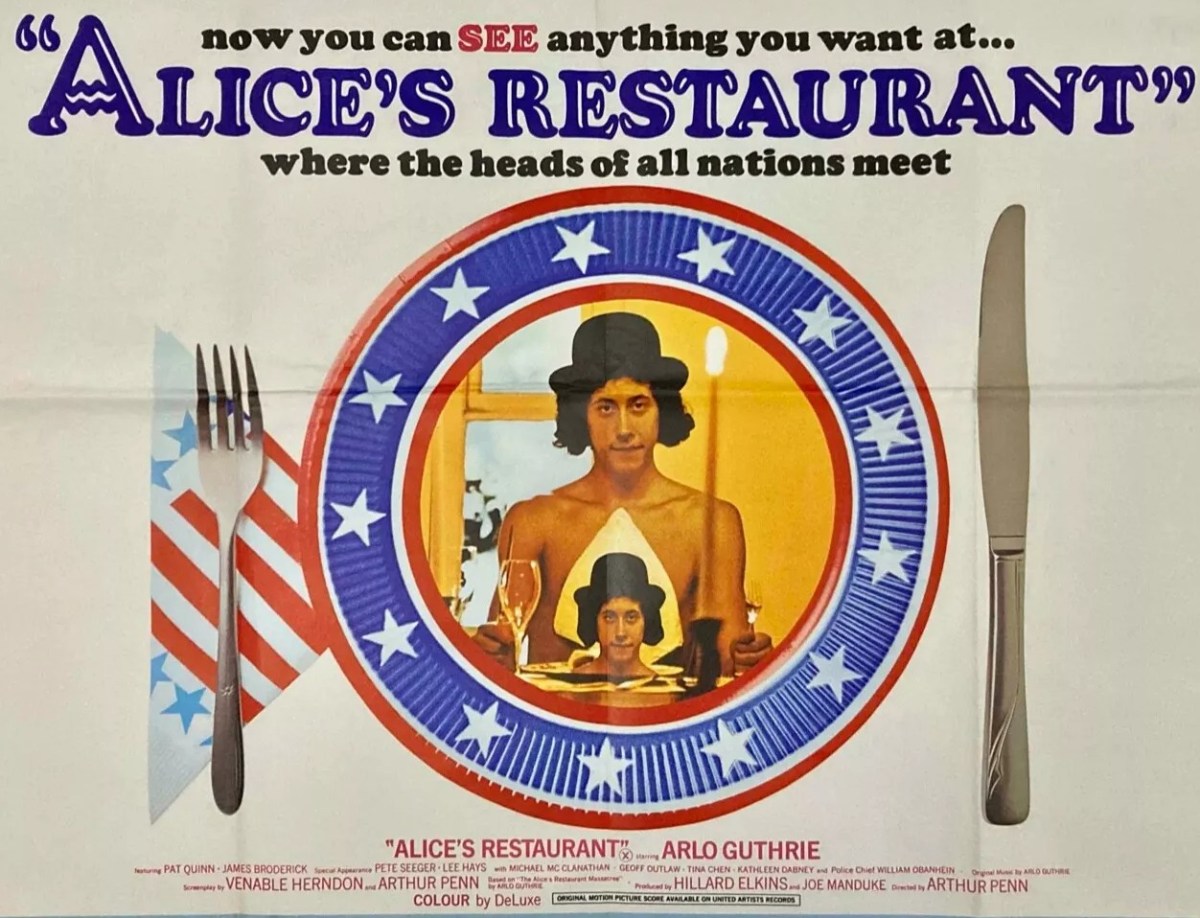
Alice’s Restaurant (1969) **

It might have been better if I’d come to this in a hazy glow of nostalgia. But I’d skipped this back in the day and although I’m a big fan of Arthur Penn I was never sparked to seek this out on VHS/DVD. So I’m coming to it for the first time. And I’m sorry to say it just feels like an indulgent mess.

It’s hard enough getting novelists to hack about their sacred texts sufficiently to turn them into workable screenplays, never mind putting the author center stage and not only have him narrate his tale but act it out. And when you discover that he’s not much of an actor, you’re not left with much but almost a documentary with drama coming from outside, from the forces of authority trying to shape the rebellious young to fit the pre-existing mold.

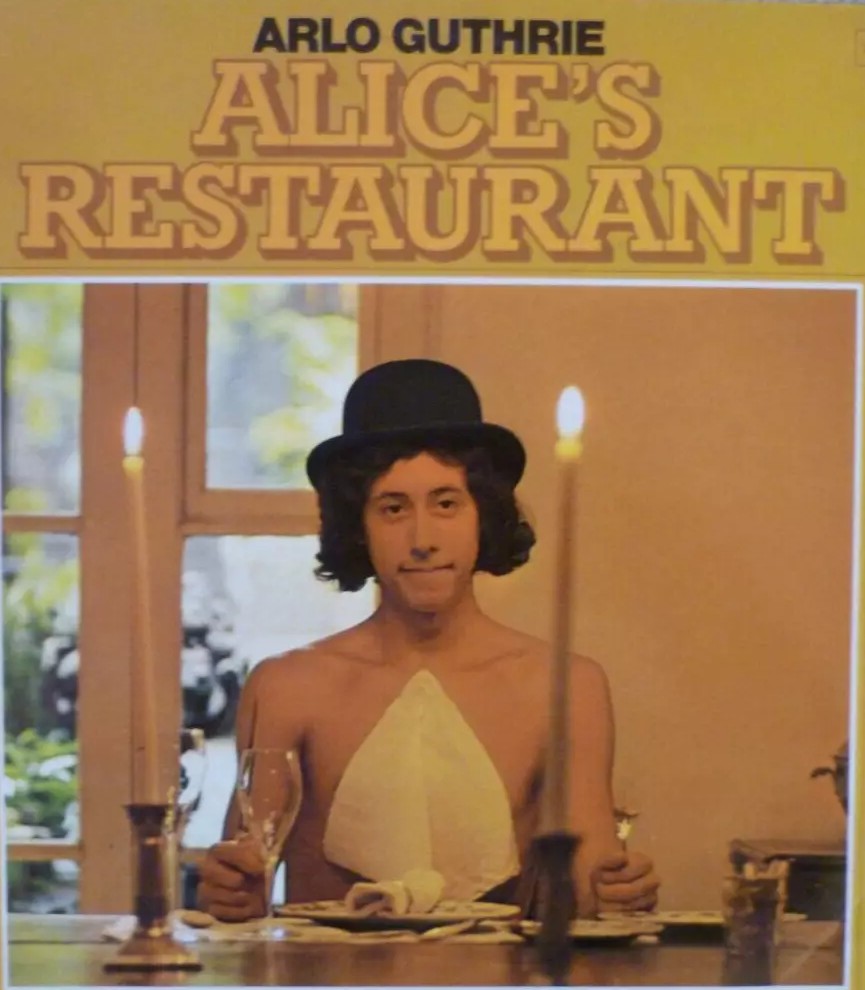
Album cover.

I have to confess I was never a big fan of folk music, excepting Bob Dylan I guess and you can argue he was only a folkie at the outset of his career. I was only vaguely aware of Woody Guthrie and don’t remember in the late 1960s his son ever touching the public consciousness overseas. So this might simply be one of those American movies that didn’t travel, like comedy or most musicals which had trouble matching up with foreign appreciation of those genres which tended to be nationalistic.

The narrative drive is Arlo Guthrie (Arlo Guthrie) dodging the draft. This was a right-of-passage especially for all young creatives, who would tend to be the most openly rebellious, but equally for a whole generation of young men who didn’t want to get themselves killed in a war they saw as senseless and who had gone off the idea of war altogether.

In Britain national conscription had ended in the late 1950s but there were no tales of people trying to dodge the draft. Elvis Presley had done his duty in America but Cassius Clay (later Muhammed Ali) did not – and was stripped of his World Championship. But away from all these high-profile cases, youngsters could avoid the draft by enrolling in colleges or universities, or pretending to have homosexual tendences, or shooting themselves (literally) in the foot, or claiming, as Guthrie did, that he had inherited a genetic illness – his father was dying of Hodgkins Disease – and when that doesn’t work acting mad, which doesn’t either.

What does get Arlo off national service is his involvement in a bizarre incident which made headlines at the time when he was arrested for littering and fined. When he reiterates his lack of objection to littering to the draft board, he is deemed unfit and is let off, as satirical a comment on the war between youth and authority as much as on the Vietnam conflict.

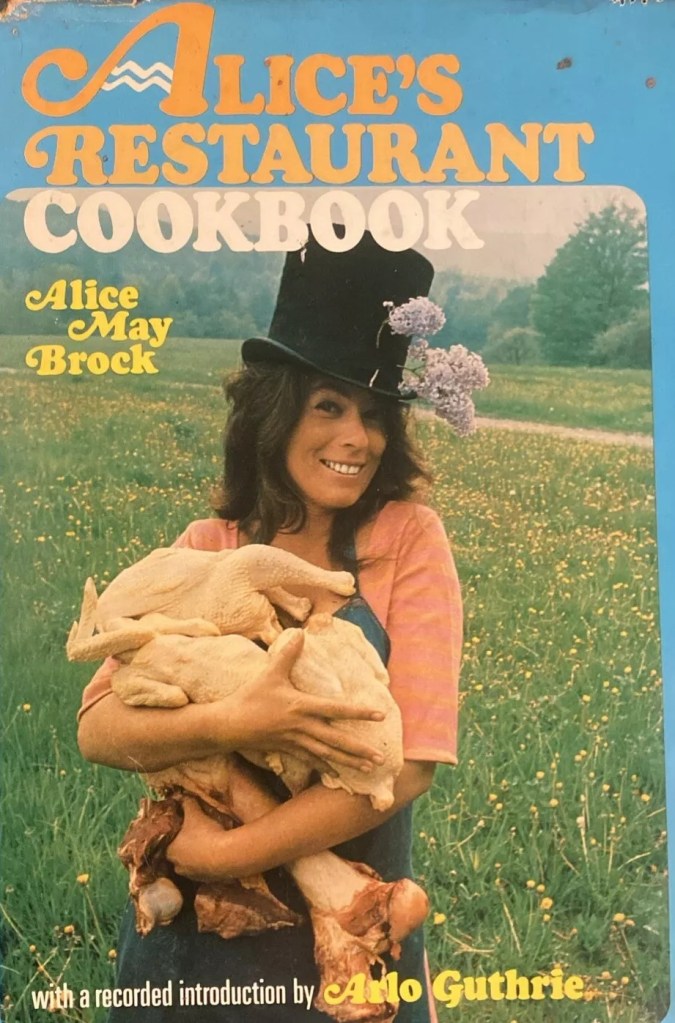
There was a real Alice and there was a real restaurant and there was an unusual tie-in.

There’s a story in here somewhere but it’s so ramshackle that, at the remove of over half a century, it doesn’t even appeal to those who worship the alternative lifestyle. After being chucked out of college, he heads off to join friends Alice (Pat Quinn) and Ray Brock (James Broderick) who have taken over a deconsecrated church in Massachusetts with Alice planning to set up nearby her eponymous restaurant, and not entirely for philanthropic reasons, Arlo composing a jingle to pull in customers.

Alice, disgruntled with lack of attention from Ray, begins an affair with Shelly (Michael McClanathan), an artist and ex-heroin addict, and every now and then Arlo returns to New York to visit his father Woody in hospital (Arlo is nowhere to be seen in A Complete Unknown). There’s a motocross race, and Shelly later dies in a motorbike crash. Woody dies too and Alice and Ray get married in a hippie-style wedding.

But most of this seems viewed even then through a time capsule as if Penn is assiduously recording a counter culture. The commercial success of this film and Easy Rider the same year triggered a cycle of youth-oriented movies that put Hollywood into an even deeper financial hole  

Sorry, folks, this just didn’t click. Maybe I was expecting too much. But the desultory narrative and the lack of any real acting made me switch off. While it has some of the offbeat vibe of Arthur Penn’s Mickey One (1965), it lacked that film’s compelling drive. Written by the director and Venable Herndon in his debut based on the Arlo Guthrie book.

Major disappointment

Discover WordPress

A daily selection of the best content published on WordPress, collected for you by humans who love to read.

The Atavist Magazine

by Brian Hannan

WordPress.com News

The latest news on WordPress.com and the WordPress community.