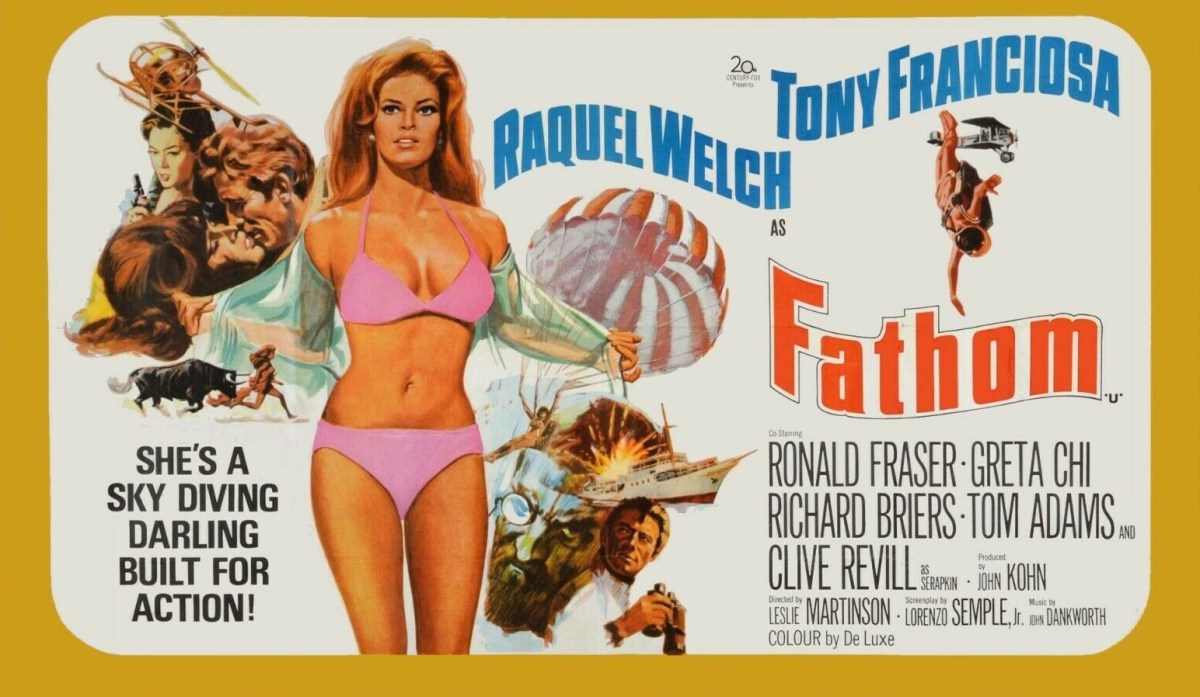
If audiences rallied to the sight of Raquel Welch wearing nothing more than a fur bikini for the entirety of One Million Years B.C. (1966) and a skin-tight suit in Fantastic Voyage (1966) Twentieth Century Fox must have reasoned they would surely return in droves were the star to spend most of Fathom in a succession of brightly-colored bikinis.
Given such a premise who would care that a sky-diving expert was named after a nautical measurement? Or that Fathom (Raquel Welch) came nowhere near the height indicated by her name? Or that the character as described in the source material (a novel by Scottish screenwriter Larry Forester) had a distinctly harder edge; murder, sex and drugs among her proclivities.
With Our Man Flint (1966), the studio had successfully gatecrashed the burgeoning spy genre and spotted a gap in the market for a female of the species, hoping to turn Modesty Blaise (1966) starring Monica Vitti and Fathom into money-spinning series. The Fathom project was handed to Batman, The Movie (1966) co-conspirators, director Leslie H. Martinson and screenwriter Lorenzo Semple Jr. (Flash Gordon, 1980).
Female independence was hard-won in the 1960s and there were few jobs where a woman was automatically at the top of the tree. Burglary was one option for the independent entrepreneur (see The Golden Claws of the Cat Girl) and sport was another.
Welch plays an innocent bystander recruited for her top-notch sky-diving skills (her aptitude demonstrated in the opening sequences) to help Colonel Campbell (Ronald Fraser) of British intelligence recover the “Fire Dragon,” a trigger that could explode a nuclear bomb. Her sky-diving skills are required to land in the courtyard of playboy Peter Merriwether (Anthony Franciosa).
That turns out to be baloney, of course, a MacGuffin to point her in the direction of a valuable Chinese heirloom. And then it’s case of double-cross, triple-cross and whatever cross comes next.
There’s an intriguing mystery at the heart of this picture and a couple of top-class hair-raising moments. In one she is trapped in a bull ring and stunt double Donna Garrett had a few very definite close calls trying to avoid the maddened beast. In another she is stalked at sea by a circling motor boat while being peppered with harpoons. There is also an airplane duel and a ton of great aerial work. A couple of comic sequences are well wrung – Campbell pins his business card to one of the prongs of a pitchfork being brandished with menace by Fathom while Peter delivers a classic line: “The only game I ever lost was spin the bottle and that was on purpose.”
The biggest problem is that the film veers too far away from the source material which posited the heroine as a much tougher character, one who can despatch bad guys with aplomb. Instead, Fathom is presented almost as an innocent, bundled from one situation to another, never taking charge until the very end. Minus karate kicks or a decent left hook, she is left to evade her predators by less dramatic means. She has a decent line in repartee and by no means lets the show down. However, the idea, no matter how satisfactory to fans of the actress, that Fathom has to swap bikinis every few minutes or failing that don some other curve-clinging item, gets in the way of the story – and her character. Into the eccentric mix also come a millionaire (Clive Revill) and a bartender (Tom Adams).
There’s no doubt Welch had single-handedly revived the relatively harmless pin-up business (not for her overt nudity of the Playboy/Penthouse variety) and had a massive following in Europe where she often plied her trade (the Italian-made Shoot Loud, Louder…I Don’t Understand in 1966 and the British Bedazzled in 1967) but she was clearly desperate for more meaty roles. Those finally came her way with Bandolero (1966) and 100 Rifles (1969) and Fathom feels like a lost opportunity to provide her with that harder edge.
She’s not helped by the odd tone. As I mentioned she gets into plenty of scrapes and proves her mettle with her diving skills. In the hands of a better director and with a few tweaks here and there it could have been a whole lot better and perhaps launched a spy series instead of languishing at the foot of the studio’s box office charts for that year.
Anthony Franciosa (Rio Conchos, 1964), still a rising star after a decade in the business, who receives top billing, doesn’t appear for the first twenty minutes. And then he behaves like a walking advert for dentistry, as though his teeth can challenge Welch’s curves. But some of the supporting cast look like they’ve signed up for a completely different movie. Richard Briers (A Home of Your Own, 1965) – Ronald Fraser’s intelligence sidekick – looks like a goggle-eyed fan next to Ms Welch and Clive Revill (The Double Man, 1967) thinks it’s a joke to play a Russian as a joke. Ronald Fraser (Sebastian, 1968) provides decent support.
But it is certainly entertaining enough and you are unlikely to get bored.
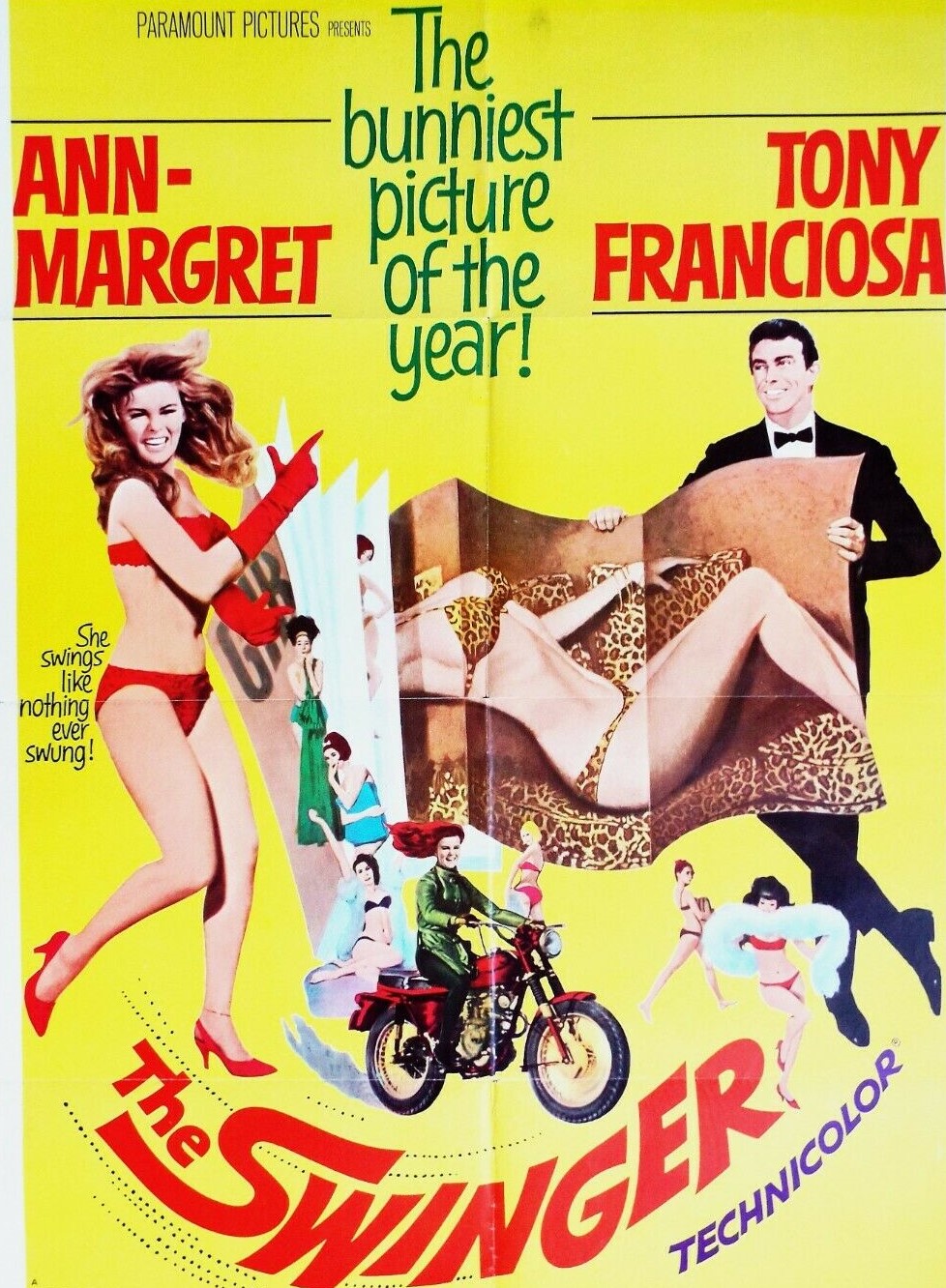
Ann-Margret’s The Swinger has staved off tough competition from the fast-rising Sergio Leone to take over the top spot in our All-Time Chart from Angie Dickinson in Jessica. It’s generally a mystery to me why some films attract more attention than others, but even I have been surprised at Ann-Margret’s popularity ahead of, for example, more popular female stars of the 1960s such as Raquel Welch. The last time I did an all-time chart it was back in September 2022 when The Swinger placed fifth. For reasons that escape me, I only filled you on the Top Ten places rather than the Top 30, so now I’m amending that.
1 (5) The Swinger (1966). She sings, she dances, she shakes her booty. Who care about the storyline?
2 (2) Once Upon a Time in the West (1969). Awesome music, stunning opening and operatic finale and now regarded as the best western ever made.
3 (1) Jessica (1962). Widow ruffles female feathers in small Italian town.
4(6) Fraulein Doktor (1969). Suzy Kendall as German World War One spy leading Kenneth More a merry dance.
5 (3) The Secret Ways (1961). Richard Widmark in polished Alistair MacLean spy thriller set in Hungary. Early appearance by Senta Berger.
6 (4) Oceans 11 (1960). The Rat Pack slides into action, Frank Sinatra and Dean Martin organising a heist in Las Vegas.
7 (8) The Golden Claws of the CatGirl (1968). Daniele Gaubert as a sexy cat burglar.
8 (7) Pharoah/Pharon (1966). Polish epic about love and religion in ancient Egypt.
9 (-) Can Heiroymous Merkin Ever Forget Mercy Humpe and Find True Happiness? (1969). Anthony Newley’s Fellini-esque musical ode to hiumself.
10 (-) Vendetta for the Saint (1968). Roger Moore as Simon Templar.
11 (10) Moment to Moment (1966). French-set Hitchcockian thriller starring Jean Seberg and Honor Blackman.
12 (-) Sisters (1969).Intense French drama starring Nathalie Delon and Susan Strasberg.
13 (-) Subterfuge (1968). Gene Barry uncovers a mole in British Intelligence with the help of Joan Collins.
14 (-) Stagecoach (1966). Ann-Margret again in remake of the classic John Ford western.
15 (-) Lady in Cement (1969). Frank Sinatra in his second outing as private eye Tony Rome coming to grips with gangster’s moll Raquel Welch.
16 (-) A House Is Not a Home (1965). Shelley Winters gives both barrels, acting-wise, as the madam of a notorious brothel.
17 (-) Fade In (1968). The drama Burt Reynolds preferred you didn’t see. A romance set around the filming of Blue (1968).
18 (-) Supercar (1961-1962) in color. Episodes of the much-loved Gerry and Sylvia Anderson British television series with added color.
19 (9) Father Stu (2022). Impressive performance by Mark Wahlberg as a priest,
20 (-) Baby Love (1969). Orphaned Linda Hayden is taken advantage of by a wealthy London couple and their son.
21 (-) Blonde (2022). Ana de Armas in potent reimagining of Marilyn Monroe’s life.
22 (-) Pressure Point (1962). Prison psychiatrist Sidney Poitier tries to understand racist Bobby Darin.
23 (-) Beat Girl/Wild for Kicks (1960). Teenager Gillian Hills mixes with the wrong crowd in London-based drama best known for a supporting cast including Christopher Lee, Adam Faith and Shirley Anne Field.
24 (-) Sodom and Gomorrah. (1962). Robert Aldrich Biblical epic.
25 (-) The Girl on the Motorcycle (1968). Singer Marianne Faithful heats up the screen in leathers and often a lot less.
26 (-) A Place for Lovers (1968). Faye Dunaway and Marcello Mastroianni in doomed romance.
27 (-) Deadlier than the Male. Richard Drummond reinvents Bulldog Drummond as he battles sadistic pair Elke Sommer and Sylva Koscina.
28 (-) The Venetian Affair. Robert Vaughn as disgraced CIA agent caught up in nuclear threat.
29 (-) 4 for Texas (1963). Frank Sinatra, Dean Martin, Charles Bronson, Ursula Andress and Anita Ekberg. A cast to die for in this Robert Aldrich western.
30 (-) For a Few Dollars More (1965/1967). Clint Eastwood in the second of the Sergio Leone western trilogy. The Man with No Name meets The Man in Black.
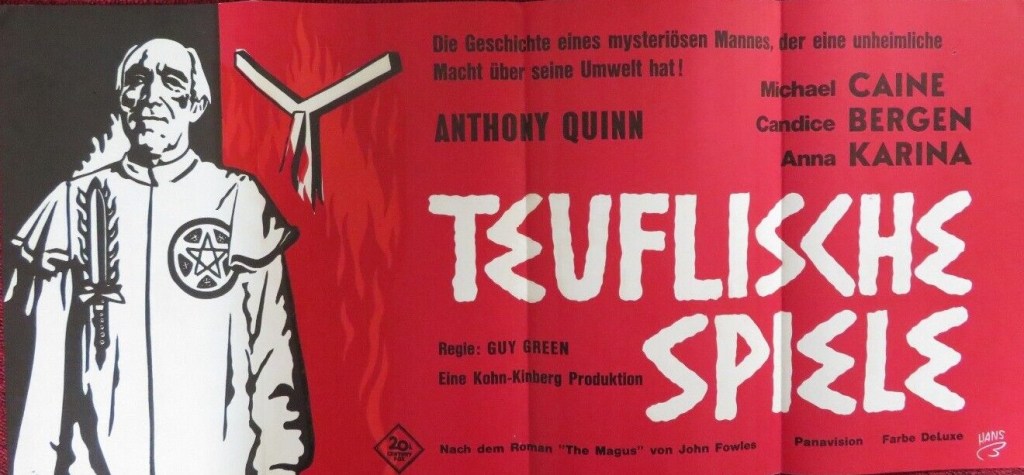
Mind-games and unreliable narrators give this considerable contemporary appeal. Throw in Anthony Quinn back in Zorba the Greek (1964) territory and Michael Caine as a lothario in the Alfie (1965) mold plus Candice Bergen (Soldier Blue, 1970) in preppy mode and you have nothing short of ideal casting.
Nicholas (Michael Caine), escaping a failed romance with Anne (Anna Karina) by teaching English at the Lord Byron School on a Greek island, becomes entangled with millionaire Conchis (Anthony Quinn). The action primarily takes place on Conchis’s fabulous villa stuffed full of art treasures. Conchis initially presents himself as a psychic who can summon up the past, namely in the shape of Lily (Candice Bergen) who talks and dresses like the young girl Conchis previously loved.
But every time Nicholas rumbles a ruse he is presented with a different version of Conchis’s self. These include a psychiatrist, conjurerer-up of the mythic past and Second World War collaborator. All of these identities carry sufficient personal truth for Nicholas to doubt his doubts.
Is he the victim of some elaborate game, one which caused the mysterious death of his predecessor? Is he smart enough to expose the millionaire as a dangerous fantasist? Is Lily genuinely falling in love with him and will this be yet another romance which makes him feel trapped? Is he actually put on trial in front of the entire village or is that all a dream? Is Conchis intent on stripping him of his core identity? And if so, why?
It should have been a cracking film but somehow misses the target. In theory, this is because Michael Caine is miscast. Caine is usually in charge and here is anything but. But actually, flipping over an actor’s screen persona, especially this cocky one, works. You might keep on wishing the real Michael Caine would stand up, and the fact that he doesn’t gives the film its strength.
Anthony Quinn initially overdoes the flamboyance to the point of being hammy – what magician is not – but you can see the point of that when he turns into the sober mayor forced to deal with invading Germans during World War Two and faced with making life-or-death decisions. The general consensus is Candice Bergen is the weak link, but I’d challenge that too since she is playing a role, that of an easily-duped actress.
The main problem is the picture is loaded down with flashbacks. And all to do with the various reinventions of Conchis’s life. In keeping with the film’s style you are never sure how much of this is true. Caine’s character has little to do except ask questions. (A modern film would have him chasing after physical clues to uncover a riddle.) So it becomes very stagey, with Conchis like a frustrated teacher with an aberrant pupil.
Of all the misleading ads! This lost a fortune for Fox.
John Fowles adapted his 300,000-word cult novel, removing the bulk of the philosophizing, but not realizing that what works in a book, especially in the hands of a gifted narrator, is not so easily translated onto the screen. For the adaptation of his previous bestseller The Collector (1965), director William Wyler brought in screenwriters to make the book work as a film.
Either screenwriters balked at the problems of dealing with a masterpiece or Fowles insisted on writing the screen version or director Guy Green (Pretty Polly/A Matter of Innocence, 1967) believed him the best person to reconstitute his work. Quinn, rather than Caine, has the movie’s pivotal sequence, forced into an action on a par with Sophie’s Choice (1982) and it might have helped if that element had been brought in sooner.
As it is, the movie is no more than interesting when it should have been fascinating.
Everyone loves a legend and here we are treated (twice) to the creation of one. Surprising echoes of Vertigo (1958) with none of that film’s virtuosity and proving that New Hollywood is much the same as Old Hollywood.
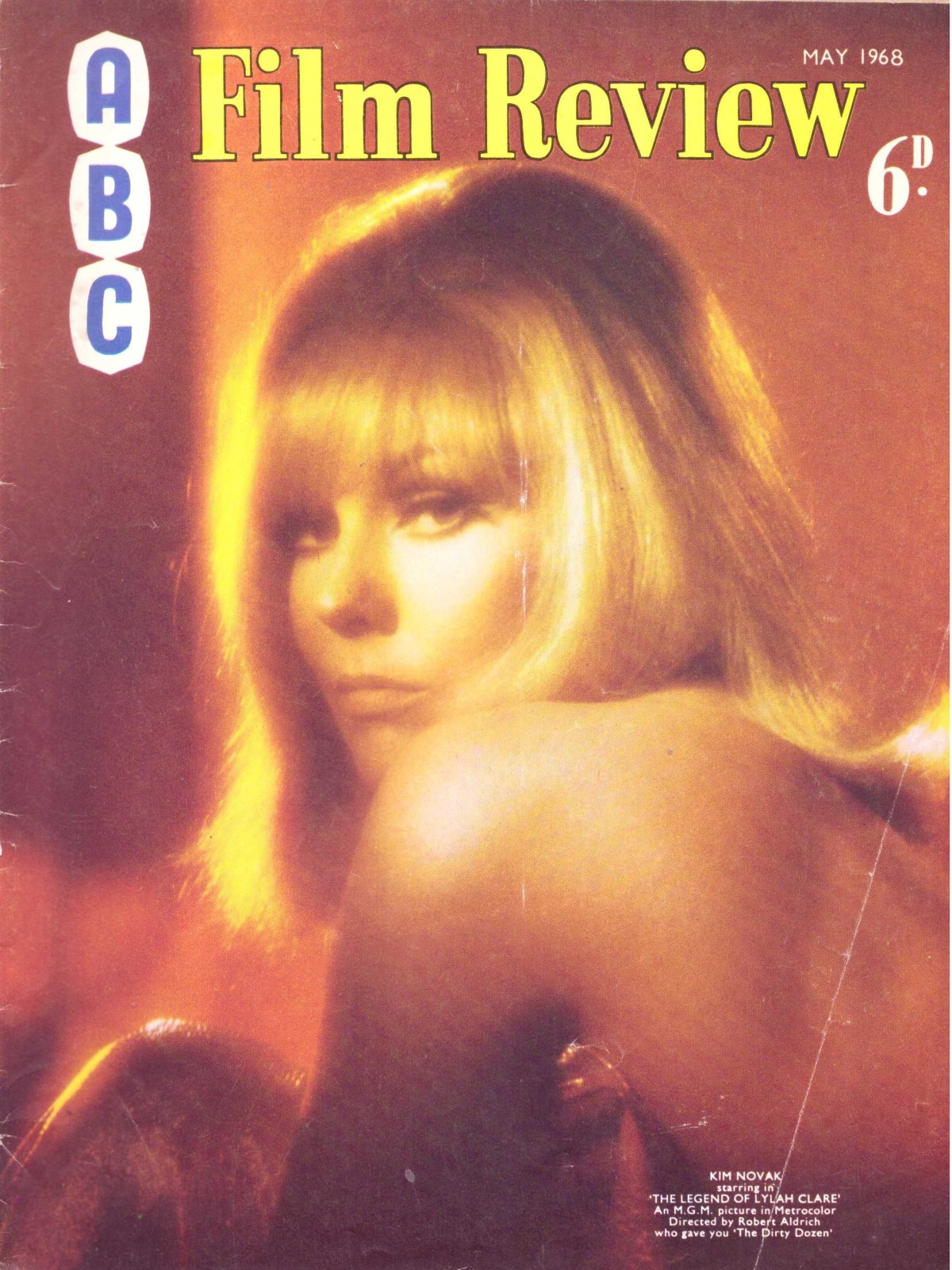
No wonder Kim Novak (The Amorous Adventures of Moll Flanders, 1965) came out of semi-retirement – three years off-screen following a brief marriage to Richard Johnson. It’s the role of a lifetime, an actor’s dream, the chance to delight Oscar voters. She plays two parts – the deceased Lylah Clare, a Jean Harlow type, and Elsa Brinkmann (name changed to Campbell), the ingenue hired to play her in a film about the star’s life.
Basically, history repeats itself. Director Lewis Zarken (Peter Finch) who turned Lylah into a star and married her, repeats the process with Elsa, seduction not leading to marriage, but the same jealousy plays out and the same tragic ending. Black-and-white flashbacks fill us in on Lylah, but most of the picture is Elsa’s transformation from mousy, bespectacled brunette full-blown blonde movie star.
Initially, Zarken is not smitten, but when Elsa manages an uncanny emulation of Lylah’s voice and it transpires she has the exact same measurements, he changes his tune and embarks on his own comeback. Elsa takes to stardom pretty fast, humiliating gossip queen Molly Luther (Coral Brown), and, for no apparent reason, takes to striding around the garden topless except for bra.
As Zarken grows more attached to Elsa it’s soon apparent he believes the woman he’s directing is Lylah re-born. There’s some mystery about Lylah’s death but no mystery about how this new relationship will work out, other than that Zarken will be tormented by jealousy as before.
As you might expect, Zarken duels with studio boss Barney Sheean (Ernest Borgnine), and there’s some interesting insight into negotiation techniques. The scenes showing how a movie is made are among the best, especially how a director finds alternatives when sequences don’t work. There’s temptation everywhere, drugs, alcohol and sexual experimentation if that’s your bag, a lesbian acting coach (Rossella Falk) coming on strong.
Of course, Elsa soon suspects it’s the character she’s playing – as in Vertigo – that everyone is falling in love with not the person she is.
But while Elsa can impersonate the great actress’s features and voice she lacks her acting talent, making her even more vulnerable to her own insecurity. “You’re an illusion, without me you don’t exist,” barks Zarken after Elsa makes the mistake of assuming he has real feelings for her instead of just bedding her as he would any powerless woman. And the idea that she would forsake a promising career for motherhood infuriates him, though, of course she could be making that up as a means of holding him to ransom.
For the most part, Novak, very under-rated as an actress and seen too often as just glamorous, is excellent, but she is hindered by too speedy a transition, from shy young woman to someone giving full throttle to her emotions, and, at one point, required to throw her head back in a maniacal laugh. Peter Finch (The Red Tent, 1969) is spot-on, exuding control, but very capable of the spiteful exhibition of power.
The real problem is that there’s little mystery as to how this will unfold. Most of what we see in Hollywood is what we expect, and although it’s not as camp as Valley of the Dolls (1968) at times comes perilously close. It’s often very stagey. Director Robert Aldrich (Flight of the Phoenix) had previously taken a pop at Hollywood in the The Big Knife (1955) and Whatever Happened to Baby Jane (1962) but it’s such a difficult subject matter that virtually every avenue explored appears cliché.
Take it as camp and you’ll be satisfied, but don’t go looking for anything deeper.
No idea what’s going on with this “we’re sorry” business below.
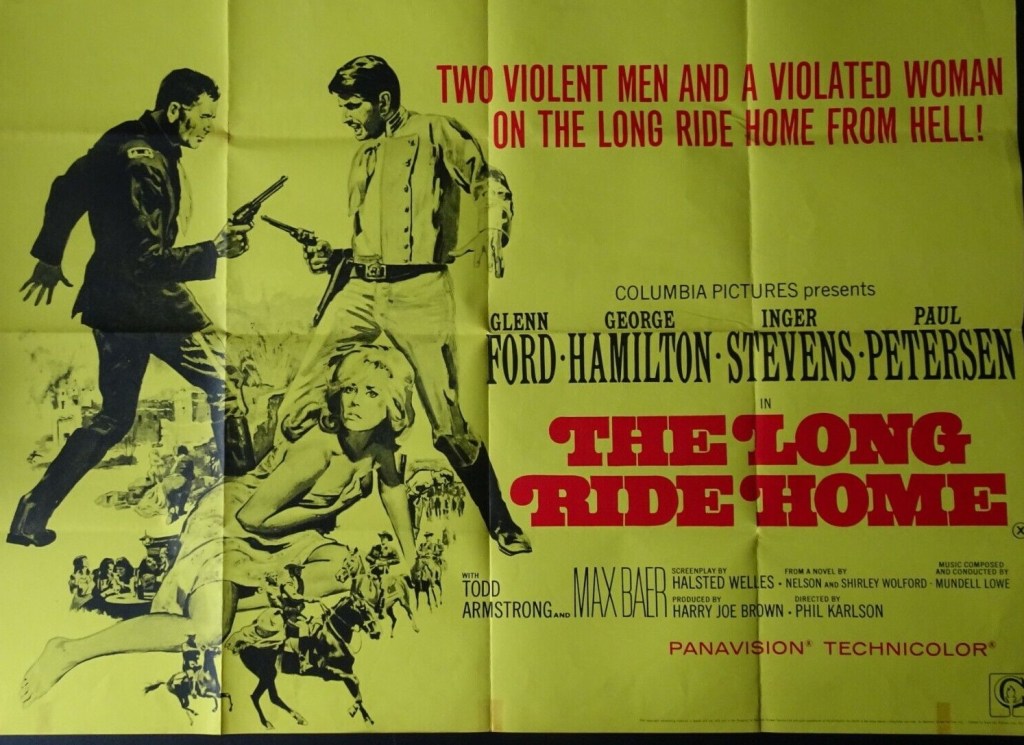
The American Civil War is often slotted into the wrong genre. It is not a western. It is a war, with all the inherent wrongheadedness, viciousness and atrocity. We begin with senseless execution and end on a note of humiliating barbarity. Along the way we witness easily the greatest performances in the careers of George Hamilton (The Power, 1968) – a wonder after this how he was ever associated with playboy characters – and Inger Stevens (Firecreek, 1968).
At the tail end of the war in a Confederate POW camp, the disciplinarian commander orders raw recruits to execute an escapee. When they fail to find to the target Major Wolcott (Glenn Ford), witnessed by appalled missionary fiancée Emily (Inger Stevens), steps in to finish the job. In the wake of this Wolcott sends Emily away under escort.
POW leader Captain Bentley (George Hamilton), fully aware the war might end in days, but determined to escape to Mexico and continue the fight, organises a breakout. Instead of sneaking out quietly, in revenge he turns the Union cannons on his captors. And despite being better informed how close the war is to an end, the dutiful Wolcott sets off in pursuit.
Bentley ambushes Emily’s escort, killing the soldiers and stealing their mounts, but promising Emily that as befits a Southern gentleman he will respect her honor. She’s not so innocent of war, anyway, begging Bentley to kill a fatally wounded Union soldier rather than leaving him to the buzzards or, one assumes, marauding Apaches.
Unfortunately, his comrades don’t share that sentiment and when Emily makes the mistake of unloosing her blouse to wet her neck at a stream it inflames their lust. Equally, unfortunately, Emily doesn’t keep to her part of the deal and in attempting to escape hits Bentley a humiliating blow with his own saber.
While unfamiliar with the territory, Wolcott is a pretty good soldier, taking a shortcut over the mountains to cut off their retreat. “How come he knew what we were gonna do before we done it,” wails a Confederate soldier. “Before you even thought it,” snaps the over-confident Emily.
A few miles from the border, the Confederates hole up in a bordello where Bennett finds a despatch announcing the war is over. Ignoring the fact that for the ordinary soldier you couldn’t find a better place to celebrate peace than in a whorehouse, and determined to continue the war, Bennett conceals the information.
In revenge for losing face in front of his soldiers, he (luckily off camera) rapes the half-stripped and bloodied Emily. In the manner of every savage taking advantage of wartime conditions, Bennett tells her, “You think nothing like this can ever happen to you. But you’re lucky because your humiliation will be over soon. You and your major are going to know I won.”
Rape, as currently in the Ukraine and as in many previous conflicts, used as a weapon.
When Wolcott arrives, it’s obvious what has happened and while holding a lid on his own emotions (a Glenn Ford hallmark), once he has proof the war is over, he refuses to give chase. Brutally, he tells her, “I can see (witness) men die for their country but I can’t see them die for your honor.” It’s Bennett who, oddly, comes to her rescue, opening fire on the Union soldiers, compelling Wolcott, in breach of the rules of war, to cross the border into Mexico in pursuit.
This isn’t a typical Glenn Ford (The Pistolero of Red River/The Last Challenge, 1967) picture where he plays the central character and is scarcely off screen. Here, he disappears for long stretches as the camera focuses on George Hamilton, his squabbling gang and the growing tension between him and Inger Stevens. If you’ve only seen Hamilton in his screen playboy persona, this is a revelation as honor and misguided duty turn into repulsive action.
And this is by far the best performance by Inger Stevens. What she achieved here launched her career, although admittedly as a female lead rather than top-billed star. The emotion her face portrays without the benefit of dialog is quite astonishing. Expecting to be an innocent bystander, unexpectedly thrown into the tumult, physically abused, and then, contrary to her Christian beliefs, she goes from stalwart to victim to, against her Christian principles, showing no sign of turning the other cheek but in full Old Testament mode urging revenge.
The scene when Emily enters a room full of soldiers, attempting to retain some dignity in the face of torn clothes and bloodied face, while acknowledging her humiliation, is stunning. The only scene that comes close to matching its power is at the end, the sequence shot from above, light streaming into a darkened cellar, when, having killed Bennett, Wolcott abandons his potential bride.
Phil Karlson (The Secret Ways, 1961), a stand-in for original director Roger Corman, does an excellent job of focusing on the brutalities of war, not just the rape and violence, but the recruits, as dumb as they come on both sides, who fail to cope with the pressures. You would have to be fast to spot Harrison Ford (billed as Harrison J. Ford) making his screen debut, but Harry Dean Stanton (Cool Hand Luke, 1967) has a bigger role. Halstead Welles (The Hell with Heroes, 1968) wrote the screenplay based on the novel The Southern Blade by Nelson and Shirley Wolford.
A couple of later westerns might have raided this picture for ideas: continuing the fight in Mexico was the focus of The Undefeated (1969); a constantly carping pair who delight in slaughter evidenced in The Wild Bunch (1969); relentless pursuit a constant theme of 1969 westerns as diverse as Butch Cassidy and the Sundance Kid, True Grit, The Wild Bunch, Mackenna’s Gold and Once Upon a Time in the West.
Regard this as a western and you will be disappointed. Take it more seriously as a war picture and it offers far more. I’m probably being a tad generous in giving it four stars but I was knocked out by the performances of Hamilton and Stevens and a number of excellent scenes, the two in particular mentioned above for example, and the dialogue.
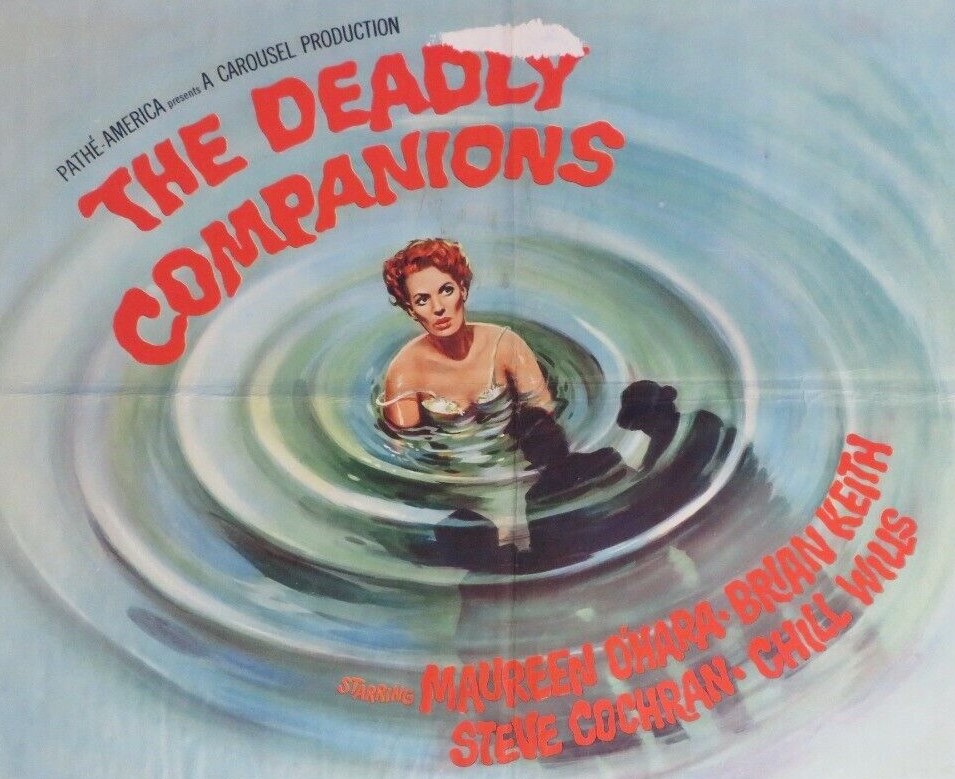
Pathe America didn’t have much idea how to sell The Deadly Companions. So they went for the obvious. Maureen O’Hara bathing.
And that was basically it. Out of the eight pages in the A3-sized Pressbook all but two were devoted to a picture of Maureen O’Hara in a desert pool. There were 29 advertisements in varying sizes in the Pressbook and all focused on that central image, even the smallest advert featured O’Hara in the water.
Even more extraordinary, given that O’Hara (regardless of her current marquee status) was a star of some magnitude, over two decades in the business, female lead to some of the biggest actors in Hollywood like John Wayne and Tyrone Power, occasionally top-billed in her own right, working with directors of the magnitude of Alfred Hitchcock and John Ford, was how little space was devoted to her for a movie of which she was the denoted star.
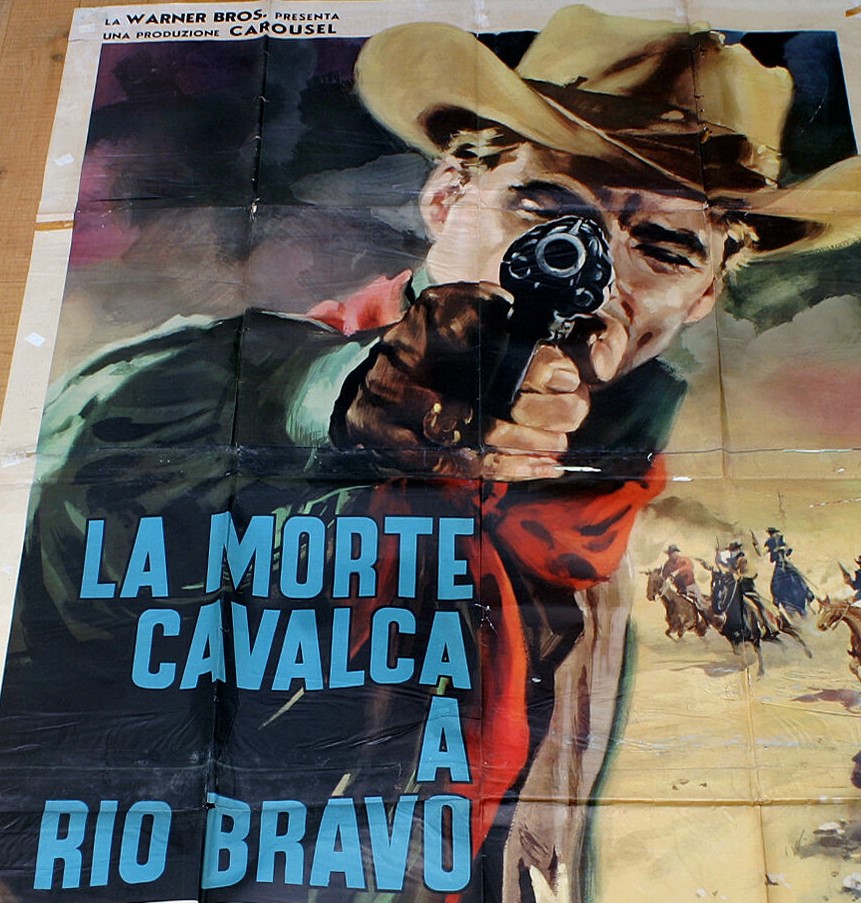
Foreign distributors avoided the bathing image in favor of straightforward action.
Out of the two pages – A3-size remember – set aside for material that might attract the attention of showbiz editors on regional newspapers, a grand total of 28 lines was devoted to the star. Stuntman Chuck Hayward was allocated more space – two articles were written about him, not just one. Details about the props received more space. The extras received more space. Information about a cave received more space. The famous Arizona cacti received more space. The musical instruments used in the score received more space.
Even so, Maureen O’Hara with all her experience, would surely have plenty stories to tale, some juicy nuggets to snag the interest of the entertainment journos. A reflection, perhaps, on time spent in the company of Wayne (three movies), Errol Flynn (Against All Flags, 1952), Oscar-winning Alec Guinness (Our Man in Havana, 1959), Power (The Black Swan, 1942), and Charles Laughton (Jamaica Inn and The Hunchback of Notre Dame, both 1939).
Nope. You guessed it, every line of space given over to Maureen O’Hara concerned the bathing scene. It was her first ever, as if that was some kind of rite of passage. We discovered the water was “scarcely above freezing. It had come down to the Arizona lake from the melting January snow.” And there was no body double for the brave O’Hara. “She insisted on doing the scene herself, so the audience is not cheated.” For the river scene, in which she was accompanied by Steve Cochran, the water was no warmer and was completed on the first take, indication perhaps of Peckinpah’s lowly status. Later in his career he would have demanded retakes.
The main image of O’Hara in the water is overlaid with threat. Her three “deadly” companions surround her, even though such a scene did not occur in the picture. The tagline spells it out: “An Unholy Alliance! Three hell-driven men stalk a beautiful, tempting woman alone in an untamed land!…Savage action and explosive emotions erupt on the screen.” Accompanying that are three other images of the companions: “See – the deadliest gundown of them all!” / “See – the vicious crunch of fish against flesh!” / “See – the terror of Apache cruelty.”
There were some tagline variations on the theme: “Men without women in an untamed land…they forced their way into her life!” / “Trapped…by her past and the sins of the men who pursued her through a savage land!” / “Alone – in an untamed land – with three men who forced their way into her life.”
Change of marketing approach came too late.
O’Hara’s character’s profession, not spelled out in the movie where she is passed off as a “dance hall hostess,” is more clear-cut in one ad. “Trapped…Money gave men the right to her lips!” Some identifiers provide an insight into the companions – Brian Keith described as “Deadly…Hate and revenge were all he lived for.” Steve Cochran was portrayed as “Deadly…Nothing stood between him and what he wanted.” While for Chill Wills it was “Deadly…Half-crazed with greed and dreams of grandeur.”
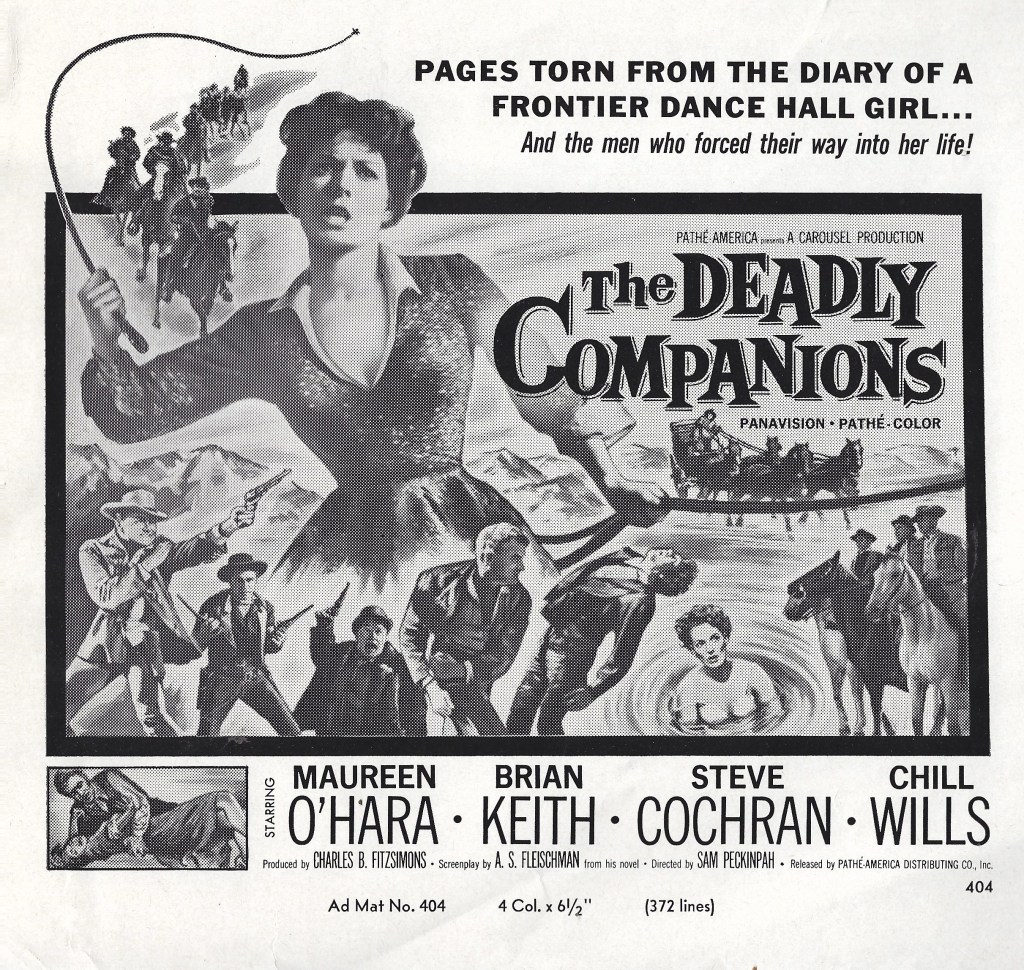
However, some exhibitors, who were after all funding this enterprise, believed the Pressbook came up short, resulting in Pathe America creating a one-page supplement which presented O’Hara in a different light. Now she moved closer to her fiery screen persona, lashing out with a whip rather than languishing as a victim. The bathing image was retained but reduced in size, the emphasis now on action, on gun and fists. The tagline became: “Pages torn from the diary of a frontier dance girl…The greatest adventure love story in years.” Switching the focus to the O’Hara-Keith relationship was a bit of a stretch, but it was better than the original idea of O’Hara as a male plaything
The distributors stressed action even more when the movie was reissued the following year with a new title Trigger Happy. This time the tagline read: “They fought with guns worn low…Lust and revenge…romance and hate. A motion picture of great impact.”
Oddly enough, though the book by scriptwriter AS Fleischmann was promoted in the Pressbook, there was no mention of O’Hara singing the theme song, or cutting a single, a well-known promotional device for targeting radio stations. Otherwise, promotional ideas were in short supply.
Exhibitors were encouraged to hire three horsemen to ride through the town with signs “I am one of The Deadly Companions” or to set up headless cut-outs in the lobby and let children fire water pistols at them.
Even allowing for the relative inexperience on the production-distribution side, this was a particularly poor collection of marketing notions. Almost as if the producers believed that, considering the movie was made by exhibitors for exhibitors, it would get a free pass as regards the marketing aspects.
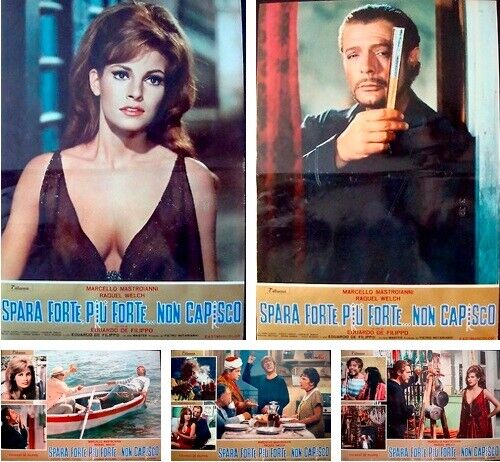
The Raquel Welch picture nobody’s seen. Which is a shame because she demonstrates considerable comedic flair. And there’s a freshness and naturalness – almost a youthful gaucheness – about her that’s lacking in other movies where she was developing her more iconic acting style.
Tania (Raquel Welch) literally bumps into sculptor Alberto (Marcello Mastroianni) when his latest acquisition, an iron gate (locked naturally), blocks a footpath. Intrigued, she enters his Aladdin’s cave of artefacts and is frightened by his mad uncle who communicates via fireworks. With a start like that, you’re either headed for gentle romance between sensible young woman and less sensible artist, the usual on-off on-off scenario, or, this being quirky Italy and the director the even quirkier Eduardo Di Filippo (better known as a playwright – Saturday, Sunday, Monday) it’s going to follow a different route.
While Raquel Welch is for the most part costumed in alluring dresses she does not wear a bikini as in the poster at the top.
And so it does. Alberto thinks he has witnessed the murder of neighbor Amitrano (Paolo Ricci) – blood-soaked glove one clue – but when he confesses it might have been a delusion, something to which he is prone, he is arrested because the dead man was a gangster. That sets a surreal tone – chairs raining from the sky, anyone?, a coffin full of potatoes, fortune tellers – and for some reason Alberto (who has received a bang on the head) begins to think Tania is also a figment of his imagination.
You can see where that idea came from, the delectable Tania in cleavage-resplendant form wearing dresses with clasps that appear unwilling to do their job. But on the other hand, he is handsome enough, with an artistic beard, and I doubt it would be the first time he had attracted a beautiful woman.
Tania is certainly a character, driving around in a sports car (with pink drapes) that appears to float rather than drive, containing another receptacle for a blood-soaked glove and with hot food in the glove compartment. In fact, she carries around a goodly supply of this local delicacy in case she might feel hungry in a police station or what have you.
Raquel Welch wasn’t girl of the year when this was made but by the time it was released in the USA in 1968 she had made a name for herself, in particular being named Star of the Year by one of the industry’s exhibiting organisations.
There’s certainly a bunch of dream-like sequences. After he finds a bloody knife and bloodied clothes Alberto gets punched on the head by a turbaned man, only to wake momentarily and fan his face with a fan, the kind of imagery Fellini could have dreamed up in his sleep. But this is set against a realistic backdrop, neighbors screaming at each other in the traditional Italian manner.
So, what we are left with is a perfectly acceptable comedy where Alberto is accused of a crime he didn’t commit but the film might be too Italian for most tastes. This was made before La Welch achieved screen notoriety through the donning of a fur bikini and critics tended to look on Mastroianni (A Place for Lovers, 1968) as a serious actor rather than someone mixed up in this kind of gentle tomfoolery. I thought he was excellent in the role. But that was par for the course here, everyone dismissed.
De Filippo (Ghosts – Italian Style, 1967) didn’t have the kind of critical following ascribed to the likes Fellini and Antonioni so if this fitted into his normal style nobody was aware of it. But I’ve a feeling that this quirkiness was one of his hallmarks.
If you accept it on face value without looking to insert some kind of meaning then it makes perfect sense. As I mentioned, although her voice is dubbed, Raquel Welch (Bandolero, 1968) comes across very well, especially as, despite the enticing attire, she is not required to be all sexed-up or carry the dramatic weight of the tale, unlike the westerns where she is generally an object of lust and continually attempting to assert independence.
Having said that, this is particularly hard to track down, so you might not think it’s worth the bother. But, of course, if you are a Welch completist, nothing will be too much trouble. However, you’ll need to scour the second-hand markets to find a DVD.
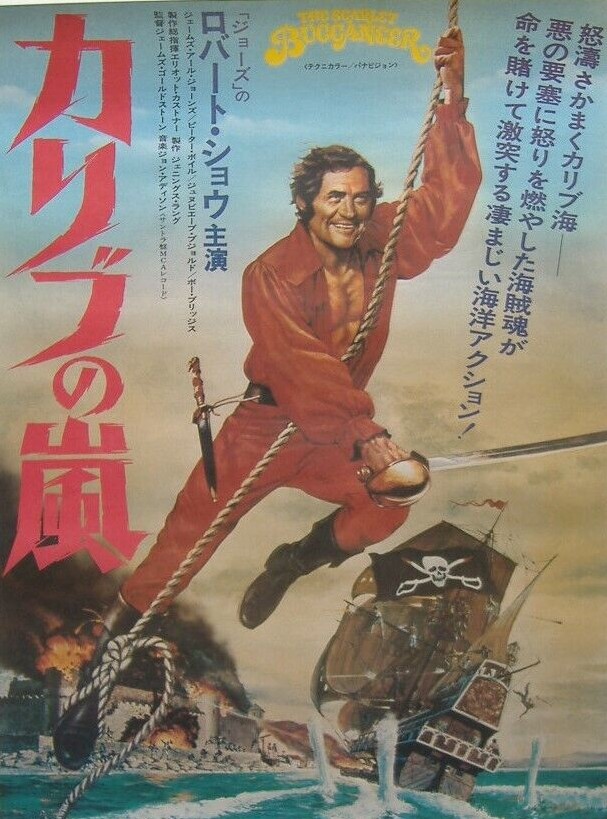
Red faces all round. Uneasy pirate spoof that misses all its targets, coming close to resembling the kind of movie that gives turkeys a bad name and saved only by a spirited performance by Genevieve Bujold. Uber-producers Jennings Lang (Rollercoaster, 1977) and Elliott Kastner (Where Eagles Dare, 1968) should have known better but were seduced by the tantalizing returns for Richard Donner’s The Three Musketeers (1974) and its sequel which had revived the moribund swashbuckling genre.
Robert Shaw (Custer of the West, 1967) was nailed-on for the leading role since had made his name playing a pirate in British television series The Buccaneers (1956-1957) and was as hot as he was going to get after the double whammy of The Sting (1973) and Jaws (1975). However, the movie takes its cue from one of the chief supporting actors Major Folly (Beau Bridges).
It’s color-coded. In case we can’t tell a good guy from a bad guy, we’ve got the Man in Red, pirate Ned Lynch (Robert Shaw), shaping up against the Man in Black, unscrupulous Jamaican governor Lord Durant (Peter Boyle). Ned is presented as a seagoing Robin Hood, Durant as the wicked Sheriff of Nottingham, his ruthlessness somewhat undermined by his predilection for playing with toy boats in his bath and for getting his hairy back waxed.
Twin narratives quickly unspool. Ned rescues from being hanged shipmate Nick Debrett (James Earl Jones) while Durant jails island chief justice Sir James Barnet (Bernard Behrens) and steals his treasure.
Stolen treasure being fair game, Ned and Nick hijack a coach-load of it, while Sir James’s on-the-run daughter Jane (Genevieve Bujold) ends up in their hands. Not being as black-hearted as his nemesis, Ned puts Jane ashore, but still a bit black-hearted humiliates her in a swordfight, and is disinclined to help her save her imprisoned father.
However, Jane has a trump card. For reasons unknown, Durant is heading back to England with a cargo of 10,000 dubloons, too tempting a target for any pirate. Naturally, nothing goes as planned but, as you might expect, there is a happy ending.
This might have worked, since all the ingredients are there, the laughing cavalier, the spirited woman, the humorous sidekick, the unprincipled villain. You’ve got an historically-accurate pirate ship for once, unlikely romance between high-born woman and charming scallywag, simple rescue-imprisonment-rescue scenario, and ample scope for swordplay.
Except the dialog is awful, the ship too small to accommodate any fighting so the pirates are landlubbers for the most part, and except for the duels between Ned and Jane and Ned and Durant, the swordfights are all kind of bundled together, and every now and then the action stops so we can hear a verse or two of a sea shanty sung by nobody in particular.
Though Ned and Nick trade cringeworthy, and in one case downright offensive, limericks, the best (only) laugh comes when Ned chucks Jane off a roof onto a canopy and follows up with the line “It worked.” It doesn’t help that Durant’s pederastic tendences are played as a joke. Everywhere you look people are turning cartwheels or are “blithering idiots” or “pawns” and as you might expect there’s a cat-fight and a monkey around to relieve a jailer of his keys. You are just praying for a shark to come along to put the cast out of their misery.
In the midst of this feast of over-acting along comes Genevieve Bujold (Anne of the Thousand Days, 1969) who must think she’s in a different picture. She is a feisty one all right, not above putting a knife to a man’s cojones, or kneeing them in that region, and, given the lawless state of the island, branded a criminal for wounding a rapist. At least she takes the whole thing seriously rather than as if being in a Mel Brooks picture.
It’s hard to know who to blame: the stars for acting as if enjoying a holiday from more serious fare; director James Goldstone (Winning, 1969) for failing to get the recipe right and employing a jaunty score that undercut everything, or writers Jeffrey Bloom (11 Harrowhouse, 1974) and Paul Wheeler (Caravan to Vaccares, 1974) for making a mess of the ingredients in the first place.
Of course, I am hardly blameless in drawing your attention to this, a sudden enthusiasm for pirate pictures sending me dashing into the wrong decade.
Watch for: Robert Shaw making a bid for the all-time Golden Raspberry; an unrecognizable Peter Boyle (Taxi Driver, 1976); Beau Bridges (Gaily, Gaily, 1969) doing his best Frankie Howerd impression; James Earl Jones (The Comedians, 1967) sounding normal, minus the deep-throated vocal tic on which he made his name; and so many inanities it falls easily into the So Bad It’s Good category.
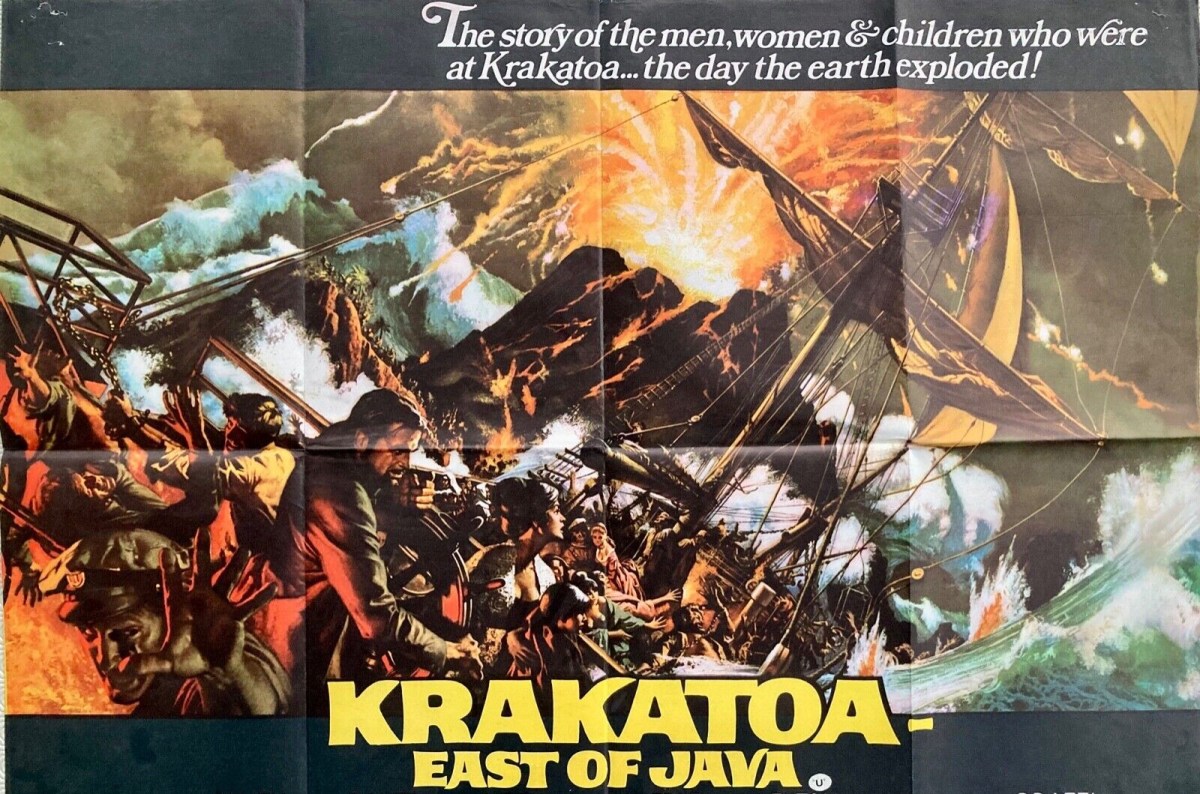
The first thing you notice about the 1970s disaster cycle is the quality of the cast – Burt Lancaster and Dean Martin in Airport (1970), Paul Newman and Steve McQueen in Towering Inferno (1973) – and Krakatoa, East of Java, which could fairly claim to have set up the disaster movie template, might be the reason. The stars aren’t big enough here to command attention for the duration and the thrills can’t compensate.
The narrative hook is decent enough. A disparate bunch of salvagers searching for a sunken ship containing a fortune in pearls sail too close to the titular volcano. Finding deep-sea divers among the manifest seems appropriate but the Oriental scantily-clad female pearl divers look like titillation and balloonists, ostensibly airborne wreck-spotters, serve the secondary purpose of providing close-ups of the fiery volcano.
But emotional involvement is sadly lacking, Laura (Diane Baker), mistress of Captain Hanson (Maximilian Schell), seeking a son she abandoned, saloon girl Charley (Barbara Werle) sticking by drug-addict diver Connerly (Brian Keith) on his last legs. There’s a claustrophobic bathyscope operator Rigby (John Leyton) and a human powderkeg in the shape of a cargo of prisoners led by the cunning Danzig (J.D. Cannon).
Like any horror picture, you have to line up your ducks and drip-feed the potential terror. Strange incident piled on strange incident raises tension on board. Luckily, Rigby is on hand to explain the increased heat, the fog, the dead fish in the water, and the high-pitched hissing. I’m not sure the science is so accurate, apparently the way to escape a tsunami is to find deep water.
Oddly enough, the movie opens with a striking throwback to the original three-screen Cinerama and a nod to the current split-screen techniques used by the likes of The Thomas Crown Affair (1968) and the travelog scenario. Where roadshow pictures began with a musical overture running over the credits here is a visual equivalent, snippets from future scenes. Unfortunately, the split-screen is limited to the opening.
But this being Cinerama, director Bernard L.Kowalski has to find room for that format’s tropes, something runaway, in this case the balloon driven through narrow mountain chasms, and something swirling round out of control, no rapids to hand so a man in a wooden crate high above the rigging has to make do.
And there’s a nod to contemporary drug-abuse, Connerly, high on laudanum, has a bad trip and attacks one of the pearl divers. But who knows what precipitated a song-and-dance striptease by Charley. Since the audience already knows the outcome, it’s a question of how many will survive and you suspect the only reason some passengers quit the ship for the shore is for an excuse to show the devastation wreaked by the volcano on islanders.
With no CGI to help and a limited budget, the special effects appear rudimentary, the volcano generally seen in the distance. The ship negotiating around the island is clearly a model but scenes on board are better done, water, fire and rocks raining down on passengers.
Maximilian Schell (Topkapi, 1964) doesn’t invest his character with much beyond staunchness, Brian Keith (Nevada Smith, 1966) seems uncomfortable with having to over-act and Rosanno Brazzi (The Battle of the Villa Fiorita, 1965) has a thankless role and you get the nagging suspicion they were chosen to appeal to different geographic demographics. Diane Baker (Marnie, 1964) can’t convey the guilt of a mother who has chosen her lover over her son nor her fear that her boy’s skeleton might lie in the wreck. Barbara Werle doesn’t quite know how to deliver a beauty of a line, in reference to boyfriend Connerly, “I wouldn’t care if he kicked old ladies in the teeth.” John Leyton isn’t a patch in the claustrophobia stakes to Charles Bronson in The Great Escape (1963).
Bernard L. Kowalski (Stiletto, 1969) keeps the incident coming, and the timing is spot-on, the ship reaching Krakatoa just before the halfway mark. There are occasional directorial touches, cutting from the smoke of the volcano to smoke belching from the funnel of the ship, and a few notes of historical authenticity. There’s a sense that the hi-tech of the time – bathyscape, balloon, powerful ship – cannot compete with nature at its most basic. But basically, he’s pinning his hopes on the fact that come the end of the movie the audience will be so overwhelmed by the eruption and the tsunami that it will have forgiven everything else that went before.
You get the impression it was spectacle first, story and character later.
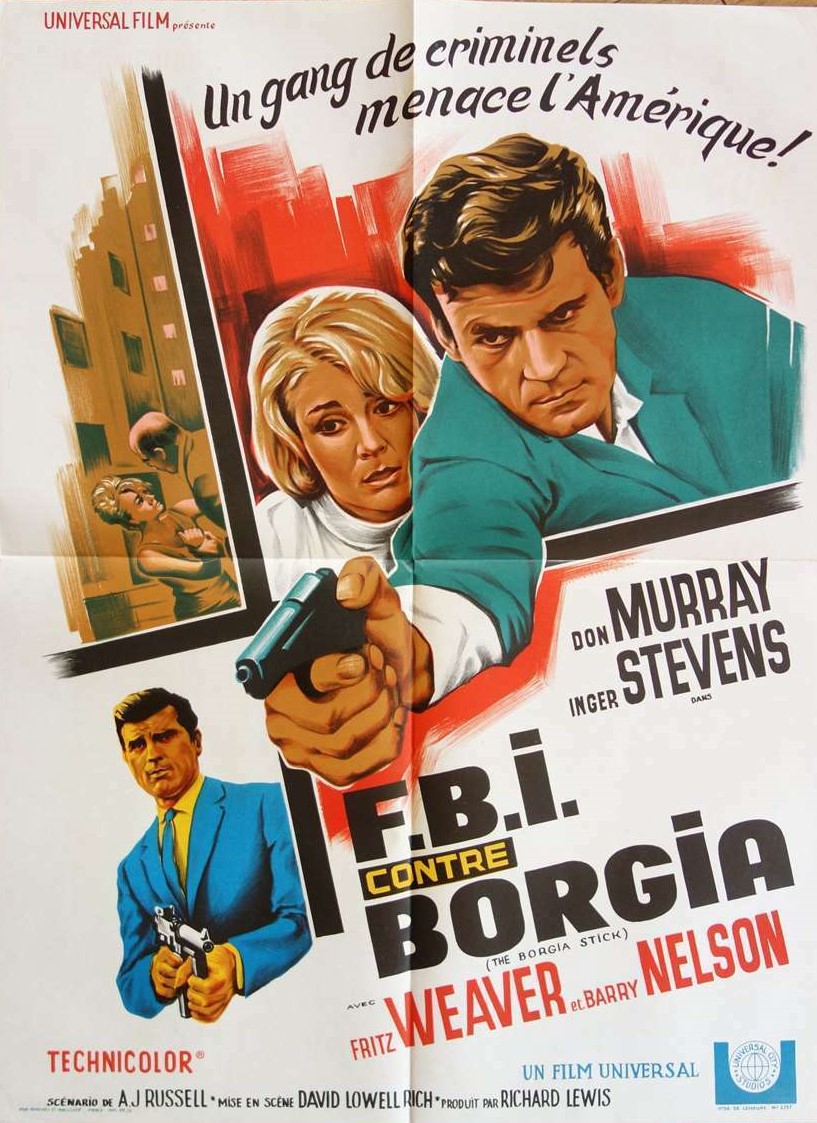
It was a gamble all round. Reputations could be made or seriously dented. Male lead Don Murray had been trying to get Hollywood to pay serious attention since nabbing an Oscar nomination for Bus Stop a decade before. Female lead Inger Stevens had been a wannabe for just as long, named as a “youngster to watch” in the mid-1950s alongside the likes of Paul Newman, Joanne Woodward and Anthony Perkins who had all more than made the grade. Director David Lowell Rich had only one feature, Madame X (1966), a remake of the 1930s classic, to his name. Studio Universal was not so much risking its financial shirt as its prestige.
For all four were embarking on a new kind of enterprise – the made-for-television movie. That notion in itself had been born out of crisis. If exhibitors were claiming that with the mid-60s production crisis there weren’t enough movies to go round, the situation was worse for the television networks which had begun to rely heavily on movies to fill out their programs.
Television had “drained the vaults of Hollywood studios” by using up “the ready supply of motion pictures faster than a grind house.” With too few new motion pictures coming down the pipeline the networks, facing being drawn into a costly rights battle, might welcome a new source of product as easily as they could be exploited by someone savvy enough to come up with a new idea.
In theory, the mini-genre that would become known as “made-for-television” had begun a few years before with Don Siegel’s The Killers (1964), but that had been considered too violent for television and released in cinemas instead. So, although in one sense it was a success it was also deemed a failure since it showed the difficulty of trying to make original movies for television. Instead, anything made-for-television would have to find a format that fitted tighter parameters. See How They Run (1964), also from Universal and starring John Forsythe (The Trouble with Harry, 1955) and rising European star Senta Berger (The Secret Ways, 1961), proved a better template.
Although considered one of the biggest studios in Hollywood at the start of the decade, what with Doris Day, Rock Hudson and Alfred Hitchcock on the payroll and willing to spend $12 million on a roadshow like Spartacus (1961), Universal had since pulled in its financial horns, balking at splashing out on bestsellers and Broadway material. But it perceived the television movie drought as a gap to be exploited, believing that a modestly-budgeted picture would make a decent profit from a network showing (and repeat showing), syndication and overseas theatrical sale.
Quality was the watchword. This would not be like the “quickly-made ersatz segments of a TV series…not going backwards in time to make cheapies.” Originally entitled “Project 120” and based in New York, the movies, “something of a stepchild” to the main film-making operation, would run 97-100 minutes allowing space within a two-hour time frame for advertisements.
While still not in the big bucks book market, which in themselves tended to require a major star to guarantee a return on heavy literary investment, Universal hired William Darrid to find less expensive works, beginning with snapping up the novel House of Cards for $70,000. That proved too expensive for television and ended up as a movie. Darrid believed it simpler and less risky to find original screenplays such as The Borgia Stick, embarking on an “intensive program to purchase…original stories for screen production.”
Universal had another aim – to develop a television segment, a movie series if you like – rather than a one-off, creating an identifiable programmer that could last a season and attract sponsors and advertisers to a recognised brand. There were nine films on the original slate and they would be sold under the generic title of “World Premiere.”
But to make a host of smaller films in a relatively short space of time, Universal needed to find talent that could be marketed to a television audience. Established movie stars were out of the question and in any case such talent would consider it below their dignity. There was no shortage of television stars but this was seen as an opportunity to showcase talent, rising stars and actors who already had some movie marquee value.
Breaking out of television into Hollywood was virtually impossible. But it had always been that way. Stars emerging from the small screen like James Garner (Maverick) or Steve McQueen (Wanted: Dead or Alive ) were few and far between. Clint Eastwood (Rawhide) had to reinvent himself in Italy. “A television star rarely makes a successful transition to pictures,” was the general observation.
Even Gene Barry, with Bat Masterson (1958-1961) and Burke’s Law (1963-1966) behind him, had to head for Europe and Maroc 7 (1967) to catch an even break, something denied him in television where the profit shares he had in both series had amounted to little once sharp practice and high production costs were taken into account.
For Inger Stevens and Barry Nelson it was a potential step up. For Don Murray a definite step down. As mentioned, Swedish-born Stevens had been a genuine ingenue, but despite nabbing the leading female billing opposite Rod Steiger in Cry Terror! (1958) and Harry Belafonte in The World, the Flesh and the Devil (1959), her career didn’t take off and she ended up a television regular, guest star in series like The Aquanauts and Route 66. But in 1963, despite an initial flaying by critics, she was top-billed in half-hour television comedy series The Farmer’s Daughter. It ran four seasons, and 101 episodes later she was a better known quantity, enough to be able to front a documentary about her homeland.
On the face of it, she was not an obvious fit for The Borgia Stick unless you were simply looking someone whose glamor might add a sad touch to a character who was nothing more than a pawn in a sordid business. The idea of such a beautiful woman going from fashionable housewife to tawdry hooker would be enough to tug at audience heartstrings whether or not she could supply a deeper emotional pull.
Don Murray was so quickly disenchanted with Hollywood that he turned producer on The Hoodlum Priest (1961) but that gamble didn’t pay off and he was relegated to top-billing in small pictures like Escape from East Berlin (1962) and biopic One Man’s Way (1964). There was a hint of potential redemption when Universal, reviewing the footage for The Plainsman (1966) originally intended to form part of the initial “World Premiere” made-for-tv strand, gave it a cinematic release.
But that didn’t hit the ground running either and he stepped into The Borgia Stick as a makeweight while he attempted to advance his career his own way, once again back in the producer’s seat, with the independent Tale of the Cock, whose title alone caused an earthquake at the offices of the Production Code (the industry censor).
With budgets so tight, Universal often hired moonlighting Broadway actors who were generally free during the day – Barry Nelson, currently starring in Cactus Flower with Lauren Bacall, was one such, with Fritz Weaver, Marc Connelly (better known as a playwright) and Sudie Bond (making her movie debut) drawn from the stage.
In-house producer Richard Lewis, who handled The Borgia Stick, took a different approach to writers and directors. He saw them, especially the writers, as “necessary” collaborators, not as mere employees to be replaced at whim. Writers were on hand during production rather than banished from the studio floor. “It’s a lot better to have him (the writer) around if a line of dialog has to be switched than let anyone else tamper with his work which was excellent enough originally for us to do it.”
The way The Borgia Stick was acquired was typical of the operation. Lewis kept in touch with most of the literary agents, finding out what kind of work their clients were considering, almost looking for a pitch. A.J. Russell’s agent thought his client had come up with “a good story.” Lewis arranged a meeting with the author and “that’s how it (The Borgia Stick) started.” Russell was a television veteran, credits going back to 1950, so this represented a major opportunity. “I gained identity as a writer with a show such as this,” explained Russell, “which is impossible to get in a regular series. The script is wholly mine…it’s something that belongs to me.”
At a time when most directors were freelance or struck non-exclusive short-term deals with studios, David Lowell Rich was an anomaly. He was a contract director, having signed a six-year deal with Universal, replacing Norman Jewison. It was a very old-fashioned deal, harking back to the Hollywood “golden age” when actors and directors were hired for seven-year stints. They worked on whatever the studio saw fit or could be loaned out to other studios if need be. That scenario would not have suited an Otto Preminger or a John Sturges. But for a television director not in the league of Martin Ritt or John Frankenheimer, whose television work had provided Hollywood calling cards, it was a big step up. “At the time Universal offered me a pact I thought it the best thing to happen and a wonderful opportunity and I still do.”
And small wonder. He, too, was a television regular, starting out in the business in 1950, and eventually entrusted with episodes of Wagon Train, Peter Gunn, Route 66, The Twilight Zone and Dr Kildare. Earlier attempts at a movie career had disintegrated after the likes of No Time to Be Young (1957) and Have Rocket, Will Travel (1959) featuring The Three Stooges stiffed at the box office.
So the prospect of regular work at Universal as the in-house director, potentially handed prestige projects if predecessor Norman Jewison’s career was anything to go by, was too big an opportunity to ignore. He was only too happy to make what he was told to make. But he was far from just a hired hand. He was considered “a New York director” with a distinctive style, revealing the Big Apple as “a surfaced, multi-layered, steely place.”
As if the made-for-television arm was a mini-studio, Universal did not, as one might expect, make one picture and wait for industry reaction before embarking on another. It started off with a complete slate, and before the nine movies in the first wave had even been televised – The Name of the Game launched the “World Premiere” format on November 26, 1966 – a second tranche, including The Borgia Stick, was already underway.
Initially, the picture was due to start shooting in New York on a five-week schedule in July 1966, but that shifted to August with production complete by early October. According to the critics The Borgia Stick exceeded expectations. Variety called it “an achievement,” and considered A.J. Russell an “exceptional story-teller” and the bold decision to shoot on location in New York working to “striking advantage.” The public tended to agree. It was ranked third among the first tranche in the ratings battle according to Nielsen.
More importantly, when up against all the Hollywood movies screened on television that year, it came in at number eight when measured by “total audience appeal” beaten only by major motion pictures making their network premieres such as The Robe (1953), Lilies of the Field (1963) with Sidney Poitier’s Oscar-winning performance, Doris Day comedy Move Over Darling (1963), The Longest Hundred Miles (another made-for-tv film), Hitchcock’s Rear Window (1954) and Marlon Brando in The Young Lions (1958) – screened over two nights it counted as two entries. Perhaps more vital, when the results were broken down by demographics, The Borgia Stick took pole position in both the 18-34 age ground and the 35-49 and was “generally considered to be the best made-for-tver to date.”
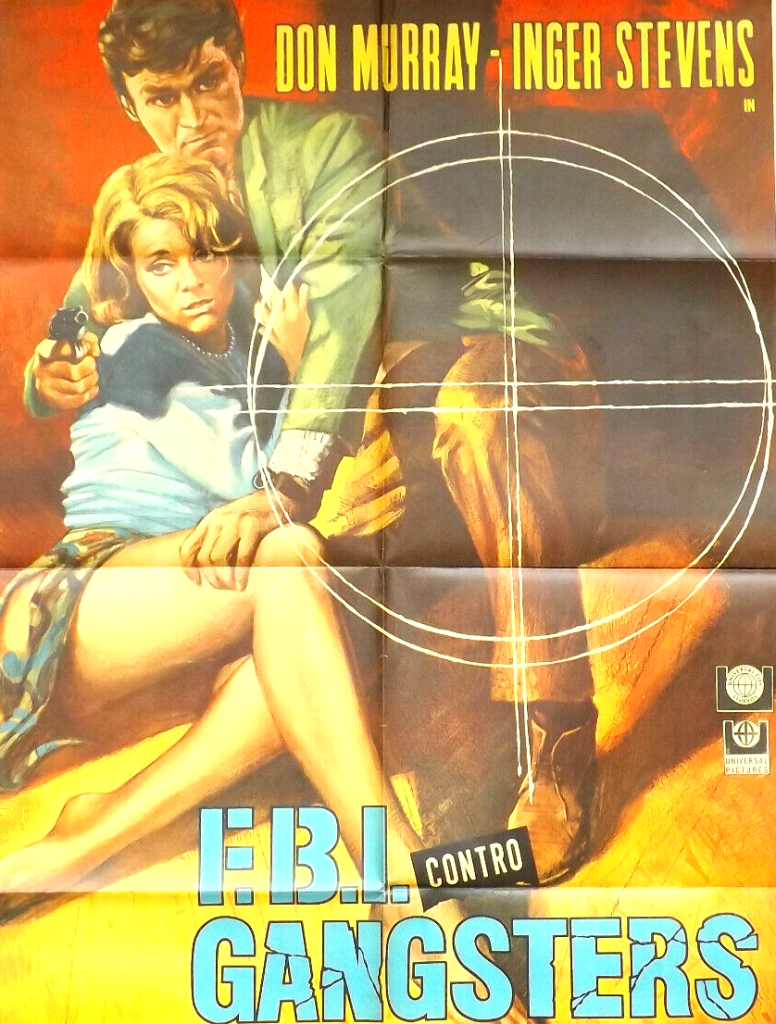
The Borgia Stick was sold to some television networks – the BBC screened it in Britain on September 9, 1969 – around the world but the Mafia theme made it a straightforward sell for cinema distribution in other areas where it went out under titles such as FBI vs Gangsters, Murder Syndicate or Gangster Syndicate.
The Borgia Stick proved to be the ace in the pack for Inger Stevens. She was snapped up immediately for the movies and over the next three years was leading lady to Clint Eastwood (Hang ‘Em High, 1968), Dean Martin (5 Card Stud, 1968), Henry Fonda (Firecreek, 1968), George Peppard (House of Cards, 1968) and Anthony Quinn (A Dream of Kings, 1969). But she had mental health issues, probably exacerbated by being forced to keep secret her marriage in 1961 to black musician Ike Jones in case it adversely affected her career, and in 1970 she committed suicide.
Don Murray’s Tale of the Cock (1966) sat on the shelf for three years before being released, minus a censor rating, as These Childish Things to neither critical acclaim nor box office interest. David Lowell Rich made three feature films on the trot – Rosie! (1967) with Rosalind Russell and Sandra Dee, Kirk Douglas/Sylva Koscina thriller A Lovely Way to Die (1968) and Eye of the Cat (1969) before subsiding back into television only emerging for an occasional movie like That Man Bolt (1974) starring Fred Williamson and The Concorde…Airport ’79 (1979). A.J. Russell also achieved breakout success, going on to write A Lovely Way to Die (1968) and Stiletto (1969).
Made-for-television movies became a regular feature of network programming and from time to time threw up a genuine success – Steven Spielberg’s Duel (1971), Bang the Drum Slowly (1973) starring Robert De Niro and The Jericho Mile (1979) with Peter Strauss among the most notable. And you could argue that the genre is currently booming on streaming giants like Netflix and Apple, making movies to win audience share and expand their subscription base.
SOURCES: “Youngsters With Star Potential,” Variety, July 24, 1957, p13; “Competitive Spirit Moves MCA (& U),” Variety, May 4, 1966, p3; “Wm Darrid Is MCA’s Literary Head,” Box Office, May 23, 1966, pE6; “Gotham Draws More Film Prod,” Variety, July 6, 1966, p1; “Broadway,” Box Office, August 29, 1966, pE4; “Universal Sets 11 Features For NBC-TV,” Box Office, September 5, 1966, pE4; “Broadway,” Box Office, October 3, 1966, pE4; “U and Metro Favor Features Made-For-TV,” Variety, October 19, 1966, p4; “Gene Barry Seeks To Prove A TV Star Can Make It Theatrically,” Variety, October 19, 1966, p4; “First U’s Film Made-For-TV Due Nov 26,” Box Office, November 21, 1966, p20; “Review,” Variety, March 1, 1967, p31; “NBC’s Ersatz Pix Hottest Package,” Variety, April 26, 1967, p165; “Last Season’s Most Appealing Pix,” Variety, July 5, 1967, p18; Stuart Byron, “Economics Can Work Out Okay For House Director – D.L. Rich,” Variety, July 5, 1967, p18; “U’s Premiere Status In TV,” Variety, August 16, 1967, p33; “Survivors, U-Pix Bought by BBC,” Variety, September 10, 1969, p59; “15 New MOTW Titles Packaged for O’Seas,” Variety, August 26, 1970, p39.











 The Magnificent 60s