The maiden voyage of the time-travelling Tardis is triggered by some unexpected pratfall comedy. On board are the venerable doctor (Peter Cushing), his intrepid great-granddaughter Susan (Roberta Tovey) and a fearful pair, granddaughter Barbara (Jennie Linden) and accident-prone Ian (Roy Castle). They land on a petrified planet ruled by the robotic Daleks with menacing electronic voices.
The malfunctioning Tardis forces them to investigate an abandoned city but they are quickly imprisoned, the steel robots determined to discover why the earthlings should be immune to the radiation that has consumed this planet after nuclear war. Meanwhile, the planet’s remaining inhabitants, the Thals, are planning an uprising.
Budget restrictions ensure that menace is limited, even as the characters endure a heap of traditional obstacles such as swamp and rocky outcrop. Adults who did not grow up in the 1960s when the BBC television series took Britain by storm and apt to come at this without the benefit of nostalgia will certainly look askance at the sets and costumes. And it doesn’t possess the so-bad-it’s-good quality of some 1950s sci-fi pictures. But since it was primarily made for children, then perhaps it’s better to watch it with a younger person and gauge their response – of course, that may be equally harsh from someone brought up on the modern version of the series or already immersed in superheroes.
On the plus side, it does move along at a clip. Roberta Tovey (A High Wind in Jamaica, 1965) charms rather than annoys as the plucky grand-daughter even if her grandfather has mutated from the sterner figure of the television series into an eccentric inventor. Peter Cushing (The Skull, 1965) is only required to ground the production which he does adequately. The innate comic timing of comedian Roy Castle, in his leading man debut, brings a light touch to proceedings as the bumbling boyfriend and generates some decent laughs. Jennie Linden (Women in Love, 1969) has little to do except look scared.
Oddly enough, it was American Milton Subotsky who, in opportunistic fashion, brought the project to the big screen, although the BBC had a track record of providing product that might make such a leap, The Quatermass Experiment in the 1950s the leading example. He wrote the screenplay and acted as producer and had previously worked with Cushing on Dr Terror’s House of Horrors (1965) and was about to embark on horror masterpiece The Skull the same year. He has approached the material with some reverence and the fact that the budget allowed for hordes of Daleks rather than being seen one or two at a time as on the television probably made some child’s day.
Scottish director Gordon Flemyng (The Split, 1968) would make the leap to Hollywood on the back of this picture and its sequel the following year and you can see what made studios have faith in his ability – he deals with multiple characters, works quickly on a low budget and delivers an attractive picture that was a box office hit.
I suspect that audiences will divide into those who watch the film with nostalgia-colored spectacles, those who think it only as good as a bad episode of Star Trek and those who adore any low-budget sci-fi movie.
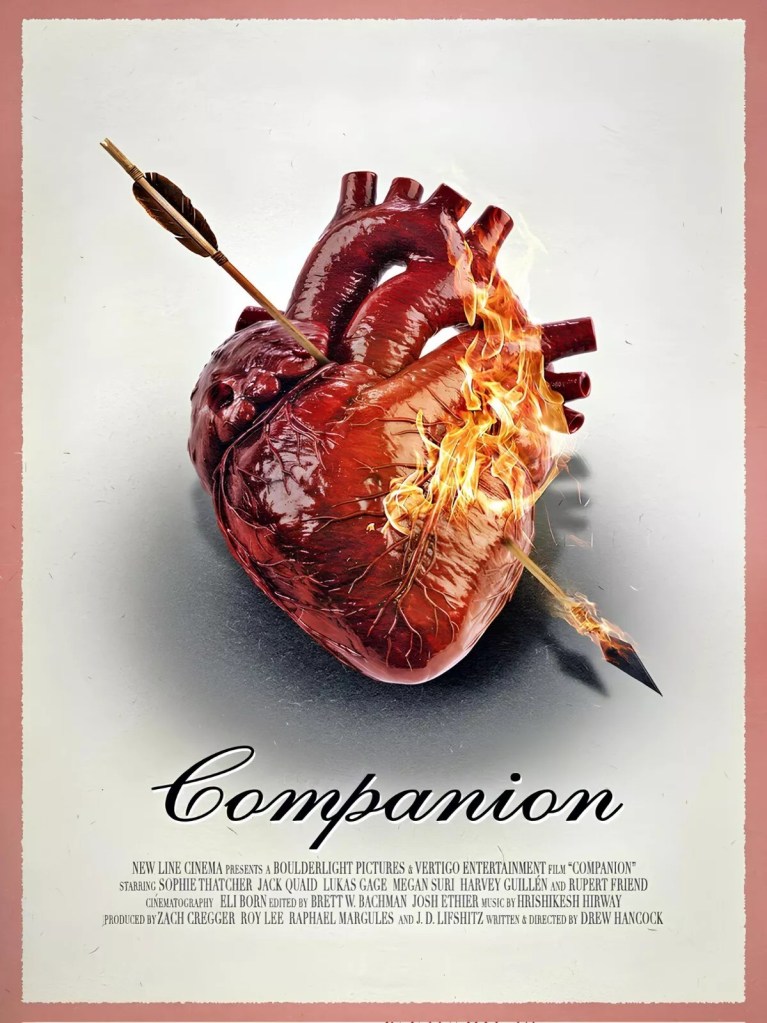
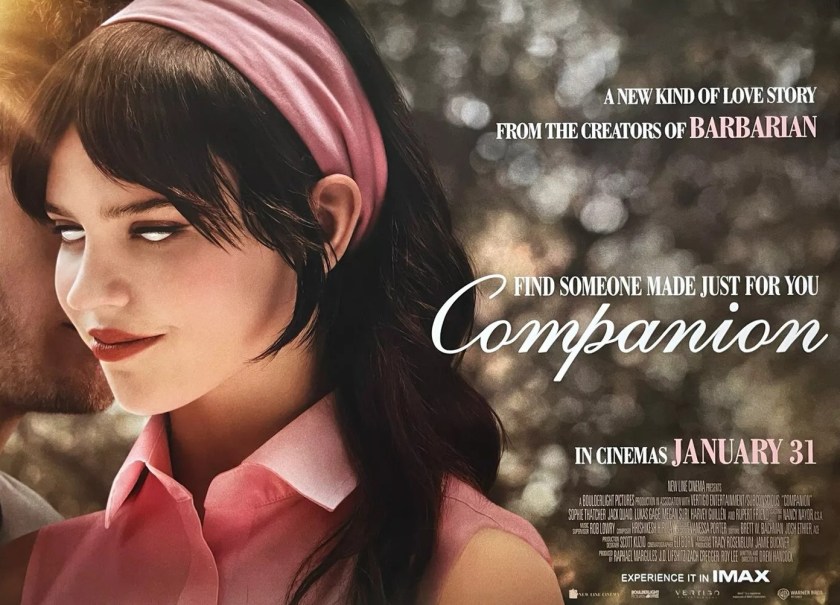
Body Heat meets I, Robot in a film noir high-concept sci fi female revenge thriller. Such a contagion of ideas should skid off the rails but it works a treat as debut director Drew Hancock offers a highly intelligent adult movie. And might have been ideal Valentine’s Day counter-programming fodder to the more lightweight Bridget Jones: No More Please except that Captain America: Brave New World has already snapped up the counter-programming slot. Hopefully, this will pull in a deservedly wide audience that it’s still around to cause the other franchise operations some grief.
In my eyes sci fi and horror have to follow an internal logic, in other words create a world that can’t be twisted to suit an inconvenient obstacle. This is filled with them, but the best is when our heroine Iris (Sophie Thatcher) has discovered she’s a robot programmed to fulfil the needs of her owner but gains control of herself and plays around with her personality only to discover that the electric car in which she is trying to escape won’t respond to her new voice.
This is just so brilliantly done that when you get one twist after another following in logical fashion you don’t recognize these as twists but rather logic played out to the ultimate degree.
Three couples meet for an idyllic weekend in the country in a fancy pad beside a lake, owned by dodgy Russian multi-millionaire Sergey (Rupert Friend) who has brought along docile trophy mistress Kat (Megan Suri). Joining them are robot owner Josh (Jack Quaid) and Iris and gay couple Eli (Harvey Guillen) and Patrick (Lukas Gage), who, also, it transpires, is a robot.
The robots are programmed with highly believable meet-cutes, one involving a fancy dress party, the other the clumsy up-tipping of a stack of oranges in a supermarket. The robots are programmed to a) have sex at the drop of a hat; b) love their owners; c) be unable to tell a lie and d) follow the first rule of robotic development, as laid down by Isaac Asimov, of being unable to kill a human.
The last commandment ain’t quite so hard and fast and it turns out an owner, for nefarious purpose, can actually turn on the aggression control. As much as Sergey is probably, thanks to his wealth and perceived status as a thug, programmed to assume any woman is there for the taking, so a robot, aggressive instincts sharpened, can respond violently to attempted rape.
So, first of all, this looks like it’s going to be a tale of how do the other members of the holiday gang deal with Sergey’s murder and the more philosophical question of whether a robot can be held responsible for a crime or whether blame would lie with the owner for dickering around with the controls or for the inventor for allowing such a possibility.
You could have had a fair old time exploring any of these possibilities, and a fairly satisfying picture, given the detail of the programing and the examination of female dependency (Kat is as much under the thumb of Sergey as Iris of Josh) and male control and in low-key fashion the kind of guy who would otherwise most likely be an unwilling celibate. The movie poses another question that it doesn’t really go into, which is how our view of an otherwise unattractive male character changes when he has a beautiful woman on his arm, Hollywood the first to perpetuate such fictions.
Anyway, the story goes in a different direction. Turns out Josh is quite the sneaky conspirator. He has programmed Iris to take the rap for Sergey’s death while he and Kat make off with the $12 million the Russian keeps in his safe. But, like any heist picture, the theft is the easy part, the thieves inclined to fall out, and with a robot distraught at discovering she’s a robot and that her life is a fiction (and Josh’s to boot) then it’s only going to get murky.
But that’s without taking into account more logic. As the story develops, Patrick takes a programmed shine to Josh, acting as his protector, Josh discovers the makers of the robots have built in some safeguards, and Iris finds that the acquisition of greater intelligence (with little more than, ironically, a swipe right) more than makes up for losing the love ideals for which she is constructed and which constitutes the center of her understanding of her life’s purpose. Like M3GAN (2022), this is sitting up and begging for a sequel.
Top marks to Drew Hancock, who doubled up as writer, for exploring so many avenues and in contriving an interesting plot without cocking it up with easy solutions. Sophie Thatcher (Heretic, 2024) is the standout, but Jack Quaid (Oppenheimer, 2023), latest in the acting dynasty, essays well a difficult part, turning from clumsy charmer to needy controller. Lukas Gage (Smile 2, 2024), too, shifting up the gears from adorable to deadly.
Certainly, one of the most intelligent sci fi thrillers in a long time.
Count me in. The buddy movie reinvented, the MCU legend trashed, all set in the ideal MCU location, The Void (worthy of two capital letters, I guess), the place where long-forgetten Marvel characters from the pre-Disney multiverse hang out, and it’s a fun ride. Whether of course this proves the death knell for the MCU after so much fan backlash and poor reviews remains to be seen. Next weekend’s box office will decide its fate one way or another.
But who the hell cares? If this is the extinction of the MCU, as some predict, then it is going out with a bang, a crazy superhero mash-up where you need to keep an MCU dictionary to hand so you can work who’s going to turn up next. Wesley Snipes, not seen in that Blade badass rig since 2004, and it’s not Capt America but Chris Evans’ earlier incarnation of Johnny Storm not seen since 2007, and there’s Channing Tatum as a character Gambit whose stand-alone picture never materialized, despite scoring highly in animated form.
Well hello again.
Anything that MCU got wrong or was criticized for – the multiverse and the varying timelines – turn up here as plot. The “sacred time lime” is almost a character in itself and if you ever wanted to invent the most ideal/ironic MCU character, who else would that be but Mr Paradox (Matthew Macfadyen)?
The entire storyline is so off-the-wall that you’d think it’s never going to work but then when Deadpool’s around walls are toys, especially the fourth wall, that magical trick of speaking direct to the camera. And it’s Deadpool and his continual wisecrack commentary on proceedings that turns what could be a s**tshow into a hoot.
But some of the twists transform what could be another deathly routine of superheroes saving the universe (yawn, what again?) into something more human. Deadpool (Ryan Reynolds) only wants to save his own tiny universe of half a dozen people, everyone who matters to him, and not a gazillion others. Somehow he teams up with the previously deceased Logan a.k.a. (in case you don’t have your MCU Dictionary handy) Wolverine to revive the moribund buddy movie, the best kickass bickering pair since Mel Gibson and Danny Glover in Lethal Weapon.
Or whatever. Anyway, they find themselves in The Void doing battle with that sweet Charles Xavier guy’s nasty twin sister Cassandra Nova (Emma Corrin). And, yes, there’s still so much jiggering about with time that you’d think the Time Bandits or Doctor Who would be claiming copyright infringement. And sometimes you can almost hear the clack of the typewriter as the screenwriter tries to fix that last loose end.
But, as I said, whenever the going gets tough – especially when the going gets tough – you can depend on Deadpool’s motormouth to see the narrative through. Deadpool and Wolverine do make a great screen team, ideal opposites, growl vs grit, class vs. sass, and really you could just junk the narrative – or come up with an entirely different one – and still this picture would work because the two principles set the screen alight.
This is akin to when Guardians of the Galaxy ripped up the MCU playbook a decade ago and influenced every movie thereafter. The guess now is whether Deadpool and Wolverine will take MCU down a new stylistic avenue or whether this is a deliberate cul de sac. I’d guess not, since it’s going to be such a money-spinner, and I could see this pair worming their way into the new Avengers team to brighten up whatever doom-laden occasion is heading our way.
Maybe the MCU is giving the finger to the fanboys, hoping to attract a wider audience rather than pandering to an audience that seemed to have made up its mind about everything way in advance and wasn’t inclined to go along with any MCU experiment, feint or development. The audience I saw it with were clearly of mixed opinion, some feeling betrayed or at the very least insulted.
But I have a good bit less invested in the MCU. It takes me all my time to keep up with who’s who in this expanding universe. So treating this picture on its own merits, I thought it generated more than its fair share of laughs, and not always rude ones, although anyone with a woke inclination would be advised to steer clear.
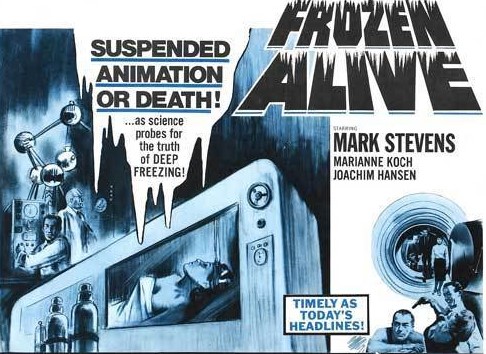
Sometimes the stars fail to align, initial promise fizzling out. Mark Stevens, rising post-war star, top-billed in film noir The Street Has No Name (1948) and Between Midnight and Dawn (1950), paired with Olivia de Havilland in The Snake Pit (1949), seemed all set for major stardom. No go. By the end of the 1950s he was mostly seen in low-budget westerns, and too few of them. September Storm (1960) was his first picture in two years. He had tried his hand at direction, but landed in B-movie hell with titles like Escape from Hell Island (1963) and after a bit part in Fate Is the Hunter (1964) hightailed it to Germany for this.
Not quite the sc-fi or noir number it says on the tin, more an exploration of personal and professional jealousies in the scientific community. You probably didn’t know the World Health Organization ran a Low Temperature Unit engaged in cryogenics experiments. Maybe they did, this being promoted as a timely movie.
Dr Overton (Mark Stevens) along with lab partner Dr Wieland (Marianne Koch) are on the verge of a breakthrough in their cryogenic experiments with monkeys. Although she has a lover Tony (Joachim Hansen), his unfaithful alcoholic journalist wife Joan (Delphi Lawrence) is jealous of his success and of Wieland and dreads leaving the fast lane for life in the country and potential motherhood.
Professional jealousy results in the successful scientific team being split up, so before that can be actioned, Overton decides to embark on a human experiment with himself as the guinea pig.
All the tension of watching an inert frozen human being relies on wondering whether he’s going to wake up and will he have all his working parts, brain especially. So, just to heighten that tension, Overton could face a murder charge when he does emerge. And Wieland, in love with him, has to decide whether it’s better to let him die than go to prison.
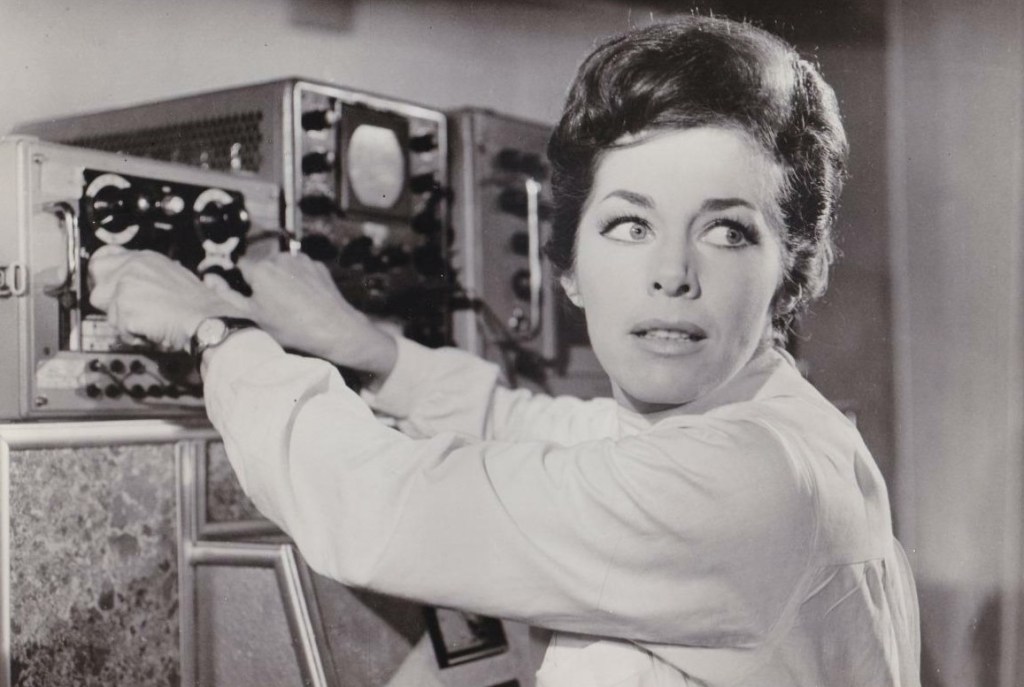
Marianne Koch at the controls. Will she let the suspected murderer live – or die?
The crime aspect is something of an oddity. The time element puts Overton potentially in the frame. And there’s a definite Hitchcockian element to the death, that in one sense robs it of tension, but in the other jacks it up to eleven. Because what we know but Wieland doesn’t is that Joan died by accident, playing with the gun of her lover.
So not only could an innocent man go to jail in the first place, stacked up against him his potential anger at potentially discovering his wife has a lover, but Wieland could let him die only to find out afterwards that he’s innocent all along.
It’s a good job Joan did die because she was stealing the picture. But even being soused in booze doesn’t dampen her zest for life, the kind of woman whose life mostly exists in cocktail bars and smart parties, dressed to the nines, showing enough cleavage to annoy her husband but tease potential suitors, and with enough toughness to dump any lover that gets too close. She’s sassy fun and married the wrong dull guy.
And she’s smart enough with her “intelligent anticipation” to figure out that husband is soon going to cosy up to lab buddy. Overton’s boss notices the signs when he’s not too busy covering his own back. “You sit on the fence and if someone makes a fuss later I take the rap.”
The Mind Benders the previous year covered similar territory but concentrated on the post-experiment after-effects, so this is almost a prologue to that, and interestingly, setting Joan aside, delivered with almost a British stiff upper lip, secret passion kept under wraps, lust revealed in lingering looks, while the cut-throat elements of ambition are played out under the guise of a civil service mentality.
Not quite what you’d expect from the title, but then it’s kind of a cul de sac in sci fi terms, as it’s generally the awakening that produces the problems and this doesn’t go there. But still a decent watch. British actress Delphi Lawrence (Farewell Performance, 1962) steals the show but the simmering turn from Marianne Koch (A Fistful of Dollars, 1964) comes close. Mark Stevens doesn’t have as much to play with and he’s pretty much kept his emotions tamped down up to this point so hardly going to let rip now. Wolf Rilla (The Secret Ways, 1961) has a small part.
Bernard Knowles (Hell Is Empty, 1967) directed television writer Evelyn Frazer’s only screenplay. You might dwell on the irony that Delphi Lawrence’s star turn here led to nothing as much as Mark Steven’s career dwindled.
Something of a cult possibly because it’s hard to find.
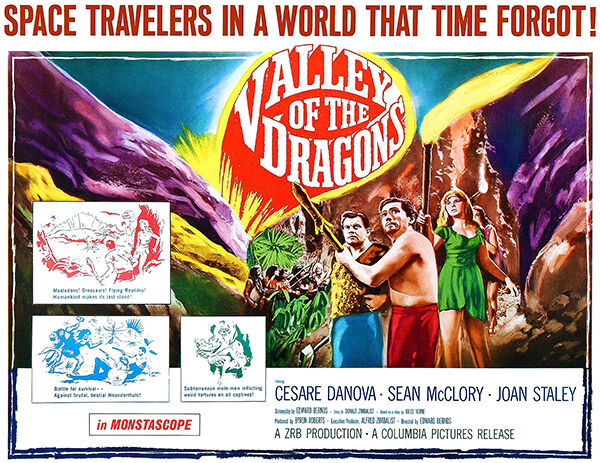
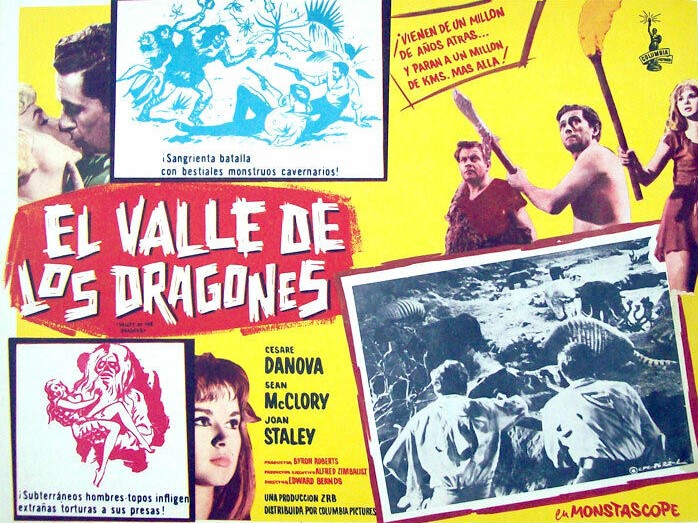
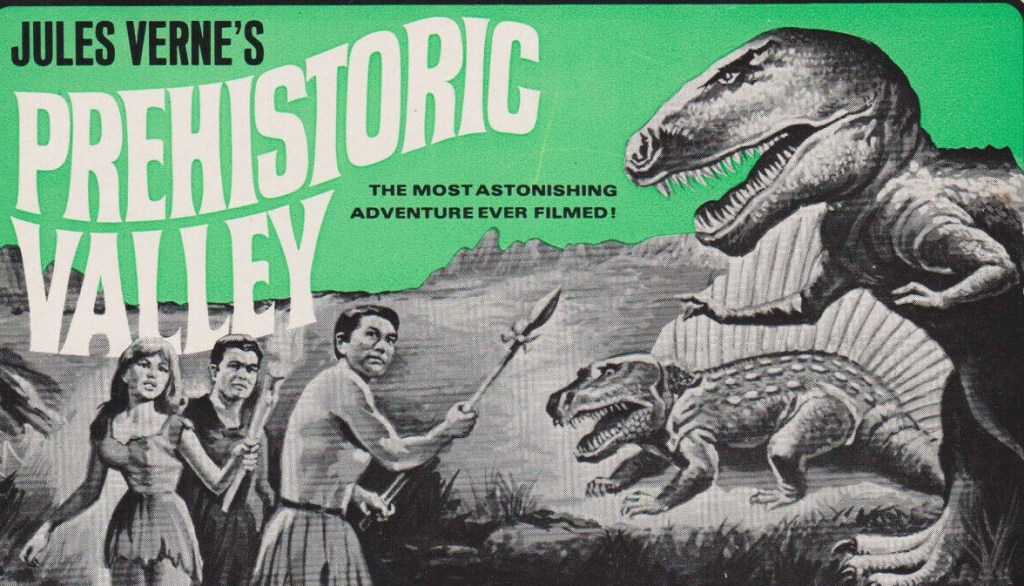
“Producers must become real businessmen,” said Al Zimbalist, “and settle down to cutting corners.” [1] And he set about giving an object lesson in the art of cutting corners in producing Valley of the Dragons.[2] First of all the source novel by Jules Verne, Hector Servadac or The Career of a Comet, was out of copyright, in the public domain, so nothing was spent on that. Secondly, it just so happened that Columbia had a “magnificent” jungle set standing by, built at the cost of half a million bucks for The Devil at 4 O’Clock (1961), but now, that Spencer Tracy-Frank Sinatra effort complete, standing empty and to a producer with a persuasive tongue available at no cost.[3]
Thirdly, such a persuasive producer could convince Columbia to put a ceiling on the overhead they attached to any picture to cover their general office costs. Fourthly, he had acquired the rights to One Million B.C. (1940) and could plunder that picture for stock shots of prehistoric monsters. And fifthly, with budget limited in any case to $125,000,[4] he couldn’t afford to pay anybody much anyway and so was inclined to offer no more than $6,000 for the script.
Director Bernds was under the misapprehension (see below) that the source book hadn’t been published in the U.S. Well, here’s proof that it was, and pretty much as soon as it appeared in 1877.
As it happened, Zimbalist could possibly afford to spend more given he was sitting on a $3 million worldwide haul from Baby Face Nelson (1957).[5] With partner Byron Roberts, he had just inked a multi-picture deal with Columbia, Valley of the Dragons the first product. Also on his slate: The Well of Loneliness based on the controversial novel by Radclyffe Hall, The Willie Sutton Story to star Tony Randall, a biopic of Bugsy Siegel and four television projects.[6] Zimbalist didn’t hang about. Valley of the Dragons went in front of the cameras on January 30, 1961, and was scheduled to hit U.S. cinemas in May[7] though ultimately it was delayed till the fall. Unfortunately, there was a surfeit of “dragon” pictures on the market what with Goliath and the Dragon and The Sword and the Dragon.
Zimbalist specialized in B-movies like Cat-Women of the Moon (1953), King Dinosaur (1955) and Tarzan the Ape Man (1959) in which Cesare Danova was second-billed. Baby Face Nelson, helmed by Don Siegel, was his best-made and most successful picture. Director Edward Bernds was cut from the same B-picture cloth with titles like Space Master X-7 (1958), Queen of Outer Space (1958) with Zsa Zsa Gabor and Return of the Fly (1959).
“Science takes a beating,” commented the director of the movie’s premise, explaining that it was not only unscientific but “utterly ridiculous.” The book, he claimed, had never been published in the U.S. because it was “viciously anti-Semitic” and it was brought to the producer’s attention by his son Donald, on vacation in London, who happened upon a second-hand copy in a bookstall. Although given a story credit – and thus some residuals – that was the only part Donald played in the making of the movie. The basic story was “shaped” by the stock footage. Bernds knocked out a 10-page treatment that Zimbalist shopped to Columbia. Although the budget was tiny, the producers would be due to pay for any overages.[8]
“The Jules Verne name meant box office at the time,” recalled Bernds.[9] Added Zimbalist, “Jules Verne was as big a name as Marlon Brando” with the advantage that “Verne never had a flop…with Verne you don’t need Marilyn Monroe.”[10] To help promote the movie, Zimbalist sent out on tour 50ft replica monsters and advertised it as being made in “Living Monstascope.”[11]
The special effects didn’t always go according to plan. While the giant spider’s jaws were spring-loaded and snapped shut thanks to magnets, the legs, operated by motors, did not always work and it was largely down to the actors to give the impression of an intense fight.[12] The rest of the special effects were simpler to achieve. An alligator given an extra dimension did duty as the dimetrodon, the T Rex was a giant blue iguana, a white nosed coati was passed off as the megistotherium, an Asian elephant covered in wool for the mastodon, while the pterodactyl came from the stock footage. “The cast was good, we had a reasonably fast cameraman…we didn’t have to spend a single day on location…and we did the impossible – brought the picture in on budget,” said Bernds.[13]
While the picture proved to be first run material, it didn’t top the bill, except in cinemas that gobbled up product, so initially it went out as support in 1961 to William Castle’s Mr Sardonicus (1961) but also played second fiddle to Mysterious Island, Weekend with Lulu and The Mask. [14] Results were mixed: a “fair “ $11,000 in Boston, “bright” $20,000 from five houses in Kansas City, “sluggish” $5,000 in Portland and “good” $13,000 in San Francisco.[15] It must have done well enough for it was revived the following year and topping a bill in Chicago that included Eegah (1962)[16] while an exhibitor in Texas deemed it a “nice surprise…will do good business for a Saturday playdate.[17]
Zimbalist didn’t realize his ambitions with Columbia. None of those projected movies materialized, nor did an anthology television series based around the works of Jules Verne.[18] He was quick off the mark to register the title Lucky Luciano after the gangster’s death in 1962,[19] but that didn’t translate into a movie. In 1964 he lined up a $2 million slate with Allied Artists including King Solomon’s Mines, Planet of the Damned, Jules Verne’s Sea Creature and Young Belle Starr.[20] But none of that quartet reached the screen either and his final pictures were Drums of Africa (1963) with MGM and the indie Young Dillinger (1965) which prompted an outcry over the violence.
Byron Roberts enjoyed a longer career, with credits for The Hard Ride (1971), Soul Hustler (1973) and The Gong Show Movie (1980). For good or bad, Bernds was rewarded for his efforts on Valley of the Dragons by becoming the go-to director for The Three Stooges, helming The Three Stooges Meet Hercules (1962) and TheThree Stooges in Orbit (1962) before sidling off for the animated version of their antics.
[1] “Varied Guesses on IA’S New Wages & Small Pix,” Variety, February 8, 1961, p3.
[2] “Another Jules Verne Yarn To Be Made Into Pic,” Box Office, May 1, 1961, pW!.
[3] Tom Weaver, Interviews with B Science Fiction and Horror Movie Makers (McFarland), p62-64.
[14] “Back St Holds Pace in 2nd Detroit Week,” Box Office, November 20, 1961, pME4; “Hawaii and Commancheros Neck-and-Neck in Seattle,” Box Office, December 4, 1961, pW3; “Hawaii Is Hartford Favorite a 2nd Timer,” Box Office, December 11, 1961, pNE1; “Mysterious Island Tops,” Box Office, January 8, 1962, pSE8.
[15] “Picture Grosses,” Variety: November 1, 1961, p8; November 8, 1961, p10; November 29, 1961, p15; December 6, 1961, p9.
[16] “Picture Grosses,” Variety, June 6, 1962, p9.
[17] “The Exhibitor Has His Say,” Box Office, July 2, 1962, pB6. This was at the Galena Theater.
[18] “Zimbalist-Roberts 3 Vidfilm Skeins,” Variety, April 5, 1961, p30.
[19] “Dead, Lucky Luciano Looks Sure for Filming,” Variety, January 31, 1962, p1.
[20] “Zimbalist Finances, 12 Go Allied Artists,” Variety, June 10, 1964, p4.
Jules Verne was the marquee attraction here after the box office success of 20,000 Leagues under the Sea (1954), the Oscar-winning Around the World in 80 Days (1956) and Journey to the Center of the Earth (1959), and to a lesser extent Master of the World (1961) and Mysterious Island (1961) with just around the corner another megahit In Search of the Castaways (1962) and minor hit Five Weeks in Balloon (1962). His works, I don’t need to tell you, are still being plundered.
Let’s get the hokey science out of the way first. In 1881 a passing comet scoops a wee bit of Earth including, crucially, some atmosphere, and two dudes Hector (Cesare Danova) and Michael (Sean McClory) who are just about to fire their weapons in a duel. Sensibly, “in the circumstances,” they decide to put their argument on hold, and later, like the true gentlemen they are, give up on the idea after they have saved each others’ lives.
I should point out, for the easily duped, that there ain’t no dragons, certainly nothing of the Games of Thrones variety, though there are prehistoric creatures, including neanderthals, aplenty. And Verne probably set the tone for modern cod sci-fi exposition with this cracker, explaining the existence of these monsters as because said comet had done a previous turn around the Earth a million years ago and snipped off a piece of the world containing such beasties.
Anyway, as you might expect, they are mostly on the run for their lives, until, separated, they end up with two separate tribes, the shell tribe and another with no distinctive fashion accessories, and, as luck would have it, each with a lady. Blonde Deena (Joan Staley) proves particularly feisty, and possessive, beating back other women who take a notion to her prize. On the other hand Michael has to thump the boyfriend of Nateeta (Danielle de Metz) until he gets the message.
As you might expect there’s a dalliance in the river – though nobody thought then to play up the fur bikini element that brought Raquel Welch instant fame in One Million Years BC (1966) – and an erupting volcano and when not battling each other the beasties, including a giant spider, are terrorizing the populace. The tribes, naturally at war, are brought together by the former rivals.
Oddly enough, given later reiterations on this theme, our heroes are scarcely muscle men and Hector, in particular, has a knack for repartee. Observing his own cooking, he remarks, “Even the chefs at Fontainebleu could not have burn it with such finesse.”
Given that these films are generally judged on the quality of the special effects, this isn’t bad, the spider is certainly duff, but the rest, woolly mammoths and (consults his beloved tattered childhood dinosaur encyclopaedia) T Rex and a goodly number of prehistoric monsters, sometimes just lizards or elephants with bits attached, sometimes just lizards in a close-up fight to the death. Lizards are used to clever effect by dropping them into the cracks in the ground that constitute the earthquake.
Director Edward Bernds (Return of the Fly, 1959) knows what to judiciously use and doesn’t waste any time getting on with the tale written by himself and Donald Zimbalist (Young Dillinger, 1965) from the Verne book Career of a Comet. One of the downsides of appearing in such B-movie pictures is the stars tend to get stuck in that level of picture. But some of these escaped such a fate. Sean McClory turned up in The King’s Pirate (1967) and Bandolero! (1968) and Cesare Danova had parts in Viva Las Vegas! (1964) and Mean Streets (1973). The female stars were less fortunate, Joan Staley’s biggest picture being Roustabout (1964) in a small role though Danielle de Metz appeared in Jessica (1962) and The Magic Sword (1962).
Minus the gazillions spent on the latest Godzilla/Kong monsterfest, you have to cut this kind of picture a bit of slack.
Seems heck of shame Netflix didn’t deign to give this a big-screen send-off, especially as it runs only a shade over two hours (that’s if you don’t count the 12 minutes of credits) and the battle scenes will look cramped however big a small-screen you possess. This was crying out for Imax. Plus, kudos to Zack Snyder for giving a 41-year-old actress the lead in a $200 million production. Could you imagine any major Hollywood studio backing that call?
Derivative for sure – what space/fantasy epic isn’t going to be? You can spot references to everything from Lord of the Rings to Game of Thrones never mind Seven Samurai/The Magnificent Seven not to mention John Wick and for all I know Home Alone. But who cares?
It’s a blast even if the voiceover laying the groundwork is a bit turgid and the backstory complicated to say the least. So, we start in some kind of Viking-esque farming village where Admiral Noble (Ed Skrein) lands with troops, demanding tribute. He leaves behind a bunch of grunts to hold the fort till the next harvest comes in.
Kora (Sofia Boutella), a stranger taken in by the village, intends to skedaddle but is halted in her tracks by the screaming of a village lass being molested by the soldiers. She soon sets about them and having exacted revenge/justice (take your pick), realizes the Motherworld (the name of this universe/multiverse/whatever) will be back for revenge/justice so she heads off with callow villager Gunnar (Michiel Huisman) to recruit rebels.
There’s little as cosy as a Hobbit-like village from now on. And the world invented is less derivative than you might expect. Sure, the saloon they enter full of odd creatures has its origins in Star Wars and the gryphon has got to come from Game of Thrones, but even so, both sequences work out in more original fashion. But try to better the scorpion robots and you’ll come up short, and the sequence where another robot is given a crown of flowers takes some beating.
This is complex stuff. Kora’s backstory is incredibly complicated and some of her recruits show considerable empathy with creatures they encounter or are about to kill or enslave. The special effects are top class. And her gang seem worthy accomplices, down to the Han Solo type rogue Kai (Charley Hunnam), though given this is a truncated version of the four-hour edit director Zack Snyder has up his sleeve we’ll have to wait a bit longer to get a better grip of some of them, especially the Brother-Sister-Act Darrian and Devra Bloodaxe (Ray Fisher and Cleopatra Coleman) who lead the existing rebels.
Best introduction goes to swordswoman Nemesis (Donna Bae) who has to deal with a child-deprived outcast giant spider, but the long-haired muscle-bound Tarak (Staz Nair) runs her close in taming the gryphon. A former general turned gladiator (now that has a familiar ring) Titus (Djimon Hounsou) completes the team.
Given the complexity mentioned, you shouldn’t be surprised if the plot turns out to be a tad complicated, and the double twist at the end sets up part two nicely.
I have to confess I had to check out Sofia Boutella’s portfolio but I haven’t seen anything in which she was the standout and to be honest I don’t remember her from the unmemorable The Mummy (2017). So, as far as I was concerned (mea culpa) she was an unknown. But even if I had seen those various movies/ television roles I would still have reckoned Snyder was sticking his neck out casting her in this when there are already a host of bankable female stars (many of whom have made a point of kicking ass on screen).
She’s excellent in the role. Ed Skrein, who I do remember as being memorable in Midway (2019), is of the sadistic villain variety. I was less convinced I have to say by Charley Hunnam (Pacific Rim, 2013) but the rest of the cast passed muster.
Zack Snyder’s (Wonder Woman, 2017) career has been pretty hit-or-miss, especially when his final cut veers so wildly from that of his employers, and I can’t be the only moviegoer annoyed by this notion of announcing a Director’s Cut even before the cinema release is announced. The only Director’s Cut I ever thought worth the name and the trouble was Ridley Scott’s Kingdom of Heaven (2005), which added genuine depth, and was far superior to the original.
Worth a watch. And since Xmas favorites now include the likes of Die Hard (1988), this may well join that august group.
Still astonishing that the two movies that rocked sci-fi to its core came out the same year. Initially beloved mostly by dopeheads 2001: A Space Odyssey quickly achieved ultra-academic status. But it’s difficult to ignore the fact that that Planet of the Apes had the greater long-term effect, given it spawned umpteen sequels and two sets of remakes.
You could also argue that the concept is even bolder than the Kubrick, not just man’s treatment of animals, but the idea of man being subject to a superior species, and inside an action-packed picture there’s plenty of time to digest the unimaginable and engage in debate about the nature of man. The elevator pitch might have been: “Take Hollywood’s strongest hero and torture him one way or another.”
Part of the movie’s genius is the unsettling opening, swirling, almost deranged, camerawork, a discordant score, the confident occupants of a spacecraft heading into the unknown finding the kind of unknown that fills them with dread rather than awe. Two thousand years into the future a spaceship doesn’t gently touch-down on a strange planet, but crashes into it, luckily landing in a lake, the three survivors escaping the sinking craft.
The audience knows a great deal more than they do, that the arid desert in which they find themselves stretches everywhere. But then they realize, with supplies that will last only three days, the soil here will not support life. But they are quickly upbeat when they find a small plant followed by substantial greenery. The sight of crucified figures on a hill is put to one side when they hear running water and rush to dive naked into a pool, confidence restored that they won’t die of thirst and should at least be able to eat vegetable matter.
The pool is a clever reversal. Usually open water is there for a female to disport herself. Now we’re seeing Charlton Heston’s bare backside. And another reversal: when clothes disappear it’s usually so a female has to come out of the water exposed.
But from the sight of the crucified apes, for the next seven minutes, their world is completely turned upside down. Chasing after their clothes they find inhabitants, automatically assumed to be inferior because they are mute and dressed like cavemen. But then the tribe hears a noise and panics. We see horses hooves, the tops of the flailing sticks used to beat prey out from the undergrowth, rifles, the natives, like dumb beasts, being driven into nets.
Then the first sight of an ape astride a horse wielding a gun. There can’t have been a more astonishing image, not even from the mind of Stanley Kubrick, in the whole of Hollywood sci-fi. Man is not just an alien in a world ruled by apes, but treated like an animal and only kept alive for scientific experiment. That man is rendered mute is hardly surprising because the apes don’t expect their captives capable of uttering an intelligent word.
From then on we’re in familiar and unfamiliar territory. There’s little more cliched than a captive trying to escape, success and failure the next beats. There’s little more cliched than a captive striking up a relationship with an imprisoned female, the pair contriving to achieve freedom.
Where this breaks new ground is that, in addition to making a connection with Nova (Linda Harrison), Taylor (Charlton Heston) woos a female ape scientist Zira (Kim Hunter) who tries to help him become accepted by her people. In the opening section, Taylor had opined, “somewhere in the universe there must be something better than man” but in the arrogance of humanity had assumed he be treated as an equal rather than an inferior.
So it becomes a duel of words. Taylor forced into being told how terrible humans are, and it’s hard to argue with the ape conclusion, while at the same time making the case for mankind, and especially himself, as a special type of species. There’s more than enough meat in the script, riddled with brilliant lines, to make audiences think deeply about the impact of man on the world. You could cast your mind back to the slaves of Spartacus (1961), trying to be accepted as equals, forced into revolt when that is denied. And to some extent that’s the imagined set-up here: Taylor will escape and establish some kind of resistance movement.
But that’s not what director Franklin J. Schaffner (The War Lord, 1965) has in mind at all. He’s been leading us by the nose to the most stunning ending in all of sci fi, and one of the most astonishing climaxes in the entire history of the movies, a shock wrung through with irony.
The movie is a supreme achievement, in springing its multitude of audience traps, turning the world upside down. Jarring soundtrack and discomfited camerawork add to the stunning images. The ape world is revealed as complex, filled with engaging characters.
Outside of Number One (1969), this is Charlton Heston’s best performance as he moves through a range of emotions, cocky, puzzled, confident, baffled, captive, pleading, arguing the case for humanity, before spilling out into straightforward heroic mode of escapee. For the first time ever Hollywood now had a genuine box office star to headline sci-fi pictures and Heston would carry the torch for The Omega Man (1971) and Soylent Green (1973)
The Day the Earth Caught Fire (1961) meets War of the Worlds with a nod in the direction of Star Trek. In the absence of a decent budget director Terence Fisher (Dracula Prince of Darkness, 1966) loads the movie with decent actors and relies of suspense rather than revelation. Ignoring the obvious opportunities for beefcake, partially embraces cheesecake.
While you might anticipate a horde of sweat-soaked men you will be taken by surprise by that most un-English of scenes – delight in a downpour. This is more sensibly located on a remote island rather than a big city and dials down on the preachy stuff, nothing to do with atomic bombs, but still alien invasion.
Instead of The Old Dark House it’s a very hot English pub in winter – a time when the rest of the country is freezing – where all the characters congregate. We’ve got author Jeff (Patrick Allen), wife and pub landlady Frankie (Sarah Lawson), local doctor Vernon (Peter Cushing), mysterious guest Godfrey (Christopher Lee), mechanic Tinker (Kenneth Cope) and newly-arrived secretary Angela (Jane Merrow) who has been having an affair with Jeff.
It’s so hot Angela has to cool off with a lager and lime. The women appear to withstand the heat better than the men who are all in shirtsleeves and soaked through with sweat. Angela’s got the right idea, nipping down to the sea in her bikini, cooling her neck (and cleavage as it happens) with an ice cube.
As well as the unseasonable weather there’s a high-pitched eerie noise that especially afflicts automobile drivers, forcing them off the road. Various characters are despatched before disclosure. There’s a surprisingly vivid slice of sexual competition between the two women for Jeff’s attentions. In an excellent scene the wife works out what’s going by Jeff’s attitude towards Angela.
Naturally, Jeff has little idea how to retrieve the situation and maybe it’s just the acceptable misogyny of the period or maybe Frankie is just a bit dim, but I doubt if many women would be happy to hear husband describe lover as a “common slut” without wondering how often he attracted to such. Luckily, the crisis is much bigger than a marriage being potentially wrecked.
The sight of the eventually sweat-soaked Angela is too much for Tinker resulting in a brutal scene of attempted rape. While the males, except for being overcome by the noise, tended to remain cool, Angela turns hysterical, threatening suicide and murder in turn, but in the context of being shunned by Jeff and attacked by Tinker it’s hardly surprising she’s at the end of her tether.
Turns out the aliens have taken a leaf out of the Star Trek playbook and can beam themselves to Earth and dematerialize and that the endless human search for life among the universe has prodded an alternative life form into action. Seeing Earth as one giant platter of energy, they have landed and started sating their appetites.
It’s a fairly standard premise and exposition is left to Christopher Lee (The Devil Rides Out, 1968) rather than the more obvious choice of Peter Cushing (The Skull, 1965). Audiences expecting Lee and Cushing to be on opposite sides, with the former cast as villain, will be disappointed. Lee takes on the role of scientist that would normally fall to Cushing. He makes a good boffin, snappy, abrupt, remote and luckily without the slightest interest in any of the disporting damsels.
Patrick Allen (Puppet on a Chain, 1970) who spent most of the decade in television, the movies generally only interested in utilising his voice for narration duties (Carry On Up the Khyber, The File on the Golden Goose etc) takes the opportunity to grab the dramatic center, the character who has to work out what’s going on, while given a pair of conflicting love interests to increase the tension.
Jane Merrow (The System/The Girl Getters, 1964) is the surprise. Provided with the only genuine character arc in the picture, she goes from cool, confident, teasing chick to all-get-out-hysterical, but still with several ounces of sense, able to beat off her attacker, and willing to embrace the suicide option rather than being burned alive by invaders. The aliens, you won’t be surprised to learn, are not, despite the build-up, in the slightest bit scary.
But Fisher does a good job and the reason is a watchable low-budget sci-fi shocker.
Nihilism was at a peak in the 1960s. The threat of nuclear war and/or the fallout from radiation was as genuine a fear as the leak of a man-made disease is today. This was a precursor, though initially ignored, of the spate of nuke movies like Fail Safe (1964), Dr Strangelove (1964) and The Bedford Incident (1965) which made the argument not to leave nuclear accessibility in the hands of trigger-happy politicians, scientists and the military.
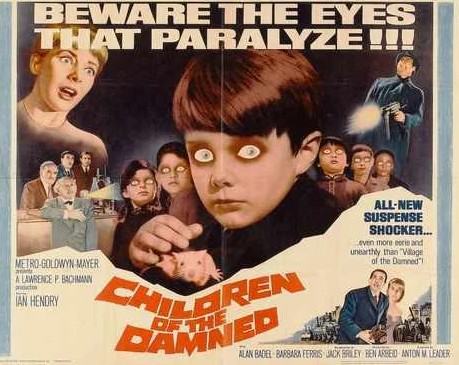
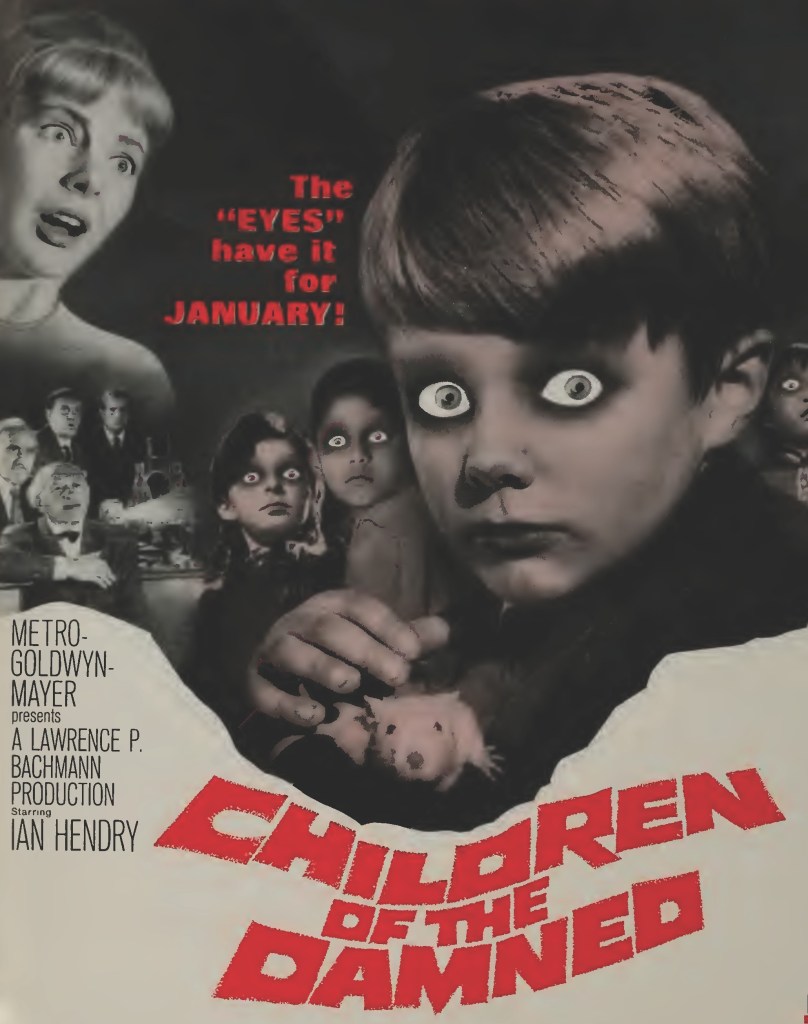
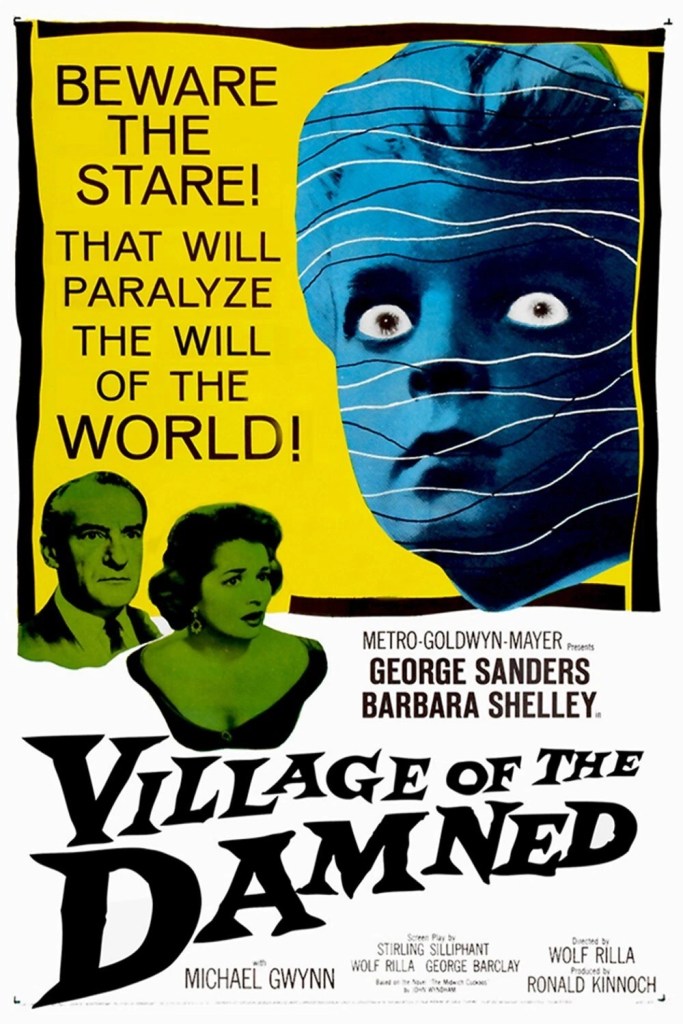
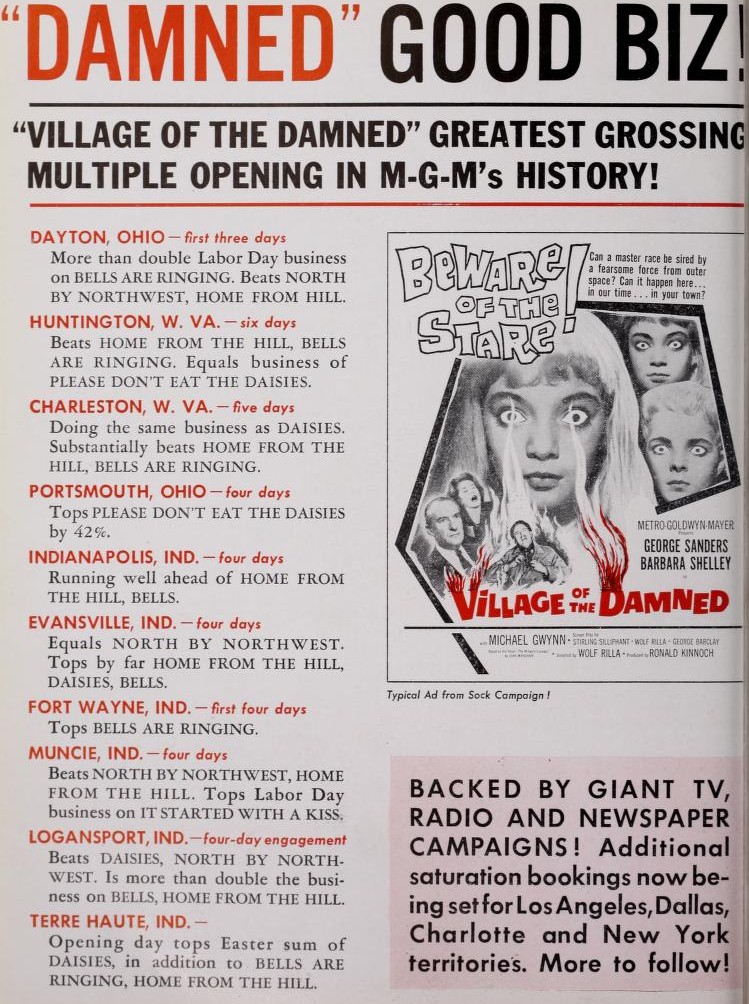
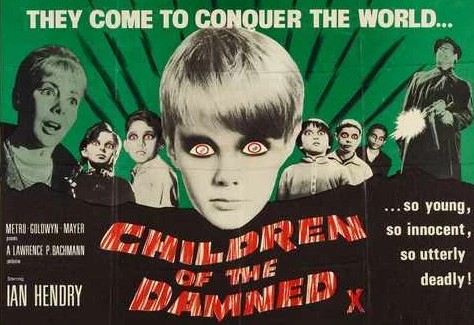
The idea that scientists for experimental reasons might welcome radiation was not a notion easily embraced. The Damned (not to be confused with the earlier Village of the Damned, 1960, and later Children of the Damned, 1964, or, for that matter, Luchino Visconti’s The Damned in 1969) presents a more ruthless scientific approach than audiences might expect.
Three tales eventually dovetail. In a very contemporary nod to English society, tearaways known as “teddy boys” terrorise a seaside town. Led by the snappily-dressed umbrella-wielding King (Oliver Reed) when not causing general mayhem they take pleasure in beating up any male who happens to be enticed by his glamorous sister Joan (Shirley Anne Field). One such unfortunate is Simon (MacDonald Carey), an American tired of the rat race. Joan decides she has had enough of being used as sexual bait and boards Simon’s yacht to apologise, at which point unlikely romance ensues. Not that romantic initially, as Simon assumes she is easy pickings, and comes on a shade too strong. Her thwarted brother sends his gang to spy on the couple.
Scientist Bernard (Alexander Knox) welcomes the arrival of his sculptor girlfriend Freya (Viveca Lindfors) who has a studio in a cottage on the cliffs. Underneath the cliffs is a secret project involving a group of obedient 11-year-old children who appear to have lived there from birth, with whom Bernard communicates via closed circuit television.
Joan and Simon enjoy an evening idyll in the empty cottage until chased out by the gang. Escape leads them down the cliffside where the children offer them a hiding place. The kids think Joan and Simon are their parents coming to the rescue. They believe they are on a spaceship headed to planets unknown. They are as baffled that the incomers have warm skin as the escapees that they have cold skin. Eventually, they are joined by King, rescued from drowning by one of the children.
Eventually, too, all are trapped by Bernard and his men. King, with his violent skills honed, is able to take on the guards and fashion an escape. Bernard allows the couple to leave on Simon’s yacht, knowing they will die of radiation poisoning before too long, a helicopter hovering overhead should they decide to land anywhere.
When Freya discovers the truth, Bernard kills her. The children lived through a radiation leak and are being groomed by Bernard to survive the inevitable future nuclear war in the hope, presumably, that they might breed and create a generation invulnerable to radiation. All that upsets the scientist of this incident is that the children now know they are prisoners.
Small wonder Hammer didn’t know what to do with such downbeat fare. Ruthless scientists like Bernard were usually put in their place by intrepid civilians like Simon and Joan or outsiders like King. The imprisoned always escaped. Humans, never mind children, were not treated as lab rats. A more cynical contemporary audience would not be remotely surprised at the conspiracies of scientists and governments.
If you think The Wicker Man (1973) took an age to achieve cultdom, this took forever, in part because of the later artistic recognition of director Joseph Losey, this scarcely fitting into an oeuvre that contained The Servant (1964) and The Go-Between (1971). Recognition was negated by poor initial distribution, the American version heavily edited, and it wasn’t really until this century that its worth was vindicated.
It’s a brilliantly bold construct, especially as, in retrospect, other characters are imprisoned one way or another. King scarcely lets Joan out of his sight, and while forcing her to strut her stuff to entice men that he can mug is revulsed at the notion of her embracing another man. Freya, too, although she doesn’t realise it, can only enjoy a relationship with Bernard in which he has complete control. The teddy boys, who think they can wreak havoc, are easy pickings for the might of the military.
Some scenes are just superb. Joan picking up Simon. King’s relish of violence. Bernard in avuncular tones addressing the children, who could all be in the running for cute Disney roles. Joan’s shock at the coldness of the children. The children’s innate obedience turning to rebellion at their betrayal. A camera tracking a room to the sound of heavy footsteps, those revealed to belong to a man in a Hazchem outfit. Bernard’s cold-blooded elimination of his lover. Finally, the cries of the children too distant to be heard by tourists on a beach.
Oliver Reed (Hannibal Brooks, 1968), working hard on his steely stare and his breathless tones, is the pick here, but Alexander Knox (Accident, 1967) runs him close. Sultry-eyed Shirley Anne Field (Saturday Night and Sunday Morning, 1960) does better than B-film regular MacDonald Carey who appears out of his acting depth.