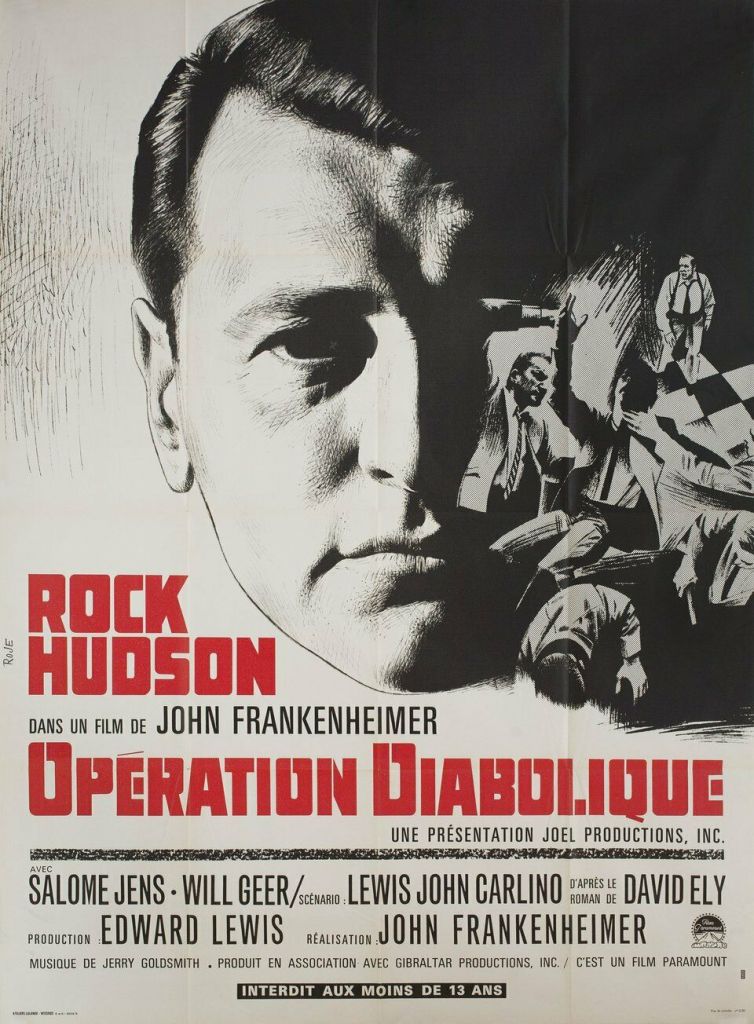
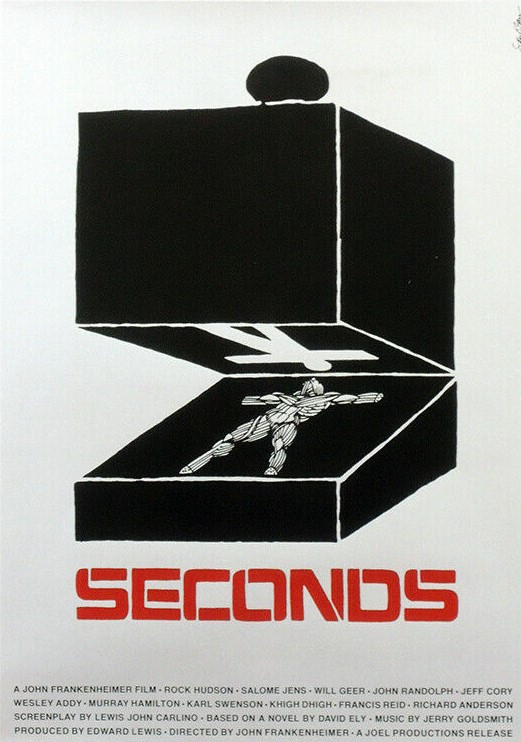
Seconds (1966) *****

John Frankenheimer’s censor-baiting and game-changing paranoia drama was decades ahead of its time – it created the template for Blade Runner (1982), The Swimmer (1968), The Stepford Wives (1975), The Parallax View (1974) and The Truman Show (1998) to mention just a few –  and underneath the sci-fi surface asked deeper questions about identity, reality and depression. And it might well qualify as reaching for the impossible dream. Kafkaesque aspects intrude. It’s as much an essay on hopelessness as it is on hope, a scorching portrayal of the human condition. Unusual camera angles and depth of field make this a visual, if occasionally challenging, delight.

Disillusioned banker Arthur (John Randolph), marriage off-kilter, reacting to a call from someone he believes is dead, gets hooked into a deal which promises rebirth. After plastic surgery and a faked death, he is reborn as a much more handsome figure (Rock Hudson), pursues a new career as an artist, is sexually re-born during an orgy, but finds memories of his old life resurfacing at  inopportune moments and takes against the notion that he has to recruit friends or colleagues to go through the same process.

Although audiences had been treated to some paranoid impulses like The Manchurian Candidate (1962) and films dealing with mental health such as Lilith (1964), this was the first film to touch on paranoia about big business, the unseen conglomerates controlling lives in unseen ways that directors in the 1970s pounced upon. Although a piece of breakthrough technology, the rebirth business is now just that, a business, wherein an anonymous  corporation, known here only as The Company, seeks to maximize profit from human misery.  

You could almost view the men who had more successfully undergone the experiment than Arthur as Stepford Husbands, guys who had created an ideal version of themselves. They could be body snatchers who have stolen a more convenient body. In another respect, the conventional Arthur turns into the rebel in society, refusing to accept this new creed. And he is gullible enough to believe his employers will accommodate his demands.   

On the one hand it is a self-destructive horror story. Arthur willingly gives in to his desire for a better life regardless of the emotional cost and is somewhat surprised to find that the community in which he lives is a construct, almost as fictional as any computer game.

It is an amazing mixture of sci-fi and horror. But the sci-fi has the bleakness of Blade Runner,  the hospital and offices where the future unfolds are drab, while the beach locations have an uncanny unreality. The horror is for the most part confined to two scenes – the new Arthur waking up swathed in bandages and later, strapped to a gurney, realizing too late his destiny.

But mostly what I found resonating was the examination of male psyche and its inability to deal with adversity and depression. Arthur isn’t so much desperate to wake up as a handsome hunk as to enter a new existence where he does not feel so lonely and displaced, where he can discover the humanity he has lost. It is not that he wants to be absolved of all responsibilities but wishes to be free of his current joyless life. While he becomes an improved physical specimen, he finds to his consternation that he has not shaken off the gloominess lurking in his brain.

The futuristic aspects are compounded by brilliant down-to-earth scenes. Company executive Ruby (Jeff Corey) goes into all the details of their contract while eating a chicken dinner, an old friend Charlie (Murray Hamilton) is deskbound, when Arthur arranges in his new skin to meet wife Emily (Frances Reid) he discovers his old true self had been only too apparent, cursed with unspoken longing and divorced from reality. Even romance with the outgoing Nora (Salome Jens) only offers brief reinvigoration after he partakes in an orgiastic grape-stomping event.

This is Frankenheimer’s masterpiece, and given he also directed The Manchurian Candidate, that is some accomplishment. He exercises total control in a film about total control but he is indebted to cinematographer James Wong Howe for developing new techniques to achieve a quite different, often austere, look.

It incurred the wrath of the Production Code – the U.S. censor – with scenes of full-frontal female nudity. These were all cut (though you will find them on the DVD). Whether their inclusion would have turned the film into a hit – rather than being booed at the Cannes Film Festival and a big flop at the American box office – is a moot point since, at that time, films as obscure as Blow Up (1966) had attracted big audiences due their more permissive approach. This should have been a late career transition for Rock Hudson (Strange Bedfellows, 1965) into more mature work but his excellent and brave performance was dismissed by the critics.

Book Into Film – “The Devil Rides Out”/ “The Devil’s Bride” (1968)

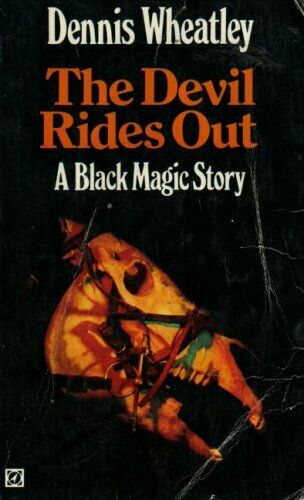
Dennis Wheatley was a prolific bestseller producing three or four titles a year, famous for a historical series set around Napoleonic times, another at the start of the Second World War and a third featuring the “four modern musketeers” that spanned a couple of decades. In addition, he had gained notoriety for books about black magic, which often involved series characters, as well as sundry tales like The Lost Continent.  Although largely out of fashion these days, Wheatley set the tone for brisk thrillers, stories that took place over a short period of time and in which the heroes tumbled from one peril to another. In other words, he created the template for thriller writers like Alistair MacLean and Lee Child.

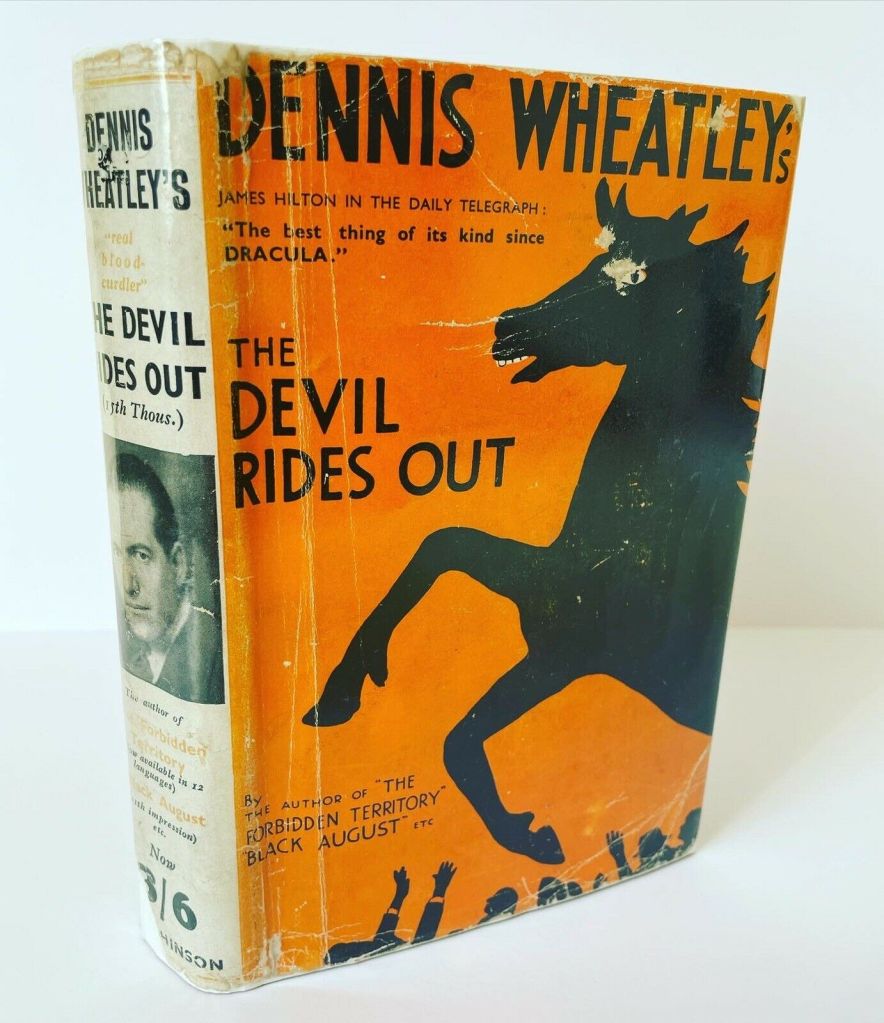
The Devil Rides Out, his fourth novel, published in 1934, featured the “musketeers” involved in his phenomenally successful debut The Forbidden Territory (1933), and introduced readers to his interest in the occult. Although of differing temperaments and backgrounds his quartet – the Russian-born Duke De Richleau (Christopher Lee in the film), American aviator Rex Van Ryn (Leon Greene) and wealthy Englishmen Richard Eaton (Paul Eddington) and Simon Aron (Patrick Mower) – are intrepid. And while screenwriter Richard Matheson stuck pretty much to the core of the Wheatley story, the film was hampered by the actors. The laid-back Paul Eddington hardly connects with the Wheatley characterization and Patrick Mower is too young for Aron.

Original British hardback cover.

As with the book, the story moves swiftly. Worried that   Aron is dabbling in the black arts, De Richleau and Van Ryn go haring down to his country house where they meet black magic high priest Mocata (Charles Gray) and discover tools for satanic worship.  And soon they are embroiled in a duel of wits against Mocata, climaxing in creating a pentagram as a means of warding off evil.

In order not to lose the audience by blinding them with mumbo-jumbo the script takes only the bare bones of the tale, bringing in the occult only when pivotal to the story, and that’s something of a shame. A modern audience, which has grown up on enormously  complicated worlds such as those created for Game of Thrones and the MCU, would probably have welcomed a deeper insight into the occult. While out-and-out thrillers, Wheatley’s novels often contained copious historical information that he was able to dole out even when his heroes were in harm’s way. The Devil Rides Out is not a massive tome so it’s a measure of the author’s skill that he manages to include not just a condensed history of the occult but its inner workings. Every time in the film De Richleau goes off to the British Library for some vital information, his departure generally leaves a hole, since what he returns with does not always seem important enough to justify his absence.

Author Dennis Wheatley.

But then the screenwriter was under far more pressure than a novelist. In some respects, this book like few others demonstrates the difference between writing for the screen and writing for a reader. With just 95 minutes at his disposal, Matheson had no time to spare while Wheatley had all the time in the world. Wheatley could happily leave the reader dangling with a hero in peril while dispatching De Richleau on a fact-finding mission, the action held up until his return. It’s interesting that Matheson chose to follow Wheatley’s characterization of De Richleau, who didn’t know everything but knew where to look. Matheson could easily have chosen to make De Richleau all-knowing and thus able to spout a ton of information without ever going off-screen.

But here’s where the book scores over the film. The reader would happily grant Wheatley his apparent self-indulgence because in the book what he imparted on his return, given the leeway to do so, was so fascinating. There are lengthy sections in the book which are history lessons where De Richleau supplies readers with the inside track on the satanic. In the opening section, once De Richleau and Van Ryn have rescued Aron, the author devotes a full seven pages to a brief introduction to the occult that leaves the reader more likely to want more of that than to find out how the story will evolve.   He has hit on a magic formula that few authors ever approach. To have your background every bit as interesting as the main story is incredibly rare and it allowed Wheatley the opportunity to break off from the narrative to tell the reader more about the occult, which in turn, raised the stakes for the characters involved.

Effectively, there was too much material for a screenwriter to inflict upon an audience ignorant of the occult. Some decisions were clearly made to limit the need for lengthy exposition. But these often work against the film. For example, Mocata wants the Talisman of Set because it bestows unlimited power with which he can start a world war, but in order to accomplish that he needs to find people with the correct astrological births, namely Simon and Tanith. But this element is eliminated from the story, making Mocata’s motivation merely revenge.  Matheson also removed much of the historical and political background, replaced the swastika as a religious symbol with the more acceptable Christian cross, and deleted references to Marie’s Russian background. Her daughter Fleur becomes Peggy. Matheson also treats some of the esoteric light-heartedly on the assumption that seriousness might be too off-putting.

Overall, the adaptation works, you can hardly argue with the movie’s stature as a Hammer classic, but the more you delve into the book the more you wish there had been a way for much of the material to find its way onscreen and to inform the picture in much the same way as the depth of history and character backstory adds to Game of Thrones.

https://www.amazon.co.uk/The-Devil-Rides-Out/dp/B00B1U3FPK/ref=sr_1_1?keywords=devil+rides+out&qid=1637411453&qsid=257-2054786-9327728&s=books&sr=1-1&sres=1448213002%2CB00I628KRY%2CB002SQ7XSG%2C0553824635%2CB00I60ZHNG%2CB09KH2QQVL%2CB00CJB9CVQ%2CB0018H7LPG%2CB07VQ8RZBJ%2CB003Z0IJKA%2C912409160X%2CB07N94V4ZM%2C0241476178%2C1734704144%2C0571311458%2CB092RHPZ93&srpt=DOWNLOADABLE_MOVIE

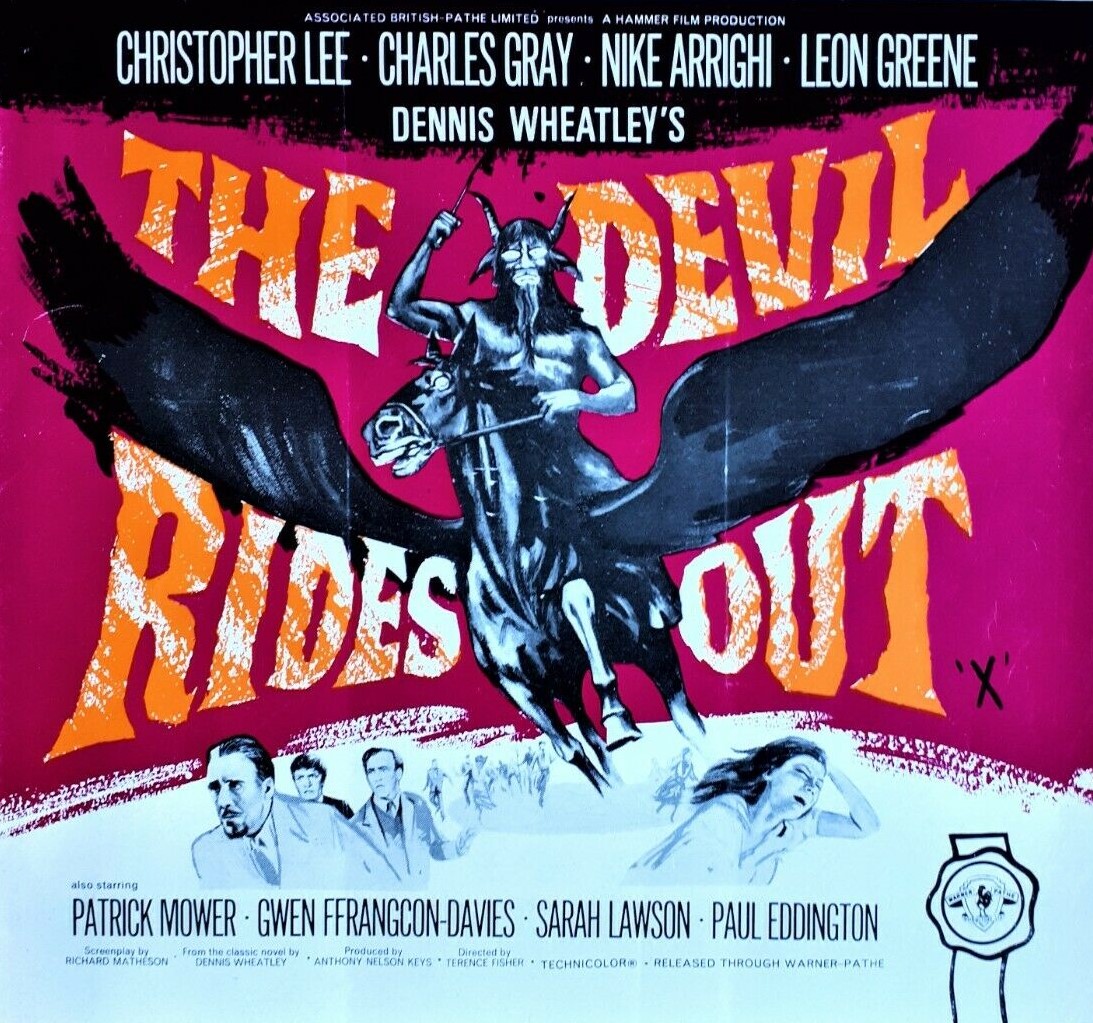
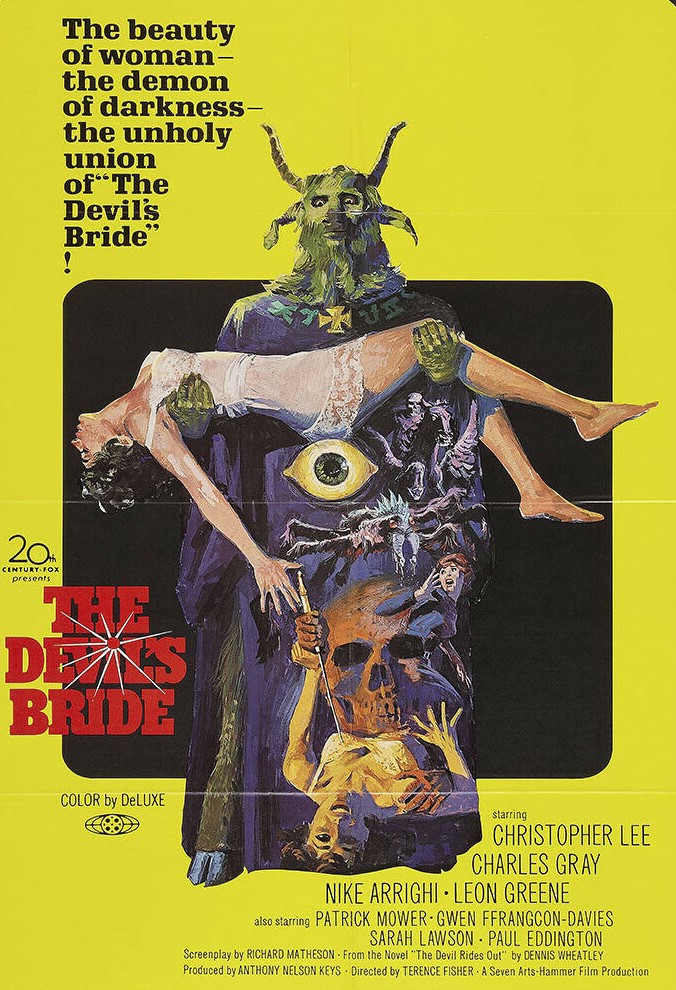
The Devil Rides Out / The Devil’s Bride (1968) ****

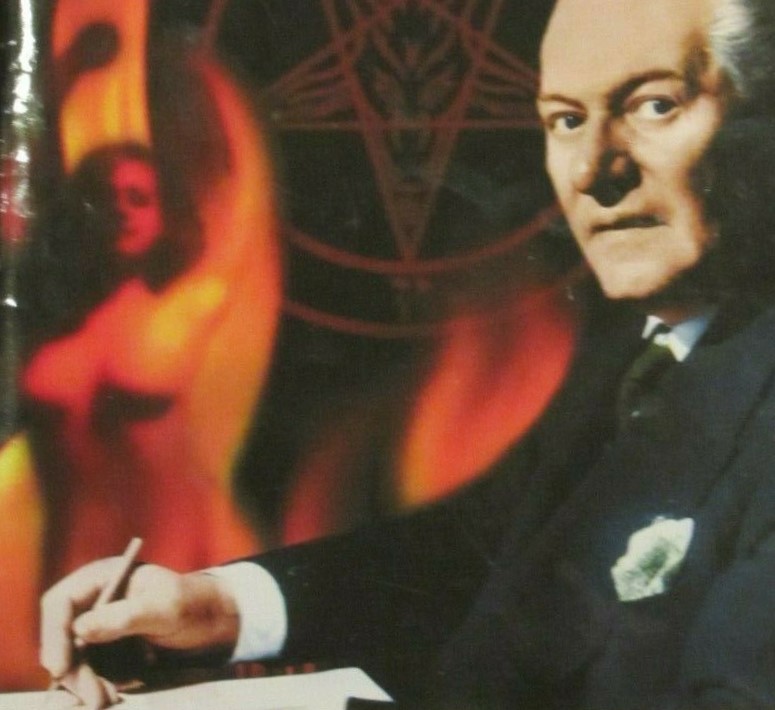
Strong contender for Hammer’s film of the decade, a tight adaptation of Dennis Wheatley’s black magic classic with some brilliant set pieces as Nicholas de Richleau (Christopher Lee) battles to prevent his friend Simon (Patrick Mower) falling into the hands of satanist Mocata (Charles Gray).

Initially constructed like a thriller with Simon rescued, then kidnapped, then rescued again, plus a car chase, it then turns into a siege as Richleau and friends, huddled inside a pentagram, attempt to withstand the forces of evil. Sensibly, the script eschews too much mumbo-jumbo – although modern audiences accustomed to arcane exposition through MCU should find no problem accommodating ideas like the Clavicle of Solomon, Talisman of Set and Ipsissimus – in favour of confrontation.  

The title was changed for American audiences.

Unlike most demonic pictures, de Richleau has an array of mystical weaponry and a fund of knowledge to defend his charges so the storyline develops along more interesting lines than the usual notion of innocents drawn into a dark world. In some senses Mocata is a template for the Marvel super-villains with powers beyond human understanding and the same contempt for his victims. And surely this is where Marvel’s creative backroom alighted when it wanted to turn back time. Though with different aims, De Richleau and Mocata are cut from the same cloth, belonging to a world where rites and incantations hold sway.  

While special effects play their part from giant menacing tarantulas and the Angel of Death, the most effective scenes rely on a lot less – Simon strangled by a crucifix, Mocata hypnotizing a woman, a bound girl struggling against possession. Had the film been made a few years later, when Hammer with The Vampire Lovers (1970) and Lust for a Vampire (1971) increased the nudity quotient, and after The Exorcist (1973) had led the way in big bucks special effects, the black mass sequence would have been considerably improved.

The main flaw is the need to stick with the author’s quartet of “modern musketeers” which means the story stretches too far in the wrong directions often at the cost of minimizing the input of De Richleau. In the Wheatley original, the four men are all intrepid, but in the film only two – De Richleau and American aviator Rex van Ryn (Leon Greene) – share those characteristics. At critical points in the narrative, De Richleau just disappears, off to complete his studies into black magic. Where The Exorcist, for example, found in scholarship a cinematic correlative, this does not try.

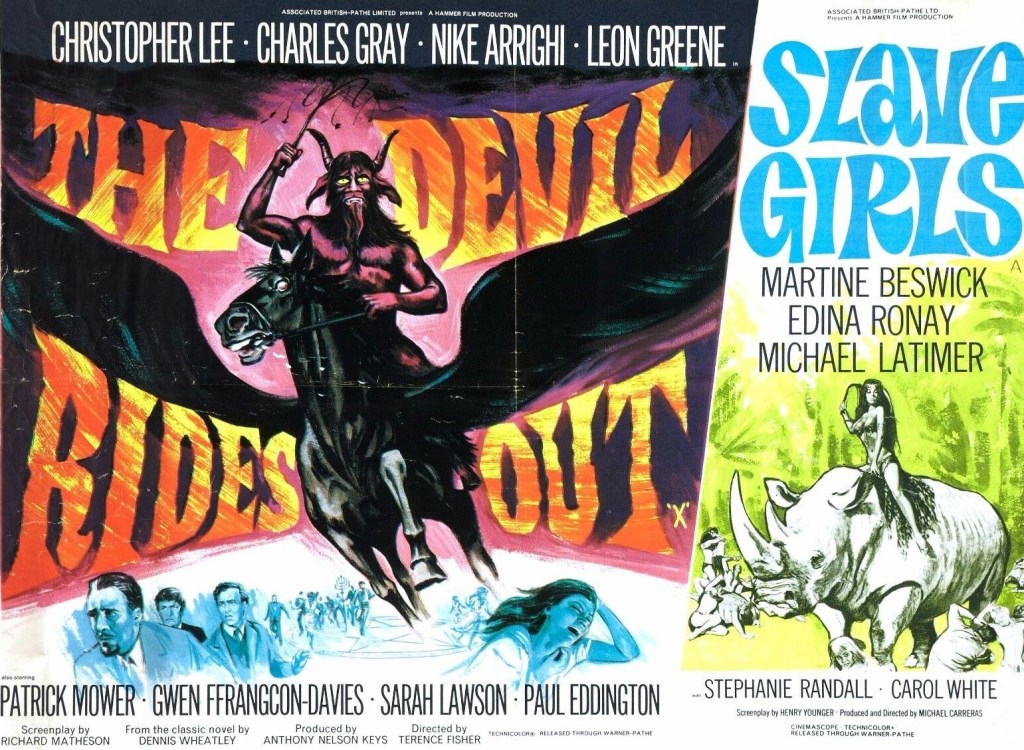
In Britain it was double-billed on the ABC circuit with Slave Girls.

Christopher Lee (She, 1965), pomp reined in, is outstanding as De Richleau, exuding wisdom while fearful of the consequences of dabbling in black magic, both commanding and chilling. Charles Gray (Masquerade, 1965) is in his element, the calm eloquent charming menace he brings to the role providing him with a template for future villains.  The three other “musketeers” are less effective, Patrick Mower in his movie debut does not quite deliver while Leon Greene (A Challenge for Robin Hood, 1967) and Paul Eddington (BBC television’s Yes, Minister 1980-1984) are miscast. Nike Arrighi, also making her debut as love interest Tanith, is an unusual Hammer damsel-in-distress.

Hammer stalwart Terence Fisher (The Gorgon, 1964) creates a finely-nuanced production, incorporating the grand guignol and the psychological.  Richard Matheson (The Raven, 1963) retains the Wheatley essence while keeping the plot moving.

Catch-Up: far from ubiquitous and with a wide range of roles Christopher Lee has appeared several times in the Blog – for Sherlock Holmes and the Deadly Necklace (1962), The Whip and the Body (1963), The Devil-Ship Pirates (1964), The Gorgon (1964), She (1965), The Skull (1965), The Brides of Fu Manchu (1966), Five Golden Dragons (1967), The Curse of the Crimson Altar / The Crimson Cult (1968) and The Oblong Box (1969).

Last night in Soho (2021) ** – Seen at the Cinema

Genre mish-mash – sci-fi time travel time (sort of) and horror – just doesn’t come off and Anya Taylor-Joy blows the acting kudos she acquired for the Queen’s Gambit Netflix series. Honestly, we don’t care how people are transported to the past or the future but the journey has to be somehow worthwhile. If there is a such a thing for a fashion student, Eloise (Tomasin McKenzie) is somewhat on the nerdy side and when she ends up in an attic flat near London’s Soho she begins to inhabit the body of wannabe singer Sandie (Anya Taylor-Joy) whose ambitions over half a century previously took her no further than the seediest pockets of seedy crime. Eloise’s visions of recreating 1960s glamour disintegrate and she’s soon slap-bang in the middle of a horror story with leering men bursting out of the walls.

It’s always difficult to keep focus on two storylines, even when they appear to converge, but when they are over half a century apart the constant jumping back and forth is just irritating. The seediness is realistic enough, punter response to learning Sandie’s real or fake name is invariably “that’s a nice name.”  There’s a dodgy boyfriend (Matt Smith), mean girl (Synnove Karlsen) and an odd landlady (Diana Rigg) and that’s about as far as this stretches in terms of characterization. And if your bag is to spot the old-timer, then you will get glimpses of Terence Stamp (The Collector, 1963) and Rita Tushingham (The Knack, 1965) not to mention The Avengers (BBC, 1965-1968) television series reincarnation Rigg.

It’s not scary enough, fashionable enough, seedy enough, or 1960s enough – only a token nod to the period with a soundtrack from the decade and a few scenes with characters in the correct clobber or cars. It might just have worked if it had been the one actress playing both female parts because that at least might have been interesting to observe. Thomasin McKenzie (Old, 2021) is passable as the naïve young thing called upon to mostly look petrified. Anya Taylor-Joy (The New Mutants, 2020) brings nothing to a role that is just a cliché. Point the finger at Edgar Wright, whose Baby Driver (2017) I thought was a sign of him having turned a corner from previous misfires.

The Whip and the Body / The Whip and the Flesh / What? (1963) ****

Has there ever been actress so skilled at displaying fear as Daliah Lavi? Where the female stars of horror movies too quickly succumbed to the scream and goggle eyes, Lavi could run a whole gamut of terror without uttering a sound and continue doing so for virtually an entire picture. Top-billed ahead of the reigning king of British horror Christopher Lee, this is another acting tour de force, not quite sustaining the intensity of The Demon (1963) but at times not far off it.

Italian director Mario Bava (Black Sabbath, 1963), here masquerading as John M. Old, has stitched together a mixture of horror and an early form of giallo, the picture taking place in the classic old dark house, in this case a castle perched on a rock above the sea, the deaths grisly, and almost fitting into the “locked room” subgenre of the detective story, where the murders appear impossible to carry out.

Originally released as The Whip and the Body, it underwent some title changes, first to The Whip and the Flesh, the German title translated as The Devil and the Young Woman and while in the U.S. it was shown as What?

The disgraced Kurt Menliff (Christopher Lee) returns to his ancestral home, begging forgiveness from his father Count Vladimir (Gustavo De Nardo) and hoping to reclaim his inheritance and his betrothed Nevenka (Daliah Lavi). While his father exonerates him, Kurt is denied the rest, Nevenka already committed to marriage to his brother Christian (Tony Kendall). Other tensions are soon evident: the housekeeper Giorgia wants revenge on Kurt for the death of her daughter and Christian is in love with another, Katia (Evelyn Stewart).

Nevenka who outwardly protests how much she hates Kurt quickly reveals masochistic tendencies as she gives in to a whipping. But Kurt’s sudden inexplicable murder instigates an investigation, suspicion falling firstly on the father, then Christian and finally Giorgia.

But Nevenka is not convinced Kurt is dead, although his body has been entombed in the castle crypt. Torment creeps into her face at his funeral and we can almost see her grow gaunt in front of our eyes. In a brilliant scene where she tracks what she imagines to be the sound of whip it turns out to be a branch lashing a window in a storm. Some of her supposed visions are easily explained, muddy footsteps leading from Kurt’s tomb actually belonging to the limping manservant Losat (Luciano Pigozzi). But how do you account for the hand, in an almost 3D shape, reaching out to her in the darkness or her ecstasy in still being whipped, her nightdress stripped from her back?

Although sometimes relying too heavily on atmospherics – windows swinging open at night, storm outside – Bava brilliantly marshals the real and the imagined, until the investigation into murder involves all the characters. Once the film begins, the drawbridge in a sense comes down, and nobody else enters the castle, and so we move from one character to another, each with their own motive for possibly committing dire deed. And with each passing moment we return to the demented Nevenka, who wishes Kurt dead but cannot live without him, and, craving the whip, cannot escape his sadistic power. Her faith in Kurt’s resurrection is so intense that the others are soon seeking signs that the dead man is still alive.

This is superior horror to Hammer. Using the same leading man, the British studio generally expected Lee to be over-the-top, his innate malevolence very obvious from the start. Here, he is at his most handsome and although definitely sadistic, the emphasis is less on his pleasure than that of his victim. And while Bava resorts to a similar kind of Hammer set, this castle is remote, has no relationship with villagers, and exudes regal dominance rather than just the normal fear of a Dracula picture. Bava employs a more subtle color palette and the piano theme tune by Carlo Rusticelli has a romantic tone.

But for all Bava’s proven skill, this would not be the same without Lavi. I doubt if there is a single actress in the horror domain throughout the 1960s who could match the actress for portraying fright, as she marches up the scale from mere anxiety to full-blown terror. And although women in Dracula movies succumbed to vampire teeth with more than a frisson of sexuality, there is a different deeper sensuality at work here, in what must rank as one of the greatest-ever portrayals of masochism embedded in love.

As noted previously, Lavi, in stepping onto the bigger Hollywood stage of Lord Jim (1965) and The Silencers (1966), lost the intensity she displayed here and never came close to matching this performance or that of The Demon. Christopher Lee, although claiming to dislike his experience, continued to rule the horror world until afforded a wider audience through James Bond, Star Wars, J.R.R. Tolkien and Tim Burton. 

Tony Kendall made his debut and soon graduated to the Kommissar X series, spaghetti westerns (he played Django twice), horror (Return of the Evil Dead, 1973), and thrillers such as Machine Gun McCain (1969). Evelyn Stewart went down much the same route, her long career sprinkled with gems like Django Shoots First (1966), The Sweet Body of Deborah (1968) and The Psychic (1977).

Mario Bava continued to exploit the horror vein including Blood and Black Lace (1964), Planet of the Vampires (1965) and Lisa and the Devil (1973) with Telly Savalas and Elke Sommer.

Censor (2021) ** – Seen at the Cinema

From video nasty to video laughty in one easy move. I was laughing out loud when the picture started to get nasty and I doubt this was the intention of director Prano Bailey Bond, making her movie debut. The movie is set in the uber-drab 1980s, where color was apparently in short supply, and all the characters inhabited offices or houses that appeared to belong to the black-and-white era.  The notion that iconic characters like Boy George, Madonna and Princess Diana might have been around at the same time is largely ignored in the bid to make every character flat and conformist.

In fairness, working in the British film censorship department was hardly likely to provide a bundle of laughs. As well as being as being as buttoned-down as they come, Enid (Niamh Algar) is also riddled with guilt since she was in charge of her younger sister when she went missing two decades previously. A chunk of the film is almost a spoof of The Office, with characters hidebound by officialdom.

And there are a few excellent set pieces. As with The Night House, the scenes that deal with grief, Enid’s parents finally coming to terms with their daughter’s disappearance, are very well done. The dialogue among the various censors, judging whether to reject movies or heavily edit them, rings very true and there is a terrific scene involving film-making where the director is kept off-camera while an actress is literally standing in the spotlight.

Tight-lipped Enid becomes obsessed with the idea that her sister is not only alive but actually an actress in a video nasty.  To that end, she tracks down smarmy producer Doug Smart (Michael Smiley). As I said, it may have been the director’s intention that Smart is killed by ironically managing to have an award statuette rammed down his throat, but I’m not so sure and at that point I began to lose faith in the picture. It goes on to a perfectly bonkers climax which had me in stitches, again not entirely a recommendation.

The Night House (2020) ** – Seen at the Cinema

An overloaded atmosphere cannot make up for the lack of directorial killer instinct, resulting in a ghost story that leans more towards the preposterous than horror.  Beth (Rebecca Hall), dealing with the suicide of her husband, begins to imagine a ghostly  presence in her remote house on a lake. Left a very odd suicide note, she pieces together stranger aspects of his life, involving the occult and a photo on his phone of a Beth lookalike.

The picture divides very neatly into the entirely believable grief of schoolteacher Beth – she nips at a moaning parent, knocks back the brandy, makes inappropriate comments to her workmates and displays sufficient off-the-wall tendencies to alarm pal Claire (Sarah Goldberg) – and the various tropes that need to be knitted together to take the story into the ghost/horror realm, few of which work. Mysterious footsteps, sometime muddy, sometimes bloody, appear, harmless neighbour Mel (Vondie Hall Curtis) is presented as potentially malevolent, and music suddenly blares out in the middle of the night.

Had the story remained entrenched in Beth’s imagination, where she almost willed her husband either to be still alive or enough of a presence (as in Ghost, 1990) that she could touch or be comforted by, and gradually either became subsumed by grief or came out of it, it might have worked very well. But the minute it started to delve into the area of the unbelievable it became largely unbelievable. Even when it is obvious her husband is not at all what he once seemed, the picture just ignores the obvious.

And that is a shame. Even more so than Stillwater, reviewed last week, this is a thespian tour-de-force. Beth is scarcely off the screen and her ever-changing mood displays terrific acting skills. But just like Stillwater, it loses its way, going for plot instead of character, and the film cannot make up its mind whether she is going mad, or just mad with grief, or whether she is victim to unseen predator. There was only one genuine jump-out-of-your-seat shock and the introduction late on of elements of her backstory served to confuse rather than elucidate.

Rebecca Hall (Godzilla vs. Kong, 2021) can certainly hold the screen and hopefully this will lead to better roles in bigger films. None of the other actors are particularly noteworthy. Director David Bruckner (Netflix’s The Ritual, 2017) seems to be focusing on horror – Hellraiser is next – but whether he needs a bigger budget or a better script to scare the pants off an audience remains to be seen. Writers Ben Collins and Luke Piotrowski (Stephanie, 2017) also appear to be specialising in this genre.

Old (2021) *** – Seen at the Cinema

Surely no director has cut his cloth according to his means more than M. Night Shyamalen. After a series of big-budget failures, he returned with a series of low-budget numbers like The Visit (2015) and Split (2016) with a couple of forays into television to keep his hand in. And although his movies sometimes don’t work, usually from over-ambition, he is still a brand name and as a triple-hyphenate one of the few working directors to completely control his output.

So the starting point is you don’t know what you’re going to get, except there will be twists and occasional shocks along the way. Even the Glass films aren’t a trilogy in the accepted sense of the word. 

Old is a neat idea. A group of strangers on vacation end up on a strange beach where time moves along at quite a clip and they can’t escape. Most of the action involves the characters responding to one calamity after another and despite a couple of gruesome moments Shyamalan seems intent on swapping jump-out-of-your-seat moments for a continual slow burn. He takes the disaster trope of who’s gonna die next – the bad old guy or the cute younger person – and inverts it until nothing makes any sense except impending apocalypse, at least for all stranded in this apparent paradise.

Speeded-up life makes for speeded-up dread. While wounds heal in seconds and pregnancy might last, oh, a half hour or so, the malfunctioning body malfunctions at lightspeed.

The great thing about Shyamalan is he is a writer first so the characters here are all very well drawn. He gives a geeky kid the geekiest of all character traits, going up to everyone he meets to ask their name and job. But it’s an ensemble picture so nobody is more important than anybody else. And the characters bring along a hamper full of tensions – there’s an epileptic, a couple on the verge of divorce, a doctor on the verge of a breakdown. He also has a distinctive visual style, preferring to track the camera from one character to another rather than using cuts.

It slightly runs out of steam as the body count mounts and it might have been an idea to introduce the shock ending – which asks significant questions about the direction society is heading – a bit sooner

There’s a solid cast, good actors rather than A-list stars, a bundle of whom are best-known for television. Gael Garcia Bernal (The Motorcycle Diaries, 2004) takes pole position in the credits, supported by Rufus Sewell (The Man in the High Castle television series, 2015-2019), Luxembourg actress Vicky Krieps (Das Boot, 2018- 2020), Ken Leung (Lost, 2008-2010), and Abbey Lee (Lux Aeterna, 2019).  Scions of Hollywood royalty get a leg-up here – Francesca Eastwood being the daughter of Clint and Alexa Swinton cousin to Tilda – and there are cameos from the likes of Embeth Davidtz (Schindler’s List, 1993)

Otherwise it’s a decent addition to the Shyamalen oeuvre, enough at least to keep him chugging along until he gets the next big idea or budget. While the chances of him alighting on another Sixth Sense (1999) or Unbreakable (2000) might appear remote bear in mind the guy has barely passed 50, an age when top directors are just coming into their prime – Hitchcock was a few years older when he hit the hot streak of Rear Window, Vertigo and North by Northwest.

There’s a fair chance the ending is uncomfortably close to science fact rather than fiction and if Shyamalan can activate social media along those lines the picture could build up enough of a head of steam to bring the director back into the big-budget Hollywood fold or ensure at least that he is never cast aside.

Saw this at the cinema as part of my Monday double bill. – but on the previous week to Suicide Squad/Jungle Cruise.

Readers’ Top 30

I’ve been writing this Blog now for one year, beginning July 2020, so I thought I’d take a look at which posts proved the most popular (in terms of views) with my readers. So here’s the annual top 30 films, ranked in order of views.

  1. The Secret Ways (1961) – Richard Widmark and Senta Berger – making her Hollywood debut – behind the Iron Curtain in gripping adaptation of the Alistair Maclean thriller.
  2. Ocean’s 11 (1960) – Frank Sinatra, Dean Martin, Sammy Davis Jr. and the Rat Pack in entertaining heist movie set in Las Vegas.
  3. It’s Not All Rock’n’Roll (2020) – remarkable documentary about the other side of the music business as ageing rocker Dave Doughman tries to keep his dreams alive.
  4. Age of Consent (1969) – British actress Helen Mirren makes her movie debut as the often naked muse for painter James Mason in touching drama directed by Michael Powell.
  5. The Venetian Affair (1966) – Robert Vaughn shakes off his The Man from Uncle persona in taut Cold War thriller also starring Elke Sommer as his traitorous wife and Boris Karloff in a rare non-horror role.
  6. The Golden Claws of the Cat Girl / La Louve Solitaire (1968) – French cult thriller starring Daniele Gaubert as sexy cat burglar forced to work for the government.
  7. Pharoah / Faron (1966) – visually stunning Polish epic about the struggle for power in ancient Egypt.
  8. The Swimmer (1968) – astonishing performance by Burt Lancaster as a man losing his grip on the American Dream.
  9. Stiletto (1969) – Mafia thriller with hitman Alex Cord and and illegal immigrant girlfriend Britt Ekland hunted by ruthless cop Patrick O’Neal.
  10. The Naked Runner (1967) – after his son is taken hostage businessman Frank Sinatra is called out of retirement to perform an assassination.
  11. Marnie (1964) – Sean Connery tries to reform compulsive thief Tippi Hedren in Alfred Hitchcock thriller.
  12. Our Man in Marrakesh / Bang! Bang! You’re Dead (1966) – Entertaining thriller sees Tony Randall and Senta Berger mixed up in United Nations plot involving the likes of Klaus Kinski and Herbert Lom.
  13. The Happening (1967) – Anthony Quinn locks horns with Faye Dunaway and a bunch of spoiled rich kids in kidnapping yarn.
  14. Dark of the Sun / The Mercenaries (1968) – Rod Taylor and Jim Brown head into the heart of darkness in war-torn Africa with a trainload of diamonds and refugees including Yvette Mimieux.
  15. The Guns of Navarone (1961) – men-on-a-mission Alistair Maclean World War Two epic with all-star cast including Gregory Peck, David Niven, Anthony Quinn, Anthony Quayle, Stanley Baker, Irene Papas, James Darren and Gia Scala.
  16. The Sicilian Clan (1969) – three generations of French tough guys – Jean Gabin, Lino Ventura and Alain Delon – clash in Mafia-led jewel heist.
  17. 4 for Texas (1963) – Frank Sinatra and Dean Martin as double-dealing businessmen in highly entertaining Robert Aldrich Rat Pack western starring Ursula Andress and Anita Ekberg.
  18. Five Golden Dragons (1967) – Innocent playboy Robert Cummings becomes enmeshed with international crime syndicate led by Christopher Lee, George Raft and Dan Duryea.
  19. Duel at Diablo (1966) – James Garner and Sidney Poitier team up to protect Bibi Andersson in Ralph Nelson western.
  20. Move Over Darling (1963) – after years marooned on a desert island Doris Day returns to find husband James Garner just married to Polly Bergen.
  21. Pressure Point (1962) – prison psychiatrist Sidney Poitier is forced to treat paranoid racist inmate Bobby Darin.
  22. Wonder Woman 84 (2020) – in one of the few films to get a cinematic screening during lockdown, Gal Gadot returns as mythical superhero to battle supervillain Kristen Wiig.
  23. Genghis Khan (1965) – Omar Sharif as the Mongol warrior who conquered most of the known world, tangling with rival Stephen Boyd and Chinese mandarin James Mason on the way.
  24. A Fever in the Blood (1961) – Warner Bros wannabes Efrem Zimbalist Jr, Angie Dickinson, Jack Kelly and veteran Don Ameche in tough political drama.
  25. The Prize (1963) – Paul Newman and Elke Sommer investigate murder in the middle of the annual Nobel Prize awards in Sweden.
  26. In Search of Gregory (1969) – wayward Julie Christie embarks on pursuit of Michael Sarrazin who may – or may not – be a figment of her imagination.
  27. Justine (1969) – Dirk Bogarde and Michael York become entangled in web woven by Anouk Aimee in corrupt pre-World War Two Middle East.
  28. The Girl on a Motorcycle (1968) – singer Marianne Faithful in a hymn to the open road and sexual freedom.
  29. Blindfold (1965) – psychiatrist Rock Hudson and dancer Claudia Cardinale in highly entertaining mystery thriller about missing scientists.
  30. Hammerhead (1968) – secret agent Vince Edwards and goofy Judy Geeson on the trail of evil mastermind Peter Vaughn.

My Five-Star Picks for the First Year of the Blog

It’s a been a fabulous year for watching the movies and my pictures of the year (the first full year of the Blog running from July to June, I hasten to add) make up an eclectic collection ranging from historical epics, dramas and westerns to horror, thrillers and comedy. Although this is my chosen decade, many of the films I was seeing for the first time so it was interesting to sometimes come at a film that had not necessarily received kind reviews and discover for one reason or another cinematic gems. There was no single reason why these pictures were chosen. Sometimes it was the performance, sometimes the direction, sometimes a combination of both.

The westerns I most enjoyed came from either ends of the decade – John Wayne and Rock Hudson in magnificent widescreen spectacle The Undefeated (1969) and Yul Brynner, Steve McQueen, Charles Bronson, James Coburn and the team in The Magnificent Seven (1960).

There was another ensemble all-star cast in J. Lee Thompson war film The Guns of Navarone (1961) one of the biggest hits of the decade with Gregory Peck, Anthony Quinn, David Niven, Stanley Baker et al.

Horror brought a couple of surprises in the shape of Daliah Lavi as the Italian peasant succumbing to The Demon (1963) and Peter Cushing menaced by The Skull (1965).

Not surprisingly perhaps Alfred Hitchcock headed the ranks of the five-star thrillers, but surprisingly to some, this was in the shape of Marnie (1964) with Sean Connery and Tippi Hedren rather than some of his decade’s more famous / infamous productions.  Heading the romantic thrillers was the terrifically twisty Blindfold (1965) with Rock Hudson and Claudia Cardinale teaming up to find a missing scientist. The Sicilian Clan (1969) proved to be a fine heist picture in its own right as well as a precursor to The Godfather with a topline French cast in Alain Delon, Lino Ventura and Jean Gabin.

Only one comedy made the five-star grade and what else would you expect from Billy Wilder’s Some Like It Hot (1959), slightly outside my chosen remit of films from the 1960s, but impossible to ignore the chance to see Marilyn Monroe, Tony Curtis and Jack Lemmon strutting their stuff on the big screen. For the same reason I had the opportunity to re-evaluate Ridley Scott’s Oscar-winning historical epic The Gladiator (2000) that gave Hollywood a new action hero in Russell Crowe. Stylish contemporary sci-fi chiller Possessor (2000), from Brandon Cronenberg,  was another one seen on the big screen, one of the few in this year of the pandemic.

Most people would certainly put Paul Newman as prisoner Cool Hand Luke (1967) in this elevated category but, to my surprise, I found several other dramas fitted the bill. The clever sexy love triangle Les Biches (1968) from French director Claude Chabrol made his name. Burt Lancaster turned in a superlative and under-rated performance in the heart-breaking The Swimmer (1968) about the loss of the American Dream. Rod Steiger, on the other hand, was a hair’s-breadth away from picking up an Oscar for his repressed turn as The Pawnbroker (1964).

Two films set in the Deep South also made the list – Marlon Brando in Arthur Penn’s depiction of racism in small-town America in The Chase (1966) with an amazing cast also featuring Jane Fonda and Robert Redford, and Michael Caine as a more than passable arrogant southerner in Otto Preminger’s Hurry Sundown (1967) opposite rising star Faye Dunaway. Dennis Hopper and Peter Fonda’s hymn to the freedom of the motorbike in Easy Rider (1969) turned into a tragic study of attitudes to non-conformity.

For only eighteen films out of a possible two hundred to make the cut indicates the high standards set, and I am looking forward to as many, if not more, brilliant films in the year to come.

Discover WordPress

A daily selection of the best content published on WordPress, collected for you by humans who love to read.

The Atavist Magazine

by Brian Hannan

WordPress.com News

The latest news on WordPress.com and the WordPress community.