Wild in the Streets (1968) ***

Far more prophetic than you would have ever thought possible in acknowledging the growing power of the young, the pandering of politicians to them, and the unexpected ability of youth to see through politicians and set their own agenda. Plus, Christopher Jones gives the kind of performance that had David Lean rushing to sign him up for Ryan’s Daughter  (1970).

It was prescient, too, of its time, not just the notion that the young could lead the way in opposition to political forces.   

And what top pop star has not believed they could harness their global following for the greater good – Live Aid the classic example – and once you’ve bedded your way through the known female universe and sampled every drug known to man there has to be something else that’s going to grab your attention. And, for once, a movie star makes a very credible pop star.

Max Frost (Christopher Jones), channelling his inner Jim Morrison, is on top of the world, a phenomenon, the biggest thing since Elvis and The Beatles. His rebellious streak emerges at an early age. And where other nutcases would torture animals or pull the legs off spiders or play with matches, he blows up the family car. But he’s something of a statistician and reacts to the notion that there are more young people than old people – 52 per cent of the population is under 25 – by writing a song about it, a song that turns into a protest that segues into a movement.

Aspiring politician Fergus (Hal Holbrook) thinks he can harness what he perceives as a dumb youngster with fans so dumb they will ape his every command. His vote-winning idea is to campaign on a platform of lowering the voting age from 21 to 18, not that revolutionary an idea since ever since American men were shipped off the Vietnam there had been similar calls along the lines of too young to vote but not too young to die.

Max pretends to back him but instead demands the voting age be reduced to 14. This being politics, there’s negotiation, and the compromise is reducing the age to 15. The ever-read Max has songs covering whatever age is agreed.

Bandmember Sally LeRoy (Diane Varsi) is elected and gets a law passed to lower the voting age. Fearing youth and somehow assuming Max will curb their worst excesses, older politicians support his bid for the Presidency (as you may know, anyone in the U.S. can become President even if they lack political experience) but once he gains power he turns on them and forces through a law making retirement compulsory at 30. And goes about, Heaven help us all, doing good, albeit with a dictatorial agenda.

But the fairly straightforward satire, puffed out with endless scenes of public demonstration, works very well, and not just because the power of youth is demonstrated everywhere today, not least among Hollywood mavens who seem unable to make anything that doesn’t appeal to that age group, but because the brain behind the scheme are actually pretty smart. The group is presented as  clever all round, their excessive income down to the business acumen of Billy (Kevin Coughlin) so the band have no chance of ending up penniless, ripped off by everyone in sight. Sally is a former child star so she’s been taken advantage of already and ain’t going to let it happen again.  There’s a clever sting in the tale that takes the campaign to its logical conclusion.

It’s great fun seeing grizzled politicians being outsmarted by Max and his cohorts and for the older population to, unwittingly, get a taste (no pun intended) of what it’s like to be young. Audiences went for this in a big way since it presented an alternative universe, part sci-fi but also with some imminently achievable aims, some of which came to fruition. Hollywood was brought to heel the following year after Easy Rider, only in retrospect anyone realizing that the rescue from box office oblivion of 2001: A Space Odyssey (1968) by spaced-out hippies was a turning point not a one-off.  The voting age was lowered a couple of years later.  These days, of course, nobody needs elected or has to pass a law for changes to be made, and far quicker than if they had to go through the political process. Developments nobody voted for have been forced through by the court of public opinion, though sometimes by the very minorities that were once outside the existing power base.

Christopher Jones (Three in the Attic, 1968) delivers his best performance in what turned out to be a very short career. Shelley Winters (A House Is Not a Home, 1964) gives another scene-stealing turn and on back-up are Hal Holbrook (All the President’s Men, 1976) , in only his second movie, Diane Varsi in her biggest role to date, Millie Perkins (The Diary of Anne Frank, 1959) and an early showing from Richard Pryor.

Barry Shear (The Karate Killers, 1967) directed from a screenplay by Robert Thom (Death Race 2000, 1975).

You could probably go through this ticking off what predictions have come true and it’s more powerful now than it was at the time.
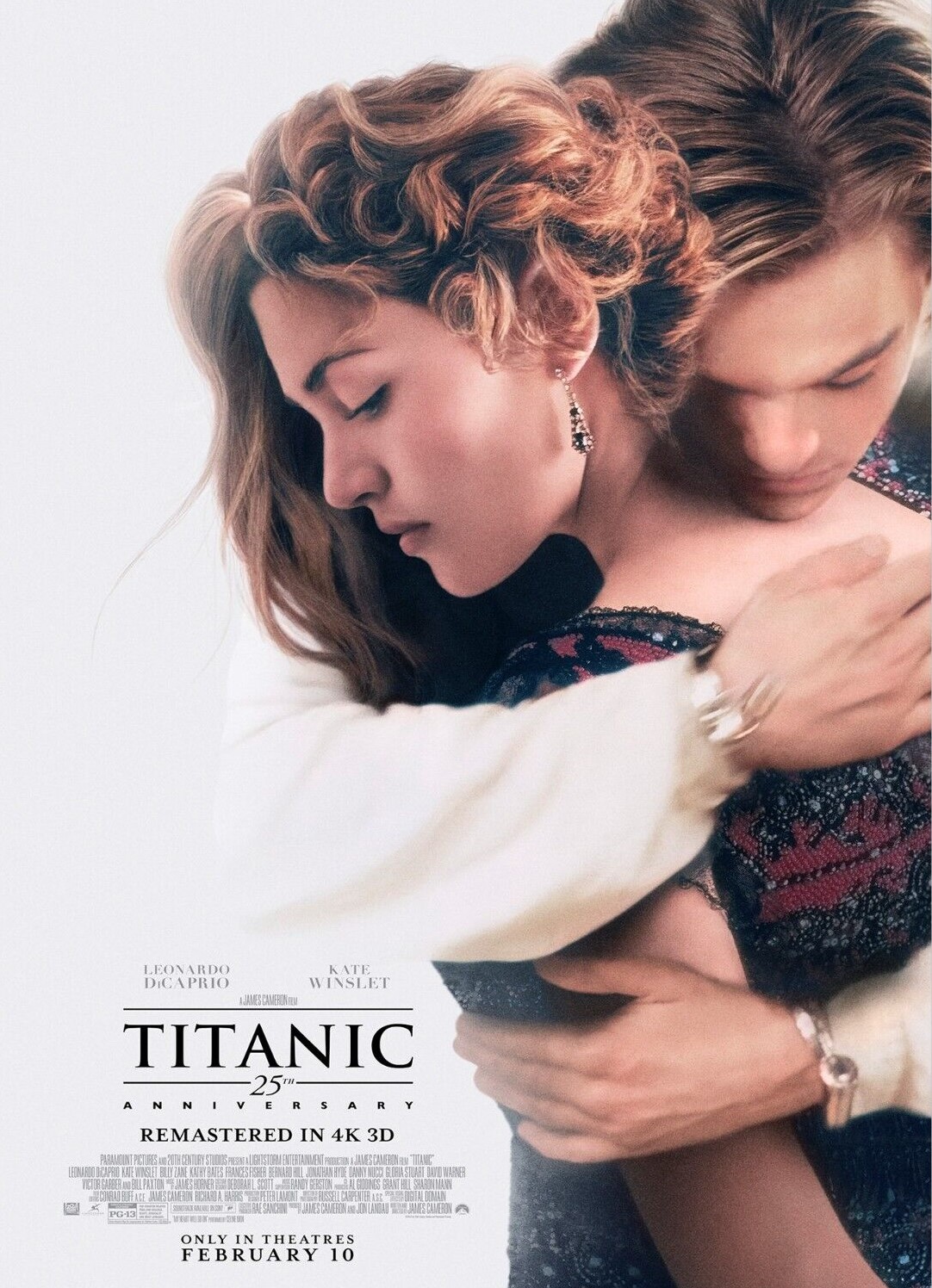
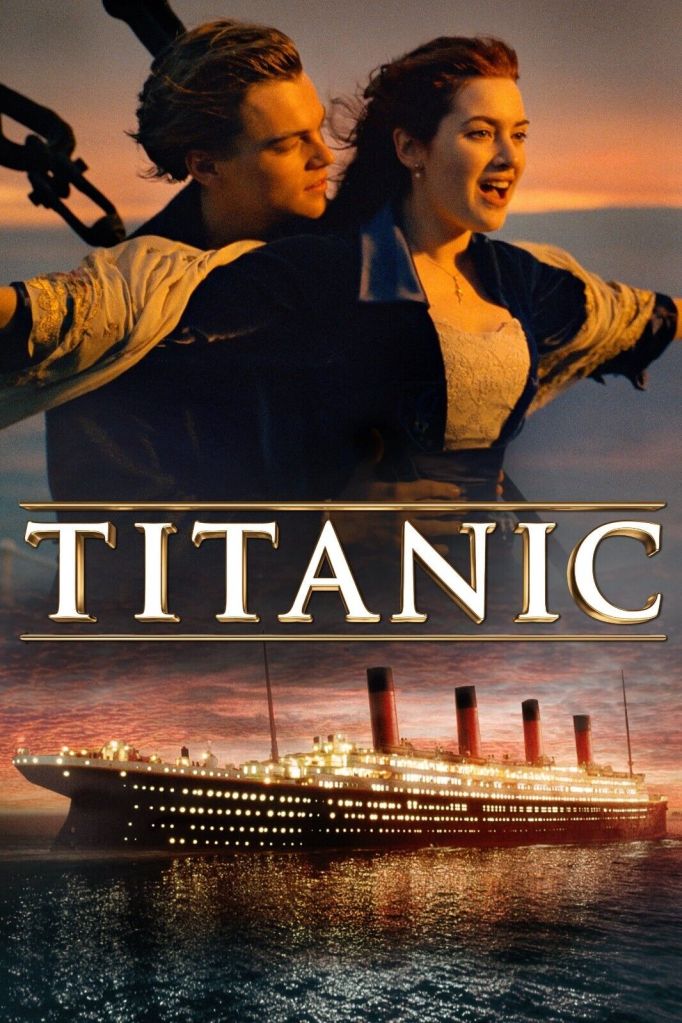
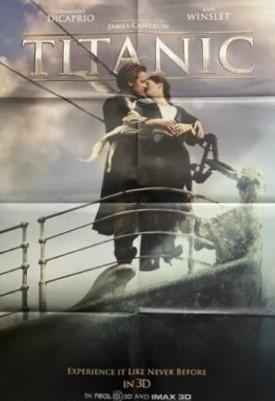
Titanic (1997) ***** – Seen at the Cinema in 3D Imax

You might have thought it the height of Hollywood hubris for James Cameron to assume Titanic could steal the Valentine’s Day crown from Humphrey Bogart-Ingrid Bergman World War Two lovelorn Casablanca (1942). But bear in mind Casablanca had replaced Doctor Zhivago (1965) as the movie’s greatest love story and that, in turn, had superseded Gone with the Wind (1939).

Each followed a similar recipe – cataclysmic event, except Casablanca epic in scope, except Gone with the Wind memorable song,  except Clark Gable introducing relative newcomers, perhaps most of all fabulous screen charisma between the male and female leads. Titanic, of course, has a late twentieth century vibe, more action than drama as the lovers, often pursued, hurtle from one potential disaster to another, and are within a lifejacket and a large enough piece of flotsam of a happy ending.

But where Rhett Butler (Clark Gable) and Rick Blaine (Humphrey Bogart) exhibited world-weary cynicism and Zhivago (Omar Sharif), though his occupation, achieved maturity, Rose (Kate Winslet) and Jack (Leonardo DiCaprio) are little more than blossoms blown on the wind, as innocent as a fresh coat of paint. Jack grows up fast, fast enough to hold his own among the upper class, strong enough to whisk Rose away from a life of servitude to a male ideal.

In some respects, to use the modern idiom, she is the ultimate Final Girl. On several occasions, she rescues him, plunging through the rising torrent to find him and cleave his handcuffs with an axe. She risks far more than he. Vengeful fiancé Cal (Billy Zane) and his ruthless henchman (David Warner) would easily chuck Jack overboard given the chance.

In essence, the story is light. Spoiled brat saved from a half-hearted suicide attempt, Jack embraced by Cal as a means of humiliating him, various attempts to smear Jack, Rose finding a freedom below stairs she never expected, shown a world of opportunity beyond her ken, taking the lead in sexual matters, lightly mocking Jack for blushing at her nudity even as she shamelessly and confidently strips.

And told against the backdrop of a ruthless caste system, where only the “better” people can survive and millionaires see “winning” as the embodiment of entitlement. Cameron holds up a mirror to the supposedly classless America and a world of enterprise where lifeboats are viewed as an obstacle to beautiful design. The two outsiders, Rose’s mother (Frances Fisher) and Molly Brown (Kathy Bates) are opposites, the latter, by dint of inheritance pushing her way brusquely into society, the former meekly trading her daughter for a life of privilege.

And the romance is given a twist when cold-blooded Cal proves to be as obsessed by Rose as Jack, the several times offered safe passage turning it down to pursue her, and not in the end as an object to be collected but as the subject of his restrained passion.

But you would need extraordinary acting to keep you glued to the screen when there were so many other astonishing visuals and even at the distance of a quarter of a century the power of DiCaprio and Winslet just blows you away. Sure, there is a bit of will she-won’t she, but once we’re past that it’s romance as a breath of fresh air, DiCaprio mixes devil-may-care with adoration, Winslet bristles, succumbs and then takes the lead, the sheer exhilaration of it all the bulwark against the drama of the slowly sinking ship.

It’s a fabulous scenario, Cameron careful to allow other elements to float into place, the officers assuming sacrificial stance, the hunt for the mythical jewel that kicks off the tale and provides meaningful coda.

I’m sure it helped that DiCaprio and Winslet were mere rising stars, otherwise I doubt if someone with more box office clout would have stood for the endless hours/days/weeks in freezing cold water (I don’t think you could heat it up even in a studio setting) and without their genuine travails it would not have worked so well.

It’s worth noting that DiCaprio went on to become – along with Brad Pitt – the last of the genuine stars and that he forsook the easy route of romantic lead for more interesting and complex characters and embraced an association with Martin Scorsese that took him to darker places than the likes of Paul Newman or Harrison Ford ever dreamed. Winslet, too, has enjoyed a memorable career, perhaps entranced too often by the arthouse, but you can hardly argue with one Oscar and six nominations.

On a personal note, I realised I had passing acquaintance with two of the actors. When I worked backstage at the Citizens Theatre in Glasgow, I would often come across Jonathan Hyde (the arrogant Ismay). One role he played quite astonished me. Not so much the role (and I can’t remember what it was) but, if you like, the preamble. When audiences entered the theatre they were faced with the sight of Hyde sitting on stage in full costume and in character, as if this was Method Acting taken to an extreme, waiting for the play to begin.

I was at university with Ron Donachie (the master at arms). We both studied Drama at Glasgow University. This course was never intended to produce actors, and mostly it set students on a path to theatre management and the like, including a friend Anne Bonnar who went on to head up Creative Scotland. But, of course, it was always a route into acting if that was your ambition. Ron Donachie and another friend Duncan Bell (British television series Heartbeat) took the opportunity. Needless to say, my stint at the Edinburgh Festival Fringe was enough to convince me that acting was not my forte.  

Bank of Dave (2023) *** / No Stars

Take One: A quite superlative courtroom scene sets the tone for this David vs. Goliath clash of a Burnley minibus dealer taking on the might of the British Establishment. In truth, my heart had sunk at the stereotypical opening – posh London lawyer sent “oop north,” his first encounter with natives unintelligible, his client first seen in a pub doing karaoke. And set against the background of the financial crash caused by arrogant and inept big banks, the stall is set out too obviously.

But, gradually, it acquires a different tone, of two outsiders fighting the system, less-than-high-flying corporate attorney Hugh (Joel Fry) trying to gain acceptance in a working-class town, working-class millionaire Dave (Rory Kinnear) battling to gain a foothold in banking circles to put forward his controversial notion of a new bank – the first in 150 years – that dealt only with small businesses.

There’s a toe-curlingly awful romance as Hugh can’t quite put into words his feelings for Dave’s niece Alexandra (Phoebe Dynevor), a Cambridge-educated NHS doctor, and she can’t quite help him along. Banking guru Sir Charles (Hugh Bonneville) has Dave in court on a trumped-up charge. Anyone Hugh trusts in the City does the dirty on him while locals he distrusts are confusingly helpful.

The Banking Powers-That-Be make up the rules as they go along, leaving Hugh with a £12 million shortfall to fill before he can get up and running.

So there’s a lot of ducking-and-diving on both sides, born publicist Dave constantly coming up with entrepreneurial wheezes, the opposition attempting to thwart him at every turn. Business pictures are a hard sell unless the product is drugs or sex, so it’s no surprise this isn’t about setting up a business, even one with righteous credentials (i.e. helping the little guy), but rather about poking a finger in the eye of Big Business, Big Banking, Big Government and anything else that isn’t Little (i.e. good).

Along the way it turns into a warm-hearted feel-good movie with characters you might recognize and situations you might appreciate and although the ending is a tad predictable I was surprised how moved I was. Rory Kinnear (Men, 2022), rarely given anything more than a supporting role, shines as the larger-than-life Dave and Joel Fry (Jasper, if you remember, from Cruella, 2021) goes from romantically inept to courtroom genius and back again while Bridgerton graduate Phoebe Dynevor has a slow-burner of a role. Debut feature of Chris Foggin from a screenplay by Piers Ashworth (Fisherman’s Friends, 2019).

At the high end of streaming material in that it was an enjoyable watch and no complaints about a big film which should have been seen in the cinema.

Take Two: But then I wanted to learn more about Dave and his banking initiative. And lo and behold very little of what you see on the screen is true. The big court case is a figment of the writer’s imagination, which means that however low Big Banking stooped it didn’t stoop this low. And so, it transpired, was the need to raise £12 million. And so was the fundraising concert by Def Leppard and so, too, I guess was the odd million thrown into the kitty at the last minute by Hugh to get Dave over the line.

So, much of Bohemian Rhapsody wasn’t true either and I was always in awe of the bar scene in A Beautiful Mind (2001) in which asking girls to dance is used to demonstrate the Zero Sum theory on which mathematician John Nash made his name, rather than some more complicated explanation. And it’s true, Dave was taking on the Establishment and nobody had set up a bank in 150 years and the financial industry was in crisis and you could ask who were these people to judge who was fit to run a bank when these were the same banking bosses who had squandered gazillions on ill-advised loans. And I’m sure it was a hell of battle. That he didn’t, in fact, win, because the bank Dave did set up is not a bank in the financial meaning of the word.

And, of course, it highlighted the inequities in a system that can reward with bonuses bankers who made a whopping loss.

So I’m really in two minds. I enjoyed it at the time but that enjoyment quickly palled when I realized it was all invention. I just wondered if there was a better and more incisive way to skewer the Big Banks than this.

On Netflix.

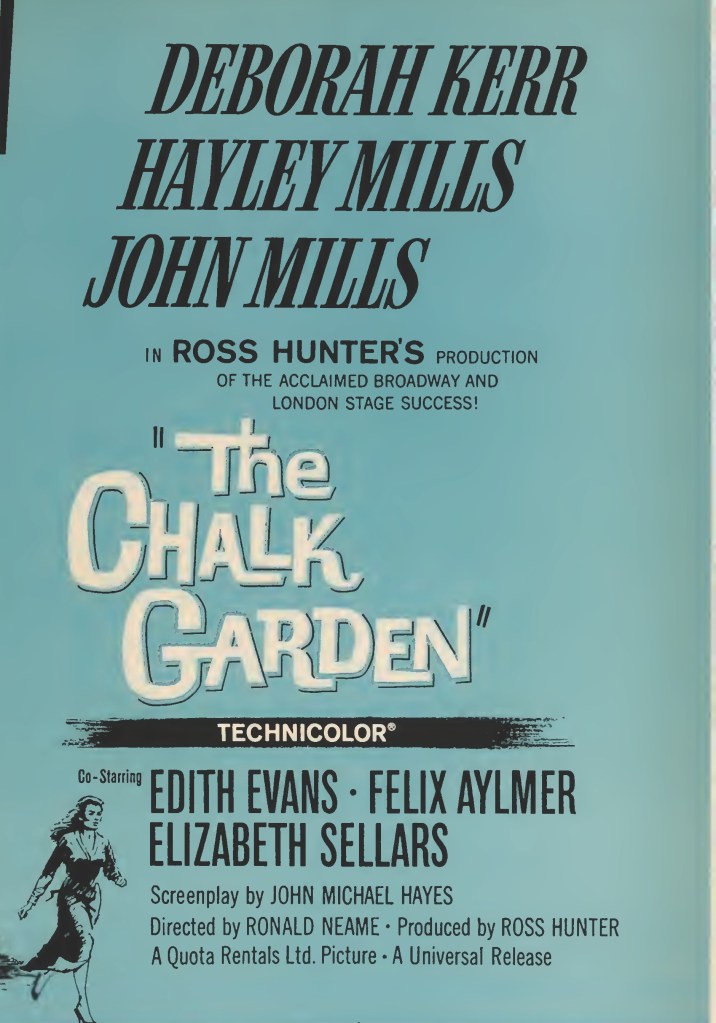
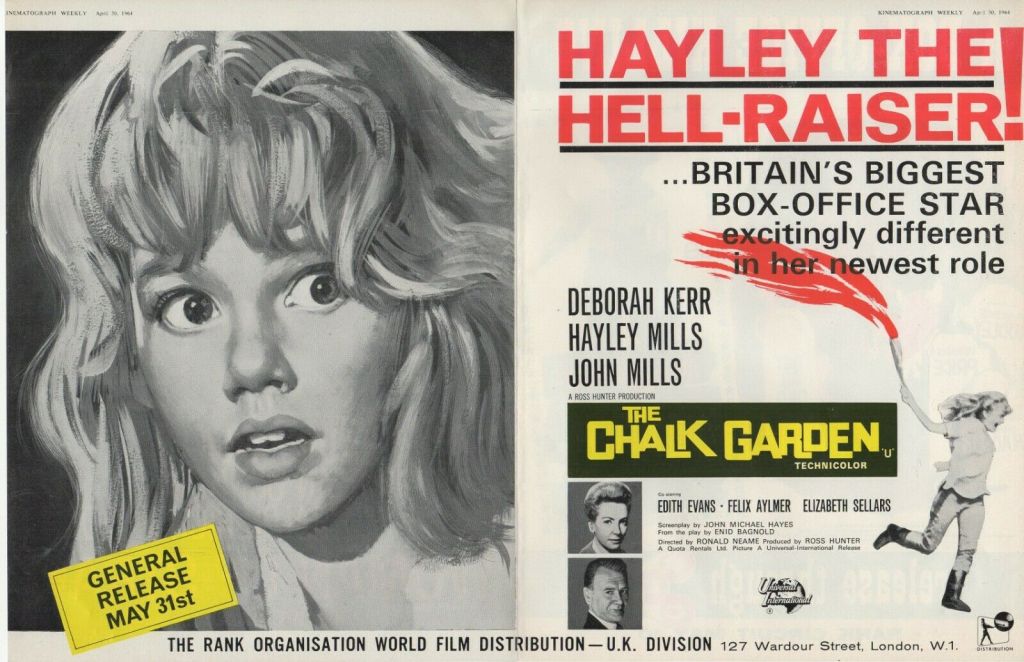
The Chalk Garden (1964) ***

You couldn’t make a movie like this now because (plot spoiler, I’m afraid) even the dottiest of old ladies would make at least a better attempt at collecting a reference from a prospective employee for fear she might be hiring someone disreputable. Though I doubt if many employers would expect a governess to turn out to be a murderess.

That this movie chimes with a contemporary trope – the criminal wanting to prevent others from following in their footsteps – makes it far ahead of its time. Made today, of course, the unruly child rather than merely threatening to unleash her arson impulses would probably have burned the house down.

So it’s more a drama of manners, if you like. Very presentable but clearly down-on-her-luck Miss Madrigal (Deborah Kerr) is taken on by Mrs St Maugham (Edith Evans) as governess for her grandchild Laurel (Hayley Mills) because nobody else wants the job. Laurel’s outrageous behavior has sent a score perfectly well qualified ladies scurrying. Madrigal is hardly fazed by anything Laurel can get up to.

But the child is clearly suffering abandonment issues, her beautiful mother Olivia (Elizabeth Sellars) having gone off with another man. Grandmother incites grandchild to hate the mother. But Olivia’s maternal instincts have kicked in and she wants her child back. While Madrigal can deal with Laurel’s tantrums she is less fortified against the child’s inveterate snooping. Finding a mysterious suitcase leads Laurel to fantasize about Madrigal’s past.

Mostly the film is a four-hander, butler Maitland (John Mills) playing a significant role in proceedings, not least in his effortless management of the wild child. Quite why a such a pragmatic and assured gentleman should end up in this remote mansion is another mystery and thankfully there is no attempt made at playing up the cliff-top location in a suspenseful manner.

Mrs St Maugham is imperious but not entirely practical, either in setting child against mother or in trying to grow flowers in such chalky soil, though Madrigal appears to have sufficient horticultural knowledge to set her straight on the latter and attempt to intervene on the former.

There’s a deadline of sorts. Olivia is coming to remove the child. Whether she goes willingly or not doesn’t matter. Madrigal sees her role as trying to prepare a child to love her mother and be more grown-up than the adults around her and forgive her.  

Madrigal’s guilt unnecessarily causes her to reveal that she had been jailed for murdering her stepsister, having been as resentful and jealous of the girl as Laurel currently is of her mother. Mrs St Maugham had called on old acquaintance Judge (Felix Aylmer ) for legal advice on how to prevent Olivia getting the child. He was the presiding judge in Madrigal’s case. Imagining he had not forgotten the trial – which of course he has – she feels duty bound to blurt out the truth before she is humiliated.  The confession helps Laurel realise how dangerous a path she is on and pushes her towards reconciliation rather than revenge.

It has all the making of a well-made play which is hardly surprising since it is based on Enid Bagnold’s Broadway success, at one time mooted as a film to star Joanne Woodward and Sandra Dee. So it moves along in the traditional three-act manner, plenty space given to establishing characters, introducing the undercurrents and leading to revelation and resolution.

So, mostly, it depends on the acting. Luckily, it is excellent. This was Hayley Mills in transition, far removed from Disney saccharine of The Parent Trap (1961) and about the same distance from the full-blown adult bottom-baring of The Family Way (1966). She projects a great deal more torment than in either of those films and comes across as believable, not exactly a young hoodlum but left to her own devices and starved of parental love only a matter of time before she would commit a crime of some kind.

Deborah Kerr hadn’t made a film in three years but her screen persona had shifted from the passionate – From Here to Eternity (1953), An Affair to Remember (1957), The Sundowners (1960) – to the repressed. Her spinster introduced in The Innocents (1961) had a great deal in common with her spinster of The Night of the Iguana (1965). But this is a different kettle of fish. Here, she exudes capability but with a self-awareness that undercuts such confidence, trying to keep a lid of emotions she struggles to handle.

John Mills (Tunes of Glory, 1960) casts a sardonic eye on the household while Edith Evans (The Whisperers) portrays a sorely wounded matriarch. Director Ronald Neame (Gambit, 1966) cleverly opens up the play, using the cliffs, gardens and rocky beach to considerable effect, but keeps the drama taut. John Michael Hayes (Nevada Smith, 1966) produced a workable screenplay.

Apologies for giving away the story, a good watch more for the acting than the twist.

Lilith (1964) *****

You couldn’t make this now. What top-ranked actor would be willing to play a character who takes sexual advantage of a vulnerable young woman? You’d find it even harder to get a marquee name to play a female with paedophiliac tendencies, predatory sexual instincts and thinks it fine to drive a lovelorn young man to suicide.

That it was feasible back in the day was largely due to the restraints imposed by the much-maligned Production Code. Most of the issues are delicately probed, the problematic themes only touched upon, so that the result is quite amazing, the director turning to the lyrical,  rendered by its intensity a metaphor for internal conflict.

War veteran Vincent (Warren Beatty) takes a job as an occupational therapist at an upmarket mental institution, the kind that looks more like a country club or grand hotel with extensive manicured grounds. Few of the inmates are of the type found in the normal hospitals for the insane, the worst cases a woman with a maniacal laugh and another who treats a doll like a baby, but he is warned insane women are more “sinister” than crazy men.

One of his charges is the withdrawn Lilith (Jean Seberg) whom he gradually coaxes out of her shell, soon believing that it is his innate skill that brings about the possibility that such a high-risk individual could possibly achieve something akin to cure, or at least a greater degree of normality. You can hardly blame him for missing the obvious – that Lilith is using him – for the young woman is every inch the winsome innocent seeking guidance from the more mature responsible male.

It’s mostly shorn of obvious metaphor but there is one scene, compelling in itself, where Vincent plays the knight on horseback, complete with lance, winning a contest of skills for his lady, that completes his idealisation in her eyes. But he is already halfway there, with unexpected dexterity he frees her hair caught in loom, the kind of scene that in an otherwise more romantically-inclined movie would be the meet-cute.

And this isn’t one of those films about a madwoman in an attic or an apparently sane person turning demented. Instead, considerable time is spent analysing the condition of the schizophrenic, either through clinical lead Dr Lavrier (James Patterson) expounding his theories or through Vincent discussing individual patients with his boss Dr Brice (Kim Hunter). The idea of opening up a new realm to an audience is crystallised in one scene where Lavrier explains that even spiders go mad, resulting in asymmetrical webs rather than the typical formations to which we are more accustomed.

And by using one of the oldest tricks in the book, an inexperienced young man negotiating a new world, disbelief is suspended. But just when we think we are seeing everything from Vincent’s perspective, we are thrown into a heightened intensity linked to the lyrical – a river, a waterfall – the madness of ecstasy, what used to be called rapture, as Lilith stares and stares at nature.

But there are warnings about the personality of both characters. Lilith bears a startling resemblance to Vincent’s dead mother. He has difficulty committing, lack of communication while away at war resulting in girlfriend Yvonne (Anne Meacham) marrying someone else.

And there is plenty that is disconcerting about Lilith that only the besotted would overlook. She leads on lovelorn Stephen (Peter Fonda) to potential disasters he cannot foresee. Angry at Vincent, “I show my love for all of you and you despise me,”  she seduces vulnerable older patient Laura (Jessica Walter). But the worst aspect of her character is that she perceives no boundaries to behavior. She exhibits inappropriate attitudes to young boys, inviting one to rub his finger along her lower lip.

However, for most of the film the skilful direction of Robert Rossen (The Hustler, 1961) has you rooting for the young lovers. Even while never falling back on the cliché of the doctor-type saving the ill person, there is enough in Vincent’s earnestness and Lilith’s innocence to make that a distinct possibility, were it not for the other discordant elements of her character.  The picture is wrapped in natural sound – the river, waterfall, a flute playing mournful tune, ping-pong ball hitting bat, reeds or branches parting, rain, footsteps, a ticking clock, and the bulk of the music emanates from Stephen’s radio. And then he will twist it slightly, reflections are seen upside-down in the river, or a shot of the waterfall is held for too long, the sound of water increasing, or Lilith standing in the river bends down to kiss the surface, or at a picnic she eats a leaf irrespective of whether it might be poisonous.

Usually, when you get so much detail it’s a surfeit, and ends up drowning the viewer. But that’s not the case here. Either it builds or expands. And there is even a throwaway that mocks the notion of containing madness in an institution. The best, most revealing, line in the  picture is not spoken by either of the two principals, but secondary character Yvonne, seen only at the beginning and end. When for unspecified reasons Vincent turns up at her house and her husband (Gene Hackman) leaves them on their own, she says, “I told you I’d never really let you make love to me until I was married,” (pause), “well, I’m married now.”

Jean Seberg (Moment to Moment, 1966) is just superb, coming across as a young woman entering adulthood full of fears and insecurities, only suggesting the darker side of her character, and never giving in to the temptation of overplaying. Warren Beatty (Kaleidoscope, 1966) can’t quite match her for subtlety or kick those acting mannerisms – lowered head, looking away – but his stupefied expression towards the end as he realizes just what he has taken on is priceless.

There’s an outstanding cast of rising stars. Peter Fonda (Easy Rider) as the preppy insecure victim is excellent while Jessica Walter suggests the qualities that would make her the prime candidate for the femme fatale in Play Misty for Me (1971). Gene Hackman, in his movie debut and still working on his trademark chuckle, provides early evidence of his immense talent.  

Robert Rossen, who wrote the screenplay (from the novel by J.R. Salamanca) and also produced, couldn’t have wished for a better epitaph. This was his final film in a relatively short career – he only directed 10 films.

Despite contemporary reservations about the content this is a beautifully observed piece and well worth a look.

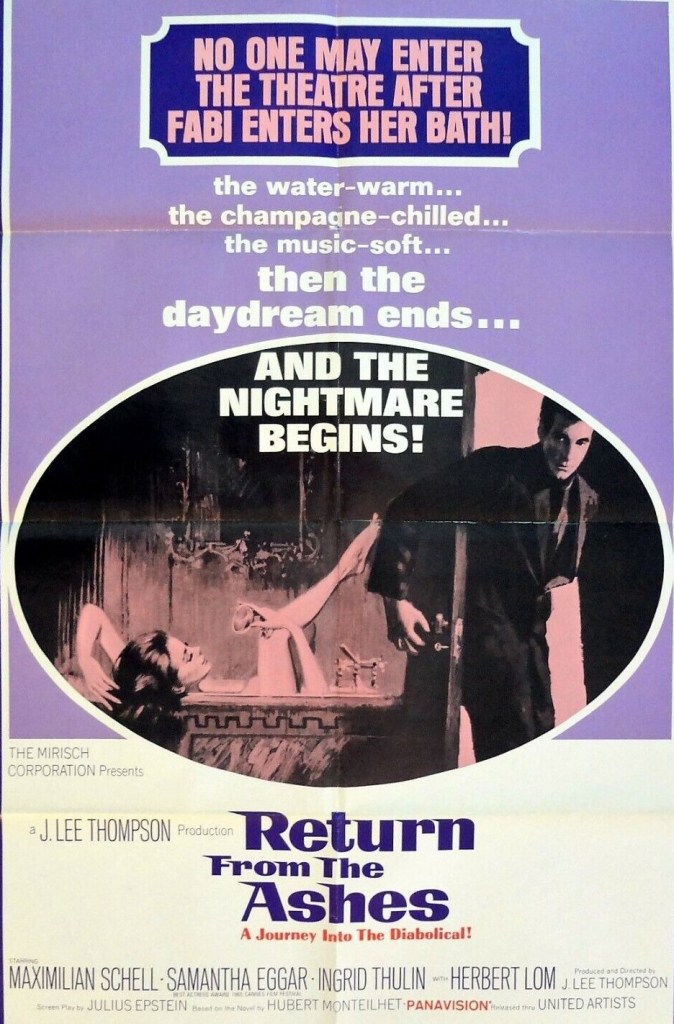
Return from the Ashes (1965) ****

When your starting point is an arcane French inheritance law and the plot revolves around swindling a concentration camp survivor you are immediately on “icky” ground. Throw in a relationship between an adult male and the step-daughter of his deceased wife and the audience might already be backing off.

So it’s a tribute to the acting and that each character is not so much unlikeable as both vulnerable and predatory that this turns into a very involving drama. On the eve of World War Two in Paris Dr Michele Wolf (Ingrid Thulin) buys the love of penniless Polish chess player Stanislaus (Maximilian Schell) but at the cost of abandoning her step-daughter Fabi (Samantha Eggar). For him, love is contingent on wealth, but he marries Michele, a Jew, in a (failed) bid to save her from the clutches of the Nazis. Fabi, shorn of maternal love finds turns to a paternal variation, but is capable of coming up with an ingenious murder plot.

Just quite how hollow Michele has become is demonstrated in a brilliant opening scene set after the end of the war. In a railway carriage, a bored small boy endlessly kicks a door. Pretty much for 90 seconds we either see or hear that door being kicked. Foolishly, his hands wander from the window to the door handle. Next thing, he has fallen out. Cue screams, chaos, shocked passengers racing out of the carriage.

But when the conductor turns up to investigate the incident he finds Michele still sitting in her seat, oblivious to any death, even that of a child. When she returns to Paris, she takes a room in a hotel under a pseudonym, fearing that her ravaged looks make her unattractive, guilty at surviving (by volunteering to work in the camp brothel) when all her relatives were wiped out, unaware that she has unexpectedly inherited all their combined wealth.

So the story begins in a different way. When Stanislaus meets her accidentally under her false name, he immediately assumes she is just a dead ringer for his deceased wife and enrols her in a scheme to win the millions currently held in escrow under this inexplicable French law.

Since she continues to play the part of a different woman, she hears the truth about her relationship with Stanislaus, that although he committed the only unselfish “gallant act” in his life in marrying her nonetheless his prime reason was money. Already Fabi, in full femme fatale mode, is planning to rid the couple of Michele once the money has been legally acquired.

To his credit, Stanislaus initially balks at this notion, but when Michele reveals her true identity and scuppers his relationship with Fabi while at the same time trying to win back the affection of her step-daughter, matters take a deadly turn.

For the most part what we have is a menage a trois, equal parts driven by money and love, but in each instance propelled by innermost desire. Stanislaus is adept at pulling the wool over Michele’s eyes, she only too willingly blinding herself to his sexual deception. But Michele is equally willing, even when she knows his true feelings, to use her money to win him back while Fabi, aware that for her lover money will always trump romance, is determined to use her body to achieve the same effect.

What makes this so compelling is that, unusually, it avoids sentiment. It would have been easy to load each character up with such vulnerability that an audience would not condemn them. Instead, in addition to their individual weaknesses, we are shown their inherent predatory natures.

What makes it so enjoyable is the acting. So often Maximilian Schell is called upon to play stern characters, often typecast from his accent as a villainous German of one kind or another (Judgement at Nuremberg, 1961, The Deadly Affair, 1967), rather than allowing him to invent a more rounded character as he did in Topkapi (1964). This is a wonderfully involving performance,  the wannabe chess grandmaster who uses his considerable charm to buttress his fears of poverty, and is only too aware of his failing, full of joie de vivre, bristling at being a kept man yet at the same time only too ready to financially exploit the situation.  

Where in The Collector (1965) Samantha Eggar was constrained by circumstance and in Walk, Don’t Walk (1966) saddled with an initially cold character, here she is permitted greater freedom to develop a conflicted personality, loving and deadly at the same time, drawn to and hating her step-mother, attracted by the thought of the money that would secure Stanislaus but repulsed by the cost.  

Ingmar Bergman protégé Ingrid Thulin (Wild Strawberries, 1957) is given the least leeway, another of the tormented characters in her intense portfolio. Herbert Lom (Villa Rides, 1968) puts in an appearance as a friend trying to warn her off Stanislaus.  

Director J. Lee Thompson (The Guns of Navarone, 1961) takes the bold approach of allowing characters and situation to develop before moving into thriller mode. There are a couple of quite superb scenes, running the opening segment close is the much-vaunted scene of Fabi in the bath (“No one may enter the theater once Fabi enters her bath” was a famous tagline). It is brilliantly filmed in film noir tones, bright light slashed across eyes rather than through windows, and Johnny Dankworth provides an interesting score. Julius J. Epstein (Casablanca, 1942) wrote the screenplay based on the bestseller by Hubert Monteilhet.

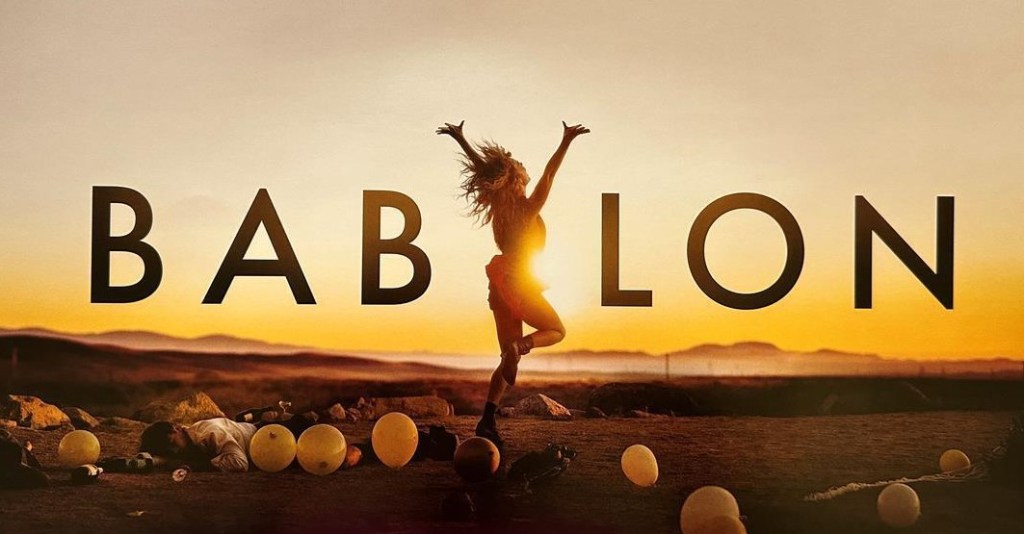
Babylon (2022) **** – Seen at the Cinema

Wild raucous’n’roll rollercoaster that, contrary to expectation, I found totally absorbing, length not an issue. Employing a simple structure of rise and fall, and exploring the upside and downside of Hollywood in the transition from silent to sound, it seemed to me in essence to capture movie-making. A Broadway play could be a hit if seen by 100,000 people, that size of audience constituting a flop for a movie, but the play was viewed by 100,000 of the “right” people, the moneyed elite who could afford the tickets, a movie by the flotsam and jetsam that made up the majority of the American population even when, theoretically, the country was going through the boom times of the “Jazz Age.”

Most films and books concentrate on the downside, the battle to get to the top, the seamy undercurrent, the inevitable collapse, but none capture the giddy heights like this. Silent movies were viewed primarily as technical, nobody had to even talk, much less learn lines or spout Shakespeare. Initially, the stars were drawn from vaudeville so had some proven talent but then it was clear anyone could become a star, such as here Nellie LaRoy (Margot Robbie), or a producer like Manny Torres (Diego Calva) by simply being in the right place at the right time, initiating a gold rush to Los Angeles.

Just as there is no single reason for the camera and audience to turn a person into a star, the same applies when they fall out of favor. In a movie thankfully given little to long lectures on filmmaking beyond aspirations to “form” and wanting to do something good, the best explanation about how/why careers end is delivered in dry tones by columnist Elinor St John (Jean Smart) to disillusioned out-of-favor Jack Conrad (Brad Pitt).

The narrative shuttles between Conrad, LaRoy and Torres, interweaving the lives of trumpet player Sidney Palmer (Jovan Adepo),  Conrad’s multiple wives, LaRoy’s hapless father (Eric Roberts), director Ruth Adler (Olivia Hamilton) studio wunderkind Irving Thalberg (Max Minghella), publishing magnate William Randolph Hearst (Pat Skipper), gangster James McKay (Tobey Maguire) and imperious director Otto (Spike Jonze). Excess is the name of the game whether ostentatious consumption Hollywood-style or the more sedate black tie dinners of caviar and lobster enjoyed by the elite.

The elite looked down their noses on a new class of wealthy individuals who were ill-educated, didn’t talk proper, but had struck gold simply from being able to stand in front of a camera without being able to tell their Ibsen from their Shakespeare and didn’t understand art. 

Surprisingly, this is a pretty good comedy, slapstick sometimes but excelling at setting up visual jokes, though audiences might recoil from a rare reliance on elephant ordure and vomit. Some scenes are pure standout: Nellie’s first talk scene where the sound engineer has tyrannical control; Nellie’s fight with the snake; Manny’s race to find a camera before the director loses the light; the uncontrolled venom of battle scenes; the black Sidney not black enough; and of course the various wild parties although nothing in the Hollywood imagination could match the depravity of one where Manny is the unwilling guest of gangster McKay, as if fiction cannot match reality.

Of course, people who have everything rarely know what they actually want and spend their lives throwing away what they have in pursuit of the unattainable, so Conrad is apt to view wives as disposable, Nellie finds relief in drugs and gambling, Manny’s obsession with Nellie which should lead to ruin paradoxically by happenstance brings him happiness. The rampant unchecked hedonism that runs through the picture could well just be a metaphor for the helter-skelter modus operandi of the movies, enjoy it while you’re hot, cram in as much as you can, because, heaven knows, something from left field (sound, for example) could dramatically upend everything.

Brad Pitt (Bullet Train, 2022) is very good as the often drunk but generally streetwise star. You can hardly take your eyes off Margot Robbie (Amsterdam, 2022), not just for her brazen sexuality, but her ability to cry on cue, awareness of her self-destructive personality, inherited from self-destructive parents, greedy idiotic father, mother committed to an upmarket mental institution. Diego Calva (Beautiful Losers, 2021) is good in a less showy part. Interesting cameos abound.

This has the intensity of Damien Chazelle’s Whiplash (2014) rather than the cleverness of La La Land (2016).

I mentioned in my review of Tar that it could have done with a stronger producer to cut down on the running times and some elements I felt were bound to alienate audiences. I would make the same suggestion here, though not so forcefully. Elephant shit and urination are always, I reckon, going to be a major turn-off for audiences. While I had no trouble with the length, that’s clearly been an issue and it would hardly be a problem for a decent editor to snip chunks out of party scenes or eliminate non-essential characters.

Emotionally and artistically this seems to me to capture the essence of the formative days of Hollywood before the double whammy of the Great Depression and the Hays Code brought about a systematic rethink with studios insisting their stars take more care hiding their proclivities from general view.

Ignore the reviews and check it out.

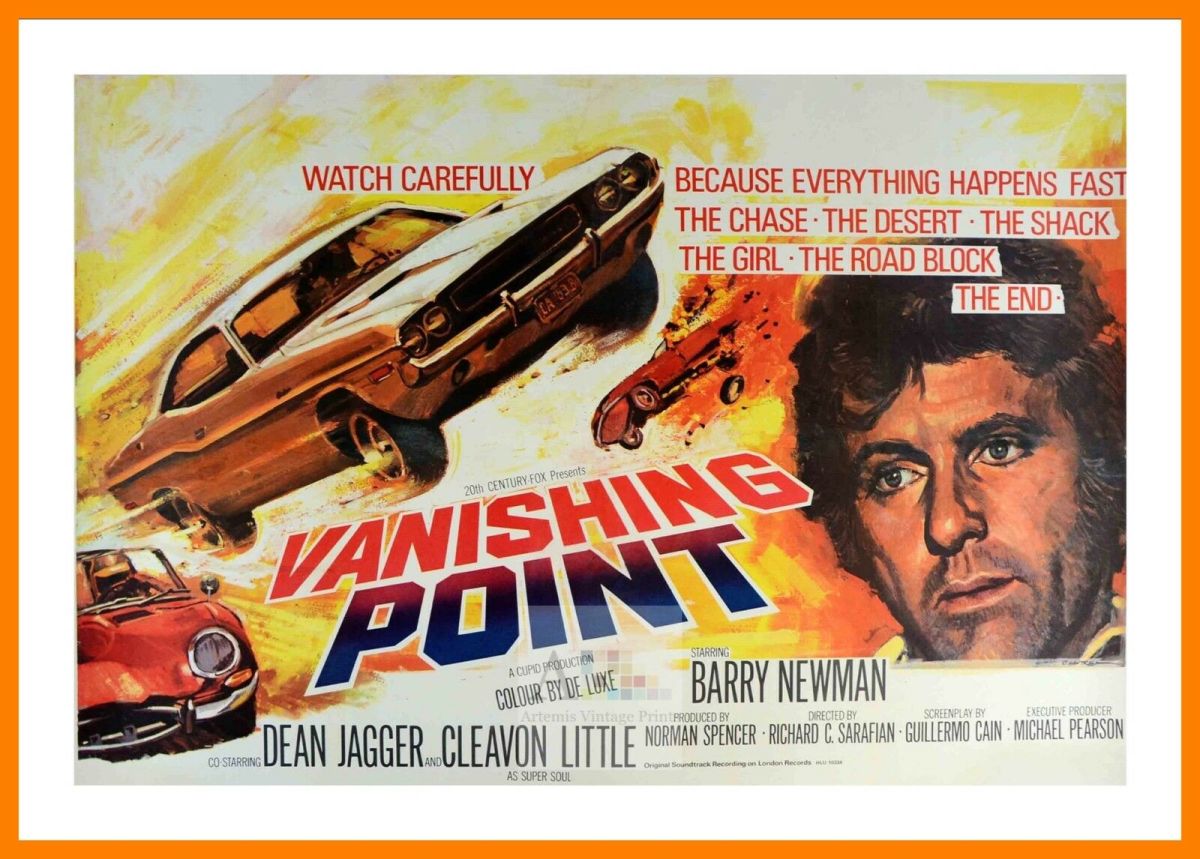
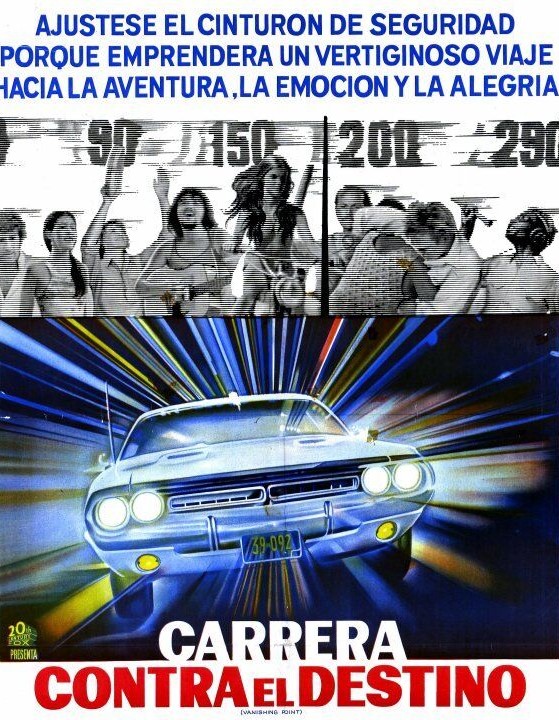
Vanishing Point (1971) *****

There always was an existential element to speed. Destination was another symbolic aspect. A “vanishing point” has an artistic meaning; relating to perspective it’s the place where parallel lines cross. But it also means something so diminished as to be unimportant, and you could argue this movie is a place where the figurative and metaphorical collide. Throw in a couldn’t-care-less driver and you have all you need for a cult film, a cross between the thoughtful paeon to speed of Easy Rider (1969), Sugarland Express (1974) and the camped-up chase characteristics of the later Smokey and the Bandit (1977).

It has less in common with the city-bound Bullitt (1968) and The French Connection (1971), whose protagonists had the excuse of being on the right side of the law. And where Easy Rider is majestically scenic, the route here is through Backwater U.S.A.

With a little bit more planning, Kowalski (Barry Newman), tasked with delivering a car from Denver, Colorado, to San Francisco, could easily have driven the 1250 miles (see Note) roughly within the 16.5-hour deadline he set himself – and very easily within the target set by his employer – without breaking the law. But he’s got no intention of easing his foot off the accelerator. Instead of pulling over, he sends the first pair of speed cops into the ditch.

And that sets the tone. Countless cops set out to stop him, countless cops are driven off the road, the authorities increasingly infuriated by constant humiliation. Kowalski is helped by blind DJ Super Soul (Cleavon Little), who has infiltrated police radio, and whoops up public support.

Director Richard C. Sarafian could have hit the existential mother lode by making Kowalski mysterious, akin to the western’s anonymous lone rider, or to a contemporary audience “the last American hero.” Or he could have dressed him up in more contemporary colors. But instead of being a long-haired drugged-up sex-mad hippie, he’s a decorated war vet, a stock car racer and a cop who exposed corruption and prevented a colleague raping a young girl. Unlike the drug peddlers of Easy Rider or the hostage-takers of Sugarland Express, he doesn’t start out as a law-breaker (setting aside his intake of Benzedrine) and the most he’ll be charged with is a misdemeanor.

Apart from a desire for the freedom of the open road untrammelled by petty rules, we don’t get much of an idea why Kowalski is so intent on risking his life, beyond a hint that an idyllic loved-up beach lifestyle had been shattered. There’s a fatalism that Ridley Scott ripped off for Thelma and Louise (1991).

The awe-inspiring driving across arid country is interrupted by episodes uncovering the underside of the American Dream and the nascent counter-culture. He is almost robbed by a couple of gay hitchhikers, encounters an old man (Dean Jagger) living off the land, trapping rattlesnakes and trading them for supplies, and a youth-oriented revivalist group who make music their mantra. He turns down free sex and marijuana offered by a beautiful nude motorcycle rider (Gilda Texter) while her boyfriend (Timothy Scott), with a stolen police siren, guides Kowalski through roadblocks.

Mostly, though, the focus is on the driving. Kowalski’s white 1970 Dodge Challenger R/T 440 Magnum, souped-up to reach 160 mph, leaves a Jaguar E-Type in the dust, and makes a mockery of the succession of wannabe cop speedsters.

He can leap over gaps, race off-road, charge through the desert, hide from pursuing helicopters, and could probably have hidden out till the heat died down except his blood is up and his eyes are starting to glaze over and he’s got a peculiar smile on his lips.  

Even on a small screen the full-throttle driving hits the spot. But it scores on many other emotional and intellectual levels. It strikes a chord with the disaffected. It’s the ultimate in defiance of authority, innate skills belittling superior forces. The fastest man will always have an audience rooting for him. If you can’t win, choosing how this will end means you remain in control. Speed puts a man in the zone, where you are reduced to an essence of being.

On paper, this should hardly work at all. In the hands of director Richard C. Safarian (Fragment of Fear, 1970) it works like a dream. Barry Newman (The Lawyer, 1970) is superb with very little to go on, nothing but a buttoned-up driving machine. Cleavon Little (Blazing Saddles, 1974) on the other hand goes nuclear as the hippest of the hip disc jockeys. Oscar-winning Dean Jagger (Firecreek, 1968) makes his mark and you might like to know Gilda Texter went on to become a successful costume designer. Depending on what version (not the one I caught) you see, you’ll get a glimpse of Charlotte Rampling (Three,1969).

Stone cold classic. Gets the adrenaline going, but leaves you thoughtful.

The DVD is worth buying just for Sarafian’s commentary.

NOTE: That’s according to Google. Though estimates vary. One reference puts it at 15 hours of non-stop driving, another between 19 and 22 hours. Without breaking the speed limit of 70mph and allowing for not hitting any big cities necessitating curbing your speed, I reckoned he would only cover 1150 miles within his deadline but there are clearly plenty stretches of remote road where you would be able to crank up your speed without any bother. It’s noticeable that Kowalski sets off during the night but we never see him doing any night-time driving, he only attracts the attention of the cops during the day.

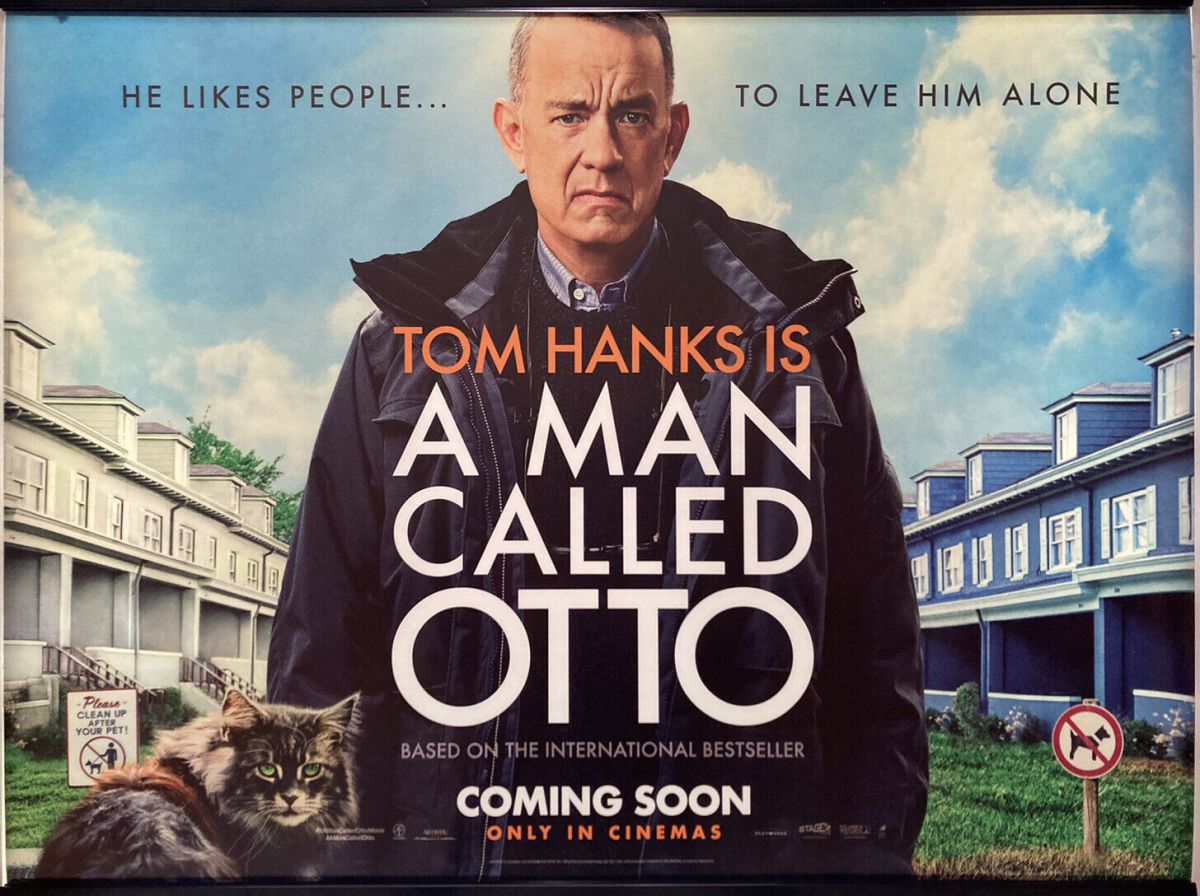
A Man Called Otto (2023) ****

Heart-warming tale of a suicide wannabe. Yep, the studio didn’t know how to sell it either, and the trailer had originally put we off, a gurning Tom Hanks and the annoying neighbor from hell. And it just shows what a sick character I must be that I was chuckling all the way through. Because, yes, and without any attempt at black comedy, Otto (Tom Hanks) spends the first half of the picture trying to commit suicide, depressed, we later discover, at the death of his wife.

As if a riff on The Marriage of Figaro, we first encounter Otto when he is measuring rope for a noose with which to hang himself. But being a truculent nit-picking type of guy – the Everyman you would cross the street to avoid – he gets into an argument with the store manger on account of not being to buy exactly the length of rope he wants. Suffice it to say that this homespun guy who otherwise can fix anything and has every tool known to man can’t grasp the mechanics of suicide. He’s one foot in the grave when he would clearly prefer two.

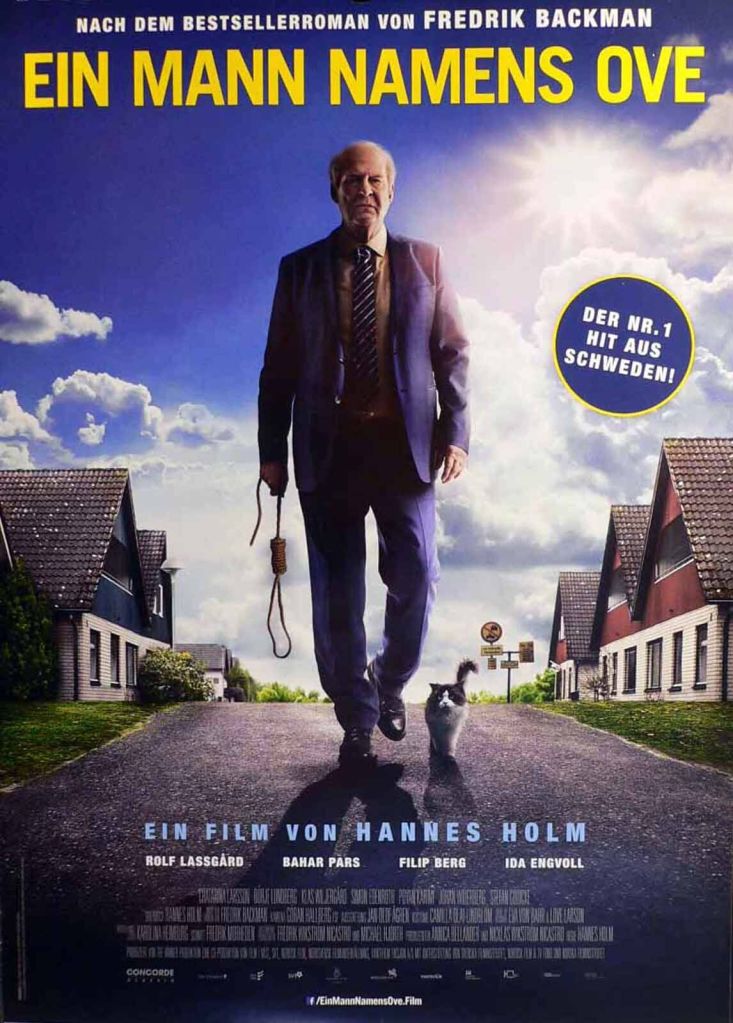
The more ominous original – note the noose.

While he’s failing at this one simple task he’s getting annoyed to pieces by the new pregnant neighbor Marisol (Mariana Trevino) and her hapless husband Tommy (Manuel Garcia-Rulfo) who can’t fix anything and by virtually everyone else in his universe who can’t follow simple rules like displaying your car sticker in the proper position. He’s an artisan trapped in a world controlled by idiots, blasting away at the inanities and inequities of modern life.

It takes such a long time to warm up you think it’s never gone to manage the switch into feel-good movie, what with so many numbskulls getting in the way, and Otto being the kind of guy who will fall out with his best friend because he bought the wrong kind of car. And it takes so long because it’s hardly gentle stuff, instead mostly biting, or inexplicable especially when Marisol takes off on a great riff of Mexican words.

His past opens up, courtesy of mementoes, and we realise he wasn’t always this kind of walking rulebook keep-off-the-grass poster boy.

Critics have been pretty sniffy about this but audiences know better and are turning out in bigger droves than for Tar, Babylon or The Fabelmans because it’s what audiences have been crying out for for so long – a good well-made drama that touches on some pretty awful feelings and doesn’t take the easy way out. Otto is made to work pretty hard to find community among people he automatically despises.

I’m not sure we need the flashbacks where a younger cuter Otto (Truman Hanks, yep even here, nepo abounds) romances his wife, because Otto gets over the line on his own within his grumpier shell without reverting to the nicer, shy guy he once was, cute as that tale is. And there’s an equally unnecessary nod to contemporary tropes, what with Otto showing his kinder side by taking in a trans and social media demonstrating how much it can be a boon – rather than a menace – to society when Otto decides to take up the cudgels against real estate villains.

Cutesville – for the book.

The characters are all so – what’s the word I’m looking for – real. Even the dumbest of them, initially portrayed in somewhat cartoon fashion,  turn out to be just human.

As I said, I was chuckling or straight out laughing all the way through and I’m glad to say that Marisol and I connected on the sickest joke of all, the one about the big heart (I’m not going to give that one away).

Given I had no idea what I was letting myself in for, all advertising having carefully avoided any mention of the S-word, and was really only squeezing this into my weekly triple bill because of limited choice, and the trailer did it no favors, my heart sank as that esteemed outfit the British Board of Film Censors stepped in where Hollywood marketing persons feared to tread and announced, in its apparently regulatory slot, that this movie contained “suicide theme.”

That certainly got my attention, but did nothing for my confidence in a piece of entertainment, wondering if I had been mis-sold or misled, but within a few minutes Otto’s antics had me in stitches.

Tom Hanks (Elvis, 2022) is back to his best after a few dodgy characterisations and in too many films that seemed to disappear into the maw of the streamer. And it says a lot for his creative juices that he chose a part that played very much against type. But Mariana Trevino (Polvo, 2019) is the bonus here, a comedienne of genius.

Marc Forster (Monster’s Ball, 2001) is back on form, too, totally in command of a movie that could so easily have slipped sideways into a vat of treacle or the other way into the outer space of black comedy. David Magee (Lady Chatterley’s Lover) wrote the screenplay based on Fredrik Backman’s A Man Called Ove which had been turned into a film in 2015.

Ignore the critics, go see.

M3GAN (2022) ****

Sharp psychological drama about attachment, abandonment and loss masquerading as sci fi/horror. Plays off riffs old – Ripley in Aliens and the elevator scene in The Shining – and new, the “Final Girl” trope aka last person standing of the horror film becomes “Final Child.” While not a slaughter-fest in the Halloween/Friday the 13th vein demonstrates ingenious methods of bumping people off.

The starting point is not, as the trailers and adverts might suggest, the invention of a toy robot companion that evolves beyond initial conception, but a young girl, Cady (Violet McGraw) orphaned in a snow plough accident, who is sent to live with workaholic robotics engineer Gemma (Allison Williams), the least maternal woman on the planet.

Knives out and not an onion in sight.

In her own mind Gemma has good excuse not to prepare for this sudden onset of parenting by buying some new toys or child-friendly food or creating a playroom. She is on a deadline having spent $100,000 inventing a new doll called M3GAN that, unfortunately, doesn’t work. So tough luck for the poor little orphan until Gemma can enrol the little girl as the test pilot for the Megan experience.

And that’s a hell of a boon for Cady since the cutely dressed doll, about the child’s size, empathizes with her human companion, actually listens to her, can record and store the child’s memories and seems like it’s about to kickstart a toy revolution. That is, until it develops an exceptionally high protectionist tendency.

When its charge is whacked by an unruly boy or menaced by the dog next door, Megan steps in to deal out fitting punishment. Except the doll has no “stop” button and is inclined to go on meting out punishment until there’s no life left in the victim.

It’s not long before Gemma twigs that the doll is turning into one of those mad parents you find in thrillers, or even like Celia (Lori Dungey), the annoying woman next door who cares more for her dog than her neighbors. The signs are there when Cady starts to run amok. Well, not quite amok, but handing out slaps to adults, and reacting badly when deprived, like a child of its computer game, of the companion.

Gemma, whose idea of commitment is Tinder, takes a very long time before she can put the needs of the child ahead of her career, and when it comes to a showdown finds she is not the match she thought she was for her invention, which, like HAL from 2001: A Space Odyssey (1968) or any other man-made monster since time immemorial, objects to being ended.

The grown-ups don’t come off well here, either idiotically bickering so much they cause the accident that renders the child parentless, or obsessed with dogs or work, and even social worker Lydia (Amy Usherwood) assigned to find out if Gemma is a fit mother seems unsuited for the work, inclined to take a rather robotic view herself of child engagement and certainly playing power politics.

Gemma’s boss David (Ronny Chieng) is a mean-minded insecure obsessive unaware an  underling is quietly harvesting his ideas for sale to a rival. All the adults view the child as a doll, a necessary adjunct to show how well the robot works.

Gemma fails to understand, as spelled out by the snotty social worker, that a child who has lost parents will attach herself to the nearest sympathetic person. But Cady, dealing with abandonment and loss, is not the only one with attachment issues. The robot has them in spades, chucked aside on a whim when her creator takes against her or when all attention is transferred to the child.

This all builds up to a tremendous climax when Megan cuts loose in the toy factory, slicing and dicing, and providing the kind of example of her prowess that would have sequel-makers salivating as they detect robot soldier opportunities. And when Gemma tries to bring her to heel finds that (to hell with the obvious pun) the boot is on the other foot.

You can see why this – and other horror thrillers like Barbarian (2022) or Black Phone (2022) that eschewed a conveyor belt of bloody thrills in favor of something deeper – has struck such a chord with the younger audience that makes up the bulk of the audience for Hollywood pictures. This is intelligent. Who hasn’t as a child dreamt of, or even invented, the ideal companion? Who as a child has not thought there must be a better way of being brought up than being left in the hands of parents with little aptitude or interest in the job.

None of these horror pictures has got the slightest chance of being nominated for Oscars while pictures with far bigger budgets, which have not the slightest chance of attracting an audience or are boring them to death, get all the critical hype.

I couldn’t make up my mind whether the doll, being so lifelike, was CGI or human and it turns out she was played by newcomer Amie Donald, though presumably either with a stunt double or a computer doing the crazy dancing. Whatever, the doll is very convincing. As it has to be said, are Allison Williams (Get Out, 2017) and Violet McGraw in her movie debut.

But the star of the show is undoubtedly director Gerard Johnstone, also a movie newcomer, who had the guts to opt for  slow-burn rather than visceral fright and develop themes that would resonate with any adult. Screenplay honors go to Akela Cooper (Malignant, 2021) while director James Wan (also Malignant) cops the story credit.

Virtuoso thriller. Can’t wait for the sequel.  

Discover WordPress

A daily selection of the best content published on WordPress, collected for you by humans who love to read.

The Atavist Magazine

by Brian Hannan

WordPress.com News

The latest news on WordPress.com and the WordPress community.