Carry On Nurse (1960) ***

There was no greater divide between audiences and critics in Britain than the long-running comedy “Carry On” series (outside of an occasional satirical bulls-eye like Carry On Up the Khyber, 1968). And a similar gulf existed between the type of audiences the movies attracted in Britain and those in America. In Britain they were vastly popular general releases while in America their usual habitat was the arthouse as if they were seen as the natural successors to the Ealing comedies. And there was a third chasm – between the endearing risqué early comedies and the more lascivious later versions.

Carry On Nurse fell into the endearing camp. The humor was gentle rather than forced, the emphasis on misunderstanding and innuendo and smooth seducers like Leslie Phillips rather than exposed female flesh and the grasping likes of the ever-chortling Sid James. Perhaps you could define this earlier film as pre-nasal Kenneth Williams, his peculiar type of delivery not yet at full throttle. Here there is innocence rather than lust and the males quake in fear not just of the indomitable Hattie Jacques in brusque matron mode but of the other efficient nurses led by Shirley Eaton who have the measure of their rather hapless patients, although student nurse Joan Sims – making her series debut – is an accident-prone soul.

And they say comedy doesn’t travel.

The action is mostly confined to a male ward. There are plenty of gags – alarms rung by mistake, boiling catheters burned to a turn, medication making a patient go wild, patients intoxicated by laughing gas and the famous replacement of a rectal thermometer by a daffodil. Wilfred Hyde-White as a constant complainer and obsessive radio listener Charles Hawtrey provide further ongoing amusement. 

But the thrust of the story is romance. Journalist Terence Longdon fancies Shirley Eaton but his initial advances are spurned as she is in love with a doctor. In a role far removed from his later brazen characters, Williams plays a shy intellectual who finally comes round to the charms of Jill Ireland (later wife of Charles Bronson). Although Leslie Phillips is his usual suave self, he makes no designs on the female staff since he has a girlfriend elsewhere and  his ailment – a bunion on the bum – makes him an unlikely candidate for a hospital liaison.  

Hattie Jacques is in imperious form, Shirley Eaton shows what she is capable of, Kenneth Williams playing against type is a revelation. 

British critics hated the “Carry On” films until late in the decade when Carry On Up the Khyber (1968) hit a satirical note. Critics felt the movies pandered to the lowest common denominator and were a poor substitute for the Ealing comedies which had given Britain an unexpected appreciation among American comedy fans.

It was a well-known fact the comedies did not always travel. Apart from Jacques Tati, the more vulgar French comedies featuring the likes of Fernandel were seen as arthouse fare. Unless they featured a sex angle or the promise of nudity, coarse Italians comedies struggled to find an international audience. The “Carry On” films were bawdy by inclination without being visually offensive

Carry On Sergeant (1958), the first in the series, had been a massive success in Britain. Distributor Anglo-Amalgamated was so convinced it would find a similar response in the U.S. that it was opened in New York at a first run arthouse. Although comedies were hardly standard arthouse fare, this was generally the route for low-budget British films.  The picture lasted only three weeks and taking that as proof of its dismal prospects other exhibitors ignored it. 

The follow-up Carry On Nurse (1959) took an entirely different route when launched in America in 1960. This time New York would be virtually the last leg of its exhibition tour.  Instead it opened on March 10 at the 750-seat Crest in Los Angeles. Away from the New York spotlight, the little movie attracted not just good notices but decent audiences.

Instead of being whipped off screens after a few weeks, it developed legs. In Chicago it ran for 16 weeks in first run before transferring to a further 50 theaters. Within a few months of opening it had been released in 48 cities. In Minneapolis it was booked as a “filler” at the World arthouse, expected to run a week and no more. Instead, it remained for six weeks and when it shifted out to the nabes out-grossed Billy Wilder’s big-budget comedy The Apartment (1960) with a stellar cast of Jack Lemmon and Shirley Maclaine.

In its fourth month at the 600-seat Fox Esquire in Denver where it opened in May, it set a new long-run record for a non-roadshow picture. It had been taking in a steady $4,000 a week since opening.

SOURCES: “How To Nurse a Foreign Pic That’s Neither Art nor Nudie: Skip N.Y.,” Variety, Aug 24, 1960, 3; “British Carry On Nurse A Sleeper in Mpls With Long Lopp Run, Nabe Biz,” Variety, Aug 24, 1960, 18;

Note: by and large this blog follows American release dates so although Carry On Nurse was shown in Britain in 1959 it did not reach America until 1960.

https://amzn.to/3G1h1Ei

The Fast Lady (1962) ***

Even the biggest stars have to start somewhere. Julie Christie in embryo, however endearing, is a long way from the finished article in Doctor Zhivago (1965). And, to be honest, this is more of a reminder of the scale of the journey undertaken for here she’s really no more than an adornment. Though, possibly, as rich man’s daughter Claire, she’s acting her socks off given her main role is to fall in love with gormless civil servant Murdoch (Stanley Baxter) after imagining him dressed in a kilt spouting Burns.

And at this point in cinematic development, cars were viewed more as sources of comedy than thrills, anyone suggesting that vehicles could be pushed to their limits in the breakneck manner of Bullitt (1968) and The French Connection (1970) would have their heads examined.

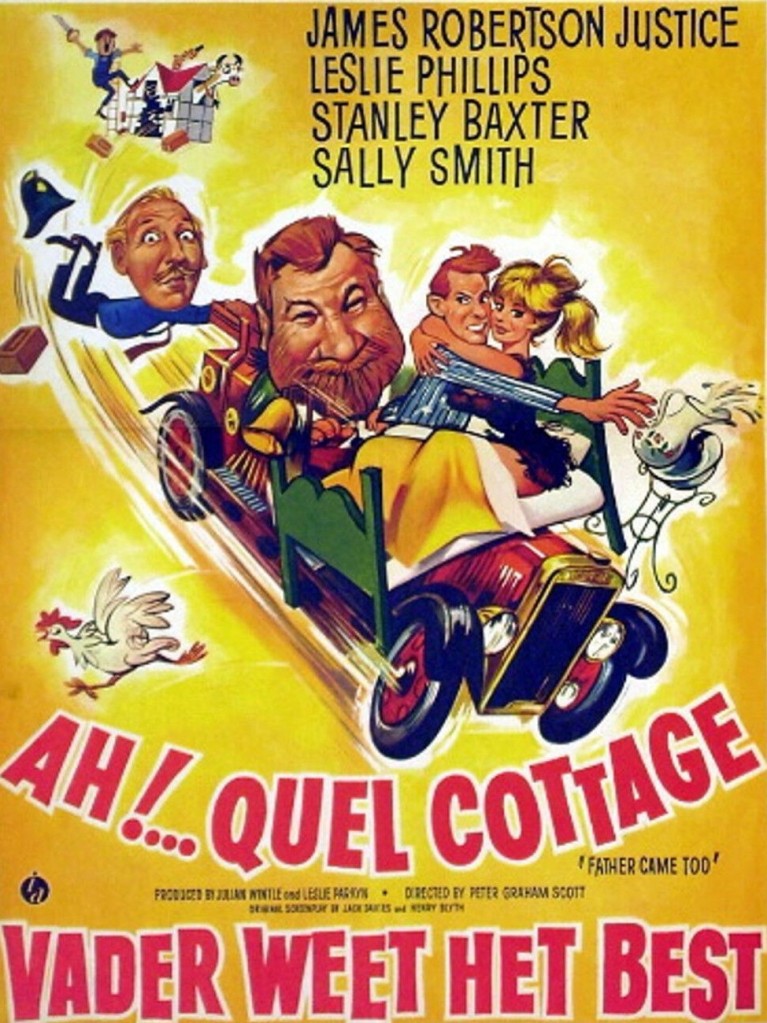
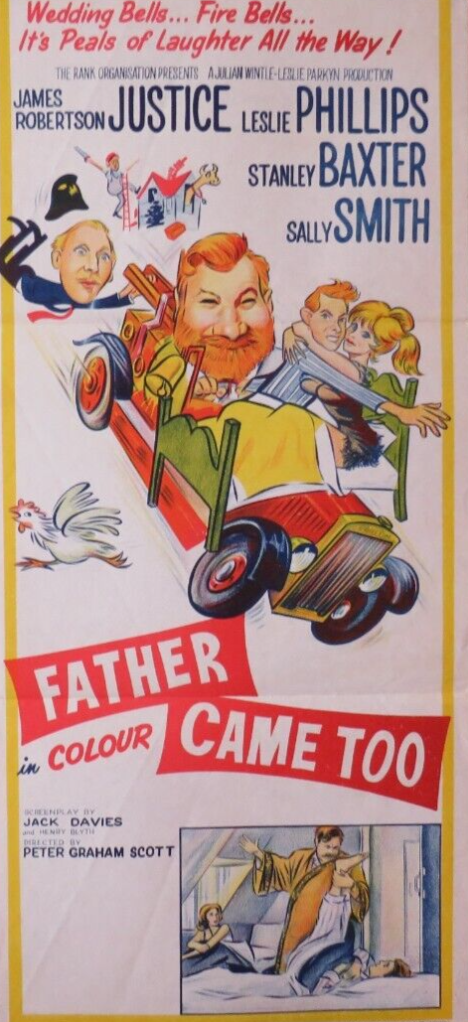
This poster and the one below bear all the hallmarks of a quick reissue
to take advantage of Christie’s post-Zhivago fame.

Cashing in on audience love of the antique auto as demonstrated in Genevieve (1953), and with a surprisingly contemporary nod to the ongoing battle between cyclists and drivers, this mainlines mostly on a long-lost innocent charm even as car salesman Freddie (Leslie “Ding Dong” Phillips) injects as much innuendo (though not on the Carry On level) as possible.

After coming off worst in a collision with aforesaid rich fellow Charles (James Robertson Justice), cyclist Murdoch decides to buy an old Bentley Red Label 3-liter (the titular “Fast Lady”)  sports car as a means of wooing speed-mad Claire. As you might expect, the path to true love is littered with obstacles, not least the overbearing father’s objections and the small matter of Murdoch not being able to drive. Cue jokes about driving lessons and tests and a mistaken arrest for drunk driving. There’s endless opportunity for protagonists to end up in the mud or the water.

Legally, in the credits, her name had to be smaller than the top-billed stars. But there was nothing to prevent distributors from making her face the focus of attention.

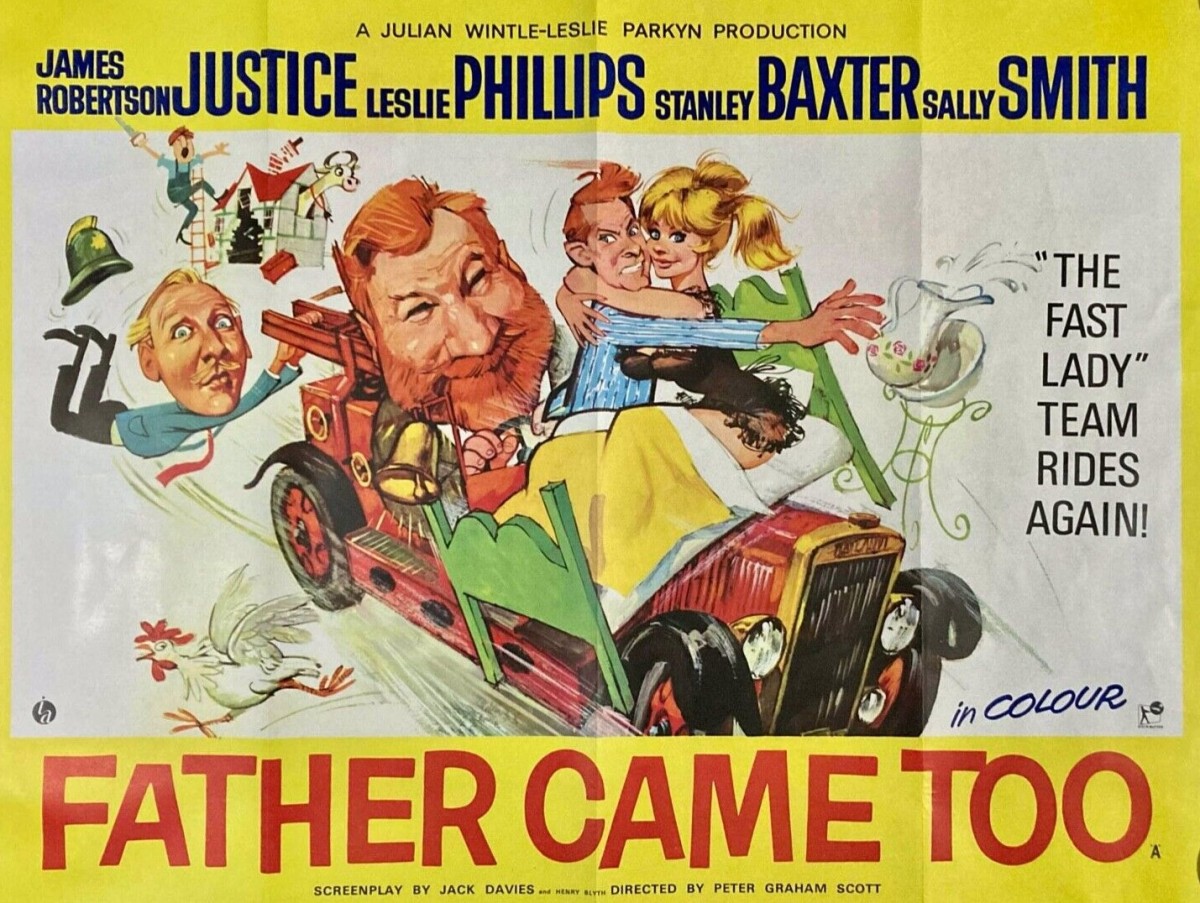
Feels miscast somehow, the top-billed Leslie Phillips (Maroc 7, 1967) has misplaced his normal charm, coming across as little more than an upper-class spiv. And you can’t help feeling Norman Wisdom would have been better suited as Murdoch rather than snarky Scottish comedian Stanley Baxter (Father Came Too, 1964) while James Robertson Justice (Mayerling, 1968) never leaves his comfort zone.

On the plus side are too many treats to mention. Apart from Christie and a glimpse of Stanley Baxter before he dominated the British light entertainment television scene, in bits parts are such  comedy legends as Dick Emery, Frankie Howerd and Clive Dunn (and singer Kenneth McKellar on television) plus a smattering of racing idols like Graham Hill and John Surtees and a cameo from BBC motoring correspondent Raymond Baxter.

Ken Annakin (Battle of the Bulge, 1965) isn’t much stretched though keeping the script by Jack Davies (Those Magnificent Men in their Flying Machines, 1965) and Henry Blyth (A Stitch in Time, 1963), based on the book by Keble Howard, on the straight-and-narrow may well have been his most difficult task.

May be heresy but for some viewers Julie Christie will take second place to the array of vehicles.

https://amzn.to/3uk6rpu

Sons of the Desert (1933) *** – Seen at the Cinema

One of the joys of the current spate of one-day anniversary revivals is that it turns up a 90-year-old gem like this. I haven’t seen Laurel and Hardy on the big screen since I was a child, and that wasn’t even in the cinema, but at our local school in Cumbernauld, Scotland, where the local padre Fr Jaconelli (part of the famed ice-cream clan) ran an impromptu cinema show on Saturday mornings with a shaky 16mm projector.

Actually, I could catch the comedic duo once a week at a pub down the road where the local chapter of the “Sons of the Desert” fan club hosts a showing. “Sons of the Desert,” in case you didn’t know, is an international fan club with hundreds of affiliated clubs (or “tents” as they are known) and this film is the reason.

But the question, as ever, with comedians, is does their schtick stand the test of time. They are perhaps fortunate in that they don’t rely on witty one-liners. On the other hand, the set-ups are so straightforward they are almost prehistoric. And comedy double acts have more or less disappeared.

The movie follows the traditional Laurel and Hardy template, some barmy scheme dreamed up by Ollie, tripping over ever prop in sight, a variety of items to destroy, the pair bedraggled. In this case, Ollie’s wife Lottie (Mae Busch) opposed the idea of them attending the annual convention of the aforesaid desert gang in Chicago so he convinces her that he’s so ill the only way he’ll recover is by taking a trip to Honolulu. Naturally, the liner sinks and they are caught out in the lie.

Meanwhile, all mayhem breaks loose, drenched on the roof, battered at the convention, the target of practical jokes by conventioneer Charley (Charley Chase) who turns out to be Lottie’s long-lost brother. The plot’s pretty much irrelevant where this pair are concerned, just the starting point for a series of gags, whether it’s Stan eating wax fruit, landing Ollie in whatever water is handy, and both doing the wrong thing when the correct would have been simpler.

Sure, Ollie twiddles with his tie and harrumphs and marches his fingers across the table, Stan scratches his hair and looks about to burst into tears, but the combination remains irresistible. Few comic duos have come as close and then for not as long.

The program also included the short Dirty Work from the same year which sees them as chimneysweeps attending the household of a mad scientist who has discovering the secrets of rejuvenation. I’m not such a big fan that I could tell you where Sons of the Desert ranks in their pantheon, except that it was the inspiration for the fan club (which prefers, incidentally, to be known as a collection of “film buffs”) but it was fantastic just to see them on the big screen and imagine the laughter they have generated down the generations.

There was a big revival in the 1960s, when silent comedy was being rediscovered, and there was a cartoon series, and they made so many films you can probably see one anywhere anytime. These kind of gagsters never went out of fashion, Jim Carrey channeled much of their mirth, but few have matched their sense of timing.

I saw this as part of my self-appointed cinema triple bill on Monday. I’ve reviewed the films in reverse order of seeing them. It’s one of the beauties of my method of going to the cinema that I can compile a program from completely different genres – comedy, crime, horror – and go in with little expectation (I doubted even Laurel and Hardy would stand the test of time on the big screen) and come out thinking I had one of the best cinema outings in a long time.

https://amzn.to/3seQd06

The Glass Bottom Boat (1966) ***

One of the joys of writing this blog has been the opportunity to reassess stars that I’ve had a tendency to under-rate. You’ll maybe forgive me for putting Doris Day in that category especially as I’ve had ample reasons now to take a different, Please Don’t Eat the Daisies (1960) just one of the many instances where the actress has confounded my expectations.

Until I started on the Blog I’d never gone out of my way to watch a Doris Day picture with the exception of musical Calamity Jane (1953) when it became a camp classic as well as Hitchcock’s The Man Who Knew Too Much (1956) and films where she happened to be co-starring with Cary Grant.

So I came to The Glass Bottom Boat with low expectations, especially as this was towards the end of her two-decades career and her co-star was Rod Taylor, a different level of star to Grant and Rock Hudson. By now, she had dropped the musical and dramatic string to her bow and concentrated on churning out romantic comedies and also been supplanted by Julie Andrews as Hollywood’s favorite cute star.

But it was in part on the evidence here that I changed my tune regarding Day. This is entertaining enough. And she sings – the theme song, one other and a riff on one of her most famous tunes “Que Sera Sera.” Unless there’s a symbolism I’ve missed, the title is misleading since the boat only appears in the opening section to perform the obligatory meet-cute with Taylor as a fishermen hooking Day’s mermaid costume.

The plot is on the preposterous side. The occasionally hapless Jennifer (Doris Day) is suspected as a spy after infiltrating Bruce Templeton’s (Rod Taylor) aerospace research operation. It’s partly a James Bond spoof – when her dog is called Vladimir you can see where the movie is headed – with all sorts of crazy gadgets. But mostly the plot serves to illustrate Day’s substantial gifts as a comedienne. For an actress at the top of her game, she is never worried about looking foolish.

And that’s part of her appeal. She may look sophisticated even when, as here, playing an ordinary public relations girl, but turns clumsy and uncoordinated at the first scent of comedic opportunity. There’s some decent slapstick and pratfalls and some pretty good visual gags especially the one involving a soda water siphon. A chase scene is particularly inventive and there’s a runaway boat that pays dividends. But there are a couple of effective dramatic moments too, emotional beats, when the romance untangles.

She’s in safe hands, director Frank Tashlin responsible for Son of Paleface (1952) and The Girl Can’t Help It (1956). I also felt Rod Taylor (Dark of the Sun, 1968) was both under-rated and under-used, never given much to do onscreen except stick out a chiseled jaw and turn on the charm. Although he had been Day’s sparring partner in her previous picture Do Not Disturb (1965) he’s not in the Cary Grant-Rock Hudson league.

It’s also worth remembering that the actress had her own production company, Arwin, which put together over a dozen of her pictures, including this one, so she would be playing to her strengths rather than those of her co-star. On the bonus side, watch out for a blink-and-you-miss-it cameo by Robert Vaughn (The Man from Uncle), and a featured role by Dom DeLuise as a bumbling spy.

Everett Freeman (The Maltese Bippy, 1969) wrote the screeplay. 

https://amzn.to/46DGUpF

Love Is A Ball (1963) ***

Three main characters playing against type and a feisty, independent, woman are the main pleasures of this conspiratorial rom-com that takes a while to get going. The main obstacle is the subplot involving the education of a klutz, impoverished French Duke Gaspard (Ricardo Montalban), who needs brought up to speed on the niceties of fine dining, horse-riding and dancing in order to represent a decent catch for American heiress Millie (Hope Lange).

So that keeps ex-racing driver John (Glenn Ford), fallen on such hard times he’ll accept a job as chauffeur, confined to the background for the first third of the movie. That is, until he works out that his employer Etienne (Charles Boyer) is a professional matchmaker who makes a living marrying off poverty-stricken aristocrats to wealthy women. However, he poses as a charmer who happens through his connections to put women in contact with eligible men without letting on that he takes a hefty commission or that his clientele is financially illiterate.

But the cunning Etienne realizes that in order to get close to Millie he has to exploit the  weakness of her over-protective uncle Dr Gump (Telly Savalas) for gourmet food. All these complications create delay in getting on with the will-they-won’t-they romance of Millie and John.

Millie, channeling the adventurous spirit of the likes of Amelia Earhart, is car mechanic, wannabe racing driver and neophyte ballet dancer, so not quite the hapless rom-com female. And she’s pretty good at putting John in his place when he lacks the necessary subservience, giving him a tight deadline to wash her family’s huge fleet of cars, and forcing him to wear a despised chauffeur’s cap.

Meanwhile, Gaspard is causing problems of his own, not just by his complete ineptitude, but by falling for Etienne’s secretary Janine (Ulla Jacobson). So it’s hitches all round especially as Millie and John spend all their time upsetting each other, so much so that, determined to get married to please her grandmother, she’s on the brink of marrying the next clod in Etienne’s line-up.

To be honest, the script is a bit of a mess and in sticking to it director David Swift (The Interns, 1962) hasn’t quite been able to play to the movie’s strengths – and making more of them – rather than trying for what amounts to not much more than an ensemble piece. What lifts the movie is watching the usually steadfast and take-charge Glenn Ford (Rage, 1966) being put through the wringer by the heiress and forced to swallow humble pie any time he has had more than enough.

Next up is Telly Savalas (The Scalphunters, 1968) who totally switches his mean if not downright villainous screen persona to portray a character who dithers over epicurean delights and turns into a happy individual as long as his appetite is sated.  A Jolly Telly is indeed a sight to be savoured.

Lastly, we have Ricardo Montalban (Sol Madrid, 1968), again an actor who errs on the tough-guy side, another of the take-charge fraternity, who always appears completely in command. It’s a bold career move for him to chuck that persona into the mixer and let it spin round a hundred times a minute till he comes out looking frazzled.

Hope Lange (A Pocketful of Miracles, 1961), who had a sporadic career as a female lead, and was at the time involved in an affair with Ford, is excellent as the adventurous headstrong spirit clad in overalls but less convincing as the glamorous heiress especially when simpering.

The screenplay, based on the novel The Grand Duke and Mr Pimm, looks as if it wanted to head in too many heads directions at once, was by Swift and Frank Waldman (Inspector Clouseau, 1968). Farce, at which Waldmann later excelled (he wrote the trio of 1970s Pink Panther films), seems is not a good fit for rom-com.

Worth seeing for Glenn Ford, Telly Savalas and Ricardo Montalban all thumbing a nose at their screen personas.

The Wrong Box (1966) ***

Somewhere between SBIG (So Bad It’s Good) and WAL (Worth a Look), The Wrong Box is a black comedy in the wrong directorial hands. Better known for thriller Seance on a Wet Afternoon (1964) and POW drama King Rat (1965) Bryan Forbes struggles to bring enough comedy into the proceedings or to wring sufficient laughs out of what he has.

Neither the wit nor the slapstick is sharp enough. But it does exhibit a certain charm. Essentially an inheritance story, it pivots on the notion that the two potential inheritors are on their last legs and putting one, Joseph Finsbury (Ralph Richardson), out of action will benefit dastardly nephews Morris Finsbury (Peter Cook) and John Finsbury (Dudley Moore) of the sole survivor Masterman Finsbury (John Mills).

It turns out Joseph Finsbury is not dead. That does not cue as much hilarity as it should., as the nephews plot to send him to his grave. Given the idea was dreamed by none other than Robert Louis Stevenson of Dr Jekyll and Mr Hyde fame, you can imagine it was written less with comedy in mind.

With so much dependent on set-pieces, it’s rather a hit-and-miss affair, with the conspirators’ failures not matching the humor of watching potential victims escape their proposed doom. Only occasionally does it sparkle.

Surprisingly, the film relies on affecting performances from the shy, retiring Michael Finsbury (Michael Caine), a gentle soul, who enjoys a very innocent romance with Julia Finsbury (Nanette Newman), a young woman terrified of being murdered, which condition provides ample opportunity for her to be rescued/consoled. who enjoy a very innocent romance.

Ralph Richardson steals the movie as a dotty pedant, weighted down with erudition and a knack, equally, for boring the pants off anyone within earshot and for escaping from the jaws of death including a massive train pile-up and several murderous attempts.

Michael Caine, in a follow-up to The Ipcress File (1965) and Alfie (1966) convincingly plays against type. John Mills (The Family Way, 1966) also plays against type as a villain rather than Hitherto, I had been rather sniffy about Nanette Newman (Deadfall, 1968),wife of the director, but here she is delightful.

Peter Cook (A Dandy in Aspic, 19680 and Dudley Moore, in his movie debut, let the show down by being so obviously the personalities from their comedy series Not Only…But Also (1964-1970), a partnership that works so well on television just frittered away here from what looks like characterization with nowhere else to go. But there is a nice cameo from Peter Sellers (The Millionairess, 1960) as an inebriated doctor.

Hard to say whether the blame lies with Larry Gelbart (The Thrill of It All, 1963) for his screenplay or Bryan Forbes for his direction.

Michael Caine got it spot-on when pointing out in his autobiography that it was a “gentle success in most places except Britain” precisely because to foreigners it represented an acceptably stereotypical view of a country full of eccentrics while to Brits it was all too stereotypical. So if you’re from America or other points global you might like it and if you are British you might not. On the other hand, the score by John Barry is one of his best with a wonderful theme tune.

Please Don’t Eat the Daisies (1960) ****

This shouldn’t work at all. The episodic structure breaks all the narrative rules. Doris Day fans should be disappointed as she’s not in typical prim rom-com mode (Pillow TalkThat Touch of Mink), but a mother – and with four kids for goodness sake. And, beyond for some reason a sotto voce rendering of “Que Sera Sera,” she doesn’t sing until late on. Worse, she hardly qualifies as the main character. That privilege falls to David Niven.

But it has charm in buckets, it plays around with the rules, breaking all narrative conventions, setting up traps for the viewer, and the four siblings are superbly realistic, little cute or adorable about them, given their main occupation is dropping water bombs on unsuspected passers-by and, even adopting sedentary positions, can’t help but cause mischief.

Initial focus is on academic Laurence (David Niven), promoted to Broadway critic, making mincemeat of a play produced by best friend Alfred (Richard Haydn), in the process savaging its star Deborah (Janis Paige). He quickly becomes front page news when Deborah’s revenge is captured by a photographer. Fame goes to his head and wife Kate (Doris Day) feels she is losing him.

But then suddenly we switch to the countryside after they swap their New York apartment for a huge house. Cue the usual slapstick caused by holes in floors and the inevitable paint. Laurence’s lofty attitudes rile the locals. But before you know it we’re onto the third storyline, Kate reviving her dancing career by putting on a show with the local dramatic society.

By now we’re also knee-deep in sub-plots. Taxi driver Joe (Jack Weston), budding playwright friend of Kate’s mother Suzie (Spring Byington), weaves in and out of the tale. You are led to expect that his Biblical musical script, initially dismissed by Laurence, is going to play a part, perhaps turning up at the dramatic society, or being reworked by Alfred into a hit. You are almost certainly going to be convinced that Laurence will end up in Deborah’s bed. And you are even more certain that Alfred is going to get his revenge by bringing a huge squad of critics and celebrities to the first night of Kate’s play. Unknown to Laurence, Alfred has passed to Kate a rejected early embarrassingly bad effort by her husband when he harboured ambitions to be a playwright.

That all these set-ups are brilliantly confounded turns the entire movie on its head. And the reversals don’t involve cheating. It’s not a question of bait-and-switch, red herrings or sleight-of-hand, but down to the believable reactions of the characters.

In the middle of this, romance would be taking a back seat except both Kate and Laurence are aware of the growing distance between them so it’s more of a middle-aged love story, marriage on the rocks, but both parties making the same type of mistakes in trying to rectify the situation as in the usual will-she-won’t-she romantic template.  

The central focus could not be more topical – sudden fame, its impact on the lucky person and on those around. And I suppose the newspaper stunt that kicks off Laurence’s sudden notoriety is even more common today.

And I have to mention the kids. One of them gets his head stuck in a chair because “nobody told me not too.” That’s the kind of infuriating children they are, parents driven bonkers trying to anticipate their next unexpected venture. There’s a marvellous scene that pinpoints exactly why this whole picture works – by taking reality as its benchmark: Kate, trying to get ready to go out, is surrounded by apparently docile kids. But one, lying on the couch, has lifted his feet, unseen by her, so that he can tap the bottom of a painting on the wall, swaying it gently from side to side behind her head, just waiting for it to fall off.

Doris Day (With Six You Get Eggroll, 1968) digs a bit deeper than normal into her characterization. David Niven (Guns of Darkness, 1962) acts as if he is in a drama, not a comedy, never playing a scene for laughs, which is why he gets so many. When he does turn on the charm it’s not to seduce but to defuse a situation.

Janis Paige (Welcome to Hard Times, 1967) has a ball as the over-the-top star, posterior a matter of public interest, who is rewarded as much as the rest of the cast with deeper characterization than her initial shallowness could expect. Jack Weston (Mirage, 1965), too, goes through various shades before discovering that he has something unexpected to offer.

There’s a bunch of belly laughs, a joke dog, high-class bitchiness among the cocktail set, and a raft of reversals, but mostly it gets by on charm.

Veteran Charles Walters (Walk Don’t Run, 1966) looks as if he’s having a ball too, pulling the audience in different directions, turning up trumps with every reversal. Isobel Lennart (Fitzwilly / Fitzwilly Strikes Back, 1967) created the cunning screenplay from the book by Jean Kerr.

Made in Paris (1966) ***

She sings, she dances, she shakes her booty. What else would you expect from Ann-Margret in light comedic mode (i.e. The Swinger, 1966) rather than serious drama (i.e. Stagecoach, 1966). While appearing as free-and-easy as in The Swinger, she’s actually a dedicated virgin, as was par for the course before the Swinging Sixties kicked in. But the way she lets it all hang out, you’d be forgiven (if you were a predatory male) for guessing the opposite.

Maggie (Ann-Margret) is a career girl, assistant fashion buyer in a New York store, having come up the hard way, small-town-girl then model then salesperson. When the Paris buyer Irene (Edie Adams) quits her job to get married, Maggie is shipped out as her replacement, not as a reward for all her hard work but as punishment because she refuses to sleep with the boss’s cocky son Ted (Chad Everett). The idea is she’ll be so out of her depth, she’ll return humiliated and only too happy to jump into bed.

What do poster designes have against certain colors?
In the movie Ann-Margret dances in blue. In the poster, the dress turns red.

Turns out Irene quit so fast she didn’t have time to tell her Parisian boyfriend and fashion designer Marc (Louis Jourdan) so on Maggie’s first night in the company’s luxurious apartment he turns up. Naturally, he expects a bit of the old-fashioned quid pro quo, je ne sais quoi, whatever they call sex when they are being coy about it, and when she refuses to play ball he cables New York to demand her dismissal. Even when the New York boss (John McGiver) relents, she is banned from Marc’s fashion shows, meaning she can’t buy clothes she is forbidden to view.

Enter Ted’s buddy Herb (Richard Crenna), from the same lothario mold. Just to even things up or add further complication, Ted realizes he is actually in love with a girl who said no after a thousand boring girls who said yes. Trying to win her way back into Marc’s good books, with Herb as her guide she tracks the designer through the night clubs, eventually putting on the kind of sexy wild impromptu dance exhibition that the more staid Maggie could only have achieved if she’d taken lessons from Ann-Margret.

That does the trick and they share an impromptu number (“Paris Lullaby”) on the banks of the Seine although Marc still insists she shed her inhibitions before marriage if she wants to be considered a true Parisienne. The arrival of Mark and then Irene, abandoning her husband on their honeymoon when called in to retrieve the situation, adds fuel to the fire and then it’s one mishap after another, especially when Maggie discovers the pleasures of absinthe and ends up in Herb’s bed (yep, she has a hell of a time wondering not just how she got there but if, Heavens to Murgatroyd as Snagglepuss would say, she committed the terrible deed).

Unbelievably, and just as well perhaps from the narrative perspective, Herb isn’t a love rival. Maggie isn’t his type, its transpires. Shoot that man on sight – doesn’t fancy Ann-Margret?  Lock him up!

You won’t be surprised to learn that it all sorts itself out in the end but you might be a bit taken aback how quickly a dedicated career girl throws away her career once a marriage proposal comes her way.

You might have expected from the title that Maggie would be a model, the best excuse you could find for the actress to cavort in a series of skimpy costumes, as she does in the pre-credit sequence, an exquisite dialogue-free montage with a clever pay-off  that makes you think this is going to be much more stylish – excluding the fashion show of course – than it is.

Ann-Margret has such a dazzling screen persona she makes light work of even the lightest of confections. She does all that her most fervent fans would want but it’s not her fault she’s been cast in a Doris Day comedy that ensures she can only properly express her character by acts of exhibition. Louis Jourdan (Can-Can, 1960) keeps creepy entitlement at bay with lashings of Gallic charm. Despite his character’s playboy tag, Chad Everett (The Impossible Years, 1968) is the squarest of squares.

Richard Crenna (The Midas Run, 1969) spins his normal hard-ass screen persona into something a bit more sympathetic. Edie Adams (The Honey Pot, 1967) and John McGiver (Fitzwilly/Fitzwilly Strikes Back, 1967) add a bit of dash in support.

You’d never guess the director was Boris Sagal of The Omega Man (1971) fame. Stanley Roberts (Come September, 1961) wrote the screenplay.

Ann-Margret at her zingiest. What more could you ask?

The Loved One (1965) ***

If only British director Tony Richardson had seen fit to add some meat to the bones, this satirical look at the American funeral business might have emulated the dramatic impact of Elmer Gantry (1960). As it is, the director is so preoccupied with the funereal inanities that it doesn’t so much lose sight of the plot as pretty much ignore it.

So, yes, the burying of a loved is big business and just like weddings some of the trimmings would make your toe curl. But even when reality intrudes, feet swell after death so require larger shoes and the only way to fit a suit on a corpse is to slit open the back, these are treated in humorous fashion.

And that would all be fine if this was the laff-fest Richardson intended but even with a puffed-out roster of cameos – Liberace as a salesman and James Coburn (Hard Contract, 1969) as a truculent customs officer the pick – this ends up as more documentary than movie. And that’s it’s main attraction for a contemporary audience who might be less concerned about the director’s almighty fall from grace after the stunning critical and commercial success of Tom Jones (1963).

In fact, it’s a shame the story goes anywhere near internment because the initial section concentrating on Hollywood is more successful in achieving a modicum of gentle satire. Wannabe poet Dennis (Robert Morse) has won a trip to America as a prize and lands on upper crust uncle Sir Francis, a Hollywood veteran, tasked with improving the elocution of cowboy Dusty (Robert Easton) so that he can play a British spy akin to James Bond.

That section entails gorillas turning up outside telephone booths, all sorts of monsters dawdling through the studio canteen, and head honcho (Roddy McDowell) running his father’s studio by the seat of his pants until he comes unstuck, resulting in Sir Francis being fired after 31 years. There’s some interesting, almost British, issue-dodging and Sir Francis in true British style, unable to deal the embarrassment of being sacked, commits suicide, leading the nephew into the arms of Whispering Glades funeral operative Aimee (Anjanette Comer). She’s in love with the creepy Joyboy (Rod Steiger) leaving Dennis to woo her using other people’s poems.

There’s another nutcase dropping out of the woodwork every two minutes, and occasionally there’s a mild piece of slapstick or physical comedy. Of course, using rampant sex as the basis for comedy, as with Tom Jones, works far better than death. In the absence of a decent narrative or interesting characters, once the initial heavy-handed points have been made there’s nowhere else to go except be more heavy-handed.   

Until Brideshead Revisited (1981) was turned into a triumphant mini-series, the works of British author Evelyn Waugh had difficulty being transferred to the screen. In part, this was due to his idiosyncratic style and in part that, even at his most serious, he was viewed as a comedy writer.

Screenwriter Terry Southern (Candy, 1968) wouldn’t have been my first choice to translate the Waugh essence for the big screen, but co-writer Christopher Isherwood (Cabaret, 1968) was no more successful.

Robert Morse (Guide for the Married Man, 1967) offers little beyond mild buffoonery. While Anjanette Comer (Guns for San Sebastian, 1968) is surprisingly good as the angelic ditzy object of his affections, she can’t carry the entire picture. Robert Morley (Genghis Khan, 1965) manages to keep a straight face while delivering his lines.

Without doubt hits the immediate target but somehow misses the bulls-eye.

Even so, there’s one element of the picture that would have contemporary Hollywood salivating. And that is a producer not frightened of taking risks, willing to go outside the envelope in a bid to deliver the different kind of movie that audiences obsessed over with Barbie and Oppenheimer.

Martin Ransohoff had an enviable track record in the 1960s. For MGM, he was the mastermind behind movies as offbeat as The Americanization of Emily (1964), The Cincinnati Kid (1965) Eye of the Devil (1966) and Castle Keep (1969) as well as big-budget offerings The Sandpiper (1965) and Ice Station Zebra (1968). His name was on such later diverse titles as The Wanderers (1979) and Jagged Edge (1985). As you can see from this random selection, his movies didn’t always come off, but at least they were different.

The Impossible Years (1968) ***

Generation gap comedy driven by unmentionables and the prospect of perplexed father getting more pop-eyed by the minute. By default, probably the last bastion of morality before censorship walls – the U.S. Production Code eliminated the following year – came tumbling down and Hollywood was engulfed in an anything goes mentality. Denial enters its final phase, quite astonishing the mileage achieved by not letting the audience in on what’s actually going on.  

Psychiatrist lecturer Jonathan (David Niven) finds his chances of promotion potentially scuppered after lissom teenage daughter Linda (Christine Ferrare) is arrested at a demonstration carrying a banner bearing an unmentionable word. That brings to the boil the notion that Linda may not be quite so sweet as she appears, Jonathan previously willing to overlook minor misdemeanors like smoking and speeding. But it turns out Linda may also have lost her virginity, that word also verboten, and may even be, worse, illegally married.

So the question, beyond just how manic her parents can be driven, is which male is her lover: the main candidates being a trumpet-blowing teenage neighbor and let) or laid-back artist hippie who has painted her in the nude.

Innuendo used to be the copyright of the Brits, in the endlessly smutty Carry On, series, but here the number of words or phrases that can be substituted for “sex” or “virgin” must be approaching a world record, but delivered with gentle obfuscation far removed from the leering approach of the Brits.

It’s a shame this movie appeared in the wake of bolder The Graduate (1967) because it was certainly set in a gentler period and its tone has more in common with Father of the Bride (1950). Setting aside that most of the adults, for fear of offending each other, can’t ever say what they mean, the actual business of a young woman growing up and demanding freedom without ostracising her parents is well done, Linda stuck in the quandary of either being too young or too old to move on in her life.

The scenes where that issue is confronted provide more dramatic and comedic meat than those where everyone is grasping, or gasping like fish, for words that mean the same as the other words they refuse to utter.

Parental issues are complicated in that Jonathan has set himself up as an expert on dealing with the problems growing children present. He views himself as hip when, as you can imagine, to  younger eyes, he’s actually square. And he’s also worried his younger daughter Abbey (Darlene Carr) will start to emulate her sibling.

Compared to today, of course, it’s all very innocent and I’m sure contemporary older viewers might pine for those more carefree times. It doesn’t work as social commentary either, given the rebellion that was in the air although it probably does accurately reflect how adults felt at confronted by children growing up too fast in a more liberal age.

David Niven (Prudence and the Pill, 1968) brings a high degree of polish to a movie that would otherwise splutter. He’s playing the equivalent of the stuffy Rock Hudson/Cary Grant role in the Doris Day comedies who always get their comeuppance from the flighty, feisty female. That fact that it’s father-and-daughter rather than mismatched lovers only adds to the fun. And there were few top-ranked Hollywood actors, outside perhaps of Spencer Tracy (Guess Who’s Coming to Dinner, 1967) who audiences would be interested in seeing play a father.

The unmentionable conceit wears thin at times but Niven and Cristina Ferrare (later better known as the wife of John DeLorean) do nudge it towards a truthful relationship. Former movie hellion Lola Albright (A Cold Wind in August, 1961) is considerably more demure as the Jonathan’s wife. Chad Everett (Claudelle Inglish, 1961) breezes in and out.

Although at times giving off a “beach party” vibe, it manages to examine the mores of the  time.

Director Michael Gordon has moved from outwitted controlling mother (For Love or Money, 1963) to undone controlling father without dropping the ball. It’s based on the Broadway play of the same name by Robert Fisher and Arthur Marx.

Lightweight for sure but worth it for David Niven and the sultry Ferrare.

Discover WordPress

A daily selection of the best content published on WordPress, collected for you by humans who love to read.

The Atavist Magazine

by Brian Hannan

WordPress.com News

The latest news on WordPress.com and the WordPress community.