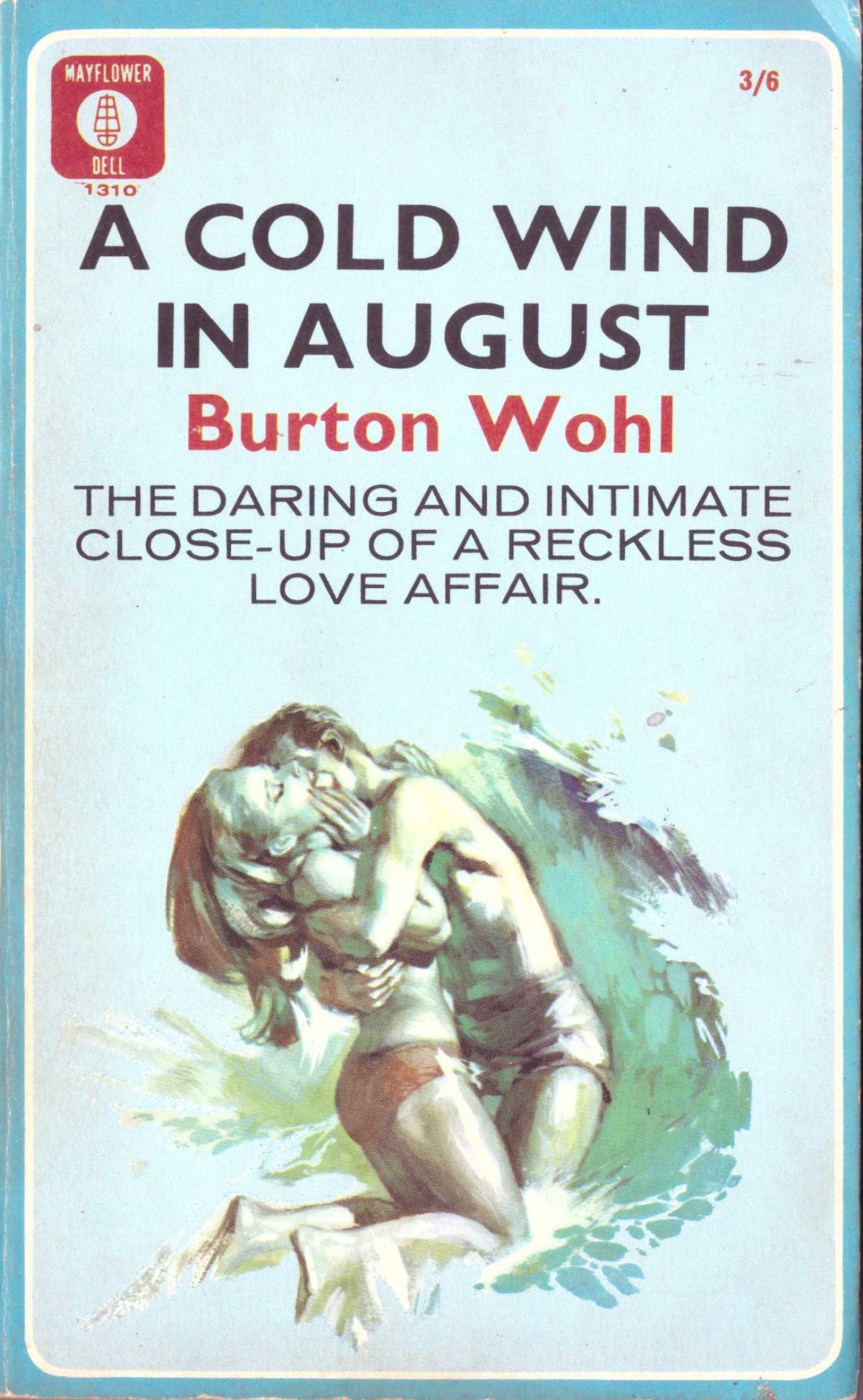
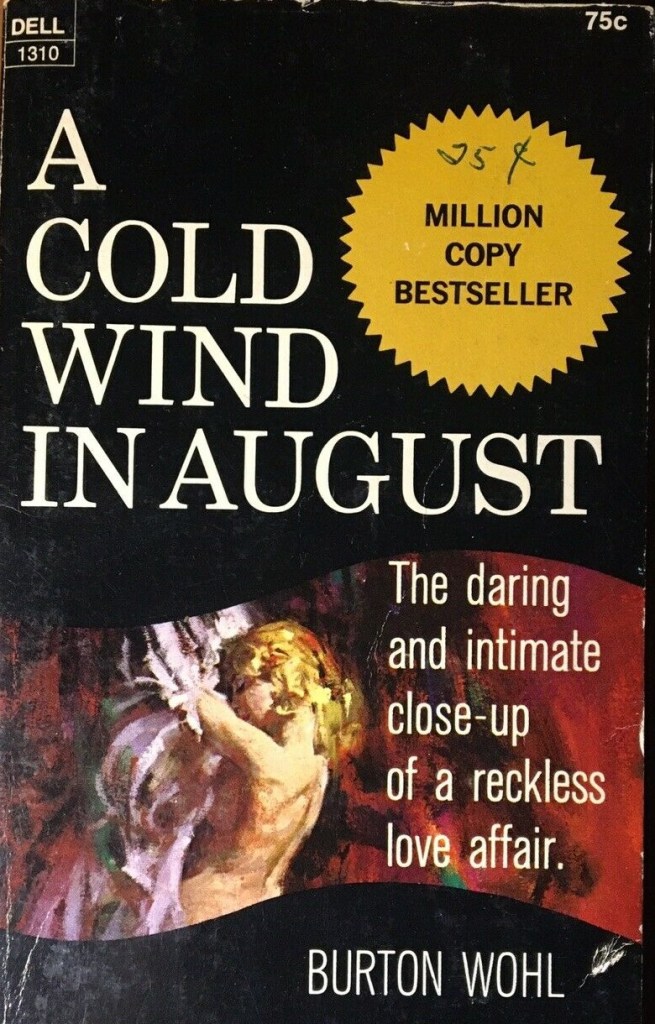
Burton Wohl turned his bestseller into the screenplay – John Hayes not to be confused with John Michael Hayes is credited with the screen treatment – and it’s an object lesson in making the transition. For a start, Wohl had to tone down his racy book. Given that what movies could show on screen was governed by a self-imposed censorship system called the Production Code, I was surprised to discover there was no such automatic limitations laid down on fiction. There had been a boom in paperback originals with sexy covers that might be sold in a local drugstore rather than mainstream book outlet and A Cold Wind in August was a surprise success since most of the books in that line were formula numbers churned out in endless supply.

Much to my surprise, given my assumptions about the period, much of the book is given over to appreciation of the physical attributes of the main character Iris (Lola Albright). This is not achieved in a salacious manner. Iris is proud of having kept her figure in good shape, vital as it is to her career, and she likes admiring it, if only to herself. So a lot of what could be written on the page could not be shown on screen, but Wohl managed to retain the essence of the story and keep intact whole chunks of dialog and sequences like Iris pressing down with her foot on the hand of Vito (Scott Marlowe) or teaching him how to drink.
The film was so well-structured I thought the screenwriter’s main problem would be what to leave out. But setting aside the obvious, it was the opposite. Wohl felt obliged to add. Iris’s ex-husband, whose presence at the beginning of the picture creates the plot device that will imperil her affair with Vito, does not appear at all in the book, the plot element delivered by telephone. There’s a section in the film that’s also new when the couple go out to the park like normal sweethearts. And Wohl also shows how young the man is, when he still gets a kick from horsing around with fire. In the book her act is titled “Mystery Girl from Outer Space” but in the film she is more cat-like.
Perhaps the biggest difference is that in the book Iris is English. Sure, her father is a blunt Yorkshireman with a blunt Yorkshireman’s rough accent, but she has taken the raw ingredients and turned them into something more polished, something she calls “class.”
It’s a short novel, just over two hundred pages, and mostly reflection of one kind or another, rather than action-packed and plot- or plot-twist driven, so by concentrating primarily on key scenes, Wohl manages to translate into film the essence of his book.
Wohl had an unsual Hollywood career. Although credited with story and screenplay for Howard Hawks’ Rio Lobo (1970) along with the director’s regular collaborator Leigh Brackett, and screenplay for The Third Day (1965) starring George Peppard, and Ballad in Blue (1965), mostly he was responsible for novelizations of existing screenplays such as The China Syndrome (1979), Rollercoaster (1977) and Mahogany (1975).




 The Magnificent 60s