I am a published author of books about film - over a dozen to my name, the latest being "When Women Ruled Hollywood." As the title of the blog suggests, this is a site devoted to movies of the 1960s but since I go to the movies twice a week - an old-fashioned double-bill of my own choosing - I might occasionally slip in a review of a contemporary picture.
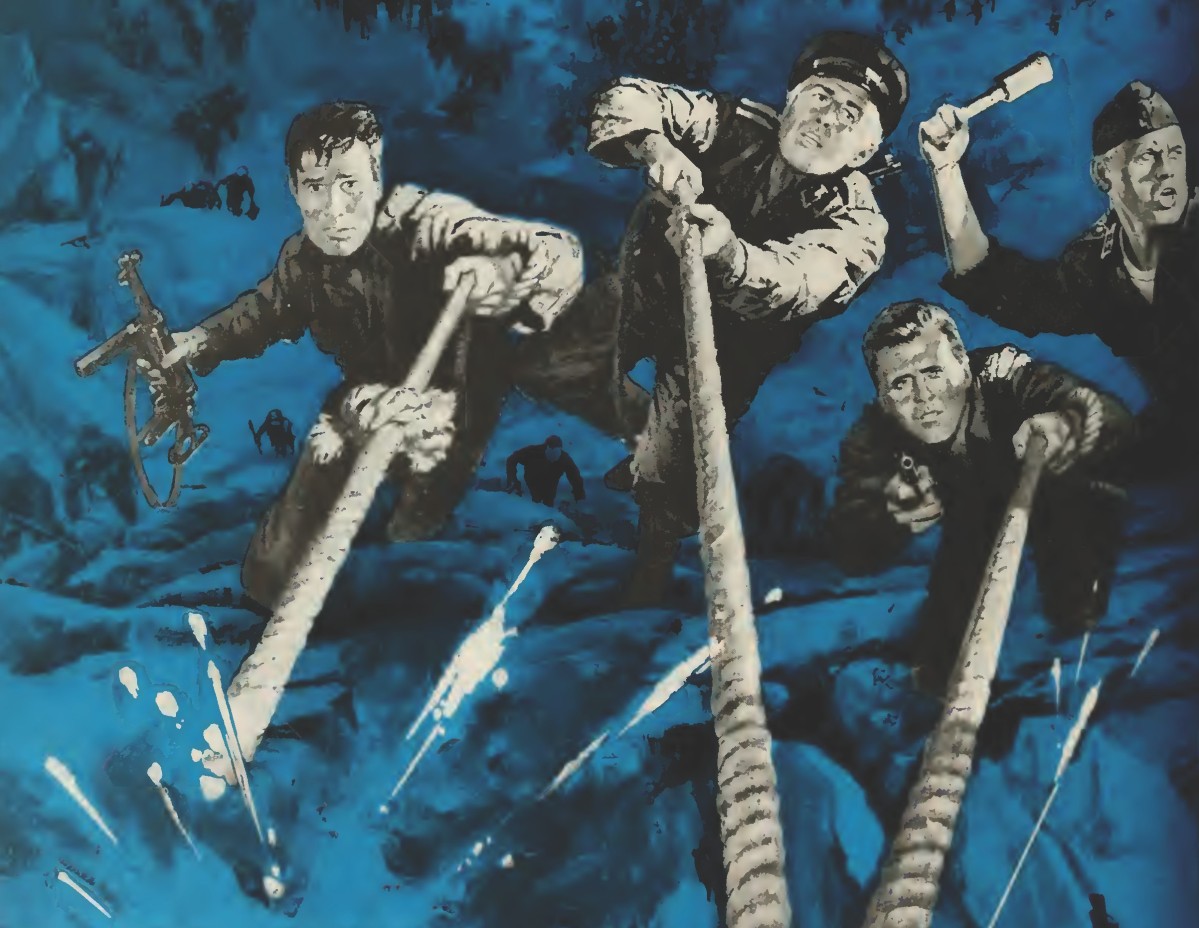
A clever mixture of detail and derring-do, World War Two picture Operation Crossbow (1965) – based on the true story of Allied infiltration of a German rocket factory – was a surprising hit at the British box office. The picture took a risk in keeping star George Peppard hidden from view for the first 28 minutes (top-billed Sophia Loren took nearly another 20 minutes to show up). Prior to their appearances the opening sequences were loaded up with a roll-call of British stars familiar with the genre in the vein of John Mills (Ice Cold in Alex, 1958), Trevor Howard (Cockleshell Heroes, 1955) and Richard Todd (The Dam Busters, 1955). Anthony Quayle, who puts in a later appearance, was also a war movie veteran after turns in Battle of the River Plate (1956), Ice Cold in Alex and The Guns of Navarone (1961).
Most war films relating to destroying a vital enemy base involved bombing (The Dam Busters, 633 Squadron, 1964), sinking (Sink the Bismarck!, 1962) or blowing things up (The Guns of Navarone, 1961). Operation Crossbow falls into the last-named category. The story breaks down into four sections: the discovery towards the end of the war by the British that the Germans are forging ahead with building V1 and V2 rockets; the recruitment and training of spies to parachute into Occupied France; a tense sequence abroad where complications arise; and, finally, attempts to obliterate the rocket plant.
Producer Carlo Ponti’s wife Sophia Loren took top billing even though her role amounted to an extended cameo.
Director Michael Anderson (The Dam Busters) switches through the genres from docu-drama to spy film to action adventure, further authenticity added by bold use (for a mainstream picture) of subtitles, all characters speaking in their native tongues. Various real-life characters are portrayed, among them photo reconnaissance expert Constance Babington Smith (Sylvia Sims), German aviatrix Hannah Reitsch (Barbara Rutting) and Duncan Sandys (Richard Johnson) who was on the British War Cabinet Committee.
Trevor Howard, at his irascible best, is the scientist pouring scorn on the idea of rockets – until they start raining down on London. Volunteers – Peppard, Tom Courtenay (Billy Liar, 1963) and Jeremy Kemp (who appeared with Peppard the same year in The Blue Max) – trained to spike the new weapon are recruited primarily on their language skills. Character is sketchy, Peppard designated a womaniser because he arrives in a taxi with two women.
But the operation has been assembled in such haste that not enough attention has been paid to the identities assumed by the agents. Courtenay’s character turns out to be wanted for murder. Peppard is accosted by his character’s divorced wife (Loren). So the mission faces immediate exposure. Although Loren’s role in terms of screen time amounts to little more than a cameo, she delivers a powerful emotional performance to a picture that could as easily have got by on tension alone. The harsh realities of war are shown in abundance. Twists come thick and fast in the second half, not least that Peppard’s face has become known, before the movie reaches a thrilling denouement.
Hitchcock had set the standard for the glossy thriller. But the bar was set so high few others reached it. Stanley Donen fitted that category with Charade (1963) with Cary Grant and Audrey Hepburn and now he was back for a second crack but minus either star. And the replacement male lead was less of a star and more of a liability.
By this point in the 1960s, Gregory Peck’s career was pretty much at a standstill. Prestige had not saved Behold a Pale Horse (1964) from commercial disaster, thriller Mirage (1965) went the same way, other projects – The Martian Chronicles, Ice Station Zebra – failed to get off the ground or like The Bells of Hell Go Ting-a-Ling-a-Ling were abandoned once filming began. So he was the main beneficiary of Cary Grant’s decision to retire.
In some ways Peck was an adequate replacement but lacked the older actor’s gift for comedy and failed to master the art of the double-take. Arabesque was almost a counterpoint to Charade. In the earlier movie Audrey Hepburn is continually suspicious of Cary Grant. The new movie sees a gender reversal, Peck constantly puzzled as to where Sophia Loren’s loyalties lie.
The Leicester Square Theatre in the heart of London’s West End was one of the four most prestigious first run houses in the capital. As in the United States, studios were prone to sticking advertisements in the trade press – in this case Kine Weekly – should any of their products achieve decent, never mind as in this case spectacular, box office.
The story itself is quite simple. A code has been put inside a hieroglyphic and a variety of people are trying to get hold of it either to decipher the secret within or to stop someone else finding out what it contains. When the scientist who has the code is killed, the man who ordered the killing, the sinister Beshraavi (Alan Badel), approaches Peck to unravel the code, but is turned down. Professor Peck is then kidnapped by an Arab prime minster (Carl Duering), whom he admires, to ask him to take up the job. Beshraavi’s provocatively-dressed wife Sophia Loren, flirting outrageously with Peck, is also after the code.
There follows more twists and double-crosses than you could shake a stick at, leaving the amenable Peck mightily confused. “What is it about you,” he asks Loren at one point, “that makes you so hard to believe?” It looks like director Donen is playing a variation of the famous Raymond Chandler maxim, that when a plot begins to flag, “have a man come through the door with a gun in his hand.” Sometimes there is actually a weapon, but mostly it’s just another twist. If Peck doesn’t know what the hell is going on, then the audience is in the same boat.
But it is stylish, set in appealing parts of Britain (antique university, Ascot), Loren decked out in glamorous Dior outfits and even Peck gets to wear a morning suit. Drop in a couple of action sequences, Hitchcock-style chases in a zoo and pursuit by a combine harvester, Peck nearly run over by horses in a race, and the pair of them having strayed into a builder’s yard facing demolition by the British equivalent of a wrecking ball. But the standout scene is when Loren hides Peck in her shower (curtain drawn) while being interrogated by her suspicious husband and then steps in naked and then they play footsie with dropped soap. And she proceeds to expound, “If I was standing stark naked in front of Mr Pollock (Peck), he’d probably yawn.”
Beshraavi’s jealousy over his wife’s flirtation with Peck adds another element of tension. Badel is a very sinuous, sensuous bad guy, who can turn a harmless massage into a matter of life and death. He also has a pet falcon with a habit of ripping people’s cheeks. But even in the face of obvious threats, Peck holds his own. In one scene as Badel attempts to retrieve what he believes is the code from Peck’s dinner plate, where it has fallen from the hiding place in the professor’s clothing, Peck taps the man’s invading fingers with the sharp tines of his fork.
And there is some accomplished dialogue. When Peck offers the falcon a date and is brusquely told the bird of prey only eats meat, he responds, “I thought he looked at it rather wistfully.” Badel retorts, sharply, “It must have been your fingers.”
Donen had not made a film in the three years since Charade, so there was some critical feeling that he was a bit rusty and used experimentation – big close-ups, odd camera angles – to cover this up. He was living in London by this point, and had been for nearly a decade. But there was very little that fazed him in any genre, and he had switched from musicals like Singing in’ the Rain (1952) to romantic drama (Indiscreet, 1958) and comedy (The Grass Is Greener, 1960). And though there is no question the film would have been better with Cary Grant, Peck proves a reasonable substitute. The movie’s main drawback is the lack of romance since falling in love with someone you believe to be a traitor or a compulsive liar is a hard trick to pull off. But if you like the idea of pitting your wits against the screenwriters, then this is one for you.
A belated entry into the Cold War thriller genre that appeared to have peaked with Dr Strangelove (1964), Fail Safe (1964) and Seven Days in May (1964). The Bedford Incident, filmed in black-and-white with a less-than-stellar cast nonetheless holds its own as an examination of men under pressure, a cat-and-mouse actioner, as well as a stark warning of the dangers of nuclear war.
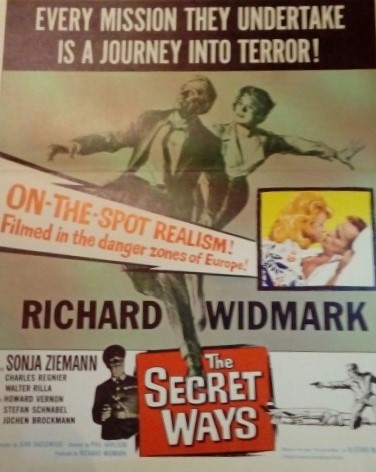
The top-billed Richard Widmark turned producer on this one, as he had done for The Secret Ways (1961), not so much to greenlight a pet project as to hold onto a spot at Hollywood’s high table just when that seemed to be slipping out of his grasp after the commercially disastrous John Ford roadshow Cheyenne Autumn (1964). In truth, Widmark’s position as an outright star appeared questionable. He seemed to transition all too easily between top billing (Warlock, 1959, The Long Ships, 1964) and second billing (Two Rode Together, 1961, Judgement at Nuremberg, 1961, and Flight from Ashiya 1964).
Also putting his neck on the line was James B. Harris who was making the jump to director from producer of Stanley Kubrick’s The Killing (1956), Paths of Glory (1957) and Lolita (1962).
Widmark is a maverick U.S. Navy destroyer captain hunting down Russian submarines should they stray into territorial waters. He has been passed over for promotion, despite having previously successfully forced a Russian sub to the surface. Into his meticulously-run ship are dropped photo journalist Sidney Poitier (re-teamed with Widmark after The Long Ships) and doctor Martin Balsam and, in effect, their presence is a simple device to put Widmark under the spotlight, in some respects challenge his operational methods, and to provide an excuse to tell the audience everything they need to know.
Among the ship’s crew and with privotal roles are James MacArthur as a young ensign and Eric Porter an a German former U-boat commander who acts as an advisor and if you keep your eyes peeled you might spot a fleeting glimpse of Donald Sutherland as part of the medical crew.
The newcomers are afforded insight into how this ship is run and into its hunting methods, for example, dredging up waste from the sea in order to examine it for evidence of a Russian presence. There is a bundle of interesting technical data – a submarine has to surface for air, as another example – and the soundtrack mostly consists of endless sonar. Apart from the German, who appears to subsist on Schnapps, the crew is unusually top-quality, the sick bay deserted, the enterprise run under wartime conditions, every person on board dedicated to fulfilling the captain’s every wish.
The tension is in triplicate. First of all, there is the obsessive captain who could just explode from tension; secondly, there is the hunt for the submarine replete with tactical maneuvers and hunches; and finally, always in the background, there is the nuclear element and the fear that untoward action could trigger a holocaust. And there’s also time to take down a peg or two the holier-than-thou visitors, Balsam revealed as a civilian doctor returning to the service as a refuge, Poitier as a rather spoiled individual who complains when dangerous maneuvers interrupt his shower. Eric Porter is excellent as a hunter who has the unenviable task of trying to rein in his boss. James MacArthur (a graduate from the Disney school) shows maturity as a young officer cracking under pressure. Poitier is excellent in a more relaxed role.
But Widmark steals the show. His over-acting often stole the show when he had a supporting role, but this is a finely nuanced performance. An admirable, instinctive commander, he is loved by his men (such adoration not easily won) with a gift for battle and outfoxing an opponent, often barely containing his own tension. It would have been easy to ramp up the pressures he felt in the way of Humphrey Bogart as Captain Queeg in The Caine Mutiny (1954) but there’s a big difference between a man about to crack and one who loves battle and is desperate to score victory.
Harris makes a sound debut, the decision to film in black-and-white paying off, and enough going on through personality clash and the sub hunt to keep the pace taut. Authenticity was added by filming aboard naval vessels (although British in this case) and what little model work there is does not look out of place. A bigger budget would have made better use of the actual hunt (as The Hunt for Red October, 1990, later proved) but sound effects rather than visual effects suffice. I had not at all expected the shock ending. Another point in this film’s favor is that the threat of nuclear apocalypse has not gone away and the fact remains that the world as we know could disappear at the touch of a button.
Christopher Nolan take note – sci-fi works best if the premise (no matter how preposterous) is simple to understand. In this endearing adventure, set in Victorian times, Professor Cavor (Lionel Jeffries) has invented a paste that defies gravity. Thus liberated, a spaceship covered in the stuff, for example, would fly to the Moon.
The story begins in present times with a worldwide space mission landing on the moon where the astronauts discover the British have been there first. Investigation on Earth leads to Arnold Bedford (Edward Judd, The Day the Earth Caught Fire, 1961), the last surviving member of the original endeavour’s three-person crew.
Space pioneers are usually stalwarts, but Bedford is a bit of a con man, an impoverished wannabe playwright, convincing his American fiancé Kate Callender (Martha Hyer) that he owns the cottage he is renting. Continuing with this ploy, he sells the cottage to the madcap inventor before realising the fortune that could be made from investing in Cavorite (the anti-gravity paste) and signing up for the voyage to the Moon.
Jeffries is a delight as the manic inventor, a far cry from the stuffy seriousness of modern movie scientists, and in a very British way sets up some wonderful comedy, obsessed with keeping out the draught, which would affect the temperature of his experiments. He thinks the mission will survive on a diet of sardines. The romance is not quite as old-fashioned as it first appears. Where Hyer is madly in love, Judd is madly in love with making money. Eventually, she goes off in a huff only to return with supplies for the journey – chickens (to provide further comedy), a shotgun and alcohol. Inevitably, accidentally, she joins the mission.
Then we are straight to Ray-Harryhausen-Land. The title offers a clue to proceedings – “in the Moon” rather than “on the Moon” – as the explorers discover intelligent life in the shape of a race of insectoids under the surface of the Moon. The science, based on genuine scientific principles, continues to be simple – the aliens employ solar power; they live underground because they lacked irises to protect their eyes from the sun; and they hibernate in pods. Maybe the giant centipede has no truth in scientific possibility, but who knows? But the aliens are smart enough to try to replicate the paste and they attempt to communicate. A stand-off naturally ensues though where Jeffries sees the potential for scientific partnership the other pair see danger.
Screenwriter Nigel Kneale (the creator of Quatermass) added Kate Callender to the original H.G. Wells tale. Director Nathan Juran was an old hand at sci-fi, being responsible for The Deadly Mantis (1957) and Attack of the 50ft Woman (1958). Producer Charles H. Schneer had previously teamed with Harryhausen on The 7th Voyage of Sinbad (1958), The Three Worlds of Gulliver (1960) and Jason and the Argonauts (1963).
If you’re desperate for time-travel nonsense and gigantic gunfights and want sci-fi to be a mystery nobody can unravel, give this one a miss. If, on the other hand, you fancy a well-crafted story and accept the limitation budgets place on sets and alien creatures, then sit back and watch.
To round off my week of celebration of The Magnificent Seven, I’ve made a 10-minute video for Youtube (link below). A number of people contacted me to ask why I wrote the book in the first place. As that was quite unusual in itself, I thought i would explain myself.
A decade ago as a treat to myself I purchased an annual subscription at considerable expense to the archive of daily trade magazine Variety. This allowed me to look back at over 100 years of this legendary publication. I used to just pop around the archive wherever fancy took me. At the time I was – and still am – a box office hound. Every week Variety published upwards of three pages of box office stats, listing how movies performed in all the major cities in America. I was poking around the stats for Butterfield 8 (1960) which delivered sensational figures wherever it opened. Every now and then I would come across a listing for The Magnificent Seven and since that was one of my favorite pictures I back-tracked a few months to see how well it had opened in New York.
I must have spent well over a week going over again and again three months of box office figures. Again and again because I couldn’t find any mention of how well the movie had done in New York. I went through the pages with a fine tooth comb, thinking I must just have missed it. But once I had done that, I came to the conclusion that the movie had not opened in New York at all. In those days, every big picture opened at one of the top theaters in or around Broadway. And The Magnificent Seven counted as a big picture. When I got to the year-end results – Variety published an annual chart – I realized the movie had not done well at all. It was, in fact, a flop.
So I began to wonder why a movie that I had always considered a big hit had been the reverse. I judged it a hit because it was reissued several times. It popped up every time there was a sequel, sometimes in a double bill with another from the series, sometimes dualed with a separate picture. For about 15 years after its release it made regular appearances on the reissue circuit – and this was even after being shown on television in the United States as early as 1963.
It didn’t make any sense. Who would reissue a flop? Why would a flop inspire sequels?
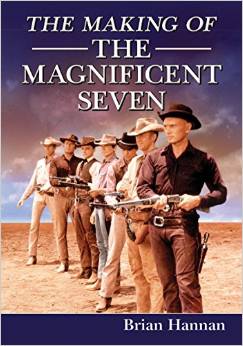
So I dug around a bit more and eventually found out all about the tortuous release history of The Magnificent Seven and my research revealed more of its dramatic history. I became fascinated by the flop that became a hit. It took me more than three years to find out as much as I could about the film from a variety of sources – including the United Artists and Mirisch archives held at the University of Wisconsin, and other trade publications like Box Office, Motion Picture Daily and Motion Picture Herald – and conversations with the screenwriter Walter Bernstein and anybody else I could find who had anything to do with the film. And then it took another year to write the book.
The story behind the making of The Magnificent Seven could have been a thriller itself. Filming was delayed for two years and on the eve of the shoot nearly halted by an actor’s strike, a writer’s strike, interference by the Mexican government and two million-dollar lawsuits. Spencer Tracy, Clark Gable, Marlon Brando and even Swedish boxer Ingemar Johansson (then world heavyweight champion) were all considered for roles. Anthony Quinn was fired.
The book also reveals how Brynner became the biggest independent producer in Hollywood, why United Artists hated it and denied it a prestigious premiere in New York and why it subsequently flopped at the box office. Also revealed is the truth behind the Brynner-McQueen feud and the scene-stealing battle among the actors. The landmark study also forensically examines the screenplay and shows for the first time who – out of the seven screenwriters involved – wrote what, as well as providing a critical examination of the direction.
Tomorrow is the 60th anniversary of the release of the original The Magnificent Seven, and this marks the end of my week-long tribute to the picture and its impact on the American western.
Timing was the biggest obstacle standing in the way of the second sequel. This was the year of masterpieces such as The Wild Bunch, Once Upon a Time in the West,True Grit and Butch Cassidy and the Sundance Kid as well as 100 Rifles, Support Your Local Sheriff, The Undefeated and Tell Them Willie Boy Is Here. I reckoned – as I explained in my book The Gunslingers of ’69 – that it was the best-ever year for westerns. But in the face of such competition there was little room for a retread of a retread.
The budget had been reduced even further from the first sequel, now down to a paltry $1.36 million. Director Paul Wendkos had only made two movies in the previous five years, low-budget programmers Johnny Tiger (1966) and Attack on the Iron Coast (1968), and was best known for the innocuous Gidget (1959). Yul Brynner ruled himself out and his place was taken by George Kennedy, making the step up from supporting actor to star, who had gained acclaim – and an Oscar – for Cool Hand Luke (1967).
As before, being cast in the film presented opportunity. James Whitmore (Chuka, 1967), who had the second lead, was the best known but that wasn’t saying much. Apart from Joe Don Baker (Walking Tall, 1973) and Bernie Casey (Hit Man, 1972), none made a subsequent impact. Monte Markham and female lead Wende Wagner were both drawn from television, the former from The Second Hundred Years (1967-1968), the latter The Green Hornet (1966-1967). Making up the numbers were bit part players Reni Santoni (Anzio, 1968) and Scott Thomas (The Thousand Plane Raid, 1969).
The script by Herman Hoffman follows the same lines as previously. This time around imprisoned Mexican revolutionary Fernando Rey (who had played a priest in Return of the Seven) funds the recruitment of the mercenaries. As before, each recruit is afforded an introductory scene. There’s an expert in hand-to-hand combat (Markham), a former slave who is a dynamite expert (Casey), a one-armed gunslinger (Baker), a knife-thrower and a chronically-ill wrangler (Thomas). On arriving at their destination, the mercenaries become less mercenary. A village boy is adopted. The villagers can’t make up their minds whether to welcome or oppose the mercenaries. Wagner provides the love interest as a peasant girl.
Instead of defending the village, the gunmen and trained villagers storm the citadel where Rey is imprisoned. This is well-executed with the help of a Gatling gun and explosives. However, Kennedy was miscast as an ice-cool killer. The picture also suffered from a dumbing-down of the violence. With a better cast and a stronger director, the material might have produced better results. However, as with its immediate predecessor, what’s mostly wrong about the second sequel is its inferiority to the original. Take away those comparisons and like Return of the Seven it remains a very watchable oater.
Oscars voters will be sharpening their pencils for Aaron Sorkin’s political powerhouse. Comic Sacha Baron Cohen is a revelation as yippie Abbie Hoffman while Yahya Abdul-Matten II as Bobby Seale, Mark Rylance as the defense attorney and Frank Langella as the judge will surely be in contention. Eddie Redmayne as Tom Hayden (Jane Fonda’s squeeze and later a Congressman) might also be favored. I guess Sorkin’s name will be in the hat but once again his writing and directorial skills clash.
The trial was a repercussion of the riots in Chicago surrounding the Democratic Convention in 1968. At the outset I was baffled and confused by the plethora of personalities and coming to grips with the American legal system but once the courtroom drama got underway I was hooked. The battle between a judge and defendants who refuse to recognize his authority plays out like Perry Mason at warp speed (though with the regulatory old-school last-minute intervention).
But I would urge you to see this on the big screen because at any one time so many characters litter the frame they will be too compressed on television and in part because the two most stunning scenes have far greater impact when the action is blown up.
As the various civil rights groups descended on Chicago to stage a protest, the police and National Guard expected a riot – and proceeded to start one. A few years later, the government produced trumped-up charges against the various leaders, including Black Panther Bobby Seale who just happened to be in the vicinity. We are well used, unfortunately, to police brutality and here it is no less brutal. The police have also infiltrated the various groups so can provide doctored evidence of intent. But what is most shocking is the way political will subverts the law. Even grizzled legal eagles are astonished by the judge’s antics especially when Bobby Seale is chained and gagged in the courtroom after one too many outbursts. On the other hand, the banter between the accused and the judge, while breaking protocol, is hilarious; Hoffman and sidekick Jerry Rubin often beating the judge to the punch which a cry of “overruled.”
As a young student at the time I was aghast at television images of the Vietnam War, had seen the Black Panther salute at the 1972 Olympics, and read some Eldridge Cleaver and James Baldwin, but was only vaguely familiar with the personalities behind opposition to the Vietnam War. Here, these personalities are presented mostly in confrontation with the exception of Jerry Rubin, who romances what turns out to be a cop. Wit of both the humorous and intelligent kind are given ample display, sometimes both together. It could have degenerated into a battle between Clever and Cleverer (Hoffman and Hayden, take your pick as to which was which), but that is only part of the wider picture.
While Sorkin’s brilliant script captures the quirks of both the personalities and the legal system, Sorkin the director gets in the way, insisting on incorporating black-and-white newsreel footage and inserting a stand-up comedy routine by Abbie Hoffman. And he definitely pulls his punches regarding Hayden ‘s contribution to the riots.
The best scene is the duel between Redmayne and Rylance in a dummy run for the former taking the witness stand. But the cinematic standout is the ending. Although echoing “Captain, My Captain” in Dead Poets Society (1989) it carries a far deeper meaning, setting on collision course two tenets of American culture, respect for the court and regard for those who have fallen on field of battle.
My only real carp is why this was a film at all when there is clearly ample material for a television series, a four- or six-parter along the lines of Mrs America (2020). I’ll probably watch this again when it reaches television but I will be surprised if it has the same impact as seeing it at my local cinema, where, by the way, I paid for admission. Either way, don’t miss it. It starts on Netflix Oct 16.
Given United Artists’ predilection for speedy sequels – the Bond films, the Pink Panthers, the Beatles movies – Return of the Seven took an age to get out of the blocks. Production was in part held up because of abortive plans to make a Broadway musical with Brynner reprising his leading role. At one point it look edas if the sequel would again pair Brynner and McQueen. And at another point it was set as a 1965 shoot with first Larry Cohen (creator of the Branded television series) and then Walter Grauman (633 Squadron, 1964) in the director’s chair.
Production finally got underway in February 1966 in Spain with Burt Kennedy (The Rounders, 1965) in command. But where the budgets for the Bond films increased with every outing, this was on a reduced budget compared to the original. The film was less of a sequel than a remake (even to the extent of re-using Bernstein’s score). The three survivors recruit four others to save a village from a ruthless Mexican rancher. Brynner returned with Robert Fuller from television’s Laramie filling McQueen’s shoes and Spanish actor Julian Mateos making his Hollywood debut standing in for Buchholz.
Lone gun – Brynner was the only member of the original cast who returned for the sequel.
A decent attempt was made to recapture the magic of the original by casting unknowns who could have a shot at stardom. Jordan Christopher was the pick of the wannabees. Although he had only The Fat Spy (1966) under his belt, he would go on to star alongside Hollywood veteran Jennifer Jones in offbeat drama Angel, Angel Down We Go (1969). While Christopher had the looks Warren Oates (The Shooting, 1966) was half a decade away from top billing although already his off-beat screen charisma brought an unpredictability to the characters he played. Making up the numbers were Claude Akins from television’s Rawhide and veteran Portuguese actor Virgilio Texiera, the former filling the gap left by the broody Charles Bronson, the latter as suave as Robert Vaughn. Perhaps as intriguing for western aficionados was Fernando Rey and Emilio Hernandez who would both become famous screen bad guys, Rey as the drugs kingpin in The French Connection (1971) and Hernandez as Mapache in Sam Peckinpah’s The Wild Bunch (1969).
Certainly, if cast was anything to go by, the ingredients were there and Kennedy would go on to a distinguished career in the genre (The War Wagon, 1967, Support Your Local Sheriff, 1969). But where The Magnificent Seven was a trend-setter, the sequel had nothing new to say. The market in mercenaries had been taken over by The Professionals (1966) and the western revival had been reshaped by movies as varied as Shenandoah (1965), Major Dundee (1965) and Nevada Smith (1966) – the “Dollars” films not released in America until 1967. Part of the problem, of course, was that critics who had buried the original had revised their opinions and were now gunning for something that might trample on that august legend.
But it’s far from suffering from, as Variety maintained, a cliche-ridden script and limp direction. The scenes with the villagers, herded away like slaves, are far grimmer than before and there are some interesting nods to the original. Where Brynner and McQueen rode shotgun on a hearse, here Fuller (the McQueen) character is asked if he will pay for a funeral. While none of the introductions can match The Magnificent Seven, this is altogether a more down-and-dirty world, a country of ruins and cockfighting. The quality of the recruits is lower, Brynner trawling the prison. Honor is in short supply, too. But in chopping pretty much half an hour off the running time, it moves along a fair clip.
Brynner is the standout and the sight of the man in black reaching for his gun still commands the screen. Neither has he lost this humanity and the sense of loss at having left the village is apparent. And while Emilio Hernandez cannot match the panache of Eli Wallach, you cannot help but admire his misplaced sense of honor. The battle scenes are well handled without reaching Sturges’ peak. Had the other actors stepped up to the plate, or if Kennedy had been accorded a bigger budget, it might have been a different story. However, most sequels suffer if all you do is compare them to the original. If you come at this without much reference to its predecessor it still stands up as a good Saturday afternoon matinee.
Return of the Seven is available as a stand-alone DVD but for little more than that cost you might as well get the whole set. Note: here it is called The Return of the Magnificent Seven.
Employing the marketing tools provided by the Pressbook were the main methods a cinema had of selling a movie to the public. In the case of The Magnificent Seven, the Pressbook comprised twelve A3 pages. As well as a range of advertisements, this contained plot summary, press releases, lobby cards, stills and material that could be marketed to television (a one-minute highlights spot and two 20-second ads) and radio (a double-sided record including jingle and interviews with Yul Brynner and Steve McQueen).
While the posters on display outside a theater would be in color, those for use as advertisements in a local newspaper would be in black-and-white. Different typefaces and letter shading were used to ensure advertisements were as arresting when seen in black-and-white as well as color. Unlike today when one image and tagline is used to sell a movie, in the 1960s a studio would produce several different posters/advertisements with a variety of taglines.
This Pressbook came with a bundle of promotional ideas, many revolving around the film’s titular number. Cinema owners were encouraged to develop tie-ups with local retailers that might include the gimmick of a seven-day, seven-hour or seven-cent sale or one that ran from 7am to 7pm. Or in conjunction with the local law enforcement agency, come up with “The Magnificent Seven rules for Safety” or, with travel agencies, a “Magnificent Seven-day Holiday,” Mexico the obvious location. Radio station disc jockeys might come up with the seven best tunes and play the rousing Elmer Bernstein theme music. Stores were encouraged to put up displays of the record sleeves. There was even potential for a fashion link with department stores after adverts had appeared in Esquire and Gentleman’s Quarterly of Eli Wallach modeling menswear.
Publicists did not let the facts get in the way of a good story. Horst Buchholz apparently spoke seven languages. According to the Pressbook it was John Sturges who taught the actors how to draw. The Pressbook also gave the misleading impression that it was Brynner who was in love with the female lead Rosenda Monteros. Another article commented on the difficulties Brynner had on rolling a cigarette one-handed – even though he smoked cigars throughout.
The main tagline was: “They were seven…and they fought like seven hundred.” And there were endless variations of this. Sometimes “they fought like seven hundred” was sufficient. Other times this idea was expanded: “seven notches above the ordinary,” and “the matchless seven.” On occasion, there was tagline that summed up the entire picture: “the renegades among them came for gold…the firebrands came just to taste the excitement…and all seven came to wipe away the past.” In this same advert, each of the gunfighters was defined – Brynner “the leader,” McQueen “the deadly one,” Buchholz “the young one,” Bronson “the strong one,” Vaughn “the vengeful one,” Dexter, “the greedy one,” and Coburn “the rugged one.”
Some exhibitors came up with their own taglines and cut-and-paste images to create their own adverts. In San Bernardino audiences were wooed by “Savage hordes of kill-crazed bandits (hungry for women, gold and blood lust) against the flaming guns of the Seven.” Elsewhere, moviegoers were expected to respond to “a message picture handsomely mounted.” Among the self-made posters was one with women in a provocative pose, something that did not occur in the picture.
In 2015 I published my first major book about the movies – The Making of The Magnificent Seven – and I was lucky enough to receive a review in the Wall St Journal. So I thought I would reprint it below since this month marks the 60th anniversary of the film opening. In recognition of the anniversary the publishers have made substantial price reductions for the print and Kindle version – the latter being less than half the original cover price.
Wall St Journal
These Guns for Hire
Heroism, the film subversively suggests, can sometimes lie in settling down to domestic life.
‘The Magnificent Seven,” when it appeared in theaters in 1960, would have seemed an unlikely addition to the canon of classic films. Its initial release was a flop at the box office, and the reviews were mixed. Even today, film writers commonly place it in the second tier of westerns, beneath “The Searchers,” “High Noon” and a few others.
All guns blazing – The Magnificent Seven launch an empire – three sequels, a remake and a television series.
But if it’s only a runner-up among critics, the story of tough but emotionally vulnerable gunmen coming to the aid of a poor Mexican village is within the top ranks of another canon—what might be called the people’s canon. The film’s popularity grew over time, both in America and abroad. It earned more at the box office in its second four years than in its first three; when the BBC showed it on British television for the first time in 1974, it drew an estimated 40% of the population. “If not the most critically-admired western of all time,” Brian Hannan notes in his account of the making of the film, “The Magnificent Seven can certainly lay claim to being the most loved.”
The film was a pioneering attempt by an American studio to remake a foreign feature. Its source was Akira Kurosawa’s 1954 film “Seven Samurai,” which the actor Yul Brynner had learned about from his friend Anthony Quinn. Brynner bought the rights with the intention of directing rather than starring.
In the volatile development process that followed, the film ended up not in the hands of Brynner but in those of John Sturges, who had started his directing career making short films for the Army in World War II. The Vladivostok-born Brynner would play the lead gunman. He would be joined by, among others, television actors Steve McQueen, Charles Bronson,James Coburn and Robert Vaughn, for whom the film would be their big break.
The composer of the film’s music, Elmer Bernstein, was the director’s third choice, possibly his fourth. But Bernstein’s hiring proved a stroke of luck: His stirring symphonic score, now practically synonymous with the Old West, would be the film’s unseen co-star.
The screenplay by William Roberts and Walter Newman—the latter took his name off the film over a dispute about credits—was broadly similar to that of Kurosawa’s original. In both films, a farm village impoverished by the raids of a bandit gang sends a few men off in search of deliverance. The men meet a master fighter who agrees to help and enlists a fighting force. When the recruits arrive at the village to drive the gang away, both the bandits and the farmers themselves prove to be more formidable obstacles to the gunmen than expected.
Yet Roberts and Newman seemingly defied the laws of physics, reducing the 31/2 hours of Kurosawa’s film to two hours while making “The Magnificent Seven” richer in both incident and characterization. The supporting gunmen have distinct, vividly drawn personalities and motives. In “The Magnificent Seven,” the chief bandit—who is all but faceless in “Seven Samurai”—has an ignoble nobility that makes him almost sympathetic. Indeed, hardly any of the characters in the film are ciphers, not even the dunce who refuses to let Coburn’s gunman and knife-thrower walk away from a duel. One of the useful contributions of Mr. Hannan’s account is to show in detail just how the writers—with, among other things, efficient storytelling devices and shrewd shifts in emphasis—accomplished what they did.
“The Magnificent Seven” is also, to a surprising extent, a film of ideas. Although its precise period is never specified, it ties the gunmen’s limited work prospects to a force that will never stop bearing down on them—the encroachment of civilization. Also notable is the film’s subversion of its own foundations with its suggestion that heroism can lie in settling down to domestic life. For several of the gunmen, the possibility exerts an attraction that they let slip in unguarded moments. The question is whether, as Mr. Hannan puts it, “they have come too far down the road to change.”
Bandit lead Eli Wallach.
The filmmakers, Mr. Hannan tells us, had an unwanted collaborator in the Mexican government. Perturbed by Hollywood’s earlier unfavorable portrayals of the country, the Mexican film bureau demanded and got significant sway over the script as a condition of shooting the film in Mexico. Among the bureau’s requirements was that Mexicans would not go in search of American fighters, an implication of Mexican inferiority. (Modern academic commentary on the film has suggested that the filmmakers set “The Magnificent Seven” in Mexico as a positive metaphor for U.S. intervention overseas during the Cold War; the more mundane truth is that Brynner had decided not to work in the U.S. for tax reasons.)
As Mr. Hannan recounts, screenwriter Roberts found a clever solution to Mexico’s demand: The farmers would go not to find mercenaries, American or otherwise, but to buy guns with which to defend themselves. While looking for guns in a border town, they would encounter Brynner’s character, who would introduce the idea of hiring men, telling them that “nowadays” gunmen are “cheaper than guns.” The shift gave Roberts an unexpected chance to strike the film’s thematic note of societal change and the gunmen’s struggles with it.
Mr. Hannan’s research for “The Making of the Magnificent Seven” is impressive. Although he apparently spoke to only one of the principals (most are dead), he makes the most of archival material. If anything, he sometimes goes over the line from authoritative to exhaustive. But on the whole, it’s a story well told.
As it happens, Hollywood is remaking the movie with Denzel Washington and Chris Prattamong its stars. In an ideal world, the remake, like the original, would be a film that parents can watch with their teen and preteen children—while also seeing them absorb lessons deeper than the “believe in yourself” of today’s standard fare. But as “The Magnificent Seven” tells us, it’s not an ideal world.
—Mr. Price is the author of “The Pixar Touch: The Making of a Company.”