My Policeman (2022) *** – Seen at the Cinema

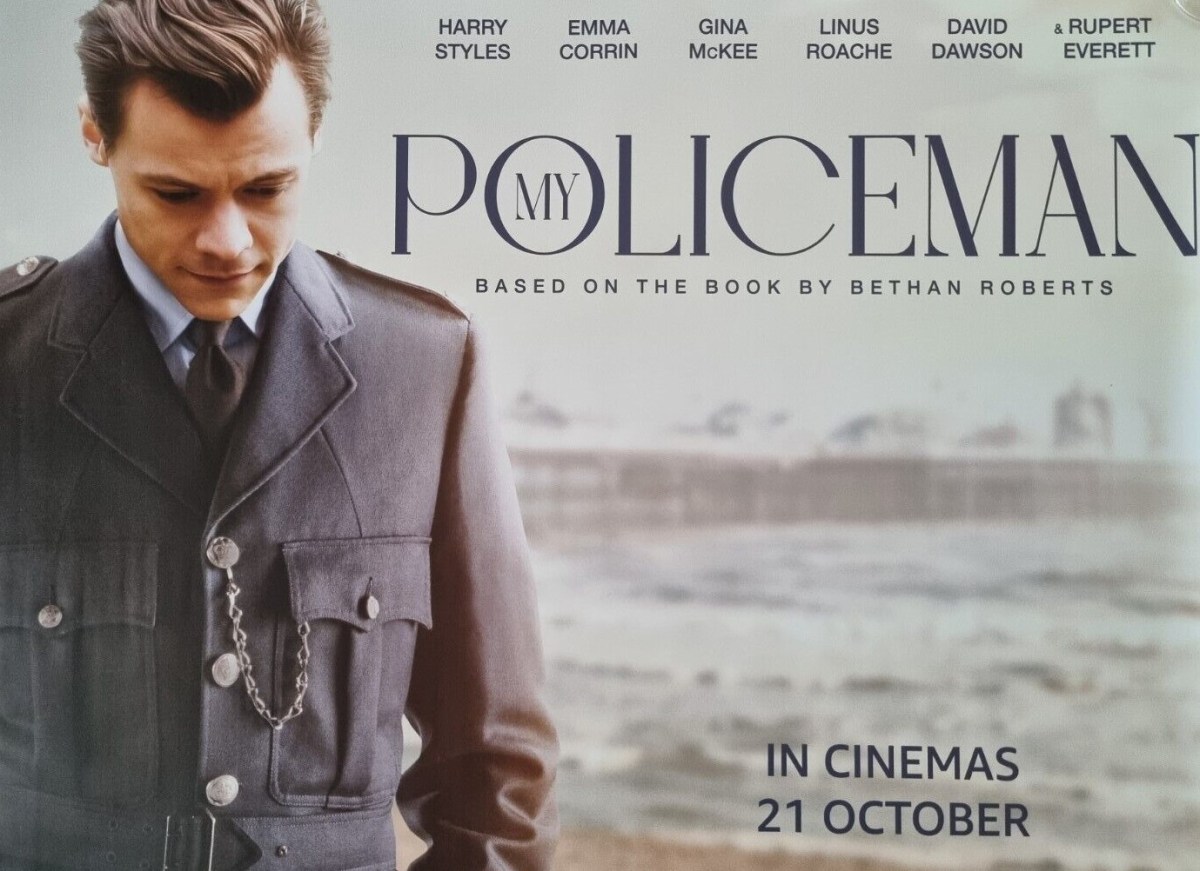
Understated love triangle set in the 1950s with perfectly-pitched performances and punctured by reticence, repression and regret. Not that I check reviews before I venture into a cinema but I gather this has been poorly-received, perhaps because it’s funded by Amazon, which has no great record in making movies, and partly, I guess, because it’s headed by pop star-turned-actor Harry Styles, credited with giving Don’t Worry Darling (2022) an unexpected, and for some, unfai, box office push.

But I found this to be solid stuff and despite the tragic outcome no overtly dramatic acting (unlike Emily for example), the whole enterprise pared down, soulful more than anything, and all the better for it. Mostly, it takes place in flashback.

In the 1990s, a stroke-ridden Patrick (Rupert Everett) is given accommodation in the household of married but childless Tom (Linus Roache) and Marion (Gina McKee). Tom resents the intrusion although they were all best pals back in the day. Gradually, we find out why, but the movie begins in low-key fashion, the young Tom (Harry Styles), a policeman, and Marion (Emma Corrin), a teacher, hooking up with all the innocence of that era at the beach. Tom teaches her to swim, she introduces him to art.

Turns out Tom has an arty buddy, Patrick (David Dawson), the slightly older museum curator. Soon they are a threesome, attending concerts and eating out, and while Marion appreciates Patrick’s appreciation of the finer things in life, she’s more at home with the more ordinary Tom. While he’s a bit hesitant about making advances towards her, eventually he plucks up the courage to ask her to marry him.

The movie flips between the 1990s featuring the older trio and the 1950s with young bucks in love. And part of the movie’s attraction is the innocence, it takes a while to work out what’s going on, or more correctly for the audience to be told what’s going on, which is that Tom has fallen in love with Patrick. But he is also in love with Marion and wants children and a proper family, so the suggestion that in marrying her he is seeking the perfect disguise for his sexuality is never pointedly made. Mostly, we get his confusion. Remember this is the 1950s when homosexuality in Britain was a crime that could result in a stiff jail sentence.

Gradually, Marion begins to suspect Tom has leanings and there’s a wonderful scene where she confesses this discovery to her best friend only to be told the friend is a discreet lesbian. Does this suddenly make the friend a completely different person, Marion is asked.

Of course, it’s only going to end in tragedy, and even then it’s an ongoing one, the older Tom unable to admit his preferences, married to the stoic Marion, and clearly agonising over the life he could have led had he been bolder earlier on.

I thought this was very delicately done. The scene where Tom shows his true feelings by his finger almost absent-mindedly stroking Patrick’s neck and his subsequent awkwardness at what then transpires as he comes to terms with his own suppressed emotions is subtly done.

I’m surprised Harry Styles has had such a rough ride over his performance. Perhaps I was out of the loop in the brouhaha of expectation. I thought he captured very well the character’s uncertainty regarding his sexuality, the knowledge that career (bachelors found it hard to get promotion in the police) and marriage could be jeopardized by an illicit action too many. This could not be a more different performance than the alpha male of Don’t Worry Darling. From his initial behavior I half-expected a rom-com where shyness is gradually overcome, but the implicit danger ensures we steer clear of such territory.

Emma Corrin (Netflix’s The Crown) comes across very well as the equally shy young woman of her time, anxious to appear not too forward, unaware of what to expect from the sexual side of marriage, remaining innocent until her wrath takes hold, and clearly willing to make do for the sake, in that very English manner, of appearances. David Dawson, in his first starring movie role, is excellent, rarely letting anguish get the better of him but far from the camp cliché.

Rupert Everett (The Happy Prince, 2018)  is the surprise turn, the virtually mute stroke victim, enduring the torture of living in the same house as his former lover who consistently ignores him. Gina McKee (Lies We Tell, 2017) and Linus Roache (A Call To Spy, 2019) are good as the mismatched couple, though I’m not sure I believed in her final action, a shade too romantic a gesture for a wife who one way or another has kept her husband in thrall for 40 years.

Michael Grandage (Genius, 2016) should be applauded for his sensitivity, for coaxing superb performances from his younger actors, and for falling into the trap of overloading the picture either with a sense of doom or of overplaying the dangers of the lifestyle. Ron Nyswaner (Philadephia, 1993) adapted the book by Bethan Roberts.

Well worth seeing and at last Prime might have something decent to watch.
Fear No More (1961) ****

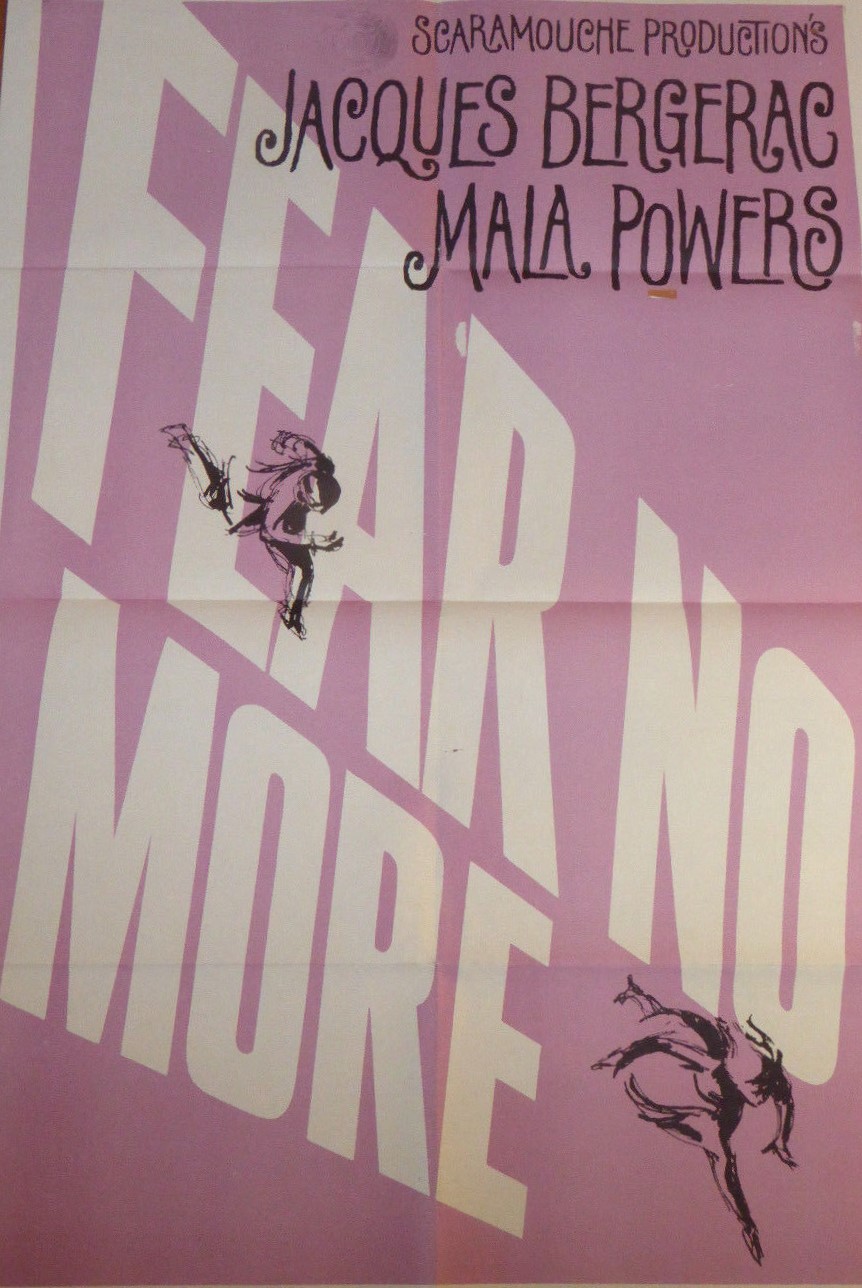
Had Alain Resnais taken the paranoia/gaslighting B-movie route for the esoteric Last Year in Marienbad he might well have ended up with a twisty concoction like this. Whereas Marienbad struggles to get anywhere near a third act, Bernard Wiesen’s unheralded under-rated debut thriller has a stonker of one. It’s the last 15 minutes when the unravelling from an unexpected source takes place that makes this well worth watching. So, I’m sorry to say, spoiler alert, as I take you through why this is so good.

It’s a twist to top all the previous twists, of which there have been many. Movies like this generally rely on story much more than character, but here we see the two main characters substantially alter, almost, psychologiclly-speaking, changing places.

Secretary Sharon (Mala Powers) on an overnight business trip by train discovers a male killer and a female corpse in her cabin. Knocked out, she regains consciousness to find herself accused of murder by cop Joe Brady (Robert Karnes). Managing to escape, she is almost run down by handsome divorced Frenchman Paul (Jacques Bergerac), delivering his son back to wife Denise (Anna Lee Carroll), who gives her a lift to Los Angeles.

Paul, an erstwhile alcoholic it later transpires, pursues her with romantic notions in mind, but she gives him the brush-off. Back in her apartment she finds sozzled ex-lover Keith (John Baer). Paul, not the kind to be so easily brushed off, persuades her to go for a coffee but when she returns to her apartment Keith is dead. Chased by the killer, she is rescued by Paul.

Gradually, she reveals that she once had a nervous breakdown and was committed to a mental institution. But when she goes to see her employer Milo (John Seymour) to explain she has lost the package with which she was entrusted, quite a different scenario awaits.

Brady is there and denies all knowledge of ever having met her. Milo denies sending her on a trip. Worse, Keith is not dead and the package she was carrying contains $3,000 stolen from Milo’s safe, to which she has access.

No wonder the most likely reason for all this confusion is that she is losing grip of her mental faculties. But, if nothing else, Sharon is quick-witted and concludes that too many pieces of this jigsaw are missing and in the absence of Milo’s wife and chauffeur Steve (Peter Brocco) that he has murdered his wealthy partner and is setting up her up to take the rap. That idea only lasts as long as it takes for wife (Helena Nash) and chauffeur to turn up.

Worse, Sharon was committed for killing the woman in her care. She pleaded self-defence and got away with it but her mind crumbled with guilt.

So just when we’re going along with the notion that this is one crazy woman and that “recollections may vary” not as much as she would like and that she is not inhabiting a parallel universe, the Frenchman does a bit of investigating on his own and finds Keith’s corpse.

In more prosperous times in her career, Powers was the female lead here.

Now here’s when it turns very tricky indeed. Although by this point Sharon should be dead in the water, mentally at least, she sparks into life, continues along the line of Milo killing his wife (the body on the train), and begins to point to all the flaws in his plan, beginning with his bungling associates. Milo, who had initially appeared in complete control, now begins to lose his temper and snap at his employees.

Milo and his associates take her to a cabin in the woods. The stronger she grows, the weaker Milo becomes, as she continues her barrage of accusation, picking more holes in his grand plan, until he realises that the police are not going to do his job for him, in condemning Sharon for his wife’s murder. The supposed wife turns out to be Milo’s sister and she, too, begins to crumble with the fear of being found out and her beloved brother going down.

So it’s heading for a complete turn-around, the supposed maniac having been gaslighted, the supposed upright employer turning shadier by the minute and unable to deal with the consequences of an action that has gone so badly wrong. Milo ends up the gibbering idiot with Sharon regaining the faculties she thought she had lost.

The Frenchman comes to the physical rescue and even though at one point the doting sister has the drop on him, she falls to pieces at the thought of what she would have to do to safeguard her deluded brother.

Quite a third act.

But there are a couple of other interesting sequences. When Paul rams on the brakes to prevent his car running over Sharon, that sends his son sitting in the front seat, in the days before seat belts, straight into the dashboard, a rather overly realistic event as regards kids in those days. Picking up Sharon and pacifying his son means Paul is late bringing the boy home to his mother and she lets rip, refusing him any future access. But, unexpectedly, later she turns up in his apartment, asking forgiveness, realising her son was so excited spending time with his father that it would not be right to deny him that.

And with all great B-films this is short and snappy, barely 80-minutes long, and hardly one of those minutes going by without a twist. Sharon is a very interesting character from a psychiatric perspective. Although cleared of killing the woman in her charge, she clearly feels enormous guilt that she allowed it to happen, and once you start falling into a mental trap of your own making it’s pretty hard to get out.

You can always pick holes in movies like this, but the two main characters, Sharon and Milo, seem to me very believable, lost in their own fantasies, especially Milo, who saw his perfect plan falling to pieces.

Unfairly, this was pretty much a dead end for all concerned. Mala Powers (Daddy’s Gone A-Hunting, 1969), the object of Cyrano de Bergerac’s affection in Cyrano (1950) and star of Rose of Cimarron (1952), had lost her way in Hollywood and not been in a movie for three years since The Colossus of New York (1958). Despite giving an excellent performance, Fear No More didn’t prove the answer to her Hollywood prayers and she only had three further movie roles in the 1960s.

Jacques Bergerac – better known for marriage to Ginger Rogers – made his final picture in 1966 but didn’t rise much above the likes of Taffy and the Jungle Hunter (1965). Prior to this director Bernard Wiesen was a producer-director on television and after it that’s what he went back to.

Catch it on YouTube.

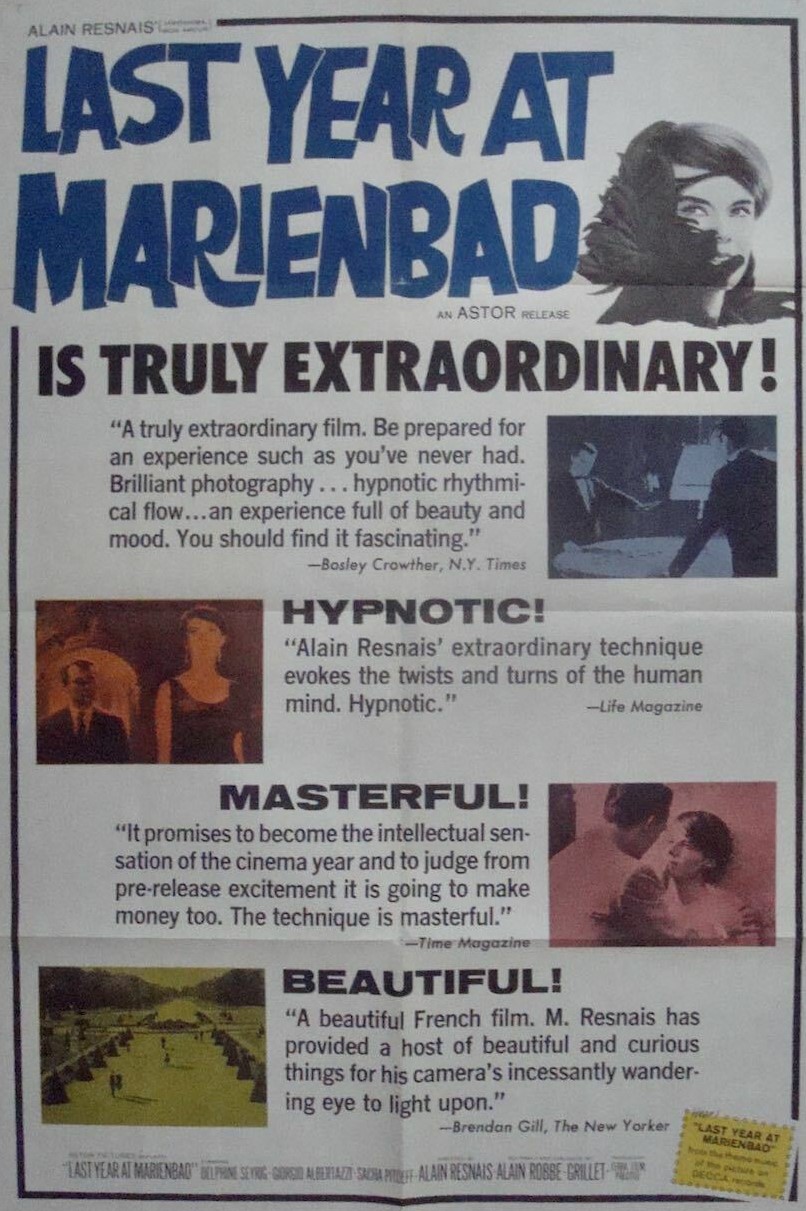
Behind the Scenes: “Last Year in Marienbad” (1961)

The late British Queen Elizabeth II put it succinctly, “Recollections may vary.” Or as director Alain Resnais, in reference to his masterpiece Last Year in Marienbad, explained, “It is quite possible that all the characters are speaking the truth…what is presented as the present or the past is simply a reality that exists while the character is speaking.”

However, Resnais was keen to dismiss other theories. “As far as I am concerned Marienbad contains no symbols or allegories.” He suggested that anyone looking for such meanings “will arrive at a correct interpretation 60% or 80% of the time but your interpretations will never hold good for the film as a whole.” Nonetheless, even Resnais was susceptible to such possibilities, for example, there is a Breton legend of Death coming to fetch his victim but allowing him a year’s respite.   

It was unusual for a director to admit he has no clue what his film was actually about. Resnais confesses that “the game (Nim) is the only point about which I am unable to tell you anything…Robbe-Grillet (the screenwriter) invented a variation without knowing it (the game) existed. My personal impression is that Albertazzi (the would-be lover) loses it consciously and deliberately.”

Offering an alternative view to the film’s meaning, Resnais added, “The whole thing is possibly a part of the woman’s stream of consciousness, as, on the point of deciding what to do, she recalls all the various factors in a few seconds.”

The last pages of the script had barely been written before shooting began. And while that was scarcely unusual, nor for pages to be rewritten during filming, what was singular in this approach was that when the editing could offer dozens of ways of putting it back together, “we always fell back on our original ideas.”

“We wanted the film to work quite differently from a conventional entertainment: by a sort of contemplation, of meditation, a series of advances and retreats from the subject. We wanted to feel ourselves in the presence of a sculpture which one studies first from one angle, then from another, from near or farther away.”

In one sense the movie, as Resnais accepted, can be seen as the man playing the role of a psychiatrist forcing his patient to accept events she has deliberately suppressed. Resnais also introduced other psychoanalytic themes: “the ostentatiously large rooms indicating a tendency to narcissism.”

Resnais added, “It is also attractive to conceive of her (Delphine Seyrig) as an invalid. First of all, the hotel has a special air. And I have always been intrigued by (potential husband) Sacha Pitoeff’s words to the woman as she lies on the bed, ‘You must rest, remember that is why we came here.’ Perhaps the hotel is really a clinic.”

Resnais’s directorial method included making sketches to elucidate his thoughts. “It helps in my relationships with the actors and the cameramen. They save the actor from getting panicky eight or ten days before the shoot. If he has read the shooting script and has a clear idea of it and then while shooting I place him in a position or composition which hasn’t been foreseen he is apt to worry.

“And as I like everyone to be relaxed as possible on the set, I prefer arguments to be over before shooting. I’m all in favor of rehearsing the entire film before shooting begins.

“For Marienbad we drew up a complete chronology on squared paper. And before beginning any scene with the actors, we said, ‘in the editing this scene follows such and such a scene, but in actual chronology it follows another scene which will appear later in the film.’ I frequently recorded a fragment of the preceding scene so as to work from the continuity rather than from the cue.”

He hesitated to adapt his ideas to suit the cinematographer. “I would be reluctant to transform a setting, even in small details, to suit the camera. It is up to the camera to present the décor in the right way, it’s not for the setting to conform to the camera. The same holds good for the actor. I have an immense respect for an actor’s work. (But) how rarely we alter the shooting to suit an actor’s feelings, whereas we are constantly changing it on account of the weather.”

SOURCE: Alain Resnais, “Trying To Understand My Own Film,” Films and Filming, February 1962. P9-10, 41; translated from Cahiers du Cinema by Raymond Durgnat.

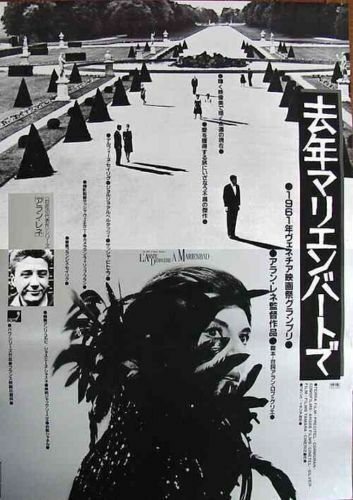
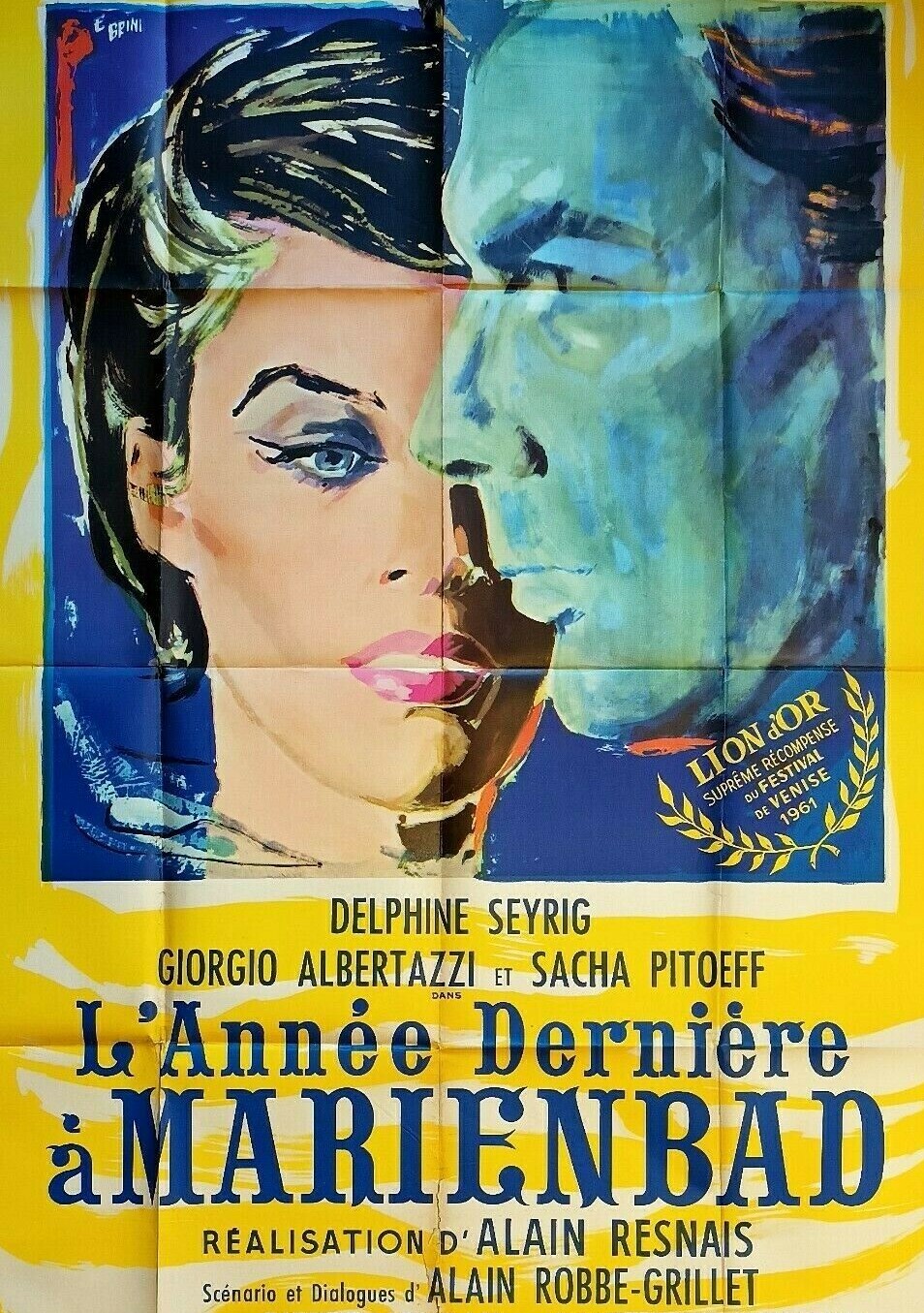
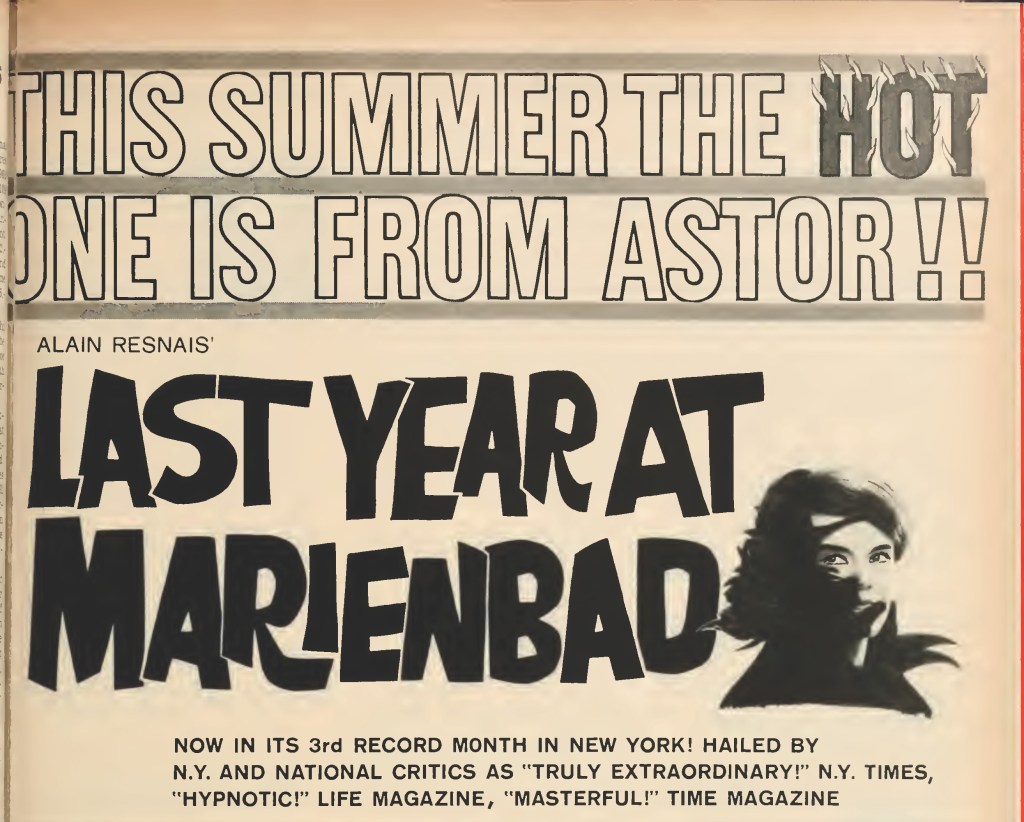
Last Year in Marienbad / L’Annee Derniere a Marienbad (1961) *****

Six decades later this miraculously emerges as a compendium of contemporary themes. Starting off with “my truth,” and segueing through unreliable narrator, false memory, parallel universe, stream of consciousness, dream vs. reality, repetitive voice-over, and still the most tantalising – or infuriating – movie ever made. A cinematic jigsaw with every piece of the puzzle highly stylized.

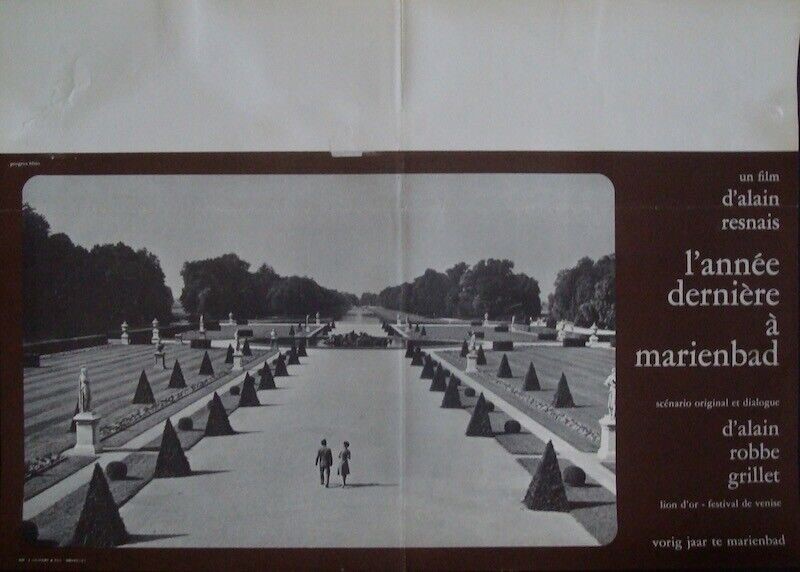
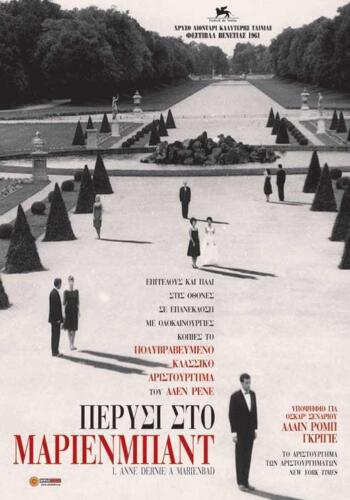
People have shadows but not the trees, the interpretation of a statue is disputed, characters in backgrounds are as frozen as mannequins, there’s a game you cannot win, no one has a name, and every now and then a row of men as if choreographed by Busby Berkeley wivel in turn and shoot at targets. Set in a huge baroque chateau with fabulous meticulous grounds, this fantasy building proves the ideal locale for an endless discussion of reality. And whatever happened last year in Marienbad could have occurred instead  in a number of other locations.

The trees have no shadows. These days CGI would rid trees of shadows but in those days it was the other way round and the shadows of the characters
were painted on the ground.

Two men, a prospective lover (Giorgio Abertazzi) and potentially a husband (Sacha Pitoeff), buzz around a woman (Delphine Seyrig). The would-be lover conjures up a tremendous amount of detail about when he met the woman, only for her to deny all knowledge of the incident, to the extent of failing to recall the reason they are meeting again, one year on. According to him, she had refused to enter into an affair the previous year but vowed to consider his ardent proclamations of love a year later. He has come to claim his reward.

That plot, slim as it is, is all you’re going to get. The movie goes all around the houses trying to establish not only was such an agreement actually struck but also whether she has ever met him at all and where exactly this supposed event might have taken place.

And were it not for the hypnotic tone, the mastery of camerawork, the cleverness of the situation, and the long tracking shots – for me an enormous plus – you might have given up the moment the man repeats, with mild differences, sentences he has already uttered. It’s the equivalent of the crime novel’s closed room mystery, except there is no solution.

So you either dismiss it as a typical French New Wave farrago, fall out with your friends over its meaning, or just sit back and enjoy it, as I did.

For a start, it’s one of the best films ever made in black-and-white, the contrast between the two so striking, the white glowing, the black occasionally ethereal, the lack of dialog almost insisting this is in reality a silent film. There are all sorts of pieces of experimental cinema, flash cuts in conflict with the languorous stately progress of the tracking camera, the aforementioned shadows and mannequins, greater emphasis given to the ceilings and corridors than to the people.

Time and place are distorted, different versions of events presented, the initial story given substance by the husband attempting to put the lover in his place by continuously beating him at an obscure game of cards (the Japanese Nim). And much to my astonishment, just as I was well settled in to letting the director take me where he wanted and expecting no conclusion, there is a climax of sorts that may point the audience in the direction of the correct reality.

By that point, did we even care, the whole essence of the movie being the inability to detect truth, the slipperiness of meaning, the elusiveness of intent and the certainty that what was clear one year is not the next. Cinema is built on conflict, and the most obvious one is difference of opinion. What one person regards as fact, the other dismisses as supposition. This could have been played out in dialog, endless discussion about meaning and veracity, we see it all the time in crime pictures and romance, what exists in one mind not having the same resonance in another, but instead we are treated to one long glorious cinematic essay.  

Director Alain Resnais had already set cinema alight with Hiroshima Mon Amour (1959) and there can have been few artists who hit the arthouse ground running in such style. That the script had been written by eternal bad-boy and future director Alain Robbe-Grillet (Trans-Europ Express, 1966) ensured that it was always going to be controversial. Unusually, Resnais, apparently, stuck very close to the script, so in that sense it was a collaboration rather than the usual loose interpretation of a screenplay.

The stars all took different subsequent routes. Delphine Seyrig, in her debut, would go on to become an arthouse darling in Accident (1966), Francois Truffaut’s Stolen Kisses (1968) and Jacques Demy’s La Peau Deuce/Donkey Skin (1970). Italian Giorgio Albertazzi did not become an arthouse darling, more likely to turn up in bit parts in a historical drama like Caroline Cherie (1968) or in a supporting role in giallo Five Women for the Killer (1974). You might remember Sacha Pitoeff from The Golden Claws of the Cat Girl (1968) and he, too, headed down the support/bit part route.

You might end up resistant to what you see, but everyone with an interest in cinema should see Last Year at Marienbad at least once.

Widescreen Weekend 2022

We are so conditioned to watching old movies on tiny screens it comes as something of a primal shock to see them in all their original glory. Most festivals lean towards the arthouse end of the cinema business so it’s all the more delightful to find an event that without apology concentrates on the mainstream. Widescreen Weekend takes place at the National Science and Media Museum in Bradford, England, and mostly in its Pictureville Cinema, the only venue in the country equipped to show Cinerama pictures in the original three-strip version which requires three projectors.

Wagons race to escape attack in “How the West Was Won.”

And while most other film festivals attract general movie lovers, this one appears to appeal in large part to those who have had something to do with the movie-making business or its technical side. Speakers might include, for example, Cinerama restoration specialist Dave Strohmaier or Kevin Brownlow, editor turned director, and among the audience you might find people like Keith Stevens from Australia, a former operations executive with Village Roadshow there, but who started out as a projectionist and regaled me with tales of projecting The Sound of Music (1965) in its original roadshow run.

There’s a limited number of movies that were made, mostly in the 1960s, either in Cinerama or 70mm, so the event has expanded to take in the earlier Cinemascope and the other versions of widescreen technology on which Hollywood depended as the marketing hook to bring back audiences from the all-encompassing maw of television in the 1950s. Later films whose directors understood the cinematic impact of 70mm are also added to the mix.

You are transported back to a time when screens were just enormous – this one is 51ft wide – and were curtained, and those curtains would not open (to the sides) until in typical roadshow fashion, a lengthy musical Overture, highlighting aspects of the movie’s music, had run its course. There is something quite sumptuous about sitting in a movie theatre staring at huge red curtains and waiting for the house lights to dim and the music to begin.

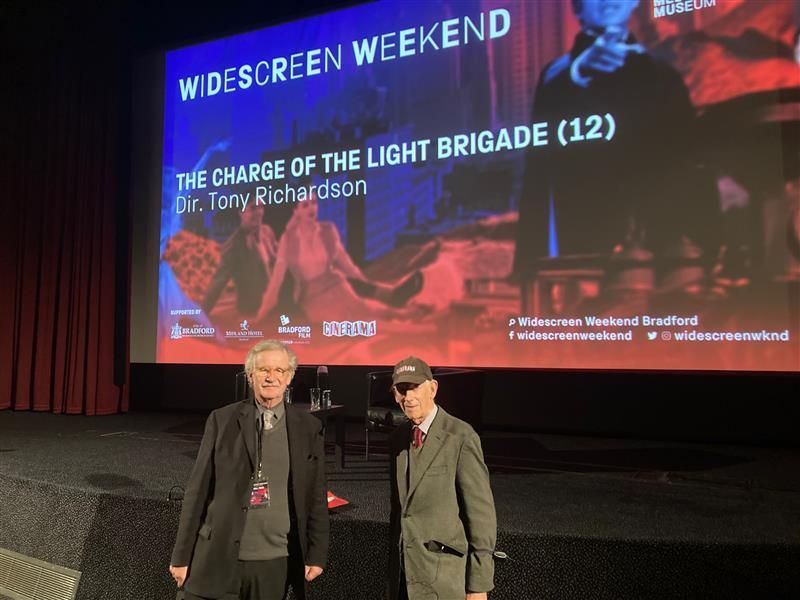
Christopher Frayling and Kevin Brownlow getting ready to introduce “The Charge of the Light Brigade.”

Roughly half-way through the movie itself, the curtains would close for an intermission, and before the picture restarted there would be more music, what was termed the Entr’Acte. Some DVDS of roadshows contain both Overture and Entr’Acte but there is a lightyear of difference between hearing them in your lounge and being exposed to them in a picture house built to bring out their best sound.

This is a homage not just to old movies but the old way of seeing a movie.

In previous years the programs have included Ice Station Zebra (1968), West Side Story (1961), 2001: A Space Odyssey (1968), the David Lean trilogy of Lawrence of Arabia (1962), Doctor Zhivago (1965) and Ryan’s Daughter (1970),a pair from William Wyler that could not have been more diverse – Ben-Hur (1959) and Funny Girl (1968) – This Is Cinerama (1952), Carol Reed’s  The Agony and the Ecstasy (1965), John Frankenheimer’s split-screen Formula One epic Grand Prix (1966) and of course the mother of all roadshows The Sound of Music (1965). Throw in a healthy helping of 1950s Cinemascope features and more contemporary pictures which embraced 70mm and you have the makings of an always satisfying weekend.

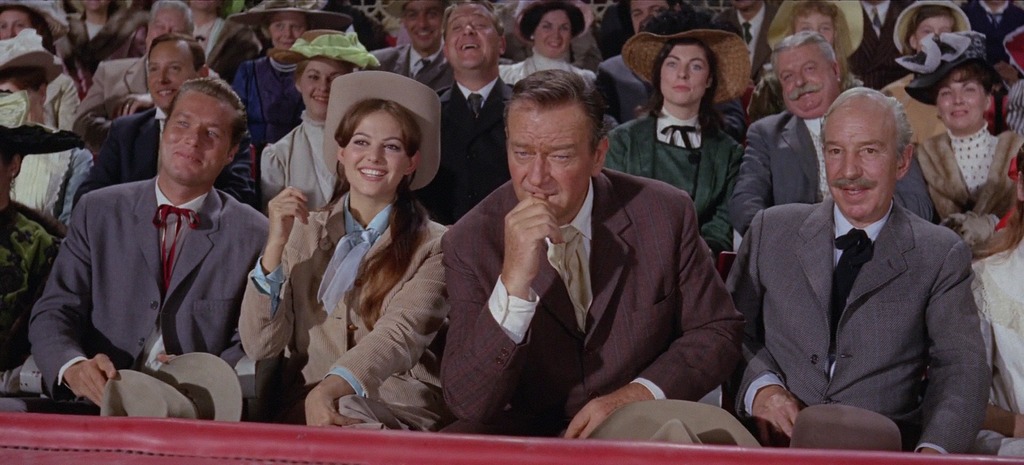
A thoughtful John Wayne next to Claudia Cardinale in “Circus World.”

So one of the highlights is to see old favorites. This year we were treated to the three-strip version of How the West Was Won (1962), your feet tapping immediately at the sound of the driving Alfred Newman score, and a restored The Wonderful World of the Brothers Grimm (1962), the first two movies made in the Cinerama process that had dramatic purpose and were not mere travelogs.

But there was also an opportunity to watch old movies that have never been screened in their original version since their initial release, such as Circus World / The Magnificent Showman (1964) shown in Super Technirama 70. Also on the program was Carol Reed’s Oscar-winning Oliver! (1968), Bob Fosse debut Sweet Charity (1969), The Charge of the Light Brigade (1968) and Douglas Trumbull’s Brainstorm (1983), Natalie Wood’s last picture and one that experiments with screen size. Extending the program into non-70mm widescreen there was a screening of Dracula, Prince of Darkness (1966) and A Star Is Born (1954). Every screening was introduced by an expert and there were occasional surprise guests like Kevin Brownlow, the editor of The Charge of the Light Brigade.

The event takes place in October every year and I’m already looking forward to the next. Kathryn Penny, who has organized the event these past few years, is moving onto a post in academia, and she will be sorely missed.  

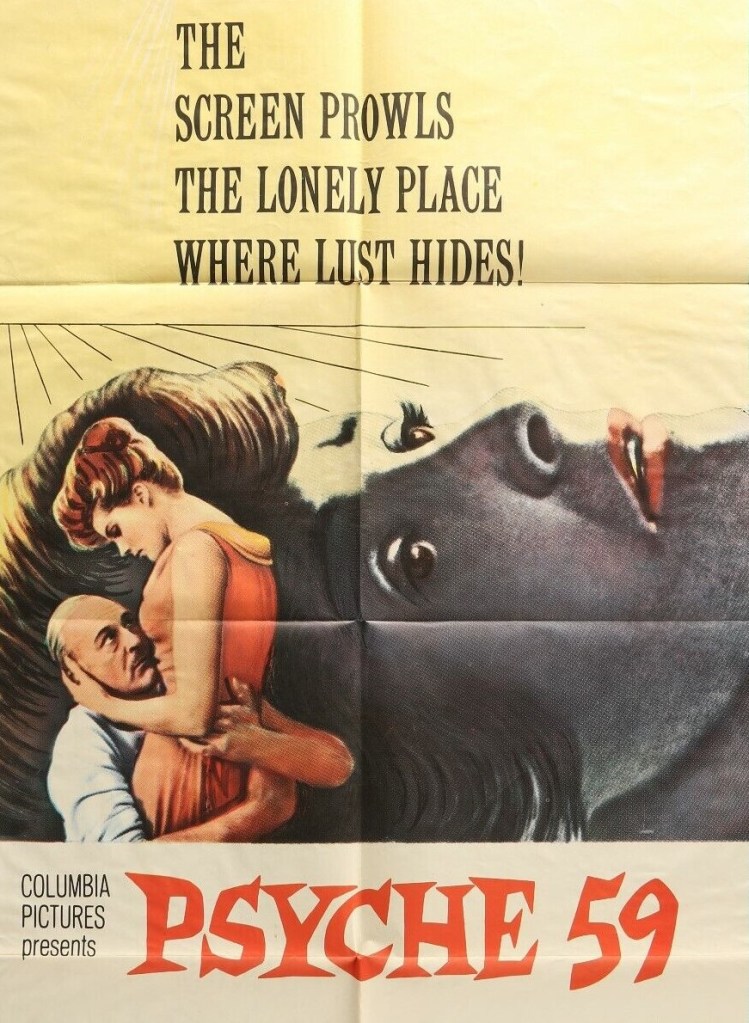
Psyche 59 (1964) ****

This is a low-budget gem, an exploration of the psychological consequences of grooming. You can probably guess from the outset where it is headed but simmering tension has rarely been handled so stylistically.

With the exception of Patricia Neal, an unexpected Best Actress Oscar-winner for her previous film Hud (1963), there were no stars in the cast. Curd Jurgens was only beginning to play characters for whom a German accent was not essential, Samantha Eggar one movie shy of her breakout picture The Collector (1965), Ian Bannen, essentially a character actor, building on his success in Station Six Sahara (1963).

Blinded after an unexplained psychological trauma, Allison (Patricia Neal) welcomes back, over the objections of husband Eric (Curd Jurgens), her much younger sister Robin (Samantha Eggar) to the family home. Family friend Paul (Ian Bannen) cares (possibly overmuch) for Allison while hankering after Robin. The screenplay by veteran Julian Zimet (Saigon, 1947, with Alan Ladd) is taut as a drum, every line a threat, suppressed emotion or piece of exposition that could bring the whole house of cards tumbling down.

The blindness is exceptionally well handled, Allison’s need for physical contact with her husband sensual in its expression. Though she can a ride a horse, her vulnerability is implicit; as she is led across a beach you wonder what would happen were she to be abandoned. What she cannot see becomes central to the movie. That Robin – vivacious but damaged – clearly has some hold over Eric is demonstrated in a tete-a-tete between them but as tensions mount such scenes cannot be kept secret. When Eric grabs Robin’s hair and she retaliates by jabbing him with scissors, neither party emits a sound, leaving Allison oblivious to it all.

Robin takes delight in exposing what has lain on the surface for too long. When Paul begins to fall for Robin, the younger woman astutely remarks to her sister: “Am I taking him away from you?”  Allison, however, is self-aware, convinced she could see if she wanted to, if she was prepared to lift the psychological barrier that keeps the past safely hidden. “I’m afraid to see,” says Allison, “there’s something I’m scared to look at.”

Given the period when it was made there was a lot that could not said – or shown – and even so the film was censored prior to release, but it is the direction by Alexander Singer (A Cold Wind in August, 1961) that lifts the picture up. An acolyte of Stanley Kubrick, the movie teems with imagination, close-ups and extreme close-ups are balanced by long two-shots, a conversation in a car between Eric and Paul mostly direct to camera a prime example.

Emotion is captured at every turn and Singer avoids the cardinal sin of treating Allison like an invalid or focusing on her reaction to what she cannot possibly see, her eyes hidden behind dark glasses for much of the time. Levity is provided by Mrs Crawford (Beatrix Lehmann), Eric’s sci-fi-reading horoscope-obsessed mother and by a couple of excitable children.

The grooming is in the past but the after-effects are very real. In a film like this it is tempting to consider that certain attitudes are dated, but it is clear from this film that nothing has changed, that men believe they can take what they want regardless of the impact on their victims.

Amsterdam (2022) **** – Seen at the Cinema

Shaggy dog story wrapped up in paranoia thriller. A shade overlong, with too many characters and too much plot but such flaws should not detract from that rare cinematic animal, a truly original movie. Brilliant screenplay, believable characters and superb acting prove an irresistible combination.

Though you can see why this sank like a stone at the box office, the all-star cast generally acting against type, idiosyncratic director given vast sums to play with, a tale that goes in too many directions at once, and the unconstitutional events of January 6, 2021, bringing this too close to home for fractured American audiences.

You don’t get this kind of writing much anymore. When individuals come together on a project – to save the world the most likely reason these days – their individuality is usually subsumed to the plot. Here, instead, the reactions of the characters remain distinct and no matter what is going on there is always time for individuality. And some of the invention is just deliciously insane, the nonsense songs for example.

Touching on the World War One aftermath of recovering from mental and physical wounds plus profiteering glee, a sense of a country racked by the Depression on the brink, mind-inducing experimentation of the political and pharmaceutical kind. A trio of war veterans, soldiers Burt (Christian Bale) and Harold (John Davidson Washington) and nurse Valerie (Margot Robbie) investigate a mysterious death, an illegal autopsy uncovering poison, only to find themselves framed for murder.

Burt is not a prime-time player according to wife Beatrice (Andrea Riseborough), and her wealthy family had dispatched him to the war in the hope he would return with bankable glory, but generally treat him as an unwanted black sheep. Valerie now makes art out of war debris, bullet shells and shrapnel, her charming brother Tom (Rami Malek) and his wife Libby (Anya Taylor-Joy) embedded in malevolence. Harold is a lawyer, for whom racism is a constant.

American and British secret service operatives, Norcross (Michael Shannon) and Canterbury (Mike Myers), float in and out. The moneyed business elite, despising White House incumbent Roosevelt, cast envious eyes at the dictatorial economic miracle of Mussolini in Italy.

On everyone’s dance card is General Dillenbeck (Robert De Niro), sought out by our intrepid trio and a mysterious cabal. All he has to do is make a speech at a veteran’s dinner. Make the right kind of speech and the trio are vindicated. Make the wrong kind and he could be assassinated.   

Like Chinatown (1974), Amsterdam is representative, a state of mind, but of freedom rather than endemic corruption. This is an intricate piece and a bit slow for today’s fast-paced generation and with more dialog than might sit well with a modern audience and flights of fancy that are far more original than anything you would find in the MCU. But it’s a hell of an intelligent thriller driven by a bunch of deadbeats.

It never goes down the obvious route. Instead of a love triangle – Valerie and Harold a pair – it’s an evocation of friendship. You don’t need umpteen clues to find the villains, they’re upfront, and they don’t think they are baddies, but cleverer people coming to the aid of the dumb masses putting too much blind faith in democracy. While this is based on a true story, in reality it’s based on the constant of the rich trying to get richer and the wealthy believing they are the best, even if unelected, candidates to run the world.

All that political stuff could have been a big turn-off if it had gone down the preachy route, but it doesn’t, instead it’s almost a miracle that it arrives at any conclusion given in whose hands the narrative has been placed. The Three Stooges would have done a better job of getting there quicker, but then you wouldn’t have had so much fun.

Not only are all the stars on their A-game but acting-wise it delivers some career-reviving turns not least from Christian Bale (Ford v Ferrari, 2019), devoid of a lifetime’s acquisition of irritating tics, John David Washington (Tenet, 2020) called upon to develop a character rather than an action-driven hero. I had to check the end credits to find out it was Mike Myers (Bohemian Rhapsody, 2018) playing the understated Canterbury and hogging the screen with none of the acting pyrotechnics that dogged previous attempts at mainstream work. Ditto Robert De Niro (The Irishman, 2019) and Rami Malek (Bohemian Rhapsody), no grandstanding this time round – don’t worry I recognized both from the off – and Anya Taylor-Joy finally delivering on the promise of The Queen’s Gambit (2020).

Margot Robbie (The Suicide Squad, 2021) is already on the rise and this will add to her growing portfolio of fascinating characters. And if you’re fed up watching any of these stars in brilliant form, there are other distractions in the form of Chris Rock (Spiral, 2021), Taylor Swift (Cats, 2019), Andrea Riseborough (The Electrical Life of Louis Wain, 2021) and Alessandro Nivolo (The Many Saints of Newark, 2021).

You often hear the term “visionary director” thrown about with indiscriminate regard, but this is the right kind of visionary, director David O. Russell (Joy, 2015) with his own way of seeing the world, and delivering it in distinctive fashion, with less of an eye on camera movement and more on dialog and motivation and staying true to a coterie of original individuals.  

I guess the money was spent on atmosphere, this is 1930s USA regurgitated in enormous detail. But you’ll forget the background, the costumes and sets, and be dazzled instead by the script and the acting, and the enveloping tale of friendship.   

Behind the Scenes: “A Swingin’ Summer” (1965)

Might be a stretch to imagine A Swingin’ Summer has anything of note to add to the momentous cinematic history of the decade except for it falling into a booming phenomenon – the actor-producer. John Wayne (The Alamo, 1960), Paul Newman (Rachel, Rachel, 1968), Jack Lemmon (Cool Hand Luke, 1967) and Kirk Douglas (Lonely Are the Brave, 1962) led the way in actors taking complete control of their careers and putting together the movies they wanted to make rather than pitching up as hired hands.

Dale Robertson was an unexpected entrant into the hyphenate business, never having achieved the marquee clout of others, best known for string of B-westerns and the television series Tales of Wells Fargo (1957-1962). Television could be lucrative, especially if you were the star of a long-running show, but the longer you worked on the small screen the more you jeopardised the continuation of a big screen career. Law of the Lawless (1964) was his first movie for six years.

Advert in “Variety” heralding the arrival of Dale Robertson’s new business.

But Dale took an unusual approach to the production business, planning even more control than his predecessors, by setting up a distribution company, United Screen Arts (“USA” a useful acronym”). He had a simple credo, the “clean family film” seen as niche market worth exploiting at a time when only Disney paid it any continuous attention and when Hollywood stood accused of eroding family values with salacious product.

He had teamed up with Earl Collins, intending to release a dozen pictures a year, claiming their operation would be “the salvation of the independent producer.” On top of that, they spent $200,000 acquiring for U.S. television syndication rights to 39 foreign films starring the likes of Elke Sommer and Bebe Loncar.  There was talk of The Redeemer, a low-budget rival to The Greatest Story Ever Told, of handling British film The Quare Fellow and Tom Laughlin’s debut The Young Sinner which had been languishing in distribution limbo for four years.

But the company’s first move was, as trumpeted, into the family market, straight into the lion’s den with The Man from Button Willow (1965), an animated feature, Robertson lending his voice to the main character. And while the family market could offer substantial returns as Mary Poppins (1964) had proved, there was an even more attractive subgenre awaiting exploitation: the teen market.

Your face looks familiar – Dale Robertson with “billboard girl” Raquel Welch in tv show “Hollywood Palace.”

It was estimated that U.S. teenagers had $11 billion in pocket money to spend on records, clothes and movies. Teenagers assumed to have outgrown the Disney animated features were too young to be permitted entrance to more racy fare. But the Britpop explosion, headlined by The Beatles, had emphasised this market’s buying power.

From just a handful of pictures targeting the older young, there were now close on 20 features heading its way, split almost evenly between beach movies and those featuring pop stars – The Dave Clark Five, The Mersey Beats among other British exports along with Elvis Presley – or movies with little attempt at narrative, no more than a “filmed variety show with little variety.”

These movies exhibited acceptable anomalies, one of which was that the pop stars playing the lead roles retained their own first names in order “to speed up and simplify teener identification with their roles.” Remove parents and the threat of a morals clause, and it was a fresh approach to sexuality, and with nudity never an option well within the Production Code definitions of harmless fun.

AIP had successfully segued from its Edgar Allan Poe line of horror movies to beach pictures. Beach Party (1963), with over 10,000 bookings so far, had kick-started the mini-genre, and another half-dozen AIP offerings had entered the movie food chain. Along the way it made stars of Frankie Avalon and Annette Funicello who acted as a junior version of Doris Day and Rock Hudson, bedroom shenanigans reimagined as more innocent beach shenanigans, and instead of being dressed to kill the main characters were as undressed as much as possible, bikinis and shorts the order of the day.

Dale Robertson set out to tap into this market, A Swinging Summer “custom-tailored for the vast teenage audience.” USA lacked the $500,000-$700,000 budget of AIP which permitted the presence of older stars like Dorothy Malone, Vincent Price and Peter Lorre. USA’s aim was, effectively, a C-picture with sunshine and music. Record companies were happy for screen exposure for their artists, so guest spots, which might otherwise have stopped the narrative dead in its tracks, turned into highlights.

With a no-name cast – Robertson knew Raquel Welch from television variety show Hollywood Palace – and a simple location at Lake Arrowhead in California, the movie was quickly filmed in summer 1964 but held back a year. USA managed tie-ups with Suzuki and Yamaha motorbikes, the former promising a free ride to anyone brandishing a ticket stub, and with record company Moonglow, which offered prizes of the latest album by The Righteous Brothers. A press conference and screening was held for 300 high school newspaper editors and Robertson managed to put together a nationwide tour with some of the participants, although its biggest piece of publicity came from a woman who got her finger stuck in the spoke of a steering wheel during a drive-in screening in Milwaukee.

A few years before or a few years after, A Swingin’ Summer would have been support material, speedily in and out of theaters. But riding a short-lived zeitgeist and taking advantage of the unexpected rise in popularity of Raquel Welch it did much better.

There was a saturation release in 71 houses in North Carolina, “impressive grosses” at the Pacific Drive-In circuit, topped by a record-breaking opening in the Crest Theater in Bakersfield, a good $7,500 at the Twin Drive-In in Cincinnati, a very healthy $28,000 in a New Orleans break, and $26,500 from five cinemas in Kansas City. First-run proved hard to come by but it still snapped up $7,500 at the 2,432-seat Fox in Denver. Supporting features included Major Dundee and Wild in the Country.

There were sightings through 1967, no doubt on account of Raquel Welch’s growing popularity. And if it wasn’t a shoo-in for big city center palaces, it found a hearty welcome in smaller operations in small towns. “The best beach picture ever played,” was the opinion of the Fayette Theater in Fayetteville while at the New Theater in Arkansas it was considered “one of the smaller pictures” that outgrossed bigger-budgeted efforts.

But this was a short-lived phenomenon, and within a few years a beach picture would be a rawer affair like The Sweet Ride (1968) and music would have segued from pop into drugs and rock’n’roll.

Dale Robertson’s foray into production was equally short-lived, moving back into television and developing a night club act. The beach genre generated not one long-term talent outside of Raquel Welch.

SOURCES: “Swingin’ Summer Release To United Screen Arts,” Box Office, February 22, 1965, p10; “Advert,” Variety, February 24, 1965, p21; “Teenagers And Their Pocket Money, A Film Market Unto Themselves,” Variety, March 10, 1965, p4; “Kansas City,” Box Office, May 31, 1965, pC4; “Dale Robertson’s Distribution Credo,” Variety, June 16, 1965, p11; “A Swingin’ Film,” Box Office, June 27, 1965, pNC2; “USA’s Summer Starts Strong in Bakersfield,” Box Office, June 27, 1965, pW5; “Swingin’ Summer Set for Pacific Drive-ins,” Box Office, August 9, 1965, pW5;  “Honolulu,” Box Office, September 13, 1965, pW4; “USA’s Swingin’ Summer Opens in 71 NC Dates,” Box Office, September 20, 1965, pSE4; “USA Sets Record Tie-Up for Swingin’ Summer,” Box Office, September 20, 1965, pB1; “USA, KFWB Host Schools To Promote Summer,” Box Office, November 1, 1965, pA3; “The Exhibitor Has His Say,” Box Office, October 24, 1965, pB4; “The Exhibitor Has His Say,” Box Office, September 11, 1967, pA4. Variety box office figures: June 9, 1965, p9; August 4, 1965, p9; September 22, 1965, p9.

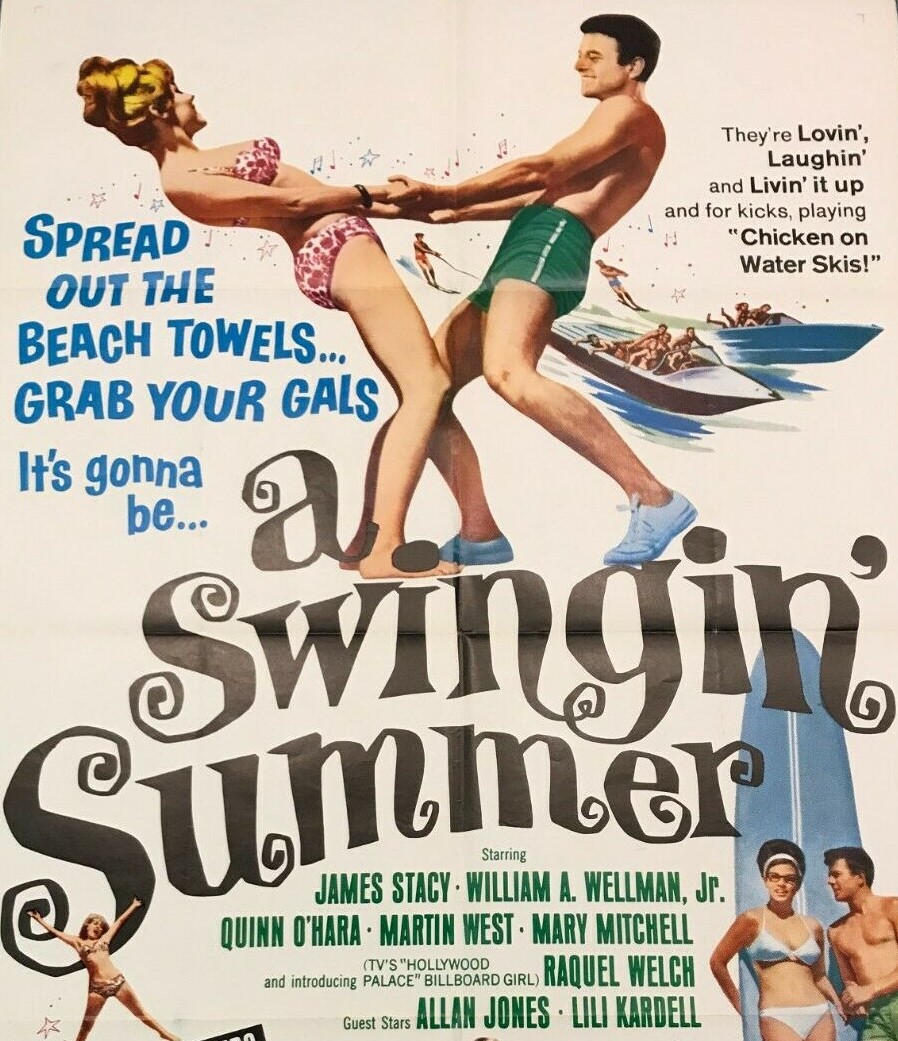
A Swingin’ Summer (1965)***

I admit it: spotting this on YouTube I couldn’t resist. After all, someone has to report on the first proper Raquel Welch picture. Plus, I had never seen a beach movie, such a staple of the decade. Plus, depending on your point of view, Raquel gets to sing.

But why waste any brainpower coming up with a new idea when you can recycle an old one – let’s put the show on in the barn. Or a version of it.

Raquel Welch – distinctive in any language.

When their summer plans are dashed, students Mickey (James Stacey) and Rick (William Wellman Jr.) decide to promote a series of beach concerts. That doesn’t sit too well with lifeguard Turk (Martin West) who takes an unwelcome shine to Mickey’s neglected girlfriend Cindy (Quinn O’Hara). Rick, meanwhile, is intrigued by nerdy Jeri (Raquel Welch) but a bit put off to discover she’s more interested in a meeting of minds than anything more obvious, and possibly by her independent, proto-feminist streak, in that she selected him for her “summer romance.”

Just in case you thought there wasn’t much else to do but wait till the wannabe promoters got their act together and people fell in and out of love, there’s a hefty amount of subplot: a fistfight, a robbery and a water-ski version of “chicken.” Plus if there was any chance of you getting bored, house band Gary and the Playboys and a variety of other acts, including as the climax The Righteous Brothers, hit the stage and, in the interests of gender equality, the platoon of good-looking women hanging around are matched by a squad of good-looking men. 

There’s even some effort at comedy, a few pratfalls, mostly thanks to the distractions of Jeri, and one gender-switch sight gag which seemed pretty daring for the times, and even a nod in the direction of health food fads. Perhaps, more surprisingly, are the solid characterisations, the principled Mickey who refuses to sponge off Cindy’s rich father. Discovering she bailed him out behind his back, securing the sum required for the project from her father, he accepts the money as a loan but renegotiates the interest rate.

Jeri is way ahead of her time, analysing the men she fancies and with the repartee to keep them in line. It’s pretty even-handed in the beach costume department, for every girl in a bikini or tight top there’s a bare-chested topless hunk, though it still manages to be overtly sexist, girls needing measured by an obliging male in order to enter a beauty contest.

Scottish actress Quinn O’Hara (The Ghost in the Invisible Bikini, 1966), a former beauty queen and girlfriend of pop star Fabian (Mr Hobbs Takes a Vacation, 1963), must have thought the prospect of becoming the breakout star pretty high, what with her reimagining of the Lana Turner/Jayne Mansfield tight top. Her only rival was the girl playing the nerd who hooked the male lead’s best friend. Ostensibly, the nerd was not much of a part, spouting psycho-babble most of the time.

A nerd is still a nerd, O’Hara must have assumed. Unless she’s Raquel Welch.

Welch handles the dialog very well, probably longer speeches than anyone else, but even with  her horn rim glasses and hair in a bun, and determined to measure potential partners by their brain cells, she stands out as an independent thinker long before she releases her secret weapon, a yellow bikini, and smart enough to work out that if that doesn’t set a man’s pulse racing to head for second base – jumping onto the stage to strut her stuff.

It’s a bit of a stretch to argue that an appearance in a low-budget beach movie ushered her into the Hollywood fast lane, but, hey, timing is everything, especially if you happened to catch the eye of a producer looking for someone to model a fur bikini.

None of the men made much of a splash in the movie business though James Stacy was the male lead opposite Welch in Flareup (1969). Supporting actor Allan Jones was the biggest name in the cast but well past his heyday as a Marx Bros stooge.

Some of the singers were better known than the actors. Topping the bill in that respect were The Righteous Brothers – hot after “You’ve Lost That Lovin’ Feeling and “Unchained Melody” – who sang “Justine” (no smash, reaching just No 85 in the U.S. singles chart). Gary Lewis and the Playboys also topped the charts in 1965 with “This Diamond Ring.” But The Rip Chords were coming to the end of their chart life. Raquel’s song “I’m Ready to Groove” did not set the house on fire, it’s fair to say.

Robert Sparr (More Dead Than Alive, 1969) was at the helm. Leigh Chapman (Dirty Mary Crazy Larry, 1974) and Reno Carrell (Winter a-Go-Go, 1965), also the producer,  collaborated on the screenplay.

A harmless curio – a neat 80 minutes long – and if you’re intent on watching a beach movie it might as well be this.

What a Product Shortage Really Meant

The product shortage is nothing new, ask the exhibitors who survived the turbulent 1960s, a decade bookended by studio financial turmoil. Already suffering from a downturn in production thanks to audiences preferring television, the business was hit by the double whammy in 1960 of the Actors Strike and the Writers Strike, which forced an unwanted hiatus on movies already in production, cut short some shooting schedules and removed others not yet in front of the cameras. For exhibitors it rendered the “shortage more acute than before.”

That resulted in the biggest cinemas in the biggest cities holding on to the biggest movies for longer. Smaller cinemas, starved of product, had no such easy fall-back. Since studios were often at war with cinemas anyway, any crisis involving production raised tempers, each blaming the other.

Spans the nation “again” this ad fails to mention.

Exhibitors claimed the shortage would be eased considerably if studios made more prints available of popular movies, rather than rationing their distribution, making cinemas wait longer in order to squeeze more money out of every layer of the food chain. Distributors (i.e. the studios) retaliated that cinemas themselves were to blame for the logjam that stifled the opening of new movies and therefore created a shortage further down the line. By retaining  pictures for months, they prevented new movies entering the distribution system. “Theaters aren’t available for top product at a time when film companies are looking for outlets.”

Reissues which might have offered a solution were not considered the guaranteed source of income they would be after the James Bond revival bonanza kicked in mid-decade after Dr No/From Russia with Love. Richard Lederer of Warner Bros blamed cinemas – “refusing to yield additional coin” – for old movies ending up on television in the first place.

Others argued that television screening was incidental. RCIP Corp took a lease on films already shown on television, such as Republic oldies Wake of the Red Witch (1948), Rio Grande (1950), and The Quiet Man (1952) and positioned them to play a role in filling in, tacked on as the support to a new film, presented as matinees or occasionally topping a bill at the start of the week. Using oldies in this fashion allowed cinemas to retain the traditional twice-weekly change, and some cinemas just went the whole hog and put together an entire month’s program of reissues.

Hot box office in its first few weeks of a revival at the Warner in London’s Leicester Square.

Whoever was to blame, it put both sides under greater pressure with exhibitors increasingly turning to foreign product to fill the gap, a move that could in the long term inhibit U.S. production.

In Britain, where the two biggest chains Odeon and ABC controlled the most lucrative cinemas, reissues were a last resort, the former circuit rarely taking that option.

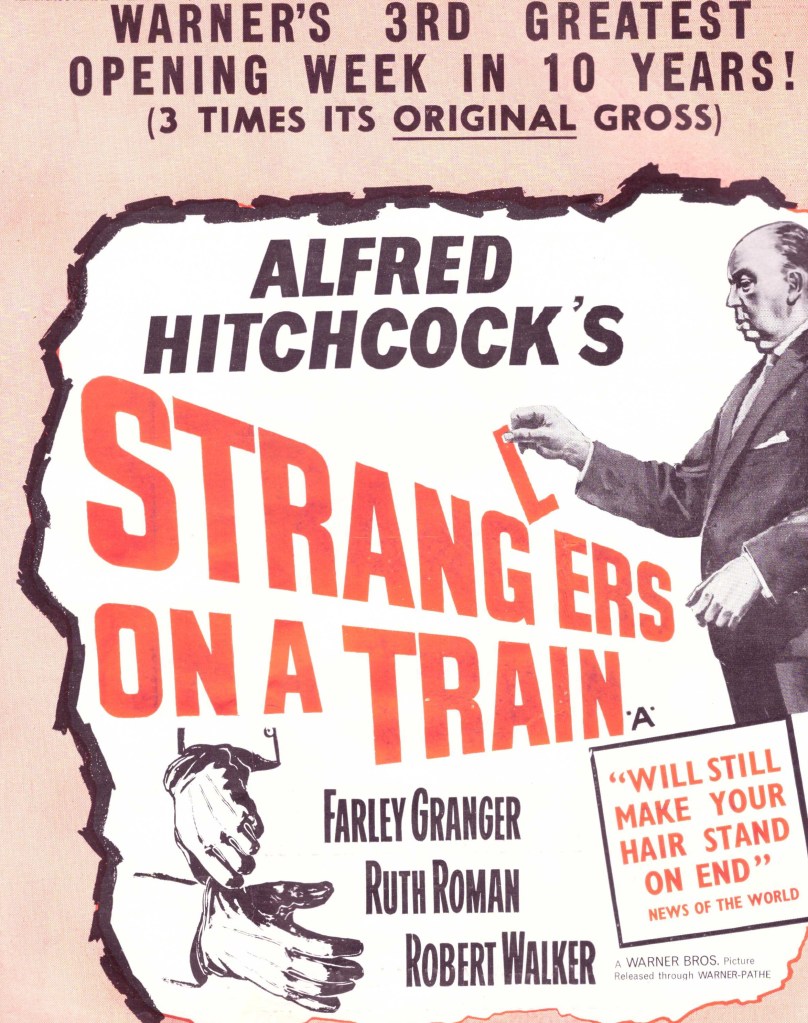
Between 1958 and 1963, ABC screened only two revivals – Strangers on a Train (1951) and East of Eden (1955) – whereas during the same period Odeon got through 75. In the 1950s Odeon used revivals as the support to prop up a weaker main feature, but by the 1960s the older pictures were the main attraction. The number of revivals presented as the top draw went from five in 1961 to 13 in 1962 and 11 in 1963 (i.e. 20 per cwent of the annual output), with others pulled in as the supporting feature.

Among the movies accorded a second outing were On the Waterfront (1954), The Jolson Story (1946), The Vikings (1958), Three Coins in the Fountain (1954), Trapeze (1956), Bridge on the River Kwai (1957), Red River (1948) and Witness for the Prosecution (1957). Odeon also took advantage of the product gap to bring back relatively recent top performers, Swiss Family Robinson (1961), Sodom and Gomorrah (1962), Psycho (1960) and Saturday Night and Sunday Morning (1960) within a year or so of their original release.

Although there was no sharp increase in movie production during the 1960s and to some extent successful double bill revivals and the retention of hit films like The Family Way (1966) and The Dirty Dozen (1967) for an extra week alleviated any shortfalls, by the end of the decade it was the circuits who came down heavy on the studios.

Films that looked as if they would do poorly on their circuit release were unceremoniously yanked off screens at the start of the week (movies at that time ran from Monday to Saturday) and replaced with something else.

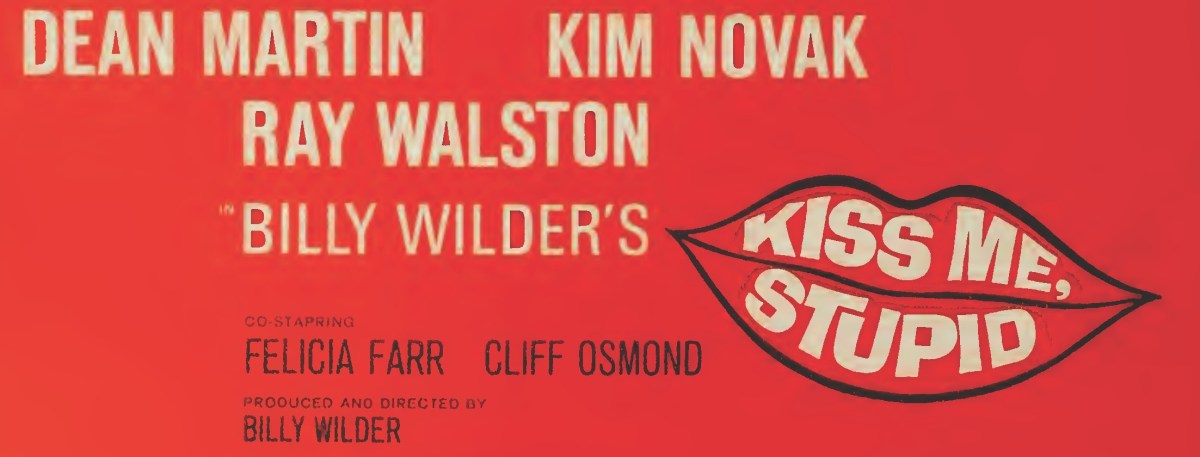
Films that failed to cut the box office ice on the circuits included: Billy Wilder’s Kiss Me, Stupid (1964) with Dean Martin and Kim Novak, Disney’s Monkeys Go Home (1967) starring Maurice Chevalier, thriller Games (1967) starring James Caan and Katharine Ross, Maureen O’Hara in romantic Italian-set drama The Battle of the Villa Fiorita (1965), thriller Brainstorm (1965) with Jeffrey Hunter, Rod Taylor in the adaptation of the Arthur Hailey bestseller Hotel (1967) and British television comedian Charlie Drake in Mister Ten Per Cent (1967).

SOURCES: “Strike Worsened Shortage Beef,” Variety, March 16, 1960, p15; “Flood of Dubs If Shortage Worsens,” Variety, March 23, 1960, p14; “Product Shortage Ends Twice-Weekly Changing,” Variety, May 11, 1960, p7; “Product Shortage Prompts Theatermen Renting of TV-Exposed Features,” Variety, May 18, 1960, p17; “Print Shortage Not Product,” Variety, September 7, 1960, p5; “How Come So Resistive To Reissues While Hollering Shortage?” Variety, February 20, 1963, p15; Gene Arneel, “Distribs: Theater Shortage,” Variety, March 6, 1963, p7; Allen Eyles, ABC The First Name in Entertainment (CTA, 1993) p121-125; Allen Eyles, Odeon Cinemas 2 (CTA, 2005) p204-214.

Discover WordPress

A daily selection of the best content published on WordPress, collected for you by humans who love to read.

The Atavist Magazine

by Brian Hannan

WordPress.com News

The latest news on WordPress.com and the WordPress community.