I am a published author of books about film - over a dozen to my name, the latest being "When Women Ruled Hollywood." As the title of the blog suggests, this is a site devoted to movies of the 1960s but since I go to the movies twice a week - an old-fashioned double-bill of my own choosing - I might occasionally slip in a review of a contemporary picture.
Just about hits the balls-eye (sorry, bulls-eye) but falls short through miscalculating its target audience. A little bit of rejigging in the inevitable sequel could see this shine. Roughly, Die Hard meets Home Alone. That’s putting it a bit crudely, but swap skyscraper for billionaire’s mansion and a little boy for little girl and you get the drift.
What gets this very much over the line are the little bits of magic, as appealing as they come, and Santa has a get-out clause (literally, and no pun intended) because in dire emergency he can vanish up any nearby chimney and though he’s aware there’s magic involved he has no idea how it’s done. Plus he has a scroll to hand, a cribsheet that separates the good from the bad.
Bad moon rising? Less of the ho-ho-ho and more of the bah humbug and it just goes to show that a man and his hammer should never be parted.
Home Alone defensive techniques have escalated since Macauley Culkin’s day, and though “You Filthy Animal” is referenced young Trudi (Leah Brady) has a mouthful of real cuss-words, plus nails her weapon of choice. It’s cleverly done how she links up with the inebriated self-pitying Santa (David Harbour) and there’s a grimace-inducing finale – the true spirit of Xmas and all – that sails close to the wind for a hardnosed thriller but par for the course for a soppy Xmas saga.
So that’s really the only problem. The picture can’t quite make up its mind in which direction it’s headed. Hard-ass with a soft center is clearly the aim, but there’s just too much gore to pull that off. Sure, some of the killings are comic, but they’re helluva bloody too. And there’s a weird backstory – even weirder than John Wick’s assassin commandments that shalt not be broken – involving (I think) something to do with Vikings and a guy who can’t die, not exactly a zombie because he’d already be dead, and thankfully he doesn’t need blood to slake his thirst, but still he’s been around for a millennium, though, truth be told, the actual date Father Christmas first appeared is not exactly set in stone.
On the other plus side, the family whose home is being invaded by villainous “Scrooge” (John Leguizamo) – color and city pseudonyms all taken by previous fictional gangsters – are just plain venal, toadying up to ruthless matriarch Gertrude (Beverly D’Angelo) whose vault bulges with gazillions of illicit dollars. Her potential heirs, Jason (Alex Hassell) and Alva (Edi Patterson), are a cringe-worthy pair. While Jason at least is attempting to sever connections to malicious mama, Alva has named her son Bertrude in a bid to curry favour. And when push comes to shove, most of that family will sacrifice every last one of their nearest and dearest.
So, basic story, family in the sh*t, drunken Santa and little girl to the rescue.
There’s some clever twists. Jason isn’t quite the dolt you think, Alva’s macho boyfriend-cum-actor turns out to have muscular chops while Jason’s partner Linda (Alexis Louder) is quite the vengeful one.
Endearing to the last, Trudi channels her inner Macauley Culkin with a side-serving of her grandmother’s ruthlessness and, taking Home Alone as her template, effectively slices and dices her opponents. And my guess is that’s the vibe the producers were chasing – fun slaughter. They don’t miss by miles, but they do miss. And an audience that would have happily lapped up the outrageously vicious Trudi will probably not relish the rest of the gory goings-on while a John Wick audience will feel hard-done-by that even a sliver of cuteness has penetrated their hardcore world.
And it’s that rarity, an action comedy with a good few belly laffs rather than the usual situation where you see what they’re trying to do but don’t actually burst out laughing.
David Harbour (Black Widow, 2021) isn’t left to carry the picture but his cynical manner, catchphrases, and surprisingly gentle approach certainly bring it home. Leah Brady, graduate of the Umbrella Academy (2022), is New Wave Cute, soft with a hard center. Beverly D’Angelo (National Lampoon’s Vacation, 1983) can;t believe her luck at sinking her teeth into such a vicious character.
Director Tommy Wirkola (Hansel and Gretel: Witch Hunters, 2013) just about gets it right, especially unusual to be able to marry action and comedy, working from a screenplay by Pat Casey and Josh Miller who co-wrote Sonic the Hedgehog (2020) which was also a matter of getting the balance right.
Great fun all round. Not sure what the title would be for a sequel but look forward to it.
After I had written this original “Behind the Scenes” article I came across an interview with director Henry Hathaway that cast light on his interpretation of “Circus World” as well as an insight into his working methods. Rather than re-write the whole Blog I’ve added his words, which come from the magazine “Focus on Film,” as a stand-alone at the end of the original feature which gives some context to the Hathaway interview. If you’ve already read the “Circus World Behind the Scenes” you can just jump to the bottom of the page.
For John Wayne it was the best of deals and the worst of deals. He had signed a six-picture seven-year contract with Paramount. On the plus side the studio paid the entire amount upfront, wiping out the accumulated debts from the debacle of The Alamo (1960). On the debit side, he received only $500,000 per picture, well below his standard price of $750,000. In fact, Paramount could recoup some of its expense by hiring him out at his previous going rate.
Wayne was coming off hits McLintock (1963), Hatari! (1962) and How the West Was Won (1962) but other movies The Man Who Shot Liberty Valance (1962) and Donovan’s Reef (1963) – the first in the multi-picture deal – had punctured a hole in his supposed box office supremacy. But for maverick producer Samuel Bronston (El Cid, 1961), getting his hands on a star of the magnitude of Wayne was a coup. Originally entitled Those Were the Days, the title switched to the more appealing Circus World.
Dell comic book tie-in.
Bronston was a new-style producer. Apart from a $2.5 million injection by Paramount he financed his pictures by country-by-country advances, and backed by DuPont, hardly the first big company to be seduced by the prospect of becoming a big Hollywood player. Distributors who advanced money in this fashion made hay if the film hit the bull’s eye, but if it flopped they didn’t get their money back. And a flop made it more difficult for an independent producer to raise the dough for his next picture. So Wayne’s involvement was viewed as a guarantee.
Nicholas Ray (King of Kings, 1961) was initially hired to direct followed by Frank Capra (It’s a Wonderful Life, 1946), also made a Bronston partner, who tried to sabotage the script, planning only to shoot the sections he had rewritten. Bernard Gordon (55 Days at Peking, 1963) was credited with the original idea, but when Wayne came on board he brought with him James Edward Grant (The Commancheros, 1961).
Grant was only tempted by the promise of a three-picture deal. The tussle ended with Capra evicted at a cost of $150,000 and Henry Hathaway (North to Alaska, 1960) at the helm.
Hathaway instigated a week of rewrites with Ben Hecht (Spellbound, 1945) before settling down to more serious work with Grant.
Initial casting envisaged Rod Taylor (Dark of the Sun, 1968) in the role of Wayne’s partner and would-be lover of Cardinale, but he took the job without reading the script and on realizing it was little more than male romantic lead he bowed out. David Niven (55 Days at Peking, 1963) was initially signed as Wayne’s old buddy Cap but he, too, quit over the script. (Wayne and Taylor got on very well and should have teamed up for The War Wagon, 1967, until Kirk Douglas muscled his way in, later doing so for The Train Robbers, 1973. )
Their replacements John Smith (who had made his debut in Wayne picture The High and the Mighty, 1954) and the veteran Lloyd Nolan were hardly in the same box office league, but shaved cash off the budget.
A bigger concern than hiring a supporting cast was the circus. Bronston recruited famed European outfit Althoff Circus, whose 400 performers ensured the ringside element was authentic. For further realism Bronston added Bob Dover from Ringling Bros. There was no need for specialist horses, Bronston already having 125 trained from The Fall of the Roman Empire to pull circus wagons and for bareback riders.
The entire circus had to be transported by rail on 51 freight cars through the Brenner Pass to Germany and via Switzerland and France to Spain, halting at the Spanish border to unload the whole shebang onto a different train because the gauges didn’t match.
For the picture’s most spectacular scene, the capsizing of the ship transporting the circus, Bronston bought the 250ft long S.S. Cabo Huertas which was heading for the breaker’s yard. Repainted, decorated with circus posters and renamed S.S. Circus Maximus it was all set for a sinking overseen by special effects expert Alex Weldon (El Cid, 1961).
Three hundred tons of water were pumped into the half of the hold furthest away from the dock. The additional weight of 600 extras was enough to flip the ship on its side. Four 50-ton steam winches with steel cables kept the ship upright until it was time for action.
Female extras who were going to end up in the drink were fitted with corsets made of cork while the men wore cork belts hidden under their costumes. The Spanish Coast Guard cleared the harbor of debris and a local fleet of boats, just out of camera view, stood by for rescue. Seven divers patrolled the harbor bottom in case the cork failed to keep actors and extras afloat. Three sets of costumes were created for each participant so they would be kept dry as long as necessary.
Hathaway completed the scene without a single injury. He called it, “the greatest job of its kind I have ever been involved in.” Bronston, who was as much a detail man as Cecil B. DeMille, ensured the band played instruments from the period
The picture went in front of the camera in September 1963 with Wayne due to end his commitment on December 18. But severe flooding in Spain knocked the movie off schedule and it went way over budget, shooting running on until March 1964, the finishing touches added in London, the budget hitting $9 million.
Rita Hayworth, who hadn’t made a picture in two years, proved a handful, usually late on set, committing the cardinal sin of not learning her lines and, probably as worse, being rude to everyone
At just 135 minutes long, Circus World wasn’t originally envisaged as a roadshow until Cinerama put an estimated $2.5 million into the project, which defrayed the costs. By the time that partnership was announced, it was too late to shoot it in the Cinerama process. The 35mm Super Technirama footage was blown up to 70mm for showing in 60 U.S. theaters boasting the iconic Cinerama curved screens. Everything in Cinerama at that point was roadshow. And they had two more projects lined up with Bronston, Vittorio De Sica’s Paris 1900 and Jack Cardiff’s Brave New World, neither of which were made. Bronston also had another two movies in preparation with Paramount: The Nightrunners of Bengal to be directed by Richard Fleischer and Suez, neither made either.
Roadshow suited Paramount which had not used that method of premium release since The Ten Commandments (1956). In 1963 it had set up a roadshow department to handle the forthcoming Becket (1964) and The Fall of the Roman Empire, which were proper roadshow length of, respectively, nearly 150 minutes and over three hours. But, initially, Circus World did not fall into the roadshow category as far as Paramount was concerned. Only the arrival of Cinerama as an investor made it imperative.
To avoid a title clash with the ultra-successful It’s A Mad, Mad, Mad, Mad World (1963), British distributor Rank changed the title to The Magnificent Showman. That alteration did little to improve its box office, opening at London’s Coliseum for a “NSG” (not-so-good in Variety parlance) $11,200, not much more than The Fall of the Roman Empire in its 17th week, How the West Was Won (90th week) and Cleopatra (51st). Nonetheless it ran there for seven months, followed by a mass general release in the U.K. with a record number of prints. In the U.S., on the eve of general release in April 1965, Paramount considered a title change to Wild Across the World and a switch of marketing emphasis to John Wayne and action.
Audiences didn’t bite, certainly not enough to recoup the budget, and far from enough to prevent Bronston’s operation sliding into liquidation.
NEW STUFF FOLLOWS BELOW
“Circus World was a mistake,” averred director Henry Hathaway.
“Capra was working on it and Paramount had invested a lot of money. Capra was writing a story and Wayne didn’t like the story and the writer (Philip) Yordan didn’t like the story. He and Joseph Sistrom were working on it and they hadn’t quite finished it and Paramount finally got sick because they needed Wayne to get their money out of it and he had given them two months, I think, and he couldn’t give them any longer without charging them more money.
“I’d just finished Nevada Smith (what!!! – some poor editing here, given that film was made a couple of years after Circus World; presumably they meant How the West Was Won) and they said, ‘For Christ’s sake will you go over there because you know Wayne so well, get it straightened out enough so Wayne will say Ok I’ll do it and we’ll get it finished in some way.’
“I couldn’t stand this fellow Jimmy Grant who was the new writer – a phoney man – so I said ‘If you’ll let me work with Ben Hecht…’ So I flew back to New York with what we had and Ben and I had two weeks to try to get some cohesion into the story. We came back and Wayne said he was satisfied. Then we ran into a bad thing with Rita Hayworth on that picture because she was drinking a lot through it.
“I should never have got into it so quickly without more preparation, the fundamental story material was weak.
“I never look at rushes. You see I only work on location and there you can’t project them properly and I get disappointed because it doesn’t look good and maybe the machine’s bad and it looks too dark and then the actors want to put on or change their make-up. I don’t let actors wear make-up (!!!), only girls, so I don’t let the actors look at it – and because they don’t look at it, I don’t.
“I only shoot what can be used so the producer has no choice. According to the law of the Directors Guild the man that puts up the money – the company – owns it. If we want to have complete control we must put up the money ourselves. What right have you to say that because you’re stubborn, and you may not be right, that you have the last say with the man who has spent millions of dollars.
“Literally, you have the right to produce your own version and they pay extra time if necessary. Then you turn it over…The only alternative you have is that if they play with it too much you quit and you won’t work for them anymore.
“I never had that trouble because I’m very conservative and I don’t over-shoot like George Stevens. He shoots a scene all ways, upside down, crossways, backways, everyways. He previewed Shane (1953) just generally telling the story and it didn’t work too well…So he recut the picture telling it through the eyes of the woman Jean Arthur as a love story…and that didn’t work too well. So he took it back and showed it through the eyes of the boy who hero-worships a guy…and that was the successful version. Now it would be impossible for me to recut a picture any other way than the way I shot it. If it’s bad, it’s bad.
“I always cut in the camera. The cutter just has to put the ends together. For instance, I don’t shoot a whole master shot all the way through. I start it and then get into the two-shots and then I get into the close-up and then I get out of it. In other words I don’t make them do the whole scene over again in long shot and then in medium shots and then in close-ups and on and on because the actors get bored with the scene and they’re never as good. You try to direct the picture in a manner that doesn’t waste the energies of the first emotional performances of the actors in long shots that you can’t use.
“The hardest thing is getting people out of goddam scenes. It’s very difficult to get them in and out of scenes gracefully. Another thing that most people never learn is that in each scene there’s a reason for that scene and, as soon as you hit it, get out as fast as you can or there’ll be a repetition of it or it hangs on too long.”
NOTE: I should also point you in the direction of the How the West Was Won “Behind the Scenes” since the Focus on Film interview also covers the shooting of that film and I’ve since added it in.
SOURCES: Scott Eyman, John Wayne, The Life and Legend (Simon & Schuster, 2014) p379-385; Mel Martin, The Magnificent Showman (Bear Manor Media, 2007), p153-168; Rui Nogueira, “Henry Hathaway Interview,” Focus on Film, No 7, 1971, p19-20; Sheldon Hall, Introduction to Circus World, Bradford Widescreen Festival, 2022; “Rank To Distribute New Bronston Pic,” Variety, September 26, 1962, p15; “Althoff Circus Logistics for Bronston’s Film,” Variety, September 25, 1963, p4;“New Roadshow Dept at Paramount,” Variety, November 13, 1963, p3; “Bronston and Paramount in 4-Picture Deal,” Box Office, December 9, 1963, p7; “Circus World Filming in London,” Box Office, February 17, 1964, p14; “Bronston’s Circus Goes Cinerama,” Variety, February 19, 1964, p4; “Bronston-Cinerama Unite on 2 Films,” Box Office, February 24, 1964, p5; “Special Mass Release for Showman,” Kine Weekly, May 28, 1964, p3; “Paramount Retains Circus World Title,” February 24, 1965, p3.
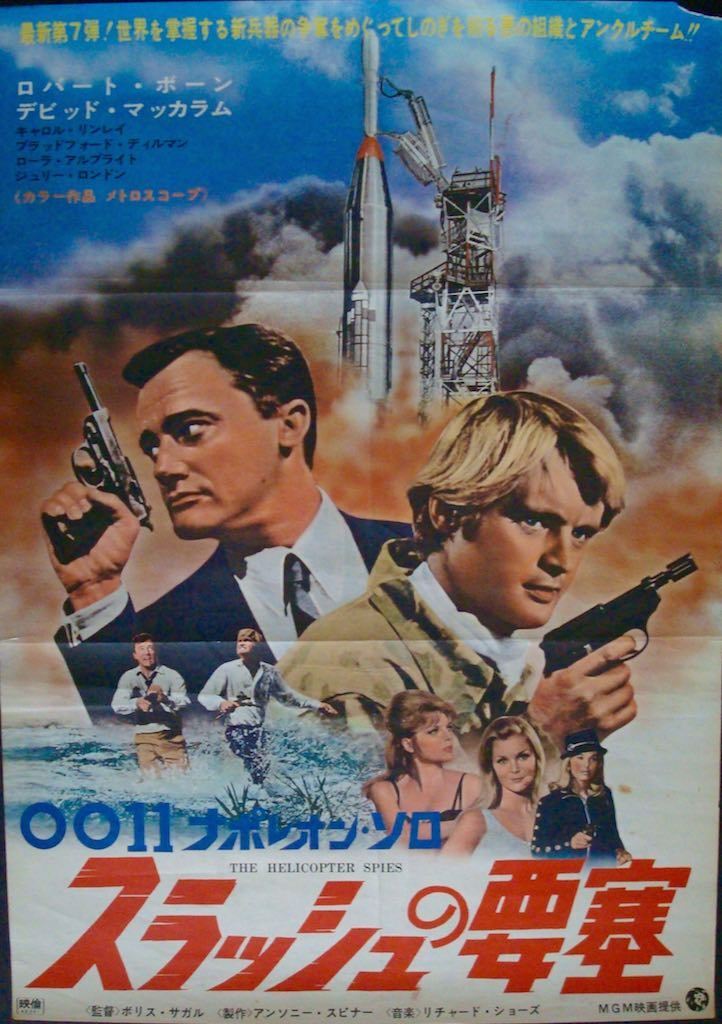
Takes a little while to come to the boil what with disreputable women, a crew of platinum-white-haired thugs, a religious cult, some very dry dialog, a high priestess with her own chorus line of psychedelic dancers, four identical brothers, and a female lead parading a prize shaggy dog story. Our intrepid heroes appear more capable this time round, the previously inept Napoleon Solo (Robert Vaughn) not beaten up quite so often, though he does end up being drowned in sand (water too precious to spare, apparently).
This time round, too, the good guys are taken for a ride by mad scientist Luther Sebastian (Bradford Dillman) who hoodwinks the U.N.C.L.E. organisation into stealing a “thermal prism” from the fortress of another mad scientist Dr Kharmusi (John Dehner). To put his own grand plan into operation Sebastian just has to hijack a rocket. And you should be aware going into this that there’s not the amount of helicoptering you might expect given the title.
This time round, too, there’s hardly a good gal in sight. Azalea (Lola Albright), aforementioned high priestess of cult The Third Way, has betrayed the good doctor in favor of Sebastian. Sebastian’s wife Laurie (Julie London) pretends to a) be out of contact with him for years and b) maintain a virtuous existence. And that’s before we come to the plainly bonkers, but still traitorous, Annie (Carol Lynley) who will make up any story in a bid to free an imprisoned unseen husband.
Sebastian has some neat touches as a leader, rewarding his team of thugs with booze and women as a prelude to killing them all off. He’s got an ejection seat in his car for getting rid of troublesome passengers. He prefers efficiency, to the point of iciness, to sexiness in his paramour and female underlings. And he has a very dry manner, which elicits a good few laughs.
But some of his thugs just ain’t that bright, the one instructed to follow Solo has just allowed him access to Laurie’s house. Laurie ain’t that bright, either, falling for an old trick by Solo who, as usual, is less bright that Ilya Kuryakin (David McCallum).
Some of the set pieces are excellent. Sebastian’s followers meet in an abandoned movie theater where Azalea gives the lowdown on the grand plan assisted by her bevy of dancers. Infiltrating the organisation by the simple device of dying his hair, Solo ‘s disguise is uncovered after being sprayed with champagne.
There are a surprising number of human touches. Head henchman Carl (Roy Jenson) vowing to take “Mom” away from her dingy life running her eponymous diner finds she enjoys too much her dingy life. Carl, appreciative of the disguised Solo’s efforts, apologises for making him ride in the baggage train. Annie can stretch innocence to breaking point, to an extent where nobody cares about her problems.
But where The Karate Killers had a straightforward storyline – find the five daughters of a dead scientist – this gets a tad lost in the first section introducing the thermal prism, the cult, doubling down on mad scientists, and giving Annie all the importance of a red herring.
I thought for a moment that this was the end of the line in my appreciation of the U.N.C.L.E. franchise, the one where it all fell flat on its face and we could see the joins, but after the shaky start it picked up and became quite enjoyable in the series’ inimitable barmy fashion. I suppose I should applaud the initial narrative boldness, audience pretty much fooled from the off, the fortress assault not much more than an extended MacGuffin, with neither Sebastian nor Azalea what they seemed.
I could quibble about the guest stars but in fact this is a superb deadpan performance from Bradford Dillman (Sanctuary, 1961) and quite a departure for the Carol Lynley of Bunny Lake Is Missing (1965). And you could say the same for Lola Albright, previously seen essaying a different kind of character in The Way West (1967).
Boris Sagal (The Omega Man, 1971) directed from a screenplay by Dean Hargrove (One Spy Too Many, 1966).
I’ve only got a couple to go to wrap up the entire series and for your sake I will persevere. If you’ve not already done so, it’s back to the box set.
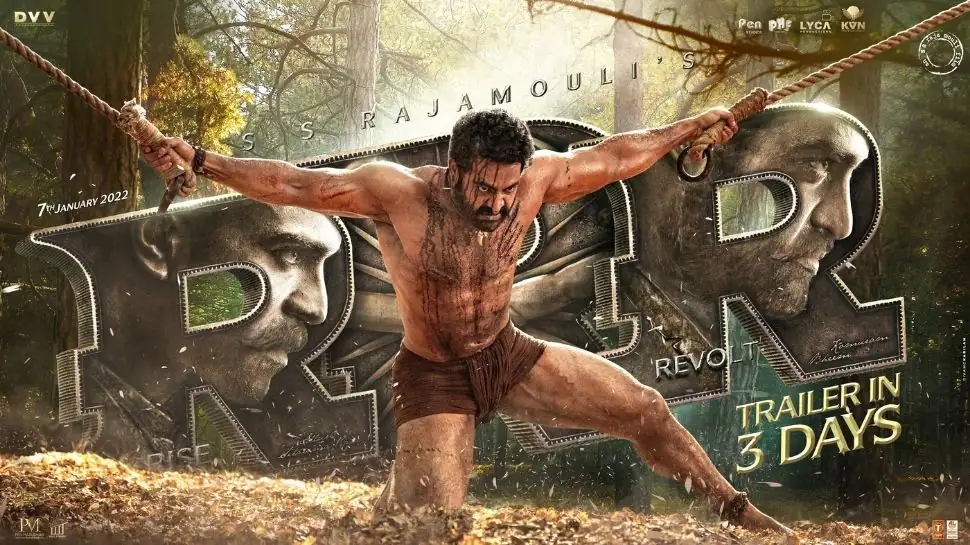
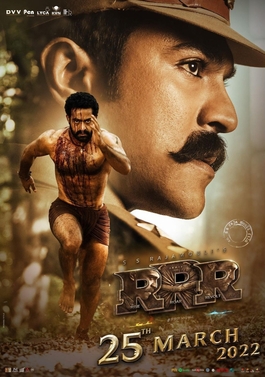
It’s unusual for the esteemed New York Film Critics Circle to be taking a lead from me. But, happening upon this, my first encounter with Bollywood, on an otherwise quiet Monday cinema outing, I have been championing it ever since, though not always to an appreciative audience. So I was somewhat astonished – and rather delighted – to discover that the New York Film Critics has just bestowed its annual Best Director Award to S.S. Rajamouli for R.R.R.
In honor of that achievement I am reprinted my original review below.
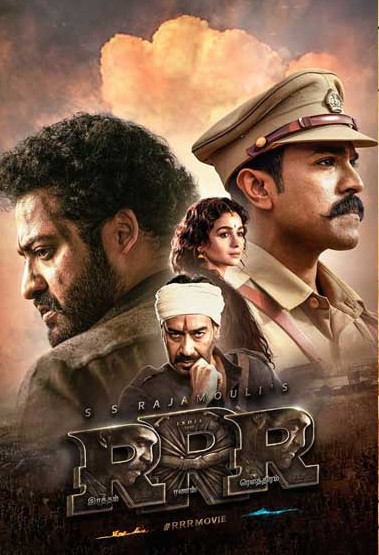
Easily the most extraordinary epic I have seen in a long time. Hitting every action beat imaginable, a stunning tour de force that ranks alongside the best Michael Bay or Steven Spielberg can offer. As if Rambo or John Wick had turned up a century ago. If films could go from 0 to 100 in ten seconds, this would be the prime contender. Astonishing sequences include a cop taking on a mob single-handed with only a stick for a weapon, a villager acting as bait for a tiger, wild animals leading an attack on a fort, a savage beating with a nail-studded whip, and the unforgettable image of one man mounted on another spraying bullets with two rifles.
Following the virtual abduction of a native girl Milla, two friends are on a collision course in the oppressive British regime in India in 1920. Technically, it doesn’t count as a kidnapping because British Governor Scott Buxton (Ray Stevenson) hasn’t, in his eyes, committed a crime, merely taking the child as a gift for his wife (Alison Doody). Villager Bheem (N.T. Rama Rao Jr.) is tasked with bringing the girl back, ambitious undercover cop Raju (Ram Charam) with stopping him. The two men, befriending each other in Delhi, are unaware of the other’s plan. That both are immensely likeable, if quite opposite, characters, creates terrific charisma, and their bromance is entirely believable.
Everything in this picture is big and bold except when it is intimate and small. There is a beautifully-observed romance between Bheema and a kind British woman Jenny (Olivia Morris), the development of which, faced with the obstacle of neither understanding the other’s language, with Raju acting as matchmaker, could have been a film on its own. There are two brilliant pieces of screenwriting, phrases repeated throughout that acquire deeper meaning as the story unfolds. The British continually kill by brutal means rather than waste an expensive bullet; “Load. Aim. Shoot,” is a mantra taught the young Raju by his revolutionary father; both come into play at the climax.
The British are horrific. The Bheema-Jenny meet-cute occurs when the native is beaten for inadvertently embarrassing a British soldier. Lady Buxton is a sadist, determined to see a man whipped till he bleeds to death. By contrast, the two heroes are often far from heroic, Bheema unable to find the girl, Raju forced into terrible violence as a consequence of ambition. And in the midst of all this ramped-up violence perhaps the best scene of all, albeit one of conflict, is an energetic dance-off between the two men and the scions of the British upper class, the fantastic “Naatu Naatu” sequence.
Director S.S. Rajamouli (Baahubali: The Beginning, 2015) makes as bold a use of narrative structure as Tarantino in Pulp Fiction, withholding until the last third of the movie a flashback which tilts the story in a completely different direction. But there is nothing lumbering about this epic, it has an incredible drive, an energy to set your head spinning. Even so, Rajamouli utilises a classic three-part structure and the three-hour-plus running time is anything but sprawling. In among a host of character-driven scenes he knows how to build a sequence, as the heroes successively triumph and fail with every passing minute, and among the introductory sequences for both main characters are some inspired images. Cleverly seeding the story creates a variety of twists, turns and reversals.
I was expecting not to like the traditional dancing sequences, which you would thought ill-fitting in a picture of this scope, but the “Naatu Naatu” sequence is treated as virtually a rebellion with tremendous dramatic impact. Although the two leads are muscular in the Schwarzenegger/Stallone mold it does not prevent them channelling their inner Gene Kelly.
Except that it is set a century ago, this has all the bravura hallmarks of MCU, an exceptional adventure told at top speed that does not put a foot wrong.
N.T. Rama Rao Jr (Janatha Garage, 2016) has the more difficult role, in that he switches from full-on action hero to romantic klutz. But the intensity of Ram Charam (Vinaya Vidheya Rama, 2019) should have Hollywood calling. The characters played by Ray Stevenson (Accident Man, 2018) and Alison Doody (Indiana Jones and the Last Crusade, 1989) are more one-dimensional but no less terrifying for that.
On energy and cinematic imagination alone, this would more than pass muster but S.S. Rajamouli has also created a brilliant piece of entertainment with greater depths than you might imagine.
This movie cries out to be seen on the big screen and maybe, in light of the NYFCC Award, your local arthouse might see fit to re-book it. Otherwise you will cn catch it on Netflix.
A western dream team. Beginning with Winchester ’73 (1950) James Stewart had revived his career post-World War Two with a string of tough westerns and had made seven movies in the genre in the 1960s including The Man Who Shot Liberty Valance (1962) and Shenandoah (1965). Starting with Rio Bravo (1959) Dean Martin had made six including The Sons of Katie Elder (1965). Genre debutante Raquel Welch had hit the box office running with One Million Years B.C. (1966) and Fantastic Voyage (1966). Following McLintock (1963) and Shenandoah, director Andrew V. McLaglen was considered one of the hottest western directors around.
Legendary Twentieth Century Fox producer Darryl F. Zanuck put together the cast and director as a “package” before calling in screenwriter James Lee Barrett (Shenandoah) to shape an idea by producer Stan Hough. McLaglen explained: “It was a Zanuck thing from the beginning.” He was working on another picture when he took a call from Zanuck. “I got a six-page outline for a western,” said Zanuck, “and I figure you ought to direct it. James Lee Barrett out to write it and Jimmy Stewart, Dean Martin and Raquel Welch ought to be in it. Nobody else. That’s the combination I want.” McLaglen took Hough’s six-page outline to Barrett who wrote it based on the actors involved.
Originally entitled Mace after the James Stewart character, the movie quickly became Bandolero!, the exclamation mark possibly to differentiate it from the 1924 Spanish picture of the same name which had been made for Metro-Goldwyn (as the studio was then known).
Despite the success of the Matt Helm spy pictures and a number of decent westerns, Dean Martin ceded top billing to James Stewart (had they shared the billing, Martin would have come first in the traditional alphabetical order).
Marc Eliot, one of Stewart’s biographers, arrived at a more unlikely scenario for the movie being greenlit, concluding that because Martin and Stewart had got on so well when the latter appeared on the former’s television show they decided to make a picture together. Given the show was taped in summer 1967 and the movie went into production a few months later it left an improbable amount of time for the picture to be set up.
Director Andrew V. McLaglen would be reunited with two of his favorite movie characters – screenwriter James Lee Barrett and James Stewart, both key to Shenandoah. The actor had been the driving force behind McLaglen’s recruitment for that Civil War picture. “I just loved working with him,” said the director, “it got to the point where any time he did a movie he wanted me to direct it.” He viewed Barrett as “one of the best dialog writers I’ve ever known in movies.”
Although theoretically, the movie was set up as a package, with stars and director in place, Dean Martin remained a doubt since he was already committed to a film with Columbia that might clash. And Stewart might easily have dropped out if producer Frank McCarthy’s plans for Patton, with Burt Lancaster in the title role and Stewart as General Omar Bradley, had come to early fruition.
Raquel Welch was on a publicity high, featured on 400 magazine covers, generating such industry buzz that she had been named “International Star of the Year 1967” by U.S. cinema owners, her growing screen popularity ranking her eleventh in Box Office magazine’s female “All-American Favorites of 1968.” Dean Martin, incidentally, came ninth on the corresponding male chart, two places above Clint Eastwood, Paul Newman topping the poll.
George Kennedy (Cool Hand Luke, 1967) had small parts in Shenandoah and The Sons of Katie Elder before graduating to second male lead in McLaglen’s previous western The Ballad of Josie (1967). McLaglen, you might like to know, was highly regarded by the trade as “more concerned with entertaining the public than making intellectual and emotional demands on the audience.” Just after the movie’s launch the director signed a two-picture deal with Fox, The Undefeated (1969) next on his dance card.
One of the few studios to persist with a talent school – Welch claimed as the most recent high-flying graduate – Fox gave current student Clint Ritchie a role in Bandolero!, others in the Class of 1968 including Jacqueline Bisset (The Sweet Ride, 1968) and Linda Harrison (Planet of the Apes, 1968). Relative newcomer Andrew Prine had acted with Martin in Texas Across the River (1966) and enjoyed a supporting role in McLaglen war picture The Devil’s Brigade (1968).
As well as genre newcomers Welch and Ritchie, the cast included western character actors like Will Geer (Winchester ’73), Don “Red” Barry (The Adventures of Red Ryder, 1940) and Harry Carey Jr. who had appeared in three previous McLaglen westerns. Even current “Tarzan,” Jock Mahoney, who played Maria’s husband, had a string of B-westerns in his portfolio. Possibly as important was the presence of James Stewart’s horse Pie, his onscreen companion for two decades.
Shooting began in Paige, Arizona, on October 2, 1967, before shifting two weeks later to Brackettville and the Shaban ranch where The Alamo (1960) was filmed. Parts of the San Antonio de Bexar set were revamped as the Texan town of Val Verde where the hanging in the film took place, while The Alamo doubled as the Mexican village of Sabinas which provided the action for the climax. Seven buildings were added to the San Antonio set including the jail, while a curio shop was transformed into a bank, a gift shop became a hotel and, conversely, an old hotel was turned into a general store. Thirty-five thousand traditionally-cast adobe bricks were made on site to create the dozen buildings required for Sabinas plus the locale’s arch, fountain, wells and wall.
Other locations included Arizona, Utah and Texas with interiors filmed at the Fox studios. The shootout between the posse and the outlaws was filmed near Turkey Mountain in Texas. The Rio Grande was forded at Devil’s River but Mace crossed the river at Pinto Creek. Glen Canyon National Recreation Area was utilized for the bandit attack and, naturally enough, for sequences requiring canyons. Other scenes were shot at Lee’s Ferry in Arizona, Balanced Rocks, and Big Water in Utah. But the first time we view Sabinas is an effects shot.
You do wonder why this film entered the studio books as costing $5 million. None of the principals were in the million-dollar salary range and the cost of 40 days shooting at the Shaban ranch was put at $25,000 a day.
The principals eventually enjoyed on-set camaraderie. Initially, Welch was too serious for the others, bombarding the director and more experienced actors with questions about her character’s motivation and psychology. “I wouldn’t say creativity was the primary concern on that picture,” commented the actress. “Barrett was there mainly because everybody said nobody could write dialog for Jimmy like he could. As far as other things in the script were concerned, they weren’t really supposed to be questioned.
“And with McLaglen it was all by the book. McLaglen created a very constrained atmosphere. It was an inoffensive nine-to-five project with a lot of very senior people, the old John Ford gang. Very cliquish. Except for Jimmy who’d always kind of throw out little things. I felt pretty lonely the whole shoot.”
To “loosen her up,” the two stars invited her out to dinner and “got her good and drunk.” Remembers McLaglen, “Dean and Jimmy and I would take Raquel Welch to dinner and we’d kid around with her.” Quite whether that was sufficient to rid Welch of her feelings of alienation was never established. However, she did register that she was surrounded by talent. Stewart “could cry on cue. No mess, no fuss. Just like that you could see tears in his eyes.
McLaglen equally enjoyed an esprit de corps with the male stars. “When I think of my time with Dean, there’s nothing but joy in my heart…without doubt the most conscientious actor I have ever worked with,” adding, “I think Jimmy had more fun on that location than he ever had.”
Texas was chosen for the June 1968 launch on the grounds that Shenandoah had done so well there. Instead of a city-by-city premiere lasting a week with many stars in attendance, the studio opted for a “new kind of premiere,” opening night at the Majestic in Dallas accompanied by a 30-minute live telecast broadcast to 23 Texas television stations. Also available was a 16mm featurette on Welch promising “an intimate look at a new star.” Welch contributed her vital statistics and preferences to a computer program that would help select the winner in a beauty contest to find the woman closest to the star in looks and personality.
Stewart, of the tub-thumping generation, believed stars should hit the publicity trail, public appearances adding 10 per cent to the gross, rather than insisting it was beneath their dignity or not worthy of their time. He claimed publicity tours were “good for the soul. Unless he has a real bitter selfish attitude (an actor) has to enjoy getting out to different parts of the country and meeting people.” Raquel Welch was one of the stars he chided for adopting the wrong attitude with autograph hunters.
Little of the weaponry seen on screen was from the period, the movie being set in 1867. And even the supposed Remington 1858 New Army revolver used by Martin, Kennedy and Welch, was improvised from another pistol. But Stewart used a genuine Single Action Army “artillery” revolver. There was some cheating going on, Martin firing a Winchester 1892 saddle ring carbine, and others using a Winchester model 1892 rifle and a Winchester Model 1873 carbine.
Despite claims by James Stewart biographer Gary Fishgall that the “film opened to near-instant obscurity” Bandolero! proved a solid box office success in the United States, where it was the top western for the year, finishing 18th in the annual chart, collecting $5.5 million in rentals (not gross) and performing very well overseas. It was a signal year for westerns, though some languished. Hang ‘Em High was 20th with $5 million, The Good, The Bad and the Ugly 24th ($4.5 million), Five Card Stud 34th ($3.5 million) and The Scalphunters 43rd ($2.8 million). In the flop category were Will Penny in 54th spot ($1.8 million), Villa Rides 75th ($1.2 million), Firecreek 79th ($1.2 million) and Shalako 85th ($1.1m).
SOURCES: Gary Fishgall, Pieces of Time, The Life of James Stewart, (Scribner, 1997) p314; Marc Elliot, James Stewart, A Biography, (Aurum, 2007, paperback) p365; Howard Hughes, “Welch Out West Part 1,” Cinema Retro, Vol 11, Issue 31, 2015, p10-17; internet movie firemarms database; “Raquel Welch To Get Int’l Star Award,” Box Office, February 19, 1967, p4; “Mace Retitled Bandolero!,” Box Office, August 7, 1967, pE6; “Cast Patton and Bradley,” Variety, September 20, 1967, p13; “Bandolero! Moves to Texas Oct 16,” Box Office, October 16, 1967, pC1; “Filming of Bandolero! Ending at Bracketville,” Box Office, December 4, 1967, pSW1; “Fox On Texas Trail for Kickoffs,” Variety, May 15, 1968, p32; “James Stewart: Stars Should Tout Films in Television Age,” Variety, May 29, 1968, p19; “Now There’s A New Kind of Premiere,” advertisement, Variety, June 12, 1968, p17; “Bandolero! Dallas World Premiere Covered Live By 23 TV Stations,” Box Office, June 24, 1968, pSW1; “Fox’s Talent School,” Variety, June 26, 1968, p13; “20th-Fox Signs McLaglen to Two-Picture Pact,” Box Office, August 26, 1968, pW1; “Big Rental Films of 1968,” Variety, January 8, 1969, p15.
Darkest – and possibly the most under-rated – western of the decade featuring a top-class cast playing against type, down-and-dirty in its depiction of the itinerant cowboy, an ending you won’t see coming and if it’s not a heretical notion close cousin to the later The Wild Bunch (1969).
Gang of outlaws led by Dee (Dean Martin), condemned to death for robbing a bank, is rescued by his brother Mace (James Stewart) posing as a hangman. While a posse led by Sheriff Johnson (George Kennedy) is in hot pursuit and the outlaws kidnap as potential hostage recently widowed Maria (Raquel Welch), Mace, sauntering through the deserted town, indulges in a bit of larceny himself.
All head for Mexico, a pitiless region, where the posse are picked off by bandits, the outlaws directed by the native Maria towards a small town which turns out to offer no safety at all. While there’s plenty action, this is more character-based. Mace and Dee are on the Civil War divide, the former (still sporting his Union uniform) riding with General Sherman, the latter with the Confederate Quantrill’s Raiders, despised by Mace as nothing more than glorified killers.
And while they are both outlaws, Mace blaming his situation on the Civil War, they are divided too by a sense of honor, Mace making it a point of principle never to harm women or children, Dee, far removed from any sense of himself, guilt-ridden, past caring, and lonely, can’t remember the last time he was with a woman he respected.
Sheriff Johnson is in pursuit in part due to unrequited love for Maria. Quick to action in a professional capacity, he is tongue-tied in her presence. Nor has the newly-wealthy Maria much need of a male protector. A whore since the age of 13 to provide for her extended family, sold into marriage nd acceptance that for security not love, she has been, ironically, set free by violent robbery. Dee’s gang views Maria as plunder, rape imminent should the brothers turn their backs. While Maria has little interest in another male protector she finds herself attracted to Dee.
Mace is mostly peacemaker, prodding his weaker sibling into responsibility, trying to instil into him the kind of code by which the likes of The Wild Bunch swore, but, still on the shifty side himself, concealing from the others the loot from his own robbery. But where The Wild Bunch are essentially sanctified by Peckinpah, especially with their hypocritical codes of honor and their unlikely redemption, the lives of Dee and Mace are unfulfilled, lawful or lawless drifters enjoying little of life.
There’s an ambivalence to Mace, theoretically a law-abiding rancher, but apparently turning outlaw on a whim. We are introduced to an impoverished Mace being ripped off for food and accommodation, spending the night in an overcrowded bunkhouse, his Unionist uniform doing him no favors two years after the end of the Civil War in Confederate Texas. He appears less prone to violence but we are not privy to how he persuaded a hangman to part with his outfit. And he’s a mean hand with a rifle, helping his brother escape his pursuers.
You might wonder just how Mace came to be an outlaw when he witters on so often about his God-fearing mother and his upbringing on a farm and you always have the sense he’s part of that woeful Hollywood creation, the “good” outlaw, as if there was such a thing, certainly no sign of him dispersing ill-gotten gains to the poor. He might just be as deluded as his brother.
Of the three, Maria is the most clear-sighted, no qualms about her behaviour, and, provided with weaponry, perfectly capable of defending herself. Mexican bandits offer her no clemency either, assuming that, escorted by gringos, she has abandoned the land of her birth, or just because any woman is prey.
So it’s a perfect onion of a western, layers upon layers, the pursued needing to defend themselves not just against the pursuers, but bandits lying in wait, and within their supposed close-knit community the brothers guarding against fellow outlaws and protecting the woman.
James Stewart (Shenandoah, 1965) played many a tough guy at the reinvention of his career in the early 1950s in Anthony Mann westerns, and while his characters often displayed venal qualities they were not outlaws. Career-wise this was a dicey role for an established western hero. That he brings the common touch that was the hallmark of his original screen persona to this characterisation of an outlaw with a code of honor does not disguise the fact that he is still an outlaw.
Dean Martin had essayed a really mean bad guy in Rough Night in Jericho (1967) but again this was his debut as an outlaw, and a conflicted one at that, enjoying the boost to his self-esteem that leadership brings, but finding himself enmeshed with the dregs of society, and certainly not on the look-out for any acts of kindness or redemption. This is a beautifully nuanced performance especially when he realizes Maria is responding to him.
Raquel Welch (Fathom, 1967) in what amounts to her first major film opposite two Hollywood legends more than holds her own. Not able to rely upon her overt sex appeal as in her previous outings, she portrays an upstanding women, abused by men in the past, determined not to take that route in the future. Alone of all the characters, having accepted her fate at an early age, she has developed a self-esteem not sacrificed to circumstance. The whore and the outlaw might be the oldest trope in the book but it works very well here as two characters find solace in each other.
George Kennedy (Cool Hand Luke, 1967), more accustomed to playing tough guys, leavens his portrayal by appearing idiotic with women. This, too, is a departure for Andrew V. McLaglen. Anyone aware of Shenandoah or The Undefeated (1969) will be familiar with his dexterity for widescreen composition, but here he tamps down on that stylistic device, concentrating more on group reaction and interaction. James Lee Barrett (Shenandoah) wrote the biting script based on a story by producer Stanley Hough.
While there’s plenty action it’s not a rip-roaring western, too much character involvement for that, but certainly ranks as one of the top westerns of the decade.
Apologies again for the premature appearance of the blog “Behind the Scenes: Bandolero!” but that will definitely appear tomorrow.
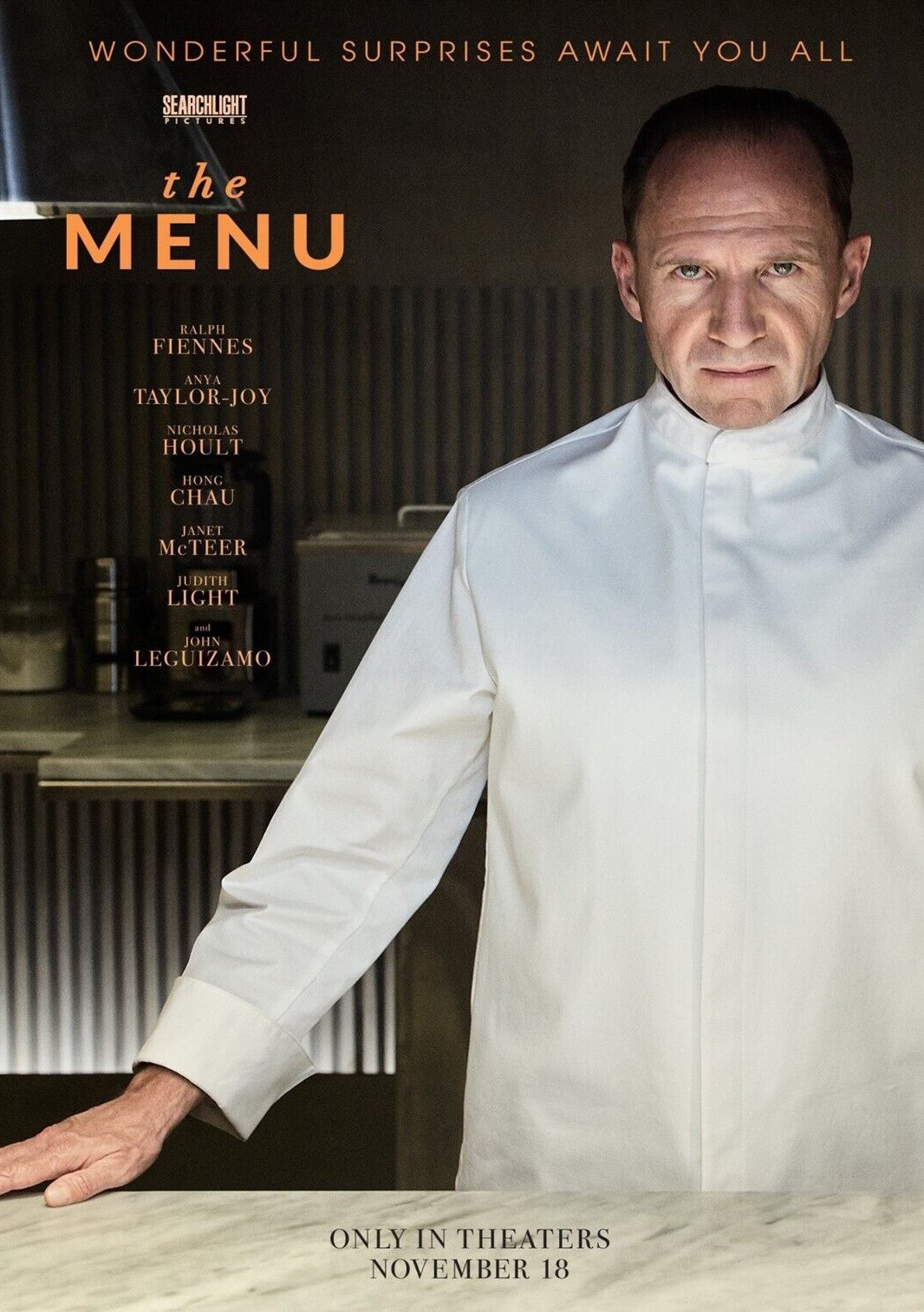
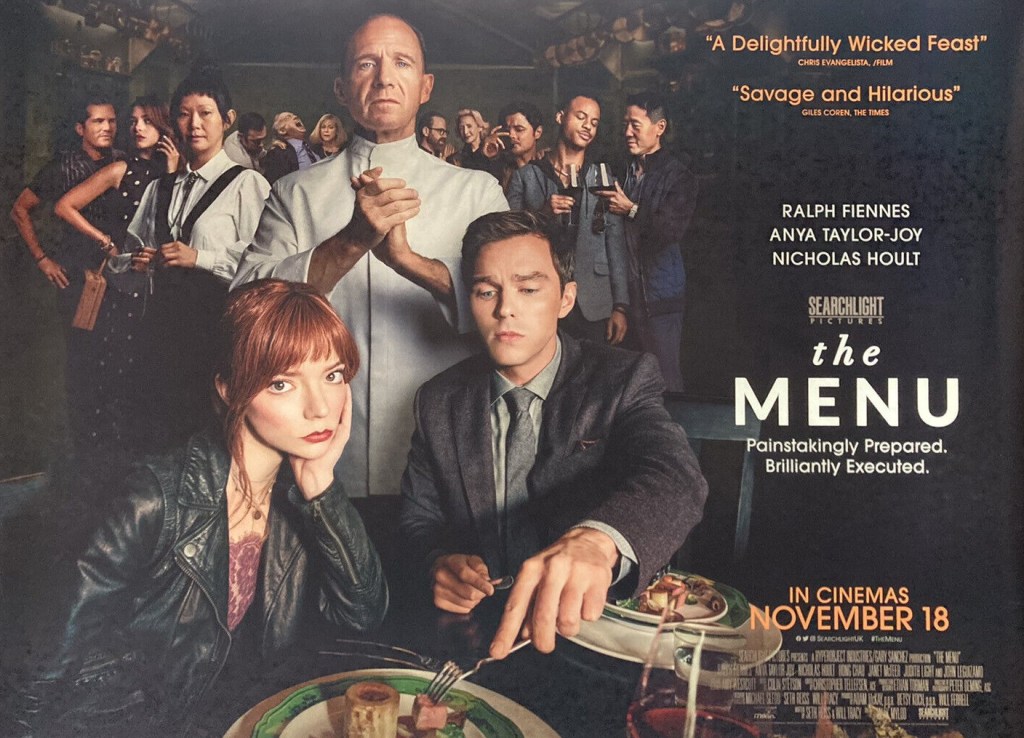
Hitchcock would have adored the apocalyptic flavour of this quasi haunted house psychological thriller. Setting aside its intellectual pretensions this is pure pedal-to-the-metal material. You never know what’s going to happen next in a tense environment created by dictatorial celebrity Chef Slowik (Ralph Fiennes) in whose eyes the entitled are likely to get their just desserts.
In most thrillers of this nature, the assorted bunch of potential victims usually attempt some kind of fightback, and they’re usually younger and sexier, but this crew are trapped in the headlights because they find it impossible to believe they could possibly be in the middle of a revolution.
The beauty of their dilemma is that Chef is trapped, too, by his desire for fame, suffocated by pursuit of perfection, but yet, as they soon come to realise, accepting punishment for his own sins (attempted rape for one). You might be fooled by the trailer into thinking there is a way out, if only a perilous one, but that’s a bit of a red herring, and as the tension grows you realise it’s heading for an incredible conclusion.
Only the rich can afford to visit this expensive restaurant on a secluded island. Most of the guests aren’t even interested in the food – that’s one strike against them – but for the experience of having said they’d been there or to, as is the prerogative of the wealthy, be pampered within a whim of their life, or to find something minute to complain about, a niggle guaranteed to cause grief.
Creepy though they are, Chef’s thunderclapping hands that demand guest attention, the cries of “Yes, chef” from his slave-like adoring workers, the detail of high-falutin’ cooking, history and ecology lessons, a ramrod sergeant-major of a maitre’d Elsa (Hong Chau), and occasional ironic twists – a bread course that contains no bread for example – are mere hors d’oeuvres for the main event.
Chef knows a tad too much about his guests’ peccadilloes – infidelity, financial irregularity – for their liking and as the evening out begins to turn into a cul de sac and shocking incident follows shocking incident, cowardice and lack of the kind of retinue that could come to their rescue, the guests can only watch as they are served up on a platter to a madman’s ideology.
Certainly, the format is exceptionally cinematic, sequences chapterized as menu courses, and the intellectual discussion that divides the world into the servers and the served well observed, but driving the thriller engine is the most refined nutcase this side of Hannibal Lecter, a thin-lipped specter at a feast of his own devising , a creator at the end of his tether, seeking revenge on those who quibble with his talent. And yet there is something universal about this individual, a man scrabbling so hard to stay ahead of the game that he is almost on a par with Arthur Miller’s famed salesman. Is Chef doing much more than the culinary equivalent of “riding on a smile and shoeshine?”
The guests are the usual high priests of pamperdom, food critic Lillian (Janet McTeer), movie star (John Leguizamo) planning to revive his career by fronting a food show, simulating orgasm with every taste, a trio of young financiers, a couple who have come several times but can’t recall a single dish they’ve eaten, and foodie Tyler (Nicholas Hoult) accompanied by a mysterious woman Margot (Anya Taylor-Joy) who turns out to be in a different branch of the service industry.
British director Mark Mylod (Ali G in Da House, 2002, anyone?) has learned from helming episodes of Game of Thrones and Succession how to match reaction to incident. As much as Chef is in control in the restaurant, Mylod is in control of exactly what we see. There is none of the over-acting that appears to come with the territory, certainly no screams or titillation, not a whiff of cleavage, the usual recourse of a horror film run out of ideas, though, as with that genre, it is the sexually compromised who suffer first.
Mylod’s tight rein ensures shock is just an element of the overall effect, rather than its signature dish, and that all the ruffley-truffley culinary dialog only serves to heighten morbid sensation.
Ralph Fiennes (The Forgiven, 2021) may well have delivered a career-best performance it is so constrained. Given equally little room to manoeuvre, little time for eye-rolling or exacerbated action, Anya Taylor-Joy is back to her The Queen’s Gambit (2020) best, while Nicholas Hoult (Those Who Wish Me Dead, 2021) adds sly deviance to a screen persona that plays on innocence. It’s an astonishing screenwriter debut for television writers Seth Reiss and Will Tracy.
As it happens, I’m very familiar with the lives of chefs, having spent three decades working with them, initially as a cossetted observer, as journalists often are, being the fawned-upon editor of Caterer & Hotelkeeper, the hugely profitable industry trade weekly in Britain, with massive sales at a time when print was the dominant media, so much so that during my time we produced a world record (for a weekly) issue of 524 pages. But when I later set up the Scottish Chefs Association, whose board comprised all the top chefs in the country, and its offshoots the Scottish Chef Awards and a cookery school for chefs, I became privy to the fears and wonders of the cooking business. So I can attest to the fear and loathing for some customers and most critics, who seemed determined in the days before social media to spoil anything they could, or demand preferential treatment.
Certainly, the restaurant is a unique kind of business, food being cooked to order, “a la minute” as the saying went, and customers disrupting a tight ecology by simply turning up late, or early, or not at all. Customers were prone to theft, teaspoons in particular replaced on a titanic scale, and the litany of complaints could outweigh a Bible. Then, as now, reputation was everything, and could be destroyed by a food critic or word-of-mouth. It wasn’t just chefs who sought perfection, but customers, any deviation from expectation harshly dealt with.
Successful chefs with investors would find that somehow they saw little share of the profits. Chefs minus investors lived a precarious existence. Good reviews would bring in bad customers, the kind who pored over every detail, like Tyler wanting to share their paltry culinary knowledge with the expert, needed extra attention, and came to say they had been there. But I can sympathise with Margot who felt she was being experimented upon rather than fed and can recall several times buying fish and chips immediately after dining in a Michelin-starred establishment.
I remember, too, industry astonishment that celebrity-chef-du-jour Anton Mosimann began the day by walking round the kitchen shaking hands with every chef, no matter their rank, rather than starting off their day with a rant. Kitchens are organised on a brigade system, obedience imperative, no questioning of authority. But rather than derogating talent as occurs here, many top chefs proved apt talent-spotters. The Roux Brothers, for example, created a magnificent template, finding backers among their appreciative wealthy customers for the young talent in their kitchens, which resulted in a new generation of chefs setting up in business without the usual financial woes.
In Britain and Europe, however, perfection could be achieved. If you reached the highest standards set by the Michelin Guide inspectors and were awarded the coveted three stars, the highest culinary accolade that could be bestowed, you had reached the top of the tree. You couldn’t relax because one or more of the stars could be taken away, but the kind of personal obsession that afflicts Chef here would be lessened. However, since very few chefs hit the three-star mark you have hundreds if not thousands beavering away trying to achieve it.
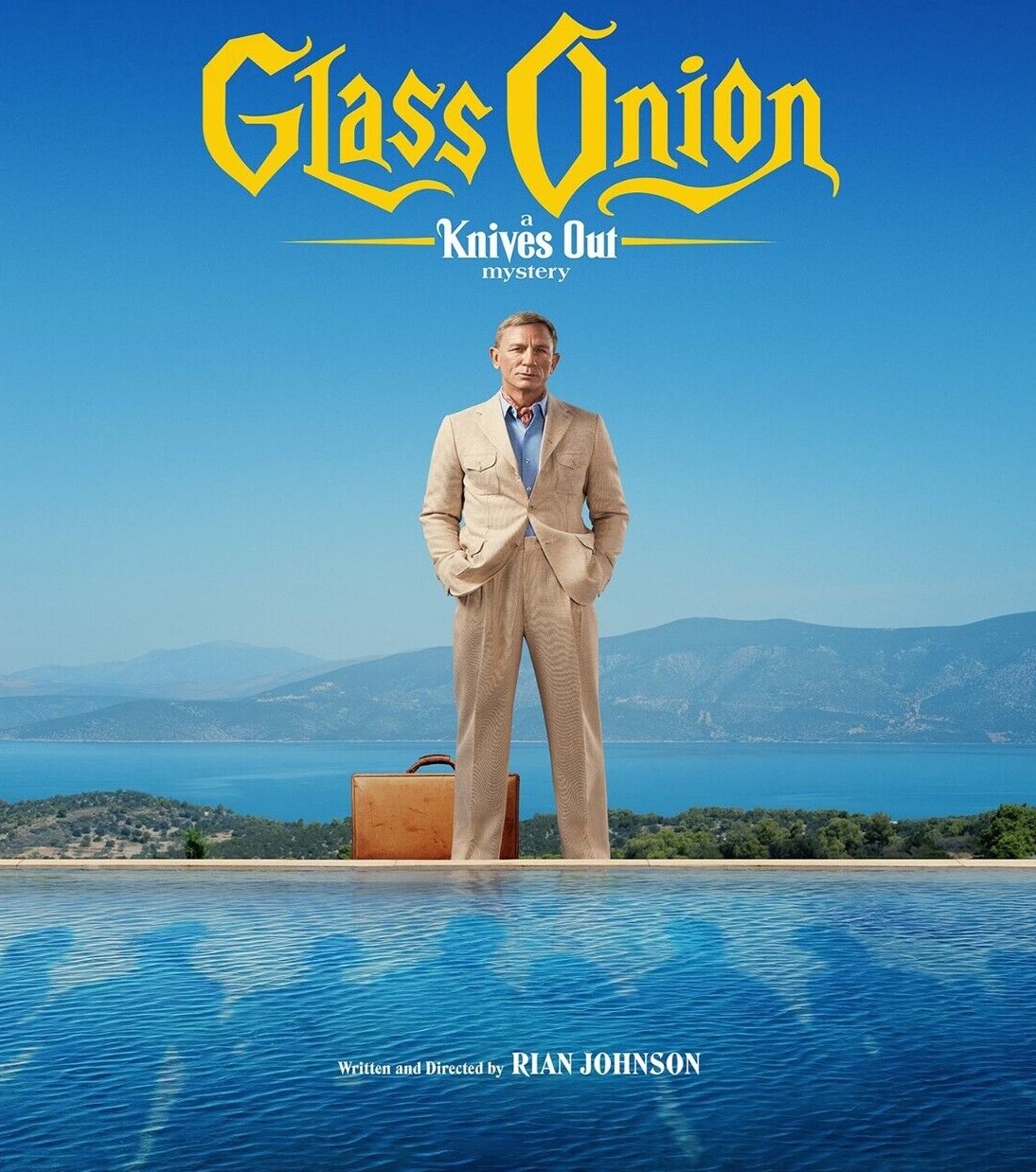
Another triumphant entry in the casebook of Benoit Blanc, self-style world’s greatest detective and easily the most flamboyant in the genre since Hercule Poirot. Writer-director Rian Johnson’s invention offered Daniel Craig an immediate opportunity to shed the typecasting curse of James Bond and the actor rises splendidly again to the occasion, some hints of his inner life offered, signs of depression and a cameo by Hugh Grant as flatmate, helpmate, whatmate.
But in the main it’s another twisty picture that plays with audience expectation even though, if only we were as clever as its creator, the truth is in plain sight, beginning with the title.
Victims – or suspects – assemble.
You have to peel through layer upon layer of an ordinary onion, but a glass onion you can see straight through. It would not occur to the audience, lured by mystery, arriving with a different sort of anticipation, counting on this glass onion to be a mere architectural folly atop a majestic building on a remote island off the cost of Greece, that everything could be actually straightforward and that the need for complicated crime is a figment of our own imagination.
There’s only one twist you may guess and the movie certainly takes a while to spark into life as we are introduced to a variety of unlikeable characters, ideal candidates you might think to be a victim, through the device of them all receiving an extremely puzzling puzzle in an apparently impenetrable wooden box.
Right from the get-go, the audience is sucked in. Are they the type of people who are determined to solve the riddle, with endless patience, or in collaborative effort expend energy and time on a fiendish enigma that seems to change shape every few minutes, layer by layer like a veritable onion? Or do we just work out that a box made of wood ain’t going to have no defence against something as simple as a hammer?
Anyway, enough with the philosophizing and on with the show. During Covid a bunch of disparate characters with no connection except a link to billionaire Miles (Edward Norton) are invited for a murder mystery weekend to his island home. Miles, being the show-off to top all show-offs, has invited Benoit on the basis that his mystery will fox the detective, score one for an uber-clever magnate.
He is so unbelievably wealthy and ridiculously endowed with genius from thinking outside the box that he has managed to secure a loan of the Mona Lisa painting from the Louvre in Paris, paid through the nose for it of course, taking advantage of the museum’s lack of income from the paying tourists, Covid having dried up that moneywell. The artwork will form the centerpiece of his cleverness as he presents to a posse of investors later on his newest invention, Klear, an idea that, however dangerous and untested, will solve the world’s energy supply problems.
Anyway, Benoit is way too smart for him and solves the murder mystery in a trice, only for there, as you might have expected, to be another real murder or two, leaving the private eye with the unusual accent a classic closed room mystery.
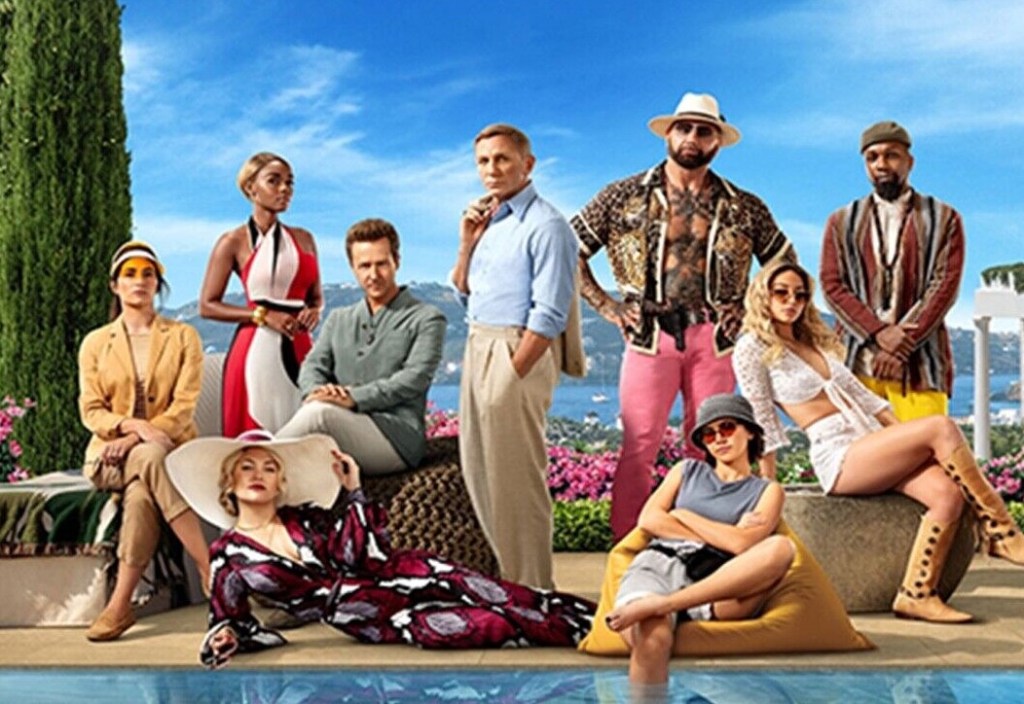
Under suspicion are Miles himself of course, plus one-time model turned fashion designer Birdie Jay (Kate Hudson), the dumbest cluck in the coop, aspiring politician Claire (Kathryn Hahn), Miles’ former business partner Andi (Janelle Monae), macho male Duke (Dave Bautista) and girlfriend Whiskey (Madeline Clyne), Miles’ sometime lover, scientist Lionel (Leslie Odom Jr) and Peg (Jessica Hanwick). What they share with Miles is vanity, an overweening sense of their own importance and entitlement.
Actually, one of them doesn’t qualify as a suspect because as you may have guessed that would be the victim. Two of them, since I’ve already kind of given away that there are two dead. Anyway, you’re not going to guess any of this since you’re all dupes to the infinite ingenuity of Rian Johnson.
Sure, the director takes pot-shots at the rich and the wannabe wealthy and the wannabes that trail along in their wake, but mostly he takes aim at the genre itself, turning the whole idea of the mystery picture on its head, that we expect something pretty intricate the moment we are presented with a movie puzzle, and motivation being the engine of all mystery start delving headlong into that morass without thinking the answer might be something a lot simpler.
Whatever Rian Johnson is doing he’s got the elan to carry it off. Sequels often disappoint. This won’t. Not quite the caliber of cast as Knives Out (2019) but that’s actually to the film’s advantage, no need for the star-stalking that afflicted the recent Death on the Nile (2022).
Thoroughly entertaining, ingenious and devious, what more could you ask for, apart from Netflix not having snapped up the golden goose, since this will be infinitely more enjoyable in the company of an audience responding en masse to the trickery, as I discovered when watching it on its brief foray to the cinema.
And there’s certainly a dichotomy here. What is the point of the Netflix sop to the movie theatre? Sure, it’s going to rack up a ton of reviews but they’re all going to be posted a month before the picture opens on Netflix rather than the weekend before. Anticipation may not last that long. Anyway, given all the turkeys Netflix has foisted on movie fans, this will be one Xmas when it delivers.
PS: Apologies for the goof on Behind the Scenes: “Bandolero.” That blog is coming on Saturday but I pressed the wrong button and sometimes when you press the wrong button there’s just no going back.
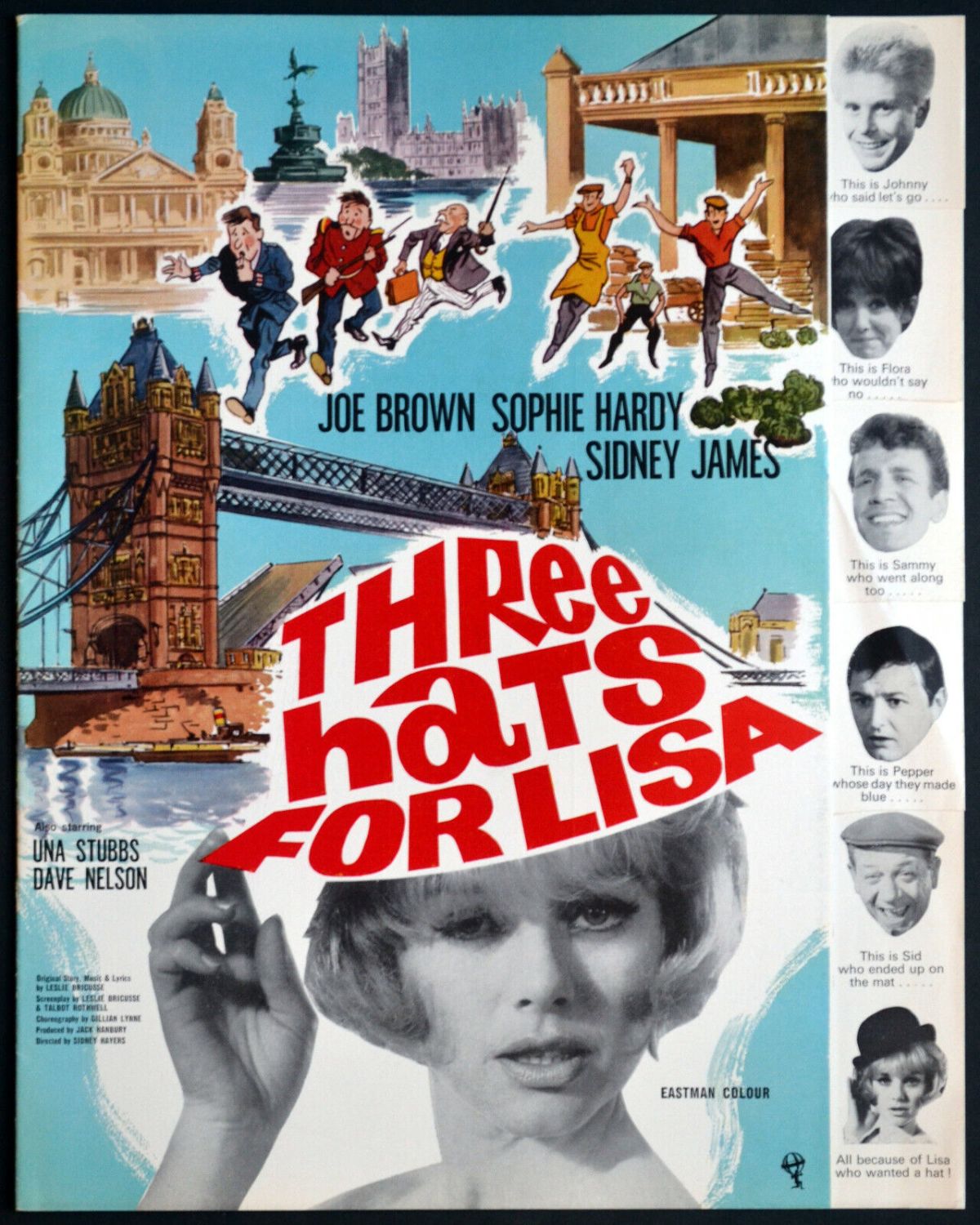
Until the triumphant arrival of Oliver! (1968), the bar for British musicals was set very low. This just about scrapes through, thanks primarily to the enthusiastic cast and a rare opportunity to hear Sid James warble, though that may well be a detrimental factor.
At this point the British movie musical was kept aloft by pop stars, Cliff Richard (Summer Holiday, 1963) injecting box office life into a moribund mini-genre, The Beatles (A Hard Day’s Night, 1964) adding artistic credibility. Any pop star could front a musical, hence Ferry Across the Mersey (1965) starring Gerry and the Pacemakers, or if you filled the picture with enough stars (Gonks Go Beat, 1964) that was deemed sufficient.
You would be hard put to place Joe Brown, leading man of Three Hats for Lisa, in the Cliff Richard/Beatles class and no British effort could come close to West Side Story (1961), Gigi (1958) or South Pacific (1958). Despite a paucity of hit singles – three Top Ten hits in 1962-1963 the extent of his chart success, Brown, voted UK Vocal Performer for 1962, and with a distinctive brush-cut, had already starred in What a Crazy World (1963), an adaptation of a stage musical, directed by Michael Carreras (The Lost Continent, 1968) which featured singers Susan Maugham, Marty Wilde and Freddie and the Dreamers.
But there was an emergent generation of stage songsmiths led by Lionel Bart (Oliver!, stage debut 1960) and Leslie Bricusse (Stop the World I Want To Get Off, stage debut 1961) and even the venerated John Barry (The Passion Flower Hotel, stage debut 1965) had tried his hand. Bricusse, on a publicity high after co-writing the lyrics for Goldfinger (1964), already had a movie musical to his name, Charley Moon (1956).
If Joe Brown had no proven box office cachet he was in good company. Frenchwoman Sophie Hardy had little musical experience that I’m aware of (unlike namesake Francoise Hardy), was making her English-speaking debut (as an Italian) and was best-known for Max Pecas’ number The Erotic Touch of Hot Skin (1964), a title that suggested far more than presumably the picture delivered. Una Stubbs, later famous for Till Death Us Do Part comedy series, was equally unknown.
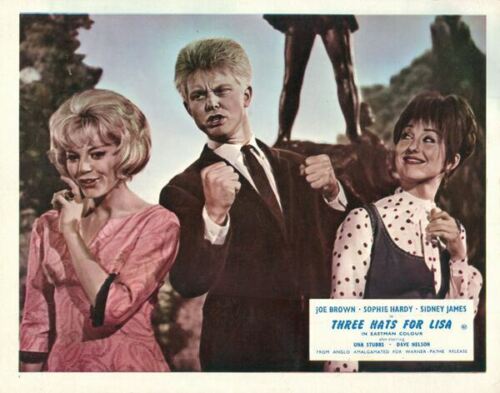
Joe Brown is the one in the middle.
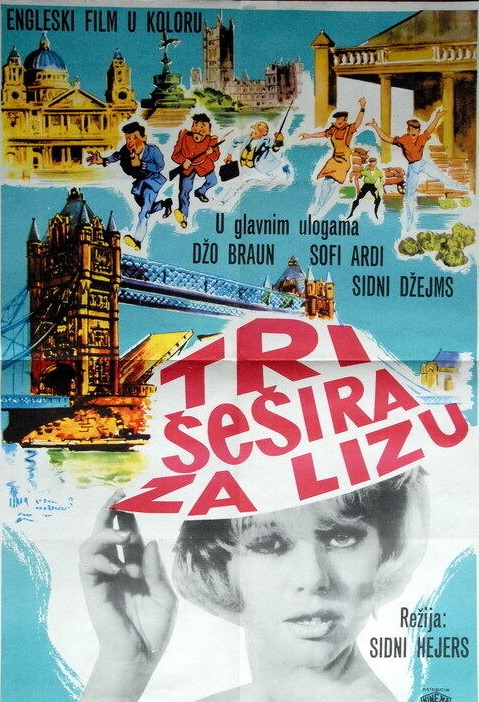
Narrative was the least consideration when crafting a British movie musical. This gets by on the notion that three irrepressible Cockneys – Johnny (Joe Brown), Flora (Una Stubbs) and Sammy (Dave Nelson) – somehow get entangled with a sexy Italian movie star Lisa (Sophie Hardy) who wants to dodge out of work commitments and collect a selection of typical British hats: a bowler, a busby (bearskin) and policeman headgear. Taxi driver Sid (Sidney James) is along, literally, for the ride. The rest of the time it’s a Swinging Sixties London travelog, an opening aerial shot of the capital, iconic sites to the fore, setting the scene, and subsequently cramming in as many tourist attractions as possible.
Every couple of minutes, for no particular reason, they burst into song and faux-West Side Story choreography. In fact, it’s stuffed with songs, fourteen over a short running time. Some are clearly spoofs – “The Boy on the Corner of the Street Where I Live” for example, or “Bermondsey” and none are particularly hummable. On the plus side, all the song-and-dance numbers are exteriors, though presumably because it was cheaper than hiring studio space. That London remained dry enough to accommodate such spectacles is probably the only miracle on show.
It’s far from dreary, and the story is daft enough, in the vein of 1940s Hollywood musicals, to get by, and the young cast fling themselves about quite splendidly, and there’s certainly an innocence to the proceedings, Johnny settling for just a kiss on the cheek from Lisa, and it would have probably stretched the imagination even more had serious romance beckoned. It seems a shame to mark down such effervescence, and though it’s in reality a two out of five, it’s not in the execrable league so I’m giving it the benefit of the doubt especially as it was directed by Sidney Hayers (Night of the Eagle/Burn, Witch, Burn, 1962) who usually manages to salvage something from unprepossessing material. And also because neither Sid James nor Talbot Rothwell, the Carry On series resident writer, give in to the temptation of the double entendre.
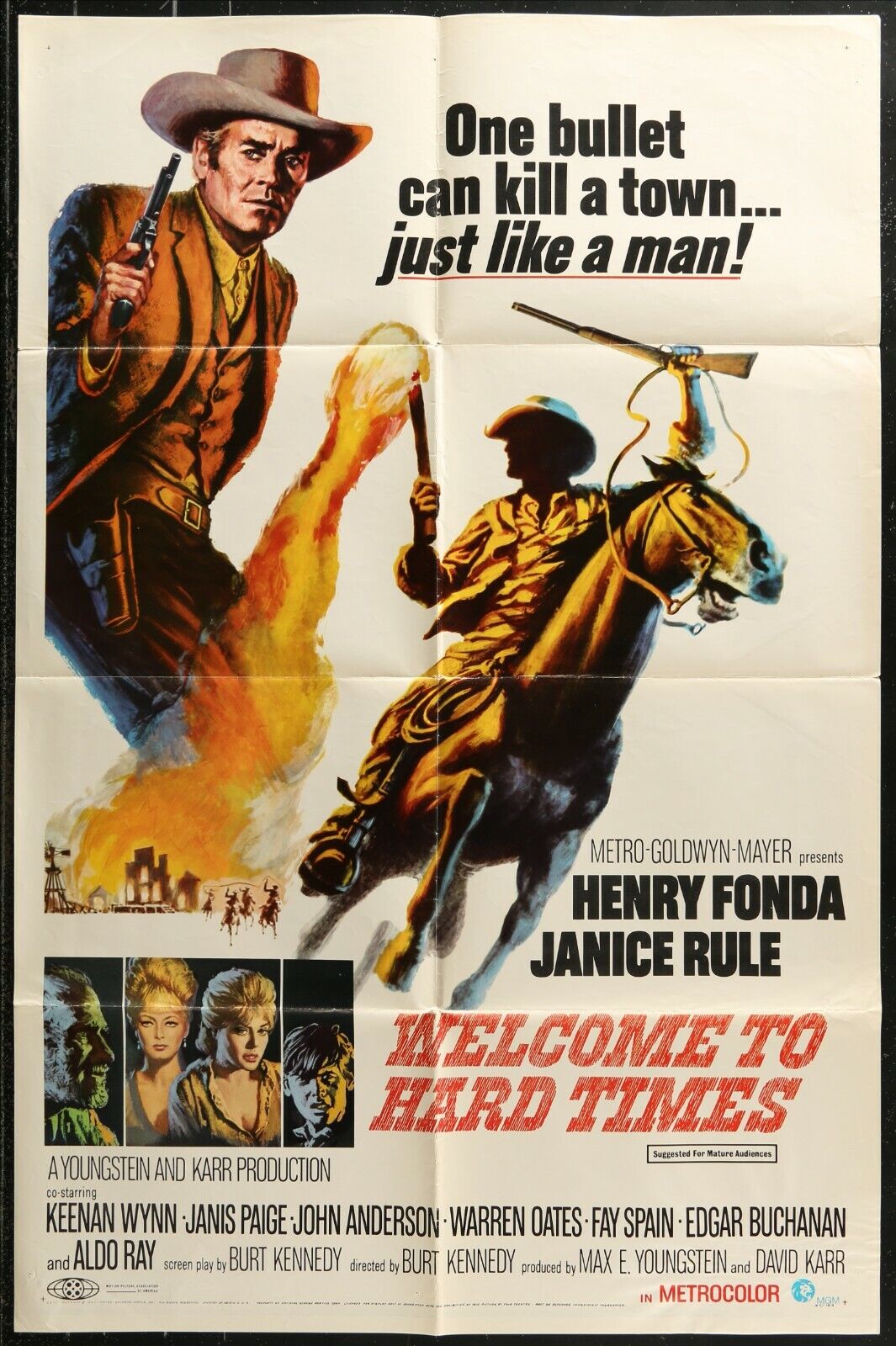
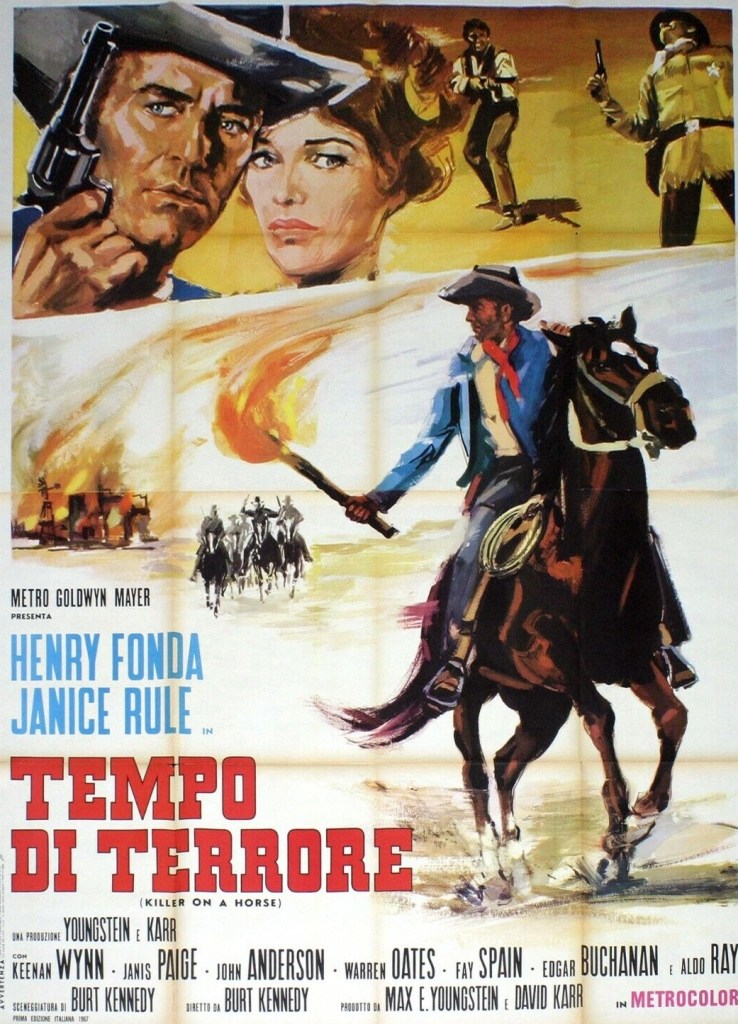
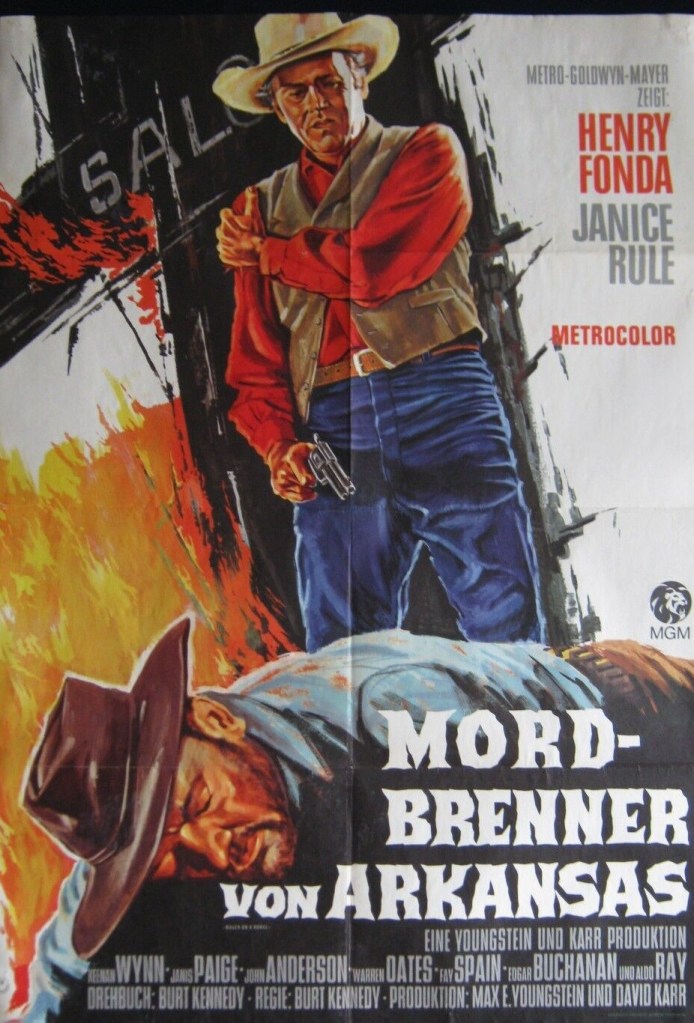
Director Burt Kennedy’s record with westerns was very much hit or miss. This revisionist effort is one of the former though it could as easily tipped into the latter, beginning with a shrill soundtrack that telegraphs every incident and the no-name villain. And you might also wonder if irony had taken such a hold of settlers that they would actually name their town “Hard Times” when there was a gold strike over the hills.
Anyway, this is certainly a town that lives up to its name. Can’t have been more than a dozen houses, a saloon of course, but it’s the muddiest place west of No Name City (Paint Your Wagon, 1969) and the meanest to hove into view since High Noon, with the townspeople in thrall not to an entire gang, but one nameless stranger (where have we seen that before).
The Man from Bodie (Aldo Ray), as he is known, is the bad guy from Hell. He shoots anyone who stands up to him like Fee (Paul Birch) or shows the slightest dissent like undertaker Hanson (Elisha Cook Jr) and rapes Fee’s girlfriend Flo (Ann McCrea) before dumping her corpse on the saloon stairs.
Will Blue (Henry Fonda), lawyer not lawman, hasn’t the guts to stand up to him, but comes the closest of the cowardly bunch. When The Man has done as much rampaging as a tiny town will allow he burns it to the ground. Most people leave, but Blue, having done too much running in his life, decides to stay to look after Fee’s orphaned son Jimmy (Michael Shea).
If Blue’s vengeful Oirish girlfriend Molly (Janice Rule) also remains it’s mostly to hate him for abandoning her to the madman – Blue had used her to distract the Man but then retreated when the going got tough leaving her to be raped at will. She sets up her own League of Desperadoes, recruiting new arrival Jenks (Warren Oates) and the orphan, to tackle the bad guy on his inevitable return.
Meanwhile, a mobile unit of sex workers, complete with tent, turns up to service the nearby gold workers. Their entrepreneurial boss Zar (Keenan Wynn) spots opportunity and helps Blue rebuild the town. Of course, everyone’s just waiting for Bodie Man to return.
Anyone that’s likeable or got anything approaching character is killed off at the start, so we’re left with an unlikeable, ambivalent, but realistic, crew. For all his later hi-falutin’ principles and pioneer spirit, Blue is still a coward who, to save his own skin, sacrificed Molly. Hoping to redeem himself by acting as surrogate father to Jimmy doesn’t result in him winning any respect from Molly.
This is one raped woman who found out the man on whom she was depending was no protector. Why should she ever love him again? And she’d be crazy to put her life in his hands once more. Of course, she could have got herself her own shotgun or pistol and ambushed Brodie Man when he took another shine to her, but instead she plays pretty please with Jenks, which is understandable, and the young Jimmy, which is deplorable.
That the sex worker magnate becomes one of the town’s foremost citizens might cleave closer to the bone than many viewers would like, but corruption was as endemic in America then as it presumably is now.
And it begs the question when all those pioneers headed out West how many of them were scum like Bodie Man? And how did the settlers think law-and-order was going to work out?
On the downside we have a villain, who, not content with killing and raping, demonstrates just how mean he is by smashing whisky bottlenecks because he hasn’t the patience to extract the cork with his teeth. Fee is dumb enough to take on the bad guy with a bit of log. Molly’s Irish accent is all over the place. And we could do with less music. And there’s a climactic twist that belonged to a horror film and is not only completely out of place but undoes the realistic tone by providing a somewhat sanctimonious ending.
But if you are expecting a movie along High Noon lines, with the good guy beating the bad, and winning the town’s respect, then you will be disappointed. On the other hand if you come prepared for one of the darkest westerns of the decade where the terrorizing outlaw exerts such fear that the townspeople, in defending themselves, pull down the shades between good and evil, then you will be amply rewarded.
The boldness of director Kennedy (The War Wagon, 1967) in reimagining the West as a place of venal proportions should be applauded. The direction might take a wrong turn here and there but the aim is effective. Henry Fonda (Firecreek, 1968) is good as ever and although I could do without the awful accent Janice Rule (Alvarez Kelly, 1966) is superb as the vengeful woman refusing Blue forgiveness and willing to use a youngster as a weapon.
A sound supporting cast includes Keenan Wynn (Warning Shot, 1967), Edgar Buchanan (Move Over, Darling, 1963), Janis Paige in her final movie outing, John Anderson (5 Card Stud, 1968) in a double role, Aldo Ray (The Power, 1968) and Warren Oates (The Wild Bunch, 1969).
Kennedy wrote the screenplay form the book by E.L. Doctorow.






 The Magnificent 60s