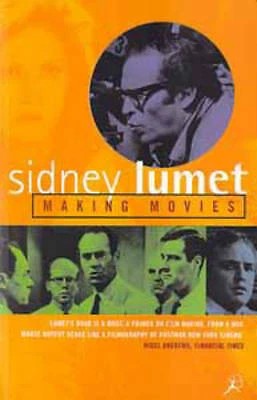
There are plenty books about directors but remarkably few that explain with any coherence exactly what it is they do. Until now, the best book I’ve read upon the subject was by Edward Dmytryk, Oscar-nominated for Crossfire (1947) and shepherding home such triumphs as The Caine Mutiny (1954), Raintree County (1957), The Young Lions (1958) and more obviously commercial fare such as The Carpetbaggers (1964) and Mirage (1965). His book On Screen Directing covers every aspect, often with diagrams and instructions, of movie making.
Sidney Lumet takes a similar nuts-and-bolts approach in Making Movies. In turn, he focuses on the script, acting, camerawork, art direction, costumes, the actual shooting, dealing with rushes, editing, sound, and a vital element in the process that you’ve probably never heard of – the answer print.

Lumet has a heck of a portfolio. Five times Oscar-nominated, from debut 12 Angry Men (1957), through The Hill (1965), The Group (1966) and The Appointment (1969) and picking up the pace with The Anderson Tapes (1971), The Offence (1973), Serpico (1973), Murder on the Orient Express (1975), Dog Day Afternoon (1975), Network (1976), Equus (1977) and running through Prince of the City (1981), The Verdict (1982) and Family Business (1989) all the way up to Before The Devil Knows You’re Dead (2007).
The actual physical process begins in the rehearsal room, a “grungy” space in a big city. Key members of the production team will be present. The unit publicist will make a nuisance of themselves. Directors beware a star who arrives with an entourage. Sean Connery, with whom Lumet, made five pictures, arrives alone, bounds “up the steps two at a time, rapidly shakes hands all round, then plops himself down at a table, opens his script and starts studying.” Paul Newman couldn’t be more different. He “treads slowly up the stairs, the weight of the world on his shoulders, puts drops in his eyes, and makes a bad joke.”
But first, of course, came the script. In the best screenplays, “character and story were one and the same. I think inevitability is the key,” the idea that, without removing the element of surprise, the film will end up where the character’s actions insist.
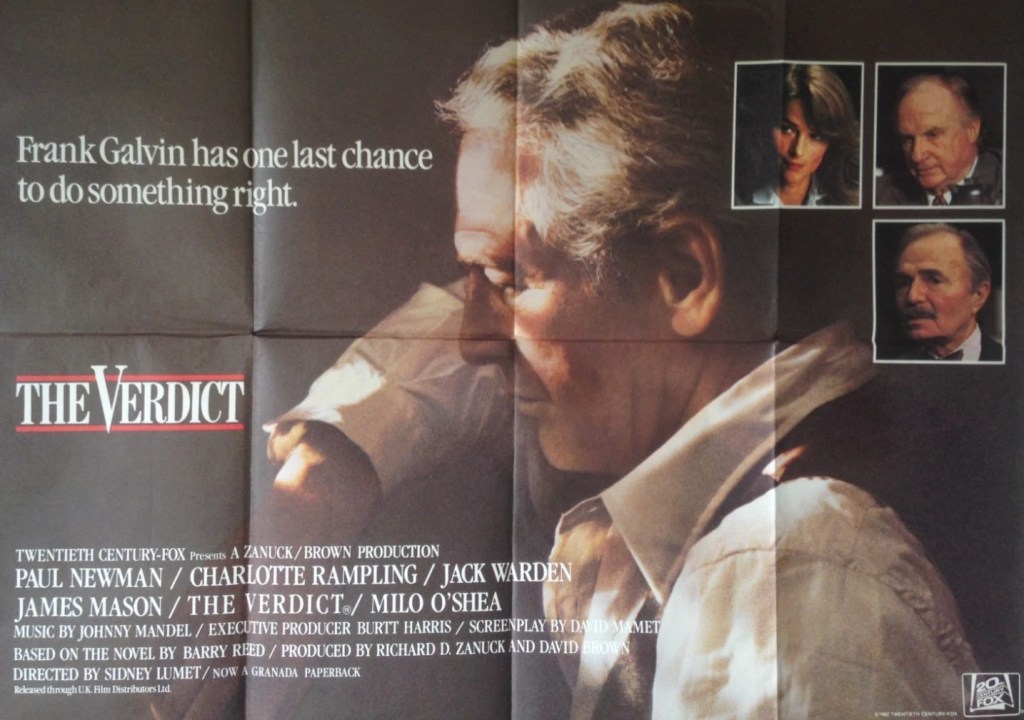
Stars can ruin scripts. On The Verdict initial star Robert Redford’s insistence on changing the main character from a deadbeat drunk into someone more sympathetic had cost the studio a million dollars in scripts and rewrites before he exited the project and Paul Newman, perfectly happy to play an alcoholic, took his place.
Naturally, Lumet has beefs with critics and nowhere is that more heated than on their opposite definitions of style. Since critics don’t really know much about cinematic style, they’ll plump for the most obvious, something deriving from costume or period setting or some fancy camera gimmick. Lumet recalls no critic mentioning style in reference to Prince of the City, a movie he deems one of his most stylistic. Akira Kurosawa noticed it and talked to Lumet about it in some detail.
Lumet views stars as courageous. Called upon to reveal parts of themselves, or their bodies, it’s a never-ending series of demands on their skill-set. On the other hand, they can set out to test the director and make his life a misery. Like everyone else, he confesses to not knowing what makes a star, certainly appearance counts, but more often it’s more mysterious, some alchemy that jumps off the screen. But stars are well rewardd, as we know, but their perks can add substantially to the bottom line. In the 1990s one major star was getting an extra $320,000 in extras, which, in effect, cost the studio four times as much when taking into account how the box office take is broken down.
“Most actors have their best take early.” By Take 4 they’re given their best. But if something’s gone wrong, a faulty camera or light or someone coughing at the wrong time and they have to go again, actors are “emptied” and it can take several more takes to find the vital “refill.” Perseverance isn’t much fun when it takes 34 takes, as on The Fugitive Kind (1960), for Marlon Brando to get it right.
Camera tricks. At the end of 12 Angry Man, the camera was positioned higher and the lens wider. “The intention was to literally give us air, to let us finally breathe, after two increasingly confined hours.” Backlighting is “one of the oldest” devices used to make people look more beautiful. In The Hill, wide angle lenses were used to give the idea of character distortion. On The Deadly Affair (1967) “preflashing” made the backgrounds drab. The documentary feel of Dog Day Afternoon was enhanced by handheld cameras. Chiaroscuro achieved the “old” look of The Verdict.
When the movie starts shooting “the call sheet is our bible. If it’s not on the call sheet, we don’t need it.” But everything you do need, including actors, is itemized on the call sheet for each scene.
The answer print is the last element in the process. Before that can be created, the director calls in the guy from Technicolor. His job title is “timer.” In a darkened room, he watches the movie, relying on a counter beneath the screen. Reel by reel, he makes notes. “This shot is too dark, that too light, this too yellow, that too red,” and so on. Contrast, too, comes under the microscope. “Every scene, every shot, every foot of film is analysed.”
The Technicolor guy heads back to Technicolor where he sits in front of a machine called a “Hazeltine,” a computerized color analyser. “He feeds the negative into the machine and sees a positive image of the picture on a TV screen. Since electronic color is quite different from chemical color, his judgement is crucial.” He can vary the color balance or lighten or darken the image. Just as in photography, the positive stock moves into the chemical bath and the positive print emerges – the answer print.
It’s not as easy as it sounds. The director is looking for the lab to achieve the effects he requires. John Schlesinger had 13 attempts to get it right on Midnight Cowboy (1969).
The last job is to marry the sound track – known as the magnetic track – to the answer print.
That’s not the end of the story. The movie will be screened to a test audience and a report on dozens of points of detail produced. Maybe that will necessitate change – edits, a reshoot.
Then we get to see it without an idea of the effort it took to create.
SOURCE: Sidney Lumet, Making Movies, was published by Bloomsbury about 30 years ago. You should get a copy online easily enough.

 The Magnificent 60s