There was a time when movies had charm. An easy grace. A fluidity. The ability to hold an audience in the palm of their hands with the simplest of narratives. Sadly, that time is long gone. I doubt if any Hollywood director – so raddled now by self-indulgence and self-importance – would even know how to make this kind of souffle.
I haven’t watched this movie in decades. And I fully expected to dismiss it as having aged badly. Instead, I just adored it. In part that is due to what is surely the greatest male screen partnership ever. It wasn’t uncommon then and now for two top stars to be paired together, but usually the narrative had them in conflict. That’s not the case here. There’s a reason why Paul Newman and Robert Redford were credited in Butch Cassidy and the Sundance Kid (1969) with inventing the buddy movie. Their screen personas just dovetail and they appear so comfortable with each other.
Sure, the story is a cracker, and the direction is impeccable, what with using long-gone techniques like the wipe, and the chapter headings, and, of course, the adaptation of the Scott Joplin music and audience exposure to the techniques of pulling the “big con” and the secret nose-stroking by which fraudsters identified each other. But while this premise would surely have worked with another duo, it would not have worked half as well.
This was Robert Redford’s annus mirabilis. It’s impossible these days to comprehend his impact, for the simple reason that stars rarely release two movies in the one year. Following Butch Cassidy and the Sundance Kid, Redford had been there or thereabouts without quite taking the final step required to become a box office sensation, indulging himself in worthy pictures like The Candidate (1972) and Jeremiah Johnson (1972), but the latter was decidedly under-performing until Warner Bros sent it long after initial release down the “four-wall” route that would prove pivotal to The Exorcist (1973), whereby a studio hired theaters to show a movie, paying a flat fee that covered an exhibitor’s costs and some profit rather than splitting the proceeds on a percentage basis.
But the double whammy of The Way We Were (1973) and The Sting sent Redford’s marquee value into the stratosphere. And he’s not the big romantic lead that he was in the Streisand picture, if anything he comes up short in the romantic department, dumb enough to seduce a female assassin. He’s always one way or another needing to be rescued from a self-induced calamity rather than the confident gunslinger of Butch Cassidy and the Sundance Kid with an adoring woman hanging on his every word.
There are a couple of other memorable pieces of acting that I’d like to draw to your attention. The first is Reford’s thumbs, which always seem to stick out, the reason for which is never explained and possibly they’ve been beaten by previous malfeasance into that position. The second isn’t Robert Shaw’s pronounced limp, but his menacing catchphrase “You follow?” which must be the toughest two words outside of swearing ever spoken by a gangster.
Seeking revenge on underworld kingpin Doyle Lonnegan (Robert Shaw), on-the-run con man Johnny Hooker (Robert Redford) teams up with the more experienced Henry Gondorff (Paul Newman). The plan is to rook Lonnegan of half a million dollars. They’re going to do it with a racing scam, where they know the results of a race before anyone else.
But first Gondorff needs to find finance and needle Lonnegan enough to bait the hook. He achieves both by stealing Lonnegan’s wallet before using that cash for his wagers and cheating better than Lonnegan at poker.
Then Hooker has to pretend that he’s fallen out with Gondorff and willing to work with Lonnegan to screw two million bucks out of Gondorff. Meanwhile, to spice up the plot, maverick cop Snyder (Charles Durning) is on the trail of Hooker and the FBI are on the trail of Gondorff.
The payoff is so brilliant that audiences at the time reputedly cheered and I have to say I felt like doing so myself.
Robert Redford was nominated for an Oscar but I think the acting honors were even with Newman. The movie won the Best Film Oscar and Best Director for George Roy Hill (Hawaii, 1966) and usually when you come to re-evaluate Oscars you tend to mark down many of the choices because they don’t really hold up. This was up against The Exorcist, American Graffiti, Ingmar Bergman’s Cries and Whispers and the comedy A Touch of Class, so it wasn’t as though there was another better contender.
I like to think it won for bravura. Elan. In every department. Fresh and innovative, oozing charm and with the greatest double act in American cinema.
Director George Roy Hill (Hawaii, 1966) was on a roll and the screenplay by David S. Ward (Steelyard Blues, 1973) hit a home run.
There’s hardly been a more enjoyable Oscar-winner.

 The Magnificent 60s
Just a perfect movie. A jewel of the 70’s.
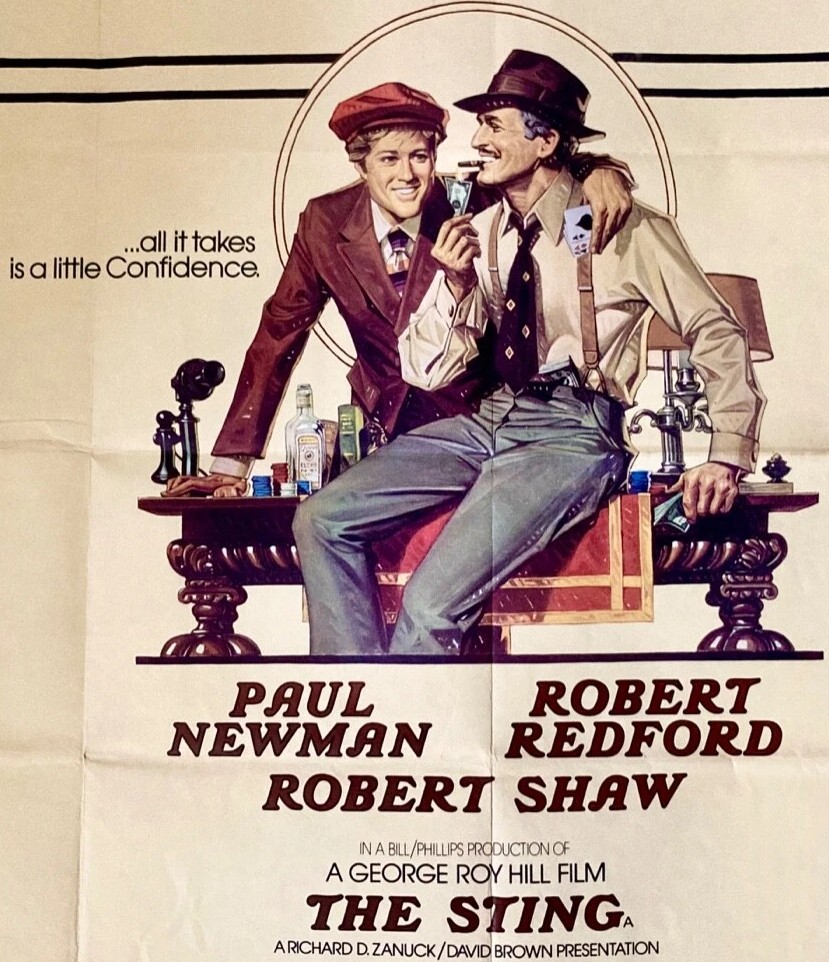
“On the first screen of the opening credits, the Universal Pictures company logo presented is a reproduction of the logo Universal used during the 1930s, a twirling crystal globe set against a black background with the name “Universal Pictures” appearing around the globe in raised, art deco-style letters. Following the logo, the names of Paul Newman, Robert Redford and Robert Shaw appear on the left-hand side of an illustration featuring their likenesses. Following the film’s title and the producing and screenplay credits, a title card reading “The Players” appears, followed by individual photographs of the three actors, with their respective names and character names superimposed.
After the three principals, actors Charles Durning through Dimitra Arliss are shown in a similar fashion, but with two photographs, side-by-side on each screen. In both the opening and ending cast credits, actor Robert Earl Jones’s name is written as “RobertEarl Jones.” Within the film, the story is divided into chapters that are announced by inserted art title cards. In order of appearance, the cards read: “The Set-Up,” “The Hook,” “The Tale,” “The Wire,” “The Shut-Out” and “The Sting.”
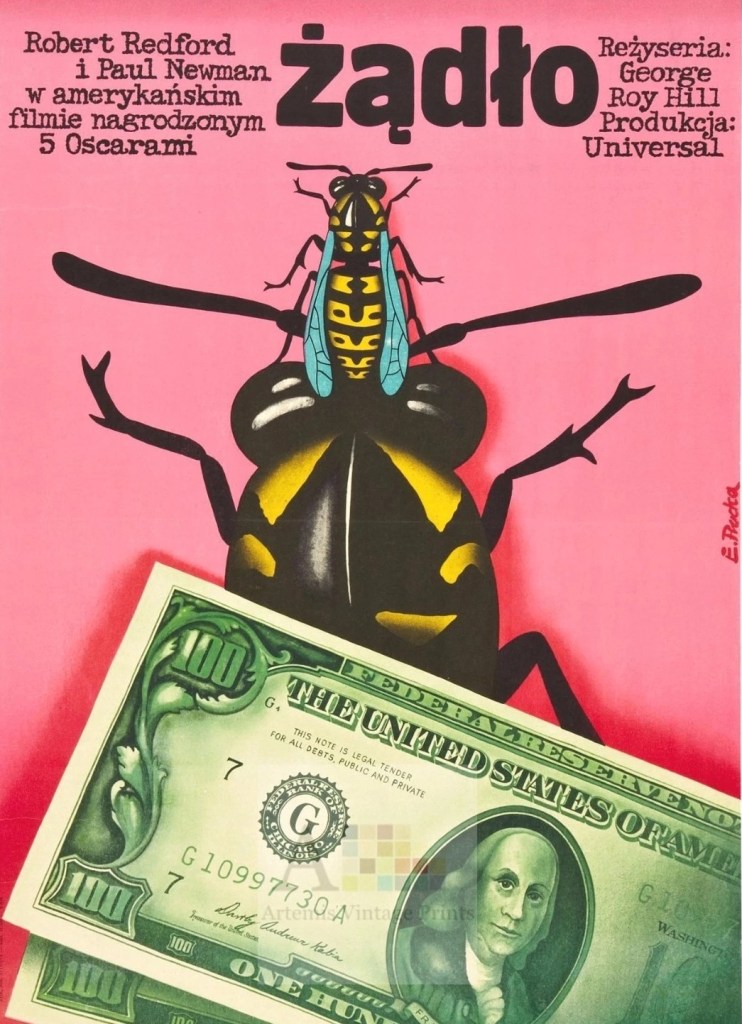
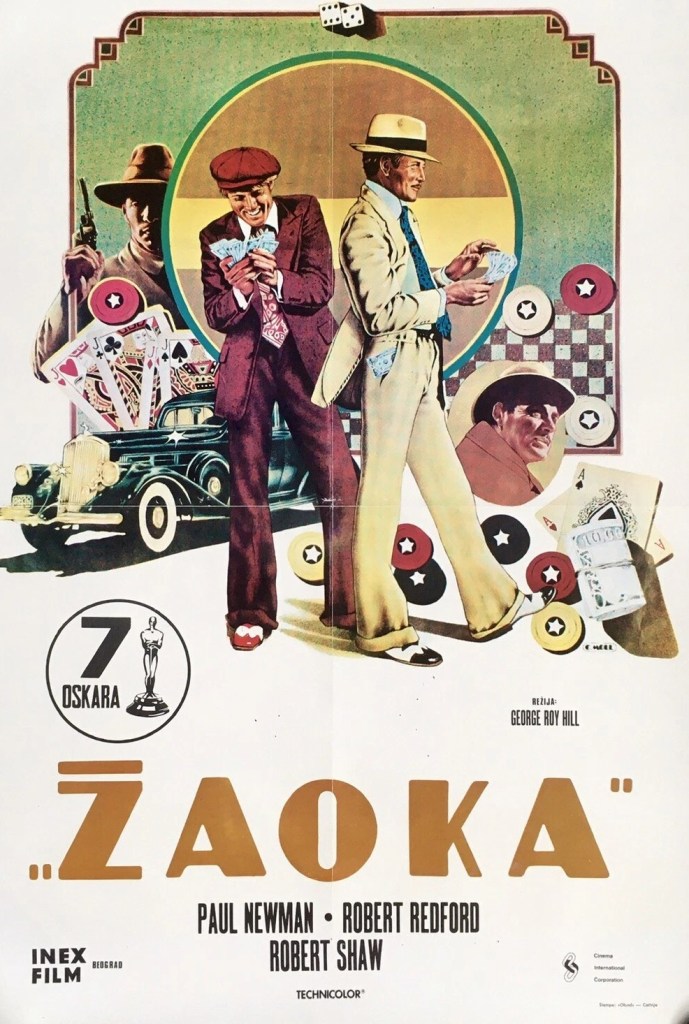
The title artwork used for the opening and closing credits and the inter-titles was created by Jaroslav Gebr. His sketches and lettering emulate the type of art work used on covers and as short story illustrations within the weekly magazine The Saturday Evening Post [SEP], which enjoyed the height of its popularity in the mid-1930s, the time period in which the film is set. This theme was also used in the picture’s key art, most notably in a sardonic pose of Redford and Newman, dressed in character, appearing as if on the cover of SEP, over the tagline “…all it takes is a little Confidence.” The film’s souvenir program featured the same SEP-inspired art, adding the date “December 25 1936” as the fake magazine’s issue date, a tongue-in-cheek reference to the film’s 25 Dec 1973 opening. The pressbook for The Sting lists a running time of 129 minutes, and most reviews list either 129 or 127 minutes, but copyright records erroneously list a running time of 103 minutes.
According to a 24 Nov 1972 DV news item, actor Richard Boone had been cast in the film in a major role. However, a Var column on 7 Feb 1973 noted that British actor Shaw had replaced Boone [in the role of “Doyle Lonnegan.”] The item also noted that Universal Pictures had not given a reason for the change but had simply dropped Boone’s name from the cast list and replaced it with Shaw’s. Noted card specialist and author John Scarne was a technical advisor on the film, and some modern sources have stated that Scarne performed as Newman’s hand double during the card shuffling scene on the train. A DV news item on 15 Jan 1973 reported that John Longenecker would serve as an AFI intern on the production. Modern sources add Patricia Bratcher, Chuck Morrell and Guy Wray to the cast.
As noted in the pressbook and other sources, The Sting was to be the first film of Bill/Phillips Productions, a company formed in Feb 1971 by Tony Bill with Michael and Julia Phillips, who were married at the time. However, another of their films, Steelyard Blues (1973, see entry) actually went into production and was released first. The pressbook reported that screenwriter David S. Ward, who was a recent film school graduate, told Bill “the gist” of the story in late 1970, after which Bill encouraged him to complete the screenplay. Ward’s first produced screenplay was for Steelyard Blues.
Redford was the first actor approached, according to the pressbook, then Newman was brought on board, as well as director George Roy Hill, with whom the actors had worked in their 1969 hit Butch Cassidy and the Sundance Kid (see entry). According to the pressbook and other contemporary sources, while most of The Sting was shot on the Universal lot, some location shooting was done in Chicago, including the sequence in which “Johnny Hooker” is being chased by “Lt. Wm. Snyder” to an “El” elevated train station and through a freight yard. That scene and a few others were shot at various Chicago locations, including Union Station, the Penn Central Freight Yards, the LaSalle Street Station and the Illinois Central Station. According to 17 Apr 1973 DV news item, the filming in Chicago marked the first Hollywood production in the city in two years due to the reluctance of then mayor Robert J. Daley to allow filming that would depict the city in a bad light.
The pressbook noted that some of the El scenes were actually shot on the Universal backlot, where “a huge steel superstructure, 20 feet high and 250 feet long” served as a backdrop for many scenes. Los Angeles area locations used to emulate the historical setting included interiors and exteriors of the Biltmore Hotel in downtown Los Angeles, the Castle Green and the Commercial and Savings Bank in Pasadena and, in San Pedro, the Koppel Paint plant, which was used for the phony FBI headquarters. The film’s period feel was enhanced not only by the costumes and art direction, but also by its editing and photography. Veteran cinematographer Robert Surtees used several period techniques that were popular in the 1930s, including the “iris shot” fadeout, in which the action closes in an ever decreasing circle.
The film’s score was adapted by Marvin Hamlisch from the melodies of African-American ragtime music composer Scott Joplin (ca. 1867–1917). Although the onscreen credits only specify “Piano rags by Scott Joplin,” the main theme music for The Sting was based on Joplin’s “The Entertainer,” written in 1902. Other Joplin tunes incorporated into the score include “Solace,” “Gladiolus Rag,” “Pineapple Rag (Pine Apple Rag)” and “Ragtime Dance,” among others, many of which featured piano solos by Hamlisch. It is possible that Hamlisch also was the man whose voice is heard on the soundtrack just before the closing credits, giving the musical count “One, two–one, two, three,” to start the end music.
Although historically ragtime music was most popular prior to World War I, two decades before the film’s 1936 setting, most critics and audiences alike were responsive to the charm of the melodies, which provided a musical backdrop and bridged the different parts of the story. In liner notes on the film’s soundtrack album, Hill wrote that he decided to use Joplin’s music after his son played one of the rags for him, then contacted his old friend Hamlisch to do the adaptations.
The success of The Sting led to a revived appreciation of Joplin’s music. Hamlisch’s album The Entertainer, which featured the theme from The Sting, among other Joplin rags, was on Billboard magazine’s “Hot 100” list for over four months, peaking at number three in spring 1974, and jazz pianist Joshua Rifkin’s album Piano Rags by Scott Joplin also ranked on the “Hot 100” at around the same time. In 1976, the Pulitzer Prize jury awarded Joplin a special, posthumous award “for his contributions to American music,” which many scholars have attributed, at least partially, to the increased public awareness of Joplin’s music precipitated by Hamlisch’s adaptations for The Sting.
As part of the film’s publicity campaign, Universal produced a small souvenir booklet that gave an historical account of the world of the confidence artists. The booklet further outlined the various stages of “the big con,” as practiced in the real world and fictionalized in The Sting. An extensive glossary of confidence game terms, many of which were used within the film, such as “mark,” “grifter” and “inside man,” was also provided, excerpted from the book The American Confidence Man by David W. Maurer. One of the film’s most memorable nods to the world of the conman was the gesture used throughout the montage, in which Gondorff gathers some of his old cohorts together for the big con. The gesture–brushing the side of the nose with the index finger to indicate discreet complicity–became an iconic symbol of the film. According to a 12 Mar 1973 DV news item, a novelization of Ward’s screenplay for The Sting was to be written by Robert Weverka for paperback publication by Bantam Books. The novelization was published by Corgi in 1974 to coincide with the film’s wide release.
While some critics considered the film too light, most were complimentary and predicted outstanding box-office appeal. The Newsweek review expressed a general consensus, stating: “Like its heroes, the film succeeds on charm and con….For all its charm, The Sting has a slightly stale, carefully crafted feel of a sure-fire sequel. But who can argue, when this lightweight delight is destined to make many millions…” One of the more complimentary reviews, by Judith Crist in New York, was entitled “Pure Honey,” and went on to call the movie “pure gold, the kind of movie that dreams of sophisticated entertainment are made on.” Many critics also mentioned the fact that the final plot twists of the story would also “sting” the audience. As the Var critic wrote, “In the final seconds, the audience realizes it has been had.”
The Sting was the highest grossing film of 1974, taking in more than $68,000,000 in the North American box office. According to a 31 Aug 1992 HR report on The Sting, by 30 Sep 1989, the film had grossed $151,491,774 worldwide and garnered a net profit of $63,632,842. Primarily due to the success of this film, in 1974 Redford became the top box-office star in the world, with Newman ranked second. Redford continued being the number one star in the world through 1977. The film won seven Academy Awards: for Best Picture, Direction, Original Screenplay, Film Editing, Art Direction, Costume Design and Adapted Score. Additional Oscar nominations for the picture went to Surtees for Cinematograhy, to Robert Bertrand and Ronald Pierce for Sound and to Redford for Best Actor, his first nomination in any category and his only acting nomination. In addition to winning an Oscar for The Sting, Hamlisch won two more Oscars that year, for Original Score and for Best Song (shared with lyricists Marilyn and Alan Bergman) for The Way We Were (see entry), making him the first person in history to win three Academy Awards in one night. Costume designer Edith Head’s Academy Award marked the eighth and last of her career.
In late 1974, a controversy erupted over Ward’s screenplay for The Sting. As reported in DV on 11 Oct 1974, David W. Maurer, then a professor emeritus at the University of Louisville, filed a complaint that his 1940 book The Big Con [revised and reprinted in 1974 under the title The American Confidence Man, and, as noted above, excerpted in the film’s souvenir booklet], had provided, “in substantial part,” a basis for Ward’s screenplay for The Sting. As noted in many news items and feature articles from the late 1970s through the early 1980s, Universal made a financial settlement with Maurer in the amount of $350,000 [some sources reported $300,000]. However, when the matter was reviewed by a panel of writers organized by the Writer’s Branch of the Academy, the panel concluded that Ward did not plagiarize from Maurer’s work, thus the screenwriter’s credit, and ultimately his Academy Award, would stand. According to a 1 Feb 1978 DV article, the WGA announced that, if Ward were to be sued by Universal’s insurer, Pacific Indemnity, for recovery of the money the company paid in the settlement, the WGA would “take an amicus position” and intervene in the case. However, it has not been determined that Pacific Indemnity ever tried to recoup the money from Ward.
A 27 Aug 1979 feature article by Stephen Farber in New West, “Plagiarism or Coincidence?: Hollywood’s Battle for Ideas,” discussed the case of The Sting, along with several other plagiarism suits settled out-of-court by Hollywood studios, and charged that studios, such as Universal, were too quick to settle plagiarism suits for relatively small sums, rather than going through lengthy and expensive court battles, even if the cases lacked merit. The article noted, as did some other sources, that two of the writers nominated for the Academy Award in the same category as Ward, Steve Shagan and Jack Rose, had requested that the WGA and AMPAS review the matter soon after Maurer brought his charges to light.
In a lengthy feature article about Ward published in LAT on 21 Feb 1982, the screenwriter charged that the book written by Maurer, who had died the previous year, was only one of many historical references he used to research his screenplay for The Sting, but the entire screenplay was original. Ward also asserted that Universal’s “nuisance” settlement to Maurer was ill-advised and led to many years of bad feeling and social ostracism for him within Hollywood. Several LAT letters to the editor, including one by Shagan, disputed a few charges within the article, but corroborated the main argument, that Ward did not plagiarize Maurer’s book.
A different plagiarism lawsuit was initiated in May 1976 when Followay Productions sued Ward, Bill, Zanuck, Brown, Michael and Julia Phillips, Universal Pictures and its parent company, MCA, Inc., for $60,000,000 general damages and $50,000,000 exemplary damages. The Followay suit also sought an injunction against Universal from selling or otherwise marketing The Sting, alleging that Followay had purchased the motion picture and television rights to Maurer’s book in 1952. On 6 Dec 1976, Los Angeles Superior Court judge Jerry Pacht dismissed a similar suit, stating that it was a matter for the federal courts, in which Followay had already filed a suit. Pacht also ruled that, in any case, Followay did not have exclusive rights to The Big Con and thus could not make a claim “to exclusive rights to make a film based on the novel.” The disposition of the federal lawsuit has not been determined.
As reported in a 22 Apr 1981 Var article, Newman and his wife, actress Joanne Woodward, filed a suit in Los Angeles Superior Court for a refund of state income taxes on his wages and profits for The Sting. The crux of the suit, which had ramifications for many in the entertainment industry, involved the length of time that Newman, who resided in Connecticut, spent in California in 1973 and how the state determined the tax rate for non-resident performers. According to the suit, Newman worked no more than thirty days in the state that year, and thus his California income tax assessment would be at a 39% rate, not the 89% that he paid the state. The couple earlier had applied for a tax refund from California’s Franchise Tax Board based on this argument, but their petition was unanswered.
The resolution of Newman and Woodward’s suit, which went through the courts for a number of years, was reported in a lengthy LAT article on 5 Jul 1989, which delved into the ramifications for all other non-resident actors who occasionally worked in California. As the article reported, on 1 Jun 1989, the California Supreme Court upheld the lower court decision that effectually equated “non-resident actors and actresses…and other entertainment personnel with professional athletes in terms of how state income tax is determined.”
On 1 May 1985, LAT reported that Newman and Hill had filed a lawsuit against Universal and MCA seeking over $600,000 in lost revenue from video sales for The Sting and Slap Shot, which the actor and director charged had been fraudulently withheld from them by the studio. The pair also sought $2,000,000 in punitive damages and charged that Universal’s accounting practices were an industry-wide problem. A 7 Apr 1987 LAT article reported that this suit was rejected by a Federal appeals court because their claim “could not support an antitrust suit.”
In 1977, Universal re-released The Sting, beginning with a 28 Apr booking at the Radio City Music Hall in New York, followed by various May bookings across North America, including a 27 May opening in Los Angeles. When the film had its first television showing on 5 Nov 1978, it was enormously successful, earning an audience share that went as high as sixty-one percent in markets such as New York and Los Angeles.
In 1983, Universal released The Sting II, a sequel written by Ward and directed by Jeremy Kagan. Replacing Newman and Redford, who reportedly passed on the project, were Jackie Gleason as Gondorff (called Fargo instead of Henry), Mac Davis as Hooker (called Jake instead of Johnny). Shaw, who died in 1978, was replaced by Oliver Reed as Lonnegan. In the sequel, Lonnegan attempts to get even with Gondorff and Hooker at the same time that they are working on another con. Prior to Newman’s death from cancer in 2008, he and Redford often publicly expressed interest in working together a third time if the right property could be found, but by the time Newman announced his retirement from acting in 2007 they had not made another film together.”
LikeLiked by 1 person
Another superb behind-the-scenes. Much appreciated.
LikeLike