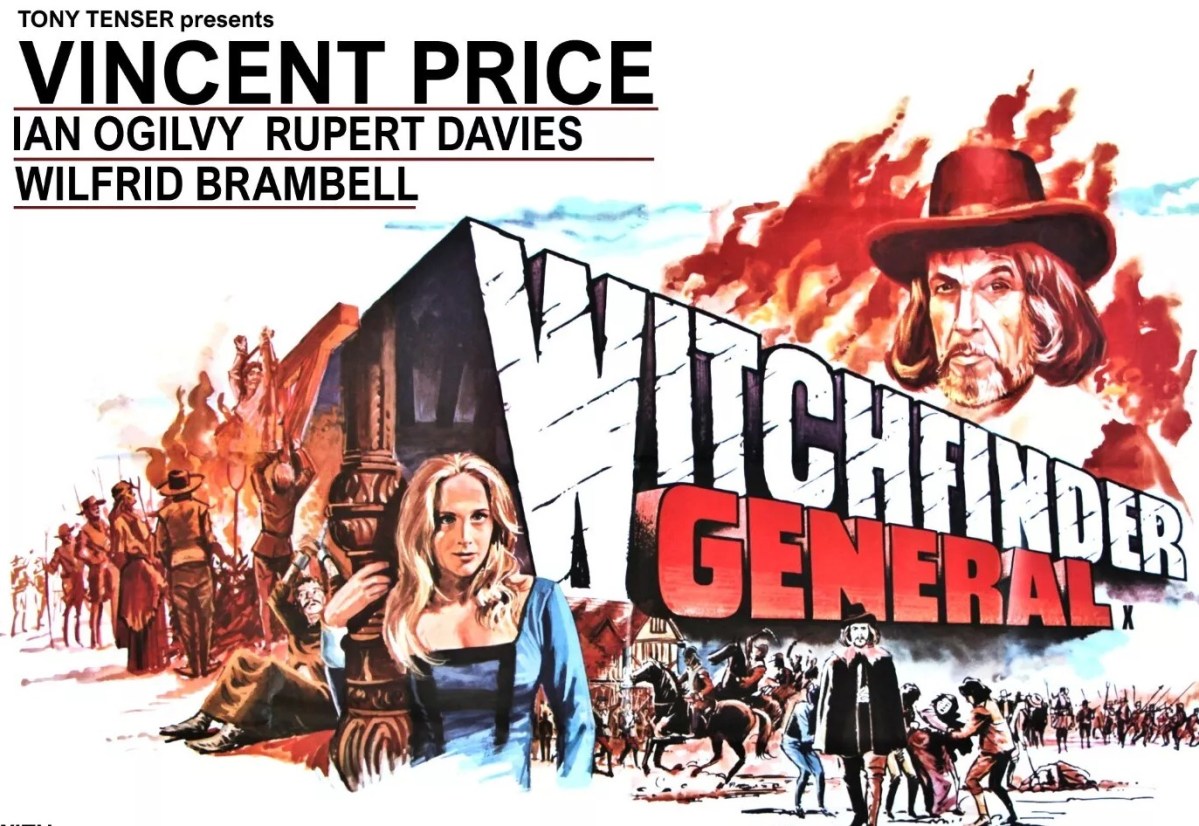
For 250 years Europe and America was in the grip of a man-made plague. Ever since Pope Innocent VIII declared war on supposed witches in 1584, tens of thousands were arrested, tortured and hung or burned to death. Although Arthur Miller’s play The Crucible is considered the last word on the subject, in fact it treats very lightly the physical degradation visited upon victims and the corruption that was at the heart of the disaster. And sure, cinema has poked its nose into the area of possession, most recently with the supposed final act of the The Conjuring series, and while items like The Immaculate (2024) and The Handmaid’s Tale series focus on female subjugation, none of these exposes the full horror of witchcraft accusation.
The British censor bristled at the violence depicted in this film, and the picture was censored to a degree, while movie critics howled at the film’s “sadism.” Yet though the film is a raw depiction of the terrors inflicted on the innocent – male and female – by a corrupt male hierarchy, it scarcely touches the surface of the tsunami of wanton killing and terror.
So this serves as a welcome reminder of that awful age. While romantic leads Richard (Ian Ogilvy) and Sarah (Hilary Dwyer) are insipid, Matthew Hopkins (Vincent Price), the self-appointed Witchfinder General, and his gang of thugs led by John Stearne (Robert Russell) are not, and the enormous delight they take in torturing the innocent is what drives the picture. Set in an England in 1645 riven by civil war, where the forces of law and order are in disarray, Hopkins takes delight in profiting from the lack of opposition to his reign of terror.
While Vincent Price (The Oblong Box, 1969) manages to resist the temptation to be overblown and his subdued performance carries ominous weight, it’s the unusual approach of director Matthew Reeves (The Sorcerers, 1967) that makes this a standout. He’s not making a horror picture, but a historical one. Not just are their nods to a specific time period, he bypasses the Gothic, the movie taking place mostly in daylight rather than nighttime, and his visual composition stands comparison with the best of the 1960s roadshows rather than standard Hammer or AIP offerings.
Hopkins delegates the actual torture to his underlings, retaining for himself the more subtle pleasure of blackmailing women into providing him with sex and walking off with a fat purse from local dignitaries for his troubles.
When he descends on any town or village, there will be a price to pay in human ruin. He picks on the village of Brandstone in Sussex and begins to torture local priest John Lowes (Rupert Davies), driving him to exhaustion by endlessly racing him up and down a room before his accomplices can get down to the serious business of plunging long needles into his naked body. Virtually all the weapons in the witch hunter’s armory are of the Catch 22 category. Nothing you do will present as innocent and then you are headed for the gallows or lowered alive into a bonfire.
Luckily for Lowes, his niece Sarah is sweet on Roundhead officer Richard, applauded for his courage in battle, and he attempts to come to her rescue. Unfortunately for her, he is called back to duty before he can save anybody and it’s only by sacrificing herself to Hopkins that Sarah believes she can save her uncle. That turns out to be the worst of the calumnies Hopkins visits upon the innocent, as once he has had his fun he just condemns the old man anyway, and the daughter to boot. And although audiences might wince at the torture it was only fraction of the pain inflicted on the victims who might well end up confessing to witchcraft just to get the agony over with. In my hometown of Paisley, seven witches were executed a few years after Salem on the accusations of an 11-year-old girl – The Renfrewshire Witch Trials has just been published on Amazon should you be interested – which shows the absolute contrivance of the authorities in ruthlessly hunting out victims on the slightest pretense.
It’s a shame that neither Ian Ogilvy (The Sorcerers) nor Hilary Dwyer (The Oblong Box) are equipped to show the depths of despair of their characters, but in some sense this is not their story, except as examples of victims, and the tale really belongs to the venal butchers who took advantage of a climate of fear. These days, it shows up almost as a quasi-documentary and that’s to its benefit.
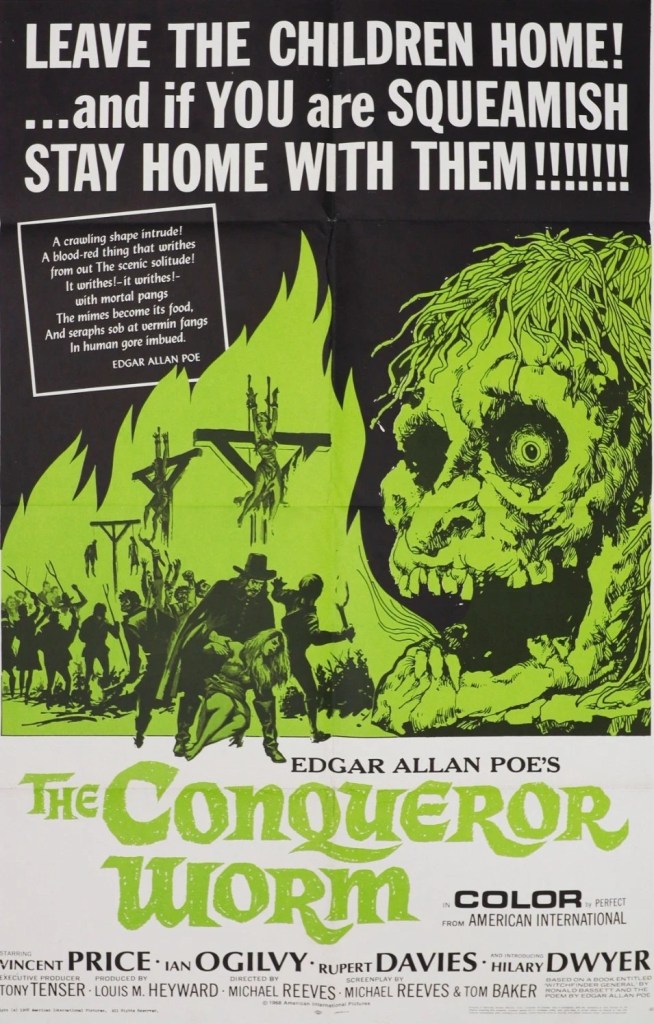
Written by the director and Tom Baker (The Sorcerers) based on the bestseller by Ronald Bassett. For its U.S. release, AIP snuck in a poem by Edgar Allan Poe which explains the U.S. title The Conqueror Worm.
Interest in this movie is unfairly attributed to the cult status it acquired after the premature death of the director – this was the last of his three films – but in fact it sits easily in the well-wrought historical movies of the period, handsomely mounted and unflinching.

 The Magnificent 60s
Brilliant review, Brian !
I myself looked into this dark witch-hunting affair by Michael Reeves and unearthed some heated exchanges between the director and Shakespearean actor Vincent Price. You’re right to compare “The Witchfinder General” to a historical film rather than Gothic horror. The atrocities depicted here serve only to denounce the political and moral collapse of an entire country, of which the inquisitor Hopkins is merely a symptom.
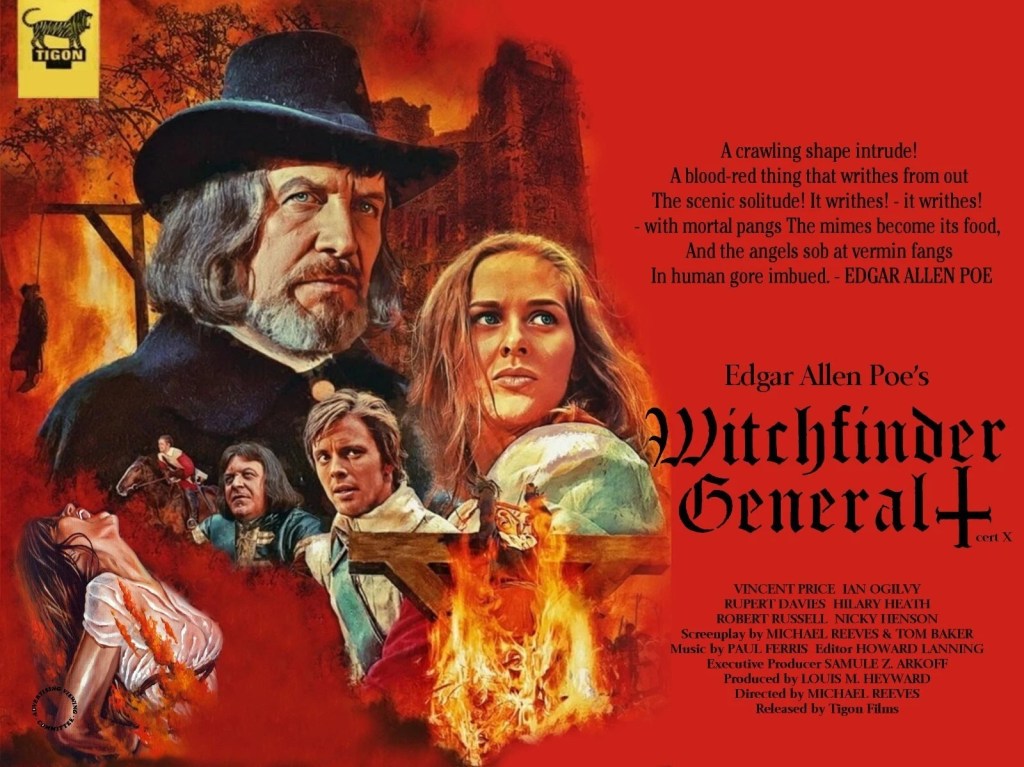
The red poster is absolutely amazing
LikeLiked by 1 person
Glad you enoyed it. We famoulsy had witch-hunting in the area where I live so I’ve got a greater understand of it. Did you publishthe information you found? I’ve got a Behind the Scenes on monday.
LikeLiked by 1 person