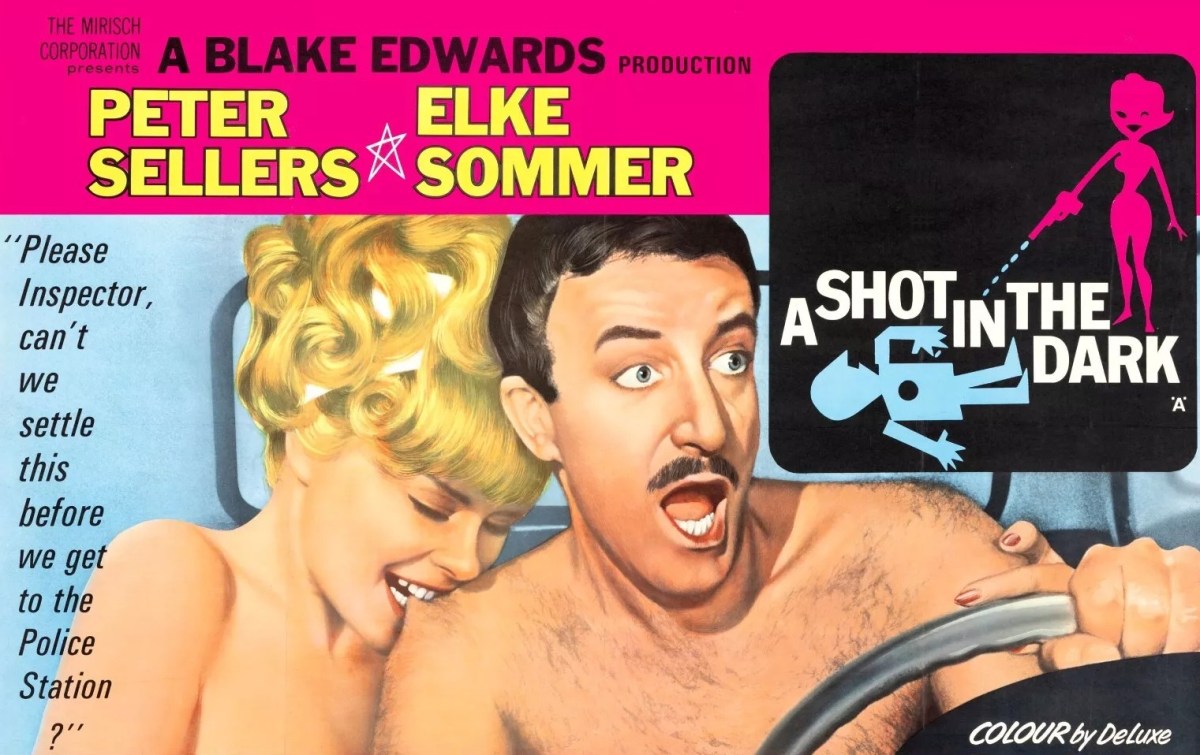
A pratfall still works wonders. An open door or window, anything that happens to be on the floor, or for that matter any object of any description – billiard cues, for example – within easy reach offers the opportunity for havoc – and a steady stream of laffs. Which is just as well, because this complicated farce, which might get a few extra brownie points today for its satire on serial killers, doesn’t do the movie any favors.
Inspector Clouseau (Peter Sellers) has acquired a more pronounced French accent than since his last incursion in The Pink Panther (1963) but it’s nothing like as excruciatingly hilarious as would be in later episodes. He still falls in love at the drop of a hat though this time the object of his affection is maid Maria (Elke Sommer) who, unfortunately, happens to be the prime murder suspect. She should be in jail but she is constantly released. Clouseau should be sacked for incompetence, but he is constantly reinstated.
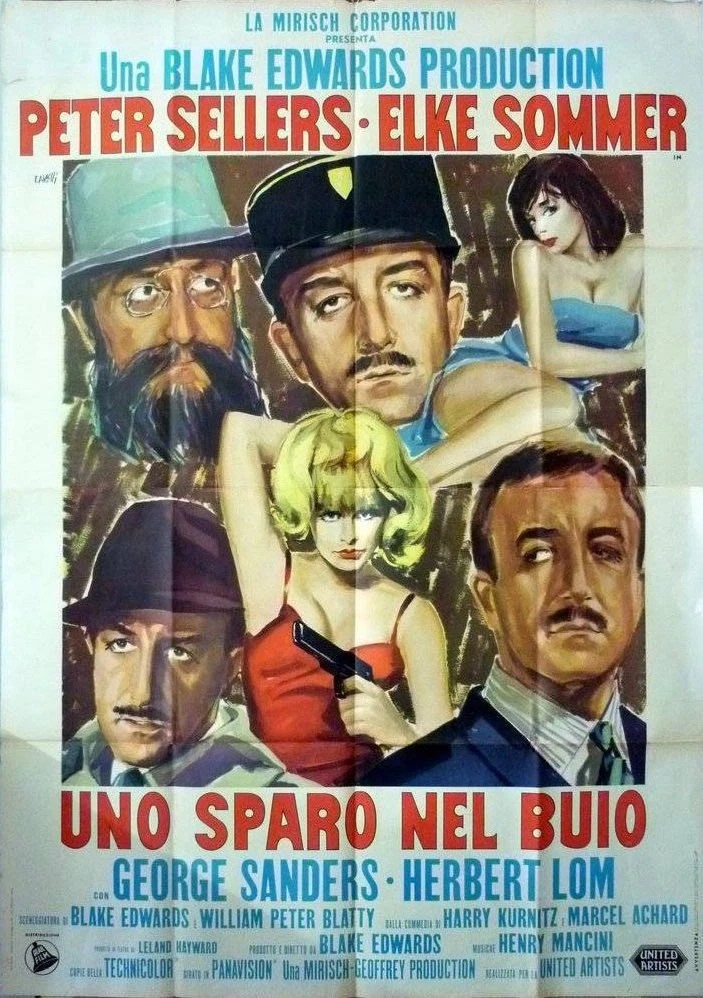
The repertory team of his frustrated boss Dreyfus (Herbert Lom) and karate teacher (Burt Kwouk) interrupt proceedings from time to time but don’t really add to the laugh quotient. A bit more effective is the satire on French bureaucracy, a running gag on the need for an official permit, for example, before you could think of selling balloons on the street or trying to earn a buck as a street artist.
I won’t go into the plot since it’s a series of baffling murders and you could argue that Peter Sellers needs neither plot nor love interest. All he needs is an open door beckoning.
I was astonished how often I laughed out loud at something I knew was coming. The minute someone walked through a door you knew Clouseau would be the other side of it waiting to be buffeted. Any open window and he’d be through it and likely as not water would await.
He doesn’t just get tangled up in words but ask him to replace a billiard cue and you’d think billiard cues had declared war on him. He’s forgetful to the point of forgetting to switch off his cigarette lighter and naturally ignores the signs that he’s set his coat on fire.
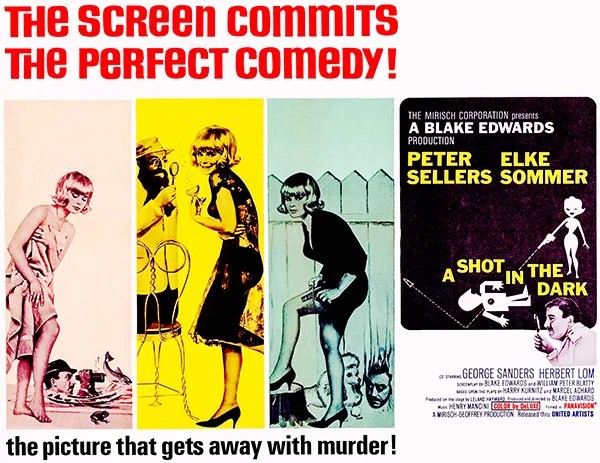
For those more censorious times, there’s a foray into a nudist colony which is primarily an exercise in the various ways that private parts can be hidden from the camera while suggesting the salacious opposite. Clothed or unclothed you can rely on Clouseau to fall down. The only hilarious scene that doesn’t involve him falling down is when Maria miraculously appears in his office and when an attached key tears a whole in his trousers.
The various twists – Dreyfus is the assassin stalking Clouseau – and the lax French attitude to adultery keep the plot going and when the narrative slackens you can always stick a bomb into the mix.
From the outset, there is plenty opportunity for farce, the wrong people entering the wrong doors, continuous mix-up, plenty occasions for the innocent person to be caught red-handed clutching the murder weapon.
It almost looks as though the two aspects of the picture are clashing. Director Blake Edwards (The Pink Panther) appears to be helming a farce within which Inspector Clouseau is encased. You might think there’s a limit to the number of pratfalls you can stick in a picture, but my answer is “try me”.
With Peter Sellers so dominant, the only way the supporting cast could compete was by over-acting (Herbert Lom) or under-acting (all the rest). Elke Sommer (The Prize, 1963) needs do little more than look winsome.
Written by Edwards and William Peter Blatty (Gunn, 1967) based on the play by Harry Kurnitz.
Occasionally drags but lifted by the genius of Sellers.


Brian, good write-up of A SHOT IN THE DARK(filmed 1963, released 1964). Although I probably think the movie is funnier than you do. I first viewed this movie on tv’s NBC MONDAY NIGHT AT THE MOVIES in 1972. I think it’s a free-wheeling, often hysterically funny farce showcasing the comic genius of Peter Sellers as the bumbling French police inspector Jacques Clouseau. Needless to say, Sellers has a field day investigating the murders of what first appears as an open and shut case against the beautiful Maria Gambrelli(Elke Sommer). Elke Sommer is the icing on this comedy cake. The wonderful sight gags just keep coming in this farce.
I can always watch A SHOT IN THE DARK right down to my funny bone.
LikeLiked by 1 person
Yes, I was a bit disappointed.
LikeLike
A little info:
ollowing the successful French production of Marcel Achard’s 1960 stage play, L’idiote, American writer Harry Kurnitz adapted the story for U.S. audiences. Under the title A Shot in the Dark, the show debuted 18 Oct 1961 at the Booth Theatre on Broadway, where it played for nearly a year before launching a national tour. Just one day after its final Broadway bow, the 23 Sep 1962 LAT indicated that Anatole Litvak planned to direct a motion picture version starring Sophia Loren. A 19 Nov 1962 DV item announced that the Mirisch Corporation had hired Alan Coppel to write the script. Although filming was expected to start the following spring, it was not until 9 May 1963 that DV reported the casting of Peter Sellers in the leading role.
According to a 28 Oct 1963 DV brief, Litvak left the picture due to illness, and the 30 Sep 1963 DV announced the recent hiring of Blake Edwards, who would serve the dual role of director and producer. A 19 Jun 1964 NYT article claimed that Edwards only agreed to work on the project on condition he be allowed to make “drastic revisions.” Having just completed photography on The Pink Panther (1964, see entry), Edwards decided to refashion the script as a vehicle for Sellers to reprise his role as the bumbling police inspector, “Jacques Clouseau.” After five weeks of rewrites, the updated draft bore little resemblance to Kurnitz’s source material. The 11 Nov 1963 DV reported that Walter Matthau, who was signed to repeat his character from the stage, left the picture in light of the changes. Production was moved to Nov 1963, with locations set in Paris, France, and London, England.
Just weeks before filming began, the 25 Oct 1963 DV reported that Sophia Loren was recovering from throat surgery in Milan, Italy. Three days later, she was deemed “too ill to work,” and the Mirisch Corp. began to search for her replacement. Shirley MacLaine was reportedly considered, but the role went to Romy Schneider.
According to a 29 Nov 1963 DV production chart, principal photography was underway on 18 Nov 1963 at the MGM British Studios in England. On 27 Nov 1963, Var reported that Elke Sommer had stepped in for Romy Schneider, who had not yet completed her assignment on Good Neighbor Sam(1964). A 17 Jan 1964 LAT article confirmed that Sommer used $100,000 of her paycheck to “buy her way out” of two German film commitments in order to sign a three-year contract with MGM.
The 23 Jun 1964 DV identified Bryan Forbes as the actor who plays “Charlie,” the locker attendant at “Camp Sunshine.” Forbes is credited onscreen by the pseudonym “Turk Thrust.”
Following production, Sellers immediately went on to film Kiss Me, Stupid (1964, see entry) for the Mirisch Corp., during which time he suffered a series of heart attacks. Ray Walston was hired to re-shoot his role, and its Jul 1964 release date was postponed. Originally scheduled for Christmas, A Shot in the Dark was bumped up to take its place in the summer of 1964. The picture opened 23 Jun 1964 at the Astor and Trans-Lux East Theatres in New York City, earning what the 29 Jun 1964 DV cited as a combined opening day gross of $68,000. According to the 2 Jun 1964 LAT, the Los Angeles, CA, engagement was set to begin 15 Jul 1964 at the Vogue and Fine Arts Theatres. Prior to its release, Grauman’s Chinese Theatre honored Sellers by cementing his hands and feet outside the venue.
While the 22 Jun 1964 DV review noted that the film’s proximity to the spring 1964 release of The Pink Panther may have diminished the “spontaneous novelty” of Clouseau’s antics, critics generally praised the character’s return, as well as the performances of Sellers and Sommers, and its positive reception led to a joint production deal between Blake Edwards and the Mirisch Corp. AFI ranked the picture #48 on its list of 100 Years…100 Laughs.
LikeLiked by 1 person
Excellent research once again. Thanks.
LikeLike