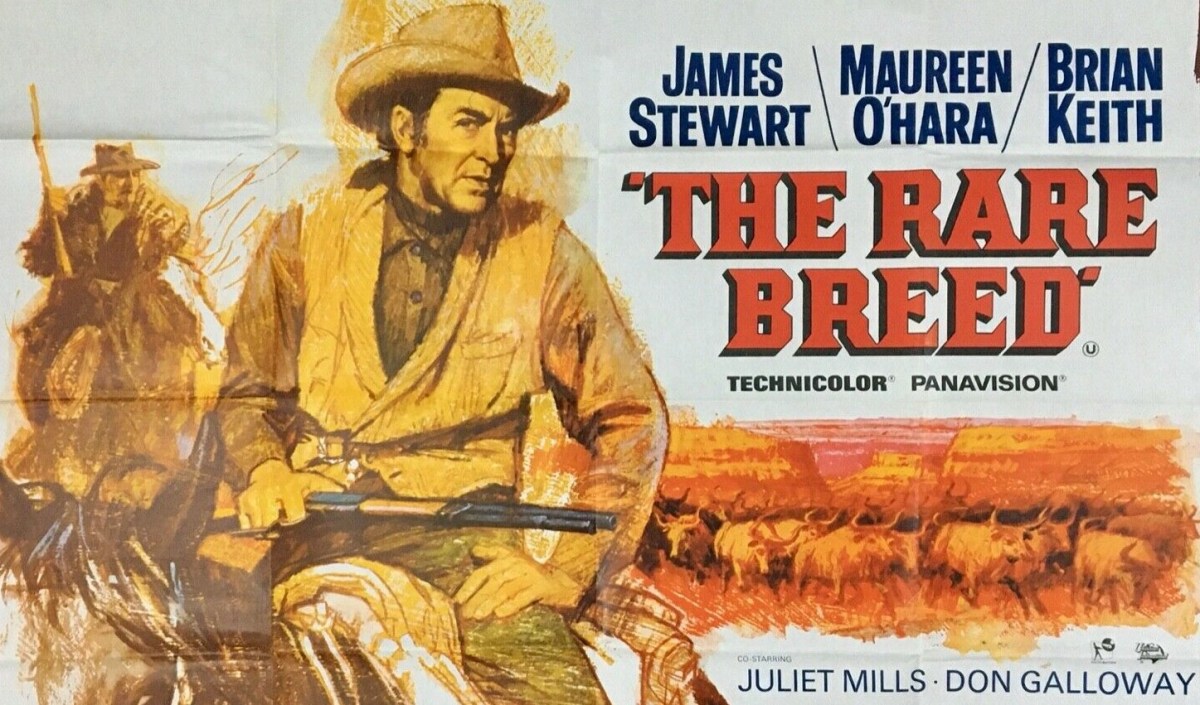
Classic themes of hope, resilience and redemption influence director Andrew V. McLaglen’s follow-up to Shenandoah (1965). Add in a battle against widespread misogyny, thieves falling out, a brilliant stampede and a forlorn hunt that has echoes in the decade-old The Searchers. But other more serious issues are explored. At the film’s core is the question of how a nation built on innovation refuses to countenance change, in other words a country where hierarchy (inevitably male) has begun to impose its preference and how those who suggest alternatives must not just buckle to that collective will but admit they are wrong, a problem that in the half century since the film was made has not gone away.
Widow Martha (Maureen O’Hara) and daughter Hilary (Juliet Mills) bring to auction her white-face Hereford bull, a British institution, the first of its kind to be imported (for breeding purposes, you understand) to America where hardy longhorn cattle are the dominant species. Despite being insulted for her temerity in challenging the existing order, Martha is astonished to receive a winning bid of $2,000, only to realize this comes with conditions attached, the buyer assuming his largesse will also win her, a sharp elbow to the ribs dissuading him of this notion.

Determined to see the bull delivered to the Texan ranch, Martha decides to accompany the animal on its journey. Wrangler Sam (James Stewart), hired to transport it instead plans to steal it and to keep the dupe sweet until the time is ripe encourages her to develop romantic ideas towards him. When another cowboy, Simons (Jack Elam), with eyes on the same four-legged prize causes confrontation the game is up, though Sam sees the trip through.
Rancher Bowen (Brian Keith) belittles the Hereford bull although viewing Martha as a better proposition, but the only way to discover whether the beast can survive in the territory is to let it loose on the open range where it was likely to encounter blizzards (not so rare in Texas as you might think). Once the bull is set free, the movie shifts onto a question of endurance, not just of the animal, but of the mindset of Martha and Sam. Her faith in her insane idea is tested to the limit and, almost in compensation, a woman needing security/protection et al, she comes to appreciate the attentions of a less wild Bowen.
Both central characters have much to lose and much to face up to. Martha, in accepting she was wrong and letting Bowen into her life, will almost certainly be surrendering her independence (she can still be feisty but that’s not the same thing). It’s a testament to her acting that you can see that faith wilting. Sam, a conniving thief whichever way you cut it (although the storyline gives him something of a free pass), has to face up to the fact that he was planning to con a woman out of the precious possession on which her precarious future was built.
The scenes between Martha and Sam are superb, especially when he is grooming what he thinks will be an easy dupe. Sam, in a purgatory of his own making, almost certainly an outcast were the truth more widely broadcast, attempts to expiate his guilt.
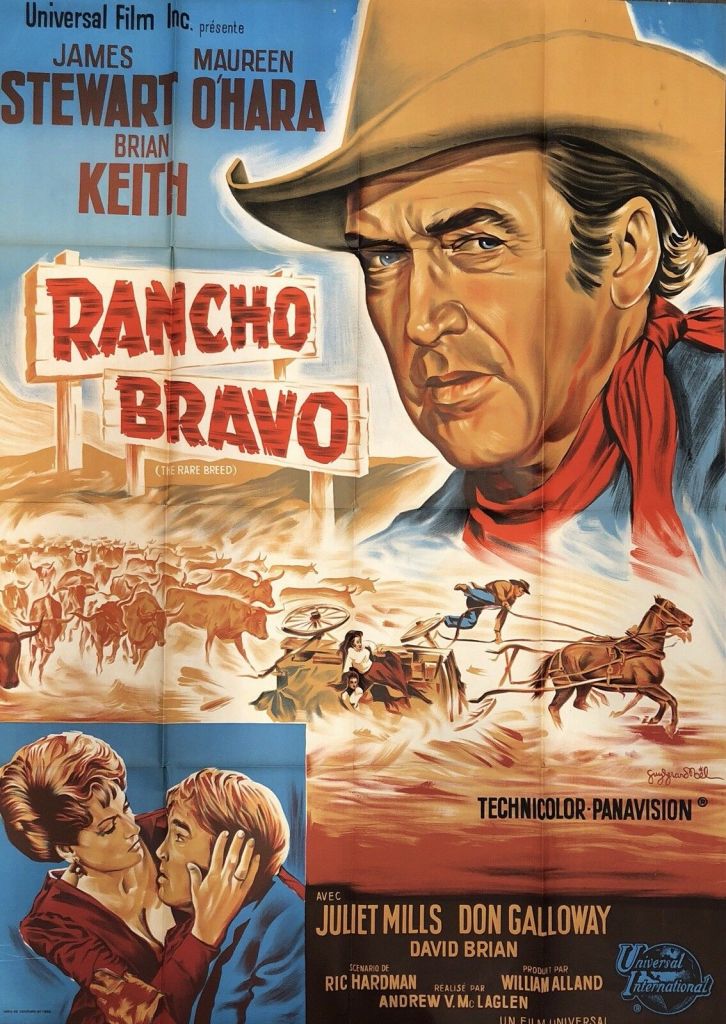
James Stewart and Maureen O’Hara had worked together in Mr Hobbs Takes a Vacation (1962) and there is no denying their screen chemistry. But there’s an innocence that O’Hara rarely displays, the woman in love suppressing those emotions not denying them as perhaps in The Quiet Man (1952). She’s both independent and, if the right man comes along, happy to accept his protection (from the male predators of the West), while at the same time keeping him on the right track and sorting out his world of misshapen priorities. There are some brilliant scenes where something else is going on story-wise and O’Hara is internalizing some deeper emotion entirely. It’s an acting coup for an actress like Maureen O’Hara who would never give up to convey so well a character on the verge of surrender.
This is one of James Stewart’s best roles, far removed from the principled hero of Shenandoah (1965) and returning him closer to the shifty character of Vertigo (1958) adept at self-justification. In the scene where he is found out by O’Hara he is outstanding. It’s not a given that the character will find a way to turn things round and his efforts to redeem himself make the latter part of the picture emotionally involving, especially as this is countered by O’Hara’s own internal battle.
It’s worth pointing out that although the narrative mainly concerns the two main characters, the background is filled with ruthlessness. Not only does Sam feel no compunction about stealing a bull worth $2,000, we first encounter Bowen’s son Jamie (Don Galloway) when he is making off with a herd of his father’s longhorns. The cattle barons use their wealth to “buy” a classy woman and cheat cowboys. And there is further murder along the way.
I was going to mark this picture down for the comedy which seems to amount to endless brawls but I wondered if modern audiences, reared on the never-ending fistfights and wanton destruction that usually indicated the finale of a superhero picture, would accept it quite happily, perhaps even welcome it. While Brian Keith (The Deadly Companions, 1961) stands accused not only of one of the worst Scottish accents committed to the screen – and these days of cultural appropriation – that does not take away from a character who, behind the beard, transitions from loathsome father to something more approaching humanity, in other words wild man who realizes the benefits of civilization.
In fact, the broad comedy serves to obscure a film full of brilliant, cutting, funny lines, generally delivered in scathing tones by the woman. O’Hara to Stewart: “You may bulldog a steer but you can’t bulldog me.” Stewart to O’Hara: “Can I help you with that” and her response “No, they’re clean and I’d like to keep them that way.” And that’s not forgetting the sight of the cowboys whistling British national anthem “God Save the Queen” in order to bring the bull to heel.
I forgot to mention the romantic subplot involving Hilary – in case you were wondering what role she had in all this – and Bowen’s estranged son, Jamie. Juliet Mills (Avanti!, 1970), older sister of child star Hayley, is excellent as the sassy daughter of a feisty woman, Don Galloway (Rough Night in Jericho, 1967) less of a stand-out in his debut, in part because he has to subsume his rage against his father.
Jack Elam (Once Upon a Time in the West, 1968) is good as always and you will spot in smaller parts Ben Johnson (The Undefeated, 1969), Harry Carey Jr. (The Undefeated), Barbara Werle (Krakatoa, East of Java, 1968) and David Brian (Castle of Evil, 1966). John Williams, masquerading as Johnny Williams, wrote the score.
Setting the comedy aside, this is a more intimate film from director Andrew V. McLaglen compared to the widescreen glory of The Undefeated and the intensity of Shenandoah and for that reason tends to be underrated. There are some wonderful images, not least Sam carrying the injured Jamie in the style of Michelangelo’s La Pieta – an idea stolen by Oliver Stone for Platoon (1986) – but mostly McLaglen concentrates on the actors.

 The Magnificent 60s
I’ll have to imagine Brian Keith’s accent. Juliet Mills is a live-wire, met her with her dad and sister in Santa Monica…Stewart kinda dominated this when I saw it on the BBC, but it sounds like there’s more going on here than just a big star performance…
LikeLike
Good bit more subtle in the performances department. Keith an all-time winner of worst Scottish accent. You should post some of these old memories of meetings with stars. Very envious.
LikeLiked by 1 person
Agreed it was very underrated when it first came out. Surprisingly I did enjoy it. Maureen O’Hara and James Stewart were as dependable as ever.
LikeLiked by 2 people
She is a great actress. Always enjoy her work.
LikeLiked by 1 person
Like this one and that’s despite Keith giving a not so good performance and I hate to say that cause I’ve always liked him. In the right roles he has a Glenn Ford like quality to him but with a harsher edge as he played more villains along the way. Love that emotional ending come spring when they find the answer they’ve been searching for.
LikeLiked by 1 person
This was not one of Keith’s better moments but you are right he has a solidity about him that you tend to trust
LikeLiked by 2 people
Tidbits:
“The 15 Jan 1964 LAT reported that The Rare Breed was among seventeen upcoming Universal Pictures productions based on original stories. A news item in the 27 Nov 1964 DV stated that actress Hayley Mills was set to co-star with Maureen O’Hara and James Stewart. On 13 Jan 1967, LAT announced that Juliet Mills, Hayley’s sister, would assume the role. The 4 Feb 1965 DV revealed that Russell Alquist, husband of Juliet Mills, composed what he hoped would be the picture’s title song. According to the 22 Dec 1964 DV, actor Lee Marvin was also being considered for a role.
Prinicipal photography began 4 Feb 1965, as stated in the 5 Feb 1965 DV. The 9 Mar 1965 DV identified the filming location as Indio, CA. According to the 23 Feb 1965 DV, a large portion of the $2.5 production budget was allocated for a herd of cattle, including 103 Herefords and 125 Longhorns. James Phillips, livestock expert for Universal Pictures, paid $1,200 for three young Hereford bulls, which were trained and fed at a cost of $2,500. Although the bulls were insured for $1,250 each, the one named “Nu Star” was considered invaluable to the production, as he was carefully trained to interact with humans. The 14 Jun 1965 LAT noted that rancher Ed Rutherford supplied the production with 200 Longhorn steers.
As reported in the 12 Mar 1965 DV, stunt players Hal Needham, Stephanie Epper, and Patty Elder narrowly escaped serious injury during a sequence in which a horse-drawn buckboard accidentally overturned. Needham, who was driving the wagon, sustained a “wrenched shoulder,” while the women avoided being crushed by taking cover in a nearby camera pit. The footage was reportedly used in the completed picture. The 31 Mar 1965 Var noted that Maureen O’Hara was expected at the 29 Mar 1965 groundbreaking ceremony for a new United Artists theater in Santa Ana, CA. However, O’Hara was needed on set at Universal Studios in Los Angeles, CA, that day so managers from the theater chain brought a box of soil from the construction site to the studio, along with a shovel. This was reportedly the world’s first remote groundbreaking ceremony. As production drew to close, the 9 Apr 1965 DV stated that the cast and crew presented Juliet Mills with a gold-plated shovel as a memento of her adventure in cattle ranching. Filming was completed 9 Apr 1965, as announced in the 13 Apr 1965 DV. On 29 Jun 1965, DV reported that Mills was back at the studio to re-record some of her dialogue.
The Rare Breed premiered 2 Feb 1966 in Fort Worth, TX, followed by openings in the Texas cities of Dallas, Houston, and San Antonio, respectively, over the next three days. Maureen O’Hara, Juliet Mills, actor Don Galloway, and director Andrew V. McLaglen attended all four events. Due to a scheduling conflict, James Stewart could only attend the Fort Worth premiere. Openings in Los Angeles and New York City followed on 16 Feb 1966. The film garnered positive reviews and received the Parents magazine family medal award. Rental revenues totalled $2 million, as reported in the 4 Jan 1967 Var. An item in the 1 May 1967 DV stated that Vindicator, a bull loaned by James Stewart to the production, was nominated for 1967 PATSY award. Stewart acted as grand marshall of the parade preceding the ceremony.”
LikeLiked by 1 person
Didn’t know Hayley was pencilled in. They usually sold the herds after production, sometimes at a profit. Thanks again.
LikeLike