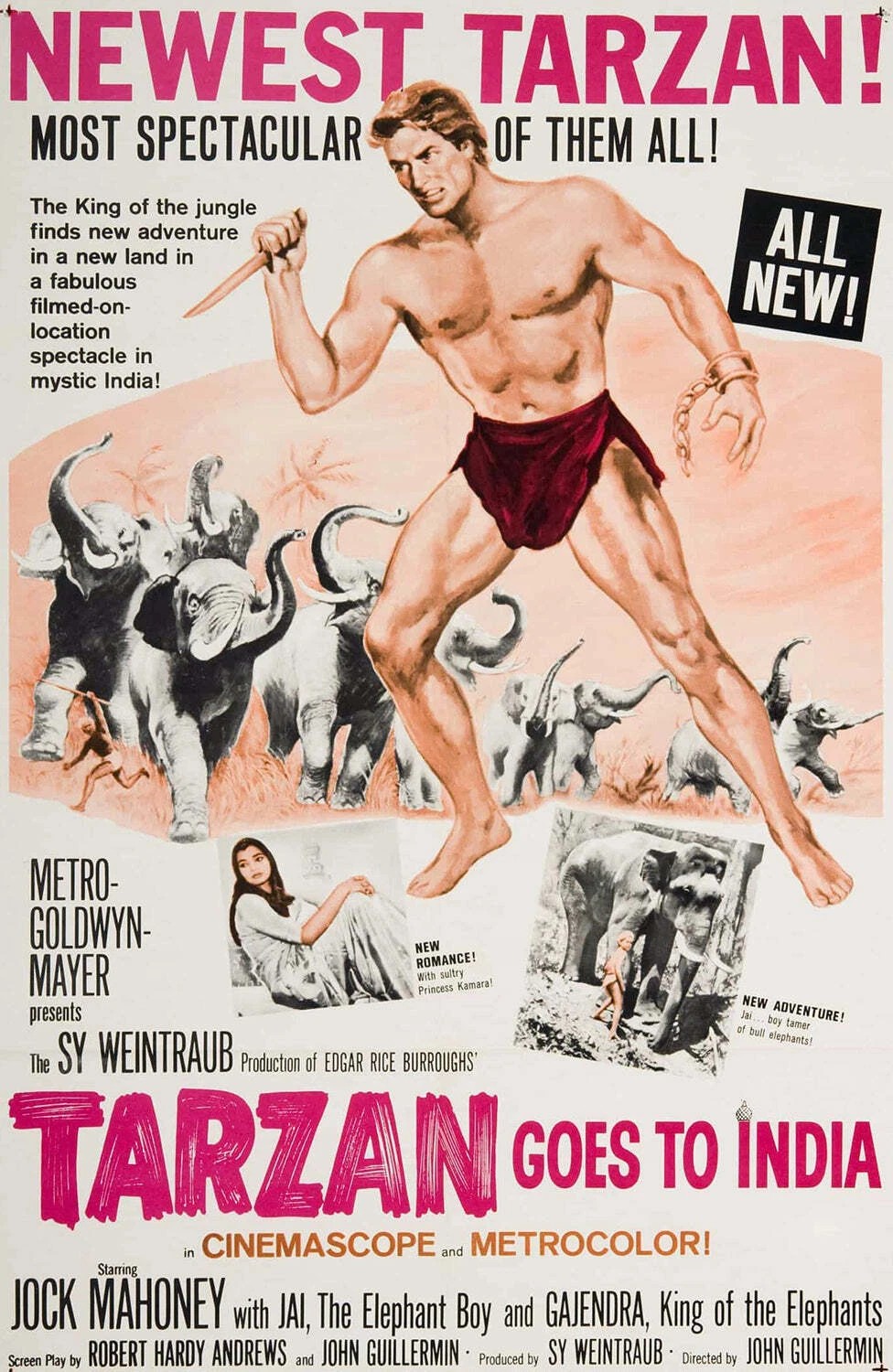
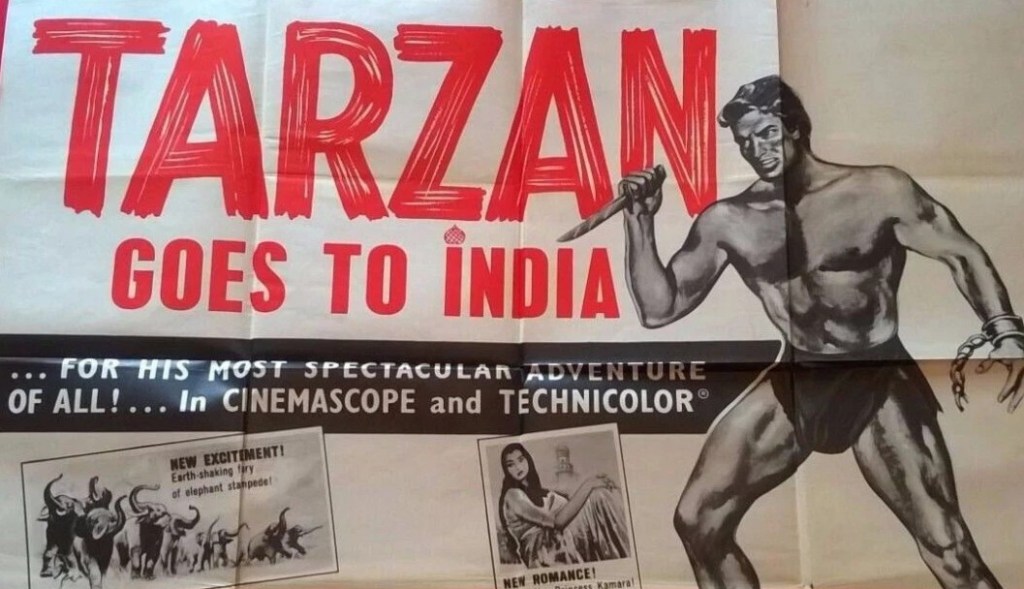
Tarzan Goes to India (1962) ***

Helluva fillip for reissue and credibility purposes to be able to point to the picture being helmed by the director – John Guillermin – of The Towering Inferno (1974), not to mention King Kong (1976) and The Blue Max (1966) – which suggested top-notch skills if not the budget to match. Guillermin, who also had a share in the screenplay, does a pretty good job of tailoring the picture to highlight issues that in others of the series are treated in more comedic fashion and making tremendous use of the location, far more than subsequent directors do with South American scenery. Elephants go mano a mano, Tarzan has a tussle with a leopard, but for sheer realism there’s little to beat a tiny mongoose putting a cobra in its place.

But what could be more timely for today’s audiences than presenting Tarzan (Jock Mahoney) as an eco-warrior. He is brought in to rescue a herd of 300 wild elephants being drowned when a much-needed hydroelectric dam is opened. Dam engineers Bryce (Leo Gordon) and O’Hara (Mark Dana), who show no compunction about the high death rate among the native laborers, are even less concerned about the fate of the elephants especially as have very tight deadline – the onset of the monsoon season  – to meet. Princess Kamara (Simi Garewal), daughter of an old friend from Tarzan’s Africa days, is trying to get villagers out of the way as well. She’s not helped by Bryce’s top engineer Raj (Jagdish Raj) who sides with Bryce.
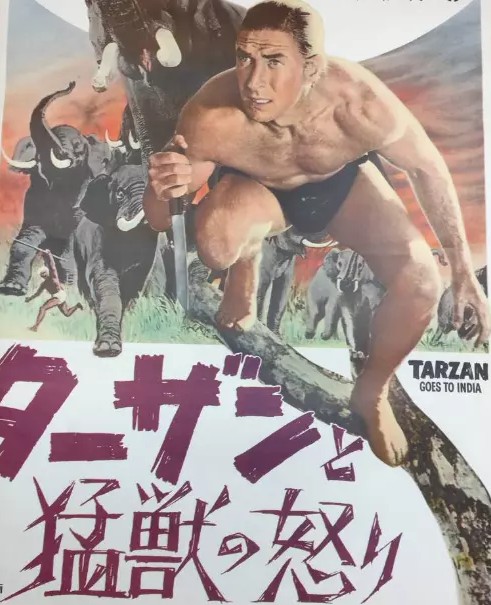
The main problem is that elephants can’t climb hills and are led by Bala, a rogue of the species, whom Tarzan determines he’ll have to eliminate. He’s helped by a small boy Jai who rides his own elephant Gajendra. Jai’s not there for comedic purpose and Tarzan helps him grow up, their bond facilitated by Tarzan saving the ivory-tusked beast from Bryce in white hunter mode.

Baits abound. Tarzan is chained to a tree by Bryce to entice a leopard. The boy is used, again by Bryce, as lure to draw Tarzan out into the open at the climax. Raj changes sides on seeing how cheaply Bryce treats life, but there’s no time for him to get lovey-dovey with the princess. Which is just as well because Tarzan’s got a lot on his plate. His plan to put an arrow through Bala’s brain goes awry, triggering the Gajandra-Bala duel, which is very well done.

Although set in India, this feels more like the real thing than the sojourns in South America. We never see Tarzan in a suit but I don’t think anyone thought to compare his entrance, emerging from a river clad only in loin-cloth, with the other more famous screen entrance of the year, that of Ursula Andress in Dr No. Tarzan does plenty of swimming, even employing the breathing through a reed trick, and swings through the trees, and runs a lot barefoot, and gets to ride on the back of an elephant. The absence of his usual animal sidekicks is no hindrance. His scenes with the young boy are touching rather than sentimental or clumsily jokey. The kid’s pretty smart, which helps.
Kamara’s there merely to help along the subplot rather than for romantic purposes. Given the lean running time (86 minutes) that kind of palaver would only get in the way. This was shot entirely on location, and it shows, no awkward switches to studio set-ups, glorious scenery all the way.

Best of all John Guillermin, who also helmed Tarzan’s Greatest Adventure (1959), knows how to construct a scene, and how to get the best out of actors whose acting skills would not be considered their main attributes. So it looks good whichever way you cut it.

Former stunt man and athlete Jock Mahoney makes the switch from Tarzan nemesis (Tarzan the Magnificent, 1960) to Tarzan with ease. Less muscle-bound than his predecessors, he brings a more mature tone to proceedings, exuding thoughtfulness more than being gung-ho.

One of the better Tarzans of the decade.
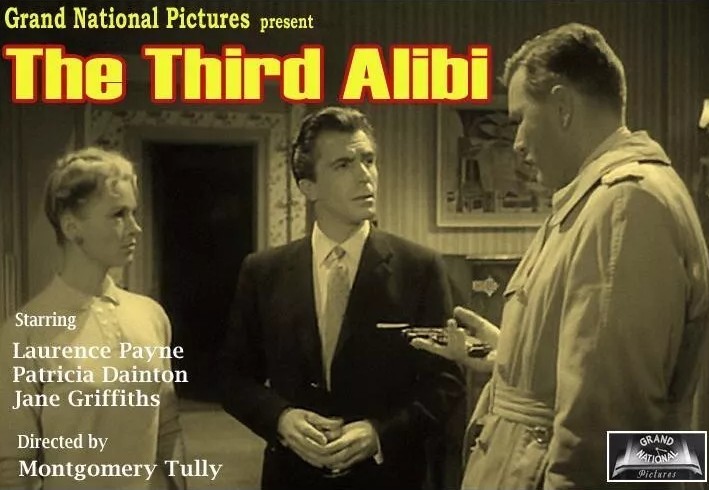
The Third Alibi (1961) ***

Sometimes there’s nothing more satisfying than a well-plotted narrative that doesn’t overstay its welcome and comes with a sting – or two – in the tail. And in the B-picture world we can accommodate all sorts of venal characters and even hope – or at least wonder if – they will get away with their nefarious plans.

We might have sympathy for stage composer Norman (Laurence Payne) stuck in a soulless marriage with Helen (Patricia Dainton). Small wonder he seeks spice through an affair with divorced sister-in-law Peggy (Jane Griffiths). After all, being a creative is hard work and we want him to enjoy showbiz success.

But that’s until driving home at night he knocks down an old man and races off without stopping. Luckily, the old fella’s not dead, otherwise it would have been in the papers. But then he’s bounced into asking his wife for a divorce since Peggy has announced she’s pregnant. But Helen isn’t agreeable, not least because of her dislike for her sister. And Helen’s very ill, a heart condition, but for reasons best known to herself, won’t confide this to her husband.

So Norman is left with no alternative but to bump her off. He comes up with a very clever plan that will allow him to pretend not be at home when he kills his wife there and also dreams up one of these clever alibis for Peggy, who’s integral to his plan, by getting her to make a nuisance of herself at the cinema, so everyone recalls her both arriving and departing, allowing her to slip out of the theater for the period of time she needs to assist Norman.

But Helen overhears the conspiracy. And when Norman goes home to shoot his wife, using an unlicensed therefore untraceable pistol provided by Peggy (war heirloom) instead of his own licensed traceable gun, he discovers the house is empty.

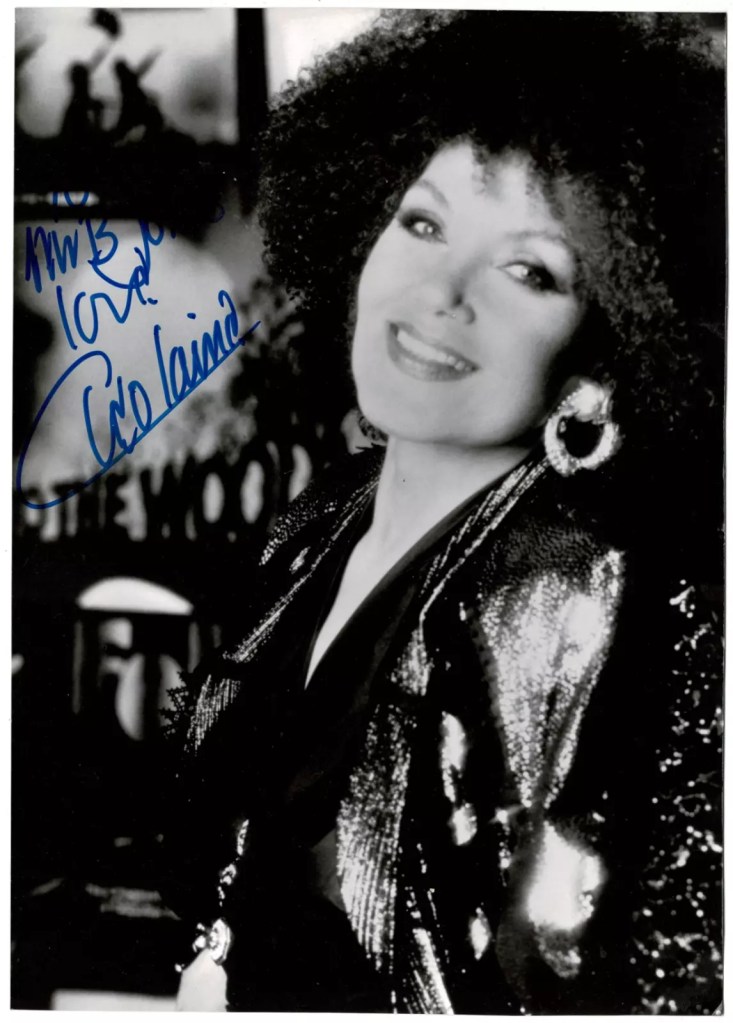
Jazz singer Cleo Laine makes a cameo appearance, as, too, does Dudley Moore.

When he returns to his lover, he finds her dead, shot through the head. As he rushes out, the police arrive. He’s only a suspect for a short time as his various alibis hold up. Helen appears to be standing by him. But then the police find his gun in the bushes outside the dead woman’s house.

When Helen confesses to the police that her husband has demanded a divorce, that puts her in the firing line. Except she’s got a perfect alibi. She stole the idea from the conspirators, making her visit to the cinema easily remembered by the staff both at the start of the movie and the end. It’s pretty much an unbreakable alibi unless any other witness can finger her.

Norman protests his innocence of course. And the irony is we know he’s innocent, but our sympathies are now with the killer, Helen, which twists around our preconceptions.

After all, not only is she the injured party in the romantic stakes, but she’s very ill, so needs all the audience sympathy she can get. So the audience, against its better judgement, is batting for her.

But, suddenly, twist number one, they don’t have to. Because the strain is all too much, and she has a heart attack and drops dead. And, surely, it won’t be long before Norman can find a way out of his predicament. And he believes he has the very thing.

There’s a nosy old neighbor who takes too close an interest in visitors to the house. So he must have seen Norman arrive there at the very time his lover was shot. The neighbor is brought in.

He’s a poor old soul. And blind. The result of being knocked over by a car a few weeks before.

What a cracking ending to a cracking tale. I always wonder why these kind of stories don’t get resurrected for some sort of portmanteau series, in the manner of Tales of the Unexpected. Although there’s little fat on them, a bit of judicious trimming would make them ideal for a one-hour television slot and this one, in particular, is little more than a three-hander, so wouldn’t cost much.

Each of the main characters is well drawn, each allowed a moment to stretch their emotional muscles. Solid, if not spectacular, acting from Laurence Payne (Crosstrap, 1962), Patricia Dainton (The House in Marsh Road, 1960), and Jane Griffiths (The Double, 1963), and impressive turn from John Arnatt (A Challenge for Robin Hood, 1967) as a doughty cop.

Written by Maurice J. Wilson (The House in Marsh Road) and director Montgomery Tully (The House in Marsh Road) from a play by Pip and Jane Baker. Tully is in fine form at the helm, wasting no time in driving this towards ironic conclusion.

I’ve been clocking up a few from the Tully portfolio in the last month or so. Astonished to find he directed another seven pictures this decade, so I might, in due course, complete the collection.

Enjoyable.

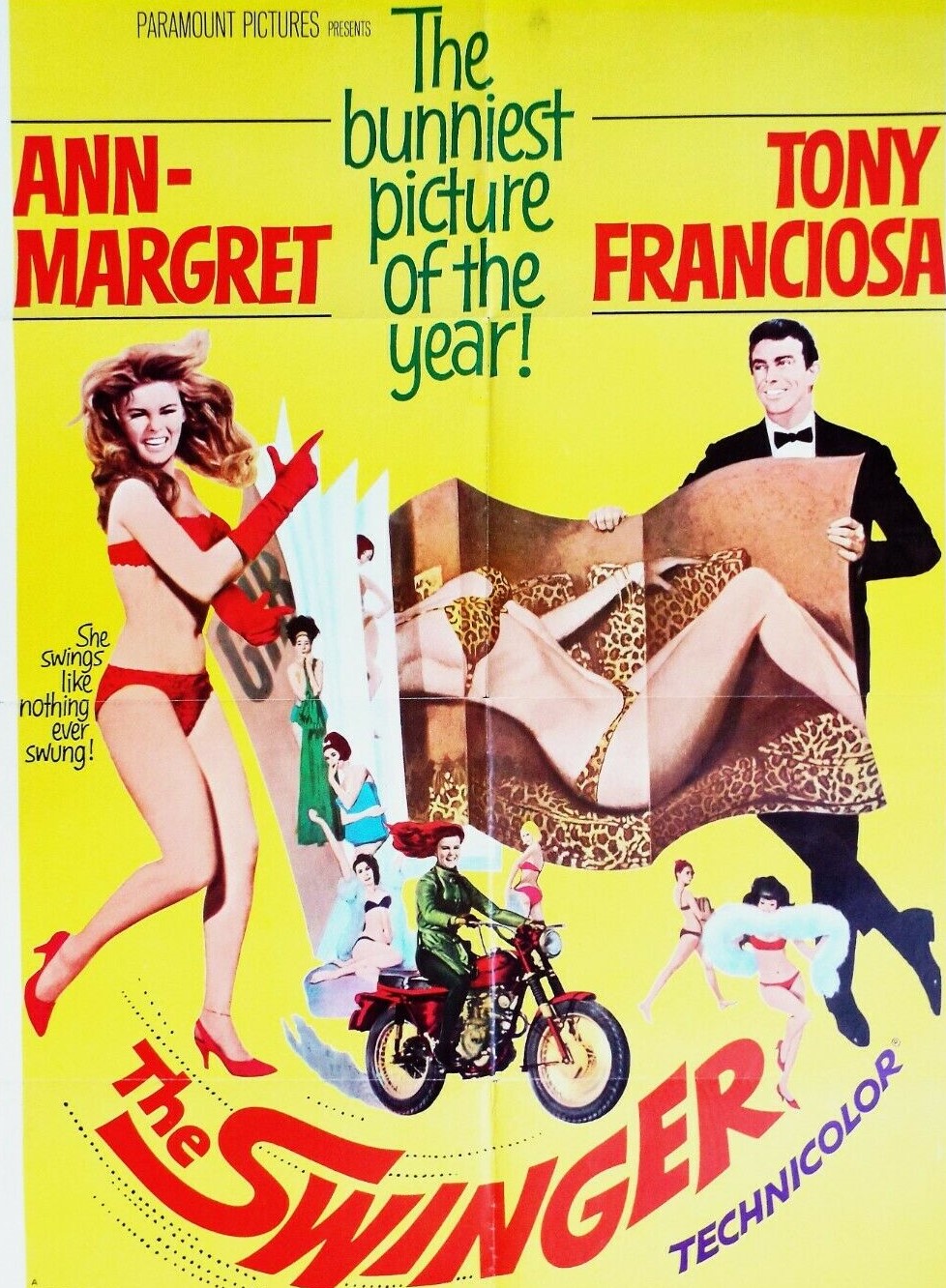
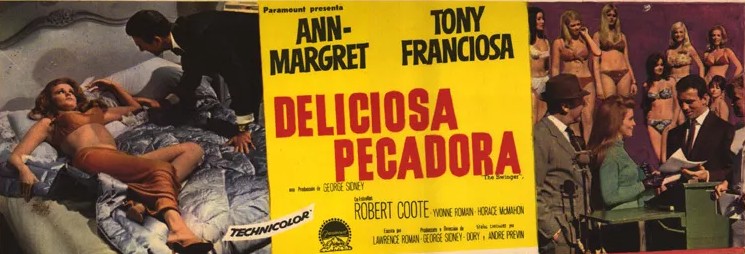
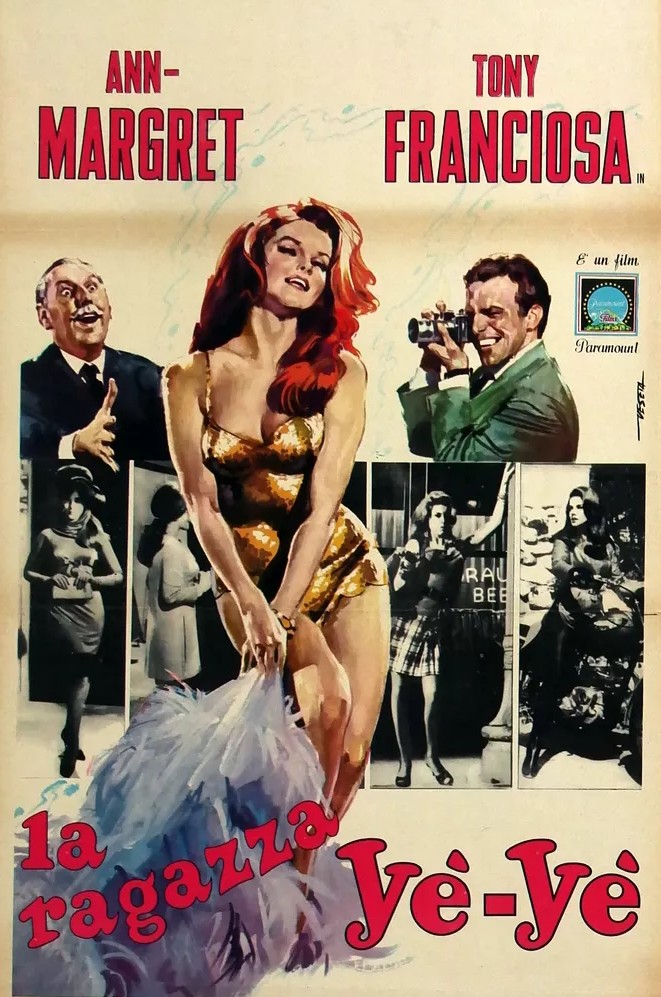
The Swinger (1966) ***

As chosen by my readers, this is the most popular movie on the Blog, so I thought I’d check back and see how it stood up. Having seen it before, of course, I knew what to expect. And despite the star’s acting abilities being better showcased in items like Once a Thief (1965) and Stagecoach (1966) I still found this effortlessly put together to deliver a movie that presented what studio and possibly the star felt was the best version (in terms of instant audience appeal) of herself. Think fun, fun, fun, if lightweight, lightweight, lightweight.

Pure confection. There was a sub-genre of romantic comedy pictures that spun on a simple plot device to throw together actors with terrific screen charisma. Doris Day, Rock Hudson and Cary Grant did little more than meet a potential new partner, fall out with them and then resolve their differences. The importance of actors of this caliber was the difference between a high class piece of froth and mere entertainment. This falls into the latter category, neither Ann-Margret nor Anthony Franciosa reaching the high standards of the likes of That Touch of Mink or Pillow Talk.

That said, this was clearly custom-made for Ann-Margret and her growing fan-base. Despite displaying unexpectedly serious acting chops in Once a Thief (1965) this plays more obviously to her strengths. She gets to sing, dance and generally throw herself around. The face, hair, smile and body combine in a sensational package.

Kelly Olsson (Ann-Margret) plays a budding writer so naïve that she tries to sell her stories to Girl-Lure, a Playboy-type magazine, owned by high-class Brit Sir Hubert Charles (Robert Coote) and run by Ric Colby (Anthony Franciosa). When her work is rejected, Olsson writes an imitation sex-novel, The Swinger, purportedly based on her own life. Sir Hubert buys the idea and Ric sets up a series of accompanying photo-shoots using Kelly as the model until he discovers her book is pure fiction.

The setting is an excuse to show an avalanche of young women in bikinis. The slight story is justification enough for Ann-Margret to strut her stuff as a singer and dancer. Since her stage show depended more on energy than singing, this effectively showcases her act.

So two-dimensional are the principals, you are not going to mistake any of these characters for actual characters. The film lacks such depth you would not be surprised if the likes of Elvis Presley or Cliff Richard popped up. The comedy is very lite, an initial attempt at satire soon dropped, the few bursts of slapstick seeming to catch the stars unawares.  

But that’s not to say it’s not enjoyable, Ann-Margret is a gloriously old-fashioned sex symbol and certainly knows how to shake her booty. The standout (for lack of a better word) scene revolves around body painting. She even gets the chance to ride a motorcycle, one of  her trademarks. Anthony Franciosa (Go Naked in the World, 1961) has little to do except smile. Yvonne Romain (The Frightened City, 1961) has a thankless role as Ric’s girlfriend.

Director George Sidney teams up with Ann-Margret for the third time after Bye Bye Birdie (1963) and Viva Las Vegas (1964). This was his penultimate outing in a 20-year Hollywood career whose highlights included Anchors Aweigh (1945), The Three Musketeers (1948), Annie Get Your Gun (1950), Showboat (1951) and Pal Joey (1957). So he certainly had the musical pedigree to ensure the songs had some pizzazz but clearly less impact on the script which was reputedly scrambled together at short notice by Lawrence Roman (McQ, 1974) to fulfil a studio commitment to the star.

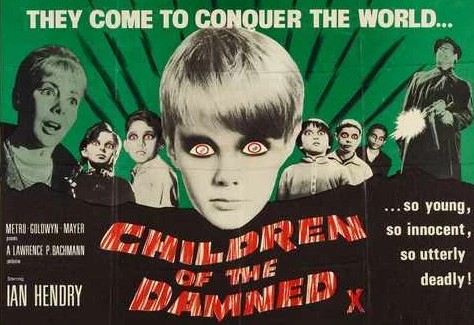
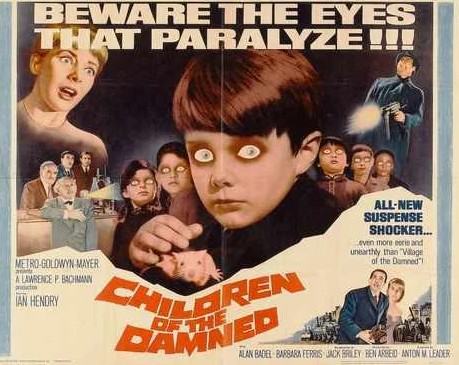
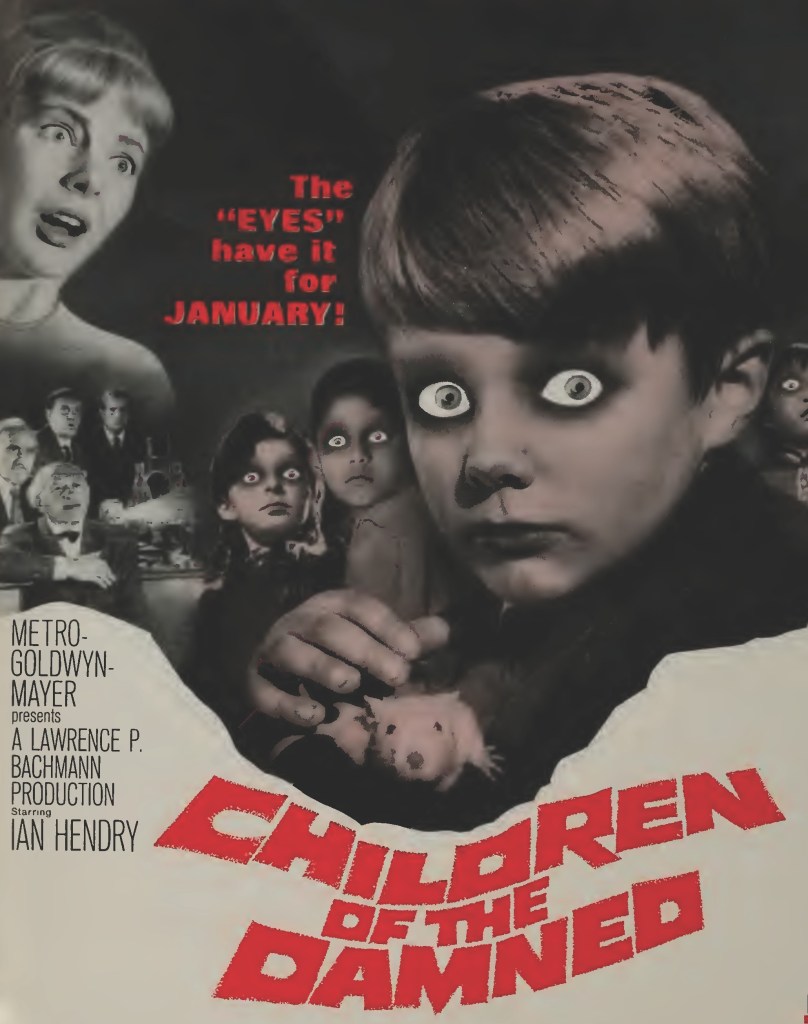
Children of the Damned (1964) ***

I wasn’t aware that celebrated sci fi author John Wyndham had written a sequel to his iconic novel The Midwich Cuckoos, filmed as Village of the Damned (1960). And it turned out he didn’t (he did make an attempt but abandoned it after a few chapters).  So he had nothing to do with the sequel. But the original had proved such a hit MGM couldn’t resist going for second helpings.

And there was nothing the writer could do about it, it being standard procedure that when you sold your novel to Hollywood the studio retained all the rights and could commission a remake, sequel, turn it into a television series, without consulting you.

The only drawback for a potential sequel was that main adult character Professor Zellaby (George Sander) and all the kids had died in the original, though the final image of eyes flying out of the burning house might have suggested the children had actually survived. And, as we know these days, just when your main character dies it doesn’t prevent him miraculously returning to life should box office dictate.

So screenwriter John Briley (Oscar-winner for Gandhi, 1982) was handed the sequel. And what we get is a lot of atmosphere, a chunk of running around in empty London streets (the result not of mass evacuation but filming in early morning when roads are clear), a very slinky turn from Alan Badel (Bitter Harvest, 1963) showing what he can do when hero not villain, and a twist on the previous problem – how to vanquish the kids – which is whether to  weaponize them. Mostly, we are reminded of how better telekinesis was dealt with in the original picture and how poorly this compares to the likes of Brian De Palma’s later Carrie (1976) and even his The Fury (1978).

Apart from the title, there’s barely a nod to the previous incarnation, except that discerning the children’s paternity proves impossible. An United Nations project has tracked down six kids with incredible intellects. Like Professor Zellaby, British psychologist Dr Tom Llewellyn (Ian Hendry) and geneticist Dr David Neville (Alan Badel) want to study the kids while the more shadowy figure of Colin Webster (Alfred Burke) appears to have more sinister purpose in mind.

In any case none of the three achieve their goals because the kids escape and take refuge in an abandoned church, defending themselves against the authorities and the military by their brain controlling abilities and by the devising of a sonic weapon. Immediately under their thumb is the aunt, Susan (Barbara Ferris), of the young boy Paul (Clive Powell) who initially excited the interest of the British scientists.

Opinion varies as to whether the children are a genetic freak of nature, aliens or an advanced human race. The authorities can’t decide whether they are a threat or a wonder and decide to eliminate them, then change their mind, while the children decide to fight back then change their minds. The ending is quite a surprise.

Although the kids still have the fearful eyes, they are generally a lot less effective a scare than when the small gang of them stood side by side in the previous picture and stared at adults until they did the childrens’ bidding or killed themselves. There’s way too much discussion among adults. In the previous picture, those kinds of conversations had more emotional impact, since it was the villagers who were left distraught. Here, you couldn’t care less about the adults.

Interestingly enough, the standout isn’t any of the kids at all, but Alan Badel, who comes over as the libidinous sort, but very charming, and views any woman as fair game, but it’s fascinating to see how his usual screen persona here makes him a hero whereas in most other films exhibiting much the same characteristics he comes across as shifty, mean or downright villainous.

Ian Hendry (The Hill, 1965) was a rising British star but isn’t given much to get his teeth into. Barbara Ferris (Interlude, 1968) has a vital role.

Directed by television veteran Anton M. Leader (The Cockeyed Cowboys of Calico County, 1970) who makes his screen debut.

Not a patch on the original.

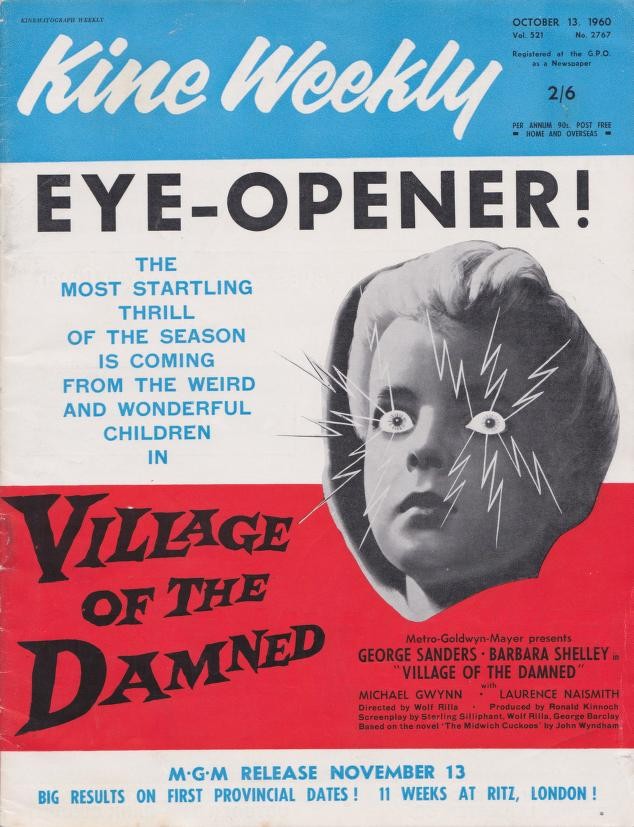
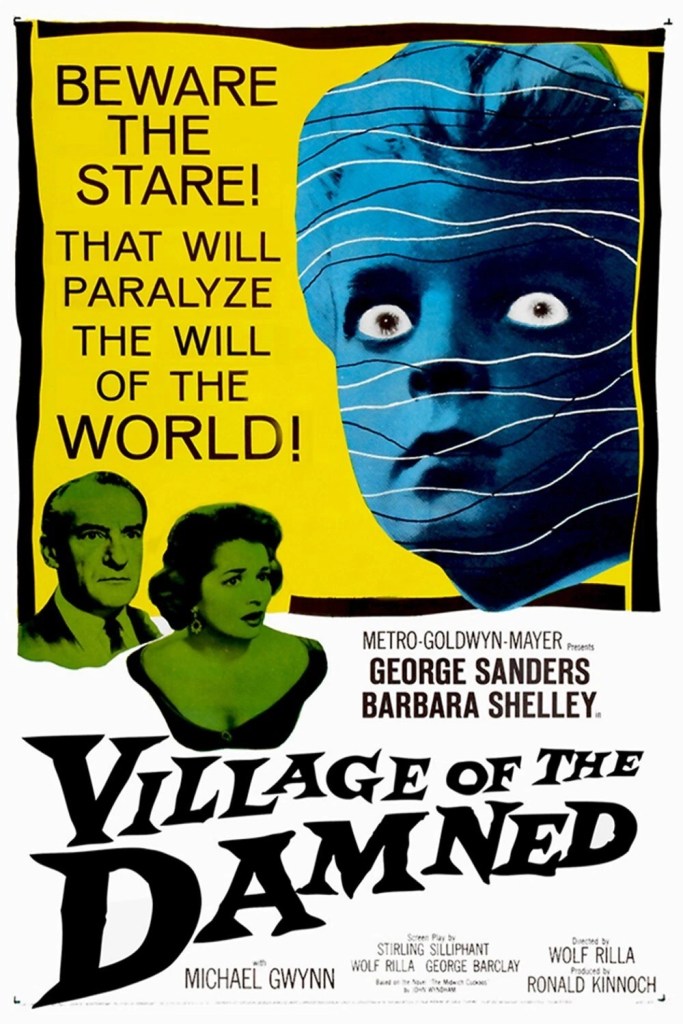
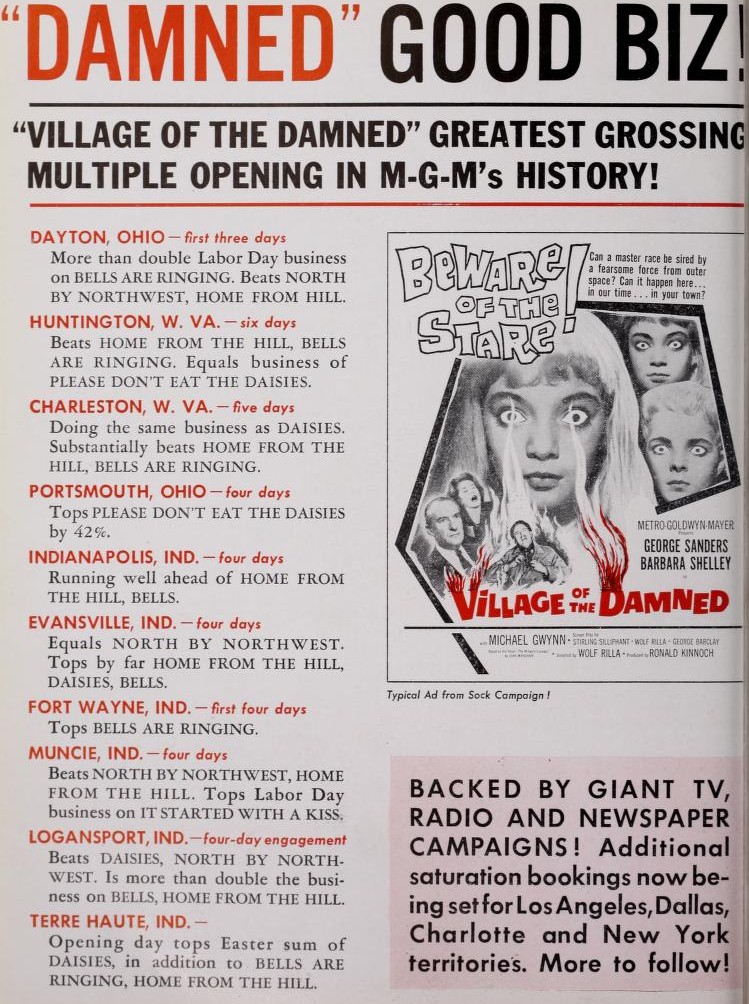
Village of the Damned (1960) ****

Superb chiller that, unusually, takes time to develop several strands over a longer time frame than is normal for a genre where the immediate takes preference. Opens a new dimension of terror, too, with the brain control sub-genre that would spill over into brainwashing. You could also, if you were of a mind, point to the genuine growing social power of the young as emphasized later in the decade with movies about hippies. It might not be too much of a stretch to point to the “Youthquake” at the end of the 1960s when pandering to a youthful audience nearly destroyed Hollywood.  

Terrific opening sequence of everyone in the small village of Midwich dropping to the ground, the immobilized driver of a bus crashing off the road, the driver of a tractor hitting a tree, taps left running, telephone calls cut off, all manner of accidents ensue. You think everyone’s dead, as do the military, called in to investigate. They cordon off the area, employ canaries and then humans to discover how far the danger spreads. But when a soldier who is dragged out unconscious from the forbidden zone wakes up, they soon realize the population is merely unconscious.

Childless couple Professor Gordon Zellaby (George Sanders) and younger wife Anthea (Barbara Shelley) are among those affected, apparently suffering no side effects for having been knocked out for around four hours. A couple of months later Anthea is delighted to report she’s pregnant. She’s not alone. But for many of the villagers what would be a cause for celebration causes untold grief. One husband returns home after a year away to find his wife is pregnant. In the days when pre-marital sex was frowned-upon, virgins, similarly affected, are shamed.

The pregnancies don’t run to the normal period either, and fully-grown children are born within a few months. What’s more, they all look as if they have inherited the same genes. Their blonde hair and striking eyes suggest they share the same father. Soon it transpires they can not only read minds but control them, causing at least two people to commit suicide.

Turns out this is a global problem, several other communities afflicted with the same condition, the Russians so concerned at the prospect that they bomb one village to oblivion, other cultures simply murdering the children.  Here, being English, where fair play still rules regardless of potential threat, the children are taken under the wing of Professor Zellaby, though the military, having sealed off the area, wait in the wings, itching to wipe out the troublemakers.

Quickly, it becomes a duel for power, the children will do anything to protect their species, Professor Zellaby at first wanting just to study the kids and understand them but soon recognizing the threat.

In between bouts of action, most of which is discreetly handled, none of the deliberately shocking scenes that might have emanated from an exploitationer, the authorities have plenty of time to ponder their existence. A leap in genetic mutation, or extraterrestrial origins, are among the options considered.

Eventually the villagers react like terrified Transylvanians confronting Dracula and attempt to set fire to the building where the children are housed but reckon without the brain control that can be exerted. In the end Professor Zellaby comes up with a self-destructive solution.

This is formidable stuff, all the more so, because in the days when most monsters grew fangs or claws or developed huge bodies and were otherwise physically frightening, the worst these kids get up to is to have a striking glow in their eyes, a startling contrast to their blonde hair, calm demeanor and neat uniform clothing.

Tremendously well done and it helps to have cast mainstream actors like George Sanders (Warning Shot, 1967) and Barbara Shelley (only later did she become a Scream Queen) and others who don’t carry the tinge of the horror genre.

Very well paced by German director Wolf Rilla (The World Ten Times Over, 1963) who resists the temptation to overplay his hand, achieving much more by leaving it to your imagination. Stirling Silliphant (The Slender Thread, 1965), George Barclay (Devil Doll, 1964) and the director adapted the groundbreaking novel The Midwich Cuckoos by John Wyndham. Horror maestro John Carpenter remade this in 1995, which only wnent to show how more successful the restraint of the original was.

Top notch.

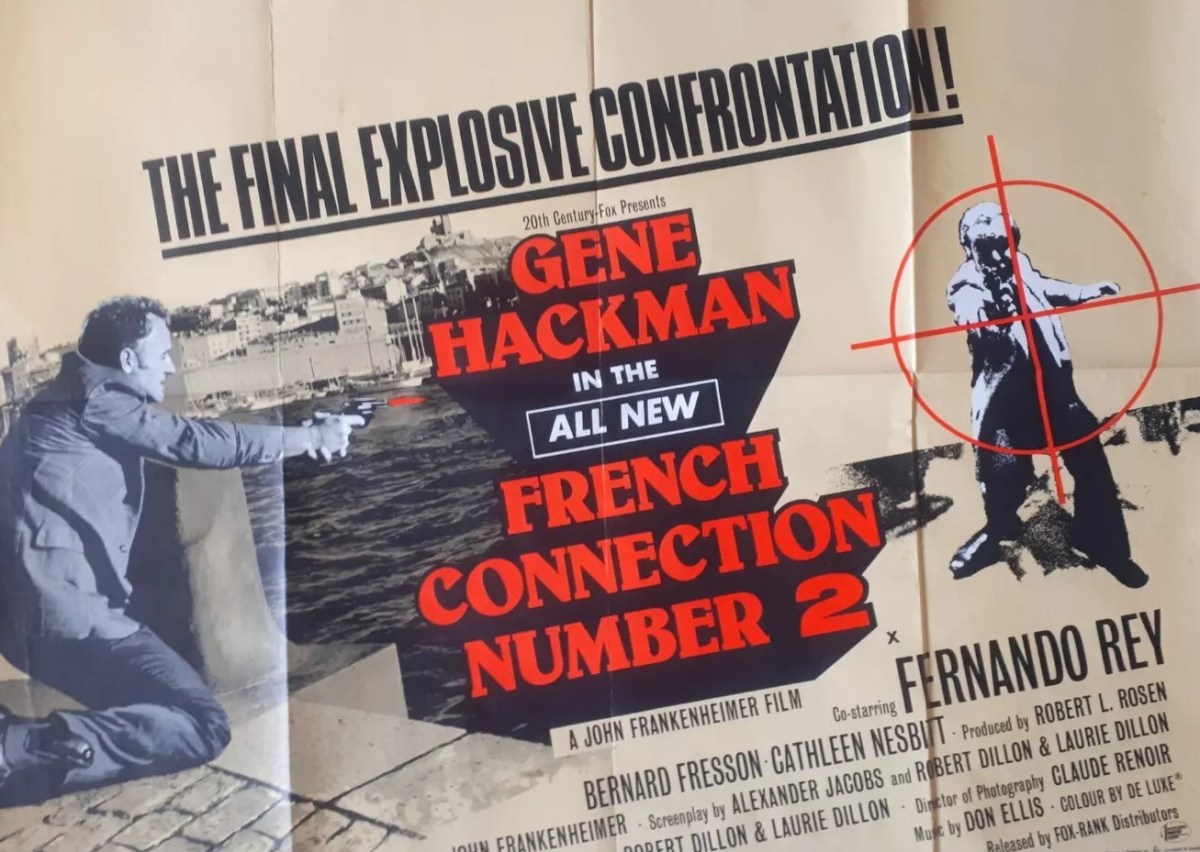
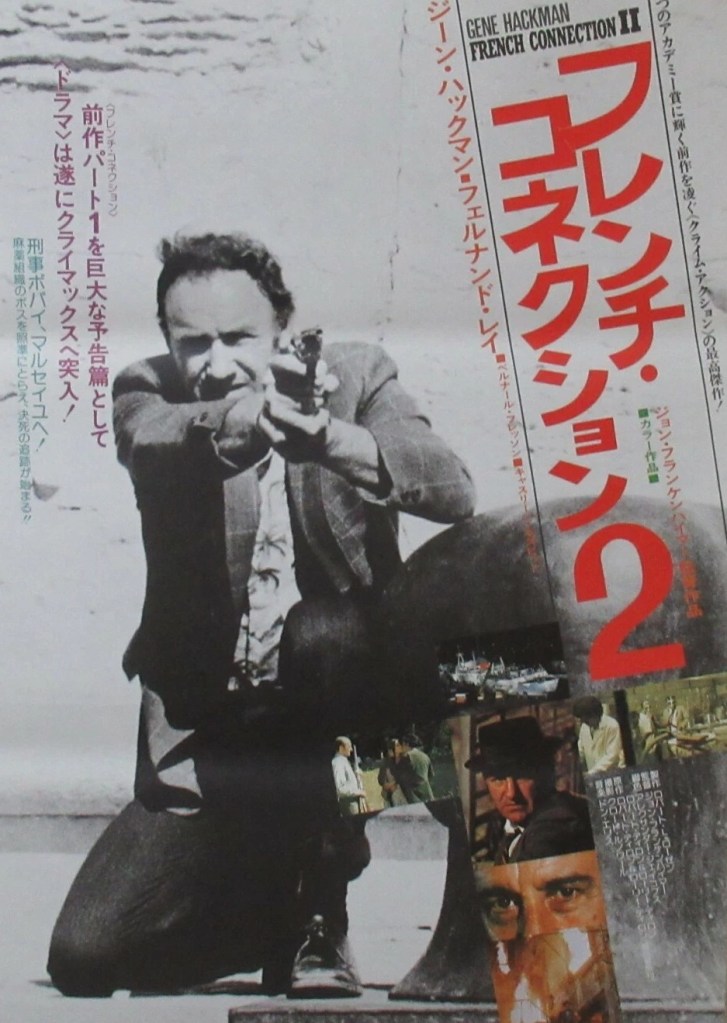
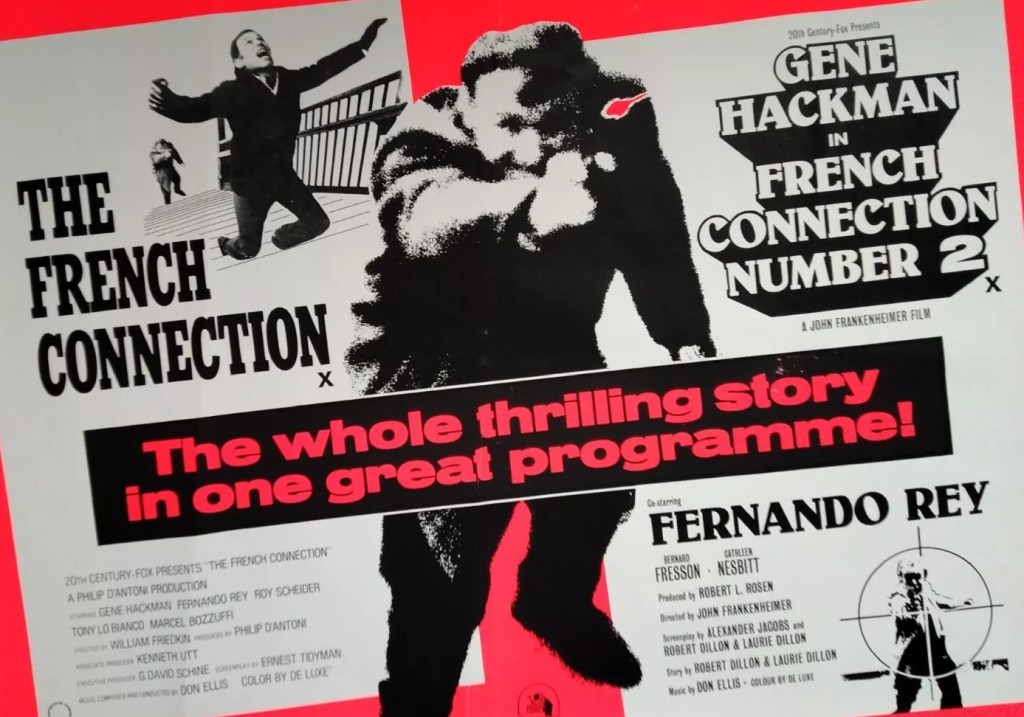
The French Connection 2 (1975) ***

Back to Marseilles four decades on from Borsalino (1970) and a preposterous plot that virtually sinks this fictional sequel to the factual original. For a start, French drugs kingpin Alain Charnier (Fernando Rey) has a very distinctive face, and it could hardly been beyond a cop, accustomed to issuing identikits, to provide the French police and Interpol for that matter with a mugshot, thus eliminating the contention that New York cop Popeye Doyle (Gene Hackman) is the only one who can identify him.

Throw in the fact that, unlike other U.S. exports like Jason Bourne who is fluent in several languages, Doyle is instantly at a disadvantage because, blow me down, the ordinary French citizen doesn’t speak English, ensuring that the cop comes across as one of these witless foreigners who thinks shouting louder in English makes him any more intelligible. And his sole method of detection is to simply wander the streets of a city with a population of 1.3 million hoping to catch sight of his quarry.

Doyle, being a natural rule-buster, soon causes the death of a local cop to add to the five people he’s killed (including two cops) in his home country. The bull-in-a-china-shop is so ham-fisted that it’s embarrassing rather than comedic. And the get-out-of-jail-free card is just as preposterous. Turns out Popeye is bait – this was a trope of 1960s low-budget crime or espionage movies though usually a woman was either the willing or unknowing lure – sent to Marseilles by his own bosses, in the hope that his presence will lure Charnier out of hiding, when, in fact, the Frenchman hides in very plain sight, on his very fancy yacht or dining in very fancy restaurants.

You’d have thought it would be an incredibly simple matter to feed the Charnier’s face into the police system and come up with a match which would then just involve either breaking down doors or taking the more discreet approach of catching him in the act.

What saves this, and only just, is Gene Hackman’s performance, not as the aforementioned bull, but as a junkie going cold turkey. And that in itself is reduced to only a handful of outstanding scenes, when his opposite number Barthelemy (Bernard Fresson) has to listen to his meanderings about baseball and his childhood. The action finale, the equivalent of a dam burst, where the two cops are flooded in a dry dock is good too. But, devoid of the racing automobiles, the climax drags, as Doyle sets up a later action trope of the endless footslog (which Liam Neeson probably thought he had trademarked). This doesn’t even involve any leaping or running across rooftops just a canter along busy streets, down alleys and then along the marina hoping to catch Charnier before he escapes by yacht.

It’s slim on atmosphere, too. Where the original had a down’n’dirty lived-in feel, this comes over as a tourist version of Marseilles if a tourist fancied a stroll down some mean streets. There’s a really dumb scene where Popeye, hoping to scare out the crooks in the hotel where he was imprisoned, sets fire to the place. But he goes upstairs with a jerrycan of petrol, rather than starting at the top and working is way down, no guarantee that when he reaches the roof there’s going to be any avenue of escape left open to him.

Sure, a sequel was always going to be in the works after the success of the original. But why not concentrate on the obvious follow-up, how a cache of heroin with a street value of $32 million seized by Popeye and Co managed to vanish from a police property office.   

Director John Frankenheimer (The Gypsy Moths, 1969, also featuring Hackman) hadn’t had a hit in a decade. This didn’t match the original at the box office. Written by Alexander Jacobs (Point Blank, 1967) and Robert Dillon (Bikini Beach, 1964) and Laurie Dillon, their only screen work.

Disappointing.

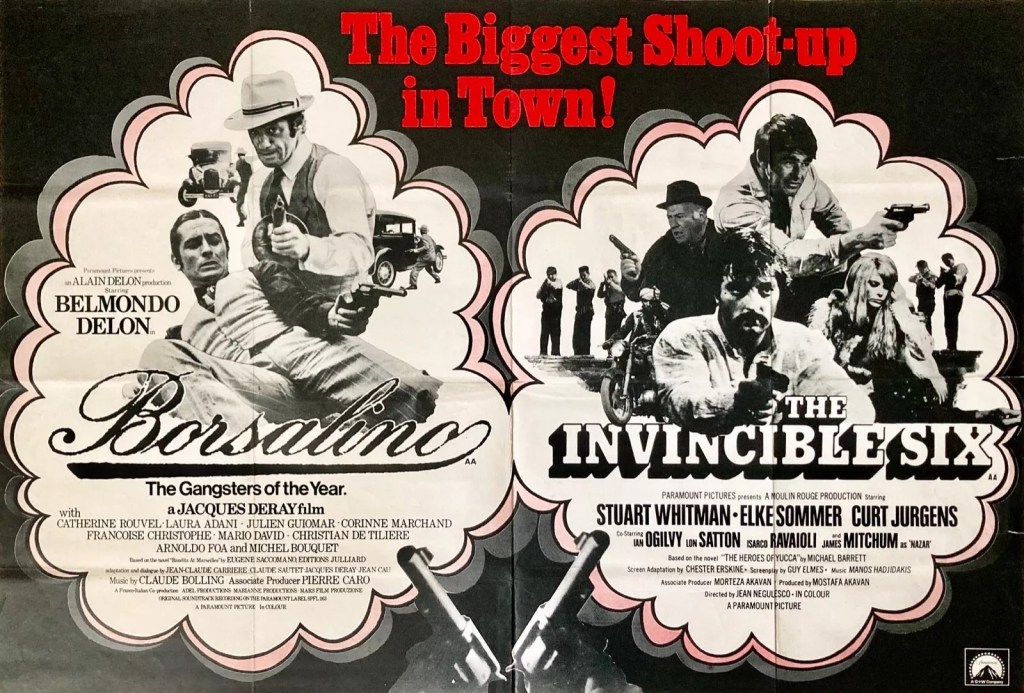
Borsalino (1970) ****

You wonder how much the unexpected success of this French gangster picture encouraged Paramount to invest in The Godfather (1972). The studio had gone down the Mafia route with The Brotherhood (1968) but to a significantly muted response. But where that film was heavy on family and drama, Borsalino went wild with charismatic performances and, as important, machine-gun-driven violence. And you couldn’t ignore the success the previous year of the French The Sicilian Clan (1969).

While Borsalino doesn’t go into the weighty issues and family sensibility that elevated The Godfather in the eyes of critics, its starting point owed more to Butch Cassidy and the Sundance Kid (1969) with two likeable hoods, even, initially at least, sparring over the same girl. The family element here concentrates on fraternity, brothers in crime, rather than the father-son dynamic that drove The Godfather. And it’s just so much goddam fun.  

Francois (Jean-Paul Belmondo) and Roch (Alain Delon) are petty crooks in Marseilles in the early 1930s working their way up to the top, initially just with scams like presenting a longshoreman who can’t speak a word of German as a German regional boxing champion, hijacking the favorite in a horse race, setting up a slot-machine business, disrupting the city’s fish market, until graduating to more serious crime and challenging Marello (Arnoldo Foa) and Poli (Andre Bollet), kingpins of the area’s organized crime. They set fire to an abattoir, establish their own fiefdoms, running legitimate businesses like casinos. But the higher they climb the closer they come to a devastating irony which cannot be ignored. Once they’ve eliminated everyone else, their only competition is with each other, and both realize that, inevitably, one will begin to want to become the undisputed top gangster.

Roch is the more thoughtful of the pair, the one looking ahead, sensing opportunity, the strategist, Francois more likely to indulge his playboy instincts, but both enjoy the high life, mixing with celebrities, politicians and archbishops. There’s plenty collateral damage. Try to steal a bigwig’s girlfriend away and you are virtually condemning her to death.   

Unexpectedly, for the genre, it’s huge fun, in part helped along by the genial earworm of a score by Claude Bolling, as evocative of the period as Scott Joplin’s rags were to The Sting (1973).  We don’t have to suffer any sanctimonious prig on the sidelines offering commentary or the gangsters making out that they’re better than they are because they don’t indulge in certain types of crime. But the biggest contributory factor is the teaming of Alain Delon (Once a Thief, 1965) and Jean-Paul Belmondo (Is Paris Burning?, 1966), the two biggest French male stars of the decade, the former enjoying substantially more success overseas than the latter.

Remember that Robert Redford was a not star when he made Butch Cassidy and the Sundance Kid so the pairing of two huge marquee names was not a regular feature anywhere in the world. It was Alain Delon, in his capacity as producer, who snared his rival, ceding top billing to achieve it.

This was the second of nine movies that Delon made with director Jacques Deray and could not have been more different from their previous outing La Piscine/The Swimming Pool (1969), a claustrophobic psychological thriller. Deray had history with Belmondo, too, Crime on a Summer Morning (1965). The characters were a great fit for their screen personas. And the photography, with some sepia tint, is distinctive.

Written by Jean-Claude Carriere (Viva Maria!, 1965), Claude Sautet (Nelly and Monsieur Arnaud, 1995), Jean Cau (Jeff, 1969) and the director, based on the book Bandits a Marseille by Eugene Saccomano.

Buddy movie breakout. Highly enjoyable.

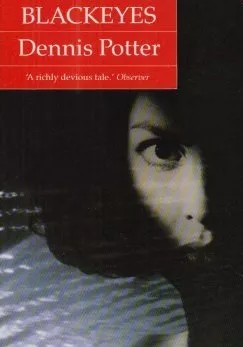
Blackeyes (1989) *****

Absolutely mesmeric. Would be catnip for contemporary audiences with its shifting time frames, juggling perspectives, narrative sleight-of-hand, and heavily feminist-oriented outlook with its slating of misogyny. Ripe for a remake and with the adventurous directors around these days they should be vying for the opportunity. But I should warn you, steer clear of the version that showed on Amazon Prime which cut the four-part television series in half.

British screenwriter Dennis Potter was something of a national institution before this appeared, the BBC ponying up vast sums (in television terms) for his experimental programs that included the likes of Pennies from Heaven (1978) – remade as a movie three years later with Steve Martin – and The Singing Detective (1986) (remade seventeen years later with Robert Downey Jr) and his blend of pastiche and males struggling with raw emotion had made him not just a household name but accorded him worldwide acclaim.

However, just as Peeping Tom (1960) put the kibosh on the career of Michael Powell, Blackeyes proved a major critical reversal and after the mauling it received and outraged headlines in the national media Potter somewhat lost his mojo and automatic critical favor although Lipstick On Your Collar (1993) helped a certain Ewan McGregor to make his mark.  

In part, Blackeyes is way ahead of its time in the use of the stylistic devices mentioned above which when incorporated into the works of, for example, David Lynch or Christopher Nolan, were hailed as groundbreaking.

So this is a three-hour-plus show setting precedents that not only break all the rules of narrative but blows them sky-high and has so many layers you can hardly keep up and that narrative spinning continues to the very end. You could almost entitle it “Whose Story Is It, Anyway?”

Elderly author Maurice (Michael Gough) has fashioned the experiences of his model niece Jessica (Carol Royle) into a bestselling literary novel. Leading character Blackeyes (Gina Bellman) is taken advantage of so often by men that she commits suicide, wading out dressed in sexy night attire into a lake.  Although Maurice makes a fine specimen suited-and-booted and talking to admiring audiences at book fairs, in reality he’s a sodden old drunk living in a threadbare apartment with a teddy bear. But he’s intellectually adroit as shown with his verbal duels with a smug journalist who spouts artistic jargon.

Jessica is so annoyed that she has not been acknowledged as the source of her uncle’s novel – he claims it is a work of imagination – that she begins to write her own fictional version of her life story, calling into question some of the events in her uncle’s account. So that’s two perspectives already. Stand by for a third, that turns the entire story on its head.

It appears Blackeyes (Gina Bellman) has not committed suicide. Detective Blake (John Shrapnel) is convinced she has been murdered, especially after he finds a list of names stuck in her vagina (yes, despite Blake gamely searching for every euphemism under the sun, the actual word, to add to the shock and horror of an audience and especially critics reeling from the sex and nudity, was used on the BBC) and later finds her diary which provides another version of events.

He’s an old-school detective, and while not beating anyone up, not above handing out a good thump in the ribs to anyone giving him lip. So while following Maurice and his niece, we are also finding out more about Blackeyes via the cop’s investigations and how she was taken advantage of in the advertising profession and world of photographic modeling. She is even the one who gets the blame when someone tries to rape her.

Her life could be viewed in two ways, as a sexually independent woman or as a victim of MeToo.

To counteract what is presented as a sordid existence there comes into her life a gentler soul, advertising copywriter Jeff (Nigel Planer) and he’s writing and rewriting versions of a more old-fashioned romance where they enjoy a meet-cute (of sorts) and get talking and move onto romantic walks along the seaside. But Jeff’s too diffident a fellow to appeal to Blackeyes and he doesn’t even get to first base. But it also turns out that he’s been watching Jessica through binoculars (they live across the street from each other) and there’s a marvelous moment when he realizes that Blackeyes occupies the same apartment as Jessica and that he could at that very moment be watching himself.

All the way through there’s been a male voice-over, measured, commenting on the action, advising on twists in the story, adding a different perspective to characters, offering many polished bon mots, and it takes you quite a while to realize that this is an entirely new voice, and doesn’t belong to either Maurice or Jeff. In the ordinary run of things, this character would turn out to be the Hercule Poirot of the piece, putting the jigsaw together, explaining all.

In fact, he’s another element of the jigsaw. He’s not just the narrator. Everyone we’ve seen are characters in his fiction. But they don’t always obey the rules and at the very end Blackeyes escapes.

So just a stunning piece of television. Although Michael Gough (Batman Returns, 1992) received the bulk of what little plaudits there were, the series is carried by New Zealand actress Gina Bellman (Leverage, 2008-2012, and Leverage: Redemption, 2021-2023) who is simply superb. She rises above what could easily have been a cliché – and in some respects was written as a cliché version of the “dumb blonde” at male beck and call. Her comic timing for a start turns many scenes on their heads. But what’s often been overlooked is her transitional skill. She moves from male fantasy figure to believable human being and from there to rebel. And that takes some doing.

Gina Bellman hates talking about this series, my guess on account of the nudity and the backlash that created for a young actress, but she should be proud of her achievement. This is more than solid stuff.

Writer Dennis Potter also directed and his camera is always prowling around the edges.

The word auteur was over-used but this genuinely fits that category.

A masterpiece.

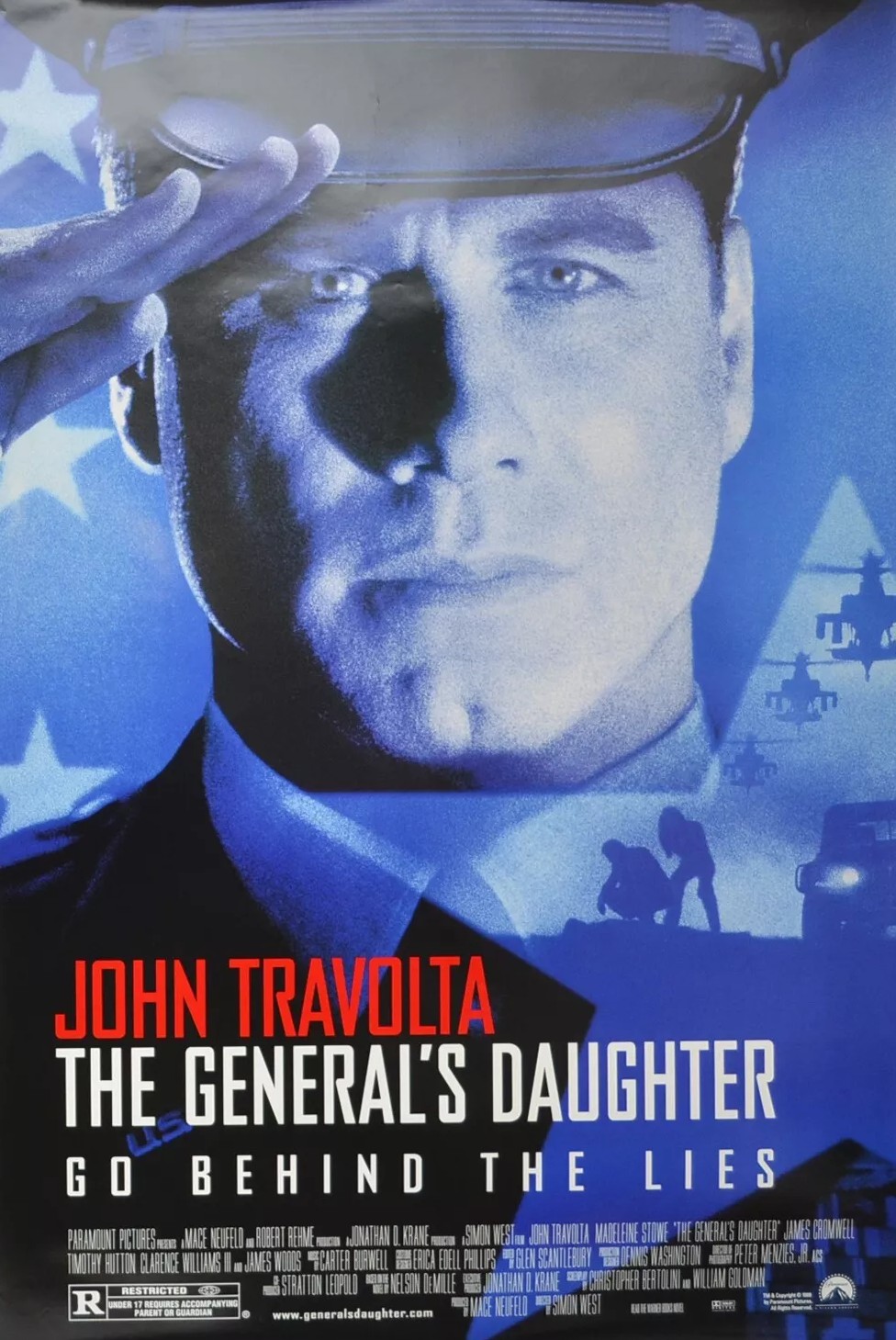
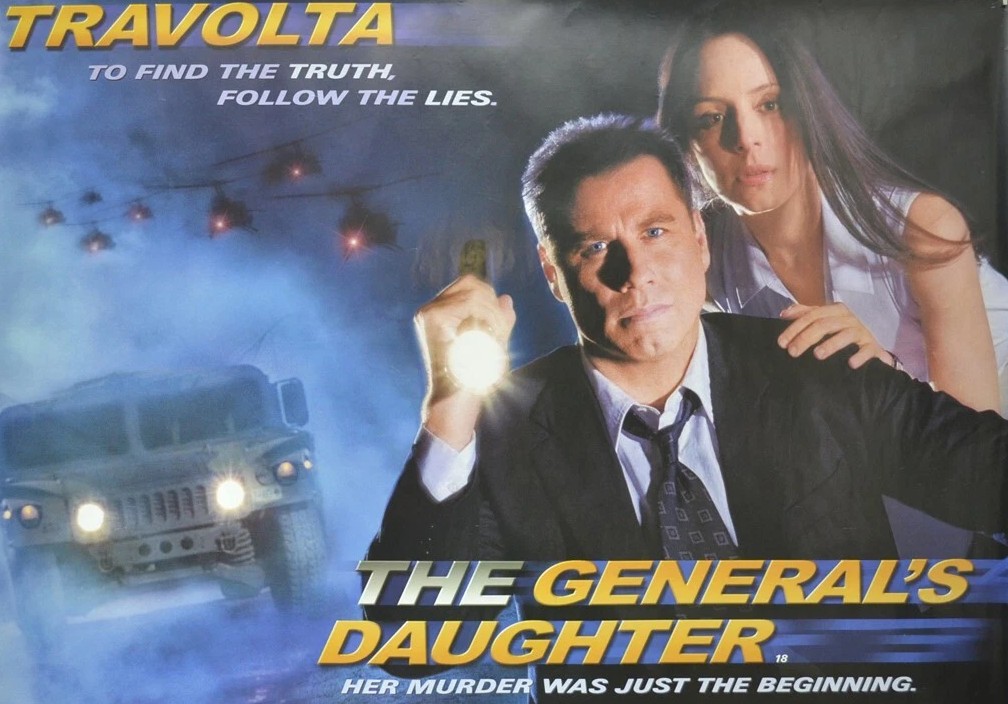
The General’s Daughter (1999) *****

“It never happened.” The most heinous words in the vocabulary of the powerful male casts a sharp contemporary light in the wake of MeToo and other scandals on the litany of personal and institutional abuse inflicted on woman. Speak up and careers will be ruined, institutions will be permanently damaged. Keep quiet and you’ll receive quiet reward, promotion maybe, a better job, some cash, all coming with the restrictions of an NDA, perhaps guilt and a guarantee that truth will remain hidden and  perpetrators go free.

In today’s society this carries far more emotional firepower than it did back in the day when the outcome was viewed as a typical twist in a better-than-average crime tale driven by an unexpectedly powerful performance by John Travolta, then in his prime.

It’s multiple rape and carried out in the most horrific manner, the victim staked out, the faces of the rapists concealed by camouflage and masks in a military exercise. And as always, it’s not about unsated lust, but power, the need of the male to bring down a rising female star cadet, general’s daughter Elisabeth Campbell (Leslie Stefanson) whose talent is putting them in the shade.   

That’s the discovery but it’s not the mystery. The mystery is why would this act be repeated a decade later, apparently as a voluntary act, as if the woman is so humiliated and has lost all her self-worth that she inflicts this act upon herself. It’s a single rape this time, but she’s still staked out, spreadeagled, and it’s on a spare piece of ground in a military barracks. But it’s the last time she’ll suffer in this particular fashion because she’s been murdered.

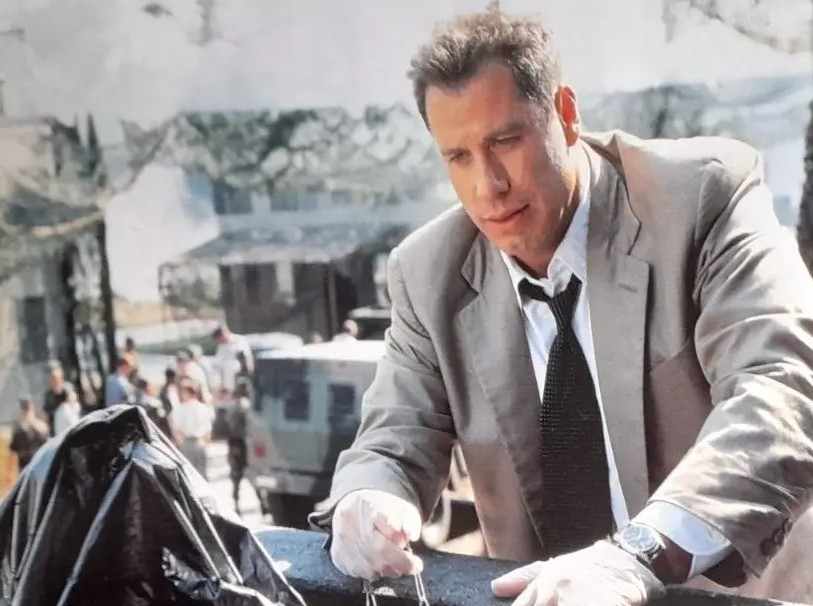
“Soldier first, cop second.” That’s the dilemma facing army detective Paul Brenner (John Travolta). Even though he’s revealed from the outset as a not-to-be-messed-with cop, that might work when he’s arresting minor criminals, but it’s going to be sorely tested when he’s confronted by the might of the U.S. Army which has already successfully buried the first crime.

Brenner teams up with ex-girlfriend rape specialist Sara Sunhill (Madeleine Stowe) and after some initial snippy conflict they soon work together as an effective team with flirting back on the agenda and Sara proving herself capable of the kind of deceit that clever cops require to snare suspects.  

There’s almost a roll-call of suspects because Elisabeth, now a captain in Psych-Ops, has left open to blackmail a whole bunch of married men after having sex with them. Her promiscuity can’t be called out because that would reflect badly on her father, about-to-retire war hero General Campbell (James Cromwell), base commander at Fort McCallum. But she is so indiscriminate in her choice of lovers that it appears like a campaign of psychological warfare against her father, who was stationed in Germany at the time of the initial rape.

So among those investigated are Col Kent (Timorthy Hutton), Col Moore (James Woods), Capt Ekby (Boyd Kestner) and the local police chief’s son. The general’s adjutant Col Fowler (Clarence Williams III) behaves in a threatening manner.

So while this follows some of the rules of the genre and invents others, with missing evidence, attacks on the investigators, charm and brute force part of Brenner’s make-up, as well as inveterate stubbornness, the core is an examination of power. Brenner is subjected to the same threat, maintaining a code of omerta for the good of the institution and its apparently good reputation in the area of female recruits.

Apart from the rapists who get off scot-free, the only other person to benefit from the horrific rape is the general, who receives a promotion for convincing his daughter that she imagined it. The general witnesses the second stake-out. That’s its whole point, to show him what she went through and to get him to admit he let her down. But he turns his back, leaving her staked out naked so someone else can come along, rape her and shut her up for good.

The implications of this are so venomous that you can hardly believe it except you know full well that running parallel to an ongoing epidemic of rape and abuse is an ongoing epidemic of cover-up. “You can’t handle the truth” was never more baldly stated.  

This doesn’t belong to the pantheon of great pictures due to the direction or acting, though that is more than solid on both counts, but because it reveals in brutal unsparing detail the impact of the crime upon the victim and the tendency for an institution to cover-up illegal act in order to protect itself and its personnel.

We are all more aware these days that rape is a weapon against women and hasn’t gone away although powerful figures – Jeffrey Epstein and Harvey Weinstein, for example – are being indicted. The crime used to be seen as the act of an individual working alone but now we know that in many instances the perpetrators can’t get away with it unless other powerful people are turning a blind eye.

The scene where General Campbell, visiting his daughter in hospital, seeing her battered and bloodied and in emotional hell, and telling her effectively to turn the other cheek makes your blood run cold.

John Travolta, back on track following some lean years before pitching up in Pulp Fiction (1995), is excellent as is Madeleine Stowe (Bad Girls, 1994) while James Woods (Any Given Sunday, 1999) offers one of his better characterizations. When Leslie Stefanson (Unbreakable, 2000) calls out, “Daddy,” it’ll break your heart.

But for all the wrong reasons the picture belongs to James Cromwell. You’ll never forget this contemptible father.

Directed by Simon West (The Mechanic, 2011) from a screenplay by William Goldman (Harper, 1966) and Christopher Bertolini (Battle Los Angeles, 2011) from the Nelson DeMille bestseller.

I can’t get this out of my mind. Netflix has it.

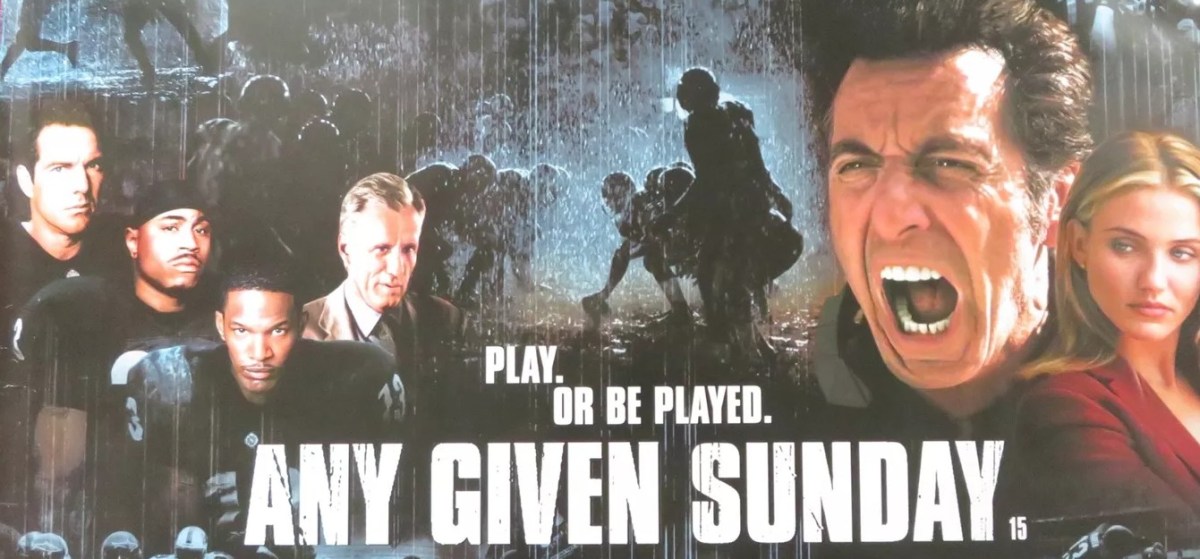
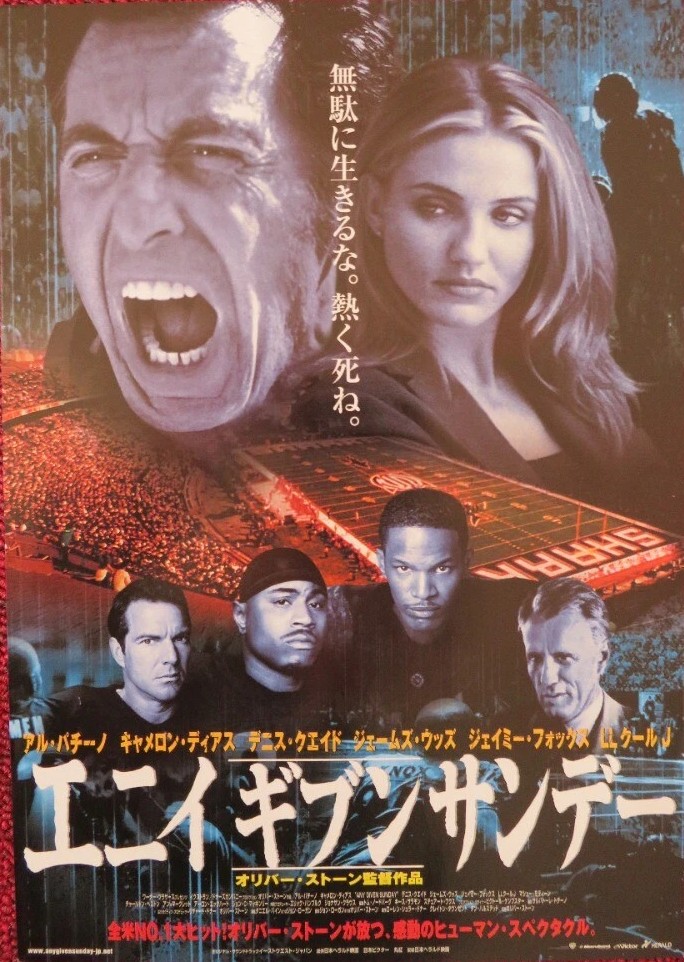
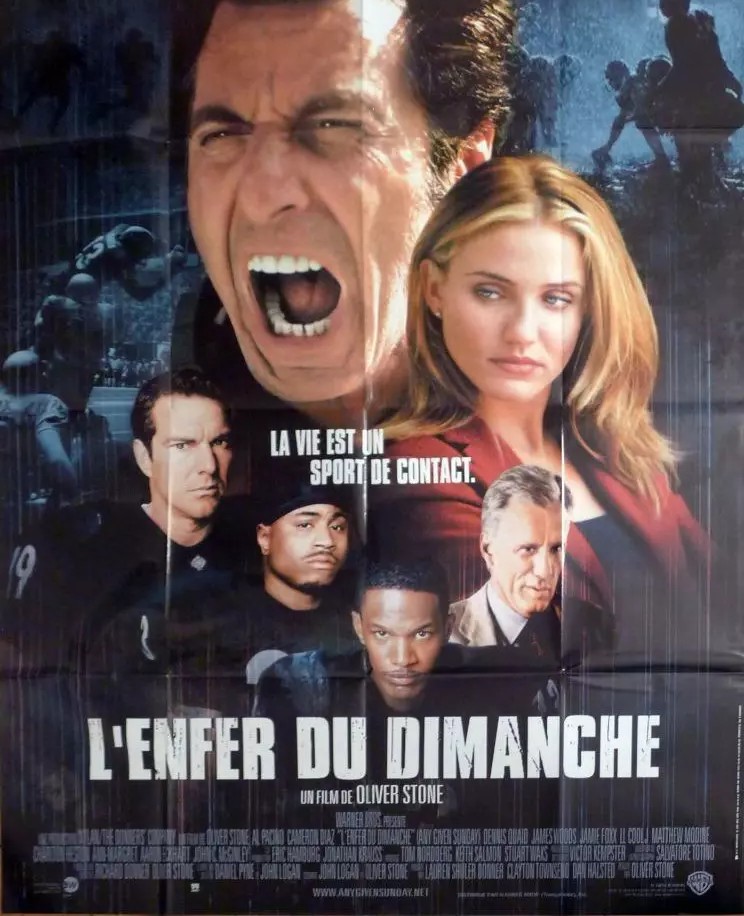
Any Given Sunday (1999) *****

It’s always with trepidation that I go back to a banker, one of my favorite films, hoping that it will remain timeless, and still good enough for a place on my all-time personal Top Ten. I’d planned a double bill of Kingdom of Heaven (2005) and this but the former proved so disappointing that it took me a while to pluck up the courage to watch Oliver Stone’s kaleidoscopic American football epic.

My fears proved misplaced and this is bearing in mind that I know nothing about the sport and have little understanding of what always appear arcane rules that make little sense to someone brought up on the  more disciplined (at least in my eyes, rules-wise) football/soccer (or the hybrid “soccerball” as my grandkids refer to it). I’ve always been a fan of sports movies, which means American sports movies, because with the exception of Chariots of Fire (1981) the British don’t seem to have the knack. So I’m used to following movies where I don’t necessarily understand what’s going on the field of play.

This is driven by three compelling narratives – all power duels of one kind or another, between owner Christina Pagniacci (Cameron Diaz) and various politicians, between her and coach Tony D’Amato (Al Pacino), and between Tony and arrogant rising star quarterback Willie Beaman (Jamie Foxx). And while all these battles are a mixture of discreet management and full-blown blood-and-thunder shouting matches, the movie is liberally sprinkled with tiny cameo moments that add depth.

There’s a blink-and-you-miss moment when team physician Dr Mandrake (James Woods) is seen in conversation on the sidelines with a blonde cheerleader. The next time you see her is when she chooses not to follow Mandrake when he is fired, as curt a signal as you’ll ever find that position rather than personality equates to worth. She appears for one more nanosecond and this time in conversation with his replacement Dr Powers (Matthew Modine).

The saddest moment is when cute sex worker Mandy (Elizabeth Berkley) tries to let Tony down gently that theirs is purely a financial, not romantic, transaction. But that’s run close when Willie’s girlfriend Vanessa (Lela Rochon) is given the brush-off by the established WAGs. And the toughest scene, amidst all these high-powered testosterone-driven adrenalin male and female junkies, is when injured star quarterback Cap Rooney (Dennis Quaid) is given the mother of all slaps by wife Cindy (Lauren Holly). All such moments are merely incidental to the three main narratives, as is the battle for music supremacy in the dressing room, when the head-bangers among the team turn the volume up to eleven.

Revenge is a theme. And that can run from setting loose your baby alligator in the team shower room, taking a buzz saw to a rival’s ultra-expensive automobile or his team-mates punishing Willie for his overweening arrogance by not protecting him on the field and allowing him to be battered by the opposition. Though there’s little as sweet as Tony handing Christina her come-uppance by stealing away Willie for his new team. But that’s run close by the grim smile of satisfaction on the face of the Football Commissioner (Charlton Heston) when he, too, brings her up short. And by Tony stiffing cocky pundit Jack Rose (John C. McGinley). Indulgence, by comparison, is sniffing coke off a naked woman’s breast. There’s even moments of comedy, Willie being duped into taking flowers to the coach when invited for dinner, and the holding-up-the-hand scene.

And all of this is before we get to the meat of the movie, the games that mean absolutely everything – more than sex, family and drugs – to the participants. Sometimes Tony, a 30-year-old veteran, conjures up the words to inspire his team, sometimes he doesn’t, occasionally he turns away from them in disgust, occasionally it’s left to the padre (in the days when “take a knee” meant something else) to inject some common sense into the overloaded equation.

If all these characters are larger-than-life that’s no surprise because there’s little room in the hard world of top-level sport for the shy and withdrawn. So shouting matches are titanic. Lives play out only in the fast lane. Winners get the prom queen, losers get…nothing. And unlike sports originating from Britain – like football/soccer/soccerball or cricket – there are no draws. If you’re not a winner, then you’re a loser.

The essential tale of staying on top, maintaining a winning role, reversing a losing one, getting to the playoffs, the holy grail of winning the Super Bowl (known here as the Pantheon) and the coveted ring that accompanies victory, is always going to be packed with drama. But director Oliver Stone (Platoon, 1986) adds other layers, the daughter whose father wanted a son, the coach who’s driven away everyone who ever loved him and now pays through the nose for nights of affection, the quarterback so infused with self-belief and victim mentality that he learns the hard way he needs help.

You can’t deny Stone his quirks, the lightning bolts or seemingly endless snatches of pop tunes and shadowy figures who appear out of nowhere, and cuts to cheerleaders or crowds, and the paraphernalia that surrounds the game. But not a moment is wasted.

The acting is top-notch. Al Pacino (The Godfather, 1972) gives one of his best performances, Cameron Diaz (The Mask, 1994) upends her cute screen persona, James Woods (White House Down, 2013) plays another version of his screen schemer, Jamie Foxx (Back in Action, 2025) gives notice of his talent. Written by John Logan (Gladiator, 2000), the director and Daniel Pyne (The Manchurian Candidate, 2004).

Best-ever sports movie (though maybe tied with Field of Dreams, 1989).

Without doubt retains its place on my All-Time Top Ten.

Discover WordPress

A daily selection of the best content published on WordPress, collected for you by humans who love to read.

The Atavist Magazine

by Brian Hannan

WordPress.com News

The latest news on WordPress.com and the WordPress community.