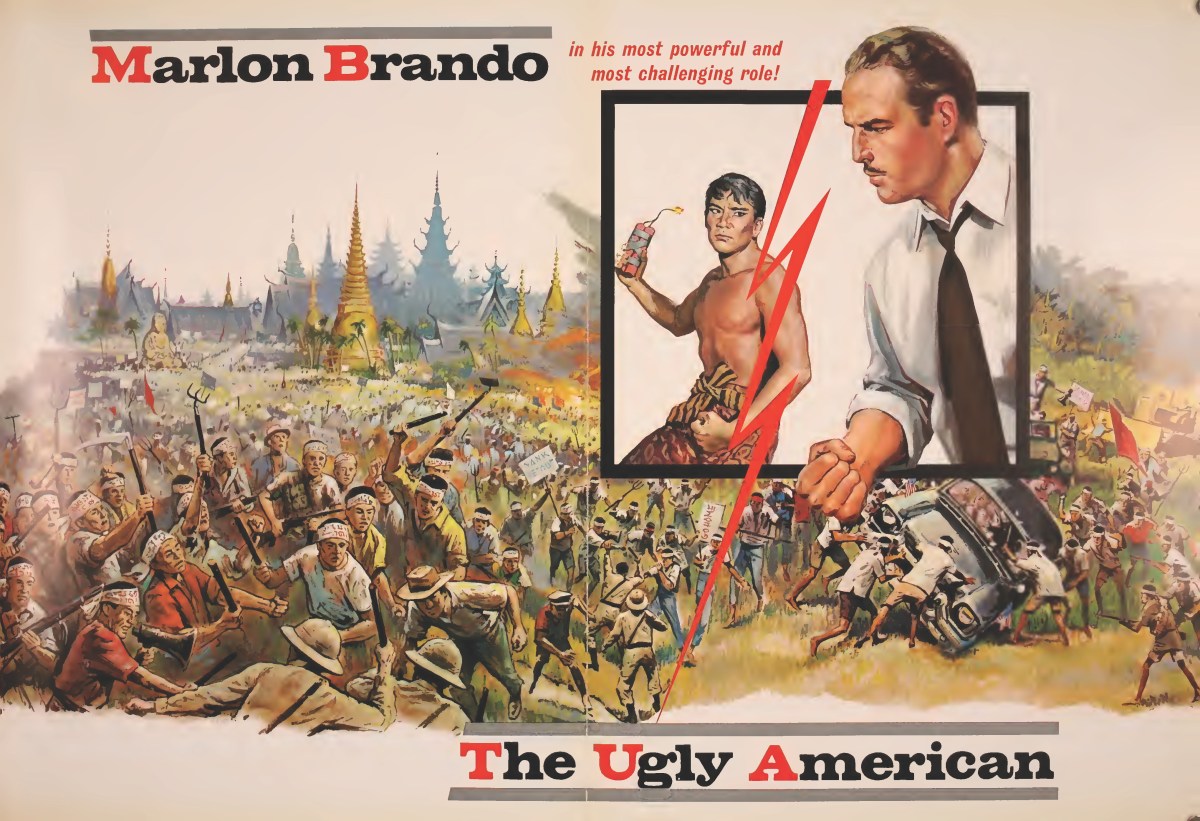
Terrific performance from Marlon Brando saves this prescient but preachy meditation on Vietnam. Harrison MacWhite (Marlon Brando) is the new ambassador, whose political credentials are questioned by many, parachuted into the fictional South-East Asia country of Sarkhan, knee-deep in civil war, Communist north versus westernized south. The battleground is the American construction of a “Freedom Road” north to China which dissenters fear will be a conduit for the military. MacWhite owes his appointment to his friendship with Deong (Eeji Okada), a charismatic leader.
On arrival, the ambassadorial car is engulfed in a riot, car rocked, windscreens smashed. MacWhite shakes up a complacent embassy and though articulate and scholarly believes he holds the solution to the tricky situation, not willing to accept that national self-determination does not necessarily mean complete hatred of the Americans. There is duplicity on both sides, rebels blaming U.S. truck drivers for deaths they caused, the Americans so used to getting their way they don’t stop to think if it is the right way.
Anxious not to be seen as a lapdog for Communism, MacWhite’s actions inflame the situation, while Deong falls victim to internal forces. Construction boss Homer Atkins (Pat Hingle) promotes the clever use of building hospitals along the road, thus encouraging locals to back it, but nobody falls for such honest skull-duggery masquerading as well-meaning intent.
Friends turning into enemies is a decent premise for any movie but this is over-burdened with debate that while interesting and providing a reflection of the times is basically a mixture of virtue-signalling and apportioning blame and, most heinous of failings, doesn’t really advance the story.
First-time director George Englund handles the action sequences well and captures the essence of a country about to explode against a background of growing tension and political machination. Use of Thailand as a location adds authenticity.
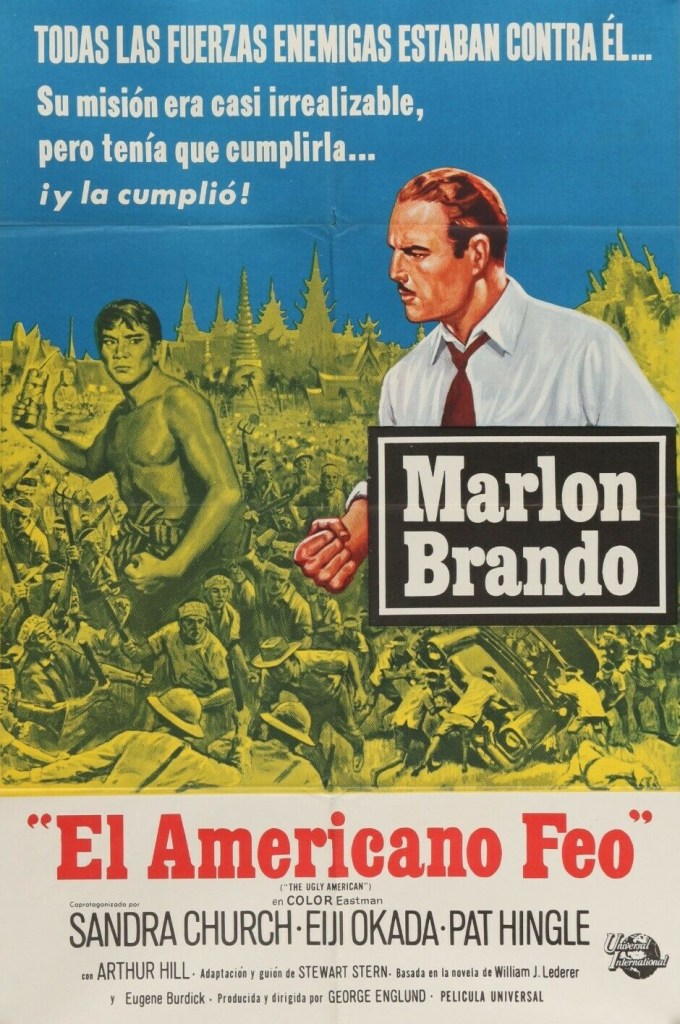
Based on a controversial novel by political scientist Eugene Burdick (who also wrote a more straightforward cold War thriller Fail Safe) and William Lederer, navy veteran and CIA officer, so it carried the stamp of authority in terms of putting forth the arguments for both sides. However, while the film bears only a “passing resemblance” to the book, according to co-author Burdick, he deemed it a superior achievement on the basis of its more dramatic treatment. Stewart Stern (Rachel, Rachel, 1969) was the screenwriter who received blame and praise in equal measure.
Marlon Brando (Burn! / Quiemada, 1969) exudes authority, broad shoulders packed into a suit, and brilliant captures the anguish of a man led into disaster by arrogance. Coming off back-to-back flops One-Eyed Jacks (1961) and Mutiny on the Bounty (1962), this was a considerable change of pace, the first of several excursions into political territory. Eeji Okada (Hiroshima, Mon Amour, 1958) proves a worthy opponent. Pat Hingle (Sol Madrid, 1968), Arthur Hill (Moment to Moment, 1965) and Jocelyn Brando (The Chase, 1966) provide sterling support.
The movie did not just predict what would happen if the U.S. lost the battle for hearts and minds but a similar situation confronting the U.S. Ambassador to Indonesia in 1965 whose appointment was unwelcome in that country.

 The Magnificent 60s
Found this:
“The film originated as a project between producer-director George Englund and actor Marlon Brando, following Englund’s stint as an executive producer at Brando’s film company, Pennebaker, Inc. As stated in the 22 May 1962 LAT, Englund and Brando had traveled together to Southeast Asia as part of a United Nations “technical-assistance program,” from which Englund returned wanting to make a film about the region. He discussed the idea with screenwriter John Patrick, who brought his attention to William J. Lederer and Eugene Burdick’s 1958 novel, The Ugly American. After reading the book, which shined a critical light on U.S. diplomacy in Southeast Asia, Englund reached out to the authors, who agreed with his vision for a film adaptation. In Feb 1959, Lederer and Burdick traveled to Los Angeles, CA, to conduct talks with studios, as reported in the 4 Feb 1959 Var; the following month, a 16 Mar 1959 DV brief announced that screen rights had been sold to Universal-International, with Englund attached to direct, Brando cast in the leading role, and Stewart Stern set to adapt the screenplay. A 1 Apr 1959 DV brief later noted that Stern and Englund had met with members of the U.S. State Department and Congresspeople, who were wary of the source material’s negative depiction of U.S. affairs abroad. The final film ultimately veered far from Lederer and Burdick’s novel, according to contemporary news items and reviews, including the 12 Apr 1963 NYT which stated, “Stern kept the title, the locale and the general skepticism of the book…and threw the rest away.”
Although a 10 Mar 1960 DV item mentioned that David Goodman was working on the screenplay, Stewart Stern was re-announced as screenwriter in the 15 Sep 1960 DV.
Rock Hudson and Karl Malden were mentioned as possible co-stars in the 1 Apr 1959 and 16 Jul 1959 issues of DV. Malden was a close friend of Brando’s who’d appeared with him in On the Waterfront (1954, see entry) and in Brando’s directorial debut, One-Eyed Jacks (1961, see entry). Although he was officially cast, production delays on Brando’s previous film, Mutiny on the Bounty (1962, see entry), prompted Malden to leave and take a role in Parrish (1961, see entry). James Shigeta was also cast, according to the 2 Sep 1959 Var, but did not remain with the film.
Sri Lanka (then Ceylon), India, and an area “near Hong Kong” were considered as filming locales, as noted in contemporary sources including the 17 Feb 1960 DV. Thailand was ultimately chosen despite its proximity to the ongoing Vietnam War, specifically fighting in areas of Laos only 400 miles away. In the 20 Apr 1961 DV, Englund, who was “determined” to shoot in Thailand, was quoted as saying, “If there was some reason not to, I feel I would be so advised by the Thai government.” Casting director William Batliner traveled to Bangkok, Thailand, to help with casting locals, as indicated by a 26 Apr 1961 DV item. Two months later, the 28 Jun 1961 DV mentioned that an advance crew was in Bangkok, headed by production manager Marshall Green and including the following crew members: Robert Larson, Art Warmoll, Virgil Clark, Willard Nunley, and Truman Eli. Filming began there on 9 Aug 1961, as stated two days later in a DV production chart. The 18 Sep 1961 DV noted that, while on location, thirty-five U.S. crew members were aided by ninety Thai technicians. Since Brando was still shooting Mutiny on the Bounty, a double was used in scenes involving his character.
Advance filming in Thailand, which resulted in five hours of footage, was completed by mid-Sep 1961, as stated in the 18 Sep 1961 DV. The project was subsequently put on hold while Brando completed Mutiny on the Bounty. In between projects, Brando had also requested and received a guaranteed four weeks’ leave. Principal photography on The Ugly American finally commenced on 20 Mar 1962, according to a 4 May 1962 DV production chart. Filming took place on the Revue Studios lot in Studio City, CA, where the construction of two large sets was said to cost $420,000. The 4 Apr 1962 DV detailed that one of those sets was a thirty-five-acre Southeast Asian village, and the other was a “jungle compound” interior built on the facility’s largest soundstage. An item in the 14 May 1963 LAT credited Brando with inventing “the Sarkhanese language” spoken in the film, described by the actor as “a mixture of Malay, Japanese and Old China Hand.”
On 29 Jun 1962, DV reported that production would finish on schedule and on budget the following week of 2 Jul 1962. Early the next year, Universal-International arranged for the world premiere to take place in Bangkok as an act of gratitude toward Thailand for its cooperation in filming, according to the 6 Mar 1963 Var. The King and Queen of Thailand were set to attend the event on 25 Mar 1963, described by Var as the first premiere of a major U.S. picture in Southeast Asia. A U.S. premiere was scheduled to follow on 11 Apr 1963 in New York City, where the film was set to be the debut attraction at the newly built Trans-Lux East theater on Third Avenue between 57th and 58th Streets.
Brando and Englund received Golden Globe Award nominations for Best Performance by an Actor in a Motion Picture – Drama and Best Director – Motion Picture, respectively.
The Ugly American may have marked the final appearance of character actor Taylor Curtis McPeters (a.k.a. “Cactus Mack”), who died of a heart attack during production. The 18 Apr 1962 DV stated that McPeters had “virtually completed his role” and re-takes would not be necessary.”
LikeLiked by 1 person
Fascinating. Thanks a lot.
LikeLike